An ordinary month with no major developments or events.

The general tone has been somewhat negative: Ingrid is quick to say no to everything, to voice negative opinions, to say that whatever we propose is boring. When the food is good she says nothing; when there is some minor part of it she doesn’t like she is quick to tell us “I don’t like these ones”. I keep telling her that I am tired of hearing it, just leave whatever parts you don’t want, but it doesn’t seem to register.

She whines and complains; she orders me around; she huffs and groans; she answers my questions in a very exasperated tone. “What would you like to drink?” – “But MUUUMMM I don’t WAANT anything to drink!!!” A mini preview of her teenage years, I guess. All drama.

She’s learned or discovered sneaking. A fresh realization that mothers are not omniscient? She might ask me if it’s OK for her to taste whatever dinner ingredient I’m preparing. I tell her it’s OK to take a few pieces but that’s enough. When I leave the kitchen and then look back, I see her stealing another piece. She never used to do anything like that before. Once I saw her take a piece and sneak off to the bathroom to eat it.

Likewise she has started peeking at me when something goes wrong – when she spills her drink, or drops her sandwich in the glass while playing around with it. (I’ve mostly noticed it at mealtimes.) To check my reaction? To see if I noticed? Not sure.

She’s at preschool all days of the week again. Shopping and running errands together with me and Adrian has lost its charm. She’d rather be with her friends.

When I drop her off att preschool or leave her for some other reason, she almost invariably tells me “Emme ma teen kõike” – “Mamma jag gör allting” – literally, “Mummy I will do everything”. I hear this daily, often several times (first at preschool in the morning, then when I leave her on her own so I can put Adrian to bed) and I have no idea what she means by this. I have asked her to explain but she cannot.

Speaking of bedtime, she is often going to bed earlier than she used to, as early as 7 o’clock. At first it was because she didn’t want to be on her own while I put Adrian to bed. Now she sometimes does it even when Eric is at home. (She is generally more OK with being with Eric nowadays, I’m no longer the one and only.) And it’s good for her – she’s more rested in the morning. So she isn’t going to bed too early just to avoid being on her own, it’s the other way round: she used to go to bed too late so as to not miss out on anything exciting.

She’s also getting better at falling asleep on her own. When I need to put both kids to bed I first prep both of them (brush teeth, go to the loo / put on a night nappy, etc). Then we go up to Ingrid’s room where I read for here while Adrian plays with her stuff. Then I tuck her in and go to our bedroom to put Adrian to bed, promising to come back when he’s asleep. She is never happy about it but at the same time she’s no longer really upset about it either. Quite often she’s asleep by the time I’m back. Some time during the night she always comes to our bedroom, which now has a mattress on the floor for her, asks to hold my hand, and goes back to sleep.

Continuing steady progress in reading and writing. She writes longer sentences without losing track of where she is, and can usually read what she just wrote. Usually she writes scriptio continua, with no spaces between words. Sometimes she puts vertical bars between them. She writes small notes, probably copying my GTD-style note-taking: whenever I think of something I need to do, or she tells me something we ought to do, I tell her I will write it down. A sample note: “PÅUNSTASKAJAGÅTILMAJKEN” – “på onsdag ska jag gå till Majken”.

She can read single-syllable words of up to four or five letters, and some simple two-syllable words. The other day she read “Det var en gång en prins som hade”, for example. It goes well as long as there aren’t any weird letters, like G that sounds like J and so on. I wish she could learn to read in Estonian rather than Swedish, because the spelling is a lot more regular. But for that we’d need more Estonian books to read, and better Estonian books, too. But with the library here it’s inevitable that we read a lot more in Swedish. Still, it could be worse – she could be growing up in London and trying to learn to read in English.

This will be a very brief monthly post for Ingrid, since (a) I have hardly taken any notes, and (b) I didn’t get this done before the vacation.

Ingrid got bored of staying at home with me and asked to go back to preschool on Thursdays. For now she will still be at home on Mondays, sort of as an extended weekend. The clinginess I saw during last month is now gone. Indeed she is experimenting with distance from me: when we’re out and about, she will regularly ask if she can take a different route. For some reason this happens most often in train stations: she will take the stairs while I take the elevator with Adrian’s pushchair, and we meet at the other end.

The first time we did that she underestimated how much slower the elevator would be, so she got a bit worried when she had to wait for me. Now the only thing I worry (slightly) about is bystanders’ reactions – that they will try to help her find me (even though we’ve agreed specifically that she will wait for me at the top of the stairs) and then I will have to go looking for them.

She still longs for spring to arrive and happily points out every puny little green speck, even if it’s last year’s grass in someone’s lawn. The moment it was above-freezing she started walking home from preschool in just a long-sleeved top, or perhaps a t-shirt and light sweater.

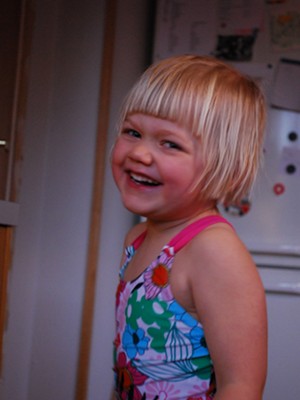
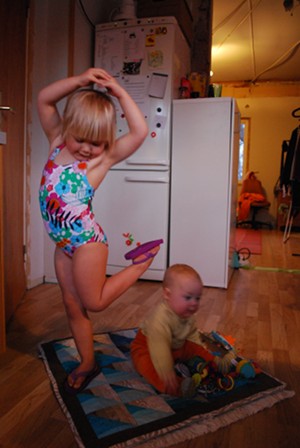
Happy with her new bathing suit

She likes to jump over things while walking. It makes walking slightly less boring (because otherwise walking is just about the worst thing she knows, topped only by getting a shot or taking bitter medicine). She jumps across puddles, manhole covers, and cracks in the street. She jumps across spaces marked by whatever happens to be in the street: from one crack to another, or from the edge of a shadow to the edge of a darker section of asphalt.

As always, the jumping is a social activity. She tells me to watch her jump, and asks me to guess beforehand: “do you think I can jump this one? what about from here?”.

Her new favourite toy is a small pink glittery plush unicorn, about the size of my fist, which I found at Myrorna (a chain of charity shops). The unicorn also plays the jumping game, just like a little plastic horse of hers used to. “Do you think it can jump over this table? Over the table AND the chair AND this highchair?” “No, surely it cannot manage THAT!” is the right answer, and then enormous surprise when indeed Ingrid “jumps” the unicorn over the chosen obstacle.

Ingrid has been sort of sensitive this month, worried about loss, about being alone, about not being able to hold on to things forever. She has difficulty letting go of things, in case she can’t get them back, just in case she needs them later.

For about a week we had tearful good-byes in the morning when I dropped her off at preschool. Then she told me she didn’t want to go there at all. She wanted to be with me all the time – or, she suggested, a preschool where parents are welcome, too. Now we have a compromise where she is there for 3 days a week and stays at home with me the other days. Every morning she tells me she’d rather be with me. At home she tells me she doesn’t want to be alone, not even in another room.

Yet when she is forced to be on her own (e.g. when I put Adrian to bed on nights when Eric is away) she handles it very well. But even then her activities are social by their nature: often she will draw a picture or write a letter for me.

Most recently she’s drawn puzzles for me: the kind where there are, say, 3 kids and one apple and tangled lines from each kid, and you have to follow the lines to see which one gets the apple. Her versions have a castle as the “prize”, and various people/animals around it: for example a girl or two, a baby, and two squirrels with pine cones. When she draws, it’s still almost always girls or princesses.

She mentions (occasionally but not daily) that we will die before her, but that it is a long time till then. We’ve discussed that we probably won’t live to be a thousand years old, but might well reach a hundred, which, luckily, feels like an eternity for one who’s four.

She has started collecting things again. It used to be sticks and stones; now she also wants to keep empty egg cartons, the foil lids from yogurt pots, empty chewing gum bags, and most other empty jars and boxes. She wants me to save the shopping list after we’re done shopping. When she borrows my camera and happens to take a blurry photo, she tells me I mustn’t delete it. She got very upset the other day when I deleted some RSS messages with pretty photos from my inbox. Today when she saw me surf the web, she worriedly asked me if I would be throwing any pictures away.

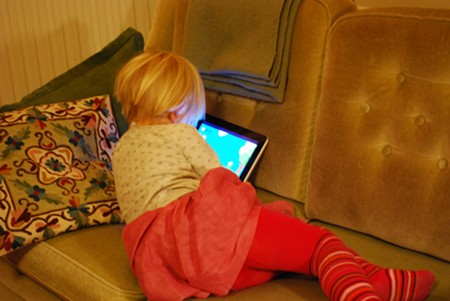
Ingrid is, in general, not so good at handling adversity. She doesn’t like iPad games where she can fail (except if it is easy to try again, such as Angry Birds). She’d rather not try at all than try and fail. She skips the boring parts of movies; she has a tendency to walk away from conflicts with friends.

Writing remains a favourite activity. She likes writing lists, messages, letters etc. It’s becoming a normal and everyday thing for her. In terms of skill she’s at about the same level as last month. Sometimes what she writes is legible, other times she skips half the letters so I have to ask her to read it for me. Sometimes when she runs out of space she squeezes in letters wherever she can, so the letters of the second half of the word is interspersed between those of the first half.

She’s not so interested in reading, although she does try occasionally. Some words she knows by sight. When she tries to spell out an unknown word, she often gets tripped up by the names of letters. When she sees “KUU” she reads “KA, U, U” – “KAUU?”.

With numbers also she’s about where she used to be. She does simple sums with small numbers without a problem. But it’s interesting for me to see that she really has no feel for numbers, no intuition. We have a card game where you’re supposed to find numbers/cards that together make up 10. She has, say, 5, 7 and 8. She tries 5 and 7 – twelve, too much. She then tries 5 and 8, without even thinking that since 8 is more than 7, there’s no way that would get her closer to 10. But if given 1, 3, 8, she tries the combinations and then realizes that what she needs is between 1 and 3, that she needs a 2.

The cards in that game have both a number and the corresponding amount of some thing. (One hedgehog, two bikes, something like that.) When she adds, say, 2 and 8, she will always count the things on both cards. She knows that the card says 8, but she won’t count 8, 9, 10 only – she starts at 1 and counts every item. No shortcuts.

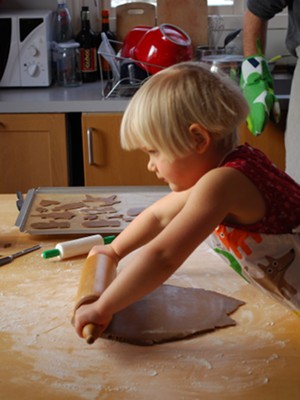
She likes composing things out of other things: decorating things with stickers, playing Fablescapes on the iPad. While I cook she often creates sculptures out of stuff in the kitchen. It started with matchbox towers; then she added spoons and tea sieves to that; the latest sculpture covered half the free space on the kitchen counter and was made up of about 15 things: tea jars, wooden spoons, etc etc.

Recently there have been fewer complaints about walking but she is not a fan, by far. At some point I suggested to her that what we really need is a pair of wings, and she adopted that idea completely. Now she often brings up wings whenever she tires of walking. Ideally she’d like wings that fly on their own, that you don’t need to flap – perhaps with hooks or handles where you can hang your bags too – and perhaps some sort of place for a baby, because they’re too young to have their own. Or perhaps a flying house (and then we discussed how many rooms it should have, and she told me that it absolutely needs windows so we can see where we’re going, and doors so we don’t fall out) or perhaps a flying armchair, with two seats like twin strollers, and a canopy for rain, and someplace to put our bags, and a tray table too. Unless she’s really really tired, these ideas take up enough of her attention to get us home without too much fuss.

She enjoys amusing Adrian. It makes her glad to see him look at her, or smile at her. She will put toys in front of him (or on top of him), wave them in front of him, etc. He mostly watches with bafflement.

She does not like wearing socks. I think her feet get too hot, and that she’d happily wear socks if she had thinner winter boots.

She likes nightgowns better than pyjamas.

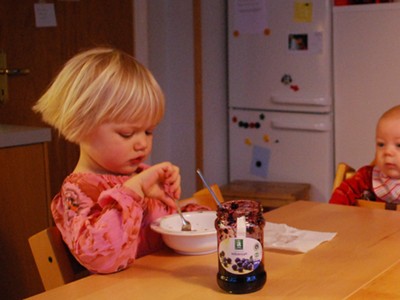
She has discovered chewing gum, and loves it. Wrigley’s Extra with blueberry and pomegranate, or with strawberry flavour. In fact she likes berries in just about any form: blueberry jam is better than apple; raspberry juice is better than orange; ice cream, yogurt, etc.

She’s also discovered the concept of wish lists, and has a long one that contains everything from “a Swedish flag” and “a music box” to “plastic duck with wheels” and “pretend flowers”.

Half of this month was filled with Christmas holidays, so we haven’t had many normal, ordinary days recently. I think we were all happy when Ingrid went back to preschool: towards the end she was spending several hours per day with either iPad games or movies. Neither Eric nor I could muster the energy to play with her, read to her, or otherwise activate her all the time.

We’ve somehow slid into a pattern where she asks for a movie or the iPad as soon as we get home. Then, when the hour runs out (which I think is an appropriate length of time for her to spend staring at a screen) it’s just about time for me to start preparing dinner, which means that she is bored then. I think we will try to turn that around, so I can do something meaningful together with her when I have time.

Almost always when I nurse Adrian, I read for Ingrid, so we read at least a book or two every day. Always, with every single book and movie, she will stop at some random point and ask me, “Mummy do you know which one I am? I am this one. [Names or points at some figure.] Which one are you?” This can be pretty annoying: here I am, giving her my best reading, and all she thinks about is which animal she is.

We play a bit of games. Her games have passed some magical threshold and now some of them are actually fun for me, not just because I’m spending time with her but intrinsically. We’re on a more equal level. We’ve played several kinds of guessing games. The simplest one is one where I guess which of her hands is holding the coin.

Sometimes we guess words (“I see something that begins with a K, in Swedish”) – on the bus, in a picture spread in a book, in the living room. For added spice I’ve got Ingrid’s ideas of spelling to take into account. “Giraff” begins with an H in her mind, and “kära” with an S. When the guesser gives up, the other player gives hints, or sometimes the guesser asks yes/no questions, 20 questions style. A couple of times we’ve also played something approaching 20 questions, with animals.

A variation on the guessing theme is the hiding game. One of us picks a random object and puts it somewhere in the house, and then gives a hint or two: “It’s something pink and it is inside a large orange thing”, or “something gray is behind something gray”. Again, if it is too hard, we ask for extra hints.

Ingrid still also likes the role reversal game from last month, and the gift-giving game, where I get a random container with some random thing inside. Also the magic game, where she is a fairy and does magic for me – magically makes Adrian stop crying (pretend only), or cleans the sofa table (for real), etc. Also the “prohibition game” (as I think about it) continues: “you must not step on the yellow tiles or you will become a dragon”, etc.

Meal times in particular are filled with games. It can take her 20 minutes (and that’s no exaggeration) to eat a small 100g yoghurt. She twirls her knife on the table and pretends it’s the hands of a clock, pretends her spoon is an ice cream, dips her spoon in yoghurt and then in juice, ladles juice onto her yoghurt, plays with whatever toy I’ve put in front of Adrian, etc.

Basically, she manages to entertain herself pretty well as long as there is (1) someone to keep her company, and (2) something that she ought to be doing but can drag out. Eating is one such activity. Walking is another: she climbs on the mounds of snow along the road, races me, walks backwards or sideways, etc. (On the plus side, she rarely complains about tired legs any more.) More annoyingly, brushing her teeth and getting ready for bed is another such activity.

She is interacting more and more with Adrian. I’m hoping to find time soon for a separate post about that. But basically she now sees him as a fellow human, and takes an interest in him. She pops in the dummy, puts toys in front of him, etc.

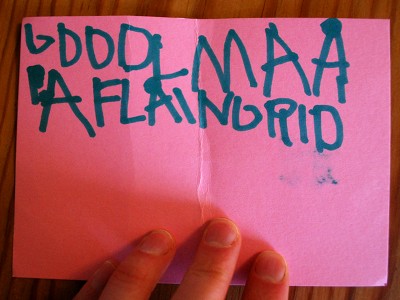
She is very very close to being able to read, but not quite. I think the only block is a mental one: she thinks that she cannot read, therefore she cannot. She can more or less write, but since she cannot read what she’s written, she loses track of where she is at. Short words, no more than 3 letters, work best. She wrote us a Christmas card, “GOD JUL MA Å PA FLÅ INGRID”. I’m saving that one.

She still likes numbers and basic addition. Sometimes she now does sums like 4+2 without holding up fingers, but I can see that she is counting fingers mentally.

She has developed an interest for learning some English. Counting in English came last month; now she notices them in movies (“sixteen” in Sleeping Beauty) and asks me to translate other words that she hears in them. We’ve read some Dr. Seuss books a few times: much of Fox in Socks can be understood just with me pointing at the pictures, while The Cat in the Hat and Green Eggs and Ham need some more translating.

She says she longs for spring to come. She doesn’t like the bulky winter clothing, and misses cycling. And she is already talking about how much she looks forward to her birthday.

Phew. Back to normal. Ingrid is her usual self again: occasionally volatile, sometimes whingy, but generally a happy girl. Life is much much more pleasant.

Ingrid’s latest “thing” is singing. We used to sing a lot, but then lost that habit somehow. Now it’s back again. A lot of Christmas songs, naturally: they’ve been practising for the Lucia celebrations at preschool for several weeks. A lot of Santa Lucia of course, but I also get to hear En sockerbagare, Tre gubbar and Tipp tapp frequently. Other non-Christmas favourites include Jungfru, jungfru skär, Tingelingelinge tåget far and the eternal Blinka lilla stjärna.

She particularly likes to sing while sitting in the sledge on our way to or from preschool. Today, when one of her friends accompanied us home for the afternoon, the two of them kept looping Jungfru, jungfru skär almost all the way home. Very uplifting!

She also likes to experiment with singing. Take a snatch of lyrics of an existing song and then sing and speak them over and over again, while varying everything that can possibly be varied: melody, pitch, speed, rhythm, stress, tone of voice etc. Or she mangles the lyrics, and twists each word into something vaguely similar-sounding but not quite: “Bjällerklang, bjällerklang” becomes “Pelikan, pelikan” and so on. Or she picks a random phrase and then sings that. Yesterday’s phrase was “tvätta mina tår” – “wash my toes”; this Monday she was singing “så såg jag smutsig ut i hopbyggnaden” – “so I looked dirty in the construction”. Go figure. This can often go on for a good while in the background while she is half-busy doing something.

She still plays with words, too, with rhymes and alliteration. “Jag vill ha mjölk” becomes “Na nill na nölk” etc. Me she now calls “mammis” – the Swedish mamma has replaced the Estonian emme, and then acquired the -is suffix (which is a very common and productive one in Swedish). She’s started picking words apart: she’s noted that both Barkarby and Vällingby (place names near where we live) have “by” in them, and Vällingby is made up of välling (“gruel”) and by.

In Swedish and Estonian, she’s started asking me what words mean. Usually she’s just picked them up and used them. But now with more abstract concepts, it’s not so obvious what people mean when they say a word or a phrase. For example, nära ögat (“near escape”, literally “near the eye”) and umbes (“approximately, roughly”) and typ (“sort of”). “Nära ögat” in particular seems to resonate with her: once I’d explained it for her, she started using it several times every day.

She’s learned to count in English. Up to 12 she gets them right every time; after that she usually needs a bit of prompting. She also picks up snatches of English from movies occasionally: everything from “You’ll never catch me” (from Disney’s The tortoise and the hare) to the Happy Birthday song (again from Disney, Pluto’s Party).

A few days ago, she got a simple calculator together with the fifteenth and last of her 1-2-3 books. It only has the digits 0 to 9, plus, minus and equals. She likes it a lot and has played with it daily. It’s not rare for her to mistype some number or press the wrong key somewhere and then tell me that 3 plus 4 equals 38, or something like that. I try to teach her the habit of first thinking for herself what the answer should be and then check with the calculator, rather than just blindly trust it. We’ll see if that catches on.

At preschool they have a maths project. They’ve split the large group into three smaller ones, each with a different theme. Ingrid’s group focuses on “short and long”. (The others have “light and heavy” and “time” as their themes.) They measure stuff in various ways, draw long things and short things etc. It’s made some sort of impression on Ingrid: several times she’s spontaneously reflected on the different sizes of things, said which one is shorter than the other etc.

She’s also interested in what things are made of, in materials, mostly in the context of which things will break and which won’t. “This cup is made of china. It is rather fragile.” “The fork is made of metal. It is hard. Look, I can do like this [tries to bend fork] but it won’t break. But if it fell from the roof all the way to the street, then it would break?” Glass, china, metal, wood, paper, fabric, clay – those are the materials that have come up at some point.

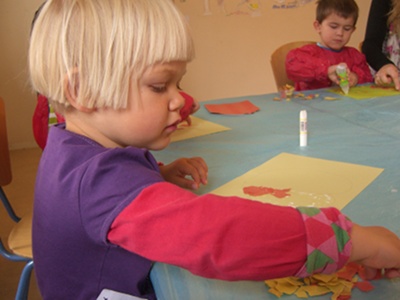
For a while we did a lot of crafts – cutting, glueing, painting – but then I think she tired and we haven’t done much in the past week or so.

For a while she was very interested in names, and still is to some extent. She picks or makes up pretty names for me / herself / her dolls: her favourites include Evelisa, Evelina, Rosetta and Josefin. Always girls’ names. Sometimes when she thinks of a particularly pretty name, she tells me that when I have another baby, if it is a girl baby, we should give her that name.

We also still play the role reversal game, where she is the mummy and I get to be big sister. Mostly it means that I should talk a lot and ask her questions about stuff, the way she does – “Mummy why does that man not have a hat”, “Mummy are we there yet”, and so on. And that is hard! I cannot blather like a 4-year-old. I get tired of that game pretty quickly.

She has begun to play a lot with her food and utensils, to the point where I often have to remind her to eat. “Just det, jag glömde det!” she says. The spoon is a playground slide, or a bridge, or the hands of a clock. The plate is a sea, or a sandbox. The piece of cookie is a shoe, or a sheep.

She is, still, most unwilling to play on her own. She’d rather complain that she has nothing to do than walk up the stairs to her room to get a toy. But when it’s time to do something – get dressed, brush her teeth, go to bed – she’s all play and silliness.

One thing I forgot to mention last month: we stopped using night nappies around her birthday, and this time it’s worked. But it requires one of us (Eric, or sometimes me) to take her to the loo a few hours after she falls asleep.

This has been a month full of whining, complaining, yelling, and general contrariness. Ingrid finds fault with everything we say or do. It’s like having a teenager in the house, I imagine.

It appears that she has, for some reason, decided to be unpleasant and unfriendly towards us. She can be perfectly polite to others, but when she addresses me, it’s often by shouting or screaming. When she wants me to pour milk, it’s no longer “Can I have some milk please” but “MIIILLK!”. Once she even started with “Can I…” but then interrupted herself and shouted “MIIILLK!” instead.

When she wants me to help her get her boots on, she refuses to come stand where I am sitting. (I refuse to crouch on the floor when I’ve got Adrian in the sling, because it is very uncomfortable for both of us.) Sometimes she even yells when she wants me to play with her or read to her. “Du ska läsa för mig du ska läsa för mig du ska läsa för mig!” (“You must read for me”) she screams, and of course I must do nothing of the sort, I must leave the room instead in order to keep my temper.

Anything I suggest is rejected. Anything I mention in a positive tone, she decides to dislike. “Look, there’s one piece of apple left!” she gladly says. “Yes, I thought you might want one more so I left it for you” I say. “I don’t want it” she responds sulkily.

And she wants help with everything. She can even ask for help moving a plate to the side of the table, and complain that she doesn’t have the strength to move it, and demonstrate by poking at it with a limp hand and an exhausted face. When Eric and I can’t help but laugh out loud at that, she gets very upset and cries that we mustn’t laugh at her.

My guess is that this is a reaction to Adrian’s arrival. A bit delayed, you might think, but then again Adrian was much easier to take care of during his first month. Now he requires more of our time and attention, and even though I do my best to spend time with Ingrid, she cannot have all the attention she wants. Is she testing us, perhaps? “Do they really love me? Do they love me if I do this, this and this?” Or perhaps she is simply mentally tired and stressed by the change and by the new order.

Tellingly she really only behaves that way with me and Eric. When, for example, another parent at preschool notices that we are having trouble (read: Ingrid is yelling at me without pause and asking for help while refusing my way of helping her) and asks if s/he can help, Ingrid explains reasonably politely what she needs help with and gladly accepts it.

During all of this I try to remind myself that:

  • I cannot control her behaviour but I can control how I react to it (and that covers both my internal and external reactions).
  • If we are to break the spiral of negative emotions and negative behaviour, it’s up to me to do it.
  • I can choose to treat her the way she “deserves” to be treated, or the way that is likely to break the spiral.

When she yells for help doing something ridiculously easy, I may think that that kind of request really deserves to be ignored until she addresses me in a more polite manner, or refused because she can do it herself perfectly well. But all that achieves is an escalation of the spiral. Instead I can interpret her shouting as a way of saying “I feel ignored and tired and unloved and I hate it and I want company”, gently remind her that I would prefer if she asked me kindly instead of shouting, and help her.

But there are times when she has decided to not cooperate at all, and then it can be physically difficult for me to help her. I cannot lift her when I am carrying Adrian; I cannot put her mitten on if she keeps her hand all limp. And there are times when my patience runs out and I just cannot take her yelling any more, and I walk away from the room or the situation.

It is bloody exhausting to have two cranky kids. I don’t tolerate loud noise well, and when two children are screaming right next to me, it leaves me tired and with frazzled nerves, even less willing to indulge in Ingrid’s whims or to get engaged in her activities.

Another reaction to having Adrian in the house: Ingrid has started telling us that she has a stomach ache, when she clearly has no such thing (and forgets it as soon as she gets distracted), most likely because we have explained to her that Adrian cries so much because his stomach hurts. If it works for him, and gets him lots of attention, why not for her, too?

Ingrid’s favourite “toy” is our iPad. She watches movies on it, plays games, draws, plays dress-up and so on – together with me or Eric if possible. We also read (a good activity to combine with breastfeeding Adrian), do crafts, and play games (board games, card games and such).

She likes to pretend she’s a wizard or a fairy or an angel, and do magic. (Fairies and angels seem pretty much the same to her – pretty girls with wings – and since I don’t see much actual difference myself, I haven’t bothered trying to explain the very different cultural backgrounds of the two.) There have been magicians and fairies in many of the movies we’ve seen recently, as well as in fairy tales, ranging from the story of Sleeping Beauty, via Disney’s The Sorcerer’s Apprentice, to Shrek and Aladdin.

She will ask me what magic she should do, wave her wand and say some magic words, and present me with the result. Sometimes she clarifies that “it’s just pretend”, that I shouldn’t expect real wings or that she cannot really magically bring daddy home early. I’ve begun using magic as a distraction when she’s in a bad mood: “wouldn’t it be nice if we could magically grow wings, then you wouldn’t have to walk home on your tired legs”. It sometimes works.

Often she or one of her soft toys is a kitten, walks on all fours and miaows pitifully. The kitten has lost its parents while picking berries in the forest, is sad and wants company. (We’ve read an Estonian fairy tale about a girl who gets lost in the forest while picking berries.) Now most recently the kitten has actually been abandoned in the forest by its father (since we’ve read about Hansel and Gretel).

Whenever I ask what she did with her friends at preschool, she tells me they played mummy daddy baby. She usually gets to be the baby, being among the smallest and youngest kids in their huge group. At home she plays she’s the mummy, and various toys and dolls get to be babies. She breastfeeds them, picks them up when they cry, and puts them to sleep. Sometimes she wants to be a mom for me, and I get to be big sister. She asks me how my day was, what I learned at school, and I am supposed to act the way she usually does. When she borrows my camera, for example, I am supposed to badger her “let me see, let me see [the photos]”.

There is also a fair amount of talk about being in love, and marrying. Contagion from all the older girls at preschool. She is in love with me and with Elin (a friend) she says, and will marry us both. Being in love means you like someone a lot, she says, and getting married means you live together.

When she draws or paints, it is only girls and princesses. Just plain girls more often than princesses, nowadays. They all follow the same template: head like this, dress like that, long hair on both sides. Very boring for me.

She has effectively learnt to write. Often she still wants one of us to tell her the letters, but when I instead say the word again, or just ask her what letter she thinks should come next, she gets it right 9 times out of 10. The most common mistake she makes is skipping a letter in the word. For example when she wante to write PIRN (for “pear” in Estonian) and had done P and I, she said that N should come next. But when I said that that would make PIN, she thought a bit and figured out on her own that R should be there too.

It’s like when she learned to stand and walk: she wouldn’t actually let go and do it until she was 100% able to do it. Back then it was some sort of subconscious or instinctive behaviour, but now it’s more conscious. She simply has a strong aversion to failure.

Speaking of walking, Ingrid is still not fond of walking so she cycles to preschool every day, if at all feasible, and most other places too. We had to walk when the streets were full of snowy slush. But when there are just some icy patches here and there, we take the bike. Slipping and falling a few times causes less fuss and complaining than having to walk all the way, especially on the way home in the afternoon. Even better than cycling is having a cycle race, meaning that she sets a goal (“first one to that brick house wins”) and races ahead on her bike, and I walk after her as fast as I can (cannot run with Adrian in the sling, he either throws up or wakes up) while shouting “this time I will surely win” or “now it really is my turn to win” and she laughs at me.

She can now hop on one foot (her right one) for a good 12 to 15 jumps, all the way across the kitchen. On her left she manages just a few.

Likes: painting my face (they do face painting at preschool on Fridays). Making silly faces and waving her arms around when I try to take a photo of her. Winning. Ice cream. Sundays, because then she gets ice cream. (Sometimes she starts counting down to Sunday already on a Tuesday.) Selecting clothes for Adrian. Torches. Balancing on pavement edges, ledges, and power cords on the floor. Playing rock paper scissors during train rides. Also during train rides, playing shop and selling me the houses, cars, boats and towers on the seat fabric. (Can’t find any official pictures; a slightly fuzzy photo can be seen here.) Plates, cups and cutlery with pictures or patterns.

Does not like: our tasteful green china. The colour black, or brown or grey. Waiting. Missing a train – even when I tell her the next one will be there in 2 minutes, she is upset.

This month’s big thing is of course Adrian’s arrival. Ingrid had been excited about the impending arrival of The Baby for a long time already. After he was born, she was very proud to be a big sister, and wanted to show him off to anyone who’d listen.

Now that he is here, she’s not quite so excited any more. I totally understand her: he isn’t very exciting, really. At first she tried to show him stuff (toys etc) but when he turned out not to be ready for that kind of interaction, she pulled back. He does cry quite a lot, and loudly, which Ingrid doesn’t like much, so she keeps a bit of a distance to him: cautiously pats him occasionally, but otherwise stays away.

She’s coping well with all the disruptions to our normal routine, and is pretty understanding when I cannot help her or spend time with her right when she wants. And while she may not like it, this change is also pushing her to do things on her own, without my help. On Tuesday nights Eric is away from home and I have to put both children to bed. This Tuesday Adrian was awake and most unhappy just when it was time for Ingrid to go to sleep. I left the room and told her I’d be back when Adrian stops screaming. When I came back, she was asleep: the first time she’s gone to sleep on her own.

Similarly Ingrid is now forced to get by without the stroller, which she was so very fond of. She can walk, run or bike, or stand on the buggy board. And of course she manages just fine, and doesn’t even complain much. When she sees that there is no choice, she is usually very sensible and accepts reality.

There is some frustration, of course, but I’m not even sure that there’s more than in a “normal” month. Ingrid’s current way of expressing her frustration is through (more or less realistic) threats and blackmail, or calling me “stupid mummy”. “If you do X then I won’t invite you to my party” and “if I can’t get an apple now then I will just stand here [in the middle of the street]”. She’s even taken to hitting me sometimes, but not with real force, mostly as a challenge.

I’m “stupid mummy” at times but Eric gets an even rougher deal. If Ingrid had her say, he’d always be last and get the least. And his clothes are the ugliest and so are his shoes. When Ingrid happens to draw three humans, the largest and prettiest one is mummy, the middle one is big sister, and the smallest one, drawn almost as an afterthought, is daddy.

That is mostly an act: when I’m busy and can’t be with her, daddy is perfectly acceptable. Again, when it comes down to it, Ingrid is a sensible girl.

The one thing she’s least able to cope with is boredom, and having to entertain herself. She’s always been very social and is never happier than when she’s playing with someone else. Then she can be as inventive and full of ideas as anyone could wish. But on her own, nothing is fun. When she has a choice between doing something on her own, or standing next to me and whinging “mummy can you read for me NOW” and “I have nothing to do” and “what shall we do”, she will choose the whining more often than not.

When we play, it’s mostly board and card games. I can’t even recall the last time we played shop or doctor or anything like that. When she plays with her friends, it’s often role play with dolls, and the girls themselves are mommies or big sisters. At nursery they also seem to play group games (vargen och kycklingarna, which in English is called “sheep, sheep, come home” I think, and bro bro breja). Ingrid has also brought home a counting rhyme from nursery (ole dole doff) which she uses in all sorts of situations, such as choosing a toothbrush in the evening, deciding which chair to sit on, etc.

The iPad remains a big favorite and is now even crowding out movies. Ingrid likes games where she cannot really fail: when she does fail some task in some game, she often decides she doesn’t want to play that game any more. Her favourite app is a dress-up game, and the next best one is a drawing app. Both often turn into social activities: we choose clothes together in the dress-up app, and take turns drawing or choosing colours in the drawing app.

Ingrid has figure out addition and can add small numbers. When both terms are no greater than 3 she knows the answer without thinking, and she can usually figure out the sum as long as it is under 10. Pairs of numbers are easiest: 3 and 3 makes 6, 4 and 4 makes 8. On a few occasions she’s done some subtraction, too (without knowing it herself). One day she was painting invitation cards for her birthday party. Eric and Ingrid had previously counted that they needed to make 6 cards. Halfway through she said, “Now we’ve done 3 cards, so we have to make… 3 more. Then it will be 4, 5, 6.”

At the same time she is close to figuring out writing. She used to focus on the dominant vowel in each word: she’d say that “raamat” (book) begins with an A and so on. Now she can say the word slowly for herself and pick out the first letter, and a few more as long as the word isn’t too long or tricky. She does even better if Eric or I pronounce the word for her, really slowly, focusing on each letter in turn. Interestingly, when she writes, she sometimes writes an L instead of an R because she pronounces them the same.

Writing seems to interest her more than reading. She isn’t interested in trying to spell out written words. But she does like emptying our mailbox and sorting the letters (E for Eric, H for Helen, I for Ingrid) – in part because she hopes that one of them will be for her. And the other day she recognized that ingen (as in signs saying “Ingen reklam tack”) starts the same way as Ingrid.

She also likes rhyming words. And with the help of the alphabet song (which they seem to sing at nursery) and a connect-the-dots app, she seems to have learned most of the alphabet.

Likes: The dance class. Slippers. Drawing princesses and hearts. Going to the library. Surprises and presents (real or play). Eating nuts.

It has been an unusually ordinary month. Or perhaps I have not been paying enough attention?

There has been a lot of talk about the baby, of course: about what s/he will be able to do (sleep and drink milk) and will not be able to do (walk, play), things that Ingrid is allowed to do but the baby won’t (help cook dinner, play with daddy’s iPad), things Ingrid will help the baby with (teach her songs), and so on. Ingrid is taking a long view of things and is already planning for how she will help carry the balance bike down the garden stairs when the baby is old enough to use it. I guess she finds it easiest to relate to her own age, so she imagines the baby in her place.

Eric’s iPad, by the way, has been a very appreciated toy. (I agree, I like it too.) It made its way into her life during a longer car trip we undertook, and has since then been almost a daily fixture. Eric has found a bunch of apps for her: finger painting, dress-up, jigsaw puzzles, simple connect-the-dots, memory (find the pairs) and so on. She can manage all of them on her own, because the interface is so simple. The touch screen is perfect for her – so much easier and more natural than using a mouse or a stylus – and the small size is also a big plus.

iPad use counts towards the one-hour screen time limit I try to keep to, so there hasn’t been much movie-watching this month. Not much reading, either, although I don’t think that’s because of the iPad. In fact I don’t know where all our time goes. She hardly plays with any toys, rarely touches her jigsaw puzzles, hasn’t drawn much… we’ve played some board games now and again but not much of that either.

Every week she spends one or two afternoons with friends, either here or at their place. A few afternoons are filled with errands, and since I don’t walk very fast nowadays we get home so late that it’s time to cook dinner. She usually helps me with that, or just potters around.

If she could, I think she’d have a friend over every single afternoon. She loves company. She also loves novelty: other kids’ toys are far more interesting than her own. And now she and her friends often play together on their own for long stretches of time, which means that I am more than happy to have her friends here, and I don’t feel like she’s too much of a burden for their parents either.

I don’t really know what she and her friends do together. “Mummy daddy baby” is one game that I’ve heard them play. Various sorts of dress-up, too: whenever I arrive to pick her up, she’s wearing fairy wings, flouncy skirts and such. There are also games with rules: “if you step on the gray ones then you die, if you step on the green ones then you win, and on the red ones nothing happens”. Death is a common part of such games. Stepping on certain stones in the street, touching a certain part of the rug, etc, all lead to death. Not very seriously, though: she’s not concerned at all when she does happen to step on them. There’s a general focus on the bad things in life – perhaps an effort to conquer them? When drawing with Majken she told me they were drawing “things that you can die of, and stinging nettles”.

She thinks a lot about her friends when they’re not together, too. She draws pictures, or takes home drawings from nursery, and tells me that this one is for Elin, or for Julia or Majken, and wants to take them with her when she next meets them. Since Julia lives in our street, just two houses further up, she sometimes walks to their house to put the drawing in their letterbox.

At first it was just the drawings; now it’s growing into a whole exchange of letters: the drawing is either folded and taped or put in an envelope, and then we have to write “FROM INGRID TO JULIA” on it (me spelling it out, her drawing the letters), and then she delivers it. Apparently Julia likes this too, because sometimes we find similar letters in our letterbox, which always makes Ingrid very happy. She checks the mail every day and inspects all the envelopes to see who they’re addressed to. (She can spell her own name all the way, and knows the first letters of mine and Erics. She’s viewed I as her letter for a long time; now all the letters in her name are “hers”. “R as in Ingrid!”)

During the first few “mail runs” I kept watch from the garden; now I just let her do it on her own. It’s a quiet street where cars are few and drivers are careful. Ingrid walks very carefully along the side of the street, looks to both sides when crossing, and shows a great sense of responsibility altogether – far more so than when we’re out walking together.

During weekends we’ve been to the circus (twice) and to the swimming pool (twice). Now that the school term has started, various organized activities are also starting up, including our Estonian playgroup. We’ve tried to find some more organized activities for her, since her hours at nursery will be shorter during our parental leave – now she’s there about 8 hours a day, but she’s only allowed 6 when one parent is staying at home. I looked for swimming lessons, but there weren’t any groups that took children under 5. Eric and Ingrid tried out “family judo” but she didn’t like that.

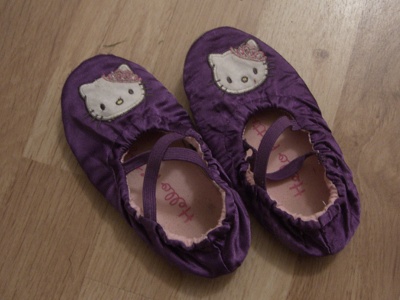
Today we tried out a dance group, since Ingrid has been talking a lot about dancing recently, and every nice dress is a “dance princess dress”, and her favourite thing by a mile is a pair of purple “dance slippers” with Hello Kitty. Really there was very little dancing involved and a lot running around with music, and some music-related games (Head, shoulders, knees and toes, Follow the leader, Freeze dance etc.) – just right for Ingrid, it seems.

Other minor points:

  • We’re back to using nappies at night, full time. Every time we try to make it without, there’s a puddle in the bed.
  • Ingrid has realized that some mushrooms actually taste good, and will not poke them to the side. I guess all our talk about tasting food before rejecting has not fallen on deaf ears. Still doesn’t eat onions or “leaves” (which covers everything from lettuce to spinach to herbs).
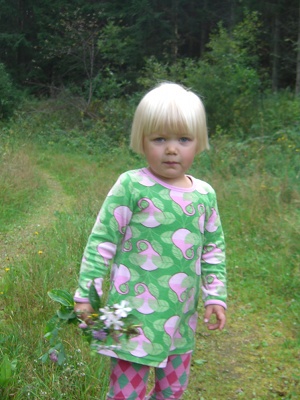
  • Other things she likes: Cake dough. Picking flowers. Opening surprise parcels and packages. Pink clothes. Cuddly blankets.

There is no doubt about it: the theme of this month is secrets and surprises. There is a lot of “don’t look now” and “no peeking”. Then she does something – sometimes for a minute, sometimes for ten. If it takes long, she will remind us to not look, about once a minute. And then finally she says “come look now”, or sometimes “dinnng” which also means that the surprise is done. Sometimes she comes to me with a surprise already prepared, hidden behind her back, and then proudly uncovers it.

The surprise can be anything. Quite often she shows off her ability to do things on her own: either taking care of herself (getting dressed in the morning, or undressing and getting into bed at night) or helping us (setting the table for dinner, or bringing out all the breakfast goods), or even playing on her own. Once the surprise was that she had assembled like seven or eight jigsaw puzzles on her own. Or she may go out and pick berries for us, or show me a picture she’s drawn.

But the surprise can also be something sneaky, such as bringing a garden trowel and sneaking it underneath my skirt, where she lays the cold trowel against my legs, and then squeals with laughter when I yelp. Or something totally quirky and unpredictable, such as taking 10 books and standing them all up on the living room table so they make a “house”.

Most good surprises bear repeating. I’ve lost count of the number of times I’ve been subjected to the trowel surprise.

Repetition combined with surprise has also been a theme in several of our games and conversations. There was the wizard game, when she’d ask me again and again what I wanted to be turned into, and then the sneaky wizard always turn me into something else instead. I’d wish to become a crocodile and she turned me into a stone instead, then I’d ask to become a bird and she’d turn me into an ice cream, and so on for a long time.

Or we might talk about how some people have cars and others don’t, and then she would start making up other things for which this is true. First seriously (bicycles, and houses, and trees in the yard) and then as weird as she could make it (roofs, doors, noses etc).

There is a lot of talk about ages. “When I am 5 I will be able to go to swim school. When I am 6 I will go to school.” But also: “I cannot go to the playground on my own. (Me confirming: No.) But I can do it when I am 6. (Me: yes.) But when I am 7? When I am 10? When I am 8? When I am 4?” and so on about many many things. She is very aware that she is three and almost four, and often informs friendly-looking strangers of this important fact – people on the train, other kids’ mums, neighbours etc.

We also talk about babies, and what they can and cannot do – sometimes in general, sometimes specifically about our baby. They cannot sit up, walk, eat, talk, etc. The baby won’t be able to ride on her bike, or climb the stairs, or even play with any toys at first.

Ingrid often mentions her own upcoming birthday. We’ve been talking about it for a long time already. Early summer we spoke about how we will first go to Estonia, then I will have my birthday, then she will go back to nursery, then the baby will probably come, and only then in the autumn will it be her birthday. Now she is back at nursery, and various other signs of “autumn” are appearing (the library is open again, and the ice cream seller at the playground has packed up for the season), so she thinks her birthday should be close, but of course it is still two months away. What an eternity to wait.

She is now quite confident with the days of the week, so anything that is less than a week away can be easily explained. This is very convenient. Yesterday she counted Monday-Tuesday-Wednesday-…-Sunday about 7 or 8 times in a row and asked, “will it be my birthday then?” and I said indeed it will. Today when we spoke about her birthday again, I told here it is many many days from now, and she said, “all the days I counted before!”.

The concepts of today, yesterday and tomorrow are, actually, harder than weekdays. She doesn’t seem to feel comfortable with the fact that “tomorrow” refers to different days. “Is it tomorrow today?” she asks. Now she mostly prefers to call them today, “the day that was” and “the next day”.

She’s also learned the basics of reading a clock. She knows to ignore the fast hand that moves all the time, and knows that the short hand is the important one. She knows that it is, for example, two o’clock when the short hand is on the number 2 and the long one is at the top. I don’t think she’s understood half hours yet – whenever the long hand is not at the top, we usually describe the time in relation to the full hour. “Getting close to two o’clock now, just past two o’clock, halfway between two and three” etc.

She’s comfortable with numbers up to 20, and can count to 29 without help. From there on at every x9 she gets stuck, but when prompted with the name of the next multiple of 10, she will keep going up to 100, as long as she doesn’t tire first. She often skips numbers like 44, 55 and 66 (as if one six should be enough already) and often forgets the sevens (37, 47 etc).

She may be able to count, but I get the impression that anything greater than 10 is still just an abstract concept for her. When there is A LOT of something she may say, “there could be twenty! or a hundred! or maybe ten!” as if all those big numbers are just about the same size.

On a few occasions she’s done some simple addition under ten: two plus two, three plus three, five plus two, and such. I think she knows two plus two by heart, but the rest she manages with the help of her fingers.

On a completely different topic, she’s come into contact with the concept of death repeatedly this month and the previous one. We’ve sometimes mentioned how people die, flowers wither, and food goes bad. We’ve encountered some roadkill, we’ve read fairy tales with stepmothers (where the mother has died), and she’s seen the frog king die in Shrek 3. “It’s like Snow White, but you never wake up.” She understands enough to know that everybody will die, and that it is not good. But there hasn’t been much more talk than that.

Other habits and skills worth mentioning:

We’ve done a lot of swimming and splashing around in the water, both this month and the last. Ingrid has long liked playing in water, but she has gained a lot of confidence this summer. She used to really dislike water on her face but can now put her whole face under water, or blow bubbles, or jump up and down so she gets water splashing over the top of her head. She can (either with my help, or with her armbands) float on her back. The greatest advances happened this weekend: she figured out how to actually move in water. With her armbands on she’d walk into quite deep water (up to her chest), lift her feet from the bottom, and then float and actually move in various directions using her arms and legs. She was actually swimming, albeit short distances and not very efficiently.

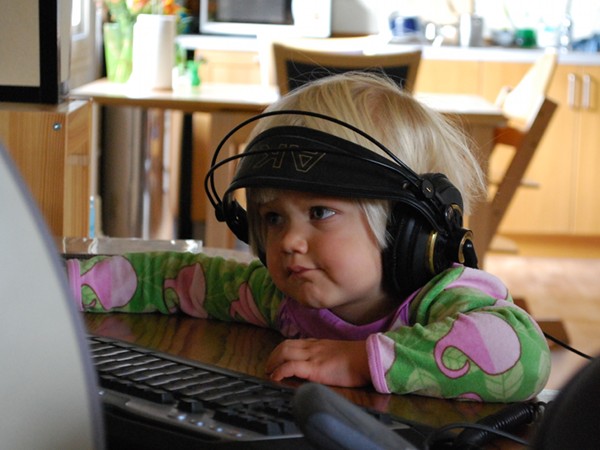
Ingrid now manages basic naviagation and playing movies on both Mac and PC, all the way from turning on the computer to turning it off again when done. Choosing the right profile, opening Explorer, choosing an mp3 file or opening the DVD in the media player, starting the movie using the shortcuts of the appropriate OS, switching to full screen mode, adjusting the volume, pausing, closing etc. The only thing she needs help with is knowing which media player to use (because we’ve got DVDs for various regions that won’t all play in the same one) and getting the DVD out of the case (and that’s mostly because we don’t want her to do it, after severe scratching of some DVDs).

She has acquired a habit of talking in a whiney voice, and various other distorted voices, when the mood strikes her. Both Eric and I find the whingy voice very annoying and say so, and we hope that it will pass soon. The other voices are not particularly annoying but can be almost impossible to understand, which doesn’t stop her from using them. She also likes to talk “like a baby”, meaning mostly “eeh” and “daah” and half words and lots of pointing. She is also still fond of the alliteration game, where the first sounds in all words are exchanged for a common one. “Klag klill kla kölk” for “Jag vill ha mjölk” and so on. Works reasonably well most of the time, except this morning I asked her, “who will pour the juice – you or me” / “mina või sina” and she wanted to answer using the alliteration game and got stuck… whatever letter she chose, “mina” ja “sina” were indistinguishable. So she switched to baby language and said “daah” and pointed at me.

She continues to be physically much more active than she used to be, say, half a year ago. Cycles to and from nursery, does not begin to immediately complain about walking, runs, skips and jumps. She is just learning to jump on one leg and can do about two hops in a row.

She goes to sleep in her own room and sleeps there until she first wakes, which can range from 2 o’clock to almost 7. Sometimes she wakes and shouts for me because she needs to go to the loo. We tried going without a night nappy for a while, when the nappy had been dry every single morning for a few weeks. But that quickly led to big puddles three nights running, so now the nappy is back. And the nappy is dry every morning again, so yesterday and today we tried without it again. Yesterday went well; we’ll see about tonight.

Quote: “Pink, pink, other colour, pink, pink, other colour, pink…”

This month saw the arrival of the era of Pink and Princesses.

Ingrid has never cared much for pink – whenever she mentioned a favourite colour, it was always green, and when she chose clothes she mostly went for green or red or brown. Now she says that pink is the prettiest colour and purple is pretty, too. Peer pressure begins its work.

And princesses. She’s loved fairy tales for a while, with all their magical ingredients: kings and queens, princes and princesses, dragons and magicians. Now it’s all princesses. She wants princess colouring books and princess stories, and so on.

I would be gagging already but luckily there is a Swedish series of children’s books about unconventional princesses. The first book is titled Så gör prinsessor or Princesses do that, and talks about a princess who, admittedly, begins her day by choosing a dress and a crown and brushing her hair 1000 times, but then goes on to scare away robbers, tame a dragon and rescue a prince. (Have a look at Prinsessor.nu for more.)

Here in Estonia she also found a princess book that she wanted to buy and I most happily agreed: it was full of Disney princesses teaching about manners. Snow White teaches table manners to the seven dwarves, Ariel learns about apologizing, Cinderella’s mouse friends talk about being friendly and nice. Quite a good idea. (Amazon US, Amazon UK, Apollo.ee)

I think the summer break might let the pink princess wave abate somewhat. There hasn’t been much talk about pink at all during the past 10 days or so. We’ll see what happens when she’s back at nursery.

Other things Ingrid has learned from the kids at nursery: (if you don’t do x) “then you can’t come to my party”. Social blackmail already.

Also possibly from nursery, or possibly an independent invention: roars of opposition. When she wants to be very clear about not agreeing to whatever it is, she turns to face me directly and lets out a deep chesty roar/growl. No tantrum, no yelling, just a roar.

At nursery she’d almost always greet me in the afternoon with “Emme can Majken come home to us?” or “Emme can I go home with Julia?” (often followed by “Emme you will not come with me”). Even 8 hours at nursery surrounded by people is not enough for her. Totally my opposite.

Now during the summer break she misses her friends from nursery. Luckily she has a good friend here in Estonia too, just a few months older than her. It took them a little while to “find” their relationship again, after a year’s absence, and of course we will be going home soon… but they’re having fun in the meantime.

When I look for a thread/pattern in her interactions with her friends, I see a focus on identity and comparisons. Several times they have swapped names – “Emme, now I am Julia and she is Ingrid”. Once she’d swapped clothes with a friend, which was quite funny – my brain had real trouble with resolving the situation. Majken in Ingrid’s clothes looked weirdly wrong, and I couldn’t find Ingrid among the crowd of 10 other fair-haired kids, because my eyes would always glide back to the familiar clothes.

Often it’s about being/doing/having just the same as the other girl. The other kid wants a banana? Ingrid must have a banana, too. The other kid decides to draw with a green pen? Ingrid also wants a green pen. The other kid finds a snail on the path? Ingrid wants to find a snail.

Sometimes it’s all about being first. “No I want to be the first to the door! No I want my milk first!” I find myself halving plums, and turning away from them while pouring milk in two glasses so they can’t see who got their milk first.

An interesting behaviour I’ve noticed is covering her ears and telling us “you mustn’t say that”. Sometimes it’s when I repeat an unpleasant truth, or remind her of something she must or must not do, but it can also happen when I comment on something she’s done well (washed her hands after going to the loo, etc). Is it because she doesn’t want to think about the unpleasantness more than absolutely necessary? Or does she want it to feel like she did it all on her own, not because we nagged her about it?

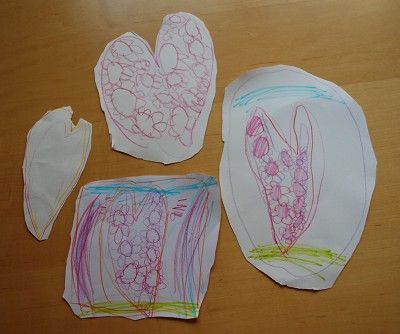
Ingrid still draws a lot. When she draws on her own, it’s mostly people. They are now much more detailed: there is hair, fingers and toes, sometimes fingernails, boobs and navels, ears, necks etc. When she draws me, she will often also draw a baby in my belly, like in the picture above. Not all of the body parts are always present, but I don’t think I’ve seen her draw a single tadpole this month. From blobs to mum-with-fingernails-and-baby in under two months.

Often she draws together with me or Eric. (Anything you can do on your own, Ingrid will want to do together with someone.) Sometimes it’s complementary drawing, but more often it’s parallel drawing. Complementary: Eric draws a train, Ingrid draws a passenger. Parallel: I draw a bus, Ingrid draws a bus; I draw a car, Ingrid draws a car. Quite often she will proceed to cut out the thing she has drawn.

Colouring books are not of much interest, but the princess series (see above) has a painting book that she likes. Each page has half a picture or a scene, that the kids then complete – a dinner table with no guests, or the princess’s half-empty wardrobe, or half the head of a dragon. This is not only fun for Ingrid but a great help for me, when my head is too tired to come up with ideas.

Ingrid got her own room this month, with a bed of her own, and an alphabet rug that she has longed for. She bravely said she would sleep in her own bed, but until now she’s ended up with us every night, some time in the early morning hours. Since she mostly manages to do it quietly and without disturbing us much, and there is more than enough space, I’m not bothered.

Otherwise the trend towards slowly increasing independence continues. (She gets more practice now that my pregnancy makes me tired.) She’s a lot more willing to do things with other adults, without me being present: with Eric of course, but also other kids’ mums, and her grandmother and step-grandmother, etc. Last year when we were in Estonia I hardly had a free moment; now I could nap for an hour after an exhausting morning, while she was out picking berries and playing with her step-grandmother. She’s also more accepting of my need to get things done, and negotiates around them: “first you cook a little dinner, then you read a little, then you cook some more, then you read again”.

In other news this month, I discovered brown spots on her teeth and we went to see the dentist. I was fearing the worst but there were no cavities, luckily, just weak tooth enamel. I guess she’s inherited my poor teeth. So now we’re even more diligent with brushing her teeth, and more restrictive about snacks between mealtimes. I used to let her snack on fruit pretty much as she wanted, except just before a meal. Not any more.

Favourite movies: old Disney shorts, which she could watch forever, and Fem myror är fler än fyra elefanter (like a Swedish Sesame Street). She likes to watch the same few episodes over and over again: A and 7, P and X and 6.

New and improved skills: buckling her bicycle helmet. Knowing the names of all weekdays, in the right order, in Swedish but not yet in Estonian. Cutting veggies without any help (but with close oversight) – hard-boiled eggs, cucumbers, string beans and rhubarb stalks have been great practice material. Catching a large ball, and throwing it back to me. Almost manages to make a swing go: she can make it happen for a short while but then loses the rhythm.

Favourite foodstuffs: raspberries, ice cream, blueberries (but the garden kind, not the wild ones). Anything with ketchup.