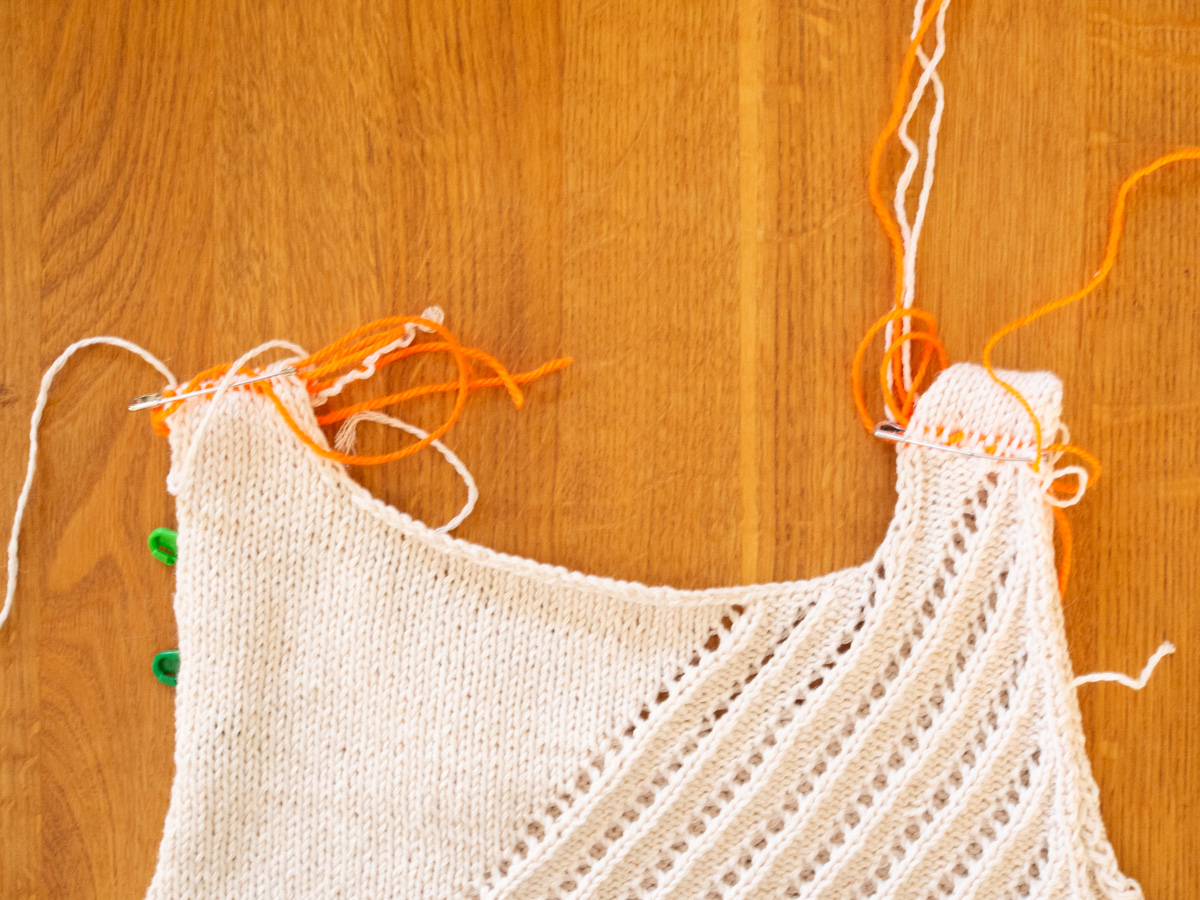
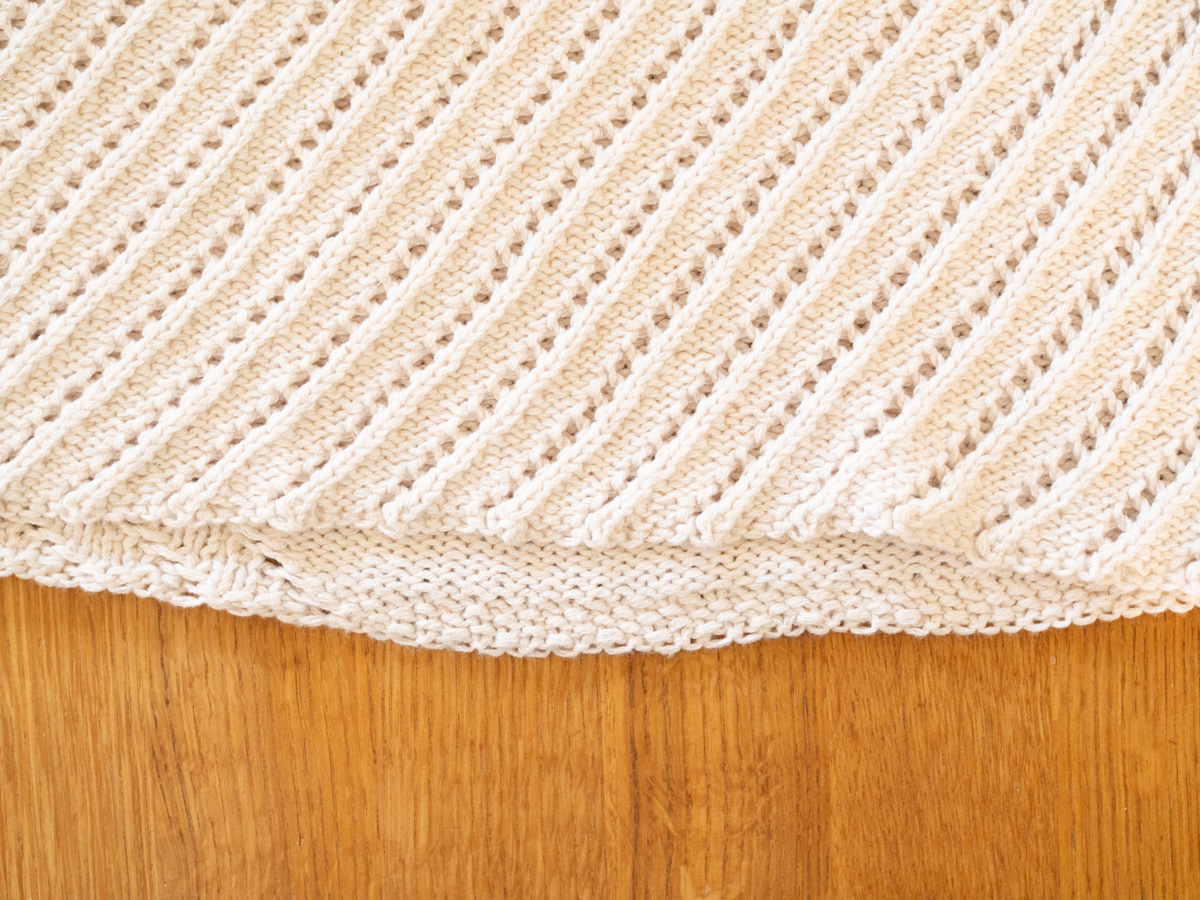
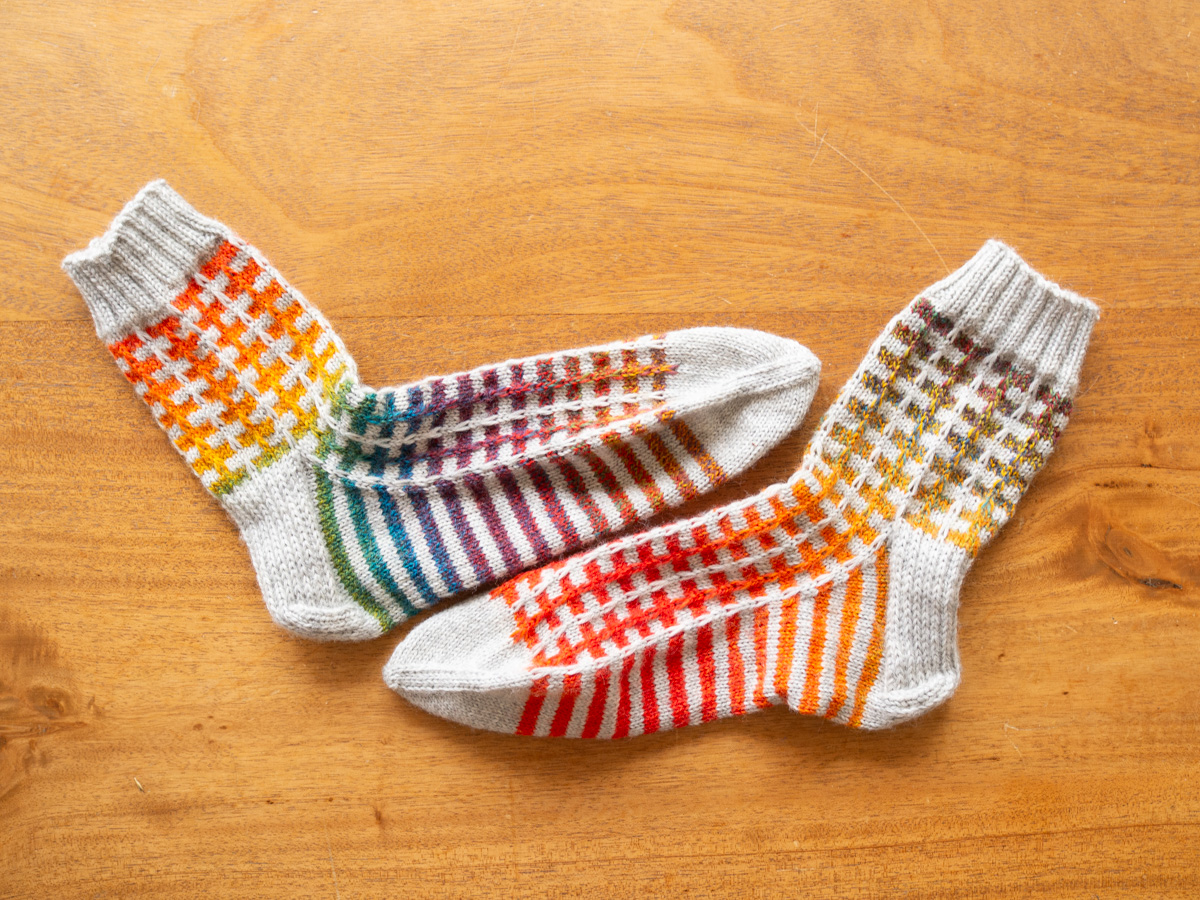
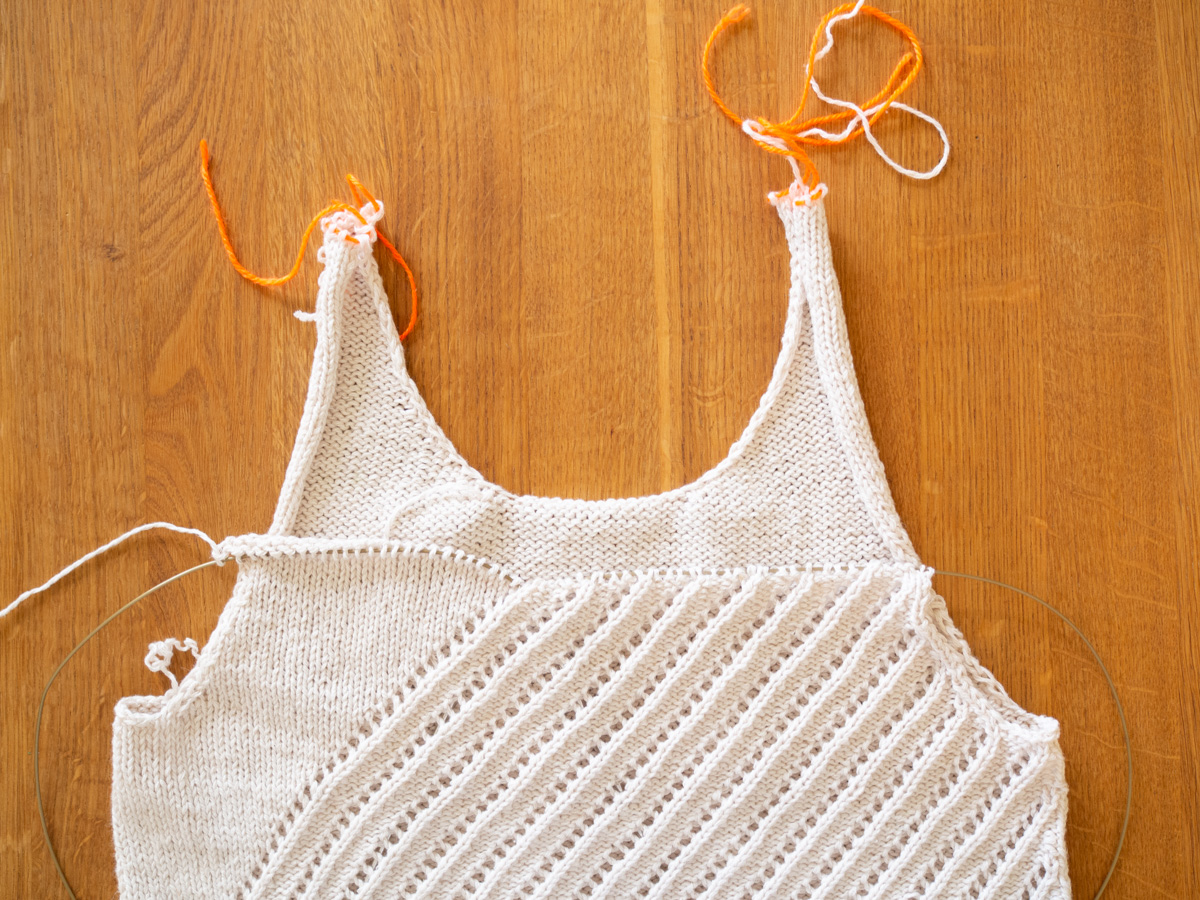
Two pairs of gift socks all done and ready to be given away.

I briefly considered making standard toes on these (maybe they will think these look weird) but there is just no world where a symmetrical sock toe will fit someone’s feet better than a more foot-shaped one. Even if their toes are at a different angle or their second toe is longer than their big toe, or whatever odd shape they may have, I am absolutely certain that they will be closer to this than to an equilateral triangle.

Third attempt. The second one came out too small. I’m not entirely sure about this one either. Should I make them looser? Well-fitting socks need to be tight but not too tight.

It’s a good thing that socks are small; I have time for a fourth attempt if needed. Maybe I’ll put this one to the side and start a slightly larger version in parallel and then see which one I believe more in.

There are two birthdays coming up in April, for people who deserve hand-knitted socks.

I’ve knit so many everyday socks for myself that it takes no effort. Knitting socks for someone else – whose foot I don’t have access to, for trying them on for size – is a whole other matter. I’m also using a thicker yarn than usual, so the numbers I’ve learned by heart don’t work at all.

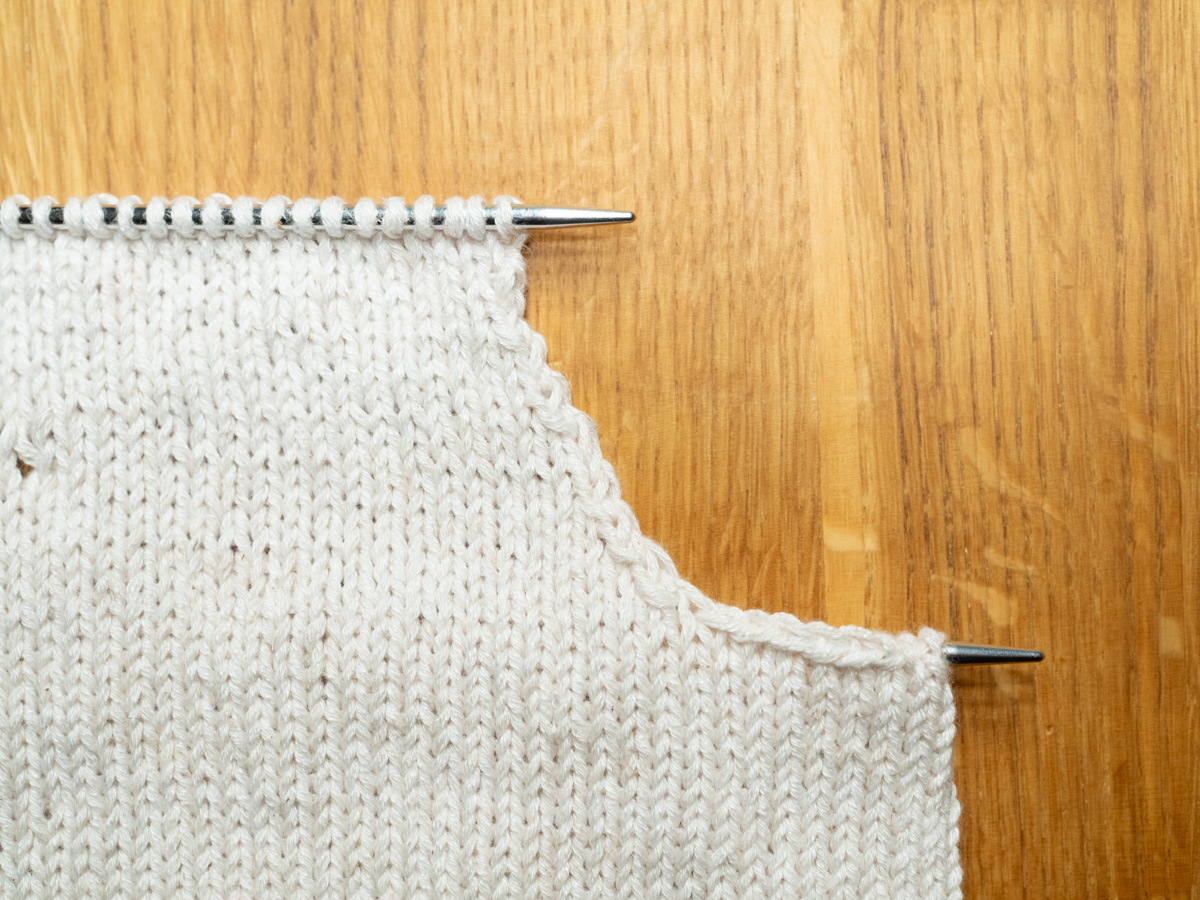
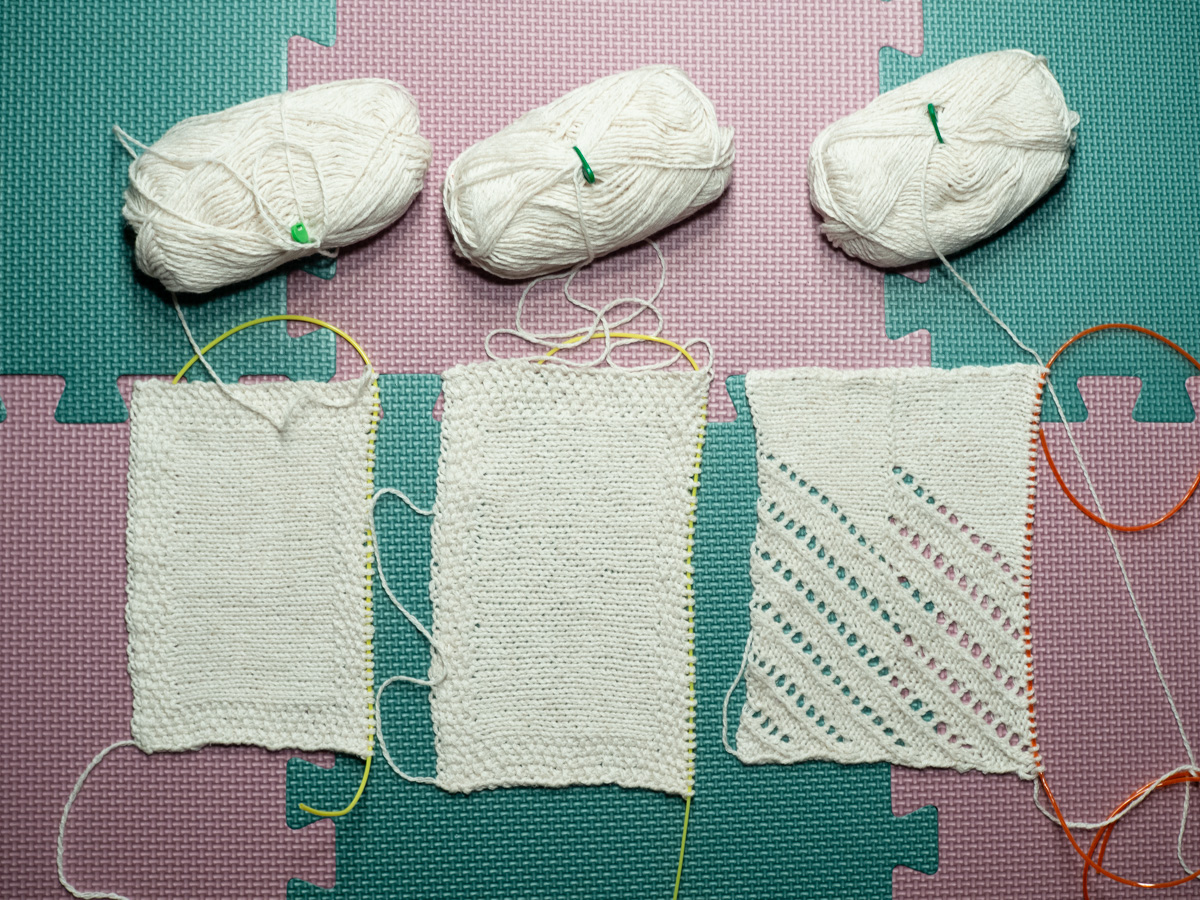
This is my second attempt of the first sock. The label on the yarn suggested using 3 mm needles. The fabric came out way too drapey and floppy with those. Could have worked for a cardigan or something, I guess, but it was absolutely not right for socks. This is a sock yarn, both by fibre content and by name. Why would they suggest a needle size that won’t work for knitting actual socks? Argh.

The worst of it was that I discovered this at the knitting meet-up. And, trusting the label, had only brought my 3 mm needles. Luckily another knitter had extra 2.5 mm needles that they could lend me for the evening. I brought the sock home with the stitches on a piece of scrap yarn.

I unravelled the bottom half of the first sleeve and re-did it with decreases. Now I’m on the second sleeve, and I made good progress during today’s knitting club session. Plus I’ve found a good method to pack it in a project bag so that I can work on it without taking it – and its five balls of yarn – out of the bag at all, so I can bring it with me to work etc.

I’m enjoying knitting this, but I’m still not sure if I’ll actually like wearing it. Maybe? Hopefully?

The striped sweater has been in timeout for a month or so. I knitted the sleeve straight because I didn’t want to deal with stripes and ribbing and decreases at the same time, and I hoped that the ribbing would make it stretchy enough to fit well even without shaping. At about halfway down the forearm, it was becoming clear that that wasn’t going to work out. I was pretty sure I’d have to rip the sleeve back past the elbow and redo it with shaping, but I really wasn’t looking forward to that.

For today’s knitting club meet-up, I packed the sweater and no other project, so I’d have no choice but to bite the bullet. Ripping back the stripes was exactly as finicky and slow as I had expected it to be. So much yarn management: rip back one row at a time, wind it up, carefully shuffle the balls around to keep them from tangling. But with company around me, it wasn’t as tedious as it would have been otherwise. I got it all done and actually got as far as knitting a few rows at the end. (With decreases!)

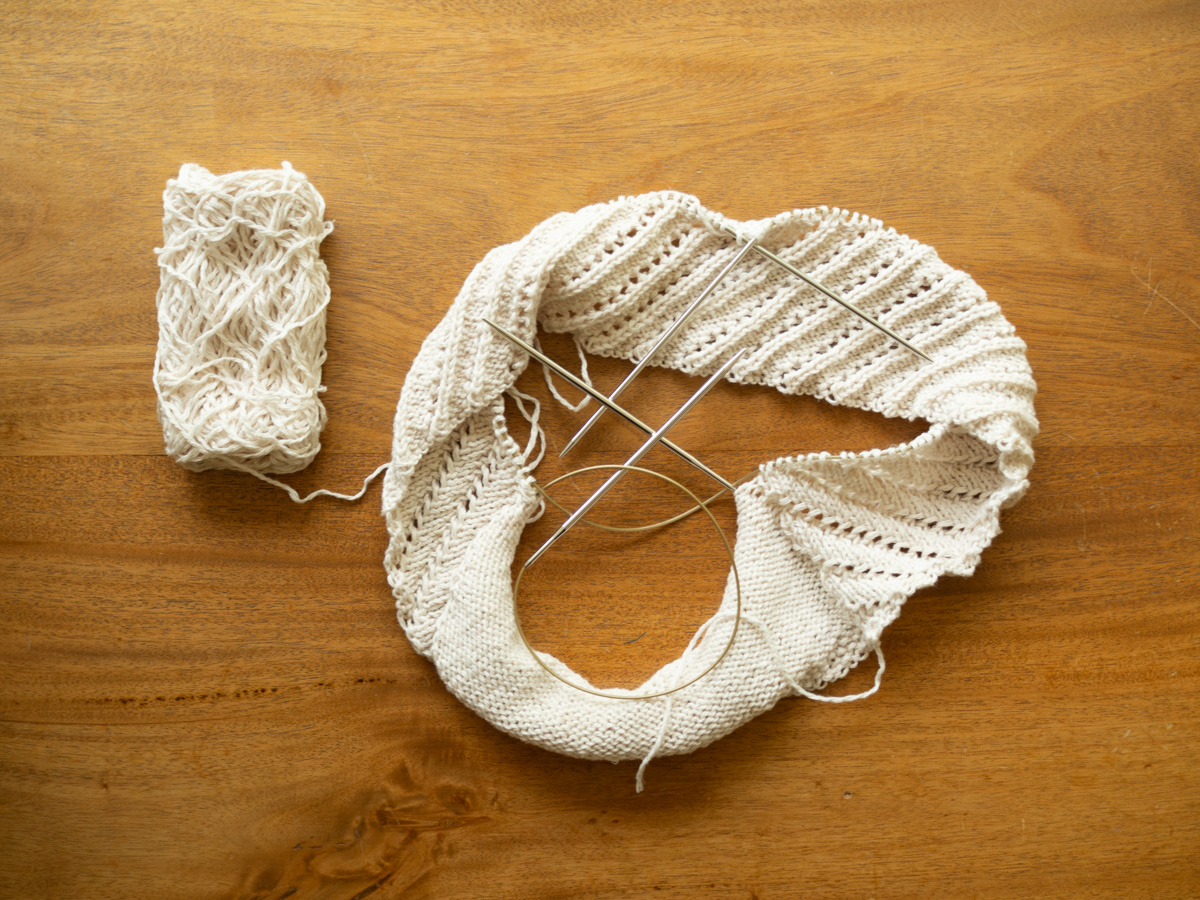
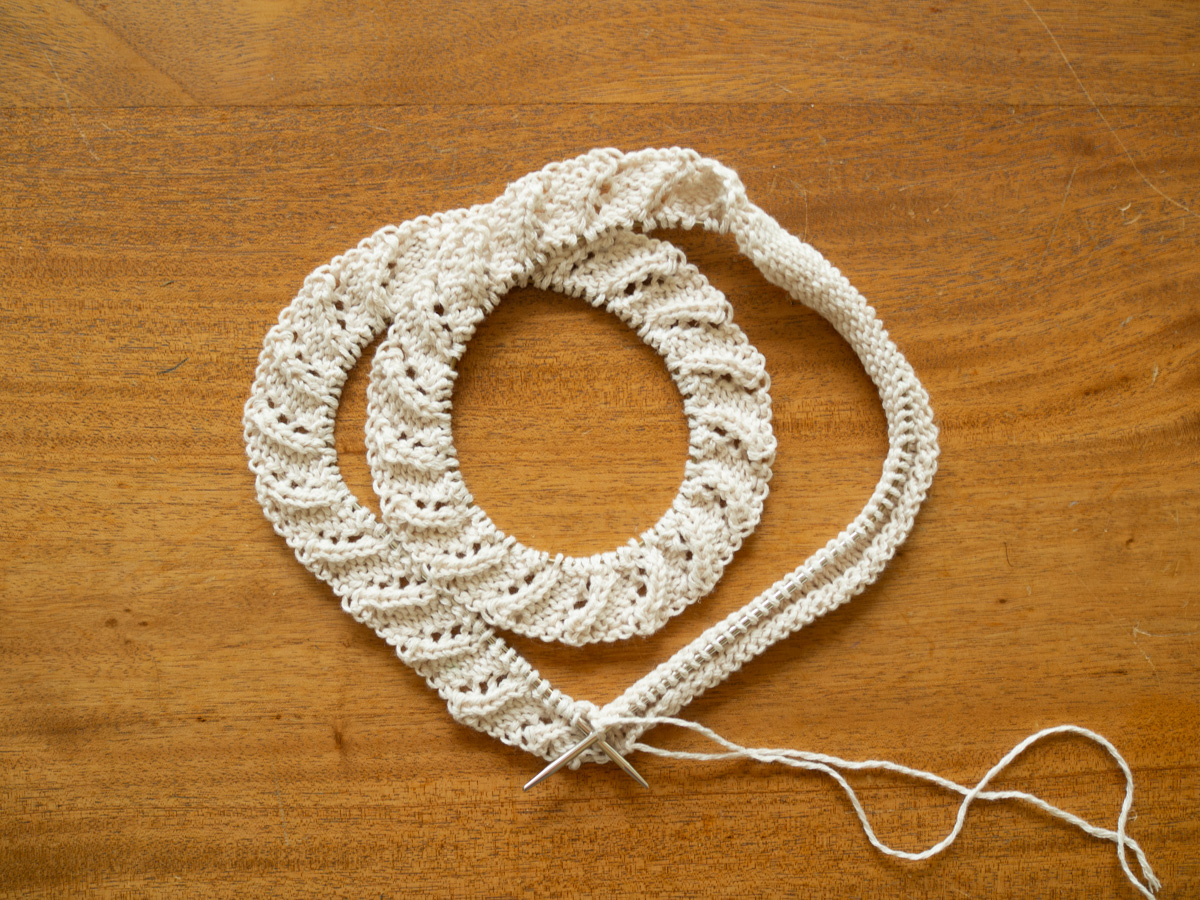
Knitting club Wednesday. I didn’t want to bring a sock – sock knitting is for commutes and meetings and flights – and the striped sweater is in time-out because I don’t feel like it, so I started a shawl.

The yarn I bought online some time ago. Maybe the colour wasn’t exactly like I imagined from the photos, but it’s still quite pretty (better in daylight than in this late-night lamplight) and feels very, very nice. Some combination of merino wool, silk and cashmere, according to the description. It’s an unplied yarn, if it can even be called “a yarn”: it’s an unplied bundle of eight very, very thin threads, thinner even than sewing thread. Some are red and some are purple, and they’re probably all made of different fibres. It’s tricky to knit with, easy to miss some of the threads with the needle – definitely not something I could knit without looking at what I’m doing.

Clean-ish complete-ish chart of the leaf pattern. Only because I didn’t take any other photos today. Not because I expect anyone to be interested, or this to even be understandable to anyone – I had to make up my own symbols for “purl two together through the back loop” and fuzzy concepts such as “make one purlwise, leaning in the direction that fits the situation”, and I didn’t bother to note down the obvious middle bits.

I figured it out!

The two tweaks that I couldn’t think of yesterday were (i) changing the total width of the panel and (ii) shifting things vertically.

Yesterday I tried to add increases and decreases to shift the 11 + 11 stitches in the two halves into 12 + 10 and back, to make a curve in the middle. Today I took away two stitches from one side, so the curve is between 11 + 9 stitches. That left me with a shorter stem for each leaf. To make the stem actually reach the leaf, I put the leaves vertically closer to each other. In my first attempts, there was only ever one leaf going on at a time. Now the right-hand leaf starts before the left one ends. Not only did this give me that curved vine that I was after, I also got a tighter pattern overall, with less dead space.

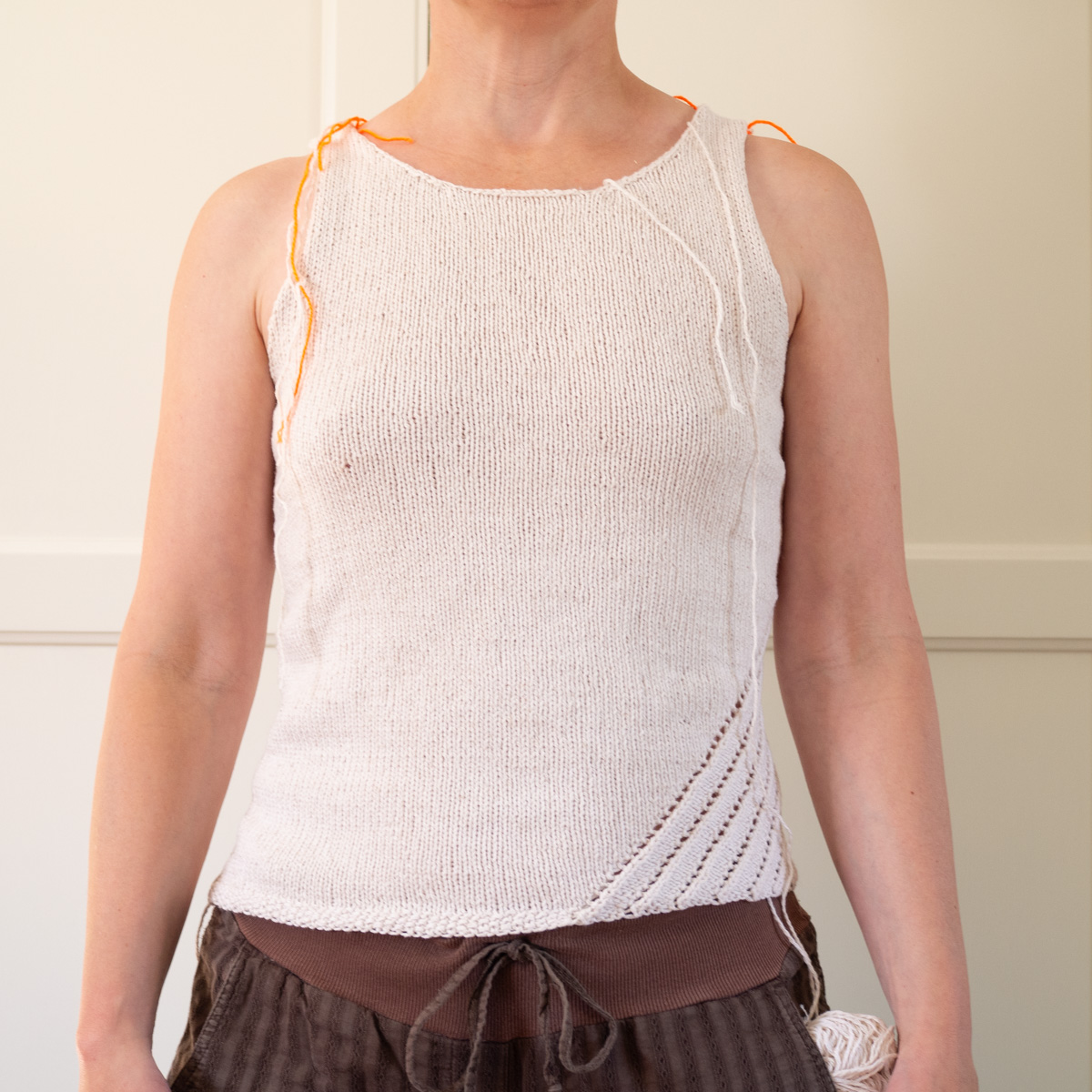
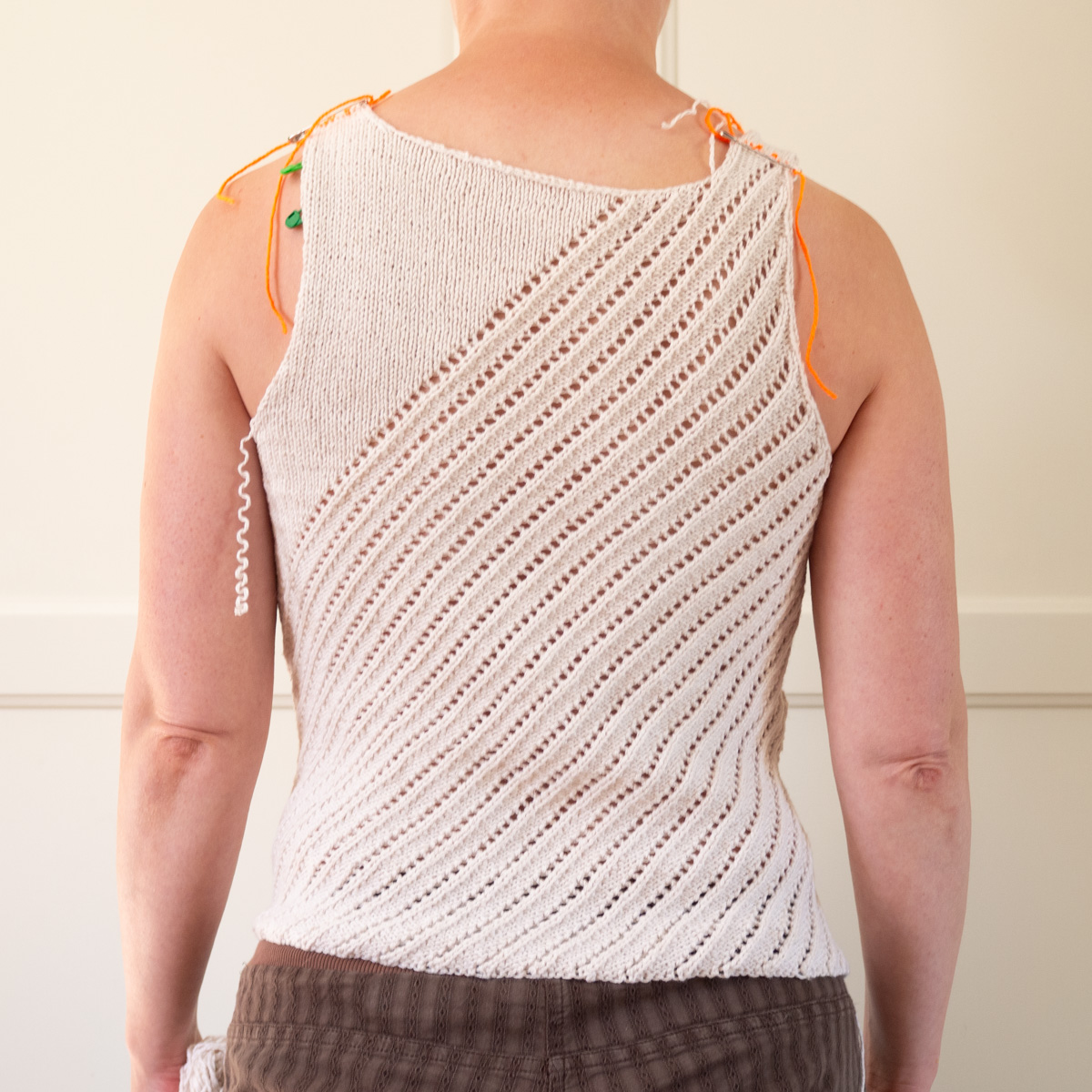
With the white dress done and the striped sweater feeling like a bit of a slog right now, I think I might want to start a new project. In my stash I have yarn for a green cardigan (bought at the crafts festival in October). The green colour is crying out for a greenery-inspired design – something with leaves, maybe.

I saw pictures of a knit pattern with leaves on a vine that I liked. Too bad it’s only available in a book published in the US in the 1970s. Then I saw pictures of a sweater with leaves that was kind of close to what I had in mind… and turned out to be discontinued.

Could I reverse engineer one of the leaf patterns based on the photos? How hard can it be? Knits for the smooth surfaces, purls for the bumpy parts. Increases and decreases to make them grow and shrink; cables to make lines slant and cross.

With lots of trial and error – mostly with pencil and eraser on graph paper, and a few attempts with actual yarn – I feel like I’m 90% there. It would all look smoother and tidier if I wet blocked the knit fabric but I don’t even need that now, I just want to see the shapes.

The leaves definitely look like leaves. My inspiration photos had eyelet increases like in the lower pair; I think I prefer the smooth surfaces of the upper pair.

The vine on the other hand needs more work. It’s a stick, not a vine; way too straight. I made several pen-and-paper attempts at making it curve – increase somewhere on one side while decreasing on the other – but couldn’t get it to work. Whenever I adjusted one part, it threw something else out of whack. The stem wouldn’t reach the leaf at the right row, or there wasn’t anywhere to put a decrease without distorting the entire panel.

Time to sleep on it.

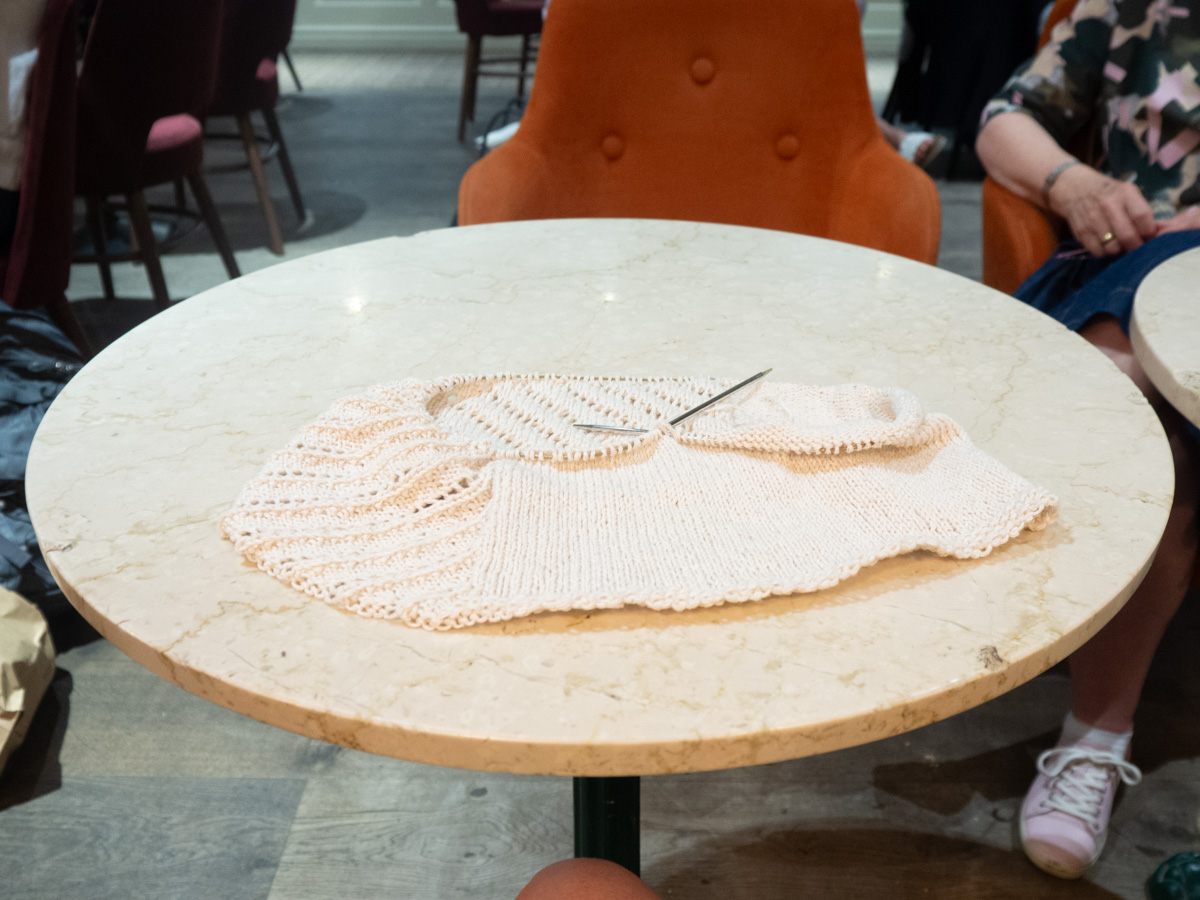
The knitting club has started up again after a break for Christmas and New Year. The Wednesday afternoon sessions are messy in the best sense. It’s crowded, there is barely any place to put your bag down, there are multiple conversations going on at the same time, and I know the names of maybe one fifth of the people. There’s no common project or theme like we sometimes have at the embroidery club – everyone just does their thing. Which is absolutely wonderful – I can be inspired by so many different ongoing projects. Today someone was wearing a cardigan based on a pattern that I’ve been thinking about knitting, and I could talk to them about it. Someone else turned out to have Estonian heritage and was knitting with a handspun yarn from Haapsalu. Another person had made felted slippers with the same yarn that I used for mine, but gotten them more felted than I managed, so we talked about what we did differently.