The general tone of this month has been positive. The endless stream of NOs has abated, and she no longer feels that she has to decide everything. Eric described it like this: a few months ago she discovered the concept of deciding, and now she’s understood how it really works. She understands that in some cases adults will decide, and children can decide over some things but not everything. It’s made our everyday life a lot smoother.

There has been a lot of drawing and writing going on this month. Almost every day she has a few drawings to take home from nursery. Her drawings are very much based on schemas and symbols. She copies things that she sees the other kids draw. She tells me, “look, this is how you draw a hand”. She asks me, “how do you draw a tree”? (My first attempt at a simple tree was too complicated, with roots and branches. “I can’t draw that,” she said, so I simplified it to a green ball on a brown stick. Plus red blobs for cherries. That was accepted.) When the first attempt at copying is not close enough, she aborts and tries again.

She likes drawing the same things again and again: mostly people, but also cars, houses – and traffic lights. Often she draws them the same way, too, with just the most essential parts, but sometimes she adds details. The people sometimes get fingers, or hair, or bags, or glasses (in which case they are daddy), or eyelashes. I don’t think they ever have bodies, though – the arms and legs are attached directly to the head.

The drawings are often accompanied by writing. And whenever I write something (a note, a shopping list), she wants to join me. She asks me, “How do you write ’rubber boots’? flower? leek? milk? eggs? traffic lights?”

The letters are more and more letter-shaped, and almost always in a row. However the row can go either left or right or snake around in any other direction. Occasionally, they’re of reasonably equal size, but that seems to be a matter of chance.

Most recently she’s discovered the concept of the alphabet. She’s been singing snatches of the alphabet song (from nursery I guess), and found it at the back of an ABC book we’ve read.

Not all the stuff that she learns from the older kids at nursery is equally useful. She’s learned to whine: please, please! She’s learned to talk with a silly babyish lisp. She’s learned to mock others, ranging from the superior “ha ha!” to such mature terms as bajskorv, fisbajs, fegis and dumma dumma bajskorv (delivered to the tune of “na na na na naah na”). In english that would be “poop turd”, “fart poop”, “coward” and “stupid stupid poop turd”.

Pott, kann, pirn, kork, porrulauk

We’ve spoken a bit about not saying such things to others because it tends to make them upset. At some point I happened to tell her that it was OK to say “ha ha” to me, that I didn’t mind. She then generalized that to all the mocking, and I now get called “poop turd”. She says it with such joyful innocence that I really can’t get upset and have to laugh instead.

She remains an intensely social creature, and she is totally unwilling to do anything on her own. It’s not that she needs someone to entertain her – she just wants company. That someone no longer has to be me. But whatever she is doing, she wants to talk about it, share it, do it together. When she is with a friend, she is good at taking initiative to come up with activities: “Come, Majken, let’s paint! Majken, do you want to take a bath with me?” and they can entertain each other for a long time. But on her own, she’s lost.

As a result, she is quite good at social relationships and social language: taking turns, sharing, finding activities that both enjoy, resolving disagreements.

Last month it was very important for Ingrid to “win” at everything, i.e. be the first. First up the stairs when coming home, first to wash and dry her hands after going to the loo, first everything. That’s still there but less markedly.

The cycling and swinging continue. And it seems the cycling has generally made her more active. Some days she’s even run all the way to nursery. Even on the days when she wants to take the stroller to nursery, she’s likely to walk and run on the way home. (The latest game: running ahead of me and stopping, arms and legs wide apart, to make a “gate” to block my way. Initially the gates could be opened by a button on her nose. Then some required a coin, or a key. For some, just saying “please, gate, could you open” worked. Lately some gates were broken and had to be climbed over or around.)

Favourite books: the 1-2-3 series, and fairy tales.

Favourite item of clothing: her new brown Scooby Doo Crocs. Otherwise her taste in clothing is weird, tending towards a lot of layering. Shorts over trousers, tank top over dress, dress over skirt… you name it.

Ingrid’s still firmly stuck in the age of NO. Her spontaneous first answer to most yes/no questions is a firm NO, which she sometimes immediately retracts, when she realizes what she’s said no to. Sometimes it helps to phrase questions differently, more openly, so it’s not a clear yes/no situation, but sometimes even that fails, and the answer is “nothing!”. And it’s still very important for her to try and get her will. I wonder how long it takes for this age to pass. It’s not much fun for the rest of us.

The cycling season also continues. Ingrid has, I think, cycled to nursery every day, and happily cycles to other nearby places, too. All this cycling has been good in itself, but I think it’s also made her generally more active. And it has forced her to walk some, too: when she tires of the bike on the way home, there’s no other option except walk. It’s good practice: we’ve started to talk about how she won’t be able to ride in her stroller at all when the baby arrives. (We will get a buggy board for Ingrid, though.)

Speaking of which, there’s been some talk about the coming of the new baby, but not much. Ingrid doesn’t seem to think it’s a big deal. When it comes up, it’s mostly in practical, caring terms. When we spoke about the baby being much smaller than her, she exclaimed, “You will have to buy small baby clothes for her!” She’s mentioned that she will have to cut her fingernails so as not to hurt the baby. (Not too fond of having her fingernails cut, she really only lets us do it when they hurt me and I start complaining.)

She’s so comfortable on the bike that she’s becoming overconfident. This has led to some falls, including one that gave her a big bleeding gash in the forehead. That required a nurse’s attention, but healed nicely with a clean straight scar. I’m now packing a first-aid kit for longer outings. Luckily Ingrid quite likes plasters, most of the time, and happily sticks them on various barely-visible red spots she finds on herself. She doesn’t like the children’s versions (they’re glossy but often too stiff to be comfortable) and takes the real stuff instead. I don’t want to declare the first-aid box off-limits (she’s got more than enough sense to not drink any medicine) but sometimes she uses up so many plasters that I’m thinking of buying and hiding a separate backup box somewhere, to make sure that we don’t one day find ourselves out of plasters when we actually need one.

The cycling may be easy but the traffic rules are harder to imprint. She’s accepted the helmet rule (must have helmet when cycling, except within the nursery grounds or other playground) and the edge rule (must keep to the side of the road, rather than the middle). When she sees others cycle without a helmet, she often comments on it.

I’m still struggling to get her to understand the importance of stopping in good time when we come to a crossroads. The streets around here are mostly small and quiet, so she can’t quite see the point of stopping to watch out for cars, and sometimes rides right across. That may work out OK 95% of the time but the other 5% can be very dangerous. So I keep on harping about it.

It’s interesting – she’s so fond of some gross motor activities (climbing, swimming, balancing on stuff, etc) but so not at all fond of walking, and not really running either. Is it the balancing she likes, perhaps? She’s always been very fond of swings as well, which would fit that theory.

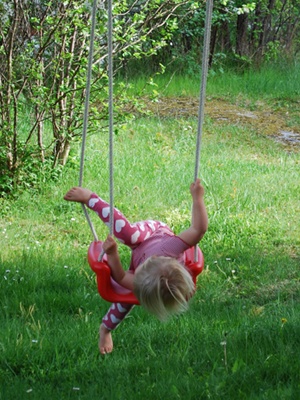
Eric put up a swing in the garden just before our trip, and Ingrid loves it. She hasn’t quite learned to pump the swing the way it’s normally done, but she can make it swing side-to-side, and even make it go in circles when she’s standing on it (and gets more leverage), so it’s just a matter of getting the knack of it when sitting down. In the meantime, she pushes off with her legs, and then goes on to clamber around and hang off the swing in various weird ways.

Another favourite outdoor activity is picking flowers. Earlier this month she picked scillas, now it’s mostly dandelions and cowslips.

She is as social as ever, always wanting to play with her friends. While we were in Beijing she kept talking about how she missed them and wanted to play with them when she gets home. She made pretend phone calls to them, saying hi, asking if they were at home and if she could come over. (Interesting: she only spoke her part, but in that way they sometimes use in movies, where hearing one half of the conversation is enough. “Are you at home? You are? That’s great.”)

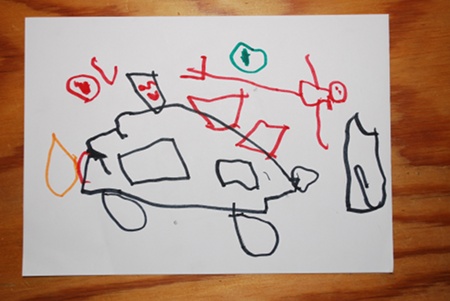
A car, with a headlight (left), a button to make it go (right), and two
passengers (the red shapes floating on top), plus other stuff.

Ingrid has suddenly become fond of drawing, and has started drawing actual recognizable figures. Previously she’d draw a large blob/circle and a small one inside it, and tell me that the small one is a whale and the large one is its house. Now during our Beijing trip she’s produced clearly human figures (mostly of the tadpole kind, with legs and arms attached directly to the head), even with different facial expressions, as well as cars, houses, flowers etc. This happened overnight; one day she just started drawing.

She is also still interested in writing. Now it’s not just drawing individual letters and numbers (although she still likes that, too) but also writing words. “How do you write NO?” “How do you write ELIN?” (a friend’s name) “How do you write HELEN?” she asks, and writes the letters one by one. The results are interesting to look at. The letters are all of different sizes, arranged on the sheet with no apparent internal order, and with different orientation. She thinks an angle is an angle, so a 7 may well have an obtuse angle.

She likes fairy tales and similar stories, ideally with princesses, dragons, knights, witches and magicians. Snow White, Cinderella, Puss in Boots – but also the #4 book in the My 1-2-3 series (which has a knight rescue a princess, plus a dragon and an evil magician). The stories she makes up and tells are also dramatic, with crocodiles and dragons, storms and fire and lightning:

“Det är krokodiler och hajar på mattan för där är det hav, men inte just där, där kan du gå. Och dom bits och sprutar eld, men då kommer någon och släcker så att det inte brinner längre. Och en dag kom det en minikrokodil, en bebiskrokodil, och den bet dig, fast bara på låtsas, så det gjorde inte ont, och den sög på din tumme istället.”

“There are crocodiles and sharks on the rug because it is a sea, but not right there, there it’s OK for you to walk. And they bite and breathe fire, but then someone will come and put the fire out so it won’t burn any more. And one day a mini-crocodile came, a baby crocodile, and it bit you, but not for real, so it didn’t hurt, and it sucked on your thumb instead.”

Activity of the month, #1: cycling. Ingrid now loves the balance bike we bought last summer, whereas the tricycle has been languishing in the basement, unused. Last summer she said the balance bike was too difficult, and didn’t even want to try. Now after just a couple of afternoons of practice, she is zipping around on it like a pro. (Just like when she learned to stand and walk: she wouldn’t even try until she was sure she could do it.) On flat ground or downhill, she can go fast enough that I have to jog to keep up with her. She can glide for many metres with both feet in the air. She likes it so much that some days she’s even ridden it to nursery and back (despite her great fondness of lazing in the stroller).

“PAPPA”

Activity of the month, #2: writing. The third and latest of the 1-2-3 books came with a painting & activity book, where one of the activities was drawing the numbers, 1 through 3. She loved it. Eric printed out a few “worksheets” for her, with all the numbers and a few important letters (E and M so she can write emme, P and A for pappa, and all the letters in Ingrid.) All in big bold type and a light gray colour, so she can trace them with her felt-tip pens. It’s been both fun and useful: her hand is a lot more stable now. Today at the Estonian playgroup she wanted to write “pappa” on the paper gift bag she’d decorated. A month ago she would just have scribbled on it and pretended it says “pappa”, but now she asked me what letters she should write, and made a good attempt at shaping the right ones.

Mood of the month: deciding. There is a lot of talk about “you will not decide what I do”. And when I sometimes nevertheless insist on deciding, Ingrid tells me what the consequences will be: “then I will be very mad at you and run away and shout that you are stupid”. (Just the way I tend to tell her what will happen if she does not comply with my decisions.) Sometimes she also tries to shout at me, “Come here right now!” But neither that nor “stupid mummy!” happen very often, probably because my reaction (mostly some vaguely acknowledging noise, and sometimes outright laughter) isn’t very satisfying.

For some reason Ingrid’s need to decide really comes to the fore at mealtimes. For a while she was so contrarian that every meal led to whining, shouting, howling and fights. Whatever we did, she would inevitably shout “NOOO not this one! NOOO not like that!”. The solution now is that we don’t even set the table for her: she brings her own stuff. And every step thereafter needs to happen on her terms. Either she asks for whatever she wants, or I confirm: “Do you want me to serve you some food? Shall I pour you some milk?” If I just do it, it’s bound to lead to a tantrum.

When she is REALLY upset, she sometimes breaks down and tells me she wants to go to bed. It took us a while to figure out why. Then one day after a tantrum she ran away to the bedroom and hid under the blanket. When she came back she told me she’d sucked her thumb. That’s something she is only allowed to do at bedtime. So when she says she wants to go to bed, she really means she wants to suck her thumb to calm down.

Speaking of willing and wanting, I’ve noticed that Ingrid needs a reason for wanting/not wanting something. When she feels full but still has food left in her bowl, she tells me she isn’t eating it “because I didn’t like it” – after having wolfed down two servings. Or she tells me she doesn’t want to go to Hedvig’s birthday party “because it’s boring there” even though the real reason is that I’ve told her we cannot go to three birthday parties on the same day. Sometimes she doesn’t make up her own reasons but invokes me instead. “Emme says that I should put two t-shirts on” she tells Eric, when I have of course not said anything of the sort. Other times it’s “the doll says I should eat the cheese first”.

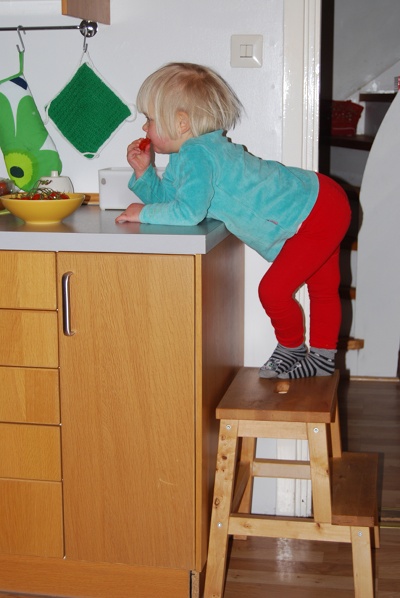
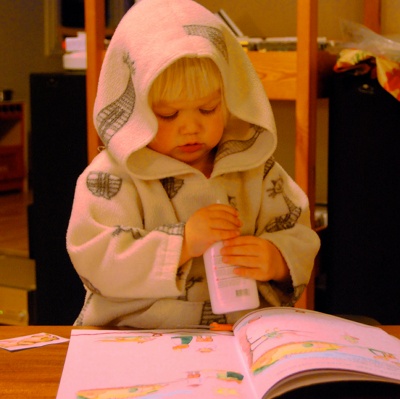
Illustrating Ingrid’s (1) fashion sense,
(2) insensitivity to cold,
(3) habit of slouching in the stroller,
(4) fondness of fruit.

A new theme in her thinking is the concept of contests and winning. Often she’ll tell us that she won because she finished her food first, or that we all won because we all got home first, or something like that. She’ll also comment on her activities in game terms, with rules and goals: “now I’m playing that I have to climb up here, and then I’ll win, but it’s only for children and not for adults”, or “one has to jump all the way to the bathroom and then it’s OK to take the toothbrush but you’re not allowed to climb on the step stool”.

Ingrid makes up other kinds of little stories, too. Most often they’re about the things around her, and often the things are mothers/fathers/babies. The small bites of bread are babies, and they want to join their mothers in Ingrid’s stomach.

The longed-for independence is growing, slowly and gradually. She’s always been a lot more independent when I am not present – with Eric, or at nursery. It’s only when I’m there that she seems to lose all ability to entertain herself, or do anything on her own for that matter. It’s “Mummy you must help me” and “Mummy come with me!” all the time. (The helplessness seems to tie in with her continuing interest in babies, and in pretending to be a baby herself.)

But otherwise now she is starting to “let go” of me. When we visit her friends, she runs off and plays with them for a good while, long enough for me to get bored and wish I’d brought a book or something to do. This week, for the first time ever, she went home from nursery with one of her best friends, without me, and stayed there for two and a half hours. Afterwards she was quite excited about the whole thing, especially about the part with the car ride to their home.

In shops and on town she’s now prone to leaving me and running off on her own. I’ve never had to worry about this scenario before. One day she ran ahead of me when we were leaving the local supermarket, and around a few corners fast enough that I lost track of her, and only found her (by that time slightly worried, both of us) with the help of strangers who saw me looking around, asked if the little girl was mine, and told me which direction they’d seen her. Now I’m glad that she is generally a sensible girl – I know there is little risk that she’d leave the store, or wander into the street, or tearing up all the bags of flour.

She is still not very good at all at entertaining herself all on her own. In the evening, after nursery, while I cook or do other such stuff, she usually watches TV for a while. Occasionally she might pretend to cook and serve food for me. Sometimes she plays travelling: packs her bag, gathers up all kinds of stuff, and then pretends our bed is a boat that will take us to Estonia. But she spends a lot of that waiting time asking me whether I will read for her soon, or play with her.

I’ve set a limit to how long I will read for her in the evenings, because otherwise she will be up half the night, listening to me read. After eight o’clock or thereabouts, it’s no more mummy time. It’s OK for her not to go to bed, if she isn’t tired, but I’m tired and don’t want to read or play any more. Last month she’d usually decide to go to bed at that time. Now she’s not as tired any more and stays up longer. Even then she doesn’t play on her own. Usually she climbs up on my desk, next to me and my computer, and scribbles or cuts paper or messes around with sticky tape.

For a while she’d describe various things as “ugly” and “disgusting”; seemed like something she’d heard at nursery and wanted to try out at home.

Favourite colours: green, followed by blue. She likes drinking straws, which we buy in packs of mixed colour. The green ones run out first, then the blue ones. She usually takes two or three at a time, in mixed colours. When the best colours are gone, she loses interest in the straws, and the rest of the pack lasts a bit longer.

Favourite movie this month: Disney’s The Prince & the Pauper.

Observation #1: she likes pointing out “this is me” in books and movies. She’s the prince in The Prince & the Pauper, the princess in Så gör prinsessor. Sometimes she’s every single child in a picture; sometimes daddy is the largest person, I’m the mid-sized one, and she the smallest.

Observation #2: she likes princes and princesses. Luckily, no demands for princess outfits yet.

Observation #3: she has great vision. She sees better in the dark than I do, and can discern fine detail at much greater distance than me. She also has great visual memory: remembering where some small detail lies in a big picture book, or playing Memory.

Observation #4: it’s become important for her to kiss and hug me good-bye in the mornings. Some days I’ve had to run off to catch my train before she was satisfied with the amount of kisses she’d given me, so now she starts the day with a kiss, to make sure I get at least one good one.

Counting stuff is back in fashion again. At nursery she’s learned to count on her fingers. She doesn’t really use them as help when counting. Rather, it’s when we mention that we have, say, six library books to return, that she might hold up her hands and count until six fingers are up. “Så här många böcker!” – “This many books!”.

Since numbers and counting are such a favourite, I’ve signed her up for the Mitt första 123 series of books (“My first 123”). Julia’s big sister has those books, and they are by far Ingrid’s favourite thing in that house. There are 15 books in the series, and you get a new one every 3 weeks. Each book is about one particular number, as well as a number/counting/maths-related concept. The 1 book is about counting in general, and why it’s a good thing. The 2 book is about pairs, etc.

Initially I found the books a bit pricey, and too pedagogical for my taste, but of course they don’t need to cater to my taste but to the kids’. And they really succeeded in Ingrid’s case. And it’s clear that a lot of work has gone into them. Each book does have a story, but on the whole the books are very visual, with large, colourful, detailed pictures. There are things to count in the pictures, or items to look for, etc. Each book also has suggestions of topics you could discuss and activities you could do with your child around the theme of the book. Plus you get a game with each book, which matches the theme.

Favourite activity number two: adhesive tape. Again it seems to be something she picked up at nursery. She’s known about tape for a while, but not quite had the dexterity and/or strength to use it well. It seems they’ve practiced at nursery, or maybe they have a better dispenser. In any case, Ingrid now very much likes to tape things.

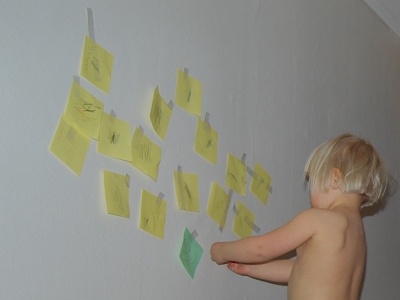
When she makes things at nursery, she insists on taking them home. So some days we’ve come home from nursery with a bunch rolled-up papers, each secured with seven or eight pieces of tape. She also likes taping notes on the wall. I’m glad she is not aware of the existence of post-it notes.

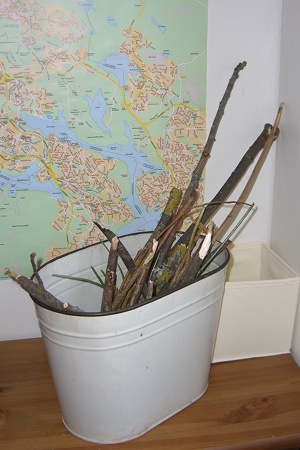
Apart from art and crafts, the other thing that Ingrid likes to take home from nursery – or to take anywhere for that matter – is sticks. Basically she kind of collects sticks. The ideal stick is about as thick as her finger or maybe slightly thicker, and about as long as her arm. And solid, sturdy, the kind that won’t break too easily. Occasionally she picks up a whole bushy branch, but luckily she doesn’t get very attached to these, and we can sneak them out of the house without much drama.

Whenever we go out, she will sit in the stroller, holding a stick in her hand. Sometimes she drags it along the snow, sometimes she knocks it against the ground, but mostly she just holds it. When she drops it, she insists on stopping to pick it up, but she’s usually not too upset when a stick breaks: she has understood that there are many sticks to be found in the world.

Once the snow is gone, we will find a good place for the sticks in some corner of the garden, so we can move the collection outdoors.

Sometimes she also collects gravel. Not pretty stones, not pebbles, but gravel, about the size of her fingertip. There’s lots of that stuff lying around now that the snow is melting. Here it’s only the gathering that is important. She may pick a pocket full of gravel and, while she won’t want to empty that pocket when we continue walking, she will then forget about it so I can empty it at home.

Speaking of walking and strollers, Ingrid’s preferences are still sedentary. In fact I am sometimes tempted to call her lazy. She strongly prefers the stroller to walking. I try to encourage walking, but it’s not having much effect. And I don’t feel that I can just leave the stroller at home, either: after a long day at nursery, the walk to the supermarket and then home would be a long one for her. But I wish she would at least get out part of the way.

And she is slightly on the chubby side. Not enough to worry about, but enough to make me think about her lifestyle. With spring and improving weather and longer daylight hours, I’m hoping that there will naturally be more outdoor activities – cycling, playground visits etc. But I’ve also found a children’s “aerobics” session in a nearby gym. We tried that once and she seemed to enjoy it. Unfortunately it takes place on Sunday mornings so it clashes with the Estonian playgroup, but at least we can go there every other week. I’m hoping that the joy of movement, of jumping and running around, will somehow spread from there to her everyday life, too.

On a completely different topic, Ingrid and I have had our first few phone calls. We tried a while ago but she didn’t seem to quite understand what was going on. Now, though, she understands very well. I’ve worked some late evenings, and now been away in Gothenburg for three evenings, so I’ve called home to say hi. She has clear expectations of what a phone call should contain: she basically gives me a report of her day – who she’s played with, perhaps what she’s eaten, and any major events during the day (like someone hitting her, or her spilling jam on her clothes). And then it’s good-bye. She is not interested in hearing anything I might have to say.

And all of a sudden, hugging has become important. It used to be that we’d say good-bye just like that, and perhaps she’d wave. Now she wants to give me a big hug, and lots of kisses too. And shout good-bye not just in Swedish but in English, too. “Hejdå hejdå hejdå bye-bye bye-bye hejdå”. Don’t know where that came from.

Favourite characters: Pippi, and Barbapapa.

Favourite stories: Hirmuäratav tolmuimeja, and Hansel and Gretel.

Not favourite foods: anything mushy like mushrooms, aubergines, zucchini/courgette; anything leafy like spinach, leeks, lettuce, herbs. Today she actually told me she is “allergic to lettuce” (I guess someone at nursery is allergic to something).

In the beginning of this month, Ingrid was moved up to the next group at nursery. Normally the whole group of children move through nursery together, but now the oldest children in one group were shifted to the next group, in order to make space for more young children. (For economic reasons the nursery needed to either let go of staff or take in more children. They chose the latter, and all the children queueing for places at this nursery were young ones. Hence the reshuffle.)

It wasn’t a huge change, really. The groups have already spent time together, especially while they’re outside, and towards the end of each day when the groups shrink as kids are picked up. So she was familiar with the staff and some of the kids too. Still, it meant a lot of new experiences for Ingrid. From being near oldest in her group, she’s now among the youngest ones. The new group is larger. And of course they do other things that the younger kids haven’t tried yet, and do things differently.

Possibly as a result of this, or possibly for some completely different reason, Ingrid has been really tired. The kid who was staying awake until 9:30 in the evening, is now telling me she wants to go to sleep sometimes before 8 o’clock. And she means it: sometimes she asks me to tell her a fairy tale instead of reading a book, so she can lie down and not have to look at the pictures. And after the story she is asleep within 5 minutes, instead of the 40 it could take as recently as early autumn.

Also perhaps contributing to the tiredness, Ingrid had a serious growth spurt early this month, with a LOT of eating. She was eating huge portions, and for a few days she asked for meals at two-hour intervals. That’s mostly past us now, but one thing that’s become part of our daily routine is having a banana on the way home from nursery.

Earlier this autumn Ingrid brought home her soft doll from nursery. During the schooling in period, back in 2008 when she started there, each parent was given the materials to make a soft doll for their child. They used those dolls daily in some activities (singing I think). Now they’re no longer using them that way, so the dolls were free to go home. Ingrid has become really attached to hers, and for several weeks she’d take the doll with her to nursery every day (and also take it with her wherever we went during weekends). It’s the closest she’s had to a comfort blanket, but now it seems to be waning in importance.

After nursery we often go to the library. They’re only open two evenings in the week, and most weeks Ingrid’s more than happy to utilize both. Mostly we read books there, but when it’s time to go Ingrid often says she wants to borrow a book, and then picks one more or less randomly. Often she loses interest in it by the time we get home. It’s the routine itself that’s important. When at the library, one borrows books, so that’s what we do.

At home there’s a lot of movie watching going on. So much so that I’ve started keeping an eye on the clock and putting an end to the fun after about an hour. Eric ripped several DVDs worth of old Disney shorts to MP3, and Ingrid’s learned how to play them all on her own. There’s a shortcut to the right folder on her desktop, and Eric set up her profile for single-click to open stuff. She turns on the computer, chooses her profile, opens the folder, clicks on a random movie in the list, and then “makes it big” with Alt+Enter. Pausing and unpausing with space bar is old hat. She even knows that when an unwanted “label” comes up (like a warning from the firewall) you click the red X to get rid of it. She still likes to type letters on my laptop, too. (Hmm… perhaps we should just set up Notepad on her profile?)

Last month’s game of bears continues almost every day. The two of us are both bears, and we have to hide ourselves under the duvet because it is winter and we need to go to sleep. Then she gets up, just like Alfie in When Will It Be Spring?, and wakes me and tells me it’s summer already! Sometimes I’m allowed to do like Alfie’s mom and tell her that she’s wrong, it’s still winter, and we go back to “sleep”, but other days she tells me “but let’s PRETEND it’s summer”, as if I wasn’t aware that’s what we were doing. During “summer” she picks nuts and berries and honey for me, and then it’s autumn and we start all over again.

There’s less counting going on now, and we can actually pass houses without reading out all their numbers.

Language-wise Ingrid’s doing great. I no longer have any worries whatsoever about her ability or willingness to learn Estonian in parallel with Swedish. She still often switches to Swedish when telling me about stuff that happened during the day at nursery, but in general she is fluent in Estonian and almost always uses it when speaking to me. Of course there’s lots more to learn – all the grammatical irregularities and more advanced sentence structures and so on. But even if she stops here, even if her underlying Estonian skills never get better than this (apart from gradually growing her vocabulary) she will get by. If she were dropped in Estonia without anyone to help translate what she says, she would manage. Most importantly, she knows to ask “what does xxx look like” when there’s a word she doesn’t understand.

Last month’s trend towards polite language continues. There’s quite a lot of “can I have some more milk please” and “could you help me with this”. We’re also hearing more and more expressions and phrases she is obviously picking up from nursery: “look at what I am doing!” and “you can take it if you want” and “we can pretend that it’s [something]” and so on.

Other such phrases confirm my impression that she’s (unusually?) sensible and willing to follow rules. This afternoon when a boy asked her about some toy at nursery, “is this yours?” she replied “no, it belongs to the nursery, everyone can play with it”. Quite often she tells me “you have to share the toys”. Indeed she’s sometimes so sensible that I worry she has no chance to make her own mistakes and messes and learn things herself. She tells me “you have to be careful when climbing here, otherwise you can fall down” and reminds me to keep to the side of the road when we’re walking home, so we don’t get hit by a car. If an adult gently suggests something, she often takes it pretty much as an order, so I try to suggest as little as possible.

Favourite foods: anything starchy (pasta, cereal, rice, bread); anything with ketchup. Bell peppers, sweetcorn, peas and beans of all kinds.

Foods she absolutely refuses: mushrooms and aubergine, both for their squishy texture I think.

Favourite movie: old Disney shorts.

Favourite book: none in particular; our reading is pretty evenly spread over most of our books.

The big news of this month is that Ingrid has stopped sucking her thumb during the daytime. Some days before Christmas I mentioned a couple of times that around Christmas she should stop sucking it, because it’s no good for her teeth. (She knows that’s true because the dentist said so.) She remembered it and took it more seriously than I had hoped, and reminded me on Christmas Eve that she would stop sucking her thumb.

And she did. That was pretty much it. The first few days I had to remind her at times, and sometimes she really wanted to, but managed to do without. I was really proud of her, and she was very proud when she told everybody at nursery. Since then, no problems whatsoever. She still needs/wants the thumb when falling asleep, and I’m willing to let that be for now. An unexpected but very welcome side effect is that she rarely wants to touch my cleavage any more. I guess the two activities together were some sort of effort to recreate the feeling of breastfeeding.

The first half of this month was dominated by Christmas: waiting for it, and then getting presents. The second half was, in turn, dominated by one of the above-mentioned presents: a board game. This was the first board game in our house, and Ingrid absolutely loves it. We have played it almost every day, sometimes several times.

It’s one of those games where you follow a path, rolling a die to decide how many steps to take, and special events happen at various places on the board. (Wikipedia tells me these are called “roll-and-move games”.) This particular game is called Drakguldet (The Dragon’s Gold), and the aim is to gather pieces of gold. On some squares you get a marker for a piece of gold, on some you lose one, on some you double your hoard, on some you have to run forward or fall back, etc. Ingrid is actually not that interested in getting the most gold, but would rather be the first one to reach the finish.

Ingrid loved the game from the moment she saw it. And it seems to be just right for her. During the first few evenings the challenge was to get her to follow the rules. She’s well aware of the concept of taking turns, so that wasn’t a problem. But there are also rules such as “you have to move forward all the time, not backwards” and “no, you cannot skip squares you don’t like” – not to mention “when counting steps, you don’t count the square you’re standing on”.

Naturally there is a lot of counting going on here: of pips on the die, of steps, and of pieces of gold. This has exposed some interesting things about her maths skills.

  • She doesn’t subitize any amounts larger than about 3 – she almost always counts them.
  • She cannot reliably tell the difference between the 4 and the 5 on a die, and either guesses or counts the pips (but always recognizes the 6).
  • She cannot translate numbers greater than 3 between languages. When she counts to 10 pieces of gold (in Estonian) and I ask her what that is in Swedish, she is totally lost. Four? Five? I guess it’s like being asked to translate 1001011 from binary to decimal. I can do it but not off the top of my head.
  • She doesn’t miscount when she physically moves objects, but she can easily miscount when just pointing at them, whenever the finger moves faster than the mouth.

Ingrid has also discovered that houses have numbers. She knows the number of our house (and the street name, although if a stranger asked her for it I’m not sure if theyd’ be able to decipher her pronounciation). On our way home in the afternoon, once we’ve made our way from the big road to the small streets, we stop briefly at almost every gate to look for the house number. She’s learned that the numbers can be found on the post box, or the gate post, or sometimes the house itself. However the number on the garbage can is not the house number. She cannot always tell which number is which (so I help) but she’s got 1, 2, 3, 5 and 0 down pat. And she knows that 2 and 2 side by side means twenty-two, and 1 and 2 is twelve (although 2 and 1 sometimes also make twelve) etc.

Continuing further on the topic of numbers, the number after twenty is “done!” because that’s what we used to say when counting was the only way to get her to allow us to brush her teeth. In fact it is “fourteen, eighteen, sixteen, nineteen, twenty, done!”.

Another game she played and liked was Memory, also known as Pairs. She’s encountered cardboard versions of it before, but this was an electronic one (at IKEA) which was more interesting and got her to pay more attention. She played it quite systematically: turn over a card, and then try all other cards against it until she finds a match. A, B, A, C, A, D, A, E etc.

Sometimes she likes typing on my laptop. I put Caps Lock on and turn up the font size to 48, and she types. She likes letters, sometimes numbers, but not punctuation marks or other weird wiggles. She knows the Backspace and Enter keys, and sort of kind of understands the arrow keys, too.

There’s more and more pretend play going on, now. All kinds of things are suddenly alive. Soft toys, of course, but also game pieces that must go to sleep, and pieces of potato that want to run away from the dragon and hide in Ingrid’s mouth. She likes to be a bear, herself (and I must be mother bear and we must go to sleep underneath the duvet because it is winter, and then it is spring and she wakes me).

Like last month, she likes to pretend she’s a baby, and her dolls are often babies, too. Babies want to be with mummy, and babies cannot do anything themselves, and they say “ääh” when they want something because they cannot talk.

There was a brief period when she was keeping a running commentary on everything she did – “now I will go and sit on the chair and have some milk” but that passed. There was also a period when she’d tell sing random stories, with a random melody – “when the bear was in the woods and picked berries there was another bear that came and he wanted to join” but that also passed. There were also several periods when Ingrid had a runny nose and would, at unpredictable points, insert the word “snor!” or “nohu!” in her speech (meaning “snot”, meaning “please wipe my nose”) without even changing the tone of her voice – “I took a book and now I want to read it snot!” and those also passed.

On the social side, Ingrid’s developed a clear understanding of the fact that others have moods and wants, and also of social expectations. When I sound curt or impatient, she asks me if I’m happy (“Kas sa oled rõõmus?). She asks about the moods of cartoon characters, and I explain that Donald Duck is looking sad / scared / anxious / angry / excited / impatient, as well as why. Her vocabulary in that area is clearly expanding.

She knows what “please” and “thank you” are for, and is willing to use them at times. She’s also wise enough to know that these words make me happy, so when she knows I am annoyed with her behaviour, she suddenly becomes extra polite.

And yet that understanding only goes so far and no further. A new and frequent feature in her conversations is a categorical “but you must!”. I tell her I cannot play just now / don’t want to sit by her side while she’s on the potty / will not read for her until I’ve finished cooking dinner. Her response is always “but you must!”, and she doesn’t really listen to any of my replies.

Favourite foodstuffs: julmust and, still, liver pâté. And cookies. Liver pâté is by far her favourite sandwich spread, and almost every dinner is concluded by a dessert of one or two cookies
Favourite colour: green. She appears to have decided, one day, that she likes green. Now almost every day she tells me that she likes green things. I think she ate broccoli today only because it was green.
Favourite movie: all kinds of Disney classics.

Favourite books: varied; the ones I can recall now include Nicke Nyfiken på sjukhuset (Curious George Goes to the Hospital), Mattias ja mamma, Mamma Mu, När Findus var liten och försvann.

Not favourite activity: sledding. I thought all children loved sledding, but Ingrid is not particularly interested. She does it at nursery, but when we’ve suggested it during the Christmas holidays, she’s declined.

Random observation: she moves like a child and not a toddler now. I remember noticing half a year ago, back in July when we were in Estonia, how she ran like a toddler, with her hips and legs moving sort of stiffly, with a bit of a waddle. That’s all gone now.

PS: The solution to our afternoon nursery pickup problems was to make it into a game. I would suggest or try to put her clothes on wrong – socks on her head, mittens on feet, fleecy trousers around her neck – and she would squeal with laughter and correct me. The fun is slowly going out of this game, there’s no squealing any more, but she still reminds every day that I should put her clothes on wrong.

This has been a difficult month. Ingrid has become immensely sensitive to time pressure (as in, strongly resistant to it) and at the same time discovered passive aggression. Any time I ask her to hurry up, I do so with trepidation, steeling myself for the resistance, and then the explosion. But sometimes I feel I have to. There are limits to how long I am willing to wait for her.

She wants me to wait for her to do stuff. She goes to the loo, and then to wash her hands. I make to leave the bathroom. She says “You will wait while I wash my hands”. I say OK, and wait.

Then she stops and does nothing.

I wait a while. I get bored and turn towards the door again. “No you must wait!” “OK, I can wait, but in that case you have to wash your hands. I have to go back and continue making dinner.”

She does nothing.

I wait. I leave the bathroom and go to the kitchen. She explodes in screaming and crying.

In the supermarket she wants to be the one to pick a loaf of bread. Sure, come here, I’ll lift you up. I lift her up, she stops.

On our way home from the supermarket, she runs too close to the road. I grab her hand to stop her. She is angry. I let go of her hand. She then refuses to move. Various (kind, then less kind, then kind of annoyed) ways of asking her to either walk or climb into the pushchair have no effect. She then sits down on the pavement in front of the pushchair so I can’t walk either.

I once tried waiting it out, but gave up after close to 10 minutes. (Literally. I timed it to over 8 minutes, and then waited some more.) So now I give her a couple of chances, then tell her that I will not ask her again. And then I walk away – or bundle her under my arm and carry her if she’s blocking my way. Both lead to screaming, and a negative spiral with angry scenes about the next thing that needs to be done, and the next.

As always, I’m sure it’s just a phase. And it will pass.

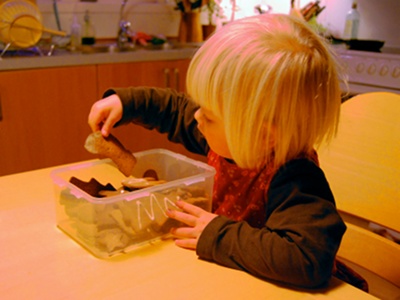
In the meantime, on a more positive note, there’s been a lot of talk about Christmas. We read Christmas-themed books in the library. Ingrid points out every new Christmas decoration she sees in the street – “för det är jul snart!”. We made gingerbread cookies and eat a few after dinner every day, and she opens a piece of her Advent calendar/puzzle every day. She talks often about how it will soon be Christmas, and then there will be presents. She got a Christmas card (addressed to herself!) today and was very happy about that.

She has become suddenly obsessed by drinking straws. She will not drink without one, and sometimes takes two or three. First she used up all the green ones (for green is her favourite colour, she’s told me), then the blue ones. Yesterday she got a fancy reusable straw as a gift from her friend Elin, and I’m sure she will be using it constantly from now on.

It’s interesting how some things become essential, cannot-live-without-it important. Her silver spoon that my father gave her at birth (an Estonian tradition) is one. For several months now she’s hardly used any other. We have a little bowl with a fish design that she’s loved, but we don’t usually serve food to her in it, because it has a very narrow base and is wont to topple. A few weeks ago I bought a different “fish bowl”, and she’s adopted it as her own now, and asks for it at every mealtime.

There was a month or two when Ingrid was slightly less insistent on visiting friends every afternoon. Now she’s in a social phase again, and would happily go play with someone almost every day. Which is hard, because she only has two best friends she wants to play with, and both families have more stuff scheduled in their life than we do. Since she doesn’t exactly lack company during the day, I haven’t gone out of my way to try to find other playmates for her.

Last month (and I now realize I forgot to write about it then) Ingrid had a period when words would get stuck, and she’d have difficulty getting them out. Not stuttering, but repeating an entire word or even two, before she got the rest of the sentence out. Sometimes she’d rephrase in order to get unstuck again: “jag vill… jag vill… jag vill… vi ska läsa bok nu”. Apparently a common phenomenon at her age, supposed to pass on its own, and indeed it did already.

Now she’s come up with new language games. The favourite by far is to give all words the same initial sound, preferably K or some combination of K and another sound. “Palun veel piima” becomes “kalun keel kiima”, “nummer ett, nummer två, nummer tre” becomes “klummer klett, klummer klå, klummer kle”.

Favourite movies: Wall-E, Kalles Klätterträd and Kung Fu Panda, among others.

Favourite books: various Petsson & Findus books, as well as various Mamma Mu books.

Favourite food: liver pâté.

Since Ingrid had her birthday parties a month ago, there has been a lot of talk about birthdays, parties, presents etc. We’ve had numerous play birthday parties (mostly for me, and sometimes for her, and sometimes for Eric). Mostly I get to be three years old. Of course I get presents, and there has to be cake or candy, and sometimes she serves us a fruit drink, too.

The most popular present, especially during the first two weeks, was the harmonica. The next most popular one was the box that her ukulele came in. It is mostly used as a play present at my play birthdays. The ukulele itself is rarely used, once the novelty value evaporated. The third most popular present was the rolled-up picture that came with a big jigsaw puzzle: it can be rolled, unrolled, used as a telescope, and the rubber band around it can be put on and taken off. We’ve also had fun with all the balloons we blew up for the birthday party – we stuffed them all in the corner behind the sofa, so it became a balloon pit. The presents (apart from a book) have mostly been forgotten already.

Other popular toys include horse chestnuts, marbles, bags and boxes: putting small things in bigger things and carrying them around. Wooden sticks and chestnuts are important possessions and have to be carefully kept account of.

She uses her toy food and doctor’s equipment reasonably often, and we play shop, too. And she’s now started to carry around dolls and/or stuffed animals and telling me that they’re her babies. The babies need to be put to bed at night, and quite often they want to come with us wherever we’re going. Oh, and of course they want to sit on my lap.

She’s been fascinated with police, ambulances and firefighters. She points out every single police car and ambulance we pass, and I think they have books and pictures of these things at nursery.

Shortly after Halloween they had a dress-up day at nursery. They had one last year, too, and Ingrid went as a tiger. This year I asked her what she wanted to be. First she wanted to be a tiger again, but I suggested that maybe she could be something new this time. A cow? A cat? A zebra, I suggested? No, she said, a fly! Well, maybe a bee? or a butterfly, or a ladybug? No, I want to be a fly. Or a police car! Hmm, how about a policeman instead of a police car? (The Estonian and Swedish words are gender-neutral.) Yes, yes, a policeman! I want to be a policeman! So that’s what she was.

Slowly slowly she’s spending more time playing on her own. (Bear in mind that “more” is a very relative term here.) When she plays, she’s commenting on her own play all the time: “this is a boat, now I’m going to take the boat to Estonia” or “This is my baby. The baby wants to be with mummy.”

Occasionally she wants to be a baby herself: “I am a baby, you have to feed me!” But those are exceptions. Most of the time Ingrid wants to do things herself, of course. She’s quite proficient at pouring milk and cutting up her potatoes. (She is, by the way, clearly right-handed now and switches much less between hands than she used to.)

When dressing herself she knows that there’s a right way round and a wrong way round, and that the tags need to end up behind her. She can manage gloves and snowsuit on her own, although finding the thumb can be tricky, and she definitely needs help getting the zipper in place. Boots and shoes, for some reason, she can put on perfectly well, but doesn’t like taking off. An aversion to getting her hands muddy, perhaps? On the other hand she likes to help us with our clothes – in the mornings she often wants to run and fetch clean underwear for both Eric and myself, as well as my dressing gown. She likes pressing the lift buttons in the train station, and knows well that U (upp) means up, N (ned) means down and D (dörr) means door.

At times helpfulness devolves into bossiness. She wants to walk ahead of me (and then sometimes stop and block my way, when she suddenly feels contrarian). She wants to decide what I will wear, which towel I will dry my hands with, and what book I will read while waiting for her to fall asleep. “But you must wear these!” “You must read this book!” It is a struggle for her to understand why I don’t accept her orders, and why I don’t like the tone she uses. We don’t require much in the way of formal manners (trying mostly to teach by setting a good example) but we do demand a polite tone of voice.

Speaking of speaking, her Estonian is coming along almost as well as Swedish, even though she speaks Swedish all day, and I read to her in Swedish when she picks a Swedish book. I’m impressed by her command of Estonian grammar, with all the tenses and declinations and so on. She switches liberally between the two languages – sometimes every other sentence is in Estonian and every other in Swedish – but rarely mixes them up. She really only does that when she starts a sentence in one language (for example, telling Eric in Swedish about something we’ve done during the afternoon) and then midway through comes to a crucial word she doesn’t know in that language.

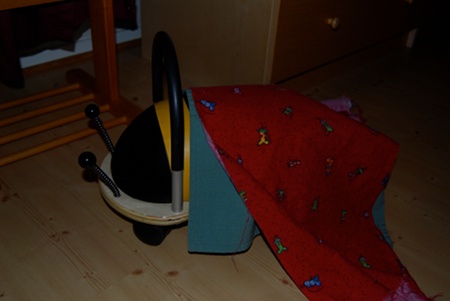
Wheelybyg, bedded down for the night

She has fun with language and words. Quite often she sings to herself: sometimes real songs, sometimes just nonsense words to a random melody. We play a game where she makes up nonsense words, preferably really long ones, and then I try to repeat them back at her. The word can be anything from “kveya” to “gananga-nanga-nii”, and sometimes I find them rather unpronounceable.

Favourite movie: Coraline (“koyoyine”). I think she’s actually starting to distinguish some words in the English-language movies she watches. One day she was shuffling some papers around and intoning, “Bobinsky, Bobinsky, Bobinsky…” just like Coraline does when sorting letters. Today she picked up “fist!” from Kung Fu Panda (“Maybe you should chew… on my fist!”) It would be cool if she learned to speak English before she started school.

Favourite books: nothing in particular, or rather, many of them. We’ve been to the library a few times, so we’ve had some new books to read (and of course when we first read them we have to read the same book at least three times in a row, more likely five) but we’ve re-read many of the old ones.

Random fact of the month: she has decided she now wants to sit on a grown-up kitchen chair like us, not her highchair. However when we go to a restaurant she always asks for a highchair. Go figure.

Thirty-six months; three years. This morning we had a cupcake with candles, and a present, and the Swedish “happy birthday” song. There was more hoopla about her birthday at nursery (the birthday song again, plus wearing a gold crown during their morning music session, plus her photo on the door, plus balloons). Then in the evening various sets of friends and relatives phoned us to wish her happy birthday. And we have two birthday parties planned for this weekend – one for family, one for her friends.

Ingrid’s number one focus this month has been her friends. She loves playing with Julia and Elin, more than any other activity, and would happily spend every single afternoon at their houses. For a month now I’ve been wanting to take her to the library, but the days when the library is open longer in the evening always happen to be the same ones when we run into Julia when leaving the nursery, and inevitably she chooses playing with Julia over visiting the library. So we still haven’t been to the library.

Sometimes she just wants to be with them, not necessarily to do anything together with them. It’s enough to be in the same room and listen to me read the same book. Or perhaps it’s just fun to play with someone else’s toys, and read someone else’s books.

She likes Julia best, but she plays better with Elin. Last time we visited Elin, they ran off together for long enough to make me wish I had brought a book. They went outside on their own, and then came back and played with their toy china and food, and then something else.

Clearly she is becoming more independent – the first inklings I noticed two months ago were not a false dawn. When I cook dinner (and she isn’t in the mood for helping me) she doesn’t just hang around next to me but goes off and plays on her own. And she won’t always follow me when I tell her I’m off to do something or other in another part of the house.

But quite often she is interested in helping me cook. Tasting the ingredients, handing me things, turning on the kettle, putting chopped veggies in the pot, stirring. Pouring things where the quantity doesn’t have to be precise, and the liquid is thick: cream, oil, vegetable broth. Serving food when it’s done – she especially enjoys ladling up soups and sauces. She’s even started to learn how to use a real sharp knife, with relatively soft stuff like cheese, tomatoes, leeks etc, under close supervision, and with my hands over hers. At dinnertime she really enjoys taking out a match for me to light the candle. I can see that she longs to be allowed to strike the match herself, but she makes no attempts to actually do it. That’s one of the advantages of her not being very independent: I can let her practice with knives and matches without having to worry that she will get a chance to try them on her own.

There’s a lot of make believe going on when she’s playing on her own, or by my side while I do something else. “We’ll pretend that I am a mouse” or “it’s your birthday, and you will get a present” and so on. A common theme is reversing our roles: she pretends that she is my mummy, and tells me what she will help me do. She also pretend sings: makes loud nonsense noises in something that is supposed to resemble a melody. (She can sing for real, too – this is different.)

Little Miss Medicine Man

When we play together, it is almost always one of two things: doctor, or shop. I don’t think there’s been a single evening without these two. The doctor game still follows a stable template, but the template has been mutating. Now it’s her foot that’s ill, more often than the stomach. And the patient (whether it’s me or her) needs to get a cuddly animal to hug, and a piece of toy candy when the doctor is done.

A few weeks ago I bought some toy money for her, and since then, playing shop has been another huge favourite. This game is slightly more varied than the doctor game. We have toy shops, and food shops, and cuddly animal shops. We even have shops that sell doctor’s equipment. We take turns being shopkeeper and customer, and we make up prices for the stuff we sell. We have a stool as counter, and a bowl for the shopkeeper to put money in, and a little purse for the customer. When the customer runs out of money she just grabs some more from the shopkeeper’s bowl.

When Ingrid is shopkeeper, most things tend to cost one, two, or maybe rarely three kronor. Sometimes she cannot come up with a price and I can pretty much name my own price. “Does this cost 5 kronor, perhaps?” She’s noticed that the coins have numbers on them, and I’ve been suggesting prices that are either 1, 5 or 10 kronor (one coin) or a few 1-krona coins, to hint that there is some logic behind the whole thing.

Speaking of counting, we still talk about weekdays and time of day, but not at all as much as last month.

Fine dining: meatballs at IKEA

I don’t think we’ve done any drawing at all this month, and barely any painting or crafts. We hardly sing at all, although she has played with her triangle a few times. We do still read and watch movies. Favourite books: Pettson får julbesök, Apan Nicke och Raffi Giraff and Vem ska trösta knyttet?. Favourite movie for the last two weeks: Mickey’s birthday party.

A few days ago, Ingrid visited the dentist for the first time in her life. The dentist confirmed that all twenty milk teeth were present (the last two appeared during this past month) and spent the rest of the time telling me about all the things we shouldn’t do. I think ideally dentists would like people to live on water only.

Quite independently of the dentist we (or rather, me) are making an effort to cut down on the amount of sweet stuff she eats. Her afternoon snacks used to be pretty healthy but then somehow she got into the habit of eating her fill of biscuits every afternoon. I thought it would be a temporary thing, as with most her preferences, but it’s gone on for longer than I like, so I’ve put an end to it.

She no longer takes any daytime naps at home at all. I’ve been trying to convince the nursery staff to not let her nap there, either, but without much luck. As a result she usually won’t fall asleep until 9 or 9:30 in the evening, which leaves her tired most mornings. Weekends, she is very fond of lying in the bed for a long time after waking, cuddling up close to me.

The weather is chilly now, but the first half of this past month was still summery, and we spent a fair amount of time outside. Picking damsons was a favourite: Ingrid especially liked shaking the bush to make the damsons fall. It was particularly great if they fell on me or her. But picking the fallen fruit was also good fun.

We’ve also played in the play house that Eric built. Ingrid’s favourite use for it is a throwing platform. She climbs up, I stay outside, and then we throw a big inflatable ball between us. The play house makes it very easy: since she’s standing above me, she is throwing slightly downwards and has a good view of me, the target. And when I throw the ball back at her, the walls make sure the ball doesn’t roll past her.

She also likes riding her tricycle (to and from the playground, or Julia’s house). Practice makes perfect: she’s gotten quite good at controlling her speed. She used to need help braking when going downhill, but now she can ride it down good-sized hills at considerable speed, and push back against the pedals to brake when it goes too fast.

In general she’s gained physical control and confidence recently. She used to always want to hold my hands when jumping down (from a ledge, or a stone, etc) but the other day she jumped down from a knee-high step (my knee, not hers) without any help at all. The same goes for stepping across wide gaps: between the balance beams at the playground, or the big flat stones in the pond in our park. I think she’s running better, too: it looks slightly more balanced and less toddlerish.

Running, of course, means chasing. Our latest chasing game is the troll game. Usually she’s a troll and I am to run away from her. Sometimes she wants to be an angry troll, which means that I should run fast enough so she cannot catch me. Other times she says she’s a friendly troll, meaning I should let myself be caught. But in either case, and regardless of which of us is the troll, the most important part of of the game is that the chasee should frequently look over her shoulder to see how close the troll is. This leads to a fair few falls: I think Ingrid has entered the age of ever-present scabs on knees and elbows.

Ingrid remains intensely social. Yesterday she told me, “I don’t want to go home. I don’t want to be alone. I want my friends, too!” So I try to find her a playmate for at least a few afternoons each week. Julia is her best friend (and lives closest to us) but Ingrid’s found another favourite at nursery whom we’ve also visited a few times. I’ve asked if there are others she’d like to play with, but she says no, she only likes Julia and Elin.

They are definitely playing together, but it’s mostly limited to simple, physical activities. They might run to the trampoline and jump together, and then run to the see-saw together, and from there on to somewhere else. I haven’t seen any playing with toys together. I think it might be because both Julia and Elin are younger than her, and less used to playing together with others.

Sometimes “let’s go play with Julia” just means “let’s go to Julia’s house” and ends with us reading Julia’s books. I think we might start going to the library with her. Her Estonian feels solid enough that I’m happy reading to her in Swedish now.

At home, the doctor’s equipment set remains Ingrid’s favourite toy, by far. Other toys get occasional brief use, but not very much. She wants to play doctor every single evening. It’s become a set piece, almost. First I’m ill and she’s doctor, then we switch, and she’s always got a stomach ache. And when we take her temperature, it’s always fifty-one.

She’s quite interested in how numbers are used: temperatures, measuring, telling the time. She often asks me what time it is, and most mornings she asks me what day it is. Then she wants to know what that means: what do we do when it’s Tuesday, what do we do when it’s seven o’clock? Is it a weekday (“nursery day”) or weekend (“home day”)? Do we have anything special planned for today – is this the day when we go play with Elin, or the day when I need to work late? Sometimes we go on to hypothetical cases: she tells me “no, it’s half past eight! What’s it time for now?”

Turns out she’s learned to recognize numbers, too, even though we haven’t spent much time looking at them. This Sunday at the Estonian nursery she found a wooden number puzzle, with one piece for each number from zero to nine, and each number’s place was indicated by that number of things: there was one snake in the slot for number 1, two rabbits in the slot for 2, and so on. She got almost all of them right at first try (but 6, 8 and 9 were a bit tricky).

Another subject of fascination is buttons – the kind you press, not the ones on clothes. She likes pressing the buttons to make the traffic light go green, and doorbell buttons, too. But she also finds pretend buttons in all sorts of places: on lamp posts (to make the light go on), on her bike (to make it go), on playground equipment (to make the light go green, so she can go on and play).

And phones: she makes many phone calls on the toy phone they have at nursery, and on mine. She can repeat my side of the most important conversations (the ones where I call Julia’s mum to ask if Ingrid can come play with Julia) almost verbatim.

When she’s done that, she seems to believe that she really has called Julia’s mum, and insists that I don’t need to call, she’s done it already, and Julia’s mum has said yes. The border between truth and fantasy is fluid. When we play doctor, she is well aware that it’s make-believe sickness and make-believe medicine. But when she talks about things that aren’t physically present, she makes no difference between things that really happened, and things she has made up because she wishes they were true.

Somewhat related, I think, is her interest in what other people are thinking. When we pass someone in the street, who’s doing something noteworthy, she will ask me: where is he hurrying? why is she running? what are they talking about? I tell her I don’t know, but he might be hurrying to the train station, or to the market; and she adds her own guesses.

In general she’s asking more complex questions now. It’s not just “what is this”, “where is the spoon” and “can I play with this” but also “which station do we get off at”, “what did you just ask daddy”, “what is a folding rule” etc.

Speaking of questions, she’s already learned that when a stranger talks to her, they will inevitably ask for her name and age. So when someone asks a question that she doesn’t quite hear or understand, she will attempt to answer one of those known questions, and tell them her age or her full name. (And she knows her full name, with all four parts in the right order, too!)

There’s a fair amount of focus on her being a big girl and helping me. And the reverse, too: sometimes she tells me she is a small baby and needs help. Sometimes when we’re eating fruit (such as raspberries) she wants to feed me, or vice versa ask me to feed her. Sometimes she tells me that when she was a baby she drank milk from my breasts – and other times she tells me that she’s my mum and I used to be small and drink milk from her breasts.

She understands that children grow bigger, and then they go to school, and then they grow into adults. When asked, she can tell me that girls grow into mummies and boys grow into daddies. But I don’t think she’s quite understood it yet:

Kui mina suureks saan, siis saab minust emme. Ja kui ma veel suuremaks saan, siis saab minust pappa.

When I grow up, I will be a mummy. And when I grow even bigger, I will be a daddy.

Favourite books: Alfons, and Kringel (one of Eric’s old books), and Palle üksi maailmas. Favourite movie: Leiutajateküla Lotte.