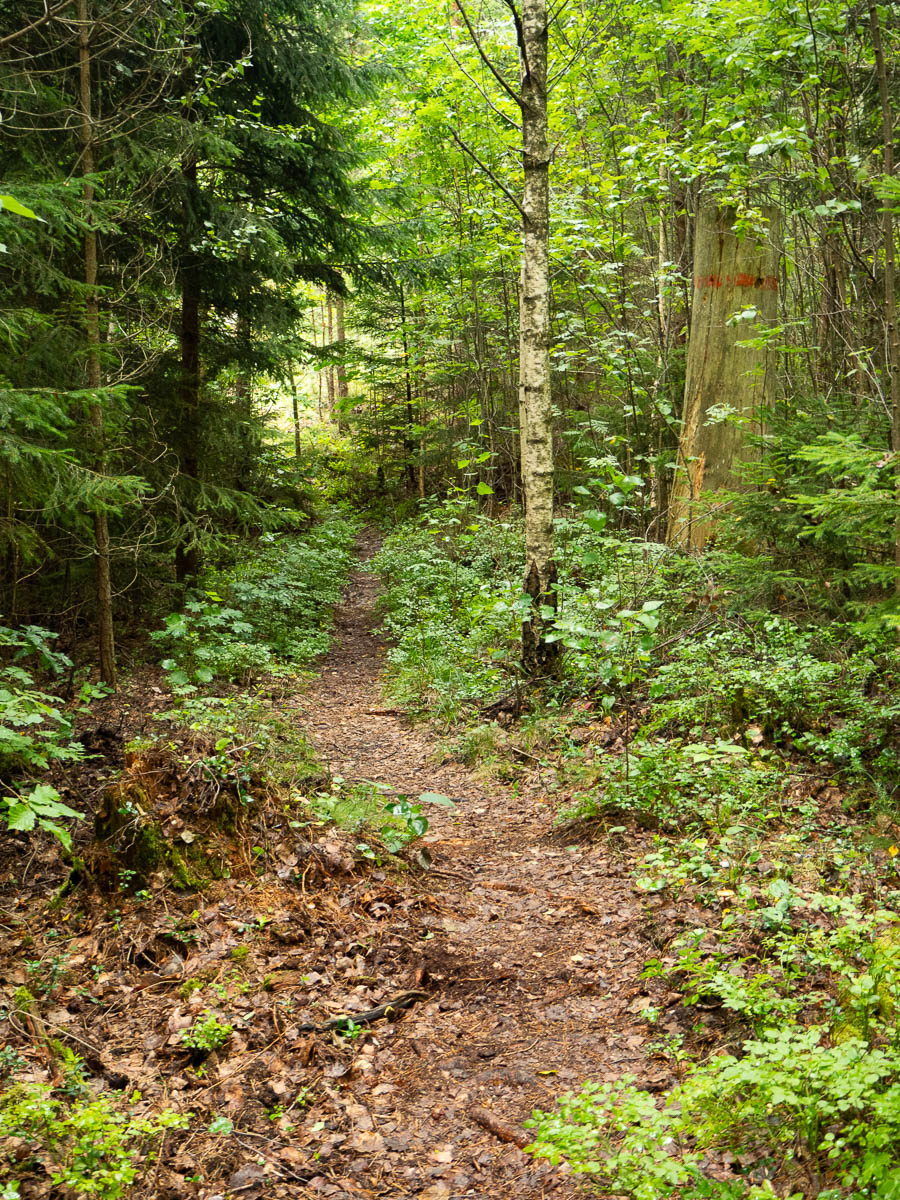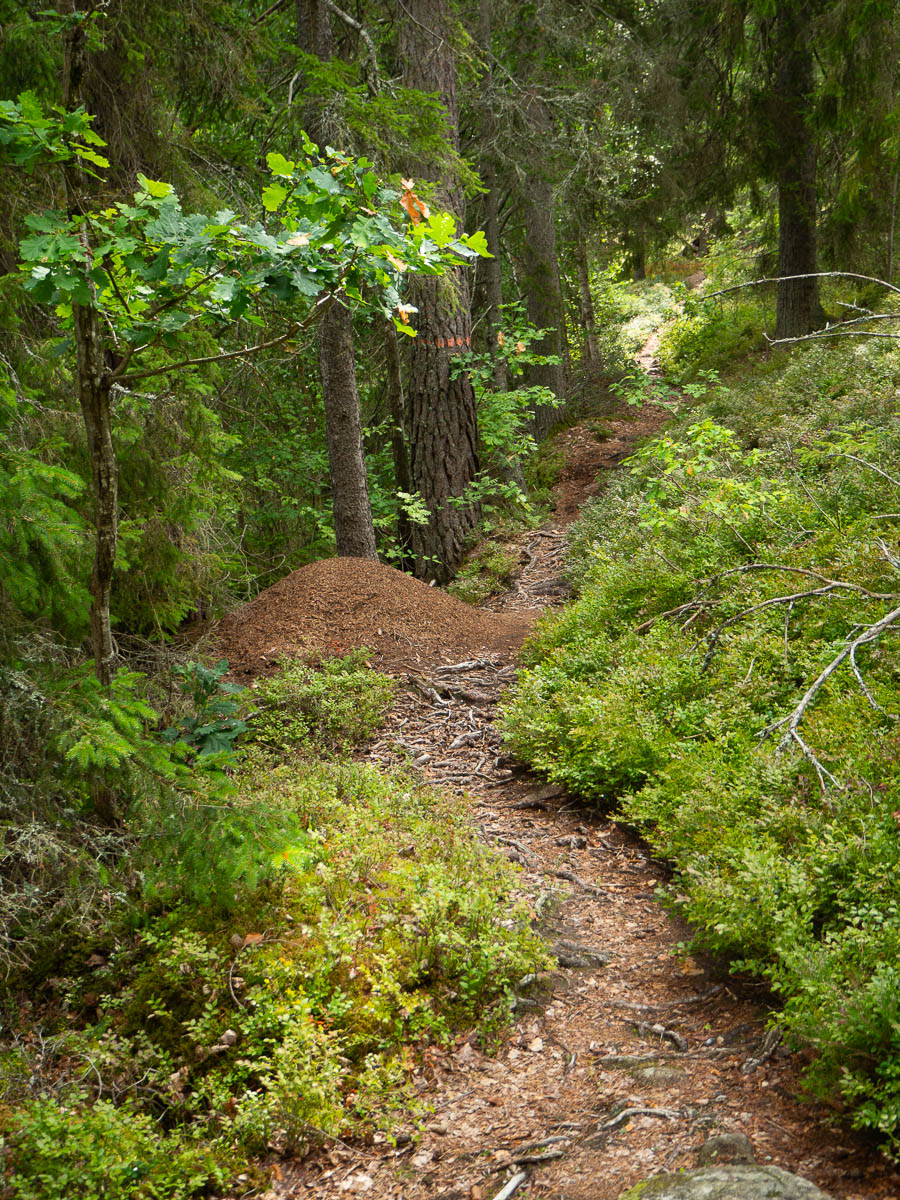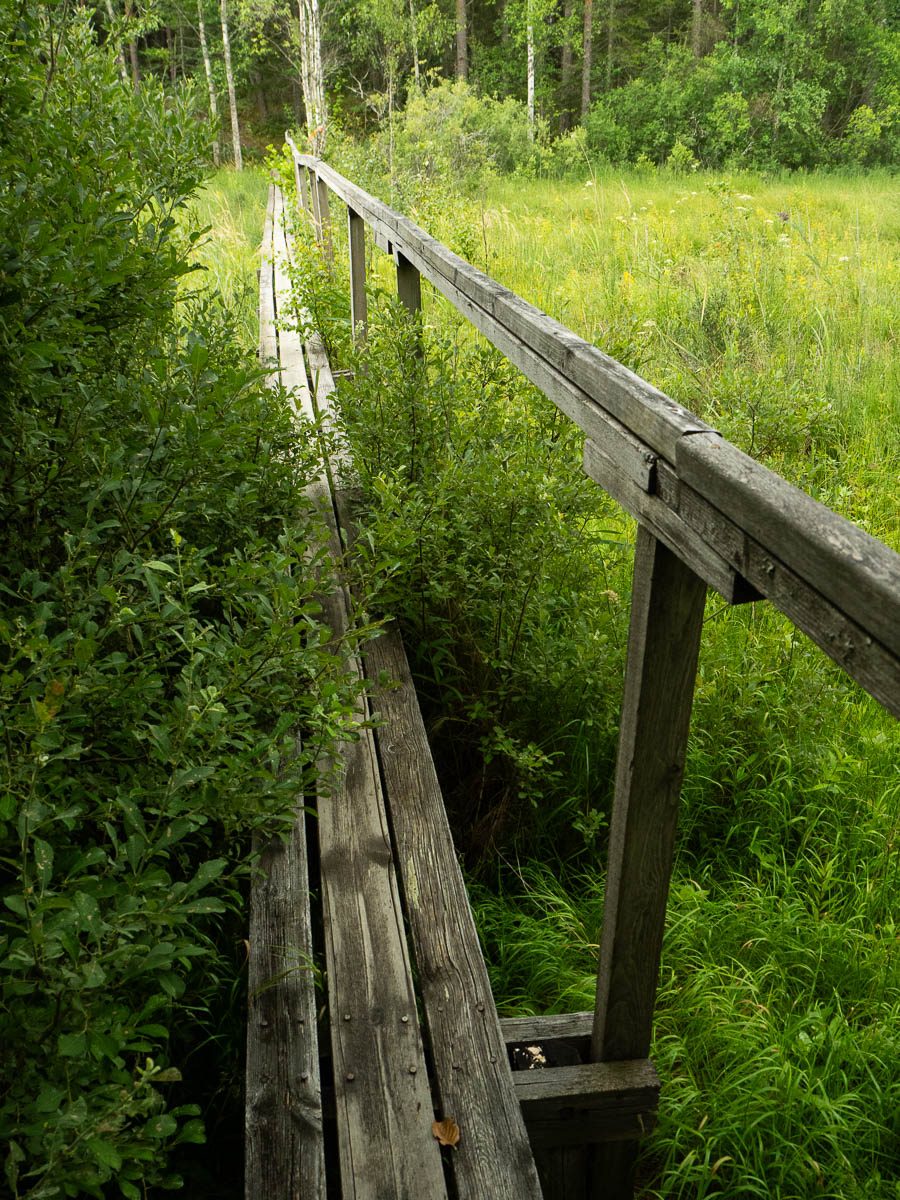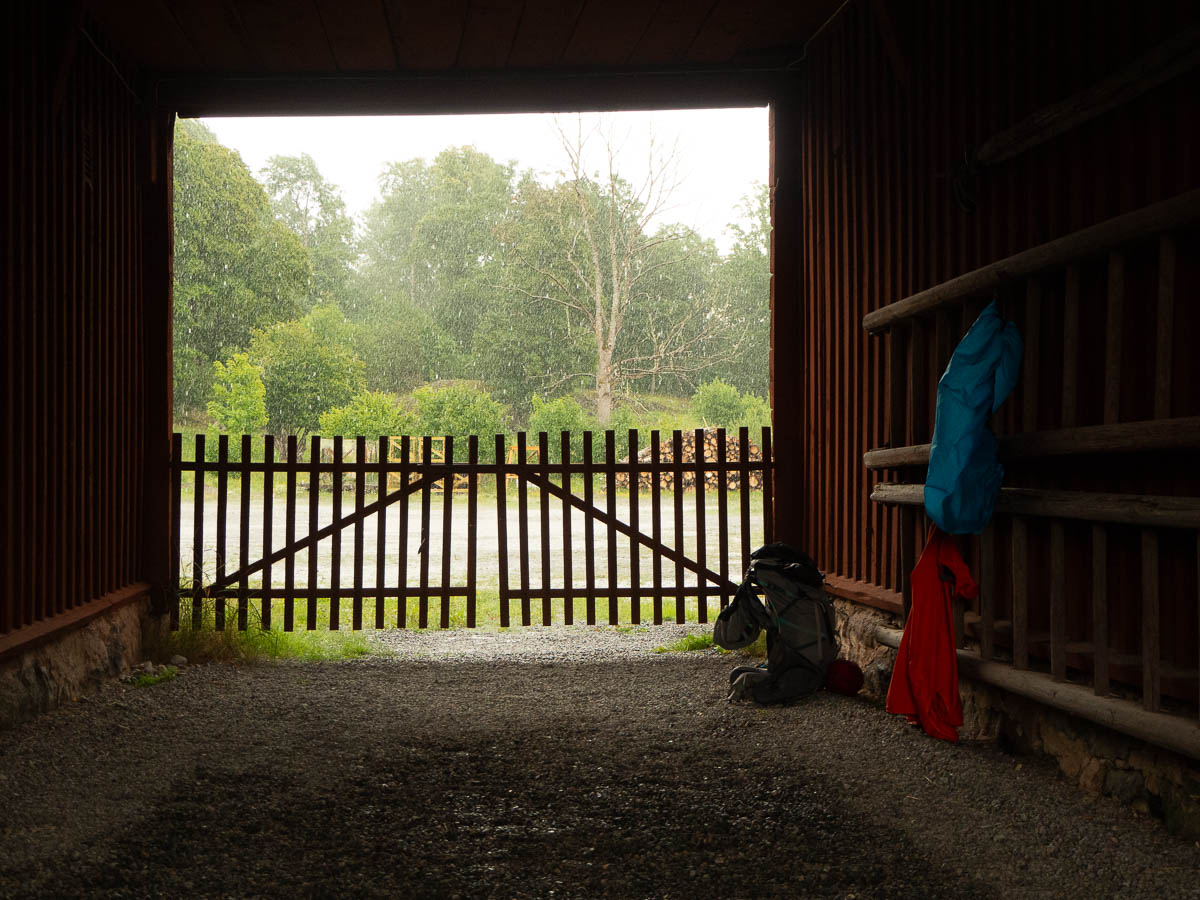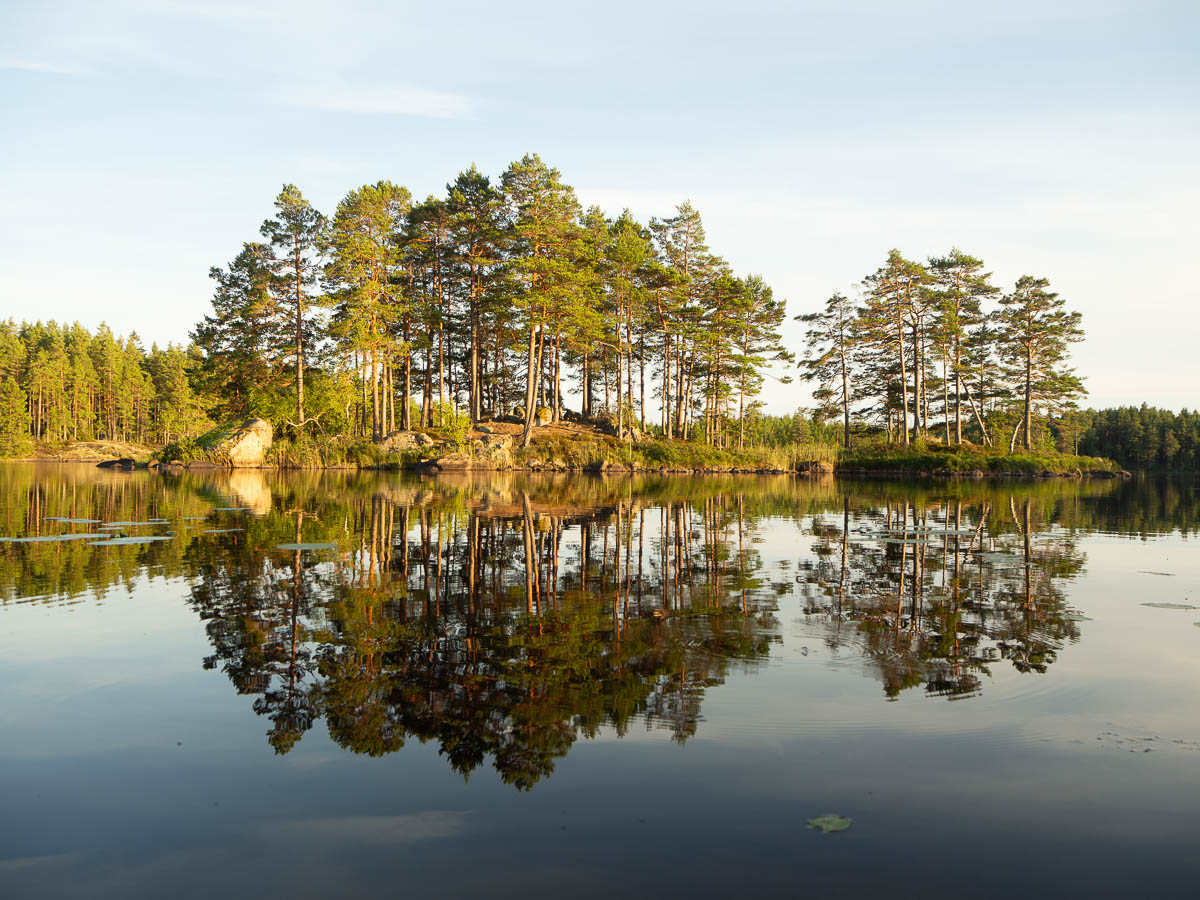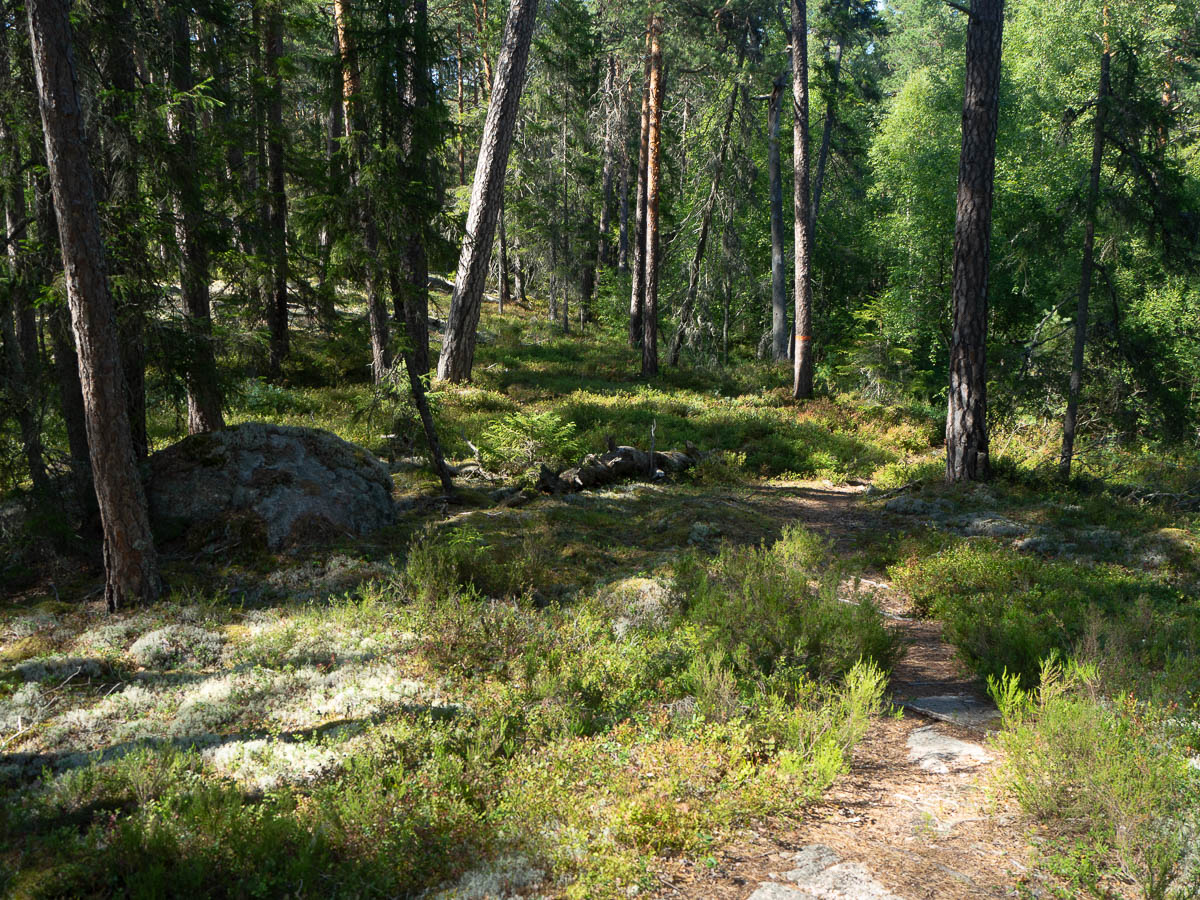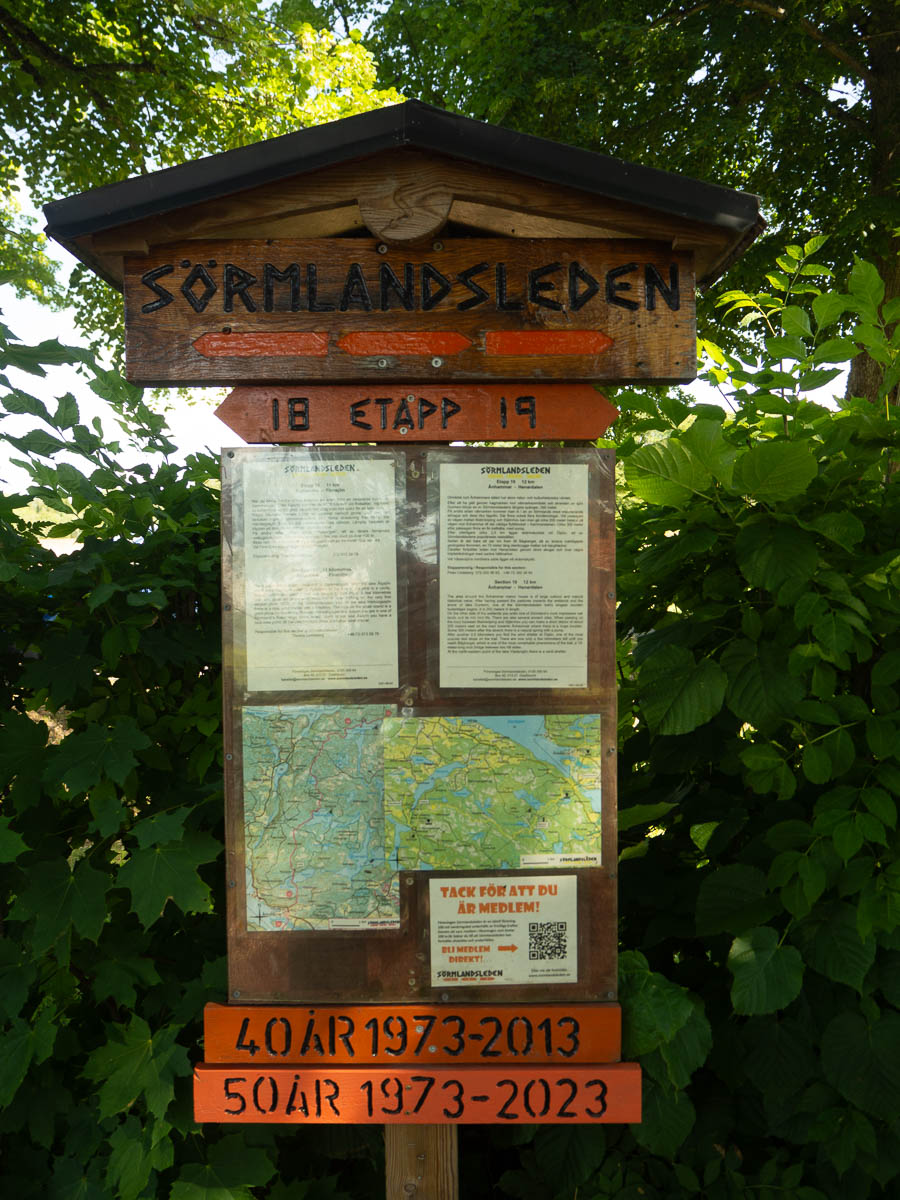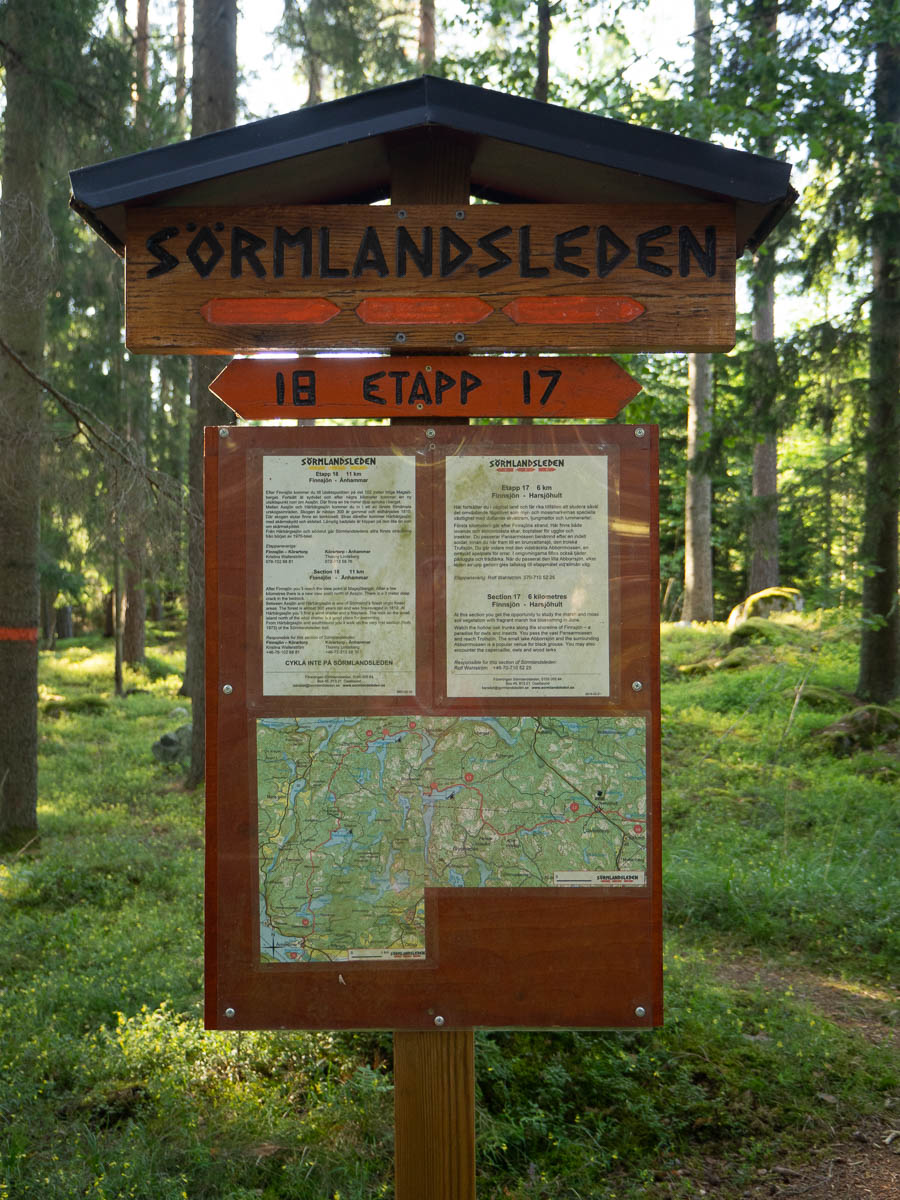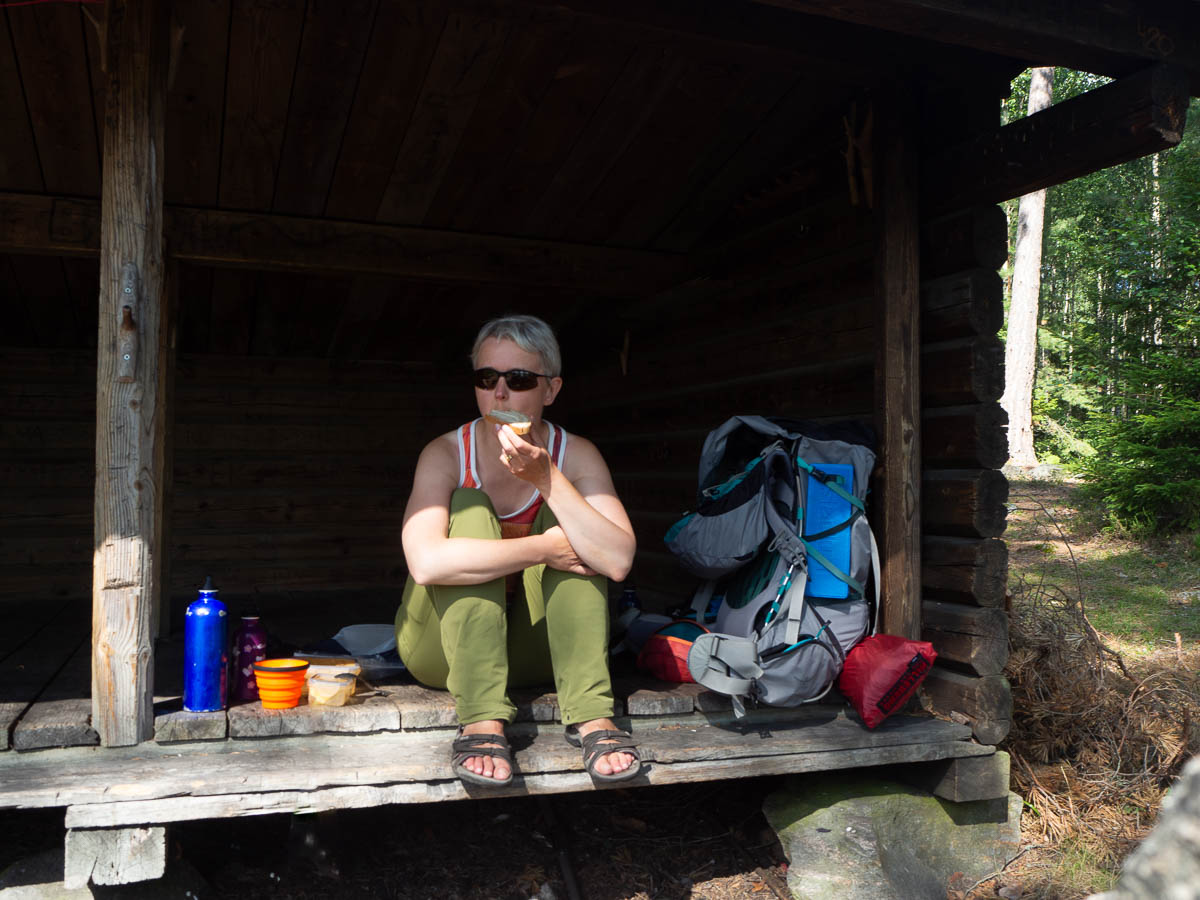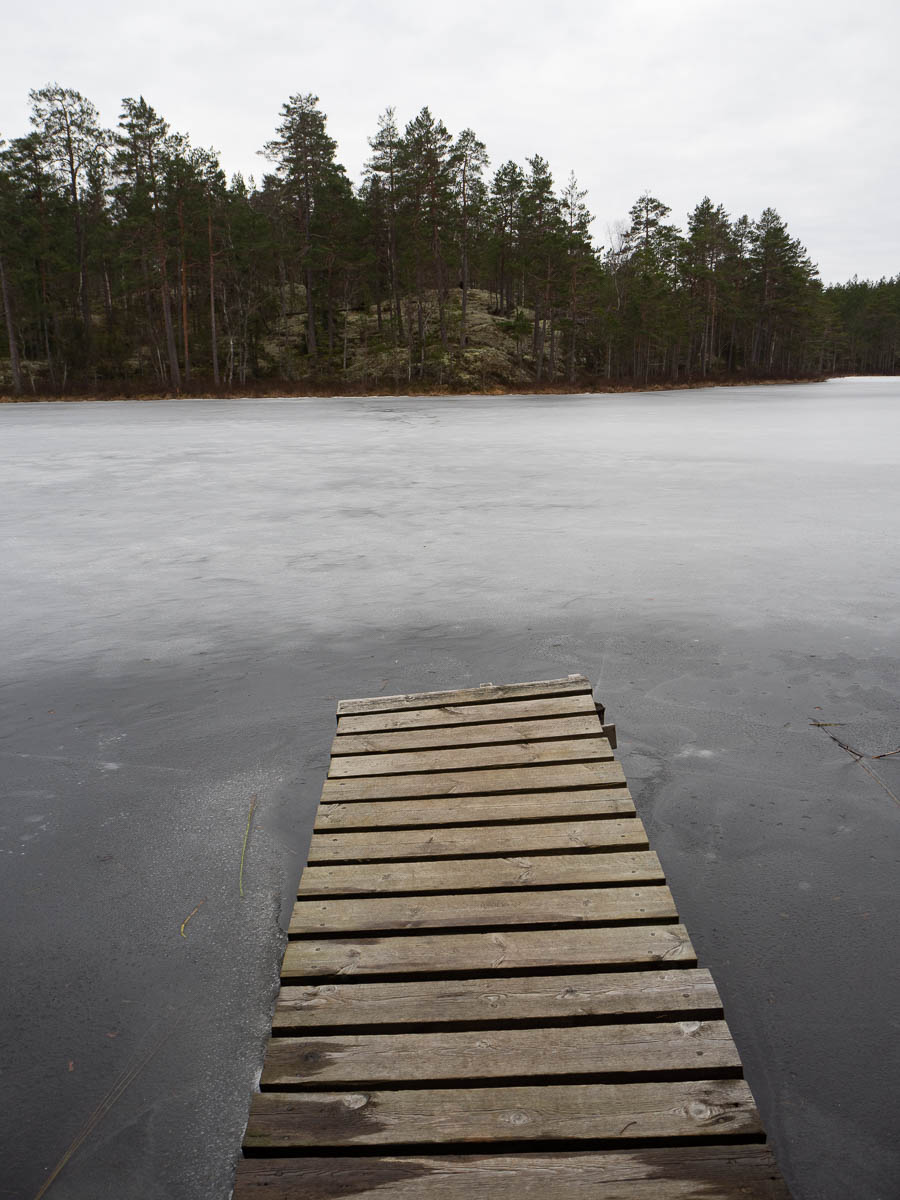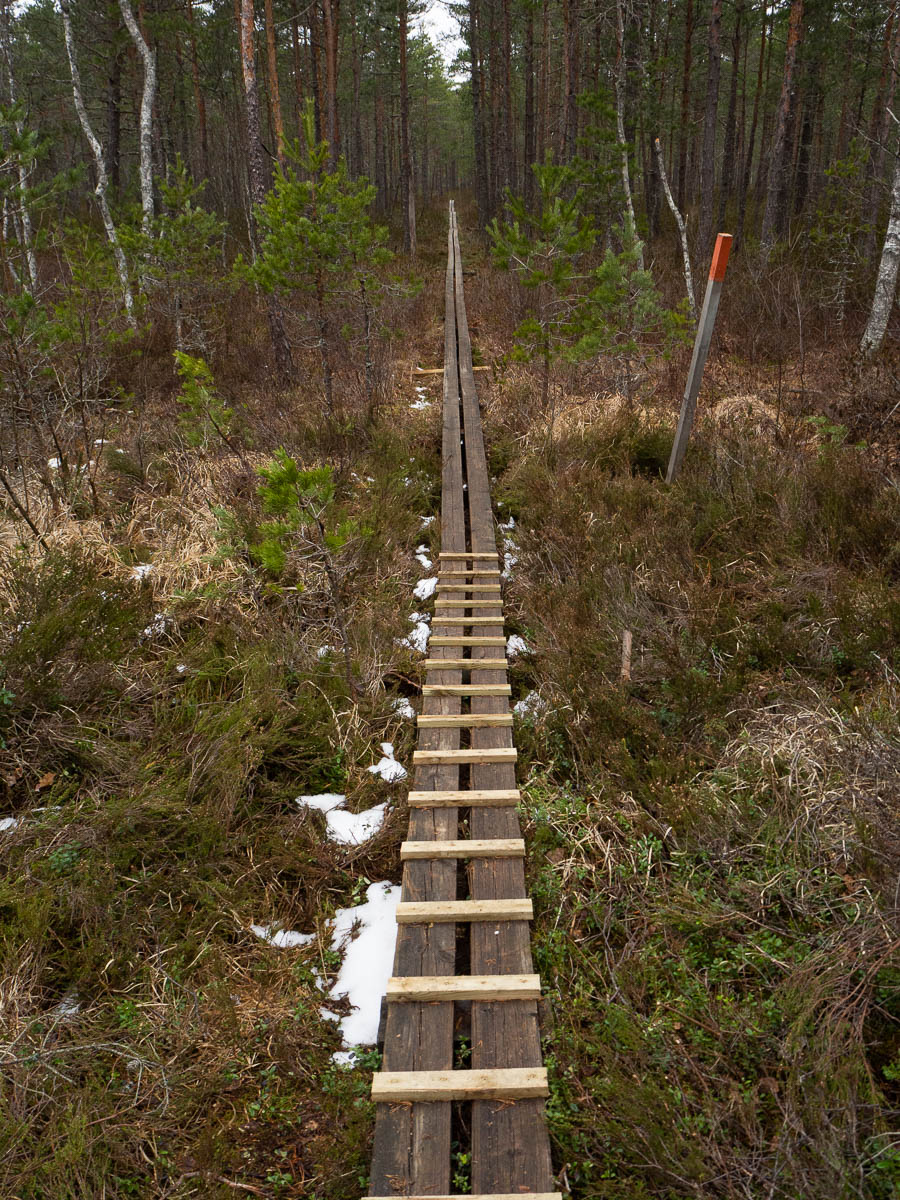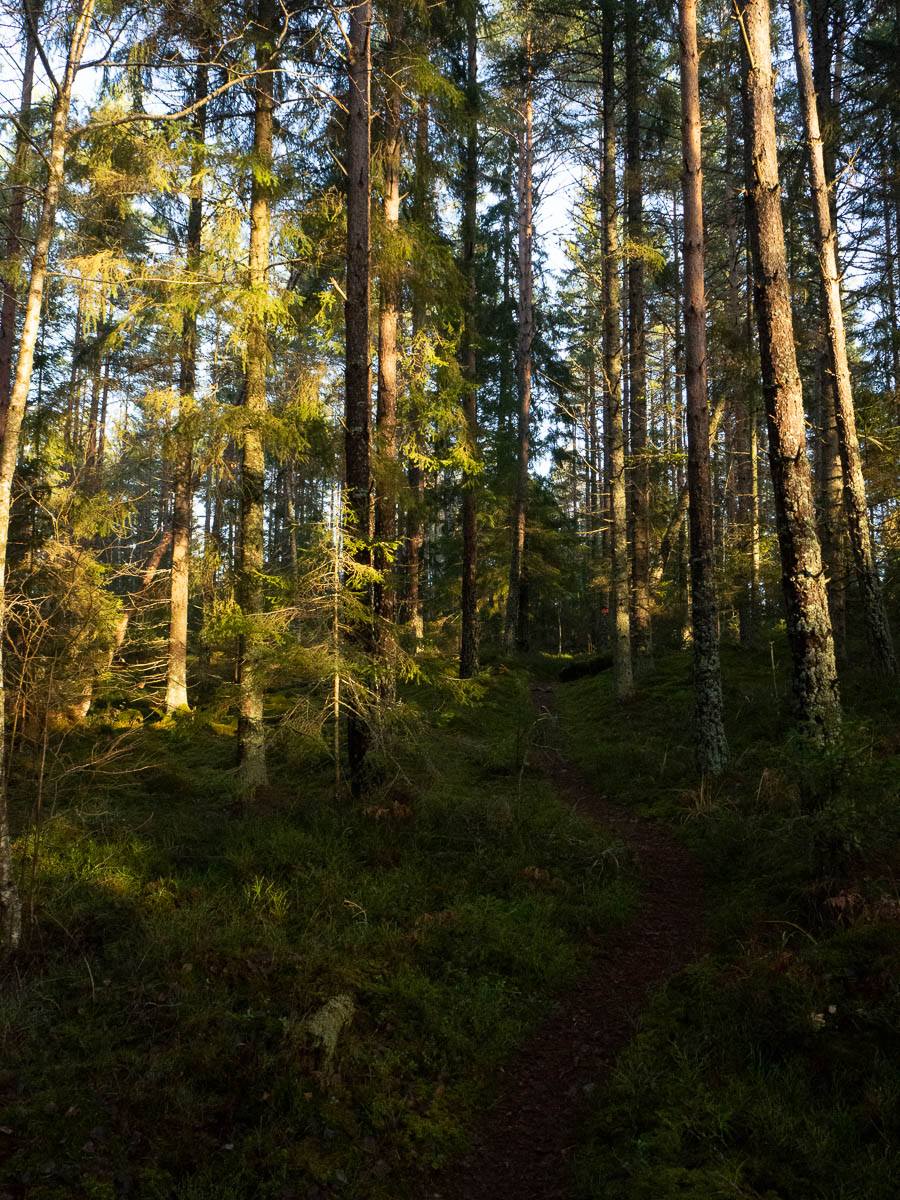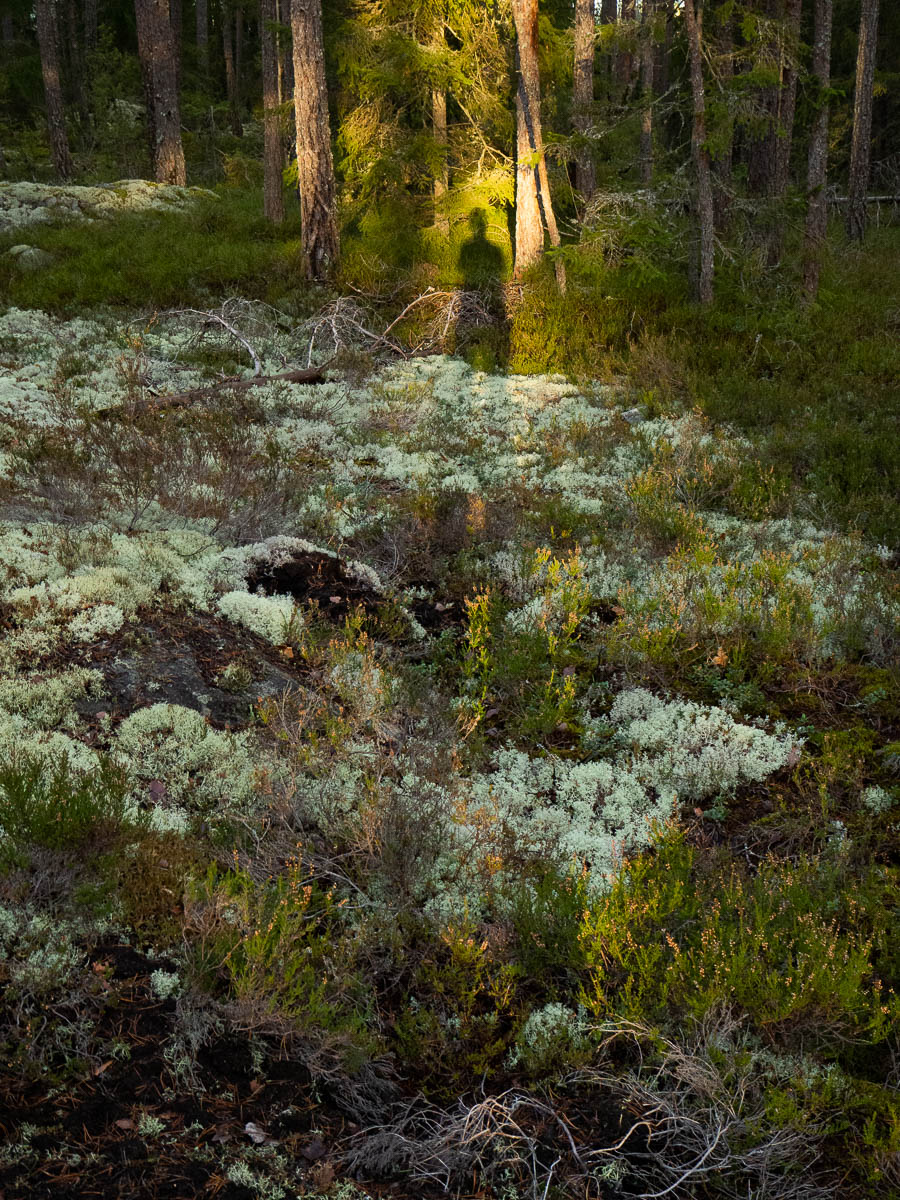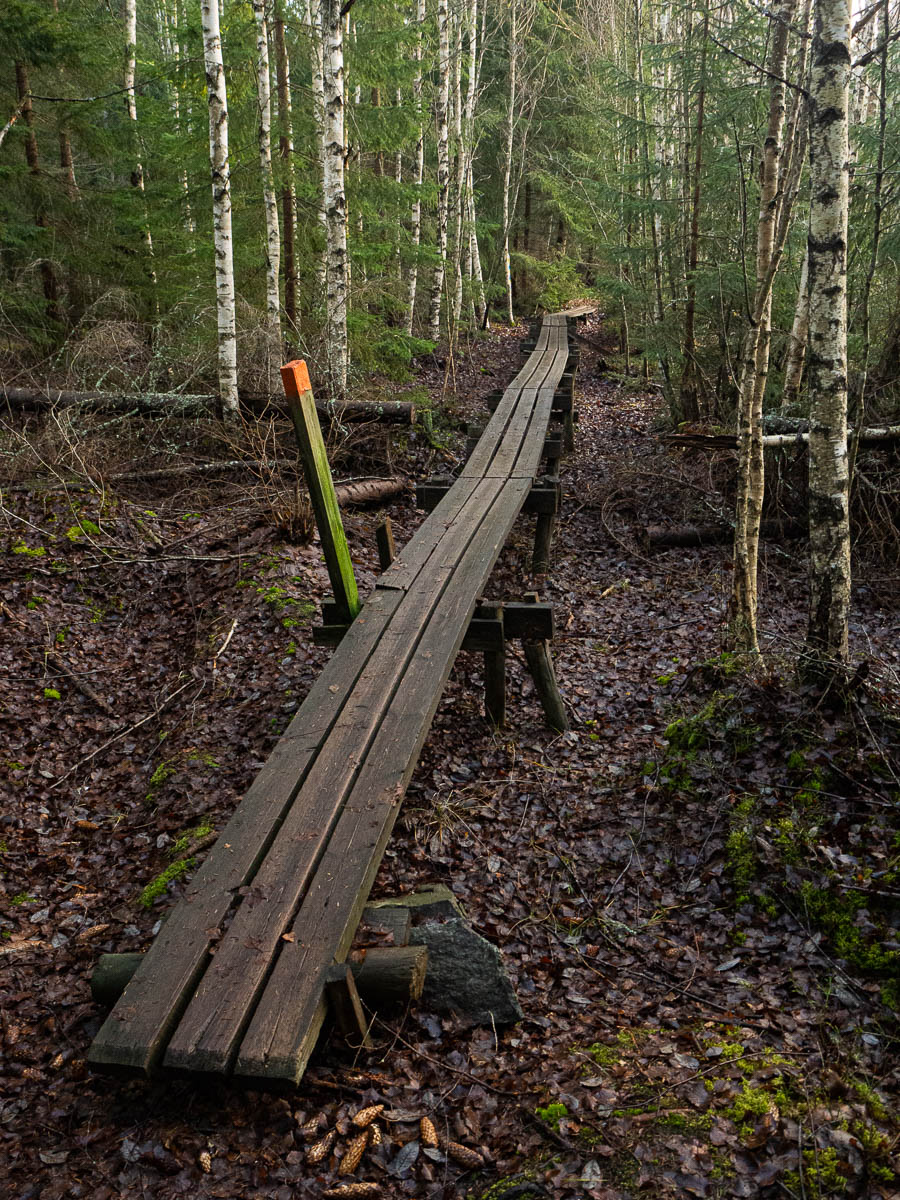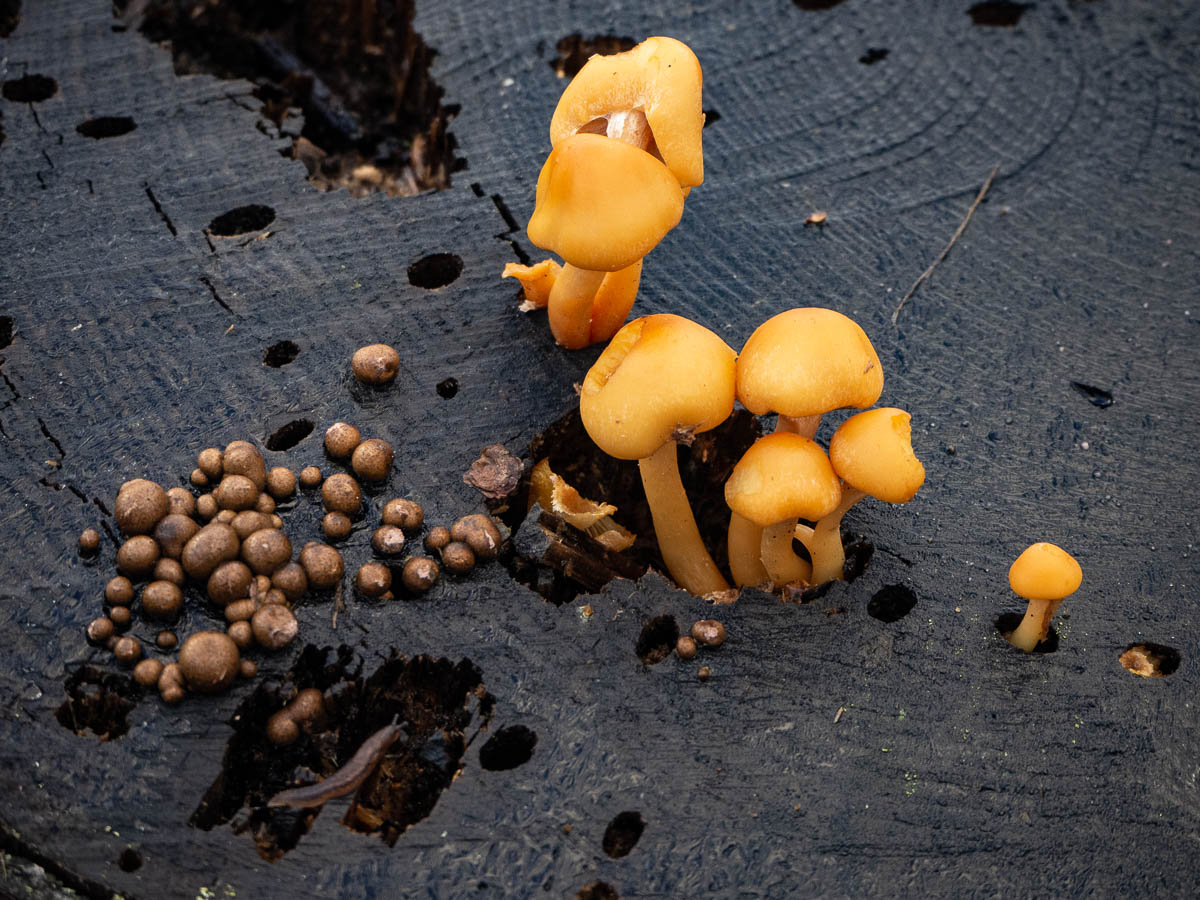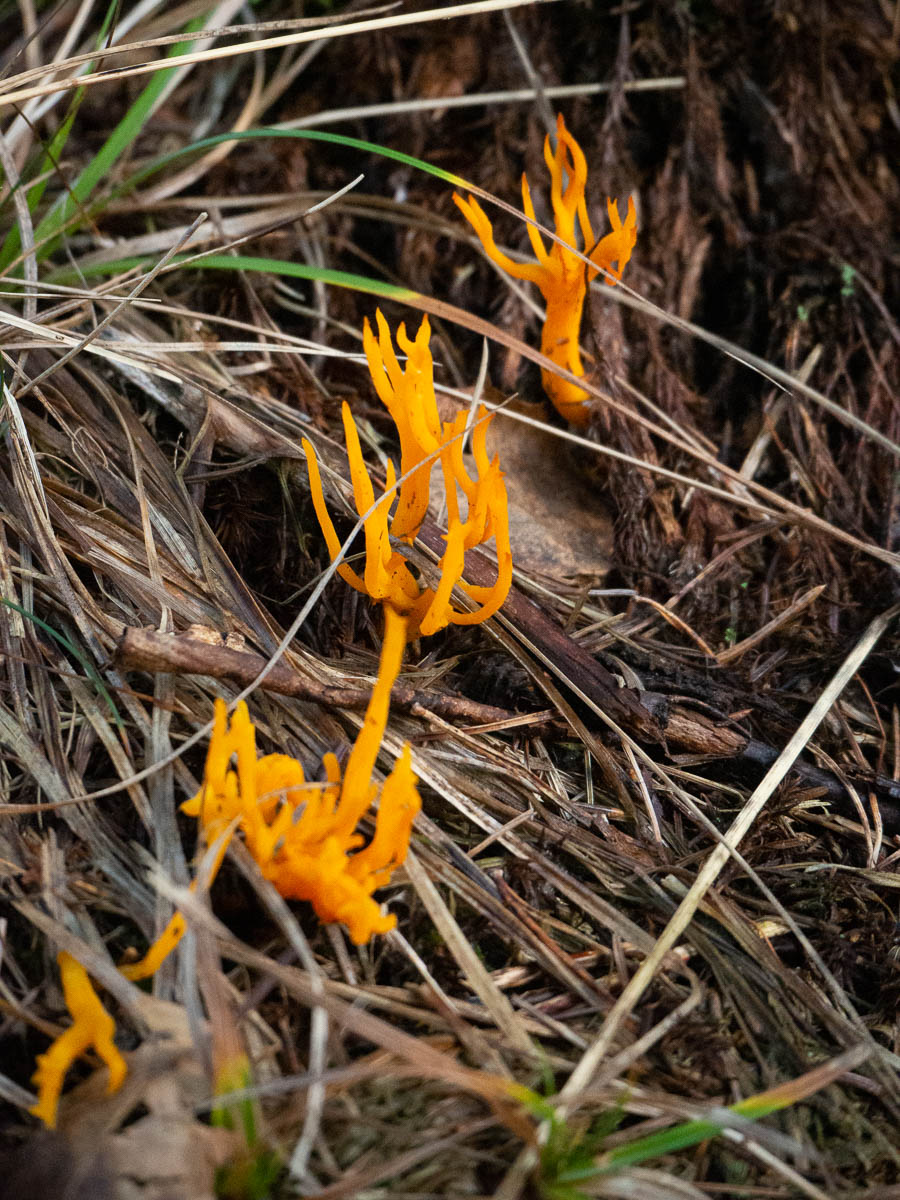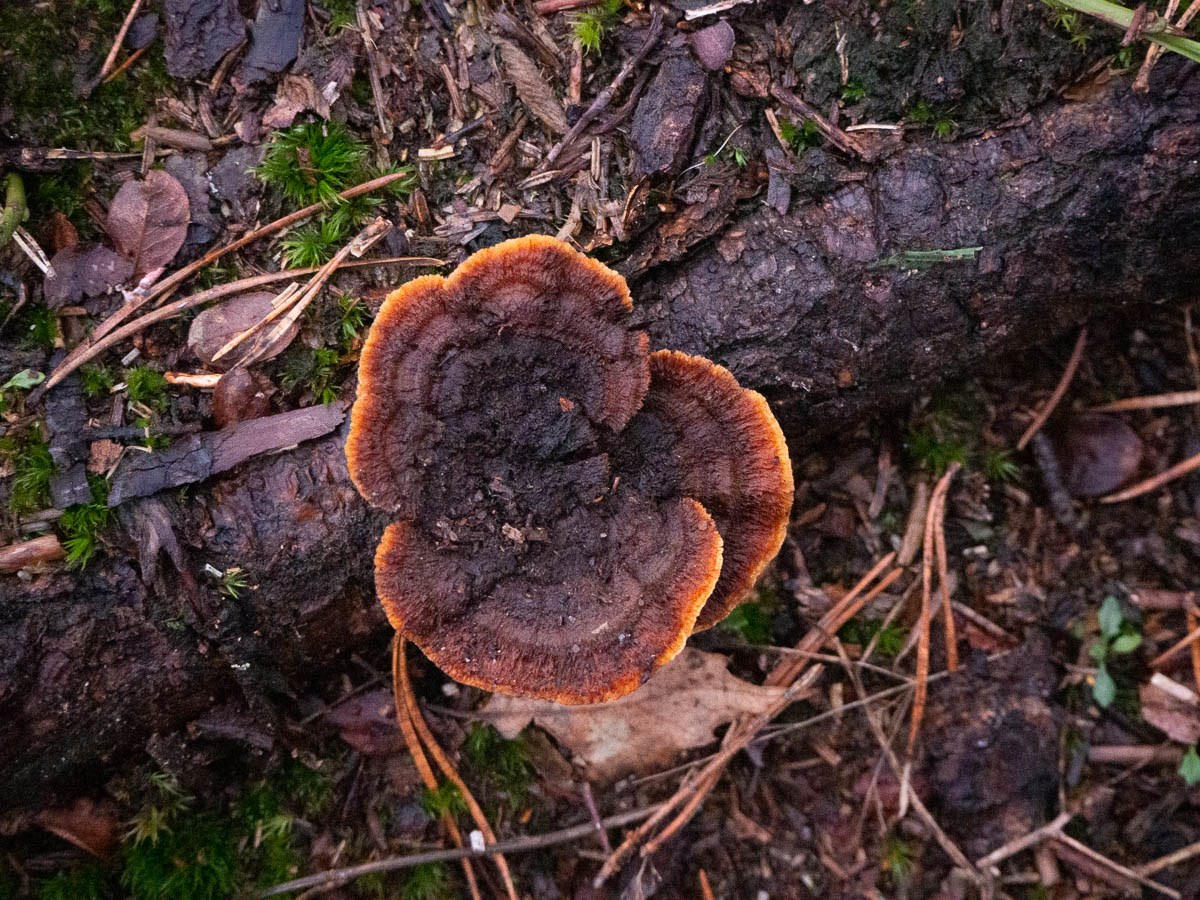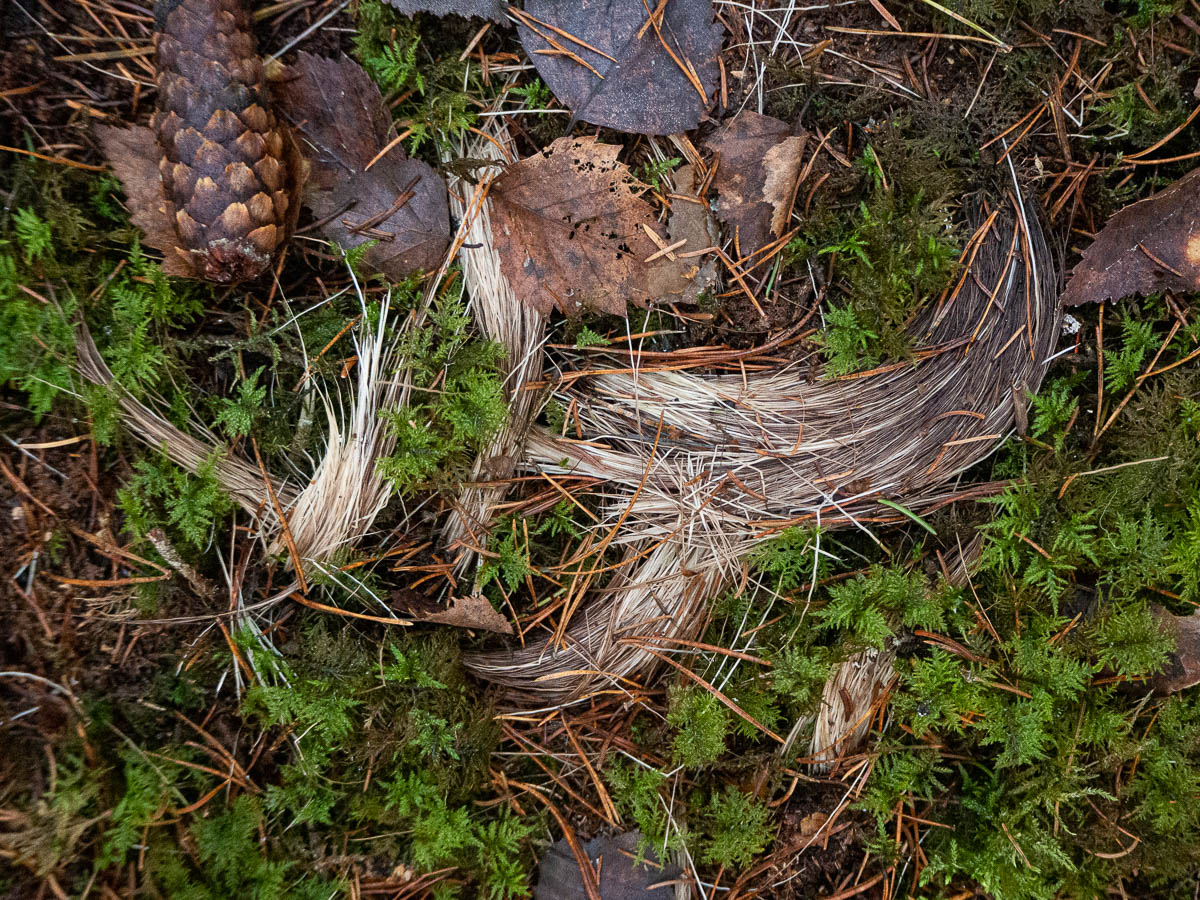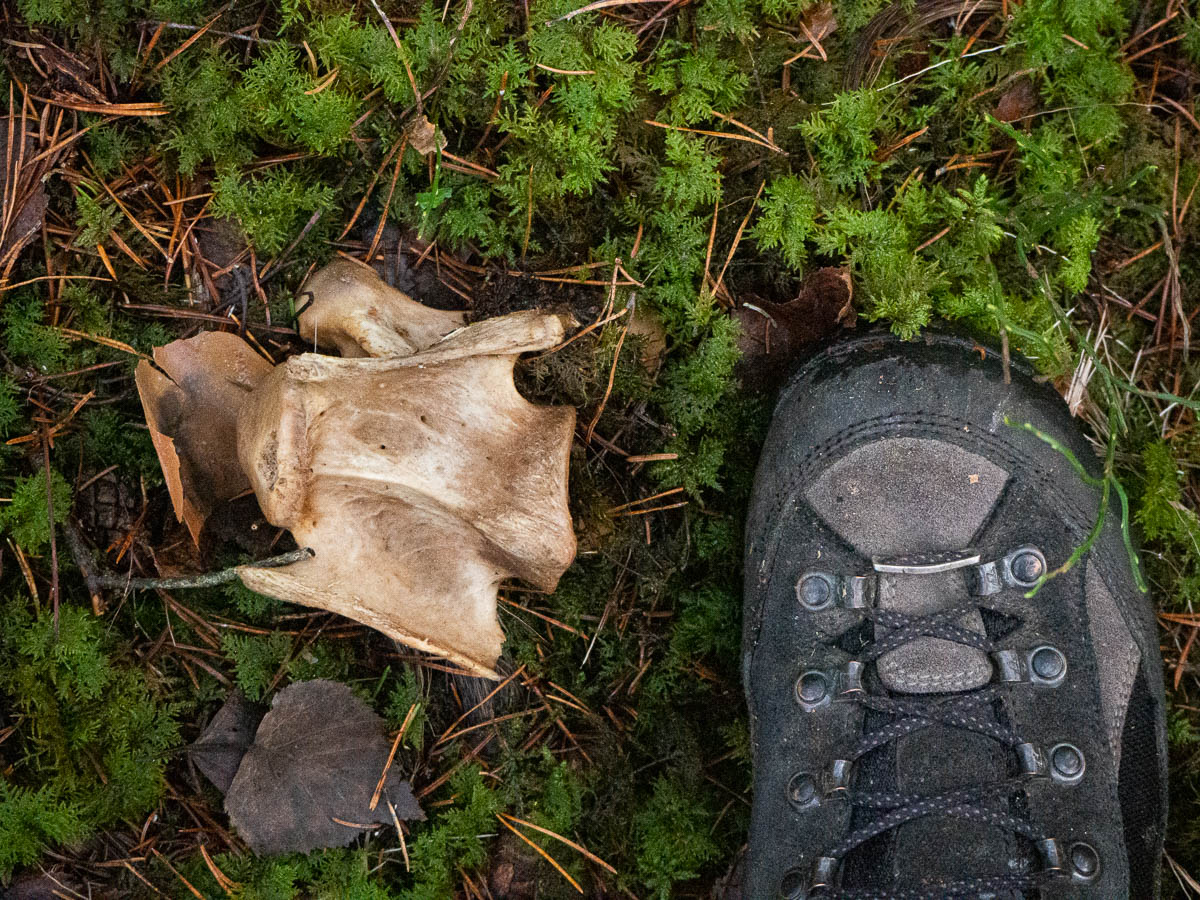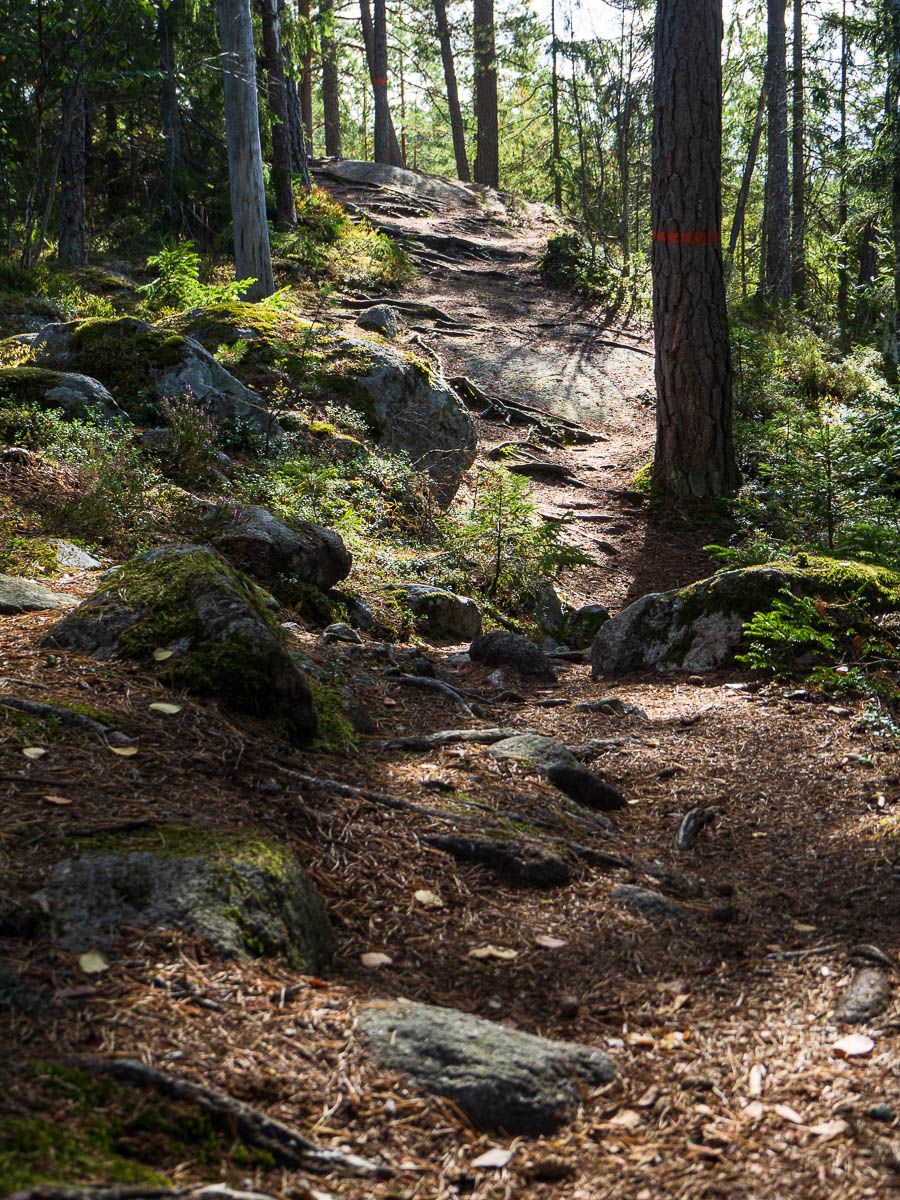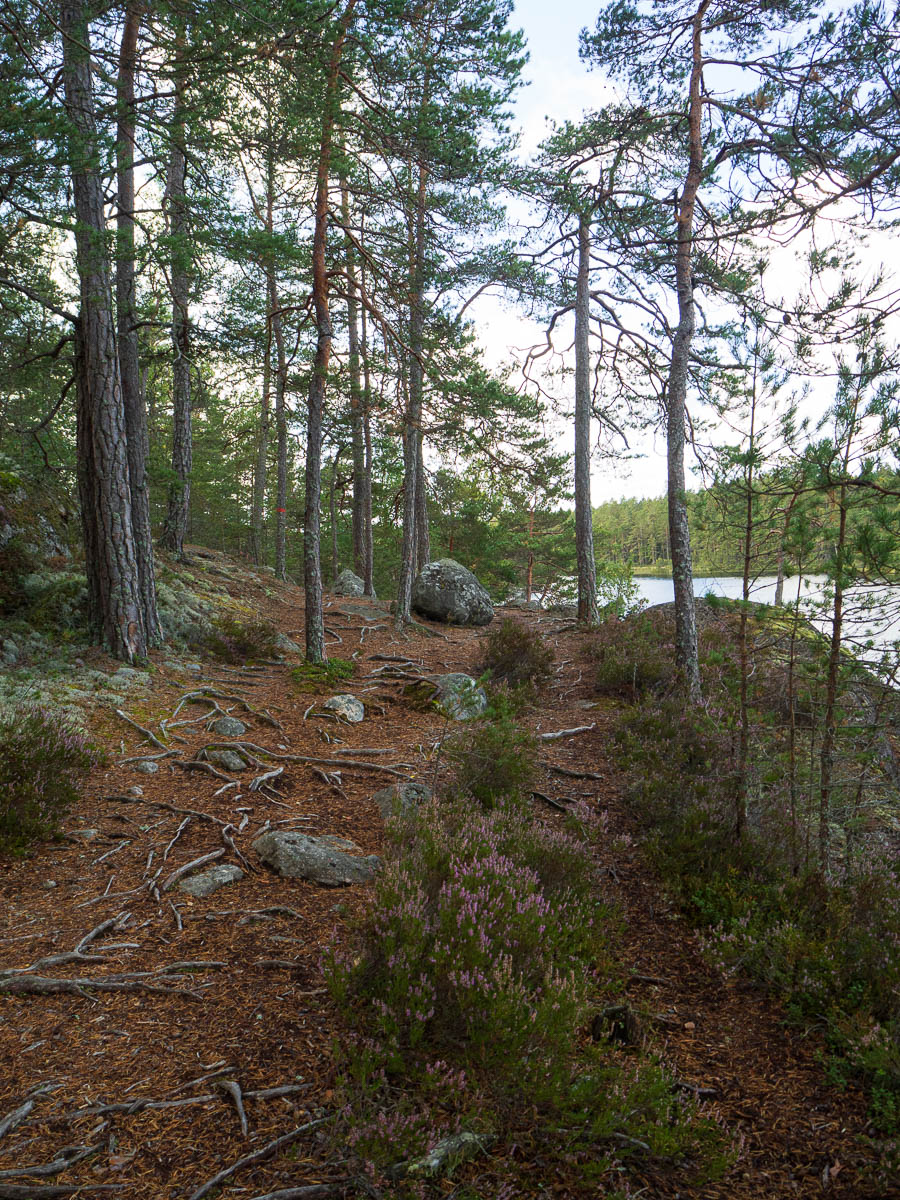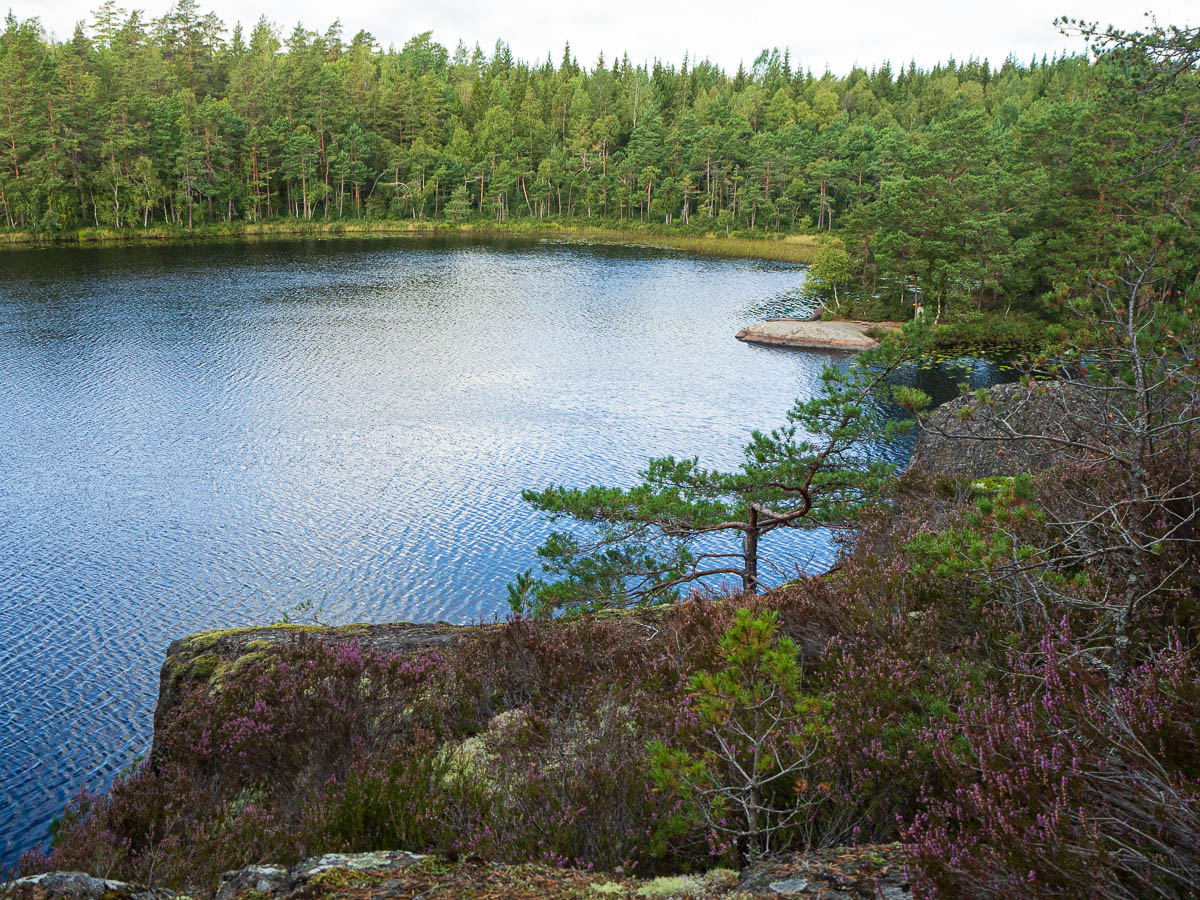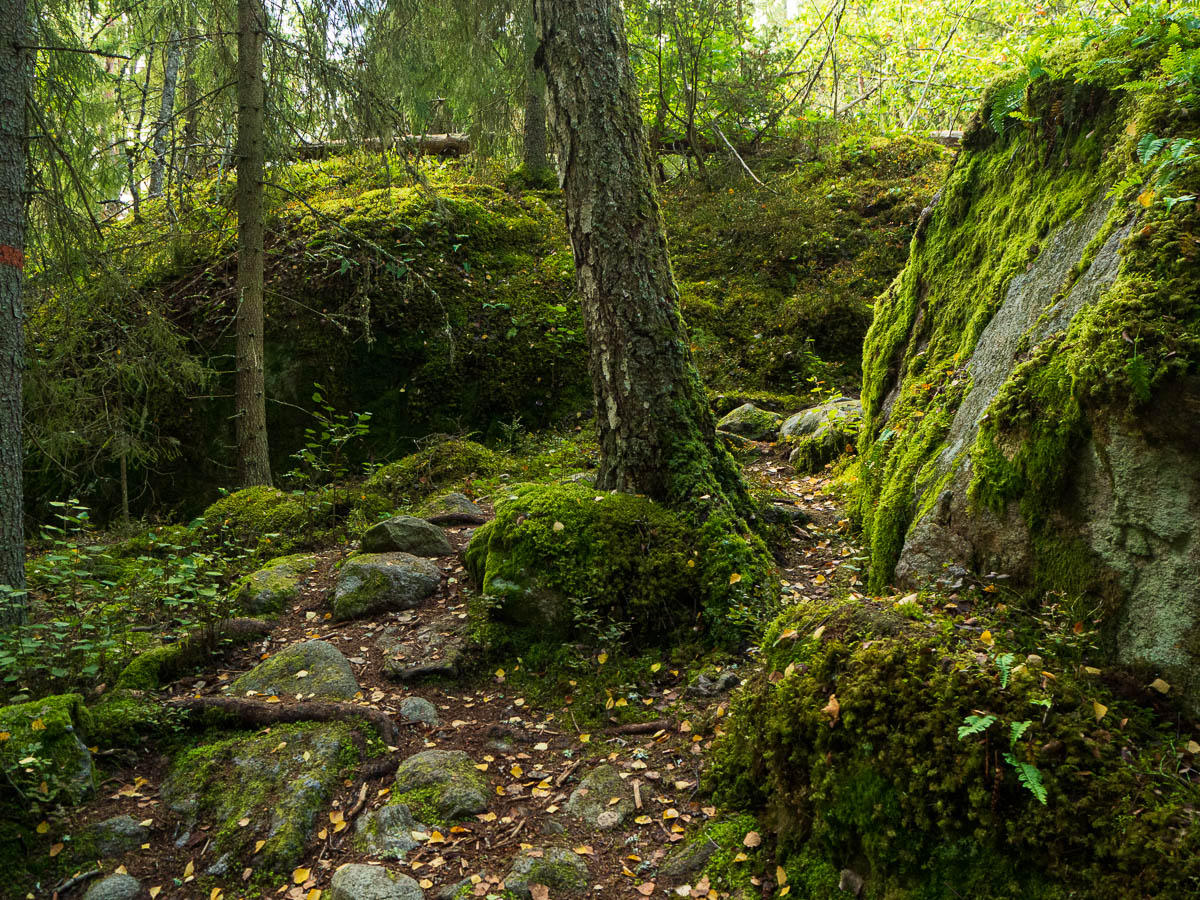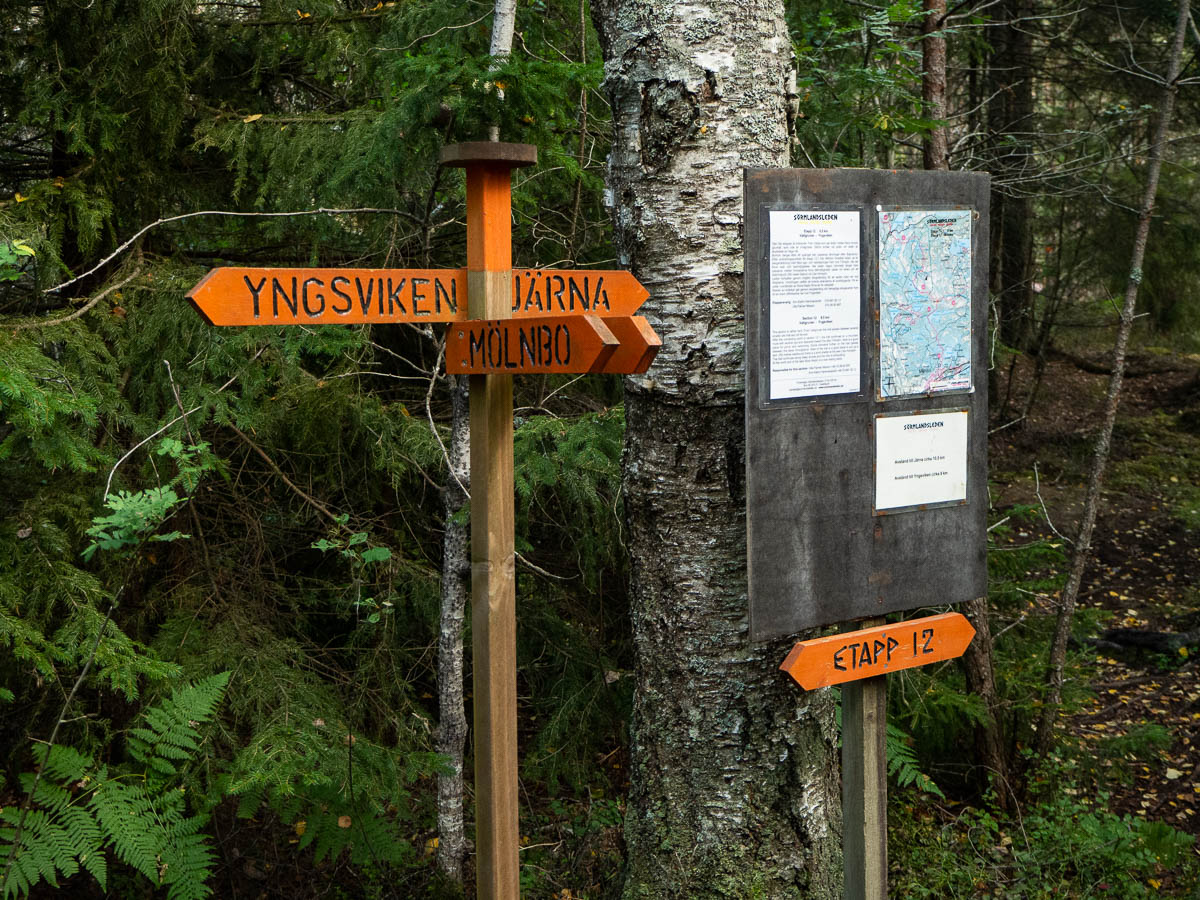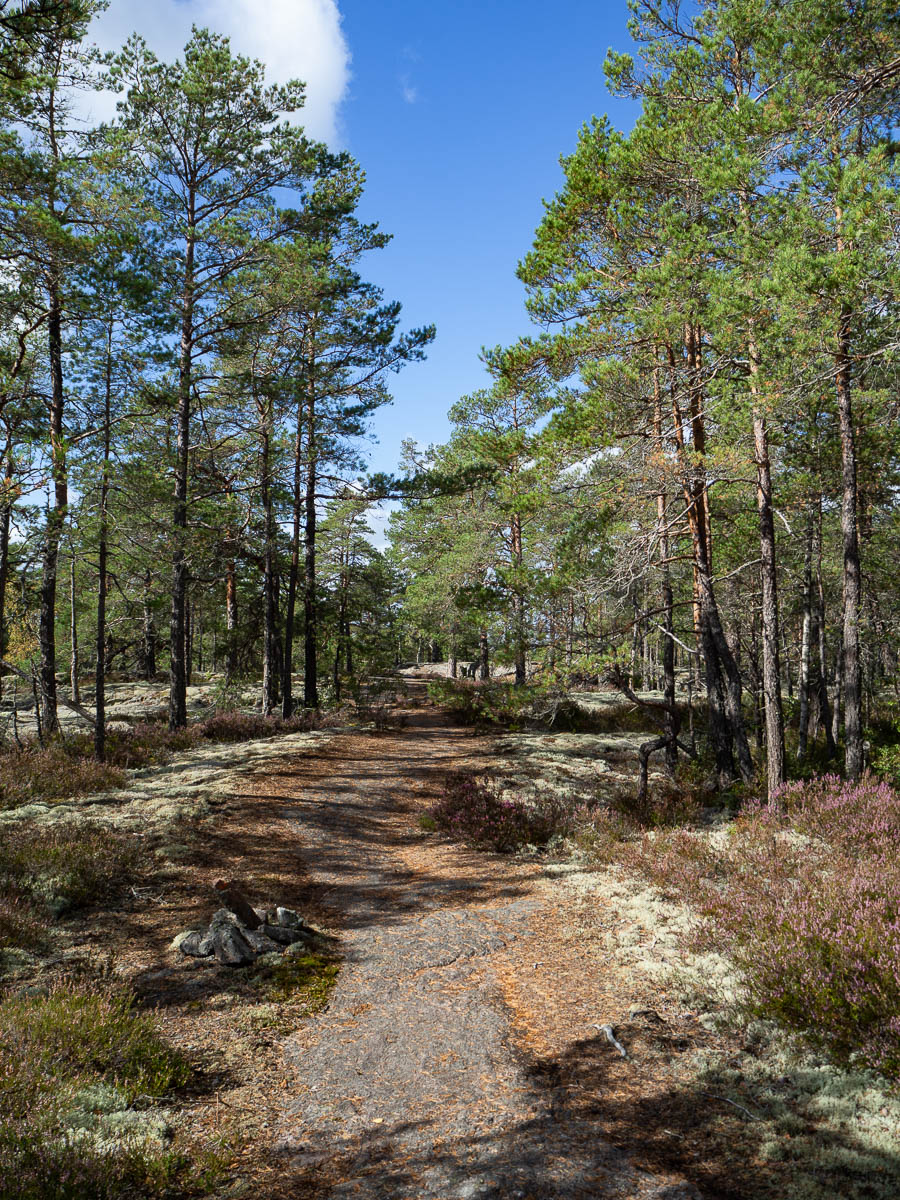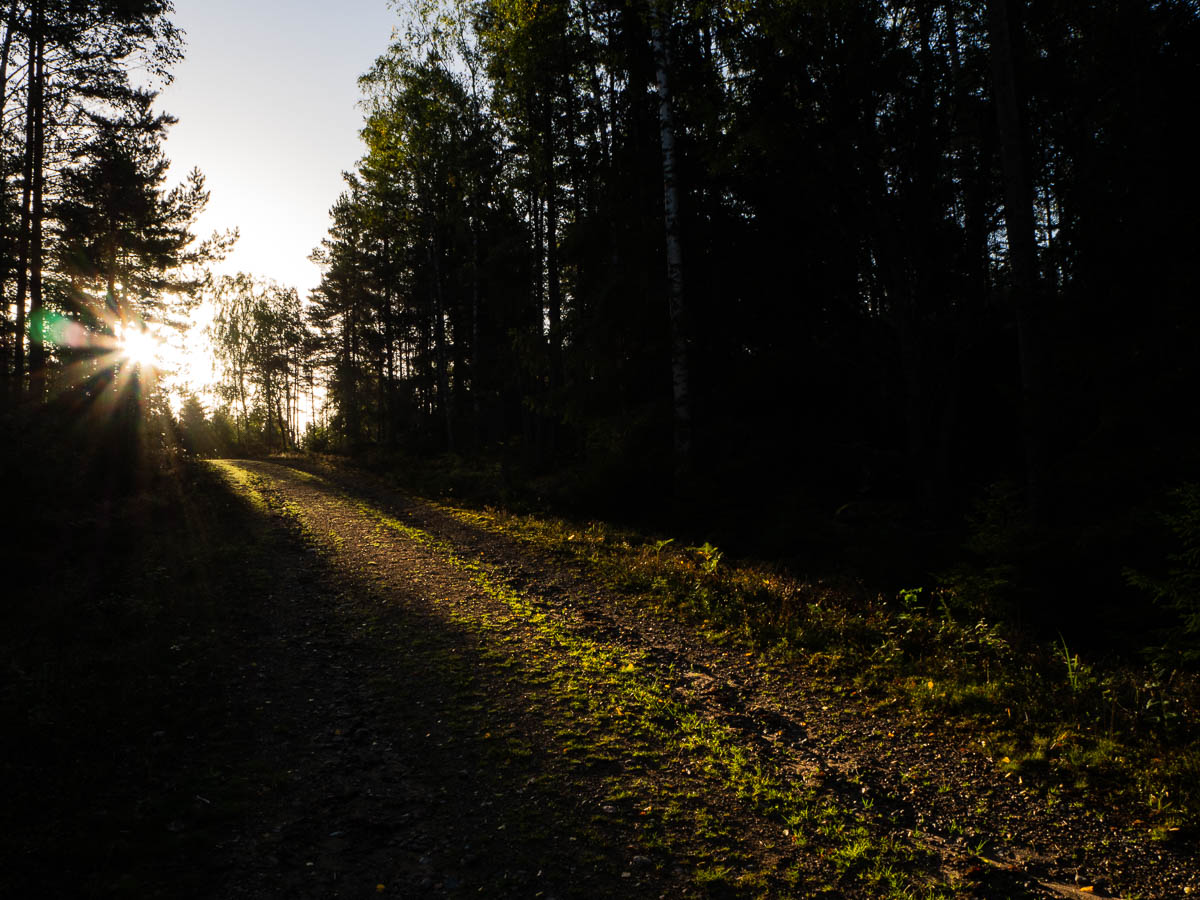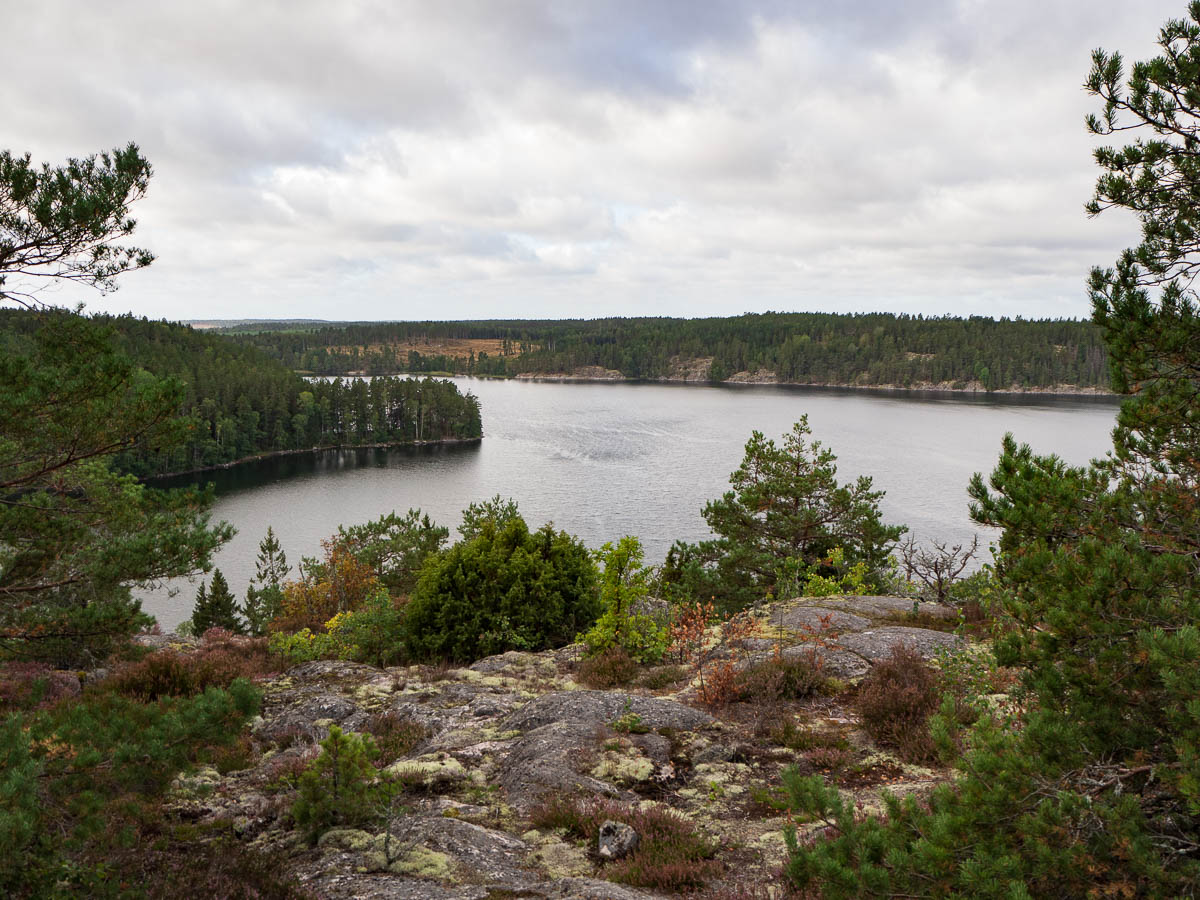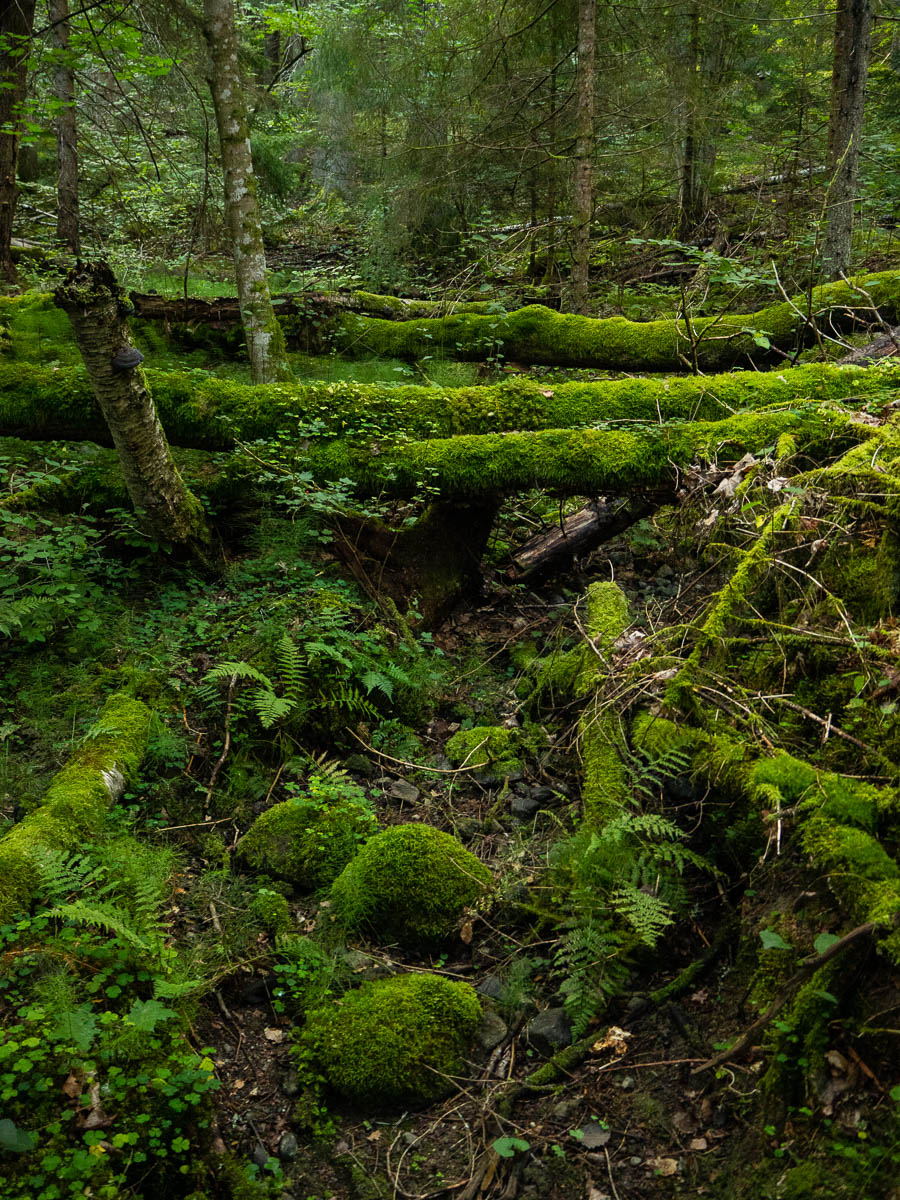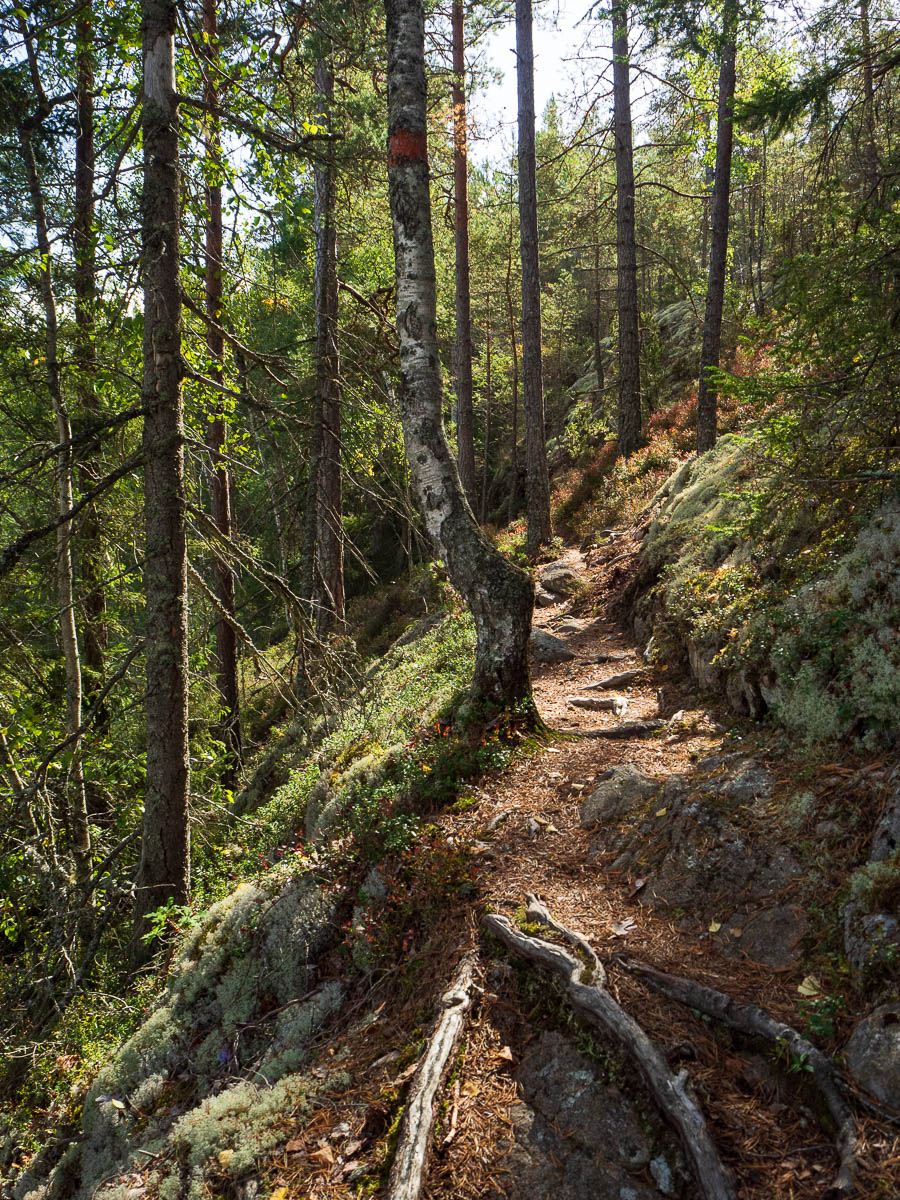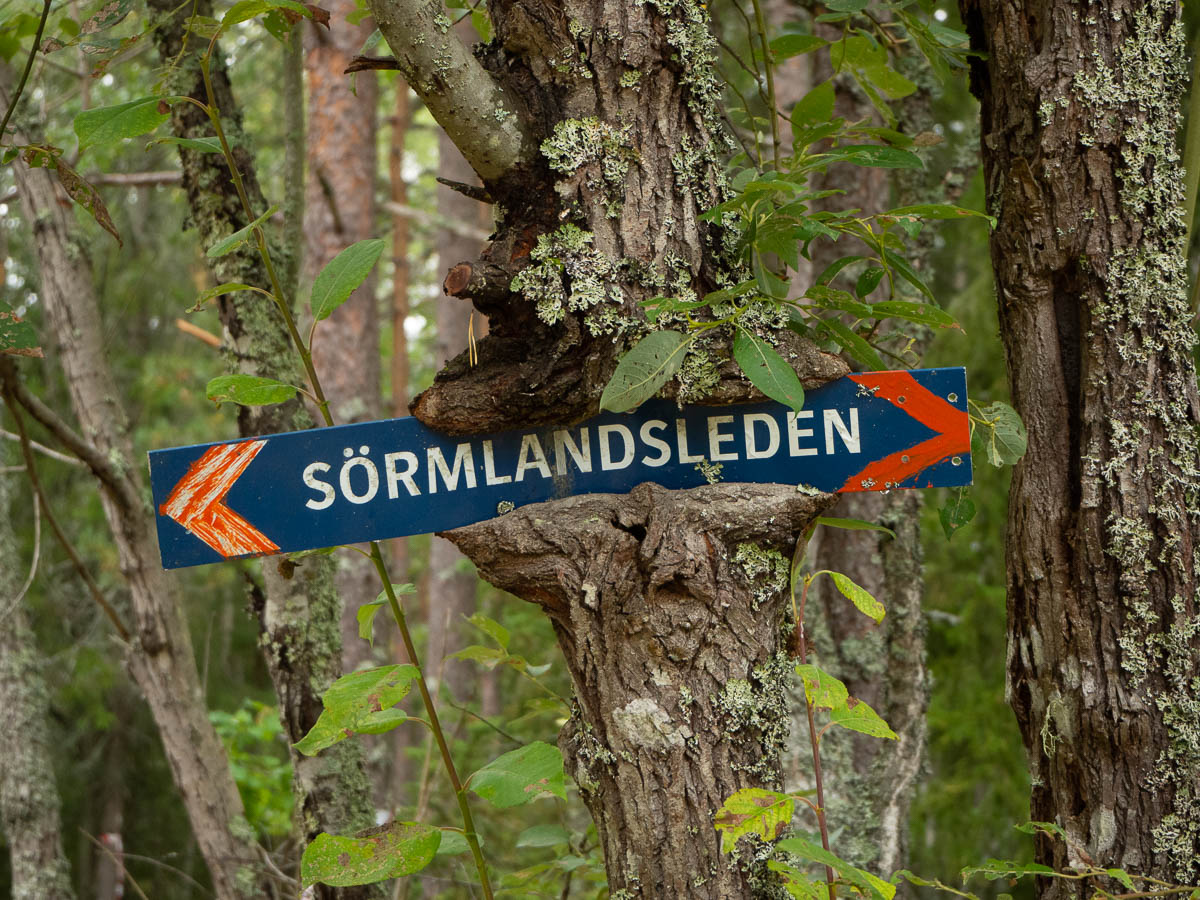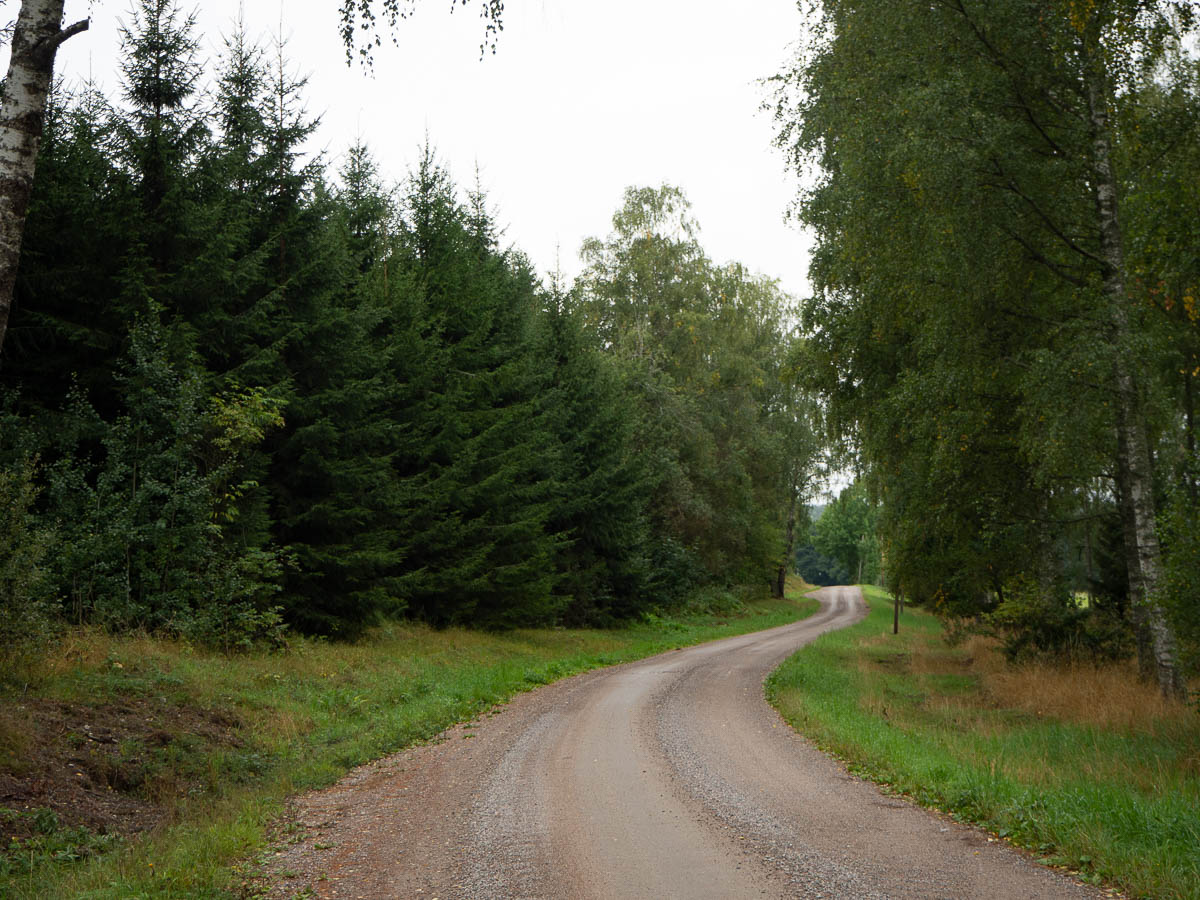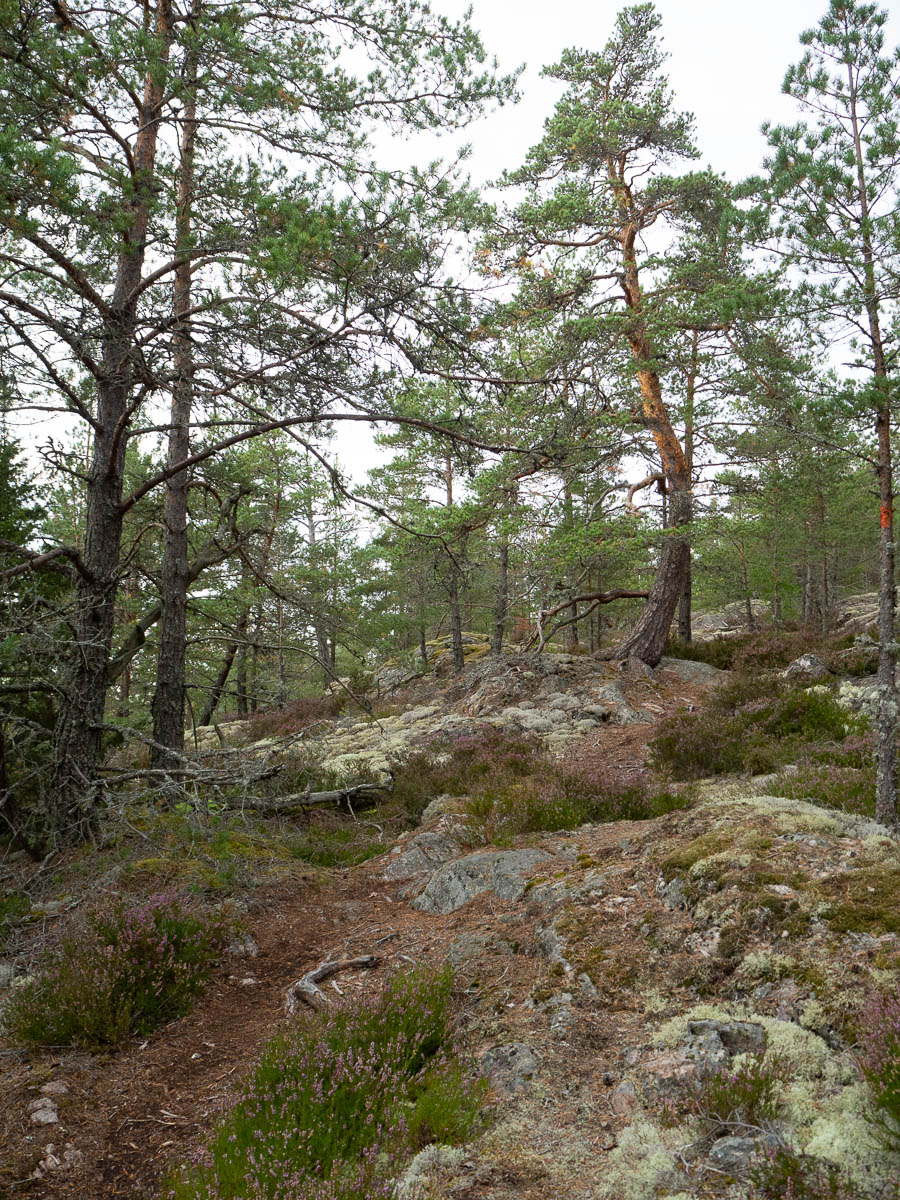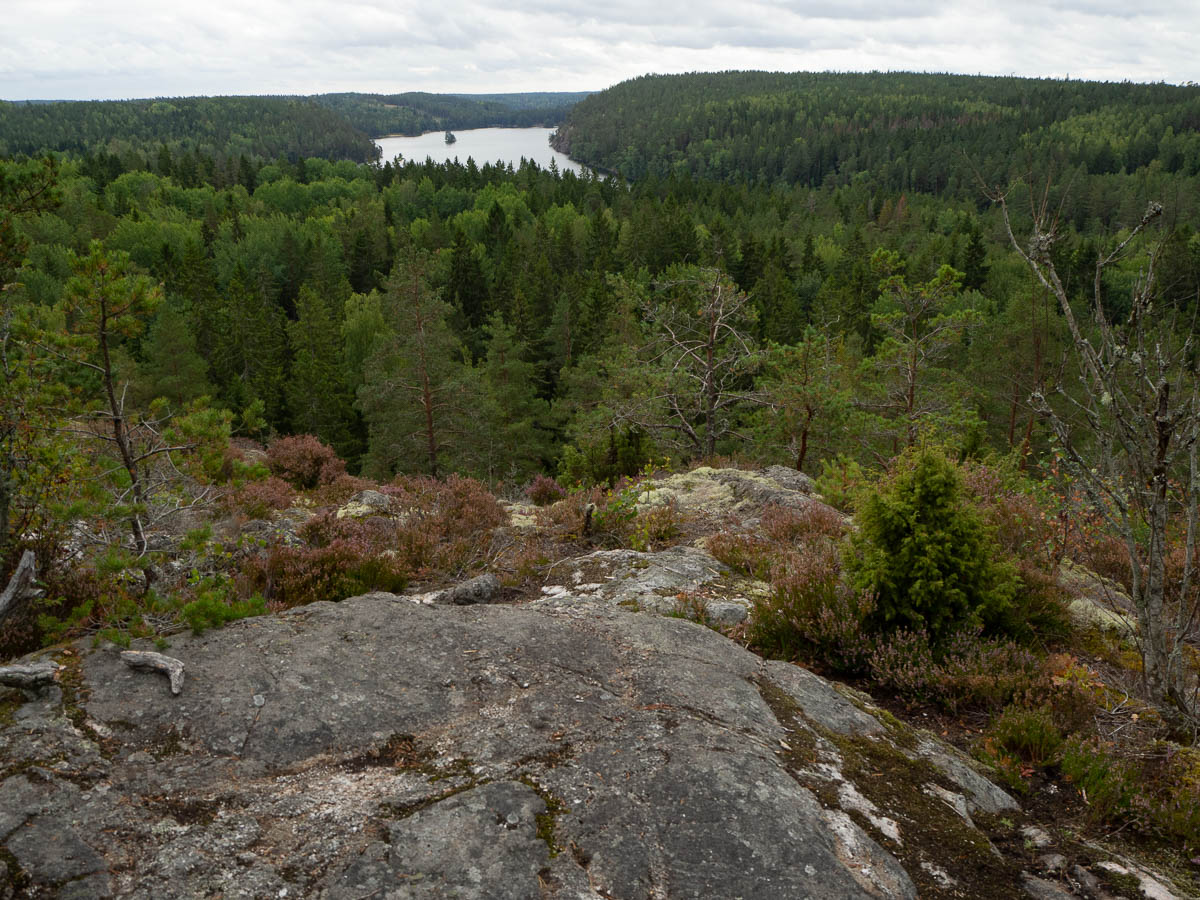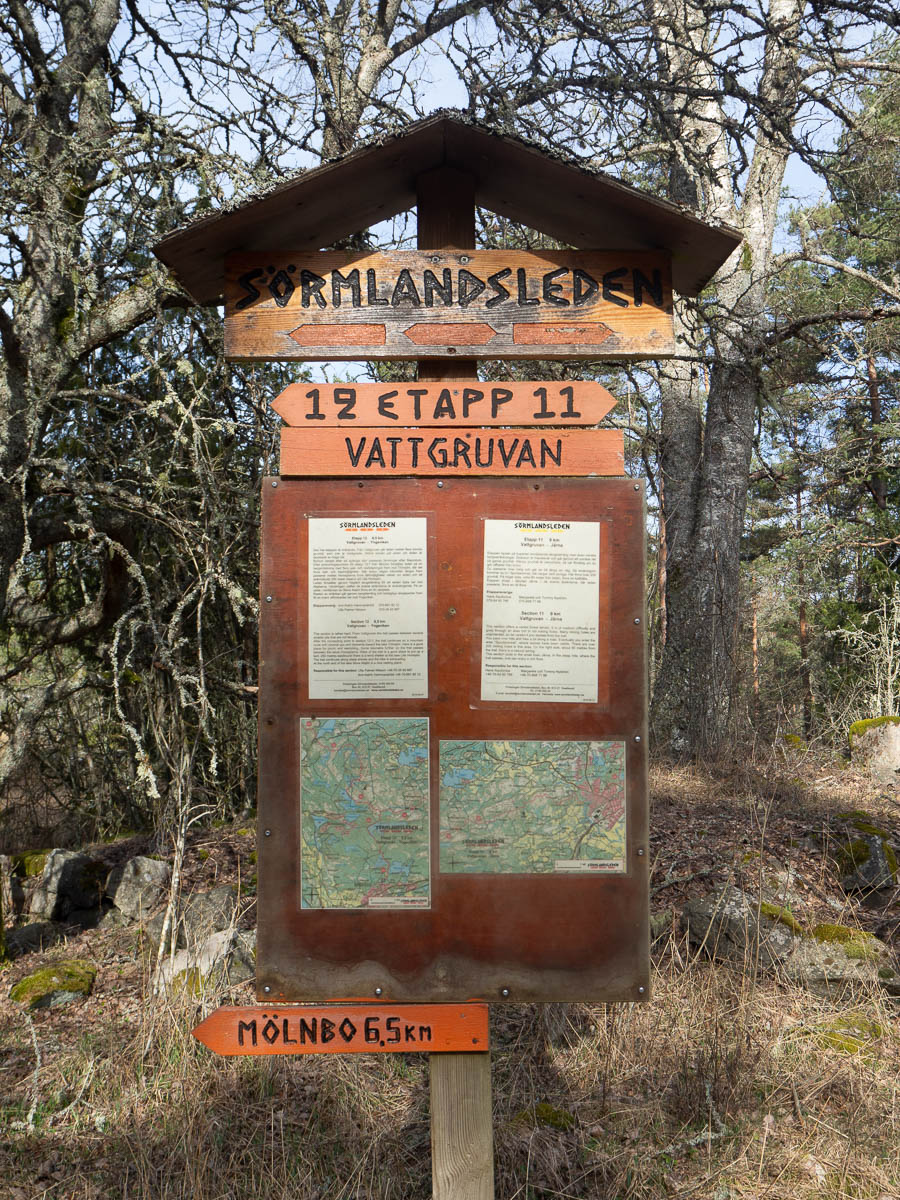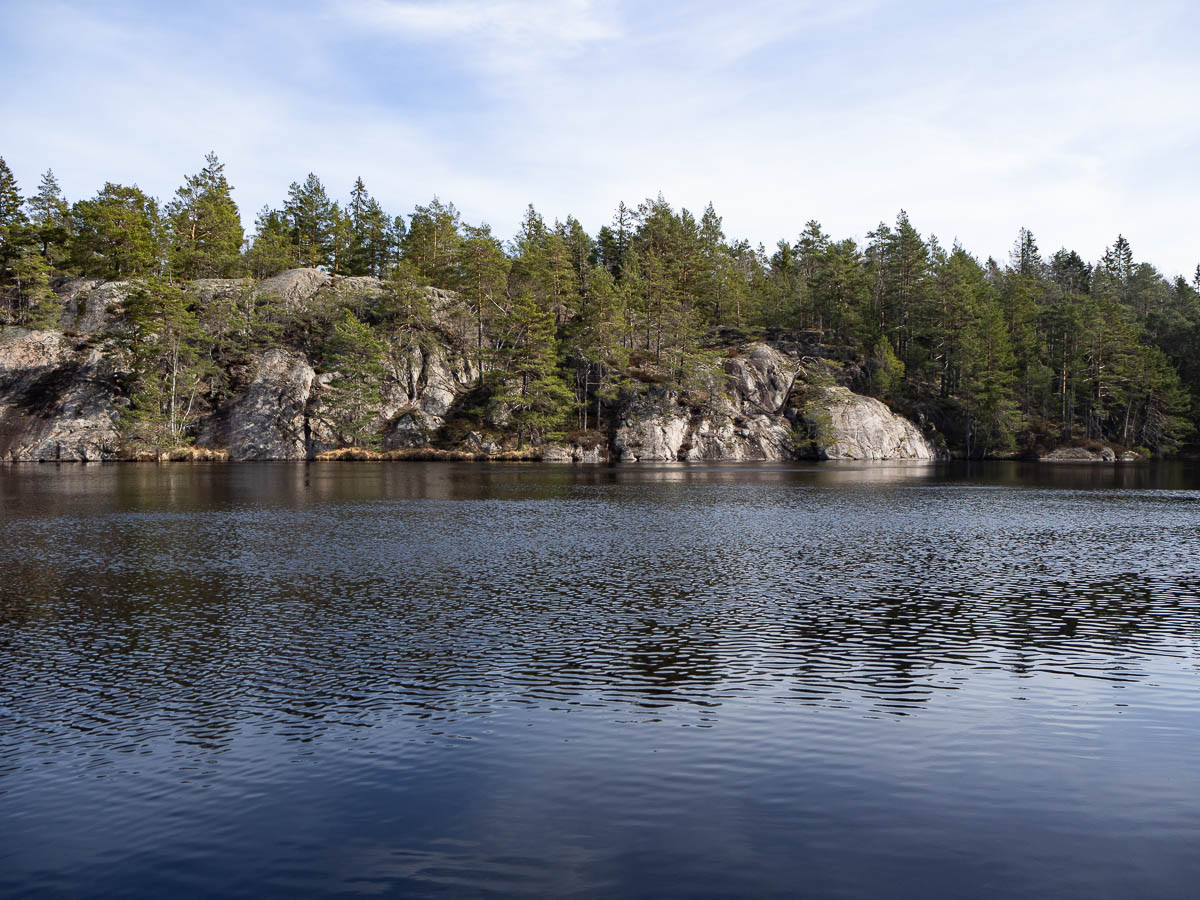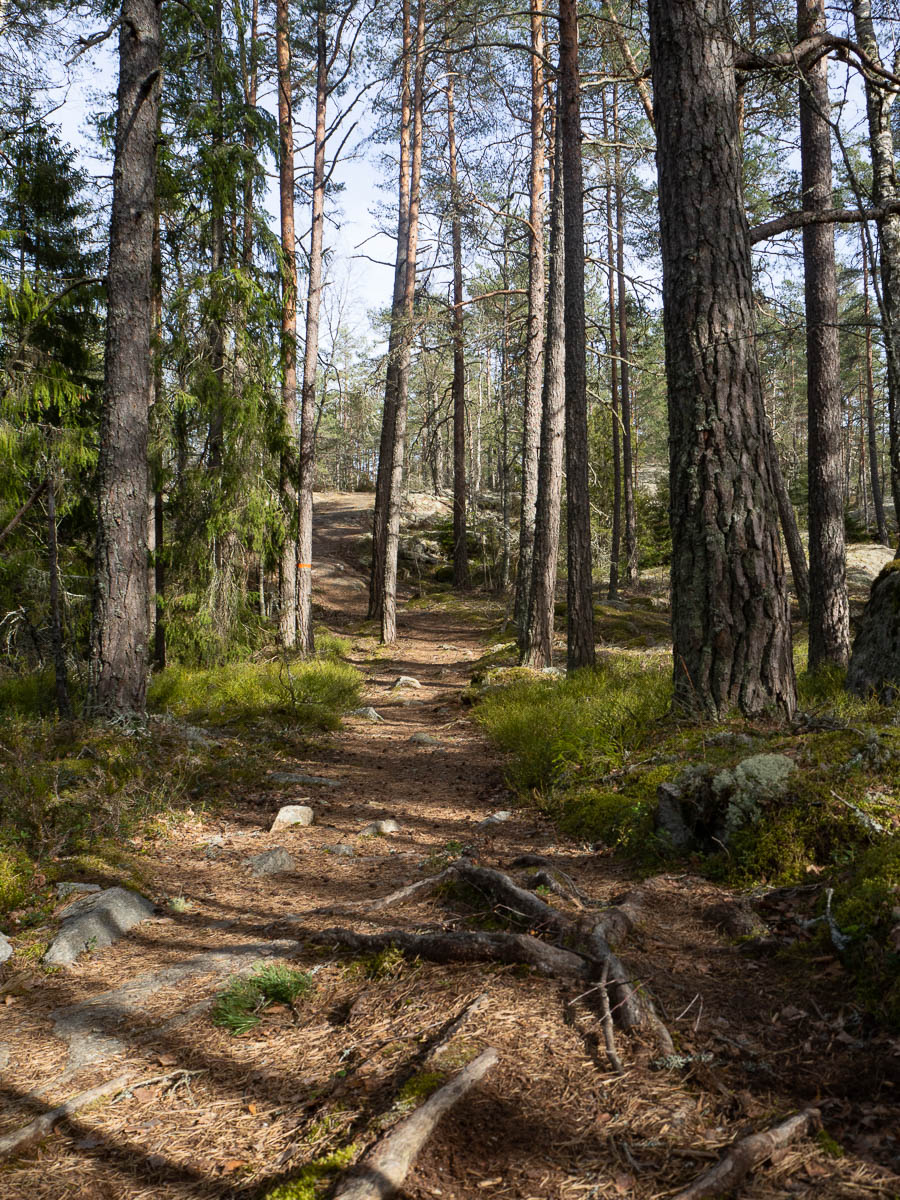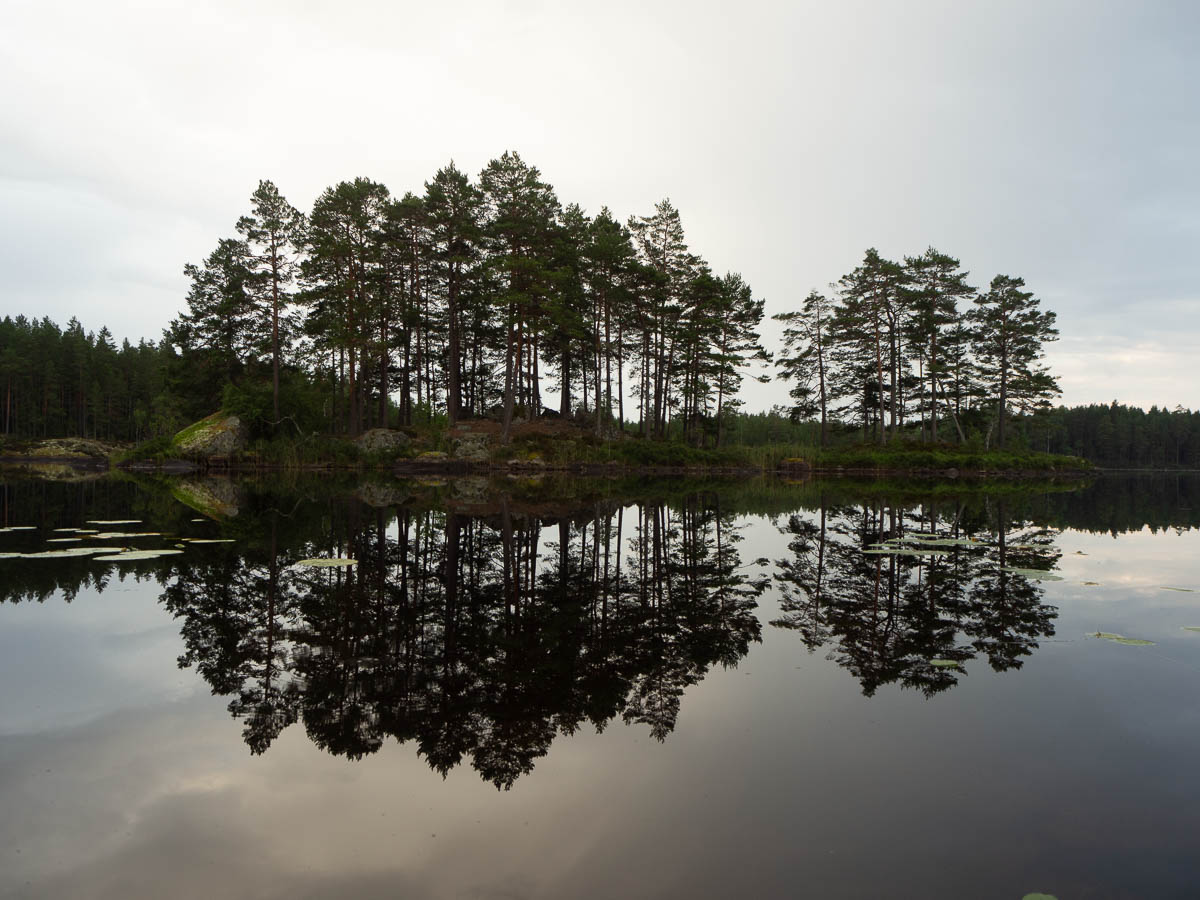
A bit of stage 13, most of stage 12 and all of 12:1. From lake Stora Envättern to Mölnbo, 15 km.

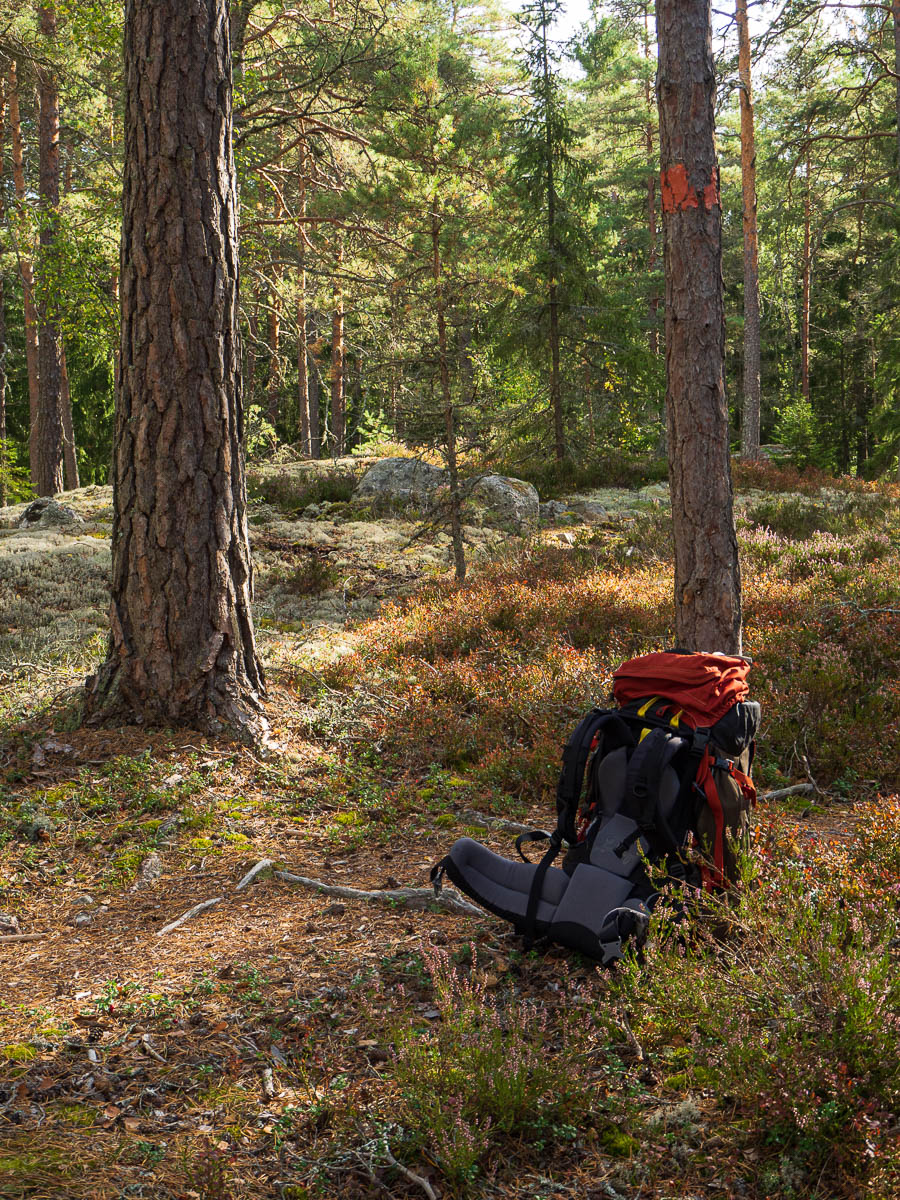
My day followed the same basic pattern as yesterday. Up early, pack and get walking. Porridge stop after an hour or so. Lakes, pine forest, spruce forest.

I walked stage 12 before, quite recently even. Some bits of the trail – with the nicest lake views – I definitely recognized. A few hills and roads were vaguely familiar. But as soon as the path went through just plain forest, I could have been anywhere.

Knowing that I am heading home inevitably made me think of train timetables and such things, and the walking did not feel quite as mindfully relaxing as yesterday. It’s a good thing that I made this a three-day trip rather than just a weekend: now I had that one perfect day of hiking untouched by ordinary days or ordinary concerns.


When I reached Mölnbo and civilization, an older man I met asked me if I had run across any wolves. I found out that a couple of wolves have their territory in the area between Läggesta and Mölnbo, and they had been spotted recently quite near Mölnbo. The man seemed to be trying to get a scared reaction out of me, but I was more disappointed. I realize that the odds are small but I’d have loved to see a wolf.


Half of stage 14 and most of stage 13. From lake Glådran to lake Stora Envättern, 15 km.

I woke up shortly after six. I’m never hungry early in the morning, so I postponed breakfast and instead just packed up and started walking. Breakfast tastes much better when I am properly hungry. I stopped for a porridge breakfast around eight.

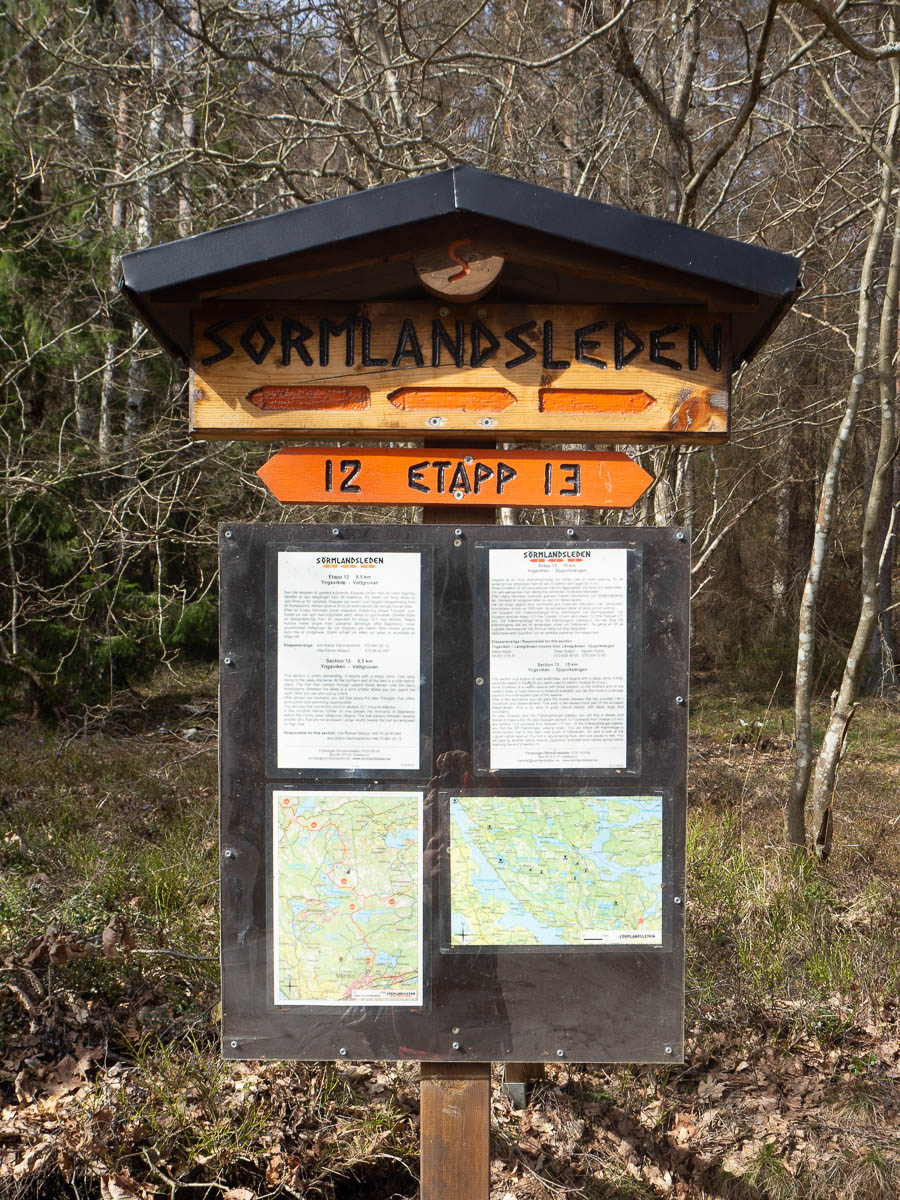
The Sörmlandsleden trail has been split into stages based on some kind of logic, but that logic is not always very obvious to me. Sometimes a stage ends (and the next one begins) by a road, which makes sense if you want the starting points to be easily accessible; other times it seems to be a random point in the middle of nowhere. The stages are not much use for planning an overnight hike: shelters and other suitable campsites are rarely near the end of a stage.

Instead I planned my days around lakes. Lakes are nice to look at, of course, but more importantly, they have water – which is most useful for doing the dishes and for cooking. This part of Sörmland is dotted with small lakes, so with a little bit of planning, it wasn’t hard to end each day near one of them.


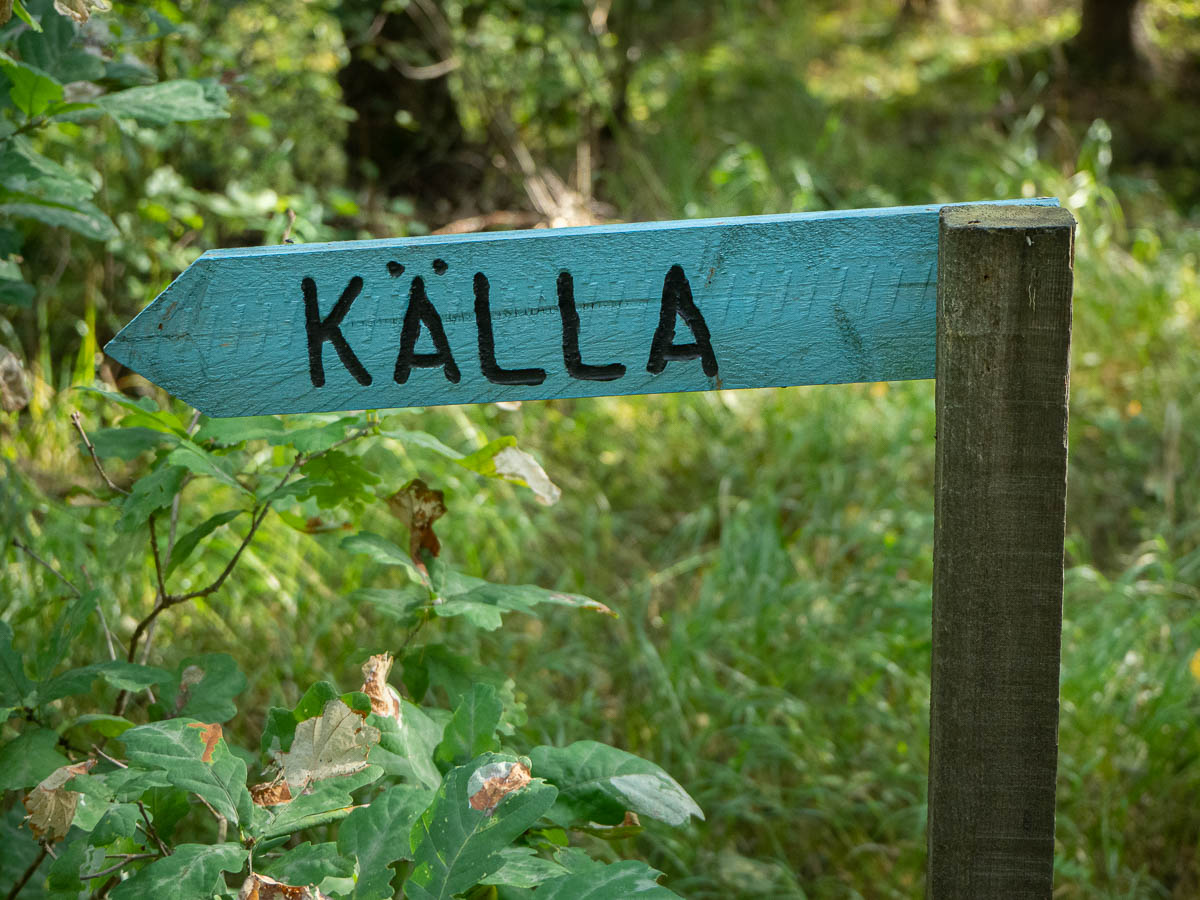
For drinking water there are freshwater springs, well marked on the maps and clearly signposted. Unfortunately, all of the springs I passed today were dry, or nearly so, with just a muddy puddle at the bottom. I had filled up my water bottles at a spring yesterday, but when that water ran out today, I had to switch to lake water.

Most hikers agree that water in mountain brooks is safe to drink. Opinions about the potability of lake water in Sörmland vary. Some say you should boil or purify it; others say it’s OK to drink without treatment. I look at these lakes and see them all surrounded only by wild, clean nature – untouched by industry, agriculture, beaches or summer cottages… so I just went ahead and drank the water as is. A little bit of fish poop won’t kill me. The water had a slightly metallic taste, but didn’t cause any problems.


The hiking today was much like yesterday’s. Up and down rocky hills, through pine and spruce forest. Wonderfully wild and peaceful.

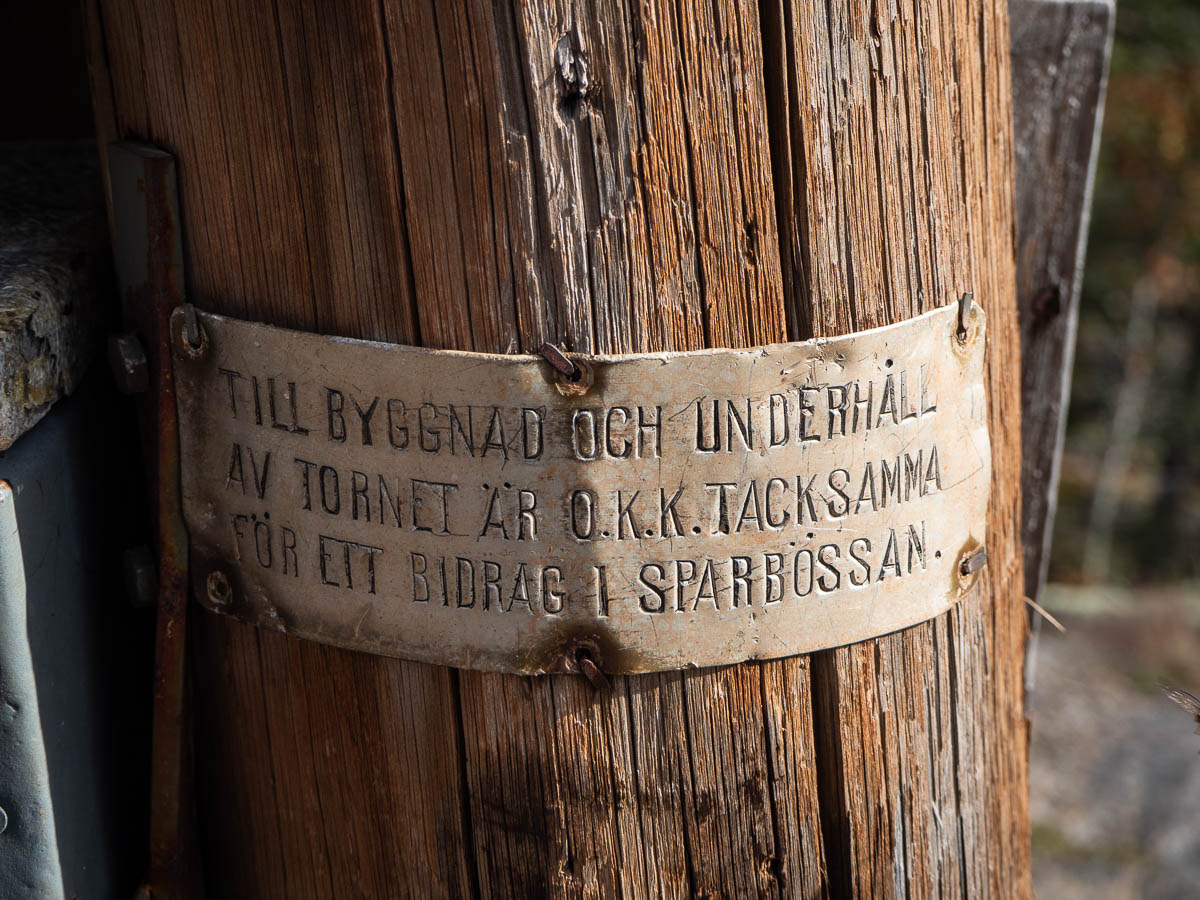
On top one of the hills there was a viewing tower, built by a local orienteering club back in 1969. It had a cute little money box for donations, dating back to the same era. The vintage sign exhorting visitors to donate to the tower’s upkeep was now accompanied by a much more modern sign with a Swish number. I didn’t climb the tower – I’m sure I would just have seen more of the same forests and lakes I’ve seen already – but donated anyway, because I liked the look of the sign so much.

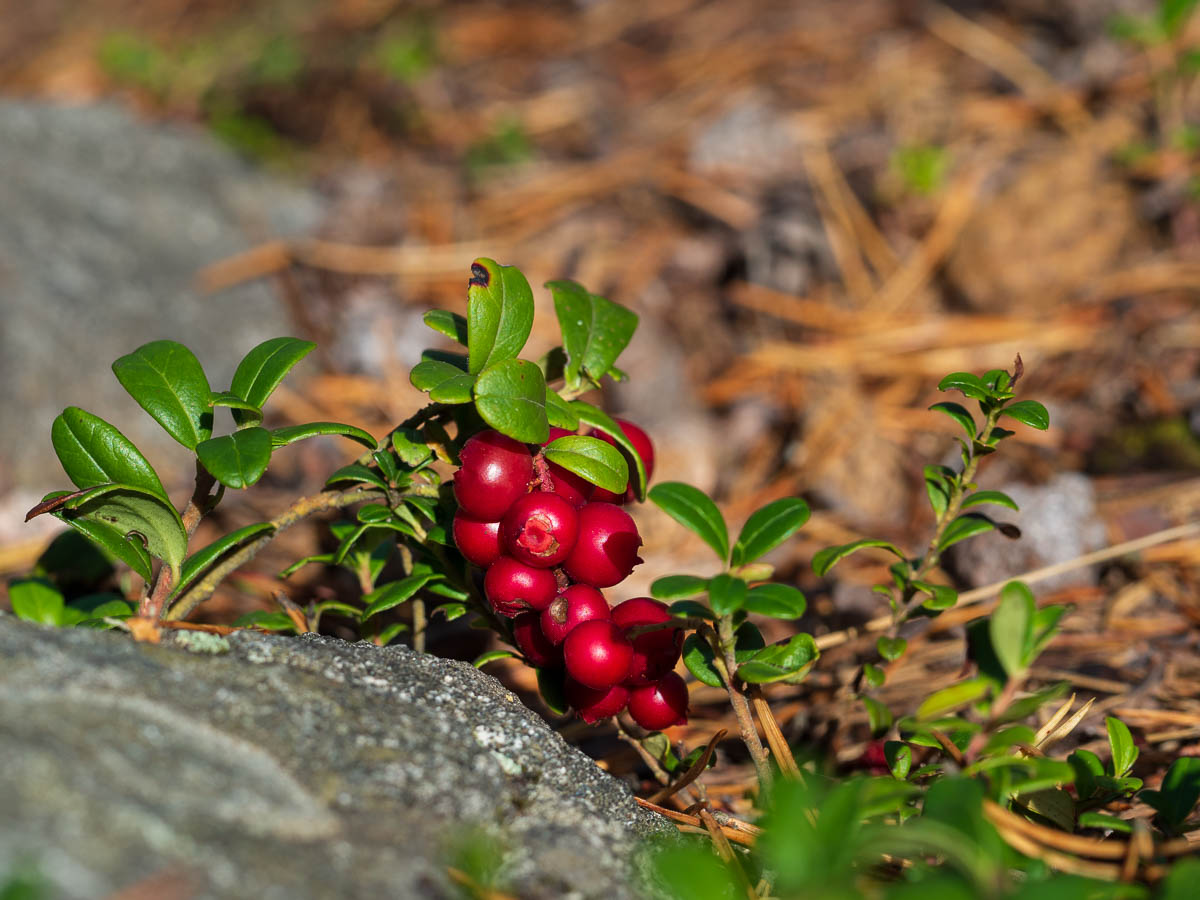
The path down from the viewing tower passed through wonderfully rich lingonberry fields. After eating bilberries off and on all day yesterday, I was getting heartily tired of them and was more than happy to switch to lingonberries and the occasional bog bilberries.

If I went out to pick berries, I’d probably want the berry bushes to be on flat ground, but when I’m hiking, I like them best on uphill stretches of the path. That way I don’t have to bend all the way down to reach them (because bending with a rucksack can be awkward) and can just scoop them up without really stopping.

By now I’ve gotten properly into a hiking mood. My thoughts drift. Sometimes I notice the trees and bushes and rocks and roots around me. Sometimes I just walk without really noticing or thinking about anything in particular. Time passes, and I can’t say how much of it has passed.

I take a lot of breaks. After snack breaks, I sit and read for a while, instead of hurrying onwards. I started early and I don’t want to stop until around dinnertime, because once I’ve stopped and set up camp, there won’t be much to do. I’d rather spread my walking over a large part of the day than have a long empty evening.

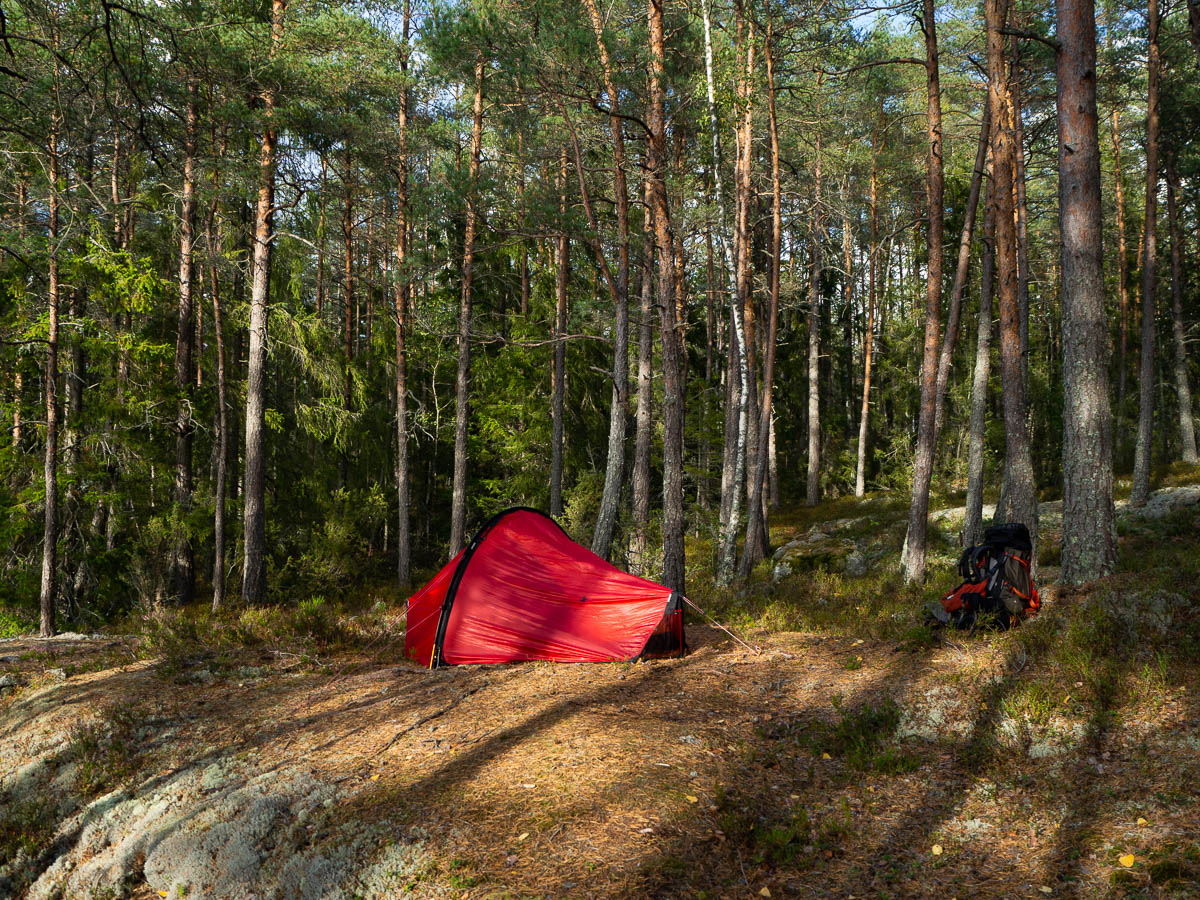
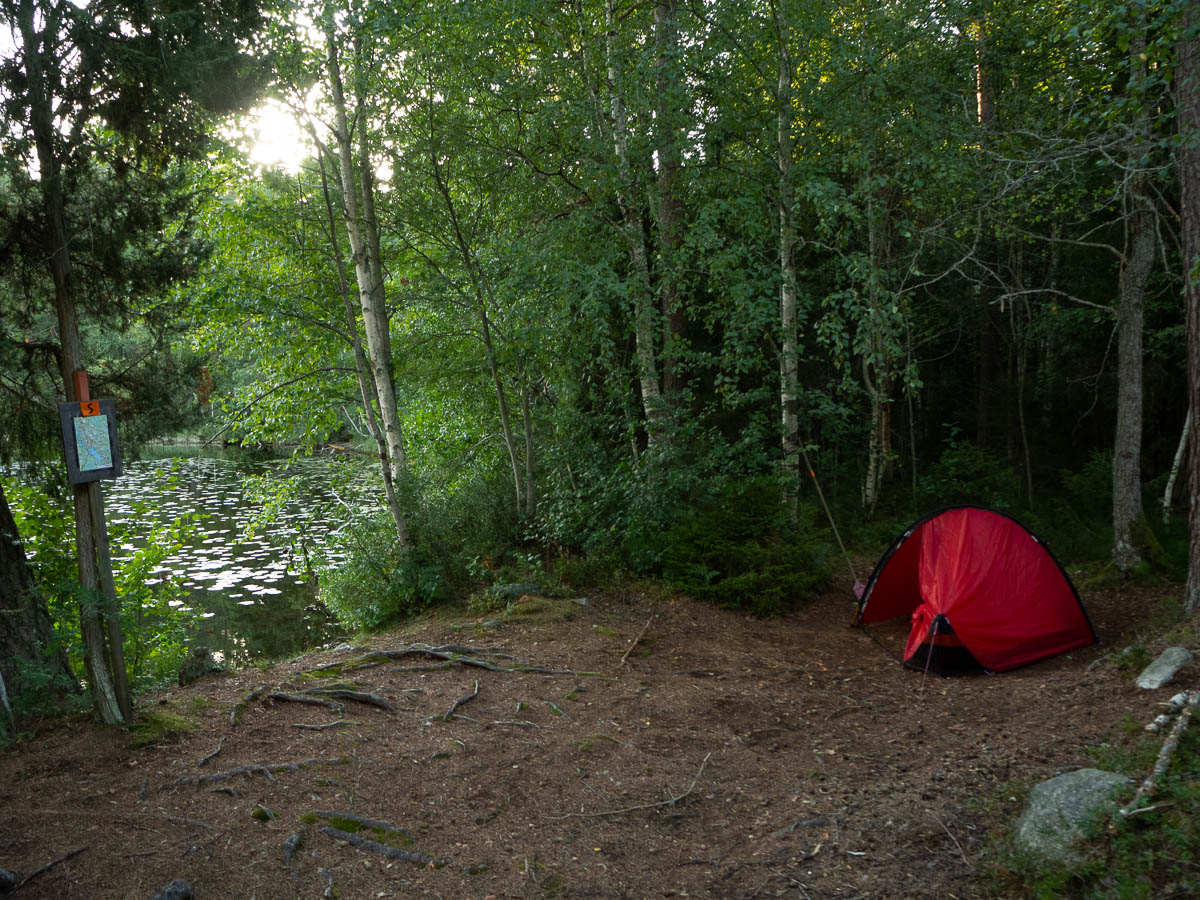
There were several camping spots around Lake Envättern, so I could find one without any other campers and more or less pretend that I was out there alone.

Just as I had finished cooking dinner, it started raining. I’d gotten hit earlier in the day by a very sudden rain shower – it took just a couple of minutes to go from tentative drops to pouring rain, and I had to really scramble to get my rucksack covered and my rain clothes on. This time I knew what to expect, which helped a little bit, but I still only had a few minutes to get all my things into the tiny tent. It was a total jumble in there.

The tent fabric seems so incredibly flimsy that it’s hard to imagine it withstanding any kind of weather, but it kept me nice and dry.

Wildlife today: one heron flying above a lake. One vole, larger than a mouse but smaller than a rat, that ran across the path. Splashing noises from fish in the lakes. Bumblebees and grasshoppers. Thrushes and various unidentified tweeting birds.


Stages 15:1, half of 15 and half of 14. From Läggesta to lake Glådran, 17 km.

The connecting trail from Läggesta conveniently starts right in front of the train station. The first kilometre of the trail unfortunately goes right alongside a noisy main road, but soon after the trail turns off onto a smaller road, and then from that onto a lane. Quite soon I was on a pleasant shaded path, leaving civilization behind.


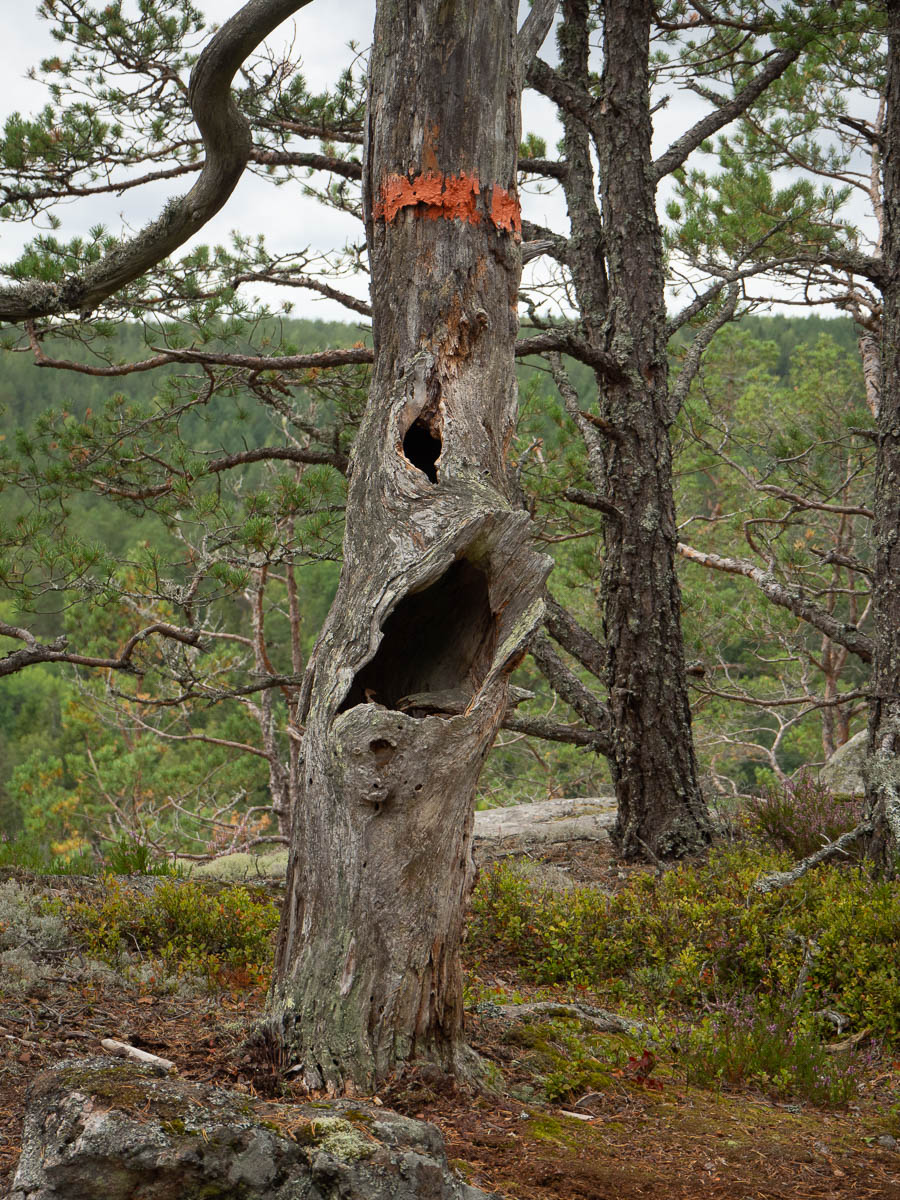
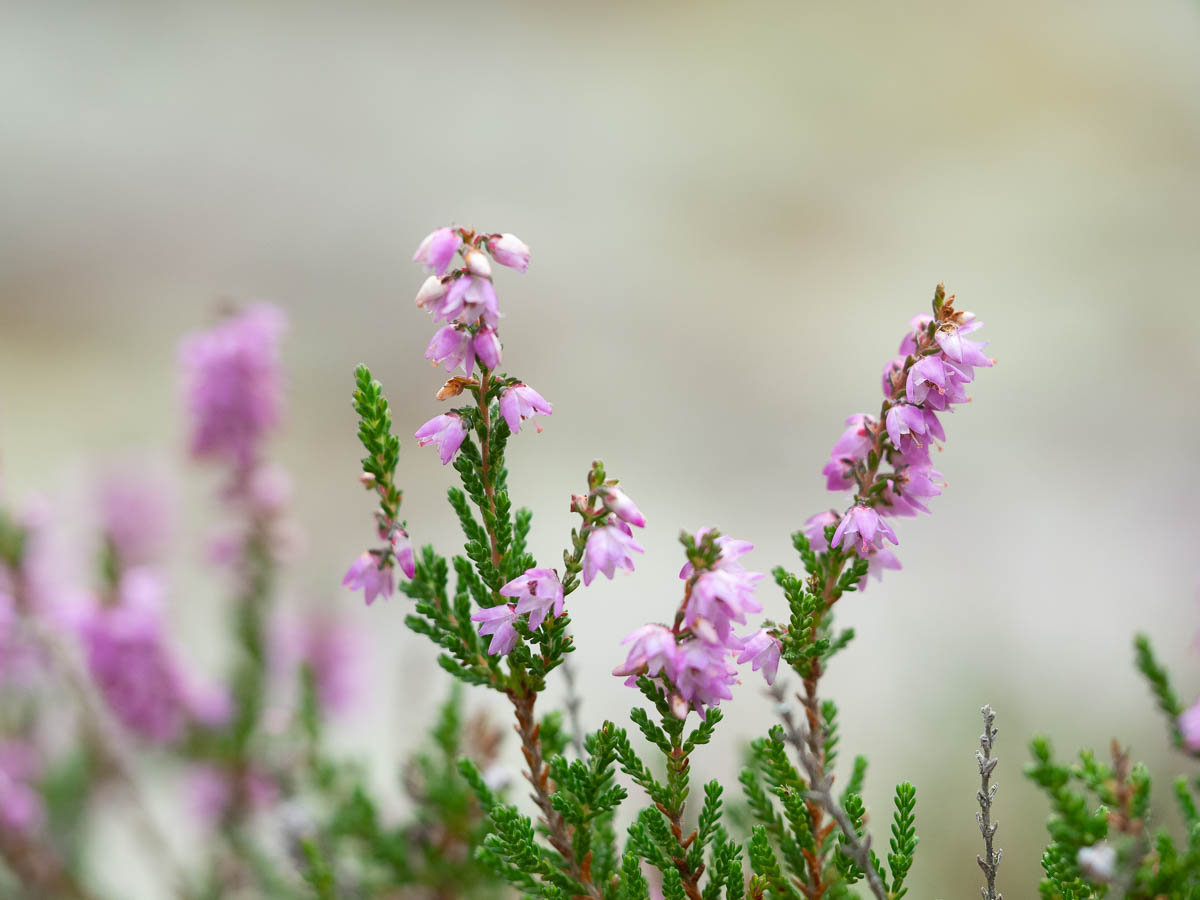
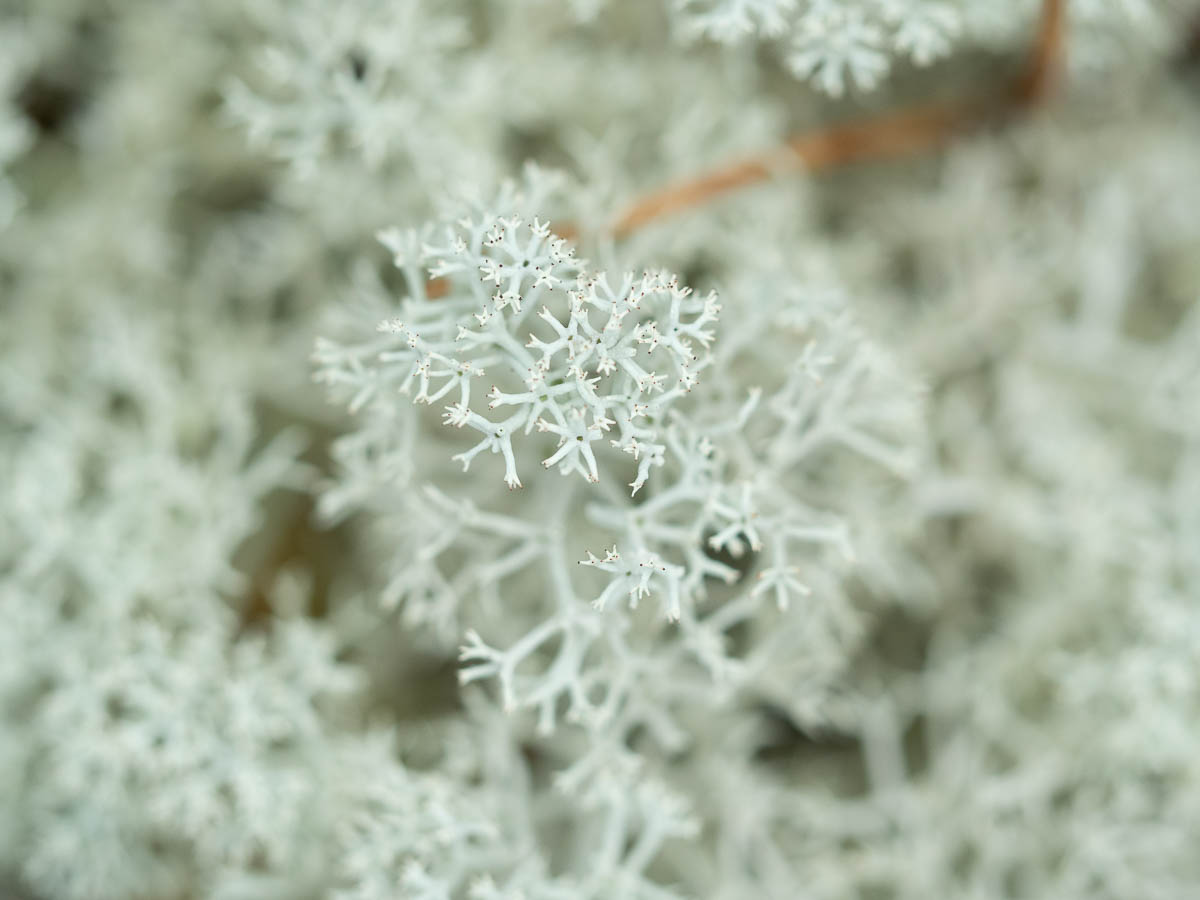
After that my surroundings were the usual mixture of Sörmland nature. Rocky pine forest with white mosses and heather; spruce forest with green mosses and ferns and bracken; mixed forest with spruce, birch and aspen. And bilberry bushes everywhere, with tons and tons of bilberries.

I’d walked half of stage 15 in 2017 and had most of the other half ahead of me today – but I realized now that there would be a gap between the two parts. I don’t know if I ever will walk all of Sörmlandsleden, but I want to keep that possibility open, so a gap here would leave a real itch behind.

I hid my pack behind a rock (not because I worried about thieves, but because I thought other hikers might worry if they found an abandoned rucksack) and just walked that missing bit back and forth, so I could check it off my list.

I felt like a gazelle walking without a rucksack. So fast, so easy!

The contrast was extra strong when I picked up my pack again, because the path went steeply uphill from there, up to a high cliff with views over the whole area, with all its forests and lakes.

Today was an excellent day for walking. Warm and summery still, but mostly cloudy, so it didn’t get too hot. And because it’s a Friday, there were very few other people on the trail.

I like hiking on my own, and having the forest to myself. I love the peace and quiet. Hearing nothing but the wind, the creak of my rucksack, the occasional bird call and the buzzing of bumblebees.

The first day of a hike, it usually takes me a while to get into the groove. I tend to worry about whether I’m walking fast enough to get to my planned destination by the end of the day. Mentally I’m partly still in my everyday life, with plans and times to keep. It takes time to let go of all of that, and some conscious effort. I forced myself to not think too much about the time, to take breaks, to be present in the here and now.

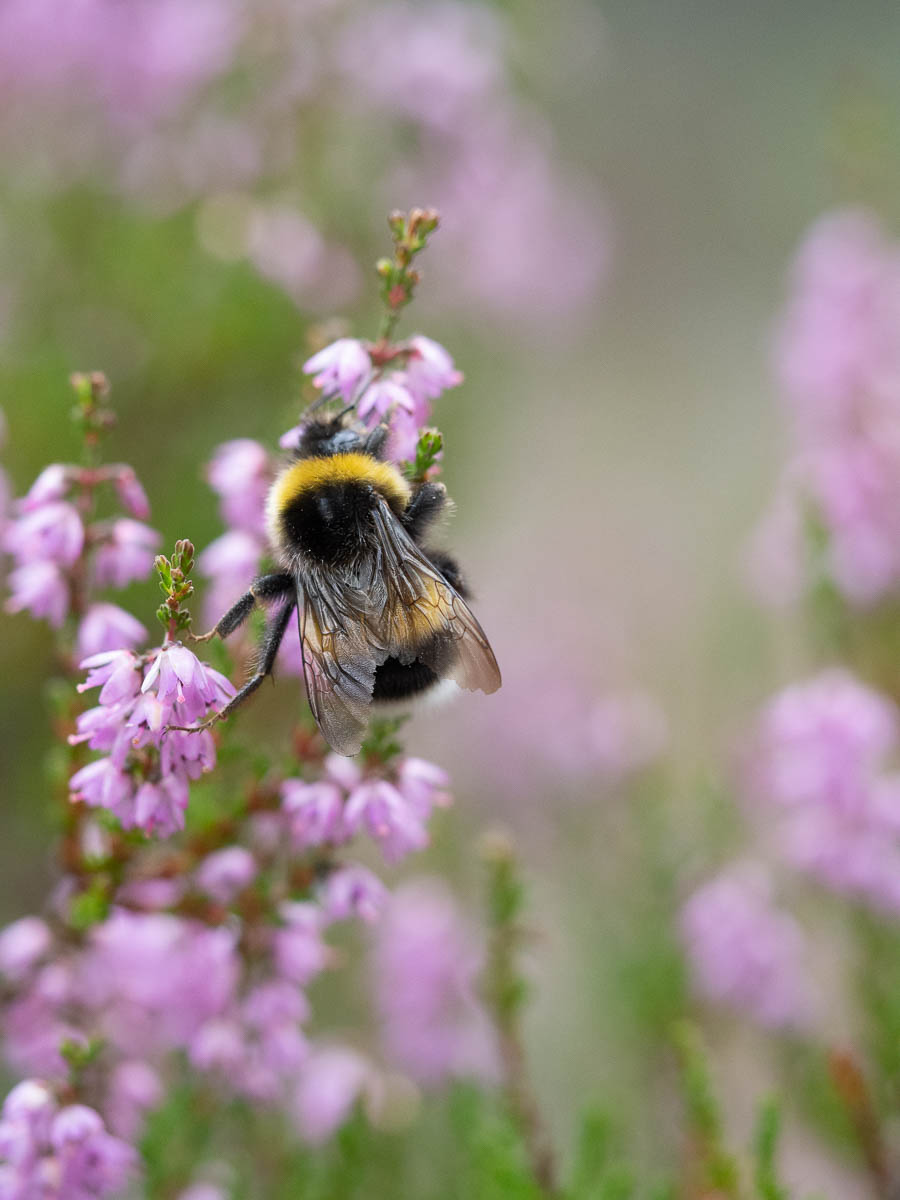
Macro photography always helps me relax. I tried to capture the bumblebees in the heather, but it was hard, because they never stayed still! The heather flowers are so tiny that a bumblebee empties one in the blink of an eye and is always moving on to the next flower.


I stopped for the night at a nice little camping site next to lake Glådran. The site was very small, but unexpectedly luxurious. Not only did it have a fireplace and a picnic table, and a flat area for putting up a tent: there was also a bucket for water, and even a rake for clearing the ground of the inevitable pine cones.


Today promised beautiful weather, warm and sunny, so I took the day off and went walking.

I have quite flexible working arrangements and this has always been possible, but I’ve almost never taken advantage of it. Somehow taking a day off feels like a smaller step when I’ve already been working from home anyway, with my afternoon walking and cycling breaks.

After a longish break from walking the Sörmlandsleden, I did another section today. I’ve done all the easy-to-reach low-numbered sections. The ones ahead of me now cannot easily be reached with public transport, and some cannot even be reached by car. The best way to walk them would probably be multi-day hikes. But I only have one day, so I just simply walked section 12 twice. There and back again.

Section 12 starts near Järna, in an old iron mining district. For the first kilometer or two, the woods are pockmarked with small water-filled mining pits, most just a few metres across. There were several informational plaques here and there as well. I skimmed a few; the oldest one I noticed was dated 1985. That was a really durable, well-made sign, with the text and images etched into metal. No flimsy plastic signs here.

The rest of the section is pretty standard Sörmland pine forest with blueberry undergrowth. There were several lakes here and there offering resting places with nice views.

Much of it was quiet, as pine forest tends to be, except for the soughing of the wind, although I heard blue tits and finches in a few places.

Section 12 is 8.5 km according to the official notes. Adding another kilometre to walk from the parking spot I found to the beginning of section 12, and then doubling it all, brought the total to 20 km. A good distance for one day, especially when the walking is as hilly and rocky as this was.


After several weekends of wanting to go for a walk but having to do other things, I actually got out today and walked section 5:3, from Hemfosa to Paradiset.

It was a beautiful day for walking – a few degrees below freezing, overcast but still relatively bright. The temperature has been below zero for a while so the ground was all firm rather than muddy. And the ground was covered with a fresh blanket of fluffy snow. I love walking on untouched snow, and that feeling of being alone in the forest.

There was a stretch in the middle where the trail went along roads, which I didn’t much enjoy, but most of it was pleasant walking through the usual fir-pine-bilberry-rock forests. This section of the trail is quite far from major roads and the commuter train lines, plus the snow muffled any remaining noises, so everything was wonderfully quiet.

The fresh snow and the lack footprints meant I could see a lot of paw prints instead. Fox, hare, squirrel, deer, and even moose I believe, plus tiny prints of unidentifiable tiny rodents.

All was great except lunch, which was very cold. My big mittens are warm and weatherproof but impossible to hold a spork with, so I had to switch to gloves, and even though I ate as fast as I possibly could, I felt like my fingers were going to turn into icicles and fall off. It took me a good while to get them warm again afterwards.

The last part of my walk went through the Paradiset nature reserve. I don’t know what it is about that place – it’s the usual pine forest over granite, but somehow it manages to look prettier than other similar forests. The moment I cross the boundary of the nature reserve, it’s like the pines become more elegant and the snow lies extra fluffy on their boughs. I noticed the same effect when section 3 crossed into the Tyresta national park.

The trail passes by Tornberget which is apparently the highest point in the greater Stockholm area. There’s a viewing tower with views of nearly endless flat pine forest in all directions. Uniform and not particularly interesting.

As usual the official distance is one thing and reality is different, what with having to actually get to and from the trail. The section starts where Sörmlandsleden crosses a public road, but it’s a kilometre from the train station to that spot. And the section ends in the middle of the forest, not even near a road of any kind, so there’s one kilometre to get to a road and then another to the nearest bus stop. In total the 15 km trail section became a 18 km walk. Starting at 9, finishing just before 15 – perfect use of daylight hours.


The Midsummer weekend contained too much eating and lounging around and not enough moving. I was itching to get out and walk, so here I am. Sörmlandsleden, stage 5:2. I like the stages that are easy to reach using public transport, and it doesn’t get much more convenient than this one: it effectively goes from Ösmo station to Hemfosa station.

Well, that’s what it does on paper. In reality the start is about a kilometre from the station, and the end likewise, so the 15 km becomes more like 17 and some. And then there’s the extra detour you can make to a hill with an ancient fort. That one is described as “might be worth making a detour for” and indeed I’m sure there are people for whom that is the case, but honestly I wouldn’t recommend it. I couldn’t see any signs of the fort itself, just a rocky hill with a view barely worth looking at, because whichever direction you look, it’s all the same forest. Or perhaps I was just getting too tired to appreciate it.

This part of Sörmlandsleden itself was more varied than most. There were lakeside views, the usual Sörmland pine and blueberry forests, rough spruce forest with plenty of rocks and roots, and even a golf course with its manicured lawns and well-tended shrubberies.


I’ve been doing the first dozen or so stages of Sörmlandsleden consecutively, but skipped a few to walk stage 20 today. This stage passes through Henaredalen, which is described as “botanically interesting, wonderful late spring/early summer flowering”. Sounds great for a weekend in May.

It was rather underwhelming. The Henaredalen valley turned out to be a only few hundred metres long, so just a tiny fraction of the 6 km walk. The rest of it was the usual Sörmland pine forest. And while there were flowers in the valley, it wasn’t exactly breathtaking. I suppose it is more “botanically interesting” than impressive for the general public.

Nevertheless a nice walk – not least because it was very empty. I ran into a single walker on the trail itself (a local bird photographer), and three people at the far end. On my way back I didn’t see a single human being.

The beautiful weather helped as well – we’re just a few days into May but already it feels like summer, and I was walking in just a tank top and thin trousers and a sandals. I thought the choice of footwear was a bit foolhardy perhaps – early May can be quite wet still – and was mentally prepared to get all muddy, but there was none of that, except in the river valley.

The coolest flowers I saw was the common toothwort (Lathraea squamaria). It was impressively good at hiding in plain sight. Its shoots are quite large and thickly covered with flowers, but those are unassumingly pale brownish pink and somehow the eye just glides over them, especially among dead brown leaves. But once I had seen one, I started seeing them everywhere.


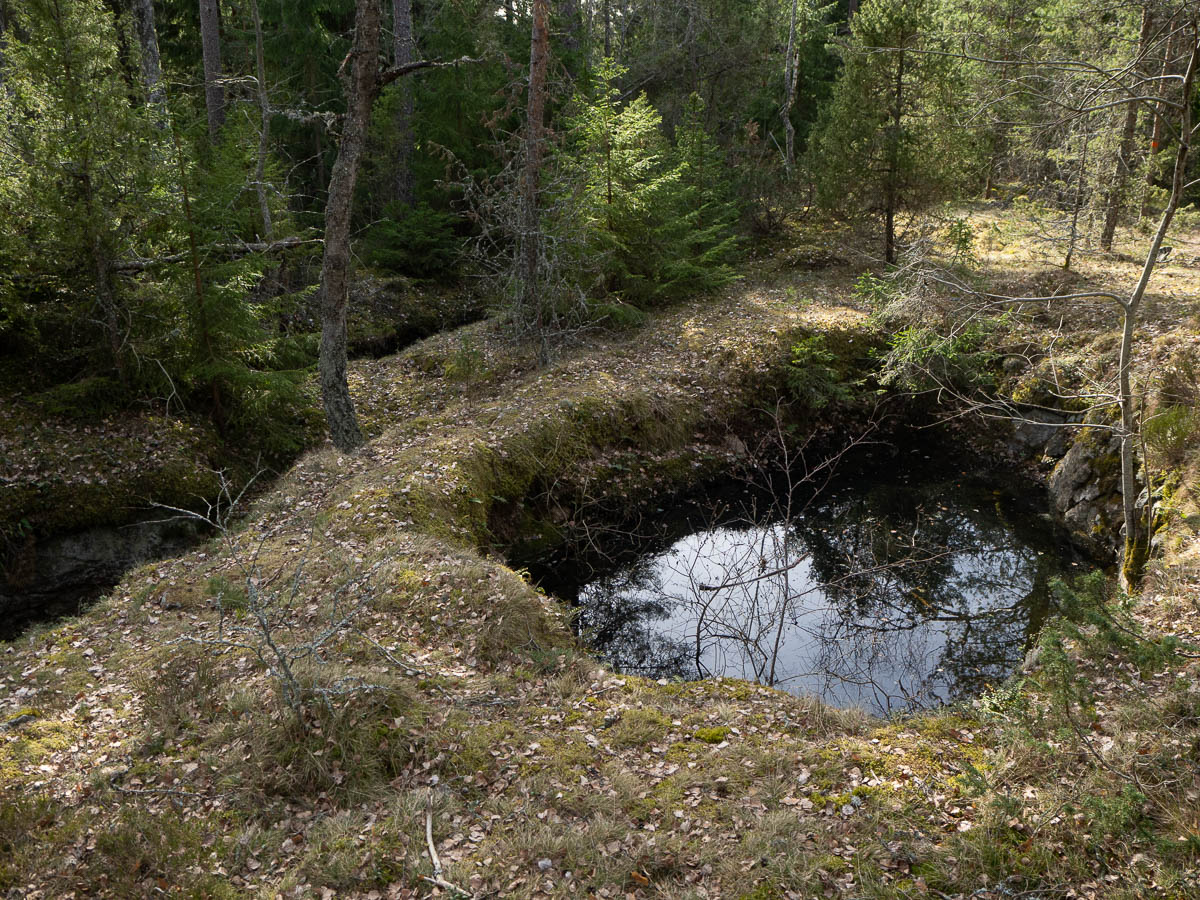
Section 11 passes through a fascinating area of pine forest west of Järna, with dozens and dozens of old mining holes.

In my mind I had never connected the name Järna to järn (“iron”). It’s always just been a name to me. Now I know better.

Some holes were just vague indentations in the ground, partly filled with earth. Others were filled with water instead, and looked pitch black because of the depth and the dark rock bottom. Some were actual roofless tunnels that you could walk in. There were also ruins of utility buildings from the mining era.

Today I actually saw other hikers on the trail. (There were also people in Järna but they don’t really count.) I ran across a few campers near a spring, and two French hikers. The French couple walked at roughly the same pace as I did but we timed our breaks differently, so we kept passing each other whenever one of our parties had stopped. I think I passed them three times and they passed me twice, until I left the main trail and turned onto the connecting trail to Mölnbo.

Section 12:1 goes along the shore of a lake for quite a while, and had some nice views to offer. The path was dusty and the day was hot, and I had a pleasant break at the lake and bathed my feet.

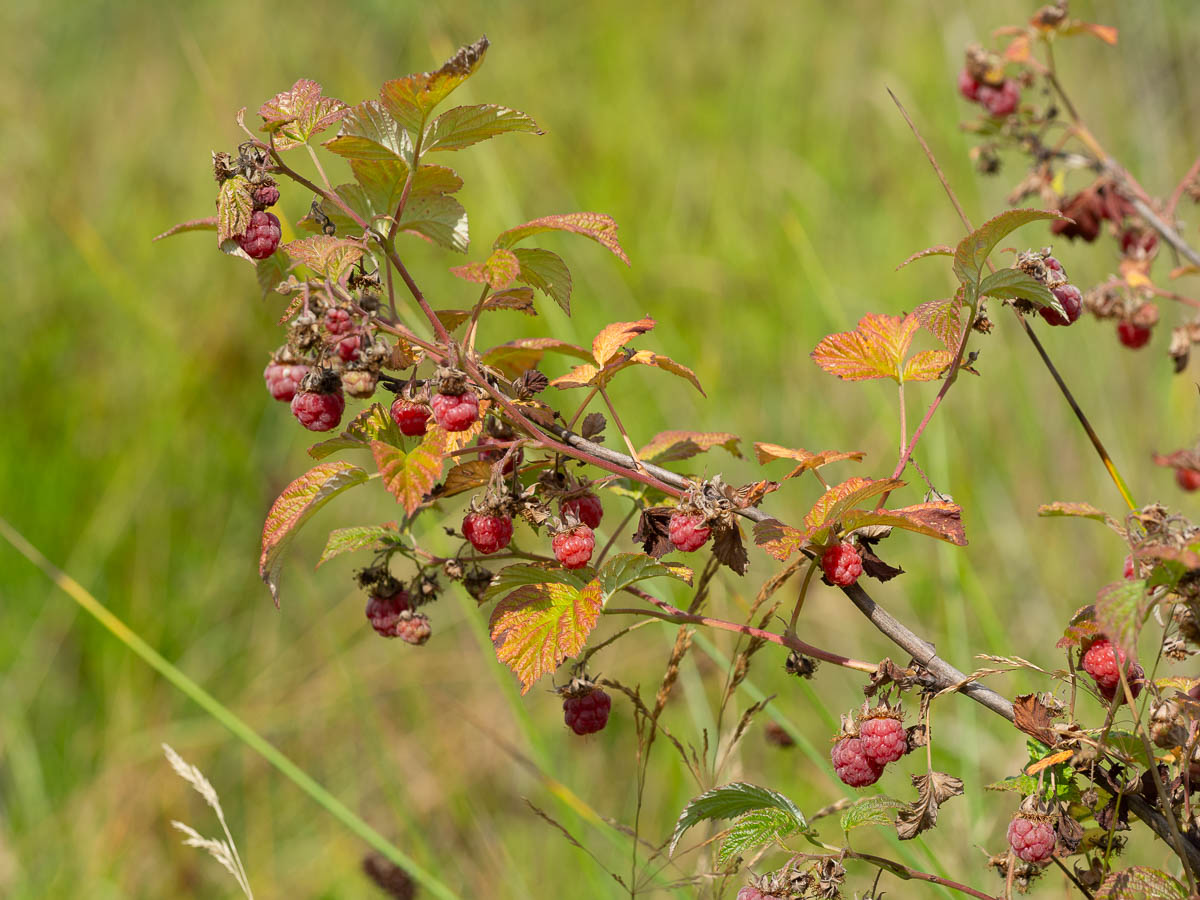
There were plenty of bilberries in the woods – enough for me to eat my fill and tire of them. Luckily there were also bog bilberries (which I haven’t previously found much of in Sörmland) and raspberries, to provide some variety.

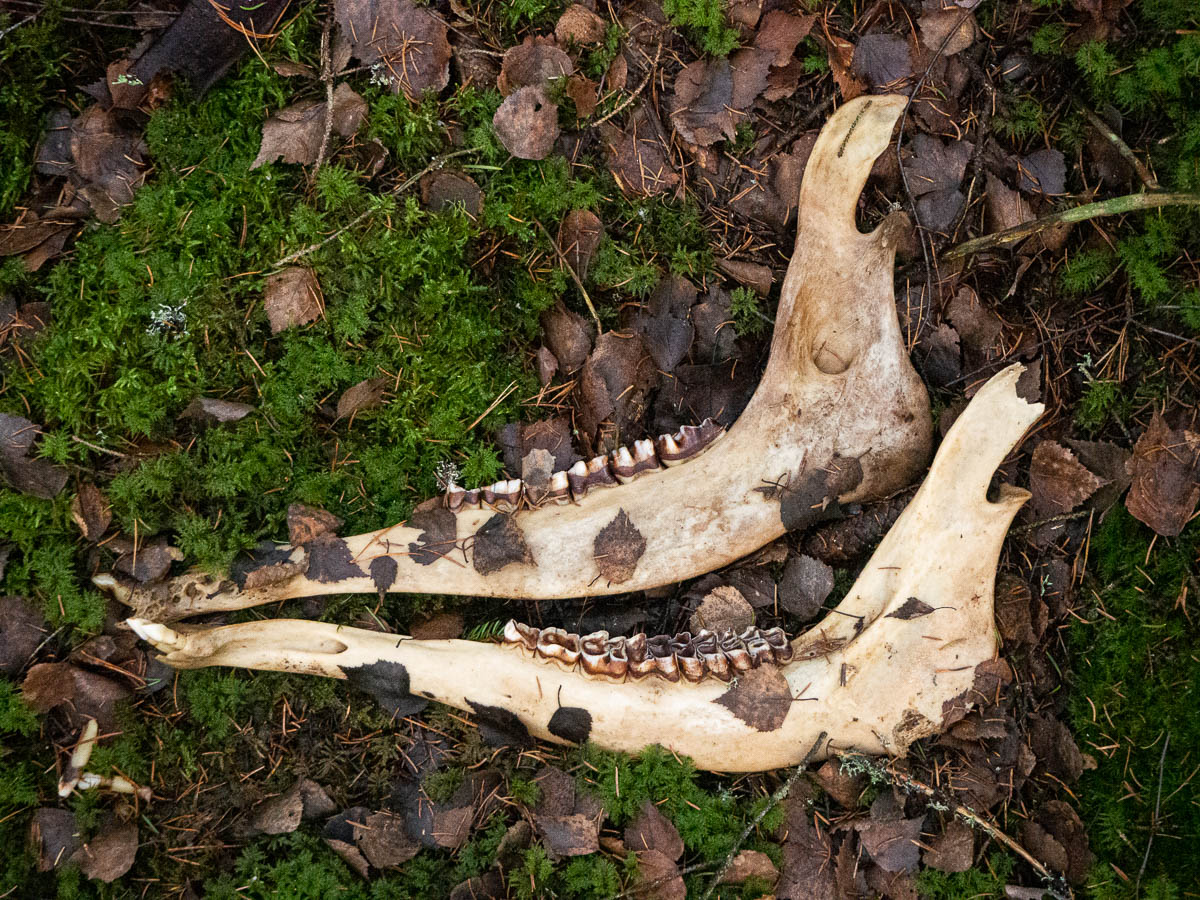
Snake skin


Day 1 of a two-day hike along Sörmlandsleden.

Section 9 goes through central Södertälje and is unlikely to go down in history as anyone’s favourite, least of all mine. I understand why it exists, and it was my own choice to walk it, and if I had to make the decision again then I’d probably make the same choice. But it was rather dull.

Section 10 was pretty typical Sörmland. Some open fields in the beginning, and then rocky pine forests with bilberry bushes. I notice here that all my photos are of the open areas – the whole section definitely didn’t look like this. The fields with their ripening heads of grain just felt so much like late summer.

This was my first solo overnight hike. I had a heavier pack than I normally walk with (sleeping bag and stove and all that, and more food of course) so I was slower than usual. I didn’t know exactly how much the pack would slow me down, so I was a bit worried that I would arrive very late at my planned camping spot. I needed to find the spring which was supposed to be there, so I’d have water for cooking dinner, and I didn’t want to have to look for it in the dark. So my walking was at times less relaxed than usual, and my breaks shorter. (I am a worrier, though I make an effort to avoid it.) In the end I got to the campsite shortly after seven in the evening, which still left me enough time before dark.

I cooked myself an excellent dinner – a hearty stew with carrot and tomato and lentils and wheat grain. Then spent some time reading while there was still enough light from my campfire and the setting sun. Then applied one last layer of mosquito repellent, and went to bed. The mosquitoes were repelled enough to not bite me, but they kept buzzing so close to my face that I had to use earplugs in order to be able to sleep.

The whole family joined me for a walk along a circular route based on Sörmlandsleden, stage 15:2 and part of 15, between the old mine at Skottvång and lake Marviken.


The weather was cloudy and cool but otherwise fine. We saw hepatica flowers everywhere. White anemones were just starting to bloom, but they were camouflaged since their flowers only open in sunshine. I also saw a very early marsh marigold.


The kids did not enjoy the actual walking part too much, which was pretty much as expected. Luckily there was stuff for them to do and to look at.

At the beginning and end of the trail, near Skottvång, there were numerous works of art in the forest along the trail – odd constructions, plastic plants in unexpected places, funny road signs (pointing towards “tree”, “path”, “air”, “water”, “berries” etc), coffee cups hanging on trees, a modern rune stone, etc.

We stopped for lunch at a picnic spot just off lake Marviken, roughly at the halfway point, and made a fire to heat and cook our food.

There was no firewood at the picnic spot, but there was no shortage of dry branches in the forest nearby. I guess not many people had stopped there recently. The fireplace was a small one and we had no proper tools with us to cut the branches to size. I couldn’t find my camping knife when packing so I only had a little pocket knife with me, but that turned out to be enough for whittling down the thicker branches until I could snap them in two.

Our standard campfire food is “hike bombs”, a recipe I learned from Ingrid’s scout hikes: foil packages containing diced pre-cooked potatoes, vegetables etc. Easy to prepare, easy to pack, quick to cook, and delicious. Our version consists of potatoes, salmon, and broccoli. For dessert, we had “hike bananas”, which is also a traditional outdoor recipe in Sweden: bananas, slit and stuffed with pieces of chocolate, and then grilled.


Both kids enjoyed poking in the fire and putting on more branches, but Adrian was quite cautious about getting close to it. Somehow he nevertheless managed to get soot marks on his forehead, which Ingrid then turned into a war painting.


After lunch we passed and climbed a viewing tower. The tower was more fun than the viewing – the surrounding area is quite flat and all we could see was forest, looking the same in all directions.


The walk back felt shorter than the way out, because we made slingshots for the kids. Shooting and looking for projectiles kept them happily occupied almost all the way to the car.

We only had pieces of ordinary sewing elastic to work with, so the slingshots were neither powerful nor easy to use, but kids were happy as long as their stones flew a few metres. We’ll probably make new ones next time we’re out walking, so I’ll have to do some research to find a better material to use next time.