Sörmlandsleden stage 22, from Hagtorp to Hälleforsnäs, 16.5 km.
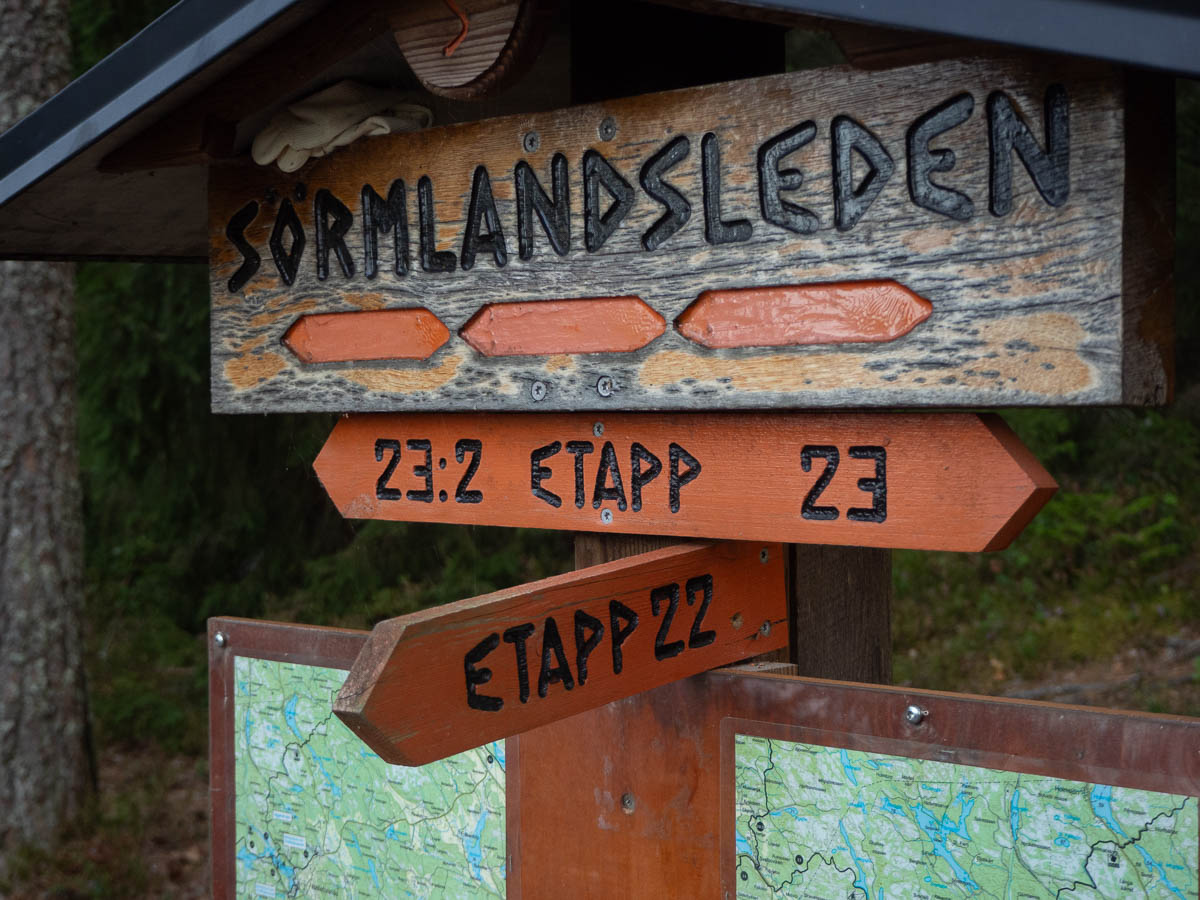
This stage has been blocking me for weeks and weeks. No way to get there by public transport, of course, and 16.5 is too much for a one-day out-and-back hike. 33 km would take me ten hours at least, plus driving there and back. Not doable. But now I had a whole free weekend, so I can walk one way today and back tomorrow. (I am again reminded that I should look into the car plus bike solution, so I can get these kinds of longer stages done in a single day.)

Hagtorp is barely a place, even: googling for Hagtorp brings up two kinds of hits only. There is the eponymous transport/shipping company, and there is Sörmlandsleden. I’m not sure what shipping activities the company actually does – there are no trucks or anything visible at their site – but they do have plenty of open gravel surface which makes for a great parking lot for hikers.

I had a leisurely start with a proper weekend breakfast and only started driving at 10:30, hoping to be hiking by 12. But there had been some kind of accident on the E4, which caused major traffic jams, and my drive took forever. When I finally got started on the trail, past one o’clock, I was very happy to be let out of the car and have a chance to stretch my legs.
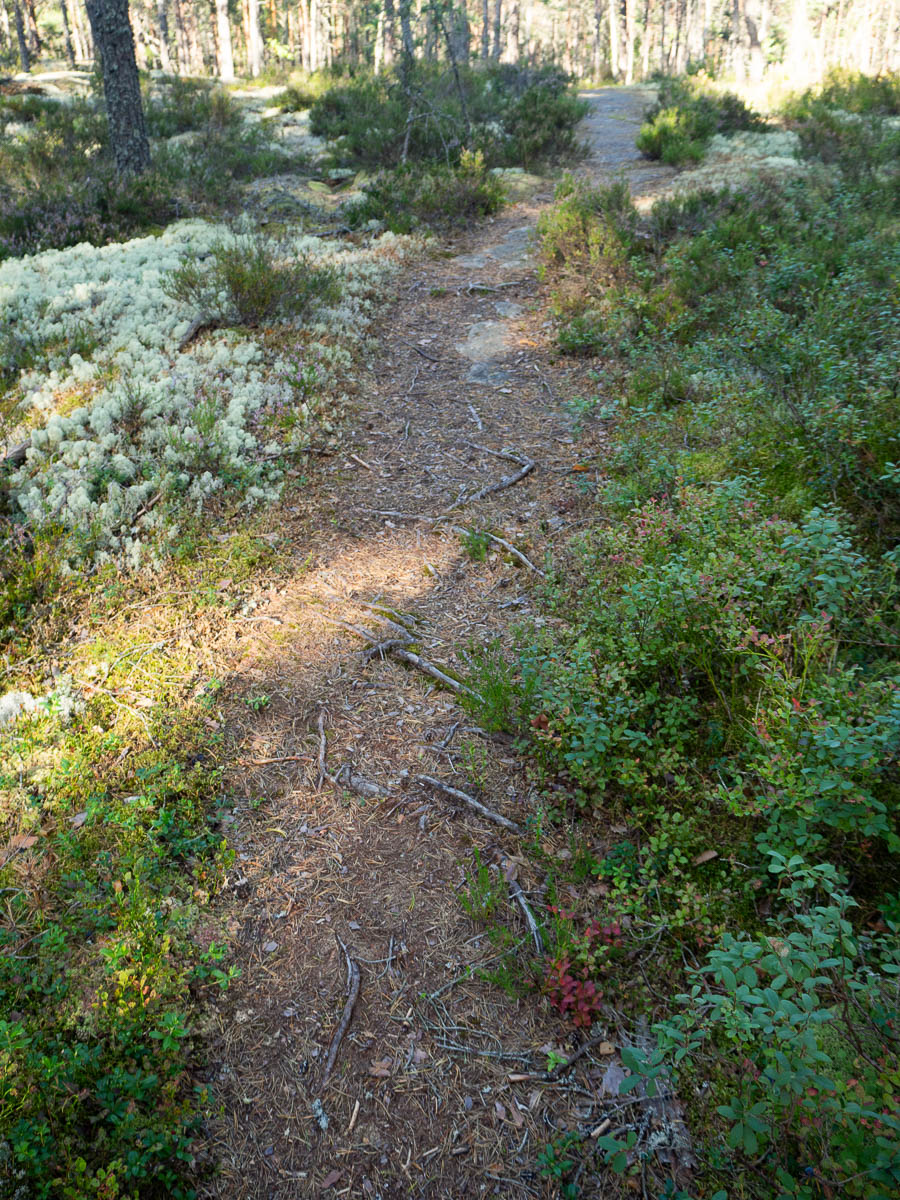
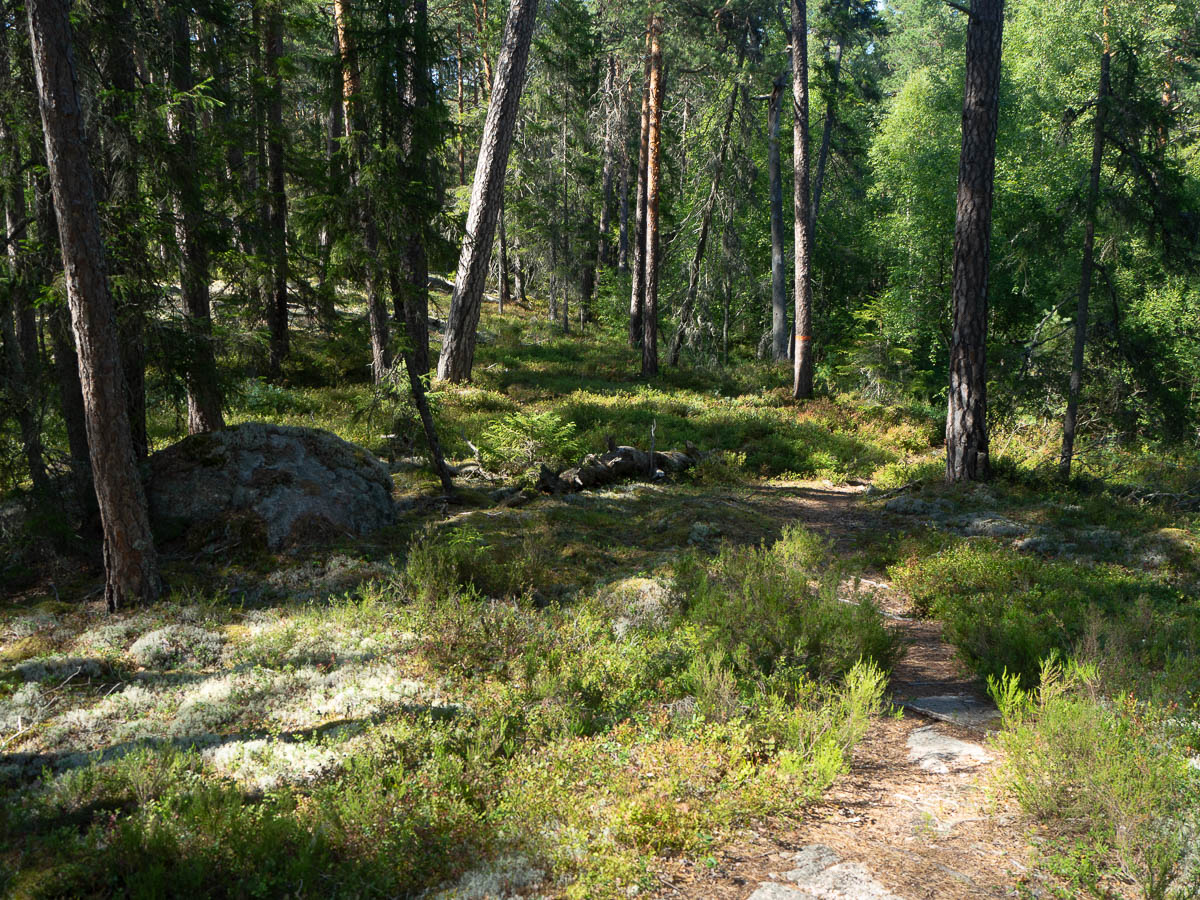
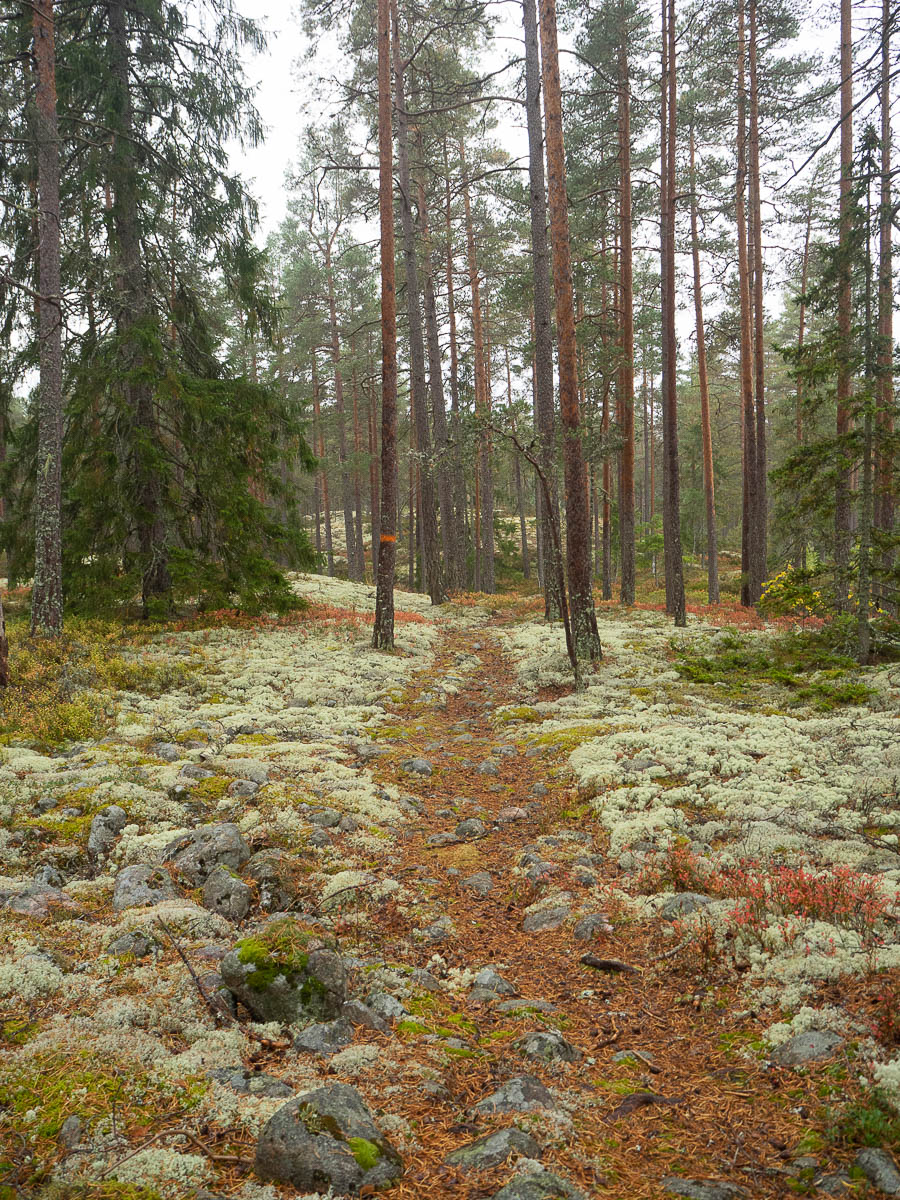
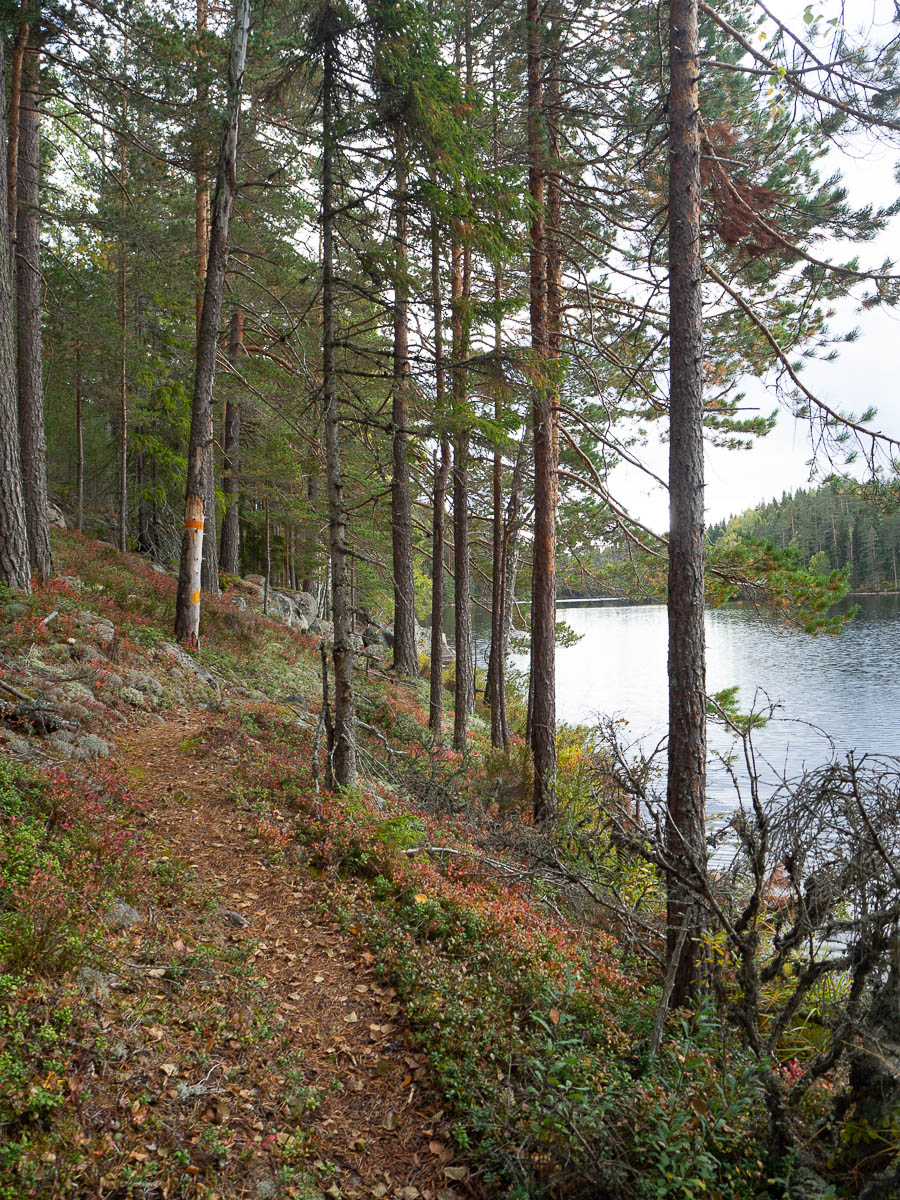
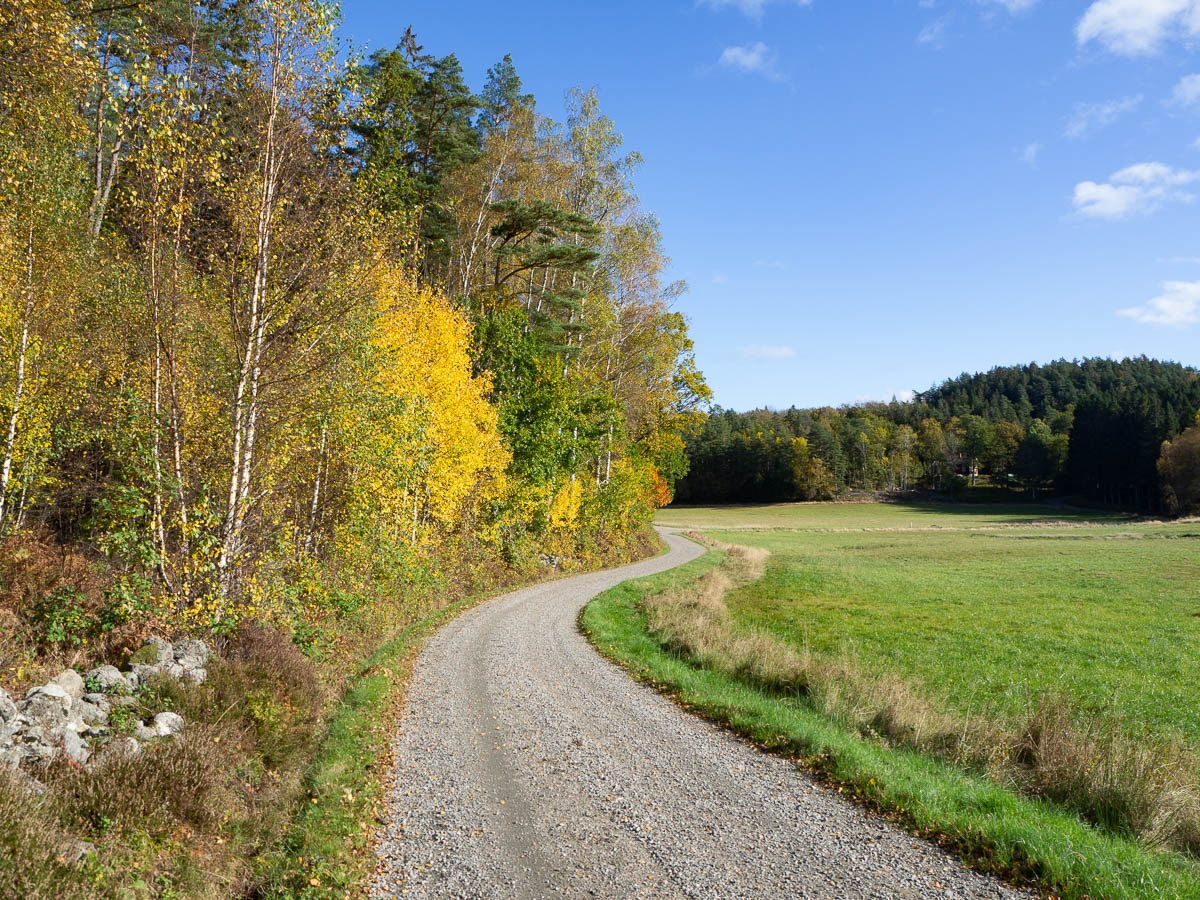
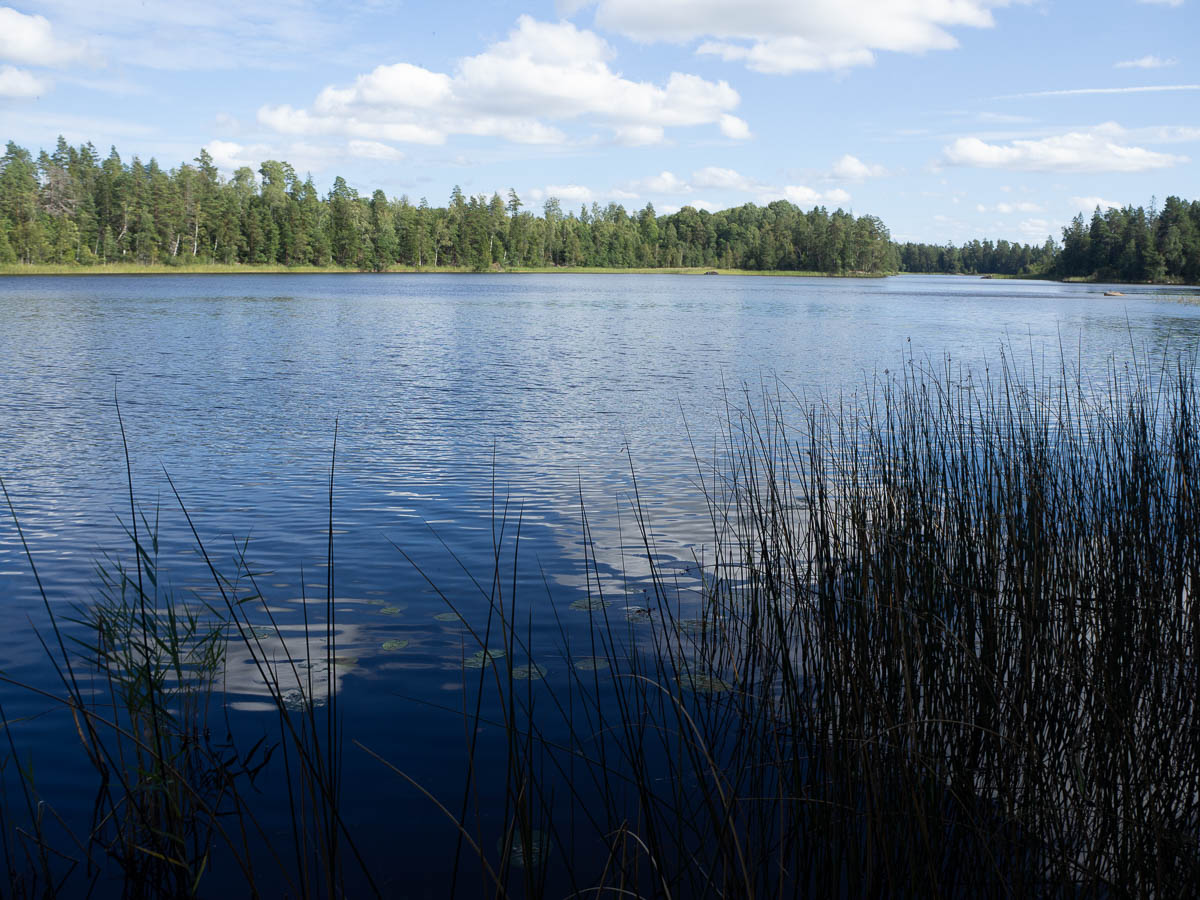
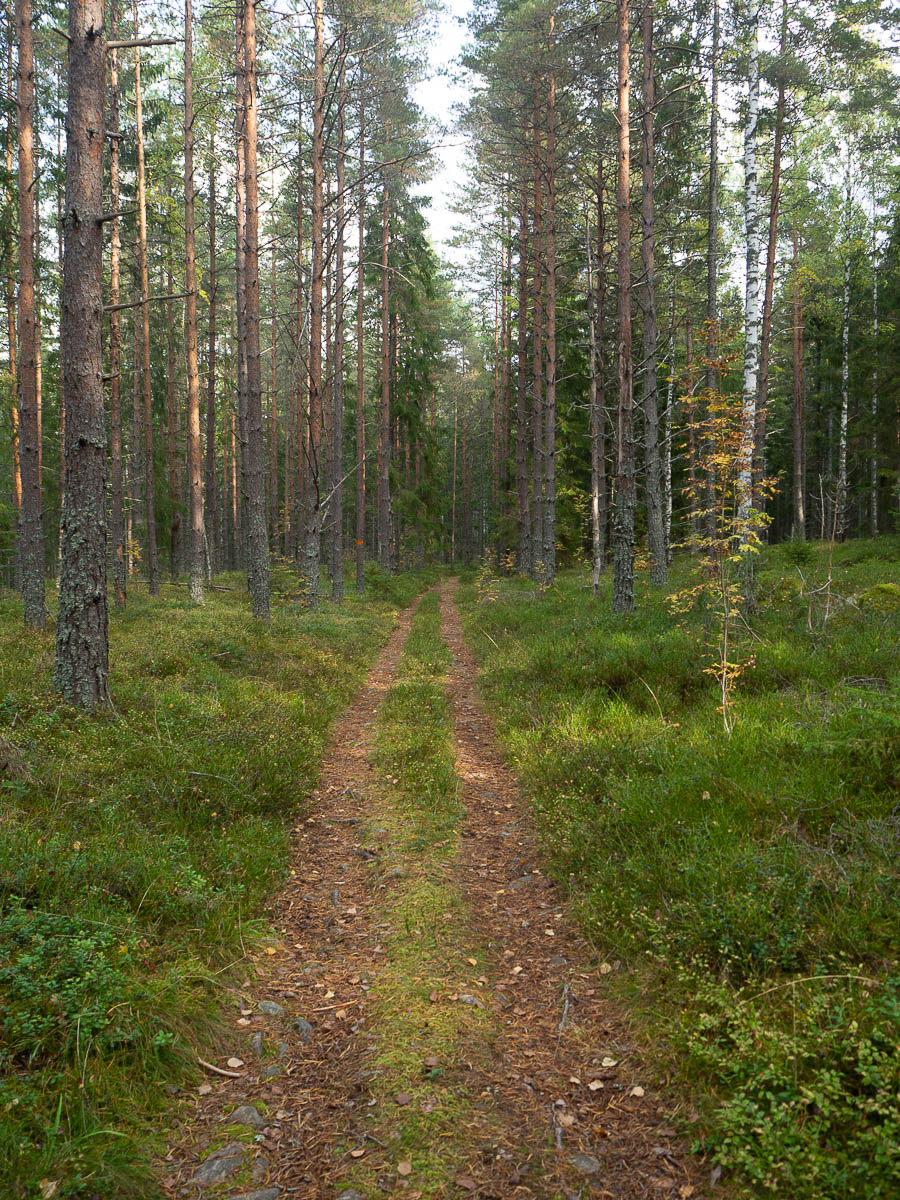
This stage had proper woods and wild nature, unlike the previous one. There was some mixed forest, and a lot of the typical pine and spruce forest with heather and blueberry bushes. And the occasional lake for beautiful views, and the occasional clear-cut area for contrasting ugliness.
I found my thoughts spinning back to the tretton37 drama all the time, and from there to code problems I left behind at Sortera yesterday afternoon, and then on private worries, and then around again. I ended up turning this into an intense mindfulness walk. Whenever I found myself ruminating again, I made myself focus on what was around me.

Sound. On a large scale: silence. Apart from the start and end, this stage was far from noisy roads, and truly very quiet. This time of the year, there’s very little bird sounds, either. But I myself was making noise all the time: there was the crunch of my boots on debris, and the swish of grass against my legs, and the slosh of water in my water bottle.

Sight. I wish I could have looked around while walking, but much of the path was really rough and uneven, with rocks and roots and tussocks, so it took constant concentration. I would have tripped or twisted an ankle quite quickly. But I could pay attention to the rocks themselves, and all the pine cones on the ground, and the various plants and bushes around me.

Smell. Not much. Books sometimes have people walking on “fragrant pine needles” but in reality any needles on the ground are dead and have no scent at all. Perhaps pine trees in other parts of the world are different, who knows.

Touch. One the one hand, plenty to experience, but on the other hand, most of what I can feel while hiking tends towards the unpleasant. The pressure of the pack on my hips. A wrinkle in my t-shirt under the straps of the pack. The sharp scratch of a juniper bush. But I liked catching the seed heads of tall grasses and letting them slip through my fingers.

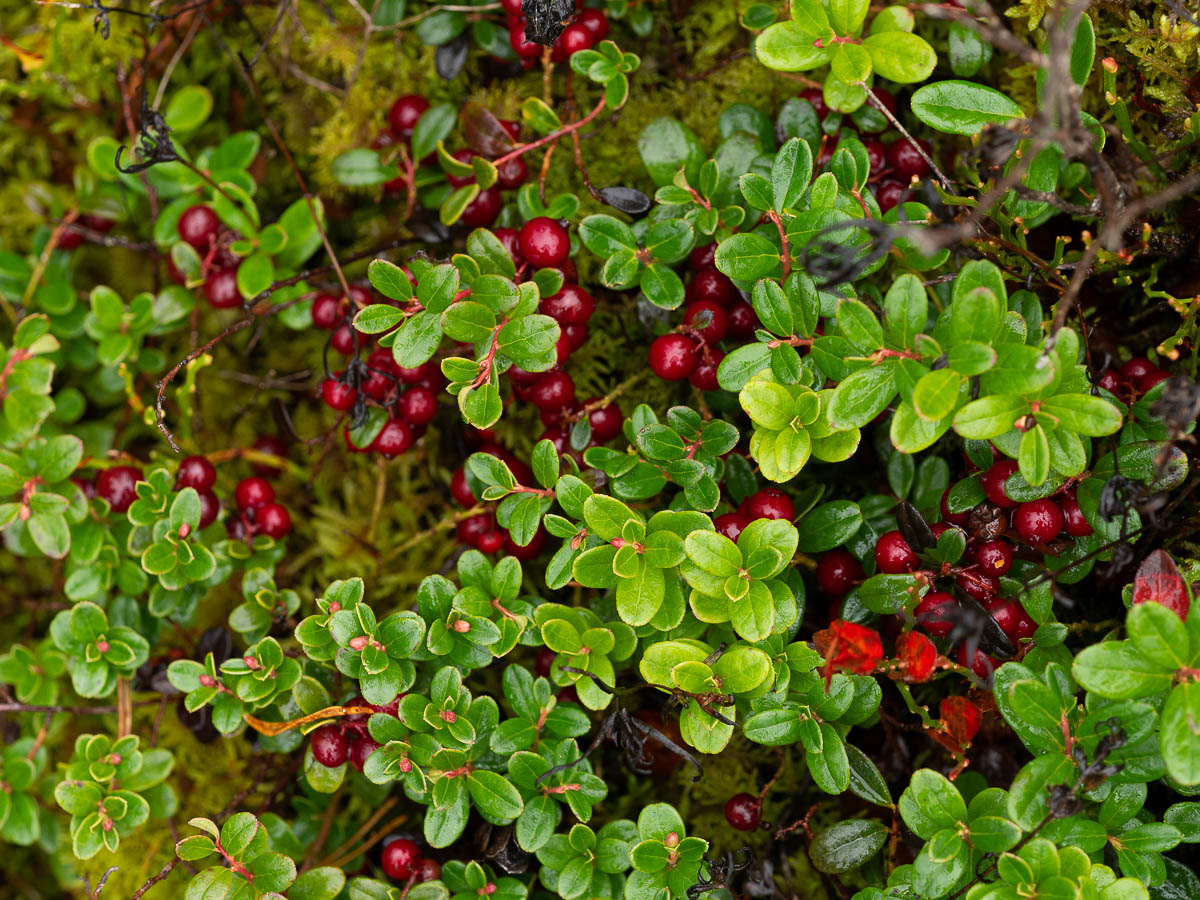
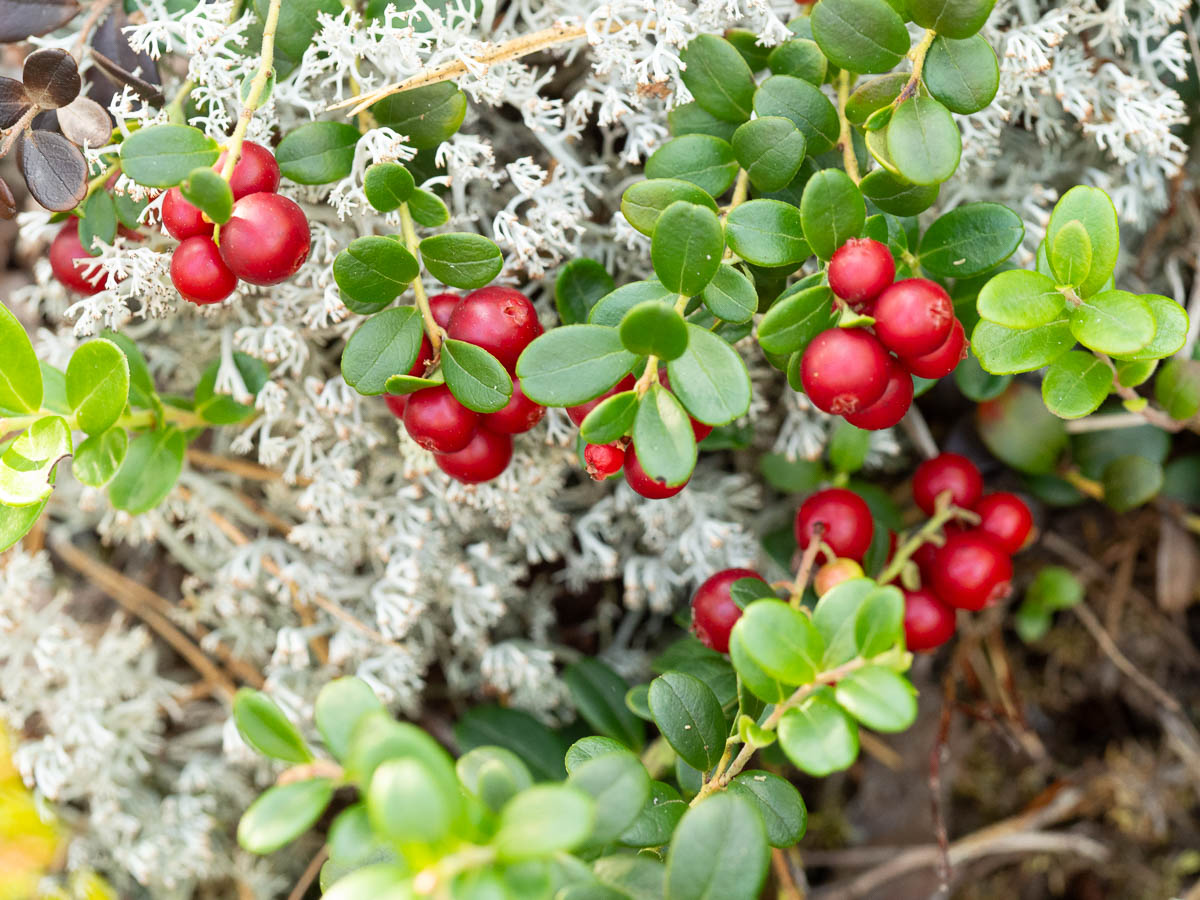
Taste. It’s berry season! Lingonberries and bilberries and bog bilberries are all ripe and plentiful. I was extra happy when I found bog bilberries, not only because I like their flavour but also because the bushes are taller and the berries thus easier to pick without bending down (which can be awkward with a heavy pack).

Most lingonberries were mostly ripe, and some were all the way ripe, but I’d say they needed another week or so to reach perfection. Which didn’t stop me from eating them, of course.
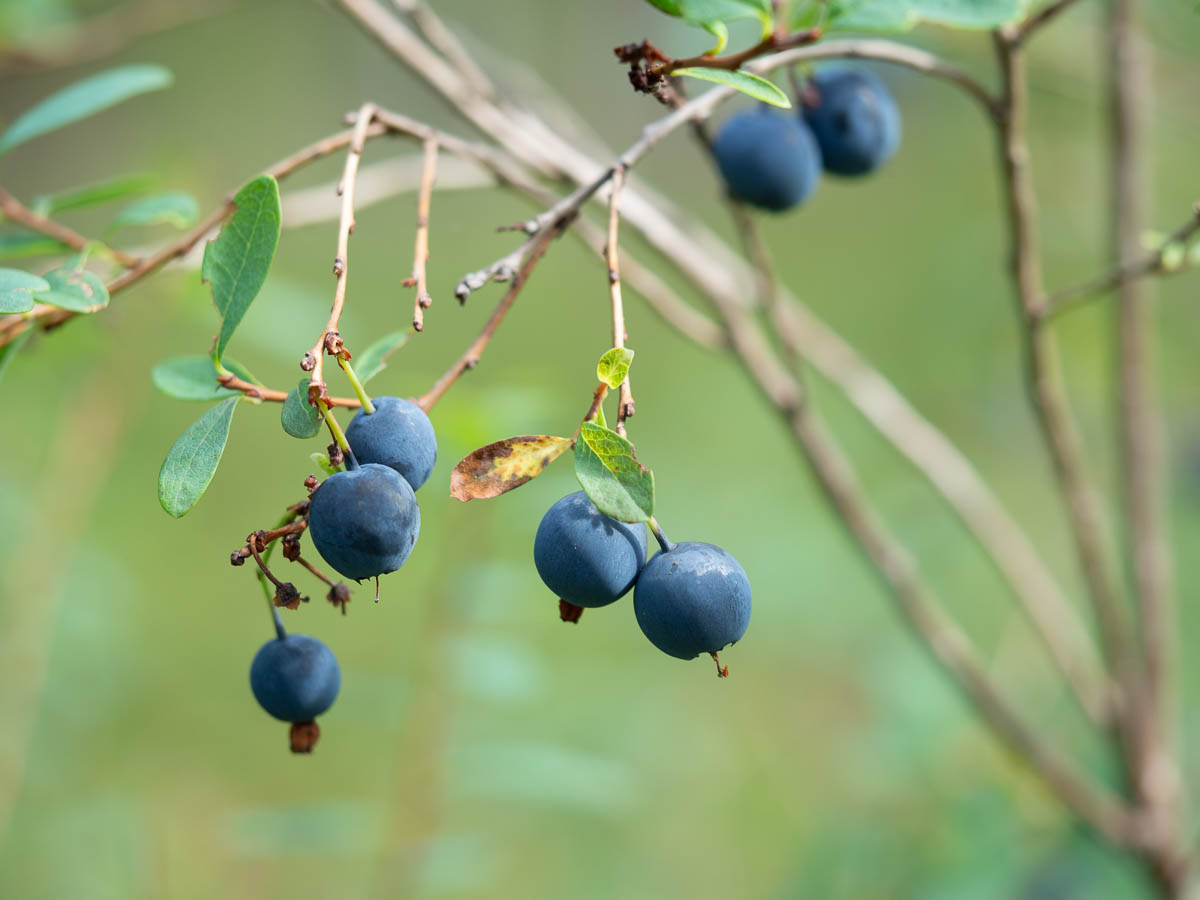
Bog bilberries look less appealing. The bushes are sparse and have an air of scragglyness. The berries hang singly or by twos at most, and the colour is muted, so they look underwhelming on the whole. It takes effort to make them look good in a photo.
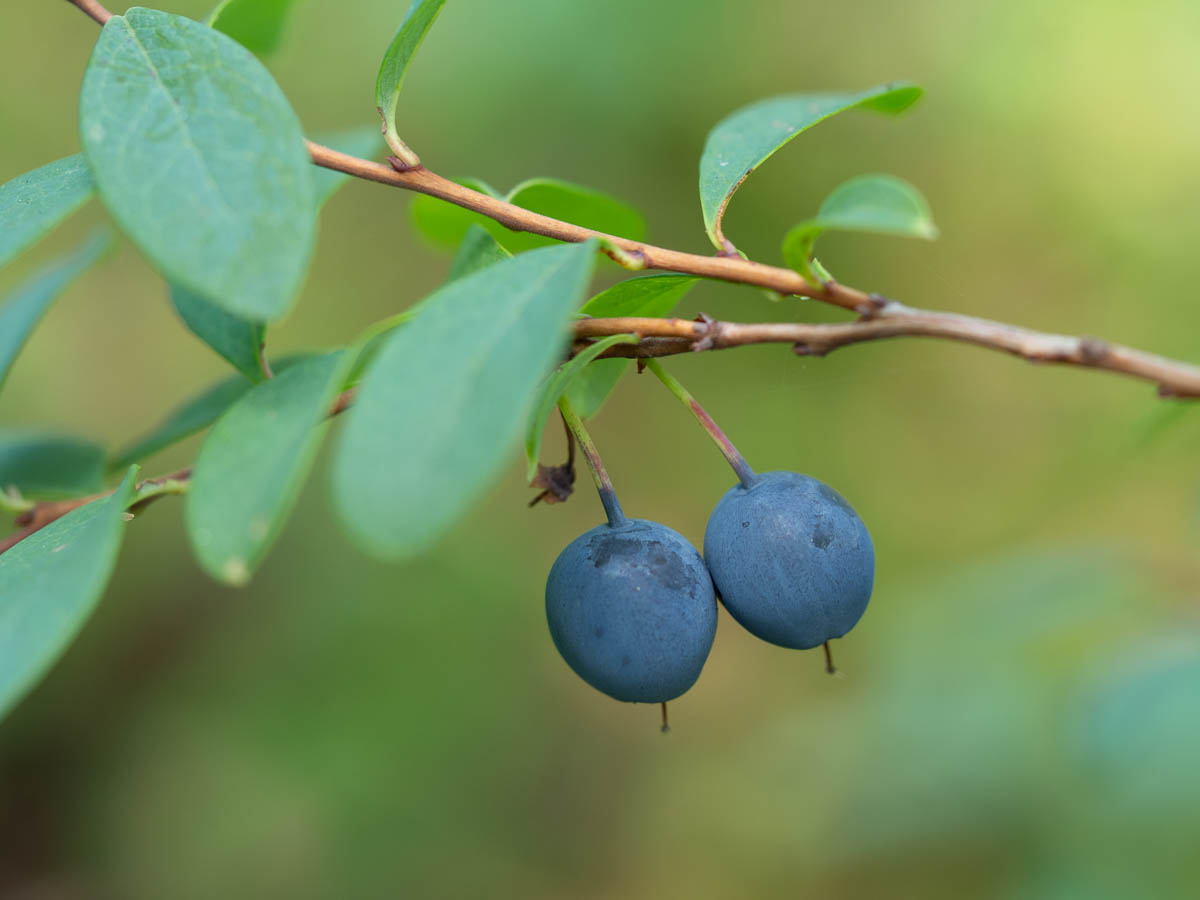
Bilberries I don’t care much about at all, while I’m out walking. They’re good in pies and muffins and yoghurt and all that, but on their own, they’re too bland for my taste.

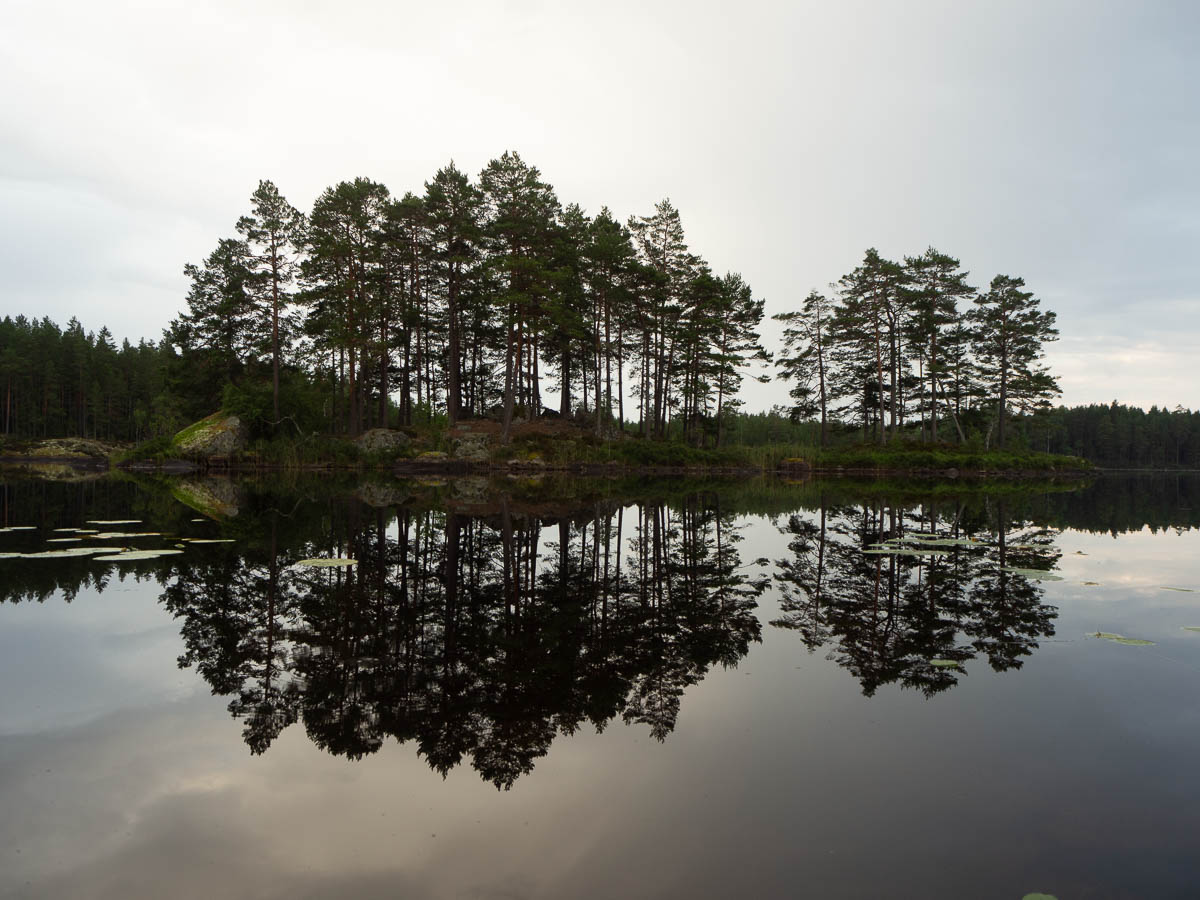
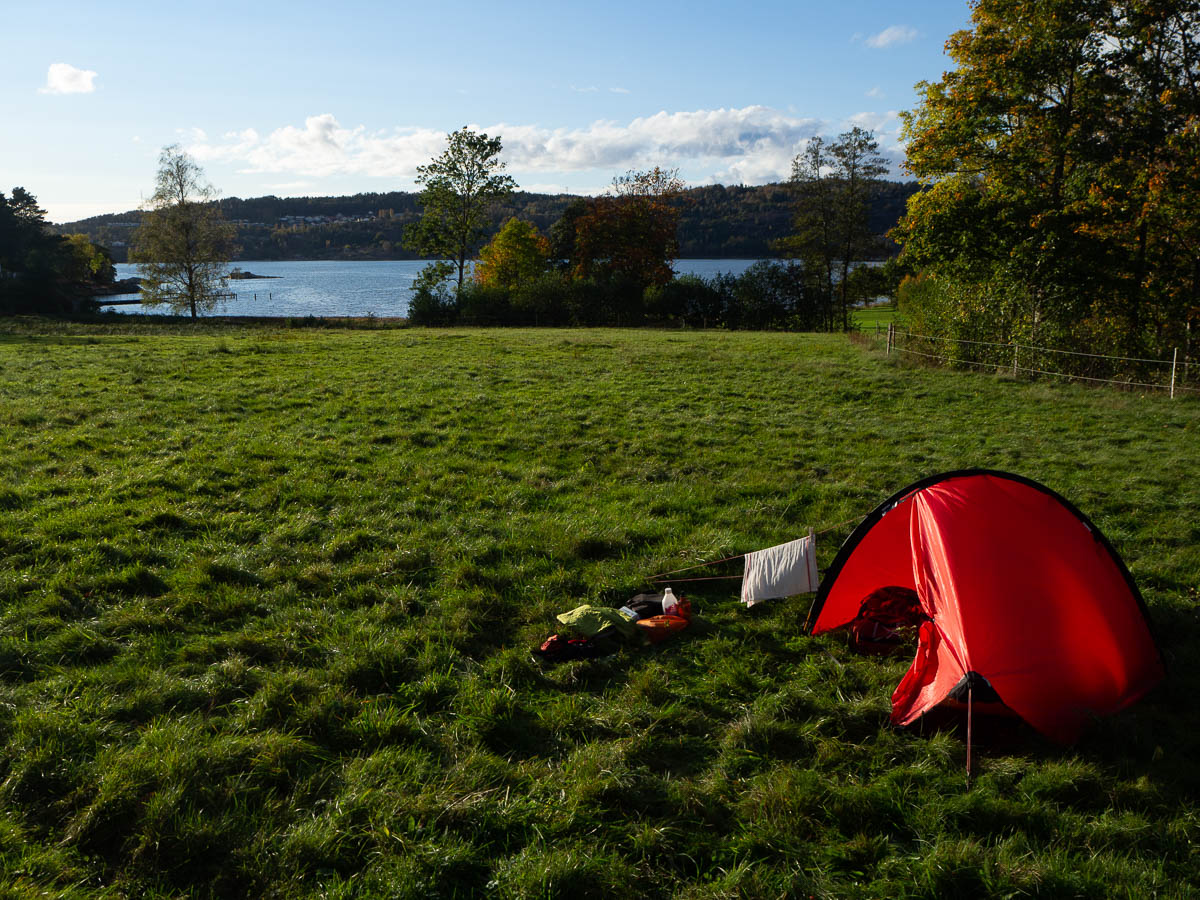
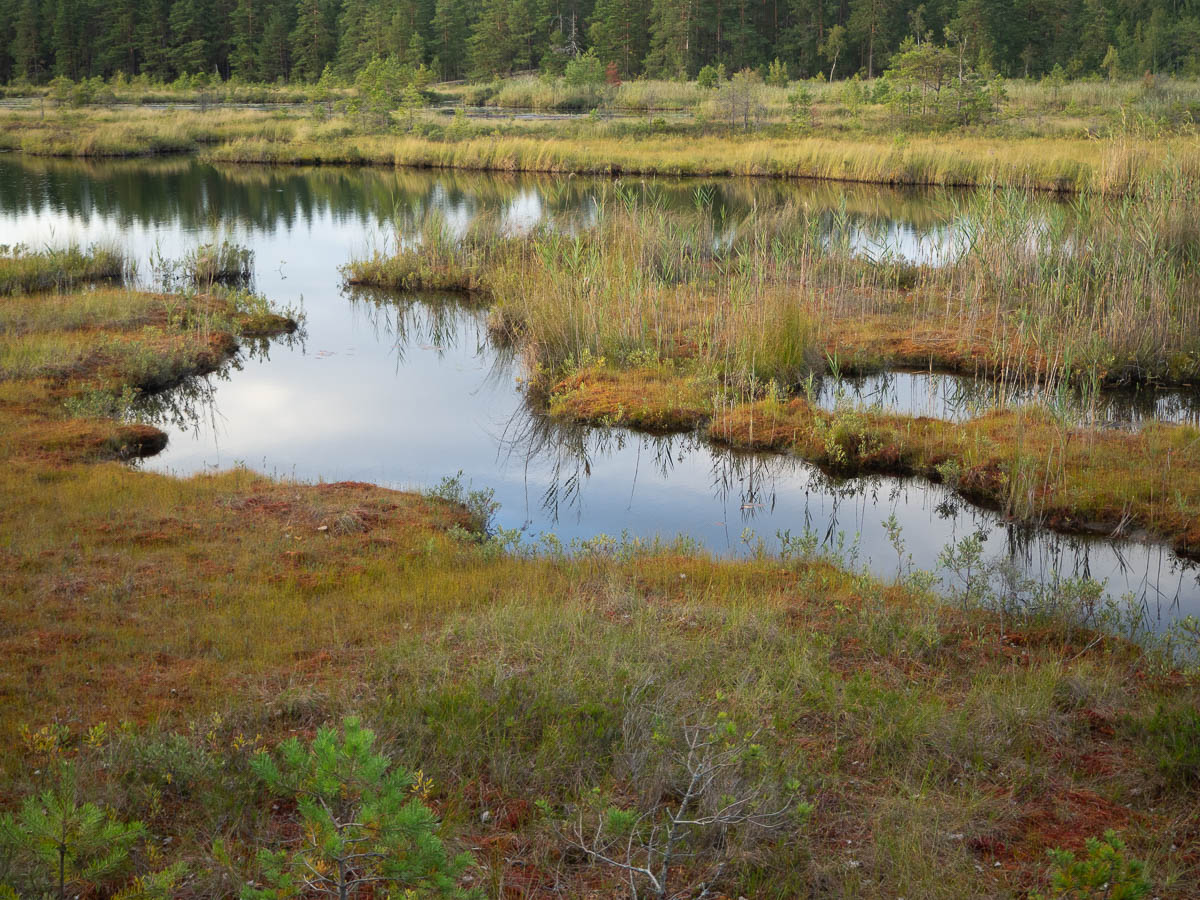
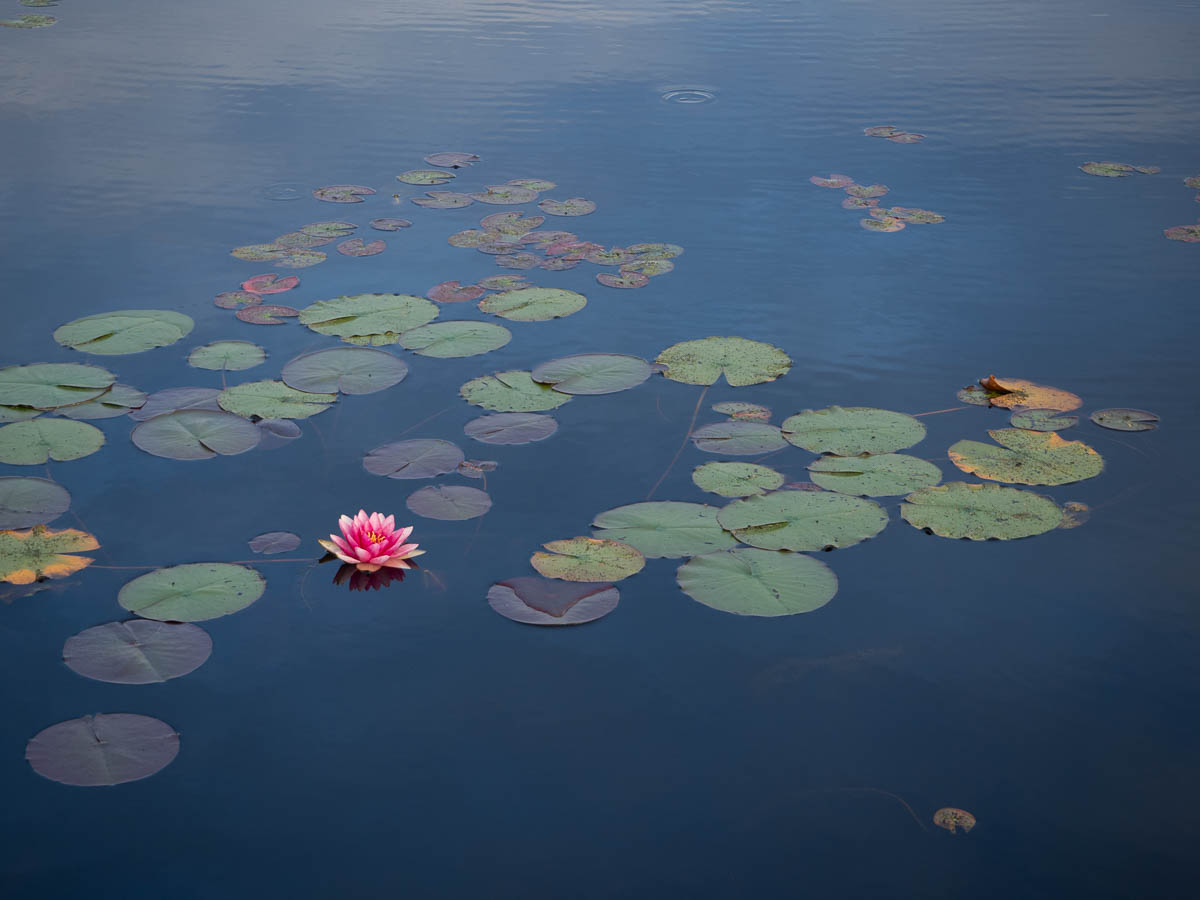
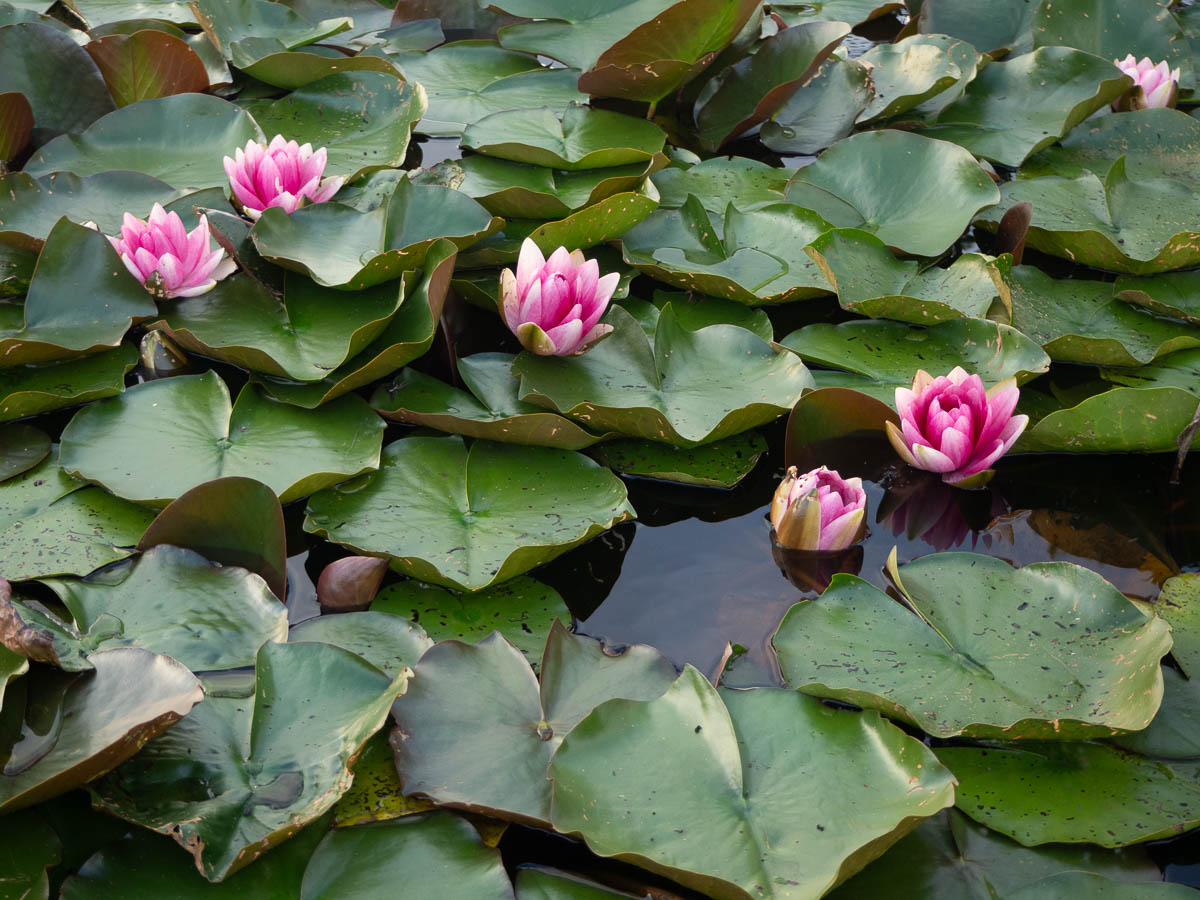
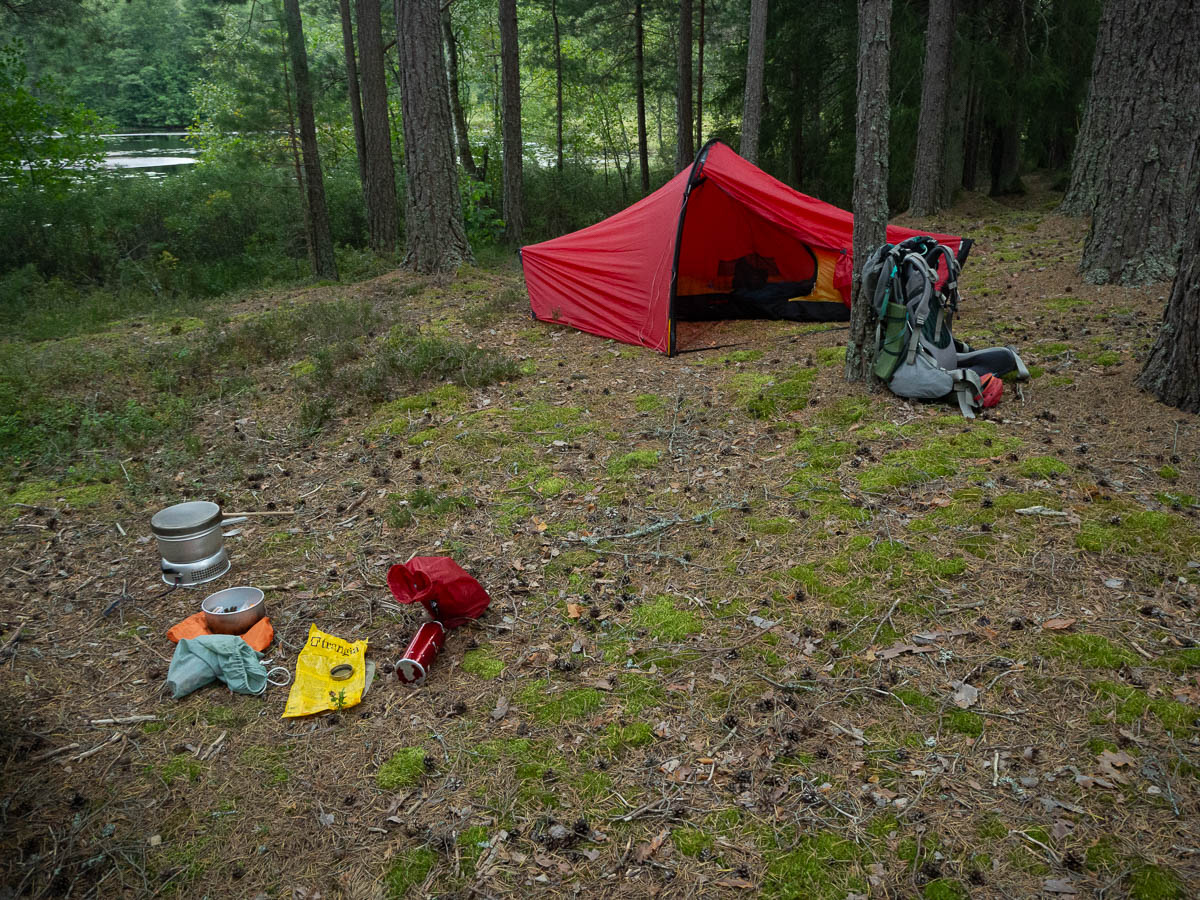
Due to my late start, and my slow pace because of the uneven path, I was worried about getting to the end at a reasonable hour. It was seven in the evening by the time I reached the camping area. I had been keeping my eyes open for the last kilometre or two of walking, for alternative camping spots in case the end of the stage was underwhelming (because the other end was literally a gravel parking lot!) but the area around Bruksdammen was beautiful. I put off all thoughts about cooking dinner and getting my tent set up, and instead admired and photographed the area. It was a wetland area with pink water-lilies in deep dark ponds.
Then there was dinner, after which I read for a while, but then went to bed at ten o’clock already, quite tired. The night was very windy – I half-woke a few times and thought at first that it was rain I heard, but it was just the wind being very loud.
Sörmlandsleden stage 19 + a little bit of stage 20, 14.5 km. From Ånhammar to Henaredalen in the middle of nowhere.

Stage 19 on its own is officially 12 km, which is a bit too short to make a full day, but also a bit too much for a there-and-back in a single day. Rather than pressing myself, I’m doing it over two days, and I added on an extra ramble around Henaredalen for this afternoon.

This was a beautiful and varied hike, going a flowering lakeside marsh…

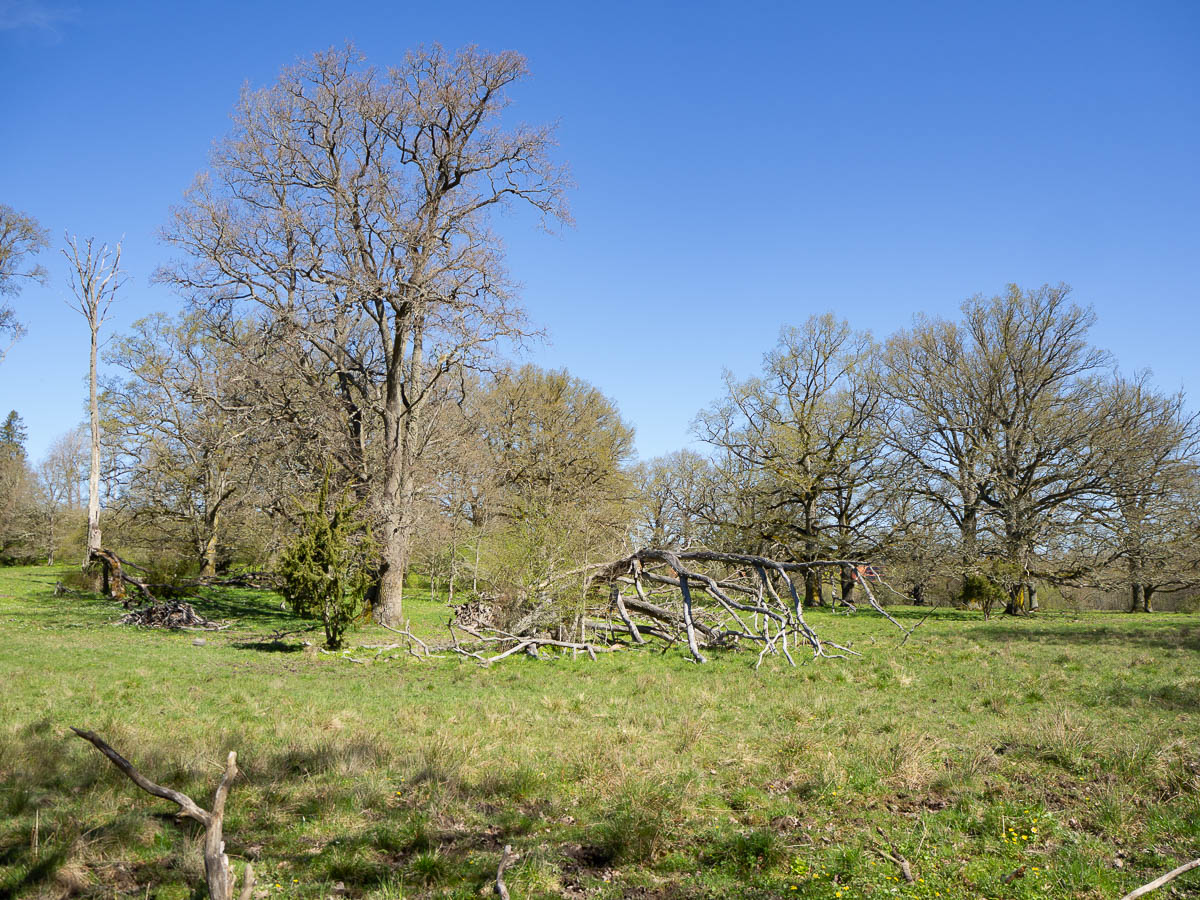
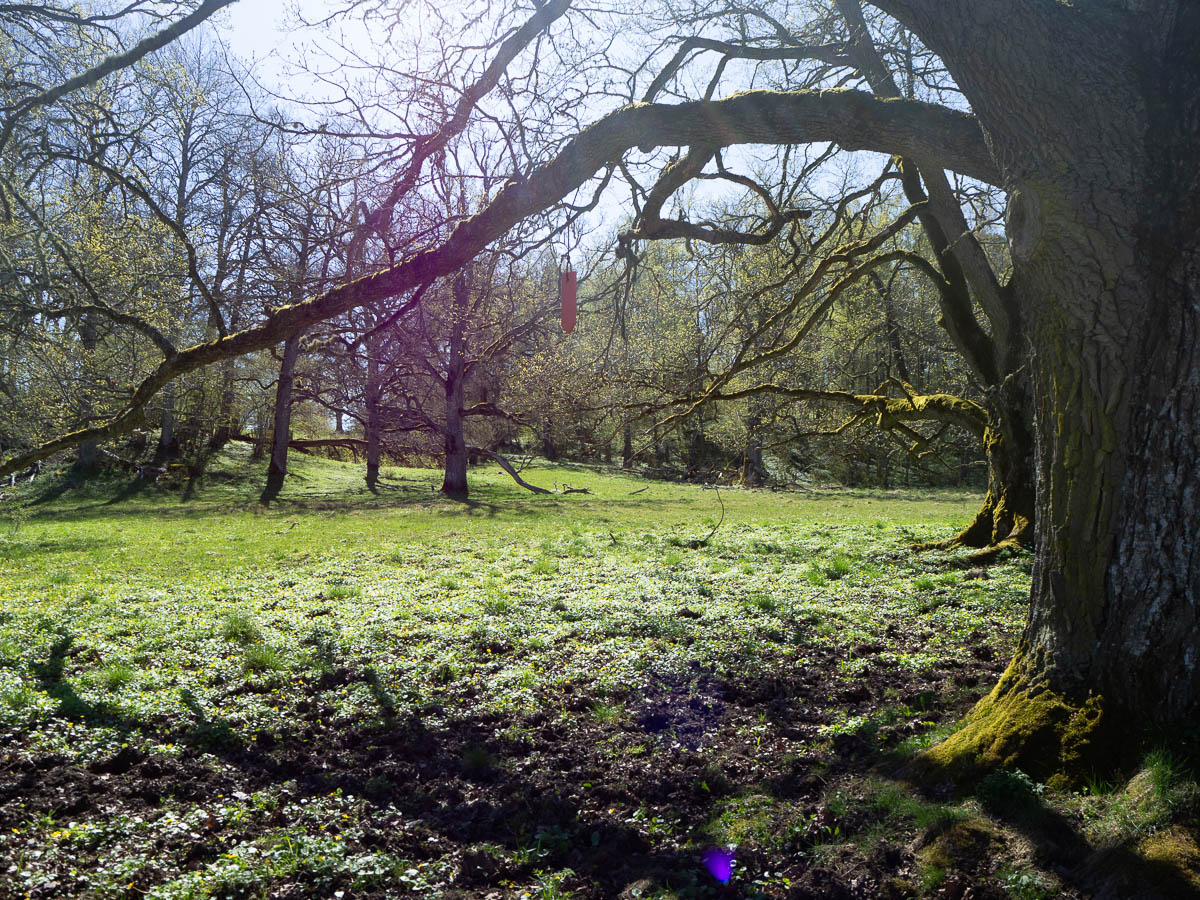
… through oak pastures…

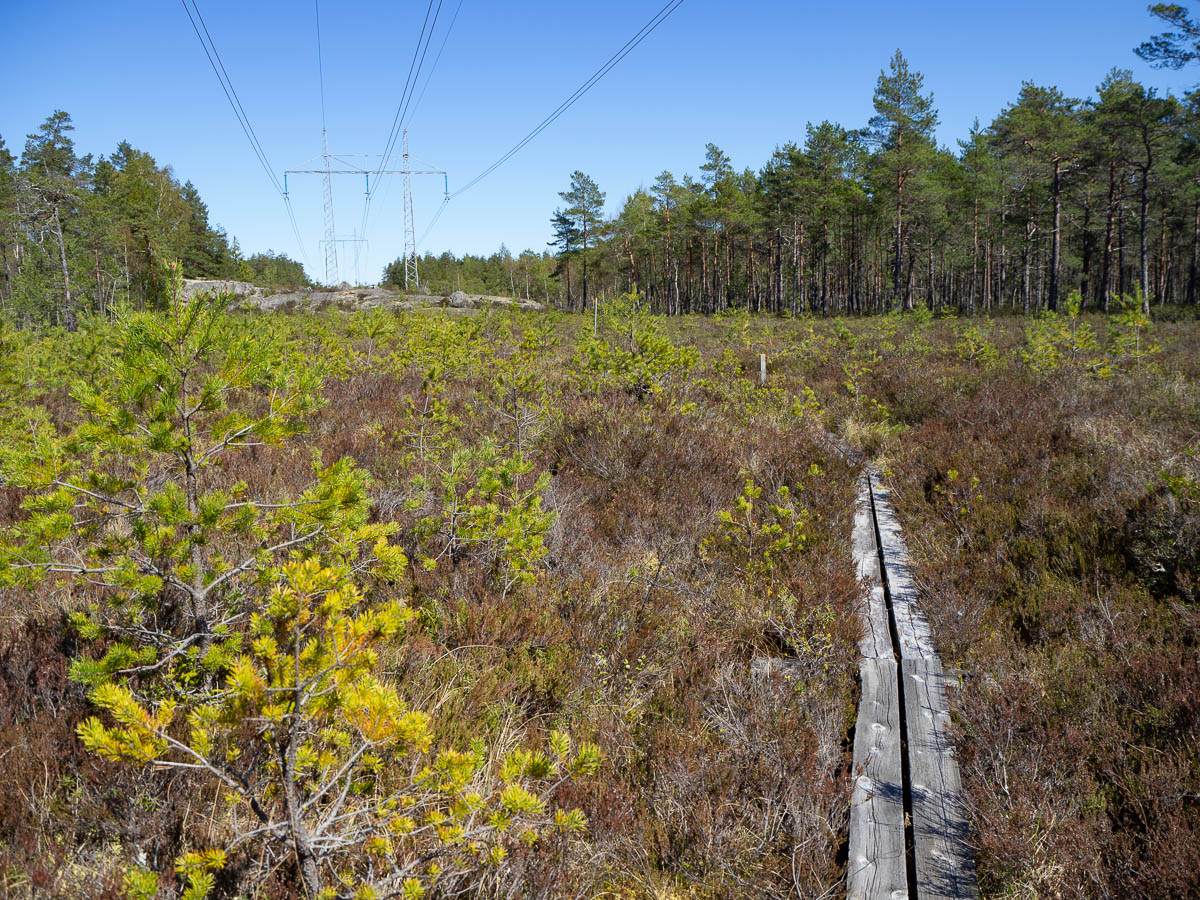
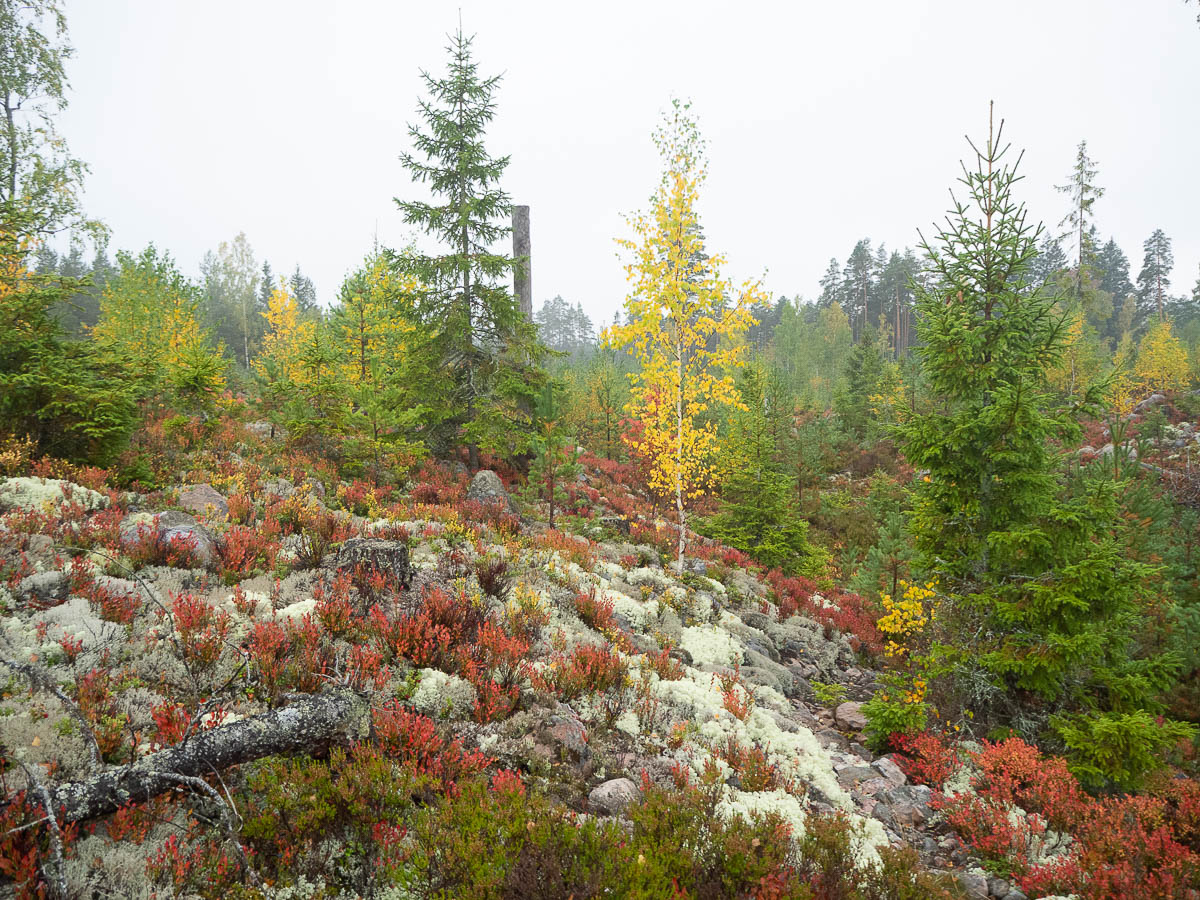
… and heathery bogs…

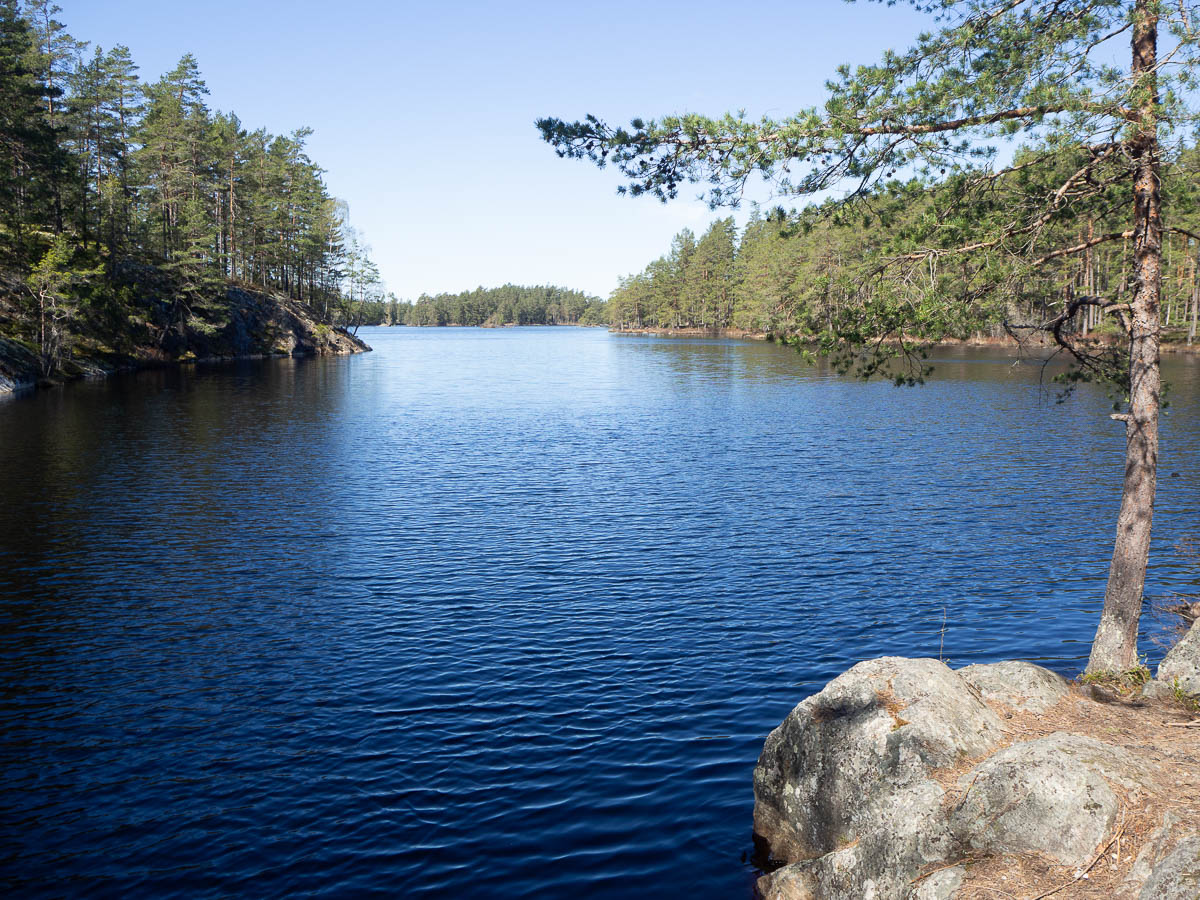
… to rocky pine forests dotted with little rocky lakes.

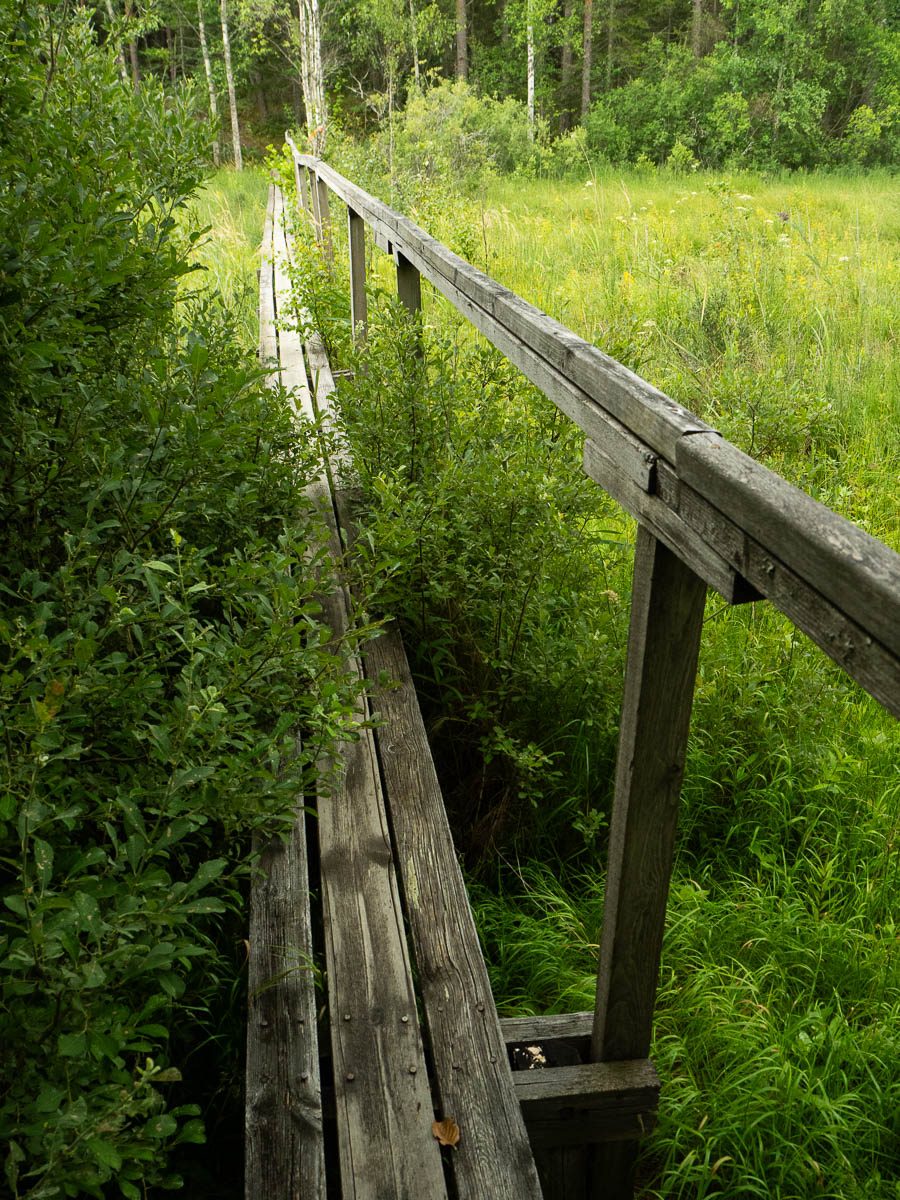
I’m glad I didn’t try to do the 12 + 12 km in a single day because this was not the easiest stage to walk. It wasn’t so much the ups and downs that made it hard, but the uneven path. Rocks and roots everywhere, and muddy patches.

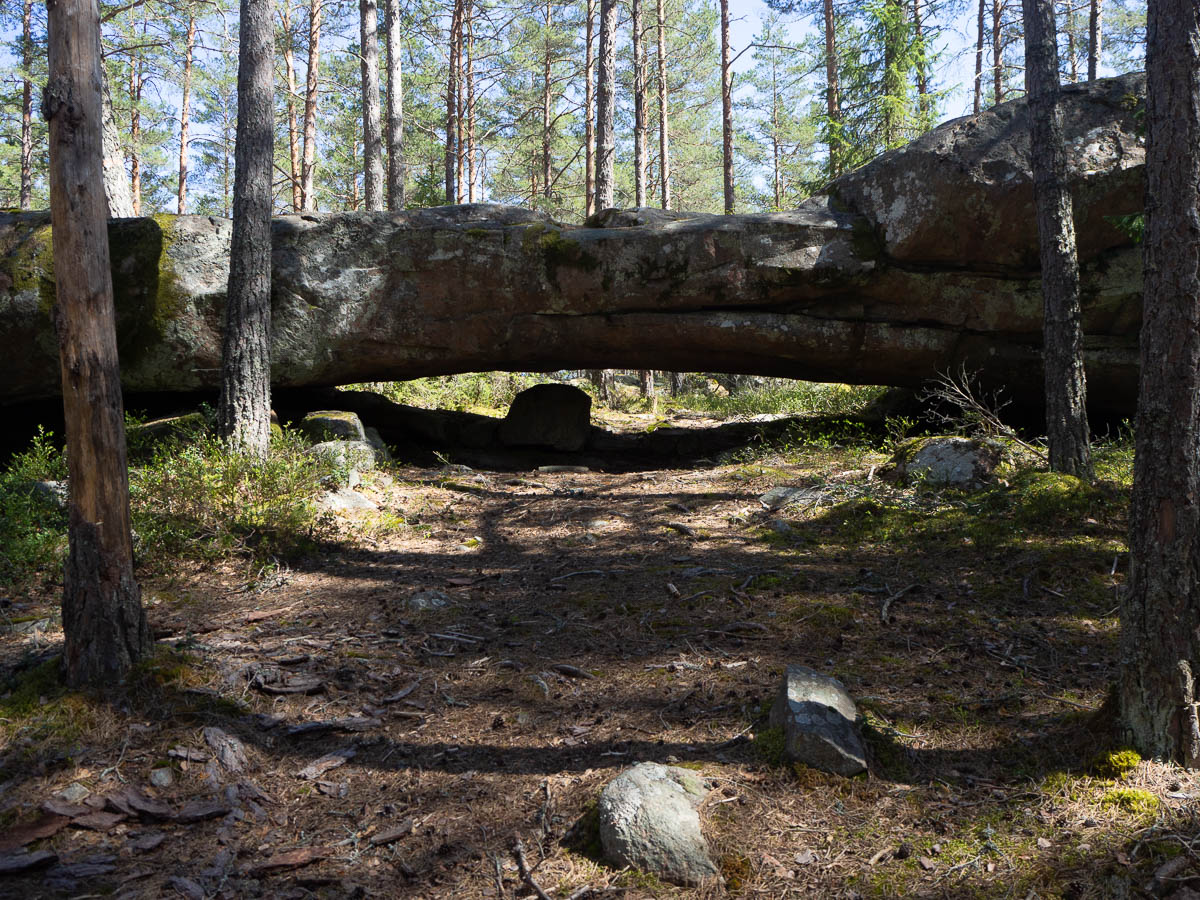
In the middle there was a ten-metre natural arch, all one unbroken piece of rock.

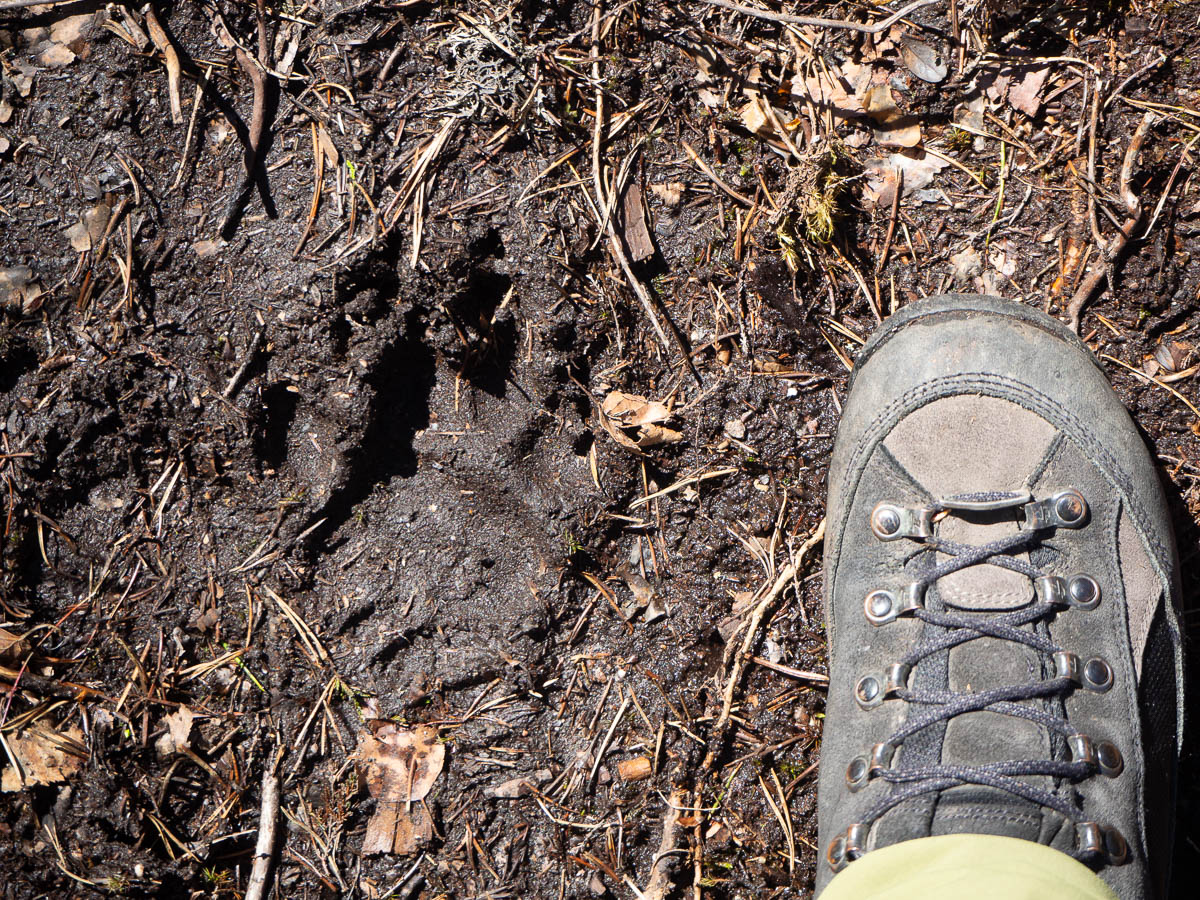
Another interesting sight was a very large paw print in the mud. Either a really large dog that somehow avoided all the other muddy spots on the path, or an actual wolf. I’ve heard from other hikers that there are several established wolf territories in this part of Sörmland, so that’s not entirely far-fetched.
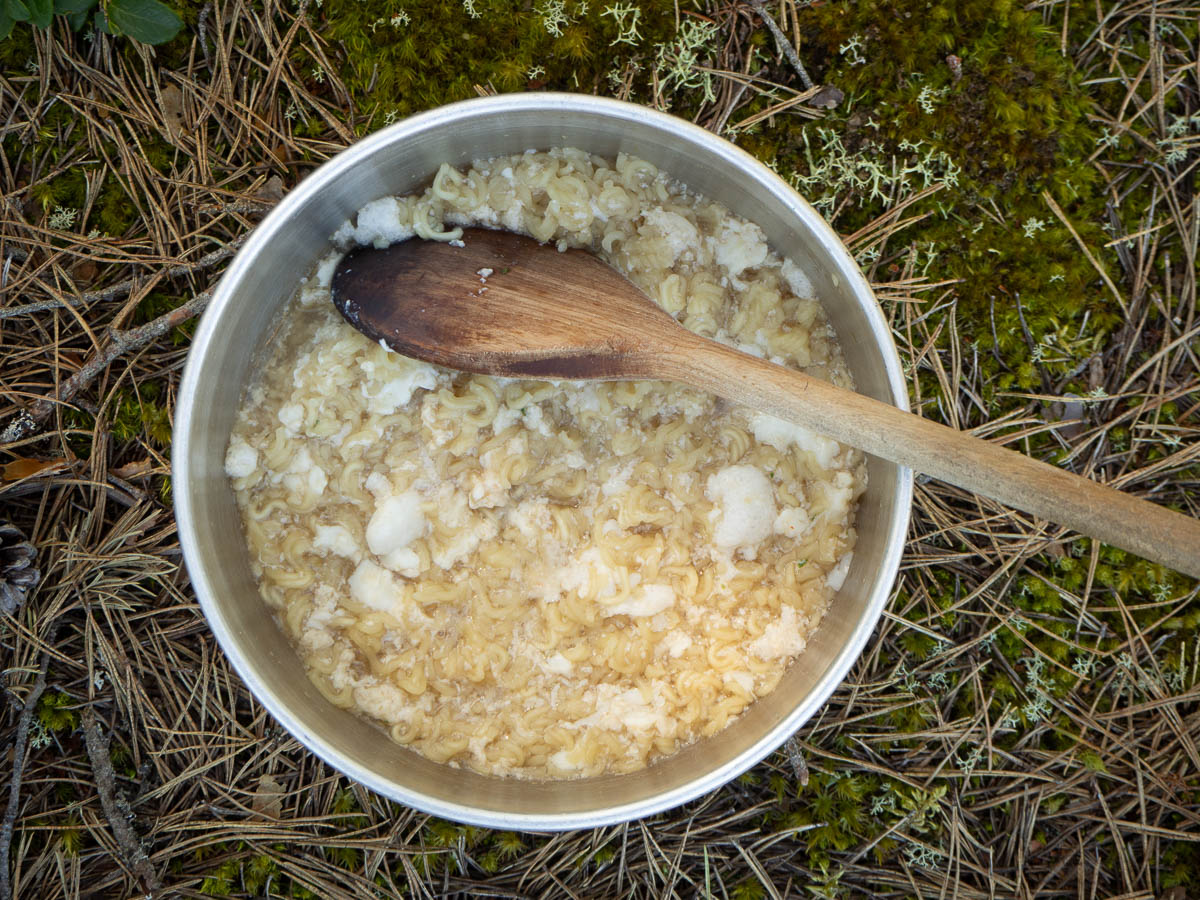
In other news, it turns out that walking around with egg whites in your rucksack will slowly whisk those egg whites into a soft foamy fluff. And if you then dump those egg whites into your hot instant noodles, they solidify into little foamy islands, sort of like sugarless îles flottantes.
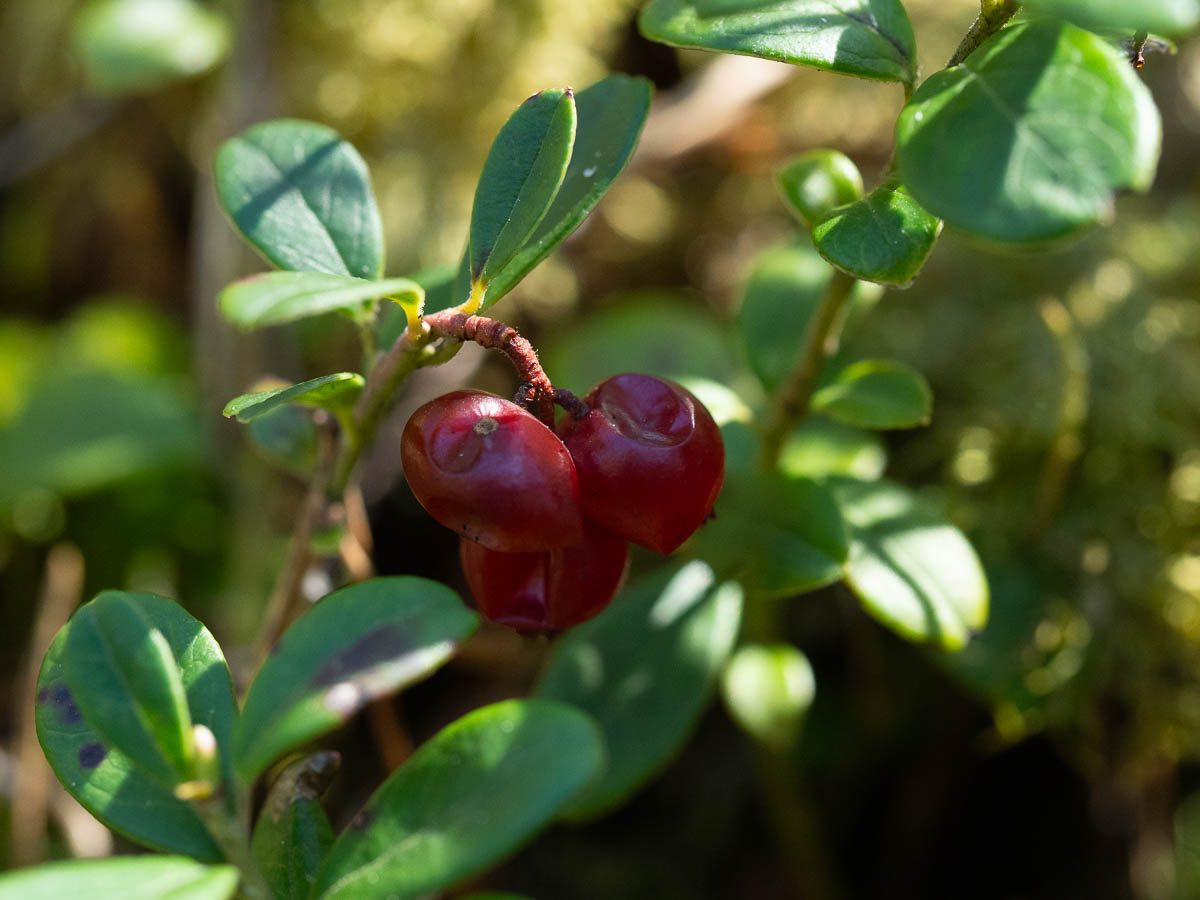
Speaking of food, I wasn’t expecting to find anything edible in the forest at this time of the year, but I was wrong – some of last year’s lingonberries were still there and waiting to be eaten. Frozen and then thawed, and partially sun-dried, they were wrinkly but juicy, tart and sweet. Few and far between, and hard to spot, not like fresh ones where you can stop anywhere and eat your fill.

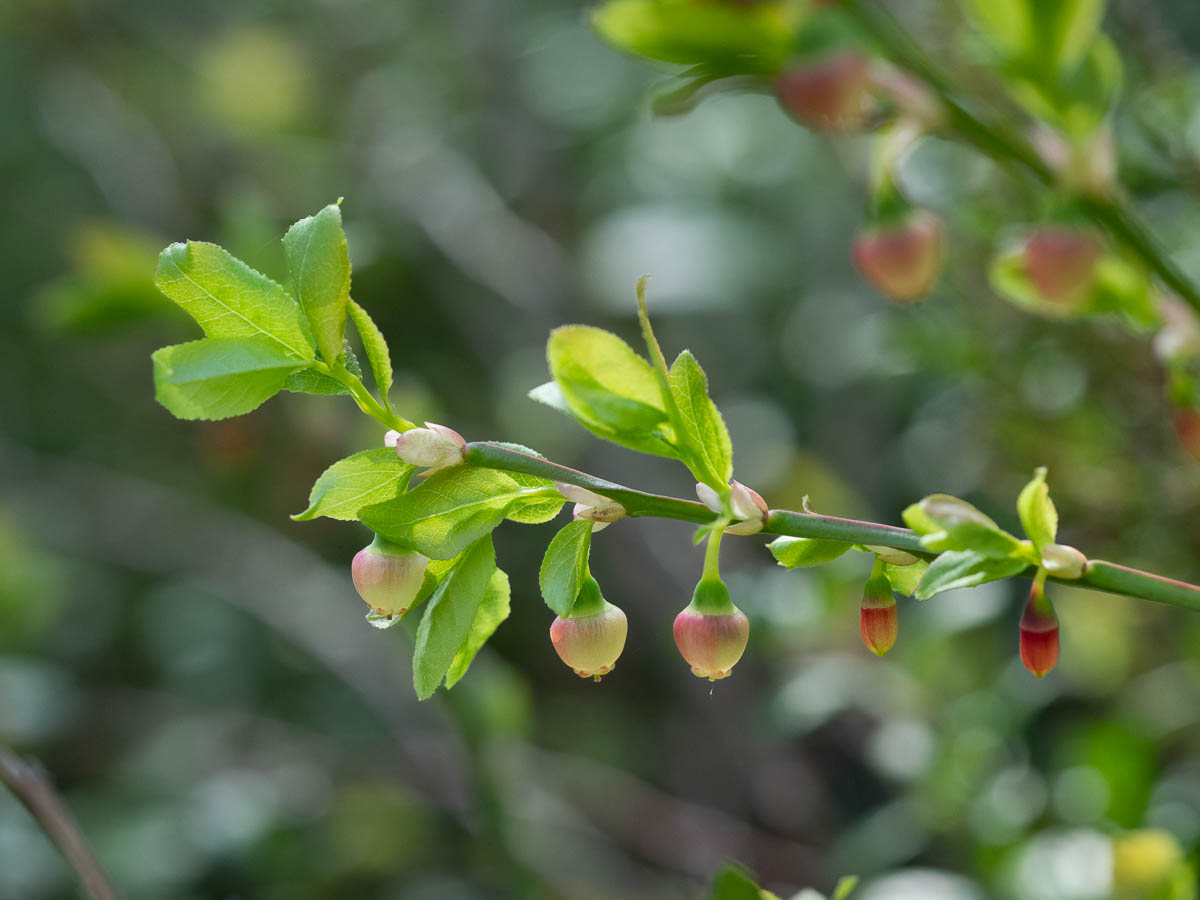
The forest was full of bilberry and lingonberry bushes, so later in the season there will be lots to eat here. Right now the bilberries taunted me with their berry-like flowers.

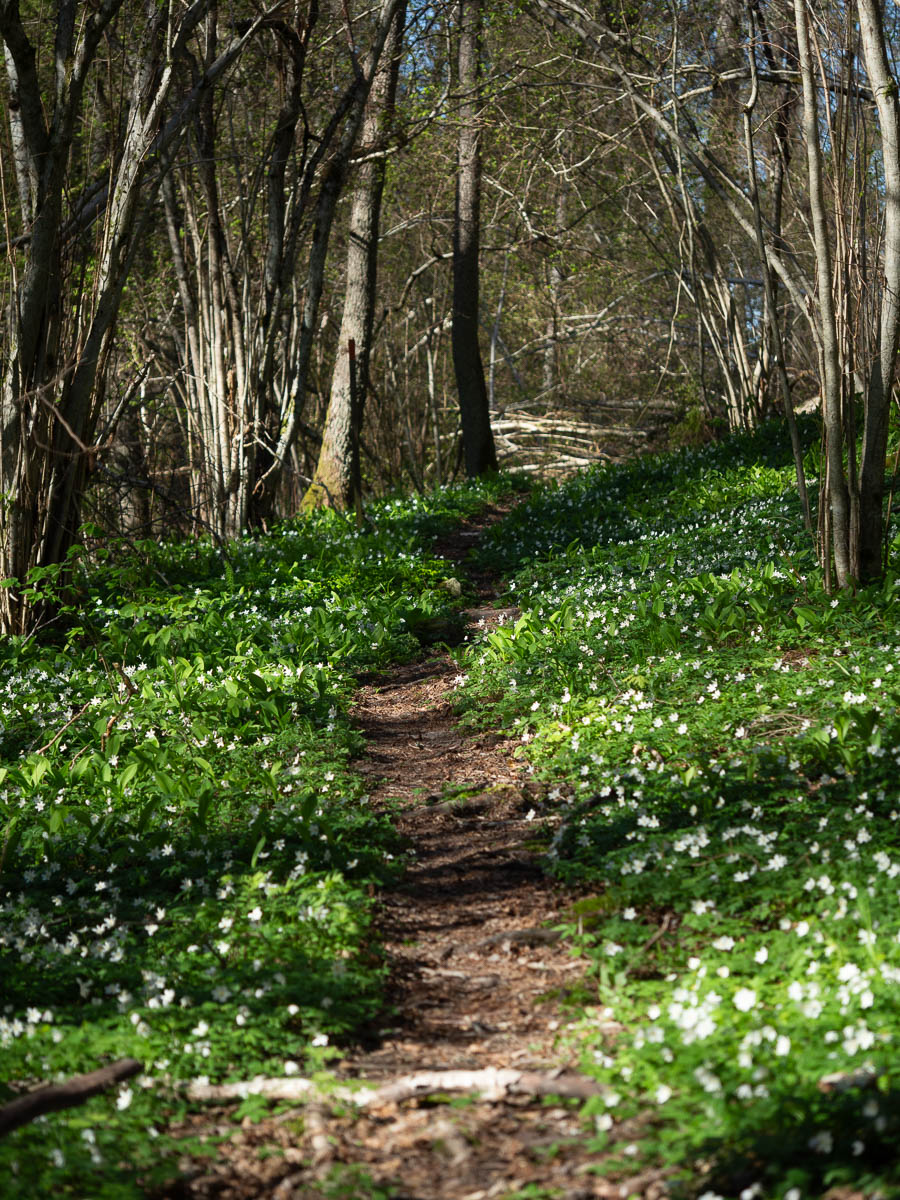
Henaredalen is a river valley that I walked in 2018 and wasn’t too impressed by. That was also in May, but this year, spring has come a lot further and the valley is more full of flowers. Much of the ground was covered by wood anemones.

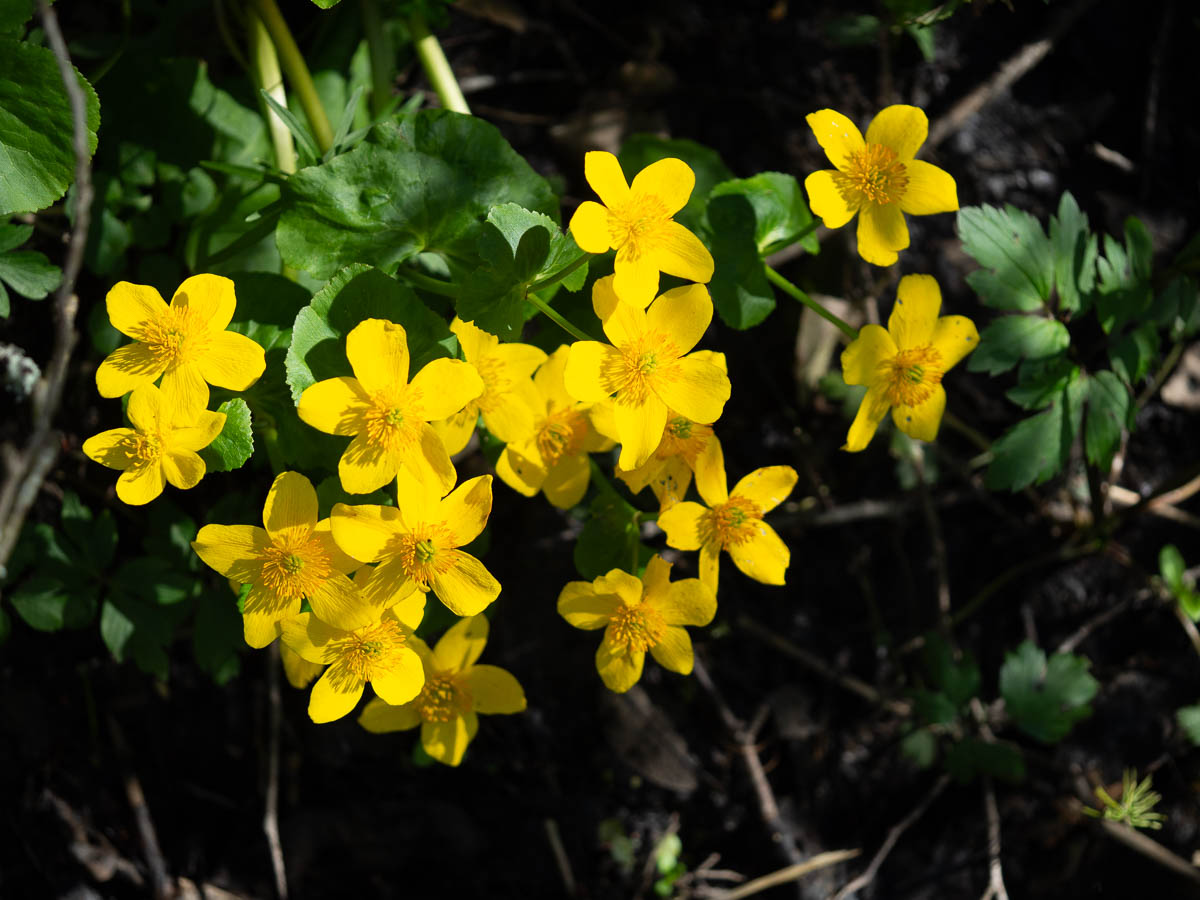
In between there were marsh marigolds…

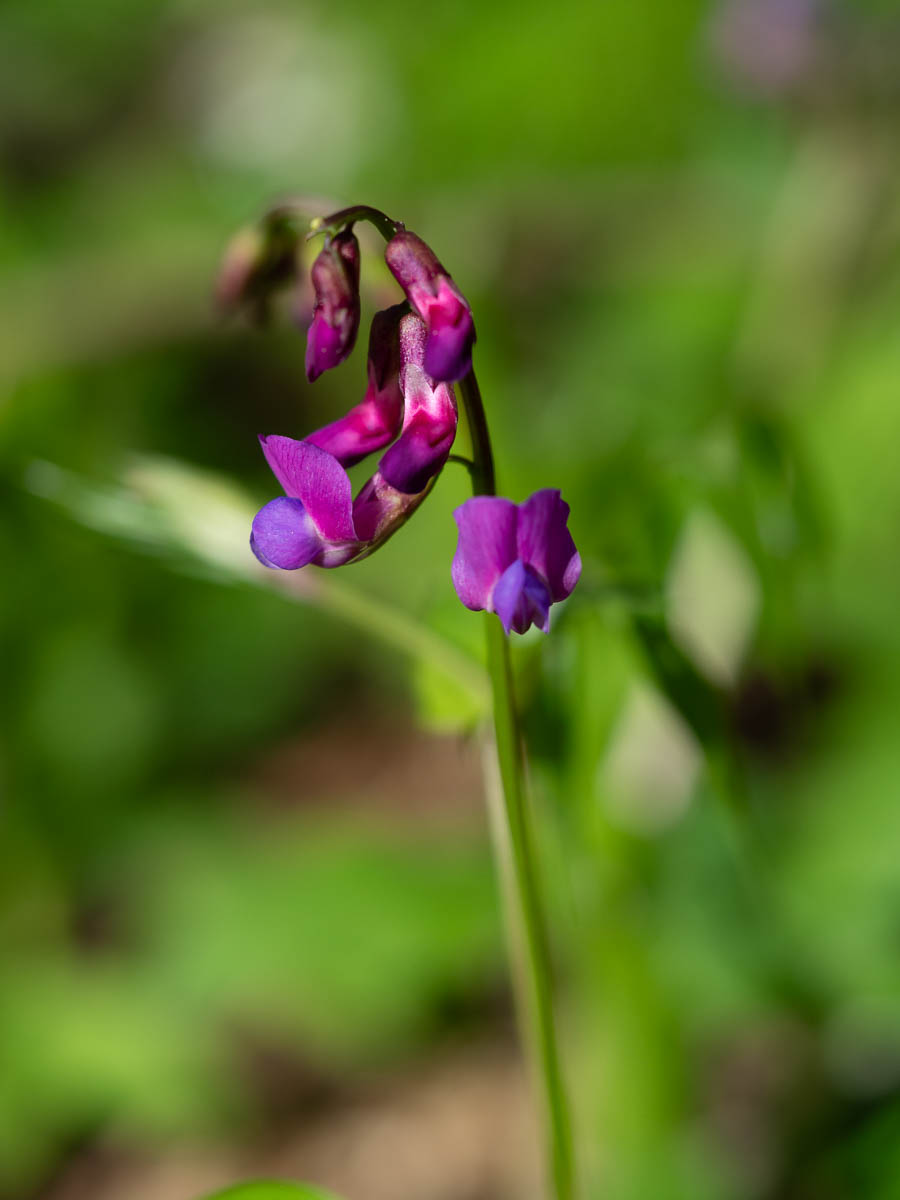
… and a pretty purplish-red flower that I later identified as some kind of Lathyrus (possibly gökärt, seahernes).

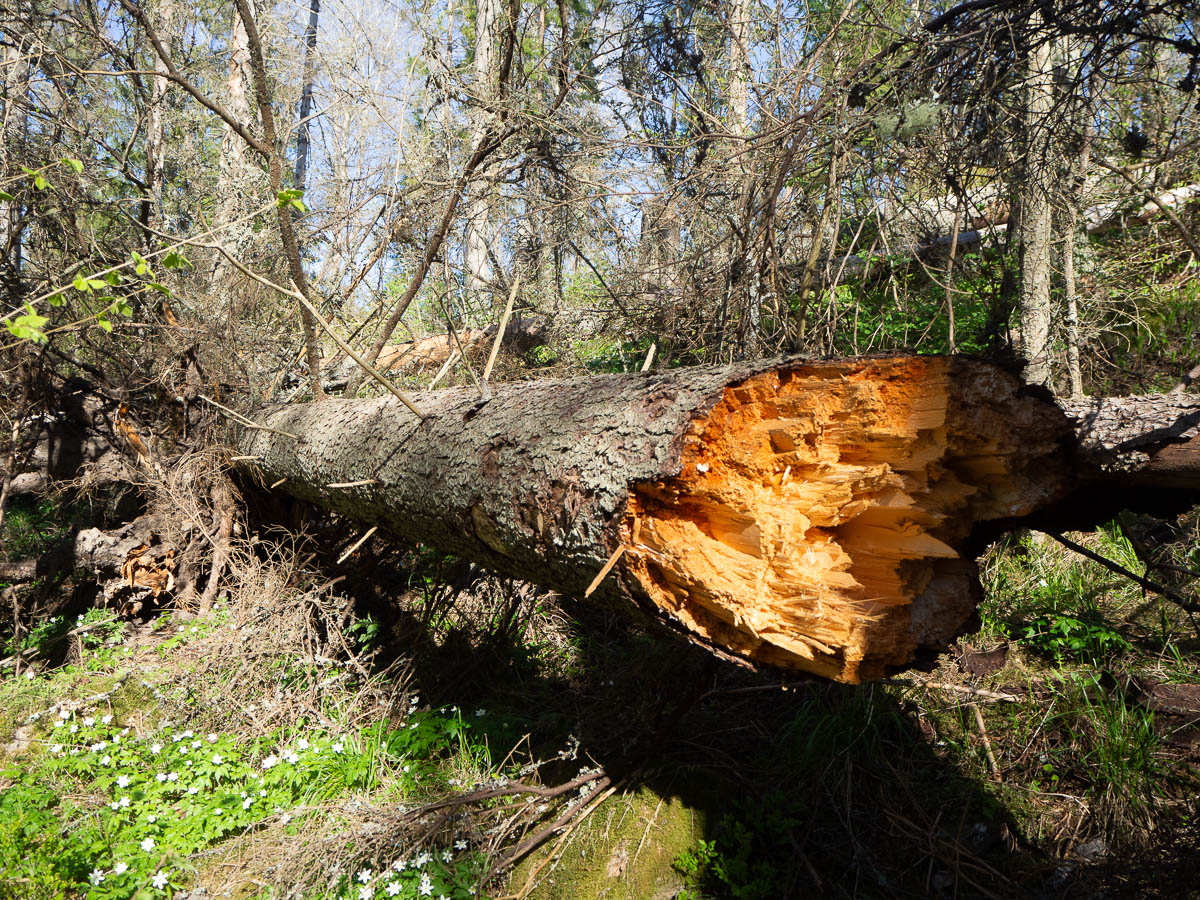
One big change from my last visit was the large number of fallen spruces. There was a sign explaining that the area is badly affected by the spruce bark beetle, and there’s a risk of spruces falling without warning. It looked to be at least a year old, and clearly plenty of trees had toppled since then.

Of wildlife, apart from the possible wolf print: butterflies of all sizes and colours. Birds, especially geese in that marshy lake, blackbirds in the deciduous forests and cuckoos in the pine forests.

Of other hikers, very few. For a while it looked like I would get the camping site all to myself, but just as I was making dinner, a couple turned up. We talked about other hiking trails in this general part of Sweden, and about the tricky logistics of hiking these hard-to-reach parts of Sörmlandsleden. They did it with a car + bicycle combo.


The view from my tent was quite different today, with yesterday’s golden sunset replaced by a rainy night and morning. I woke up at six, nipped out for a quick pee, but before I could do anything more it started raining again, so I was forced to laze around in the tent for an hour. At seven there was a break in the rain so I could pack standing up (instead of curled up in the tent) and get on my way.

There were a few brief, light showers later, but most of the time was rain-free. I just got water from below. After a night of off-and-on rain, the forest was all wet, which was especially noticeable on the more overgrown sections of the trail. The undergrowth doesn’t even need to be tall, it just needs to be right next to the path to soak you. It felt like I wiped off and redistributed all the water on all the blueberry bushes in the whole forest. My trousers legs were absolutely dripping.

What can there be to photograph when I am walking the exact same route as yesterday, with nothing new? (Apart from the weather, that is.) What’s new is my eyes and my attention.

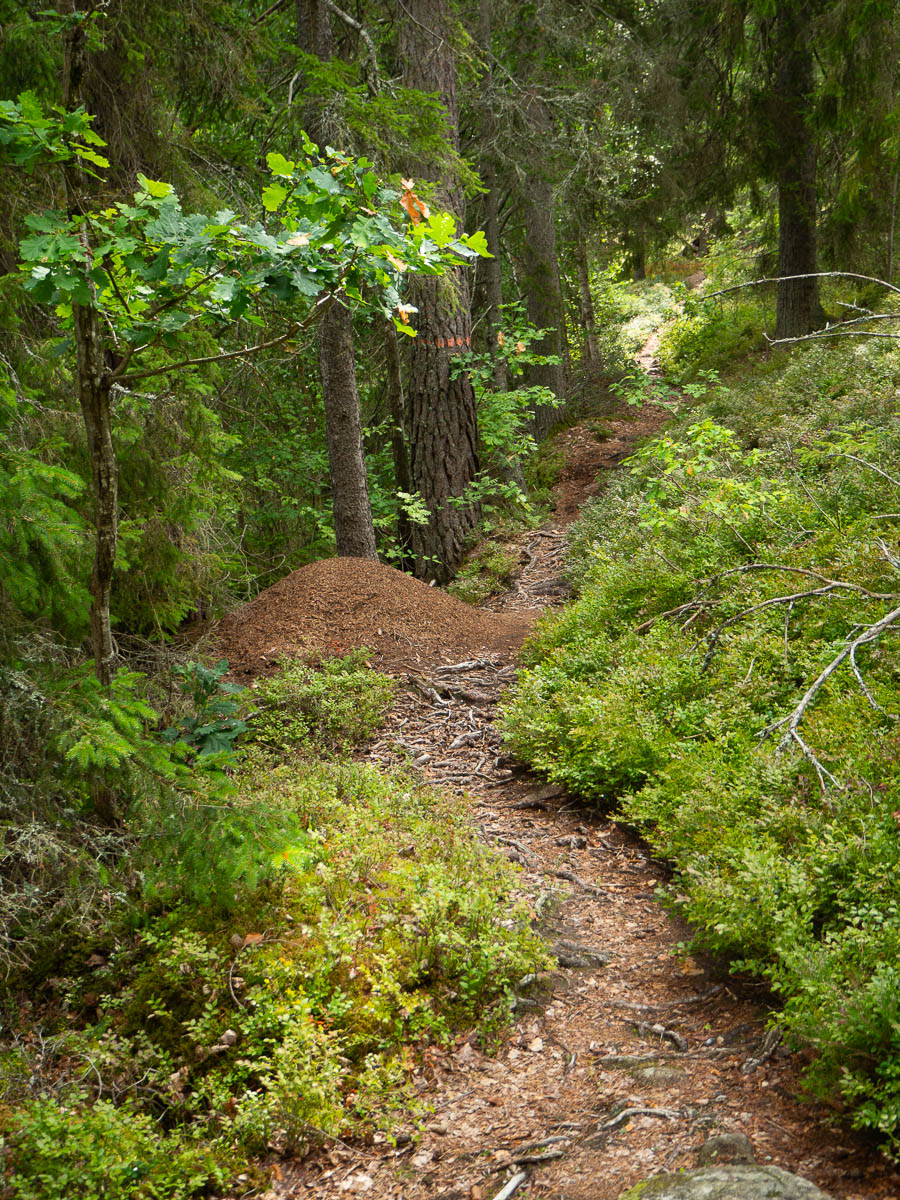
The first anthill of the day is nothing special. But when the day is over and I realize just how many they were, and how many stretches of the trail were so covered with ants that I couldn’t stop, I see those anthills with different eyes. They were truly many, and large, and frankly a bit annoying.

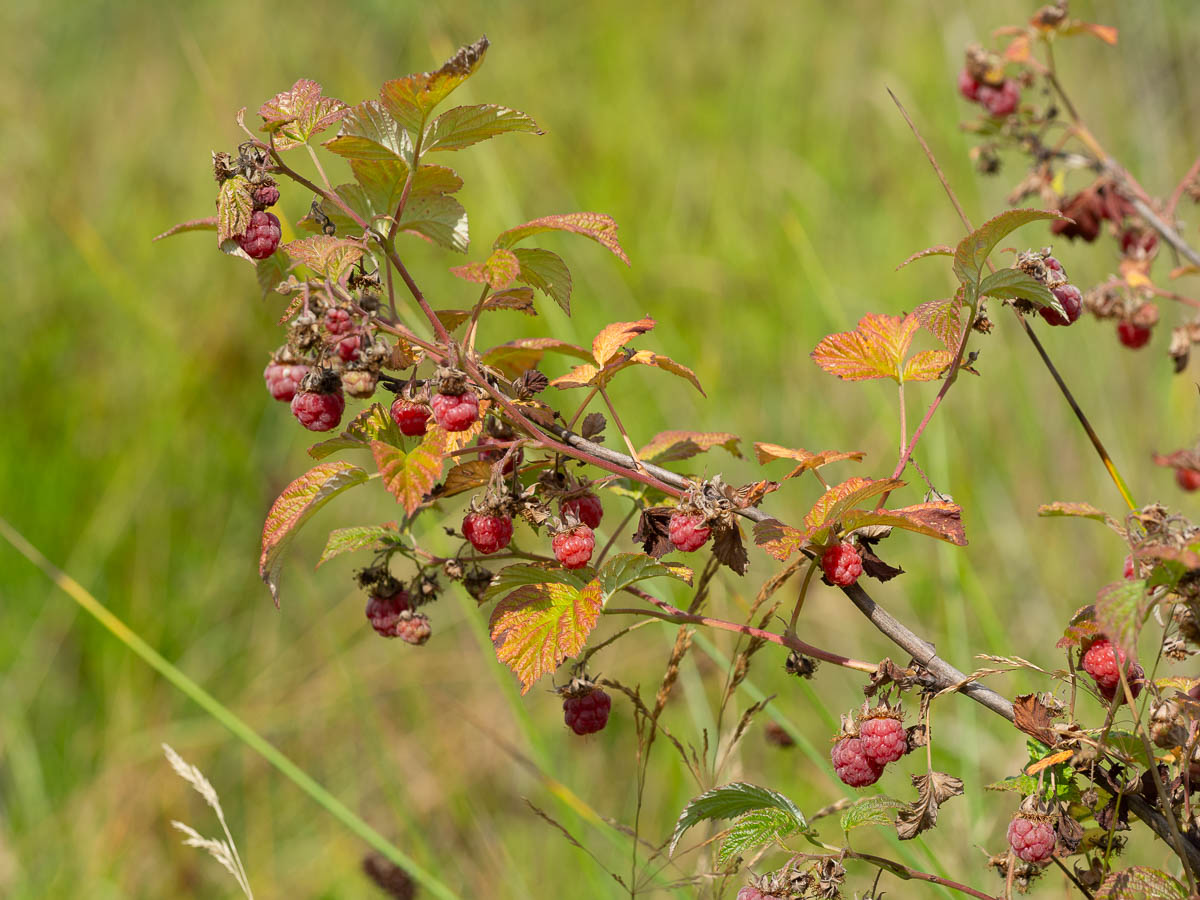
Stands of raspberries were also everywhere, and rather more pleasant than the anthills. Truly this section of the trail seems to get very few visitors, because the raspberry bushes were chock full of ripe raspberries, with nobody eating or picking them. I ate my fill, and then some – because how can I just pass such bounty without partaking? – and I barely made a dent. The first two kilometres or so (starting from the stage-19 end of the stage) were especially good raspberry picking grounds. If I ever want to drive an hour and a half and then walk another half-hour in order to get all-you-can-eat wild raspberries, then this is the place to be.

Some views just look better coming from the other direction. I know that as a photographer I should stop and turn around when I pass some interesting landscape feature, but I usually forget. But today I get another chance.

For the last hour of my hike, I could hear thunder rumbling in the distance, and then not very distant at all. Ten minutes before I reached the car, the heavens opened. I was all ready for it, with my backpack rain cover in place and my rain jacket literally in my hand, so it didn’t actually bother me much. Apart from my trouser legs – which I had long since given up on – I was still mostly dry when I got there.

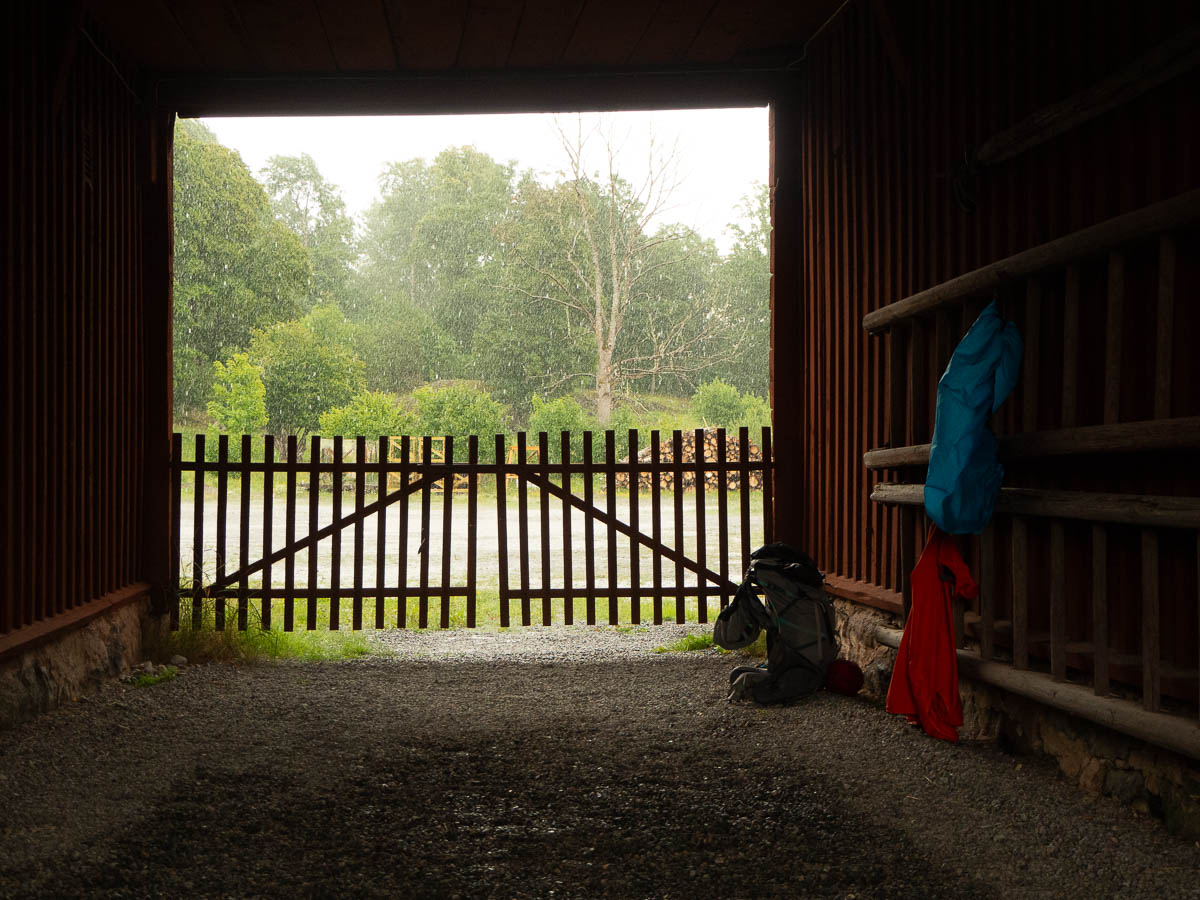
At that point it was absolutely pouring down, and the thunder was right over my head. Instead of trying to pack myself into the car in the downpour, I took shelter in an archway of the farm building behind which I had parked. It got wetter and wetter as time went by, until I had to make a little channel in the gravel to guide the water out at the other end of the archway, instead of letting it spread out sideways towards the walls.

It reminded me of playing in the mud when I was a child. Back then the street where I lived was surfaced with gravel, not asphalt, so it got a bit muddy when it rained. It also sloped slightly, so we got these lovely streams of water along the sides of the street. With a sturdy stick, we could drag new channels to make the streams join up or go the way we wanted. We had no fancy boats, but I remember sending small twigs rafting downstream.

Anyway, the sides of the archway remained dry, so I could sit down and have a leisurely lunch while I waited for the thunderstorm to abate. The good thing about summer rains is that there are usually breaks in them. I could get into the car all dry and nice. There was much more rain later while I was driving home, to the point where the rain hit the windscreen in splats rather than drops and I could barely see the car ahead of me, but I got home safely.


Picking up the Sörmlandsleden project again, after a break of more than two years. I hope it won’t take me two years until the next stage. I have been getting my life back on track after a post-covid slump, so there is hope.

I did make an attempt to get here earlier this summer, but ended up elsewhere due to complications.

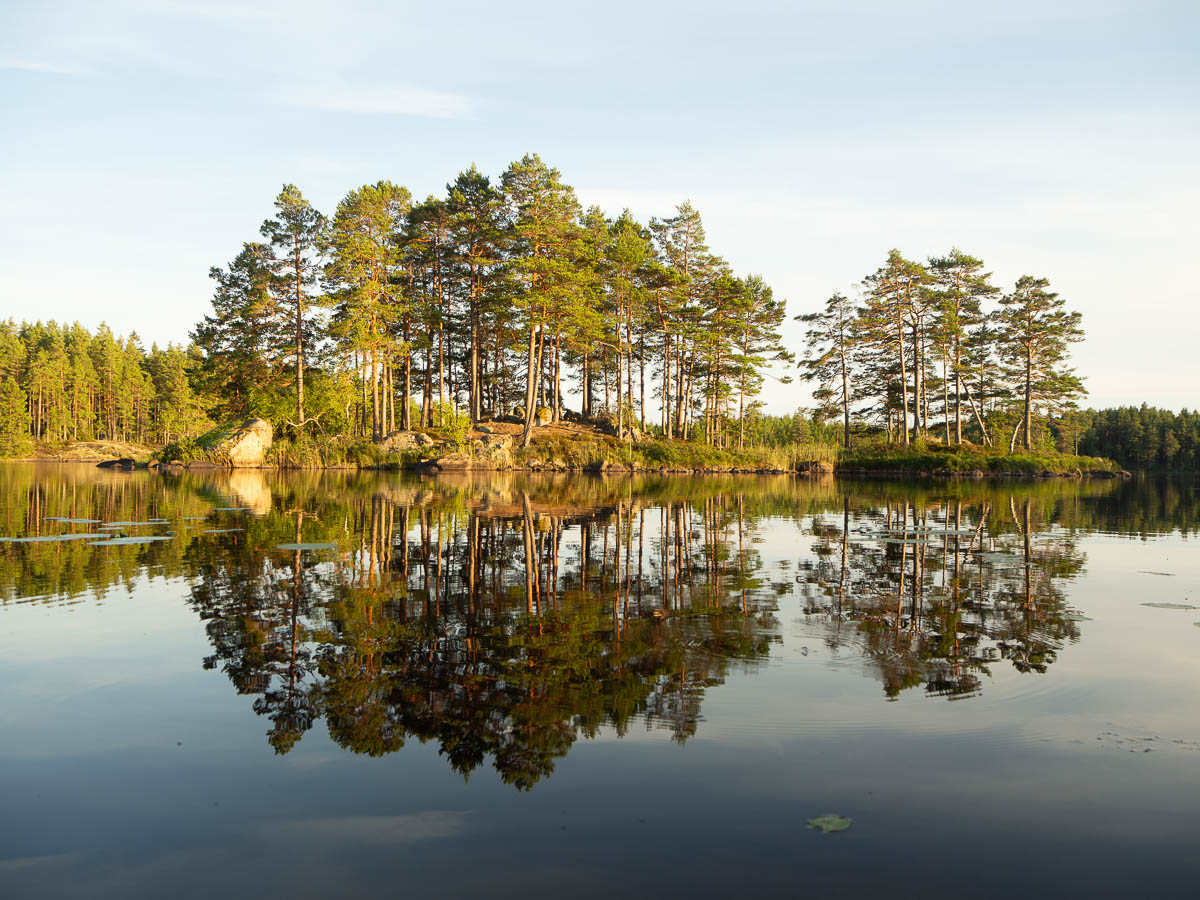
Stage 18 is one of those hard-to-reach ones. The beginning is on a road, yes, but that’s about it when it comes to accessibility. There is no parking, even. There is parking at the other end, though, so I walked this stage backwards. (I’ll be walking it forward tomorrow.) Which actually worked out really well – this beautiful lake at the beginning was for me the grand finale at the end of my day, where I put up my tent for the night.

There were several more lakes along the route, almost as pretty. But also a lot of the usual pine-blueberry-mossy-rock landscape, as well as patches of deciduous forests here and there. And clearcuts, but those bring no joy, so they don’t get any photo space here.

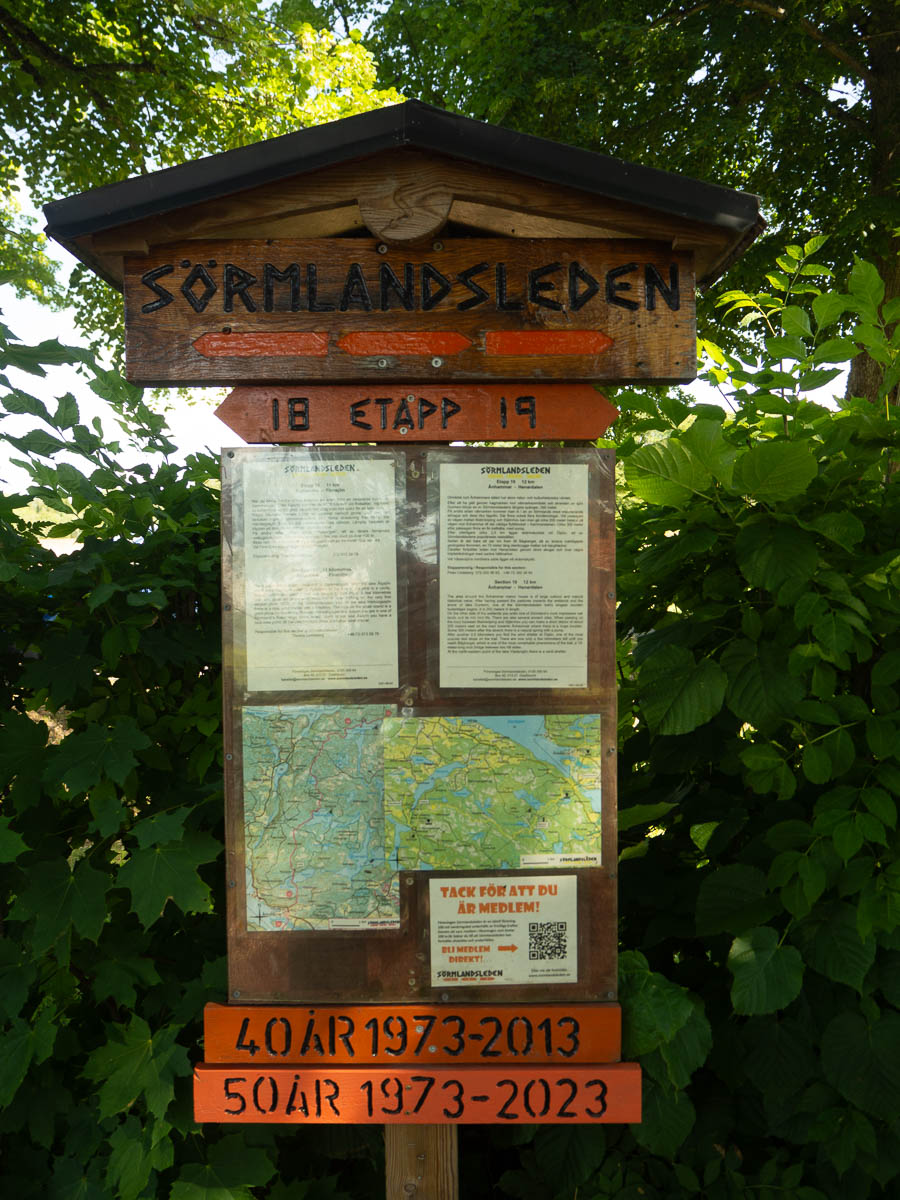
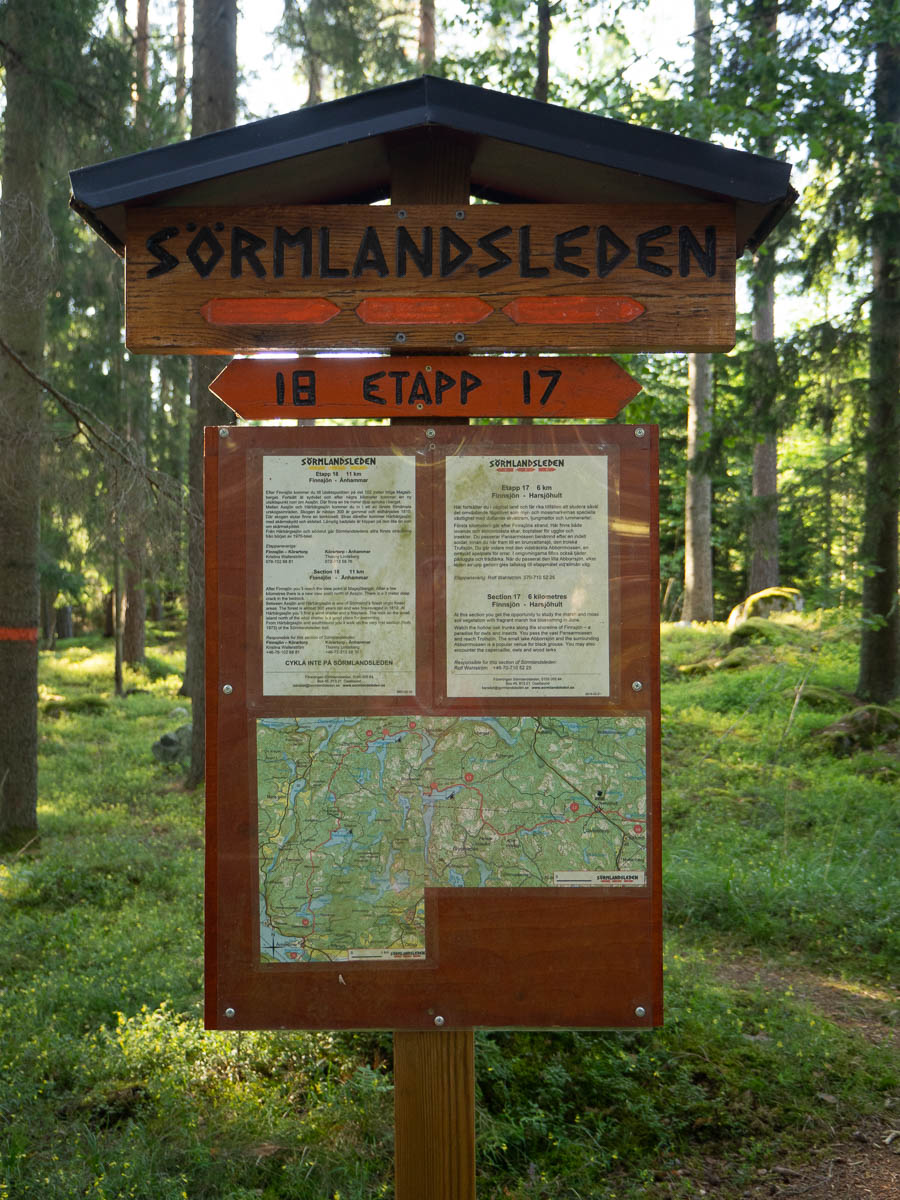
Stage 18 is, according to the signs, also one of the very earliest stages of Sörmlandsleden, from 1973. These days it seems to be a less frequented one, possibly because of that lack of accessibility. It was well signposted and the shelters were in great shape, but some parts of the trail itself were rather overgrown.

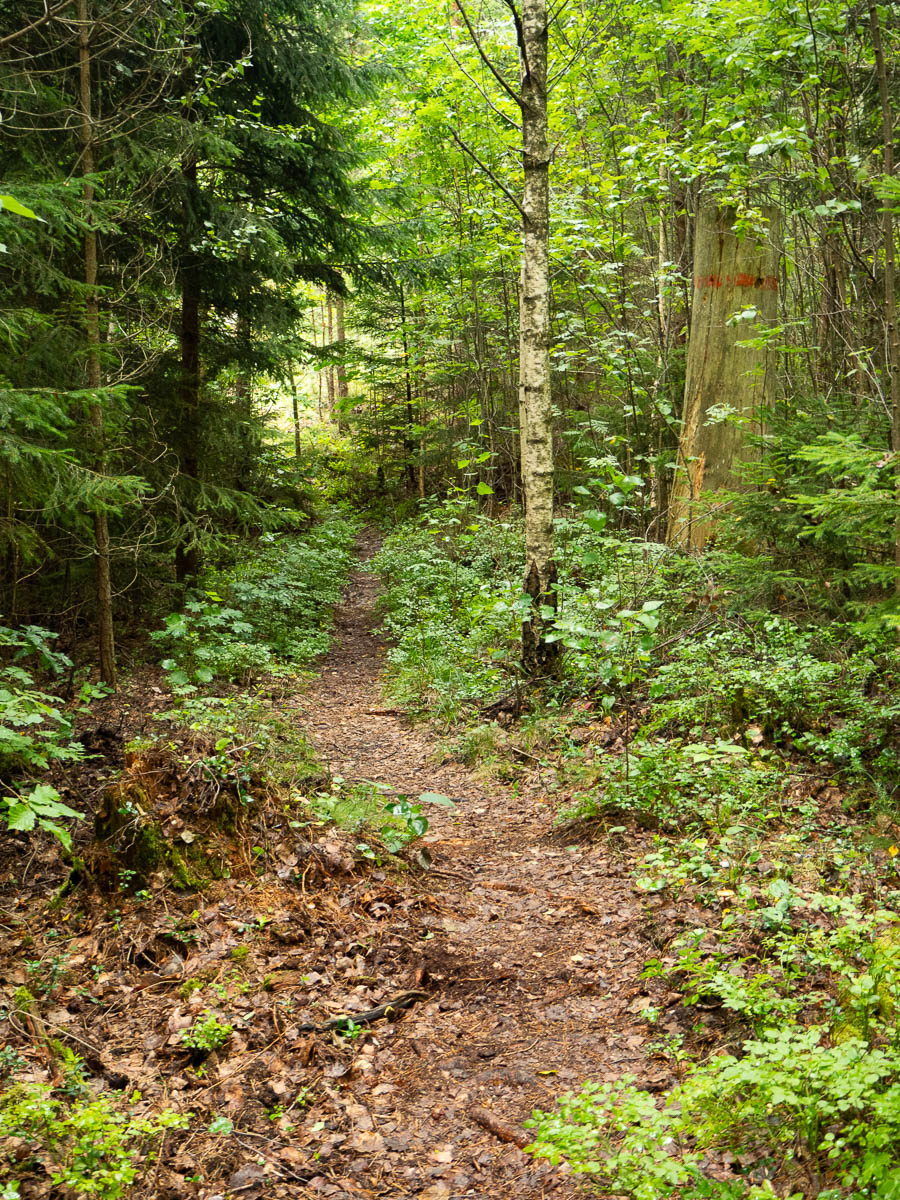
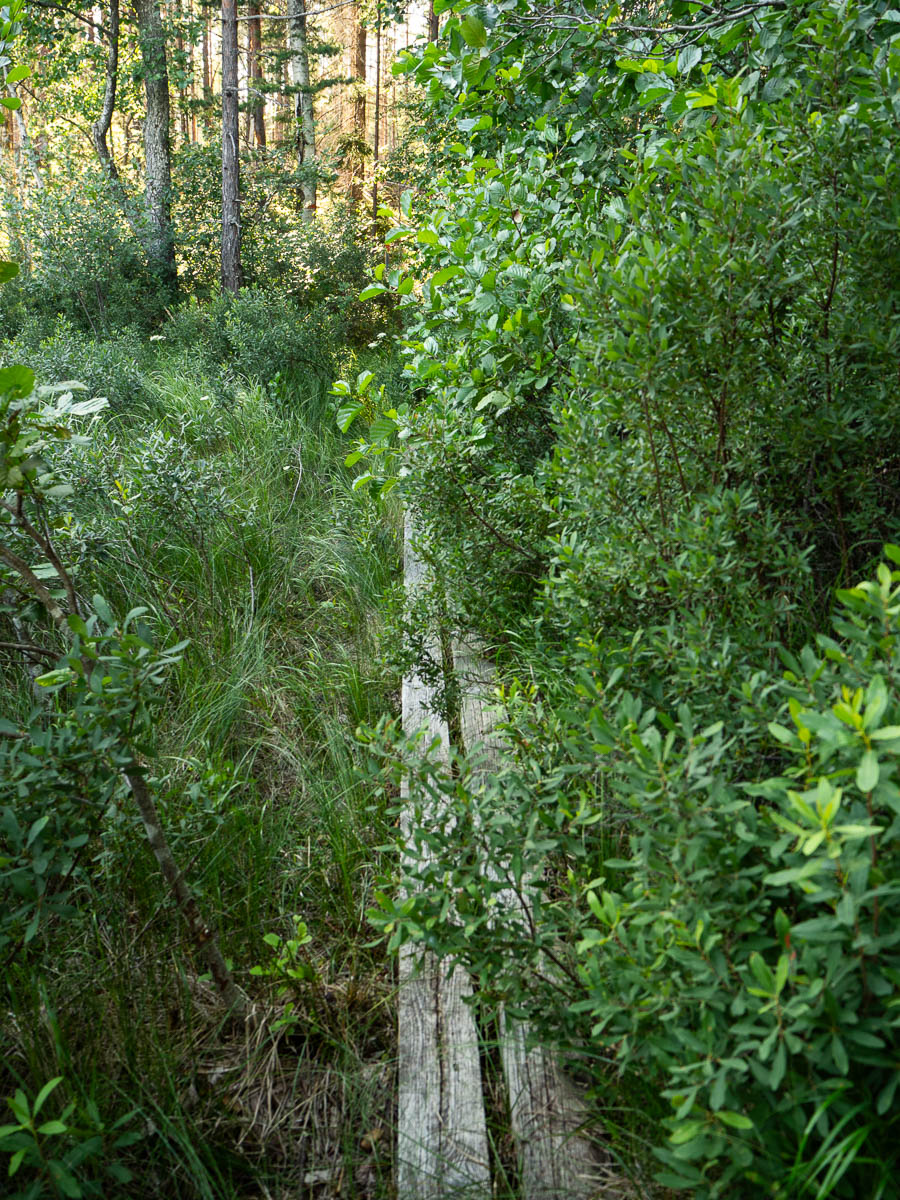
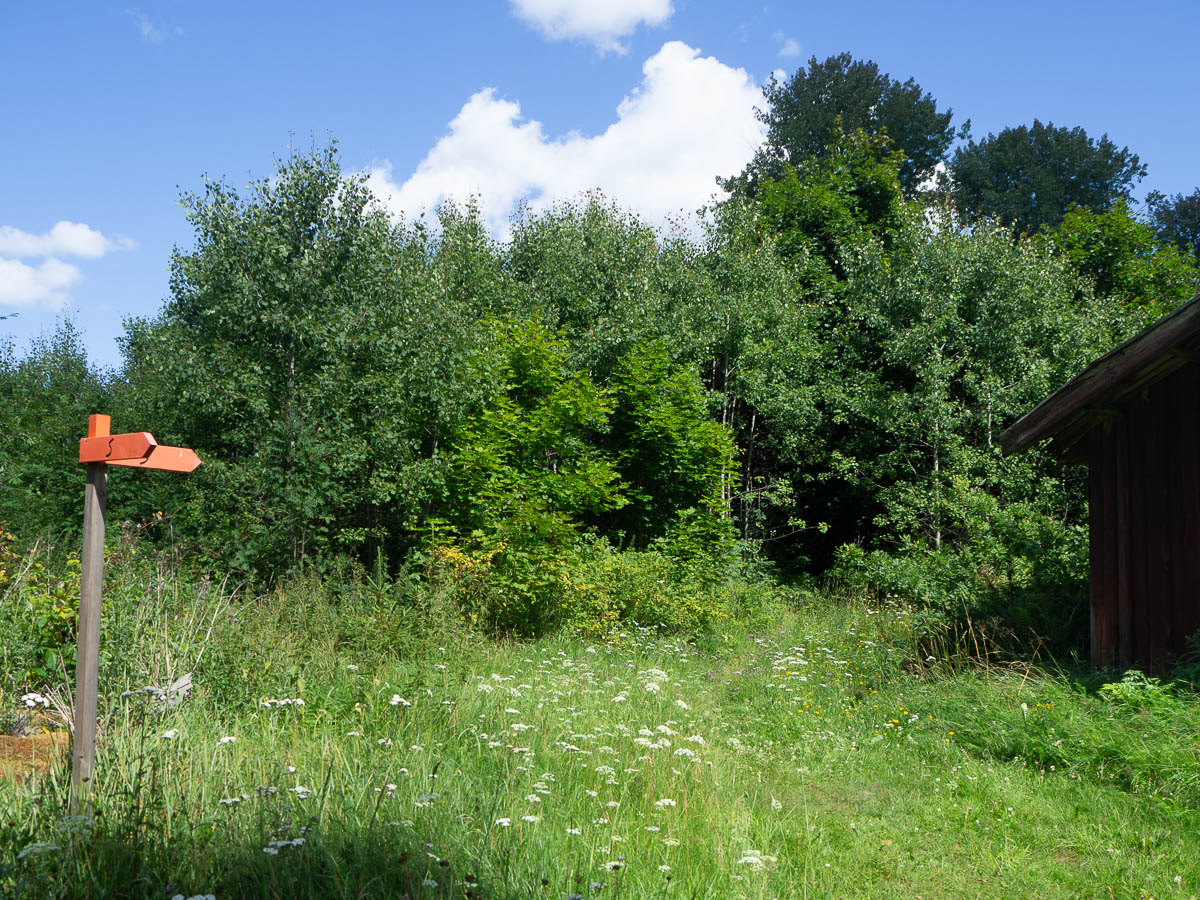
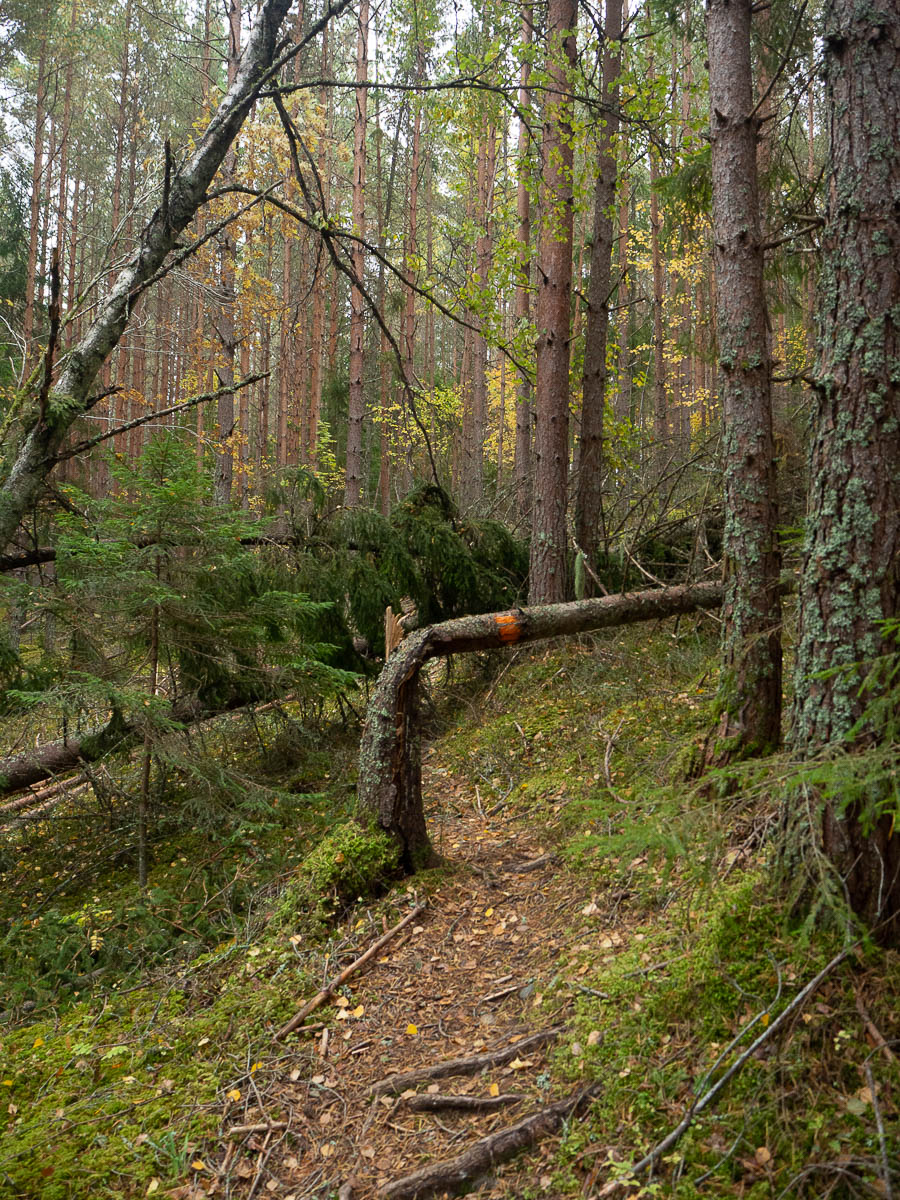
Had it not been for the orange arrow clearly pointing the way, I’d have struggled to find the continuation of the path here. (It goes right into the greenery, at the slightly larger dark patch.)

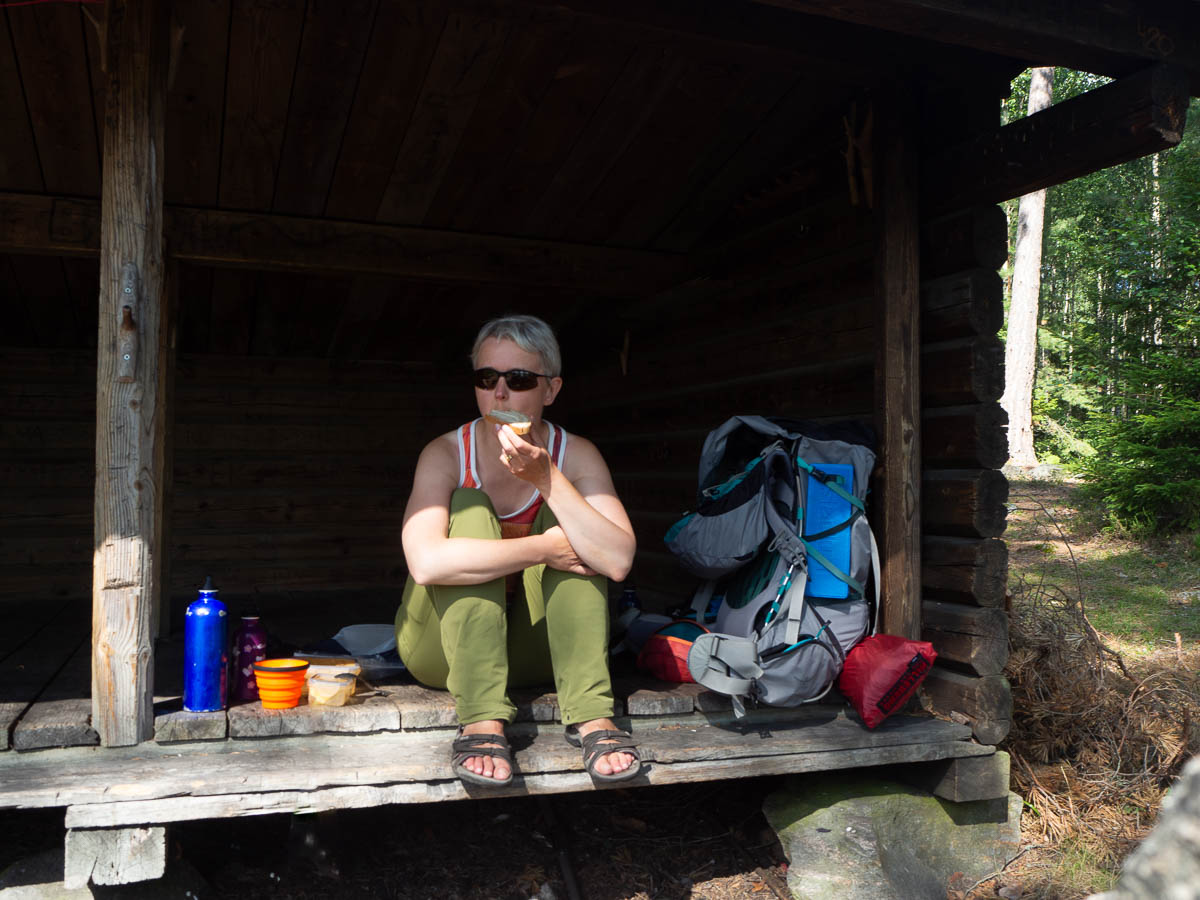
Here’s me having a snack break, with a view over another lovely lake.

Trummelsberg to Skinnskatteberg, 15 km.

I woke up to rain today.

Actually I first woke up several times during the night because of my mattress, which apparently still has a slow leak, even after my repairs. The first night I only noticed it when it was almost morning. Yesterday and today, though, it kept waking me. Given the choice between being cold and uncomfortable for the rest of the night, or getting off the mattress and pumping it up again before spending several hours in hopefully uninterrupted comfort, I judged it absolutely worth the effort. So I really haven’t had the best sleep these past few nights. I’ve been spending nine or ten hours in bed but still not feeling fully rested by morning.

It rained off and on all night, and was still raining when I woke up. The weather report promised rain all day, so there wasn’t much to be done. I packed everything except the tent itself without getting out of the tent (except to water the pines). It felt like packing took about twice as long this way. When I finally crawled out, the rain had mostly stopped, although everything was of course still wet and the trees were dripping. But at least I didn’t have to pack my tent in actual rain, which was nice.

The landscape was a bit more open today, and the flora was more alpine. Beautiful views that reminded me of my hikes in Jämtland.


Lingonberries abounded again, which I utilized for breakfast of course. I’ve never seen so many lingonberries growing so densely anywhere before. I can now understand how it’s possible to harvest and sell them on an industrial scale.

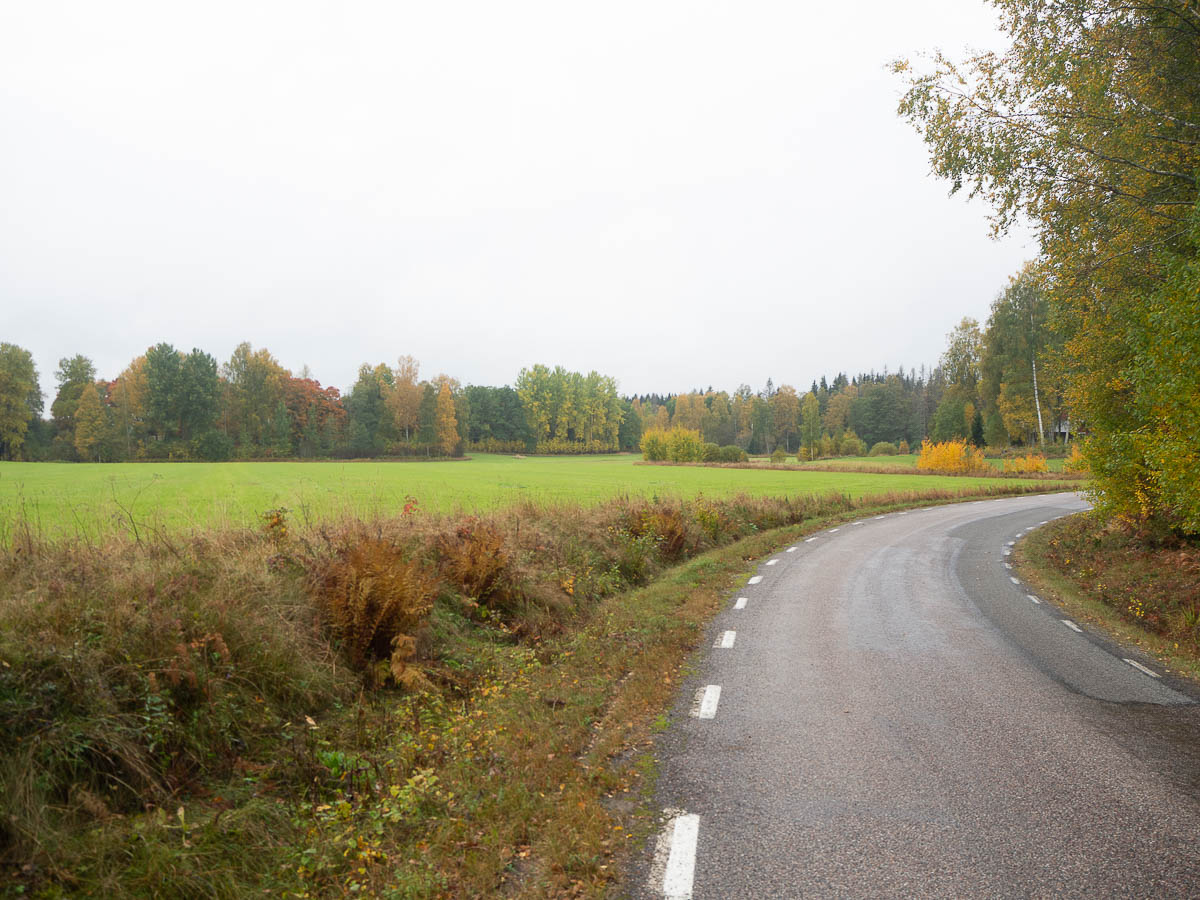
There was a bit of walking along a road. No traffic, and scenic views of meadows made it quite pleasant. Plus it took me past some houses where I could ask for a top-up of my water supply again. I might make it without, but why take the risk.

The constant rain I was threatened with never actually materialized. The air was saturated with moisture, though, and most everything was wet, so technically maybe this counted as rain. It didn’t affect me much, except for taking shorter snack breaks and timing them so I could find some kind of roof over my head.

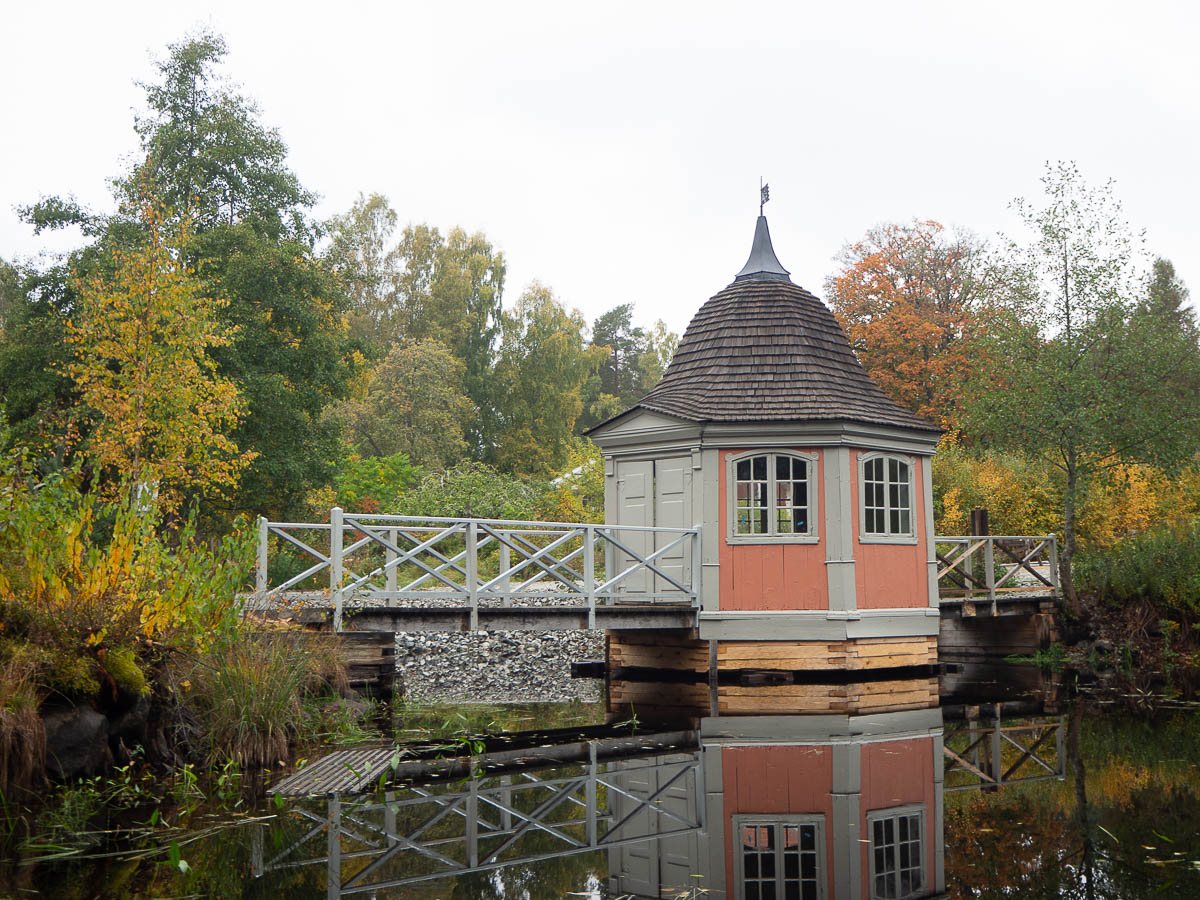
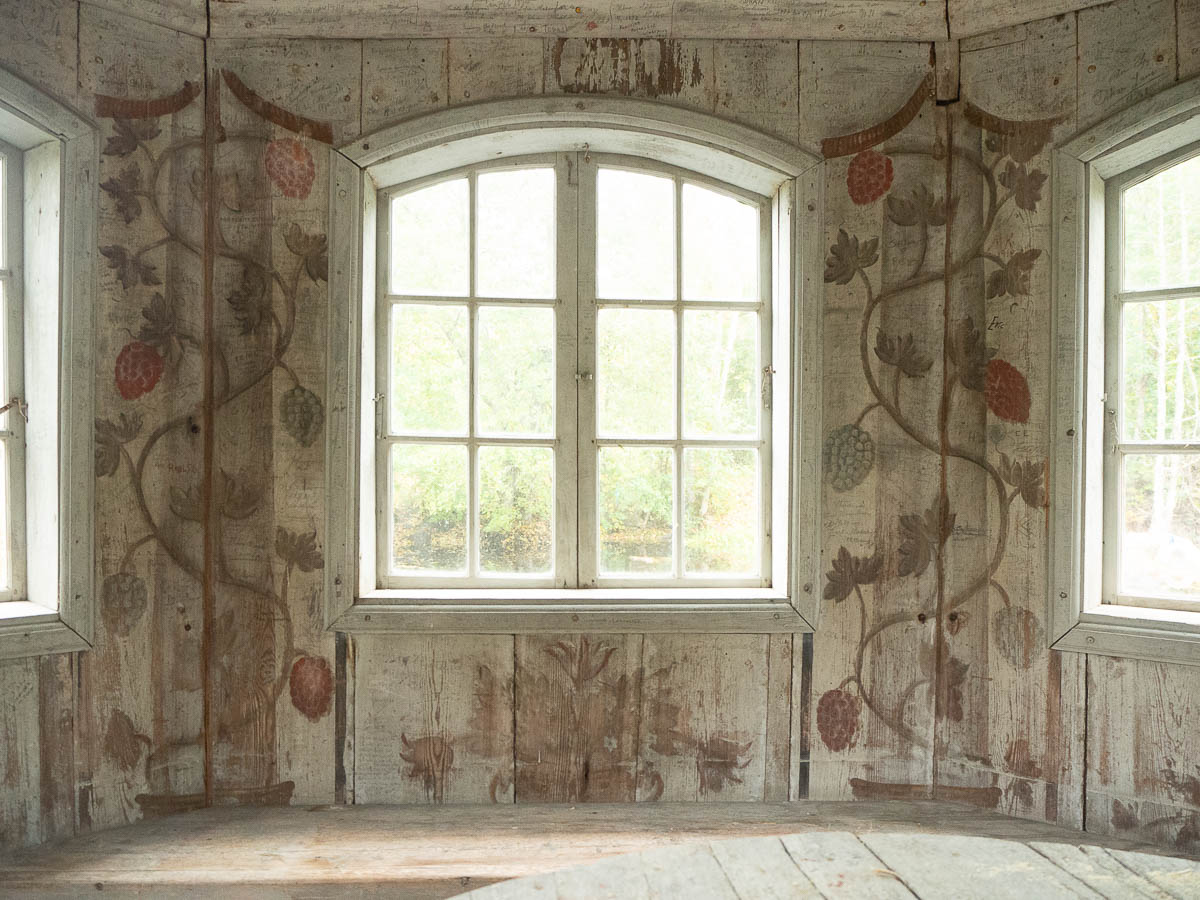
At Bockhammar the trail passed Ebba Brahes lusthus, a noblewoman’s gazebo from the early 17th century. Structurally it was in surprisingly good state, for a small wooden construction, and currently under renovation. The inside looked more worn. I wonder if the murals are four-hundred-year-old originals.


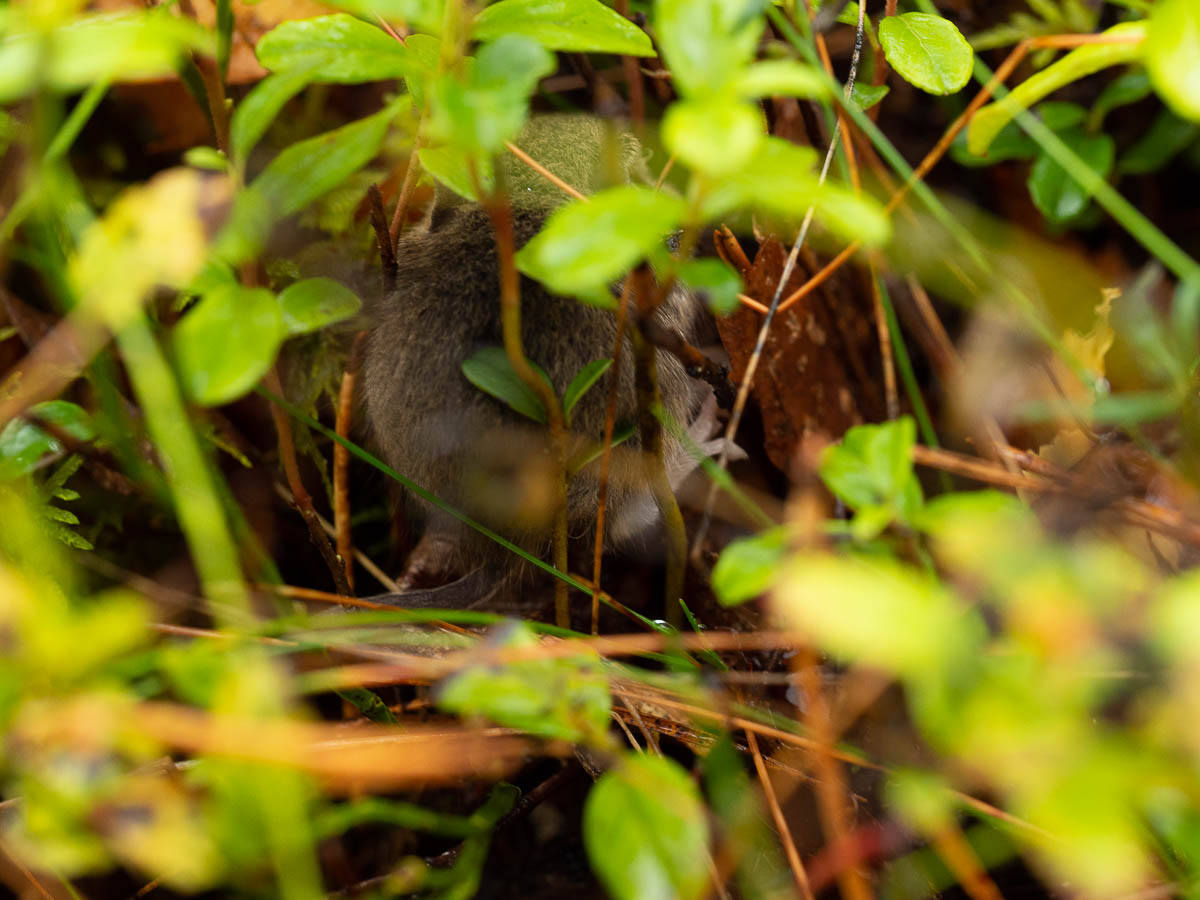
I don’t think I saw a single other person on the trail today. That’s one clear benefit of hiking in less than ideal weather. Instead I spotted a tiny little mouse, who ran into the low shrubs next to the path when it heard me approach. And then it just stopped there. Its survival method was to make itself as small and quiet and immobile as possible, so any predators watching out for movement wouldn’t see any. I could see it only because I knew exactly where the movement stopped.

And then I was back at the car and my hike was over.

Learnings and evaluation:

The Bruksleden was a pretty pleasant trail to hike. Doesn’t beat Kinnekulle or the Fells, but definitely more to my taste than the Kuststigen. Nothing spectacular or particularly memorable, but nice all the way. I might come back and do some other sections of it at some point.

The new pack had its pros and cons. The light weight was definitely nice. The lack of pockets wasn’t hard to get used to. The few features it had all worked very smoothly. And the pack sat much better on my back than the Lundhags Spirit I’ve used in the past. The Spirit always feels like it is leaning away from me, no matter how carefully I pack the heavy items close to me and how much I adjust the straps. I especially notice it when skiing: when my torso swings back and forth, the Spirit keeps slapping my upper back.

The only downside I noticed was that it has stiffer straps with harder edges, compared to the softer straps on the Spirit. I got some really sore spots on my hips where most of the weight rested on the hip belt. When I got home, I saw actual bruises and even a slight rash where the belt rubbed my skin through all the layers of clothing. Maybe I need to find some seamless underwear for next time, or add some extra padding somehow.

My packing list has reached perfection. I packed nothing that I didn’t use, apart from the first aid kit and compass, both of which I’m happy to not need. The amount of food was just right.

From around Morbyn to past Trummelsberg, 18 km.

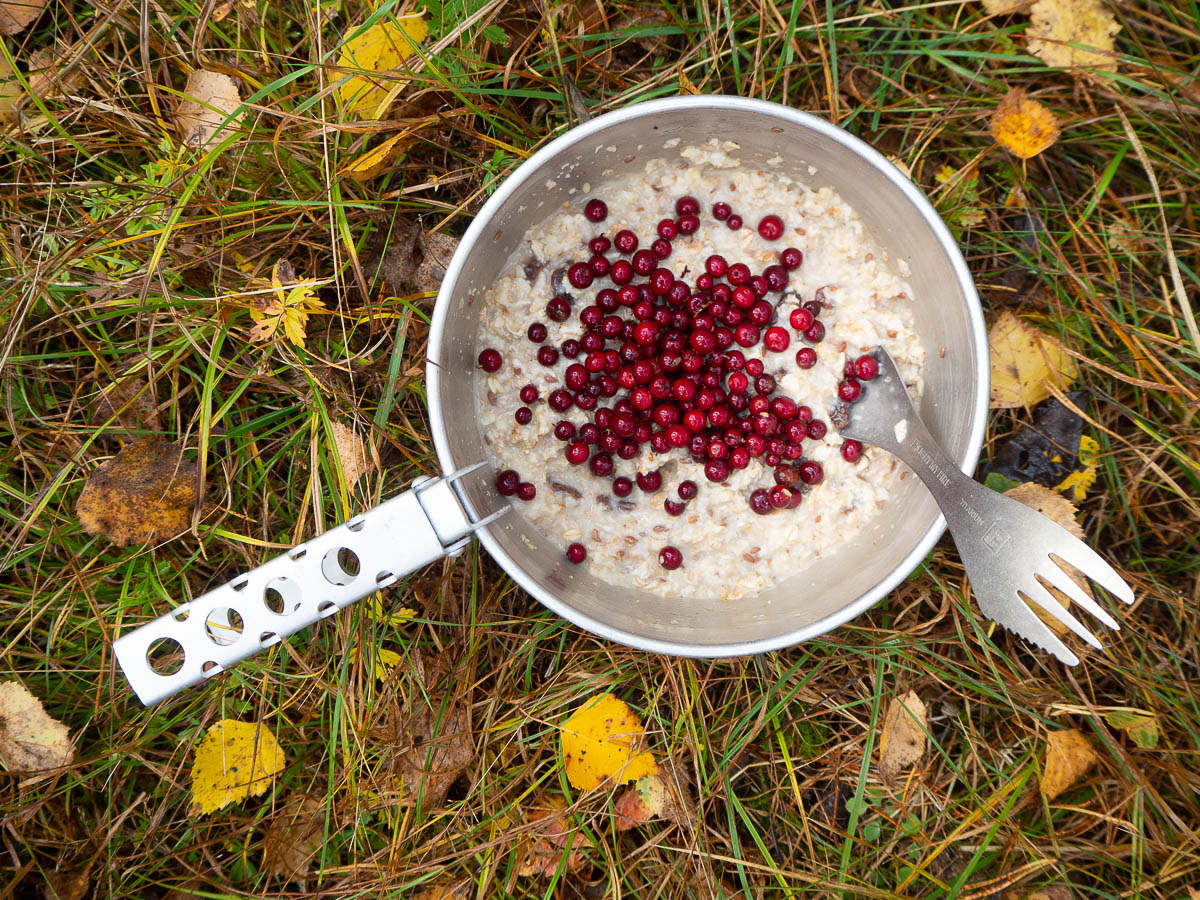
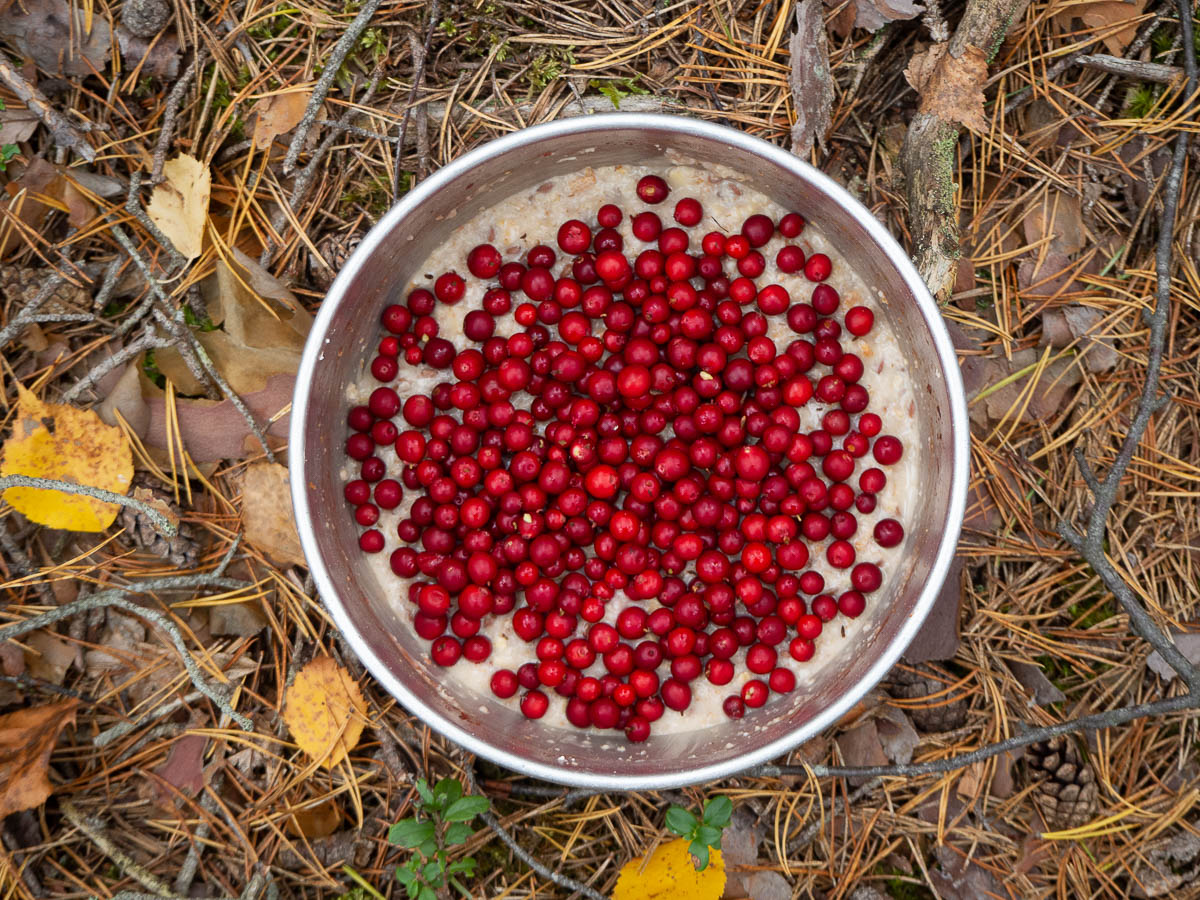
The first morning’s lingonberry brunch spoiled me for all other ways of eating porridge. Both yesterday and today I waited with breakfast until I got to a good lingonberry patch. Of which there is no shortage in this region. I’m not a lingon expert so I don’t know if there are good years and bad years, like there are with cherries and apples, or if they’re robust enough to give a good harvest regardless. But the berries have been truly plentiful.

Also, the time it takes for porridge to cook is just about the same it takes for me to pick a generous heap of berries.

As usual it’s taken me several days to really get into the hiking flow. The first day or two I always think too much about kilometres and hours, worrying if I’m making a good enough pace, if I’ll get there by dark, etc. After a while that all settles and I know that it’ll all work out, and I can enjoy myself even more. So today was the best day of walking.


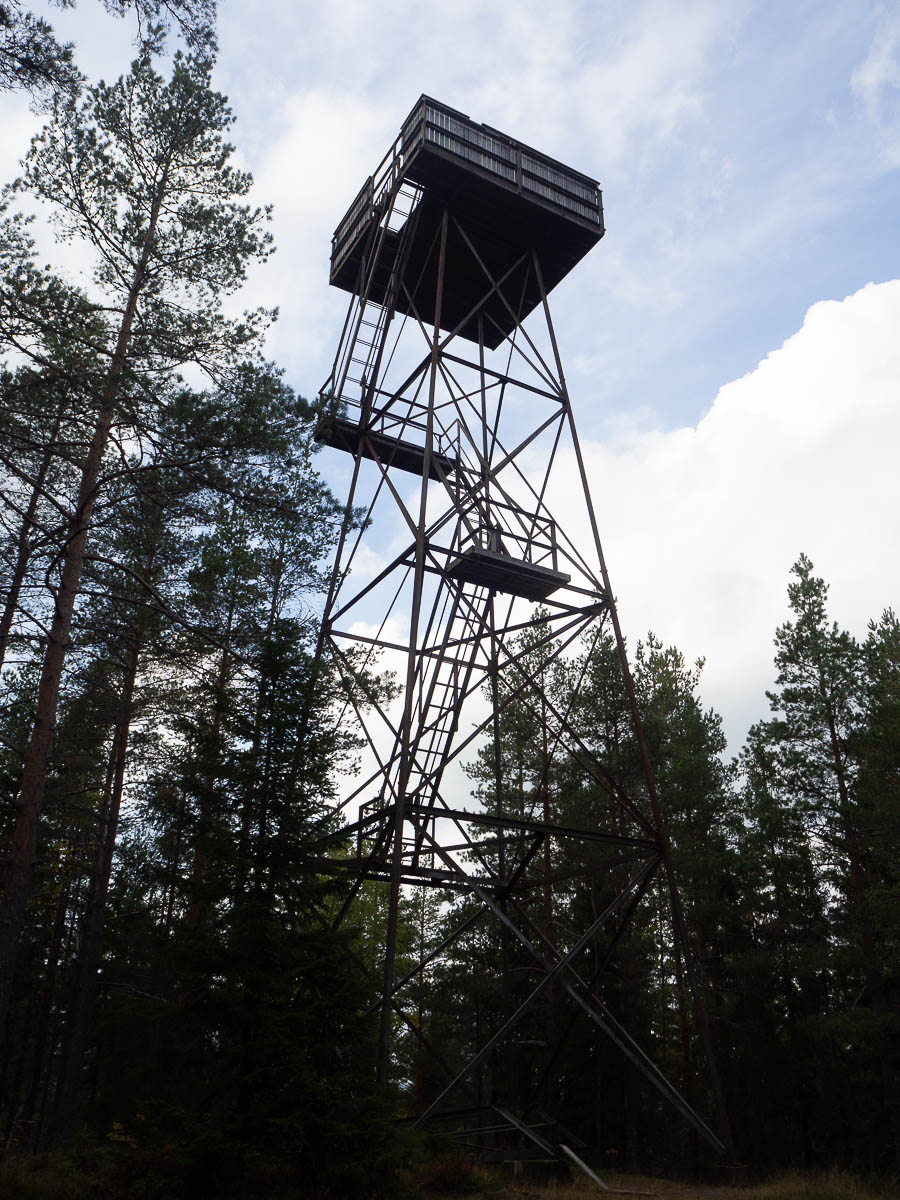
Today was a Saturday so there were more people on the trail. Yesterday I met a single hiker; today there were two hikers, four berry-pickers, two trail runners and seven day trippers. The runners and day trippers were all in the same area around Landsberget which is apparently a popular destination. There was a picnic area, a bunch of hammocks in the forest, and a viewing tower.

The tower was unfortunately closed and the bottom ladder removed. The runners climbed up anyway along the structure itself and I was just contemplating doing the same – it didn’t look too hard – but just then a family with kids arrived and I didn’t think it would be a good example to set. Eh, the views probably weren’t that special anyway.

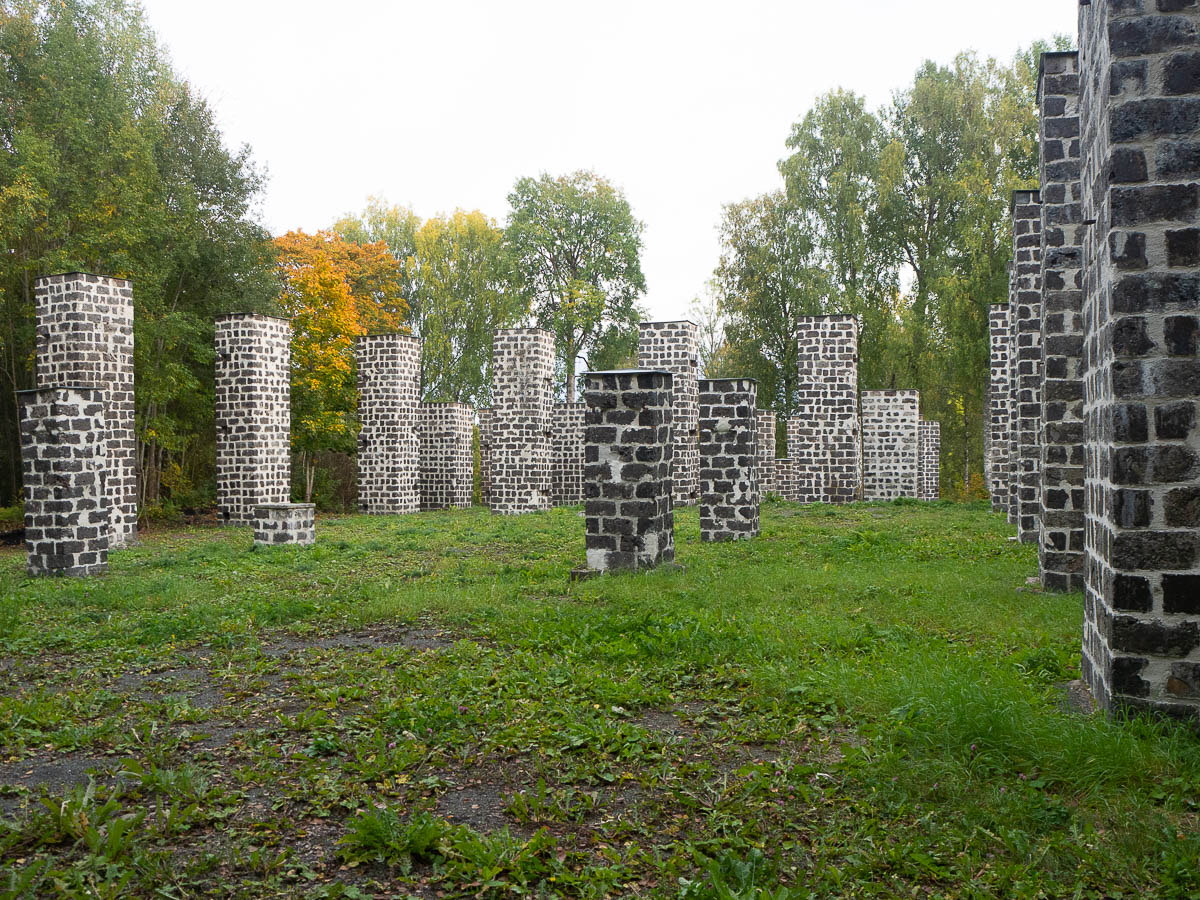
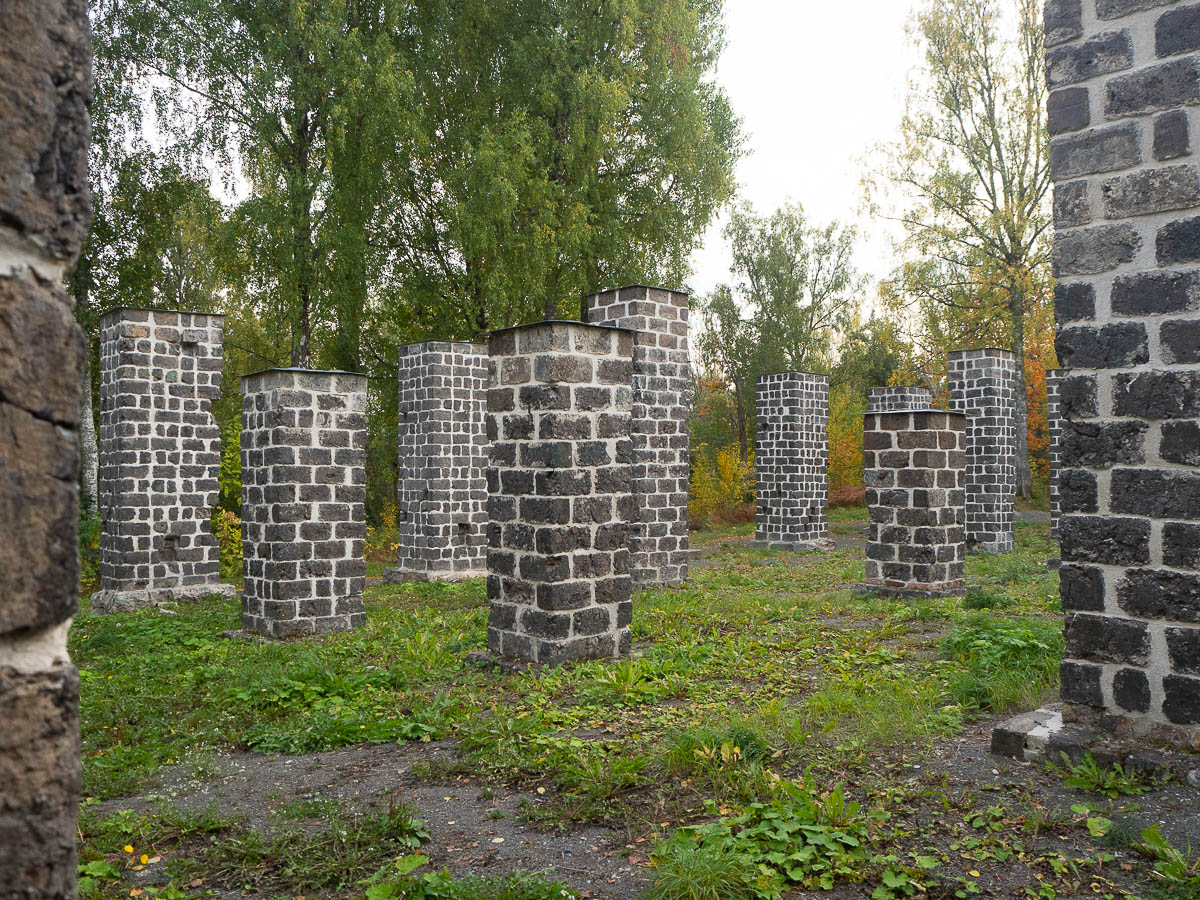
Near Trummelsberg I passed the grounds of an old ironworks with the rather strange field of black and white pillars. It looks like it could be a modern art installation, but turned out to be the (restored) remains of a coal warehouse. The pillars look like they’re made of sloppily cast modern concrete blocks, but it’s apparently old slag bricks.


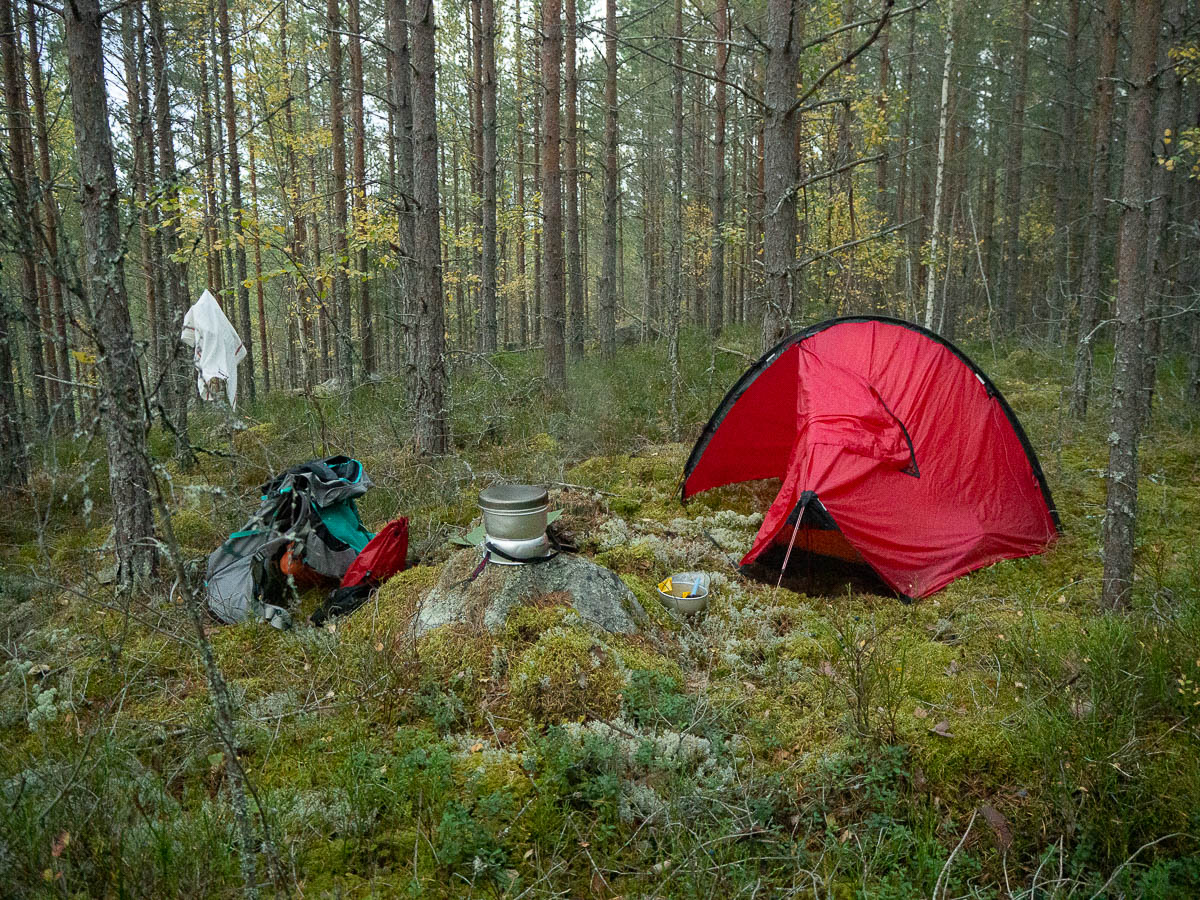
I had difficulty finding a camping spot for tonight. I walked past a spot right in Trummelsberg because I thought it was too close to houses and other people, and after that it was all dense, rocky pine forest, with not a single flat patch of ground. When I thought it was getting too late and dark I just left the path and wandered around until I found enough flattish rock-free space for my tent. There was not enough for anything else, though, so I set the stove on a rock and perched myself on another rock next to it.

From Främshyttan to just past Morbyn, 20 km.

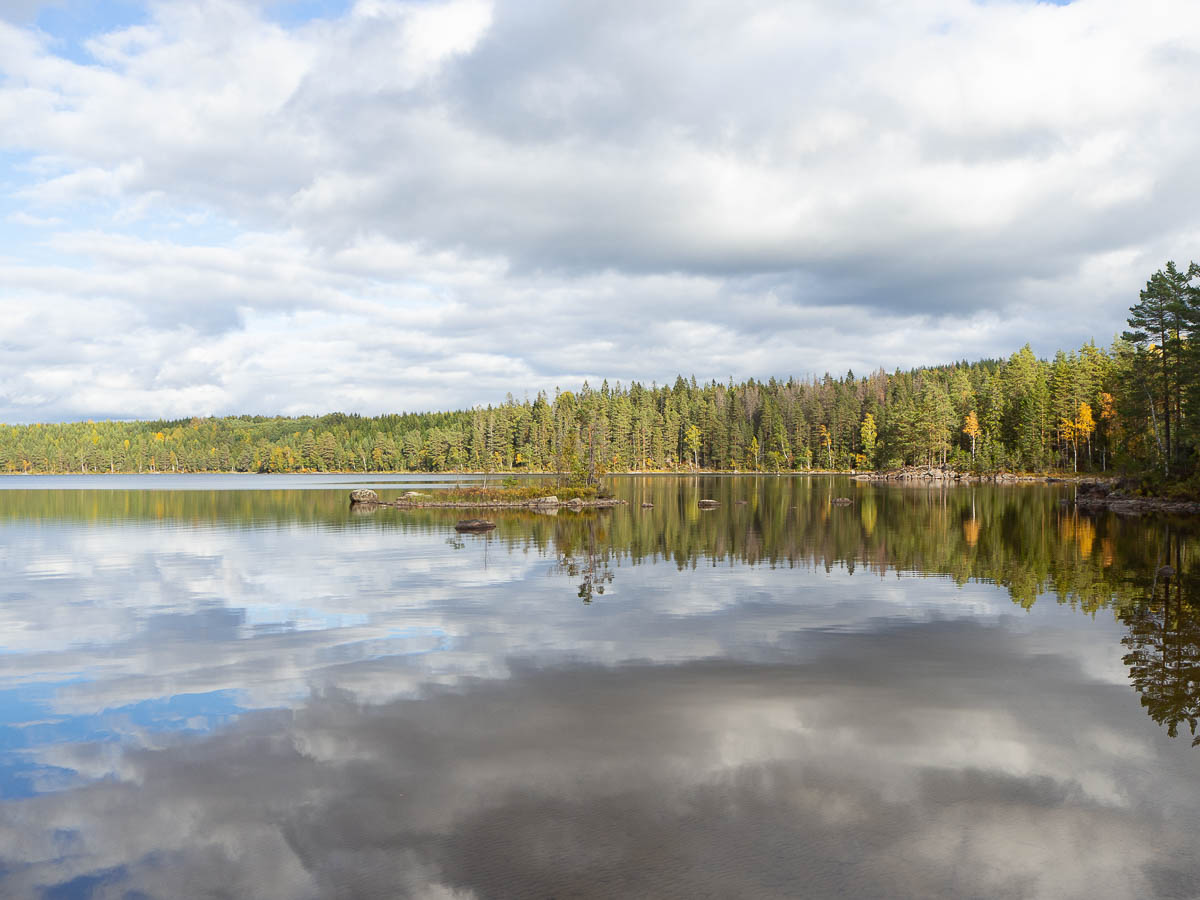
A day of lovely lakes. I spent the night on the shore of lake Storsjön (“Big lake”). Wikipedia lists 79 lakes in Sweden with that name, by the way. It mentions no interesting features for this particular Storsjön.

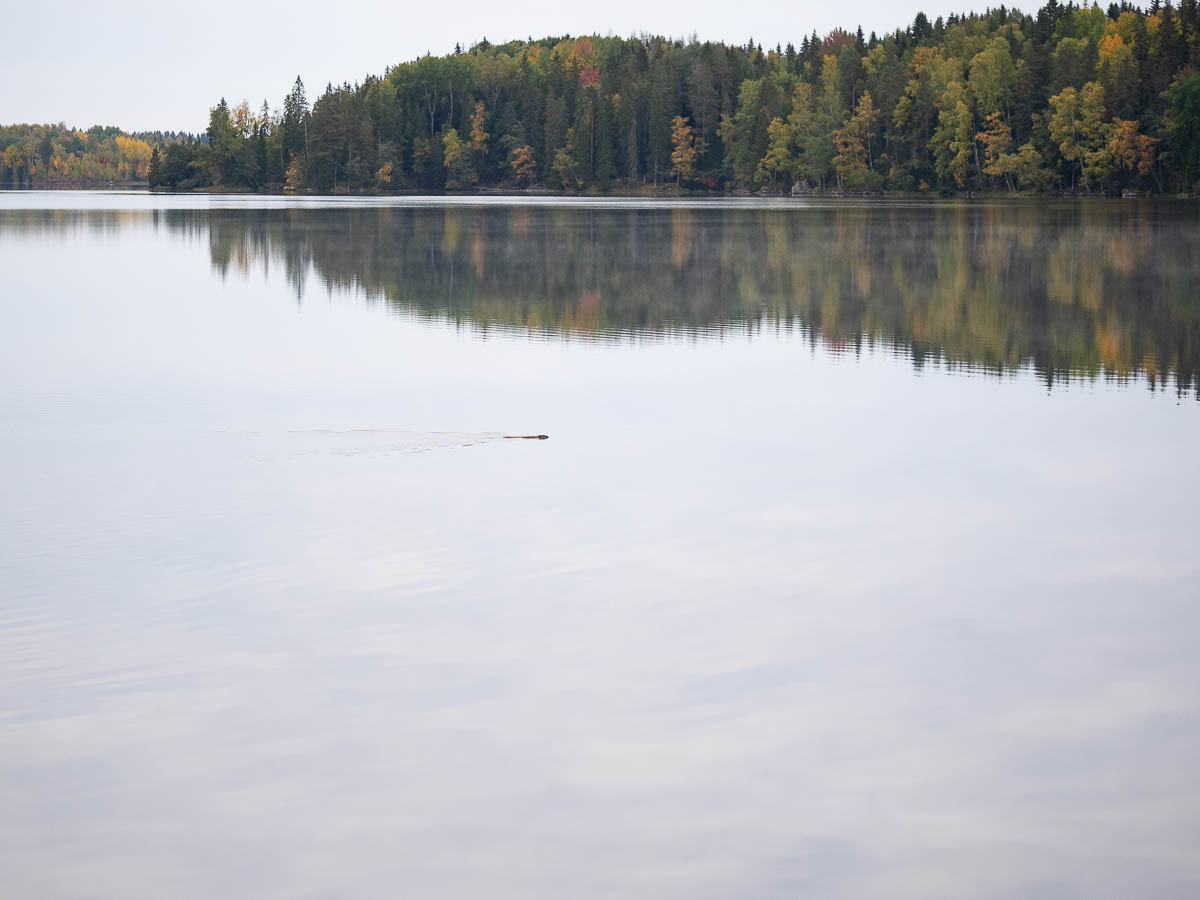
I did see something swimming in it this morning just as I was packing up. Larger than things I usually see swimming in lakes, so not a snake. Sort of dog-sized, but with a rounded head. I couldn’t immediately think what it was. I barely had time to grab my camera and get a single photo of it before it dove underwater.

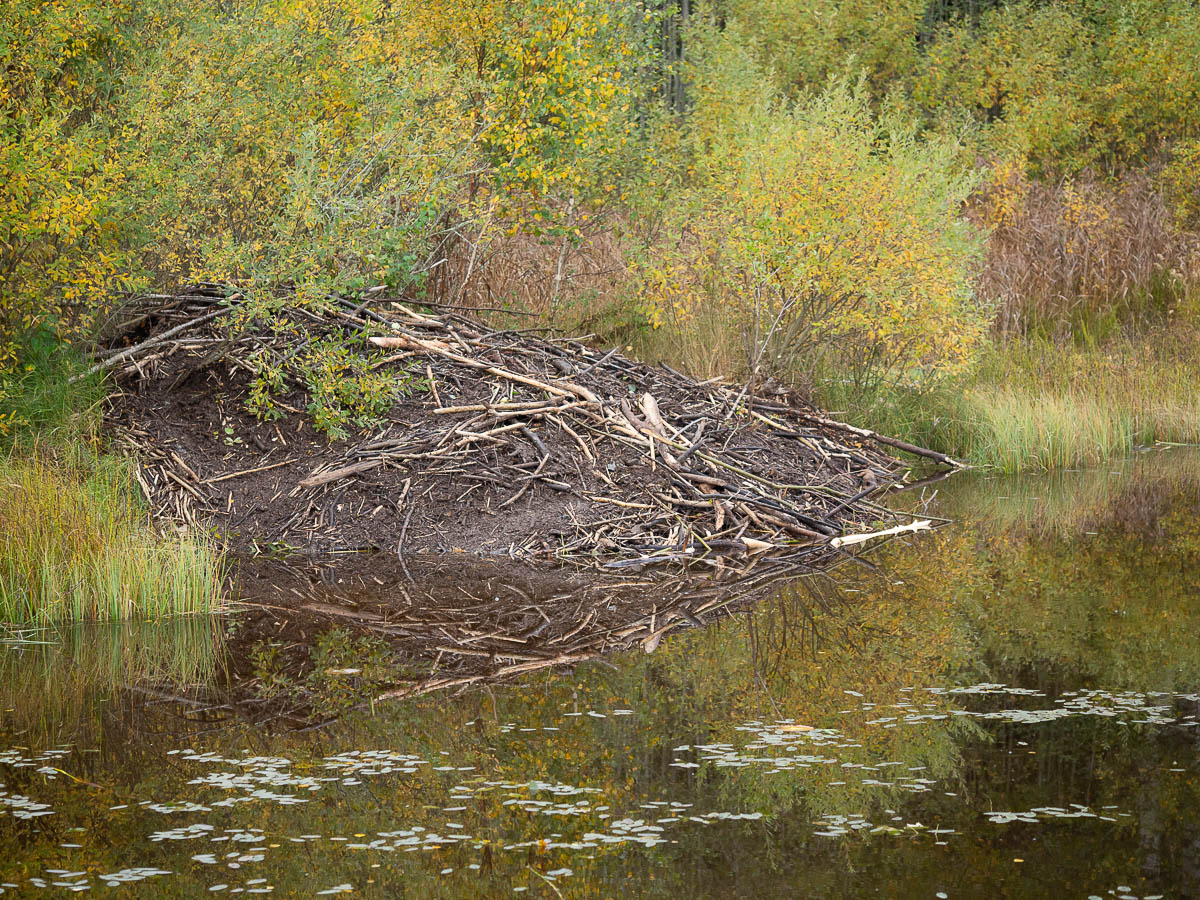
I got my answer soon after I finished packing and started walking, and spotted a large beaver’s nest on the other side of the road where it crossed a stream debouching into the lake. Of course the dog-sized swimming animal was a beaver.

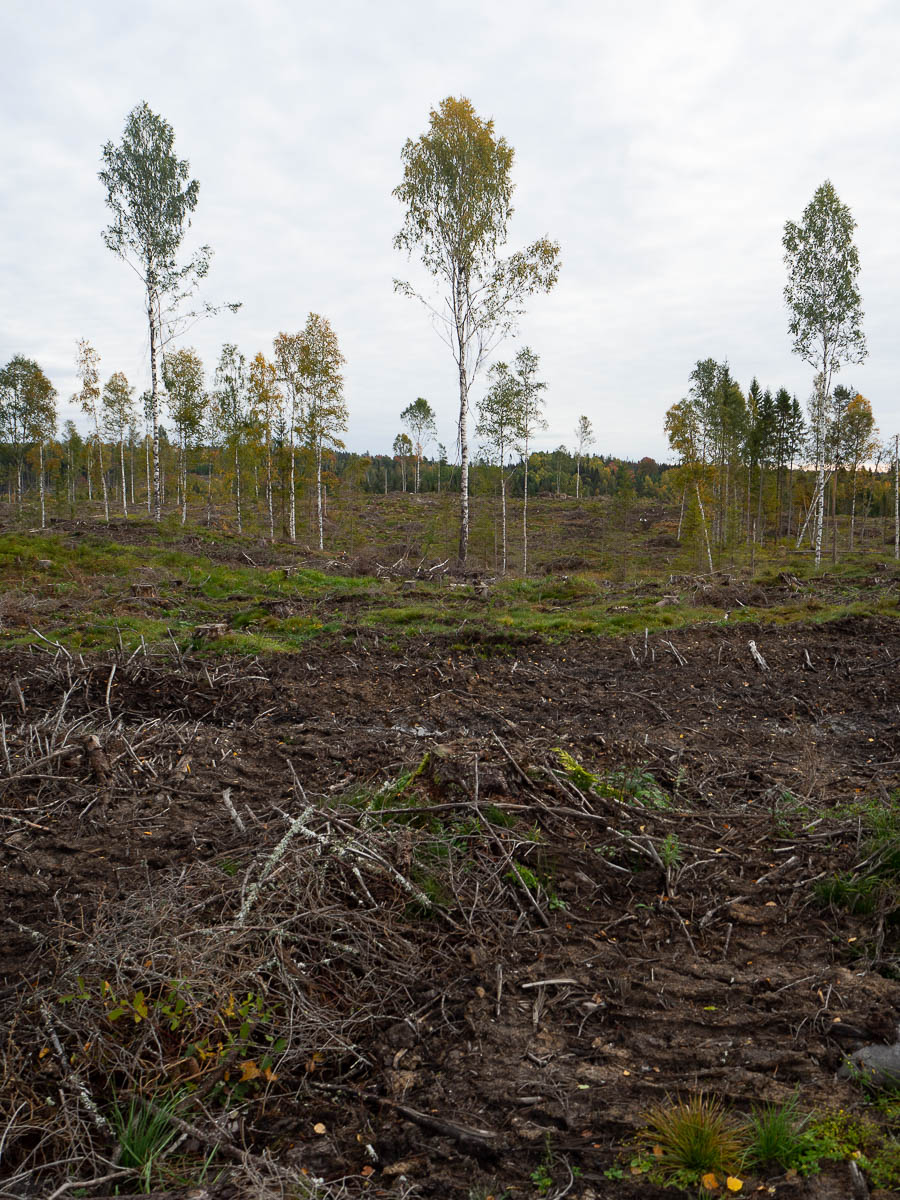
The morning’s walking took me across several very depressing clear-cut areas. I cannot comprehend how this kind of forest management can be allowed in this day and age. It’s disgraceful. A dozen trees remain, and a few stumps still stand here and there, but they’re barely enough to mark the trail across the clear-cut. It’s all churned-up, barren ground, bleak and sad.

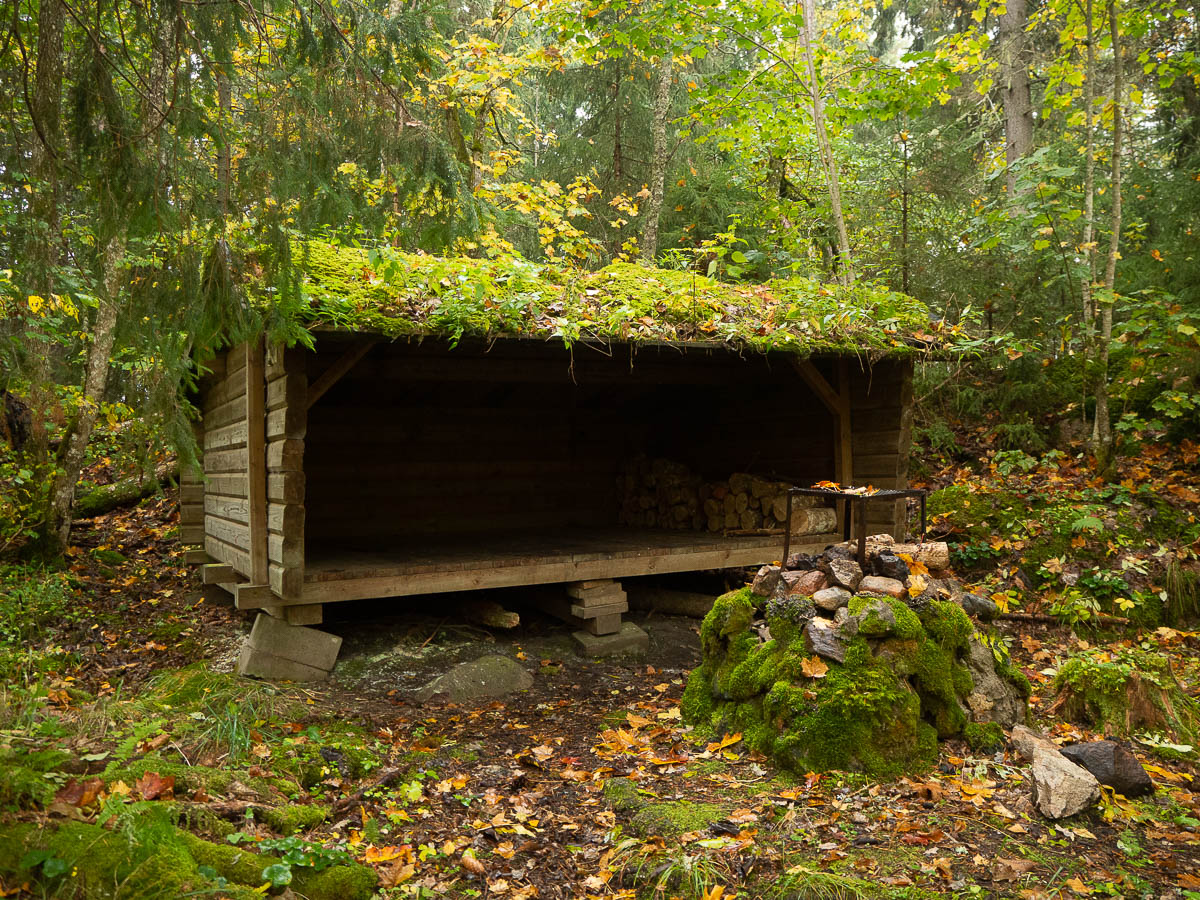
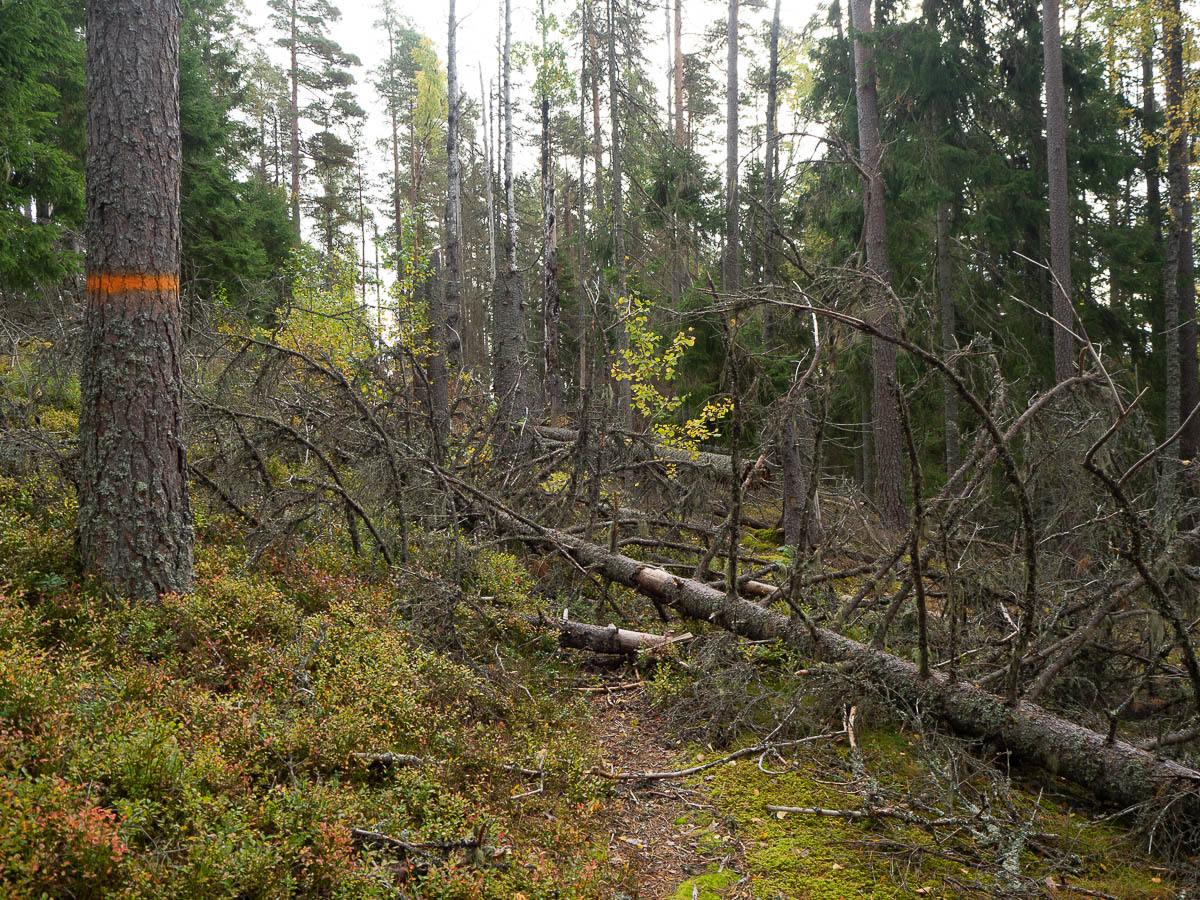
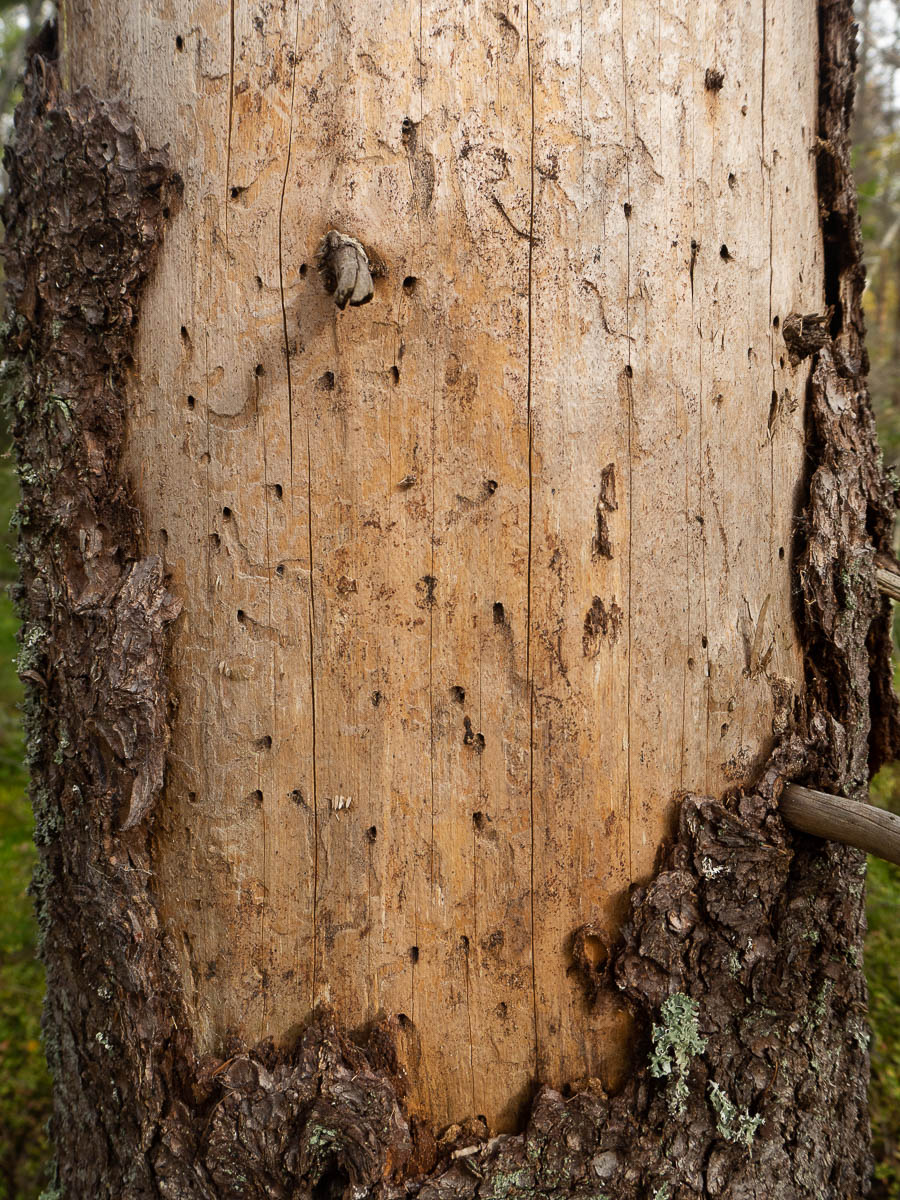
Luckily most of the trail went through actual forests, and even nature reserves where the trees get to fall wherever they fall, and are only removed where they completely block the trail. Often the path just adjusts and rounds the fallen tree, or simply keeps going across it. There were quite a lot of fallen trees here due to spruce bark beetles.


There were several beautiful lakes along the Bruksleden today.


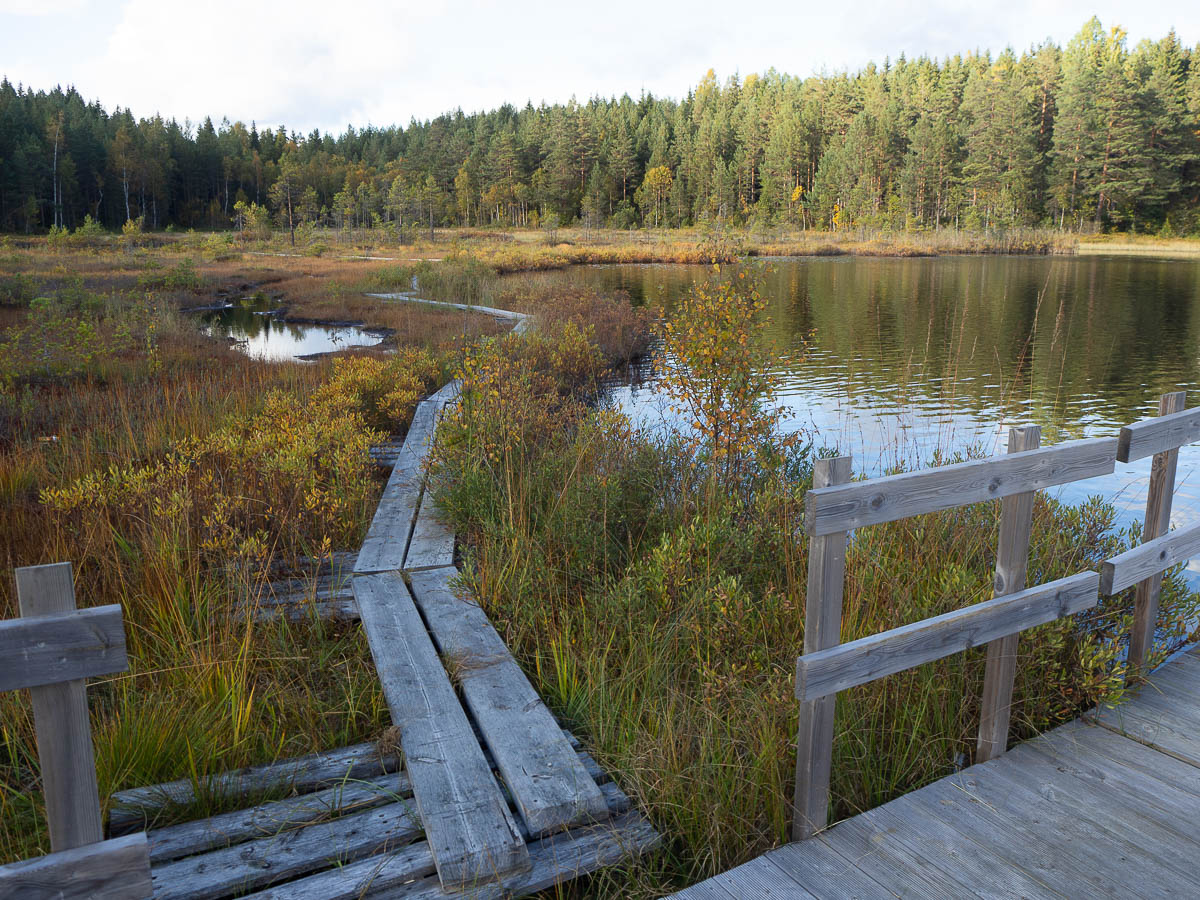
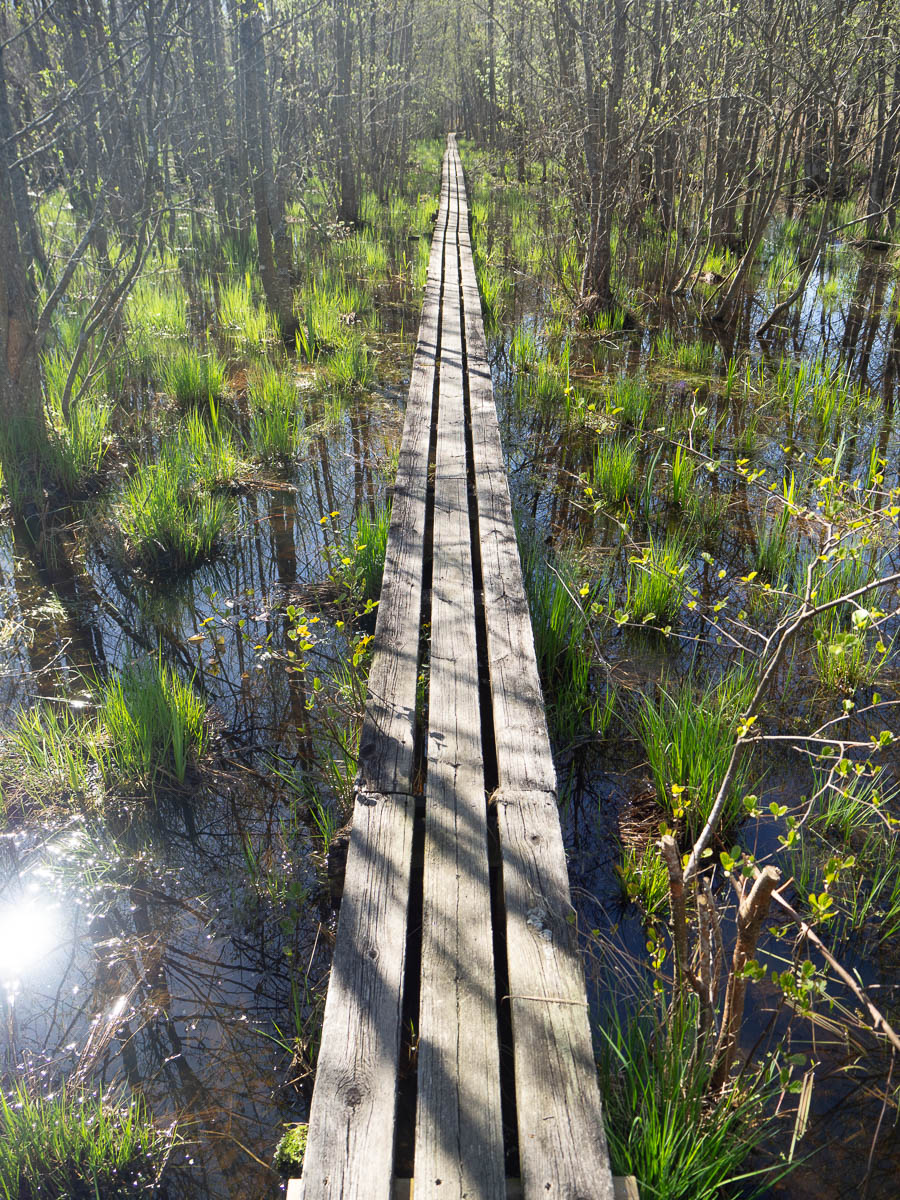
The last one I passed in the afternoon was called Abborrtjärnen or Perch Tarn, which is among the top five most common names of lakes in Sweden and had clearly been set up with fishermen in mind. There were plank walks around its boggy edges, leading to various nice fishing spots, and even a wide wheelchair-friendly boardwalk right across it. The fishing spots also made for nice snack break spots, now that there were no fishermen around.

I ran out of water in the late afternoon. Abborrtjärn was the last body of water I passed, and as close as it was to civilization (with even a small car park next to it) I definitely didn’t trust its water for drinking. I kept walking for longer than I had originally intended, until I came to the village of Morbyn where I could knock on doors and ask for drinking water. The first house had barking dogs and a man sleeping whom I happened to see through the front door window, but he wasn’t woken by the dogs or by my knocking. The second didn’t open either, but the third one had a friendly lady who filled my flasks with fresh well water.

At this point I was feeling quite ready to make camp, but I couldn’t put up my tent in someone’s back yard so I had to keep walking past the village. Then I crossed both a railroad and a large road and I didn’t want to sleep next to those either. By the time I got away from the main road and the smaller road after it, and the path turned into the forest, it was rather late. No scenic lakeside camping spot for me today – as soon as I got 20 metres away from the road and found a flattish patch of ground, I put my stuff down. I got the tent up in daylight but finished dinner by the light of my head torch.

Bruksleden loop north of Skinnskatteberg. Today I walked from Skinnskatteberg to Främshyttan (ish), 15 km.

Before I could start walking, I had to drive to Skinnskatteberg and find the trailhead and park. By the time I’d done all that, it was 10:30 and I was hungry. I don’t normally eat breakfast on weekdays any more these days, but that won’t work for a full day of hiking. After half an hour, when I felt I was in the forest rather than just off the parking lot, and I had found a lovely lingonberry patch, I stopped for a porridge brunch. It was delicious.

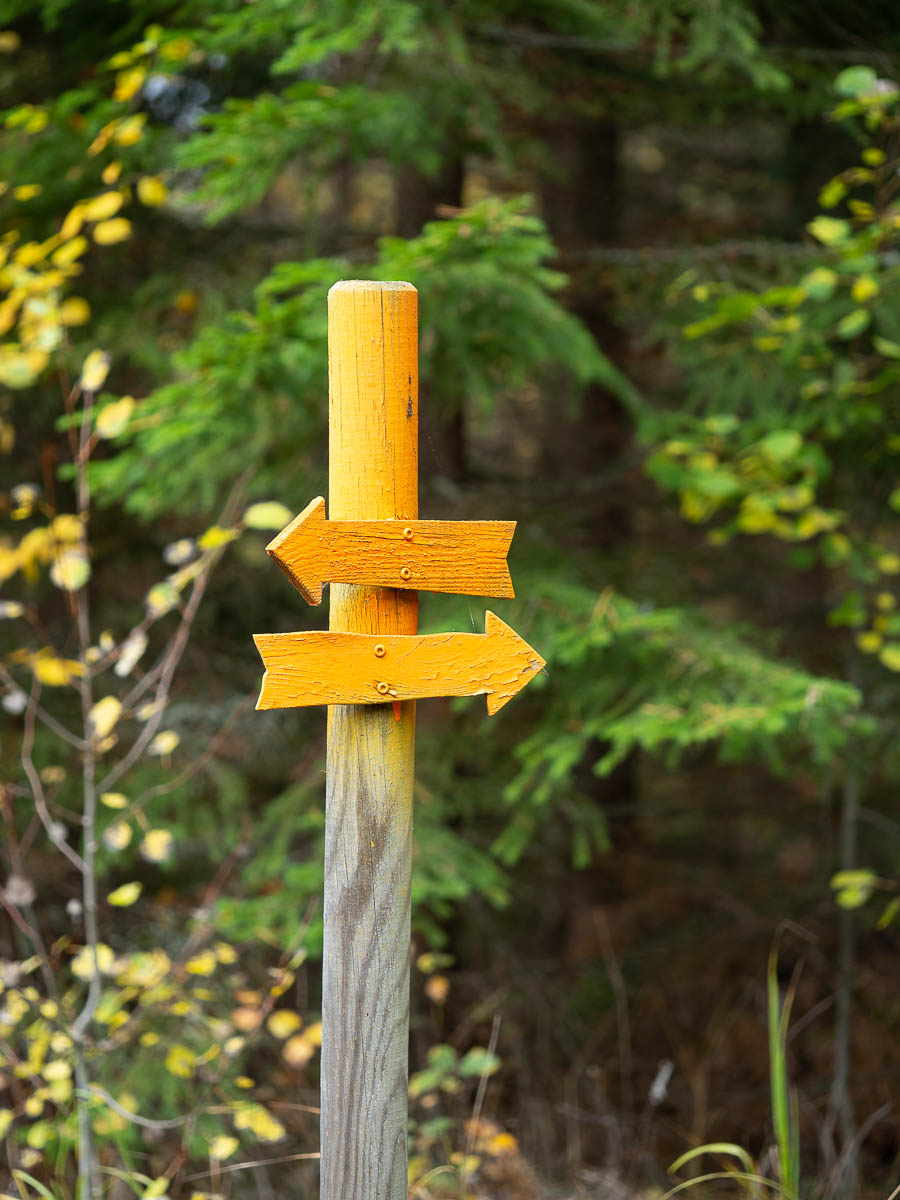
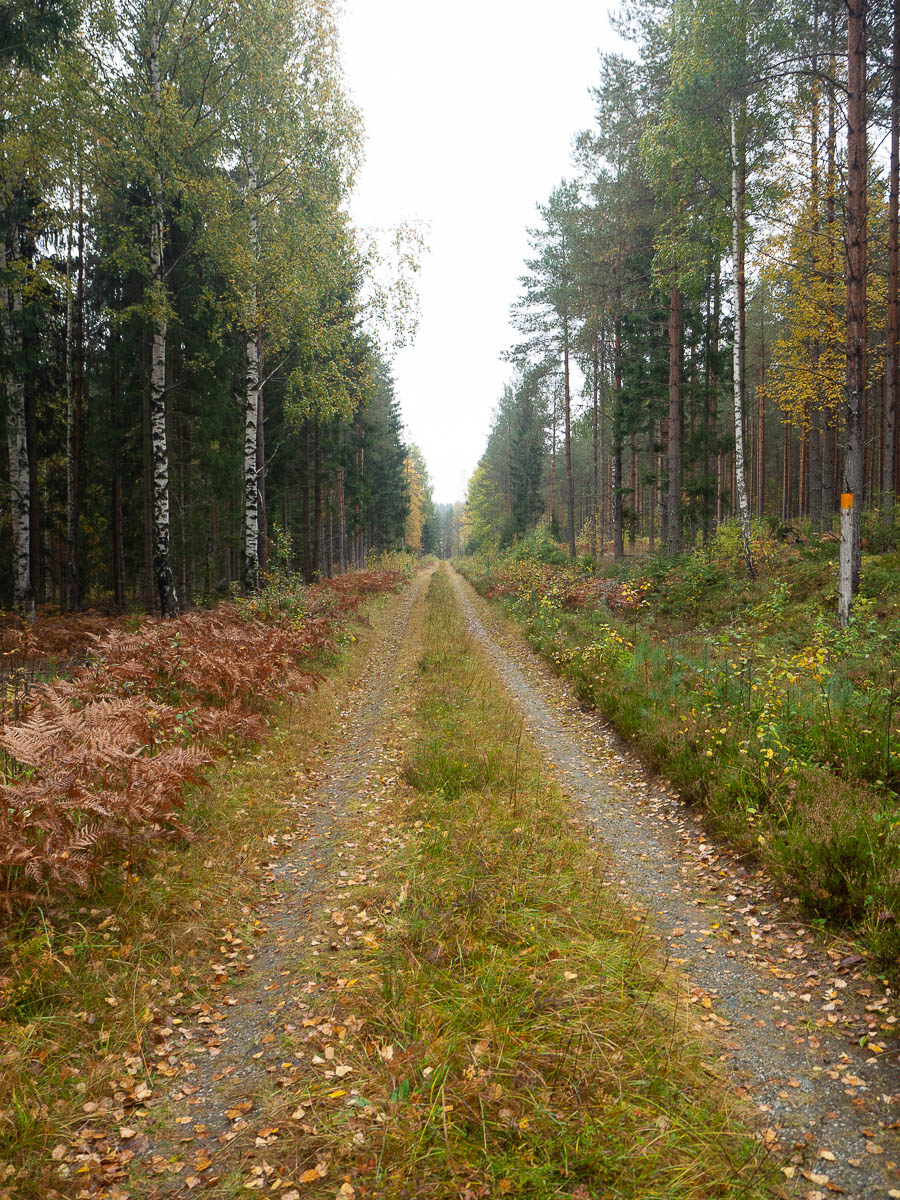
The trail was very well marked, with orange painted rings on trees and orange-topped posts where there were no trees, with the occasional signpost where needed. Very easy to follow. Even so, I missed my first turn-off. The trail was following a forest track and the walking was easy so I wasn’t really paying attention, and suddenly I realized I couldn’t see any orange markings anywhere. I only had to backtrack about 200 metres though.

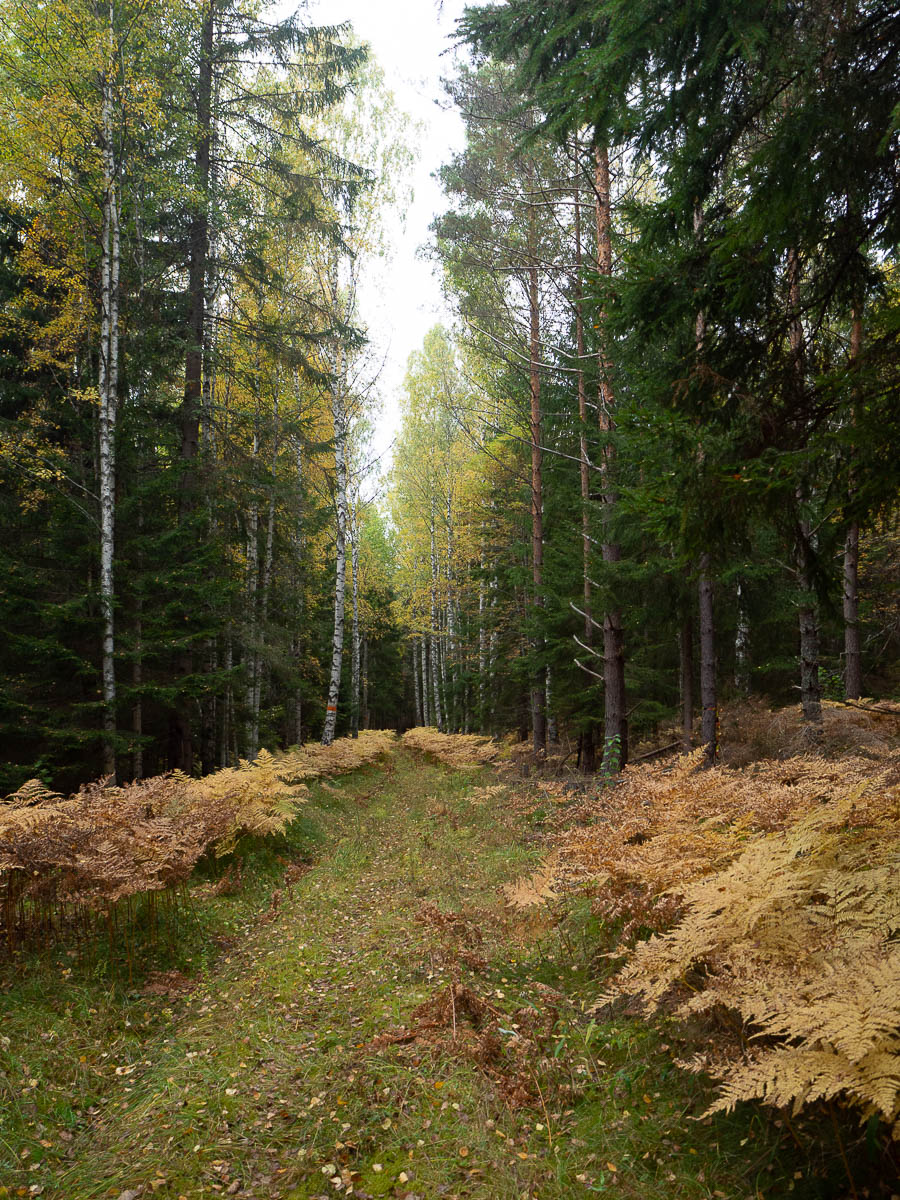
The forest around me was relatively similar to what I’m used to from around Stockholm. Pine forest, spruce forest, or pine and spruce with some birch and aspen mixed in. It’s nice to walk through and pleasant to look at, but doesn’t make for good photos, because it all looks very much the same and there’s nothing much for the eye to focus on. So my photos of today are of the highlights, the things that weren’t just forest, and thus not entirely representative.

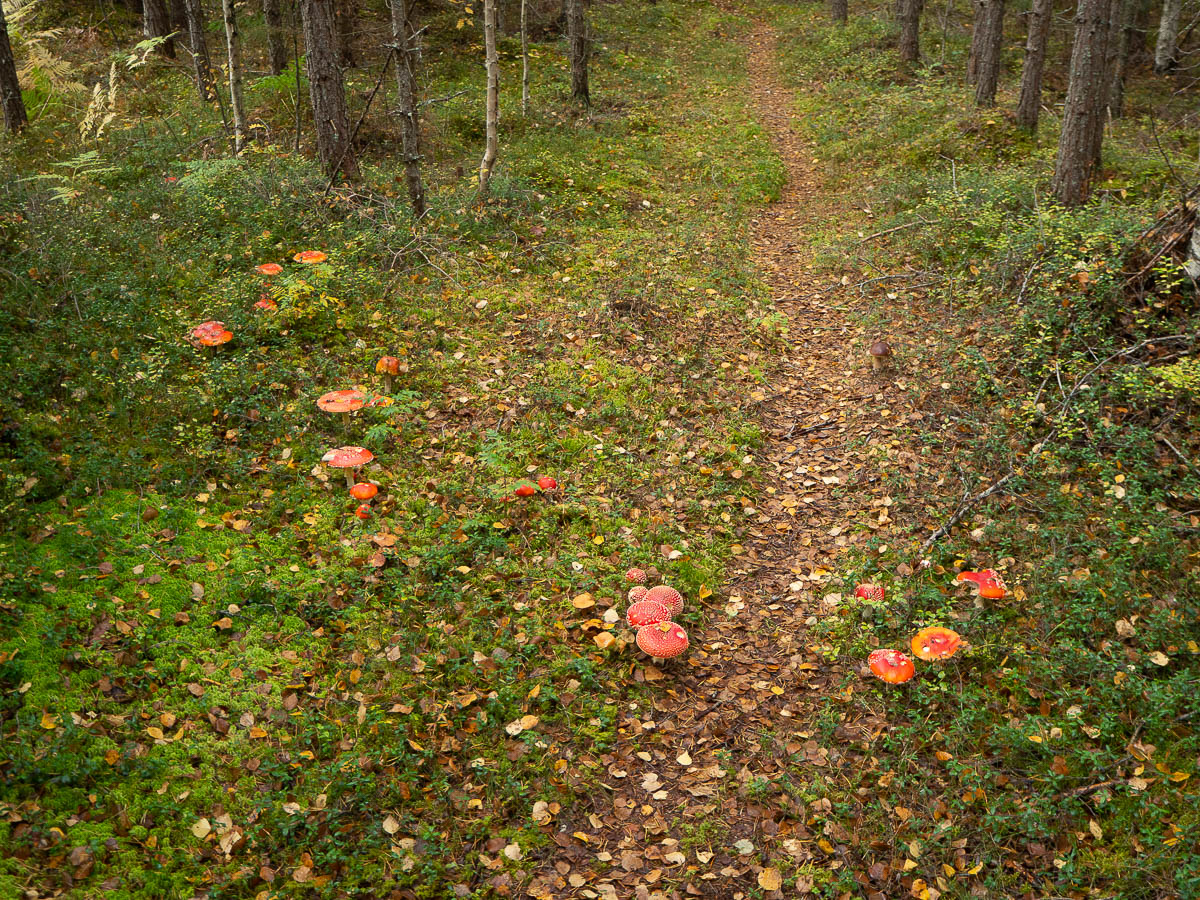
The one thing that was new and unusual to me was the mushrooms. They were everywhere. Walking around Stockholm this time of the year, you might spot one or two large fly agaric mushrooms and take notice. You might even see a whole clump of them. But here, today, I saw hundreds along my path. And loads of other kinds of mushrooms as well, of various species and colours and edibility. I’m going to have to do a whole separate mushroom blog post, otherwise the mushroom photos would totally overwhelm everything else here.

On a cloudy Thursday in late September, there was nobody else on the trail. I saw two walkers near the parking lot, but on the trail itself I was entirely on my own. Which I like. I like hiking on my own and I am honestly not the least bit interested in meeting any new people on the trail.

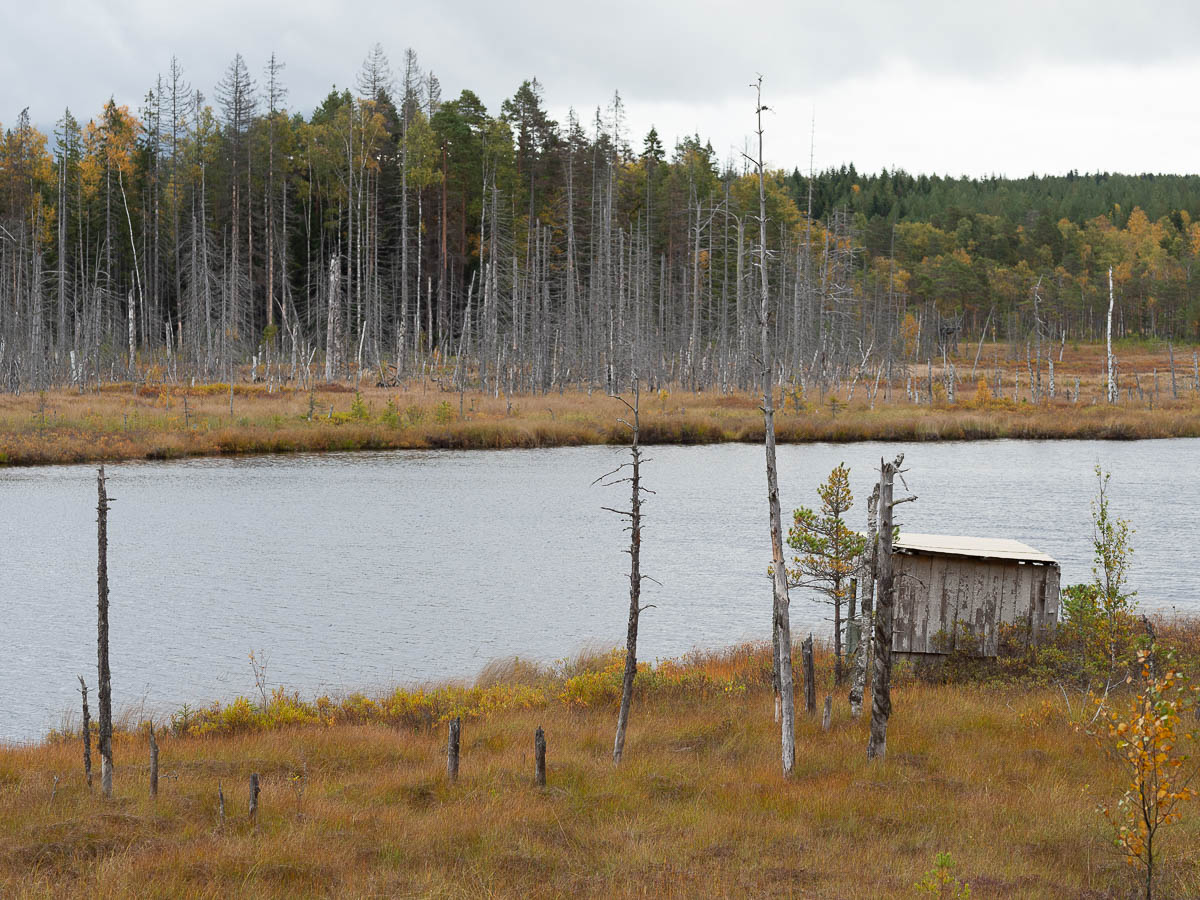
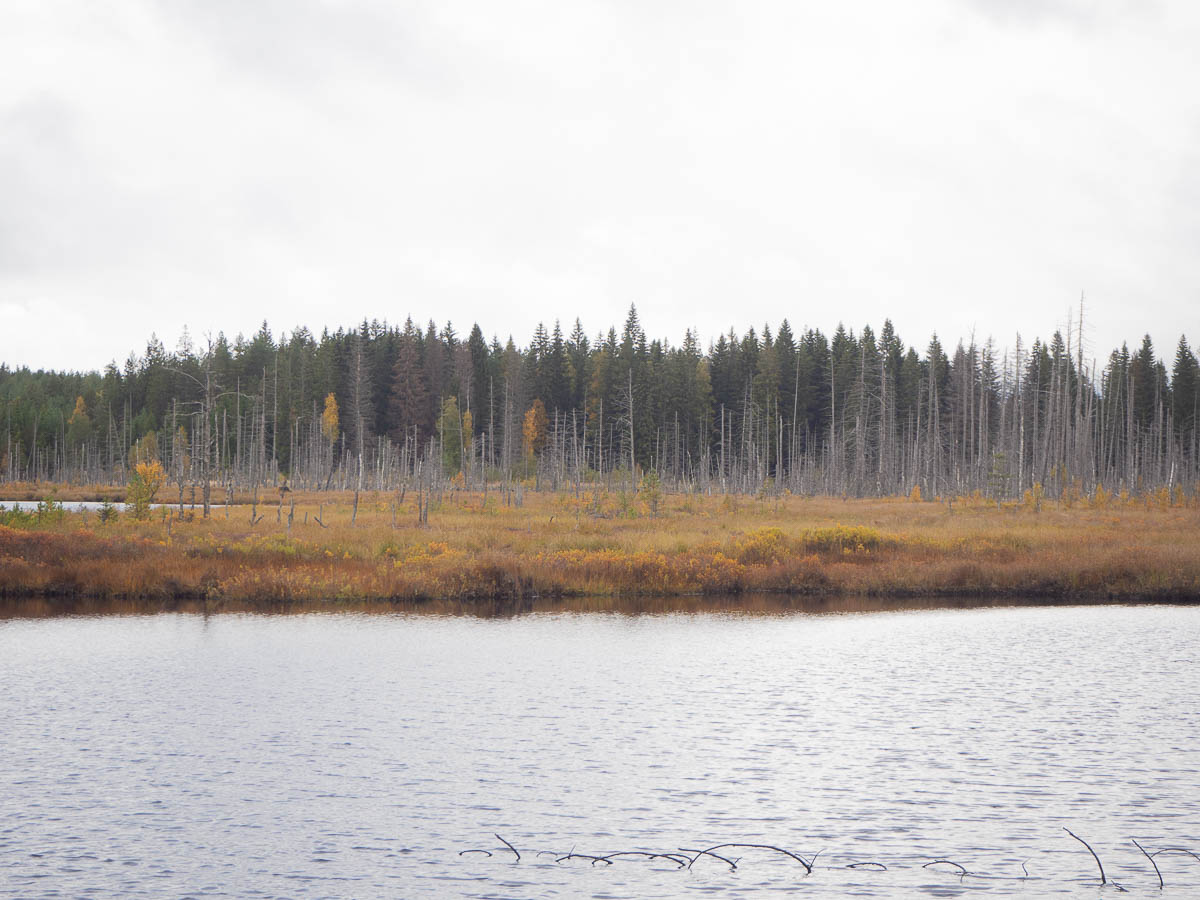
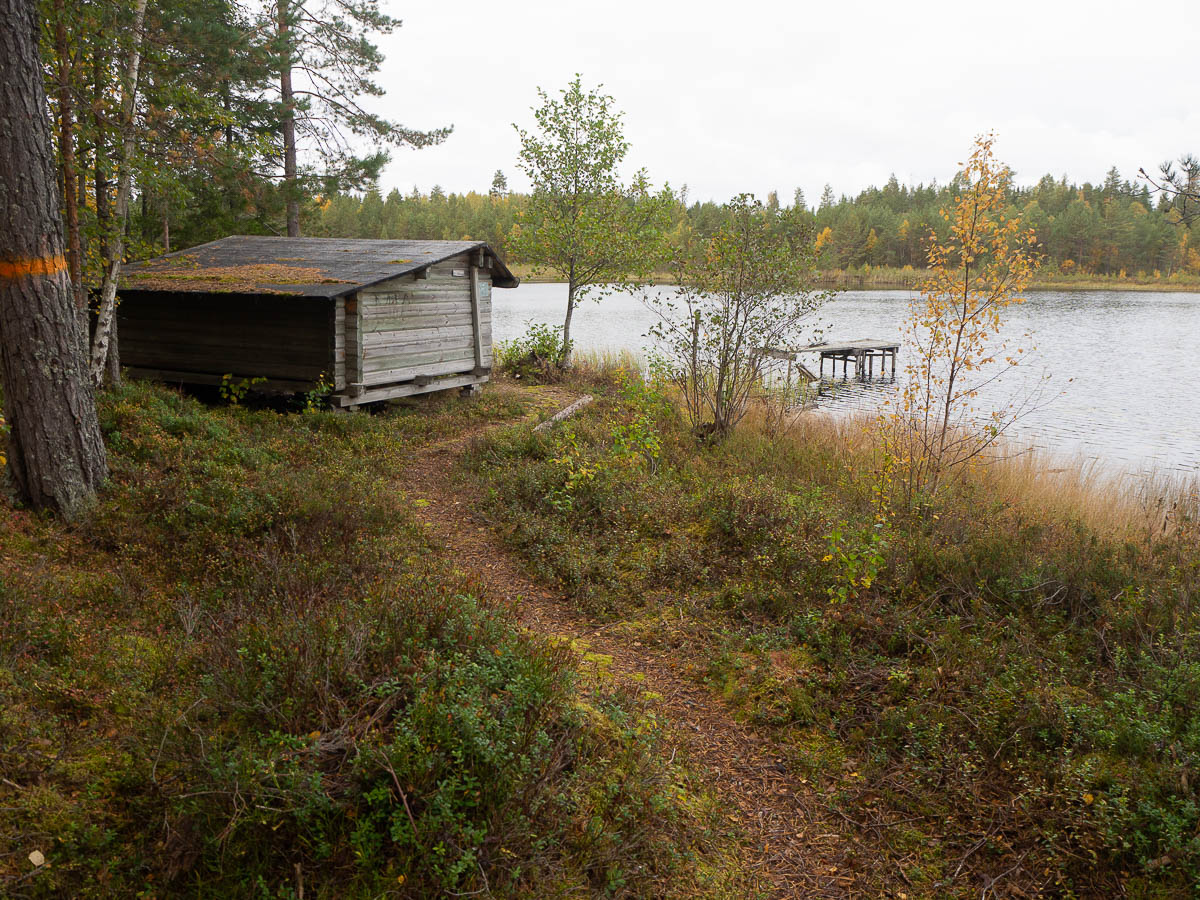
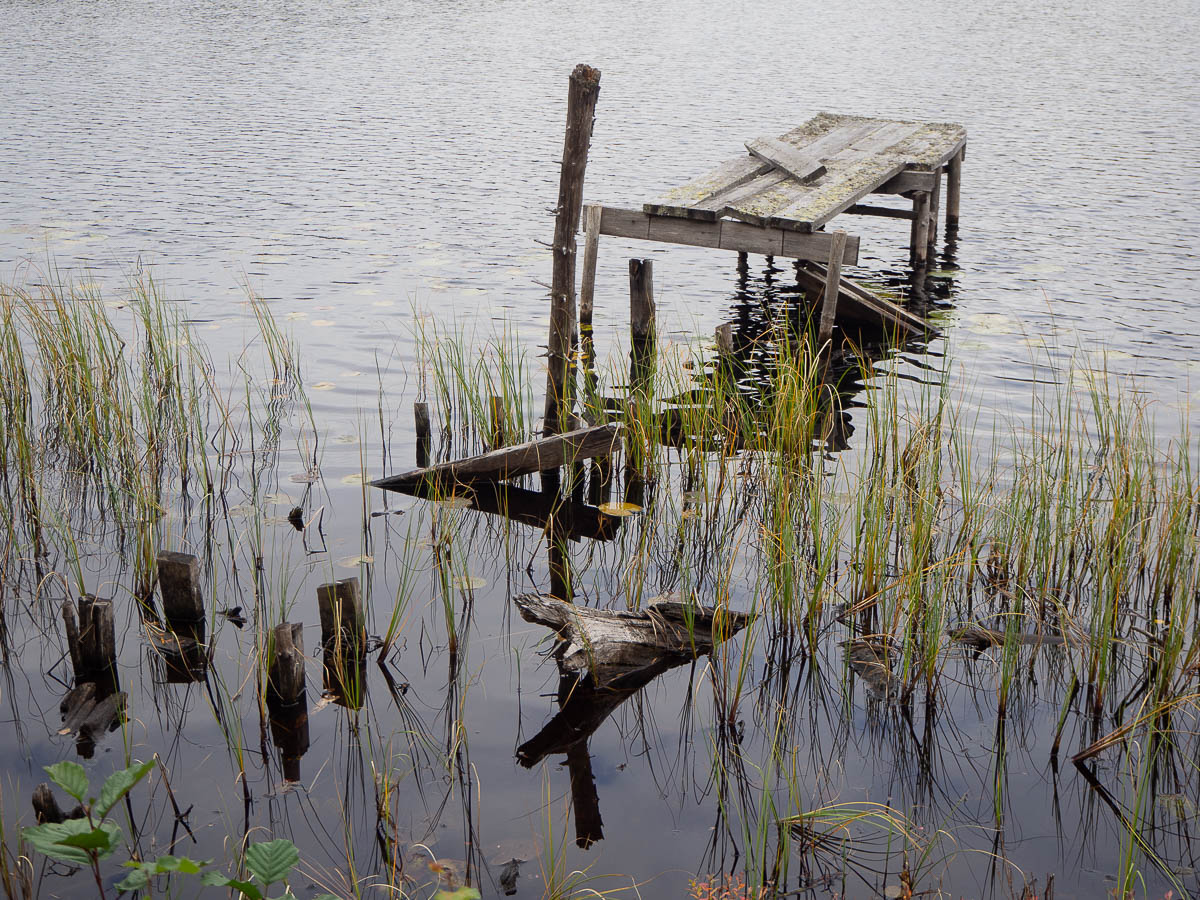
The trail went past several lakes, and those views were the best parts. Bog lakes look so tranquil and also kind of spooky. Especially these ones, with their abandoned hunting blinds and dilapidated jetties.


Hällesdalen to Stenungsund, 13 km. Only part of today’s walk actually followed the Kuststigen trail – the rest was just to get me to a point where I could hop on a train back to Stockholm.


A chilly, foggy morning, until the sun finally rose above the treetops and banished both the cold and the fog.

Shortly after breakfast I left the marked trail and made my own way south towards Stenungsund and its train station. I rather enjoyed this, because it gave me something to pay attention to. I mostly zig-zagged along small back roads right in sight of the large, numbered road and managed to stay away from that larger one all the way to the outskirts of Stenungsund.

The online map for Kuststigen was most helpful here, because of its impressive level of detail. It’s a real topographical map, down to the level of individual buildings. In fact the map was consistently more useful than the trail markers these past four days. The blue-topped posts marking the trail were often hard to see: too far apart, hidden in bushes, tucked away behind some electrical cabinet, etc. The easiest way to see whether I was on the right track was to compare the shape of my trail in my tracking app to the shape of the trail on the official Kuststigen site. (What a contrast to Sörmslandsleden, where the physical markers are exemplary and the online maps suck.)

The north side of Stenungsund was truly boring to walk through. A straight, flat road past industrial estates. It was a relief to reach the train station.

All in all, this was one of my most boring hikes. I feel no particular desire to visit this trail again. Perhaps the rest of Kuststigen has more inspiring sections, but if that’s the case then I wish that the designers of this trail had not included these boring parts.

I wouldn’t say these four days were wasted but they definitely didn’t deliver what I had hoped: beautiful views, long hours of meditative walking away from houses and roads and civilization.

From Bräcke to Hällesdalen, 20 km.

The morning offered yet more underwhelming hiking. I literally had breakfast on top of a newly clear-cut hill among tractor tracks, because the alternative would have been to stop on the verge of an asphalt road. At least on the hill I got some sunshine. I kept my eyes on my book and pretended my surroundings weren’t there, which is rather the opposite of what I normally want to do during a hike.


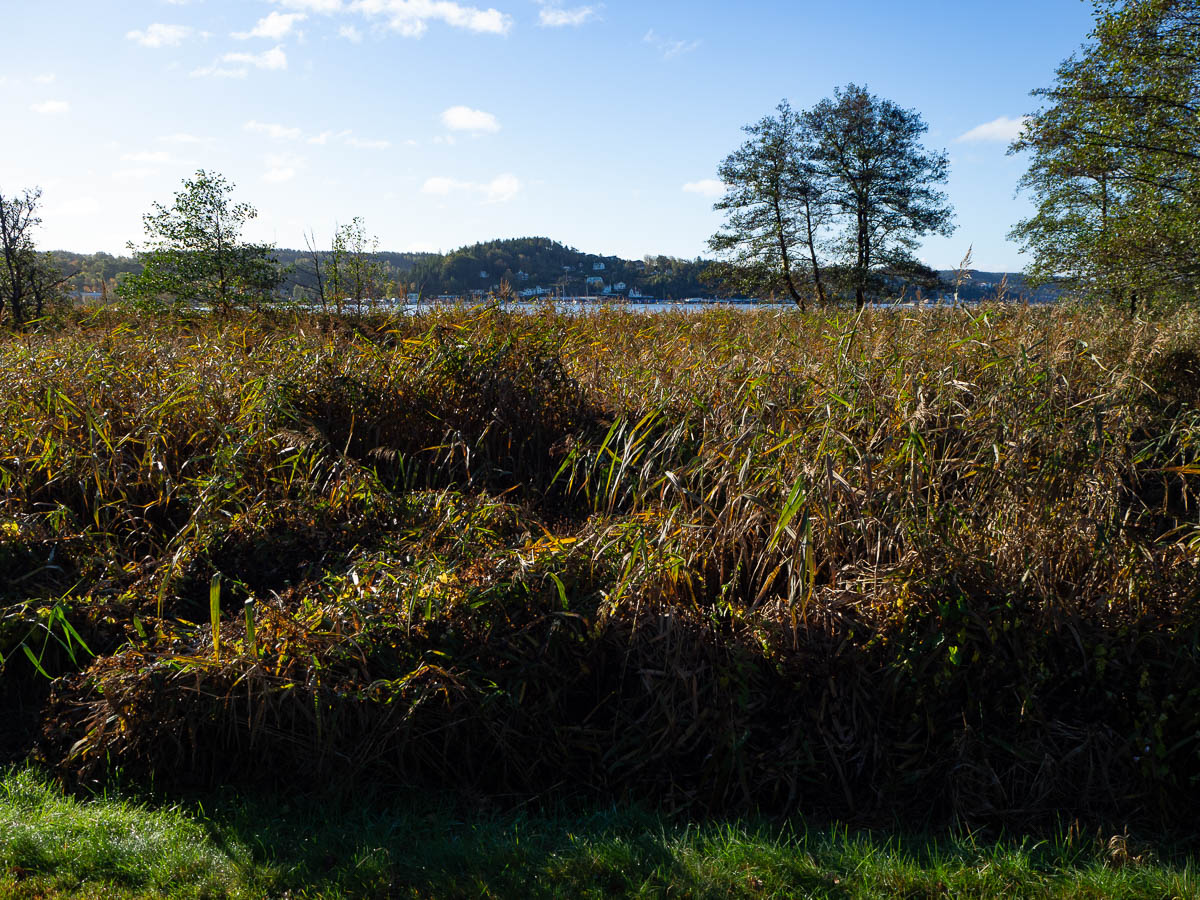
If I was three meters tall, then I would have been able to see the sea from here. Now I just saw a tall expanse of reeds.

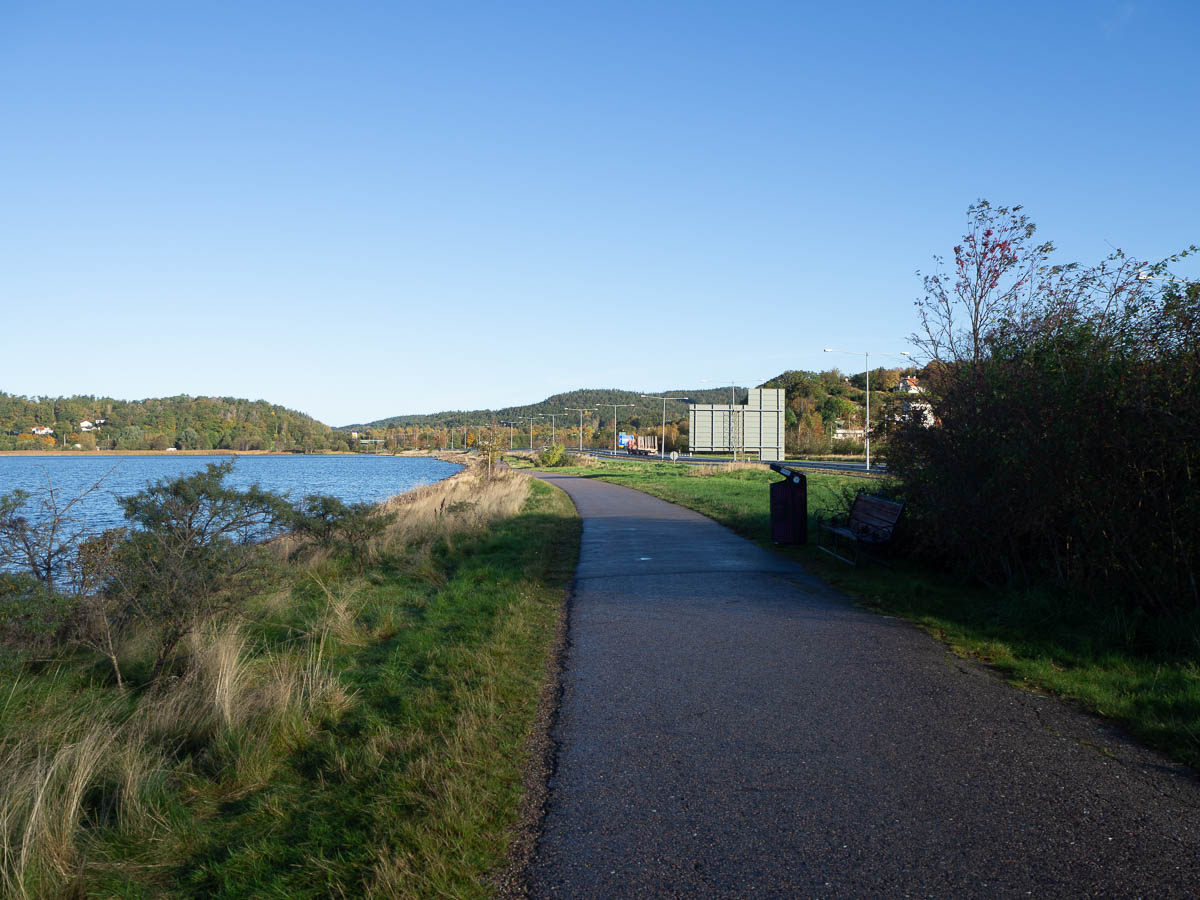
By mid-morning I reached the outskirts of Ljungskile. I was half expecting the trail to go through some ugly industrial zone. It wasn’t quite that bad, but I did get a good kilometre or so of a cycle path running parallel to the E6 motorway.

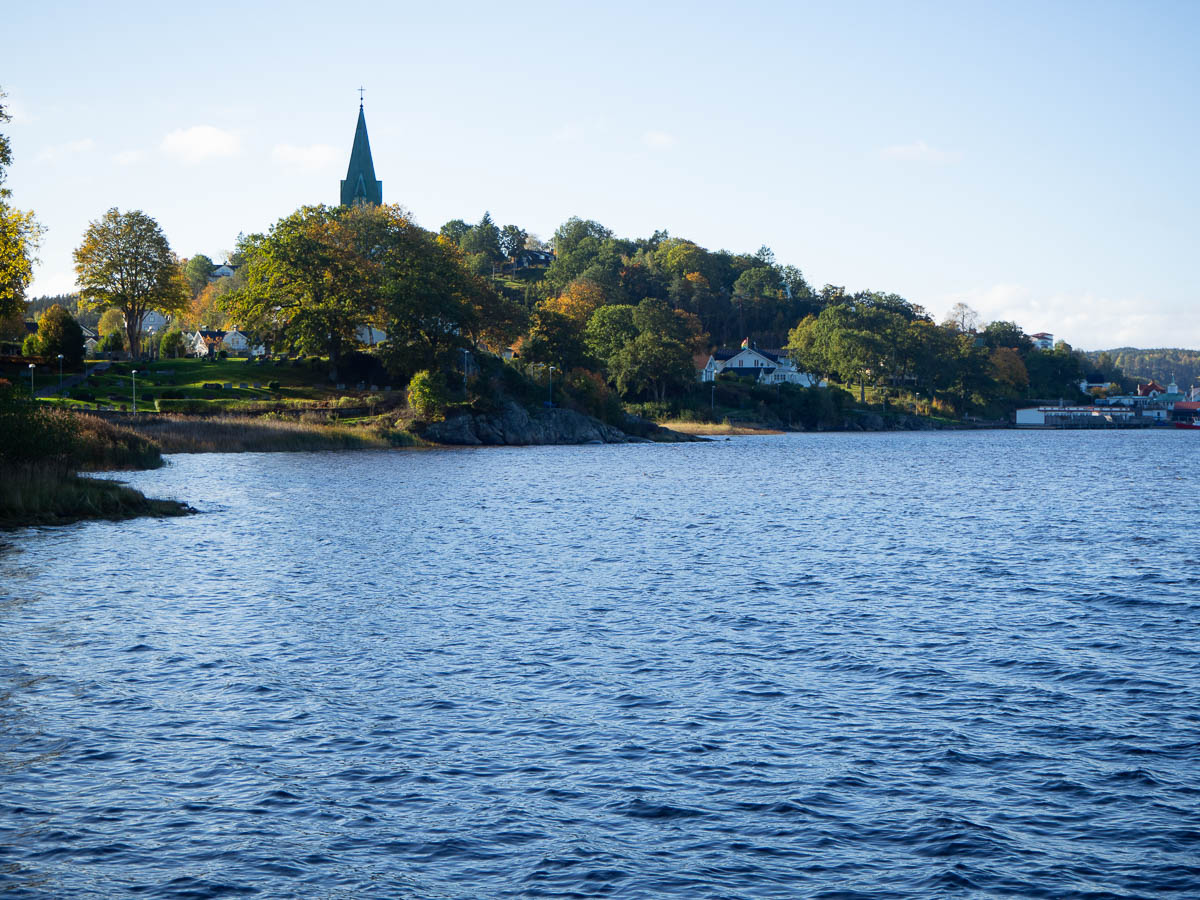
The trail section through Ljungskile was actually one of the nicer ones today, with pleasant waterside parks and views of their lovely old church.

Shortly after Ljungskile the trail turned away from the coast. The afternoon was a pleasant, generic rural walk through mostly sunny meadows and forests. Actually giving up the pretence of this being a coastal walk was almost a relief.

In the evening I struggled again to find a good camping spot. The forests were all quite dense and seriously muddy and scruffy. I finally got to some empty pastures and found one that looked like it might have some dryish, flattish parts at the far end. Got to the far end of the pasture, put my pack down and sat down for a minute – and when I stood up again, there were suddenly horses in the pasture. Their arrival did mess up my plans but at least the timing was impeccable: it would have been so much more awkward if they had arrived when I was in the middle of cooking my dinner, for example. Horses are lovely animals but I don’t want to have to worry about them getting too interested in my stove, or my food, or my tent.

I walked back across the whole pasture fast enough to catch up with the owner of the horses, and asked her if she might have another pasture that would be dryish and flattish and also unoccupied by animals. Sure, her neighbour had one, and she was heading that way anyway. I even had a view of the sea.