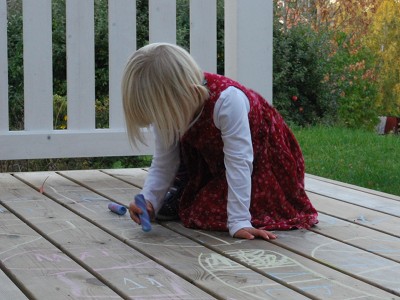
This has been another ordinary month with few noteworthy news to mention. Life with Ingrid has been routine and gone smoothly. There are no dramas and no mood swings.

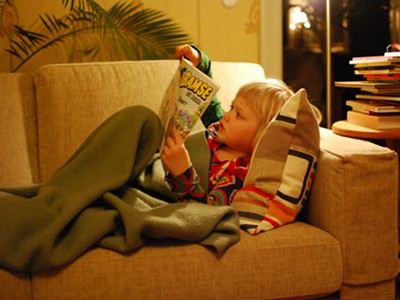
Movies and iPad are still her number one hobby, but we still limit them to afternoons only. The fallback option is still Bamse, and at times it feels like there are Bamse issues lying all over the house (even though we gather them up every evening).

She also has a new book that she loves, about animals from various habitats around the world. About 10 animals per habitat (forest, desert, polar regions etc) and a two-page spread per animal – one large photo, and one page with some text plus a quiz of some sort. (Multiple choice, true/false, fill in the blanks…) The quizzes is what she really likes about this book. When we read it together we absolutely have to do the quiz first, together, and then we can read the facts and check whether we got it right or not.

She is distractible. She fidgets and climbs around and plays with her food and gets sidetracked during mealtimes, and forgets to apply the table manners that she used to have a good grip on. We have now initiated “Sunday dinners” as a way to train those table manners back into her: with a tablecloth, candles, flowers, and a focus on manners.

At some point during the last month or two she has started spending entire nights in her own bedroom, and no longer wanders into our bedroom at night. But she still goes to sleep with one of us sitting next to her.

She plays well with Adrian, especially at nursery/preschool. Almost every day when I get to nursery to pick them up, and they’re outdoors because of the nice weather, I see them playing together. Peekaboo in the playhouse, or she’s pushing him around on a tricycle (on which he can sit but his feet cannot reach the pedals or the gorund), or encouraging him to go down the slide.

At home there is more competition about resources (especially when Adrian tries to grab whatever she has) but she can be surprisingly flexible around this. She lets go the things that are obviously more important to Adrian than to her; distracts him with an alternative when she really wants to have her things in peace; helps him when he needs help; laughs at his antics.


Helping Adrian build a tower


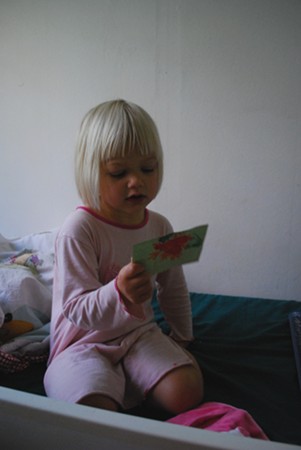
Easter cards. Chickens (with long hair and eyelashes), and eggs in various states of development: with a tiny seed, a little wiggly worm, and finally a tiny chick. And a ghost.

For Ingrid this month has generally been calm and pleasant, much like last month, with none of the drama and moodiness that we had a while back.

She herself has commented on several occasions how she is being helpful and co-operative and doing what needs to be done. When we’re in a hurry in the morning she co-operates by being quick to get dressed and pack her bag. When Adrian is anxious to get home in the afternoon, she does the same. I think maybe she’s picked up on how stressed I am at those times, and does her best to help. Which is news in itself, because in the past she has been quite insensitive to other people’s moods, and what kind of behaviour is suitable (and conducive to pleasant family interactions) in what situations.

At other times she’s still pretty blind to others’ feelings.

Some weeks ago we had a few occasions when she, for some inscrutable reason, had decided that she wanted to be very angry, or perhaps that she wanted to make us very angry. She would start off by yelling at us, saying no, banging doors and other things. When we tried to defuse the situation she’d do everything to make it worse. When we tried to get away from it (when the yelling gave me a headache) she would follow and stand right next to me and keep on yelling.

Finally when we were really riled up and wanted nothing more to do with her, she was done and stopped. And… wanted me to read her a story. What with the headache and the mood I was in by that time, I really wasn’t interested in any cuddling or fairy tales. And each time Ingrid was honestly surprised and could not understand why. She seemed to expect us to mirror her feelings. She’s done being angry – we should be done being angry, too, naturally.

While we’re on the topic of emotional maturity, one interesting thought pattern I’ve noticed is a tendency to look for causes and reasons where there is just chance, for retrofitting explanations, for seeing agency where there is none. In particular, blaming accidents on others, and taking credit for fortunate events. “It was your fault that I fell, you shouldn’t have put the [whatever] here” when running and stumbling over something. “I left this sandwich yesterday so that we could take it with us today” when really she just didn’t want to finish it yesterday (and had at that time no idea that we’d be going out today).

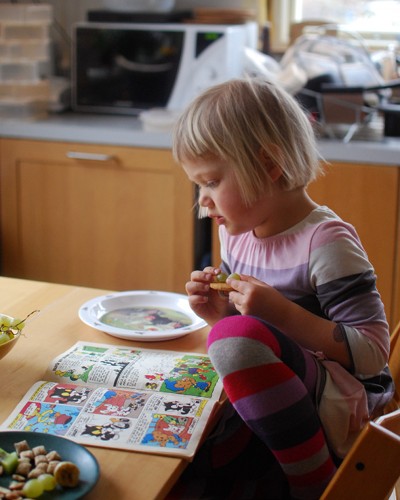
She still reads a lot of Bamse. We bought more from our neighbourhood charity shop, so she can now supplement her weekly Bamse with old issues that she can buy from us at cost (2 kronor) with her pocket money. For a while she was devouring one a day. Now she’s started reading while eating, to the point where she forgets to eat and in effect goes hungry. I now only allow this during the afternoon snack, because otherwise the reading was beginning to disrupt everybody’s meals. She’s also started eating breakfast in her room, “as a picknick” she says, and I suspect she does this to be able to read again, but I haven’t gone in there to inspect.

Favourite new skill: she’s learning to light a candle with a match, on her initiative. I don’t trust her to do it on her own yet because I’m pretty sure that if something went awry – say she flame gets too close to her finger – she’d panic and drop the match rather than blow it out. But with me right next to her she manages it well.

Another skill she is learning (slowly) is putting herself to bed without us to keep her company. She’s decided that she wants to learn to do it, and has even cut out seven gold stars for herself from yellow paper. Two of them are already up on the fridge. In fact the idea was hers initially but it arose “backwards”. She said she wanted to do something difficult for which she could get gold stars and then a treat of some kind. I guess someone at preschool was doing something like that (because it’s not how we normally do things at home). So the stars came first, and tying them to going to bed on her own came second.

She has also been practising cycling on her new bike. (Cycling is her preferred way of getting around, especially to and from preschool.) We bought a new, larger one for her this autumn (when we ran across a good deal) but it’s been too large for her until now. It’s got 16″ wheels, compared to the 12″ wheels of the old one, so quite a bit larger. With the old one she could put both feet on the ground, and with the new one she can reach it with the toes of one foot, at most. But she gave it a go, at first with me supporting her while she got started, and then on her own. Getting on and stopping are a bit hard and take all her concentration, and I have to take care to not disturb her by talking to her at those times, but once she’s up and running it works very well.

Other favourite pastimes: standing up on the sledge while I pull it. (Yes, we actually had some snow on the ground during the first week of this month.) Standing up on it backwards. Jumping off and then back on while the sledge is moving.

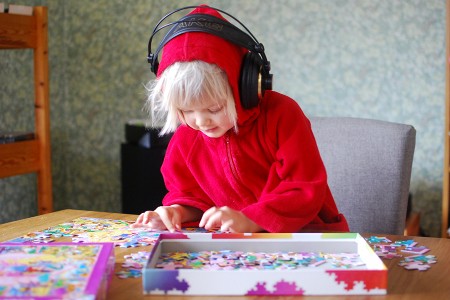
She’s taken up jigsaw puzzles again, occasionally, and listening to audiobooks.

She’s far less obsessed with sweets and sweet food than she used to be. Most evenings she doesn’t even mention sweets any more, and she doesn’t spend all weekend talking about her lördagsgodis and the Sunday ice cream.

Favourite movies: The brothers Lionheart and Monsters, Inc.

This has been steady month with few news or blog-worthy events. But under the surface things seem to be happening, something is changing. Ingrid has been more tired than usual and often complains of headache or tummyache. Her reports of aches and pains are unreliable and I think what she is experiencing is more likely to be tension of some sort, rather than an actual ache. What the reason is, I do not know.

Most afternoons after preschool she doesn’t suggest bringing a friend home with us. When we get home, she might snack or she might go straight to watch a movie.

More and more she is also choosing to read. This is her go-to activity when she’s tired of or cannot watch a movie. She reads and re-reads her old Bamse issues. It isn’t effortless but she is a fast enough reader to read an entire story at least. Now she’s learning to make sense of punctuation, for pauses and tone. When is a sentence a question and when is it an exclamation?

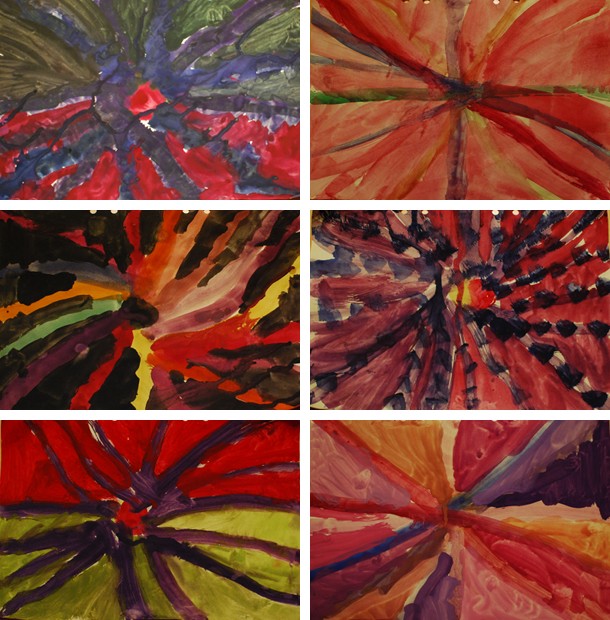
The only other thing worth mentioning is her paintings. She regularly brings home paintings from preschool. Mostly she used to paint princesses or girls, or possibly us (her family). And she previously used the paint brush as a pencil, painting line drawings. Now she is painting more broadly and boldly, often filling the entire paper. For example, previously when she painted her girls & princesses she would first outline the dress and then colour it in with a different colour. Now she paints the dress as one whole.

She’s also been making abstract paintings. The dominant one is a starburst pattern, which she’s made in all sorts of colour schemes. She’s also made some that are simply broad bands of colour, all straight and of equal width but in different colours. I’m really curious about the starburst because it has been so persistent but haven’t had an opportunity to ask her about it.

A lot of this past month has been taken up by the Christmas holidays, pushing all normal routines to the side.

One of our projects during the holidays was ice skating. This is something Ingrid has wanted to do for a while. We bought skates for Ingrid and myself and went out skating several times.

I have to say, the modern plastic-booted skates they make for kids nowadays are great. I remember sitting on a bench next to an ice rink when I was a kid, pulling at those infernal laces with freezing hands. And still the skates ended up floppy around my ankles and too tight around the foot at the same time. Now it’s just click, click, and the buckles are done, and off she goes.

Ingrid took skating as a challenge, as usual. It seemed important to her to be able to say that she can skate. At first she was claiming she could skate just because she could stand upright on them and move forward while holding on to my hand. I explained that skating while holding on to my hand is like swimming with floaties – you’re moving but it isn’t really right to say that you can swim – and that “I can skate” means gliding (not tottering) and without holding on to anything. She immediately focused on those two things, and made progress straight away. She holds my hand while getting started and picking up a bit of speed, and then lets go for a brief independent glide. Rinse and repeat until tired. I still wouldn’t say that she can skate but it’s an activity that we can enjoy together.

Much of life is a competition for her. Apparently she’s not alone about it. One day a friend of hers was here and they happened to stand next to Ingrid’s Bamse magazines. The conversation went like this:

Ingrid: Look at how many Bamse magazines I have!
Friend: I have more!
Ingrid: I have this one, and this one, and this one…
Friend: I also have this one.
Ingrid: … and this one, and this one.
Friend: I have many more at home.

Eric gave her a “weekly Bamse” as a Christmas gift. (“Vecko-Bamse” to complement her pocket money, “veckopeng”.) It’s not a subscription but a stack of old issues that he bought in a charity shop, and she gets a new one every Saturday.

Bamse is just the right kind of reading material for her. It’s a comics magazine, so there’s lots of pictures. (She still likes books to have pictures on every page.) The texts are short and simple, and in capital letters, which she prefers.

We tried one issue of Kalle Anka (Donald Duck) but not only was it in lowercase, it was also full of words like “ämnes­omsätt­ningen” (meta­bo­lism) and “outhärd­ligt” (unbear­able) and “obliga­tioner” (bonds) and so on. I kept having to read the hard words for her and then explain what they meant, so she kept losing track of the actual story.

But with Bamse she can sit and read on her own. One morning she spent an hour just reading. She doesn’t like it quite as much as the iPad but it’s clearly a fully acceptable substitute when computerized entertainment is not available.

Apart from Bamse, we’ve been reading Tam tiggarpojken, a Swedish fantasy series for 6 to 9-year-olds. It’s a bit challenging for her, but in a good way. Things are not spelled out as explicitly as in books for younger kids.

At first I just read the books, but it turned out that she really didn’t understand large chunks of it. Now I stop every now and again and ask her about what I just read. Sometimes she’s with me, but other times she has no idea what’s going on or why. So I read it again or explain it in simpler words or in terms of something that she can relate to. More and more I do so with other books, too. It’s good for both of us: makes me read more actively and her listen more actively.

Most often it’s the why I need to explain. I wonder if it’s like that for her with life in general, not just with books. Things happen, and she either has no idea why (but it doesn’t bother her) or she makes up some sort of reason for herself that is very far from reality.

Other news:
Lördagsgodis still works well. It’s so nice to be free of the nagging during dinner on weekdays. Yesterday she bought candy for 6 kronor (about a dollar) and it lasted her an hour. She sat at the kitchen table for an hour, reading Bamse and eating candy. The moment she was done she left the Bamse magazine and went and picked up the iPad. (All optimised to follow the house rules: “No eating candy in the living room”, “No using the iPad while eating”.)

I’ve let her use a knife for sharpening pencils and for paring apples, i.e. cutting things that are hardish and held in the hands rather than on a cutting board. She’s a bit of a wimp when it comes to blood and getting hurt, so I’ve been saying no until now because I didn’t want to face the wailing that would come if she cut herself. But she managed it very well.

The positive moments have been more frequent this month, and the general tone of Ingrid’s life is a little bit less negative than before. In part I think the Christmas calendars are to thank: there is something new to look forward to every morning, and a new video clip to watch every afternoon. So she gets the entertainment she craves, and that keeps her in a better mood.

I’ve been making an effort to spend more “quality time” with her in the evenings. I am not very fond of the concept of quality time but when she is not interested in normal time spent together doing normal activities, then somewhat-artificial quality time is better than nothing. At the same time she is spending fewer afternoons with her friends. We used to have kids in our house two or three times a week; this week we haven’t had a single one. I’m not sure if it is a coincidence, or because of frictions in their relationships – or if this is less important now that she gets more time with me.

We also let her spend more time with “entertainment devices” – movies and iPad games – than before. Previously I’ve tried to limit screen time and asked her to find other activities instead, but we’ve pretty much given up on that. All it leads to is whining and complaining. Now I only say no to movies/iPad when it’s getting close to bedtime, so that she can get a chance to get bored and realize that she is tired.

We (Eric and I) do try to think of activities that impose an active role on both participants, so she cannot just coast along. We insist on taking turns when playing I spy or when drawing together. I refuse to make decisions for her when we’re doing crafts, or to finish the task for her when she gets bored – our recent projects have been really small but they’ve taken several evenings each. She has little persistence and is unwilling to expend any real effort on anything. I often have to remind her to slow down, to do things properly instead of rushing. For her it is more important to make many things fast, while I’d rather see her make a few but with care – regardless of whether she’s making gingerbread cookies or writing Christmas cards.

In creative activities and games she will reuse the same ideas over and over agains, and I’ve started rejecting those. No, we will not draw another princess in the Scribblenauts sandbox – you’ll have to come up with something new.

One small positive development is that she is more likely to choose iPad games instead of re-watching a movie. A virtual tea party on the iPad is a much more passive and lazy activity than a real tea party with her toy china would be – but she is at least doing something rather than just sitting and watching.

She still thinks that almost every activity is boring, and to most ideas and suggestions, her first reflexive reaction is negative. If things are not to her liking, she is immediately deeply disappointed and sour. Sometimes it feels like “nöööh” and “but whyyyyy” are the most frequently spoken words in our household.

When things are fun, she often overreacts in the other direction. She can’t let an activity be just simply fun – she has to squeal and force out a loud laugh and turn it into a performance.

She spends a lot of time reacting, and rarely listens or reflects. I get the impression that it is very rarely that she thinks about what she wants, what she likes, what our suggestions entail – she is governed by emotions. Or hormones, perhaps.

A more interesting development is that she is exploring the power of sneaking and of telling untruths. When dinner doesn’t meet her expectations, she tells us “I don’t like that”. You still have to try it, is our standard response. “But I already have. We had this for lunch at preschool and I didn’t like it.” Well, I can be very sure that they did not have beetroot soup at preschool, nor oven-baked aubergine with mushrooms.

One day I caught her nibbling on a small piece of candy she had taken in a convenience store. We had a very serious talk (but a brief one due to circumstances) about stealing, and I think she understood the importance of it. But the whole situation was also a bit funny and I had to make an effort not to laugh: she clearly knew that what she was doing was wrong, so she had gone into a corner of the store and stood with her face towards the wall. She was so conspicuously up to no good that I could spot it from the other side of the store.

Actually, her poor lying and sneaking skills are a good reminder to me about how immature she really is in her understanding of the world around her, and of other people in particular.

The candy incident made me think that perhaps our current sweets regime is not working for her. Until now we’ve stayed away from the lördagsgodis concept, going for “everything in moderation” instead, but now we’re giving lördagsgodis a try. My hypothesis is that with our current regime she never feels like she’s been able to eat her fill. She’s always left unsatisfied, wanting more. Well, if she gets to eat lots in one go, perhaps she will feel satisfied afterwards. We’ve only tried it for a week and a half so too early to tell if it’s working better. For now the main effect is that the daily nagging of “Are you done eating? When will you be done? Will you be done after you finish what is on your plate now? Can I bring out the sweets while you’re eating?” has been replaced by daily reminders of “I can’t have any sweets today if I want lördagsgodis.”

She is pretty obsessed with sweet stuff. She described this past Sunday as “a happy, happy day!” (“en lyckodag”) – a slightly sweeter-than-normal cereal for breakfast, then saffron buns after her last kids’ judo session for this term, then gingerbread cookies and ice cream at a birthday party.

One thing that’s struck me is how little curiosity she shows. She rarely asks about how things work, how the world works, or about words she doesn’t understand in a book I read for her. Sometimes I pause and ask her, “do you know what andedräkt means?” and she says no. But she never thinks to ask me.

She is reading and writing better than ever, even though she hardly gets any practice. She is even reading a little bit more fluently in Estonian. She is also more confident with numbers – when adding 7 + 6, for example, she no longer counts first 7 fingers and then 6 more fingers & toes and then counts them all together. She says “7” and then counts “8, 9, 10, 11, 12, 13” while holding up one finger at a time, which means that she can “count” six fingers without actually counting to six. What she still lacks is a feel for numbers greater than 10. She can in all seriousness suggest that 7 + 7 is 9. But when I pointed out that 5 + 5 makes 10, and 7 is greater than 5 so 7 + 7 should be more than 10, she agreed, and quickly said “10… and 1, 2 makes 12, and 1, 2 more makes 14”.

I am already thinking that next year she’ll be going to school. Schoolwork won’t be a challenge for her. What I’m concerned with is the risk of boredom – and when schoolwork catches up with her, I worry about her ability to apply herself, to actually work. But perhaps it is too early to worry about that now.

Favourite iPad games: everything from Toca Boca, especially Toca Tea Party, Toca Store, and Toca Birthday Party.

Favourite book: Printsessijuttude varalaegas, a pink book chock-full with princesses. We’ve read it almost daily since she got it for her birthday. I am getting really tired of princesses.

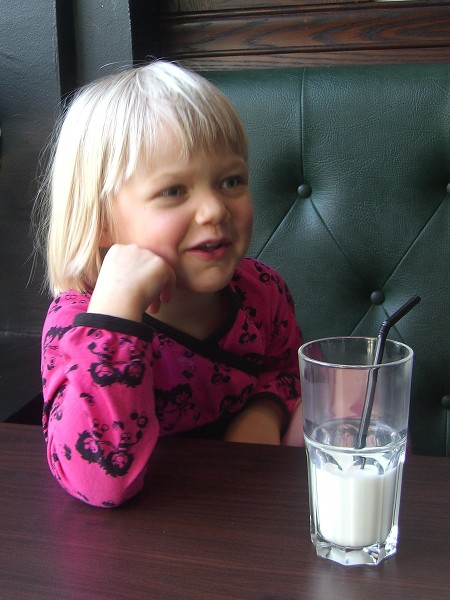
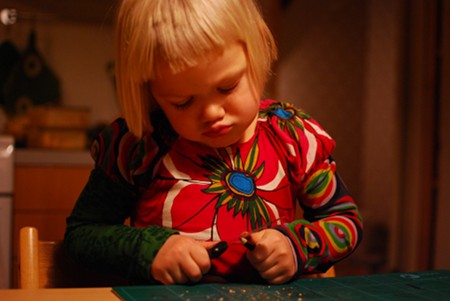
Other small stuff: earlier this week she let a friend cut her hair. (You can see some traces of it in the first photo above. Eric evened it out where possible, but there are still some gashes in her bangs.) It’s the kind of thing I’ve read about – kids cutting their own hair – but never thought that Ingrid would try it. We had been saying for a while that we really should cut her hair. I guess she got tired of waiting and took things in her own hands.

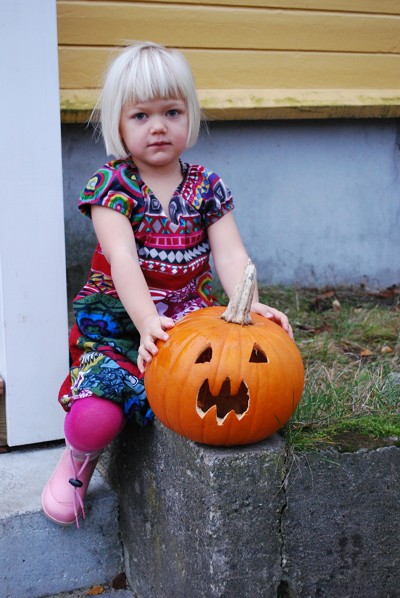
I found a usable photo of Ingrid for this month after all.

There hasn’t been much news this month, so I’m going to try and write more generally about some aspects of Ingrid’s personality this time. Specifically, the aspects that stand out and that I notice most, and those that have changed most over the past few years.

When Ingrid was about half a year old, someone described her as “strong, glad and active”. We hadn’t thought to describe or summarize her personality, but when we heard that description, we found it very apt. That is exactly what she was like. And the description remained applicable for years.

Now it really doesn’t fit any more. Strong she remains. But “glad and active” have been replaced by “surly and unimaginative”. Unlike some previous downswings, this has been going on for months, so it doesn’t seem to be a short-term negative phase.

Somehow, somewhere, she has lost the joy of doing things, the desire to be active, to create. Now she wants to be entertained instead, to consume. She used to like so many things: drawing and painting, writing, all sorts of crafts; jigsaw puzzles, singing, word games; helping us cook or bake, pick clothes for Adrian, take photos… Now she thinks everything is boring, and really only likes watching movies, listening to a book, and playing with friends – and any sort of activity where someone else (primarily Eric and/or I) provides the creative energy.

She will reject all suggestions to actually do anything as boring. She does not want to do any of the things that she used to enjoy. And when I do get her to participate in some sort of activity – painting or some sort of crafts – she seems to focus mostly on finishing and barely enjoying the process. She asks me to finish it because she “is tired” or because “you can do it faster mommy”. It’s more about getting it done than having fun. She optimizes for (what in my opinion is) totally the wrong thing.

She has no interest at all in joining us in things we do, whether it’s cooking, baking, emptying the dishwasher, raking leaves in the garden, going to the supermarket, or anything else. She perceives and notices the effort but not the joy of doing things.

She lost her creative drive, her imagination. She hardly ever draws, or sings, or makes up silly word games. And if she does draw it’s the same things as before, and when she does make up silly stuff it is silly stuff she has made up before. When we play games that require fantasy, she always wants to take the passive role. When we play the I spy game, or any other guessing game, she never wants to be the one to guess – she wants the role that doesn’t require any real effort. And if I want us to take turns, she suddenly doesn’t want to play that game any more. Eric and I now make a conscious effort to avoid such unbalanced games and choose ones where both players have to put in equal effort (such as ett skepp kommer lastat and so on). Even so, when it comes to the point where it gets a bit hard, where she needs to exert herself, she’d rather give up.

When we make up stories or pretend something, she wants me to come up with all the ideas. She can even be bored at Junibacken, or a swimming pool, and keeps asking “What shall I do now”.

Possibly related to this – she suddenly cannot or doesn’t like to make decisions any more. She wants us to choose clothes for her in the morning, to choose a plate and cup for her, to say what sweet she should have after dinner, to choose the book to read at night. But when we do choose she usually rejects our choice anyway, which gets pretty tiresome after a while. We now generally refuse to make the decisions for her, or if I do decide, I will not let her override it. Otherwise we are back to the usual routine – us contributing positive, creative energy and her either consuming it, or overriding it with rejection or negative comments.

I wonder how much of this is specific to Ingrid, and how much applies to most five-year-olds. I don’t know any other five-year-olds well enough to know.

I wonder how this came about. I wonder if it is a phase, whether she will outgrow it or whether we need to somehow help her out of it. (How do you teach someone to enjoy doing things?)

I also wonder if this is all somehow related to her being clever but not wise. She is ahead of her peers in cleverness (reading and writing and game strategy and planning ahead) but lacks wisdom and common sense. Has she in her cleverness “seen through” the “game”, decided that you “win” by getting the most done with the least effort?

Ingrid is five years old. Such a big girl.

She is so mature in some ways that it is easy to forget she is really just a small child. She is very verbal and forward and in some ways very smart, reads and writes. But then she does something that reminds me how young she is.

She is mature in her planning. She can think many days ahead, and plan for those days. She saves her finest plate and cup (with princess pictures) for special days, such as a Sunday, or when her best friend will come to visit. She saves the best part of a meal till last, “as dessert”. With sushi, for example, she first eats all the rice, then the salmon, then finally the prawn.

She is immature and naive in her worldview. She believes in fairies and in falling stars, believes that your wish will come true if you see a falling star and whisper your wish. (Disney’s The Princess and the Frog put that idea in her head, while Shrek and Sleeping Beauty and Cinderella “taught” her about fairies.) She wishes for a pair of wings, “two real wings that you can put on and take off, that fly for real, and they should be white and silver and pink and turquoise”.

She is immensely immature in her relationships with other people, both kids and adults. She bosses around her friends and is then puzzled and upset when they object to following her directions. She is pretty bad at reading others’ emotional state and at putting herself in their position. Very self-centred and very anxious to be in control. She absolutely has to keep an eye on which colours of candy friend M chooses, and make sure that she herself gets the same or better. She insists on opening the refrigerator when friend E wants to get a yogurt, not because she wants to help but because she wants to keep an eye on E and see what she does at that fridge. Millimeterrättvisa, “millimetre fairness”.

But at the same time she can draw pretty reasonable conclusions about what facts other people should know. She is much better at figuring out what others know than what they feel. The other day Eric said something about a friend of hers (that her friend T had been in a bad mood during Ingrid’s birthday party because she’d gone to bed very late the day before). Ingrid immediately wondered how Eric could know that. (The answer: He’d spoken to T’s father on the phone.)

She has difficulty judging the passage of time. At a meal she can ask us, “is this lunch or dinner?”, not noticing that it is dusk outside – or not realizing that only a small part of the day has passed.

The games she plays with her friends center on simple relationships. It’s often mother and big sister, mother or baby, or two neighbours, or perhaps cat owner and cat, or maybe doctor and patient. She often turns real life into a game. When we’re about to eat she may tell me “you’re my neighbour and now I’m calling you on the phone and then I will ask if I can come and have dinner at your place”.

She continues to impress me with her reading ability. She reads fast and with ease, except for the lowercase letters b, d and h. They look too similar. She can read fast enough to actually read the lyrics of a semi-familiar song while she is singing it.

Tights and dresses have become her favourite clothes; she rarely wears anything else.

This month Ingrid learned to read. She’s known all the letters for, like, years; been able to read single words for at least six months, and been able to write something that I can more or less read for even longer. Now it’s all come together and she can read: not just single words but proper reading, fast enough that she can read entire sentences and stories.

Sometimes she gets stuck but unless she’s tired or in a hurry, she will reread the word until it makes sense. And she’s pretty attentive and notices when she’s made a mistake. She can read “smörgåsar” where it says “smörgåspaket”, catch that, and try again. My hypothesis is that with long words like that, she looks at the first half of the word, skips to a conclusion, and then reads the last few letters to confirm.

Her first book was En liten stund by Anna-Clara Tidholm. It’s really a book for toddlers: a simple story, about 30 pages, with a picture and a couple of sentences on each page. (It’s about two rabbits who eat pancakes. Lots of pancakes, with lots of raspberry jam and cream.)

This is about the right level for her, so Eric and Ingrid have been borrowing toddler books from the library, and I have brought out her own old books: Bu och Bä, Liten skär, etc. There is also the Extra lätt att läsa (“Extra easy reading”) series, which is at about the same level but the topic matter is geared towards 6- to 8-year-olds rather than 3-year-olds. (Simskolan was particularly topical.) But she quite likes the toddler books, too.

Ingrid’s first book: En liten stund.

Reading other people’s writing has brought up the matter of Swedish spelling. Which is much easier than English spelling, thank goodness, but not as regular as Estonian. She’s learned how to read the sj in sjuk and sk in skiner, and that the g in morgon and the r in bord are not heard. Currently she is struggling with the fact that de (“they”) should be pronounced dom while det (“it”) should be pronounced de – sentences tend to lose their sense when you read “it” instead of “they”. I do wonder why they didn’t use the modernised dom spelling in books that are aimed at beginning readers.

As with everything else, reading is, of course, a social activity for her. She may have read on her own on a few occasions, but she’d much rather read for me or for Eric. (And show us the pictures, just as she wants to see the pictures when I read for her.) Today she had a friend over after preschool, and read Bu och Bä i skogen for her.

Now that she has figured out the art of reading, she reads everything. She reads the text on cereal boxes and on juice bottles, on street signs and on notes from my desk. Annoyingly many texts on everyday goods are in English: slogans and brand names on cereal boxes are a good bad example. (“Kellogg’s Rice Krispies Multigrain”.) We’ve also discussed why some packaging has the same text in Norwegian and Danish in addition to Swedish.

Often when I’m reading for her, I hear her mumbling under her breath some words from the page I’m reading. In particular she often reads the last word from each page.

Other than reading… nothing much, I think. I haven’t spent as much time with her as I used to when I was at home, so now I simply don’t see enough of her to notice minor changes.

She usually spends most of the night in her own bed but often wanders over to her mattress next to our bed some time around 5 or 6 in the morning. Sometimes earlier, sometimes not at all.

In the morning, in bed before we get up, she likes cuddling with me or playing with Adrian.

During breakfast she likes to pour apple juice on her cereal instead of milk. Other breakfast favourites include tunnbrödsrulle with liver pâté and perhaps apple slices, or scrambled eggs.

It is very important to her to give me a proper good-bye when I leave for work: put on her shoes, follow me out onto the porch or down the stairs, then three hugs and three kisses, and wave from the porch until I go out of sight behind the neighbours’ hedge. The ceremony slowly gets longer and longer: first it was just three kisses in the kitchen; one day earlier this week she forgot what she was doing and followed me all the way to the corner, at which point we both laughed at her mistake and she ran back, and now she’s wanted to do it that way every morning.

When I see her again in the afternoon she is usually either watching a movie or playing with a friend. When movie time is up we usually read a bit, or play with Adrian (either all three of us together, or just her and Adrian) while Eric makes dinner. After dinner and after I have put Adrian to bed, we may read some more, or maybe draw.

Most days she will have brought home a drawing or painting for me from preschool. The subject matter is generally girls, princesses, castles, flowers and hearts.

She often uses varför (“why”) in the sense of “how unfair, do I really have to, why must I do this”.

She likes wearing dresses and tights or leggings, and rarely picks any other clothes. I think that the waists on skirts and trousers make her itch.

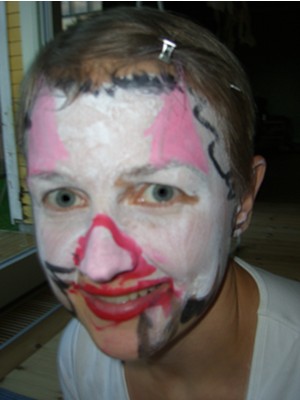
I let Ingrid paint my face again today, while Adrian and Eric had gone out for a walk. When they came back and Adrian saw me with my painted face, he was shocked into speechlessness. Rather than crawling or leaning towards me to be picked up, like he usually does, he sat quietly in Eric’s arms and just stared at me, without making a sound. Then he picked and poked and pulled at my face for a while. Then we nursed, after which he poked some more. When I washed off the paint after dinner, he was quite happy to see my real face again.

Admittedly Ingrid’s rough brushwork tends to lead to scary-looking results, even when she chooses a non-threatening design to imitate. This time the design she was guided by was a cute kitten. The outcome… more like a bloody ghost.