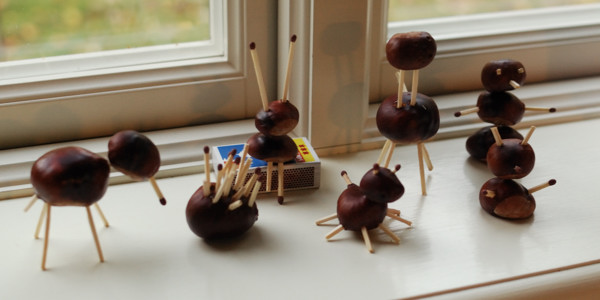
Ingrid and I made chestnut critters this year again.
Back row, from the left: Rabbit, giraffe, snow man.
Front row: Elephant, hedgehog, six-legged dog, space alien looking for a hug.
Ingrid and I made chestnut critters this year again.
Back row, from the left: Rabbit, giraffe, snow man.
Front row: Elephant, hedgehog, six-legged dog, space alien looking for a hug.

This was the month of waiting for the birtday. Really Ingrid has been looking forward to the birthday for way more than just one month – already during summer she was telling me how she was looking forward to autumn because that’s when her birthday is. But now the longing was intense, and so was the planning.
Many weeks in advance she was already planning what games she would play with her friends, and what activity they would do to get the goodie bags, and whom she would invite, and where they would sit, and so on. Some of the plans were quite fixed early on, while others kept changing.
She wrote party invitations for her friends and decorated them with foam stamps. We walked and cycled to the friends’ homes to put the invites in their letter boxes. For two of them we had to send the invites by post (because they live in apartments and the front doors are locked), and for these she wrote out the addresses herself, and then put the letters in the post.
Interestingly (to me) the focus was all on the friends and activities, and not at all on the presents. This was not the case last year, when she had a long wish list of presents. (Or maybe that was for Christmas? Same same.)
Friends are important to her. Or rather, her peer group is important to her. It used to be that she cared about a small number of friends that she played with. Now she seems to be more aware of being part of a group, and looking up to older kids, I guess.
In particular, she is picking up new speech patterns from school: things that others say, that sound cool, that she uses without quite understanding them. There’s lots of “gud va”: gud va bra, gud va kallt det är, gud va gott, and I’ve even heard some occasional “shit va” as well as one “fett bra”. (After that one she stopped and wondered out loud, What does that actually mean?) Things, objects, are often den här dumma x, “this stupid x” (bag, bicycle, …)

When she talks about her day at school, she usually tells me what they ate, what special Friday activities they did, and (when applicable) what body part she hurt or who hit whom. Otherwise they just “did stuff”. I am glad for the weekly newsletters from school – this way I have at least some idea about what they do all day long.
The class seems to have a “self” theme/project at school, which they’ve used across subjects: they’ve done several kinds of self-portraits, had a homework assignment where they answered questions about their favourites (colour, food, activity), measured themselves and compared their current height to their height when they were born (hanging paper tapes of the right length side by side on the wall) etc.


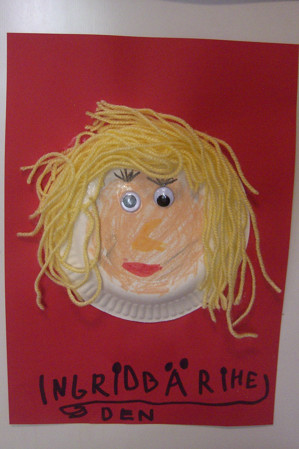
We the parents got to see some of the results of these projects during a parent/teacher meeting some weeks ago. Looking at the paper tapes I saw that Ingrid was the 2nd shortest in her class. Looking at her self-portrait I saw that she can be quite observant in her drawing, not depicting herself as a cookie cutter girl with a triangular dress and long eyelashes. She had drawn her actual clothes that day, and a proper body-shaped body, and the face too. But then within a week of this she also drew her family, with stick-shaped men and triangle-shaped women. Easier that way, I guess, especially when she cannot actually look at as and has to draw from memory.
Ingrid herself was not too happy with the result – the nose looked wrong, she said. This is pretty representative of how she judges her own achievements right now: if it isn’t perfect, she is unhappy. Never mind that the self-portrait is otherwise really carefully done – the nose isn’t just right so she’s “no good at this”. Never mind that she is the only one in her class to read and write fluently – she struggles with her spelling in Estonian (her 2nd language) so she is “no good at this”. I keep telling her that she is doing great, that school is for learning, so it is all about doing things you can’t quite do yet.
Yes, she is now also getting Estonian lessons at school. Every Friday afternoon she has a one-hour lesson together with two Estonian boys. Their tasks are adapted to their skill levels; Ingrid has been writing – once it was the names of body parts, once parts of a house. So it’s both vocabulary and spelling practice. Estonian spelling is simple but the letter sounds are not the same as in Swedish – Ingrid;s first attempt at spelling “juuksed” came out as “joksed”.
Speaking of languages, I suspect that she knows way more English than we get to hear. On one occasion she quoted The Great Mouse Detective at us: “Guards! Seize this despicable creature!” But she can also construct grammatically correct sentences of her own: one morning she said something, and unfortunately I forget what it was, but roughly like “I was just drinking some milk”, with the correct word order and tense and everything.
In the afternoon, after school, she still usually watches a movie or plays with the iPad. She has learned to play Reversi and can actually manage Field Runners, a “tower defense” type of game, too. She’s also had enough persistence to learn Tiny Wings, which is a game that takes some practice before you can really play it.
The evening ends with a fixed bed time. It is semi-fixed, or perhaps you can call it blackmailing: if she is in bed by the time we’ve set, we will read a story for her; she can stay up later if she really is not tired but then there will be no story. In practice she stays up until the bedtime we set, on the minute: she really doesn’t want to go to bed but she really wants a story, too. Recently she’s had trouble getting up in the morning so we moved bedtime forward by 30 minutes: now screen time ends at 8 and she goes to bed at 8:30.
She has been sucking her thumb when falling asleep until now. I told her she was too old for that, and she stopped doing it on the day of her birthday, so two nights ago. These two nights she’s been sleeping with a glove on her sucking hand. It seems to be pretty easy for her, which neither she nor I had expected.

On the nights when she has trouble calming down and going to sleep, she likes me to rub her back or her tummy. When she really cannot calm down, I take her through a relaxation exercise, going through all the parts of her body, relaxing them, making them heavy and warm and limp and dark.
Ingrid is still quite rule-oriented in her thinking, and wants things to happen the same way they happened before. She wants to play the same game in the same situations: the “letter game” (I Spy) on car and train journeys; the “humming game” (where we take turns humming a song and the other has to guess which song it is) while cycling home from school.
Likewise she tries to recreate happy situations from the past by repeating important-seeming elements of them. She wanted the goodie bags at her birthday to be handed out by a pirate “like at Elin’s party”. She wanted to have dinner at a local restaurant on her birthday, because her preschool class went there for their “graduation” lunch. (We did both, and I think she was happy with the outcomes.)
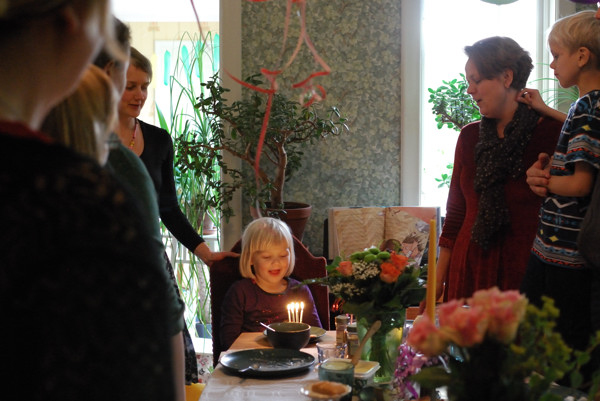
(In Sweden it is traditional for everybody to stand up while singing Ja må hon leva, while the person whose birthday it is remains seated. Kids stand on their chairs.)
This month, Ingrid started school. In Sweden currently kids normally start school the year they turn six. Ingrid turns six in a month; therefore she now goes to school.
Initially I think Ingrid was a bit disappointed with school. She had expected something radically new, and what she got was not that dissimilar from what she had just left behind.
The first year of school is sort of a preparatory year. It is called nollan, meaning year 0, or förskoleklass (“pre-school class”) or F-klass for short. (Pre-school class should not to be confused with preschool, which is a different thing.) It is part of the school system rather than the child care system, and it has a curriculum, etc.
Those confusingly similar names actually reflect reality quite well: F-class appears to be closer to preschool than to real school, as far as I can see. Especially during the first week or two they mostly spent time getting to know each other, “team building” and “trust building” and other such fluffy stuff. Also the school part only takes place in the morning, and after lunch there is after school care instead.
But now their weekly newsletter actually lists “maths play” once a week and “language play” on other days, and sports once a week. So perhaps their activities will gradually become more school-like.
During their last maths play they counted things and sorted them. Initially I found that a bit silly, but then I reminded myself that those are five- and six-year-olds after all, and of course not every five-year-old has Ingrid’s interests. (One evening this week she asked as to give her some maths tasks, like “how much is 12 plus 12”. She managed not only that but also 51 + 51, and then 52 + 52, and 51 + 11. She’s well past the counting fingers stage.)

When the school term began, her swim school also started up again. It turns out that she can actually swim already: she can do a passable back stroke from one end of the 10-metre pool to the other, without stopping. I don’t think she could do that at the end of the spring term, and she hasn’t been practising during the summer, so I don’t know where that came from. And I don’t think she realized it herself: she didn’t seem to think that swimming on her back counted for real.
She got weighed and measured at school and officially stands at 110.6 cm and 20.4 kg. Her feet were recently measured to be 16.5 and 17.0 cm respectively; that half-centimetre difference has been there for a long time.
Favourite reading material: still Bamse.
Favourite movie: Tom & Jerry. (She has discovered the wonders of YouTube.)
Favourite fruit: plums.
Favourite food: pancakes. Generally she is still a bit picky with her food, but we have now agreed that as long as she eats one vegetable with her dinner, she can otherwise choose freely what she will eat. It isn’t rare for her to eat just the pasta (skipping the sauce) and then one raw bell pepper, or three carrots, or a handful of cherry tomatoes.

This past month covers most of Ingrid’s summer vacation, including our trip to Estonia, as well as her first day at school.
Well, not school school: school starts for real next Wednesday, but the after-school care started today, and since there is no school yet, after-school care lasts all day. Ingrid was noticeably nervous about it all. We met her teachers and some of her new classmates at an information meeting in June, and saw the school building as well. But the after-hours care is in a different building, run by different other teachers (at least until school begins) and with different kids (it is for kids from grades 0 to 3).
Luckily one of her friends from preschool also started today, and was already there when Ingrid and Eric arrived this morning. When I picked her up in the afternoon she told me she had had a great day, showed me around, handed me piles of drawings she had made, etc. A great relief for all of us.
Last week was a dad-and-daughter week. Adrian was back at nursery and I was at work, so Eric and Ingrid spent some time together, just the two of them. Since her baby days Ingrid has always shown a clear preference for me, much more than Adrian ever has, but now she is old enough to “detach” somewhat from me and more happy in Eric’s company. Especially if that involves visiting Liseberg!
At Liseberg, she tried all the rides she could, skipping only the ones where she didn’t make the height cutoff. No rollercoaster is too intense for her, and no merry-go-round too dizzy. More is better!

Ingrid has been in a really good mood for most of this month. Happy, pleasant to be around, polite even. She says please and thank you; she looks out for Adrian, helps me when I ask her to, and even offers her help sometimes. There are no sulks, no arguments about bedtime, no complaints about tired legs when we are out walking.
She even speaks Estonian to me at times, and I know for certain that she does it for my sake only. She knows that I really like hearing her speak Estonian, and makes an effort to do so. Of course it helps that she’s had two weeks of practice and Estonian now comes more easily to her. Those two weeks make a huge difference every year.
She is developing a greater capability to relate to others, and is now finding pleasure in making others happy. (This hasn’t been her forte in the past.) For example when her friend M was with us for half a day, and was in a somewhat obstinate mood, Ingrid was quite willing to compromise and suggest solutions when they found themselves disagreeing. She could pause and reflect enough to remember that their day together is more likely to turn out pleasant if they can play rather than fight, and then she made an effort to make it so.
When she and her friends tire, they often take a break, and Ingrid reads aloud for both of them. (Bamse, of course.) She is now reading fluently enough to read with a suitable inflection, getting not just each individual word right but also the tone of the entire sentence.
Favourite food: flat nectarines (like paraguayo peaches) and plums.
Favourite iPad app: Where’s my water.

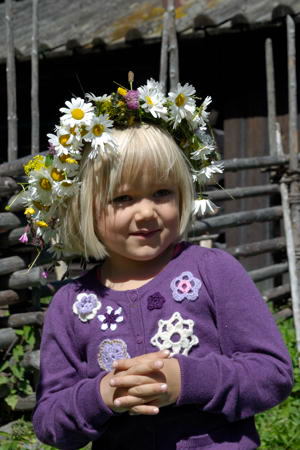
Tidbits from Ingrid’s sixty-ninth month:
Ingrid sometimes talks to us as if she was irritated and impatient with us – not the way we talk at home, but the way she hears other parents talking to their kids, or perhaps some parents in a story book or movie. (Emil’s, perhaps.) “I’ve told you a thousand times! Aah! Don’t you understand anything?!”
I’ve also heard her and her friends treat their toys like that at times, and dole out punishments, also something we never do at home. “And now you must sit here for three years! And you can’t come out until you show some remorse for your pranks!”
I know less and less about what she and her friends actually play and say when they’re together. Most of the time they’re off on their own. They rarely need supervision nowadays, they don’t get into conflicts that they cannot resolve. There are rarely tears or fights.
She plays well not just with friends but with strangers, too. When we go to the playground and none of her friends are there, she often walks up to some other likely-looking kid and makes contact. Sometimes she offers a toy, sometimes she just pulls them into her play, sometimes she introduces herself or asks for their name, etc. Usually she chooses someone a bit younger than her.
That quote above, with the three-year timeout, is also an interesting example of her sense of time. When it comes to days and weeks, easily observable units, she has a good grip of how long they are. She’s known her days of week for a long time, a year or two already I think, and now knows the names of the months as well. But a year, or three years for that matter, is effectively synonymous with “forever and ever”.
Towards the shorter end, she sort of understands hours and knows that an hour is a pretty long time to wait. She can look at a clock and roughly tell the time – “between two and three” for example. She knows that eight o’clock happens twice a day, morning and evening. She kind of understands half hours as well, and knows that half past three (which in Swedish and Estonian is actually called half four) is halfway between three and four.
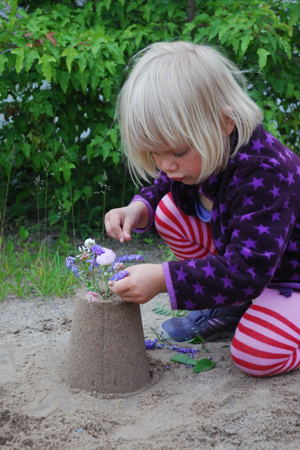
But quarter hours and minutes confuse her: she cannot remember whether “kvart i” is less than and “kvart över” is more, or the other way around. Whenever she asks what time it is (which happens quite often) and we say it is ten minutes to twelve, for example, she always asks if this means it’s more or less than twelve.
Speaking of time, she’s been staying up later and later in the evenings during the summer. Partly this is probably due to the light summer nights. But she also just does not want to go to bed. Life is too exciting. Often I do interesting stuff during the evening, after putting Adrian to bed, and Ingrid joins me – whether it’s because she is actually interested in the job, or whether she just wants me to let her stay up, I don’t know. She’s helped me dig and water in the garden, and cut branches with loppers. The lopper handles are as long as her arms but she did a great job. I think she actually worked so hard that her muscles were sore – she complained of an achy back the day after.
But unfortunately she keeps this fun going until she is way too tired, and then we get a tantrum when it’s time to get ready for bed. The new deal is that she can stay up as late as she wants, but teeth must get brushed no later than 8:30, and if she wants a bedtime story, she needs to be in bed by 9. This has worked very well: as usual, she accepts a simple, clear rule much better than daily negotiation.
Oh, and speaking of stories: she cannot tell one. She can make up a story, but she cannot tell a coherent story about something that happened to her or to us. When I hear her tell about some event, it is a jumble of details, with no order or reasoning. It is usually almost impossible to figure out from her tale what really happened.
Favourite summer activity: picking wild strawberries. Or maybe bathing and splashing in a pool. We bought some noodle water guns and they have gotten a lot of use.
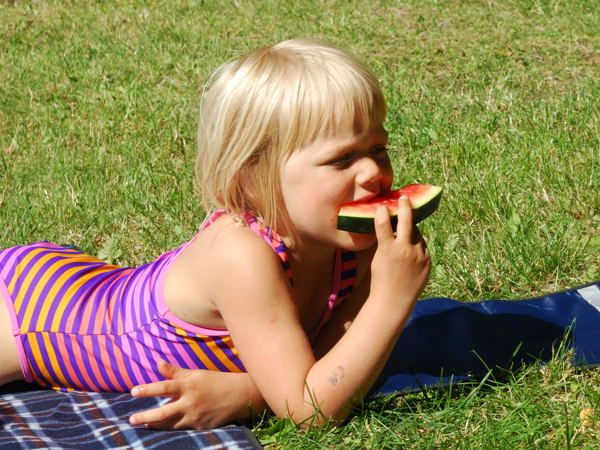

This Thursday afternoon Ingrid’s preschool had their summer party, officially ending this term. Preschool is still open for another two weeks but in “summer mode”, with freer activities and less focus on the educational side of things. And I am actually getting used to the idea of Ingrid going to school this autumn.
I still haven’t quite gotten used to how much more mature she now seems. I wrote about it last month so I’m not going to rehash the details. But it reminds me how these things really seem to happen in waves. For a long time it feels like nothing happens, and then suddenly I realize she’s grown. Not in size but inside.
Speaking of size, though, she weighs 19.9 kg and has size 110/116 in clothes (closer to 116).
Ingrid more mature emotionally and socially than just a few months ago. She’s more capable, and more willing to be capable, and less inclined to ask us to do things she is able to do on her own.
She can focus and concentrate very well, as long as she finds the task worthwhile. At the preschool summer party the kids performed several song and dance acts, and I was impressed by how concentrated she was during the dancing: really focused on the music and the moves, and doing them all in the right order and at the right time, rather than looking around or dreaming away (like some other kids were).

She’s also gained confidence. During that same show, she and a friend of hers performed a song together: just the two of them, in front of 30 families or so. And they did great. She sang loudly and clearly and seemed pretty relaxed about it. The whole show was planned by the kids, so this was something she and friend M wanted to do, not something a teacher put them up to.
The song, by the way, was Twinkle, twinkle, little star. Ingrid first sang it in English, and then M repeated it in Swedish – “for those of you in the audience who need a translation”. Ingrid has gradually been learning English of her own accord. She’s been watching movies in English for a long time, but she has also started asking us what things are called, speaking to us in English rather than Swedish or Estonian, etc. “I am eating bread”, “This is a book”, “I want to go out”, “Adrian cannot eat this”, “This apple is red”, “Where is the fork” etc.
To Adrian, she speaks Swedish. She clearly views Swedish as her native language.
Her confidence also shows in physical bravery. She swings high and climbs high, and jumps from one tall structure to another, and hangs from things.

Yesterday we went to a swimming pool, and after a few practice rides with me, she was going on her own down the cascade, which ends with a big splash in a deep pool where she can’t touch the bottom, as well as through the water jet tunnel. (With flotation aids, though, since she cannot yet swim well enough to keep her head above the surface.) Last time, a few months ago, she would not do either of those without holding on to me.
She is also happier. There are fewer sulky faces, and more laughs and smiles.
Favourite pastime: Bamse, still. The first thing she does on Saturday mornings is to ask for her weekly Bamse. She reads that, and then buys another one for some of her allowance, and then some more. During the week she may talk about saving money for this or that, but when she has the money in her hand and the stack of Bamse back issues in front of her, all of that goes right out of her head and she spends it all on that. She now reads so fast and effortlessly that she can easily plow through ten of them in a day.
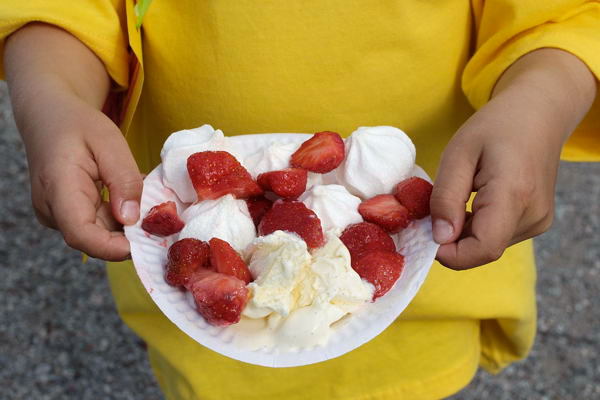
Summer party at preschool: a song-and-dance-and-magic show by the kids, and then an orgy of strawberries, ice cream and merengue.

It is heart-warming to see and hear Ingrid and Adrian together. They play so nicely with each other, and Ingrid takes such good care of Adrian, that I’m almost afraid to believe it will last – even though it’s been this way since Adrian was born.
When he was a tiny baby Ingrid didn’t quite know what to do with him. But as soon as he could at least sit up and respond clearly to the world outside, she was there, waving toys in front of him and making silly faces at him.
Now their interactions are very different but apparently still pleasing to both. I say “apparently” because they’ve now progressed to a level that I as an adult cannot grasp. Their play is physical, and seems to involve lots of noise, squealing and shouting, and imitating each other. Adrian’s part is entirely non-verbal and much of the time so is Ingrid’s. When she speaks to him, it’s baby talk.
When we are out walking he prefers holding Ingrid’s hand rather than mine.
I wonder how he will react after summer when she goes to school and won’t be at nursery with him any more.

It feels like a step change has taken place. Ingrid has matured, and realized that being nice to people has advantages, that “thank you” and “please” work. Previously she’d first order us around and, when we pushed back, swung to the opposite extreme and asked us with a honeyed voice and overdone politeness. “Please dear mummy could you be so kind as to help me.” Now she just asks nicely straight away.
Likewise she sometimes remembers to thank me when I do something for her, or buy clothes for her, etc. Occasionally she even remembers to compliment us on the food. Mostly it’s something like “I liked the pasta. The sauce wasn’t so good but the pasta was good” but still, that’s something.
For some reason she’s become picky with food. She used to eat pretty much everything we served, except for a few things that I knew she didn’t like. (Squishy things like courgettes and aubergines, and leaves, which covered everything from spinach to lettuce to chopped parsley.) Now she is almost as bad as Adrian and eats starches (pasta, rice, bread, potato), meatballs, and possibly one or two vegetables (bell peppers, peas, sweetcorn). And fruit, luckily.
I think this may tie in with her general tendency right now to want everything to be just so. If her new toothbrush isn’t perfect, just the way she imagined it, it’s no good. If I serve a favourite dish of hers but it comes out not exactly like last time, it’s no good. Etc.
She is distracted and there seems to be a lot going on in her head. Meals take forever, because she forgets to eat. She starts talking about something (to us, or just to herself), climbs down from the chair because some rope needs to be straightened out just so because her doll needs it as a lifeline, or she is too busy trying to balance a strand of spaghetti just so on her fork. At night when going to bed, the soft toys in her bed have to be lined up and organized just so, and a running commentary is going on throughout.
Interestingly she has no trouble coming up with things to do when she already has something to do (such as eating, or getting dressed). It’s when she is not busy that she has trouble entertaining herself. But she’s become better at that, too. She doesn’t start talking about watching TV as soon as she’s done eating breakfast, and has actually managed some days completely without TV.

Ingrid’s quite preoccupied with bodily hurts. At the end of each day at preschool the first thing she will tell me is which parts of her body she hurt and how many times. When she summarizes her Sunday morning judo session it’s all about counting bruises and falls, rather than remembering what was fun.
She has been more interested than usual in buying things and in the concept of money. She’s had an allowance (10kr every Saturday) since her 5th birthday. Sometimes she’s been more interested and sometimes less. Now she’s used up all her money and actually bought one thing on credit. (A pony ride when we went to the circus: 30kr, a waste for 2 minutes’ ride in my opinion, but not in hers. Since it was a unique opportunity I let her borrow 30kr from me.) She has started talking about saving up some money to buy something bigger (such as one of those large shiny helium-filled balloons) but fiscal discipline is not coming easily to her.
A friend of hers had a miniature backyard sale of old toys. Ingrid wanted to do the same with her old toys and clothes but I vetoed the idea because I want to keep most of them for Adrian. But I suggested that she could earn some extra money by doing chores. Specifically I’d pay her 1kr for setting the table, and 1kr for clearing it after a meal. She earned 5kr in total but now her interest has waned.
She likes to talk funny (imitating some dialect or accent that I can’t place right now) and walk funny (knock-kneed, toes turned in).
She likes tattoos, both the kinds you transfer with water and home-made ones (with face paint), and almost always has one on her arm or hand. Every time she gets one, she wants me to take a photo of it – she is not happy about the impermanence of these things.
She’s started describing herself as “not so good at” all sorts of things – things she can do reasonably well (cutting her food), things she hasn’t practised much (speaking English), and things she’s never tried (karate). This must be something she picked up from preschool. I didn’t say anything initially but now I object and explain what “not so good at” means and what the difference is between not having tried, not having practised much yet, and actually not being good at something.

| « Older posts | Newer posts » |
