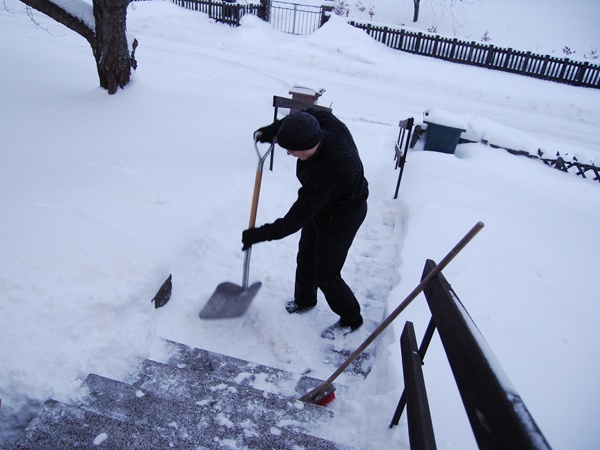
Well we got snow all right. Here’s what our stairs looked like when Eric had shoveled the top one, this morning at 8.30:
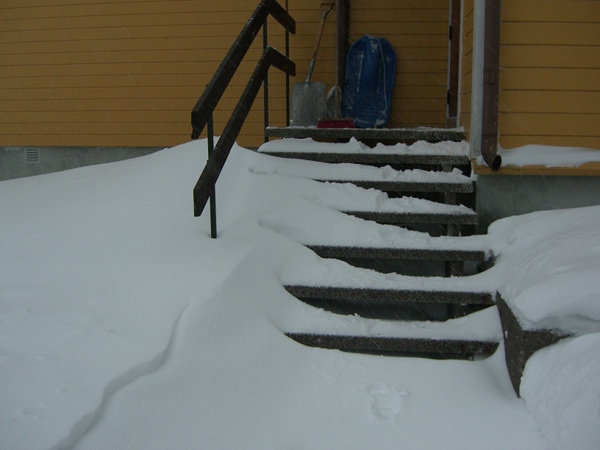
And here’s the state of affairs less than 9 hours later, at 5pm:
And (as warned) there were disruptions to civic services. Train delays, of course – no surprise. Rather more surprisingly there was something weird going on with our electricity supply. At some point during the afternoon we lost power to a quarter of the house. It was early enough that I had no lights on, and I didn’t notice that my Mac had switched to battery power. After a while I thought it was getting unusually cold here, got up to check the temperature (thinking that perhaps I was just coming down with a cold) and indeed it was barely over 15°C. All the heaters in the room were off, and I quickly realized that we had no power in the room.

A fuse, I thought, and spent almost an hour hunting the culprit. The wiring in this house is a mishmash, installed at different times through its history. As proof, consider the situation I had: living room all without power; some outlets in the kitchen OK, some not; ceiling lamps in the kitchen without power; ceiling lamp in hallway without power; wall outlet in hallway OK.

We have three fuse boxes, one up in the house and two side by side in the basement. The ones in the basement are at least labelled; the one up here was a total mystery – I wasn’t even sure if it was still in use. Anyway all the fuses in all boxes looked perfectly OK to me. Nevertheless I took three trips to the basement, replacing various fuses which I thought might be relevant, based on the scanty labelling. No luck.
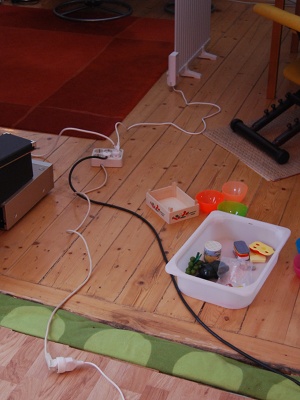
During this time the temperature had gone from 15.3 to 14.7 and I realized that it will soon be seriously unpleasantly cold in here. I took a break from my investigations and focused on damage control instead. The good thing about electrical heaters is that you can plug them into any outlet you want, as long as you have enough extension cord. So I spread a network of extension cables from the kitchen to the living room, and got two of the three heaters hooked up, as well as some lamps.

Back to investigating. Now I went through all those unlabelled fuses up here (I think there were nine in total). Still no luck. Surely the juice in the living room couldn’t be affected by fuses labelled “heater (basement)” or “wall outlets and lighting, bathroom”! I couldn’t face more running back and forth between the house and the basement. It really was a task for two people and phones: one to fiddle with the fuses and one to check what happens in the house. But Eric and Ingrid were out at Junibacken. At this point I gave up, spent a little more time installing more extension cords to let me have a desk lamp in the kitchen, and started cooking dinner.

Eric and Ingrid got home, and Eric spent some more time investigating. Still no success. Then, just as dinner was almost done, the house went all black for a moment. The next moment the power came back – including in the previously dark part of the house. And we’re both thinking – wait a moment, what just happened here? Are we supplied by two separate power lines? But we only have one meter… Or is the old half of the house somehow more sensitive to small voltage fluctuations? No idea. Whatever it is, I don’t like it. I don’t like mysteries in my electricity supply.
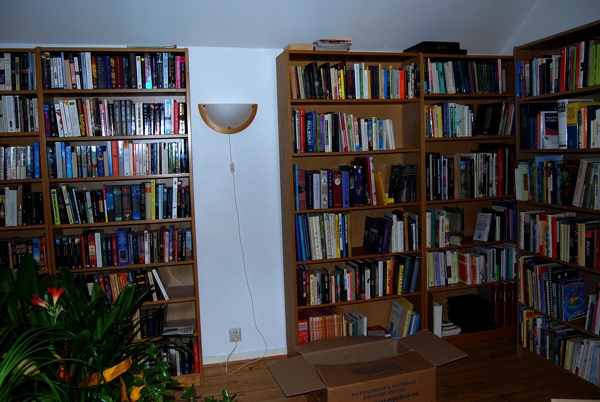
Eric and I both like books, so we own quite a lot of them. Many of them have lived in storage boxes for years now – a sizeable portion of our library stayed behind when we moved to London, and we were only reunited when we moved to this house a year and a half ago. Now, during those winter weekends when there’s nothing to be done in the garden and the weather doesn’t particularly encourage cycling or other activities, we’ve been slowly unpacking and sorting through them all. We’re finally almost through.

There will still be a few boxes for special cases, but most of the books have ended up in one of two places: the shelves, or the charity shop. This weekend we drove to the charity shop with 5 boxes full of books.

Store: Children’s literature that Ingrid’s too young for. Books in French that I read while living in Belgium (that I think I will someday re-read, even though I cannot envisage when or why I would do it). Books that we want to keep for nostalgic reasons. Books that we really don’t open often but like too much to give away.

Shelve: Books we haven’t read yet. Books that we would love to re-read if we had time. Books that are fun to browse. Books that bring back fond memories. Books with a historical meaning (remember dictionaries?).

Ditch: Many books about business and economics from our university days. Lots of mediocre fiction. Various lexicons and reference books: we use the internet instead.

Partway through this work a thought struck me: the entire decision process is founded on the premise that the world will go on functioning as it does today. In particular, we’re assuming that the Internet will go on existing, and that I can use it to look up anything I want.

But if one day we should have an apocalypse that wipes out our communications infrastructure – meteorite, collapse of civilization or whatever – we would probably really miss those reference works and rue our decision to not buy an encyclopedia. The people hoarding all their old books would be the heroes.

Is it worth keeping an encyclopedia packed away in the basement, as a sort of insurance policy? What is the probability of an apocalyptic event happening within my lifetime? A general collapse of civilization could probably be foreseen some way off, but the meteorite scenario is trickier.

Of course if anything like this did actually happen, we’d have bigger problems than lack of information and history. We should instead make sure to equip ourselves with books about basic medicine, growing your own food, and carpentry and metalworking and construction and so on.

See what kinds of thoughts books can lead one to!

Our first winter with a garden (meaning last winter) we put up a bird feeder for suet balls. We had quite a lot of visitors during late autumn, to the point where we started thinking that we’d need to ration the balls because of cost. Then winter came, and suddenly there were hardly any birds at our feeder. Our theory is that they found better food elsewhere.

This year we upgraded to a seed feeder. We kept the suet ball feeder, too, but now we also have a little hut on a stick, filled with seeds. This way we can vary the food. It also allowed us to move the bird food further away from the house. The suet ball feeder hangs off the kitchen window, which meant that the twitchier birds would fly away as soon as anyone moved in the kitchen.

The new location seems perfect. We’ve got a good view of it from our dinner table. It’s far enough to for the birds to consider it mostly safe. It’s got various trees, bushes, eaves etc. within a few metres, in several directions, which allows the birds to scout out the area before coming in for a feed.

First we bought some sort of seed mix consisting mainly of oats and sunflower seeds. The sunflower seeds got eaten, but the birds totally rejected the oats. These ended up on the ground below the hut in such amounts that I couldn’t even see the ground underneath. They even started sprouting, so in November we had a thick mat of oat shoots underneath the bird feeder.

Then I checked which kinds of birds were supposed to like what kind of seeds, and mixed my own seed mix: peanuts, sunflower and hemp, since we mostly had small birds such as sparrows and tits. Turns out all the birds visiting us adore peanuts, and the sunflower seeds generally get eaten too, but no one touches the hemp. We’re forced to scrape out the hemp seeds now and again, or the hut will just fill up with them.

This season we have seen:

  • Sparrows, en masse, especially before the snow came. They preferred eating on the ground, and would eat the seeds that other birds had kicked to the ground, or kick down their own. They often travelled in gangs; sometimes there would be up to thirty sparrows underneath the feeder. Now during winter they are far fewer.
    I assumed at first that they were common House Sparrows (Passer domesticus, koduvarblane, gråsparv) but closer observation showed that most, or possibly all, were really (Eurasian) Tree Sparrows (Passer montanus, põldvarblane, pilfink).
  • Tits. We have two kinds, Great Tits (Parus major, rasvatihane, talgoxe) and (Eurasian) Blue Tits (Parus caeruleus, sinitihane, blåmes). For some reason the Blue Tits all look really scruffy, while the Great Tits look well-fed and sleek.
    The tits like to scratch away the less interesting seeds, then take a peanut and fly away with it to a tree, where they hold the nut with one foot while eating it. They often hang around the feeder together with the sparrows – neither seems bothered or scared by the other.
  • Nuthatches (Sitta europaea, puukoristaja, nötväcka). Beautiful sleek birds with a very distinctive behaviour – they often turn around to face downwards, both on the feeder and in the tree. They seem to like sunflower seeds best. They also often share the feeder with tits.
  • Jays (Garrulus glandarius, pasknäär, nötskrika). Even more beautiful than the nuthatches. Cautious birds who often abort their landings at the feeder, fly another scouting round, and then come back to feed. They’re also big, so the feeder wobbles whenever they land, and it’s hard for them to get into a good feeding position. But they manage. I get the impression that they travel in pairs – often when I see one, there’s another one somewhere nearby.
  • Magpies (Pica pica, harakas, skata). Brash and confident, often they scare away the other birds. Sloppy eaters: when they first arrived at the feeder, they would scratch around so much that much of the seed ended up on the ground. Eric had to modify the feeder (put up bars along the sides, so instead of one large opening on each side there are two or three small ones) so that the magpies don’t spoil all the food.
  • Blackbirds (Turdus merula, koltrast, musträstas). At first they would mostly land in our whitebeam tree and eat the berries, but now they’re also feeding off the seeds on the ground beneath the feeder. I think there might only be a single couple visiting us: I’ve seen a single male and a single female.
  • Green Finch (Carduelis chloris, grönfink, rohevint). It’s a rare visitor here; I’ve only seen it a couple of times.


Turns out we have damsons. (For the non-gardeners among you, damsons are basically small plums.) In fact it turns out we have masses and masses of excellent damsons.

Last year our best damson bush had maybe 20 plums. The older bushes and trees, some of which look near death, hardly had anything. We were seriously discussing taking them all down.

Luckily we’ve had other, more highly prioritized gardening projects, so the bushes are all still there. And this year they are laden with damsons, the boughs bending almost to the ground with rich, dense bunches of fruit.

During the past ten days, we’ve been picking several litres of damsons – well, not daily, but roughly every other day. The ground underneath the bushes is mostly soft, so we let the plums fall and pick them from the ground. (Ingrid particularly likes shaking the bush to make more of them fall.) This way I don’t have to squeeze every plum to figure out whether they’re ripe or not. A few fall on the moister, mossier side of the bush get eaten by snails and slugs, but the rest are in great shape. Birds don’t seem to like them, unlike our cherries.

They’re a pain to stone, because they’re so small, and the stones are not loose. It’s a messy, sticky job. But they taste great!


The cherry season is officially over. We picked and used most of them early last week, for some jam, and a pie, and lots to simply eat.

We did a final round yesterday, now that the cherries are well overripe, and knocked and shook down the ones we couldn’t reach to pick even from a ladder. Over half went straight into the compost heap, rotten or moldy or half-eaten by birds. The rest (maybe 2 liters) went into the fridge, and will be gone by tomorrow night. I don’t think we’ll find any more edible ones now.

Some of the birds eat while the cherry remains attached to its stalk and branch, so they manage to eat everything. Others pull of the cherry and then try to peck it while they’re holding it, but unfortunately they frequently drop it, so we find lots of cherries with just some large holes pecked into them.

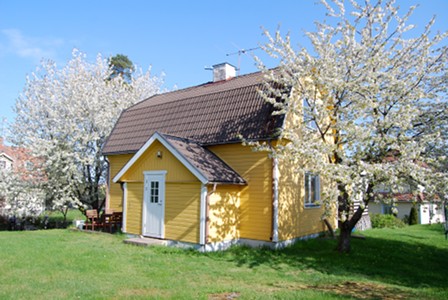
May is the prime time for our garden, the season when it is at its most impressive and beautiful, because of our two huge cherry trees. They’re taller than the house and flank it on two sides.

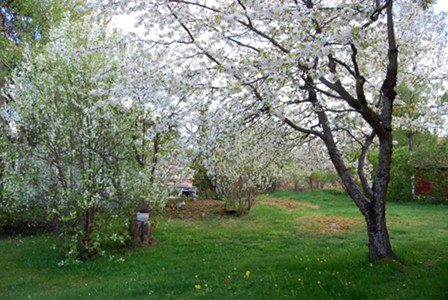
When the cherry trees were joined by a large bird cherry bush (prunus padus, hägg, toomingas) and a plum tree, half the garden was covered in white blooms.

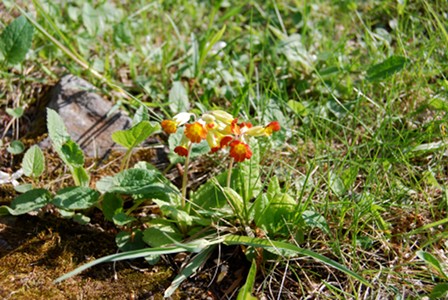
But we also had lots of primroses, both the ordinary wild yellow ones and some lusher-looking red ones (possibly planted) and orange hybrids

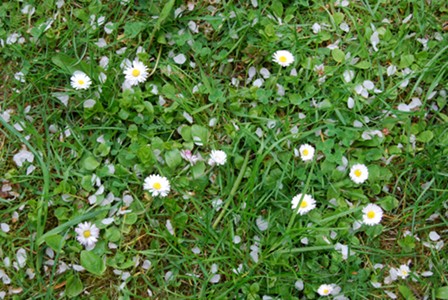
and daisies, here camouflaged between fallen cherry blossoms

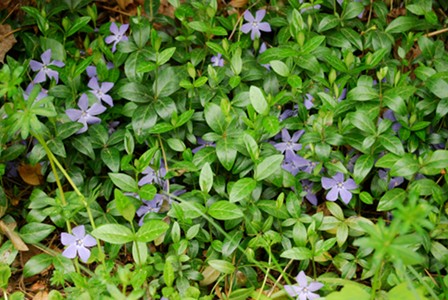
and periwinkles

and various weeds which I’m sure would have been removed long ago in a stricter garden, but which I found quite decorative.

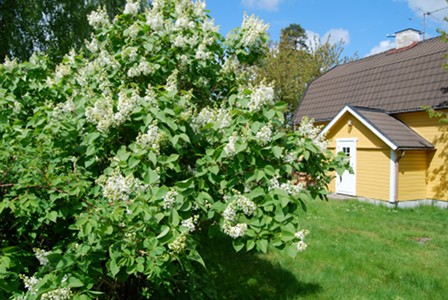
By the end of the month, the lilacs were blooming, too.

Whenever the weather is good and we feel like doing something in the garden, but don’t want to undertake any major projects, we dig out cherry roots.

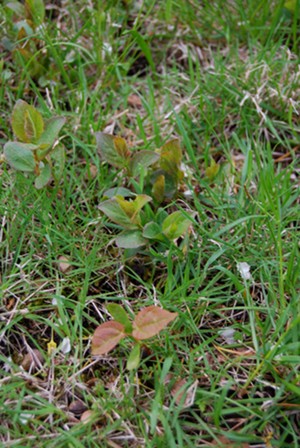
We have two huge cherry trees, one on each side of the house. Around the tree at the rear of the house we also have lots and lots of very small ones. Most seem to have started from cherry pits, but it’s possible that some are shoots from the roots of the main tree. They’re dotted around the lawn and don’t really cause much trouble – until they’re cut down by a lawnmower. That leaves small stubs sticking out of the lawn, perfectly hidden, just stiff and sharp enough to be really uncomfortable for bare feet.

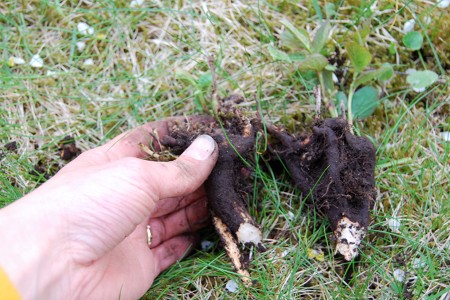
And of course when you mow them down, you don’t kill them. They just try again, sending up a new shoot next to the old one. So one sharp stick becomes two, three, four, an entire knobbly lump with sharp points. Many of these lumps appear to have been around for years: they have roots as thick as my thumb.

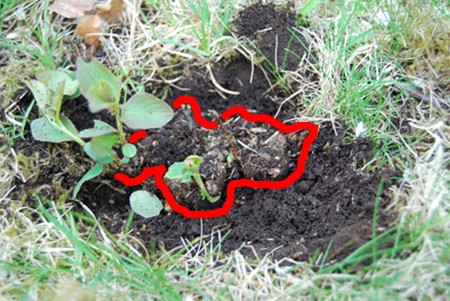
When I found the first sharp stick last summer, I thought I’d just pull it out. But of course then I discovered the lump around it, and the thick roots, impossible to pull out. Vigourous frequent mowing might kill new shoots, but wouldn’t help with the existing ones, which would go on hurting our feet. So now we have an extirpation campaign. Armed with strong shears and a weeding trowel, we dig out the root as far as we can, and pull out the rest, or twist or cut it off. The bigger ones leave somewhat unsightly scars in the lawn, but that’s a smaller problem.

By the end of this summer we should be done with all the big old lumps. We’ll probably miss some smaller ones, but after next summer we’ll hopefully have a stick-free lawn.

Cherry shoots in the grass

Ugly lump exposed

Extirpated

The birds are still wandering around the edges of our garden. This morning I saw three of them together within a few steps of each other, plus one of the parents, still feeding them worms.

A day or two ago I saw one of them try to fly. It flew a few meters up from the ground and tried to land on a tree branch. It almost got a grip but not quite, and tumbled half a meter to the next branch further down. It couldn’t get a grip there either, and tumbled to the next lower branch. And again it couldn’t get a grip, and fell down onto the grass below. It looked a bit confused and miffed, and didn’t try again.

About 10 days ago, Eric discovered a bird’s nest in the cherry tree in front of the house, and a clutch of baby birds inside. We’ve been following their progress daily since then. They’re fieldfares (turdus pilaris, björktrast, hallrästas).

By the time we discovered the nest, the eggs had already hatched. There wasn’t much activity or movement around the nest until hatching, and nothing to make us notice the nest. It’s at the height of our 1st floor window, not very visible from the ground.

Once the babies had hatched, though, there was a lot of traffic, as the adults kept fetching worms for the little ones. Both mama bird and papa bird were working hard: sometimes one parent had barely left the nest before the other arrived (after a few reconnaissance stops at lower branches, to check that the coast was clear). We could often see the adults hopping around in our garden, pecking for worms.

The baby birds grew at an astonishing speed. Ten days ago they were naked, blind and puny. Yesterday the first one left the nest, and today the nest is empty. However the birds aren’t quite ready to leave their parents yet: they can hop around, but not fly yet, and the parents will keep feeding them for another few days.

According to the Internet, fieldfares in southern Sweden often lay a second batch of eggs in June/July. Stockholm is well below the middle so perhaps we’re southerly enough to see another clutch?

Naked and small, barely visible over the edge of the nest
Hungry!
Still hungry, but now with a few downy feathers
More feathers… still ugly
All feathered now
Getting very cramped in the nest
Just hopped out of the nest

We have lots of scillas,

some scilla-like white flowers that the Internet says are puschkinia scilloides (porslinshyacint)

and the occasional yellow Star-of-Bethlehem (vårlök, kollane kuldtäht, gagea lutea).

Also a few violets, almost disappearing among the scillas

and some unidentified purple flowers.

There are daffodils coming, too, but they’re on the north side of the house and thus about a month late.