As time passes, doors disappear from our house. Slowly we’re gravitating towards the open plan living habits we acquired in London.

Already when we moved in, some doorways were doorless, and had probably been that way for a long time, since there aren’t even any hinges. This is the case for the doors from the hall to the living room, and from the living room to the corridor. The door between the hall and the kitchen appears to have been removed more recently, the hinges are still there.

A few weeks after the house became ours, we lifted away the door between the bathroom and the laundry room, because we couldn’t see any point to having a door there. (The laundry room, also known as the weird room, is a room that can only be reached from the bathroom. It was originally planned as a walk-in closet, then morphed into a sauna before it was built, but was never furnished as a sauna, so now it holds the tumble dryer, our laundry bins, and some odds and ends).

During our Christmas vacation we took down the wall between the kitchen and the living room. The improvement was huge. Now that the wall is gone, and the potential has become real, there is no chance that we’d ever want a wall there again.

Last week we got rid of the bathroom door, too. We never close it, anyway, except when we have guests. And when it was open, it couldn’t be opened all the way, flat to the wall, so it blocked the already-narrow corridor, making it seem darker and slightly cramped. For the sake of the guests we stowed the door in the laundry room, so we can easily put it back when needed.

The only doors still left downstairs are the bedroom door (so we don’t wake Ingrid in the evening) and the door to the mud room / cold storage room (because it’s unheated and made the kitchen very cold during winter). The upstairs doors have escaped removal thus far, but that’s mainly because we don’t spend any time upstairs so they haven’t gotten much attention yet. As soon as the staircase gets a proper banister and we unblock it for Ingrid, those doors will face an uncertain future.

From the moment we first viewed this house, we agreed that if we were to buy it, we would want to tear down the wall between the kitchen and the living room, for a more open feel.

Our London flat was vast. Cavernous, even. And we loved that spacious feeling, and really miss it. We’re now doing our best to recreate some of that feeling here. The wall is gone now, and now it looks like we might be able to gain some height, too. (The ceiling in the old part of the house appears to have been lowered to match the new part. At some point we’re going to tear it down, see what’s behind it, and hopefully gain a good 25–30cm of height.)

In the living room, the part closest to the wall evolved into a cul-de-sac where stuff tended to accumulate: mostly Ingrid’s toys and books, but other stuff as well. On the kitchen side, the wall was all bare. All we had in front of it was a big cupboard. I haven’t even got any pictures of that side of the kitchen as it used to be, because it was so uninteresting.

After we moved all the stuff, all that was left was a white wall – and some cabling in the wall. Before we could attack it with big sharp implements, we had an electrician disconnect and remove the outlets on both sides. It turned out that the junction at the top of the wall was a major one, apparently supplying all of the top floor with electricity, so the top box stayed in place.

Then we got to work. Or rather, Eric got to work, and I got to keep Ingrid out of the way, and take photos whenever I could. Instead, Eric was helped by our next-next-next-door neighbour Gustaf.

First they removed some molding and the skirting board. Then they attacked the drywall with a crowbar.

Behind the drywall we discovered panelling, and a boarded-up door. The door was removed in its entirety and found a new home in Gustaf’s house, where it fit perfectly. The panelling was simply torn down.

At this point we were left with the innermost layer, and everything on the far side of it. Eric and Gustaf kept the living room side of the wall untouched as far as possible, to keep all the dust and mess confined to the kitchen. (Tearing down drywall makes for an awful lot of gypsum dust.)

Now that we got a good look at what was inside the wall, we were suddenly a bit less confident about tearing it down.

The planks were a good 5cm thick. Given how solid and heavy the whole thing looked, we started thinking that maybe it could be load-bearing after all. It shouldn’t be, given how the rest of the house was constructed, but you never know. It’s not the kind of decision you want to make rashly: even a 5% risk of the top floor falling down on top of us is too much.

So we took a break. The next day we called a couple of builders, and had them take a look and confirm that it was indeed OK to take it down. They had a 5 minute look, walked around, knocked on a few things, and announced confidently that the wall was definitely not load-bearing.

We continued on New Year’s Eve. Because the planks were so heavy, Eric and Gustaf sawed them into sections and removed them in pieces. That’s Gustaf in the picture.

After that it was time to take down the drywall on the other side. Gustaf in blue shirt, Eric in white.

And we’re through! A big hole in the wall.

Time was a bit limited on New Year’s Eve (we had dinner guests coming a few hours later) so we stopped there and cleaned it all up. Most of the wall was gone but the top bit was still there. Almost elegant, in a way: one could almost imagine an arch of some sort there.

A few days later Eric sawed off the “arch”. Now we just have 20-cm stumps left of the wall planks. It would be almost impossible to remove those without damaging the stretch ceiling, so they’ll have to wait until we get rid of the ceiling, which is not a high-priority project and might have to wait until next winter.

We also have a rather unsightly gap in the floor, which will also have to wait a while. This would be easier to fix than the top of the wall, but we haven’t quite decided whether to put in place a temporary quick fix, or let it be until we decide what to do about the kitchen floor. The original wooden floor seems to be there still, under a few layers of other stuff, and we might want to dig that out. Or not.

We’re very pleased that the wall is gone! The whole place feels so much more open. And lighter, too: now both rooms get light from three directions. Plus, now that the wall is gone, there’s no place there for stuff to accumulate, so there will be less clutter, too. It’s nice to be able to go directly from the living room to the kitchen without a detour through the hall. Ingrid in particular loves running around in circles around the chimney stack. And it makes both rooms much more social: I can hear music while I’m in the kitchen, and have a conversation with Eric while one of us is in the kitchen and the other is in the living room.

… it was the coldest day of this winter thus far (about –13°C) and we got back home to a really chilly house. All the radiators are now at full blast, so the bedroom feels OK, as does the corner of the living room that’s closest to the radiators. The rest, and particularly the floor, are less pleasant. Fleeces and thick woollen socks for both Eric and me, and a hat for Eric’s bald head and a blanket for my shoulders. Ingrid of course is not the least bit bothered.

All I want to do is curl up in the sofa, excellently placed right between the two radiators. I have no desire to do anything productive.

… we finished taking down the wall between the kitchen and the living room. Just in time for the new year! Unfortunately I didn’t get to join in any of the fun parts: my main task was to keep Ingrid occupied and out of the way, so my contribution was limited to taking photos and helping to clean up the mess afterwards, for tearing down drywall creates an awful lot of gypsum dust.

I did nothing useful, again. But we did get a couple of experienced guys over here to look at our wall, and their verdict was that it was not load-bearing so it’s OK to tear it down.

… we started taking down the wall between the kitchen and the living room. The innermost layer turned out to be more solid than expected, so now we’re unsure whether it might be load-bearing to some extent and hesitant to move forward. Will need to consult with someone more expert tomorrow.

I also packed away all the nappies that Ingrid no longer uses.

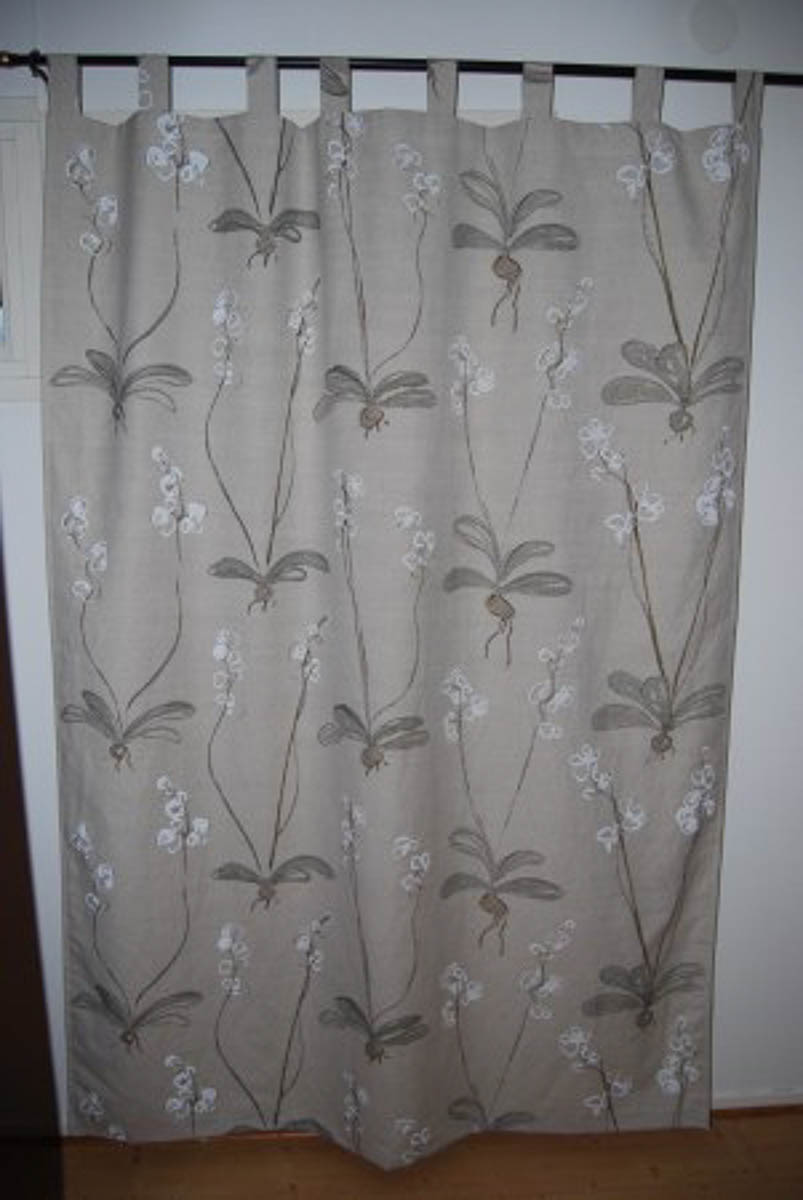
Today I finished sewing a curtain which I’ve been working on, off and on, for over a week. Finally at least one of the windows in this house has a curtain! It was getting sort of urgent because (1) the window in question is that of the veranda door and was noticeably cold, and (2) the window sits right opposite the bathroom door, so anyone looking in that direction from outside has a view straight into the bathroom.

The hardest part was finding a suitable fabric. It was very easy to find Christmas themed fabrics, and to find traditional furniture fabrics. (You know the kind – they’re heavy, tend to have scrollwork or fleurs de lys or similar designs, and often very rich colours like brown, red, cream and gold. Not at all suitable for a relatively narrow hallway in an early 1900s wooden house.) I ended up ordering 2.5 metres of a fabric that was expensive relative to what I saw in most shops, but considering that I intend to have this curtain hanging there (and have to look at it daily) for the next 15–20 winters, it was well worth it.

Besides, it turned out that fabric ordered directly from the manufacturer is delivered on a roll, which means no creases at all, which means no ironing!

On day one I measured twice and cut once. No, actually I measured four times and cut twice, once for the main fabric and once for the lining. Then I pinned the lower hems.

On day two I sewed the lower hems and measured and cut the eight little loops.

On day three I zigzagged and then hemmed the edges of the eight fiddly little loops. 32 darn seams, meaning 64 knots to tie, and by the end of it I had knots swimming in front of my eyes even when I looked away.

On day four I pinned the loops in place between the curtain and the lining, pinned and sewed the top edge, and pinned the two sides.

On day five I sewed the two sides and reinforced the bases of the loops. Then I got overconfident and topstitched the top edge without pinning it (I had the main seam there to keep things in place, after all!) but the lining was slippery and the two layers ended up slipping so it didn’t hang straight.

On day six I did penance for my hubris by unpicking the entire topstitching seam.

On day seven I pinned the top edge and topstitched it again and hung up the curtain and was quite pleased.


PS: The fabric is from Sandberg and I bought it at Var Dags Rum.

1.
Spånga is colder than central Stockholm. Most days the difference is a couple of degrees Celsius. For a good while I thought I was imagining it, or that it might be because I am in Spånga during morning and evening, while I’m in the city during the day, when it’s obviously warmer. But then we had about a week of near-freezing weather and I realised that it really is colder here. Every morning I’d go from the snow and ice in the streets of Spånga to the wet streets of Stockholm city. Here the ice never melted, even during the day, while in Stockholm it never froze, even during the night.

2.
Our house is badly insulated and generally kind of cold. I now understand why the previous owners put in three indoor thermometers, and that’s just on the ground floor. But what I don’t understand is why the thermometers seem unreliable. The one in the living room almost always says something like 17.7°C or 18.1°C. But sometimes that’s so cold that my fingers are stiff and it’s hard to type, and then the day after it feels quite OK. It’s not just me – Eric feels the same.

3.
Ingrid, on the other hand, is almost never cold. I am wearing a t-shirt, a fleece sweater, trousers or long fleece skirt, and woollen socks. Ingrid walks around in panties and socks. When we go out and I offer her clothes, telling her that it’s cold outside, she generally refuses most of the clothes and tells me “want be cold” (“tahad külm oleks”). It’s not uncommon for her to wear nothing but her indoor clothes plus a pair of boots, when we come home from nursery. On the other hand, when I tell her that it’s wet outside, she accepts that as a valid argument, and will put on her waterproof trousers or rubber boots. For a while I was losing hope that she would ever put on her snowsuit, and she probably wouldn’t have done it for the sake of the temperature only. But now she has found out that snow on bare hands is not pleasant, so when there’s snow outside she actually accepts snowsuit and mittens.

4.
A sledge is essential winter gear. I had thought of sledges as toys but they are also an important mode of transportation. We hadn’t realised that, and had to buy one really quickly when the snow came, because taking Ingrid to nursery in her pushchair through mushy snow was hard work.

5.
Speaking of essential winter gear, Smartwool makes the best woollen socks. They have sporty models and dressy ones, simple gray ones and colourful striped ones, high ones and low ones. (I like these best.) Nice-looking, comfortable, neither itchy nor scratchy, really durable, and can be machine washed on a normal program with the rest of our clothes.

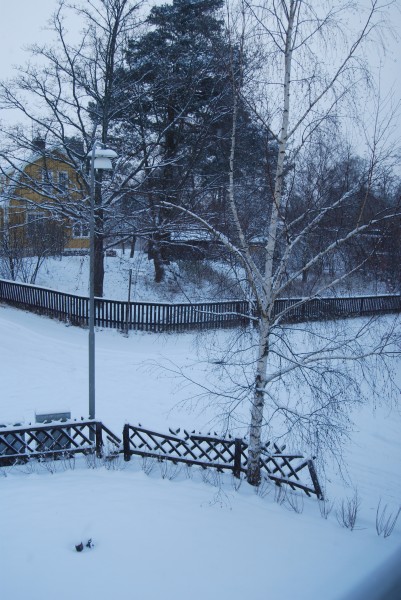
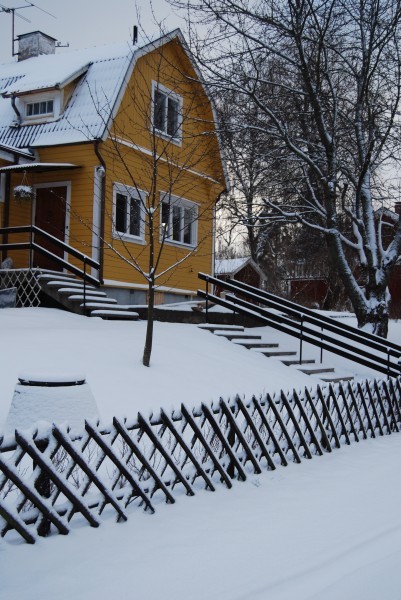
It started snowing yesterday evening and continued, off and on, until late morning. By the end of it we had about 10 centimetres of snow.

Snow in winter is no big deal, of course – in Stockholm, that is. But after 7 snowless years in London, Eric and I were both all gosh and wow over this. Fresh new snow is very pretty, after all, especially in a garden.

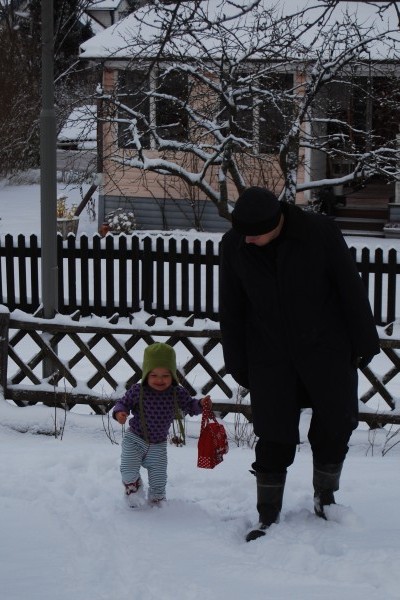
Ingrid had never seen snow before, other than in books. First we looked at it through the window. Then she wanted to go out, but refused clothes. Poked the snow outside our front door with a finger, then stepped on it with her bare feet. Changed her mind 10 seconds later and came in crying. After that she accepted one layer of clothes, plus boots, and enjoyed the snow a lot.

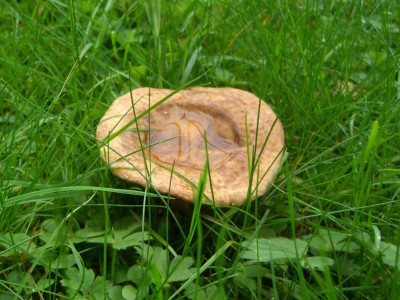
We may not have many flowers or decorative bushes in our garden, but there is no shortage of moss, lichens or mushrooms. I took a walk around the whole garden last Sunday, and once again today, and counted twelve different kinds of mushrooms large enough to be noticed. I’m sure there are less eye-catching ones that I’ve missed.

We have mushrooms that look like mushrooms are supposed to, and mushrooms that look like apricots.
We have shaggy mushrooms… …and we have velvety mushrooms.
We have small brown slimy mushrooms… …that do their best to take over the whole garden.
We have mushrooms growing on trees… …and we have poisonous toadstools.

The one thing we don’t seem to have is edible mushrooms.