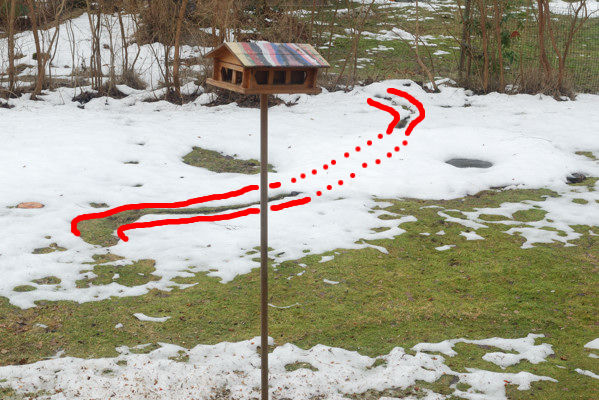
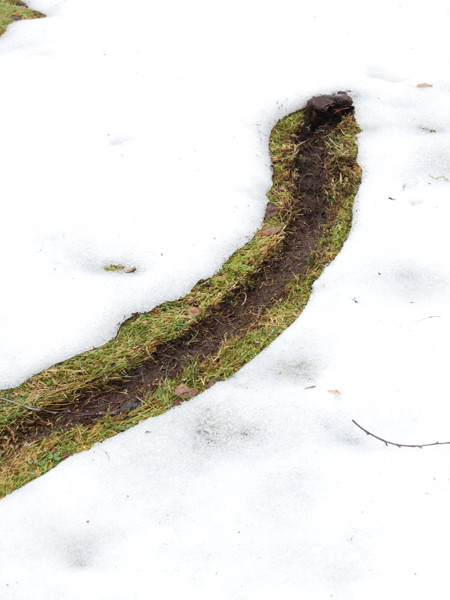
Most of the snow we got during December melted away over the year end. It turned out that the voles who live in our garden had created a tunnel under the snow from the lilac hedge towards the bird feeder. It must have been the feeder they were aiming for, because there is nothing at all of interest otherwise in that part of the garden.

Our bird feeder continues to feed (birds) and entertain (us). This year the sparrows and nuthatches have been few, and I don’t think I’ve seen a single siskin. The magpies dominated during the early part of the season but are now rare. The Great Tits and Blue Tits are there, as always. The Great Spotted Woodpecker has been here a bit more frequently than last year, and occasionally we get visits from squirrels, too. Their climbing ability, seen up close like this, is awesome.

It seems we’re mostly feeding blackbirds this year. They were just a couple last year, but this year there are at least five. I wonder if last year’s continuous food supply led more of them to decide to spend this winter here and not migrate to warmer climes. They are still struggling to hold on to the feeder. At least one of them is somewhat more confident about its acrobatic abilities, and flies up and hangs on while flapping wildly. The others tend to feed on what falls on the ground instead. Often the snow is completely covered in their footprints.

They seem to be quite dependent on our feeder. Often several blackbirds are hanging around the feeder already before dawn. When I go out to fill up their food, sometimes they don’t even bother to flee, and once I had to shoo one of them away from the feeder to be able to open it.

Today I pulled up our first carrots. They turned out to be totally ready for eating, and delicious to boot. (Even though some were mutant four-legged carrots.)

The carrots were a whim: Ingrid got a packet of seeds together with a Bamse issue. And yet, of all the vegetables we have tried to grow, I have to say that carrots have thus far given the best result. The deer chewed off the tops of both our tomato and pea plants when I planted those; the pumpkin plants barely grew and didn’t result in any actual pumpkins. But the deer left the carrot plants alone, and the carrots thrived.

Having planted enough bushes for now, we have turned our attention to the part of the garden that is in direst need of attention: the part between the house and the root cellar, formally known as “the slope of weeds”.

The name summarizes two of the three salient characteristics of this place. It is a steepish slope, hard to walk without holding on to something. And it is full of weeds, and has been since we first arrived here. It is dominated by bindweed (Convolvulus arvensis, åkervinda, kassitapp) and greater celandine (Chelidonium majus, skelört, vereurmarohi) with accents of nettles, wild strawberries, and other weeds. In the middle of it all, a little spiraea bush, buried under bindweed during most of the growing season, the previous owners’ single attempt to tame this slope. (You cannot even see it in the photo below but it’s grown a bit in the last four years, despite the inhospitable surroundings.)

The slope of weeds as of 2008

The third important fact about the slope of weeds is that the earth is full of junk. At the top there is a thin layer of reasonable garden soil. Beneath this soil is a layer of junk. Garbage. Trash. In some parts the junk is buried under 15 cm of earth; in other places it reaches all the way to the surface. It is the only part of the garden that is dangerous for bare feet. The chunks of concrete and roofing tiles are not so bad; the shards of glass are pretty dangerous.

Altogether this makes the slope quite unwelcoming, and improving it is a major project. You can’t just clear away the weeds and plant something nicer, because you can’t even work the soil without hitting all sorts of foreign objects all the time.

Now we intend to fix all three things at once. We will get rid of the weeds and the junk by removing and replacing enough of the earth to get a workable, plantable ground. We won’t get rid of the slope-ness of the slope but we will have stairs built along the wall to make the slope passable.

Our friend Anton the Builder will arrive on Monday to start working on the stairs. To prepare, we’ve been doing a lot of digging: removing the topmost layer of soil with all the weeds and their roots, evening out the slope nearest the house to make place for the stairs, and digging a hole for the concrete slab that the stair will rest on. We’ve already filled two 1m3 sacks with earth, stones, and other stuff, and have begun on a third one.

The amount of junk coming out of the earth there is astounding, as is the variety.
Chunks of concrete, roofing tiles, bathroom tiles and bricks.
An entire sack of cement.
Shards of pottery, china and glass.
Electrical wires. Rope. A one-metre iron T-bar. A bin bag.
Nails, both large old rusty ones and modern stainless steel.
The heel of a shoe. A spoon. A pitchfork.
A candy wrapper.
A small glass bottle with a bit of dried nail polish.
A metal tube for mayonnaise or something like it.
A door from a wood stove.
Bones of some large animal. Cow, perhaps.

It’s like a midden combined with a dump for construction waste.

One interesting fact is the wide time span that this material covers. The large nails and the stove door are old, and the bricks as well: they’re not the modern sort that are half hollow, but solid, heavy, old-style bricks. Other things are much more modern, such as the candy wrapper and the wires.

I have tried to imagine how this came to be, but I have a hard time making sense of this. Who would throw old plates and bones in their garden, or pitchforks and china? And why? In what scenario could it possibly seem like a good idea to have shards of glass in your garden? Or did some of this come from somewhere else as part of some cheap load of fill dirt?

In any case, while it makes the digging slow and laborious, it also makes the whole project feel like an archaeological dig. I never know what I will find next.

The blog has been quiet because I have been busy doing other stuff. Namely, (1) reading the Song of Ice and Fire series, and (2) working in the garden. #1 is hard to put down, and #2 feels sort of urgent while the evenings are still light enough for me to work outside after the kids have been put to bed.

I did a first round of planting about a month ago. This weekend we paid Zetas another visit and came home with more bushes.

The garden looks like this:
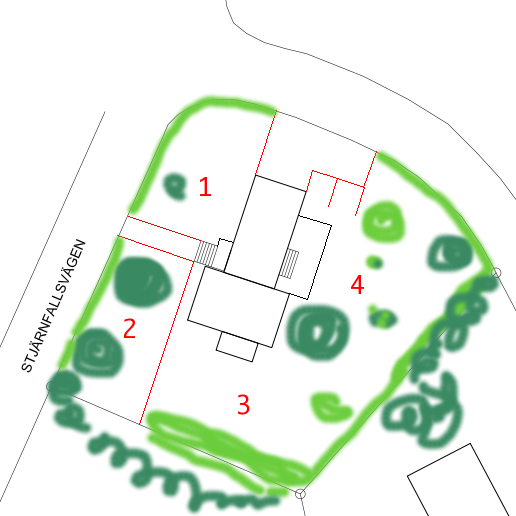
The red lines mark man-made structures; the light green is for bushes and dark green is for trees.

I think of the garden as consisting of four major parts.

Beginning from the north, the part 1 lies between the house and the crossroads (bounded by the two streets, the stairs up from the street, the house and the driveway). I think of this part as the front garden, the welcome mat. This is the part that I have focused on this summer.

It was quite bare to begin with, even more so than the rest of our garden. There is a young cherry tree, which is probably an accidental child of the larger cherry tree in section 2. At first there was also a birch tree, but since it grew up through the sleepers that make up the border around the garden, we had it taken down. The cherry tree can stay for a while, but we do not need three of them in our garden, so in the long run its days are numbered, too.

Now I’ve planted a number of bushes and shrubs that will hopefully give it some more life in the coming years. Towards the north, near the road and furthest from the house and its shadow, there are the sun-loving bushes: a staghorn sumac (for its hairy looks and autumn colour), a dark-leaved black elder (for some dramatic colour during the summer) and a japanese quince (for its colourful flowers). I’ve loved staghorn sumacs since I was a child – we had a few near the house where I first grew up, as well as at my grandmother’s summer cottage. I like the way they’re hairy and spindly at the same time, and their clusters of fruit as well. The elder and the quince I chose because they manage to both look pretty and be useful – one with its flowers (for elderflower cordial) and the other with its fruit.

Closer to the house I’ve put shrubs that are happy in the shade. There are two dogwoods, one with yellow bark, the other with red, for some winter colour. I’ve also put in a mahonia as a contrast to the dogwoods, and to have something flowering near the front entrance.

These all I chose because they are hardy and easy to care for, and should be able to cope with the heavy clay soil we have. Next to the stairs up from the street I’ve been more daring and planted a Viburnum x bodnantense “Dawn”. It sounds so lovely that I couldn’t resist buying it. I am afraid that it might not be very happy there, both because of the clay soil and because it will be shaded by the large cherry tree, but it’s worth a try.

Part 2 is the woodlands. Here we have a cherry, a whitebeam, and a birch, and shade (and roots) from the neighbour’s horse chestnut and birches. Plus as a bonus there is some ground-dwelling hole-digging animal there, probably some sort of vole. So the ground is poor, dry, shady, and dotted with holes, and nothing much will grow here. This section has its prime time in spring, first because of the bulbs we’ve been planting (mostly crocuses and daffodils of various kinds) and then later again when the cherry flowers.

Part 3 is the kitchen garden. This is the only flat part of the garden. The bedrock is very close to the surface here; the soil depth ranges from zero (where the rock peeks out) to maybe half a meter at most. It gets decent amounts of sun during the morning at least, but in the afternoon it is shaded by the neighbours’ trees. Here we’ve created raised beds out of pallet collars and planted strawberries, a gooseberry bush, rhubarb, and other stuff.

A cherry tree separates the kitchen garden from the last section of the garden. Part 4 will have a more decorative role, similar to part 1, but with a pure summer focus. This is the part we see when we sit in the living room or out on the deck. It is unfortunately quite shady, with the cherry tree, and the neighbours’ trees, and more trees along the fence, and the shadow of the house itself. Currently we have a large philadelphus here, as well as a cypress, and a very small flowerbed around a large rock. I haven’t quite figured out a plan for this part yet.

The lack of plan didn’t stop me from buying some bushes for this part, though. I planted a weigela for some colour, and – because I couldn’t resist it when I saw it – a butterfly bush (Buddleja davidii). I don’t have high hopes for the latter; it probably won’t get enough sun here, but maybe, maybe…

Between part 4 and the road we also have an old root cellar, and between the root cellar and the house lies what we refer to as “the slope of weeds”, a steep slope covered with nettles, greater celandine, bindweed and other nasty stuff. I intend to clear this slope in the next few weeks, and make something pretty out of it later this year, or maybe next.
Yesterday we drove to Zetas garden centre and did some shopping. We bought some climbers that I planted next to the play house – common hop (Humulus, humle, humal) and honeysuckle (Lonicera periclymenum, vildkaprifol, väänduv kuslapuu). Ingrid picked another dahlia for the deck. And we got several bushes for the front garden – Japanese quince (Chaenomeles Japonica, rosenkvitten, ebaküdoonia), a dark-leaved variety of black elder (Sambucus nigra, fläder, must leeder) called “Black beauty”, staghorn sumac (Rhus typhina, rönnsumak, äädikapuu) and red-barked dogwood (Cornus alba, rysk kornell, kontpuu).

Today I spent much of the day digging. The part of the garden that I think of as the front garden, the quadrant between the house and the crossroads, has very heavy clay soil. When dry, it is hard as rock. After rain it’s just very dense and gluey. Luckily it’s been raining quite a lot recently – otherwise we’d probably have postponed the shopping for another weekend.

The front garden has been waiting for awhile. The previous owners weren’t particularly interested in gardening and left the entire garden very bare, pretty much just a lawn and a few large trees (which were all there before them).

After we moved here, it took about two years for us to get a feel for the garden and to settle on a plan for it. Last year we spent our time and money on the house. This year finally the garden gets some love.

I was raised a perfectionist. If I didn’t have perfect grades, I sensed mild, baffled disappointment – “What happened? Surely you can do better?” That expectation rooted itself in me and I came to see it as natural, and as my own. So for years I’ve tried to do things as well as I possibly can.

“If it’s worth doing, it’s worth doing well.” When I’ve known that I don’t have the time or skill to do something well, I have chosen to not do it.

Now I am finally trying to unlearn that perfectionism and to practice “good enough” instead. “Don’t let perfect be the enemy of good.”

See that chair makeover in the previous post? The seats of our kitchen chairs were worn out and stained and needed replacing. Reupholstering a seat is not much work: from beginning to end, it took me about an hour per seat. But there are also the backrests. Reupholstering those would require the chair to be disassembled almost completely, and then the actual reupholstering would be a lot fiddlier. I don’t even know exactly how the fabric is attached, but it would almost certainly require more than scissors and a staple gun, probably quite a lot of measuring and sewing. Given all the other tasks and projects on my list, it was clear to me that that just wasn’t going to happen. I could of course also have bought new chairs, or accepted them in their somewhat ugly state. But I opted for a good-enough solution, and reupholstered just the part that actually needed it. So what if the seat fabric now doesn’t match the backrest.

Likewise in the garden. For some time now (like, a couple of years) I’ve wanted to do something with the one and only flowerbed in our garden. To do it properly, we should replace the stones around it, because the lawn is creeping into the flowerbed. And we should probably move them a bit further out because the flowerbed is quite narrow. And we should really mix manure or compost into the soil, which is dry and poor. But… all that would take me an entire weekend, and that’s just not going to happen any time soon. So instead of waiting for that utopian weekend (with no kids to interrupt my work, and decent weather, and nothing more urgent to do) I just bought and planted a bunch of perennials that should hopefully be able to cope with the poor soil, in the narrow space that is there, and then threw in some cheap annuals to get some colour straight away. It’s not perfect, but it’s something, which is way better than nothing.

Our kitchen chairs have a new look.

Yesterday I exterminated cherry seedlings. 616 before lunch and 134 after, for a total of 750. It’s a most fertile cherry tree we have.

Here’s a photo of last year’s pickings.

This weekend we bought some dahlias, which I repotted and put out on the deck yesterday evening. But I forgot to check the weather report and therefore they were damaged by the night frost – just hours after I put them out. Now I feel like a fool, and sad to see for the beautiful flowers that hang brown and shrivelled. I hope they recover, otherwise I will have to start over.

And the cold I’ve had for a week got worse during the weekend, and today I realized it’s now turned into sinusitis – fever, half my head aches, and my teeth as well.

And Adrian’s reaction to seeing me trying to rest on the sofa is to get all worried and clingy, and want to nurse every 5 minutes, so really there wasn’t any resting for me until he went to bed.

Now I’m in a grumpy mood, feeling sorry for myself and the flowers. I’m treating myself with chocolate – after about 60kr worth of nice pralines from Chokladfabriken I am feeling distinctly better.