Today was the first really warm day for this spring. Jacket off, shoes off, I could actually sit in the afternoon sun in the garden without freezing. Finally, finally something that feels like spring. Even though it probably came about the same time as last year and the year before, it feels like the wet and cold period (non-winter? pre-spring?) has lasted for ever.

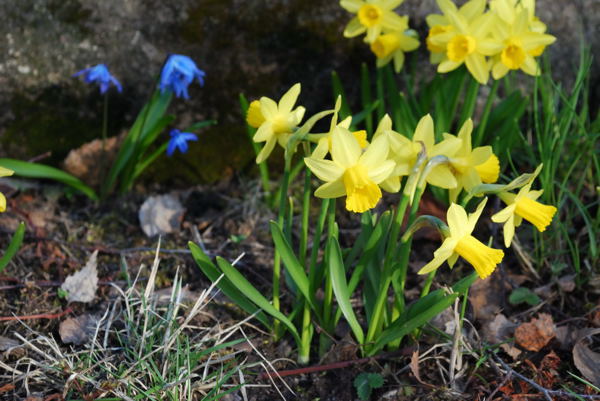
Look at what this weather (with repeated late cold snaps and even snowfall) has done to the daffodils. They’re totally stunted – some no taller than scillas.

Remember our bird feeder? It was up and running last winter, although all the building work around here meant that neither we nor the birds had optimal peace of mind to really enjoy it. This winter we’re all enjoying it more than ever.

The seed mix – sunflower and peanut – that we optimized in our experiments two years ago remains a great hit with the local birds. This year we improved it further: Eric found hulled and chopped sunflower seeds, which means that we don’t get that mushy pile of sunflower hulls underneath the feeder.

The mix of birds that it brings has changed, though. The Great Tits and Blue Tits are there as usual. The Jays and Nuthatches still come, but they are fewer than they used to be, and same with the Sparrows. The Magpies mostly came in autumn and now haven’t been around much.

Instead we have some new guests.

  • Siskins (Carduelis spinus, siisike, grönsiska) have absolutely dominated during the current cold snap. They move around in flocks of several dozens birds. When they come to feed, they come a few at a time, until there are around 15 of them on the ground beneath the feeder, another few at the feeder itself, and more in the trees and bushes nearby. They’re also easily spooked by bigger birds: when a blackbird or fieldfare flies by, even at some distance, the entire flock of Siskins takes flight in near-panic and flies into the trees. Since they are so many trying to take off at the same time, it isn’t rare for a few of them to hit our kitchen window. Luckily they haven’t gathered much speed yet when they reach the window and usually don’t even knock themselves out but fly straight on. While they sit around in the trees, they chirp and twitter constantly. You really can’t miss them when you walk past our yard. It does not surprise me at all that people like breeding them as songbirds.
  • Blackbirds (Turdus merula, koltrast, musträstas). They were more frequent arlier during the season when it wasn’t that cold yet but they come now, too. Just like the previous years, there’s either a single couple, or they just travel in pairs: I’ve seen single females and single males, but rarely more. They have trouble hanging on to the feeder: neither small and nimble like the tits and sparrows, nor strong like the jays, they struggle and wobble. They’re much happier on the ground. To accommodate them, we now spread food on the ground underneath the feeder, too. (The Siskins like that as well.)
  • Fieldfare (Turdus pilaris, björktrast, hallrästas). A big and bossy bird who likes to have the whole field for itself and chases away any others. It doesn’t hesitate to bully even the jays, who are their size if not larger. It likes to feed on the ground just like the Blackbird. It also likes to just sit there after feeding and look sullen, just because it can.

Among the rarer visitors, there is still the occasional Green Finch or Great Spotted Woodpecker. I also noted a pretty Redpoll (Carduelis flammea, urvalind, gråsiska) the other day.

More Siskins


We’ve been struggling with fruit flies in the kitchen, around our fruit bowl. We tried to get rid of them by just squishing them, and then by vacuuming them up, but it hardly made a difference.

Then I consulted the Internet. The Internet suggested a liquid trap for them, with a tasty liquid (vinegar, juice, wine, sugar water) and a few drops of dishwashing detergent.

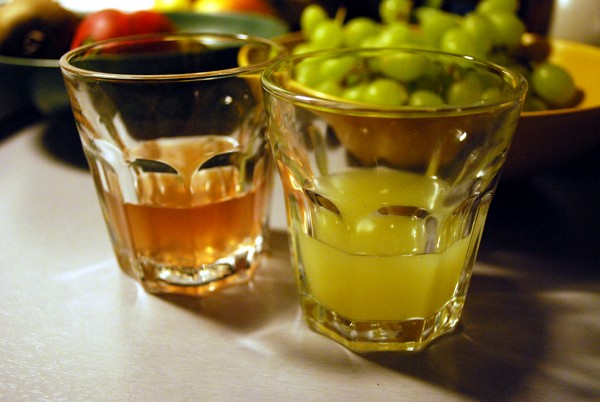
For the sake of experiment, we made two traps: one with apple juice (which seemed reasonable since they like fruit) and one with red wine vinegar (which several online sources suggested as particularly effective). And it worked like a miracle. After a few hours the apple juice had trapped 4 or 5, while the vinegar trap had 17 dead fruit flies. Since then the number of dead flies keeps increasing and we hardly ever see any live ones flying around – they must go directly from hatching to drowning. Great trick!

In addition to our excellent cherry tree and lovely damson bush, we also have an apple tree. It doesn’t get quite as much love and attention as the others – perhaps because it stands far away (relatively speaking) in a corner of the garden, and its fruit become edible late autumn (October-ish) rather than during summer when we we’re all out in the garden all the time. But it does bear nice fruit.

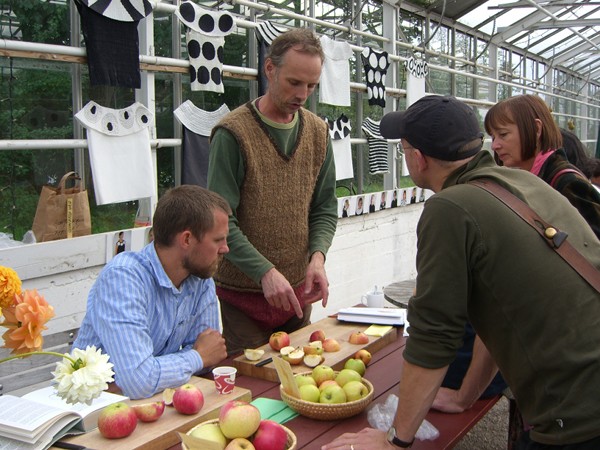
Since we first ate its fruit we’ve wondered about what kind of apple it might be. Today we went to Rosendal’s trädgård to find out. This weekend they have their annual apple and pear show, which includes representatives from Sweden’s Pomological society who sit there and inspect people’s fruit and try to figure out what kind it may be.

We brought them five of our apples. They looked and they cut and they tasted and they consulted their books, and they concluded that our apple tree is a Gravensteiner. “Sweet, at first quite tart, very fine. Very old variety. Excellent both for eating and for cooking.”

Many of our neighbours, friends and acquaintances have been asking us about the remodelling – Are you done now? How did it turn out inside? What exactly did you do? – so we decided to invite them all to view our home in its new incarnation. Today we had a houseviewing party. Well, not quite a party, a houseviewing afternoon with coffee and biscuits. Lots of people came, we had a lovely time, and lots of biscuits got eaten. Now we’re all knackered. Except for Ingrid, who came into her second wind some time around 7pm and was still singing and hammering at the piano at 8.30.

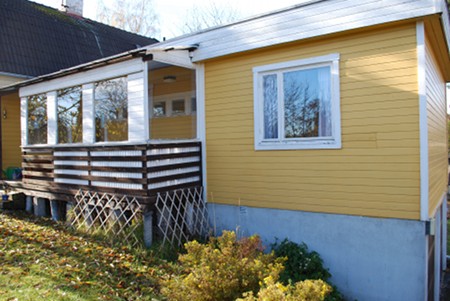
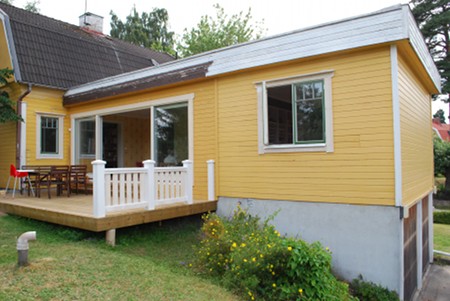
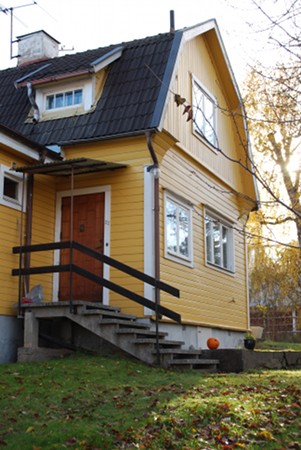
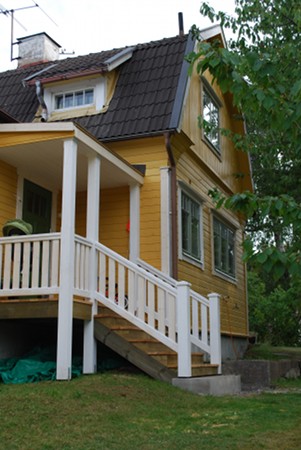
We put up before-and-after photos of the house for the guests to look at. Going through the photos was interesting – already I myself am starting to forget what the house felt like before we started changing it. (I’ll be posting more of them here, too.)

Adrian was feeling quite a bit better today. He was sort of unwell on Friday, and really ill on Saturday, with a fever and a runny nose, and barely sleeping at night. Last night he slept a bit better, and today he actually had enough energy to crawl around and play and look at all the people. He loved the crowd so much that he barely slept at all during the afternoon.

The building works here may be done but that doesn’t mean we’ve run out of work. We have painting to do, lighting fixtures to buy (there’s currently no lighting in the entry hall, or the stair hall, or the walk-in closet), books and bookshelves to move from the bedroom to the office/library…

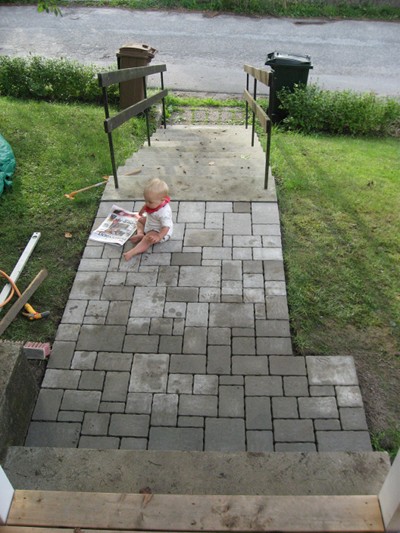
This evening, after both kids were asleep and our productive time began, we got started on laying stone on the flat bit of ground between the garden stairs and the stairs to the porch. It was already paved before, but when the new porch got built, the upper flight of stairs became wider and moved slightly, so we ended up with an unpaved gap.

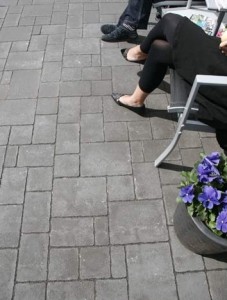
We chose paver blocks that come in a mixture of sizes, Fantasi Antik. We spent an hour and a half this evening designing a layout for the stones that we can live with.

Both Eric and I are “pattern people”: if there is a visual pattern, accidental or intentional, we cannot help noticing it. And if that pattern is in a place where there isn’t supposed to be one, it will keep catching our eye and irritating us. Like a visual itch. It often happens with cheapish printed products – cheap laminate flooring, fabric, wallpaper – where the pattern repeat is too short.

So we wanted to make very sure our paving is sufficiently random. In particular, no too-long unbroken lines, and no too-large rectangles of blocks. For example the long unbroken line down the middle of that marketing photo above would be a clear no-no.

It was almost like a computer game. Except with pixels of 70x70mm, weighing over half a kilogram each. And instead of trying to make order, we tried to make randomness. Sort of an anti-Tetris.