This evening I started on this season’s second round of mowing the lawn. I mow in sections, usually about a quarter or a third of the lawn at a time, so it takes about a week or two to do the whole thing.

This is not just to spread out the work – although with about 800 sq m of lawn to mow, doing it all at once would take at least half a day. It’s also because I don’t want to denude the whole garden at once. This way there is always some part that does not look “shaved bare”. Because that is what I think the mowed parts look like: bare and boring.

Most gardeners seem to dream about the perfect lawn. Perfectly even, perfectly uniform… perfectly dull.

I can imagine that one might feel a sense of achievement, of mastery over the forces of nature. I guess. But I really cannot empathize with that. If you don’t want nature in your garden, but rather something more akin to a carpet, why have a garden at all?

It always feels like a pity to mow down all the variety, all the flowers and the different grasses, to an even green surface. Now I only mow at the last responsible moment, when I feel that the lawn is close to becoming unmanageable. Once it grows too tall, it becomes difficult to mow: the thinner grasses bend so the mower runs over them and doesn’t cut them, and in other parts where the grass is particularly lush and thick, the mower simply gets stuck.

I always make an effort to spare the wildflowers (aka weeds) in the lawn: wild primroses (nurmenukk/gullviva), the ox-eye daisies (härjasilm/prästkrage) and Campanula (sinikelluke/blåklocka), Lady’s Mantle (kortsleht/daggkåpa), larger groups of lawn daisies (tusensköna/kirikakar) and creeping buttercup (revsmörblomma/tulikas) and so on. In a proper lawn, these would all be considered weeds. Here, I’m happy for them to go to seed and spread.
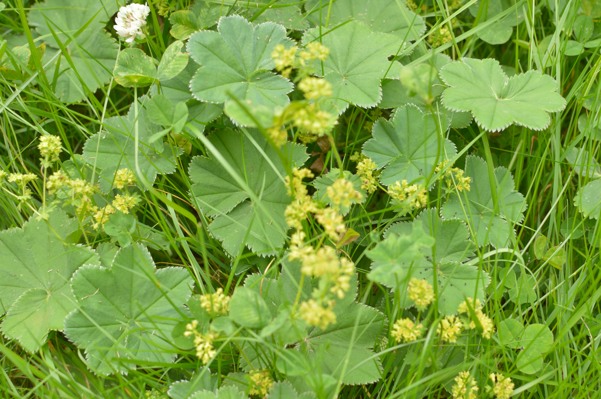
Not a weed

Also totally not a weed (although I don’t go out of my way to spare them) is clover. Its tendency to attract bees is, according to gardening magazines, a reason to get rid of it: you might get stung. To me, something that attracts beneficial insects to the garden is most welcome. We just watch our step when they’re in full bloom to avoid stepping on the bees and bumblebees. (There is a bumblebee nest somewhere in the crawl space under our house.)

I also don’t mind plantains (groblad/teeleht), or any of the other non-lawn species whose names I don’t even know. (I think I should by a book about weeds.) And I don’t mind moss, either. It is soft to walk on, and nice to look at.
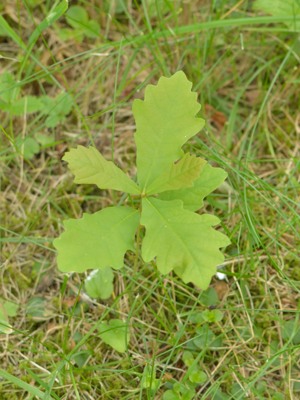
Weed

There is only one species of plant in our lawn which I do consider a weed, in agreement with mainstream gardeners, and will dig out if I can bother: dandelions.

Then there are things that are technically not weeds, and may even have some positive value, but totally exhibit weed-like behaviour in our garden, and need to be kept at bay: if let loose, they would spread out of control, fast.

Cherries. They spread by root and by seed, and there is no end to them. In the same category (but without the redeeming berries) are maples: every spring and summer we walk around pulling out maple seedlings. And oaks, too, probably brought here by squirrels or jays, because there are no oak trees here.

Lilacs and snowberries. Both are nice in hedges but send their rhizomes way out into the lawn, and then produce lots of shoots.

As a result of our non-standard way of caring for the lawn (infrequent mowing, no watering, no fertilizer) we have seen new species spreading and thriving. The wood anemones are spread much wider than five years ago. This year we noticed foxgloves for the first time, in a part of the garden that I have left unmowed since spring.

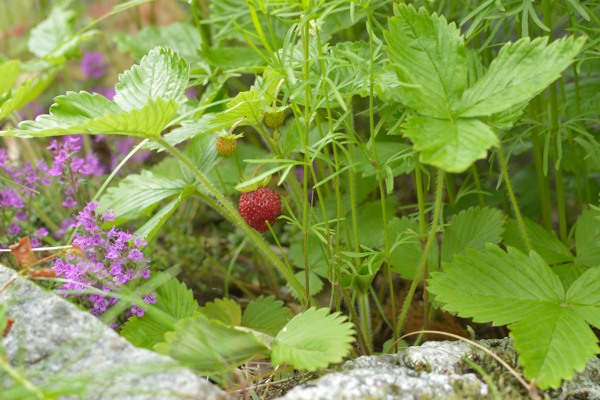
Wild strawberries, which we found in just a few places during the first summer, are now spreading in more places than I can count. Lots of fun for the kids, who go on strawberry hunts in the evenings, and an interesting challenge for me. I don’t want to mow the strawberries of course, at least not the largest, most fruitful patches. But if I don’t do anything then they will get buried under tall grass. My current solution is to simply tear off some of the grass by hand (where the grass is thin) or with grass shears.
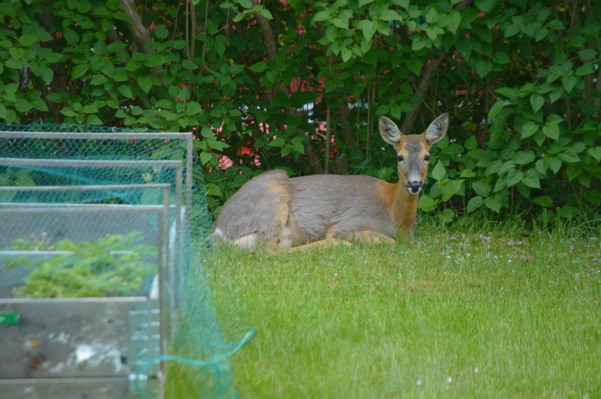
The deer are getting bold. This one didn’t move more than an ear even when I opened the door 10 metres away from her.

Those rats we had? It seems that one of them (or maybe some other small creature, who knows) has gone and died somewhere underneath our kitchen.

There is an unpleasant dead odour that is strongest in one corner of the kitchen, and an awful lot of very fat flies.

I crawled into the foundation under the kitchen and looked around. I saw droppings of some small animal, but there was no dead rat to be seen. The smell was there, too, now coming from above, so the dead thing is probably somewhere in the floor substructure.

So now we wait. And kill flies. Fly paper, which I haven’t seen since my childhood days, apparently still exists, and works. But a plain old rolled-up newspaper is much more efficient. Especially with these flies: many of them are unusually slow and dull, and don’t even try to fly away. One afternoon after work I swatted fifteen, and Ingrid did another four, while the fly paper had caught only a handful during the day.

The pansies I planted in April? They got eaten by deer.

Twice.


I am seriously annoyed. They don’t just nibble at the flowers, either – when the deer come, they eat every blossom bigger than the tip of my thumb. The destruction they leave behind may be small in size but it still looks quite depressing afterwards.

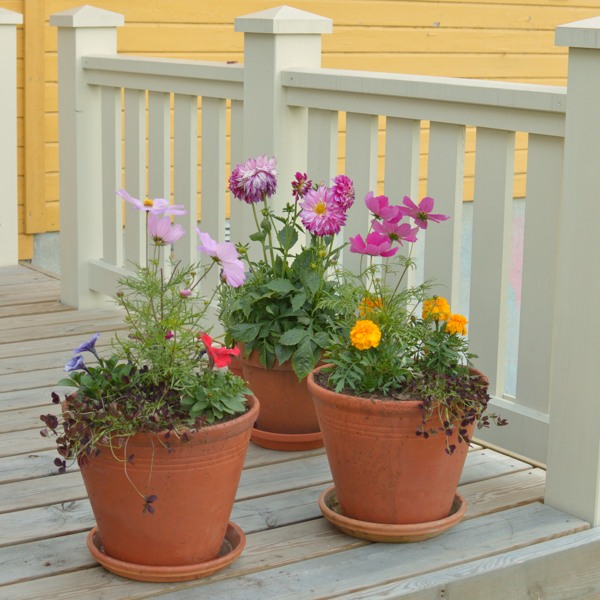
On the plus side, deer apparently do not eat French marigolds (tagetes), garden cosmos, or petunias, so my plantings behind the house have been left in peace.

During winter, when there isn’t much to be done in the garden, I spend more time on crafts. Last winter season I made an advent calendar in felt and started knitting a cardigan. The cardigan is still not done, because during this winter season I focused more on interior decorating. Time to finally make some curtains for this house!

We have nine sets of windows that “need” curtains. (I don’t think the storage closet needs any, and the glass wall in the living room is not going to get curtains either.) The bathroom window already had one, which leaves eight. I managed to sew curtains for four of them, so I’m halfway there. Perhaps next winter I will get the rest done.

The “office” was first in line because I wanted to be able to get rid of the glare on our computer screens. Thick, lined, but otherwise un-fancy curtains in a fabric that matches the art nouveau and early-1900s inspiration I’ve generally been following in this house: Sandberg’s Lily of the Valley.

The curtains for our bedroom are similar in style and construction. If your memory is really sharp, you may recognize the fabric: this is the curtain I made for the balcony door back in 2008. Back then I expected it to hang there for the next 15 or 20 years. The door itself only survived for less than three more years, but the curtain got a second life. I removed the tabs at the top, made a twin for it, and now it hangs in our bedroom. I am hesitant to make another prediction about its expected life, but I hope it will be long. The fabric: Sandberg’s Louise.

Actually, the twin is not quite a twin. Or maybe it’s a fraternal twin. The new fabric I ordered did not quite match the old one: one is more beige and the other is more gray. Maybe the old one changed colour in the sun? Maybe in a couple of years they will be indistinguishable. But during the day the curtains are apart, and at night nobody looks at them, so the mismatch doesn’t bother me at all.

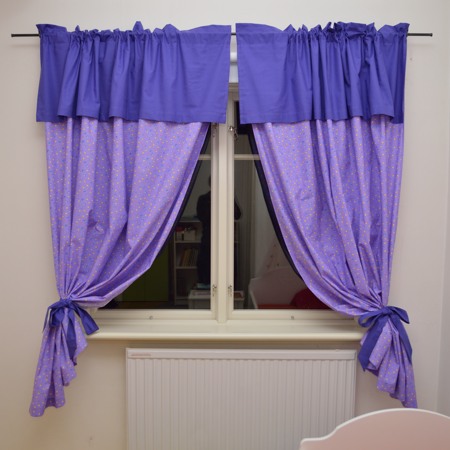
The curtains in Ingrid’s bedroom are of a very different style… We looked at photos of curtains online and Ingrid had a very clear idea about what hers should look like. Patterned, but with a small pattern, “like maybe hearts or rings”. Ideally violet or lilac or something like that, or maybe blue. And tied back with nice bows, and with a valance. It took a while to find the fabric because this is not exactly in line with current decorating trends, but Ingrid was very happy with the result. She likes to untie the bows for the night.

And finally, some cushions. We had a set of three old cushions in dark green linen that I sewed in 1997 when I moved in with Eric, and they were really at the end of their life. There were actual holes in the fabric. These new ones are in dark brown wool felt, decorated with fabric in traditional Estonian patterns. My working name for the set is “Rebel yellow”. One of them I made after Ingrid’s wishes – can you guess which one?

PS: If you can’t make the numbers add up – office + bedroom + Ingrid’s room equals three, not four, right? – it’s because the office has two large windows which I count as two, not one.

We’re well into April and it still doesn’t look like spring outside. Half the garden is covered in snow, and today we had three dense showers of snow (and one of hail).

This weekend we decided to make spring nevertheless. We hung up Ingrid’s swing. Eric put up a nesting box. I planted pansies, labeled as “frost tolerant” at the garden centre so I hope they survive. Eric swapped tyres on the car, from winter to summer tyres. Adrian and I took our first bike ride. (Ingrid has bravely been cycling for several weeks already.)

I found one crocus blossom, two snowdrops, and a dozen scillas in the sunniest corner of the garden.

The rodent has extended his highway, which used to go from the hedge to the bird feeder, all the way to the house. There he has dug another little tunnel to get in under the stairs and onwards into the foundation. And from the other side of the house another little path goes to one of the old vole holes.

The neighbours report that from the hedge (which follows the border between our garden and theirs) the rat wanders into their garden as well. The rat seems to have made himself at home here.

And this weekend we spotted the rat in company of another.

It is time to take countermeasures.

With winter almost over, I can declare this season’s best buy: a snow pusher. (For those of you living in less-snowy climes, have a look at the photo.)

In previous years we’ve made do with just a shovel. A pusher seemed like a waste of money and space. You only use it after a really heavy snow fall, maybe half a dozen times during the season. The rest of the time it just stands there, taking up lots of space.

For the two staircases from the street to the house, a shovel is the only option – there is no space for anything else. In fact on the lower stairs there’s barely enough space to swing a shovel, and occasionally I imagine sawing down the handrail on one side, to give me more room.

But then there’s also the driveway in front of the garage, and the roof. We clear snow off the roof because of the risk of leaks. When we redid the interior in the extension, we discovered signs of an old water leak from the roof. Apparently the roof (a sheet metal one) is not entirely waterproof. So any time the weather report promises above-zero temperatures, we climb up on the roof and shovel off the snow before it melts and starts leaking into our office/library.

And for both the driveway and the roof, the pusher makes life a LOT easier. Now there’s no more lifting, just pushing. Especially for the roof, where we now just push the snow over the edge. (From the driveway the snow needs to be pushed up into a bank.) It’s not even hard work any more – it just takes a bit of time. I quite enjoy it. Peace and quiet, fresh air, nice view, moderate exercise.

The gardening season is about to begin! Last week friend/neighbour P told me about an interesting lecture at a gardening club. This made me suddenly realize that spring is not far off. Now I have bought a bunch of new gardening books (which are lying here just waiting to be browsed) and attended the lecture, so I’m full of inspiration and energy, making plans for this season.

Last summer I planted a bunch of bushes and shrubs. Later, towards autumn, we cleared out much of our “slope of weeds” and had a carpenter build stairs along one edge of that slope.

This year’s main big project will be to finish clearing that slope and then to plant it. It’s not the most central part of the garden, but it is one that we see daily during the summer, and also the ugliest one right now. I’m imagining a low-maintenance combination of small bushes, some decorative grasses, maybe a few large rocks, and hardy perennials for most of the area.

I also hope to add some more climbers & creepers to the play house, to make it more fun for the kids. Hopefully I can do this early in the season so they have time to grow enough to make a difference already this summer.

If we still have time and energy left over then maybe we’ll plant raspberry bushes. This is something that we’ve been talking about for at least two years now, and I’m hoping that we can finally do something about it.

I also have visions of decorative plantings to both sides of the entrance, and along the stairs that lead from the street to the entrance, and also a complete remake of our one and only flowerbed (behind the house, by the wooden deck) but all of this will probably have to wait until another year.

Rat

It turns out that the rodent eating bird food in our garden is a rat. Suddenly I am much less fond of it.

But… rats don’t burrow in the ground. So: do we have both? Or are the voles gone and the rat has moved in? Or is the rat here just for the winter?