Born to Run is many stories in one.

The question that starts it all off is simple: Why do we get injured by running? How come every other animal can run without damaging their body, but not us humans?

It is about seeing running differently, and doing running differently. Running should not be about expensive highly-engineered shoes with thick soles, or gritting your teeth and going on through the pain. Done right, running should be full of joy and not pain. (McDougall is a strong proponent of barefoot running.)

It is about man’s history as a runner. According to one hypothesis, humans are born to run, and running is the skill that gave us an advantage compared to other species. (See the endurance running hypothesis.)

It is about an Indian tribe in Mexico for whom long-distance running is a way of life – the one group of people who still run like humans did a long time ago.

It is about six long-distance runners, all among the best in the US, meeting up for a 50-mile race together with some of those Indians in Mexico’s canyons, and those people’s back stories.

Underneath it all, the book is a song of praise to long-distance running.

The book is interesting, almost a page-turner. I wouldn’t say it’s well-written, exactly (it rambles and meanders, and the hyperbole occasionally gets annoying). But the book is so full of passion and energy that I could live with the author’s style.

I am not a runner, and I have never loved running. After reading Born to Run, I am tempted to become one.

Amazon US, Amazon UK, Adlibris.

I read a book! I don’t get much time to read nowadays but recently I finished The White Tiger by Aravind Adiga.

Narrated in first person, the book tells the story of Balram Halwai. Balram is the son of an impoverished rickshaw driver in backward rural India, which he calls “the Darkness”. He starts out as a manual labourer, then learns to drive a car and gets employed as a driver for one of the landlords. When a son in the rich family moves to Delhi, the driver goes with him.

Balram’s village is owned and controlled by landlords whose power is like that of feudal lords of old, including power over life and death. In Delhi the gulf between the master and the servant remains yawningly deep: the car that he can drive but isn’t allowed to touch otherwise; the malls he as a servant is not even allowed to enter; the furniture he is not allowed to sit on. The masters talk about him as if he wasn’t there, read his letters, and openly comment on his quaint habits.

As long as his boss treats him well and honorably, Balrams accepts this as the natural order of things. Servility is a habit so deeply ingrained that he serves instinctively. But when the boss almost frames Balram for a crime that the boss committed (and only drops the plan when the crime gets hushed up by other means), he suddenly seems to awaken to this reality, to realize that he is not his own man and never will be, even though he earns good money. He is chattel.

As he loses his respect for the master, he decides to break free and to become a master. In an opportune moment he kills his master, steals a lot of money, and sets up a new life for himself.

The book is angry and bleak, hopeless through and through. There is neither love nor empathy in this world – homo homini lupus est. There is no idealism and no desire to change the world or to break the master/slave pattern, just the desire to be on top rather than at the bottom.

It is a witty, fast-paced, sharp book. But it is also shallow in both idea and execution. There is nothing particularly original or thought-provoking here. The characters are superficial, even cartoonish at times. Balram himself seems disconnected from everything around him, and rarely seems to have any normal emotional reactions except when threatened with years in prison. His comments are inconsistent, sometimes so jaded and cynically critical, sometimes so naïve.

Good enough but forgettable, nothing special or prize-worthy.

Amazon US, Amazon UK, Adlibris.

I have been reading the Song of Ice and Fire series recently. About a month ago I caught up with what’s been published, by finishing book 5.

It all started with the HBO series, which was awesome. Halfway through the first season I bought the books, because I wanted more. By squeezing a fat book into a single season of a TV series inevitably things get cut, especially back stories. Also the movie can show you what happens but mostly cannot tell you why the characters do what they do – you cannot hear what’s going on in their heads.

Book one (A Game of Thrones) was a great read – as good as the TV series and then some. Things that had passed too quickly to make sense on the screen, started making sense. People I had mixed up because they looked and sounded too similar and were only occasionally referred to by name, got distinct identities.

Book two (A Clash of Kings) was a good follow-up. Things got more complicated, events had consequences, trouble spread, characters got fleshed out while new characters entered the scene. It wasn’t as powerful as book 1 but that is normal – now that events had been put in motion, they needed time to grow and mature. The book promised great things to come.

Book three (A Storm of Swords, parts 1 and 2) was noticeably weaker. Martin has now spun off so many plot threads that he cannot even keep them all aloft at the same time: book 3 is split into two volumes, each of which follows half of the crowd. So much is going on that I lose track of things. After the build-up of book two, I wanted this one to up the pace again, but it didn’t happen.

Book four (A Feast for Crows) is more of the same. The progress is so slow that I literally don’t even notice that one plot thread, which had initially seemed to be a most essential one, is not even included in this book.

Book five (A Dance of Dragons) is even worse. All the pieces are in motion, heading for something or someplace, but no one ever actually arrives anywhere. They travel, they dither, their plot threads are temporarily suspended… Instead new people are introduced, and unlike the old ones I do not feel any connection to these newcomers, and cannot bring myself to care much about them. Give me the Starks, not some psychopathic torturer of a lordling!

While I was riveted at first, I gradually became less and less enamoured of the series. I won’t buy the next book until the series has been completed, so that I can know that there is an actual ending and a resolution to look forward to. It is as if Martin himself has lost his passion. It is just a job at this point. The language becomes repetitive, the events uninteresting.

Apart from the sprawling muchness of it all, there thing that really annoys me is the seeming lack of master plan. Events and circumstances that seem really portentous later appear to have no particular meaning. Hints of a grand structure vanish into nothing. For example, there are the five plus one direwolves for the five plus one Starks – and then one is killed already in book 1. It is presented so as to sound important, that one of the Stark children now does not have her wolf, and during all the following books I am kept waiting to see why it matters… and it seems it doesn’t.

Events happen randomly. Out of nowhere, magic appears, when Martin needs it to solve a problem. Out of nowhere, characters that had until then seemed central to the story, get killed off. Out of nowhere, some characters get brought back to life. And literally brought back to life, not just “oh he looked dead but had simply fainted”. By now I don’t take any death seriously because I know that Martin could change his mind at any time.

Oh, and I am by now also really annoyed by the recurring soulless listings of what people wear and what heraldic devices they have on their shields and banners.

The Dervish House is the second book for me by Ian McDonald. I previously read and like A River of Gods. This one follows the same fundamental pattern of picking an exciting city in a non-Western country and an up-and-coming technology and then cooking up a wild story around these two.

Where River of Gods was about artificial intelligence and India, this book is about nanotech and Istanbul. It is the year 2027 and Turkey has joined the EU, and Istanbul is gripped by an intense heat wave.

It is less overwhelming in pace and style than River of Gods. It is also closer to us in time (set in 2027, twenty years before RoG), so its future is easier to relate to. All this makes the book noticeably more accessible than RoG.

It all starts with a terrorist bombing on a tram. For a handful of people (of whom only one was actually present at the bombing) the bombing sets in motion chains of events and adventures that culminate in life-changing events for all those involved.

The people are all tied together by an old dervish house (which gives the book its title) where they live or work. But despite the physical proximity they barely know each other. Their stories mostly run in parallel, only occasionally coming close and touching, but then running apart again.

Nanotech is the central technology that enables the plot, and terrorism is what sets it off. (Of course there’s other cool stuff, too: the search for a Mellified Man, self-assembling robots and so on.) But what the book really is about is business, economics, trading and dealing. Nanotech makes the world move forward, but money makes it go round.

The story takes place in a single city over just five days, and the cast of characters isn’t large. But at close to 500 pages it still felt a bit slow to me. The parallel story lines, following each of the key characters through events that take place at the same time, made it feel like I was living through every day not once but five or six times.

My feelings about the book are mixed. It is impressively well planned and researched; plot threads carefully tied up at the end. Intricate, with a lot of exciting ingredients. But a bit slow, and none of the characters really struck me as interesting. Still, I’m glad I read it.

Read the book for its atmosphere, not for the plot or the characters.

Adlibris, Amazon US, Amazon UK

In a post-apocalyptic North America, the state of Panem consists of a Capitol and 12 Districts. 70-odd years ago, the Districts revolted against Capitol rule. Capitol won the war. And as a humiliating punishment, they instituted the Hunger Games. Every year two representatives from each District – one boy and one girl, aged 12 to 18 – are obliged to participate in a fight to the death in a televised spectacle. This year Katniss Everdeen is determined to win. She needs to, because otherwise there is no one to take care of her family: with her hunting skills, she is the main breadwinner.

It will come as no surprise to you that the book is full of violence, a lot of it pretty graphical. There’s everything from being stung to death by swarms of mutant hornets, to being hit with a rock. At first I thought it odd that such a bloody book would be marketed as young adult literature, but then I remembered what I read and watched when I was thirteen (Stephen King and Friday the 13th) and reconsidered. Today’s teenagers can be pretty unmoved by blood and gore.

The book was hard to put down while I was reading it, but left no real impression afterwards. It was thrilling but shallow. The book is about death as televised entertainment. From such a setup I would expect the book to rise a step above its contents, to take a critical view of what is going on, to reflect, to comment. Now it felt like we just got a written version of the TV show.

Katniss was all set up for us to like and feel sorry for and root for, but I found her character unconvincing and inconsistent. She hardly reacts to the deaths around her, only feeling sorry when her ally (a sweet young girl) is killed, but otherwise she’s unmoved. Her own likely death doesn’t seem to worry her much, either.

The writing was pretty dull and uninspired, in the journalistic style that I so hate in the detective stories that abound in Sweden. Things are described in a minimal, impersonal manner, giving us no real feel for the places or the people. There is no metaphor, no colour in the language.

One thing that really annoyed me from the beginning was the ridiculousness of the whole setup. A capital city of magnificent wealth, endowed with technologies such as hovercrafts – kept alive and afloat by the productive forces of 12 small, poor districts with backward technologies? One of which focuses solely on coal mining, and another on fishing? Yeah right. And 74 years of hunger games, of parents giving up their kids to near-certain death each year, and no one rebels? Yeah right. And a supposedly demoralizing punishment that involves making celebrities out of the punished, dressed and made up by top stylists, interviewed live on TV? Yeah right.

The whole setup only made sense when I read The New Yorker’s review:

If, on the other hand, you consider the games as a fever-dream allegory of the adolescent social experience, they become perfectly intelligible. Adults dump teenagers into the viper pit of high school, spouting a lot of sentimental drivel about what a wonderful stage of life it’s supposed to be. The rules are arbitrary, unfathomable, and subject to sudden change. A brutal social hierarchy prevails, with the rich, the good-looking, and the athletic lording their advantages over everyone else. To survive you have to be totally fake. Adults don’t seem to understand how high the stakes are; your whole life could be over, and they act like it’s just some “phase”! Everyone’s always watching you, scrutinizing your clothes or your friends and obsessing over whether you’re having sex or taking drugs or getting good enough grades, but no one cares who you really are or how you really feel about anything.

Cheap thrills for a day or two, good to have read so you know what the hype is about, not worth buying book 2.

Adlibris, Amazon US, Amazon UK.

This is the kind of book that makes me want to ask, How on Earth do you come up with an idea like that?

Embassytown is a human town in the middle of an alien city on an alien planet, whose raison d’etre is its embassy. Only Ambassadors, specially trained people, can communicate with the aliens – the Hosts, as the humans mostly call them.

Communication with the hosts is challenging to say the least. For them language is an opening into the speaker’s consciousness. Language that is generated by a machine or a computer is meaningless noise to them. Words have to be uttered by a sentient mind in order for the Hosts to perceive it as language.

It is impossible for the Hosts to lie, to speak about things that are not, or even to use a metaphors. Everything they say is a literal truth. In order to speak about ideas and concepts that do not exist yet, they create similes. Avice Benner Cho, the first-person narrator, was asked to participate in a staged simile when she was young, so that the Hosts could later compare various things to “the girl who was hurt and ate what was given to her”.

But they understand the concept of lying – they have learned it from humans. They find it fascinating and try to learn it themselves. They have Festivals of Lies where they listen rapturously to humans saying “this box is red” about a blue box, and compete in almost-lying – the winner is the one who comes closest to uttering an untruth.

Some humans see this development as disastrous and try to stop it. But just when it seems that we’ve arrived at the crux of the book, we’re proven wrong. Instead things turn in a completely different direction when a new Ambassador arrives from off-planet (unheard of!). Communication between humans and Hosts go badly wrong, society melts down, and soon the entire Embassytown is threatened with extinction.

I don’t want to say too much more about how the language actually works and how humans manage to communicate with the Hosts, or about what happens in the book. Miéville uncovers the big picture one little piece at a time, and does it so skilfully and with such care that running ahead of him and ripping the whole curtain down would destroy much of the magic.

It is an intellectual book, built on a single idea taken as far as it can possibly go. Language and communication and translation are the main “characters”. The actual physical human character narrating the book is secondary. The story happens in and to the world around her. She observes and occasionally participates but she is, for the most part, not central to the story.

Several reviewers complain about the lack of character development. And indeed if you follow tradition and view Avice as the protagonist, you would probably be dissatisfied with how Miéville develops her. By the end of the book I still feel like I hardly know anything about Avice. But as I said she is not the focus of the book.

Likewise there is very little in the way of descriptions or world-building. We get only a vague idea of what the Hosts look like (large, insect-like) and almost nothing about what the planet looks like, and even less about their society.

So, to me those weaknesses are not weaknesses. More problematic are some weaknesses in the idea itself, aspects of it insufficiently explained. How could an entirely literal language arise? How is it possible for them to hear and understand a lie but not repeat one? How can the Hosts stage similes if they cannot fully think of them before they have been performed? But Miéville’s execution of this idea was so exquisite, so pleasing to follow, that I didn’t want to be ungrateful. Instead I decided to go with the flow and not ask too many questions about it.

It is a weird and beautiful book – and towards the end, when things break down, a pretty violent one, too. It is confident, forceful, rich, sprung apparently fully formed from Miéville’s imagination. Reading it requires some effort but the rewards are great.

Read this review by Ursula K. Le Guin if you’re still not convinced that you should run and buy this book.

Amazon UK, Amazon US, Adlibris.
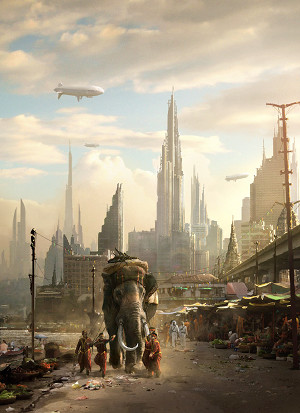


Imagine a future where climate change has had near-catastrophic effects. Sea levels have risen by several metres. Carbon emissions are strictly rationed and petroleum is longer used: there is no electricity, cooking and lighting is done by compost-generated methane, and all other energy needs are provided by muscle power, human or animal. Muscles move cycle rikshas, windup radios, lifts, fans, etc. (I couldn’t help wondering why solar and wind power aren’t used.) Genetic engineering has also advanced and the effects are almost as bad as those from climate change: global corporations engineer pests to kill all useful plants except those of their own design, and engineered diseases run amok.

Thailand, proud as ever, is surviving in this new world, pushing back against these changes. Bangkok is kept from drowning by seawalls and massive pumps; Thai specialists revive old varieties of plants from their seedbanks and forbid imports of seed or produce from the agribusiness giants. The ministries of Environment and Trade are the most powerful forces in the country, guarding it ferociously. Entire villages can be razed and burned when a genehacked pest is found.

The atmosphere is bleak and unpleasant, not only because of the dystopic changes but because of what has happened to the Thai people. Corruption and bribery is everywhere, as is hatred of foreigners – the Westerners with their agricultural corporations, as well as the Chinese refugees from Malaysia’s ethnic cleansing.

The windup girl of the title is only one of a number of key characters, who get roughly equal weight. None of them is particulary sympathetic but I still found myself sympathizing with them. Anderson Lake: a corporate spy from one of the agricultural corporations, trying to find Thailand’s seed bank, while running a battery research company as his cover. Tan Hock Seng: illegal Chinese refugee, Lake’s right hand man at the battery company, plotting to steal Lake’s blueprints, dreaming of becoming rich again. Jaidee: the head of Thailand’s environmental army, a thug who revels in destroying the illegal imports and unlicensed methane he finds and terrorizing anyone whom he finds breaking the rules. Kanya: Jaidee’s second-in-command, a Trade ministry mole in the very heart of the Environment ministry’s army. Emiko: the windup girl of the title, a woman genetically engineered by the Japanese to be the perfect geisha and given dog genes for servility, who unknowingly sets big events in motion.

The world is great, vivid, detailed, all implications of his imagined future are covered. The characters are multifaceted and well-drawn.

The story… not so much. There is no clear beginning and no clear procession from there on (although there is a clear end). Much of it is slow, wordy, and weighed down by a lot of detail. There is much scene-setting, and little happens for a long time. The plot wanders from character to character, which makes the book unfocussed but at the same time gives equal attention to all sides of the ongoing conflicts. In the second half the pace picks up and by the end we’re racing along, with political intrigue giving way to riots and revolution, with a lot of graphic violence.

It’s a bleak book about struggling to survive, remaining human, making difficult choices in difficult situations. Tough times bringing out the worst and the best of humanity.

The book was good enough that I didn’t want to give up on it, but not engaging enough to compel me to pick up the book. It was hard to get into and took me weeks to get through. Impressive, fascinating, thought-provoking, but not a joy to read. I’m glad I read it but I’m also glad it’s over.

PS: One final quibble. I can’t help wonder, why did he pick Thailand? It is a bit of a cop-out to set the story in one of Western writers’ standard go-to countries for exoticism. (Japan for high-tech exoticism, India and Thailand for sweaty, teeming masses.) There is nothing specifically Thai about the story; all of this could have taken place in any low-lying seaboard country in the world. Is it more acceptable to make an Asian country poor and ridden with corruption, than to do the same with, say, Holland (to pick another low-lying country)?

An excellent review over at Strange Horizons.

Amazon US, Amazon UK, Adlibris.

The Queen, out with her yapping dogs, stumbles into a travelling library that’s stopped behind Buckingham Palace. Out of politeness she borrows a book – one whose author she once made a Dame. Despite the author’s fine background the book turns out to be rather dull. Upon returning it, the Queen feels obliged to borrow a new one, and this time she is hooked.

Her staff do not read books (with the exception of Norman the kitchen boy), so they have little understanding for this new pastime. And the Queen is obviously losing any enthusiasm she might previously have had for such tasks as opening some public building or visiting a shoe factory. Her reading habit is seen as somewhat bothersome, and her private secretary, among others, conspires to put an end to it. But the Queen persists, and lives are changed.

This is a perfectly lovely little book. Charming, witty, wonderfully British, each phrase a joy to read. It is light entertainment but at the same time it is also a serious story about how literature can change lives. The Queen comes across as both eminently royal and surprisingly lovable and human. One wishes the real Queen read this book.

Adlibris, Amazon UK, Amazon US.

Eldbärare (“Fire-bearers”) is part 2 of a 4-part fantasy series. I reviewed part 1 some while ago.

At the end of book 1 the twins got trapped in a magic stone circle. After a year all of a sudden they get out. They’ve spent this year viewing the memories of the man who holds them in the circle. Since he’s hundreds of years old, they learn a lot. This is a useful plot device but to me it’s too much like cheating. At various points throughout the rest of the book, they can just think back, “oh didn’t we see/hear something like this back in the circle” and bam, problem solved.

But the twins still don’t really know what their father wanted them to do, or where they’re going. The world is still a mystery. It is hard to know who’s friend and who’s enemy. They continue their quest (and acquire a second one on the way) and continue to learn about the wide world that they know so little about. I rather like this setup – it makes much more sense than the usual fantasy setup where you have a quest mapped out and just need to get through all the hardships and slay all the dragons in your way.

This second book is a smooth continuation from book 1, which I really liked, but somehow book 2 falls short of my expectations. All the reviews I could find online were very happy with it, so I almost started to doubt my reaction, but I can’t deny that I was disappointed with it and I don’t feel any strong desire to read part 3.

Somehow the sense of urgency, of impending doom, of great responsibility, has weakened. Even though the twins have two important quests, one of which is pretty much on the “save the world” scale, it doesn’t seem urgent. The tone of the book, the behaviour of the kids themselves, the pacing, all would fit a quieter world with smaller worries and smaller quests.

Pacing is the book’s greatest weakness. A third of the way in, Sunia and Wulf find themselves in a community of people of the Blood. These people are sticklers for tradition, etiquette, courtly manners etc. They assure the kids of their intention to help but explain that these things take time. And for some reason the twins accept this. Despite the urgent need for action, when the forces of evil are approaching and the kids have not one but two important quests to fulfil, for a long while – nearly a hundred pages – they pretty much just sit around and wait. Once they leave the castle where they’re kept semi-imprisoned, the pace picks up, and the plot becomes much more interesting again.

A few elements of the plot are a bit too predictable. When Wulf’s eyes first meet the eyes of a girl, his throat immediately feels dry, and of course we know some sort of romantic feelings will arise. The romantic feelings are rather clumsily adolescent, with repeated variations on the theme of “I was feeling things for her that I couldn’t express in words”. This makes the whole book feel like a YA novel, which is not what I signed up for.

Other parts of the book feel fresher and more interesting. The people of the Blood have pretty strict gender roles and neither Wulf nor Sunia fit into those. Wolf is the one who’s good with words, and with a sewing needle; Sunia has great skill with the sword. This theme is presented relatively subtly and un-preachily.

It’s not a bad book. Like Ondvinter, its great strength is the “feel” of its world, its inhabitants, its history. The series is not innovative in the way that makes you go wow; there are no wild flights of fancy. It’s just a world that clearly has its own character (Nordic and slightly archaic) and is free from the whole dwarves and elves thing. But while this made book 1 worth reading, for me this is not enough to carry a whole series.

Adlibris.

One of my fundamental principles of parenting is that violence is not OK. Hitting, spanking, slapping, “disciplining”, whatever you call it and whatever spin you put on it – it is not OK.

Non-violence towards children is the norm in Sweden, unlike some other countries where I understand that there are people who publicly hold the opposite view. Here, if you spoke for spanking (and not in joking) you’d be viewed as seriously misguided at the very least. If you’re a parent and you told someone you hit your kids, I suspect that you’d find the social services at your door soon, or the police.

My views on this is not what I want to discuss here. Perhaps another time.

I’ve been reminded of this cultural difference by several books I’ve read for Ingrid. Occasionally we come across mentions of adults hitting kids. In some books it is talked about very openly, while in others it’s a more oblique reference. I often struggle with how to treat such collisions between our reality and the story. Do I let it pass? Do I explain?

In Pätu the father mentions getting his belt. In Sleeping Beauty the cook reaches out to slap the kitchen boy. Even Pippi Longstocking, when telling about how she sends herself to bed, says she threatens herself with a good hiding if she doesn’t obey.

Many of the briefer and more passing references probably don’t make any sense for Ingrid at all, and pass more or less unnoticed. “Ett kok stryk” or “keretäis” (“a good hiding”, in Swedish and Estonian respectively). She isn’t even familiar with these words, it is nothing we ever feel the need to talk about in this household. And fathers reaching for their belts or for birch rods? What for? These I explain when she asks, which she rarely does with things she doesn’t understand in a book.

But when we recently read Kipling’s story about how the elephant got his trunk (in an old Estonian translation) and the poor elephant child was beaten again and again by his family and relatives, and he didn’t react with anything but sadness, I felt I had to explain. That many many years ago people thought it was OK to hit kids, but not any more. That parents mustn’t hit their kids. That no one should hit anyone.

If you are a non-violent parent, how do you deal with such stories?