Egenmäktigt förfarande won the August prize in 2013 and reviewers praised it to the skies. I can see why, and yet I didn’t like or enjoy the book at all.

Ester, a writer/journalist, falls head over heels in love with Hugo, a famous artist. He seems sort of interested and they meet casually a few times. But it soon becomes apparent to everyone but Ester that he’s just not that into her. She can’t let go and desperately interprets every little action of his, looking for signs of love. He on the other hand needs that feeling of being desired and keeps her hanging on, never quite saying no.

If Ester was a teenager, I might find this believable. But I just cannot swallow the idea that an intelligent, rational adult woman with no apparent psychological problems would suddenly become so naive and blind, and lose all of her critical thinking ability as well as her self-respect. This book makes no sense to me.

And its wallowing in Ester’s inability to think clearly became very predictable and quite annoying after a while. At first I could empathise with Ester to some extent. But as the story went on and nothing ever really changed, I felt that her emotional state was so far from what I could relate to that it didn’t engage me at all any more. I turned the pages faster and read less of each one.

The story is so very simple that the book isn’t really about the story but about how it is told. Even though it’s all about emotions and passion, it’s very dispassionately written. I never get close to Ester. We may hear the thoughts inside her head but we see them from the outside, laid out in order and clinically dissected. It’s passion as described in an essay, using the most carefully chosen clever and precise phrases, strung after each other just so. Passion from a distance, so you cannot actually feel it, only analyze it.

A book for intellectuals to be impressed by, not for readers to enjoy.


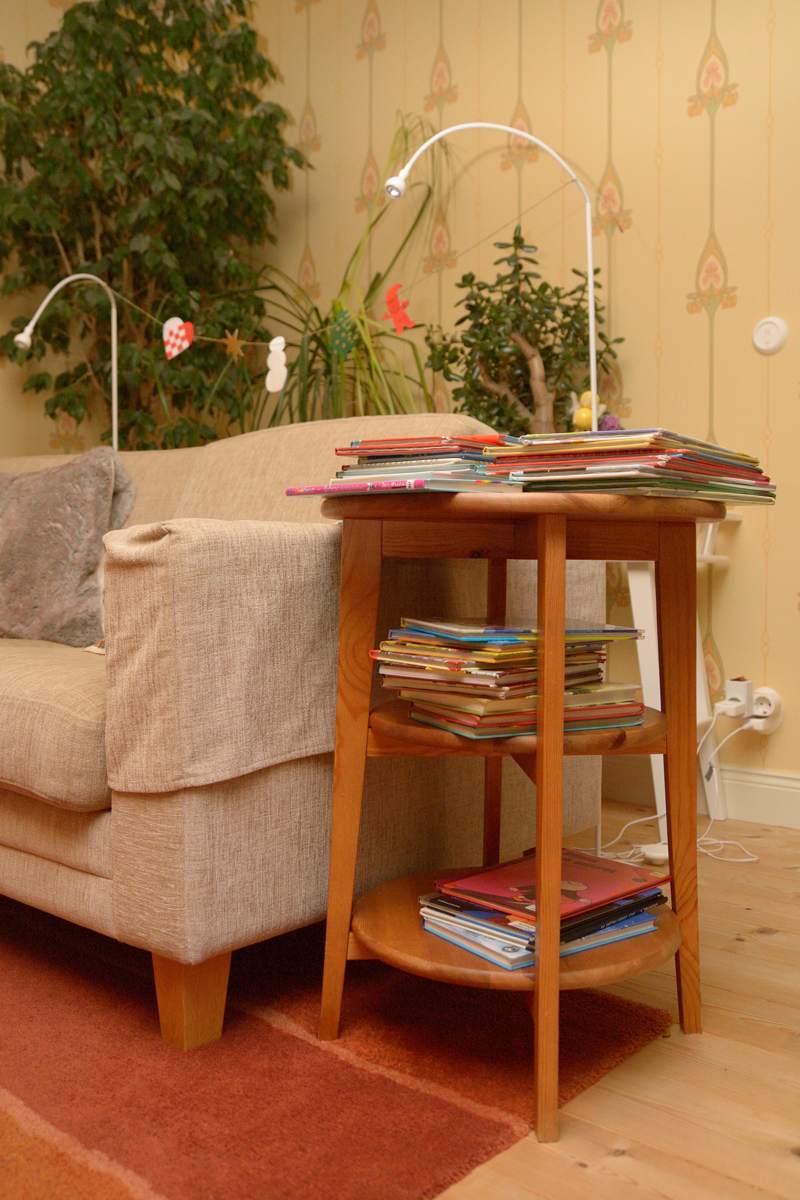
Our bookshelves are full, and books keep piling up on all sorts of surfaces here. I have 6 piles on my desk. There are piles on the bedside tables in our bedroom and the kids’ bedroom. There are piles on the side table next to the sofa. At least we manage to keep the piles off the floor…

Kate Atkinson’s Life after life is one of the best books I’ve read in a long time.

To quote the back cover:

During a snowstorm in England in 1910, a baby is born and dies before she can take her first breath.
During a snowstorm in England in 1910, the same baby is born and lives to tell the tale.

That baby is Ursula Todd. She dies at birth, strangled by her umbilical cord. But then the story starts over again, and this time the doctor makes it in time despite the snowstorm, and she survives.

At the age of four, at a beach in Cornwall, she and her sister are swept out to sea. No – an amateur painter notices the girls struggling in the water and carries them safely to the shore.

Again and again, Ursula starts over and avoids the death that ended her previous attempt.

Ursula herself gradually becomes vaguely aware that her life is repeating. She sometimes knows what is about to happen, and gets a sense of foreboding when she approaches a pivotal point in her life. Sometimes this helps her avert the tragedy; sometimes not.

The turnings and returnings may sound repetitive, but I would rather describe them as rhythmic, even mesmerising. Each time Ursula relives an event, we learn something new about it. Perhaps we see it from another character’s viewpoint, or maybe simply from a different angle. Our view of the web of Ursula’s life/lives becomes richer and denser with each turning of the wheel.

There are an awful lot of ways for a girl to die. Accidents. Influenza. (That one took several attempts to get past.) An abusive husband. The world war.

The war and the endless bombing of London take up a major chunk of the book. According to the author, the book was triggered by her thoughts the war that she just missed. It is a book of “bearing witness to the past”.

But to me it is also about the vulnerability of life, and the fear and pain of losing our loved ones. Ursula’s mother loses not just her, over and over, but sometimes also her brothers and sisters. Ursula herself sometimes starts over not for her own sake, but for that of others.

With these premises, the book could be a really depressing read. But there is so much warmth and love in Ursula’s lives, and there is always that persistent hope that next time will be better.

Kate Atkinson is an incredibly skilled writer. I feel tempted to pile up all sorts of praise here. Beautiful, rich, vibrant… This is a wonderful book, one of the best I’ve read.

To quote the back cover:

At a suburban barbecue one afternoon, a man slaps an unruly boy.
The boy is not his son.
This single act of violence reverberates through the lives of everyone who witnesses it happen…

In each chapter, we get a snapshot of the life of one of those persons. The man who gives the slap; the boy’s mother; their friends and relatives. Every chapter broadens our picture of their relationships, backgrounds, characters.

They’re all connected by more than that one event, of course. They wouldn’t have been at the barbecue if they didn’t know each other. Some are cousins, husbands and wives. Some are childhood friends, some are colleagues. So some parts of their lives overlap. But we also see the aspects of each life that are private, that they don’t show to their friends. And of course we see how differently two people can view the same things.

It’s an interesting idea, but I found the actual contents disappointing. It’s all one giant soap opera. Everybody does drugs; everybody is an adulterer; every relationship dysfunctional. (Oh, look, it’s even been turned into a TV series.)

It’s also a cruel, merciless, loveless book. Almost everybody in the book is miserable, full of contempt and anger against the others. And I absolutely believe that it is possible to write a great book about ugly people – but basically I just don’t like this author’s world view, and don’t enjoy reading a book like this.

What is the point of this book? What did he try to achieve? It sure doesn’t feel like he wants to tell a great story. The story-telling and the writing are pretty bland and mediocre. The characters are predictable and, in fact, all very similar to each other. I don’t care about any of them. There are no surprises.

Makes me wonder how much of the book is attention seeking, banal “like whoring”. Start with slapping a child, and then put in as much drug use, alcoholism, adultery, swearing, racism, everyday violence, teenage sex etc etc as possible, so as to shock (which seems to be almost required of modern literature). Slap your readers in the face.

Or maybe that’s what life in Australian suburbia is really like. Good thing I’m not living there.

I read the first few chapters and then just skimmed through the rest. I have no idea how it ended up on the short-list for the Man Booker Prize, or why anybody would describe it as a modern masterpiece.

More here, if you’re interested (and do read the comments as well).

In the world of Graceling, some people have “graces”, unique and extraordinary talents. Katsa (teenage female protagonist) has the Grace of killing.

The Graced belong to the king, and so does Katsa. The king, her uncle, uses her for his purposes, which are mostly unpleasant. Most Graced are feared and despised, and Katsa of course doubly so because of the nature of her Grace. Naturally she comes to also despise herself.

She has no friends, hasn’t had any for a long time, and doesn’t even know how to have friends, since her grace manifested itself at the age of eight. But then she meets someone who sees something else in her and actually becomes her friend. Although one has to wonder why, because Katsa is childish and immature, usually angry, and often lashes out in anger at everyone around her (verbally or physically).

She goes on a quest of a kind (solve a mystery, save some innocents and destroy some evil people, the usual stuff). En route she gradually comes to see her grace and her self with new eyes. And of course she finds love as well, and the future is bright etc etc.

With its simple heroics and simple romance, Graceling solidly falls in the YA category. Katsa is a strong character, easy for teenage readers to like and identify with. It plays to every teenager’s feeling of being an outsider and not fitting in. And unlike most teenage heroes, Katsa has a teenager’s feelings (perhaps more strongly than most). She is passionate, often angry, storming. She searches for her place in the world and for her own identity.

We have a strong character and strong feelings, some really strong scenes and a few very strong ideas. But the rest of the book is pretty weak. The plot veers from predictable to making no real sense. All supporting cast are clichés, with stereotypical evil kings, good-looking princes and sassy urchins.

It isn’t really bad, but I really wouldn’t say it’s a good book either. It kept me reading all the way to the end, but as soon as I took a step back, the flaws became glaringly obvious. I don’t mind reading about teenagers, but I do mind that the book almost feels as if it was written by a teenager. It may be that Kristin Cashore grows up and learns to write more maturely; in the meantime I won’t be looking to read any more of her books.

Bring Up the Bodies is the sequel to Wolf Hall.

By the end of book 1, king Henry VIII had freed himself of his first wife to marry Anne Boleyn, and incidentally also cut off the Church of England from Rome. By the end of book 2, his marriage with Anne Boleyn is over, after just 3 years.

Bring Up the Bodies covers a shorter time period (about a year) and so it is shorter and tighter than the previous one. It also has a rather different mood. Book 1 is about growth and becoming and arriving – Cromwell coming from nowhere to become Master Secretary to Henry VIII, Anne becoming queen. Book 2 is about revenge, unmaking and downfall. It is a tense book, full of fear and anxiety.

There is a feeling of inevitability: you know that the queen is doomed, Cromwell knows that the queen is doomed – it’s just that she herself doesn’t know it yet. Her relentless drive to marry the king is what leads Henry to break with the Vatican; her equally stubborn refusal to let go of him leads to her death, and others’ death too.

Anne really is framed as a villain here. But the picture we get of Cromwell is not much better. He almost seemed like a nice guy in book 1. He took care of his family and household, he was loyal to his master, he helped the poor. But while he is still nice and charitable and generous, another side emerges: Cromwell as a ruthless, calculating, vengeful man of expedience, serving no one except the king and himself, not hesitating to condemn men to death because it suits him.

It’s all about business, and not much about his personal or family life – he doesn’t have much family left, after his beloved wife, daughters and sisters all died in book 1. He gets close to no one. I was about to say that he treats everybody as chess pieces rather than human beings – but at the same time he uses their human frailties, their humanity, against them, to serve his purpose.

When the king needs men who are guilty, Cromwell produces some – not necessarily those who are most guilty, but those whose guilt is of most benefit to him. The law becomes a tool not for the good of the realm, but for furthering his personal aims. Only success matters. And because he is an excellent lawyer, clever and manipulative, he achieves it, seemingly without much effort.

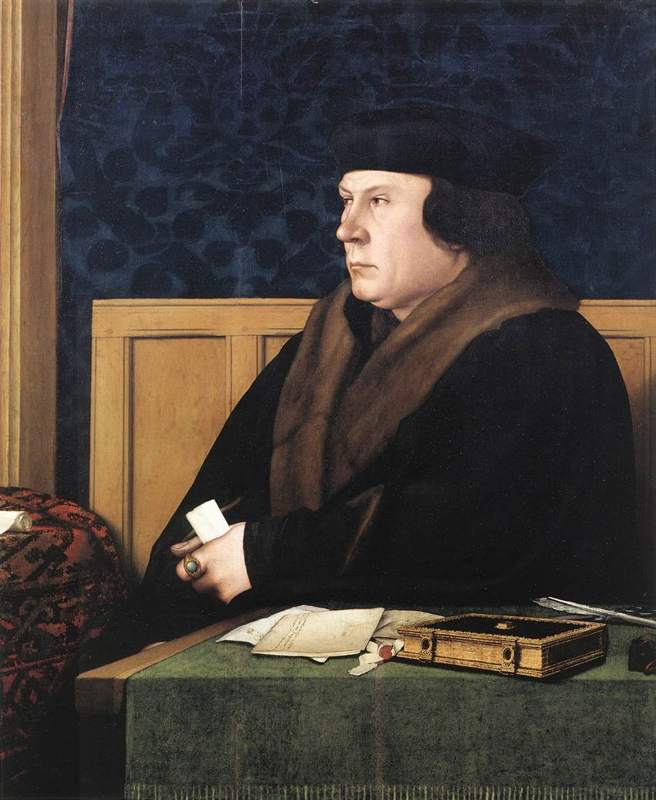
Hans Holbein’s portrait of Cromwell hangs in his house. Several times he jokes that Holbein makes him look like a murderer. But it seems he never thinks that he might actually be one – because he has the law on his side. And neither do we, really, because he is still such a likeable man.

Effectively the book frames the trial of Anne Boleyn (and those accused of adultery with her) as Cromwell’s personal revenge on those who brought down his master, cardinal Wolsey. Which is apparently not really in accordance with historical fact. And I don’t much like this idea as fiction, either: it gives Cromwell too much power, makes him too much of a “godfather” pulling all the threads, and wraps a complex series of events into a simplistic package.

But that’s a minor quibble. Bring Up the Bodies is still an excellent book, intense, beautiful, magnificently well written. I just loved it a teeny bit less than the previous book.

One good thing about reading prize-winning books is that lots of clever people write insightful reviews about them. If you want to find out more about this one, you might want to see what The New Yorker, The Globe And Mail and The Guardian have to say.


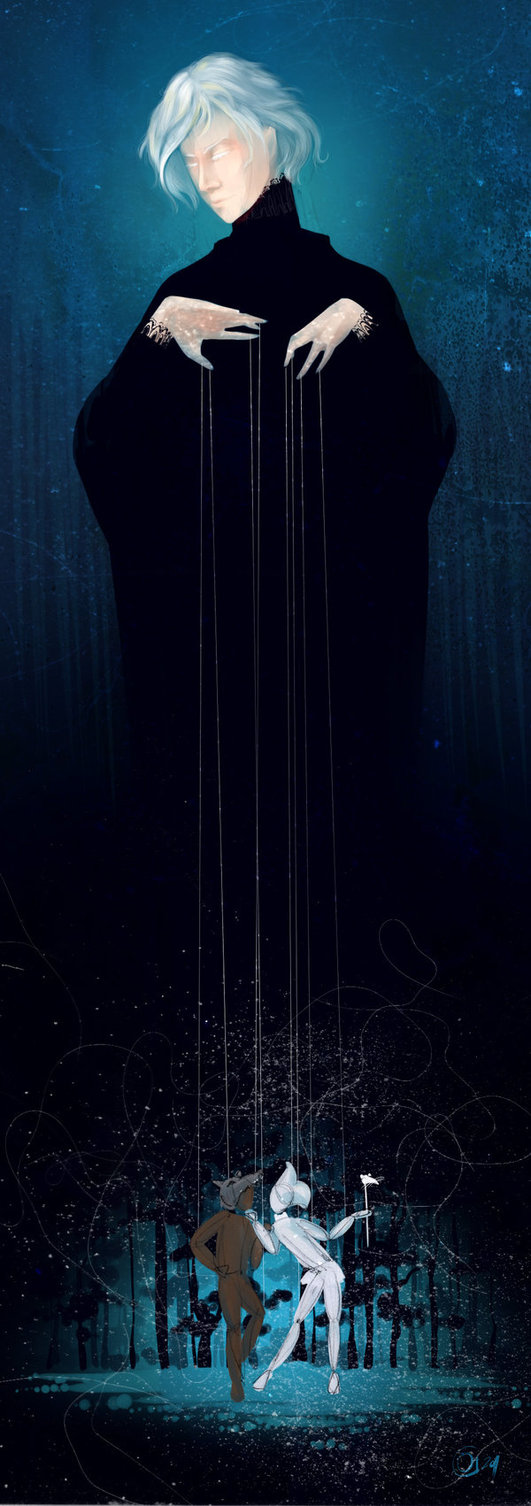
The Fool – fan art from DeviantArt

Fool’s Errand, The Golden Fool and Fool’s Fate make up The Tawny Man Trilogy, a sequel to The Farseer Trilogy. I thought I would surely have posted a review of the Farseer trilogy when I read it – it made such a strong impression on me – but that was in 1999/2000, way before I began blogging, so of course I couldn’t have.

I will try to stick to talking about the Tawny Man trilogy here, but if after reading this you decide to read it, please do start with the Farseer trilogy. You will get a lot more out of them this way.

These books are all about the characters and the relationships between them. There is a well-crafted world for these characters to inhabit, and a plot for them to follow, but those are really only there to support the cast. A quest to either revive or kill a dormant dragon? Fine, whatever, let’s go and find out – but please let me know what happens to the Fool!

To give you a quick introduction, the main characters are Fitz, the bastard son of a prince, who is raised by the prince’s stablemaster and trained as an assassin; and the Fool, who is simply the king’s fool. The lives of these two twine around each other, and it is this criss-crossing of their paths that makes up the series’ backbone.

A royal bastard, raised in a castle as a tool for the royal family – Fitz is always in the thick of things. He’s an unwilling hero who’d much rather have a quiet life and raise a family, but again and again he gets pushed into intrigue and danger – by fate, by a sense of duty, by friendship and love. “Adventure” is the wrong word for it when it is undertaken so reluctantly, and often fraught with so much tragedy, pain, hard work and frustration.

The Fool is the mysterious other. He is maybe not entirely human. Nobody knows where he came from, and there is some uncertainty about his gender. He talks in riddles and makes cryptic but precise prophecies that come true. He is entirely white.

But there are many other characters around these two, all fully developed and imagined in great detail. Many of them stick around throughout all six books. There are kings and queens, assassins and magicians, minstrels and warriors, even animals. What really struck me about Hobb’s writing is how real she can make those characters seem. I feel like I really know these people, almost as if they were my friends. In fact, because we see inside Fitz’s head (the books are written in first person), I can actually know him better than my real life friends, whose heads I cannot look inside, whose thoughts and emotions I can only guess at.

The joy of reading these books lies in slowly getting to know these characters – falling in love with some, coming to despise others – and experiencing the ups and downs of their lives with them. This being epic fantasy, their ups soar beyond mountaintops and their downs plumb the depths of despair. They fly with dragons, they are immersed in the joy of magic, they fall in love. They are betrayed, tortured to death, abandoned; lovers are separated, kingdoms threatened, friends die.

But the mundane is also there, making the characters human. They are bored, uncertain, they quarrel, they make mistakes.

Throughout it all, a few themes recur. Sacrifice is one. What is more important: the fate of the kingdom (and possibly humanity) or the life of a friend? What would you be willing to die for? And what would you be willing to give your life for?

Love is another. Where does the line go between love and friendship? What can it mean to love another?

And finally, the importance of everything. Life is the sum of all our experiences and choices, good and bad. You would not be you if you had not lived through the difficult, painful parts. We are making choices all the time, and all our choices matter.

“Not all men are destined for greatness,” I reminded him. “Are you sure, Fitz? Are you sure? What good is a life lived as if it made no difference at all to the great life of the world? A sadder thing I cannot imagine. Why should not a mother say to herself, if I raise this child aright, if I love and care for her, she shall live a life that brings joy to those about her, and thus I have changed the world? Why should not the farmer that plants a seed say to his neighbor, this seed I plant today will feed someone, and that is how I changed the world today?”

Without being overtly emotional in tone, these books are nevertheless more moving, more full of feeling than any others I can recall right now. (Some of Mercedes Lackey’s books are in the same league but don’t come close.)

The books were beyond absorbing, compulsive in the true sense of the word. I stayed up reading well past midnight not once but many times. I could not put down the book because even if I did, all I could think of was the book. I could not sleep because all I could think of was the book.

Hobb is too skilled to use simple cliffhangers. But still somehow each chapter ends at a point of such high tension that surely, I thought, the next chapter will have to resolve things, and then I can put it down.

And then comes the the crescendoing finale. After all this emotion, one hopes for an ending that is, well, perhaps not happy, but that somehow gives everyone what they deserve. This one doesn’t. It is tragic and heartbreaking. It is the antithesis of cathartic. I felt deceived, betrayed. I literally felt sick and my brain didn’t function properly for two days.

I sought the help of the Internet (you will find innumerable discussions of the ending there!) and it helped me make sense of the ending, to understand why this was in character for both Fitz and the Fool. That helped me accept it but it was still a crushing experience.

Just like with my photography courses, I am glad I did it, but I am also glad it’s over, because it took a lot out of me. And yet I will absolutely do it all over again.

You may also want to read this review, which is both well-written and entertaining, and covers aspects of the trilogy that I haven’t gone into. But then again, you might as well just skip it and read the books.
The narrator is a boy, just turned seven. His parents have financial difficulties and take in a lodger. Soon the lodger kills himself, and the boy is the one who finds him. This is the beginning of a spiral of terrors, where an otherworldly entity makes its way into this world, into the boy’s house, and into the boy himself.

The boy gets help from Lettie Hempstock, an eleven-year-old in the house at the end of the lane, and her mother and grandma. They turn out to be not quite from this world either.

The boy may be the narrator but he is mostly a passive participant in this story. The nameless alien entity comes into his life, and he cannot do much about it – all he can do is go to Lettie and ask for help. And when that doesn’t quite solve the problem, all he can do is wait for the Hempstocks to do something more about it.

This passivity, this helpless hanging on while knowing that there’s nothing you can do, is not a comfortable feeling. There is no sense of adventure, of daring – it’s mostly just about being afraid. That is what, to me, pushes the book from the fantasy genre into horror. I picked up The Ocean at the End of the Lane expecting it to be a modern fairy tale but got a horror story instead, and I’m not very fond of horror stories, no matter how good they are.

But this passivity is also very necessary, because the whole book is an allegory of childhood (certain angles of it at least). The book drips with allegory: life can be terrifying when you’re a child and the world is large and incomprehensible; parents are not always strong and wise; adults can seem like monsters at times; childhood innocence lost; adults don’t remember what it is like to be a child; etc.

The allegory is layered on so thickly that at times the story itself gets second priority. The boy is ordinary, unexceptional, not particularly interesting in any way. Which of course helps the allegory along, because the boy is everyman, but doesn’t make the story any stronger.

The themes of myth and fairy tales and ancient “gods” in a modern world is very Gaiman in a way, but at times the book reminded me more of Stephen King. It’s a Stephen King book set in Sussex instead of New Hampshire: a horror story that revolves around kids and has nameless horrors that you cannot afterwards describe, from beyond space and time.

It is all perfectly well executed, with wonderful skill and great mastery of language. But it feels more like a personal therapeutic/philosophical exercise than a novel. Felt great while I was reading it, but disappointing afterwards. I liked both Coraline and The Graveyard Book better: the ideas were fresher, the central characters more active participants in their own stories.

Finally, it really really irritates me that the boy gets the blame, and blames himself, for everything that goes wrong, when he has no idea that his actions could possibly lead to this. He thinks it’s his fault when it really is the oh-so-great-and-powerful Lettie who doesn’t properly explain the situation to him.

Quite often someone (especially a child) in a book or a movie is expected to do or not do certain things, but is not given sufficient information to make the right decisions. It is an annoying plot device. “Don’t let go of my hand” is not enough of a warning – the difference is huge between “don’t let go of my hand or you may fall and skin your knee” and “don’t let go of my hand or the world may end”. In some movies they don’t even say anything, and only when the poor kid has done X, someone tells them that they really really shouldn’t have done that. If something is so bloody important, you better say so before!

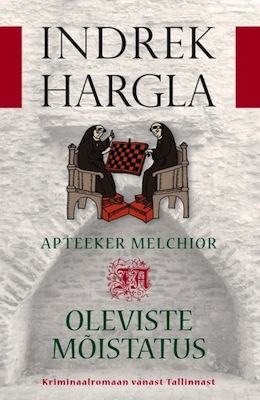
I have trouble finding Estonian fiction to read. Last summer I bought Indrek Hargla’s “Apteeker Melchior” series (the first three books), and quite enjoyed them.

Melchior is the town apothecary in Tallinn in the beginning of the 15th century. He has a strong sense of justice and a keen brain, and therefore cannot help but get involved in solving the occasional mysterious murder.

The books are a nice combination of well-crafted murder mystery and historical novel. Hargla’s descriptions of everyday life in medieval Tallinn are evocative and appear to be thoroughly researched: we get to read about everything from meals to bathing habits.

I wish the books had a better map of the city, ideally with an overlay of Tallinn’s current geography. The streets that Melchior walks, the houses and the back yards are all described very vividly, but since I am not a native of Tallinn this is rather a wasted effort without a map.

I read the three books out of order (just grabbing one randomly from the shelf when I wanted a book to read) but looking back now I can see a trend from a slightly teacherly manner to “wilder” stories. Book 1 dealt with the murder of a master builder and mostly takes place among worthy guild members. Book 2 had adulterous monks and sightings of ghosts; book 3 had a gambling den, more adultery, amnesiac foreigners etc.

All in all: nice, entertaining, well written.

I recently read Alfie Kohn’s book Unconditial Parenting. This is one of those books that I wish every parent would read. But I suspect that many would not even take this book seriously. Unfortunately those are the parents who would need this book’s advice the most.

It’s not a book that gives you practical tips to make your everyday life easier. In fact, after reading this book, your everyday parenting will probably become harder – because the book will make you think about parenting in a different way.

Instead of summarizing the book in my own words, I will let it speak for itself, by quoting the paragraphs that made the strongest impression on me.

This book looks at one such distinction [between different types of parental love] – namely, between loving kids for what they do and loving them for who they are. The first sort of love is conditional, which means children must earn it by acting in ways we deem appropriate, or by performing up to our standards. The second sort of love is unconditional: It doesn’t hinge on how they act, whether they’re successful or well behaved or anything else.
(p. 10)

In our society, we are taught that good things must always be earned, never given away. Indeed, many people become infuriated at the possibility that this precept has been violated. Notice, for example, the hostility many people feel toward welfare and those who rely on it.
[…]
Ultimately, conditional parenting reflects a tendency to see almost any human interaction, even among family members, as a kind of economic transaction.
(p. 17)

The way many kids are treated suggests a lack of respect for their needs and preferences – in fact, a lack of respect for children, period. A lot of parents act as though they believe that kids don’t deserve respect in the way adults do. Many years ago, the psychologist Haim Ginott invited us to consider the way we might react if our child accidentally left behind some item that belonged to him or her – and then to contrast that with the way we might react if a chronically forgetful friend of ours did the same thing. Few of us would think of berating another adult in the tone that is routinely used with kids: “What is the matter with you? How many times do I have to remind you to look around for all your things before you leave? Do you think I have nothing better to do than…” and so on. With an adult, we’d be more likely to say, simply, “Here’s your umbrella.”
(p. 49)

A fair amount of research suggests that people’s basic parenting styles “are already in place before they gain direct experience with their own offspring.” These styles are deeply rooted in experiences they had long ago.

A man left a message on my website recently that read, in part, “I watch, as if a spectator at a train wreck, as my friends use the same parental behaviors that wounded them when they were little. It is not a pretty sight.” Nor, I would add, is it a simple matter to determine why this happens. The folks he’s talking about presumably didn’t sit down and consciously decide to make their own kids as unhappy as they were.
(p. 106)

If you haven’t experienced emphatic parenting, it’s hard for you to become such a parent yourself. The same might be said of unconditional love: If you didn’t get it, you don’t have it to give. People who were accepted only conditionally as children may come to accept others (including their own kids) in the same way.
(p. 107)

Some parents live in terror of what other people – not only their friends and relatives, but the nameless and omnipresent judge known as “they” – will think of their children, and thus of their own parenting skills. […] Even relatively secure parents are sometimes made uncomfortable by the possibility that someone somewhere might be thinking, “Boy, that mother doesn’t know what she’s doing. I mean, just look at her kids!” Consider how much of what we do with our children is driven by worries about how we’ll be perceived by other adults.
(p. 111)

These excerpts represent the foundations of the book, and the parts that resonated most with me. But there are also more concrete principles and recommendations. This is a book to return to again and again. It is full of immensely important insights. It is also very readable and “just right”: neither too long nor too short, neither too academic in tone nor too breezy. I wish every adult would read this.

Amazon UK, Amazon US, Adlibris