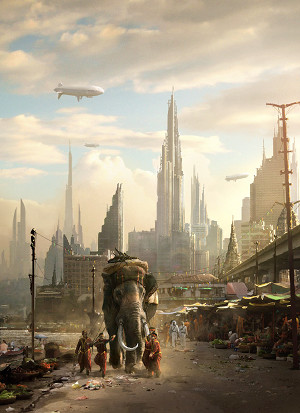
Imagine a future where climate change has had near-catastrophic effects. Sea levels have risen by several metres. Carbon emissions are strictly rationed and petroleum is longer used: there is no electricity, cooking and lighting is done by compost-generated methane, and all other energy needs are provided by muscle power, human or animal. Muscles move cycle rikshas, windup radios, lifts, fans, etc. (I couldn’t help wondering why solar and wind power aren’t used.) Genetic engineering has also advanced and the effects are almost as bad as those from climate change: global corporations engineer pests to kill all useful plants except those of their own design, and engineered diseases run amok.
Thailand, proud as ever, is surviving in this new world, pushing back against these changes. Bangkok is kept from drowning by seawalls and massive pumps; Thai specialists revive old varieties of plants from their seedbanks and forbid imports of seed or produce from the agribusiness giants. The ministries of Environment and Trade are the most powerful forces in the country, guarding it ferociously. Entire villages can be razed and burned when a genehacked pest is found.
The atmosphere is bleak and unpleasant, not only because of the dystopic changes but because of what has happened to the Thai people. Corruption and bribery is everywhere, as is hatred of foreigners – the Westerners with their agricultural corporations, as well as the Chinese refugees from Malaysia’s ethnic cleansing.
The windup girl of the title is only one of a number of key characters, who get roughly equal weight. None of them is particulary sympathetic but I still found myself sympathizing with them. Anderson Lake: a corporate spy from one of the agricultural corporations, trying to find Thailand’s seed bank, while running a battery research company as his cover. Tan Hock Seng: illegal Chinese refugee, Lake’s right hand man at the battery company, plotting to steal Lake’s blueprints, dreaming of becoming rich again. Jaidee: the head of Thailand’s environmental army, a thug who revels in destroying the illegal imports and unlicensed methane he finds and terrorizing anyone whom he finds breaking the rules. Kanya: Jaidee’s second-in-command, a Trade ministry mole in the very heart of the Environment ministry’s army. Emiko: the windup girl of the title, a woman genetically engineered by the Japanese to be the perfect geisha and given dog genes for servility, who unknowingly sets big events in motion.
The world is great, vivid, detailed, all implications of his imagined future are covered. The characters are multifaceted and well-drawn.
The story… not so much. There is no clear beginning and no clear procession from there on (although there is a clear end). Much of it is slow, wordy, and weighed down by a lot of detail. There is much scene-setting, and little happens for a long time. The plot wanders from character to character, which makes the book unfocussed but at the same time gives equal attention to all sides of the ongoing conflicts. In the second half the pace picks up and by the end we’re racing along, with political intrigue giving way to riots and revolution, with a lot of graphic violence.
It’s a bleak book about struggling to survive, remaining human, making difficult choices in difficult situations. Tough times bringing out the worst and the best of humanity.
The book was good enough that I didn’t want to give up on it, but not engaging enough to compel me to pick up the book. It was hard to get into and took me weeks to get through. Impressive, fascinating, thought-provoking, but not a joy to read. I’m glad I read it but I’m also glad it’s over.
PS: One final quibble. I can’t help wonder, why did he pick Thailand? It is a bit of a cop-out to set the story in one of Western writers’ standard go-to countries for exoticism. (Japan for high-tech exoticism, India and Thailand for sweaty, teeming masses.) There is nothing specifically Thai about the story; all of this could have taken place in any low-lying seaboard country in the world. Is it more acceptable to make an Asian country poor and ridden with corruption, than to do the same with, say, Holland (to pick another low-lying country)?

Leave a comment