I won’t be revealing much by telling you the starting point of the plot, since it’s in every review and on the back cover of the book. Fat Charlie Nancy, a wimpy, average guy, hears that his father has just died. And on top of that, it turns out that his father was a god – the trickster god Anansi. And Charlie has a brother that he didn’t know about. Charlie’s life is turned upside down, and he spends the rest of the book trying to right it up again.

This contrast between ordinary man and powerful gods sets the tone of the book: it’s a mixture of the mythical and the ordinary. On the one hand, people struggle with crappy jobs and unpleasant mother-in-laws – and at the same time they are persecuted by vindictive gods and go on dreamlike quests. The kind of book that reviewers inevitably describe as surreal. (Inevitably, I will do the same.)

One thing that the reviewers all agree on – and so do I – is that it’s a very funny book. Possibly too funny in places – the humour is too obvious, as if he was constantly grinning and winking at me. Despite this, I found the first half of the book slow going. I got to hear more than I wanted about Charlie’s drab life and his perpetual embarrassment about things.

In the second half (or thereabouts) the story comes more to life, and it starts to feel more like a Gaiman book: an unstoppable flow of surreal events takes off, pulling the characters with it, until everyone is spat out on the other side.

The plot was rather predictable and simple, and lacked the sense of mystery that Gaiman is usually able to create – the feeling that there is more to the world than we see. The mystery in this book is very clearly limited to Charlie and his brother, and that’s only because they are sons of a god. For everybody else, the world really is an ordinary predictable place.

The book does have some excellent scenes, where Gaiman lets loose his imagination and conjures up gods and ghosts and tigers. But these scenes don’t quite mesh with the rest of the book. All the various genres that Gaiman mixes in – slapstick, fantasy, crime, folk tale – never mix into one whole.

On the whole, not a bad book at all. Gaiman hasn’t written a single bad book. But it’s not as good as his other works. “Lightweight” is a word that comes to mind. Worth reading, but I won’t be going back to it again and again the way I do with Neverwhere or Stardust.

I won’t be giving away too much of the plot by saying that the book is about a 19-year-old prostitute in Victorian London. Unusually for young women of that time, she reads books and thinks and intends to get a decent life. She gets started on that route through the owner of a perfume business who falls in love with her.

While she is the heroine, somehow the world of the book revolves more around him. The key persons are his wife, slowly going mad from an undiagnosed brain tumour, his brother, his friends from student days. I’m not sure if this is intentional, but it seems suitable, given how it reflects the order of Victorian society.

The book is based on very thorough knowledge of Victorian England – half of the reviews on the web kept reminding me how 20 years of research have gone into this book. The result is a story full of vivid and believable detail about the lives of low-class prostitutes, the household of a well-to-do businessman, street life, dirt and sounds and smells.

There was dramatic tension enough to keep me gripped all the way through the book. I found some turns of plot a bit hard to believe, especially in the context of a Victorian society, but was willing to overlook them (and a few other technical weaknesses, such as the rather annoying first-person “dear reader” sections) in an otherwise well-told story. And yet somehow something was missing.

There is no purpose to all this wealth of detail and drama. I got no real insight into the characters, and they remained curiously distant. Neither did I really get any deeper insight into the society or times they lived in. And yet there is so much that could have been explored. Class prejudice, to begin with. Or Victorian sexual repression, which makes women into either prostitutes, or ladies who even as grown-ups don’t know where children come from, and are outraged by any hint of body shapes showing through the dress. Or the faint beginnings of a new era, when women are taking a more active role in society, and the importance of aristocracy wanes in favour of businessmen. All of these themes are occasionally hinted at, but never given any real attention.

This reminds me of a curious feature of the book, or rather, its characters. They also lack depth in their thinking, and are all surprisingly shallow. They don’t look further than the surface in others or themselves, and never attempt to understand or explain their behaviour. Judgements are based almost exlusively on prejudice and conventions: men’s prejudices about women’s ability to think, everybody’s prejudices about prostitutes’ weak morals and characters, etc. Life decisions just happen, without much thought of any kind. Admittedly this was a time before the birth of psychology, so I wouldn’t expect the amount of analysis that a modern person would naturally undertake. But surely people of above-average intelligence in any time period would exhibit some independent thought, some attempts to question, to understand?

The most disappointing part was the ending. The story is simply cut off, rather than brought to a conclusion. The author even felt it necessary to add another one of those “dear reader” bits to say that this is the end – otherwise I guess the reader would be wondering if perhaps some pages were missing from their copy of the book. Loose threads are left loose; the main characters’ lives are either destroyed or left in limbo. Nothing is resolved. Nobody grows or develops, nobody is left with a hope for a better life. Even the characters who hadn’t had much misfortune happen to them in the book, were sent off with hints of how they will suffer in the future. Such a bleak and heartless ending was truly depressing, and almost made me wish I hadn’t read the book. In a way the book does have a theme, I guess: “bad things happen to good people”, or “life isn’t fair”.


Reviews tend to describe this book as one of two things: a “Victorian epic” in the tradition of Dickens (of which it falls far short) or as a “bawdy, bold, and lusty romp” (which I find a more accurate description, if you disregard the end). It’s a period piece that never rises above its story. It could have been a really great book, given the effort and knowledge and skilful writing that have gone into it. It’s a bit sad to see that promise unfulfilled. Knowledge and dramatic skills may make a bestseller, but not a great work of literature.

Best review of “The Crimson Petal and the White”: in Salon.

This is the book that claims to be “the zero tolerance guide” to punctuation, a call to action to all those who have an “inner stickler”. It is nothing near the former (I guess an overzealous editor took liberties with the truth when writing the back cover text), and while I guess it could serve as the latter, it misses its target there as well, because – as various reviewers have already pointed out – the punctuation in the book occasionally ignores the rules it so praises.

“Eats, Shoots & Leaves” is really more aimless and lighthearted than the cover promises, which is probably why it’s sold so well. It doesn’t require the reader to actually engage much of their brain. It’s a series of ramblings on the topic of punctuation, with each chapter devoted to one punctuation sign. Each chapter generally contains an overview (but a rather cursory one) of rules applicable to that sign, and lots of anecdotes about its history and its use and misuse. All this is mixed with generous amounts of personal musings about the sign’s character, worth and importance. Generally the anecdotes and personal views get more space and attention than the rules – she positively revels in listing cases of apostrophe misuse.

The constant wittiness and jollity was on the border of becoming annoying, but didn’t quite cross that line. However it did overpower the contents – a case of favouring style over substance, definitely. I would have preferred more substance and less prancing around. Even the nuggets of knowledge that were there were spread out without any structure or framework. As a result I can’t remember any of the facts that I found interesting while reading it. An author with real expertise in any of the subjects covered could have done a much better job of presenting the information. A book about the history of punctuation marks could be really interesting – or one about various writers’ idiosyncratic use of punctuation.

The book does succeed in whetting appetites. It definitely brings home the point that punctuation matters and is worth paying attention to – not just by schoolteachers, but by everyone who cares about clear communication or wants their writings to have character and life. But if someone already cares enough to buy the book, do they really need a book to confirm their opinion? It is preaching to the converted and making them feel better about unleashing their “inner stickler”. Well, it might actually be of use as a gift from parents to older children: funny enough to keep them reading, so they might soak up some slight passion for commas without noticing that they’re learning things.

Serves well as light entertainment, but won’t make any lasting impact.

(“Let the right one in”)
A friend of ours works in the Science Fiction Bookshop in Stockholm, and occasionally gives us surprising books that we would probably never have found ourselves. This one is one of them. Her description, as far as I remember it, was that the book is “about vampires in the suburbs of Stockholm – not as silly as it sounds”. Having read the book, I can’t think of a better way to describe it myself.

There is a boy, about 12 or 13 years of age, in the western suburbs of Stockholm. Not the kind of suburbs with gardens and villas, but the kind with concrete blocks. There is a girl of about the same age who moves in to the flat next to where he lives, and they sort of tentatively become friends. All very ordinary… But then there is also a man who kills a young boy in the woods. And the girl smells like something dead. And things take off from there.

The premise may sound absurd, but it is treated so calmly and matter-of-factly that as pages go by, it becomes more and more believable. The characters live their ordinary lives in an ordinary part of Stockholm, and under the cover of this ordinariness, stranger things are presented to us as well, almost sneaking in unnoticed. Really, when you think about it, wouldn’t a dull suburb be a great place for vampires? And wouldn’t ordinariness be the best way to survive, instead of black cloacks and striking hairdos?

The book is beautifully written, with an easy yet sparse flow of words, and a great feeling of realism. Grips you and won’t let go – sucks you right in.

“Little, big” is about a family – the Drinkwaters – who see faeries, and whose fates are somehow linked to the world of faery. It all revolves around the family home, a large mansion somewhere in the countryside. Family members come to the house, leave it and come back again, marry into it and grow up in it. There is a sense that the house and the family are there for a purpose, even though no one really knows what that purpose might be.

It’s widely described as a masterwork and a classic, which led me to expect a lot more than the book had to offer. The language is beautiful – “lyrical” and “poetic” are terms that seem to recur in many reviews. But the author doesn’t seem do much with it. The book felt like it was building up and promising that more would come, but it never delivers. The story just ambles on while nothing much happens, occasionally slowing down further, and then it ends with nothing particularly climactic. Pleasant but unremarkable characters go about their slightly mysterious yet ultimately unremarkable lives. “Pleasant but ultimately unremarkable” is, in fact, quite a good summary of my impressions of this book. It is sort of like a long and fantastic dream… and then you just wake up. Meh.

Much of this lack of action is surely intentional, because this “waiting for something to happen” is exactly what the various Drinkwater family members spend a lot of their time doing. They are aware that their world is a magical place, even if nothing magical happens most of the time. They feel like they are on the edge of something big that can only barely be perceived. But that is in my mind not enough to keep a book going.

While I was reading “Little, Big”, I rather enjoyed it. But looking back, it didn’t leave a particularly strong impression, and even while I was partway through the book, it didn’t feel particularly important that I finish it. One reviewer at Amazon had a very apt comment that explains this:

Because it has no plot, you can open the book anywhere and start reading, set it aside, open it up tomorrow at a different place and it won’t make any difference to your comprehension of the story. No one chapter is contingent on the chapter that precedes it. No one chapter ever really resolves anything.

It’s somewhat tempting to look for reasons why I wasn’t more impressed with what’s so often lauded as a masterpiece. Perhaps I approached the book with the wrong assumptions. I was expecting a fantasy book, but got a meandering family saga. Or perhaps it simply isn’t for all tastes.

The pile of read-but-unblogged books is growing precariously high and threatening to topple soon. Time to reduce it – by picking the thickest one.

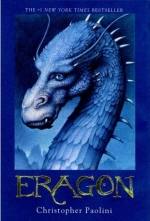
I bought Eragon for two reasons: it had a beautiful and stylish cover design with an unusually intelligent-looking dragon. And it was everywhere: every bookshop seemed to have it either as a staff pick, or a special offer, and it was always on prominent display in airport bookshops (which is where I got it).

As the covers clearly indicate, it’s a story about “One boy… One dragon… A world full of adventure” – adventure fantasy, that is. Just the right stuff for a long flight to New York, I thought.

The book felt entertaining enough to begin with, but the more I read, the more unsatisfying I found it. The language, above all, felt stiff and clichéd and dull – there was no sparkle, no gratifying turns of phrase of the kind that good writers come up with. Sentences were simple and tended to follow a common template.

The plot felt quite single-threaded, to borrow a term from the software world. Eragon (the boy in question) is in point A and decides to go to point B. He does so, while meeting with adventures on the way. In point B he pauses to find someone, or do something, and then figure out where to go next. The process then repeats from B to C. Each stage appears somewhat cut off from the rest: when a stage is underway, previous and subsequent stages are ignored. Most of what happened between A and B does not have any real repercussions later. It’s as if the author (or the presumed audience) could only think this far ahead, and no further, and just took things a little piece at a time.

None of the events or characters are particularly inventive – it’s a pretty ordinary flow of wandering, interspersed with a few battles. Nothing particularly unconventional happens. There is the usual young hero who has lost his parents, his wise but mysterious teacher, and then a trusted companion. All straight and relatively likeable, but with no particular depth to them. All the components have been done before by other writers, and better.

The world, likewise, is pretty much a standard fantasy world. Some mountains, some forests, some deserts, some villages. Pretty standard monsters and non-human races. Except that the world as a whole didn’t quite add up… Perhaps it is harsh to require realism in a fantasy book, but if a world does not stand up to closer scrutiny, it loses a lot of its spellbinding power. Towns in the middle of a desert with no feasible means of growing food; an “empire” consisting of a few dozen small villages and towns many days’ travel apart – but somehow strongly cohesive and with a strong central power. Distances, geography, population and economy just don’t add up. Sometimes other things don’t, either, such as when Eragon, previously illiterate, learns to read fluently in a week. Yeah, right.

At first I thought that the author had intentionally kept both the story and the language simpler than average to appeal to young readers, and perhaps not put that much work into crafting a coherent world. (The book is generally categorised as “young adult” literature.) What I didn’t know until after I finished it was that the book’s main claim to fame is the age of its author, Christopher Paolini, who apparently began writing Eragon when he was 15. Looking back, that explained everything. His age really shows.

On the whole, I have to say this is a good effort for a teenager, and better than most people (teenagers or not) could achieve. In fact it is probably even better than the average fantasy book, given the amount of template-produced junk out there. It works well enough as light reading on a rainy day, but it’s not enough to qualify as a good book, in any sense. The Curious Incident of the Dog in the Night-Time is far better, and so is Harry Potter, to mention two other books aimed at “young adult” readers. Another 5 or 10 years, perhaps, will let Paolini grow into a more nuanced language, and acquire some more original ideas.

An entertaining critique of the book from an editor’s perspective puts a lot more energy into pointing out shortcomings in both language and plot that a good editor should have spotted and gotten fixed. I couldn’t find any particularly insightful positive reviews, as those mostly seemed to be on the “This book is very good! I enjoyed it a lot!” level.

On the topic of book reviews, my high school teacher of Swedish (a strict, old-fashioned man who was probably more feared than loved) used to remind us time and time again: “a plot summary is not a review” – “ett referat är inte en recension”. While I found it frustrating as a 15-year-old, now, 10 years later, I think it is a pity that the world’s book reviewers haven’t yet been taught that lesson. Far too many of them start their reviews by giving away far too much of the story.

This is very much the case with Iron Council. So if after reading my review you’re thinking of reading it, I’d recommend you to just get it and dive in without reading too many more reviews.


China Mieville has a distinctive approach to story-telling. He uncovers some parts while keeping others carefully hidden until their time arrives. Indeed, after the first fifty pages of Iron Council I was still completely perplexed about why I was being told about these persons whose background or roles were never explained, as they seemed to be desperately trying to reach or catch up with someone else, in some unknown place of wilderness, for unknown reasons. And then the story switched to a different place and different people, who had no discernible connection to the first set of people. In fact it wasn’t even clear whether the two parts were taking place at the same time, or decades apart.

While it may feel somewhat frustrating at times, this is all done so deliberately that it would feel a shame to side-step the author’s intent. Instead, go with the flow and let things happen in their time. It will all make sense in the end.

Iron Council takes place in the same gothic/Victorian world, and revolves around the same city, as Mieville’s other books. Yet the world is treated the same as the rest of the story, in a way: we are told that which is relevant at each point, and not a bit more. Where other books would find ways to slot in brief lectures – by letting someone explain things to a child, or a foreigner – we are on our own here. There are no maps of the world or the city, which otherwise staple fare in books about complex fantasy worlds (all probably simply following Tolkien). We are not provided with a summary of its history or the city-state’s government, but offered glimpses of it as it touches the characters’ lives. Even the laws and forces of nature remain unexplained, even though it becomes clear early on that they are not the same as in our world. To the end, the world remains a vast, alien, complex and mysterious place, and we have only wandered through a small part of it. So the initial confusion is replaced not by clarity, but by a lingering sense of mild puzzlement.

Even though we are never given a chance to understand this world, Mieville somehow manages to give the impression that he himself knows all about it. It is so richly detailed, so vividly and intricately imagined, that it becomes entirely believable.

This is reinforced by the kinds of characters we follow. They are neither people of power, nor ordinary nobodies. They tend to be from the fringes of society. As with the world, the characters are presented in glimpses. The more ordinary aspects of their lives – those that do not immediately matter for the story – are ignored. Surely inhabitants of this world must buy groceries, have houses, get an education, use their public transport system? It’s all ignored, increasing our sense of alienation.

And as if this wasn’t enough, Mieville’s language compounds the effect. The language is rhythmic yet wild, poetic and naturalistic, as grotesque as the world, occasionally simply overwhelming. So is the vocabulary. There are some made-up words, of course – it’s hard to get by without these when your world has concepts that aren’t present in ours. But even his vocabulary of English words is so large that it becomes difficult to judge which words he’s made up, and which ones I’ve just never seen before. And when I say “large vocabulary”, I mean “you won’t even find these words in an ordinary dictionary”. There are literally hundreds and hundreds of words that look like they probably might be English, and whose meaning can generally be figured out from their context, but I don’t know for sure. But when there’s so much puzzlement already going on, what difference will a few hundred strange words make?

Mieville’s only weakness is in writing endings. His stories build up towards a massive climax, leading us to wonder how he will manage to bring it all to a close. He does well in Perdido Street Station, which deals with smaller-scale actions and forces. As his ambition grows, and his stories deal with changes in entire societies, his ability to bring them to a conclusion doesn’t quite keep up: both in The Scar and in Iron Council the ending is side-stepped with a weakish trick. Something grand is going on, and it has to either succeed or fail grandly, but instead he sort of avoids this choice, and neither happens.

All in all, I would say Iron Council, and Mieville’s other books, are great if you want something completely unique and unclassifiable, uncomparably imaginative, and unforgettable. Oh, of course one can find other good reasons to read this book… Grand themes such as Marxism and fascism, transcontintental exploration and exploitation, are present too, as well as various philosophical questions. But one can find these everywhere, while no one builds a world quite like Mieville does.

If you’d like to read more about the themes and threads of the book, I can recommend J. N. Mohlman’s review at Amazon. Skip the editorial reviews, though, as they’ve got too many spoilers in them. For a completely opposite perspective, from one who found the book frustrating and pretentious, try this review – well-argued, and only very mild spoilers.
Catching up with my pile of finished books, here’s one I finished about a month ago: Bangkok 8.

It isn’t what I normally read: a thriller / detective story in an exotic country. Starts with a dead body, which leads to another death (that of the detective’s partner). Sounds common enough. But when the murder weapon is a swarm of drugged snakes, and the detectives are dedicated Buddhists, and most of the action takes place in Bangkok’s prostitute district, you get something different. I’m not sure if any one of these would have been enough to get me to read the book, but all three together were hard to resist.

The atmosphere is about as bizarre as this initial setting makes it sound. But somehow Burdett manages to present it in such a way that it all sounds mostly plausible. I don’t know how true it is to Thai culture, or how true it is to facts – is the Bangkok police force corrupt through and through? do Thai radio news programmes talk about ghouls in the city? It doesn’t really matter, though, because it makes a good story.

While the detective story aspect is reasonably interesting, it isn’t what I remember a month after reading the book. It’s just there to provide a scaffolding from which the rest of the book can hang. Instead, I remember the exploration of the sex trade, and the Thai view of westerners’ obsession with sex, and the tale of the detective’s prostitute mother. Don’t get me wrong, it’s not a moralising book. It’s not exactly immoralising either – there is no actual sex in the book. It’s just very matter-of-fact, but seen from an unfamiliar angle.

I think I originally found this book through a brief review in the book catalogue of Stockholm’s Science Fiction bookshop. At the time I wondered why they would list a book like this. Having read it, I understand: even though the story takes place in our world and our reality, it all feels surreal and somewhat alien.

They say you shouldn’t judge a book by its cover – but you’ve got to start somewhere, and the cover is the first thing you see, if you look at a book in a bookshop. And the covers are often quite informative. So I do judge books by their covers. Especially when it comes to SF, where there are many more good books than I have time to read, and where covers can say a lot about the type of book. If the cover shows a half-naked woman + horse + sword, or spaceships in battle with beams of light, it’s generally safe to assume that it’s a traditional story with nothing particularly interesting to offer. Most of my recent purchases of SF books have either been based on the cover, or authors I already know.

The cover of “Tom O’Bedlam” is both beautiful and intriguing, and I had to look inside. The books by Robert Silverberg that I’ve read previously have been somewhat disappointing – not exactly dystopic, but rather grim – but this one seemed different.

It’s a post-disaster world, with half of America inhabitable due to radioactive dust. Civilization still exists, but society’s mood is one of dull hopelessness. Against this gloomy backdrop, people start having dreams of beautiful alien worlds – verdant, peaceful, cultured. Different people report having the same dreams, and the dreams get more and more intense. And for some reason, they’re most likely to happen, and most intense, near one man – the crazy, innocent Tom O’Bedlam. He himself has those dreams even while he is awake.

Calling this SF is a stretch, really – it is really a future fantasy, there’s barely any science there. It’s about how people react to and deal with the unknowable – mistrust, hope, mysticism, cynicism, adoration… But in the end, it’s mostly about belief. Above all, it’s a very beatiful book (the cover didn’t lie!) – beautiful descriptions of beautiful dreams and visions, vivid and detailed. In fact the whole mood of the book is beautiful – there is hope for people in a world of despair. An uplifting read, without getting mushy, and a gripping story. Left a good feeling after it for several days; best book I’ve read in several months.

Subtitled “A rogue economist explores the hidden side of everything”, and having praising quotes from Malcolm Gladwell and the Wall Street Journal on both the front and the back cover, and positive reviews in all sorts of places, this book has certainly gotten a lot of attention. And the premise is an interesting one: an economist points his economist’s way of thinking at problems that aren’t traditionally considered as part of the field.

The economics covered are microeconomics, or how individuals make their decisions (as opposed to macroeconomics, which is concerned with entire nations and economies). Different chapters cover different aspects of economic thinking. One discusses cheating and the detection of it – among schoolteachers cheating their students to better results on standardised tests, and among sumo wrestlers. In economic terms, this is about incentives and statistical measurement. Another chapter covers information asymmetries and the power of having more information than outsiders – exemplified by real estate agents, and the story of how the Ku Klux Klan was more or less destroyed when its secret information was made public. Other chapters examine the economics of crack dealing, what childhood factors affect a child’s success as an adult, and the different distributions of baby names among high-income parents and low-income parents.

I really wanted to like this book. It applies an analytical approach to everyday problems, and that sort of thing always deserves encouragement. And economics is an interesting subject, so if someone can write an interesting and entertaining book about it, that’s a good thing.

But ultimately the book left me unsatisfied. First of all, it was really lightweight. Big type, sparse layout, 200 pages – barely a day’s worth of reading. And while I knew it was aimed at a non-specialist audience, I was expecting a weightier discussion than this. It appears to be aimed at a rather naive audience who doesn’t really question conventional wisdom, or anything much at all. A fair amount of space is dedicated to excerpts from the NY Times essay about Levitt that led to this book, and there is quite a lot of repetition. The book’s magazine-article origins shine through, I guess. Too much entertainment, stories and anecdotes; too little substance.

Related to this problem of light-weightedness (is that a word?) is the unfortunate fact that some of his claims don’t really hold up when you look at them more closely – he presents facts that support his thesis, but doesn’t look for alternative explanations or contradictory evidence. Dave Taylor goes through a bunch of these slips.

And then of course there’s his best-known chapter, about how the decline in crime in the US was due not to gun control, better policing, higher usage of prisons etc, but to the greater accessibility of abortions. That one appears to have been debunked (solid discussion at ISteve; see also articles in the Economist and Wall Street Journal.) The main methodological flaw is that they measured total arrests, not arrests per capita… oops.

On the whole, a relatively entertaining read, but not worth the money if you know anything about economics at all, and won’t leave any lasting memories.