The pile of read-but-unblogged books is growing precariously high and threatening to topple soon. Time to reduce it – by picking the thickest one.
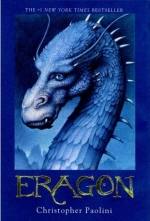
I bought Eragon for two reasons: it had a beautiful and stylish cover design with an unusually intelligent-looking dragon. And it was everywhere: every bookshop seemed to have it either as a staff pick, or a special offer, and it was always on prominent display in airport bookshops (which is where I got it).
As the covers clearly indicate, it’s a story about “One boy… One dragon… A world full of adventure” – adventure fantasy, that is. Just the right stuff for a long flight to New York, I thought.
The book felt entertaining enough to begin with, but the more I read, the more unsatisfying I found it. The language, above all, felt stiff and clichéd and dull – there was no sparkle, no gratifying turns of phrase of the kind that good writers come up with. Sentences were simple and tended to follow a common template.
The plot felt quite single-threaded, to borrow a term from the software world. Eragon (the boy in question) is in point A and decides to go to point B. He does so, while meeting with adventures on the way. In point B he pauses to find someone, or do something, and then figure out where to go next. The process then repeats from B to C. Each stage appears somewhat cut off from the rest: when a stage is underway, previous and subsequent stages are ignored. Most of what happened between A and B does not have any real repercussions later. It’s as if the author (or the presumed audience) could only think this far ahead, and no further, and just took things a little piece at a time.
None of the events or characters are particularly inventive – it’s a pretty ordinary flow of wandering, interspersed with a few battles. Nothing particularly unconventional happens. There is the usual young hero who has lost his parents, his wise but mysterious teacher, and then a trusted companion. All straight and relatively likeable, but with no particular depth to them. All the components have been done before by other writers, and better.
The world, likewise, is pretty much a standard fantasy world. Some mountains, some forests, some deserts, some villages. Pretty standard monsters and non-human races. Except that the world as a whole didn’t quite add up… Perhaps it is harsh to require realism in a fantasy book, but if a world does not stand up to closer scrutiny, it loses a lot of its spellbinding power. Towns in the middle of a desert with no feasible means of growing food; an “empire” consisting of a few dozen small villages and towns many days’ travel apart – but somehow strongly cohesive and with a strong central power. Distances, geography, population and economy just don’t add up. Sometimes other things don’t, either, such as when Eragon, previously illiterate, learns to read fluently in a week. Yeah, right.
At first I thought that the author had intentionally kept both the story and the language simpler than average to appeal to young readers, and perhaps not put that much work into crafting a coherent world. (The book is generally categorised as “young adult” literature.) What I didn’t know until after I finished it was that the book’s main claim to fame is the age of its author, Christopher Paolini, who apparently began writing Eragon when he was 15. Looking back, that explained everything. His age really shows.
On the whole, I have to say this is a good effort for a teenager, and better than most people (teenagers or not) could achieve. In fact it is probably even better than the average fantasy book, given the amount of template-produced junk out there. It works well enough as light reading on a rainy day, but it’s not enough to qualify as a good book, in any sense. The Curious Incident of the Dog in the Night-Time is far better, and so is Harry Potter, to mention two other books aimed at “young adult” readers. Another 5 or 10 years, perhaps, will let Paolini grow into a more nuanced language, and acquire some more original ideas.
An entertaining critique of the book from an editor’s perspective puts a lot more energy into pointing out shortcomings in both language and plot that a good editor should have spotted and gotten fixed. I couldn’t find any particularly insightful positive reviews, as those mostly seemed to be on the “This book is very good! I enjoyed it a lot!” level.

Well it’s really nice to come across yet another person who feels this way. My favourite game is spot the plot hole, problem, or other book. My favourite one was wearing a five foot sword at the waist. But I digress. Yes he is a young author with much promise, but most serious authors would lock their first attempt at a novel in a box and bury it in cement. Hence it is saved for memories but it will not rear its embarassing experimental head at some later point when the work is creditable and with a little luck even original.
Thanks for the review (in case you were wondering, I found your blog in a google search about this book). I just cleared the first 100 pages of Eragon and was wondering if it would get any better. After your review and some others I’ve read I plan to finish the book, if for no other reason than to be able to compare it to the movie, but I don’t plan to pick up the next book anytime soon. I have a lot of books sitting on my shelf that sound more interesting.
It is nice to know I’m not the only person unduly impressed with this book. After all the hype I was wondering if I was the only person picking up on the cliches.
Personally, I LOVED the book, seeing as though I AM a young adult, which is the age group the book is aimed at. I agree that there are some boring parts where you can tell that Christopher P. was running out of ideas, but i think overall the book was GREAT!!! And I think that “Eldest” is even better; even if the boring parts in that one are more boring than in “Eragon.” But the boring parts don’t even come CLOSE to how boring the beginning of “Lord of the rings” is. “Lord of the rings” books are WAY worse than the inheritance trilogy. So, like i was saying before, if you aren’t a young adult, and you don’t like fantasy, you wont like the books. But if you ARE a young adult, and you DO like fantasy, (like myself) there is a 97.8% chance you will LOVE “Eragon” and “Eldest.” Whether you are either a young adult, or if you like fantsy or not is a mystery to me.
YOUR BOOKS ARE AWESOME!!!!! I love your writing. It is soooooooooo good!!! When is the 3rd book going to come out? What will the title be? Are Eragon and Ayra going to get married and have a son named Ayragon?? LOL……I love writing too and I want to write fantasy just like you!! You are soooo COOL!! :)
-Ashley :)
YOUR BOOKS ARE AWESOME!!!!! I love your writing. It is soooooooooo good!!! When is the 3rd book going to come out? What will the title be? Are Eragon and Ayra going to get married and have a son named Ayragon?? LOL……I love writing too and I want to write fantasy just like you!! You are soooo COOL!! :)
-Ashley :)
ur books rock out loud i love reading them
ur books r awsome i love reading them
I LOVED Eragon and Eldest. Sure, in some places it gets a little boring, but i was captured by the first page onwards. it was a wonderful effort by a teenager, and i say C.P. did a great job *tremendous applause*
PS i also agree with Ashley:)
I just wanted to say that first off The Lord of th Rings is a great story through and through. Now why I am commenting….. C.P. please fire anyone who had a hand in the Eragon movie and start over from scratch…. They obviously had no idea what the story had to offer and how in the world could they ever tie in a sequel with the terrible ending they portrayed. Seriously if I hadn’t of read the books Eragon and Eldest.. I would’ve of never gone near them after the movie. You are a very talented writer but you should just start over from scratch with the Eragon movie because whoever tried to make that movie had no clue as to what you wrote…. I would sware they never even read your books. At this point if a sequel comes out I will not spend a penny on it. Please give us an Eragon movie that is from your imagination and not from hollywoods b.s. I would without a doubt go and see your version of Eragon before I would ever go and see a butchered and ruined version of an absolutely wonderful story. In short great work with the first to book in the inheritance serious but please let someone who loves and respects your hard work make your movies from now on; so we can all enjoy what you meant for us to enjoy.
Thank you for the two absolutely wonderful books you’ve given us but seriously do not let them people from Eragon movie have a thing to do with a sequel please!
i thought the books were awesome and whoever doesnt like the books u got somethin wrong wit u does anyone no when the third book is comin out???????
when does the third book come out in canada?
To the dear Fans of Eragon GOD DAMMIT YOU PEOPLE SUCK IN BOOK TASTE I MEAN I HAVE ONLY GOT HALF THROGH THE BOOK AND I ALMOST GET SICK WHEN I TRY TO GET THROGH THE OTHER HALF MEAN IT CAN SERIUSLY NOT BE A GROWN UP MAN WHO IS MADE THIS BOOK IT IS MADE LIKE IF A LITTLE GIRL HAD SEEN LORD OF THE RINGS AND THEN JUST REWRITE THE HOLE THING JUST WITH DRAGONS IN IT AND ANOTHER WHY IS THE MAIN CHRATER GAY I MEAN HE ACT LIKE IF HE WAS SCRAED OR SOMETHING LIKE THAT I AGREED WITH JON JUST THAT THE PERSONS WHO HAD A “HAND” IN IT SHOULD NOT JUST GET FIRED NO!!! THEY SHOULD GET HANGED AND TO ALL YOU NERDS OUT THERE WHO LIKE IT PLEASE KILL YOUR SELF OR STAY IN THE FOREST WHERE YOU PLAY LIFE ROLEPLAYING ( im sorry if i have spelled some thing wrong but the reason is that im not from england)
the third book is called EMPIRE and it is green. it has a picture of Rorans dragon. Roran hatches a dragon in the third book.
I hated the book, 1. it is 2D, 2, the vauge plot is from Star Wars, 3. Elves and Dwarves are from Lord of The Rings, and 3. Names, descriptions, and animals are from The Wheel of Time which are the BEST!!!!!!!!!!!!!!!!!!!!!!!!!!!!!!!!!!!!!!!!!!!!!!!!!!!!!!!!!! ever(though it shouldn’t be read by younger audiences for some sex content), but is still the BEST book ever.
I hated the book, 1. it is 2D, 2, the vauge plot is from Star Wars, 3. Elves and Dwarves are from Lord of The Rings, and 3. Names, descriptions, and animals are from The Wheel of Time which are the BEST!!!!!!!!!!!!!!!!!!!!!!!!!!!!!!!!!!!!!!!!!!!!!!!!!!!!!!!!!! ever(though it shouldn’t be read by younger audiences for some sex content), but is still the BEST book ever.
that 3rd book sounds so awesome! i htought eldest was as good as it gets but now EMPIRE sounds 10x better! OMGosg i cant w8 till i get it!does any1 no the realise date?
that 3rd book sounds so awesome! i htought eldest was as good as it gets but now EMPIRE sounds 10x better! OMGosg i cant w8 till i get it!does any1 no the realise date?
Never one for fantasy myself, the ocver had grabbed my attention nonetheless and after seeing it on a ‘recommended reads’ list at the library, I felt compelled to check it out. A couple chapters into the book I realized that Paolini’s writing, while lacking a certain finesse, still managed enoough dimension within cerrtain scenarios to produce a worthwhile read. While a HUGE number of COMPLAINTS come from readers who are affronted by the seemingly enormous amounts of plagiarism within the story, I enjoyed it most becuase it seemed to combine the most constant, interesting aspects of writers within the fantasy genre (really, there’s not a wholelot of room to manuever there anyway). I could never stomache so much Tolkien for so long, nor did I ever get into Star Wars, either. Eragon provided me with the same perspective and relatively similar plot as these other books, but without so much depth and length. It was lighter and more fun and I RECOMMEND THIS BOOK FOR ANYONE INTERESTED IN SIMPLY DABBLING IN SOME FANTASY FICTION- it covers all the bases with less intensity.
I personally think that eragon was the most original book of all time from begining to end also eldest isnt the best book by [paolini becuse it fosent focus on any main setting the story keeps switching around it never stays on a main scene but alas eragon rocks in originality and fantasy christopher you truley are my idol
Christopher Paolini reminds me of the Guptara twins Suresh and Jyoti, as they are also young fantasy writers. You may have heard of their bestselling book, Conspiracy of Calaspia, and if you haven’t, i suggest you read it. The book is fantasy,and is set in another world, but the twins spare the cliches of elves and dragons. An international competition is actually being started revolving around the book, in which you write a 1000 word essay, and 10 winners will win a 10 day literary tour of england, and 2 weeks at the triennial C.S Lewis writing acadamy.
wen is book 3 coming out
hi,i LOVE Eragon & Eldest and i’m so excited for the 3rd book so…….WHEN DOES IT COME OUT ?????!!!!!
hi,i LOVE Eragon & Eldest and i’m so excited for the 3rd book so…….WHEN DOES IT COME OUT?????!!!!!
Roran is not getting a dragon. Eragon is not going to date Arya. Christopher Paolini sayd that in an interview. And I don’t know why you guys say bad things about the book as you wouldn’t even be capable to write something like that with 15 or 70 years- old. Idiots!!! the books are awsome!!
I loved this book, from start to end I was pulled into this fantasy world created by the very talented Christopher Paolini. I am in the process of attempting to write a fantasy novel myself, its no easy task. The world was well described, the caracters were as believable as fantasy caracters can get, and it was humourous. The movie is what ruined it, its like they took a quarter of the book and left the rest of it out. And what they did include in the movie they screwed up as well. The book was awesome and the movie was a crime as far as I’m concerned. I pity Chris for having had to see his masterpiece hurt by the stupid hollywood interpretation.
Mikkel you idiot, are you inviting a bunch of people to commit suicide. Did everyone read that, imagine if some sort of authority were to fall upon this. Now to correct you if a little girl had written it, it would not be a dragon but a giant tulip breathing love power. I mean honnestly, I never seen a little girl write such a novel. Second of all it had nothing to do with lord of the rings. The plot is not one caracter trying to destroy an object of power, the lands are different. There are no orcs, the caracters are very different. If anything its closer to star wars. A farmer boy becomes a grand hero and faces off with a deadly foe to save the world. And of course Eragon acted scared, wouldn’t you be if you were suddenly flung into the life of a dragon rider. The people who raised you dead, razac and a shade trying to kill you, the urgals. I would be, you would shit yourself. And you wouldn’t be able to fight worth a penny’s worth. So of course he is scared, Chris made the caracters realistic and although I marvel at J.R.R. Tolkien’s work, real people do get scared once in a while. And the fact there are elves and dwarves does not make eragon a lord of the rings rip off, so next time you insult a great work of art be like the others who didn’t like it and give valid points!
Thank you. I really didn’t like the books either, and I don’t think they were written very good. When I read it, I thought it was OK, mostly because it had a dragon in it, but I wasn’t very invested in the characters. I only wanted to continue reading after Eldest because I had a vague curiosity about the fate of Elva, but that’s about it. This isn’t what I consider to be the signs of a good book–I don’t care about what happens to the characters or about them, period, because I know what’s going to happen: Galbatorix will be defeated, Ergy hooks up with Arya, Happily Ever After, blah blah blah THE END. Really, it’s too predictable, and not to mention strangely written. I can see Paolini’s age showing through his words, like the fact that everyone rarely “says” anything. It’s always “admonished Oromis” or “Eragon declared hotly” or (everyone knows this one) “Apologized Brom.” There’s no reason for all these mutations to be here when we already know Brom is agreeing. Then theres the plot holes and the magic system lifted almost directly from Earthsea. That’s just my two cents.
Mr Paolini is A writer: very good at his task, very indeed. BUT…! I’m afraid I am a devoted supporter of Master Le Guin from whom Paolini learned (!) a lot, not to say Master Tolkien, Mr Brooks and many others, last but not not least Master Poul Anderson with his “The Broken Sword”. Agood writer indeed as I said, but not a phenomenon: Christopher, don’t let yourself be used as a guinea-pig and be considered an experiment, sort of Frankenstein. You have talent: now show your creativity.
To all those who think Eragon, Eldest and Brisingr are boring:you must stick with the book, no matter what. It may seem boring at times, but you have to let yourself get sucked in by the flow and keep reading. Trust me, if you leave Eragon three quaters of the way through, then start reading it a month later, you will notice that you LOVE it, and that you cannot compare it to anyother book. If this fails to work, then you clearly AREN’T a bookworm. Also, the 3 (soon to be 4) will keep you going for much longer than most books. To the man himself; no matter what anyone says, you are the best author of all time, but people need to have a real taste in books to love yours’. Well done!
:D
P.S:THE MOVIE F****** SUCKED! IF I EVER FIND THE PEOPLE WHO MADE IT, I’LL THROW THE BOOK AT THERE HEADS!
the third book is brisingr and its comming out on the dec 20 2003