Half a year ago I saw a play based on the novel Embers by Sándor Márai. Now I’ve read the book.

Somewhat to my surprise I didn’t enjoy the book as much as the play. Perhaps because I saw the play first, and therefore approached the book with too specific expectations?

Plot-wise, the play was a very faithful adaptation of the same book: the same story, told in the same manner. I found the presentation of the story, the gradual uncovering of facts, as impressive and skilful as I did when seeing the play. Some episodes had been cut, of course: mostly background story about how the two men grew up together. These helped build the story, but were not essential.

I thought the pacing of the book was uneven and at times annoyingly slow. From time to time, Henrik makes a pause in the “real” story in order to deliver a lengthy lecture (I can’t think of a better description) about some deep and important concept such as friendship, revenge, or loyalty. The lectures were irritating interruptions in the flow of the story, and I frequently found them uninteresting and too wordy. I cannot remember whether these were present in the play as well – if they were, then they must have been delivered in a manner that made them interesting in a way that words on a page couldn’t achieve.

Reading allows a slower pace than listening, so as I read the book, I had time to notice some of Márai’s linguistic mannerisms. He shows a great fondness for far-fetched, almost absurd, similes for describing peripheral, unimportant objects. Important objects and people, on the other hand, are barely described.

For example:

In the castle courtyard there was an incredibly ancient fig tree that looked like some oriental sage who only had the simplest of stories left to tell.

Why an oriental sage, of all things? And what on earth does the simplicity of stories have to do with it – how would a fig tree with complicated stories differ from this one?
Also, neither the castle courtyard, nor the fig tree, are important at all, even as a setting. The sentence sits in between other, more interesting ones, without fitting in. It does not contribute to my understanding of what is going on, or to convey a particular atmosphere. It is just unnecessary, in my opinion.

Once I had noticed a few of these similes, I kept seeing them everywhere, and after a while they became really grating.

Yet on the whole I have to say that these two complaints are minor, and due to my personal preferences. Another reader might disagree completely. And the book is well worth reading despite them, because the story is interesting and very well told. (Do read my review of the play for more about that, if you’re interested.) Not everybody can see the play, after all.
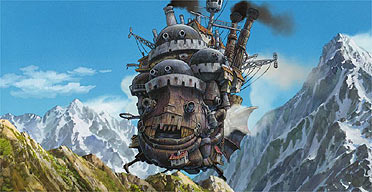
A movie by Miyazaki Hayao / Studio Ghibli, based on a book by Diana Wynne Jones.

This is a fantasy story or fairy tale for teenagers. (Interestingly a lot of good fantasy writing is labelled “young adult” these days.) It’s got everything from wizardry and dastardly deeds to romance and perilous battles. An evil witch puts a curse on young Sophie, making her appear an old woman. She makes her way to the flying castle of Wizard Howl (who’s rumoured to devour the hearts of young girls) hoping to find a way to remove the curse. There is a complication, though: part of the curse is that Sophie cannot talk about it. And so she becomes a part of the wizard’s household, together with his apprentice and his tame fire demon.

While the story contains a number of fairy tale clichés, Wynne Jones makes obvious fun of them, without trying to be clever about it. Thus, for example, Sophie reflects early on in the book that she is unlikely to achieve much in life, because she is the eldest of three daughters, and only the youngest has any chance in a fairy tale. And despite the consciously clichéd components, the story itself is far from predictable, and kept surprising me to the very end. In fact it is quite a weird story, where people keep doing weird things. Wizard Howl in particular seems rather irrational at times. But then he is a wizard, after all.

The writing is focused, humourous and action-oriented, with hardly a word spent on peripheral details. Places, things and people are described only to the minimum extent necessary, conveying only their essence – often from Sophie’s subjective point of view. Here is how Sophie first sees Howl’s castle, for example:

Wizard Howl’s castle was rumbling and bumping towards her across the moorland. Black smoke was blowing up in clouds from behind its black battlements. It looked tall and thin and heavy and ugly and very sinister indeed.

There’s nothing about the colour or material of the castle, or whether it is square or round, has towers or not: only how Sophie experiences it.

Seeing the world and following the story through Sophie’s eyes adds some spice to the book, since her experience is sometimes very obviously coloured by her expectations and moods – and her often immature and impulsive teenage thinking.

In general I found this a funny, lively and enjoyable book, and would definitely read more of Wynne Jones.


The movie, while visually impressive, was less satisfying than the book. (Luckily I saw the movie first.) Since the book spends little attention on visual detail, this leaves Miyazaki a lot of freedom to invent the looks of the people and the world. And as with all his movies, it really looks like a fairy tale world: beautiful and colourful.

But the movie has a big problem: its failure to tell the story. The plot comes across as barely coherent, and I was completely confused by some turns. To be honest, this is not that uncommon with Miyazaki’s movies: Spirited Away, for example, is similarly beautiful but does not exactly make much sense.

The movie is really only a loose adaptation of the book – Miyazaki has taken some liberties with the story, and that’s putting it mildly. Some side plots have been excluded because they would make the movie too long. Fine. But then for some reason he finds time for other things that do not exist in the original story, and in no way make his version of the story clearer. He makes up a war between Ingary (the kingdom where the story takes place) and a neighbouring country, which lets Howl spend a lot of time fighting for the kingdom. I couldn’t see how this contributed anything but a sinister mood to the story (and some spectacular fighting scenes of course). And for some equally unclear reason, he introduces some sort of weird flying machines (he seems very fond of flying machines; I think all his movies have got some), changes the gender and role of one character, etc.

Since the movie is necessarily shorter than the book, all the characters get less attention, and come across as more superficial in the movie. This is especially true of Sophie, whose thoughts and wonderings get a fair amount of space in the book. And if Howl is somewhat irrational in the book, then in the movie he makes no sense at all as a person.

While the movie isn’t bad, it doesn’t measure up to the book at all. But on the other hand, without the movie I wouldn’t have read the book, either!

(PS: The movie should definitely be seen with the original Japanese voices and English subtitles.)


PPS: I have started adding links to Amazon for the books I write about. Not because I want to encourage you to buy the book, or if you do, to encourage the use of Amazon. I’ve simply noticed that whenever I read an interesting book review elsewhere, the first thing I want to do is check it out on Amazon, and it annoys me when there is no link so I have to copy & paste.

I have, contrary to my expectations, actually managed to finish two books since Ingrid was born. Finding time to blog, however, is harder: I can read while I’m eating breakfast, or putting Ingrid to bed, and I’ve even managed to read a few pages while breastfeeding, but neither of those settings is suitable for blogging. (Typing requires more hands than reading. And the presence of a computer.)

Time for a futile attempt to catch up again. From the backlog, two novels by Tony Daniel: Metaplanetary and Superluminal.


Metaplanetary was a lucky random pick from Forbidden Planet several years ago. It appears to be part of a trilogy (in true SF tradition), or perhaps an even longer series, although the cover doesn’t make that clear – in fact the cover doesn’t even mention this fact. But it was also very readable on its own. I re-read it now that Superluminal, the follow-up that II’ve been waiting so long for, came out in pocket format; part 3 is yet to appear.

The books are about a future where mankind has invented faster-than-light communication and computing, which in turn enables artificial intelligence. Mankind has colonised the entire solar system, and the inner solar system has been linked into a vast network of cables, lifts and connections. It’s a world of flow – of people, information and energy.

All of this is now falling under the rule of a megalomaniacal tyrant. The first book deals with the beginning of the troubles, and how they lead to a civil war within the solar system; the second one is all about the war.

But the civil war is, in a way, just an excuse, a framework to hang a story from. It is not a book about war – it is a book that explores a fantastical yet believable world. It is a combination of fabulously inventive ideas on a vast scale, and an immense amount of detail. There are artificial intelligences, as mentioned, but also Large Arrays of Personalities, and semi-intelligent nanotech life. And spaceships, and tunnels of organic goo going from planet to planet, and so on.

And while the world is based on technical / scientific advances, the book focuses on the effect of those advances on people and society. What would a mixed society of biological and digital humans be like? Would they segregate into enclaves, or mix freely? Would one oppress the other, or look down on the other? What would it be like to have nanotech particles absolutely everywhere – including inside everybody?

But Metaplanetary is not just full of good ideas: there is also an entertaining and well-told story, with plenty of suspense and lots of strong characters. In fact there are a number of storylines, and it is often unclear how they are related – although that did not bother me much, as they were all very readable on their own.

Somewhat confusingly, much of the technology isn’t explained until later, which made the initial chapters a bit hard to follow and understand. Another weakness was the way the story lines are left hanging at the end of the book, to be picked up in Superluminal.

I found Superluminal less engaging than Metaplanetary. Perhaps because it was more linear and focused on a narrower story – that of the war? (Although I have to say it was an interesting and very different war, with planet-scale battles involving sentient spaceships etc.) Or maybe because it is the middle of a story, with neither a real beginning nor a real end.

I do hope that the conclusion is published soon – it would give me a reason to reread these two books yet again.

(Another one from the backlog.)

A science fiction book, but the science fiction element is limited to one new technology: the ability to send people to the past (and later pick them up and bring them back again). We understand that this procedure is now relatively stable and is widely used by historians to study their favourite epochs. There is not much focus on this time travel thing otherwise, and no time is wasted on explaining how it works, which is good.

For the purpose of this book, though, only one trip is relevant: one person is sent back to medieval England. Things go wrong on both ends of the time machine. On the medieval side, Kivrin falls ill, loses track of the pickup spot, and then misses the pickup. On the modern side, the time machine technician notices that something looks odd about the “drop”, but falls ill before he can tell anybody what exactly looks wrong – and then his disease turns out to be part of an epidemic that makes it hard to get anything done in Oxford, least of all get a time machine fixed.

These two strands of the story continue side by side, quite independently, until they’re brought together again at the end. Meanwhile, both are filled with disease, confusion and a struggle to bring Kivrin back again.

In the medieval story Kivrin finds out that her preparations (language, manners, etc) weren’t sufficient to prepare her for the medieval times, and she struggles to survive in a world that’s harsher and more primitive than she imagined. She naturally feels dislocated and lost in an alien place. But she goes from observer to participant, comes to care about the people around her, and by the time the (inevitable and rather predictable) crisis arrives, she is right in the middle of it, together with the “locals”.

I cannot judge how accurate the historical detail is, but it was realistic enough for me, and quite interesting. One interesting angle was the closeness of death: crises (diseases or otherwise) are not fought but suffered through, with help from faith.

On the whole, this half of the story was not bad at all – perhaps because of the close focus on one character, and seeing an unknown world through her eyes. Because of this viewpoint, the medieval world we see is frustratingly limited (to one household and a small village around it) but then again that’s what it probably was like.

The modern story could almost have been written by a different writer. Instead of believable characters it is populated by cliched figures who are very obviously supposed to be funny, but are actually annoying from the first moment you meet them. Despite the epidemic their lives are filled with trivial worries which become really tedious. (Hearing an underling complain about the shortage of loo paper is only funny once or maybe twice.)

The characters also show a remarkable lack of emotion – even when a good friend dies, they barely seem to notice.

The plot here is simple, to the point of being simplistic – “will they get Kivrin back home?” – and hangs on a few ridiculous details which are repeated ad nauseam. Phone lines are overloaded because of the epidemic and a lot of time is spent trying to get hold of other people. Have these people forgotten answering machines (which surely existed in 1992 when the book was written)? Some high-level university admin has gone away and no one can get hold of him – and that holds up the action for days on end. Yet in the end this “mystery” is simply dropped with no explanation.

If the modern half of the book was removed or kept to a minimum, this book could have been a lot better. As it is, I am very puzzled about why it was awarded both the Hugo and Nebula awards. It’s not innovative in any way, and the storytelling doesn’t even do its routine premises justice, really. Still, the medieval half made a strong enough impression on me that I found the book worth reading.

This book can be summarised in a single word: funny.

It was written to be funny (and not much else) and it is funny (and not much else). I mean that in a good way: it is outrageously, hilariously funny and made me laugh out loud, and I enjoyed reading it. How can you not enjoy a book that counts among its characters a transvestite Filipino canoe navigator, a talking fruit bat called Roberto, a cannibal, ninjas, and a whole tribe of shark-hunting ex-cannibals? Where the story includes a cargo cult, plane crashes, and shady doctors on a tropical island?

(Well, you could not enjoy it if it was badly written, but it isn’t.)

Where does a writer get ideas like that? How do you come up with a title like “Island of the Sequined Love Nun”? Christopher Moore must be a seriously disturbed person.

A “quant” is one who works in quantitative finance, which is mostly concerned with developing models for analysing financial derivatives.

I had an obvious interest in the book from the moment I read about it, given my closeness (ehm) to the industry and one the firms discussed in the book. And while I was never a quant myself (lacking the requisite PhD in quantum physics) I have worked closely enough with quants to be interested in hearing what an insider might have to say about life as a quant.

Given the numerous 5-star reviews the book got, I was sorely disappointed with it.

The book really does not live up to any of the promises of its title. Firstly, Derman’s life as a quant takes up no more than half the book – the first half is about his life in the world of academic physics (first during his PhD and then his seemingly endless wanderings from one postdoc position to another) and later in Bell Labs. Secondly, and more importantly, the promised “reflections” are nowhere to be found.

This book is a plain and simple auto-biography, written by a brilliant (as far as I can judge) scientist who nevertheless has nothing particularly brilliant to say about his life. Derman simply goes through his life from when he finishes his undergraduate degree, methodically and linearly, almost year by year. This might work if he had led a particularly interesting life, or was able to write very engagingly about the ordinary things in his life, but Derman isn’t that good a writer.

I see this simple chronological approach as a symptom of a bigger problem: Derman has no particular aim with this book, no theme. There are no reflections, no insights, no trends or discussions of how things have changed, no conclusions from important events. He could have written about the birth of financial engineering, or the daily life of a quant, or the differences between academic life and Wall Street… but he doesn’t.

Instead, he spends a lot of time complaining about his career, its hopelessness and aimlessness and loneliness, and how unhappy he was with most of his jobs (especially the one at Bell Labs).

And when Derman isn’t talking about the difficulties of finding a career, he indulges in endless name-dropping, which really got on my nerves. Every colleague whose name readers might recognise is mentioned (especially all the famous physicists), as well as more tenuous connections, including people he met only once for a failed job interview. Or never met at all, for that matter:

We learned database theory from David Shaw, who later founded the investment boutique D.E.Shaw & Co., as well as the first free email service, Juno. At D.E.Shaw, David employed Jeff Bezos, who later left to found Amazon.com.

“Look at me! I once knew someone who later knew Jeff Bezos!”

The amount of ink spent on talking about Important People doesn’t decrease when Derman talks about his life as a quant. He seems to be almost obsessed with Fischer Black. Yes, I know, Black was an important guy, and made important discoveries, but still… Even in chapters where Derman is neither working with Fischer Black, nor hoping to work with Fischer Black, nor talking about how Fischer Black would have done things, he suddenly, out of the blue, makes comments such as this one (“it” being the Risk magazine):

Fischer, too, commented admiringly on it.

I am still wondering why Derman wrote this book.

I guess “My Life as a Quant” may appeal to readers who have followed a very similar career path and recognise all these names. Or perhaps to those who know the physics world but not the quant world – but the book isn’t focused enough to give those readers any real understanding of quantitative finance. Perhaps it can be inspirational for wannabe quants, of whom there is no shortage, I’m sure.

I spent the afternoon in a bookshop, which is a great way to spend an afternoon. Usually I do this on weekends, of course, and it turned out that weekday visits can involve special considerations: a large and important part of one floor (the SF section) was blocked off because some celebrity author was signing books there. A surprisingly large number of people were queueing for the event, even though it was in the middle of the day on a Wednesday. Don’t these people have any work to do?

A visit to a bookshop almost invariably ends with me buying books. And while I showed commendable restraint this time – if I say so myself – and went home with only 4 new books, this still means that these 4 will soon make their way to the “books to blog about” pile, which is still teeteringly high… A deal, then: for every book I read, I will blog about two. This way, the pile should be gone by the time I’ve read all 4 of the new acquisitions. For extra effect, I’ll start with the biggest one.


And a big one it is indeed. The Stand, complete and uncut edition, 1415 pages.

Story: A virus escapes from a government lab, and wipes out almost all of the US population. The survivors struggle to survive, to find each other and to recreate some sort of order, some sort of civil society.

Unlike most of King’s stories, the horror element in The Stand is quite limited. That is, there is horror enough in the scenes of multitudes dying, but it is all restrained and realistic, not presented as horror scenes. This is one of the reasons why I re-read this book: it is not a horror story dominated by looming monsters or crazed murderers. Most of it is an exploration of psychology and sociology. How might people react when everyone around them dies? Who would survive and how? How would they keep their sanity? To what lowly state would society collapse, and how might it recover from there?

Some people who survive the initial epidemic die soon after, because they are not “cut out” to be survivors. For others, the disaster is a wake-up call, and they pick up their unsuccessful, failing lives and start taking responsibility.

How would you react? What would you do? If you survived, how would you go on?
What would it feel like to be able to take anything, do anything, go anywhere, because there are no controls – but to be totally alone?

Much of the strength of The Stand comes, I think, from its combination of epic scale and close observation. The end of the world as we know it is an immense event, but it is told through small episodes. The book touches upon the lives of many dozens of characters, and even the list of main characters would have to include a good half dozen. A bit disjointed, perhaps, but at the same time I thought it was a great way to really show how all-encompassing the effects of the disaster were / would be. The characters themselves are somewhat predictable and not particularly interesting, but they are more than adequate for illustrating the themes of the book.

This close attention to detail is, in a way, also a shortcoming of the book, because it ties it so closely to the USA around 1980. For a non-American reading it 30 years later, it can be hard to relate to all song lyrics quoted and names mentioned.

The book’s other strength is the pervasive feeling of hope, and courage and goodness. Unlikely friendships form, and unlikely people become heroes. There is evil too, of course – there always is in a Stephen King book, and it’s never subtle. (King doesn’t really “do” subtlety.) In this one, two people personify the opposites of good and evil, and survivors tend to gravitate towards one of them, and of course there is a kind of a fight between the two sides in the end. I found that part of the book less interesting, primarily because it was so predictable and, ultimately, rather unsatisfying. I guess King just didn’t know how to end a book of this kind of epic scale without taking a supernatural element to help. However, the end is, after all, only a small part of the book and doesn’t detract from the rest of it.


Footnote:
I have a special relationship with Stephen King, because he was one of the first authors I read in English (not counting children’s books). I must have been around 12 I guess, and I believe I read a good dozen of them. I can’t even remember where or how I got hold of them… The Stand was the one that made the biggest impression, and I’ve returned to it a few times since then.

As is obvious from the author’s name, this is a novel pretending to be a memoir. Chiyo, a young girl, joins (or rather, is sold to) a geisha house, where she initially works as a maid, later goes through geisha training and apprenticeship, and finally becomes a full geisha.

Plot-wise, the early years get the most attention, and every subsequent year goes past faster and faster – at the beginning of the book Chiyo is 9; by the middle she is 14; by the end she’s an old woman. A lot of attention is paid to her years of painful struggle to be accepted into geisha training, and the rituals and processes of becoming a geisha, yet we hear relatively little about her time as a famous geisha. It feels like the author loses interest, or has a deadline to keep: the second half has less life and energy. The ending is the weakest part; the book just fades out with a very unsatisfying conclusion. Still, most of the plot was exciting enough, and well-enough presented, to keep me interested all the way through.

True to the memoir form, the focus of the book is on that which is small and close – jealousies, everyday events, conversations. The small-scale is presented with beautiful detail, especially of kimonos, hair styles, insides of houses. But the book has almost nothing to say about the wider world outside Chiyo’s immediate day-to-day life, such as Japanese society, the changes to Japan over all this time, or even anything insightful about the geisha tradition. While I got a rough picture of what the life of a geisha entailed, I would have liked to know a lot more.

Interestingly, all those who laud the book’s authenticity and claim that it “perfectly describes Japanese life” or something of that nature, are westerners. All comments by Japanese readers, and Westerners living in Japan, have said that Golden doesn’t know much about what he’s talking about.

So in actual fact the book is more historical romance than history. Unfortunately the romance element is hollow and naive. The characters are simplistic, and each one has a single role to play: the rival is a vicious plotter; the head of the geisha house is ugly and only cares about money; the influential man who becomes attracted to Chiyo is decent yet grumpy. Even Chiyo herself is shallow, and remains childish throughout the book. She is repeatedly described as clever, but doesn’t show it much – she doesn’t try to understand the big picture of what is going on around her, or have any sort of direction in her life. She becomes obsessed with a man she’s seen once, and then somehow keeps that infatuation alive for many years, even though she only meets him a few times a year at most, doesn’t really know him, and there are no signs that he cares about her.

(And why do all of Chiyo’s metaphors involve either trains, sea waves or tree leaves?)

All in all, not a bad book, but not particularly noteworthy either. Definitely not worth all the praise and attention it’s gotten – most of that has got to be due to the exotic setting and the word “geisha” in the title.

The pile of books read-but-not-yet-blogged is teetering and threatening to topple again. Here’s the oldest one in the pile (in terms of when I read it, not when it was written). Unfortunately it’s also the thinnest one in the pile.

Margaret Atwood’s A Handmaid’s Tale is an exploration of what society could develop into as a result of widespread sterility, and a fundamentalist desire to control sex and anything sexual. It’s a story about society, not far in the future, where religious fanatics have gained control of the US society and reshaped it according to their will.

Individuals’ rights are severely curtailed and everybody is assigned a specific role from which they are not allowed to deviate. Women in particular have lost most of their freedom. By the time the book starts, women are all either wives, household servants, or childbearers for other women who cannot have children. (Fertility has suffered after some sort of nuclear accident or other environmental catastrophe, and is now the highest priority for all women.)

Offred, the narrator, is a Handmaiden, effectively a childbearing slave. Her life is one of restrictions and routine. She is allowed nothing except that which is prescribed. The book is presented as her diary, as she goes about her daily life of empty routine, boredom and frustration – and remembering (trying to remember) life as it was before, her child, her husband.

Not much really happens in a book, yet a great deal is said about society and about Offred’ life. The back story – how she, and society, got to where they are today – is uncovered piece by piece. This is sometimes a frustrating and confusing process, because of the large gaps in our knowledge. But as a whole I found it very well told and well written.

Commenters who are dissatisfied with the book complain either about how unrealistic the scenario is – which to me just means that they have not understood the meaning of satire – or about the language. The language is somewhat… non-standard in places: sentences have odd broken rhythms and repetitions. Possibly somewhat pretentious, but I thought it fit the story and the narrator’s state of mind. This was more work than reading a run-of-the-mill book of fiction perhaps, but well worth it: chilling, gripping, engrossing.

It is interesting to note that the book was first published just over 20 years ago, in 1985. It was a reaction to the then-current feminist debate about sexuality and pornography, in particular discussions about forbidding pornography for being demeaning to women. 20 years later it is not western feminists but Muslims who provide a more current backdrop. Their stated aim is likewise to protect women, but instead they curtail the freedom of those they claim to protect. The same kind of patriarchal ”for your own good“ rules abound in the book. Replace Christianity with Islam, and it probably gets close enough to some of the more repressive and fundamentalist Muslim societies today, where women have no right to property or to a job, or to walking in the streets on their own. Or, for an example from ”closer to home“ (in some sense) consider fundamentalist Christians’ attempts to control women’s reproductive rights.

But the book is more than just a dystopia about women’s rights. It’s a story about control, routine and emptiness; about humans being reduced to a single function. (Ironically a society that has forbidden pornography because it objectifies women, ends up objectifying them more than ever.) It’s about society’s unsuccessful attempts to stand still: even as they try to control everything and everybody, people find their ways to break the rules. Even those who are supposed to enforce the rules and set an example will break them if they get too restrictive.

This is one of the very best books I’ve read recently. I also liked Atwood’s Oryx and Crake a lot (it was the first of her books that I read). Now I’m wondering why it took me so long to discover her. Will have to buy more of her books, definitely.

Here’s a book that has been constructed around a single idea – a gimmick, even.

A group of travellers take refuge for the night in a castle. They find themselves inexplicably mute, so they use a deck of tarot cards to tell each other their stories.

Tarot cards communicate concepts and ideas, not facts, so each one can be interpreted in many different ways. In the book, cards acquire different meanings depending on their setting, so the various narrators reuse the same sequences of cards to tell their different stories. The end result is a single tapestry of cards that tells all their stories using the whole deck of cards.

The idea is clever, and it’s interesting to see Calvino generate ever more fanciful adventures out of very little. It is really no different from what any fortune-teller does, but in fictional form there are fewer limits on where the cards and the interpreter’s imagination can take the story.

Some stories are based on legends and tales such as those of Helen of Troy, Hamlet, Oedipus etc. Others are wild and surreal flights of fancy, full of vampires, grave robbers, apocalypses and demons.

On the whole, I thought the gimmick dominated the story-telling. This is like one of those experimental creative writing exercises, where the writer sets himself a strict constraint, and sees what sort of story that leads to. Experiments of that kind are generally more useful to the writer than they are enjoyable for the audience. Calvino himself says in the afterword that he was obsessed with this idea of generating all the stories that could be contained in a tarot deck, and that he published this book to be free of it. It shows. I doubt that a writer without his reputation could have gotten this published at all.