The topic of survival fascinates me, and especially the non-physical sides of it. I am not so interested in the mechanics of surviving an avalanche, or the knowledge of how to build a shelter out of sticks and how to build a rabbit snare – I want to understand the mindset. Why do some survive all sorts of calamities, whereas others freeze or panic, or just give up?

Gonzales has got some really interesting points. First of all, what leads people to make the – in hindsight – obviously stupid decisions, ignoring glaringly obvious warning signs, that lead to a possibly lethal accident? Among the answers:

  • habit – it’s always worked before
  • stress leading to confusion
  • rigidly following an outdated plan, when reality changes
  • holding on to an incorrect mental model of the world even when the map doesn’t seem to match reality
  • taking shortcuts, being in a hurry
  • group dynamics – not wanting to be the coward, or the one to slow everyone down
  • underestimating the forces of nature, the weight of snow, the force of falling from a certain height, the power of ocean waves
  • unwillingness to turn back, to give up – the uncertain but hopefully nearer goal is more tempting

And second, what does it take to survive one, after it’s happened? The right mindset.

  • focusing, not give in to the shock and confusion of realizing that you’re lost
  • have a reason to live, something or someone they want to survive for
  • not giving up, even though surviving looks hopeless
  • not expecting rescue, not counting on God to save you
  • positive thinking: taking delight in small victories

Interesting fact: the youngest children often have very good survival rates, because they follow their instincts. They rest when they’re tired, crawl into a hollow tree when they’re cold. On the other hand, kids between 7 and 12 years of age have one of the worst survival rates, because they think more like adults (and less instinctively) but they cannot yet control their emotional responses, and panic.

On the minus side, the book is not very well organized. It sort of has a structure, but is mostly built out of case studies. The key points lost between anecdotes and quotes.

There’s too much talk about Gonzales’ father and what a cool survivor guy he is, and there are silly attempts to bring chaos theory and self-organizing systems into the picture.

Finally, the book was too narrow for my taste. There’s too much focus on risky adventure sports. (Although there were ordinary cases of getting lost in the woods, too.) I would have preferred something more varied – surviving PoW camp, or an ordinary fire.

Underlying it all is the view that you’re not living a full life unless you engage in activities that could lead to your death, and ideally survive a few accidents that almost do lead to it. This view that your own preferences are universal, that everyone should live life your way, is immature and annoying.

On the whole, it’s got its points but it’s not very well written, and I come away from it slightly disappointed.
Amazon US, Amazon UK.

This is the second book I read by Susanna Clarke, after Jonathan Strange and Mr. Norrell. The Ladies of Grace Adieu is a collection of short stories in what seems to be the same world as in the novel – England but with magic – although not always in the same era. And as with JS&MN, it is written in 19th century style (even for the stories that take place earlier) – dry, witty, charming and mannered.

The stories are faery tales, i.e. tales about faeries. Faeries as powerful tricksters, who do things for their own reasons, and whom you cannot trust even if they seem to be helping you. For one reason or another, in most of these stories, humans come in contact with the world of faeries, and stuff happens.

“Kind of nice”, is the best I can say about this book. There’s nothing exactly wrong with it, but overall it felt a bit tame and repetitive. Most of the stories lacked that special spark. Looking back at it, I would probably have found the stories more entertaining if I had read each one on its own.

Amazon US, Amazon UK.

Plot summary: Pug, an orphaned boy brought up in a small keep in the far backwaters of the kingdom, finds himself apprenticed to the keep’s magician. Before he really has time to learn much magic, however, strangers – apparently from another world – are seen in the lands around the keep, sneaking around, seemingly preparing for an invasion.

Indeed, a rift has been opened between two worlds, by the magicians in the other world, in order to invade this one. This gives them a great tactical advantage. In order to figure out the nature and limitations of the rift, Pug and his master join a scouting foray. Unfortunately Pug is captured and taken to the other world. He stays there a long time, learns their magic and becomes a powerful magician.

Let me get it off my chest: Magician sucks. It is described as a “classic fantasy epic”, gets overwhelmingly positive reviews on Amazon and elsewhere. I found it boring and badly written. It isn’t awful. I actually finished the book (unlike some). But it is bad enough that I find it hard to come up with anything positive to say about it. Even Robert Jordan is better than this.

There is no originality. Pug’s world is a standard Tolkien-slash-medieval world: we’ve got humans (check), elves in the forests (check), dwarves in the mountains (check), and some killing robbing dark elves too (check). They have a standard feudal system, and that standard kind of magic where the magician mumbles a cantrip and waves his arms and stuff happens.

None of it comes to life. There is no depth to the world. I get no feeling of history, or life outside of the story line of this book. That other world is not described vividly enough to ever feel real. The characters are flat, all average and likeable and dull (except for one, who’s mad in a very standard way).

Even the magic feels fake. While magic, and the differences between the magics of the two worlds, are crucial to the plot, we only see very superficial examples of it, and with no understanding of how it works. It is all on the level of “he waved his arms and chanted and magically created some mist”.

The language is dull and plodding. The tone is monotonous. There is no sense of humour, no beauty, no power. The dialogue is embarrassingly bad, stilted and formal in an effort to make it sound medieval. It has no personality – even in the end I couldn’t keep some of the characters apart because they sounded exactly the same.

The pacing is weird, to say the least. At times, several years pass and you almost don’t notice. At other times, a single afternoon’s conversations are rendered in great detail. The siege of the keep takes 30 pages, and yet many more important and potentially more interesting events of the war are over in a few paragraphs. It seems that the expositions are only there to shine a spotlight on some particular person or relationship between persons. It is such painfully clumsy character-building that it’s embarrassing.

The story has no particularly interesting aspects or ideas. It’s hard to see what it’s about, what the point of it is. The plot just plods along, except for an occasional interruption from some very contrived scene. (For example: a commoner of no particular importance, who’s barely learned to ride a horse, gets to accompany the princess on her daily rides – just so he gets an opportunity to rescue her.)

I wouldn’t recommend anyone to read this; there are much better examples of fantasy out there. And I have no intention of reading any other works by Feist.

Amazon UK. The book was published as two separate volumes in the US: Magician: Apprentice, Magician: Master.

The Automatic Detective is a strange but funny blend of hard-boiled detective story and retro sci fi.

Mack Megaton is a robot. Originally built for destruction , he has gained free will, given up his violent ways, and now earns a living as a taxi driver. In a city bustling with mutants and sentient robots (many of whom are even full citizens), he actually sort of almost blends in, even though he is huge, red, and almost indestructible.

One day his human neighbours are kidnapped. Mack gets mad. (He has issues with anger management.) He gets no real help from the police, so he decides to track them down and rescue them himself.

The rest of the book is full of what would be standard for a detective novel but comes across as funny in this setting. Confrontations with mob bosses, intimidating their underlings, exchanging macho but witty comments with sassy blonde girl, gunfights and sneaking around.

The Automatic Detective feels sort of like a what-if game by the author – “let’s see if I can make this work”. Since it is founded on a cliché, it feels worn at times, but the mixture as a whole is nevertheless distinctive enough to stand above cliché. Not an unforgettable work of great literature, but good light-hearted fun all the way through.

Amazon US, Amazon UK.

Well. Wow. Where to begin.

Anathem is a book of ideas. It is intellectual, complex, and amazingly ambitious. It is not like anything else I have read. It is a science/philosophy thriller, which sounds really dry and serious, but is much more engrossing than that. Anathem is both funny and fun, if philosophy and quantum theory is your idea of fun. But reading it requires attention and almost feels like work. It is the kind of book that makes me feel dull, and 100 pages in I was already thinking that I should probably really start over, taking notes, and perhaps read up on some philosophy before I do that.

Brief plot summary: On the planet Arbre, scientists live segregated from ordinary people, in convent-like places. The flow of information in both directions is strictly controlled, as is the scholars’ use of technology. This separation was put in place a few thousand years ago after some vaguely described Terrible Events, in order to limit the power of scientists’ ideas, and the risk of dangerous technologies being developed and used.

The convent doors are opened only once per year (or once per 10, 100 or 1000 years, for different parts of the convent). So the scholars inside their walled communities think and theorize, and watch cities come and go outside their walls over thousands of years, and civilization rising and falling and rising again.

Around one of these door-opening times, something happens in the skies of Arbre that changes everything. Some scholars get busy speculating on what exactly happened, and figuring out how it will affect their world – using precious few observations, and their impressive deductive abilities. Events grow, some scientists are even called forth from their convents in order to work together, and finally grand things happen.

This is all told through many philosophical debates and entire chapters filled with theoretical discussions that are crucial to the plot – you can’t skip any of it and still be able to follow the action. It is a Socratic novel. Stephenson manages to cover several major strands of the history Western thought from the ancient Greeks onwards (the history of philosophy on Arbre is similar enough to Earth’s to be clearly recognizable, but obfuscated just enough to make it an effort to match up the two) as well as some interesting parts of quantum theory (and I do mean theory, there are no “quantum wormhole warp drives” in this book).

To quote another reviewer: Anathem is “a unique, impressive but fairly mad novel: one part hubris to one part taking the piss to one part gnarly geek awesomeness” (Strange Horizon Reviews). An Amazon reviewer said it felt like a novelization of Gödel, Escher, Bach, and I can sympathize with that, too.

It was a wonderful if somewhat daunting book. If you haven’t read any other books by Stephenson, don’t start with this one – it might be too big a shock. Which doesn’t in any way mean that it isn’t good – you just need a warm-up first. Stephenson’s scope and ambition have definitely grown over the years but luckily the page count has come down since the Baroque Cycle. (This book is a mere 900 pages, plus appendices with more science if you feel you didn’t get enough.)

Amazon UK, Amazon US.

Flora Fyrdraaca is the almost-14-year-old daughter of an old and once-illustrious family of soldiers. But now there is little left of their illustrious past: the father is mad, the mother always off working, and the magical butler has been banished so the house is in disrepair. And Flora herself is named Flora Segunda because she is the replacement for the first Flora, blonde and beautiful, lost in the war.

On top of that, Flora is stuck with most of the housework since the butler is gone. She also has her Catorcena, the celebration of her adulthood, to prepare for – speech to write, dress to finish, invitations to sign.

When Flora stumbles upon the butler, she sees a chance to get rid of some of the housework, and for some excitement, too. She happily promises to restore him to his powers. Of course this is not as easy as it sounds, and meddling in magic can have dangerous consequences.

Both the girl and the book are spirited, colourful, outrageous, and keep confounding expectations. All characters are over-the-top but not so much as to become caricatures. At several points I thought I saw a cliched resolution coming up, and I am glad to say I was wrong every time. A fun read all the way through.

Amazon US, Amazon UK.

The Cloudspotter’s Guide is exactly what it says on the tin: a systematic guide to the main types of clouds, their subspecies and varieties, the physics leading to their creation and disappearance, etc. It’s all that, plus a love for clouds. The science is mixed up with all sorts of anecdotes and asides, personal reflections and observations about clouds in art and culture.

This is a pleasant diversion, a charming book. The style is very personal and chatty. This makes it an easy read but at the same time makes it hard to remember many details. There were so many disparate facts that I have already forgotten most of them, and the clouds all blur together again. But nevertheless, it was a pleasant read.

My one complaint is the lack of pictures. Each chapter starts with a nice woodcut-style illustration of a particular type of cloud, but apart from those ten images, and a few colour plates in the middle, there are mostly small black and white photos, flat and grainy – probably because of cost issues. This should be a glossy book with pictures all over the place. Not a coffee-table book, mind you: I rather liked reading it during my commute, and being able to look up from the book and gaze at the clouds above me.

Amazon UK, Amazon US.

Every other fantasy book and RPG, and pretty much every fantasy book or game where a significant part of the action takes place in a major city, has a Thieves’ Guild, possibly a Beggars’ Guild, and an Assassins’ Guild.

Now I can understand the reason and rationale for the first two. Thieves and beggars could well want to prohibit outsiders from crowding onto their turf, divvy up the city, and impose other rules. But I really have trouble understanding how an Assassins’ Guild could possibly exist.

Quite apart from such mundane concerns as “wouldn’t it be rather dangerous for someone to be a registered assassin?”, there is the issue of volume and sustainability. Let’s think about the numbers.

How many members does a guild need to have in order to be called a guild and not just a bunch of guys? A few dozen at least, I’d think. Let’s say 30.

How often would an assassin need to kill someone in order to keep his skills sharp? Once a week seems like a reasonable minimum. That’s 52 kills per assassin and year, and 1560 kills for the entire guild.

How many people in a city? Most fantasy takes place in a late medieval or renaissance-equivalent era. The top 10 cities in this world in the year 1500 ranged from 150,000 inhabitants to 670,000 inhabitants (About.com). Let’s assume, generously, that the cities in the books are really grand ones, say 300,000 souls.

Assuming a life expectancy of 30 years (Wikipedia) and a stable population, there would be 10,000 births and 10,000 deaths every year. Of those 10,000 deaths, about 3,000 would be children in their first 5 years of life. That leaves 7,000 deaths of other causes.

1560 assassinations out of 7,000 deaths would mean that one death out of every 4 or 5 is an assassination. Or to put it another way, deaths from all other causes would need to be 20% fewer than in our average medieval city, or else the city will be emptied pretty quickly.

If we reduce the assassins’ activity level to one kill per month, that’s 360 kills per year or rougly 5% out of all non-infant deaths, which is rather more reasonable. But it means that, on the one hand, the guys wouldn’t get much practice, which means they would not be as skilled, so they would get lower pay, and they would need to have day jobs. And once you’re spending 90% of your time working as a messenger, thief, horse trainer, or whatever, and only killing someone once a month, can you really call yourself an assassin still?


PS: For more medieval demographic calculations, try Medieval Demographics Made Easy.

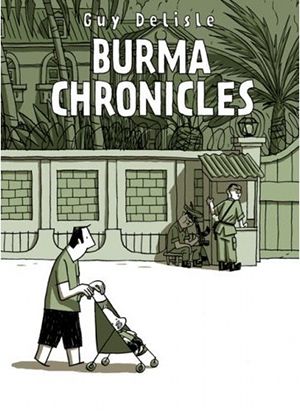
This is a documentary / autobiographic comic book about a year spent in Burma. Guy’s wife works for Médécins Sans Frontières. Guy takes care of baby Louis, draws cartoons, wanders around, and teaches cartooning to local students.

In short vignettes he shows us scenes from his experiences as a foreigner in Burma, and from life under a dictatorship. The focus is on daily life, show up-close, observed with humility and wry humour. The drawing style is simple – not the most stunning-looking comics, but it works well. New York Magazine has a sneak peek.

Skimming some reviews online I discovered the book was originally published in French, and I had read a translation. I never suspected – the translation was excellent.

Amazon UK, Amazon US.

Re-reading this cult classic, 15 years or thereabouts after the first time.

A colony is founded on Mars, but dies out. Years later, a new group of astronauts visiting Mars find Valentine Michael Smith, the child of a couple of the colonists, raised by Martians. Michael is brought to Earth. He learns to be human, and then – when he discovers that humans don’t have his powers of telepathy, telekinesis etc – teaches humans how to be Martian.

This is limited to his closest friends at first, until a juridical disagreement between Michael and the government is resolved, making him free and filthy rich. Then he starts to travel and meet people, in order to understand more of human society, and when he “groks” it well enough, he founds a religious cult to help spread his views. In the meantime we also hear a lot about the views of Jubal Harshaw, old rich opinionated eccentric who happens to be in the midst of the group of people around Mike.

Named views (Mike’s and Jubal’s) mostly come down to free love. Human moral rules are arbitrary, hence hindrances to human development. Anything that leads to love and “growing closer” is good. They value other human rules and conventions equally lowly: minor episodes aim to illustrate the pointlessness of money, the acceptability of occasional murder etc. (However, drugs are no good, and homosexuality is pitiable. Free love is good only when done the traditional way.) Through descriptions of Mike’s new-founded cult we also get some criticism of organized religion.

This is a book that clearly wants to be important, and to provoke. It was written with the explicit intention of changing social mores. And (having not been there myself at the time) I have to fall back to Wikipedia’s judgement of its effects:

The late-1960s counterculture, popularized by the hippie movement, was influenced by its themes of individual liberty, self-responsibility, sexual freedom, and the influence of organized religion on human culture and government, and adopted the book as something of a manifesto.

One can wonder, of course, how much of this was down to the author “reading” the currents of social change, and how much he was actually directing them?

Because of this aim to change the world, it’s a very preachy book, sometimes tiresomely so. And as so often is the case for books that want to spread important ideas (Little Brother comes to mind), the plot, characters, language etc gets less attention, so the end result is far from great literature.

The characters are bland and stereotypical (except for the absurdly colourful one of Jubal Harshaw), more charicatures than humans. There isn’t much plot, and the book is long and rambling. And rather annoyingly, the women are always lovingly jokingly girlishly submitting to their men, and the men are always patting their bottoms.

There are moments of greatness, and the core idea of “Thou art God”, the oneness of all life, the conflation of life / love / understanding / god, is at times expressed very well. Parts of the book are also quite funny and uplifting.

I can imagine that the ideas were probably pretty wild for 1961, but both society and SF have grown a bit since 1961. The book now feels juvenile, not so far from the 1950s pulps after all, despite its ambitions.

Amazon UK, Amazon US