Quentin seems to have everything he needs to be happy: good friends, smarts, looks, sensible parents. But he’s not. Real life just isn’t enough. If only it could be more like Fillory, the Narnia-like magical land in the fantasy books that every child has read and dreamed about. But while other children stop dreaming about Fillory before their teenage years, Quentin secretly still longs for it.

Then suddenly he finds out that magic is real, and he can learn to be a magician. Instead of going to a normal college, he goes to a magical one, and does indeed learn magic. But magic has no magical power to make him happy. Magic gives you power, but without anything meaningful to apply that power to, a magician’s life can feel as meaningless as anyone else’s.

Ordinary people given magic remain ordinary. They make stupid decisions, make messes of their lives, make nothing of the opportunities they’re given. They long for something, and when they achieve it, realize it’s made them no happier.

This may make a great truth but it does not make a great book. Or perhaps it makes a great book, in some literary sense, just not one that’s fun to read. In fact, despite all the magic, it was ultimately a depressing book. Or perhaps it was depressing because of the magic? We expect fantasy literature to show us something magical, something different from this world. And here’s a so-called fantasy book that tells you that you ain’t gonna get it. Because of this, I suspect that people who don’t normally read or like fantasy are more likely to enjoy this book than fantasy readers.

I also found the storytelling in The Magicians unsatisfying. There is a lot of “tell, not show”. The world, the characters, the action, all remain at a distance, and I never get that sense of being transported into a different reality. A charitable interpretation would be that Grossman makes the book mirror Quentin’s state of mind. Just like Quentin always feels that he’s never really part of the world, that surely there should be something more to life, the reader feels the same about the book. Unfortunately I don’t think this is the case: indulging in weak writing just to make a point would be going too far. So I think it’s just a case of slightly weak writing.

There are some great ideas and some excellent scenes, and I kept hoping (like Quentin) that something would turn the whole thing around, but it never happened. A promising but unsatisfying book.
Amazon UK, Amazon US, Adlibris.

Michael Pollan is the author of the best advice about food I’ve ever read or heard:

Eat food. Not too much. Mostly plants.

He first expressed this in Unhappy Meals, an essay in NY Times Magazine back in 2007. I found myself agreeing so strongly with everything in the essay that I bought the book. Then I read the book, and again I found myself vigorously agreeing with every single page. This is such a sensible book that I wish it was mandatory reading for everybody. In fact just skimming through the book now while reviewing it makes me want to re-read it.

Part 1 of the book talks about “the age of nutritionism”: how food was reduced by scientists to collection of nutrients, which we’re always told to eat more or less of. Great news for the producers of processed foods – and bad news for us, since instead of just enjoying our food, most people are confused, obsessed and worried about what they eat. Unfortunately all this advice rests on a very weak foundation – the last few decades’ prevailing advice to “eat less fat” was essentially a huge experiment, and is now looking like a failure.

Part 2 talks about “the Western diet”: how our relationship to our food has changed over the last 150 years. We’ve gone from whole foods to refined, from complex food chains of wide variety to simple monocultures, from quality to quantity, from leaves to seeds, and from food culture to food science.

Part 3, “Getting over nutritionism”, goes back to those seven words of advice and expands them into more tangible pointers. What does it mean to “eat food”? How can you help yourself not eat too much?

For a contrarian viewpoint, check out In Defense of Food Isn’t About Nutrition (a review), according to which Pollan’s book is mostly “the desire to show off beating out scientific thinking”.

Amazon US, Amazon UK, Adlibris, Adlibris (Swedish translation).

I read this book because I loved the movie. The book actually contains three unrelated stories, the first of which was the basis for the movie. All three fit into a total of under 300 pages, so the movie must have been relatively loosely based on the book.

I did not like this book. I kept going through the first, familiar story, even though I didn’t think it worked as well as the movie. But I gave up in the middle of the second one: it was dull, ugly and depressing.

The title story is about a girl who becomes the fourth wife of a rich man, and her relationship with the other three wives. Scheming, adultery, cruelty, jockeying for position and manipulation. It ends, as Chinese stories often seem to do, in tragedy.

The second story, “Nineteen Thirty-Four Escapes” is about the wife (again) of a peasant who’s moved to town and left her behind to take care of the children and their plot of land. It’s all about poverty, tiredness, struggle and cruelty. Perhaps this is for ideological reasons (it’s a book about pre-Communist times written during the Communist times, after all) but whatever the reason, I want no more of it. I also found it confusing – Chinese literary conventions being different from Western ones – but I could have lived with that if it hadn’t been for the unpleasantness of it all.

The third story I can’t say anything about because I never read it.

Amazon US, Amazon UK, Adlibris.

Two middle-aged people – William and Neaera – both lead lonely, quietly miserable lives. They both happen to visit the aquarium at London Zoo, and feel sorry for the sea turtles there. They keep visiting the turtles and, independently of each other, discreetly ask the head keeper how one would go about kidnapping and freeing the turtles. Somehow, without really ever deciding, they decide to rescue and free the turtles together.

You might perhaps expect this to end in romance of some sort, but Hoban is better than that. The two are so used to being lonely that they’re bothered by each other’s company. Neither does their adventure change their lives. The world doesn’t even notice; there are no news stories and no police investigations. But their little project does give each one a tiny little kick, launching them on what might become a new path in their lives.

The tone of the book very much reflects the lives of the two people. It is quiet and melancholy, through and through.

I have mixed feelings about the book. On the one hand, it is delicately written, and the two lives really come to life. But at the same time I couldn’t help finding these lonely lives depressing and dull. I didn’t exactly find it riveting, but I enjoyed reading it, yet I’m not sure I’d want to re-read it.

Amazon US, Amazon UK, Adlibris.

… or The Soviet time and the Soviet man is a collection of recollections of the Soviet times in Estonia. A newspaper called for people to send in their memories of the Soviet times, and a selection of them were published in this book. There are sections about everyday life, “products and production”, fashion, shortages, etc.

Due to the source of the material, it’s an uneven book. The editor’s work appears to have been limited to selection and cutting (and probably correcting spelling mistakes). Inevitably some contributors have spent more energy on trying to sound cool and above it all than on actual content – several parts of the book have a rather unpleasant tone. And some central topics are only briefly mentioned, while others get covered by multiple contributors. It all depends on who felt like writing what down. The same goes for the supporting photos: no one has bothered to visit an archive, it’s just whatever they had at hand.

The selection is slanted towards older memories: there is more material about the 1940s and 50s than about the 1980s. I guess older newspaper readers are more inclined (or have more time) to write down their memories.

Despite its shortcomings, it’s a valuable book to me, because it serves to remind of something that was everywhere but now is nowhere. And such things are so easy to forget.

No longer available in shops; try a second-hand book store.

The Victorian Internet is the story of the telegraph system, from the first optical signalling systems in the late 1700s all the way, to its decline as it’s overtaken by the telephone in the early 1900s.

The focus is on the social and business side of the story, rather than technical details. As the title indicates, the author views the telegraph as something similar to today’s Internet: a new way to connect people across the world and speed up communication, with all the attached hype, obsession, hacking, encryption, chatting, techno-stress, and talk about world peace that we got for the Internet. The comparison isn’t new or novel in any way, but many of the similarities and parallels were new to me. Interestingly the book was written in 1998, before the Internet boom got underway – but since the story it tells is 150 years old, none of it feels dated.

This was a diverting and enjoyable book. Read it and enjoy.

Amazon UK, Amazon US, Adlibris.

In chapter one, an assassin kills an entire family, but the toddler (always one to wander off) manages to walk out of the house without him noticing. The little boy walks to the graveyard just up the hill. The ghosts at the graveyard see him and hear the pleas of the ghost of his mother. They shelter him from the killer, and a couple of them adopt him. (Mr. and Mrs. Owens, married not just until death do them part but for a good 250 years now.)

The boy, now called Nobody Owens, grows up among the ghosts. He learns their ways and their skills. He never leaves the graveyard, because the assassin is still looking to kill him.

This is The Jungle Book set in a graveyard, with ghouls instead of monkeys and a werewolf instead of a python. There is adventure, danger, learning, fun, and some appropriately scary scenes (it’s a children’s book after all). There are delightfully weird characters. And in the end, of course, there is the inevitable return to life among other humans.

The book is imaginative, well-written, fun and poetic – everything a good Neil Gaiman book usually is. The plot is a bit shallower and the tone a bit more charming than in his adult fiction, but nevertheless really enjoyable. The one downside, according to some reviewers, is that it is perhaps a bit too closely inspired by The Jungle Book, but since I don’t have any fresh memories of that book (having last read it over twenty years ago) it never bothered me.

Adlibris, Amazon UK, Amazon US.

This is a slim book of just over a dozen short stories, all with the same theme: a satirical take on when religion becomes dogma, with Orthodox Judaism as the starting point. Some stories deal with the idiocy of religious practices, when taken literally and seriously. One shows two hamsters trying to understand why the gifts of food from their Joe are not as bountiful as they used to be, and attempting to regain Joe’s favour by applying themselves even more diligently on the exercise wheel. A few show what reality might look like from God’s point of view, if the world worked the way religious creed tells us.

The stories are funny and well-written. The thematic focus of the book gave it a strength it wouldn’t have otherwise, but at the same time I found it slightly repetitive. I enjoyed reading this, but wouldn’t have wanted any more of the same.

Adlibris, Amazon US, Amazon UK.

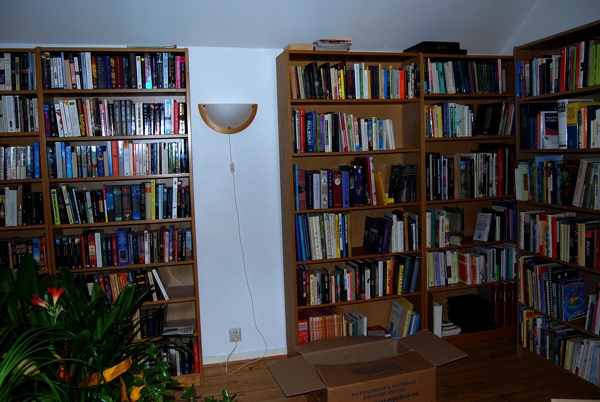
Eric and I both like books, so we own quite a lot of them. Many of them have lived in storage boxes for years now – a sizeable portion of our library stayed behind when we moved to London, and we were only reunited when we moved to this house a year and a half ago. Now, during those winter weekends when there’s nothing to be done in the garden and the weather doesn’t particularly encourage cycling or other activities, we’ve been slowly unpacking and sorting through them all. We’re finally almost through.

There will still be a few boxes for special cases, but most of the books have ended up in one of two places: the shelves, or the charity shop. This weekend we drove to the charity shop with 5 boxes full of books.

Store: Children’s literature that Ingrid’s too young for. Books in French that I read while living in Belgium (that I think I will someday re-read, even though I cannot envisage when or why I would do it). Books that we want to keep for nostalgic reasons. Books that we really don’t open often but like too much to give away.

Shelve: Books we haven’t read yet. Books that we would love to re-read if we had time. Books that are fun to browse. Books that bring back fond memories. Books with a historical meaning (remember dictionaries?).

Ditch: Many books about business and economics from our university days. Lots of mediocre fiction. Various lexicons and reference books: we use the internet instead.

Partway through this work a thought struck me: the entire decision process is founded on the premise that the world will go on functioning as it does today. In particular, we’re assuming that the Internet will go on existing, and that I can use it to look up anything I want.

But if one day we should have an apocalypse that wipes out our communications infrastructure – meteorite, collapse of civilization or whatever – we would probably really miss those reference works and rue our decision to not buy an encyclopedia. The people hoarding all their old books would be the heroes.

Is it worth keeping an encyclopedia packed away in the basement, as a sort of insurance policy? What is the probability of an apocalyptic event happening within my lifetime? A general collapse of civilization could probably be foreseen some way off, but the meteorite scenario is trickier.

Of course if anything like this did actually happen, we’d have bigger problems than lack of information and history. We should instead make sure to equip ourselves with books about basic medicine, growing your own food, and carpentry and metalworking and construction and so on.

See what kinds of thoughts books can lead one to!

I can hardly believe I bought a book that’s part of a 10-book series, and yet I did – because of a Review at SF site that called the book an “astounding debut”. And it was pretty astounding, and I don’t regret buying it the least.

Gardens of the Moon is a book of fantasy in the truest sense of the world. Erikson (and his co-creator Ian Cameron Esslemont) have put their fantasies to work and imagined a fantastical world.

The result is a complex, dense, sprawling, opaque book. There are lots of people and peoples, as well as gods, demi-gods, and other kinds of entities. There are varied, lively cities, hundreds of thousands of years of history, a system of magic not like anything else, and much more. It is clear that a great deal of work has gone into this world. (I found out afterwards that part of the explanation is that the world was created for an RPG and the books came later.)

The setting: The Malazan empire is at war, aiming to conquer a neighbouring continent. The war is not going well, but nevertheless the empire has conquered the next but last Free City on the continent, and is setting its sights on the last one. Meanwhile tension is growing within the empire and the army – the new empress doesn’t trust anyone from the old guard and tries to get rid of them all.

The plot is almost impossible to summarize. There are many threads, crossing and meeting and then separating again. Each one on its own is complex enough to be hard to describe in brief. There is the thread of a squad of elite soldiers sent out to sabotage Darujhistan, the last Free City, in preparation for conquest. There’s the thread of a young army captain trying to catch up with them to save them from the Empress’s plan to get them killed. There is an assassins’ war, there is a group of magicians chasing another, mad, magician, there are attempts to revive an ancient all-powerful monster, and attempts to hinder these attempts, and so on. Oh, and then there are the various gods, meddling in all these affairs: Greek style gods who take a close interest in the mortal world, and have a tendency to manifest physically and push events in their desired direction.

It’s intense, to say the least. And Erikson’s writing style underscores the intensity. The reader is thrown right in, in the middle of the story. It’s sink or swim. There are no info dumps: you either figure it out as the time and the pages pass, or you don’t. Refreshingly challenging.

After the first few chapters, just when I thought I wasn’t up to the challenge, the threads started coming together, and I felt I understood roughly what was going on. Then the story got more complex again, and then some things got their explanations again. The complexity stayed just this side of being unmanageable.

The complexity of the book is simultaneously its strength and its weakness. It makes for a thrilling read, an immersive world, a captivating story. But it also makes for work. This is a cult book rather than mass market fantasy.

This is not a book to be read in one sitting. I felt I had to put it down now and again so my brain could rest. But it was well worth it. I’d say that in order to get through the book without giving up in frustration, you have to go with the flow rather than trying to catch every last detail – but stay focused.

The book, its world and its plot are refreshingly non-tolkienesque. There are no clichés – no dwarves, no elves, no quests. Well, no clichés apart from a thieves’ guild and an assassins’ guild. Sigh.

It’s a dark book, of war, malice, manipulation, ambition and power. This is no war of heroes. There are no heroes, and barely any good guys. There isn’t even a good side and a bad side – it’s everyone against everyone else. In fact at times it’s hard to know who’s on whose side, or indeed how many sides there are. There are real people on each side of each conflict, and we see the conflict from all their points of view. Even though they aren’t good guys per se, they are all easy to sympathise with. And everybody has surprises in them.

While the characters have depth and, well, character, this is still a book driven mainly by plot rather than by character, by intellect rather than emotion. We never really get into the characters’ heads, and it is at times hard to know what moves them. They are instruments for moving the plot along. Erikson has no sentimentality for them: even important people are killed off when it suits him.

And – last but not least – while Gardens of the Moon is a part of a sequence, it is supposed to stand on its own, and I thought it succeeds at that. The story arc was completed, the various spying and assassinating factions mostly sorted out, and a phase of the war concluded. While I’m looking forward to reading more about this world, it’s not a necessity in order to enjoy this book.

Amazon UK, Amazon US.