The narrator of Cat’s Cradle is writing a book about the day the first atomic bomb was dropped, by collating the stories of people who were involved in its creation. One of the inventors of the bomb, Dr. Hoenekker, no longer lives, so the narrator contacts his three children instead, to record their impressions of the day.

Hoenekker’s three children, the narrator, and some other people happen to converge on the island of San Lorenzo, a poor island dictatorship somewhere close to the US. The state religion in San Lorenzo is bokononism, a joke of a religion founded to give the people of the island something to be happy about.

The children have inherited Hoenekker’s last invention: ice-nine, a form of water that is solid at room temperature. It is also very stable, and when it touches ordinary water, it turns that into ice-nine too. (A pre-nanotech version of grey goo.) Each of the three got a small piece each. And though none of them is evil or power-hungry – just careless and thoughtless – they manage to destroy the world.

The book has no one central point; rather, it has a bundle of ideas. It’s a tight and focused book, and Vonnegut fits a lot of story and a lot of ideas in few pages. There’s the obvious commentary on the Cold War and nuclear proliferation. There’s making fun of just about every kind of blind following: blind nationalism, blind local patriotism, blind adherence to religion, blind belief in science, etc. There’s man’s folly and tendency to, semi-innocently, invent things that can destroy the world, while claiming that technology is not inherently evil. (”Guns don’t kill people, people kill people.”)

And underlying it all is the darkly humourous view that life just does not make sense. And yet we try to make it make sense. The opening quotation of the book is as follows:

Nothing in this book is true. Live by the foma [harmless untruths] that make you brave and kind and healthy and happy.

Which is what most of us do most of the time, anyway.
Amazon UK, Amazon US.

Ondvinter (“Evilwinter”) is a most rare thing. Good contemporary Swedish fiction is hard enough to find; good Swedish fantasy – like Ondvinter – is almost never seen.

Sunia and Wulf are twins in their early teens, living with their father at a small farm some way off from the village. They’re a bit different from the other families, true, but they’ve never given it much thought. Then their father comes home from the woods one day, fatally wounded. He dies in a fever. Strange creatures turn up around their farm, and soon the two children have to flee for their lives.

They discover they’re of the Blood, whatever that means, and find an ally in the Lady of the Mountain, whoever she may be. They find out all sorts of unexpected things about themselves and their father. Events unfold around them that they’re somehow involved in, but don’t understand at all to begin with.

“Country boy/girl discovers that s/he is more than s/he thought” is nothing new, of course, but done well it can still feel all fresh. And the world in this book, and its creatures, are refreshingly non-clichéd. There’s a distinct Nordic feel to them, without falling back on the tired tropes of Norse mythology. It also feels very Nordic to have the incarnation of evil be an endless, all-consuming winter! The landscapes that Wulf and Sunia move around in are such as I can easily imagine finding somewhere in Sweden a few hundred years ago.

The language fits this all well: very Swedish, with slightly archaic phrases here and there, and a definite preference for words of Germanic origin.

This consistency of tone and mood – low-key and chilly – is a real strength for the book. The physical landscape, the events, the world, the language, all fit together. Never overwrought, and yet vibrant, varied and evocative. A joy to read.

Adlibris.

The world of Mainspring is a clockwork world, powered by the mainspring, created by God the master Clockmaker. The globe is divided in two by a vast equatorial wall, and the gear teeth of that wall mesh with the brass orbital track along which the Earth travels around the lamp of the sun. The wall also separates the known, civilized northern world from the wild southern one, which is only known from myth and legends of magic and riches. Much of the North appears to be controlled by the English empire (powered by a Royal Navy of huge ocean-crossing airships) and the Chinese.

One day Hethor, a clockmaker’s apprentice, receives a visitation from an angel who tells him that the mainspring is winding down, and he needs to find the Key Perilous and rewind it. And as if bearing that momentous responsibility wasn’t enough, Hethor is given no pointers and no advice on how or where or what. Plus, he has no money and hardly any friends. Plus, the political landscape is dominated by Rational Humanists, who tend to think that the mainspring should be allowed to wind down, and that humans should take back from God the responsibility for their lives. (There are no atheists in this world, since God’s handiwork is very conspicuously visible to all.)

It’s not a bad setup, and the idea of an actual universe of intelligent design was interesting, but the execution is pretty weak.

Hethor barely deserved to be called a protagonist. He is bland and passive, and follows the winds and the forces that push him around. Luckily for him they tend to push him in the right direction. When he survives a perilous encounter, it’s by luck and for any merit or effort of his own. As a result the story flows very straightforwardly in one direction. Almost no events, once past, have any repercussions on future events, and future events shed no new light on past ones. Things just happen, one after the other. Secondary characters (except for the hero’s inevitable romantic interest) come and go. None stays with us long enough to warrant much attention, or becomes more than a sketch.

Most mysteries in the book remain mysteries, and not in a pleasing way. Why on Earth was Hethor chosen? Why not tell him how he is supposed to achieve his task? What are those powerful characters in the background attempting to achieve? Why do some people choose to believe Hethor’s story and help him, without any visible good reason? Why does Hethor seem to gain magical abilities after some time?

I began reading this book with high hopes, and gradually became more and more disappointed. The weak ending clinched it. I won’t forget the unique concept, but I have already forgotten most of the unremarkable story.

Amazon US, Amazon UK.


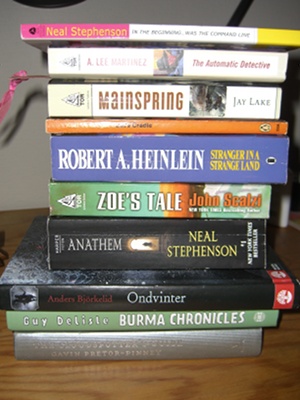
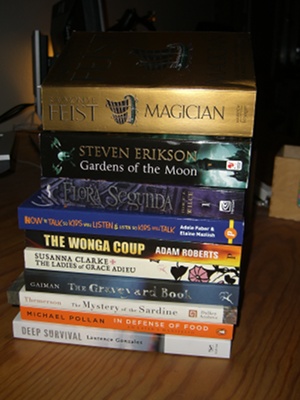
Books bought, not yet read


Books read, not yet blogged

Hanteringen av odöda (“The handling of undead”) is the third book for me by John Ajvide Lindqvist (having already read Låt den rätte komma in and Människohamn).

After hours of increasing tension and a strengthening electric field in the Stockholm area, leading to excruciating headaches and malfunctioning appliances, something snaps, and the dead come back from death. Not all of them, just the ones who died in the past two months, but that’s more than enough to shock society.

Unlike classical zombies, these ones are far from violent and have no interest in eating us. All they want is to go home. Instead of a battle to survive, we have a society struggling to somehow manage hundreds of rambling undead, and people trying to get to grips with their own reactions to the undead.

For some relatives of the recently dead, this seems like a good thing at first: your beloved wife/son/grandpa is back! But while the awakened ones may not be dead, they’re far from alive, which turns out to be harder for the living to cope with than proper death. When the body is broken, perhaps partly decayed, and the mind is in no better shape, what do you do? How do you react?

Turning the zombie story upside down is an interesting idea, and Lindqvist tells a good story. His realistic, quiet tone suits the story well. The yuck factor, while present, was relatively low, and there was enough suspense to make me want to keep reading.

I found it hard to read about the grief and the stories of loss, especially since two of the main threads were about deaths in a parent/child relationship. I have great difficulty dealing with such stories. But that’s just me, and even so, I liked the book.

The Steel Remains is the (fantasy) story of three war heroes, well after the war (against a race of lizard people wanting to take over all human lands) has ended. Ringil, the main guy, is asked to help track down a distant relative who’s been sold into slavery. The second one, Egar, is a nomad chief who’s no longer respected by his tribe. Archeth, advisor to an emperor, is tasked with investigating a mysterious and powerful attack on a harbour city. Most of the book circles around Ringil’s voyage but the three plot threads turn out to be connected, via a powerful alien race who has evil plans against humans.

That’s the plot. But the theme of the book is that of war: the cost of war, and how little time it takes for the gains to be frittered away, and how quickly the people forget what their warriors did for them and what they sacrificed.

While some of the events described (the war, for example) are huge, the viewpoint is always close up and personal. There is no grand battle between good and evil – there are just angry men fighting for or against something.

This is fantasy noir at its bleakest. It’s a corrupt, bigoted, ignorant, violent world, where criminals get rich and honest people suffer. There is no hope, no aspiration towards a brighter tomorrow. In all the 400 pages not a single happy relationship is mentioned, nor a happy memory, not to mention actual happy feelings in the present.

Perhaps this is why one of the back cover blurbs says that The Steel Remains “doesn’t so much twist the cliches of fantasy as take an axe to them. Then set them on fire.”

But I suspect that comment was referring more to the style and tone of the book, which is pretty brutal: all full of action and violence, drugs and sex and swearing.

Unfortunately this axing of cliches becomes too much of a focus for Morgan, and turns into provocation for provocation’s sake. Yes, making your protagonists flawed is a trendy thing for fantasy books, but when they’re all more or less despicable, you’ve gone too far. (Not as bad as Abercrombie’s The Blade Itself but definitely competing in the same league.) Yes, having a homosexual protagonist is a modern touch, but describing each of their sex acts in great detail is just juvenile. And yes, using contemporary language is a break with the usual high-flowing semi-archaic language, but when every other word is fuck, it starts to grate.

I guess this brutalist approach suits the theme. But it also seems like a prop that Morgan uses because it’s an easy way to stand out. Strip away the dark ambience from this book and what remains is not so special.

(Oh, and I cannot resist mentioning the absurd love affair between Ringil and one of the vampire-like all-powerful evil elves. Yeah, right, aliens find humans irresistibly sexy, happen to be homosexual, and their anatomy just happens to fit, too. Gaah!)

Still, despite this grumbling, I enjoyed the book. It did stand out from the masses of fantasy: it was intelligent, coherent, thrilling, realistic and intense.

Amazon US, Amazon UK.

The Goal is an odd mixture of novel and management handbook. In the form of a novel – where the narrator is the head of a factory in trouble, threatened with closure – Goldratt presents the Theory of Constraints.

In Socratic form Alex, the narrator, first gets to figure the goal of the business, and then how to achieve it. According to The Goal the goal is making money. You can agree or disagree with that, but that’s the premise of the book. Once that’s clear, Alex is coached to think about what levers he can use to make the plant make more money, and then we get to read, in quite a lot of detail, about how he actually manages the production in his plant to make it happen.

As a novel, The Goal is well below average, but as a business book, it’s an effective and enjoyable way to present a relatively dull topic. I definitely found it more interesting and easier to read than most business books.

I read this book because it was mentioned by Scott Bellware at the not-ALT.NET open space earlier this year, among a raft of other books that somehow have to do with lean software development. (Scott has an extensive and thoroughly described Lean reading list on his blog, too.)

The Goal has nothing directly to do with lean software development, although there are certainly themes that are relevant: continuous improvement, focusing on finding and eliminating the biggest bottleneck first, the necessity of having some slack in your process, etc. But perhaps one needs to have invested more of one’s soul and life in the concept of Lean to find this really inspiring. To me it was worth reading once, but not something I’m going to re-read any time soon for fun or profit.

Amazon UK, Amazon US.

According to the afterword, Chabon’s working title for Gentlemen of the Road was Jews with Swords. But as he himself admits, that brings up images of “Woody Allen backing towards the nearest exit behind a barrage of wisecracks and a wavering rapier”: funny, but in a puny way.

The Jews in the book are as far from Woody Allen as you can get: two mercenaries / con men in the 950s AD, wandering around somewhere in the Caucasus area. Zelikman is a pale, fair-haired, skinny Jew from the Frankish kingdom; Amram is a burly Ethiopian who likes to think of himself as a Jew. Neither matches the contemporary stereotype, which is exactly Chabon’s purpose.

Most of the action takes place in Khazaria, a Turkic nation that for some reason adopted Judaism as its state religion. I’d never heard of Khazaria before and at first I was convinced that it was a fiction but turns out that there really was an empire like that.

Due to money troubles (which seems to be the normal state of affairs for them) Zelikman and Amram find themselves tasked with delivering a young man safely to his grandfather’s home. The assignation spirals out of hand, and soon the pair are helping stage a revolution.

It’s Dumas with a modern, self-conscious angle. Inevitably there’s fighting and warfare, but nevertheless the adventures in the book have melancholy and fatalistic overtones. Nothing is black and white; the good guys cause as much bloodshed as the bad ones, and their reasons for acting are not more righteous.

The writing is wordy and lush, with long sentences flowing through phrase after twisting phrase. It won’t appeal to all tastes but in this setting it worked well for me.

The book as a whole was pleasant and enjoyable, but too slim, and, ultimately, forgettable. It did make me want to re-read Dumas and to read more of Chabon’s work, though.

Amazon US, Amazon UK.


Whenever I think of Jews with Swords I cannot help thinking about Jews with Horns. And whenever I think of Dumas, I cannot help thinking about The Shawshank Redemption.

House of Leaves is one of those rule-bending, genre-crossing books that’s hard to describe without resorting to (unfair) comparisons to other works. I was tempted to make some but managed to quell the urge.

Johnny Truant inherits a suitcase filled with the writings of an old man called Zampano. Zampano has written a purportedly documentary story about Will Navidson. And Zampano’s book is supposedly based on documentary material (video footage, photos, diaries) by Navidson himself and his family.

Thus,
You are reading a review written by
me about a book by
Danielewski consisting of papers edited and commented by
Truant, written by
Zampano, based on material recorded by
Navidson, who then finally has first-hand experience of the events described.

Underneath and inside all of this, it’s a story about a haunted house, where the inside dimensions seem larger than the outside. Then one day a door appears, on the inside of an outside wall, leading off into a dark, cold unknown.

Navidson becomes obsessed with exploring and understanding the house. Zampano appears to be obsessed with documenting and analyzing Navidson’s explorations. Truant is definitely well beyond the point of obsession, in fact he’s losing touch with reality due to all this.

Reading this book takes some patience. It’s a good 700 pages, to begin with. The stories are labyrinthine and sometimes hard to follow, frequently split between the body of the page and several layers of footnotes. Oh, and there’s appendices, too. Neither the footnotes nor the appendices can be skipped because they contain essential parts of the various stories. It’s got various typographic “enhancements” such as text upside down, on the side, in one corner of the page only, etc.

It takes some effort to read, but it’s fun. And it may be gimmicky, and it may have a bit too much of pretentious showing off the author’s smarts, but it’s original and fresh. It is rewarding if you read it as the experiment and puzzle it is, but probably less so if you approach it as a horror story.

Amazon US, Amazon UK.

Glasshouse begins with Robin (the narrator) in rehabilitation after memory surgery. The surgery turns out to have been unusually extensive – Robin is uncertain about all of his past, including his reasons for removing so much of his memories. He soon suspects that someone is trying to kill him, due to something in his past life.

When he is invited to participate in a psychological experiment recreating 20th century society, closed off from the outside world, it seems like a good idea – the bad guys will never be able to find him there!

Inside the experiment, Robin and his co-subjects have to get used to the obsolete concepts of marriage, jobs, church etc, plus (relative) material deprivation and physical danger. The subjects lose all the perks of the 28th century – fabrication machines, an ever-present network connection, body rebuilding, and consciousness backups (which effectively assure their immortality). Even worse, the rules (which he has consented to) include no communication with the outside world, no way to get out, and almost nothing in the way of civil rights.

The subjects get points for acting in character, and negative points for breaking the rules. This is enforced by extensive surveillance, plus enthusiastic tattling by your team members, since points are shared.

The experiment is a sort-of humourous look at our times, both because of how odd some of our modern habits seem to them, and because of the inevitable misinterpretations. Enough to make me wonder how future historians might really see us – and how much we have gotten backwards of the history and archaeology we think we know.

Anyway, Robin soon becomes suspicious of the experimenters’ aims and senses something sinister behind this project. Slowly he finds out just how sinister it is, and by the end he’s fighting not just for his life, but for mankind’s freedom.

Glasshouse is a hardcore SF thriller with good pace, lots of suspense, great storytelling and interesting ideas. Stross keeps surprising all the way to the end. Lots of fun.

Amazon US, Amazon UK.

Here’s a somewhat critical review whose author read the book far more attentively than I did and saw all kinds of things that I never even noticed.