So much is going on in Adrian’s life. His life is full, and he is full of life. So much energy, so much feeling! He is childhood embodied.

This month brought warm weather and Adrian has really enjoyed spring. We’ve been out on playgrounds, tried cycling, and even the inflatable pool has been in use. On playgrounds Adrian loves swings best and he can swing (or rather, have me push the swing) for half an hour before he tires.

It took a while for him to get used to spring weather and new clothes. He insisted on wearing his rubber boots with warm lining, and the “furry” jacket, and taking his mittens to nursery every day. Gradually he came to accept normal shoes and fleece jackets instead, but he’s still a bit suspicious of his Crocs shoes.

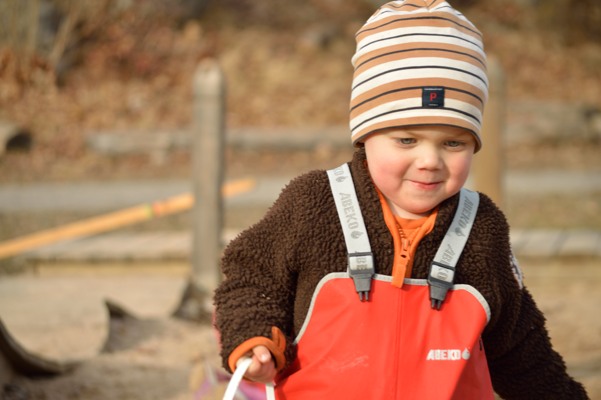
Even now he loves wearing a jersey hat, sometimes even indoors. He doesn’t like wind in his hair, he says, and when it gets windy he always puts on a hat. Also he never goes out without shoes, even though he loves being barefoot indoors.

Ingrid’s old tank tops were instant favourites. Not because they were tank tops but because he loved the pictures: a tiger on one, an elephant on the other. The novelty of no sleeves is so great that he points it out to people he meets – inga armar!

Adrian is usually happy to be around strangers but crowds make him uncomfortable. When we went to the Valborg bonfire, he was really bothered by the masses of people, and asked to go home. Det är jättemycket barn. Och mycket tädi och mycket onu. Jag vill inte vara här. (“There is very much kids. And much woman and much man. I don’t want to be here.”) The bonfire itself was scary, too.

He is also afraid of animals, especially if they are running loose and he thinks that they could come close. He doesn’t want to visit his best friend Hanna because they have cats. He pulls back when he sees a dog, and ideally wants to go to the other side of the street. I’ve been explaining to him how the dog is tied to a leash and cannot come closer. One day we saw a hare, and even though it was in a garden across the street Adrian closed his eyes and wouldn’t look.

Cuddly furry animals are scary, and he would never go pet one. But chickens, for example, are less scary than guinea pigs. And tortoises are not too scary at all, and a crocodile (a small one, and behind glass) was more interesting than scary, as we found out at this year’s Djurexpo.

Language-wise he has obviously decided that Swedish is his language. He understands Estonian perfectly well, and knows the names of many things in both languages. But when he speaks, he always chooses Swedish, and only uses an Estonian word when he cannot remember the Swedish one.

He is learning about similarity and groupings, and I often hear him use words like “same”, “similar”, “together”, “only”. He is also interested in amounts, especially jättemycket! and supermycket!. When we pour a drink for him he often asks for supermycket, which I think means that he wants a full glass, not half like I usually pour for him.

He has entered a “can do” phase. He wants to do things on his own without any help. When he drops a grape on the floor, instead of asking me to pick it up (as he used to) he now says Bara jag ska hämta!, “Only I will get it”, sometimes explicitly instructing me not to touch it. I am also not allowed to help him put on his sandals or hat, or to set the table for him, and sometimes even to open my nursing t-shirt for him.

I have made some attempts at getting him to use the potty but had no success. He knows what it’s for and he is perfectly aware that we all do our thing at the toilet. But he has no interest in trying it out himself. When I get him to sit on the potty he produces nothing, and then he gets up and less than a minute later makes a puddle on the floor.

He is aware of his own peeing and pooping, and often tells us afterwards that he needs a clean nappy, but it still seems to take him by surprise every time and he doesn’t seem to have any “premonition” in advance.

He still needs a nap during the day, almost always, but then often stays awake quite late, falling asleep around 9 together with Ingrid. It isn’t rare for Ingrid to fall asleep before him.

He still nurses about as much as he used to: when we wake, when we get home in the afternoon, frequently during the evening, at bedtime, and once or twice during the small hours.

Odds and ends:

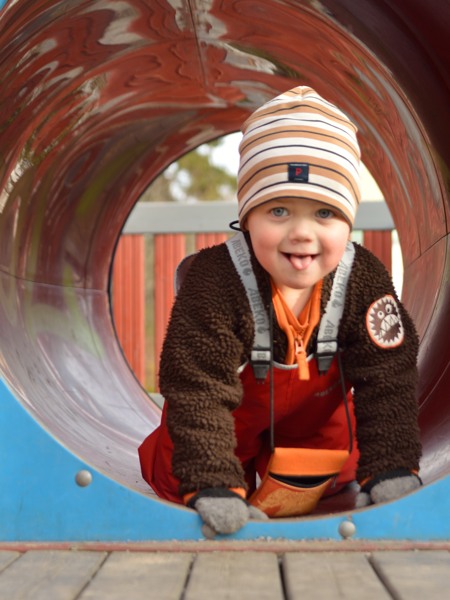
  • When he is happy, he often runs with his tongue out. So when he falls, the part that feels most discomfort is his tongue, which is then all covered with sand. He then tries to wipe it off with his hand which is also sandy, and doesn’t understand why it gets no better.
  • Even when he is upset, angry or sad, he still says thank you. He can be fighting with Ingrid about a toy, crying with frustration, and when Ingrid gives it to him, he chokes out a “thank you” through his tears.
  • He watched Rise of the Guardians with Ingrid and Eric and is now looking forward to Christmas. Idag är det jul! Nu kommer jultomten! – “Today is Christmas! Now Santa Claus will come” he says. My explanations about seasons, and having to wait for winter and snow, don’t really make sense to him. He still doesn’t quite understand “tomorrow” so the wait until winter is an unimaginable eternity.

Running

Fundamentally, Adrian is a happy and sweet child. He is co-operative, considerate and kind: he is usually happy to please others and do as he is asked, and he takes care to be nice to others.

When when we get home and I ask him to put his mittens and boots away, he happily complies. When he comes up with some sort of mischief – such as playing with flour or potato starch while I’m cooking, or throwing all my clothes on the floor, or dipping his hand in the drink in his glass – he asks first. And when I say no, he listens. The fact that I try to say yes as often as possible probably matters, too: he would be less inclined to cooperate if he always got a no.

But this month a new streak of anger and frustration has appeared. When he is denied something that he really wants, or when things don’t go his way, he gets very angry, and he is very aware of his anger.

Sometimes he simply tells us: Jag är jättearg!, “I am very angry!” Or he can tell me, Du får inte prata med mig!, “You mustn’t talk to me!” which really means “I don’t want to hear what you are saying”.

Other times he scolds the thing he blames for his woes. Dumma golvet! (“stupid floor”) when he hits his toe against the floor, dumma lappen! (“stupid cloth”) when he is angry about having his bottom wiped, dumma springa! (“stupid run”) when he runs and falls, and dumma mamma when I won’t let him eat raisins for dinner.

But he can also just shriek to express his anger – with controlled, calculated shrieks, not mindless rage.

One thing that he regularly gets angry about is ownership. He wants to own things, and he likes to tell me how this thing is his, and his only, and not Hanna’s, and how Darin cannot have it. (Hanna and Darin are two of his friends at nursery.) Unfortunately he doesn’t own very many things, and often wants to own things that aren’t really his. He doesn’t want Ingrid to take bread from the same bag as he does, nor to share the water bottle with her. He gets very upset if someone sits on his chair. But he also gets upset if I sit on what in his mind is Eric’s chair.

At the same time he isn’t really very interested in the few things that he does own. The Pippi doll lies forgotten in a corner; the stuffed doll named Johan remains at nursery.

The one exception is clothes. He is fond of many of his clothes, especially the ones with pictures – the Pippi and Bamse t-shirts, the crocodile pyjamas and the one with Winnie the Pooh, the monster socks. But he also loves his jersey hat and his rubber boots.

Pyjamas are his favourite clothes, and he regularly wears pyjamas to nursery. I guess they are soft and comfortably loose. For several days his favourite was a shimmery pink skirt (that I made for Ingrid a long time ago). I called it his disco skirt because he liked to put on while dancing.

He has also tried out Ingrid’s nail polish – blue on the right hand, red on the left – and that was fun. He showed off his nails to everyone we met. But when Ingrid chose glittery black, and he of course had to have the same, he regretted it immediately: black is definitely not his favourite colour.

He thinks that things become his when he has used them for a while. He plays a bit with a ball, then leaves it to do something else, but gets angry if Ingrid then takes the ball. It’s like he’s anxious to own everything.

The same goes for activities. He doesn’t want to miss out on anything. This is especially noticeable when he is with other kids, either with Ingrid at home, or with the other children at nursery. As soon as someone does something that looks interesting, he needs to be there, but at the same time he doesn’t want to let go of what he was doing before. It’s a constant race for him to try and keep up with everything that the others are doing. He is so much more relaxed when it’s just him and me at home, without Ingrid.

Adrian loves being with Ingrid, but he doesn’t really play with the other kids yet. He understands pretending, but it’s a self-conscious thing for him, an act. “Look, I’m a ghost!” or “look, an elephant”, but it doesn’t turn into play. He still prefers adult company to that of other kids, and often seeks out an adult, both at home and at nursery. Mostly he then wants to read or to sing.

He hates having his hair brushed (det gör jätteont!) and having his dirty nappy changed. Brushing teeth is usually more or less OK, and wiping his nose too.

He enjoys chasing and being chased, especially when it is time to brush his teeth or change his nappy.

He plays with the first letters of words. It began with a friend at nursery calling him Adrian-Padrian. First he didn’t like that at all. Jag är inte Adrian-Padrian! But when we made it a game and called Ingrid Ingrid-Pingrid, and Ingrid joined in and said emme-pemme, he was on board. Now it’s Ingrid-Pingrid and Adrian-Padrian and pappa-lappa and emme-pemme and lappen-pappen and all kinds of things.

He has learned to count to two, and understands when things are two. He counts “one, two”, and holds up two fingers: “I have this many meatballs”. But with larger numbers it’s all wild random guesses.

One day, all of a sudden, Adrian fell in love with his soft stuffed doll. Eric made it for him during the schooling-in week last year, and it’s been at nursery since then. They use them occasionally for some sort of group activities I think. And then one day Adrian absolutely wanted to take it home with him, and to hold it all the way home, and to have it with him during dinner, and then in bed.

We gave it a name because I didn’t want to keep calling it “the doll”. I tried a few names and asked if Adrian liked any of them. “The doll” is now called Johan.

Johan was the drop that started a flood. Now Adrian wants to take stuff with him whenever we go out: bags, toy cars, Johan, his favourite jersey hat, an extra pair of mittens, books… At dinner time Johan (or the car) gets to sit on the windowsill. One evening he took three little Chubbies cars with him to bed, and then tried to hold and hug all three while falling asleep.

Taking things with him when going out is OK, but he also wanted to take things home from nursery, and we had a number of tear-filled disagreements about.

Every afternoon, after nursery but before we pick up Ingrid from school, we go grocery shopping. Adrian wants to hold the most important grocieries in his arms both in the supermarket and afterwards on the way home. And just like with the cars, he has difficulty understanding and/or accepting that he only has two hands. He holds a banana, a pair of mittens and a book in his hands, and hugs a large bag of corn snacks, and then asks for the juice bottle as well.

Adrian’s started to pretend and make believe. A piece of fabric becomes a scarf for the hobby horse. An empty bowl in the kitchen sink is cake dough; a pink drinking straw becomes a flamingo. Food, especially, is good fantasy material: the row of apple chunks is a snake; the half-eaten biscuit is a camel, or a dog, or a train.

Watching Daddy finger on YouTube with Daddy

Colours, which he was so interested in last month, have now clicked in place. He still talks a lot about them, but now he actually gets many of them right: red, green, blue, yellow, purple, orange, sometimes white and black.

He often asks, Vad heter den färg?, and he mentions the colours of things he cares about. And he seems to find it fascinated that several things have the same colour. Den vagnen heter röd. Den skorna också röd! Väskan också röd! (“This stroller is called red. This shoes also red! The bag also red!”)

He has started using compound sentences, with a main clause and a subordinate clause. For example using men inte, “but not”, as in “Mommies have boobs but not daddies”.

Miscellaneous items:

  • He has learned to jump with both feet.
  • Favourite Melodifestivalen song: En riktig jävla schlager.
  • Favourite item in the supermarket: Paulun’s raspberry and pomegranate juice. (“Buy raspberries! Green ones!”)

Insisting on the “big bowl”, “big spoon” and “big glass”

Adrian seems to have grown a lot this month – not in size but in age. Language development is part of it. But he also had his first real haircut (if a 2-minute haircut done at home can be called “real”) and suddenly he looks much older.

But returning to language, he seems to talk a lot more, and about more varied things. He talks about us vs. others, and about ownership: not just “mine!” but also about what is ours and what is not. He talks about who is small and who is big. He talks about what he is doing (jag hoppar! or even jag är här!).

He still pretty much ignores grammar: skips the small helper words like prepositions, and often also the less weighty verbs such as “have” and “be” and “do”. He knows about future tense but not about past: he can say jag ska titta på film (“I will watch a movie”) correctly, but jag tittar på film (“I am watching a movie”) can equally well mean “I watched a movie this morning”.

He loves letters and loves to point them out in all sorts of settings. A (Adrian), I (Ingrid), P (Pappa), M (Mamma), O (oo vad det låter bra), Ö (Örjan), N (näsa), E (Eric or elefant), sometimes also D (Darin), H (Hanna), and others that he knows less well.

He talks about colours a lot, too, usually getting them completely wrong: points at something and says “green”. Often green is his first guess regardless of what the actual colour is, but he also suggests blue and yellow and red. He knows the names of a bunch colours but I don’t think he ever uses any of them correctly.

Numbers and counting are also fun. He knows the numbers come in a given order, but not that you need to start at one. Given two meatballs he can count them “one, two” but equally well “seven, eight” or “four, five”. But I think he’s very close to getting it.

He is practising getting dressed and especially undressed. He can get pretty much all of his clothes off, except for the boots & snowsuit, because of the straps on the snowsuit that go under the sole of the boot. Putting them on is harder and often he doesn’t even want to try – Jag kan inte! Emme ska göra. – but he is very cooperative when I do it for him. He doesn’t object to clothes, generally, and is not at all as warm-blooded as Ingrid. He likes wearing a fleece top and sheepskin slippers at home, like us adults but quite unlike Ingrid.

In fact there is a lot of jag kan inte (“I cannot”) and also jag orkar inte (roughly “I’m not strong enough”) about all sorts of things.

He is curious about our doings and wants to watch as soon as we do something new. Vad du, pappa? But when Ingrid is around, he generally prefers to play with her. Right now the favourite game is playing doctor, when he gets to “coperate” Ingrid. (In Swedish koperera, and it is just as funnily almost-correct as in English.) Whatever Ingrid does, Adrian will do as well, no matter how little he understands of what’s going on – “just happy to be on the show.” He browses Bamse magazines because she does, and stays up until 8:30 because she does. He is much calmer and quieter when she is not at home – trying to keep up with her winds him up but also takes a lot of energy.

When he has a goal, he always runs and never walks. He only walks when he doesn’t quite know what to do next. Jag ska hämta bok! Jag springer!

He is quite sensitive to certain kinds of sensory input, such as loud rumbling noises (tractors, motorbikes) but also the sensation of wind on his face, or snow or raindrops. He doesn’t even like to bathe with me any more, because of the risk of me splashing.

He is scared of all sorts of animals, almost to the point of panic. When a cat enters the room, he not only climbs onto my knees but tries to get even higher up, onto my shoulders, and closes his eyes and hides his face. The other day we saw a hare in a garden we passed, and he didn’t dare to look out until two blocks later.

Likes:

  • Music. This is nothing new but it is something that I am reminded of almost daily.
  • Toothpaste.
  • Breaking eggs (for pancakes etc). He used to do it with great gusto; now he often needs a bit of encouragement because jag kan inte!.
  • Cutting with a sharp knife. Bananas and apple chunks are great for practising knife skills.
  • Eating with his fingers, and especially cramming food into his mouth with his palm.
  • The intro song from this year’s first Melodifestivalen show, a cover of Euphoria by Gina Dirawi. Except that he calls it Copacabanana, which is the (very different) MF song that first caught his attention.
  • Gummibjörn
  • Toting a little bag with him when we go out.
  • Sitting inside the shopping trolley when we’re at a supermarket.
  • The TV sections in Teletubbies, when they show actual kids doing stuff, but not the other parts with Teletubbies themselves. With Ingrid it was totally the opposite.

A happy month. The shouts of inte! are a thing of the past, and Adrian has generally been full of joy and positive energy. I’ve heard fewer min mamma! and he hasn’t been as clingy.

But he “compensated” for that by suddenly wanting to breastfeed all the time (it felt like). Especially when he is feeling insecure, he finds security in breastfeeding. But for several weeks he also used breastfeeding as a solution for pretty much every problem. Feel like cuddling? Have some boob. Hurt his knee? Ask for some boob. Upset because of some disagreement with Ingrid? Fix it with a boob. Disappointed? Bored? Tired? Boob!

He could literally ask to breastfeed at 15-minute intervals at times. And he had great difficulty accepting “no” or “later” as an answer, which hasn’t been a problem for us in the past. If I happened to be in the shower, or in the middle of some demanding step of dinner preparation, and asked him to wait, he screamed and tore at my clothes and tried to pull me down to the floor.

Just as this was getting to a point where it really couldn’t take it anymore, we turned a corner of some sort, and he calmed down again. Now we’re back to a normal state of affairs. I can tell him that I will just finish peeling those potatoes, or change out of my work clothes into something more comfortable, and he waits. Sen tissi, he tells me, in his Swedish-Estonian pidgin language.

One day he even made up a little song about breastfeeding. Tissi, tissi, tisse-tisse tissi, … Melody: “Midnatt råder” / “Haldjate jõuluöö”.

During the Christmas break Adrian took a big step forward in language development. The nursery staff all commented on how much he’d learned during just two weeks. Suddenly he went from mostly reusing phrases he’d learned from others, to freely constructing his own sentences as needed. He also simply speaks a lot more now. It makes a big difference to how I perceive him: it’s as if he’d aged several months in just a few weeks.

He talks the most when we’re on our way home from nursery, and every day the main topic is pretty much the same. He talks about who has been where, and who is going where. Nu köpa banan. Sen gå hem. Adrian gå hem. Ingrid gå hem. Alla gå hem. Lapsed gå hem. Adrian dagis. Ingrid på skolan. Pappa på jobbet. Emme på jobbet.

He often points out large vehicles (trucks, buses, tractors) but now he’s also started commenting on loud ones and saying that he doesn’t like them. Even just a snow plough can be too loud for comfort.

Once we’re home (and in fact as soon as we’ve picked up Ingrid from school) there are more important things to do than talk. Before dinner, he mostly plays with Ingrid. That doesn’t involve much talking beyond “me too!” and “let me” – it’s mostly squealing and giggling. I am amazed at how high my tolerance for loud, high squealing and screeching has become, as long as it’s happy squealing.

Sometimes their play is at a level that I as an adult cannot understand. They can, for example, have fun “falling” off the sledge on the way home, again and again. Or they just sort of tumble around and giggle and make silly noises. Other times Ingrid comes up with something and Adrian enthusiastically joins in: climbing into an empty laundry hamper; using a bath towel as a sleigh (Adrian sitting on it and Ingrid pulling it around); pulling blankets over their heads and pretending that they’re ghosts (and trying to scare me).

Their play is generally very simple, immediate and physical. Usually little or no equipment is involved, and it’s always simple things such as blankets or boxes, rather than toys. Toy food is the only exception, and when they play with that they always involve me: the kids both prepare food that they serve to me.

Ingrid has been trying to teach him hide-and-seek. He loves the seeking, and especially the finding – där var Ingrid!!!. – but needs a bit encouragement and prompting. Without that, he looks in the two closest places and then gives up. But he can keep going for a good while if I help him by suggesting places to look.

Ingrid hides in simple places such as under a table or behind a door, but even so, Adrian often needs help spotting her. He can stand right next to her but because Ingrid has never before hid in that place, he doesn’t understand that she can be there. Once he literally almost stumbled over her: not her feet but her entire body, curled up in a ball between two boxes on the floor. But he was instead looking in the distance (behind the drawer unit under my desk, where Ingrid had hid before) and did not notice her. Ingen Ingrid! he said, and turned to leave – and I had to point out to him that she was right in front of him.

The counting is also kind of fun but not for long, so I need to help him stay in one place long enough for Ingrid to hide. But he totally sucks at hiding. He does not understand the point, and as soon as Ingrid shouts “I’m coming!” he also comes out and starts looking for Ingrid, so the game is over very quickly.

Adrian adores Ingrid. Sometimes there is disagreement or competition, but he so loves being with her, doing what she does.

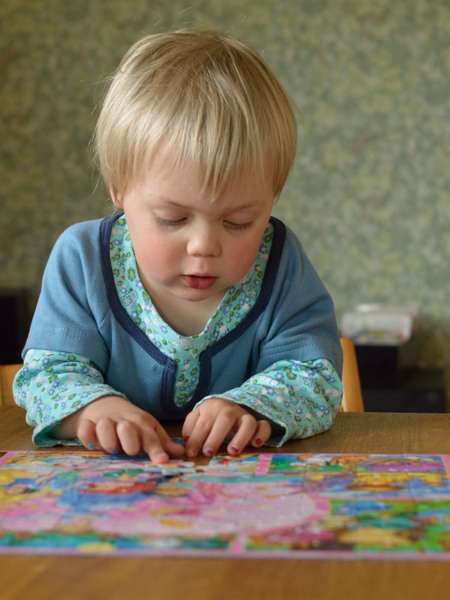
Left to his own devices, Adrian likes exploring the various board games we have (which mostly means spreading everything out on the floor). He also has a knob puzzle with a Pippi picture that he likes.

After dinner they’re both usually too tired to play more, so then it’s TV or iPad for both of them.

On the iPad he seems to have outgrown toddler apps like picture books. He now likes simple shape puzzles, knob-puzzle style. Lekplats is a favourite one, and Shape Builder. He also likes Beck and Bo, and Villa Villekulla of course.

Favourite songs: the Pippi theme song was first replaced by “Sjörövar-Fabbe”, and now I think “Mors lilla lathund” has taken over, with “Sommaren är min” as a close second. These three all originate from Pippi movies, too.

One day we were singing “Fader Abraham”, and he suddenly understood about left and right, which he found very exciting. Since then, putting on his clothes or boots instantly becomes much more fun if we guide him: “left foot… right foot…”.

On YouTube his favourites have been “Daddy finger” and the Örjan song from Fem myror och fyra elefanter. Both Ingrid and Adrian love that whole show and have been watching it a lot. Adrian calls it nonu tädi, meaning “man and woman”, or sometimes Magnus och Brasse.

Adrian is learning:

  • Grammar. He has been trying out different plural forms (bamsor, elefantor, bokor) and has just in the last few days understood vi/meie (“we”).
  • Letters. Last month he learned A; now he has added I for Ingrid, P for pappa and M for mamma/emme. The number four (4) is also an A for him. He likes typing them on my computer and pointing them out in all sorts of settings: magazines, signs, iPad apps etc.

We are cautiously experimenting with milk. It seems that I can add a bit of sour cream to my food occasionally, without any obvious ill effects. But it’s difficult to know. He has been quite gassy recently, which could be due to the sour cream, or maybe not. Who knows.

By far the most frequently used word in Adrian’s vocabulary right now is min, “mine”. Everything is “mine!” and there is a constant stream of min emme!, min tallrik!, min skor!, min vagn!. Sometimes we make a game of it – he goes min emme! and Ingrid says min emme! and he says min emme! once more and then I go min Adrian! and Ingrid says min pappa! and so on. Or maybe it turns into min fot! and min lampa! and mitt träd! until anything and everything is ours.

It is partly a game, partly a habit, but partly also a manifestation of his intense possessive jealousy right now. When he says min stol! he means it, and will not let Ingrid touch his chair. He tries to push away Ingrid’s hand when she holds on to the stroller while we walk home from school; he won’t let Ingrid use the same glass as he.

He is mostly jealous towards Ingrid, and probably all the kids at nursery. Not towards me, but I suspect that is because I fall in the category of “possessions” rather than “competitors”. He sometimes doesn’t want to allow Ingrid to sit next to me, because I am min mamma!

There also seems to be a streak of actual anxiety about separation and strangers. The proclamations of min mamma are most frequent when we are with people he doesn’t know well. When we go to pick up Ingrid at school, he doesn’t really want to walk in through the door, and when he does, he hugs my leg, hides his face, and says min mamma! to anybody who comes close or even looks in his direction. He does the same when some friendly stranger on the train starts talking to him, or a neighbour says hi to me. A few months ago he would have gladly said hi to them all and then shown off some bag or toy or something.

It’s not just me he wants to keep close. He gets anxious when the family is out walking together and one of us falls behind or gets too far ahead. When we’re all home and suddenly he cannot see Eric, Adrian asks where he is. The one day when I took him to nursery in the morning and we did NOT have Ingrid with us, he checked several times, var är Ingrid? and I kept telling him that Ingrid is at home. He is in a herd phase and, like a good sheep dog, he wants to keep the herd together. (I remember Ingrid doing the same at about the same age I believe, but with more tears. Maybe those are yet to come.)

Adrian likes:

  • Helmets. A few weeks ago, just before the onset of real winter weather, we bought a new bike helmet for Ingrid, because she outgrew the old one. At first he wouldn’t let her have it but when we gave him her old helmet he wore it every day. Not while riding a bike, because he doesn’t have one, but while sitting in the stroller on the way to nursery. Luckily winter came and he no longer saw Ingrid wear her helmet and we could hide the helmets so he forgot about them.
  • Routine. Things should be done the same way they always are. He likes taking the same route to nursery every day, and in the afternoon going to the supermarket and then to Ingrid’s school.
  • Music and singing. It is often he and not Ingrid walking up to the CD player and asking for some music. He sings for himself when he sits in the stroller, or when he is playing with some toy. He always sings a recognizable melody and sometimes does several verses. Currently it’s mostly Christmas songs. And we actually don’t sing the Pippi song constantly any more.
  • Everything Christmas-themed. He points out all the Santas and elves and Christmas trees and Christmas lights and advent displays and St. Lucy figures he sees.
  • Monsters and growling. His favourite clothes is his tiger suit, and his favourite socks are the ones with small monsters on. He likes to pretend he’s a tiger and roar and growl and show us his claws. And then the tiger becomes a lion, här kommer lejonet, roar!, and then a giraffe, roar!, and then a zebra, roar! and then här kommer Sankta Lucia, roar!. Everything roars.
  • Playing with toy food and our toy stove. Sometimes he cooks on his own, but he also likes cooking for me. He often serves me food that he himself wouldn’t eat for real, such as broccoli, soup, and cheese sandwiches.
  • Playing with dress-up toys, where he can choose clothes and accessories for a magnetic doll figure for example. He often ends up creating wild combinations with two pairs of trousers on the doll, shoes on her hands and a flower pot on her head.
  • Doing everything that Ingrid does. That ranges from “shallalooba” to drinking with a straw and reading Bamse.
  • Feeding the birds and especially the squirrels. A few weeks ago we saw a squirrel visit our bird feeder and he was very excited by that. Since then when I go out to fill up the feeder, he comes with me to “feed the squirrel”.
  • Gingerbread cookies and raisins, but not saffron buns. Those he just tears into small pieces, looking for any hidden raisins.

Adrian has learned:

  • The letter A for Adrian.
  • How to say that we do one thing after another. He simplifies “first X, then Y” to “then X, then Y” but has definitely grasped the concept.

He is learning:

  • How the telephone works. He knows that Eric’s voice can come out of the phone and understands that it is indeed Eric speaking, and finds it quite fascinating.
  • Dressing and undressing himself. He could pull zippers up and down last month already (except for the end bit) but now he also practises taking off his socks, top and trousers, and sometimes tries putting them on as well. With trousers he actually has some occasional halfway successes. He can put his hat on (but usually ends up with an ear flap in his face) and his boots as well.

Other small stuff:

  • He calls small dogs “dog” and large dogs “wolf”. Large in this case is any dog whose back reaches to my knee or thereabouts.
  • I notice him talking about things that have happened a lot more than he used to. He mentions things that have happened earlier and seems to be thinking more about such things, remembering more.
  • He actually says thank you when given things.
  • He is totally not a vegetarian. Several mornings he has chosen to eat fish fingers for breakfast. When he gets to choose lunch, he chooses meatballs or fish fingers.
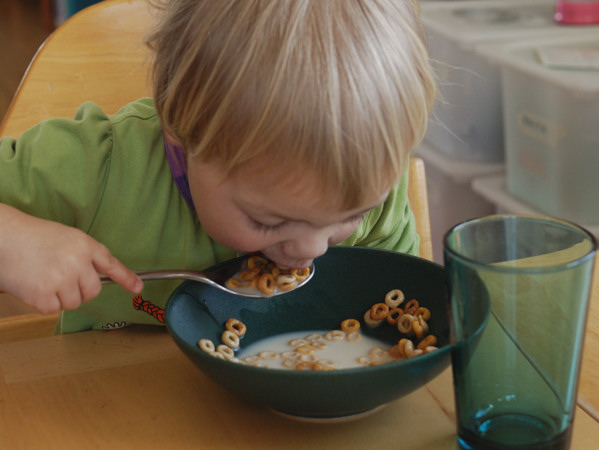
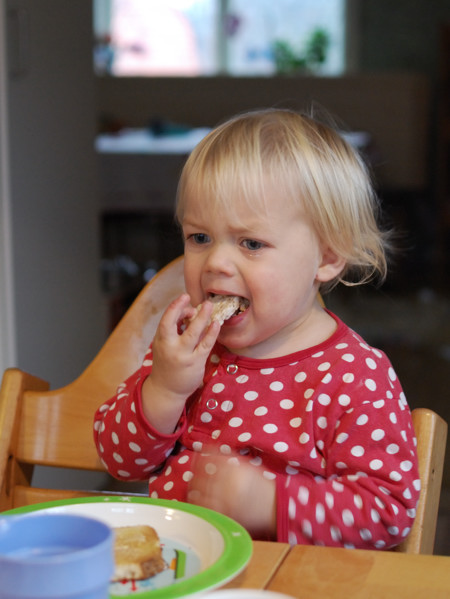
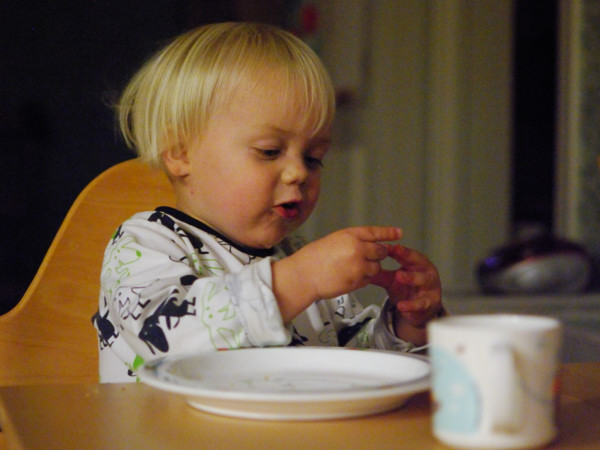
  • Often he eats more than Ingrid. Ingrid is distracted at mealtimes; he shovels in the food with both hands and barely pauses to breathe. For breakfast he can eat a whole portion of porridge made from half a cup of oatmeal.
  • When there is an L or R sound before another consonant, he swaps them around. “Korv” becomes “kovr”, he drops things “på govlet”, the food is “küml”, the time is “tovl”, and the Skalman figure on his toothpaste tube is “Kamlan”.

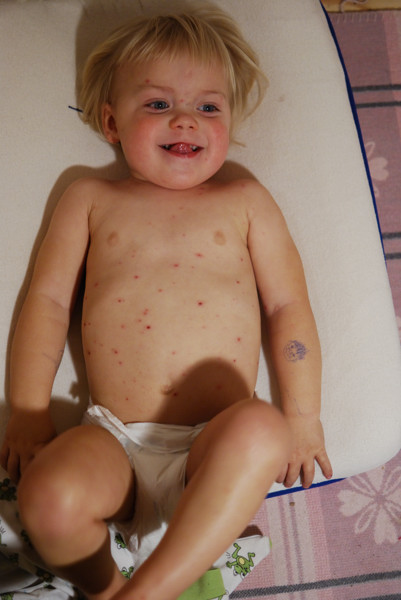
Adrian has chickenpox. Luckily it doesn’t seem to affect him much – he is feeling more bored than ill. At least now… I see I said the same thing when Ingrid fell ill with chickenpox, and then a day later she was as miserable as she had ever been.

And Ingrid is also at home, keeping us company, with a fever. It feels quite weird – she is so rarely ill nowadays.

Compared to last month, the flood of inte! (“not!”) has abated somewhat, although we still hear it quite a lot. Adrian can say Inte äta pannkakor! Jaaa! Pannkakor! in one breath. (“Not eat pancakes! YES! Pancakes!”). It seems like a reflex.

But in general he definitely is more positively disposed towards the word. He has learned to both nod and say Jaa! to agree with things. But he doesn’t always remember that option, so generally I interpret silence as assent, and I am usually right.

He can also say tycka om det (“[I] like this”) and uses it widely, for example tycka om det banan and tycka om det tiss (about bananas and boobs) and about Pippi, favourite books etc.

He constructs more complex sentences now, with more component parts. Jag vill inte äta, and också gå ut. In particular he’s learned to make sentences that describe what he is doing: jag sitter här, jag klättrar här, etc. He also comments on what others do: Ingrid ledsen (“Ingrid sad”) or pappa bakar (“pappa is baking”, when he felt the smell of freshly baked bread in the house) or tädi jookseb.

He asks questions. Probably the most common one is nonu gör?, “man doing?” (mixing Estonian and Swedish) which means “what is that man doing?”. Another frequent one is var är emme?, “where is emme?”. That one has now also developed into a primitive hide-and-seek: he crawls under the kitchen table and suggests that I ask “where is Adrian?”. I do that a few times and then he bursts out, här är Adrian!

He makes jokes. He points at my breast and tells me he will eat it; he points at a glass/my skirt/a fork/a pen and says “sandwich!” and laughs. He likes me to make the same kind of jokes – to call things with the wrong name, to joke about eating obviously non-edible things.

Speaking of eating, he has had some major eating phases this month, putting away 6 potatoes for dinner, or 4 large pancakes – more than what Ingrid eats. As usual, his appetite waxes and wanes, and some days he eats close to nothing. His is still quite conservative when it comes to food and will especially not touch any unknown vegetables, or any food where things are mixed together, such as casseroles or soups (apart from porridge). Although there was one week when he tested a fruit smoothie, and some soup, and a piece of roasted parsnip, and a bit of persimmon. There is hope for him yet, I guess.

Adrian is still very fond of music and often asks me or Eric to sing for him. He himself sings, too, and knows large chunks of many songs by heart – and sings them clearly enough that I can recognize the melody. He has definite favourites and often asks for specific songs – and vice versa, often asks me to skip other songs that I try to sing for him. All the Pippi songs are his absolute favourites: above all the main Pippi theme song but also Mors lilla lathund and Sjörövar-Fabbe. That last one we have on a CD, and that song has been playing for what feels like hours every day recently. Nevertheless the Pippi theme song is best of them all. He asks for it when he is bored, he asks for it when I change his nappy, he asks for it as a lullaby.

Because of Pippi he also likes pirates (because in one movie Pippi goes on a trip to rescue her father from pirates). Anything with a skull he calls a pirate (such as other kids’ socks and rubber boots). Likewise any man with a bushy beard is a pirate, such as the guy on the Turkish yogurt pots (who, by the way, is in fact a Greek).

Another favourite song is “Tingelingelinge tåget far”. This is a song where, at a specific place, you insert the name of a person – usually when singing for a child you use the child’s name. We (meaning I) sing it in endless variations: for each family member, for Adrian’s friends and for Ingrid’s friends, and so on. He also likes “Trollmor”, “Gumman i lådan”, “Jag hamrar och spikar”, “Lille katt” and many others.

He likes “bouncing” songs that involve me bouncing him on my knees – “Sõit, sõit linna” and “Prästens lilla kråka”. Ingrid has also rediscovered the joy of these songs and sometimes I end up bouncing both on my knees at the same time.

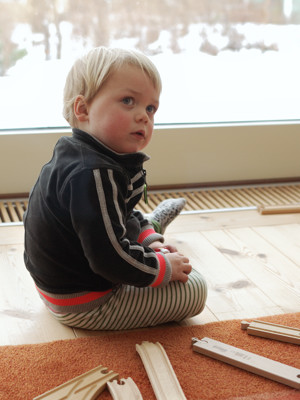
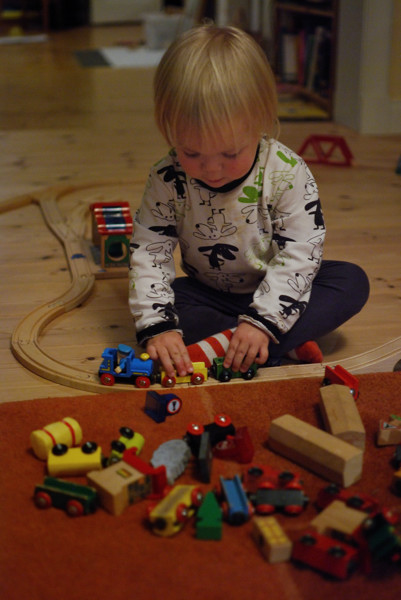
As for toys, he plays with the Brio train set quite often. He doesn’t usually build any tracks himself but will happily push his trains along when someone else puts down the tracks. But he can also play with the trains and other pieces on their own, without any tracks.

And sometimes he takes the two large crates of trains, tracks and accessories, happily exclaims jättemycket! (“a lot!”) and pours it all out on the floor. He seems to get some special sort of satisfaction out of that, and has tried the same with my sewing stuff (both my dressmakers’ pins, and my box of spare buttons).

He also plays with toy food, especially while I am preparing dinner, and often offers me food that he has “cooked”. Sometimes he offers me an empty pot, or even an empty hand, and says it’s sweetcorn (or whatever) – he can pretend that nothing is something, which I think is pretty advanced.

He can cut with scissors, with some effort. The kids’ scissors we have are a bit stiff so he needs to use both hands to open them, but can then close them using the proper grip. But I have to hold whatever he is cutting, because he can’t manage both. First he cut some ribbon, then he cut some paper; then he went around and wanted to cut just about everything (his trousers, a door handle, my thimble, and so on). So he only gets to use scissors under very close supervision.

He likes trains, and train rides to town. I don’t know which part he really likes most – the physical train or the fact that we’re taking the train. Or both. In any case he is really happy when we say we’re going on the train, and ecstatically shouts out “TRAIN!” when the train arrives at the platform.

Adrian’s monthly post will have to wait until tomorrow, because the object of said post is still awake and showing no signs of wanting to go to bed, at 10 pm. Instead he is sitting on my knee, making funny noises, poking at my boobs, and voicing opinions about what I should be doing on my computer instead of typing (looking at a Pippi movie, or at pictures of him or Eric or dolphins).

This was the month of will and wanting – and not wanting. The two most commonly occurring words in Adrian’s vocabulary are min (my, mine) and inte (not).

Well, Adrian’s min does not really mean “mine”. In reality I believe it covers a wide range of meanings, from the actual “mine” through “I want to have this thing” to “I like this thing”.

When I pick him up at nursery, he proclaims min mamma! to everyone who ventures close, and holds on to me just in case they intend something sneaky. Also min vagn! (stroller) and min macka! (sandwich).

Other people’s mums are important, too, and he points out all his friends’ mums and dads when we run into them. Hanna, our friends’ daughter who is just two days older than Adrian, is his best friend. He always greets her happily when she comes to nursery in the morning, shows off his Pippi shirt, says Hanna kom! and drags her off to some activity. He almost always points out her house when we pass it.

At meal times at home there is a lot of min mumin!, meaning “I want my Moomin plate and cup”. He got a set of Moomin tableware for his birthday and now effectively refuses to use anything else. As the bowl gets emptier and the design at the bottom becomes visible, he happily points out the characters.

Pippi is his favourite character, in all shapes and forms. He would wear his Pippi shirt every day if he could, he loves the Pippi books and movies, and he adores the Pippi song. At Ingrid’s birthday party, after we had sung Ja må hon leva for Ingrid, the whole family sang the Pippi song for Adrian. He was overjoyed.

But he’s a fan of various other branded characters as well – not only Moomin but also Bamse and Barbapapa. He has a Bamse t-shirt which is his second best after his Pippi shirt; he asks for Barbapapa clips on Youtube. The only characters I know he doesn’t care about is Teletubbies. He seems bored by them.

Another favourite brand is the jingle for SF, the Swedish movie studio behind the Pippi movies as well as all the other film adaptations of Astrid Lindgren books.

inte comes and goes in waves. Sometimes it seems like all he can say is inte. He can say inte macka! (“not sandwich!”) and at the same time take the sandwich he is offered and bite into it with gusto. He can walk around mumbling inte inte inte to himself.

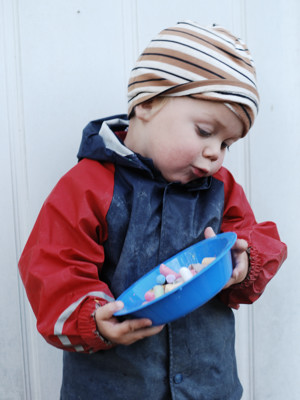
Nappy changes are almost always inte. He hated them so much that we’ve switched from cloth nappies to disposable ones. Brushing teeth and brushing hair is sometimes OK and sometimes a fight. He often has very strong opinions about clothing, wants this set of pyjamas and not that, this hat and not that. He likes his rubber boots and a soft stripy jersey hat with a fleecy inside (which Ingrid also loved for years, and only gave up because she outgrew it).

Usually he is relatively sensible about his clothes, so I let him choose. Once we’re outside and he realizes that his choice may not have been ideal, he has no trouble admitting that and putting on more clothes. Sometimes he wears less than I would, but he doesn’t seem cold. But he’s not at all as warm-blooded as Ingrid, who could cycle home from nursery in her indoor clothes in +5°C. Adrian always wants at least a fleece when we go outside.

I guess he gets to hear a fair amount of inte at nursery. I sometimes hear him repeat phrases like inte knuffas and inte bitas – “no pushing”, “no biting”.

Other phrases that Adrian has picked up from nursery: illa dig där (“hurt yourself there”), låt det vara (“leave that alone”).

There is also a lot of flytta på dig and akta på dig (“move over”, “get out of the way”) which could come from nursery but he may well have picked those up from Ingrid as well. For him they seem to mean “this thing is in my way” – he can say flytta på dig! to a chair that is blocking his way when he tries to push his step stool to the kitchen counter.

The nursery staff tell me that he is always very busy during the day. He wants to do everything that the others are doing. When three kids around him are doing three different things, he wants to do all of these. There is a lot of rushing around, trying to keep up. And he is so frustrated when he cannot manage to do everything that the slightly older kids do.

Adrian likes and/or notices sounds, and often points them out to me. Låter! he says when an airplane flies past, or we pass some loud machinery, or hear a neighbour’s chainsaw in the distance.

He has started to play with his food. A piece of bread will often become a car that drives around the edge of his plate, or a boat, or a crocodile (when the slice of bread looked like jaws after he’d taken a big bite out of it).

But the playing rarely distracts him from eating – unlike Ingrid, I have to say. She can get so lost in her daydreams or playing that she totally forgets to eat. Adrian has been eating quite a lot, although his diet is not much more varied than it used to be.

Anything that looks unfamiliar gets flat out refused. It’s the looks that matter: I can make courgette fritters which consist of maybe 85% courgette, 10% egg and 5% flour, but they look like pancakes, therefore they are pancakes, and thus edible.

Most veggies he refuses. He eats peas and sweetcorn (and calls both of them corn) and that’s about it. But he eats most fruits and berries. He eats raspberries but refuses bell peppers and tomatoes which can taste much sweeter.

He is almost always hungry when I pick him up at nursery, because they don’t let him eat whatever he wants. For their mid-afternoon snack, for example, the kids get one flatbread each, and after that they can have as much crispbread as they want. Adrian likes soft bread much better than crispbread, so he goes hungry instead. And sometimes he probably doesn’t eat much at lunch, either. I often hand him a sandwich as soon as we’re off, or we go straight to the supermarket to buy bananas.

He is also hungry early in the morning. I stopped feeding him at night about six weeks ago. After several weeks he was generally sleeping well all night, but he kept waking at around 5 or 5:30 every day. He’d cry and just could not go back to sleep for a long time. Some days we had to get up at 5:30, other days he fell asleep again after a long while. Eventually I figured out that he might actually be hungry (duh) and I started nursing him again at that time. Now he wakes, feeds, and goes back to sleep, all within 10 minutes. During the rest of the night I refuse, and he has no trouble accepting that.

I took away his dummy during daytime and that has generally worked pretty well. During the first couple of days he was immensely upset. He screamed all the way from nursery to Ingrid’s school (that used to be a time when he would always suck on the dummy). But after a couple of days he forgot that habit, and now there is no screaming at all on the way home, and not much during other times either. Generally he has been taking it very well. Only sometimes when he is really upset about something, he wants a dummy to console himself. But he has been nursing more in the afternoon, replacing the rubber nipple with the real thing.

He likes numbers and counting. He can “count” to four (in both languages I believe) but I don’t think he really understands anything above two. It’s just like a kind of a verse.

Ingrid discovered that she can calm him by counting: one day on our way home from school he was upset about something, and she just started counting for some reason – “one, two, three…”. At around four he became quiet. When she reached ten and stopped, he was all calm, and didn’t start up again. She tried it again this evening when Adrian wanted to nurse while I wanted to finish my dinner: she counted slowly to ten, which kept him calm so that I could finish eating. A very cool trick, I have to say.

We’ve reached a point where Ingrid sometimes understands him better than I do. It used to be that I had to tell Ingrid how to interact with him, to tell her that he doesn’t seem to like this or that. Now she notices behaviours and reactions that I don’t, and comes up with tricks and ideas that I wouldn’t even think of.