We have deer who visit the garden. We have had rats (and from the amount of interest shown by a neighbourhood cat, I suspect they are still here). Now we also have killer slugs.

Just a few years ago, killer slugs only existed in books and gardening magazines. I had never seen one in real life. I’d seen some small slugs as a kid, but nothing since then.

Last summer I saw one or two shockingly large slugs in our garden. “Oh look, a slug – I wonder if it’s one of those Spanish killer slugs?” and that was that.

And this year they have arrived en masse. I probably missed one last year, so it found itself a nice nest and laid some eggs, and now its babies hatched and started colonising our garden. I have picked several dozens already.

They crawl around on my flowers. One of the bastards ate most of a broccoli plant before I caught it. And they are pretty disgusting to step on with bare feet.

Now we’re at war. I go on daily slug-picking rounds, especially near our compost hole. And I have declared a bounty on them: the kids get 1 krona for spotting a slug and telling me, and another if they kill it as well.

The least unpleasant extermination method (for all parties involved) that I’ve come up with is freezing them. I have a slug jar (an empty can of coconut milk) in the freezer, covered with a plastic bag. Whenever I find one, it goes in the jar. When the jar starts filling up, I empty it in the compost hole.

Interesting slug fact of the day: the Gothenburg Museum of Natural History is so interested in slugs that they invite the public to send them slugs for identification. Apparently it is very hard to reliably distinguish them from the outside, you need to look at their anatomy for proper identification. I considered sending a few to them but really I don’t care what species they are. They are in my garden, they are too many, and they are eating my broccoli – I will kill them regardless of species.

Slug fact #2: they are tricky to photograph! They are not frightened by sound or movement. But as soon as anything touches them, even just a blade of grass that I want to move out of the way, they defensively pull themselves into a dense little lump, just a third of their stretched-out size, and then they stay that way. I haven’t yet had the patience to wait for them to re-emerge.
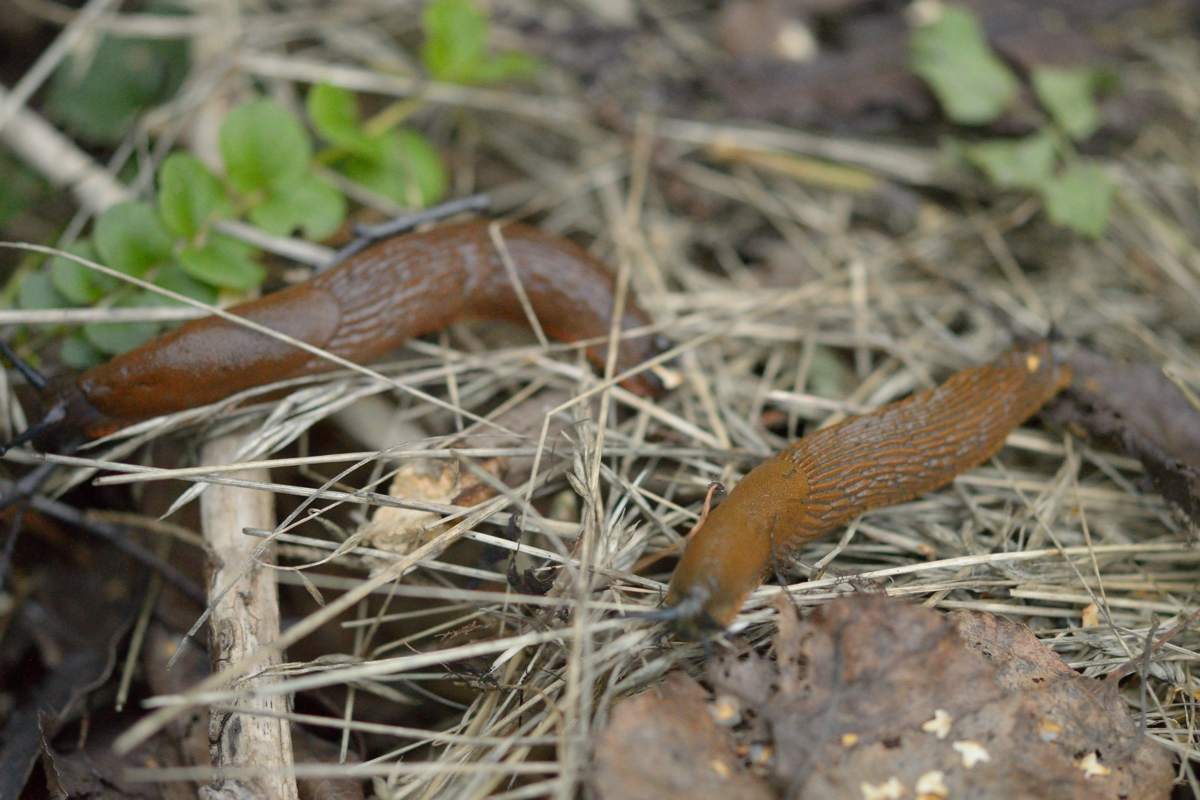
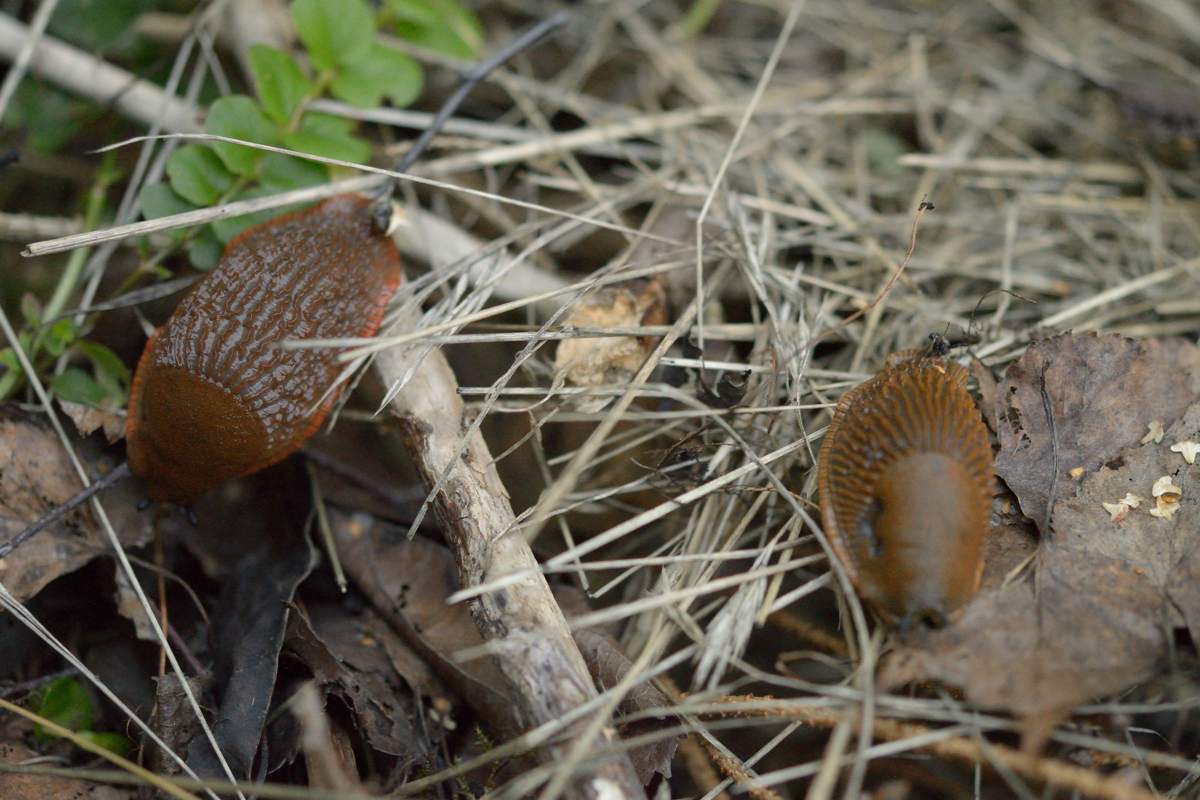
Same place, same scale, same two slugs. The smaller was about the size of my index finger in its relaxed state; the larger was longer than my middle finger.

Last spring we put up a nesting box for birds in the cherry tree outside the kitchen. A pair of blue tits promptly moved in and nested there.

This year both blue tits and great tits have been interested in the box, flying around, inspecting, trying to crowd out the others. It seems the great tits won – the blue tits haven’t been around for a week or so.

Today Ingrid found a broken egg on the ground, about the size of the tip of my finger. Unfortunately it very much looks broken rather than hatched. I wonder what happened to it, and I hope the parents have better luck with the other eggs (which I hope are still there in the box).

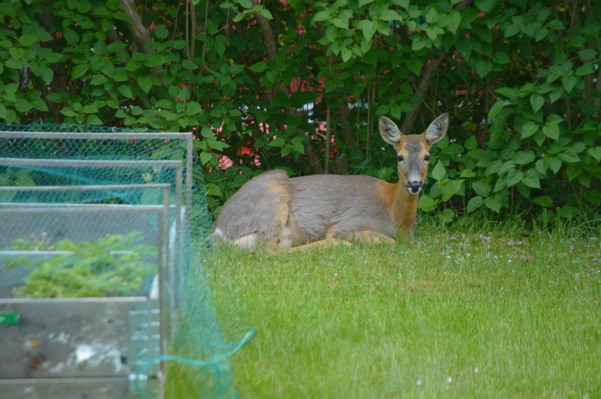
The deer are getting bold. This one didn’t move more than an ear even when I opened the door 10 metres away from her.

The pansies I planted in April? They got eaten by deer.

Twice.


I am seriously annoyed. They don’t just nibble at the flowers, either – when the deer come, they eat every blossom bigger than the tip of my thumb. The destruction they leave behind may be small in size but it still looks quite depressing afterwards.

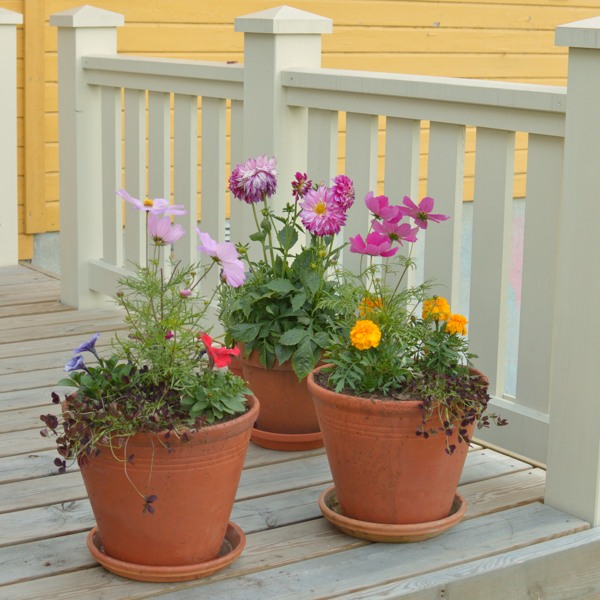
On the plus side, deer apparently do not eat French marigolds (tagetes), garden cosmos, or petunias, so my plantings behind the house have been left in peace.

Our bird feeder continues to feed (birds) and entertain (us). This year the sparrows and nuthatches have been few, and I don’t think I’ve seen a single siskin. The magpies dominated during the early part of the season but are now rare. The Great Tits and Blue Tits are there, as always. The Great Spotted Woodpecker has been here a bit more frequently than last year, and occasionally we get visits from squirrels, too. Their climbing ability, seen up close like this, is awesome.

It seems we’re mostly feeding blackbirds this year. They were just a couple last year, but this year there are at least five. I wonder if last year’s continuous food supply led more of them to decide to spend this winter here and not migrate to warmer climes. They are still struggling to hold on to the feeder. At least one of them is somewhat more confident about its acrobatic abilities, and flies up and hangs on while flapping wildly. The others tend to feed on what falls on the ground instead. Often the snow is completely covered in their footprints.

They seem to be quite dependent on our feeder. Often several blackbirds are hanging around the feeder already before dawn. When I go out to fill up their food, sometimes they don’t even bother to flee, and once I had to shoo one of them away from the feeder to be able to open it.

Remember our bird feeder? It was up and running last winter, although all the building work around here meant that neither we nor the birds had optimal peace of mind to really enjoy it. This winter we’re all enjoying it more than ever.

The seed mix – sunflower and peanut – that we optimized in our experiments two years ago remains a great hit with the local birds. This year we improved it further: Eric found hulled and chopped sunflower seeds, which means that we don’t get that mushy pile of sunflower hulls underneath the feeder.

The mix of birds that it brings has changed, though. The Great Tits and Blue Tits are there as usual. The Jays and Nuthatches still come, but they are fewer than they used to be, and same with the Sparrows. The Magpies mostly came in autumn and now haven’t been around much.

Instead we have some new guests.

  • Siskins (Carduelis spinus, siisike, grönsiska) have absolutely dominated during the current cold snap. They move around in flocks of several dozens birds. When they come to feed, they come a few at a time, until there are around 15 of them on the ground beneath the feeder, another few at the feeder itself, and more in the trees and bushes nearby. They’re also easily spooked by bigger birds: when a blackbird or fieldfare flies by, even at some distance, the entire flock of Siskins takes flight in near-panic and flies into the trees. Since they are so many trying to take off at the same time, it isn’t rare for a few of them to hit our kitchen window. Luckily they haven’t gathered much speed yet when they reach the window and usually don’t even knock themselves out but fly straight on. While they sit around in the trees, they chirp and twitter constantly. You really can’t miss them when you walk past our yard. It does not surprise me at all that people like breeding them as songbirds.
  • Blackbirds (Turdus merula, koltrast, musträstas). They were more frequent arlier during the season when it wasn’t that cold yet but they come now, too. Just like the previous years, there’s either a single couple, or they just travel in pairs: I’ve seen single females and single males, but rarely more. They have trouble hanging on to the feeder: neither small and nimble like the tits and sparrows, nor strong like the jays, they struggle and wobble. They’re much happier on the ground. To accommodate them, we now spread food on the ground underneath the feeder, too. (The Siskins like that as well.)
  • Fieldfare (Turdus pilaris, björktrast, hallrästas). A big and bossy bird who likes to have the whole field for itself and chases away any others. It doesn’t hesitate to bully even the jays, who are their size if not larger. It likes to feed on the ground just like the Blackbird. It also likes to just sit there after feeding and look sullen, just because it can.

Among the rarer visitors, there is still the occasional Green Finch or Great Spotted Woodpecker. I also noted a pretty Redpoll (Carduelis flammea, urvalind, gråsiska) the other day.

More Siskins

Spring is in the air. Well, it is still –10°C outside, and there is still half a metre of snow in the garden… but the sun is up well before me, and the birds are chirping and twittering much more actively.

Other creatures are, apparently, also getting that spring feeling. Here’s the sight that met us behind our house yesterday morning, where the snow had lain more or less untouched the previous night:


Hare tracks everywhere! Must be that March madness coming on.

I’ve never actually seen the hares visit our garden – just their tracks and some droppings underneath the bird feeder. (I guess they won’t say no to some seeds when they’re desperate.) Eric’s spotted them lurking in the lilac hedge at times.

The bird feeder has also attracted the interest of a couple of roe deer. (Look at how deep that snow is around the doe’s leg! I expect we’ll be reminiscing about the Great Winter of ’09 for many years to come.)

As with the hares, they’ll take peanuts and sunflower seeds when that’s the only thing on offer. We have very deliberately not put out any more suitable feed for them: we don’t want them to think that this neighbourhood is a good place for them to hang out. They should really stay in the nature reserves well away from here. Here they risk getting run over, and of course they are rather unpopular with most homeowners since they tend to eat parts of the garden that people would rather keep. Tulips, I’m told, are a favourite food in spring.

We haven’t planted any tulips, but I am hoping to see a lot of snowdrops, crocuses, scillas and daffodils.

Our first winter with a garden (meaning last winter) we put up a bird feeder for suet balls. We had quite a lot of visitors during late autumn, to the point where we started thinking that we’d need to ration the balls because of cost. Then winter came, and suddenly there were hardly any birds at our feeder. Our theory is that they found better food elsewhere.

This year we upgraded to a seed feeder. We kept the suet ball feeder, too, but now we also have a little hut on a stick, filled with seeds. This way we can vary the food. It also allowed us to move the bird food further away from the house. The suet ball feeder hangs off the kitchen window, which meant that the twitchier birds would fly away as soon as anyone moved in the kitchen.

The new location seems perfect. We’ve got a good view of it from our dinner table. It’s far enough to for the birds to consider it mostly safe. It’s got various trees, bushes, eaves etc. within a few metres, in several directions, which allows the birds to scout out the area before coming in for a feed.

First we bought some sort of seed mix consisting mainly of oats and sunflower seeds. The sunflower seeds got eaten, but the birds totally rejected the oats. These ended up on the ground below the hut in such amounts that I couldn’t even see the ground underneath. They even started sprouting, so in November we had a thick mat of oat shoots underneath the bird feeder.

Then I checked which kinds of birds were supposed to like what kind of seeds, and mixed my own seed mix: peanuts, sunflower and hemp, since we mostly had small birds such as sparrows and tits. Turns out all the birds visiting us adore peanuts, and the sunflower seeds generally get eaten too, but no one touches the hemp. We’re forced to scrape out the hemp seeds now and again, or the hut will just fill up with them.

This season we have seen:

  • Sparrows, en masse, especially before the snow came. They preferred eating on the ground, and would eat the seeds that other birds had kicked to the ground, or kick down their own. They often travelled in gangs; sometimes there would be up to thirty sparrows underneath the feeder. Now during winter they are far fewer.
    I assumed at first that they were common House Sparrows (Passer domesticus, koduvarblane, gråsparv) but closer observation showed that most, or possibly all, were really (Eurasian) Tree Sparrows (Passer montanus, põldvarblane, pilfink).
  • Tits. We have two kinds, Great Tits (Parus major, rasvatihane, talgoxe) and (Eurasian) Blue Tits (Parus caeruleus, sinitihane, blåmes). For some reason the Blue Tits all look really scruffy, while the Great Tits look well-fed and sleek.
    The tits like to scratch away the less interesting seeds, then take a peanut and fly away with it to a tree, where they hold the nut with one foot while eating it. They often hang around the feeder together with the sparrows – neither seems bothered or scared by the other.
  • Nuthatches (Sitta europaea, puukoristaja, nötväcka). Beautiful sleek birds with a very distinctive behaviour – they often turn around to face downwards, both on the feeder and in the tree. They seem to like sunflower seeds best. They also often share the feeder with tits.
  • Jays (Garrulus glandarius, pasknäär, nötskrika). Even more beautiful than the nuthatches. Cautious birds who often abort their landings at the feeder, fly another scouting round, and then come back to feed. They’re also big, so the feeder wobbles whenever they land, and it’s hard for them to get into a good feeding position. But they manage. I get the impression that they travel in pairs – often when I see one, there’s another one somewhere nearby.
  • Magpies (Pica pica, harakas, skata). Brash and confident, often they scare away the other birds. Sloppy eaters: when they first arrived at the feeder, they would scratch around so much that much of the seed ended up on the ground. Eric had to modify the feeder (put up bars along the sides, so instead of one large opening on each side there are two or three small ones) so that the magpies don’t spoil all the food.
  • Blackbirds (Turdus merula, koltrast, musträstas). At first they would mostly land in our whitebeam tree and eat the berries, but now they’re also feeding off the seeds on the ground beneath the feeder. I think there might only be a single couple visiting us: I’ve seen a single male and a single female.
  • Green Finch (Carduelis chloris, grönfink, rohevint). It’s a rare visitor here; I’ve only seen it a couple of times.


The birds are still wandering around the edges of our garden. This morning I saw three of them together within a few steps of each other, plus one of the parents, still feeding them worms.

A day or two ago I saw one of them try to fly. It flew a few meters up from the ground and tried to land on a tree branch. It almost got a grip but not quite, and tumbled half a meter to the next branch further down. It couldn’t get a grip there either, and tumbled to the next lower branch. And again it couldn’t get a grip, and fell down onto the grass below. It looked a bit confused and miffed, and didn’t try again.

About 10 days ago, Eric discovered a bird’s nest in the cherry tree in front of the house, and a clutch of baby birds inside. We’ve been following their progress daily since then. They’re fieldfares (turdus pilaris, björktrast, hallrästas).

By the time we discovered the nest, the eggs had already hatched. There wasn’t much activity or movement around the nest until hatching, and nothing to make us notice the nest. It’s at the height of our 1st floor window, not very visible from the ground.

Once the babies had hatched, though, there was a lot of traffic, as the adults kept fetching worms for the little ones. Both mama bird and papa bird were working hard: sometimes one parent had barely left the nest before the other arrived (after a few reconnaissance stops at lower branches, to check that the coast was clear). We could often see the adults hopping around in our garden, pecking for worms.

The baby birds grew at an astonishing speed. Ten days ago they were naked, blind and puny. Yesterday the first one left the nest, and today the nest is empty. However the birds aren’t quite ready to leave their parents yet: they can hop around, but not fly yet, and the parents will keep feeding them for another few days.

According to the Internet, fieldfares in southern Sweden often lay a second batch of eggs in June/July. Stockholm is well below the middle so perhaps we’re southerly enough to see another clutch?

Naked and small, barely visible over the edge of the nest
Hungry!
Still hungry, but now with a few downy feathers
More feathers… still ugly
All feathered now
Getting very cramped in the nest
Just hopped out of the nest