Puffin © Ian Lyons
Cormorant nest

One of the most enjoyable things we did in Iceland was a “nature-watching” cruise around the coast and small islands of Breiðafjörður.

While the inlands are largely empty, the coasts of Iceland are very much alive. The large bay of Breiðafjörður in north-west Iceland is said to be one of the most bird-rich areas in Europe. It has shallow mud flats with lots of food, as well as thousands of islands and islets and a long coastline, offering good nesting grounds. I’m sure the lack of human activity helps as well.

Iceland’s most eye-catching bird is definitely the puffin, Fratercula arctica. And they really do look just as odd in real life as they do in photos. What the photos don’t tell you – although the birds’ body shape is a hint – is how unsuited puffins are to flying. They somehow seemed like mutant penguins who were good swimmers, and had now barely learned the art of flight. They need a good-sized runway to take off, as they trot along the ground or the water and frantically flap their wings to get airborne. Once in the air they look like chubby barrels with wings attached.

Around 3 million pairs of puffins breed in Iceland every year. That’s six million breeding birds! They live in colonies; we mostly saw them on small grassy islets that they had taken over more or less completely, to the exclusion of other birds.

Other common birds from the auk family were black guillemots (Cepphus grylle), shags (Phalacrocorax aristotelis) and cormorants (Phalacrocorax carbo). We mostly saw guillemots on the water, fishing, while shags and cormorants were easier to spot in flight or on the nest.

The species we saw most of was the fulmar (Fulmarus glacialis). They are called “storm birds” in both Swedish and Estonian (stormfågel, jää-tormilind) and I found that very fitting. At first glance they appear similar to gulls, but when you look closer, they have a more raptor-like build, straighter wings, and they move differently in flight. Unlike puffins, flight is the natural state of these birds, and we rarely saw them doing anything else. They were quite confident and unafraid of our boat, and flew in very close. Their flight was about as distinctive as that of puffins, but in a different way: very controlled and efficient gliding, utilising the wind, often just above the surface, with only a few occasional beats of the wings.
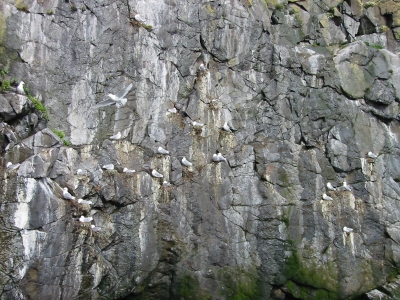
Nesting kittiwakes

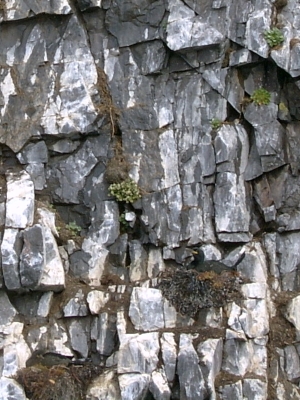
The kittiwake (Rissa tridactyla), another gull-like bird, is not called a gull in English, but is considered a gull in both Swedish and Estonian. We mostly saw them nesting, which they did on minuscule ledges on vertical cliff faces. Indeed, their Estonian name is “cliff gull” (kaljukajakas).

Other birds we saw quite a lot of included eiders (Somateria mollissima) and Arctic terns (Sterna paradisaea – this one migrates between the Arctic and the Antarctic every year!). Finally, the trip concluded with what was obviously the official highlight: passing by the nest of a pair of white-tailed eagles.
One of my strongest memories of Iceland will without doubt be its smelliness.

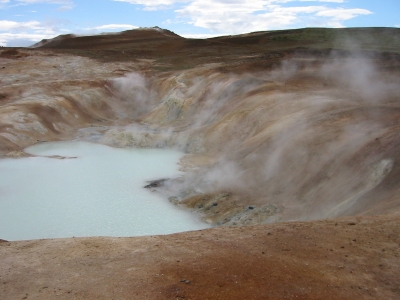
Most of Iceland doesn’t smell much at all – or smells of nothing more than moss and water and sea. But the volcanic areas make up for it tenfold. The water in their hot springs has a lot of sulphur in it, and smelled like a mixture of sewerage and rotten eggs. And because the water comes out steaming, the smell is quickly distributed and reaches the nose easily, and spreads well with wind.

For some reason I seemed to be a lot more sensitive to that smell than most visitors. Maybe it’s something that takes a special gene, like smelling asparagus in your urine? Or perhaps it’s just due to the pregnancy. Anyway, I couldn’t go near a sulphurous spring without retching and gagging. So any time we wanted to see a fresh lava field or bubbly mud pools, I was trying to walk upwind of them, walking very fast when we got close, and breathing through a hanky and as lightly as possible.

And what’s worse – the hot water in their taps comes from hot springs! At one of the hotels the hot water stank so strongly that I had to wash myself and brush my teeth with only cold water, which was very cold since it probably came straight from a glacier. I was very relieved to discover that the next hotel had less-smelly water and I could actually wash my hair again!

Many of Iceland’s best-known tourist sites are either waterfalls or otherwise “watery”. The waterfalls are due to the mountainous and craggy terrain, and the numerous glaciers that send their melting waters down towards the coast. In fact it looked like most rivers had a waterfall somewhere along its course.

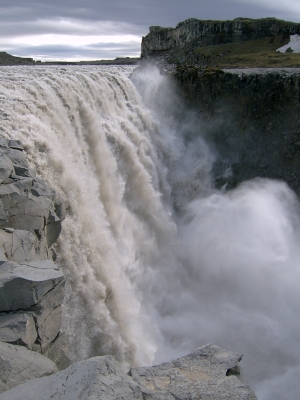
Dettifoss
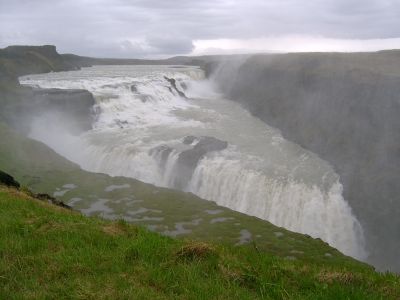
Gullfoss
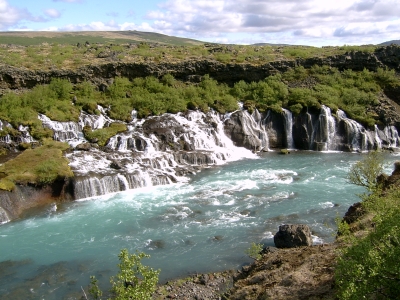
Hraunfossar
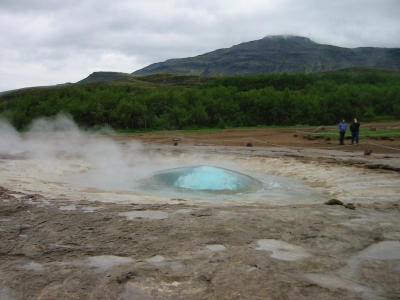
Strokkur about to erupt

Iceland has what’s claimed to be Europe’s most powerful waterfall – Dettifoss, with 200–400 cubic metres per second, depending on season. It doesn’t have Europe’s highest, a title claimed by several waterfalls ranging from Norway to Switzerland. (Height can be measured in different ways – is it the longest free fall that matters, or do consecutive cascades count as one?)

Not as powerful, but definitely more spectacular was Gullfoss (“Golden falls”). Gullfoss has two stages, and the second one dives straight into the opposing wall, throwing spray and mist high up in the air. That’s why my photo looks foggy, and that’s also what creates the small pools in the foreground. It also explains why the grass there is so much greener than on the other side of the river.

Dettifoss does the same, and because the river is in a deep gorge in an otherwise flat and empty region, you can see the clouds of spray well before the waterfall itself becomes visible.

Hraunfossar (“Lava field falls”) is a completely different set of waterfalls. There is one narrow and flashy waterfall, and adjacent to it is a broad picturesque waterfall that comes seemingly out of nowhere, as water trickles out from a lava field and from under layers of moss. Again the area just around the waterfalls was lush and green (on a relative scale) – even small birch shrub! – whereas just 100m further away there was only moss and brown grass.


Other watery sites include, of course, the world famous geysers. The original Geysir (“Gusher”) is no longer active, but the neighbouring Strokkur (“The Churn”) performs admirably, spouting hot water every 5 minutes or so. Our photos don’t look too impressive, since the grey and foggy pillar of water was barely distinguishable from the grey and foggy sky, unfortunately. If you want to see what it can look like in good weather, look at photos tagged “geysir” at flickr.

Between eruptions, the water level in the pool fluctuates significantly, and the moment before an eruption the surface balloons up into a very distinct mound. It takes a fast camera (or very lucky timing) to catch this. The shutter lag on my camera was way too long, but Eric caught this great picture of it.

Various smaller pools of boiling water are scattered around the same site – just as with waterfalls, you can spot the area from some distance away because of the steam rising from the ground.


Then there is Europe’s largest hot spring at Deildartunguhver, where 180 litres of almost-boiling water well out of the ground. This mostly has a curiosity value, as there isn’t much to see, apart from huge clouds of steam – large and dense enough to hide everything including the path, so finding your way out is a matter of turning back 180 degrees and walking in a straight line until you emerge at the other side of the cloud. Water from this spring is piped 60 km to two neighbouring villages, where it is used for heating.

Iceland’s emptiness is not so strange, really, when you look at what the land itself is like.

Iceland is of volcanic origin. It’s a large blob of magma welling out of the slowly widening rift between the North Atlantic and the European continental plates. And that’s not just history – they have active volcanos right now. The last period of significant activity was in the 1970s-80s; a new island popped up off the coast of Iceland in the 60s as a result of an underwater volcanic eruption. The last major eruption in the 1780s killed 80% of the sheep in the country, and ashes wrecked agriculture all across the land. Famine reduced the population to 38,000 and according to my book, Denmark actually considered evacuating all survivors, effectively abandoning the country. And in between major eruptions, of course, the volcanically active areas are full of bubbling mud pools, springs of boiling sulphurous water, and fumaroles of other noxious gases.

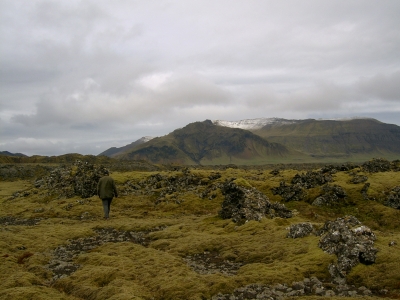
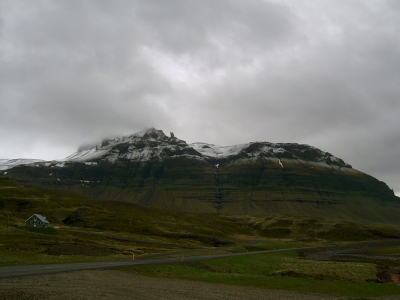
Much of Iceland therefore consists of volcanic rock. The mountains resulting from old, major eruptions look reasonably normal, covered with a thin layer of soil. In other places, lava has flown over the ground more recently and created lava fields, which are about as hospitable as they sound: fields of jagged black porous stone formations.

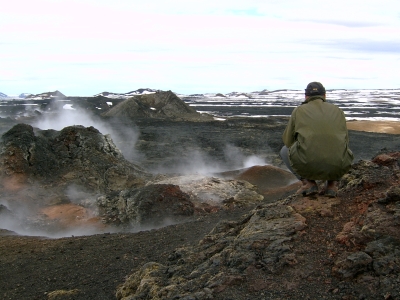
We saw a number of these (hard to avoid, really) of different ages. Fields created by the activity in the 1970s resemble common descriptions of Hell. The ground is covered with black lava mounds, with steaming cracks here and there. The ground has bright white and yellow patches of sulphurous deposits. Nothing grows there at all. A few hundred years later, vegetation starts taking hold, mostly mosses and lichens. There is still really no soil to speak of. Another few thousand years, and mosses are joined by tufts of grass and even some small and hardy flowering plants.

Even where the ground is covered with some soil and has more plant life, it is a struggle for anything to grow in Iceland. It isn’t as cold as you might think, based on its location just south of the Arctic circle, because the Gulf Stream brings mild and moist air. Nevertheless, summer is short and chilly, and sunlight weak. On mountainsides in the northwest, snow extended very far down – to about 600m from sea level, I would guess.

As there are few forests, there is no shelter from wind or rain, and soil erosion is a real problem. Some areas in the northeast get very little rain, which gets captured by the glaciers and mountains to the south and west. The ground, being porous and volcanic, doesn’t hold water very well, either, and volcanic ash is not particularly fertile. At best, there are thigh-high shrubs of arctic birch and willow, mixed with heather and possibly a few bilberry bushes. Much of the countryside is just empty brown moorland of dry grass. And the worst areas are simply dusty stony desert.

The only inhabited areas are the coastal lowlands, which tend to be somewhere between moorland and grassy meadows – barely fertile enough for sheep and horses, and doesn’t really support any farming.

According to our guide book, Iceland had extensive forests when the first Viking settlers turned up in the 9th century. Most were chopped down, either for timber or firewood, or to clear land for fields and pastures. What the settlers didn’t realise was that due to Iceland’s cold and dry climate, trees take a lot longer to grow than in Sweden or Norway. So what would have been a sustainable pace of felling back at home, ended up denuding the whole island.

Iceland now has a reforestation programme, and plantations of birch and pine were frequent. Many farmhouses in the middle of grassy mountains had a tight cluster of trees just around the house – often fenced in to protect the trees from sheep. They have also introduced lupins to control erosion and fertilise the earth. In many places, clumps of blue lupins covered large areas and stood out as the only plants taller than a few centimetres.


Lava field after 300 years – Leirhnjukur


Lava field after 4000 years – Berserkahraun


Sulphur springs – Leirhnjukur


“Normal” landscape

It’s empty in many senses of the word. First and foremost, there are almost no people in Iceland. Of the quarter of a million Icelanders, 170,000 have congregated to Reykjavik and its suburbs, which leaves less than one person per square kilometre in the rest of the country. The second largest town has about 16,000 inhabitants, and everything after that is just villages and single farms.

Since the country is essentially uninhabited, its roads are generally deserted. It is possible to drive a good 10 minutes on the main ring road around the island without seeing any other vehicles. Streets in villages and towns were also surprisingly empty – even during a weekend, during the summer when schools are out, there were almost no children outside, and we rarely saw anybody working outside on the farms either.

Tourist sites were equally empty, even the major ones – most had no more than half a dozen cars parked when we got there. This was quite a pleasant change from most other regions and countries we’ve visited. No crowds, no jostling, nobody disturbing our views.

This scarcity of people led to scarcities of all the things that occur around people. Shops, restaurants, petrol stations… I believe our road map of Iceland shows every single petrol station in the country, except for the ones in Reykjavik, and a few of the larger villages where the map only shows one but reality had two side by side.

The country was also surprisingly empty of things to see and do. Normally, I imagine, one browses a travel guide and picks and chooses between sights. Here, though, we had days when we saw everything that the book mentioned as being on our route, and even made quite long detours to pick up sights that would not have been near the top of our list… if we had had a list to choose from, that is. But when the alternative is to drive for 4 hours straight and not see anything but an empty road, every waterfall becomes valuable.

I do wonder what it would feel like to grow up in rural Iceland. Driving an hour every morning to get to school. (We saw many boarding schools as well.) Having two sports to choose from (swimming and football). No library or cinema to go to. No real chance to have any friends, because you cannot get to them. In some places, no real way to be in touch with the outside world at all – even radio coverage was patchy.

I’m not a particularly gregarious person, and I value my personal space, but I do like to have some contact with the rest of the human race. And I want to have something to do with my time. Based on what I saw, I really wouldn’t want to live in Iceland; it would drive me mad within a few weeks. One week was enough to have me twitching restlessly from lack of activity and stimulation. What do Icelanders do all day? Walk up and down their endless hills? Write lugubrious poetry?

Here are some pictures from our Lake District trip. Nothing spectacular; visually this wasn’t a very memorable holiday. Scotland was more impressive (4 years ago). And despite the name, there were far more hills than lakes!

I was surprised by how barren the hills were – they’re not particularly tall, but for some reason there were hardly any trees or bushes – due to the soil, maybe, or the wind? And because we went in early spring, the views were mostly of brown hills covered with dry grass and dead bracken. It probably looks greener in the summer, but it must still be pretty empty.

Down in the valleys, the walled-in meadows were green and dotted with sheep. It was lambing season, so the meadows were full of lambs, ranging from newborns who could barely stand, to restlessly prancing and skipping ones, and finally those that had already started to settle down, grow up and eat grass. I don’t know what they do with the lambs to make them so cute!


Downtown Manhattan (the financial district and Tribeca) is a lot livelier than it was two years ago, and so much more alive than London’s City that the comparison is almost cruel. Where the City is focuses on offices and office workers’ needs (pubs, sandwich shops, some shops), downtown Manhattan is a mixed neighbourhood with both offices and residential buildings. People actually live here. When I walk to work in the morning, there are joggers and dogwalkers – not just the ubiquitous delivery vans. And the resident population has attracted restaurants and shops that are open in the evenings and weekends. In fact I saw to my surprise that many shops here are open from the morning rush hour till late evening, 8 to 8, so even those who work long hours can do their shopping before or after work. The streets are still awake when I walk home around 7pm. In London, everything is closed by that time, and during weekends the City is like a ghost town.

The other thing that struck me is how spacious Manhattan is. Streets are wide. Pavements are really wide – wide enough for food carts and their queues, without blocking the street. There are even empty spaces between buildings. Shops in Soho are roomy and even cheaper shops feel like spacious showrooms. There are advantages to building upwards instead of sideways!

But Manhattan is just like London in that streets are in miserable shape in both places. In London streets get dug up and then half-heartedly patched over, until you can barely see the original surface and there are more bumps and patches than there is even surface. Manhattan streets just seem to degrade. Potholes, crumbling edges, sunken and slanting concrete slabs to stumble on. Maybe it’s just nostalgia, but I cannot remember any of Stockholm’s streets looking this sad.

So now I am in New York. Managed to sleep almost all the way until 5 this morning. Well, until around 3 at least, and then doze for another two hours. Watched TV for a while, but there was nothing but news, ads and TV shops on there. Breakfast at 6, which was the earliest they could do, but still felt late to me… but it was a good breakfast; worth waiting for. Then read for an hour and a half, and then walked to the office with my colleague Paul who’s also here from London.

Now it’s past 6:30 and I’m knackered and starving. As soon as the report I’m waiting for finishes running, I’ll be out of here. Looking forward to a good dinner – I’m thinking of going to Kin Khao, which is a great Thai place in Soho I was recommended for my last visit to NY. I remember the food as excellent and the portions as… American-sized. Last time I made the mistake of ordering both a starter and a main course; I won’t be doing that again!

Sunday was our last full day, so we wanted a full-size walk again. On the other hand we were a little bit tired after the previous day’s walking – both of us somewhat out of shape, not having had much exercise in the past couple of weeks – so we didn’t feel up to anything too ambitious. Eric didn’t want any too steep descents as his knees were bothering him a bit. The walk up to Dale Head and Robinson (Duerden #19) seemed like a good compromise: two little peaks and lots of easy ridge walking, totalling 12 km and 860m ascent. Most of the walk can be seen on the map here.

The first quarter or so of the walk, starting in Little Town, was a nice and easy flat bit in a valley between two ridges. Then came the ascent, all concentrated into one long and steady, but not too strenuous uphill march. During the ascent the wind grew in strength, as we came out of the protected valley. When we reached Dale Head the wind was absolutely ferocious – we covered every bit of exposed skin except our faces to try and protect ourselves, and had to lean hard into the wind to stay upright. Our hoped-for lunch break near the top with beatiful views was cut very short because the wind was just too cold. There were even a few patches of snow up there, even though it wasn’t a particularly tall hill. In fact the top of Dale Head, the highest point during the walk, was by far the least enjoyable moment. But the views were impressive. The ridge walk from Dale Head to Robinson was a lot less windy, more sunny and more comfortable. The ground went from rocky to grassy, and was very pleasantly bouncy-soft to walk on. This continued all the way along the rest of the ridges, even though the wind picked up again occasionally.

Monday morning was rainy. This probably wouldn’t have stopped us if it had been our first day, but after two full days we were not as eager to walk any more, so we abandoned our initial plans for a shorter walk and just went for a drive: first up to Keswick, and then the loop along B5289 past Derwent Water, Buttermere and Crummock water. This passed just south of where we had walked on Sunday, giving us a different perspective of the hills we’d walked on, as well as of the views we’d had from up there. We stopped at the highest point of Honister Pass, just below the hills, to take a few pictures, and were again almost blown off our feet by the freezing wind, and hurried back into the car as soon as we’d snapped our photos.


Photos will have to wait a week or so, as I’m about to leave for New York to spend the week in our NY office.

Easter is a 4-day holiday in the UK – both Friday and Monday are free. Eric and I have a bit of a tradition (all of five years now!) of using the Easter weekend for exploring beautiful parts of Britain. We’ve been to Scotland, Cornwall, Wales, Isle of Wight, and now this year the Lakes.

As usual, we took the train to roughly the right part of the country, and then rented a car. If we owned a car, we’d probably feel obliged to drive all the way from London, and back again, which would be exhausting and take forever, since half of London probably heads out of the city for the long weekend. But since we don’t have one, we can relax in a comfortable train seat for a few hours instead, and leave the traffic jams to others.

We stay in B&Bs most of the time. In the past we’ve just printed out a list of potential B&B places and had no firm plans at all. Every day around midday we’d decide roughly which direction we would go in the afternoon, and where we might end up for the night, and called around until we found something in the area. It’s always worked well. This time we planned to do less driving and more walking, and were happy to stay in one place all nights, so we actually booked in advance – and besides, the Lake District is a bit more popular for holidays than Scotland for example. In fact, if we hadn’t, we might well have had trouble finding some place to stay. Almost all places we passed had their “No Vacancies” signs out. We stayed at the Elder Grove in Ambleside. Nice place, and quite professional – I’m not even sure why they call themselves a B&B and not a hotel. Very decent breakfast (home made jams!) and very helpful hosts – they even helped us find a veggie restaurant nearby.

In addition to a car and a roof over the head, a walking holiday requires maps and/or books. We had two books this time – one Pathfinder Guide to More Lake District Walks with what looked like relatively leisurely strolls, and Frank Duerden’s Best Walks in the Lake District, which seemed to have slightly more demanding walks. Duerden did have more interesting walks, in general, but its maps were horrible. All in black and white, they use his own symbols instead of conventional ones, and they only show features that lie directly along the path, i.e. walls, streams, hedges etc. There is no context, apart from crude contour lines – for a circular walk the middle of the circle is left blank on the map! This makes navigation far harder than necessary, because it ignores most of the surroundings, including such obvious navigation aids as peaks and ridges. Luckily I had also bought OS Explorer maps for most of the Lake District region, so we didn’t have to rely much on the book’s maps. Apart from our first walk, we only used them to figure out the general plan, and then used the OS maps and the book’s description to find our way.

The Pathfinder book on the other hand had detailed Ordnance Survey maps in full colour, and could be used without any additional maps at all.

We had a soft start on Friday, with a long drive and two short walks. In the morning we drove from Ambleside towards Wast Water, over Wrynose Pass and Hard Knott Pass. Interesting roads, to say the least! Very twisty and with 30% slopes. We then walked around the south end of Wast Water (Duerden, walk 4) and in the afternoon around Dunnerdale Fells (Pathfinder, #17). Both pleasant enough but not very memorable.

Feeling all warmed up, we undertook a slightly longer walk on Saturday: Place Fell and Ullswater (Duerden #17). 13 km and 700m of ascent, rough map here. From Patterdale (which is just outside the map, in the south) across the small river to the farm, then up to Boredale Hause, then up up up to Round How and on to the top of Place Fell. Then slowly descending towards the northeast while passing some smaller peaks, dropping down to Sandwick, and ambling back along the coast of Ullswater. The paths marked on the map are pretty close to where we actually walked. Good paths and good views, and the lakeside path back was very pretty – but the landscape up on the fells was pretty desolate.

Almost nicer than the walk itself was, again, the road there and back through Kirkstone pass.


It’s well past bedtime here so this will have to do for today. More to come soon, including photos of course.