This whole vacation felt like an experiment. We hadn’t been on any particularly adventurous trips with Ingrid – only visiting friends and relatives, and that’s quite different from a week of hiking. We weren’t exactly nervous, but quite unsure about how it would work.

It worked out perfectly all right. Ingrid was OK with sleeping in a strange house and a strange bed. She was OK with being carried on someone’s back most of the day, and spending anything from 1 to 3 hours in a car every day. She was OK with eating strange food at somewhat unpredictable times. She was even OK with two 4-hour flights.
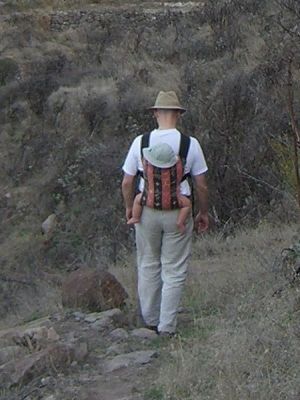
I suspect that she was quite bored much of the time, because she slept more than usual. Or it may just have been due to all the new impressions. But she accepted the boredom quite well.

The only slight complication was that she wouldn’t drink enough water (and did not produce enough wet nappies). Of course breast milk was as popular as ever, but I don’t think the amount she gets nowadays is anywhere near enough to keep her hydrated. We resorted to giving her diluted peach juice instead of water, and that went down very well.

Speaking of nappies, that tends to be our main logistical concern when travelling. Cloth nappies are OK if we’re going somewhere for a day or two, but for a longer trip it has to be disposables because we usually don’t have anywhere to wash and dry the nappies. If we buy them at home then they take up a lot of space in our luggage, especially because it’s hard to know exactly how many we’ll need. If we buy at the destination then we usually get lots left over (they’re usually sold in packs of 60 or more) and then either have to give them away to someone, or take them home with us, which raises the issue of luggage space again. I wish nappies were sold loose, by the pound.

All in all a great success. It was certainly helpful that we were lucky with the weather, and travelled with a very helpful company. And I think we hit the sweet spot in her age: old enough to not be too “fragile” and sensitive to changes, young enough to accept days of boredom. We’ll see how the next vacation goes.
One of the more interesting aspects of our vacation in Gran Canaria was the house we stayed in. It was a cave house. It turns out that cave houses are widespread in Gran Canaria and in some other parts of Spain as well. We saw many caves while we were walking and driving around. A few were prehistorical caves dug by the Guanche, the stone age people living on the islands before the Spanish arrived, but most were more recent. Some were being lived in, others were used for storage, and quite a number had been abandoned.

“Everybody knows” cave men lived in caves, but I’ve always wondered how they could find enough suitable caves. It turns out they didn’t – they made their own. That wouldn’t work in the hard rocks of Scandinavia, but in the light porous volcanic rock of Gran Canaria it’s quite doable, probably even with prehistoric tools.

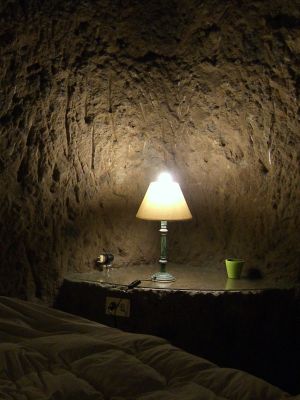
The cave house didn’t feel much different from a normal house, really. There were no windows except in the front of the house, of course, so the night could get very dark. During daytime, the front garden compensated for the lack of windows – we had breakfast outside every morning. All the walls and floors were made of stone, which kept the temperature very even throughout the day and night. But there was no feeling of being in a dark dank cave – it was quite cosy.

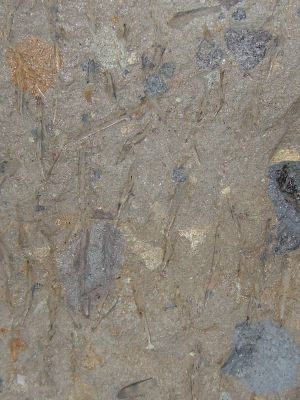
We were told that the interiors of most cave houses are whitewashed to look like ordinary houses, but in ours the walls were raw rock, which I thought looked very nice, and brought out the cave-ness of the house.

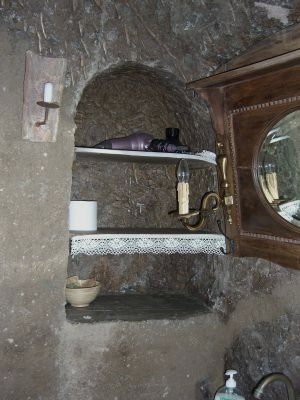
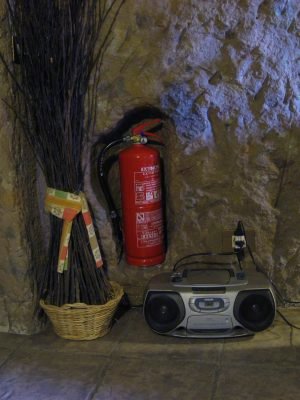
The builders had also used the original rock for furniture and interior features. You want side tables? Right, let’s carve out two side tables. You need somewhere to put a fire extinguisher? OK, let’s carve a fire-extinguisher-shaped niche here. Shelves in the bathroom? Can do. But once the side tables and niches and shelves are in place, that’s where they’re going to stay!

Cave wall Niche for fire extinguisher
Side table Bathroom shelves

Want to build your own cave house?

As I said, Darren, our local Upland Escapes manager, was out of action when it came to walking. But he did provide us with excellent food. The Upland Escapes package included breakfasts and packed lunches. The breakfasts were self-catering, and our kitchen was stocked with all we could possibly want: fresh bread and cheese and fruit, fresh eggs and juices, and excellent jams, including a lovely quince marmalade. The fruit bowl was based on local fruit, including things whose identity we could only guess at (which later turned out to be guavas, and a very large papaya).

The lunches were even better. I was most impressed that UE had managed to find staff who were both good guides and such good cooks! The words “packed lunch” had led me to expect sandwiches, or maybe an occasional quiche slice. Admittedly we have been conditioned by past holidays to have quite low expectations when it comes to food. (The low point was reached in Pyrenean mountain refuges, where breakfast consisted of dry biscuits.) And Spain isn’t exactly known for its vegetarian cooking.

Instead we got wonderfully varied meals: there was a quiche slice, yes, but also a pizza sandwich, roasted vegetable kebabs, potato salads, cous cous, and so on. Each lunch was juicy and flavourful, and always topped off by a scrumptious cake. And all of this was made from great quality ingredients and beautifully presented – which must have been extra challenging given that it all arrived in plastic containers and was made to last at least half a day before it was eaten.

In fact Darren’s lunches were so much better than anything we could find in the local restaurants that we kept them for dinner, and took bread and fruit for lunch, or made do with what the restaurants had to offer. The restaurant fare may have been OK for meat-eaters but wasn’t particularly exciting for vegetarians, whereas Darren’s was created with vegetarians in mind. We did our best to praise his cooking each time we saw him but I’m still not sure whether we managed to properly convey just how pleased we were with the food. This was the first holiday ever where the food will be one of our most positive memories. (You can probably tell that from how much I’ve talked about it here.)

(In fact we had one good restaurant meal on our last day, in Las Palmas, at La Chascona. It was the first and only restaurant we saw that offered something other than the standard menu full of grilled meat, and had good food, so I feel it deserves a mention here.)


(To be continued.)

We had quite specific requirements for our vacation, mostly because of Ingrid. This was our first walking holiday with her, and we didn’t know how she would react. So we didn’t want to commit in advance to walking a certain amount each day, or following someone else’s pace. We certainly wanted self-guided walking rather than groups, and no full-day hotel-to-hotel walks. At the same time we wanted the whole thing to be as easy and convenient as possible. I didn’t want to have to think and plan too much, so putting together our own itinerary armed with just maps and books (which is what we’d normally) was not ideal either.

It turned out that there is a company offering holidays of exactly that kind. Upland Escapes, a small travel operator, offers flexible walking holidays in several locations in Europe. (Do the Canary Islands count as Europe?) Their packages include accommodation, a hire car, and a set of maps and instructions for local walks. The walks range in length from one hour to a full day (8 hours or so). Just what we wanted!

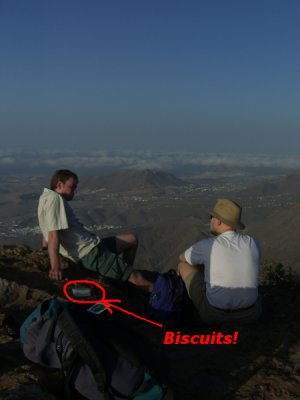
Near Roque Faneque, taking in the view and Ed’s biscuits

We were very happy with Upland Escapes, and would absolutely recommend them if you’re looking for a walking holiday. I really only have good things to say about them – there wasn’t a single case where we thought they could have done better.

Normally all guests are cared for by their local manager, who also doubles (triples) as walking guide, translator, and cook. But because we happened to be their only guests in Gran Canaria at the moment, and because Darren, the local manager, had hurt his leg and couldn’t guide any walks, we got the personal attention of Ed, one of the founders and managers of the company. Ed helped us choose our walks, and accompanied us for walks on some of the days. He also answered all our questions about the islands’ nature, culture and history. And how many guides surprise you with home-made biscuits when you reach the peak of your walk?

In addition, because Ed had been personally involved in scouting out the walks, he knew all of them well and could advise on details like which walks would have most shade, and propose a selection of walks that would be as varied as possible. There were walks through and between the neighbouring villages, walks on exposed ridges, on wooded slopes and in quiet valleys, and in (extinct) volcanic craters.

The walking handbook was not quite as good company as Ed, but the descriptions were all very clear and we had no trouble finding our way on our self-guided walks, either.


(To be continued.)

Eric and I have turned into quite keen walkers over the last couple of years. We haven’t been doing much of it since Ingrid’s birth, but when we started feeling that a holiday would sit well before Christmas, we thought we’d try again. (Our other favourite holiday activity, diving, seemed much less suited to a toddler.) I rather fancied some sun so we aimed for some place warm rather than a wintery location. We ended up going to Gran Canaria because it’s really the closest place to Europe where you can get good walking and reliable good weather this time of the year. (Madeira, our #2 option, failed the second condition.)

Indeed we got a week of consistent sunshine (except for a few slightly cloudy afternoons, and a slight misting of rain one morning before we set out). The temperature was a pleasant 20+ degrees in the sun, dropping, I think, to around 15 in the shade higher up in the mountains. Warm enough to walk in t-shirt, but not so warm that the heat becomes a burden. (The evenings and mornings felt distinctly chillier and we were happy to have our fleeces and warm socks then.)

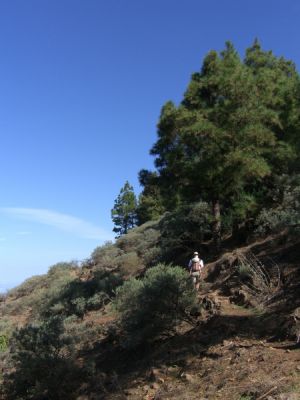
Pine forest and shrubs

I had previously pictured the Canary Islands as quite a beachy place, not really as a destination for a walking holiday, but it turned out that the interior of Gran Canaria is full of eminently walkable mountains, ridges and valleys. The landscape is very volcanic, with much exposed rock and steep slopes, and quite arid. The general feel is sort of a mixture of African desert and Mediterranean hills: cactuses, various shrubs and large aloe plants on the lower slopes, and pine forests higher up. The pine forests seemed familiar at first, but a closer look showed them to be quite different from Northern European ones. Not only were the pines strange, with very long needles and very large cones – the forest was very uniform, and almost a complete monoculture. The pines were all the same shape and size and bright green in colour and the undergrowth was limited to just a few shrubs. It almost looked artificial.

While the landscape in Gran Canaria isn’t as breathtaking as, say, the Dolomites, there was still enough variety and striking landscapes to make every day’s walking interesting. Eric and I concluded that the missing ingredient that would have taken the whole thing closer to breathtaking was colour. This was the end of the dry season, so the colour scheme was brown / beige / green across the board. A bit of snow would have helped – or some flowering plants. I imagine that the islands would look better in February–March when things are in bloom.

The other missing part was animal life. There were butterflies and a few birds, but most of the time everything was very quiet around us.

It was also quiet because there were not many people around. Since the Canary Islands are mostly known for their sun and beaches, the interior gets very few tourists, most of them day trippers from one of the coastal towns. Because tourism is so important for the islands’ economy, and the mountains really aren’t good for many other productive uses, the government is focusing on getting more people to spend more time in the mountains. (The only other possible activity in the mountains is small-scale agriculture. But the slopes are so steep that they have to be terraced for farming, which excludes most farm machinery, so the plots are all tended by hand.) So there were well-maintained paths in many places, and the information centres were up-to-date and in good shape. Nevertheless even the most popular spots (like Roque Nublo) were far from crowded, and on some walks we didn’t see a single other walker. We liked that.


(To be continued.)

Well, it took me a bit more than a day to get back to a computer, but here I am now.

We spent Saturday and Sunday in Kaunispe, doing the sort of things that one tends to do in the country: walks in the woods, playing and swimming at the beach (cold!), lazing around under the apple tree, eating gooseberries from the bush. Plus, of course, the sort of things that one tends to do with a small baby: feeding, cleaning, washing and putting to bed.

Monday morning we started back towards Tartu, and most of the rest of the day was spent driving.

Tuesday (today) I made a brief shopping expedition in the morning (children’s books and DVDs). Then during the day I met my three oldest friends, whom I have known since I was about 3 years old. We all lived in the same block of flats, played together a lot and went to the same school as well.

Two of these friends now have children who are a few months older than Ingrid. I met them for the first time today. I had seen photos of both babies before, so even though I hadn’t actually met them they felt very familiar to me. It was interesting to see how much difference just a few months can make – although if I think back to what Ingrid was like a few months ago, it really was very different from her current self.

Tomorrow I will spend more time with the same friends. Thursday, on to Tallinn to meet another old friend, and Friday back home.

Saaremaa, middle of the night. And I’m typing on some sort of laptop Mac thingy which is turning out to be surprisingly difficult. Things keep happening on the screen even when I don’t think I have touched anything special.

Monday we got up at 4 and flew to Tallinn and then drove to Tartu. An uneventful flight and an uneventful drive as well.

Tuesday morning we (my father and his wife and myself with Ingrid) drove to my father’s summer house in Kapsta. The rest of Tuesday and Wednesday, plus half of Thursday, we spent hanging around the garden.

Ingrid got a sandbox and a little wading pool, plus a large expanse of grass to explore, and an assortment of plastic and rubber toys to play with, as well as new interesting things such as a little wooden stool (which could be banged against the floor), a dustpan and brush (which could also be banged against the floor with far more interesting outcomes than the ones at home).

Thursday around midday we drove towards Saaremaa, stopping in Pärnu for the night. The weather was really warm so we went to the beach in Vana-Pärnu: Ingrid’s first encounter with the sea. She wasn’t much interested in the water, but the heavy dark muddy sand was great fun.

Friday we continued to Saaremaa, to visit a bunch of relatives in Kaunispe, and that’s where I am now, being attacked by vicious midges.

To be continued tomorrow because it is bedtime now.

Having survived a whole week away from home, including 4 flights, I’ve concluded that travelling with a baby is perfectly doable, if not exactly relaxing. It helps a lot that Ingrid is happy to be transported in the sling, both awake and asleep, and that she is still fully breastfed. This makes her very transportable, without having to worry about getting home for naps or meals. All we need for a meal is a place for me to sit, preferably indoors this time of the year but I’m sure that in a pinch a bench outdoors in the sun would work as well. And all we need for a nap is a short walk to get her relaxed and sleepy.

Flights are still the least enjoyable part. She does not enjoy sitting still, strapped in and facing forward, with nothing to look at other than the seat back, and no one to “talk” to. And nappy changes on a cramped airplane were a bit tricky, too.

Nevertheless the overall experience was good enough to make me think seriously about planning an actual holiday for this summer. Maybe a walking holiday somewhere (day trips, I guess) or perhaps cycling.

We went to Edinburgh this weekend for the Edinburgh Tattoo, which we’ve wanted to visit for several years (roughly since we moved to England, in fact) but never gotten around to. And since we were going anyway, we took some time to see Edinburgh itself too, as well as some of the events offered by the Edinburgh Fringe.

The tattoo was more or less – but not quite – as I had expected. The pipes and drums and marching were there, although I had expected more pipe music and less of other music. And I definitely hadn’t expected the more exotic parts of the programme, which this year included a children’s choir from Uganda and singers and dancers from Chile and Easter Island. However the pipe music was great, and the marching impressive, with a Swiss group of army drummers outclassing everybody else in terms of pure technical excellence.

When we checked the weather report the day before leaving, the forecast was for three days of unbroken “light rain”. It didn’t turn out quite that bad, but the first day was quite wet. Luckily the rain stopped before the Tattoo (which takes place outdoors, in the courtyard in front of Edinburgh Castle, and has no roofing) and while we got some rain after that, it stopped far from what the weather forecast had led me to expect.

The day before we left I took a quick look around to see what else one could do and see in Edinburgh, apart from just walking around, and realised that the Edinburgh Festivals were going on. (That’s Festivals in plural: I knew about the main festival and the Fringe, but it’s grown far beyond that now. All of central Edinburgh was taking part in some festival or other.) Read some reviews, did some Googling, and booked tickets to two pretty randomly chosen shows.

The first one was Sclavi: Song of an Emigrant – a piece of physical theatre / dance descibed as “gushing torrent of polyphonic songs punctuated by raw physicality”. That sounded sufficiently weird to be interesting, and indeed it was. There seemed to be a story there, but most of it was completely incomprehensible because it was in Czech – which didn’t really matter, because the singing was wonderful and the dancing beautiful. (Review by The Guardian.)

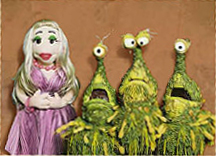
The second one was Jim Henson’s Puppet Improv: puppet improvisation theatre. Found by pure luck through The Edinburgh blog, this turned out to be even more hilariously funny than I expected. (Jim Henson is the guy behind the Muppets.) They had a daytime child-friendly version, but the ““adults only” label for evening show that we saw was definitely appropriate! Improvisation theatre doesn’t really lend itself to written descriptions… The show contained everything from the inevitable George Bush jokes to speed-dating aliens. Absolutely the highlight of the weekend!

We also popped in for a quick visit to the National Museum of Scotland. This was a bit of a disappointment: beautiful things in a beautiful building, but presented without any coherent order or story, so that we felt confused and lost rather than informed or enlightened.

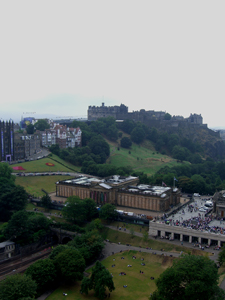
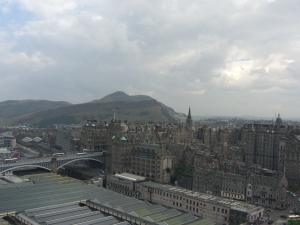
Edinburgh is grayish-brown

The rest of the weekend was spent simply walking around and up and down Edinburgh. Edinburgh is a very pedestrian-friendly city and much more pleasant to walk around than London – or rather, a much larger proportion of it is pleasant for walking than in London. It looked like a nice town to live in, too. One thing that struck me was the uniformity of colour: 90% of all buildings in central Edinburgh were made of the same dark gray stone, which felt rather oppressive, especially in rainy weather.

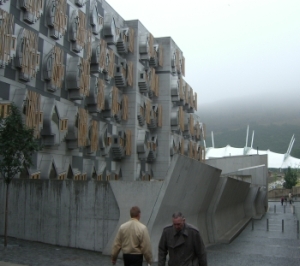
The controversial parliament buildings were even uglier than I had expected, looking like a concrete bunker with bars in front of all windows. The only good views I’ve seen of it are from above (an angle from which few people will see it) although we were told that it looks better on the inside.

Scottish Parliament

We concluded the weekend with a nice climb to the top of Arthur’s Seat, which is a little (250m) extinct volcano about a mile east of the city centre: a pleasant piece of highland with excellent views of the city. (The photos here are not from the hill but from the Walter Scott monument in the middle of the city.)

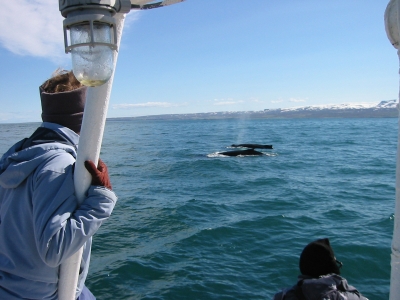
Real whales!

One of the most exciting things we did in Iceland was whale-watching trip out of Húsavik. We spent several hours in the bay of Húsavik in a wooden boat, looking for whales – and getting quite close to them!

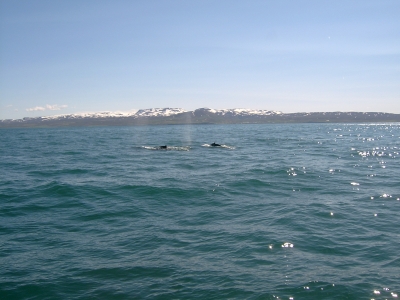
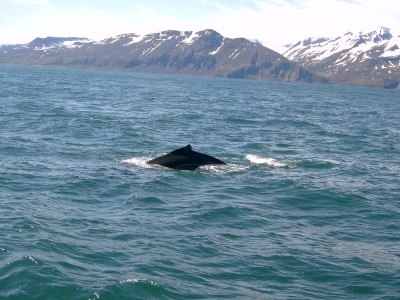
The whales we saw were humpbacks. We found a pair of them who seemed to be feeding – making short dives of maybe 5 minutes, and staying close to the surface between dives – and followed them around for a while. The first sign of their surfacing was often a spout of water. After that they tended to swim close to the surface for a while, so we could see the top half of their body, one part at a time. When they were about to dive back down, they often flicked the tail (fluke) up high.

The head was as knobbly as it looks in the picture, and true to their name, they had a humped back (see photo #3). The long white flippers were very also very distinctive. All in all a very satisfyingly whale-like whale. Interesting factoid: the white pattern on the fluke is different for each humpback, like a fingerprint, so scientists are now able to identify and track individual whale by photographing their flukes.

Finding the whales turned out to be a matter of patience, experience and good eyesight. Many times our guide would announce a whale “11 o’clock, 1 km out” and none of us could see anything until the boat got to within a few hundred meters. Spotting was made harder by the fact that whales only stayed on or near the surface for a short while, and then disappeared, after which it could take anything from a minute to five minutes for them to come back up. Once she had spotted a whale, we would aim in that direction and try to get as close as possible.

When we were really close, the challenge was no longer to spot the whales, but to predict where they would come up next time. Since we were so close, even 100 metres could put the whales on the other side of the boat, so all sides had to be covered. And if we went in opposite directions, we could quickly lose our “close contact”. The captain seemed to have a sixth sense for predicting the whales’ direction. On several occasions, the whale submerged, and the ship puttered in what appeared to be a random direction – yet when the whale came up again we found ourselves in exactly the right spot.


Iceland used to have a whaling industry, but a moratorium was put in place in 1989. The whaling industry adapted quickly, and is now making good money out of whale-watching instead. (Our boat was a converted whaling boat.) According to our guide book, flags were at half mast in Húsavik when the moratorium was lifted in 2003 to allow whaling for “scientific purposes”. Apparently whalers have agreed to stay away from whale-watching routes, so as not to kill or scare away the whales who have gotten used to human presence.


Eric took the first 2 pictures (I need to get a faster camera!). And rather than edit picture #3 to straighten out the horizon, I left it the way it came out, as a reminder of how much the boat swayed when we were standing still, facing the waves.