The high rate of Caesarean sections (one in every five births in the UK and in Sweden; one in three in the US) is probably of more interest to me than to you.

One of the reasons for these high numbers is women’s preferences: half of the Caesareans in the UK are elective. Choosing to undergo major surgery rather than to go through a natural process is an odd choice in my opinion. But I guess those women may have greater faith in modern technology than I do, or be more averse to pain and hard work, or put greater value on convenience. Anyway, that’s not why I’m posting – other women’s reasons for elective Caesareans are relatively irrelevant to me because I’m not even considering that option.

What I find more interesting right now is the other half of Caesarean sections, and why they are performed. It appears that doctors’ inexperience is one major contributing factor: junior doctors are more likely to opt for a Caesarean because they do not have sufficient experience in other assisted methods of childbirth

An article in the New Yorker highlights a related reason: the standardization of childbirth. Teaching all obstetricians to perform one standardized procedure well is easier than teaching them the numerous more “manual” alternatives. And Caesarean section is a standardizable procedure – it is a technical process that doesn’t vary much from patient to patient. Using the forceps, on the other hand, is more of a craft – it requires the doctor to develop a “feel” for using the right amount of force, etc.

The question facing obstetrics was this: Is medicine a craft or an industry? If medicine is a craft, then you focus on teaching obstetricians to acquire a set of artisanal skills. You accept that things will not always work out in everyone’s hands.

But if medicine is an industry, responsible for the safest possible delivery of millions of babies each year, then the focus shifts. You seek reliability.

Whereas before obstetricians learned one technique for a foot dangling out, another for a breech with its arms above its head, yet another for a baby with its head jammed inside the pelvis, all tricky in their own individual ways, now the solution is the same almost regardless of the problem: the C-section. Every obstetrician today is comfortable doing a C-section. The procedure is performed with impressive consistency.


Found via Salon.
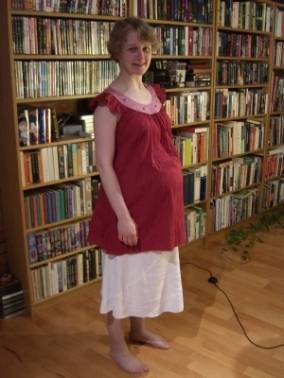
My very pregnant looks came up during a lunchtime conversation today. Somehow that then led on to a mention of Homer in his muumuu in “King-size Homer”.

I have to say, this is the first time I’ve ever been compared to Homer, in any context!

Helen in muumuu Homer in muumuu

We went to an antenatal parent education class today, organised by the Royal London Hospital. I have to say it was a big disappointment.

First problem: it took us 3 tries, on 3 different weekends, to even get to the class. The first time no teacher turned up and we gave up and went home after 15 minutes. The second time no teacher turned up, we chased around the hospital to find out what was going on, were told the class was cancelled because the midwives were all busy, and went home again.

This time a midwife did turn up to actually hold the class. But she was so disorganised, and her way of presenting so confused, that the class was almost useless.

She started by handing out a course plan with a list of topics. That course plan had nothing to do with the actual course. When she spoke, it was almost a stream-of-consciousness presentation: she might be talking about pain relief in labour, in 3 sentences segue into breastfeeding, then moments later be talking about how to raise children, and then back to labour again. Only when someone asked a specific question did she stay on topic for more than a few moments.

Occasionally, when someone asked a question about something I felt informed about (I have been reading, after all) I was very tempted to answer the question myself because then they would at least have gotten a coherent answer. I believe some of the people there may have gone home more confused than they came. Of course, if they knew nothing at all, then this may have been more useful than nothing…

The course was supposed to take 6 hours. 4 hours after we’d started, the midwife obviously thought she had spoken enough and sent us home. Well, she did ask if there was anything more we wanted to hear about. But if we knew what we needed to know then we wouldn’t have been there, would we!

I got the impression that someone had set up this class a while ago – written the course plan with suggested topics in a rational order – and then handed it over to other people to run. Maybe the original plan was put together by a consultant from somewhere, or just a midwife with some planning skills who later left. (The course seemed to be a few years old: many of the printouts and photocopied materials were dated around 2002). In any case, the materials appear to have been taken over and used by random people with no teaching or organisational skills whatsoever.

Maybe the teachers are different on different weekends and we just had bad luck. But the hospital should know that. If the hospital sends someone with so little preparation and so little teaching aptitude to teach a class, they can’t take these classes very seriously. This seemed like a mixture of box-ticking (“each hospital shall provide antenatal classes”) and keeping the parents pacified, rather than an effort to actually provide information or knowledge.

It certainly explains why the antenatal classes by the NCT (National Childbirth Trust) are booked about half a year in advance (which is why we attended this one instead).

I think there might be some truth in those stories about pregnant women feeling tired, after all.

Friday evening after work I had dinner, read some, and then pottered around aimlessly for a while. By 9:30 I was barely able to keep my eyes open so I went to bed and slept 11 hours straight.

Saturday I went to Oxford Street for some shopping. Took the tube instead of cycling to give my body some more rest. When I got home I lay down on the sofa to catch my breath and rest my legs a while. Fell asleep and woke up an hour and a half later.

Thus the relatively low frequency of new posts here recently.

Blump really is a very active little fellow. Even midwives comment on how much s/he moves – every time they try to listen to Blump’s heart, s/he moves away from the heartbeat monitor as soon as they put any pressure on it. And I’ve never had the kind of worries that some pregnant women write about, when they don’t feel the baby move much and wonder if everything is OK.

Standard medical knowledge expects babies to settle in one position (normally head down) around week 32. I am now coming to the end of week 33, and Blump definitely hasn’t done that yet. It feels like a minor earthquake when Blump turns around from one position to another. It’s hard to imagine two arms and two legs making all that movement! Sometimes s/he sneakily turns around during the night – twice during the past week I’ve woken up to find Blump apparently lying horizontally, with his/her feet kicking out towards one side and the head pointing towards the other side, which was a pretty odd feeling!

With all this moving around, I’ve become curious to understand where and how s/he is lying, and learned to more or less “map out” Blump’s body.

First of all there’s the kicking, of course. Kicks are strong and distinct; arm movements feel smaller and lighter. Where I feel most movement, that’s probably where the legs are. Hiccups – regular “ticking” movements – should probably come from the top half of the baby’s torso, I imagine.

In addition to feeling movements, I can figure out Blump’s position by feeling around the belly. (One of the midwives explained briefly what she feels for, and the rest is just practice and common sense.) It doesn’t work every time, but it is getting easier and clearer as time goes – in part probably because I get more practice, but also because Blump fills up more of the belly.

I find it’s easiest to map out Blump’s position when I lie on my back with my knees bent, so the water flows down towards my spine and leaves Blump more exposed. The parts towards the top half of the belly are easiest to feel – above where my waist used to be, up towards the ribs. I try to feel what’s up there, and assume that the parts I haven’t located are lying down below the waist.

  • A broad thing that gives strong resistance and doesn’t yield to pressure is the torso / back. When Blump lies with his/her back towards my one side, I can feel that that side of the belly is “solid” whereas the other side is more “watery” and has more “give” (in the space between and around the limbs).
  • A small sharp thing that can be pushed around is probably a foot or a knee – especially if continued poking makes it move!
  • A broader lump (but not too broad) that can be moved from side to side is probably the head.
  • An even broader thing that moves just a little is probably the bum.

Every body part on its own may be hard to spot, but if I can kind of guess a few of them, the various clues reinforce or clarify each other, until I get a reasonably clear picture of what’s in there.

Right now, for example, Blump seems to be lying with the head down, the torso towards the left, and legs & feet up underneath my right ribs.

Looking down and seeing a big belly and nothing else… I’m getting used to that, as well as the sensation of heaviness and bulkiness. What still surprises me is how the rest of the body has changed. Everything is rounder and fleshier: what used to be skinny and knobby, where every tendon and vein stood out, is now smooth and rounded. I’m not sure if it’s fat tissue or water, but it isn’t what I’m used to seeing. My feet don’t look like my feet, and my hands don’t look the same either, nor do most other previously-bony body parts.

My grandmother would have been happy to see this… she always used to encourage me to eat more, telling me how my face looked “skinny as a goat’s footprint”. (That sounds a lot better in Estonian, by the way: “nägu nagu kitsejälg”.)

I find it interesting to observe how radically my metabolism has changed. I am now eating about as much as I did before the pregnancy. Yet now I am gaining weight, almost faster than I’d like to, whereas previously I didn’t manage to gain a single kilo in almost a year. All due to the magical power of hormones.

Despite all the stories about how pregnancy feels awful, I feel great. During the first few months I was expected to feel sick, but didn’t. In the last trimester I’m supposed to feel swollen and achy and tired, but don’t. The hip and back pains are gone, after some help from a physiotherapist and a lot of help from the big V. I just have to be a bit careful with some movements, and not sit still in a bad position too long – but that applies to every body. The weekend in Edinburgh was an exquisite reminder of just how good that pillow is!

I’m also feeling a bit less out of breath now, since I started eating iron supplements (last week). Apparently my iron levels were low. The blood tests to detect that, by the way, gave me my life’s most impressive bruise. The whole crease of the elbow, plus 10cm both downstream and upstream along the veins, was dark purple for over a week.

Blump’s kicking keeps reaching new extremes. I remember, there was a time when it was barely detectable… Now Blump sometimes kicks so hard and so much that the whole belly is moving, and I find that I cannot concentrate on what I’m doing. I get the temptation to tell Blump, “Mother is working right now… go play somewhere else.” I wonder if all babies are so active.

An unanticipated advantage of being pregnant is that I no longer walk faster than most people around me. I’m now about as fast as the average tourist near Westminster, or a shopper on Oxford Street. Navigating the crowds is far less unpleasant when I don’t have to weave between lots of slow people, but can just go with the flow.

Whenever I meet an acquaintance who did not yet know I was pregnant, or meet someone again after not having seen them for a while, their first question is always: “How far along are you?” or “When are you due?”

I don’t get it. What’s so interesting about the date? None of these people are close acquaintances who see me regularly, or work with me, so it’s not like they need to know from what date I won’t be around any more, or at what point to start asking about the baby.

Do they feel like they must ask something, in order to be polite, and that’s the first question that comes to mind? Do they have a mental scale of what a woman should look like at x months, and need to fit me in?

The second question is generally “Do you know what you’re having?” and I can understand why that would be interesting – it’s easier to imagine a little boy or a little girl than a little boy-or-girl.

Today, for the first time in years, I switched into first gear (on my three-gear bike) in order to get up a hill. And it wasn’t even a particularly steep hill – it was the gentle slope up Ludgate Hill towards St. Paul’s.

This is a historical moment, really. I remember the last time I used the first gear: it was on a very sandy path in Richmond Park, where the wheels were digging in and the bike was almost getting stuck in the sand. That was at least two years ago. And I cannot even remember if I had ever used it before that.

Well, I guess it’s good that I finally found some use for it!

As Blump grows in size and strength, s/he also learns new things. A week or two ago, I felt odd rhythmic movements – sort of like heartbeats, but far too strong and too slow for a real heartbeat. I couldn’t figure out what Blump was up to, but then a while later I read that babies can have hiccups even before birth, so I guess that’s what they were.

Blump has also learned to express his/her dissatisfaction through vigourous kicking. Occasionally I’ve lain on the wrong side or at the wrong angle, which has somehow made Blump uncomfortable. Maybe s/he has ended up lying on an arm, or with a leg in a twist… don’t know. But the feedback has been very clear: Blump thrashes around so the position becomes really uncomfortable for me as well, at which point I turn the other side and we’re both happy again.

The movements have also become a lot more distinct. Sometimes I can look at my belly and see one side bulge out, and then see the bulge move across the belly, or see the belly stretch with a kick or an elbow jab. It really does look just like the Alien movies.

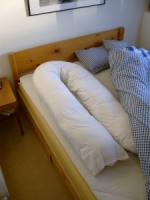
My best pregnancy buy, by a mile, is a big V-shaped body pillow. Well, it’s also just about my only pregnancy buy (apart from clothes and a couple of books) but never mind that.

The joints around my pelvis have gradually loosened and become more achy. Nothing too bad, really, just a bit uncomfortable. But about two weeks ago it suddenly got a lot worse, so I was spending a large part of each night twisting and turning, trying to find a position that didn’t hurt too much.

Then one night when Eric happened to be away, I finally achieved a reasonably comfortable sleeping position by arranging all the three pillows in our bed in a carefully shaped long mound. That was a relatively good night. But of course Eric was going to come home and want his pillows back, so I needed a more long-term solution.

Eric had reminded me a few days earlier that there are long body pillows I could try. I thought I’d simply buy one of these, but when I went to look for one on Ebay, the search brought up some more interesting results as well: huge V- and C-shaped pillows. They were three times as expensive as simple bolster pillows, but, well, they looked so funky that I just had to try one. I bought one straight away – anything to get a good night’s sleep! – and it was delivered two days later, just in time before Eric was to come home. There were some big eyes in the office when my parcel arrived!

That night I had my best and deepest sleep in weeks, maybe more than a month. The pillow keeps my hips in a good position and provides some support for the upper body and/or the back as well, depending on how I lie. The only downsides are that it takes up half the bed, and that changing sides (or rather, extracting myself from the pillow) is a bit of a project. But balanced against the comfort of sleeping in it, those are minor points.

If I had known that it would feel this good, I’d have bought one weeks earlier.