
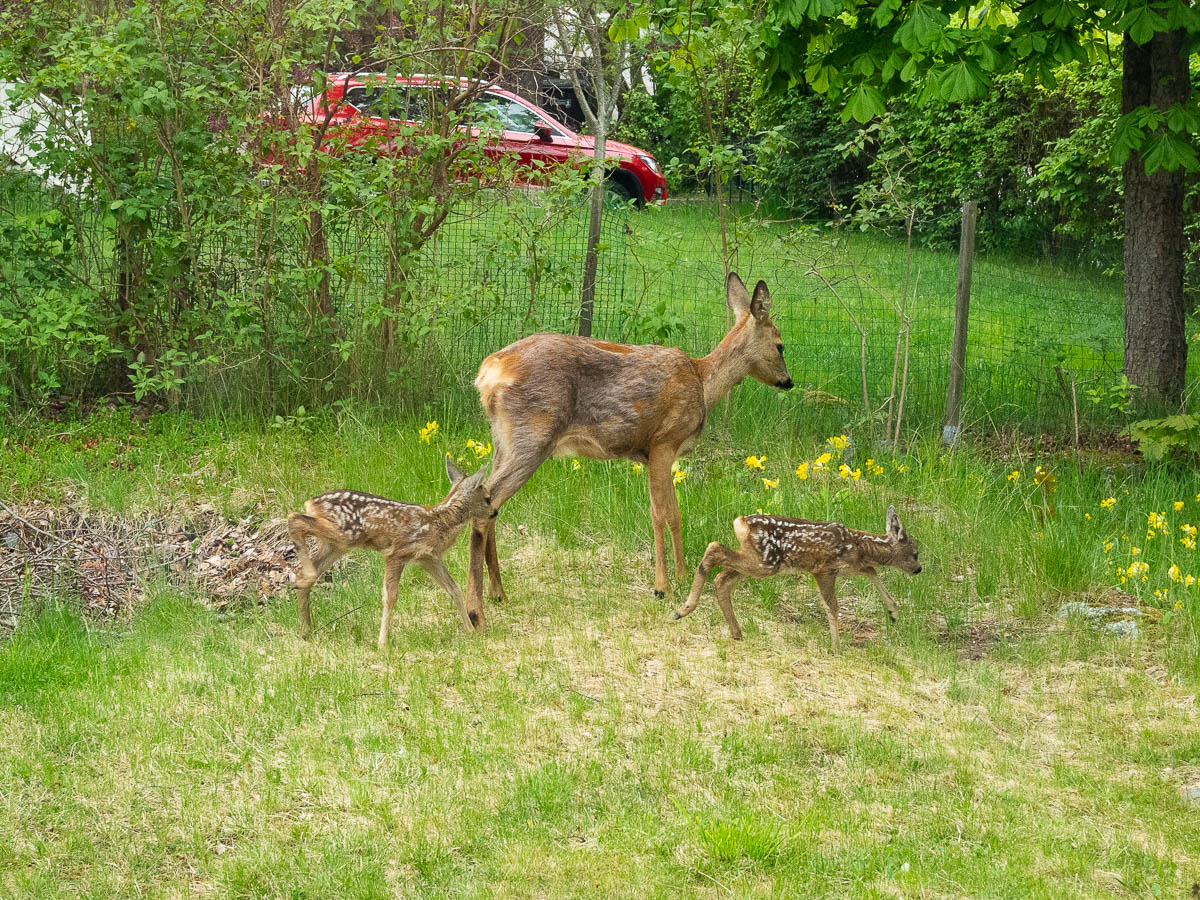
The day before yesterday, a roe deer walked through our garden with its fawn. Deer walking in the garden is no news, it happens often enough. But this was the first time I saw one with a newborn fawn this close.
After the two crossed most of the garden, I saw another fawn come out of the lilac hedge! Very cute.
Then they went off across the road and that was that, I thought.
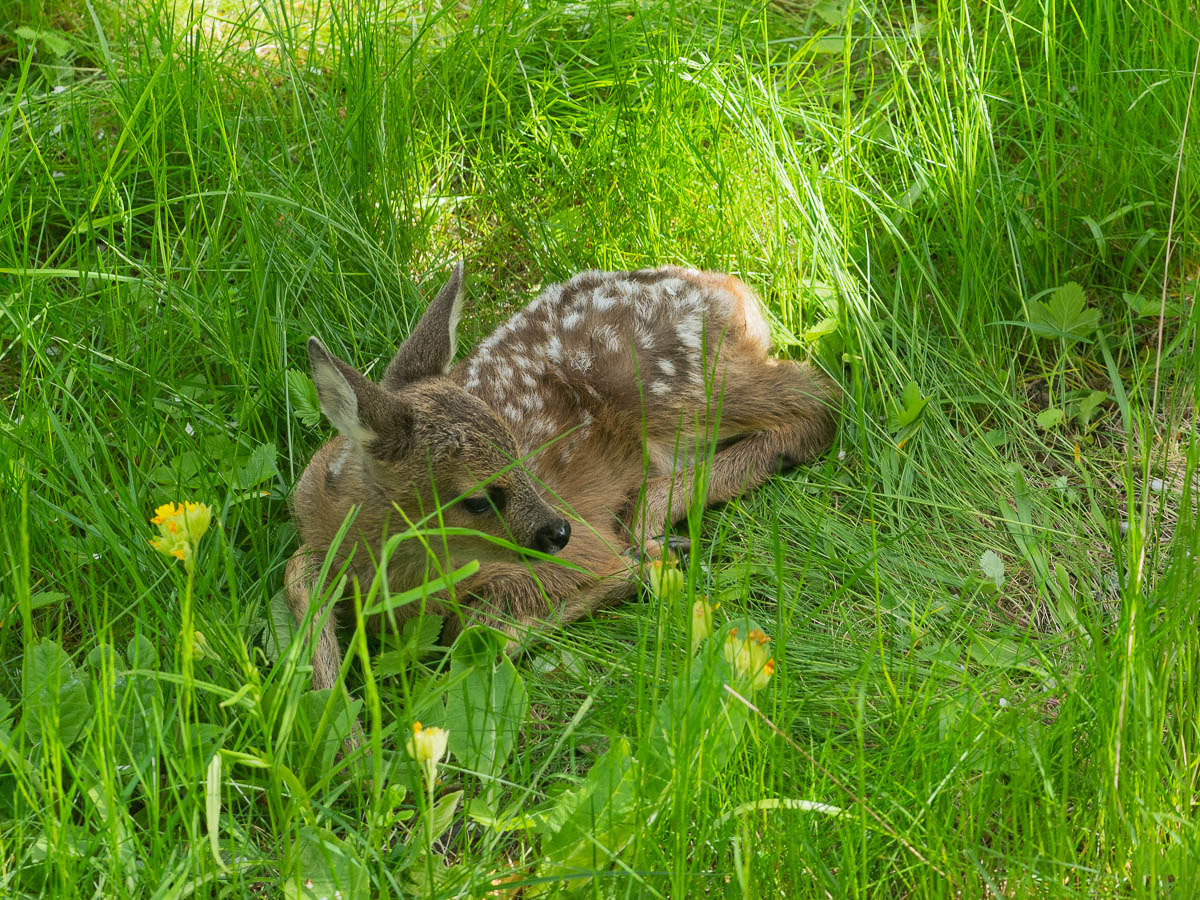
Today, as I was finishing my lunch out on the deck, I suddenly noticed that one of the fawns had been lying in the tall grass under our cherry tree during my entire lunch, only 5 metres away from me. It was so quiet and immobile that I hadn’t noticed it at all until I happened to look at that exact spot.
Mama deer came by a few times in the afternoon, and I saw them in a few different places in the evening.
I mostly tried to stay out of the garden today. If I was too visible, I was afraid mama deer might not dare come back to feed the baby. And I wouldn’t want to have a fawn starve because of me.
They left in the evening, probably to move to some other garden in the neighbourhood.
Deer look cute but they are marauders when it comes to plants. No tulips would survive in this garden, and deer have repeatedly eaten my pansies in the past.
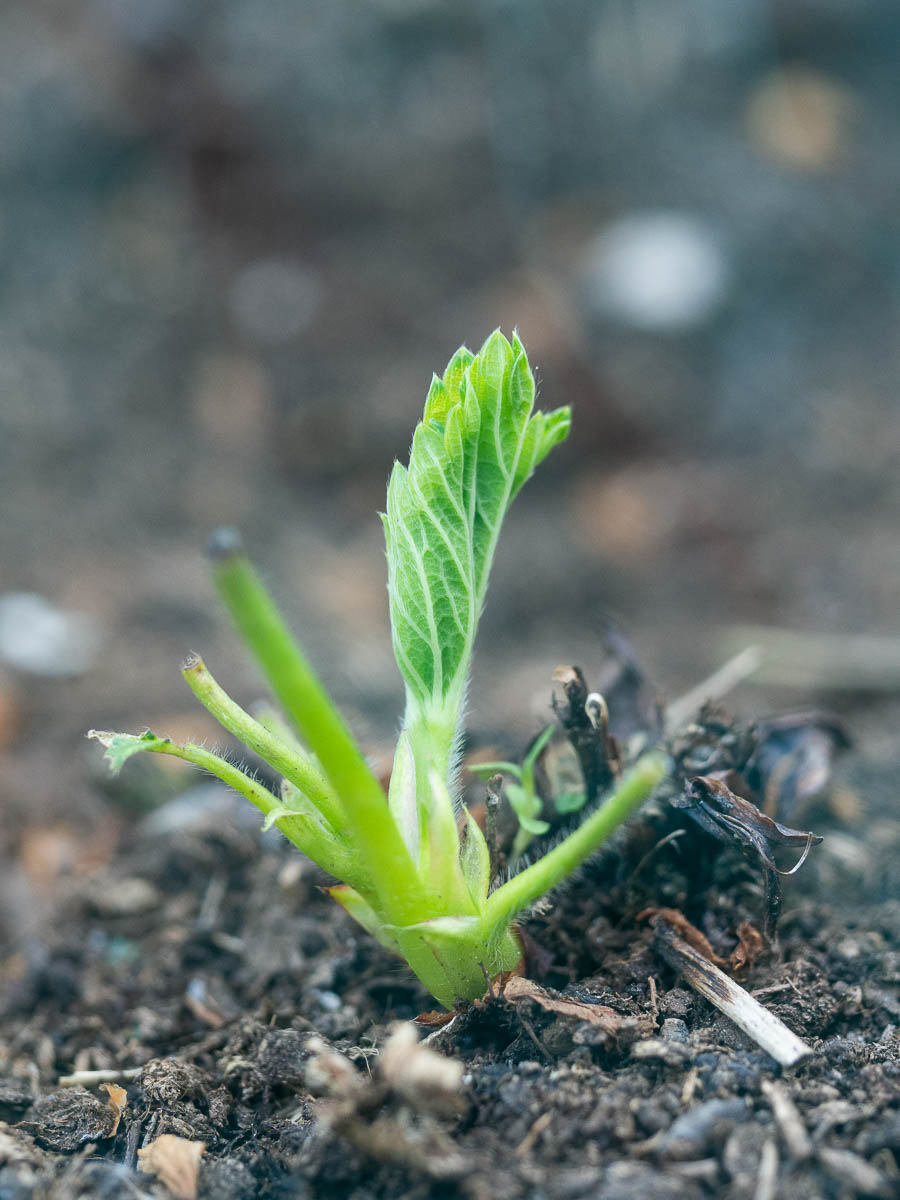
This time mama deer took big bites from my strawberry plants, right under my eyes. I normally cover the strawberries with netting but hadn’t had time to put up nets for this summer yet. I’d forgotten that the nets protect against deer as well, I was mostly thinking of them as protecting the berries from birds.
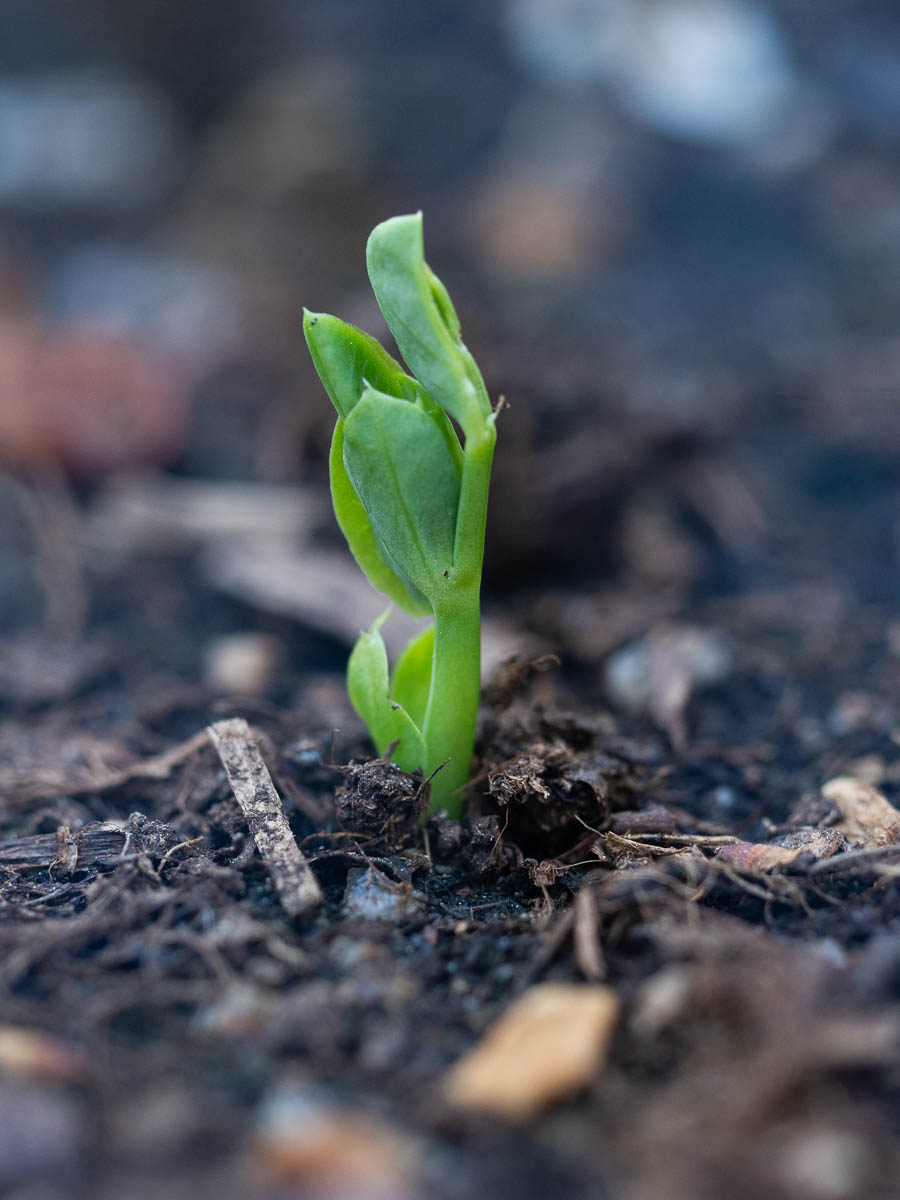
I quickly threw on the nets today, on the strawberry boxes as well as the one where we planted peas. And just in time – the pea sprouts are just becoming visible. If pea shoots are a delicacy for us humans, how much more delicious might deer find them? They would probably leave nothing behind.
I have mixed feelings about deer. I like wildlife of all kinds, and I like seeing animals in the garden. Squirrels and hares and deer, and birds of course. I wish there were hedgehogs around here.
I don’t like them eating the things I care about.
On balance, though, I’d rather have a garden without tulips than a garden without deer.
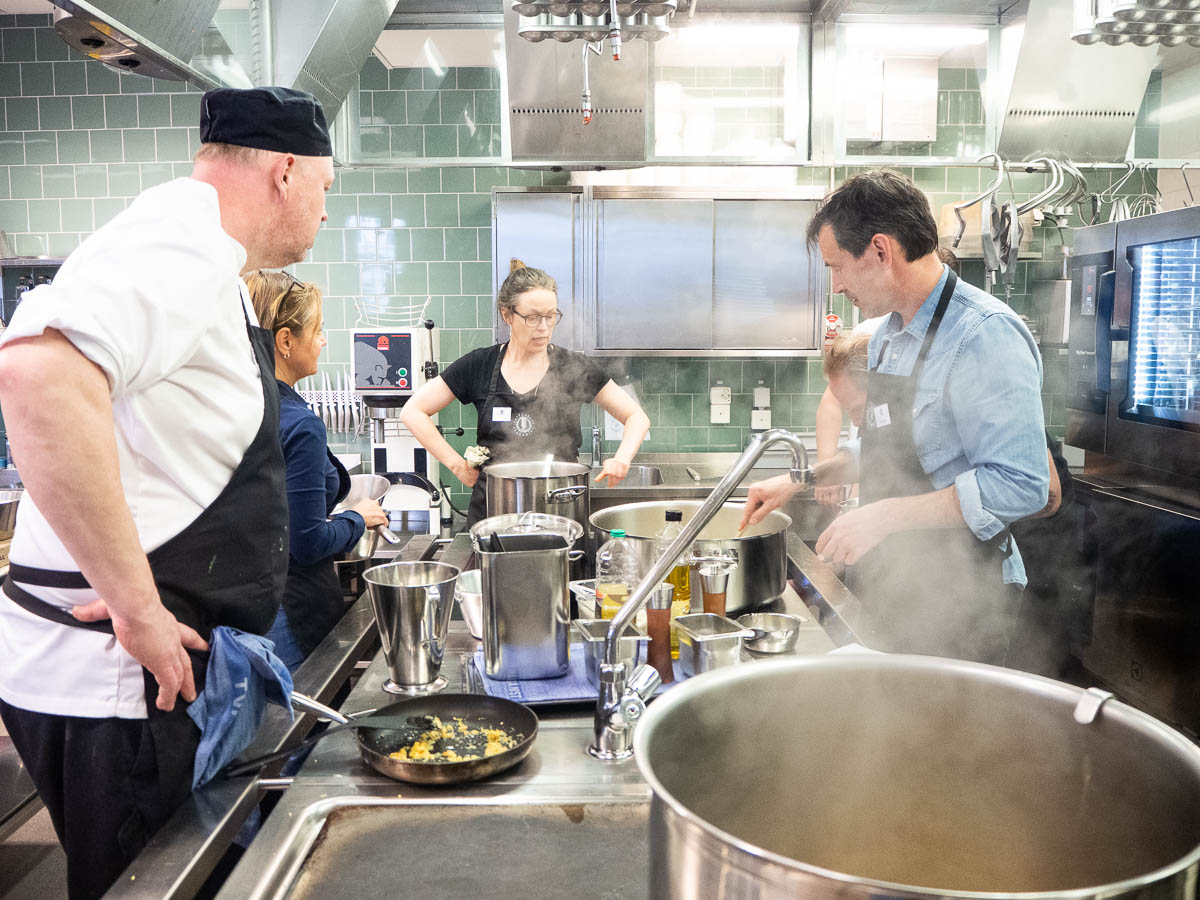
This looks like another scout camp kitchen, doesn’t it? It’s not! It’s a proper restaurant kitchen (indoors! with electricity!) at Restaurakademien, where I spent today learning to cook vegetarian food with a professional chef. I got this course as a Christmas gift and now it finally happened!
I know how to cook vegetarian food already, of course. I enjoy cooking, and this was a way to do more of it in a fun setting, and to maybe learn new things – new techniques, new ways of thinking about a meal or a menu.
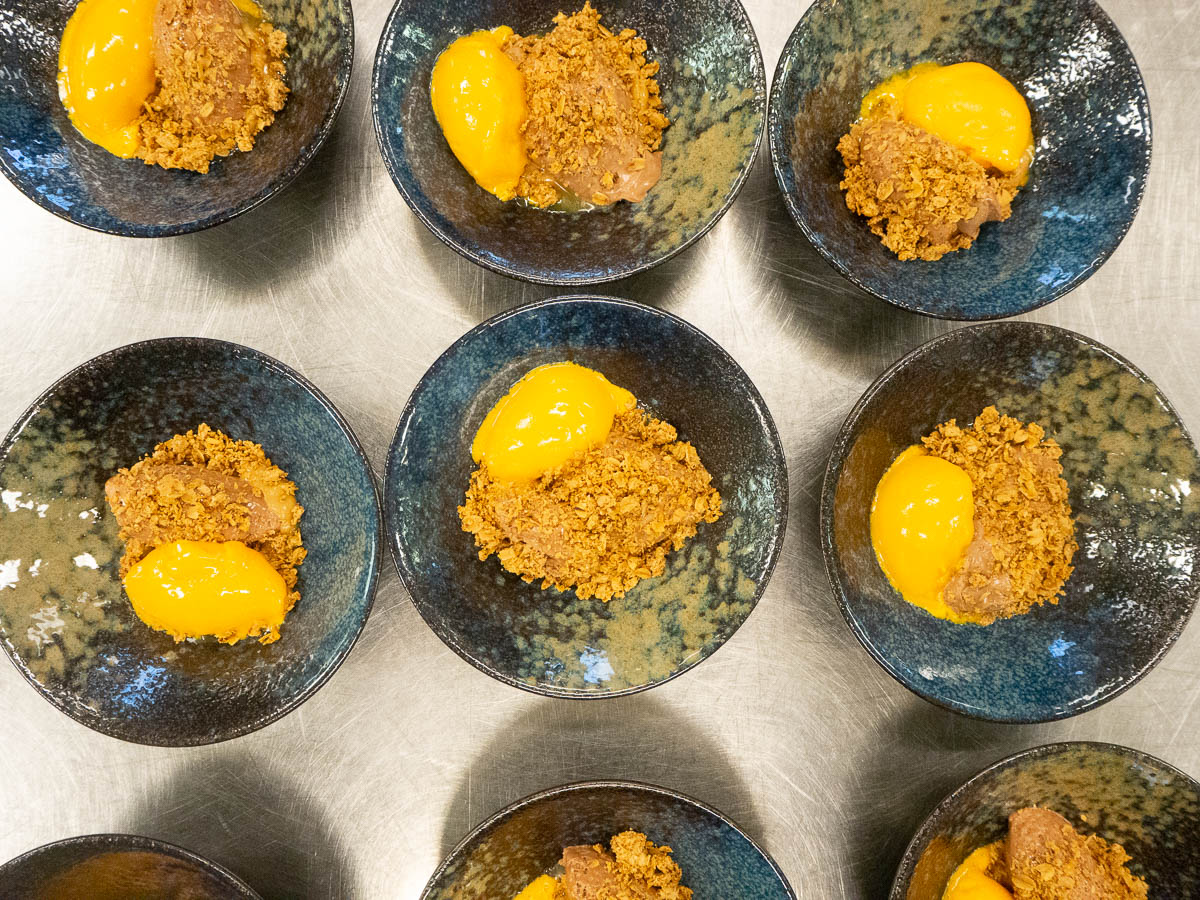
We worked in groups, and prepared three three-course menus altogether: the starters for lunch, and the main courses and desserts for an early dinner.
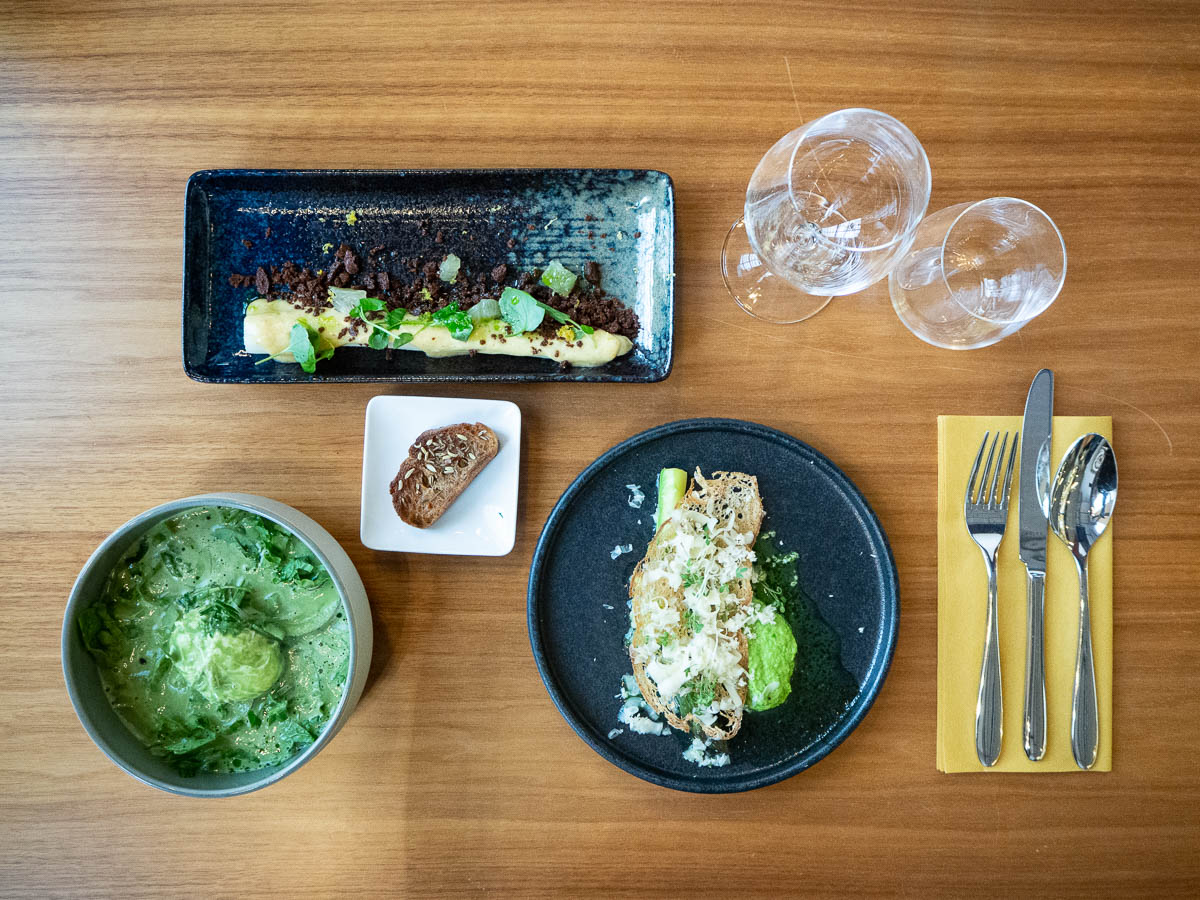
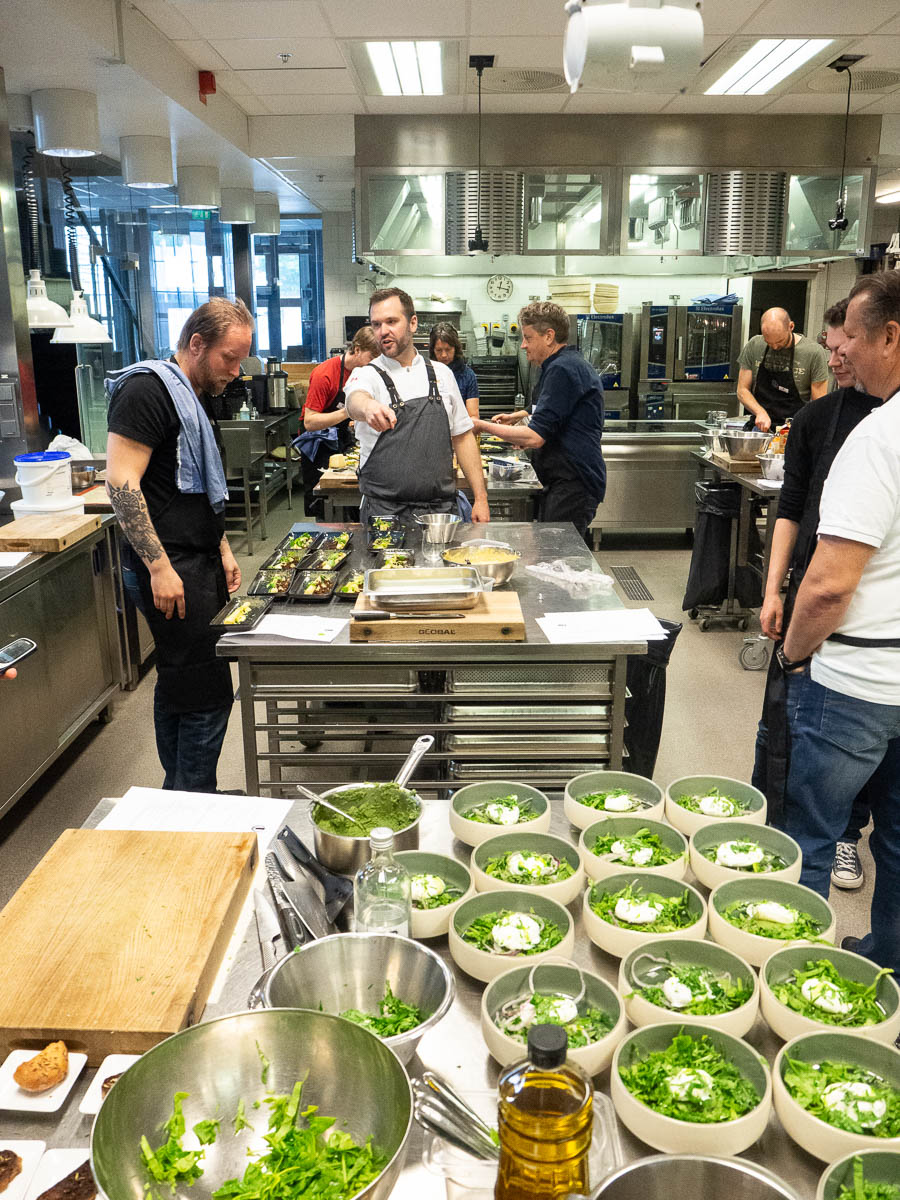
Lunch consisted of two asparagus dishes and a nettle soup. As part of preparing these we learned how to make a Hollandaise sauce and how to poach eggs. I haven’t tried making Hollandaise sauce, but I have tried poaching eggs a few times, and it’s been hit and miss, really. This chef had a procedure that seems a lot more predictable and easier to succeed with than the ones I’ve tried before. The guys who were in charge of making the eggs for today’s lunch followed his instructions and ended up with 15 near-perfect eggs, so I’ll definitely be giving that a try at home.
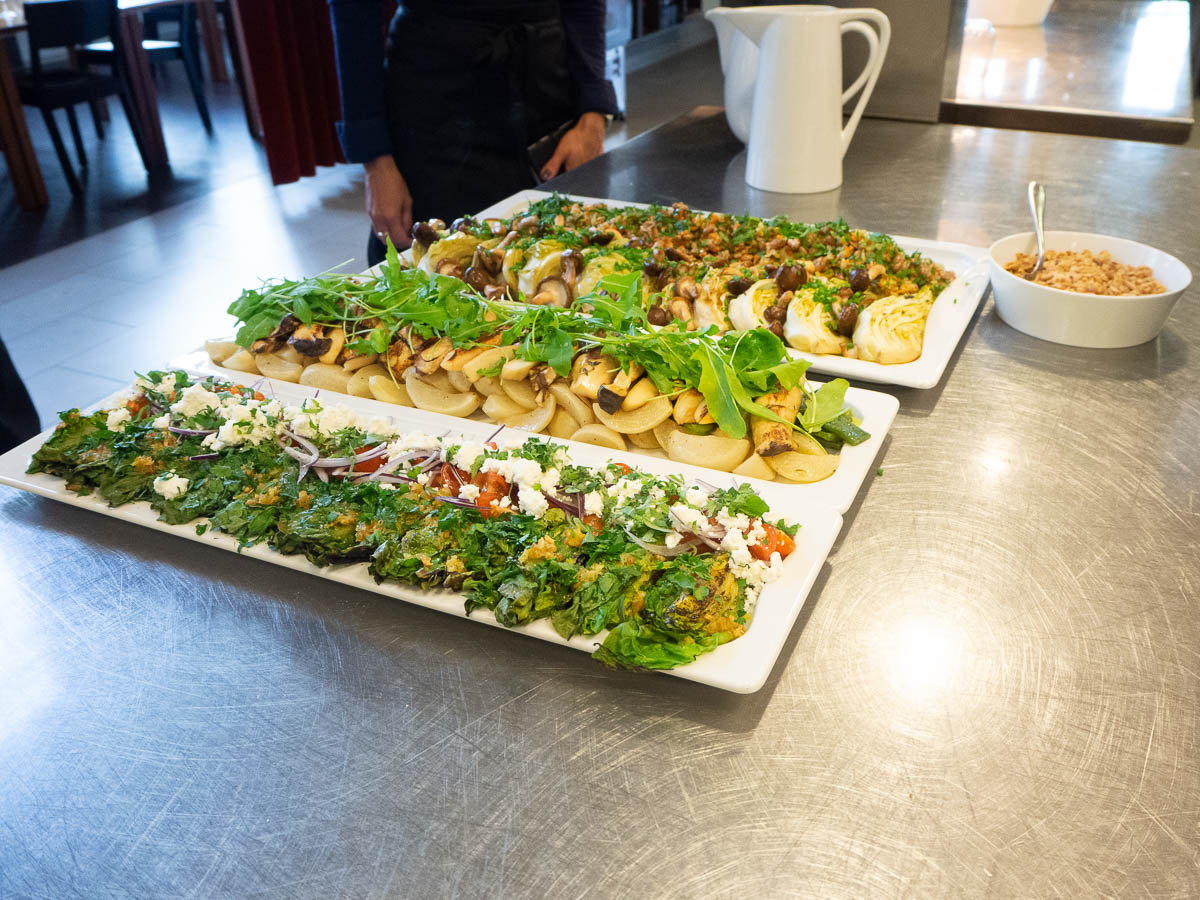
Preparing the main course was somewhat less interesting. A lot of peeling and chopping. The results were delicious, though.
With so many people and so many different dishes to prepare, it was a matter of chance what each one of us got to work on. I was a bit disappointed with how that worked out. I would have preferred that we prepare fewer courses, but so that all of us could participate in all the interesting steps.
I think the rest of the group probably learned more from the main courses than I did, especially about how to compose a vegetarian meal. Many of them said they mostly eat meat and rarely cook vegetarian dishes. Meat-eaters often try to plan a vegetarian meal by starting from a meat dish and then finding a replacement for the meat, and this approach rarely leads to a satisfying result.
I’ve been thinking of how to characterize this chef’s style of cooking, which is rather different from mine. It’s very “restaurant-y”, somehow. Fine dining in a vaguely French-inspired manner. Each course we made consisted of several components – a little bit of this, a small heap of that, toppings of various kinds, and herbs everywhere. Somewhat fussy for my taste – I would have used fewer parts and let each of them get more attention.
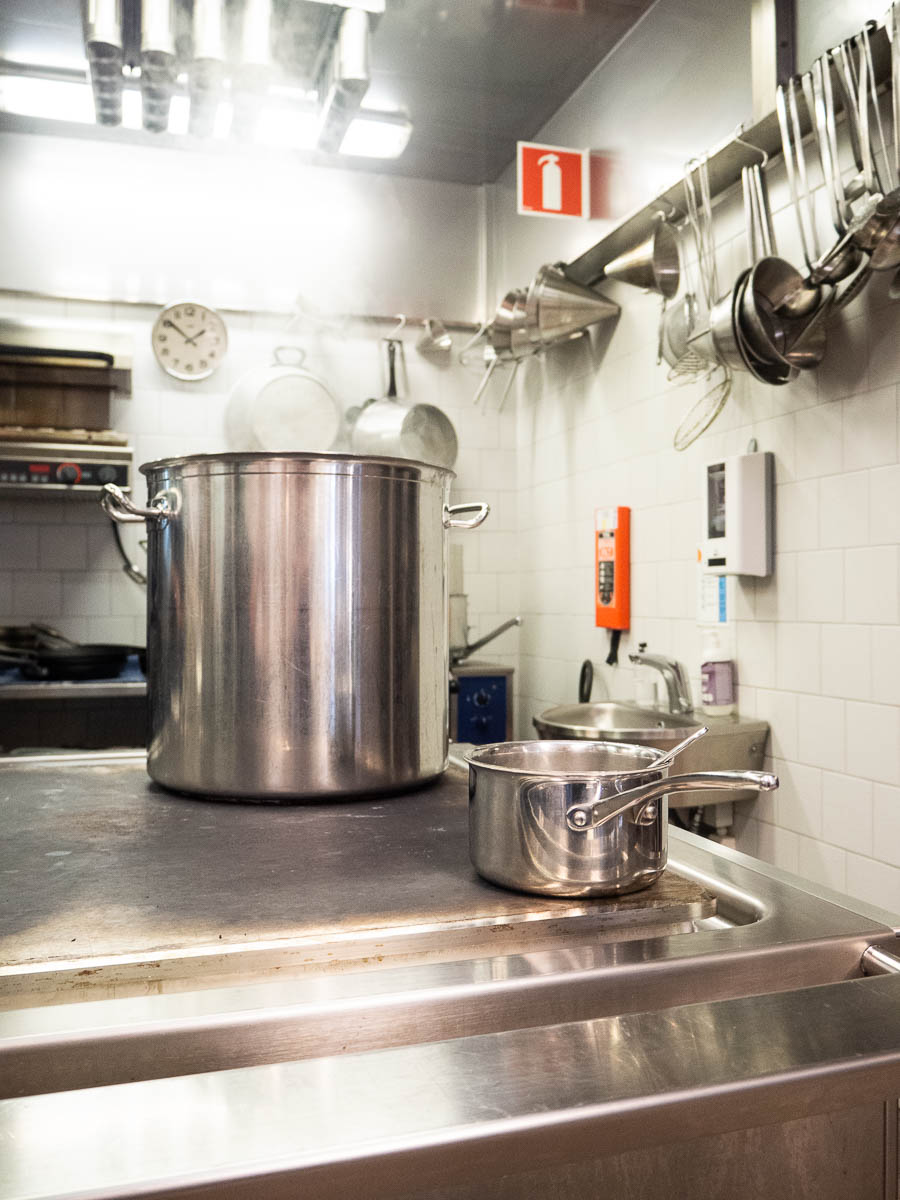
An interesting part of this course was the experience of working in a restaurant kitchen. Not having to think of doing the dishes – just put them on the trolley there! – was a luxury.
Another luxury was a large griddle. I imagine it’s mostly meant to be used as a giant pan, but we didn’t have many such components in our dishes. Instead we used it as a large, extra hot, always-on stove. Need to bring some water to boil? Or reduce some vegetable stock? The griddle is there, ready and waiting for you. Very convenient.
The cutting boards and knives were solid and sharp. But other luxuries surprised me by their absence. There was a definite shortage of measuring cups and spoons, for example.
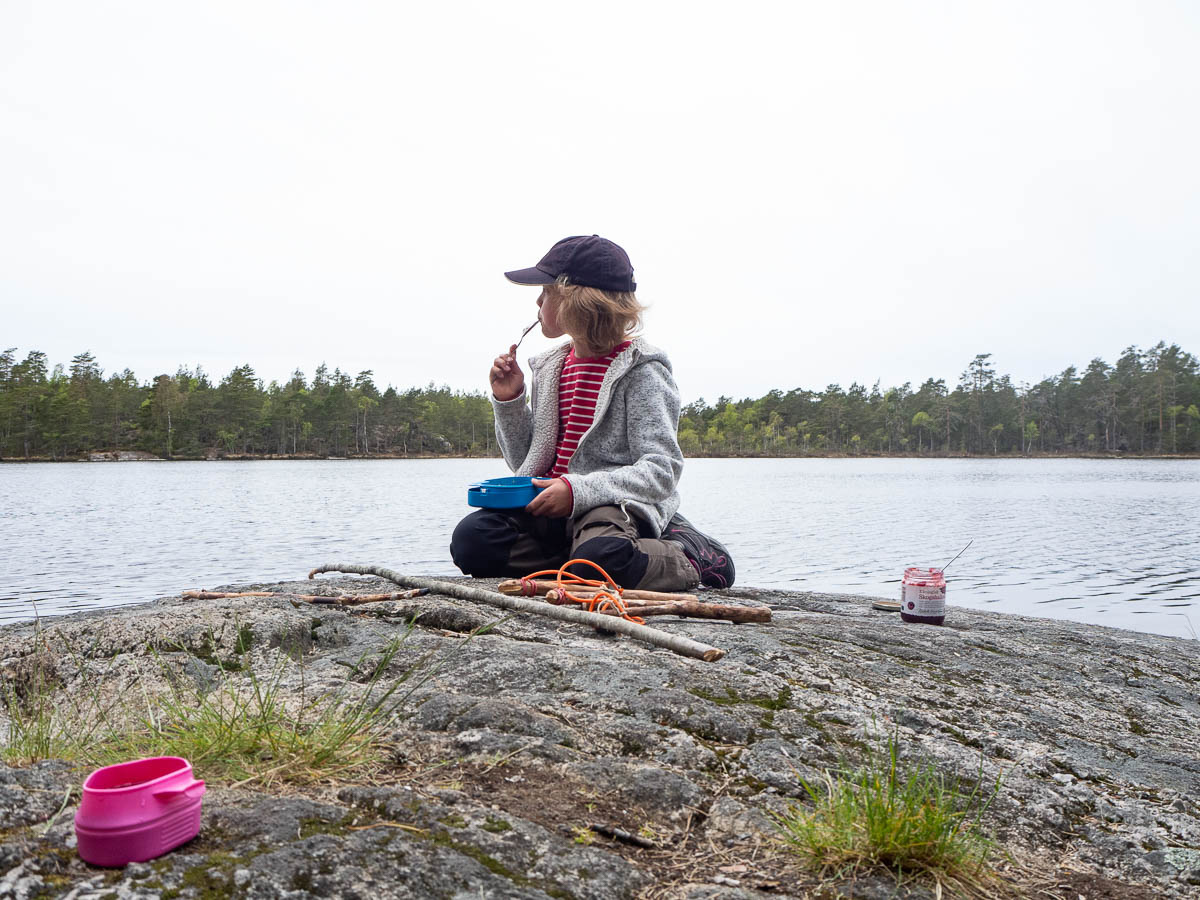
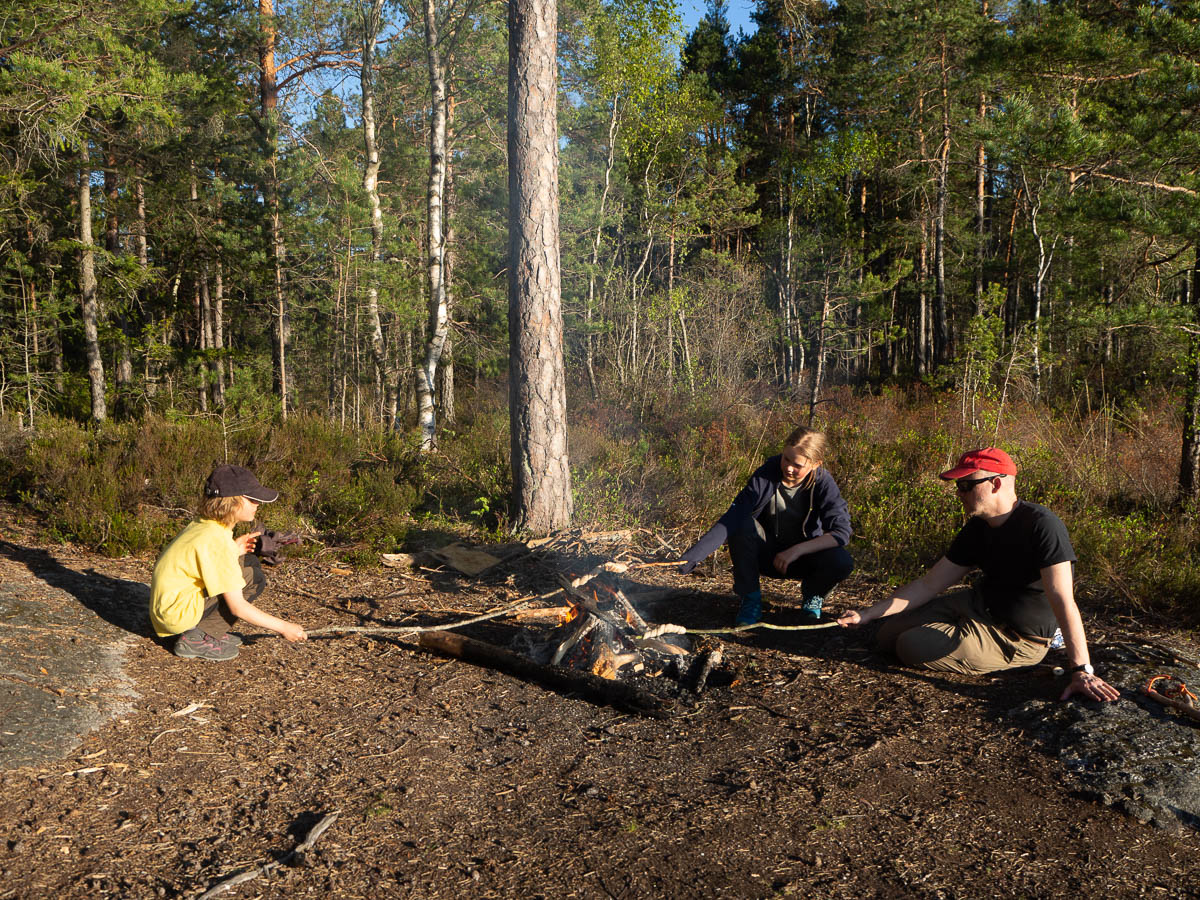
Last night’s sunshine was all gone this morning. Hot porridge and hot bread from leftover bread-on-a-stick dough went down quite well in the cool, cloudy morning.
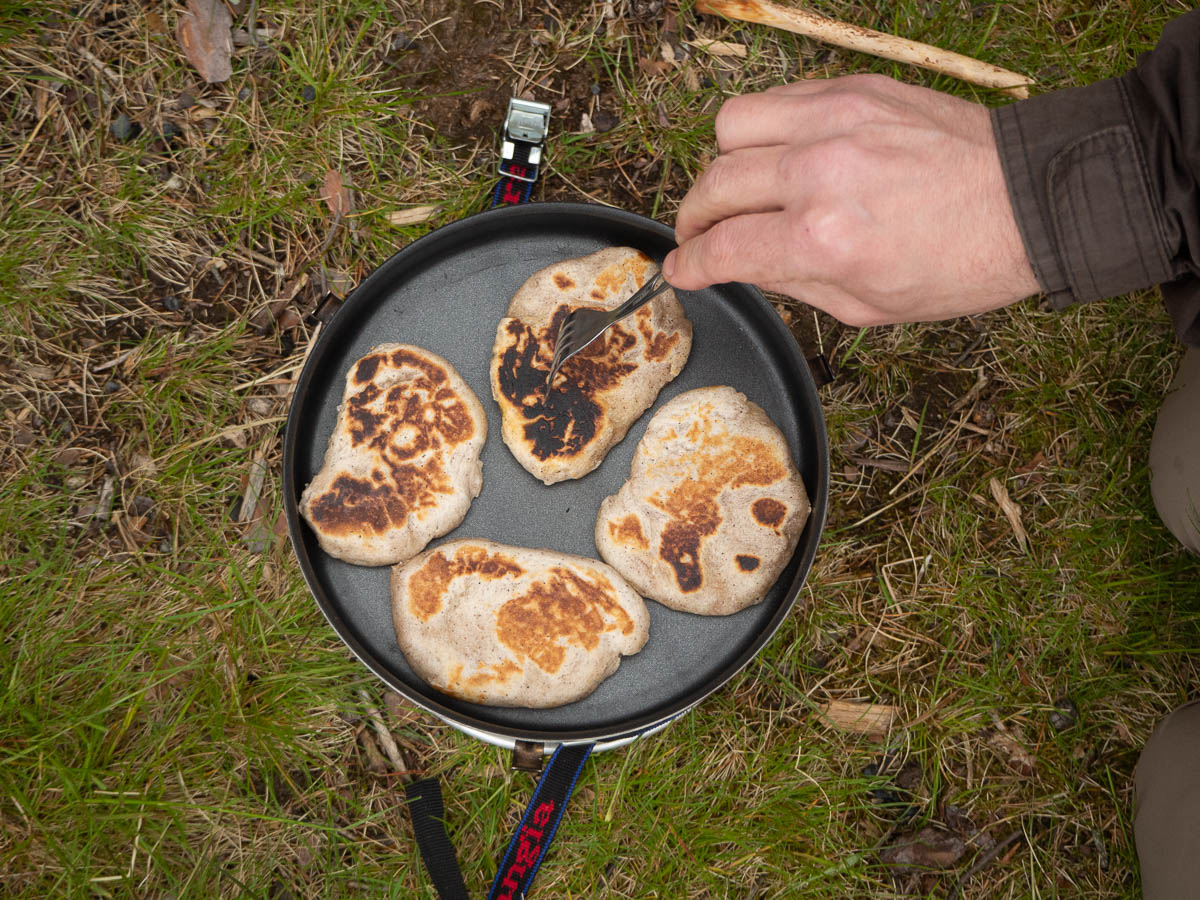
The bread/cake/bannock things were not part of the meal plan at all, but were so delicious that I think we’ll plan for them next time.
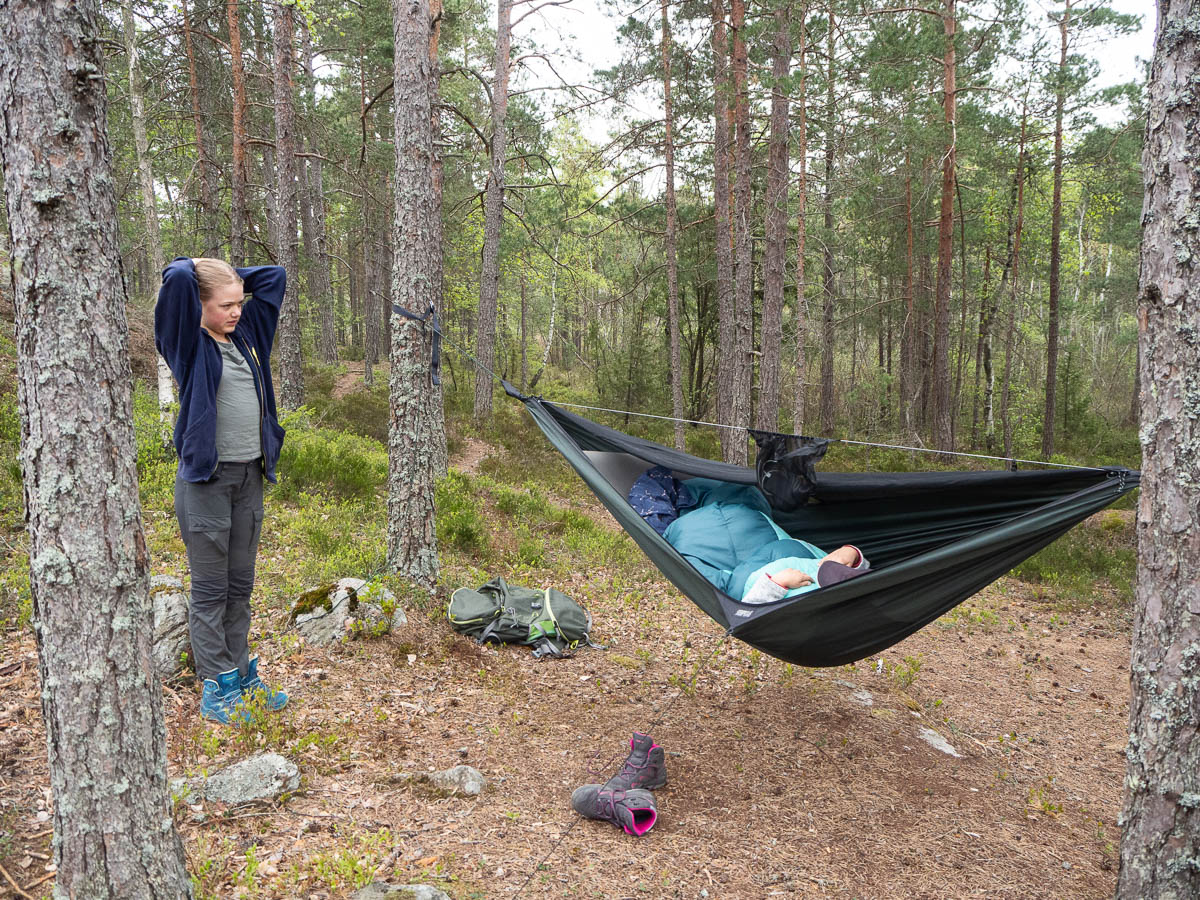
After breakfast, Adrian tested the hammock – fired up by Ingrid’s talk about how wonderful it is to sleep in one. And during much of walk home, he was already planning the next hike, when it would be his turn to get the hammock. We’ll see.
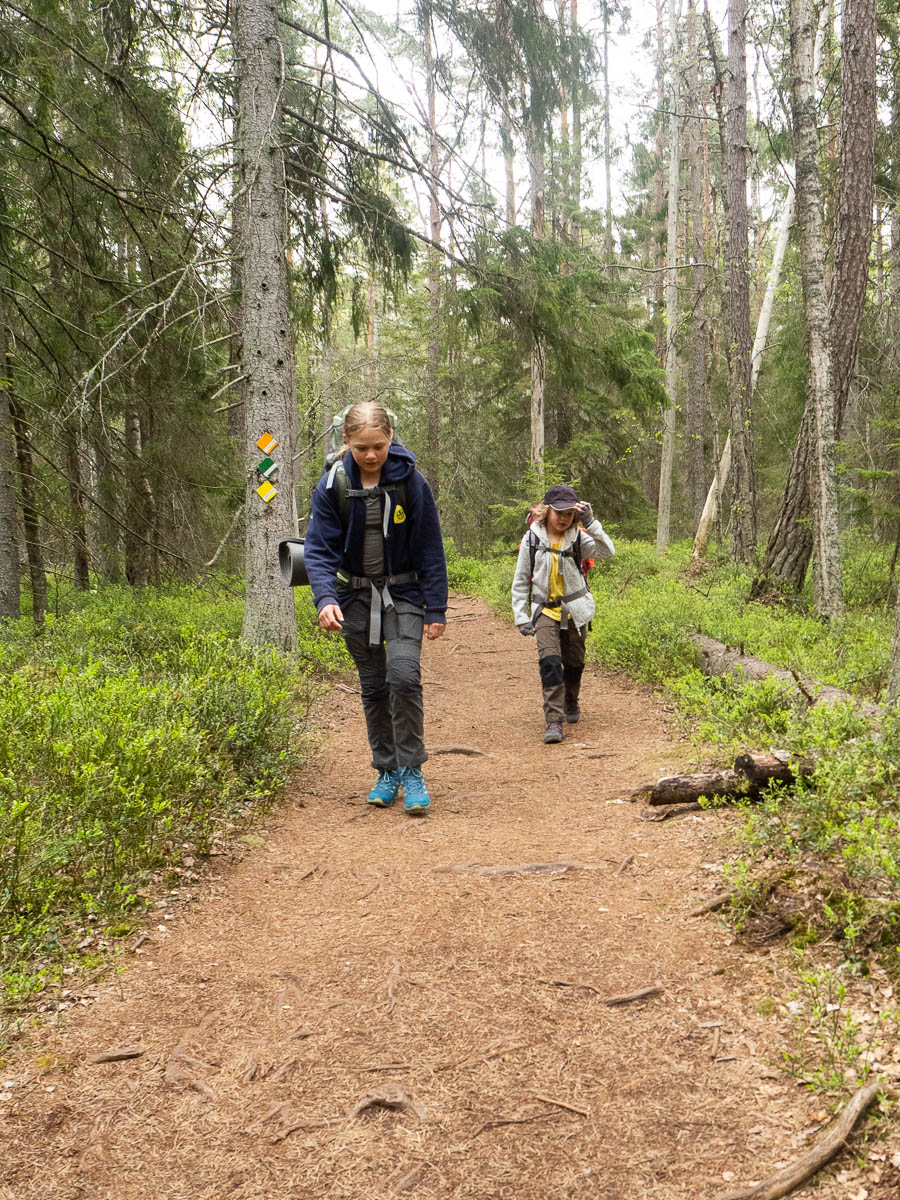
Walking home is never as much fun as walking out. The distance that felt like nothing yesterday, was suddenly long for the kids’ legs. “Are we there soon?”
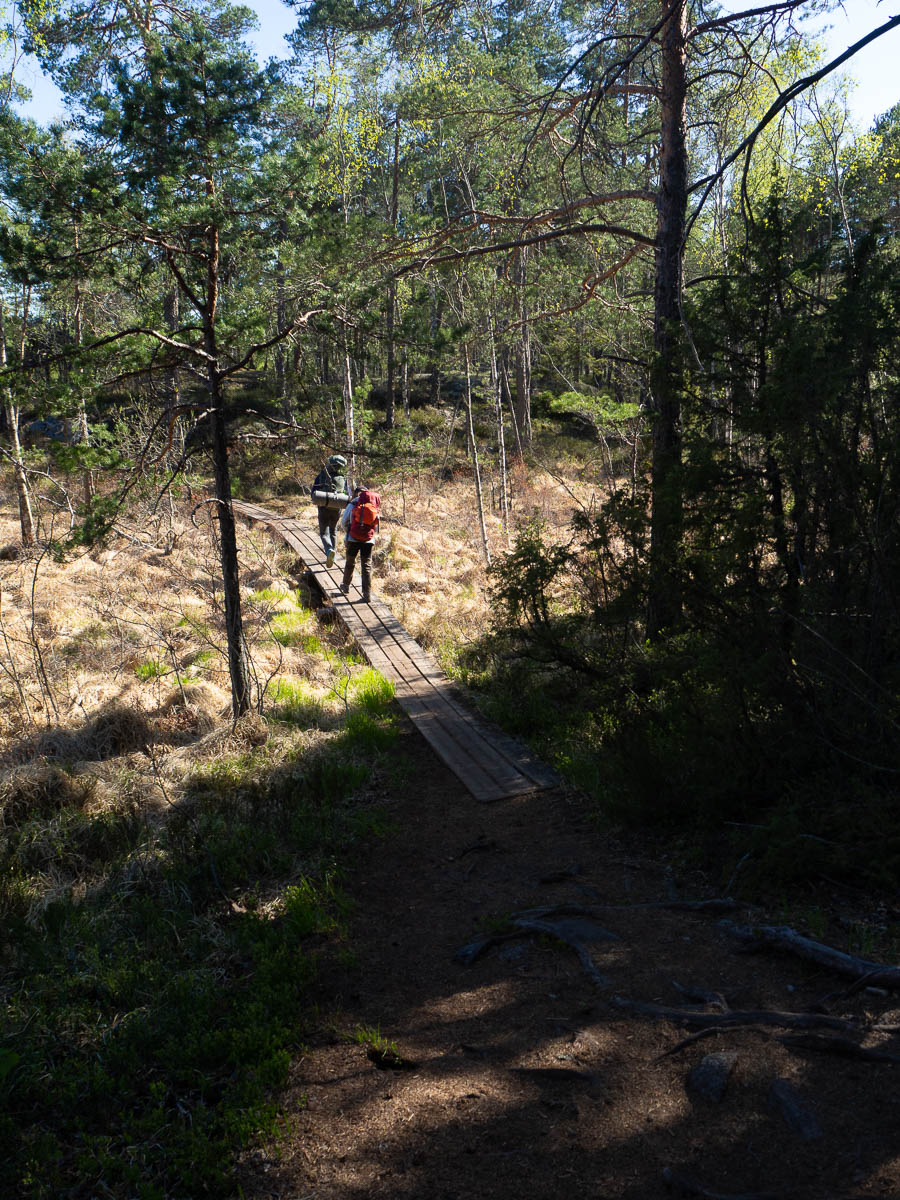
Had this been a normal spring without a coronavirus pandemic, there would have been various scout hikes and camps in May. With the pandemic, all larger scout events have been cancelled, along with so much else of society. Instead we went camping/hiking on our own.
There are several beautiful nature reserves around Stockholm, and Paradiset and Tyresta are the ones I like best. Adrian and I camped in Paradiset once before and it was such a nice spot that I thought we could go there again, this time with the whole family.
A closer look at the map showed that the shelter where we stayed last time, on the shore of lake Trehörningen, was just a kilometre from the parking lot. Back then Adrian was six, didn’t want to walk any long distances and left all the carrying to me… This time there’s four of us, all with strong legs and proper rucksacks, so we could walk a bit longer. The first scenic spot is likely to be the most popular one – further away we might find a spot with fewer people.
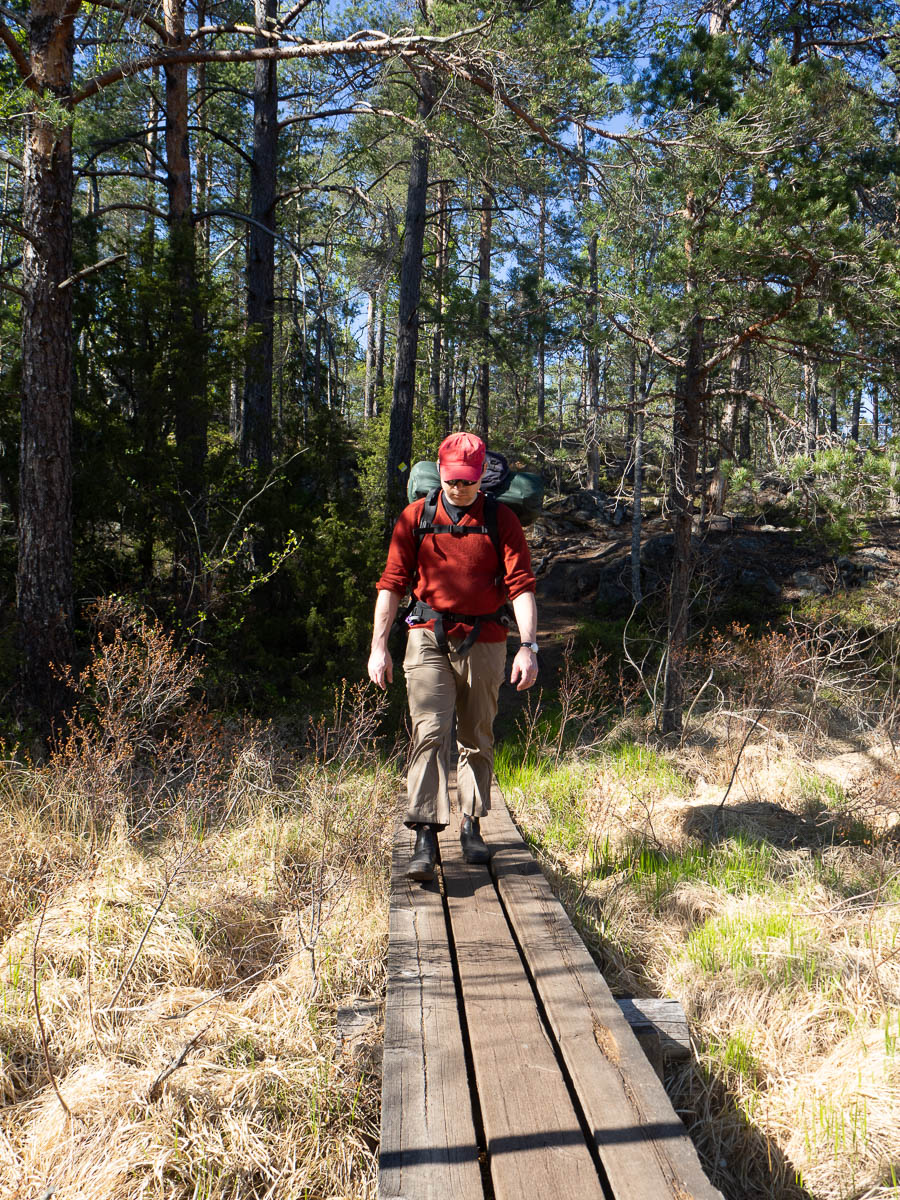
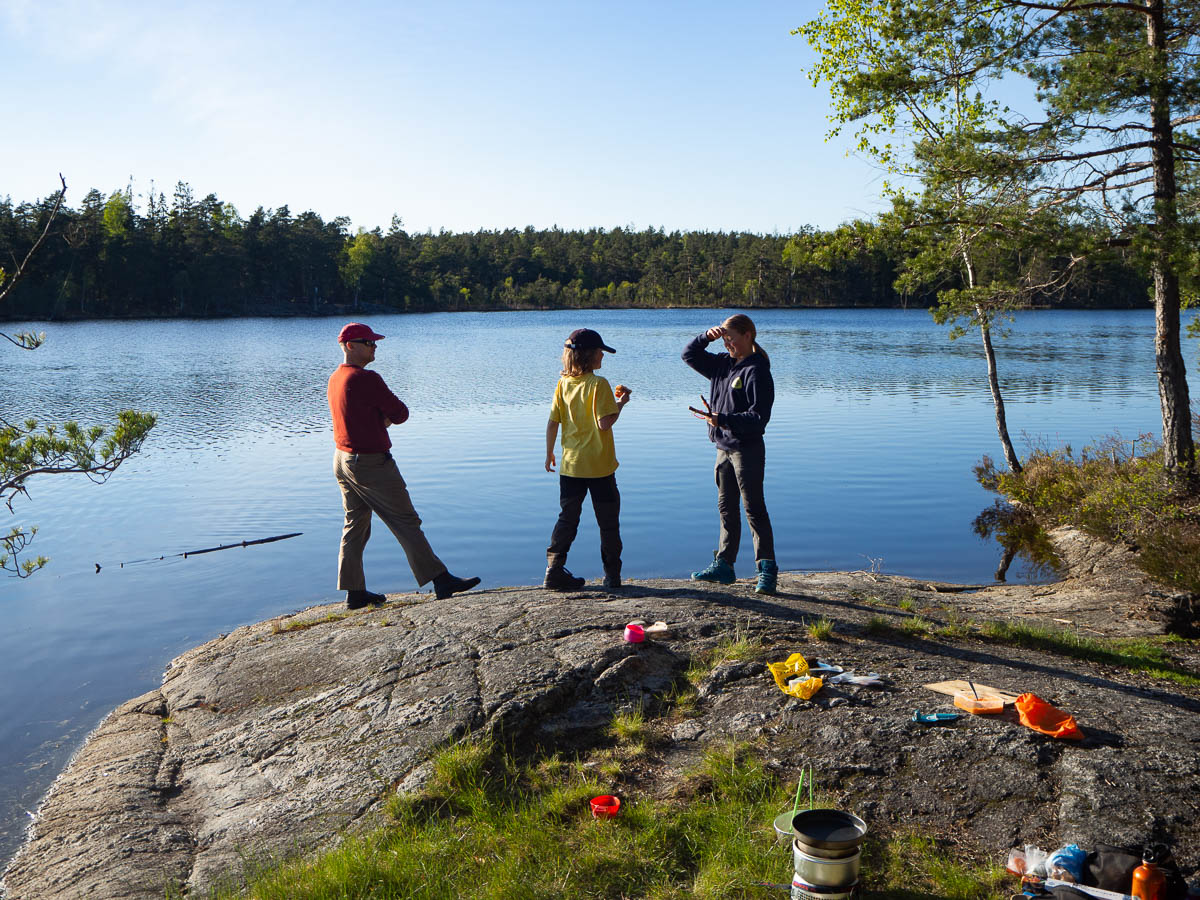
That was the plan. There were several tents in the woods around the first shelter, so we didn’t even turn that way. When we got to the second shelter on the shore of lake Långsjön, we found quite a crowd there as well. Eric spied a flat-looking place with what seemed to be a fire place on the other side of the lake, so we headed off there. There was no shelter there, but a good flat spot for a tent, and much more peace and quiet than at the shelter. Technically you’re really only allowed to camp at designated spots… but this spot had clearly been used for camping before, so we figured it would do no harm if we stayed here.
The original plan was for Eric to sleep in the shelter, me and Adrian in the tent, and Ingrid in a hammock. Everyone gets their preferred “roof” over their head. (Ingrid had tried sleeping in a hammock on her last scout hike and absolutely loved it, best thing ever.) Without the shelter, we were three in the tent, which was a bit cramped but OK for one night. I don’t really expect to get a good night’s sleep on a hike anyway.
Now that we had shelter, the next question was firewood. With all these people out in the woods, the nearest box of firewood was already empty when we passed it. I emptied my rucksack, and Adrian and I walked back to the first shelter to pick up firewood there. Luckily the box there still had some.
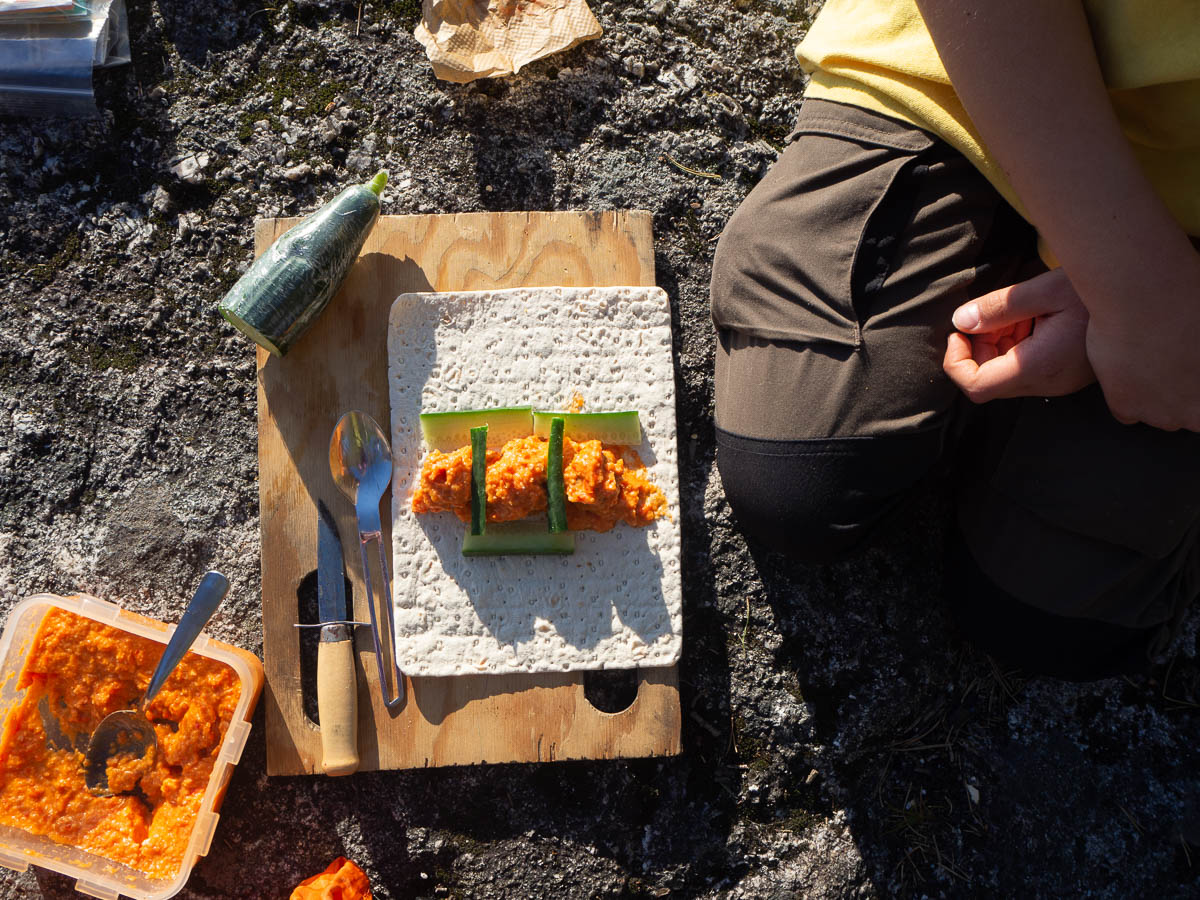
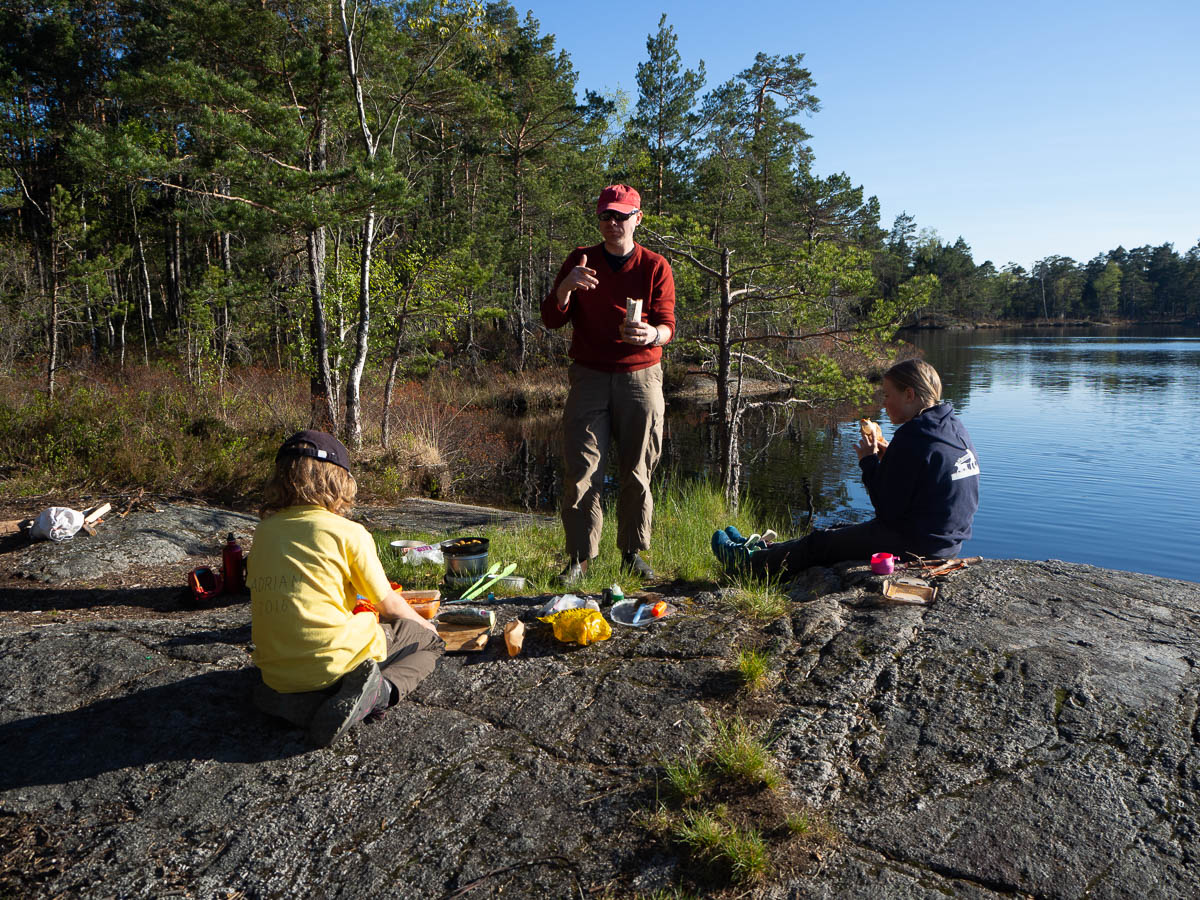
When we got back with the wood, it was definitely time for dinner: falafel wraps with salsa romesco and cucumbers.
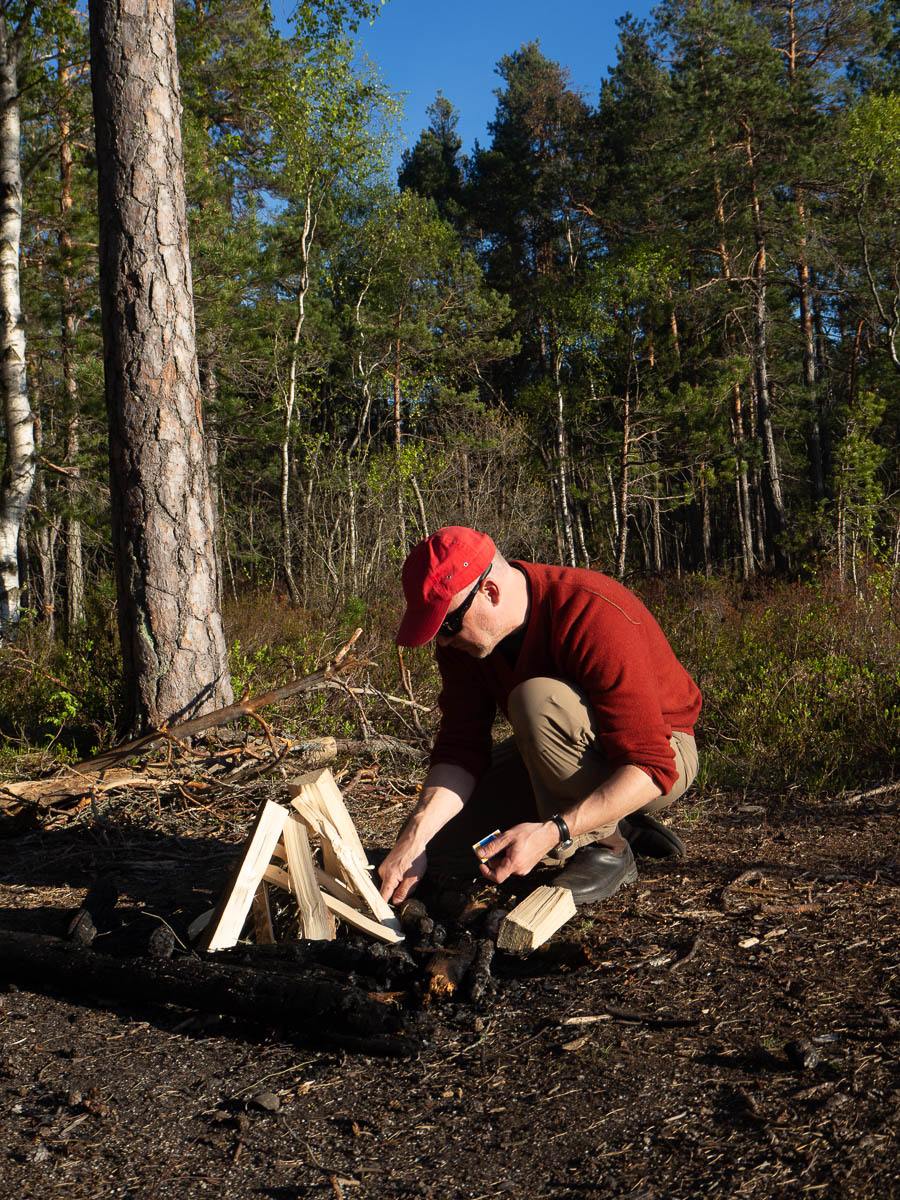
The firewood wasn’t for the dinner (its easier to fry up falafel on a stove) but for even more important things: bread on a stick, and a grilled banana dessert!
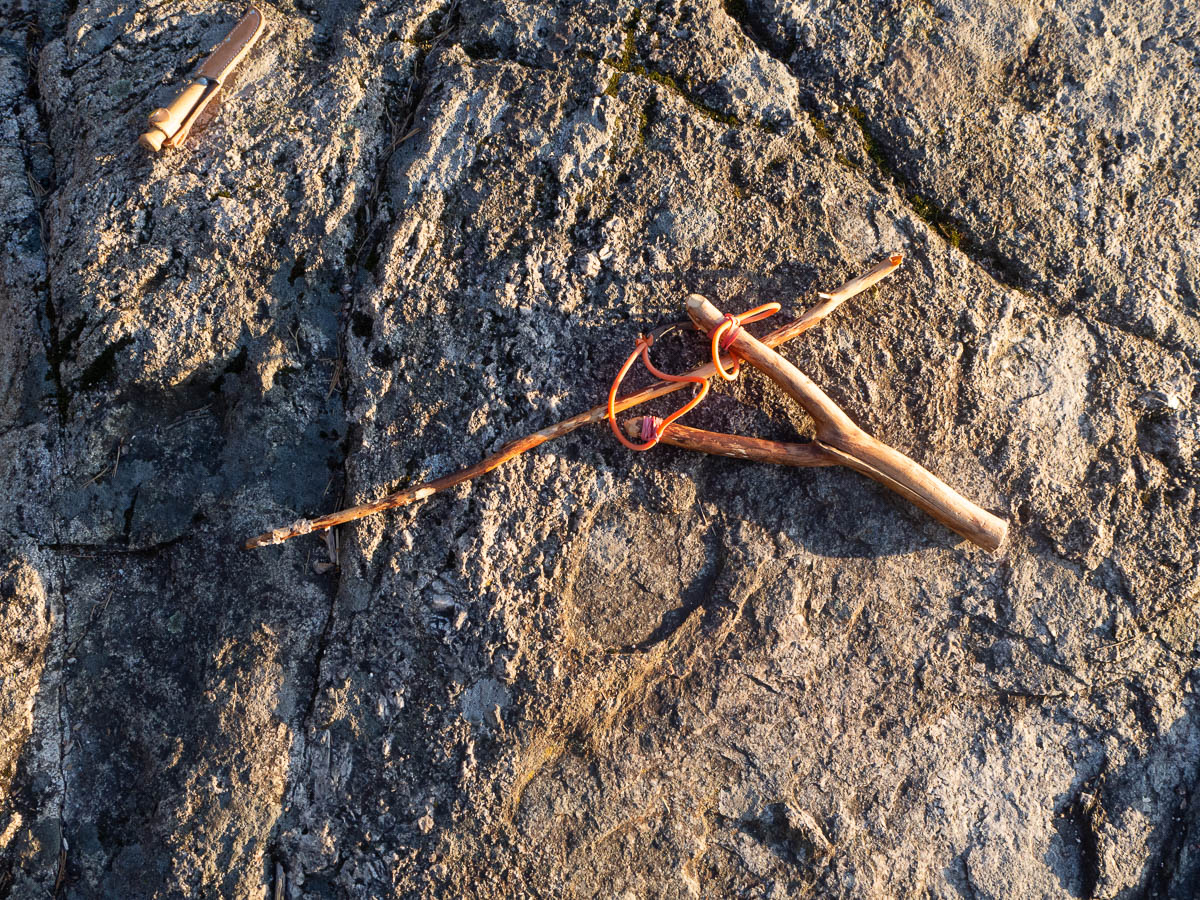
After dinner – and before dinner, and during dinner – Ingrid and Adrian played with slingshots. I once tried to make some using some random elastic bands but those didn’t work too well at all. Now I had bought some proper slingshot bands, and they made a big difference.
Rocks flew best, but there were almost none in the forest around us. There were plenty of pine cones, though. Ingrid experimented with different techniques and angles and differently shaped cones, trying to shoot them as far as possible.
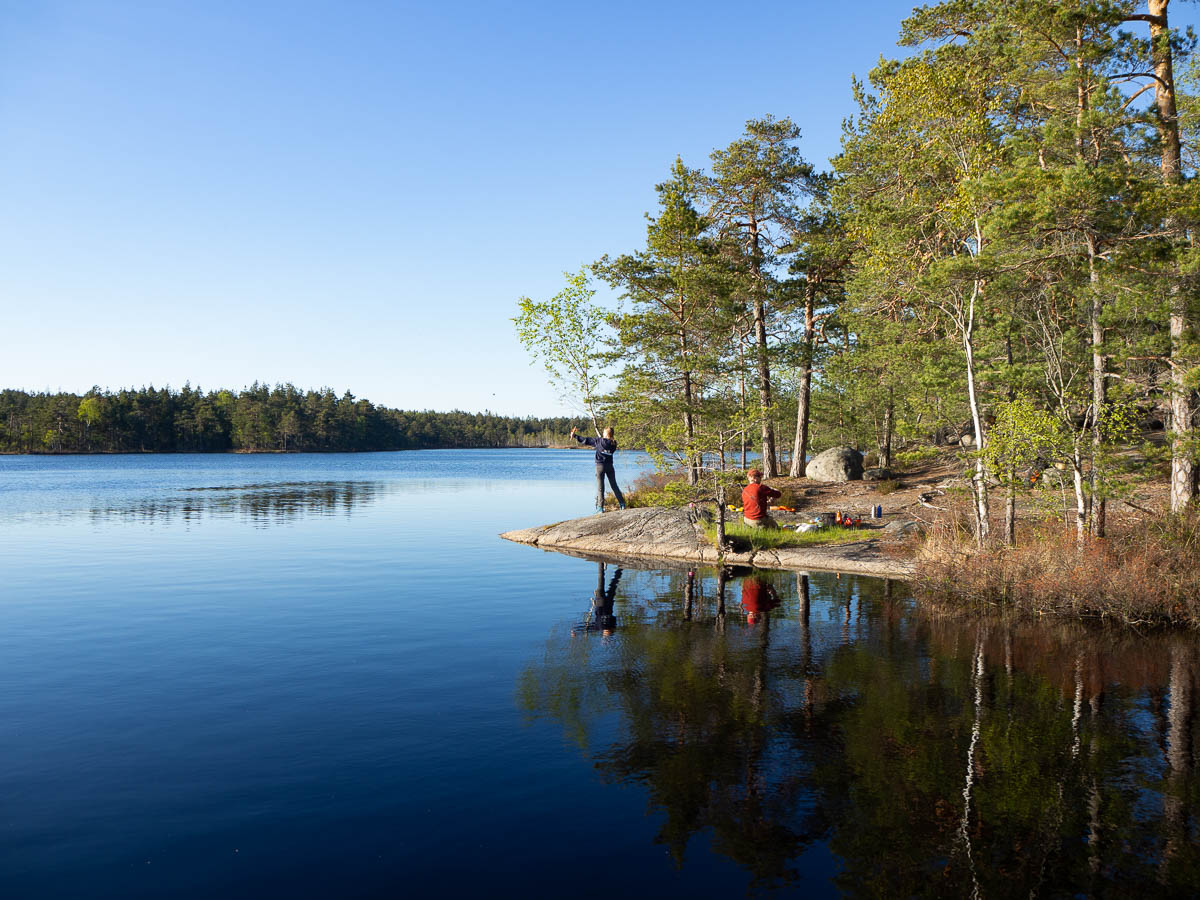
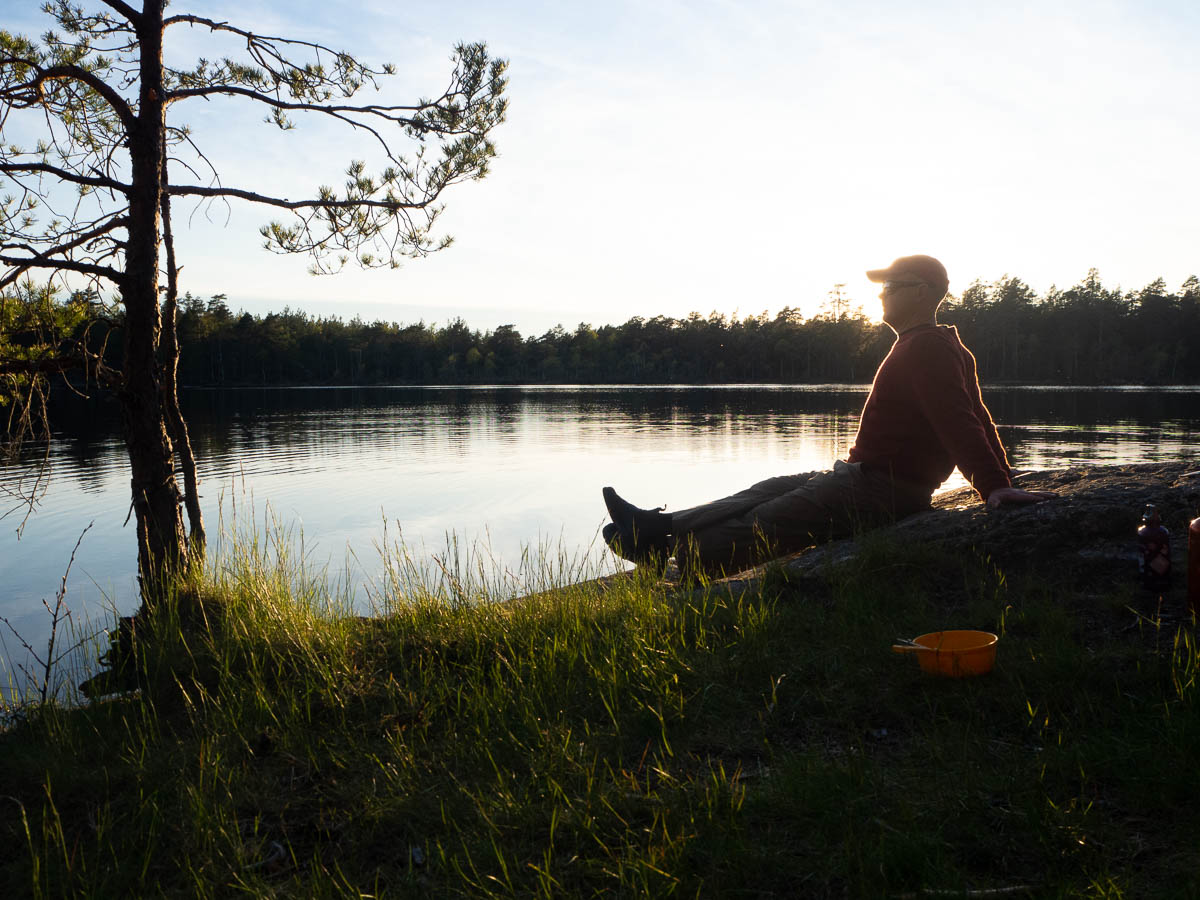
The weather was absolutely lovely, with blue skies and a hot sun, and barely any wind. And we were on the east side of the lake and thus had the evening sun shining on us until late. Only after the sun went down behind the trees on the other side of the lake did it get a bit cooler.
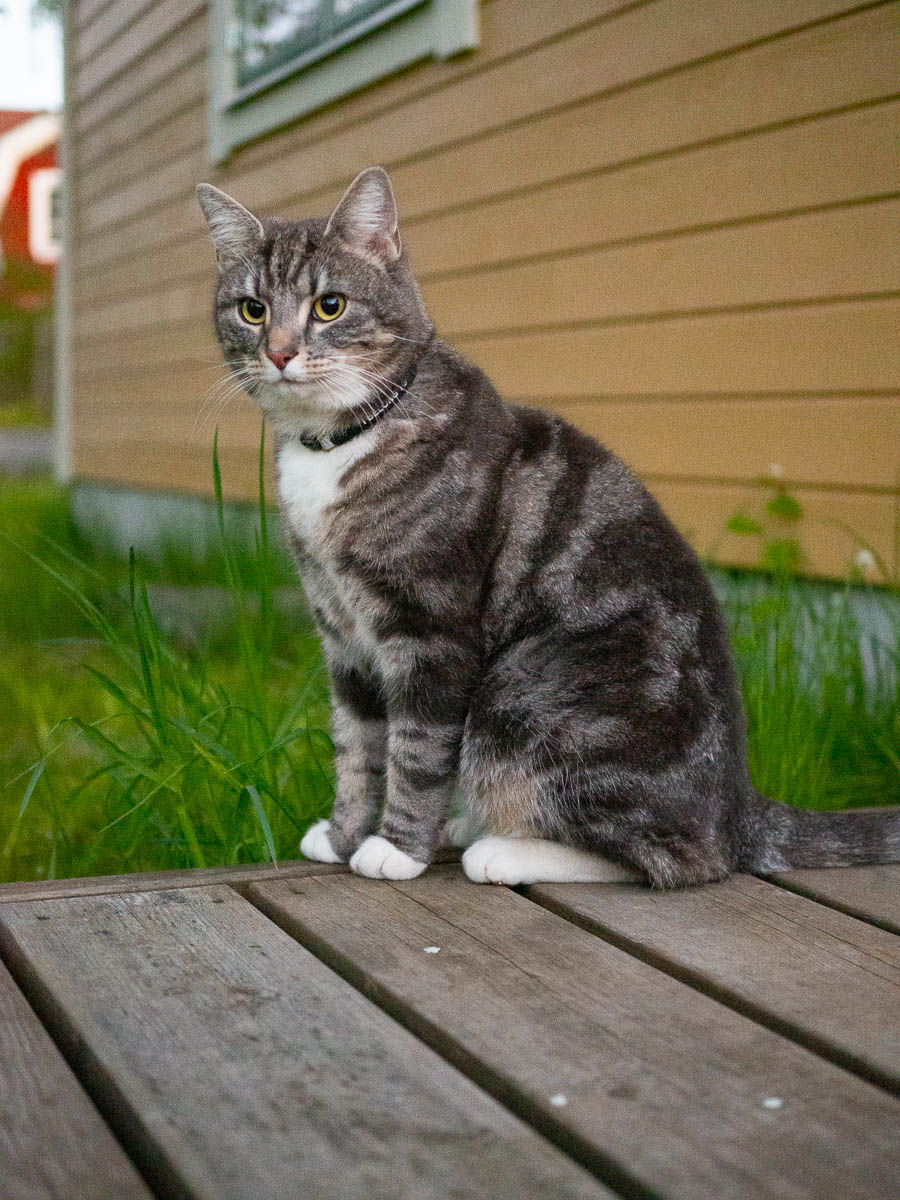
This is the curious cat that I often see nosing around the garden. (Not the new young one who tried to fish for baby birds in the nesting box, but a more regular visitor.) And the house, too: if the doors to the deck are open, it tends to come inside.
I like cats. I like this cat, too. Even if it hunts little birds. But I don’t want it to make the inside of our house a part of its territory.
Speaking of birds, I’ve had a blue tit in the house twice in the last week, or maybe two different ones. The first time it flew into the ficus tree, and was relatively easy to chase out from there because it’s near the double doors to the deck. The second time it flew into the next room and got confused and slightly panicked by the windows there, but I got it out without much trouble.
And of course there is an endless stream of bees, bumblebees and wasps who fly in and then can’t find their way back out again. Windows.
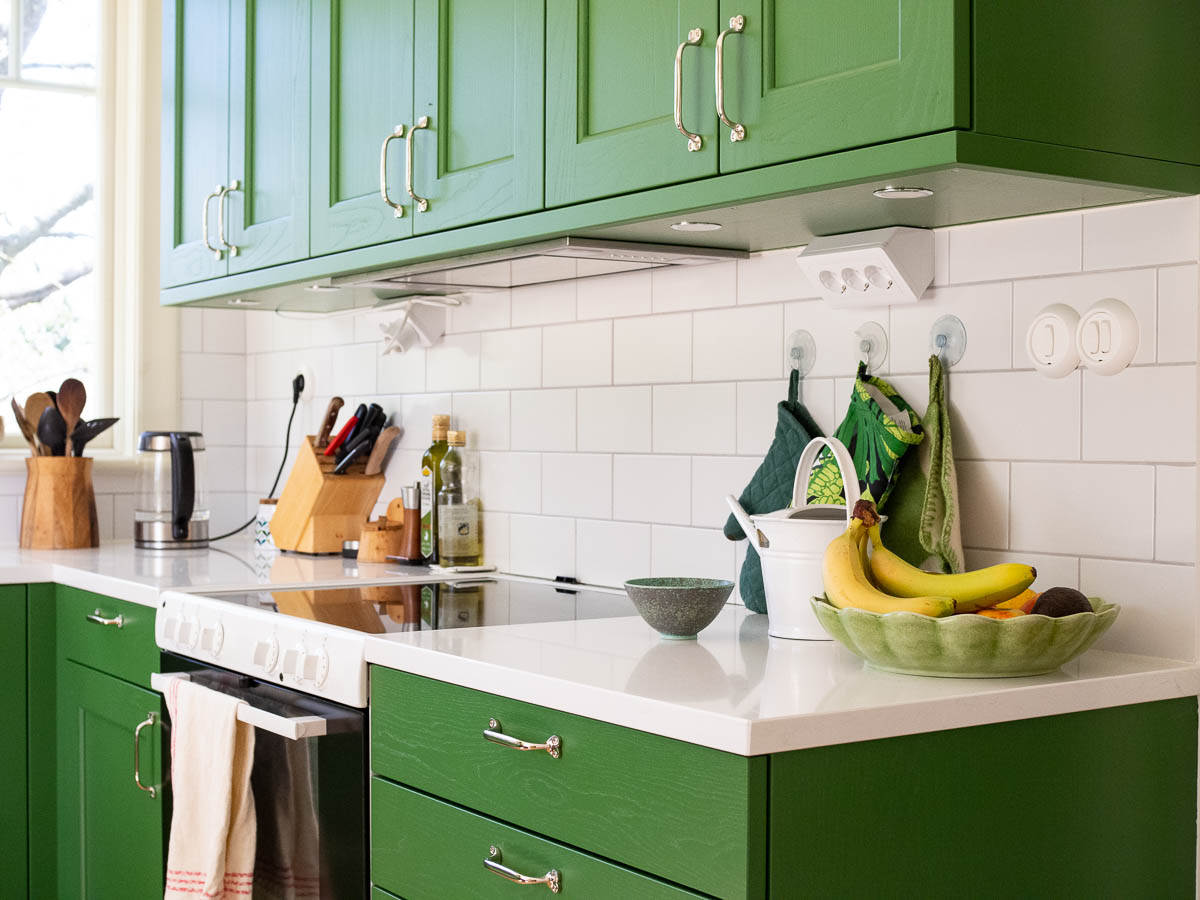
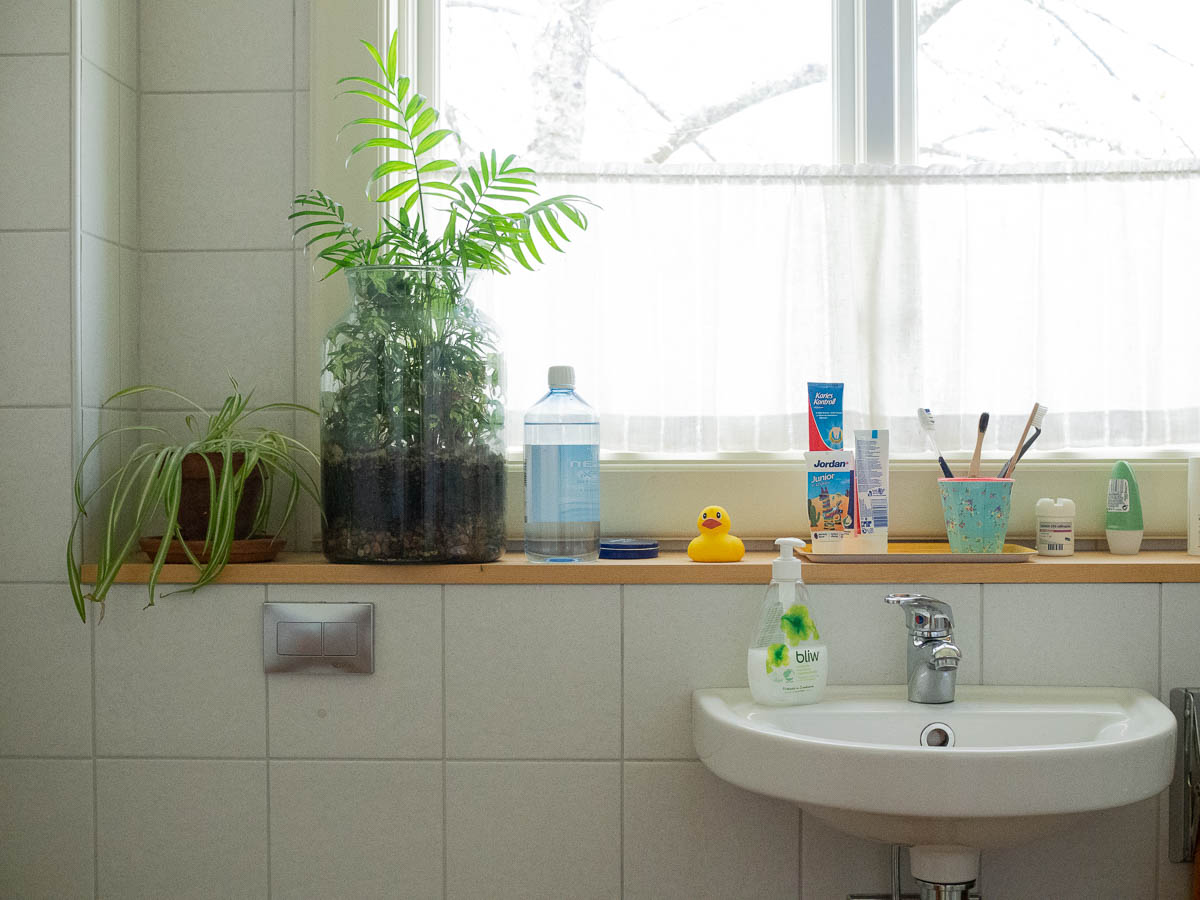
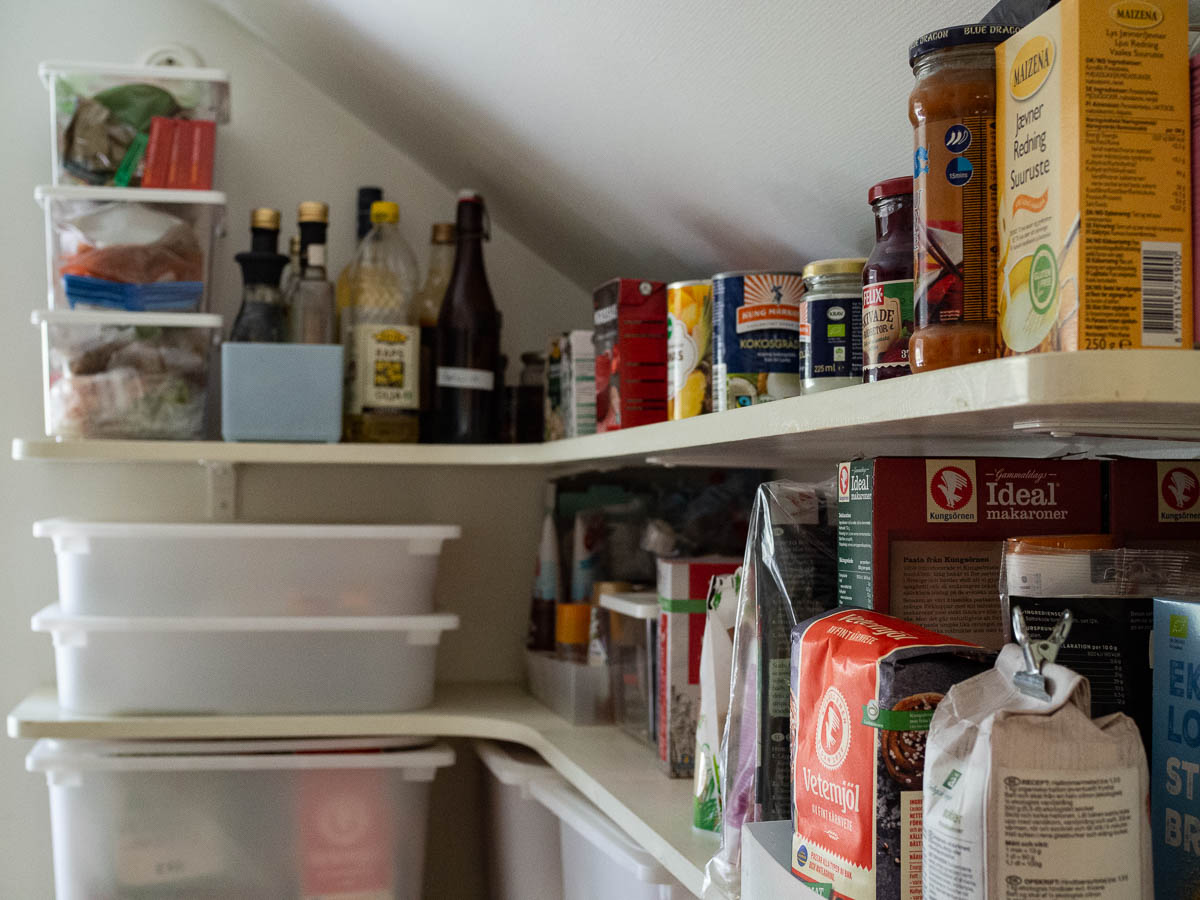
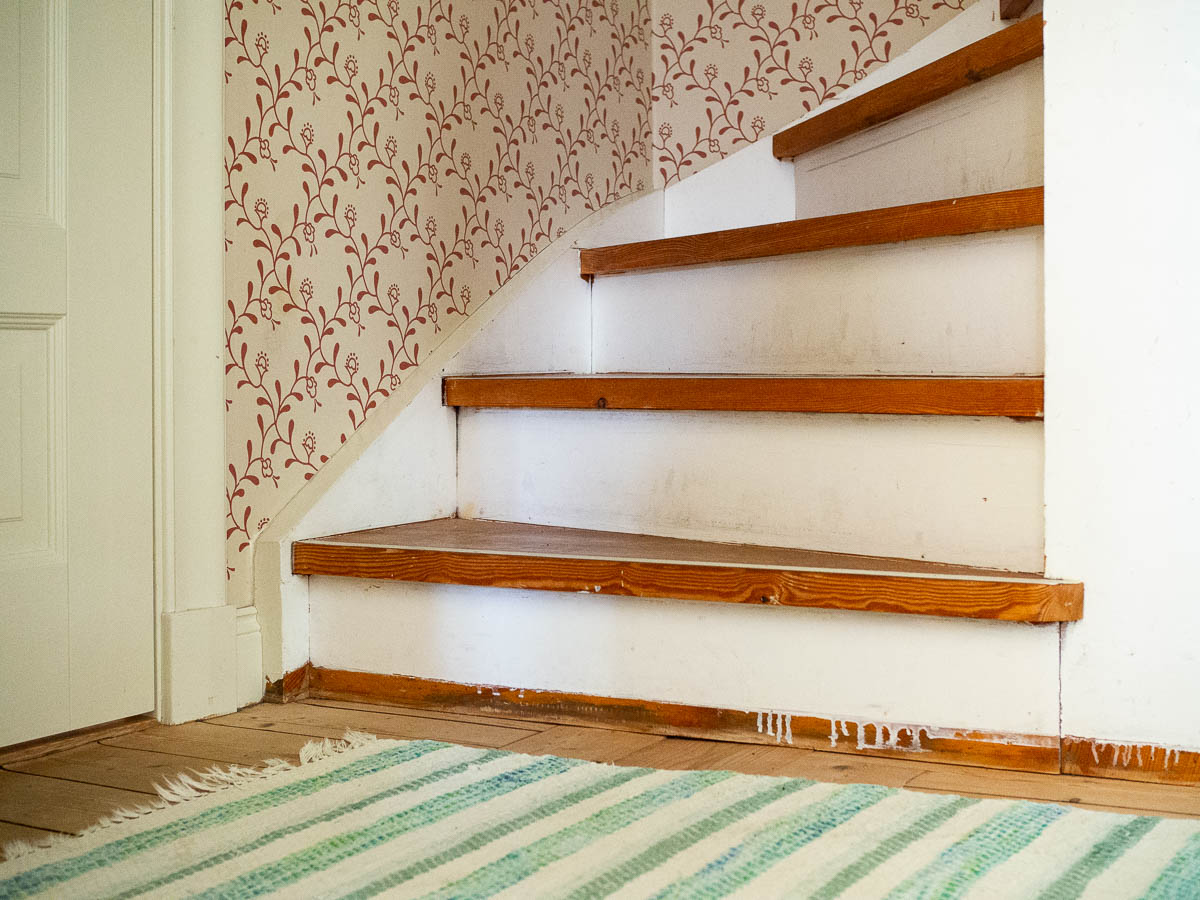
We’re doing a social thing at work – sharing photos/videos/whatevers of our homes, and others will guess to whom each home belongs. I’m definitely doing photos; there’s no question about that!
I’m quite sure that nobody at work reads my blog. Otherwise, whoever does will get major spoilers here. Well, if they read my blog then they will have seen plenty of photos of the house already so this won’t make any difference…
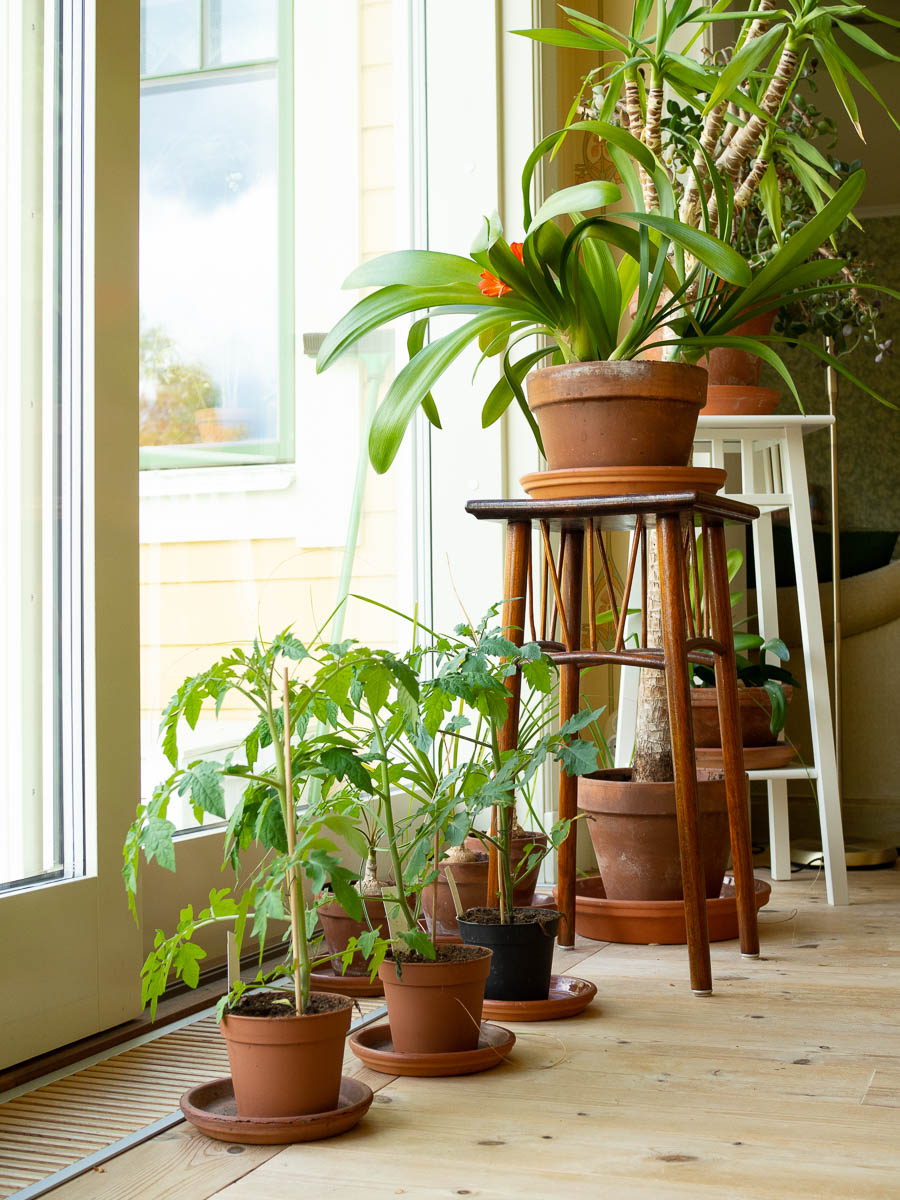
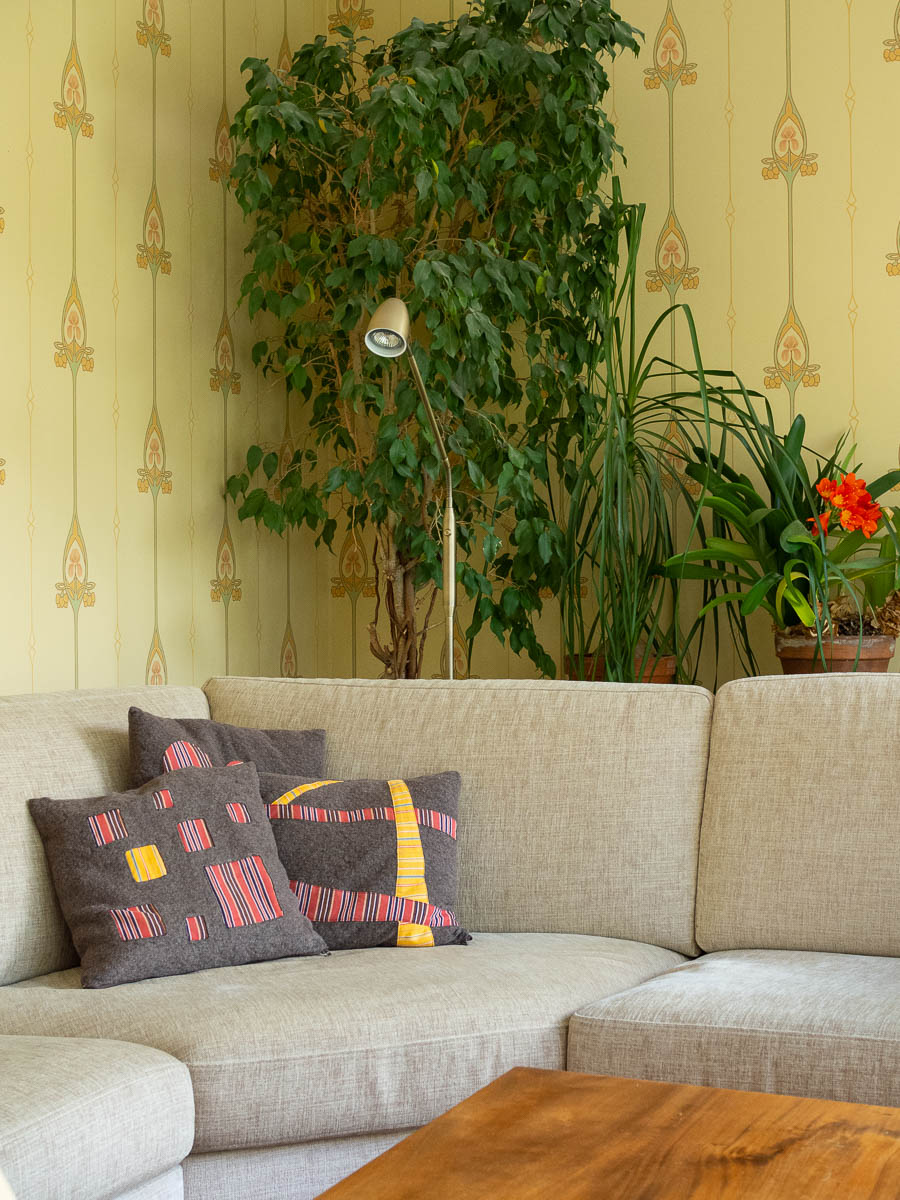
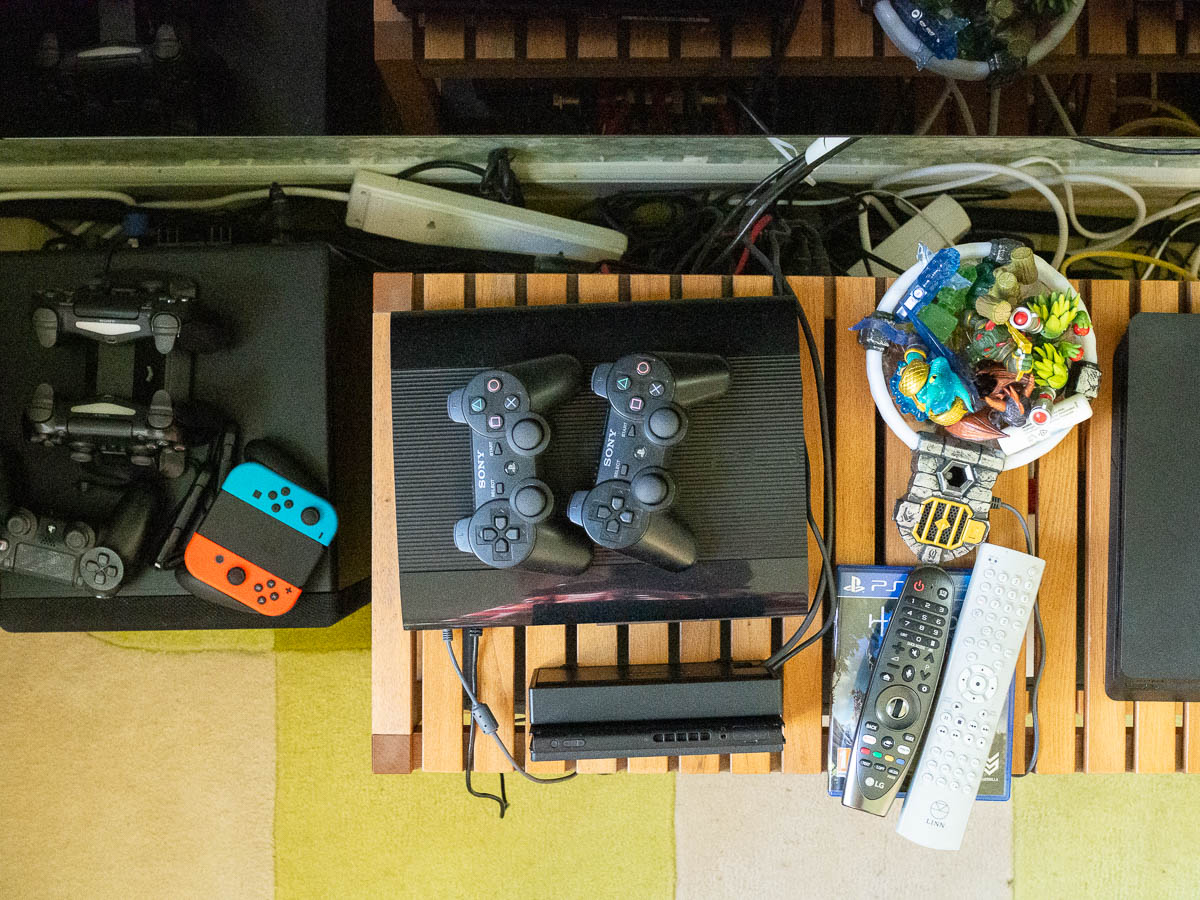
Anyway, here are some photos I took of various parts of the house. All rooms are represented except the bedroom and the children’s rooms. I also skipped my home office because my colleagues see it every day in our online meetings, so a photo of that would make the challenge way too easy.
I am willing to bet money that all the other homes will have predominantly white walls.
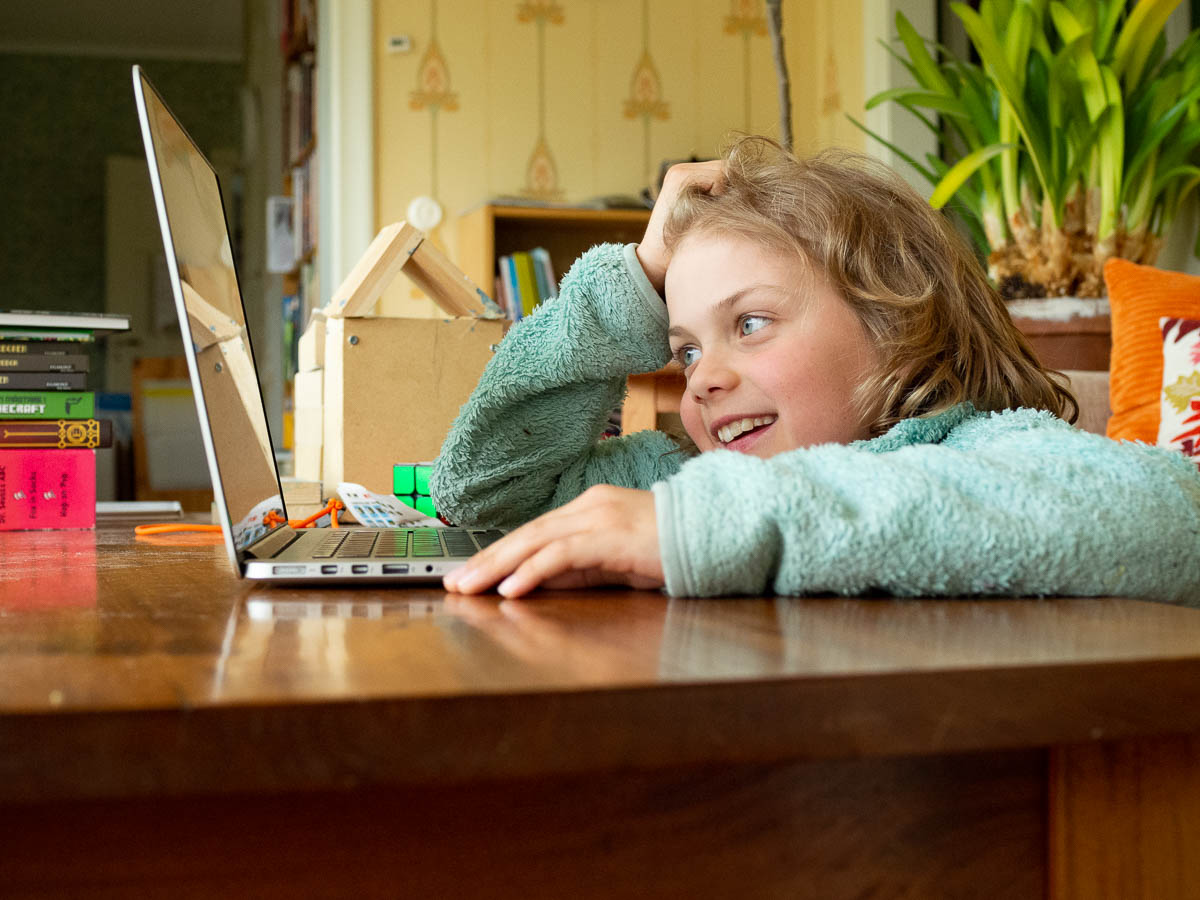
The schools in Sweden are all open, but Ingrid’s and Adrian’s Estonian lessons are taking place online – I’m guessing because the teacher would otherwise be travelling back and forth between schools across town, and that’s not good from the point of view of infection control.
Ingrid has “proper” lessons and tests and things. Adrian’s lessons are more like extended homework, but online.
Quite often one of the tasks is writing. Write x sentences about an animal, write x sentences using words from the previous exercise.
Normally he would write them in his exercise book. Now that the lessons are happening online, he writes them in Word on my computer.
He insisted that the document needed at least one emoji. Preferably lots, and weird ones – somehow homework in Word doesn’t feel like real homework and he doesn’t take it as seriously as his normal schoolwork. We agreed on one “teacher” emoji in the end.
Yesterday was a day of gardening – of soil chemistry and strawberry plants. We also made a trip to a nearby garden centre to make a start on planting that curve between sections 4 and 4b.
I had a list of ideas, but when I got there, I still felt lost and aimless. They didn’t have some of the bushes I wanted, even though they are quite common ones. Of other species they had the “wrong” varieties. Or their estimates of final size didn’t match up with what I’d read online. And with all those changes, I just couldn’t picture the whole thing in my head.
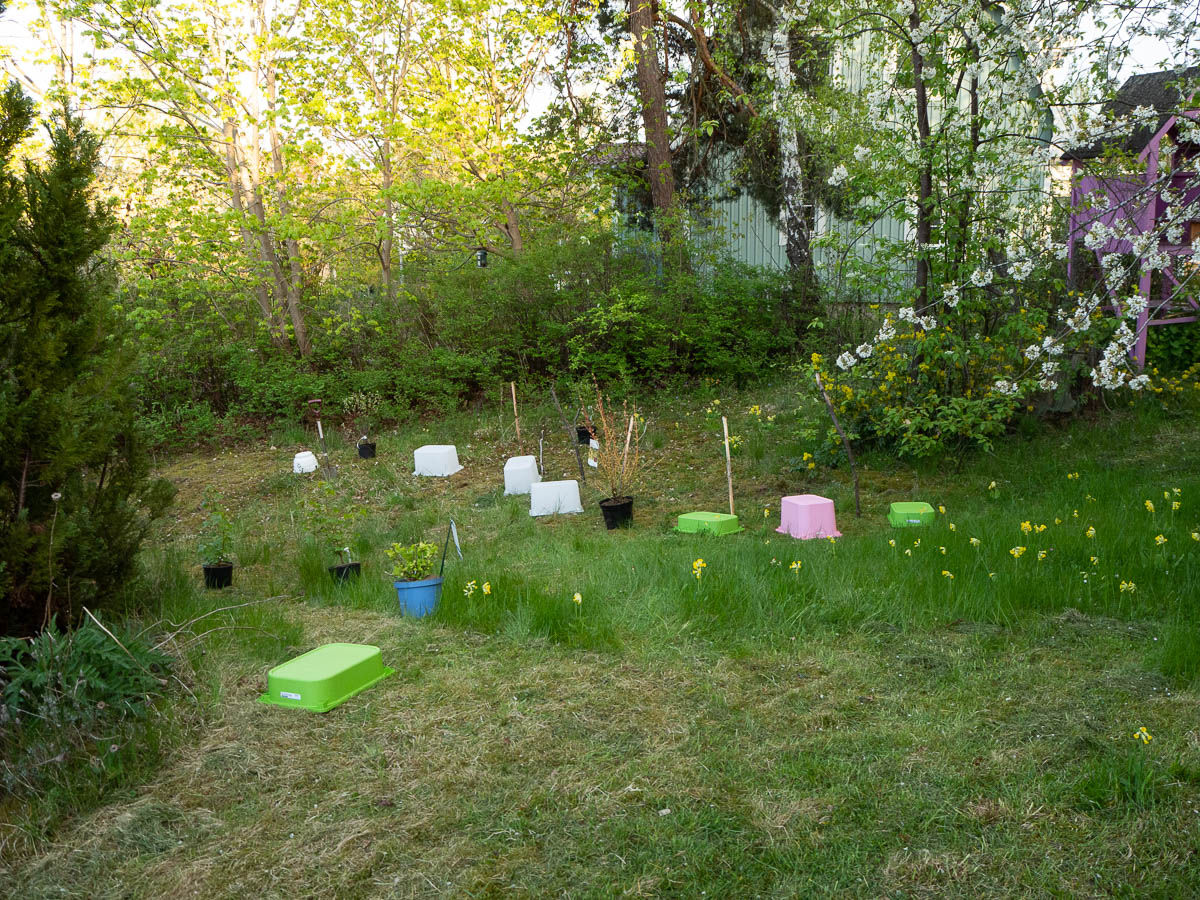
Still, I bought a few bushes to at least make a start. Later in the evening Ingrid and I went out and made a more serious attempt at a design. IKEA’s Trofast boxes made great stand-ins for plants: durable, stable, visible, and mud-proof.
Ingrid was great help in this! “What if we swap these two, so we get a more interesting height variation here? Should we have something dense and ball-shaped here next to the flowering one?”
Armed with this new, much clearer design idea, we made a new, more confident shopping trip today and came home with plenty more bushes. Our shrubbery curve is starting to become reality!
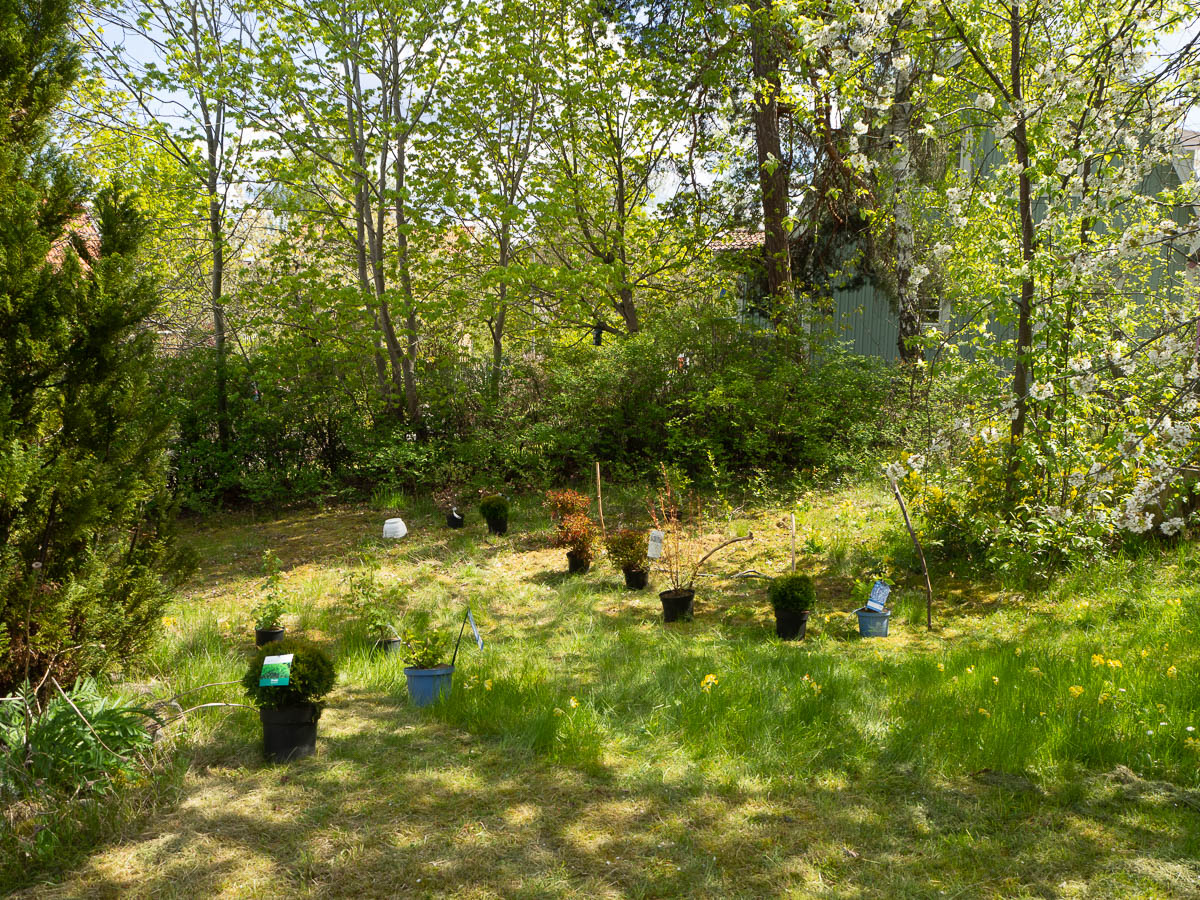
From yesterday: one Cornus mas, one Amelanchier alnifolia, one Cornus sanguinea ‘Midwinter Fire’, and two blackcurrants ‘Delikatesnaja’.
Today the pink Trofast box turned into a Hydrangea or two, the three white ones into Spiraea japonica and the three green ones into Thuja occidentals ‘Danica’.
I’m not convinced of our ability to keep Hydrangea bushes alive. The internet says they die if you’re not really diligent about watering them. But Ingrid has been fascinated by them for years, and it is the one and only bush she really wants to have in the garden, so we’ll give it a try.
I’m still thinking about the large mossy patches in the back garden. Could it be because the soil is more acidic there? The soil there is definitely different than in front of the house, much sandier and less full of heavy clay.
We should have some pH indicator strips somewhere, and even an electronic gadget to measure acidity, for the pool. But we seem to have put those away in such a good place that we can’t find them any more, even after searching through the kitchen, the laundry room/pantry/mud room, and the basement shelves.
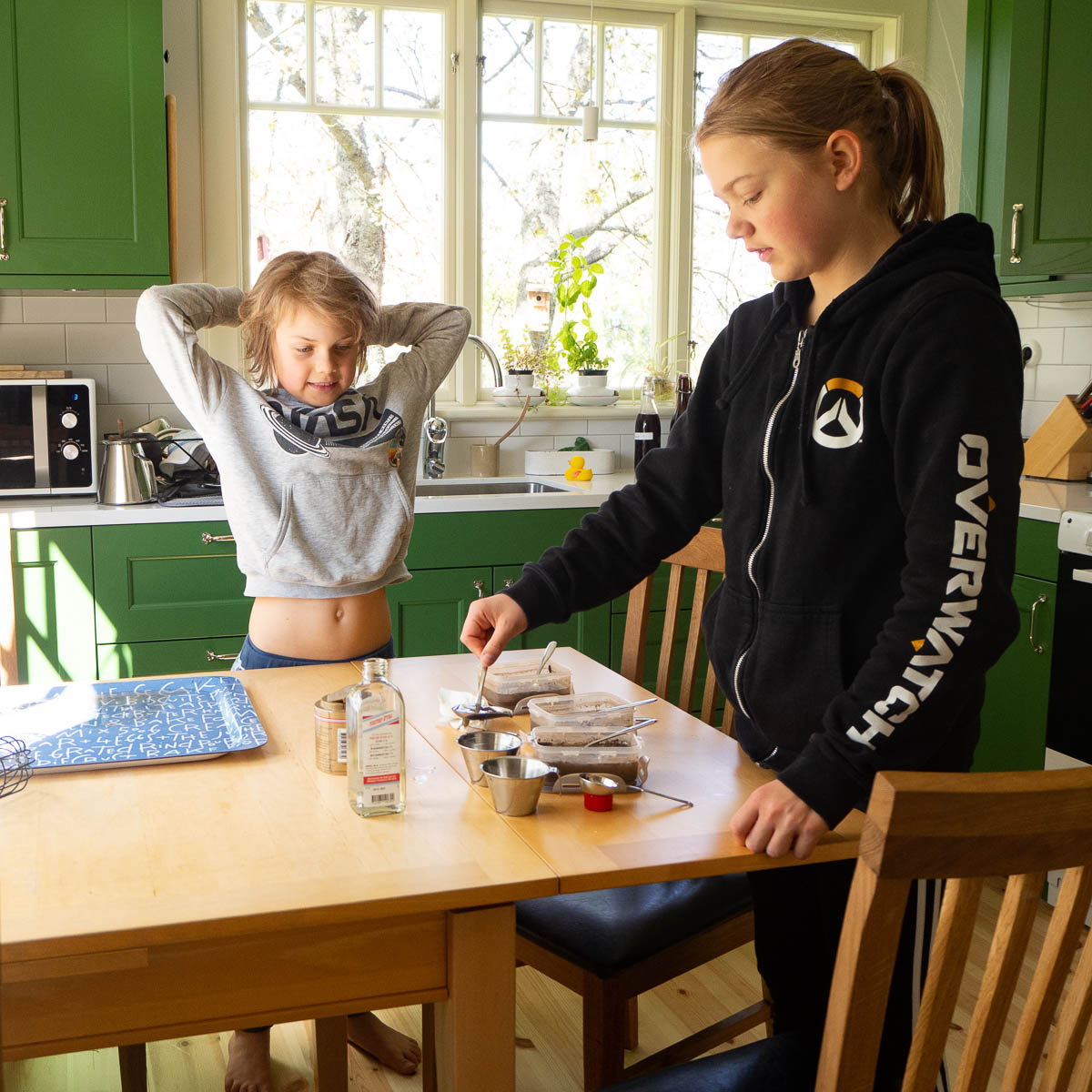
We could buy new ones (and will have to, anyway, for the pool) but I wanted some answers today, now! Instead of shopping, we did home chemistry. Dug up soil samples, mixed them with water, and then tested half of each sample with white vinegar and the other half with baking soda.
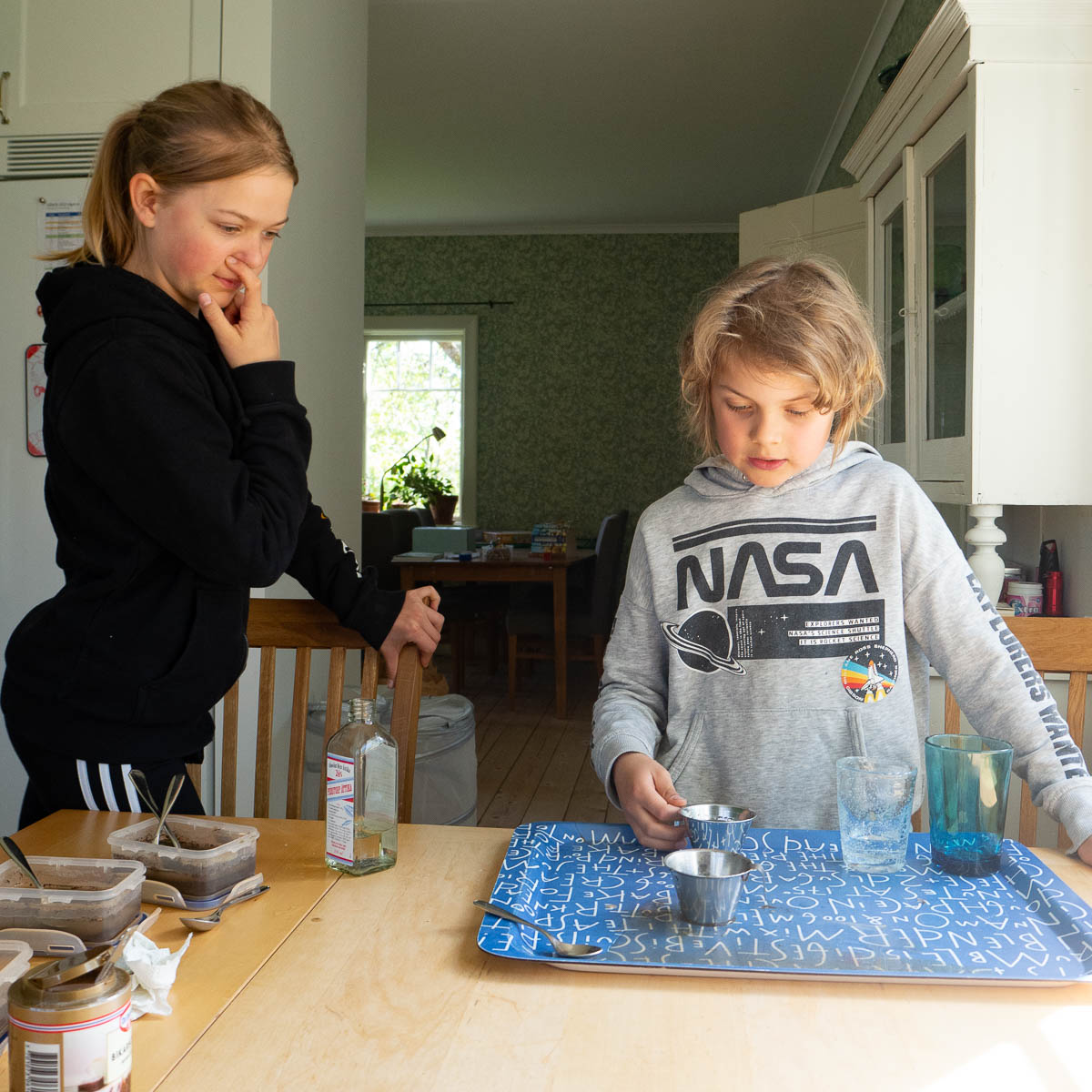
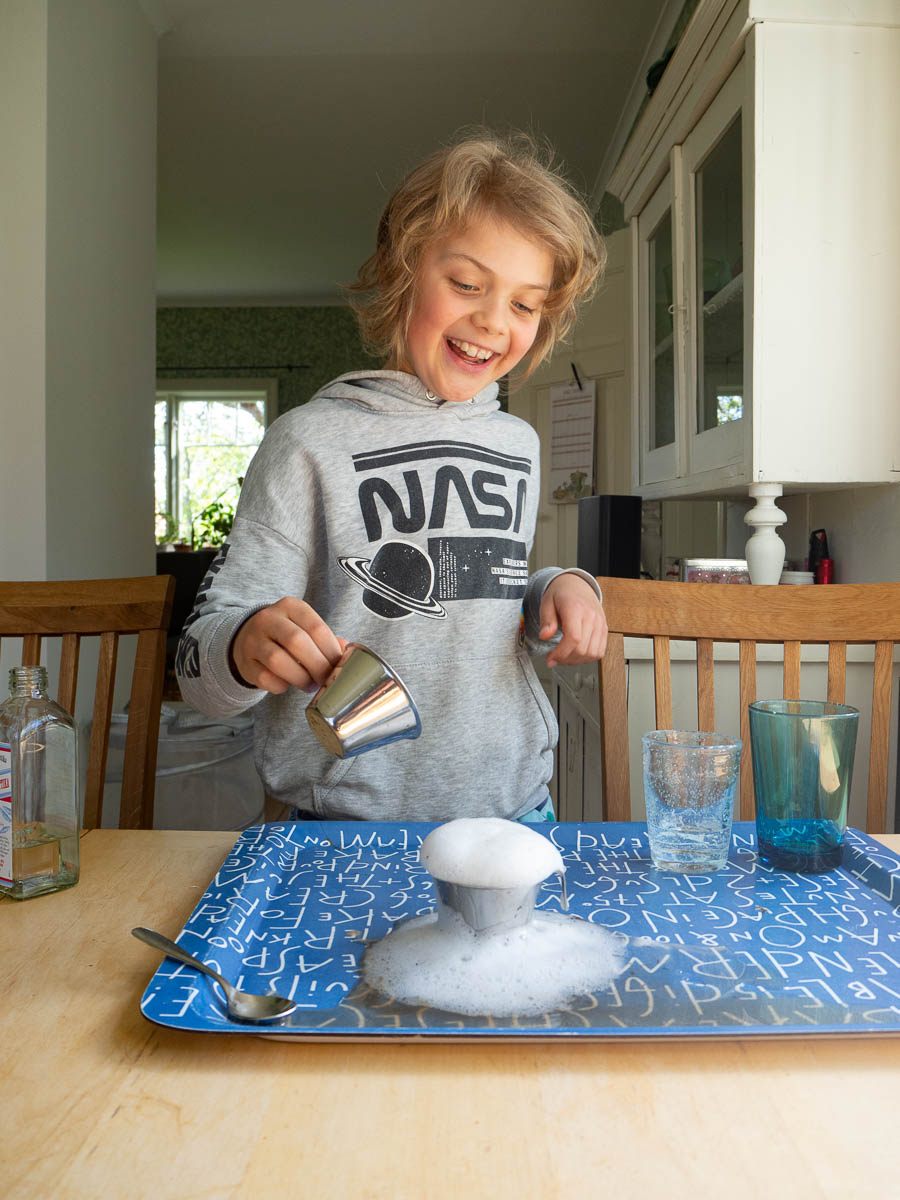
The results were very boring. No fizzing anywhere. So I guess the soil is neutral. It is of course also possible that our chemistry experiment was too crude – perhaps we should have taken more of something, or mixed it better… but whatever, it’s not really that important.
But chemistry that doesn’t go fizz and bang and change colours is very dissatisfying. When we were done with the testing, Adrian got to pour the vinegar-mixed sample onto the bicarbonate sample to at least get some proper fizzing out of it. Much better!
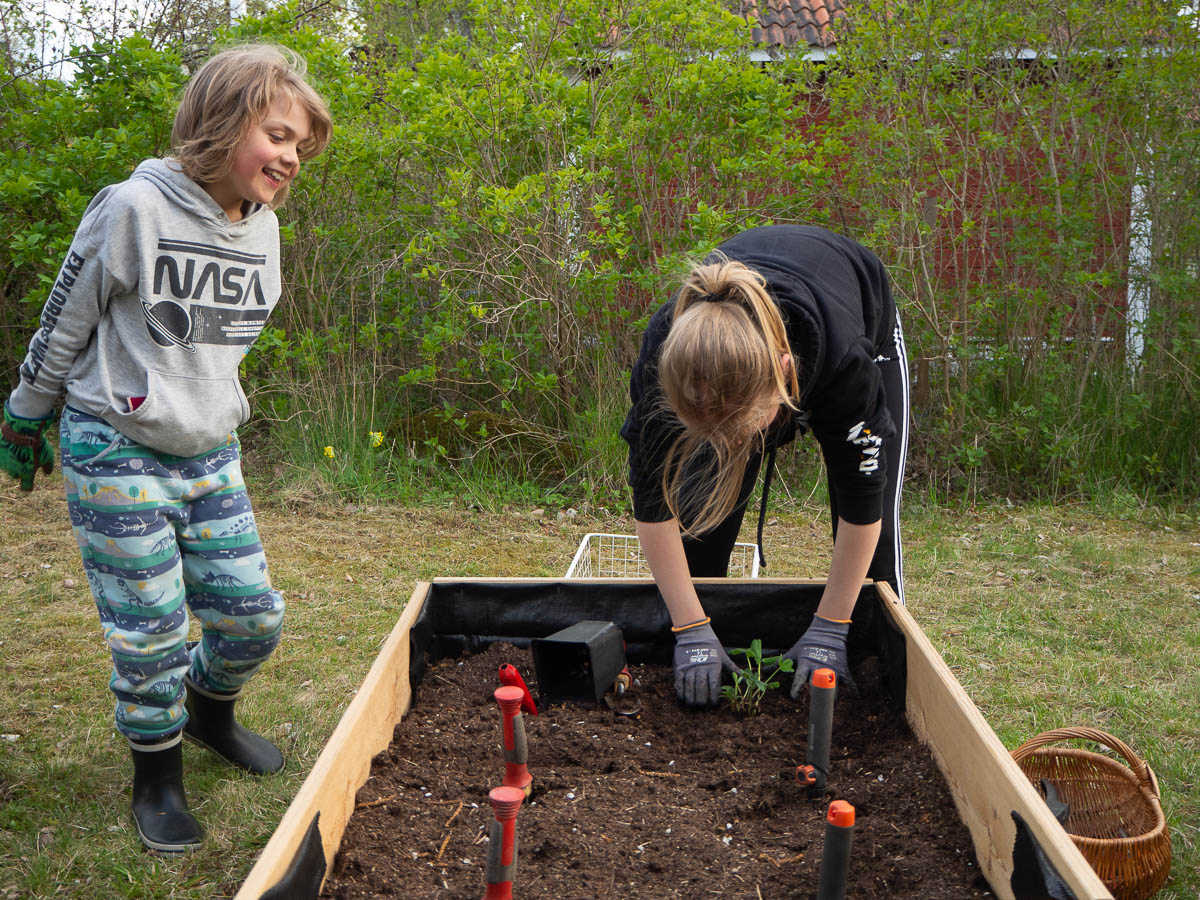
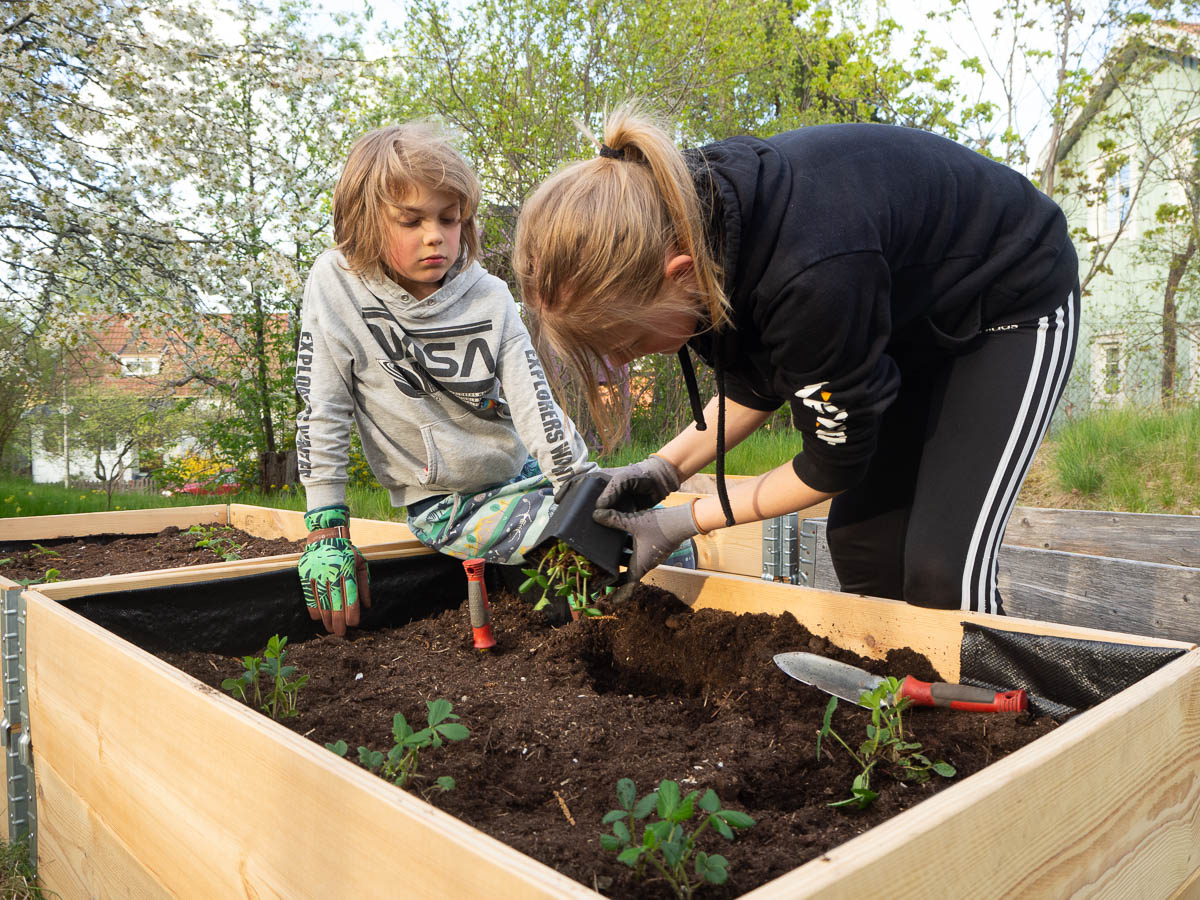
In the afternoon we planted more strawberry seedlings. That is, Ingrid planted strawberry seedlings, while Adrian planted my hand tools (in neat, straight rows and at equal distances and at the same depth!) and I took photos.
We now have one box with older plants of either Honeoye or Zephyr (the sign says Zephyr but I thought we had Honeoye there) and three plants with this year’s seedlings: Polka, Florence and Senga Sengana.

| « Older posts | Newer posts » |
