Do children make us happy? The question has been raised in a few articles. There was a Newsweek article earlier this year, reporting on a study of whether having children makes people happy. The study reported that

Parents experience lower levels of emotional well-being, less frequent positive emotions and more frequent negative emotions than their childless peers

and

In fact, no group of parents—married, single, step or even empty nest—reported significantly greater emotional well-being than people who never had children. It’s such a counterintuitive finding because we have these cultural beliefs that children are the key to happiness and a healthy life, and they’re not.

There’s also an essay at Babble.com, which has as its starting point Daniel Gilbert’s book Stumbling on Happiness. The essay features this chart which also seems to say that married people without children are happier than those with children:

Stumbling on Happiness also mentions a study trying to ascertain which activities women enjoy most, and reporting that “taking care of children” is rated lower than grocery shopping, sleeping, or socializing.

The initial angle for both stories is that parents lie to others (perhaps because it isn’t socially acceptable to say that you were happier before you had children) and maybe even delude themselves:

“Perhaps parents find it psychologically advantageous to talk themselves into thinking this is a great thing,” theorizes Oswald, who has two daughters. “It would be psychologically difficult to come to the view early in life, I’ve made a huge mistake having these children. I imagine that humans are good at the flexibility of thought that stops them from taking that view.”

I don’t find that explanation very convincing. If parenting consistently made us unhappy, then we’d have died out long ago. So there must be more to this.

Firstly, this might be a new phenomenon, as Newsweek recognises: changes to family and work patterns may have made parenting a lot more stressful than it used to be. We don’t live with our extended families, we are stressed and hurried. (Perhaps even more so in the US, where these studies have been performed?) And our expectations have changed as well: rather than having kids so they can help you on the farm and one day inherit it, people now expect parenting to be a fulfilling experience, a way to realise themselves. And indeed people in the Western world are having fewer and fewer children. Perhaps they have indeed concluded that children aren’t worth the bother, the money, or the loss of freedom.

Another explanation is that the studies may have asked the wrong questions. Parents may not enjoy “taking care of children” but that doesn’t mean their children don’t make them happy. You wouldn’t conclude that beautiful clothes don’t make women happy because women don’t enjoy “taking care of clothes”, to pick a random example.

But even more importantly, I think the studies have looked at the wrong measure of happiness. Average happiness is not how we judge our lives, and not what we remember afterwards.

“How do [the experiences of parenthood] balance out?” Gilbert asks. “It turns out that if you average all the moments, they balance out a little on the negative side. Being a parent lowers your average daily happiness. But average daily happiness isn’t all there is to be said about happiness. Indeed one could make the case that average happiness across a day isn’t what we’re trying for. As human beings, it’s not our aim. It shouldn’t be our goal. What we should be looking for is special transcendent moments that may even come at the cost of a lower average.

This is what a childless / child-free adult’s happiness levels might look like over some arbitrary time period unmarked by any major life events:
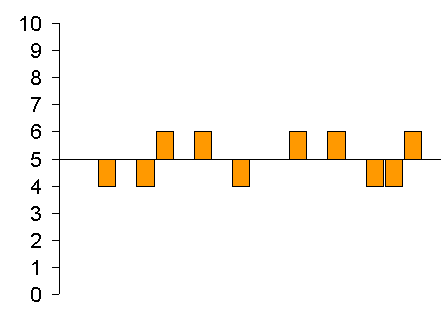
And this is what they might look like for a parent:
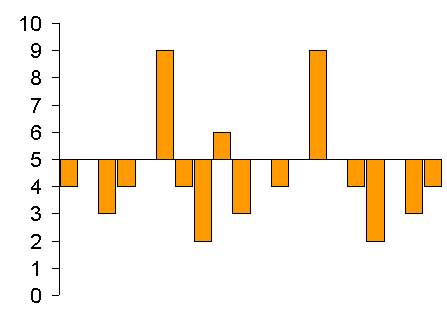
The little ups and downs of normal life have been replaced by a rollercoaster. The lack of flexibility and freedom and time have dragged down the average, and there are more troughs than before. Those are the troughs of teething, sleepless nights, and tantrums, and later on “I hate you mummy!” and so on. But you also get more peaks, of the kind that make your heart melt and that you wish you could remember forever: the early morning snuggle, the happy child running to greet you with a hug.

Finally, long-term happiness is different from short-term satisfaction. Satisfaction is about the balance between feeling good and feeling bad. But for durable happiness, something more is needed. I myself think of it as growth. Gretchen Rubin, one of my favourite bloggers, has a slightly different angle and describes it as feeling right: “to be happy, you must think about feeling good, feeling bad, and feeling right”.

Parenting makes you grow as a person. It’s corny but it’s true. You learn things about yourself, and you change, and you become a more mature person. You aren’t fully adult until you have taken care of someone else.

Links:
Newsweek: True or False: Having Kids Makes You Happy
Babble.com: Are You Happy? Are You Sure?
The Happiness Project: Do your children make you happy?
Momaroo: Do Kids Make You Happy?
Walrus Magazine: Parenting makes you miserable. Discuss.
National Post: Do our kids make us happy? Answer: It depends what you mean by ‘happy’.


Last weekend’s Berlin trip was my first night away from Ingrid. It quite naturally became the end of night-time breastfeeding for us, without too much complaining.

Things would have been different even just a few months ago. Breastfeeding has been an important source of comfort and security for her. Whenever I have tried to cut out night feeds (and I’ve tried this every few months or so) she has been very upset. Sometimes she understood what I wanted and tried her best, really tried, but she couldn’t go back to sleep – she just lay there, tossing and turning and whimpering, for close to an hour. (After which I gave up, fed her, and we were both asleep within minutes.) As a result, both of us got even less sleep than usual during those nights, which is why I didn’t repeat the experiment too often.

This time she was upset the first night I wasn’t there, and then she accepted the new deal. For several nights she still woke once or twice, but didn’t even ask to breastfeed: just rolled closer to me, confirmed that I’m still there, and went back to sleep. The last 2 nights she’s had a cold, slept worse, and missed breastfeeding again, but now that I know she can do it, it’s a lot easier to refuse.

I was slightly concerned that this might be the end of breastfeeding for us. I feared that a 2-day separation plus no more night feeds would cause supply problems, and then she’d be less interested, leading to even lower supply, and thus even less interest. But that hasn’t happened – she’s still breastfeeding at least once a day, and generally both morning and evening.

You might think that 2 years of breastfeeding is enough, even more than enough. Somehow it’s become the cultural norm to wean as soon as you can, and definitely before the child’s a year old! (I have my theories about why this may be so, but that’s a separate topic.) Had you asked me two years ago how long I’d breastfeed, I would never have guessed that I’d go on for this long. But that was then. That was before I knew how enjoyable these moments would be for both of us – and before I had seen how natural and right this feels.

I recall posting some time ago about how becoming a parent hasn’t really changed me. I have to modify that statement a bit. I have changed. I have developed patience.

At root I’m not a particularly patient person. I twitch with impatience when I cannot walk up the escalator because people are standing in the way, or when the people in the queue in front of me cannot find their way around their own wallets because the wallet is stuffed with junk.

But now I have learned to sit quietly in a dark bedroom for 20 minutes (or longer, on a bad day) doing nothing but waiting for Ingrid to fall asleep. And that’s after 10 minutes of bedtime story + lullaby. It was hard in the beginning, but now I manage to wait it out without any real frustration, night after night.

Hmm, I just had an idea – audiobooks! Why haven’t I thought of that before? Thank you, blog.

Parent hack #1: Store bibs in the kitchen (or a dining room, if that’s where you eat).

In London all we had was one large room that served as kitchen + dining area + home office + living room, plus a separate small bedroom. In our new house we actually have multiple rooms. This is a novel experience, and one I will have to get used to. (We intend to fight it, though: the wall between the kitchen and the living room will come down soon.) This means that we suddenly need to think about what room we put things in.

We used to store bibs in a dresser with all the rest of Ingrid’s clothes. But the dresser is in the bedroom, which is at the other end of the house from the kitchen. So before every meal one of us would walk all the way to the other end of the house to get a bib for Ingrid. Until finally a light went on, and I moved the bibs from the dresser to the top kitchen drawer, next to the cutlery.

Parent hack #2: Use empty cereal boxes as drawing paper.

Ingrid likes drawing. Actually mostly she likes to watch me draw, and occasionally she does some brief but energetic scribbling. We used an ordinary A4 pad of paper to begin with. But her scribbles often ended up outside the paper, or the paper got wrinkled by her vigorous actions, so I figured we needed something bigger. The only large piece of paper I could find was an empty box of HavreFras, that I split open and flattened. It keeps its shape a lot better than plain paper – not only during drawing but also when I fold it up and tuck it away between our drawing sessions. Now I keep all our cereal boxes, and sometimes find myself thinking that I should finish that cereal so I get a new box to draw on.

Parent hack #2b: Draw on a carpet.

Despite the larger surface, Ingrid’s scribbles still often veered dangerously close to the edge, and I had to scrub crayon marks from the floor. Then a few weeks after we’d moved we finally unpacked and unrolled the carpet, which covers most of the free floor area in the living room. Naturally we ended up sitting on the carpet and drawing on our cardboard box (something you couldn’t do with a plain sheet of paper). And I realised – crayons don’t leave any marks on a dark carpet! You’d have to really work hard to make a mark of any sort with a crayon on a soft carpet. As an added bonus, dropped crayons don’t roll as far on a carpet as they do on a bare floor.

Realising that washing dishes is, in fact, quite a pleasant and peaceful activity, when compared to alternatives such as trying to brush a toddler’s teeth, or singing “baa baa white sheep” for the umpteenth time.

Via Bruce Schneier I found this essay by a mom who let her 9-year-old son take the NY subway home on his own.

Long story short: My son got home, ecstatic with independence.

Long story longer, and analyzed, to boot: Half the people I’ve told this episode to now want to turn me in for child abuse. As if keeping kids under lock and key and helmet and cell phone and nanny and surveillance is the right way to rear kids. It’s not. It’s debilitating — for us and for them.

Even more interesting is this graphic that Bruce links to, showing (anecdotally) how children’s freedom of movement has decreased over the past 4 generations. While I think some of this decrease is sensible (the 8-year-old in 1919 did not have to cope with cars doing 70mph on busy roads), much of it is due to excessive anxiety.

I am also reminded of this TED talk about 5 dangerous things you should let your kids do.

A few months ago I wrote about Ingrid’s crying and tantrums, about how strongly they affect me, and how I cannot ignore them. The more I think about it, the more I think that is a good thing, and I shouldn’t try to ignore her crying.

A commenter said she is immune to her child’s wailing if it’s not because he is sick or hurt. But then I thought about what would make me sad, and I can think of many things that would upset me more than plain physical pain. Disappointment, frustration, loneliness, anxiety, loss, fear… I am sure these all are as upsetting for a child as for an adult, if not more. Frustration and disappointment in particular must be a big part of a toddler’s life. They are just starting to understand the world and want to do more with it, but still have very limited power to express their wishes and to affect the world around them.

Sometimes the root cause of the unhappiness is something that can be solved. Lonely and tired and don’t want to sit in the pushchair? OK, we’ve got a baby carrier for that (a whole stash of them in fact). Other times I either cannot or will not solve the problem. Upset because I don’t allow her to stab the kitchen table with her fork? Too bad, I still won’t allow it. Disappointed because the playroom we were going to visit is closed? Well, so am I, but there’s not much I can do about it.

But even if I cannot fix the problem, I don’t want to ignore Ingrid’s crying. She has no other way of expressing these emotions, after all – I can hardly expect her to sigh and say “I’m really disappointed”. She has had so little experience of disappointment in her short life, of course she’s going to be bad at dealing with these feelings! Over time she will learn to recognise these feelings, understand, express and control them. At the moment, however, she needs adult help. So I do it for her: I talk to her, and say the things I think she might want to say if only she knew how.

Of course she would eventually stop crying if I ignored her as well. But I believe it is more productive in the long run if I help her handle the situation.

PS: Things may change when Ingrid grows older and we get to real attention-seeking tantrums, exaggerating the unhappiness because of the reaction it provokes, making noise because it might get you things. But that’s not what’s happening now.

From the Internet and from books I get the impression that “baby’s first steps” and “baby’s first word” are considered to be important milestones. My experience is that the very first ones are actually not particularly interesting at all.

The first time Ingrid stood without support, she didn’t realize she was doing it. Same for the second, third, and fiftieth time. But then one day she understood that she can stand, and from that moment on she can stand.

Her first steps happened one or two at a time, but again she didn’t realize what was going on. Although she was taking steps, she wasn’t walking – she was standing but happened to move forward. And again, one day she understood that she can walk, and from that moment on she walks confidently (though not effortlessly or faultlessly) and probably won’t be doing much crawling at all.

I imagine the same applies to language. First words are irrelevant. For many months now she has been able to say a few words and put them in context, i.e. she knows to say heja when coming home or leaving home. But for a long time that looked like simple mimicking without understanding the meaning, the purpose of language. Only recently she started showing signs of really understanding that words belong with things, that things have names – she likes pointing at objects around the house and hearing their names. Just like with learning to walk, this happened quite suddenly. So one part of that quantum leap has probably taken place. I’m not sure about the other part – actively and purposefully using words in order to achieve something. Maybe she already knows how to do it but cannot twist her tongue into the right shape, or maybe she hasn’t understood that yet.

The carers at Ingrid’s nursery have a habit of saying “good girl!” or “good boy!” when the children do something they (the carers) like. It’s not just them, of course. “Good girl” seems to be the standard response when a parent wants to tell his child that he is happy / impressed / pleased with what the child did.

I don’t like that. In fact it really annoys me. Alfie Kohn says it even better in Five Reasons to Stop Saying “Good Job!”:

Once you start to see praise for what it is – and what it does – these constant little evaluative eruptions from adults start to produce the same effect as fingernails being dragged down a blackboard. You begin to root for a child to give his teachers or parents a taste of their own treacle by turning around to them and saying (in the same saccharine tone of voice), “Good praising!”

Still, it’s not an easy habit to break. It can seem strange, at least at first, to stop praising; it can feel as though you’re being chilly or withholding something. But that, it soon becomes clear, suggests that we praise more because we need to say it than because children need to hear it. Whenever that’s true, it’s time to rethink what we’re doing.

I see several problems with the “good girl” approach. Firstly it’s the way the phrase is standardised and becomes an almost mechanical response. To me it means that you’ve let your praise become routine, an automatic response. You may care about what your child did, but you’re certainly not showing your interest particularly well. “Good girl” feels, well, impersonal. It’s like handing out mass-produced store-bought candy instead of a home-made cookie. There is no real connection. Robin Grille puts it well in Rewards and Praise: The Poisoned Carrot:

When giving a positive comment, are you trying to seduce the child into pleasing you again, into making Mama or Papa proud? Or are you genuinely glad to see the child accomplish something that pleases him, or genuinely delighting in her being? Therein lies a paradox: that which is not intended to reinforce, but merely to “connect”, is the most reinforcing.

“Good girl” is also not helping the child understand what she did well, or why it was good. I’d much rather say “Thank you for giving the spoon back to me” (instead of throwing it on the floor) or “Yes, let’s put the socks back in the drawer, nice and tidy!”

But what I like least about “good girl” is how it is used to praise achivements that don’t need to be praised, and shouldn’t be praised. The best reward for learning something new, or doing something fun – running, jumping, climbing, throwing a ball – is the joy of doing it, not being praised by someone else. Praise turns play into work. Something that was simply fun is now being judged as good (on some sort of scale). If you’re a “good girl” for taking your first steps, does not walking make you bad?

(The English “good girl” is the most egregious example, because of the immensely loaded word “good” in it. The Swedish “duktig” and Estonian “tubli” are somewhat less judgmental, but still mean that the child is being evaluated and praised for living up to parents’ hopes and expectations.)

Earlier this week I went to a toddler play room with Ingrid. Two other small girls were running and climbing around – the younger one about 2 years old, the older maybe 3 or 4. The little girl climbed all the way to the top of a big slide, and immediately I heard her older sister say “good girl” with that special sugary tone that parents use, obviously learned from hearing it many many times from their mum. Already at the age of 3, she had learned to respond with canned praise rather than shared joy… I found that quite sad.

If I had any doubt about this at all, if I felt the least bit tempted to call Ingrid a good girl, my golden rule (“As above, so below”) would dispel the last of my doubts. You wouldn’t do so to an adult, so why do you think it’s OK to do so to a child? Would you say “good girl” to your wife, other than as a joke? Would you want to hear “good job” after you’ve proudly managed to make your way down the slope on a snowboard for the first time? Personally I’d feel rather insulted.

(Warning: boobs are mentioned in this blog post. Many times.)

Ingrid was not even 6 months when I went back to work. She breastfed exclusively until a week or two before I had to go back to work. Our breastfeeding relationship was far too important for both of us to stop at that point, or even cut it to just mornings, evenings and nights. Now over 3 months later the situation hasn’t changed much… The first thing she wants in the morning is the boob. The first thing she wants when we get home from nursey is the boob. I barely have time to get us both free from coats and slings and bags and shoes, and she’s already making her “want boob now” noise (which is a throaty kind of cry, almost like a cough – very distinctive). I sometimes suspect that she spends her entire afternoon looking forward to that moment. And of course there’s the evening wind-down boob-in-bed session, and the cosy quiet night feeds.

At nursery she gets expressed milk from a trainer cup. (She never used a bottle. First there was no need, and at 6 months it would have felt silly – that’s the age when some babies start to wean from the bottle – so a cup it was.) Very conveniently for me, there’s a quiet room at the nursery at work where I can express and store milk. It has a comfy chair, a door I can lock, and a fridge. So for the past 3 months I have been a very steady visitor to the nursery. Twice a day, every day, and no meeting is important enough to make me skip this appointment (although I do flex the times) because if I do skip it, (a) my boobs will explode, and (b) Ingrid will have no milk for the next day.

For the benefit of those of you who haven’t been involved with babies recently, the most common way to express milk is to use a breast pump. There are electric ones and manual ones. If you want to see one in action (sans breast), head over to DadLabs for a video!

However I never got along with either the electric pump we bought, or the manual one I tried. Both hurt me, and the results were puny. So I do it the old-fashioned way, the way cows have been milked for thousands of years: by hand. And it’s given me a whole new appreciation of how much hard work milking is – and a new respect for the milkmaids of earlier times. I wonder if those milkmaids got RSI? I certainly get stiff shoulders and tired hands. Let’s assume, conservatively, that during each 15-20 minute session, I spend 10 minutes actually expressing milk. And let’s say that I do 2 squeezes per second. Well, probably a bit less – say 3 squeezes for every 2 seconds. That’s 10 * 60 * 3 / 2 = 900 squeezes, twice a day. A good workout for the fingers!

BB (Before Baby) I knew in an abstract way that babies eat and drink breast milk, and that it’s good for their health and digestion and all that. So of course I was going to breastfeed. But I somehow imagined that once you introduce babies to “real food” they would prefer that, and maybe just go on breastfeeding a bit for comfort now and again. The reality, as any mother could tell you, is quite different. Most babies are happy to live mostly on breast milk for far longer than the first 6 months. It is possible to wean them despite this, of course, but it takes an effort. Online mothering forums have tons of questions about how to stop breastfeeding.

I used to think that extended breastfeeding (past a year or so) was for extreme mothers, barefoot and with dreadlocks and batik clothes, who carry their babies in cloth slings and sleep in the same bed with them. (Slight exaggeration, but not by much.) Now continuing to breastfeed seems like the most reasonable, natural thing to do. Oh, hang on, I am one of those crazy hippie mothers, wearing my baby and sharing a bed with her… and giving birth at home… missing the dreadlocks though. Do you think I would look good with dreads?