This is a book about ethnopediatrics – child care from the point of view of an anthropologist. The question Meredith Small tries to elucidate is, To what extent is parenting based on biological imperatives and to what extent is it based on culture? She shows how differently children are cared for in different cultures, and how convinced all of these parents are that theirs is the right way and the others are crazy/wrong/weird. Parenting practices rest on parents’ assumptions about the world and on their values – they are as much a product of culture as what we eat, what we wear, or how we dance.

First, Small presents an overview of relevant aspects of human evolution – about how our upright posture and large brains lead to babies being born “unfinished”, and about the parent-child bond that is essential for babies’ survival.

Then she takes on a world tour highlighting cultural differences in parenting. The !Kung San train their babies’ motor skills so that the babies can cope with their nomadic life; the Ache carry their kids until the age of 5 to keep them safe in a dangerous forest environment; Gusii mothers don’t talk to their baby because children are viewed as low-status family members and expected to watch and learn rather than talk; Japanese mothers encourage dependence and a close bond between mother and child; American parents expect babies to cry a lot and don’t think it is necessary to respond to all crying.

Next there are more in-depth looks at three central elements of baby care: first a chapter on sleep across cultures, then a similar chapter about crying, and finally about breastfeeding – all from both an evolutionary and cross-cultural point of view.

It’s a slim book and a quick read. It could be slimmer still with some editing: at times it felt repetitive and padded with more words than it needs (perhaps in an attempt to make it feel more substantial). Disappointingly for me as a reader 60 of the 300 pages are filled with references, footnotes, an index etc. It does, however, set the book apart from all the books about babies that are really opinions served as fact, “do this because I say so”. This is, instead, “this is what other people do and here’s why”.

Throughout the book, the author remains an anthropologist, an observer standing to one side, and never quite expresses any firm opinions about what she describes. But if I were to summarize the book in just a paragraph, both what is said and what is repeatedly hinted at by leading questions, I would say this:

Babies evolved to be close to the parent, since they cannot survive on their own. They evolved to be carried rather than transported in plastic seats, to sleep with the parent rather than alone, to breastfeed frequently throughout the day and for years rather than months. Western child-rearing is to a great extent fighting against millions of years of evolution. If you work with your baby’s nature rather than against it, you will make life both easier and more pleasant for both yourself and your baby.

Amazon US, Amazon UK, Adlibris.

One evening in Gran Canaria, I noticed a book lying abandoned on a deck chair, next to a pretty pink scarf. It was still there the evening after. The third evening someone had moved both items from the deck chair (probably they wanted to use it!) onto a ledge. The scarf looked nice but not my colour. The book I picked up because it had a smiling baby on the front cover. If no one had claimed it during three evenings, I figured I could adopt it.

From the back cover of Why Love Matters – How Affection Shapes a Baby’s Brain:

Why Love Matters explains why love is essential to brain development in the early years of life, and how early interactions between babies and their parents have lasting and serious consequences.

Sue Gerhart goes through all the various ways in which human contact and human relationships affect brain development, and how experiences during the first months and years of life can leave marks for life.

The main thesis is that a baby cannot regulate its own needs, physical or emotional. It needs the help of a caring adult. If that relationship is dysfunctional, if the adult is unable or unwilling to fulfil the baby’s needs, the baby suffers not just immediate discomfort but also longer-term effects. Brain chemistry becomes subtly imbalanced, some parts of the brain do not develop properly, inappropriate emotional habits are founded. In the long run, all kinds of mental and emotional troubles can arise, and Sue Gerhart shows how the former can lead to the latter. Babies of depressed mothers get used to a lack of positive emotions; babies of angry, resentful mothers learn to suppress their feelings. Babies who get no help with soothing negative emotions do not learn how to keep on an even keel.

While some other author on the back cover says “I would recommend it to all new parents” it really isn’t written so as to be accessible by most parents. I would guess it really wasn’t written for the general public but for politicians, social workers, those in charge of childcare facilities, psychologists etc. In particular the book is unlikely to be read by those who need its message the most: those depressed mothers, or the parents who meet their babies’ demands with anger.

A reviewer in The Guardian expresses resounding support and provides a thorough summary.

If there is one thing to take with you from this book, it’s this excerpt (p. 91):

Good timing is a critical aspect of parenting, as well as in comedy. The ability to judge when a baby or child has the capacity to manage a little more self-control, thoughtfulness or independence is not something that books on child development can provide: the timing of moves in a living relationship is an art, not a science. Parents’ sensitivity to the child’s unfolding capacities can often be hampered by an intolerance of dependency. This is partly cultural and partly the result of one’s own early experience. Dependency can evoke powerful reactions. It is often regarded with disgust and repulsion, not as a delightful but fleeting part of experience. It may even be that dependence has a magnetic pull and adults themselves fear getting seduced by it; or that it is just intolerable to give to someone else what you are furious you didn’t gt yourself. […] Often, parents are in such a hurry to make their child independent that they expose their babies to long periods of waiting for food or comfort, or long absences from the mother, in order to achieve this aim. Grandparents only too often reinforce the message that you mustn’t “spoil” the baby by giving in to him.

Unfortunately, leaving a baby to cry or to cope by himself for more than a very short period usually has the reverse effect: it undermines the baby’s confidence in the parent and in the world, leaving him more dependent not less. In the absence of the regulatory partner, a baby can do very little to regulate himself or herself other than to cry louder or to withdraw mentally. But the pain of being dependent like this and being powerless to help yourself leads to primitive psychological defences based on these two options.

[…] The dual nature of the defensive system seems to be built into our genetic programme: it’s either fight or flight. Cry loudly or withdraw. Exaggerate feelings or minimise feelings. Be hyper-aroused or suppress arousal. […] Whichever way the individual turns to find a solution (and these strategies may be used consistently or inconsistently), he or she will not have mastered the basic process of self-regulation and will remain prone to being overdemanding of others or underdemanding.

Adlibris, Amazon US, Amazon UK.

Super-Helen is my secret mummy identity. She is just like me, except that she has a lot more patience. She doesn’t get annoyed and frustrated as easily as I do, and can keep calm and behave in a kind and friendly manner even when the kids around her are definitely not.

When things get too much, when Adrian is screaming right next to my head while Ingrid is dragging her feet on the way home, when both are crying for food RIGHT NOW, when I feel like either hitting them or locking them both in the house while I go for a walk… I think to myself, What would Super-Helen do? And usually Super-Helen’s solution works for me, too. The hard part is keeping myself together enough to remember to ask Super-Helen.

This has been a month full of whining, complaining, yelling, and general contrariness. Ingrid finds fault with everything we say or do. It’s like having a teenager in the house, I imagine.

It appears that she has, for some reason, decided to be unpleasant and unfriendly towards us. She can be perfectly polite to others, but when she addresses me, it’s often by shouting or screaming. When she wants me to pour milk, it’s no longer “Can I have some milk please” but “MIIILLK!”. Once she even started with “Can I…” but then interrupted herself and shouted “MIIILLK!” instead.

When she wants me to help her get her boots on, she refuses to come stand where I am sitting. (I refuse to crouch on the floor when I’ve got Adrian in the sling, because it is very uncomfortable for both of us.) Sometimes she even yells when she wants me to play with her or read to her. “Du ska läsa för mig du ska läsa för mig du ska läsa för mig!” (“You must read for me”) she screams, and of course I must do nothing of the sort, I must leave the room instead in order to keep my temper.

Anything I suggest is rejected. Anything I mention in a positive tone, she decides to dislike. “Look, there’s one piece of apple left!” she gladly says. “Yes, I thought you might want one more so I left it for you” I say. “I don’t want it” she responds sulkily.

And she wants help with everything. She can even ask for help moving a plate to the side of the table, and complain that she doesn’t have the strength to move it, and demonstrate by poking at it with a limp hand and an exhausted face. When Eric and I can’t help but laugh out loud at that, she gets very upset and cries that we mustn’t laugh at her.

My guess is that this is a reaction to Adrian’s arrival. A bit delayed, you might think, but then again Adrian was much easier to take care of during his first month. Now he requires more of our time and attention, and even though I do my best to spend time with Ingrid, she cannot have all the attention she wants. Is she testing us, perhaps? “Do they really love me? Do they love me if I do this, this and this?” Or perhaps she is simply mentally tired and stressed by the change and by the new order.

Tellingly she really only behaves that way with me and Eric. When, for example, another parent at preschool notices that we are having trouble (read: Ingrid is yelling at me without pause and asking for help while refusing my way of helping her) and asks if s/he can help, Ingrid explains reasonably politely what she needs help with and gladly accepts it.

During all of this I try to remind myself that:

  • I cannot control her behaviour but I can control how I react to it (and that covers both my internal and external reactions).
  • If we are to break the spiral of negative emotions and negative behaviour, it’s up to me to do it.
  • I can choose to treat her the way she “deserves” to be treated, or the way that is likely to break the spiral.

When she yells for help doing something ridiculously easy, I may think that that kind of request really deserves to be ignored until she addresses me in a more polite manner, or refused because she can do it herself perfectly well. But all that achieves is an escalation of the spiral. Instead I can interpret her shouting as a way of saying “I feel ignored and tired and unloved and I hate it and I want company”, gently remind her that I would prefer if she asked me kindly instead of shouting, and help her.

But there are times when she has decided to not cooperate at all, and then it can be physically difficult for me to help her. I cannot lift her when I am carrying Adrian; I cannot put her mitten on if she keeps her hand all limp. And there are times when my patience runs out and I just cannot take her yelling any more, and I walk away from the room or the situation.

It is bloody exhausting to have two cranky kids. I don’t tolerate loud noise well, and when two children are screaming right next to me, it leaves me tired and with frazzled nerves, even less willing to indulge in Ingrid’s whims or to get engaged in her activities.

Another reaction to having Adrian in the house: Ingrid has started telling us that she has a stomach ache, when she clearly has no such thing (and forgets it as soon as she gets distracted), most likely because we have explained to her that Adrian cries so much because his stomach hurts. If it works for him, and gets him lots of attention, why not for her, too?

Ingrid’s favourite “toy” is our iPad. She watches movies on it, plays games, draws, plays dress-up and so on – together with me or Eric if possible. We also read (a good activity to combine with breastfeeding Adrian), do crafts, and play games (board games, card games and such).

She likes to pretend she’s a wizard or a fairy or an angel, and do magic. (Fairies and angels seem pretty much the same to her – pretty girls with wings – and since I don’t see much actual difference myself, I haven’t bothered trying to explain the very different cultural backgrounds of the two.) There have been magicians and fairies in many of the movies we’ve seen recently, as well as in fairy tales, ranging from the story of Sleeping Beauty, via Disney’s The Sorcerer’s Apprentice, to Shrek and Aladdin.

She will ask me what magic she should do, wave her wand and say some magic words, and present me with the result. Sometimes she clarifies that “it’s just pretend”, that I shouldn’t expect real wings or that she cannot really magically bring daddy home early. I’ve begun using magic as a distraction when she’s in a bad mood: “wouldn’t it be nice if we could magically grow wings, then you wouldn’t have to walk home on your tired legs”. It sometimes works.

Often she or one of her soft toys is a kitten, walks on all fours and miaows pitifully. The kitten has lost its parents while picking berries in the forest, is sad and wants company. (We’ve read an Estonian fairy tale about a girl who gets lost in the forest while picking berries.) Now most recently the kitten has actually been abandoned in the forest by its father (since we’ve read about Hansel and Gretel).

Whenever I ask what she did with her friends at preschool, she tells me they played mummy daddy baby. She usually gets to be the baby, being among the smallest and youngest kids in their huge group. At home she plays she’s the mummy, and various toys and dolls get to be babies. She breastfeeds them, picks them up when they cry, and puts them to sleep. Sometimes she wants to be a mom for me, and I get to be big sister. She asks me how my day was, what I learned at school, and I am supposed to act the way she usually does. When she borrows my camera, for example, I am supposed to badger her “let me see, let me see [the photos]”.

There is also a fair amount of talk about being in love, and marrying. Contagion from all the older girls at preschool. She is in love with me and with Elin (a friend) she says, and will marry us both. Being in love means you like someone a lot, she says, and getting married means you live together.

When she draws or paints, it is only girls and princesses. Just plain girls more often than princesses, nowadays. They all follow the same template: head like this, dress like that, long hair on both sides. Very boring for me.

She has effectively learnt to write. Often she still wants one of us to tell her the letters, but when I instead say the word again, or just ask her what letter she thinks should come next, she gets it right 9 times out of 10. The most common mistake she makes is skipping a letter in the word. For example when she wante to write PIRN (for “pear” in Estonian) and had done P and I, she said that N should come next. But when I said that that would make PIN, she thought a bit and figured out on her own that R should be there too.

It’s like when she learned to stand and walk: she wouldn’t actually let go and do it until she was 100% able to do it. Back then it was some sort of subconscious or instinctive behaviour, but now it’s more conscious. She simply has a strong aversion to failure.

Speaking of walking, Ingrid is still not fond of walking so she cycles to preschool every day, if at all feasible, and most other places too. We had to walk when the streets were full of snowy slush. But when there are just some icy patches here and there, we take the bike. Slipping and falling a few times causes less fuss and complaining than having to walk all the way, especially on the way home in the afternoon. Even better than cycling is having a cycle race, meaning that she sets a goal (“first one to that brick house wins”) and races ahead on her bike, and I walk after her as fast as I can (cannot run with Adrian in the sling, he either throws up or wakes up) while shouting “this time I will surely win” or “now it really is my turn to win” and she laughs at me.

She can now hop on one foot (her right one) for a good 12 to 15 jumps, all the way across the kitchen. On her left she manages just a few.

Likes: painting my face (they do face painting at preschool on Fridays). Making silly faces and waving her arms around when I try to take a photo of her. Winning. Ice cream. Sundays, because then she gets ice cream. (Sometimes she starts counting down to Sunday already on a Tuesday.) Selecting clothes for Adrian. Torches. Balancing on pavement edges, ledges, and power cords on the floor. Playing rock paper scissors during train rides. Also during train rides, playing shop and selling me the houses, cars, boats and towers on the seat fabric. (Can’t find any official pictures; a slightly fuzzy photo can be seen here.) Plates, cups and cutlery with pictures or patterns.

Does not like: our tasteful green china. The colour black, or brown or grey. Waiting. Missing a train – even when I tell her the next one will be there in 2 minutes, she is upset.


Parental leave is called föräldraledighet in Swedish. The first part, förälder, means parent. The second, ledighet, generally means leisure or holiday. It has overtones of freedom, of time off. Of course reality is nothing like that. Eric likes to refer to it as “parental service” instead.

I don’t know where the time is going, but it definitely feels like two children take more than twice the time as one. There is more to be done, and less time to do it. I seem to recall a certain amount of leisure when I was at home with Ingrid as a baby. Now there are nursery hours to keep, errands to run, and busy evenings trying to juggle the needs of two children at the same time. I am glad that Ingrid is as old as she is, and as sensible as she is – this would be a lot harder otherwise.

With the arrival of Baby 2 just two months away, I have started preparing a bit.

I’ve bought a (used) carry cot for our stroller (an Urban Jungle, which replaced the Bugaboo I didn’t like, which in turn replaced our beloved Stokke Xplory when Ingrid grew too heavy for it).

Why not use the Stokke? One, you can’t attach a standing board to it, and I do want to have that option for Ingrid for longer trips. Two, in Sweden’s climate we couldn’t make do with just the seat, we’d have to get a foot muff, or (more likely) a carry cot and a sleeping bag for it, and that would become expensive. Three, the Stokke is not very good in snow. So it will have to wait in the basement until spring.

I’ve also discovered that the concept of moses baskets is totally unknown in Sweden. I am now considering whether to make do with the carry cot we have (which is rather too heavy for that kind of use, really), or to buy a kind of a soft carry cot that some Swedish strollers use, or to make my own.

Clothes then and now

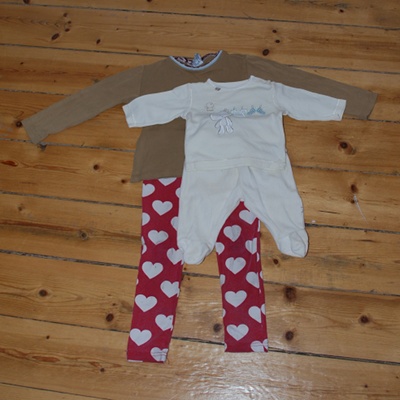
I have inventoried the baby clothes we have since Ingrid’s baby days. I had thought that we should have lots, probably won’t need to buy anything. But when I actually fetched the bags marked “0–3m” I saw there was hardly anything there. After a moment’s thought I remembered that we had borrowed a lot of clothes for the first 6 months. Now we’ve done some shopping at the Erikshälpen and Myrorna second hand shops, so we have something at least.

And, just as the Stokke was enough for a London winter but not for a Swedish one, I’ve realized that we will need to buy more warm clothes, hats and such. But I’m thinking that we should be covered for late September weather at least, so I’m leaving those purchases for later.

Speaking of clothes, I have learned that there is no official one-to-one conversion of clothes sizes from the UK scale (0–3 months, 3–6 etc) to the international one (measured in centimetres). Depending on the manufacturer, 0–3 months may correspond to 56cm or 62cm, 3–6 will be 62cm or 68cm, and so on.

By the way, here is what I wrote about buying for your baby and more specifically about buying baby clothes back in 2007.

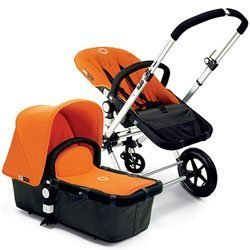
Despite my less than stellar experiences with pushchair makers’ web sites, I managed to decide on a new pushchair. In the beginning of August we bought a second-hand Bugaboo Chameleon. (I’m not going to honour their atrocious web site with a link.)

One month later, I gave up and decided to get a new Stokke. The Bugaboo wasn’t a bad pushchair, really, but Stokke suits me much better. (Eric spends less time pushing the pushchair about and wasn’t as interested in the choice as I was, but he also liked the Stokke better.)

The deciding factor for me was the ease of “driving”. The Bugaboo started misbehaving as soon as the road sloped sideways. The pushchair was pulling me off the road, and the struggle to keep it straight left me with achy wrists every single afternoon. Add a heavy load of groceries and I was near tears at times. I never had that kind of trouble with the Stokke. I think the frame of the Bugaboo has a fundamental design flaw, at least for my body: the angles at which I can apply force (determined by the angle, attachment points and shape of the handlebar) were very inefficient given the direction I wanted to push or turn it.

Also, the handlebar on the Bugaboo can be raised and lowered, but its angle cannot be changed. When I had it at a comfortable height, I was walking way too close to the pushchair, so my toes kept hitting the rear axle. I had to either walk with my arms outstretched, or the handlebar too high, in order to avoid that. The Stokke doesn’t have a rear axle – the lower section of its frame is sort of x-shaped – and both the height and the angle of its handlebar are adjustable, which made it much easier to adapt to how I stand and move.

The two pushchairs are quite similar in many ways – robust design, well constructed, adaptable, expensive – and if you haven’t tried them you might well think that they’re pretty much the same. But once you take a closer look, it turns out that there are a lot of differences.

  • The Bugaboo has suspension on its front wheels. It’s also got foam rear wheels, while the Stokke has hard wheels with a layer of rubber. So the Bugaboo offers a smoother ride, especially on uneven roads, and is slightly easier to push up and down over pavement edges. But I think the suspension contributed to its headstrong behaviour on sloping roads.
  • The Stokke has better options for adjusting the handlebar. The Bugaboo only allows you to adjust the height, and changing it means unscrewing and then rescrewing two screws. Which means you wouldn’t adjust the handlebar every time you hand over the pushchair to your partner when you’re out walking together. With the Stokke we definitely do that. In fact adjusting the handlebar is so easy that I change it for a 100 metre uphill stretch, when I want a slightly different angle, and then put it back when I reach the top.
  • The Bugaboo allows you to reverse direction by just flipping the handlebar to the other side, so you end up with the large fixed wheels in front and the small swivel wheels at the back. Their instruction manual says it’s good for tricky terrain, snow and sand and such. The Stokke has nothing like that.
  • The Stokke has a more convenient basket. The Bugaboo basket has a curved bottom which makes it harder to pack (especially with boxy things like cartons of milk and juice) and it’s a bit difficult to access (almost impossible with the carrycot in place). The Stokke basket/bag has a flat bottom and is perfectly accessible with the seat facing backwards, and relatively convenient with the seat facing forwards, too.
  • The Bugaboo is lighter: 9.3 kg vs. Stokke’s 12.5 kg according to the official stats. Which was a real surprise to me, because the Stokke feels lighter when I’m pushing it.
  • The Stokke can go up and down stairs: you don’t need to lift it, you can pull it up step by step, i.e. less strain for your back, and no need to wait for someone to help you. This is less important in Stockholm where all train and tube stations have lifts, but in London this feature made all the difference.
  • On the Stokke you can raise and lower the seat, and at its highest, the seat comes much higher up than on the Bugaboo, or any other pushchair I’ve seen for that matter. I like that a lot, especially when Ingrid was a baby.
  • The Bugaboo carrycot has a carrying handle and can be used as a Moses basket. The seat can also be lifted off the pushchair and used separately. The Stokke doesn’t give you that option.
  • The Stokke comes with an infant insert for its seat, so the seat can be used from about 3 months’ age. (We never even bought a carrycot and got by with just the seat, since we didn’t use the pushchair much in the first months.) The Bugaboo has quite a deep seat so when it’s upright, small children tend to sink down into a “sack of potatoes” position.
  • Releasing the seat for reclining can be done with one hand on the Stokke, so the other hand can stabilize the seat and slowly lower it down. On the Bugaboo you need two hands to push two buttons on either side of the seat, so the seat always reclined with a jerk. Or perhaps there is a trick that I just didn’t discover yet.
  • The Bugaboo has a more “normal” shape, while the Stokke has a central axle which means that you need a special “split” foot muff and can’t use any old sleeping bag. It’s also a bit tricky to wrap a sleeping kid in a blanket when there’s a stick in the way.
  • The Stokke has a removable plastic footrest. Especially in autumn and winter, I often removed the footrest to shake off the gravel and dust. On the Bugaboo, the footrest is part of the seat, i.e. made of fabric and not removable, i.e. it gets pretty gunky pretty fast.
  • The Bugaboo has much more convenient brakes: the brake handle sits on the handlebar and is easy to put on and off. On the Stokke, the brake is operated by a little lever that sits down by one of the wheels, so you can only reach it with your foot, and sometimes I need to jiggle it a few times before I get the brakes on or off.

Edited on October 4th to add another paragraph (on brakes).

Top five unhelpful things you can say to your toddler, especially if the child is crying, angry, sad or upset – learned from actual playground encounters:

  • Sluta! (Stop that!)
  • Skärp dig! (A direct translation would be “Pull yourself together!’ but I guess in English you’d say something like “Behave yourself” instead.)
  • Vad är det för fel på dig?! (What’s wrong with you?!)
  • Nu lägger du av. (You will stop that right this moment.)
  • Varför ska du vara så jobbig? (Why do you have to be so difficult?)

Every time I hear a variation on this theme I can just imagine the toddler thinking, Thanks for the reminder – I had totally forgotten that crying is not the accepted method of argumentation in this setting. Of course I will stop. Not.

Småbarnsförälder is a very useful Swedish word meaning a parent of young children. It is useful because it allows one to concisely express wry observations about parenthood, such as “only parents of young children would have their Sunday dinner at IKEA’s customer restaurant”.

(Ingrid has not discovered McDonald’s yet, so the IKEA restaurant is her idea of fine dining. Meatballs! With jam! And you can watch TV afterwards!)

We had our work Christmas dinner yesterday, at a nice old manor house, with everyone’s partners and everything. It was interesting (but not exactly surprising) to see that the colleagues who I enjoy talking to, also had partners I enjoyed talking to, and the colleagues I’d never felt a connection with had partners I couldn’t connect to either.

I think we (Eric and I) managed to prove to everyone that we are incurably odd, since we decided to walk home from the party, even though it’s about a half-hour walk and it was raining a bit. But after 3 hours of sitting and stuffing ourselves we really felt a need for some fresh air and exercise. The Swedish smorgasbord-style Christmas dinners almost seem to be designed to make everyone eat too much.

Ingrid was at home watching Teletubbies with my mum. Her last time with a babysitter was almost a year ago, and we were a bit unsure about how it would go. In the end it went as smoothly as anyone could wish. She didn’t even ask for us, not even when it was time to go to bed. I warned her in advance that grandma would come for a visit and mummy would go out and Ingrid would stay at home. The first time, a few days before, she didn’t like the idea much at all: big teary eyes and trembling lower lip. The second time, the day before, she looked a bit cross and said she wanted to come with me. The closer we got, the less she cared, and by the time I was about to leave she didn’t even care enough to come to the window to wave me good-bye. So to all those who claim that children need to be left early on with babysitters in order to train them, and that all this co-sleeping and babywearing and liberal cuddling will cause trouble later, I just say “hah!”.