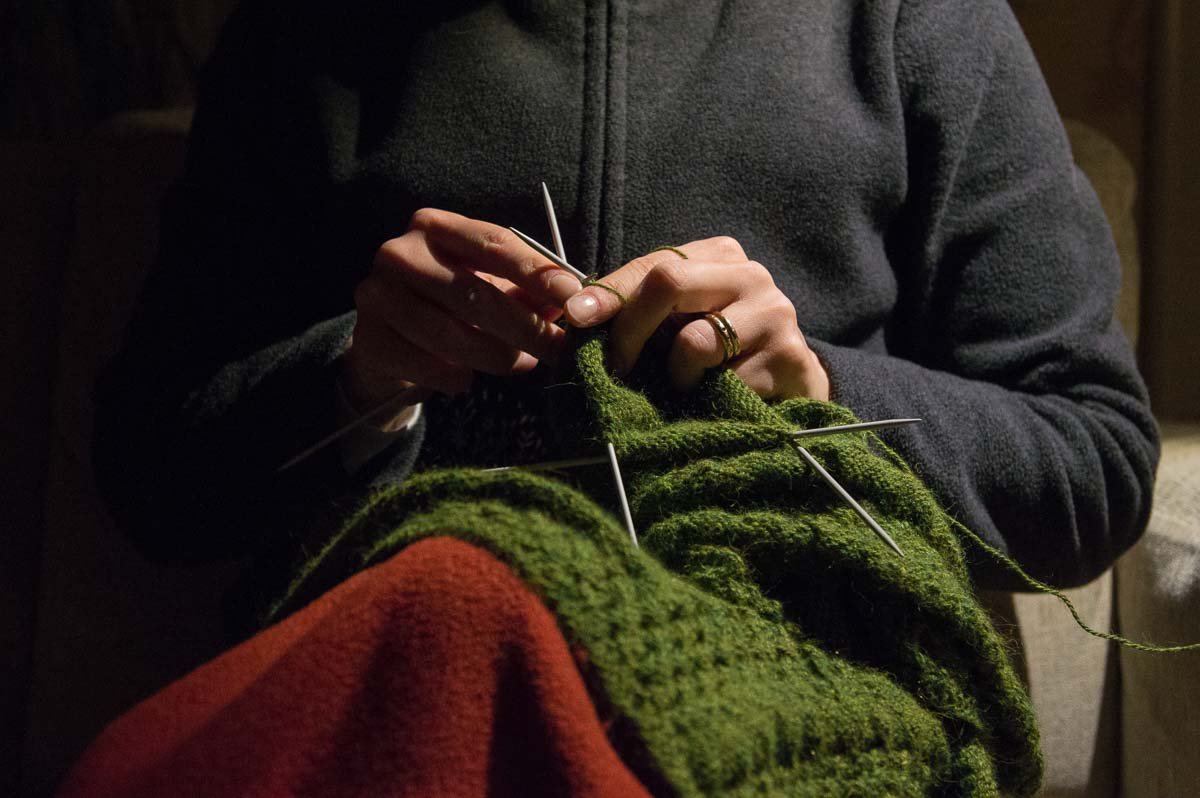
Knitting that cardigan that I began two winters ago. One of my favourite ways of winding down in the evening.

This week’s prompt in a weekly photo project is “house on fire”, as in “you have 10 minutes to gather the things that you would take with you if you were forced to leave your house indefinitely.”
I am one of those unsentimental people who wouldn’t really miss any of my belongings much. If the house burned down, it would be inconvenient and costly, but there isn’t a thing in it that I would cry about. Everything important is digital. Where other people have scrapbooks, I note down my thoughts and memories here in the blog; all my photos are backed up in the cloud. I would still grab the computers and the network hard drive, though. Next I’d grab the one album with my childhood photos, and then my jewellery box.
The computers are ugly and the photo album is even uglier and truly the jewellery box is the ugliest of them all. (Fake leather just does not age well.) But the jewellery is beautiful. So I picked this one necklace that Eric gave me to represent them all.
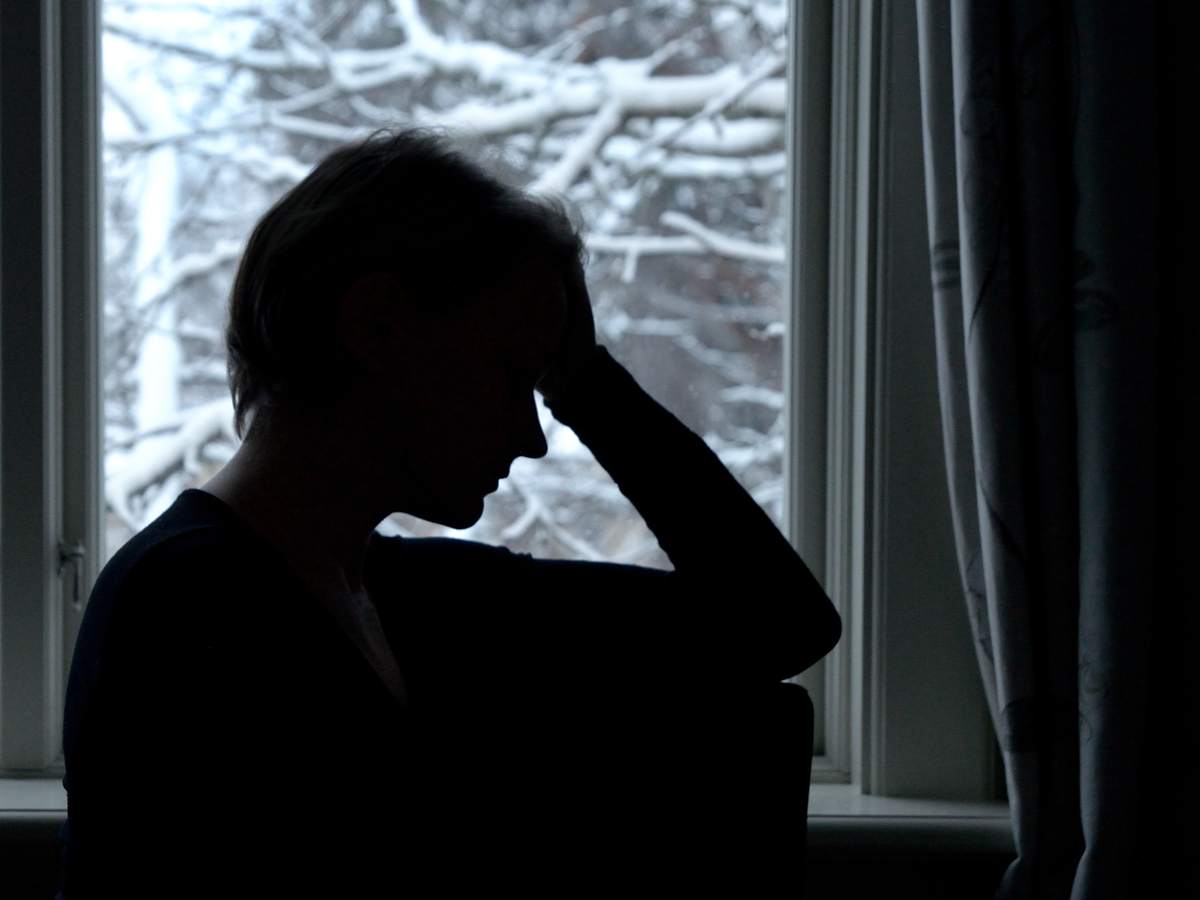
The Christmas break ended, and after just two days of everyday life I am already feeling my stress levels going up. And I have had a cold for over a month now – I haven’t felt fully well since early December.

In our kitchen we have a tear-off calendar with paintings by Monet. Looking at the paintings, it has struck me several times that if Monet’s paintings were photos, and if he were to submit them to some social forum for feedback by other photographers, many of his compositions would probably immediately be criticised for breaking basic rules of composition. “Leave more space around the subject!” (Camille Monet and a child in the garden) “Don’t cut off your subject’s hand – if you had taken a step back you could easily have avoided that!” (Camille with a small dog)
A blogger at fotosidan.se noted the same thing when reading a book about Edward Hopper. A window frame “growing” out of a woman’s head – what kind of composition is that!
These rules of composition, presented like immortal truths, are so strongly influenced by current fashions and trends. Right now, the rule of thirds is on top of every list as if it was really a rule. Go back fifty years and there was no such thing.
It bothers me when these ideas or concepts are presented as rules, and then with the admonition to only break the rules when you know why you’re breaking them – when you have mastered the rules and made a conscious decision to break them.
I have come to really hate that idea. I don’t want photography to be about rules. I don’t want to follow a checklist and then carefully break one rule make a pretty photo.
In fact I don’t even want my photos to be beautiful, most of the time. I don’t really know what I want them to be, but beauty is rarely among my goals.
I take photos with distracting elements competing for attention. I take photos where the subject is facing away from me, or with faces partially hidden, or with heads cut off. I don’t do it for any carefully considered purpose, guided by artistic vision. I do it because it’s what I want to do at that moment.
That was actually an incredibly liberating insight I had recently. I am not a photographer. I don’t aspire to greatness in photography. I do not need anybody to approve of my photos – I have no clients I need to please, and I don’t need the approval of “real” photographers, either. I would rather take photos that mean something to me, regardless of how many rules they break, even if everybody else considers them crap.
Another rule that I keep hearing is great light is the most important thing for photography – photography, after all, being “drawing with light”. If you don’t have great light, you won’t get a great photo, and that’s that. If you have crappy light you might as well put away the camera and go home. Well, I refuse to listen to this rule, too. Crappy light is all I have during six months of every year, and I would rather take ugly photos than none.
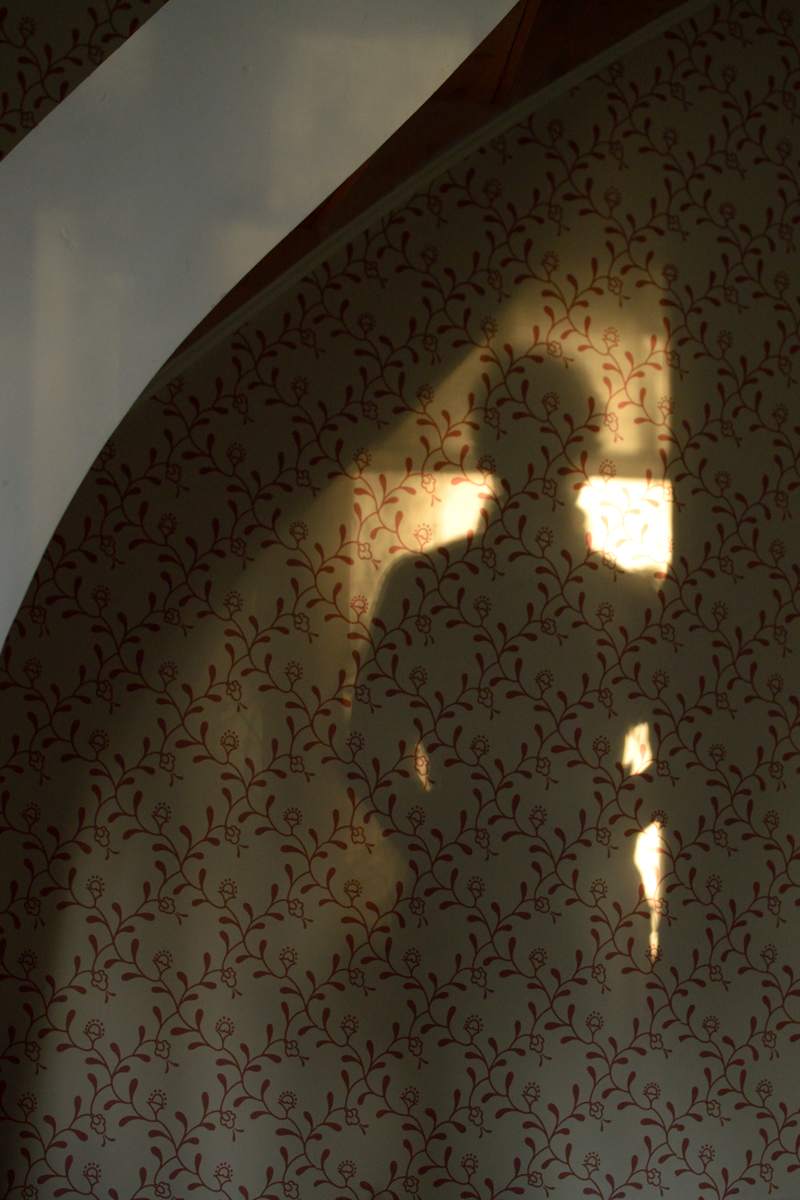
The Swedish weather service reports that the past month has been the most sunless November for a hundred years. The official number for total hours of sunshine in Stockholm this month: three.
One fifteen-minute stretch of sunshine happened on a weekend so I actually saw it with my own eyes, and even caught it with my camera.
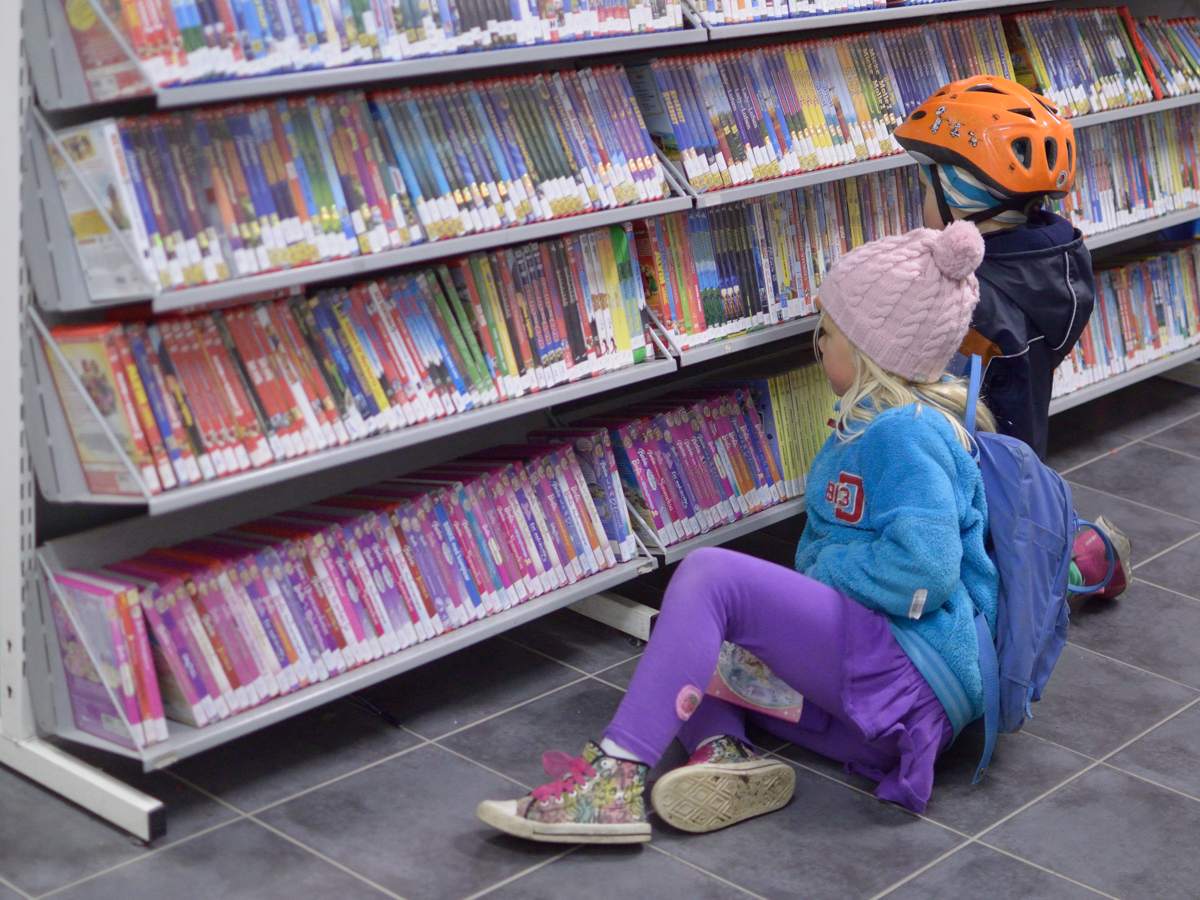
Preparing for Friday evening movie time.
I used to aim for consensus, trying to get the kids to agree on a movie to rent. But their tastes are so different that this only led to nobody being happy. Now we take turns. Today was Ingrid’s turn to choose, so we got a Barbie movie.
It strikes me when I look at this photo how unconcerned both kids are about sitting on the floor. They are not at all bothered by wearing slightly dirty clothes almost all the time. The same with food stains etc.
For my own self, I draw a clear line between my “out” clothes and “home” clothes, and while I might well sit on a dirty floor in my “home” clothes, I set a higher standard for my “out” clothes. This has both benefits and costs of course.
When you picture the year in your mind, what does it look like? Do you even do that?
I do. And apparently I’m not the only one: there’s a long thread at MetaFilter about how people picture calendars in their heads. (The internet truly is a wonderful thing.)
For me the year is a flat ring. It is oval in shape, and relatively narrow compared to its diameter. Imagine 365 blobs of no particular shape for the 365 days and arrange them next to each other in an oval shape; that’s roughly the scale of it. But my year is continuous and is not made up of daily blobs.
The ring lies flat at a slight slope; summer is noticeably lower than winter. The winter end is also the narrow end of the oval.
We move counterclockwise around the ring.
Distance affects visibility. The ring is large and narrow enough that from where I am now, in autumn, I cannot see spring on the other side. I can see the whole year if I leave my current actual position and decide to view the year from above, but I cannot see it from where I am.
The closest physical-world equivalent I’ve seen is this rotating playground structure. There’s one near my mum’s home in Uppsala. In this photo (from 2010) Ingrid is stretched out roughly from February to April.

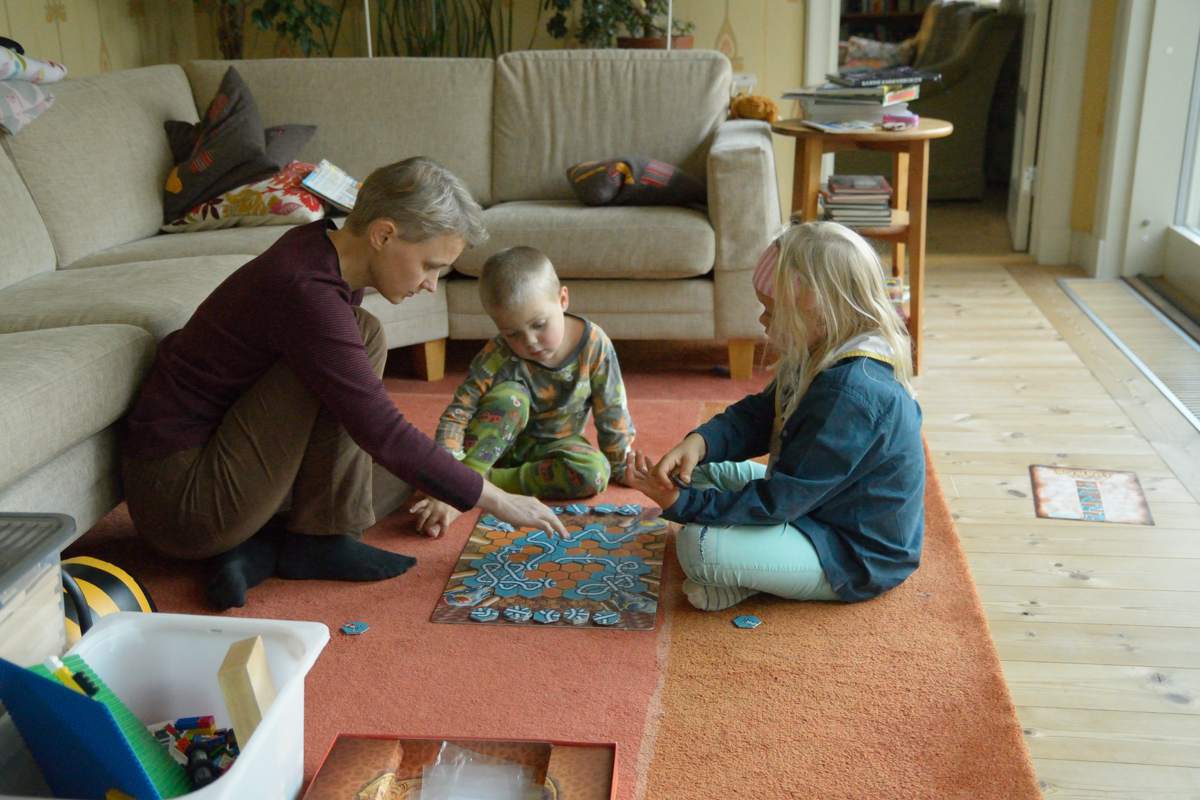
Playing games with the kids.
Whenever we do play, games or otherwise, we’re always on the floor. Sitting on chairs around the dinner table just doesn’t have the same kind of feeling. I’ve occasionally thought about buying a sofa table but I think we all feel more comfortable on the carpet.
If there was one thing I could change about myself, I would lower my expectations for myself. There is that persistent streak of perfectionism that I always struggle with and never manage to quash.
I view myself and my doings with a critical eye. I compare myself to others; I compare myself to the best. I feel I should always make an effort to do better. If I’m not good, then I feel I’ve failed. If I think I will “fail”, I abstain.
I know it is so and I remind myself that these thoughts make no sense. Sometimes I manage to convince myself; other times not.
The daily photography project is one way to train myself to let go of those impossible goalposts and settle for good enough. Forcing myself to post something, even if it is not quite what I had aimed for, not quite as good as I had hoped.
Looking at other photographers’ work is a mixed experience. What could be inspirational often just feels unattainable. It makes no sense to compare my photos to the pros and feel that I fall short – and yet a part of my brain still does that.
Remember those stones that I was stacking back in May? And that I didn’t break any fingers?
Well, I didn’t break any fingers but I did damage a fingernail. It wasn’t even noticeable at the time but as it grew out, it had a big crack across. And even that was not a problem – it slowly grew out and behind the crack the nail was healthy.
But then the edges of the crack got more and more worn, until one day that ragged barely-attached bit of nail accidentally got torn off.
It turns out that torn-off fingernails don’t always heal very well on their own. Two weeks on, it was still not healed. I ended up having to go to the local clinic today so they could cut/scrape off a bit that was growing all wrong. (I learned a new word in the process; I now know what svallkött is.) Note to self: take better care of damaged fingernails in the future.
In addition to the new word I also got a very impressive bandage from the nurse, really out of proportion with the actual damage (but in proportion to the expected amount of bleeding according to the nurse). A great conversation starter at work, and with the kids at home.
And thirdly I gained a new appreciation for the importance of the middle finger. It turns out to be useful for much more than sticking up in the air. Adjusting my typing for the lack of middle finger was surprisingly easy. On the other hand, it was quite tricky to peel an onion or a clove of garlic, or do any other task that requires precision with a small knife. I don’t usually think of using my middle finger to hold the knife, but it makes a big difference to stability. Likewise, holding a pen or a toothbrush is much, much easier if all the fingers are present and work properly.

| « Older posts | Newer posts » |
