Language development continues apace. Two-word combinations are now old hat, and combinations of three words and more happen every day. In fact they are so common that I’ve stopped noticing them. She also learns new words at such a speed that my astonishment has worn out and I am simply accepting this miracle as an ordinary thing.

We’ve just spent two weeks in Estonia, and she figured out very quickly that Estonian is the thing that works with those people. By the end of the two weeks she was using very few Swedish words when talking to us. But for some words she took care to point out that pappa says something else. She might say muna about the egg on her plate, and then look at me and say pappa ägg. Bilingualism is obviously not going to cause any difficulties for her.

Some of the words she learned very early on remain in their early state – she still says “Ije” for “Ingrid” for example. Otherwise her pronounciation is now good enough that even strangers can understand some of what she says. As long as she picks the right language, that is.

I love all this talking. It’s so nice that she can tell me what she wants, point out things that she sees or hears or wonders about, or just express her thoughts. The best thing about it is the insight I get into what is going on inside that head, what she understands, what she is interested in, what she thinks she is doing. A window into her mind. Today, for example, she has been commenting a lot on noises she hears, such as airplanes, passing cars that she cannot see, PA announcements and so on. Had she not been speaking, I would probably not have noticed it, because it’s not something she can point at.

Puddle!

Her talking has also made it clear to me just how much she understands: concepts like soon vs. later, things happening quickly vs. taking a long time, “first we do this, then we do that”, etc. I’ve also realised how much she remembers, and thinks about things we have seen or done or read during the day. When we run out of milk during breakfast, and I tell her that we’ll buy more in the afternoon, she confirms this at lunch, and then mentions it again when we go out in the afternoon. At bedtime she may repeat the ending of a particularly memorable book we read in the morning, or remind me that I promised we would buy her a pair of rubber boots soon.

Ingrid is still very fond of books, and now it’s definitely stories she wants. Preferably stories with pictures on every page, and no more than a few sentences per page, so we don’t have to look at the same page for too long. Rhymes are also good. She has never yet turned down an offer to read a book. And while previously she would often begin the day by telling me “uuut!” (go out), now she is more likely to tell me “läsa bok!” as soon as we get up.

On a whim, while we were stuck waiting somewhere and she was bored, I started pointing out letters to her, and how they make up words. She loved the game! Then she would pick up a newspaper or some advertising material with big letters on it, and point at them and say “I, E, O, E” as if reading, to show me that she wanted to play that game again. We bought an ABC book and it’s a great favourite.

We’ve also counted things a lot. She has a firm grasp on the concepts of one and two, and often tells me, for example, that she is putting two berries in her mouth at the same time. But beyond that I’m not sure. I know that she knows that number words come in a certain order, and she knows how they are used, but her own counting often goes üks, kaks, viis, kuus, kümme, meaning “one, two, five, six, ten”. And it’s always those specific ones, plus sometimes kaheksa (“eight”) in the right place, too. She always, always skips three and four. I suspect it’s because she cannot say the L sound (the words are kolm and neli in Estonian) so she doesn’t like to even try to say those words.

Lifting, not pushing the wheelbarrow…

On the physical side, I’ve noticed improved dexterity. She can now eat quite well with a fork, and can build towers out of Duplo blocks. Long and slim towers, preferably of the smallest 2×2 pieces… But she still prefers large things and big movement. Climbing frames are great, especially those that are really meant for older children, so that she really has to stretch to reach. Otherwise it’s too easy, I guess. Kicking a ball, balancing on things, hanging from things… The best toys are the large ones, and the best use for them is to carry and lift them. We bought her a chair, and while she does sometimes sit on it, she mostly carries it from one room to another.

Dolls are beginning to become more interesting. Dolls get to eat cheese, and wear her bibs, and sleep in our bed, sit on our chairs. (One of them apparently needed a nappy, too, but unfortunately the mismatch in size was just too big.) She even let me brush her teeth without struggling when she got to brush a doll’s teeth at the same time. Dolls and toy animals all like kisses, too: give her two stuffed animals and they will soon be rubbing their noses together while she says “puss!”.

In some ways a toddler is easier to care for than a baby. In other ways it’s a lot more complicated. On the one hand, a baby’s needs are simpler, but on the other hand, a toddler can tell you much more clearly what she wants or needs, and a toddler can actually take responsibility for their needs to a surprisingly large extent.

Sleep is a case in point. Ingrid was a lousy sleeper for a long time. It was really hard for her to fall asleep, and it took a long while for her to understand that falling asleep is not a terrible thing to be avoided at all costs. Now she knows that sleep is good, and actually wants to go to sleep. When she starts looking tired, I ask her if she wants to sleep. Often she says yes and runs towards the bedroom, waiting for me to follow. If she says no, I try again 5 minutes later, and again, until she says yes. She always does, after a while. I think there was one evening when we came home really late and she was really cranky and was saying no to everything, so I carried her to the bedroom despite her NOs, but once there, she was happy to go to bed.

Food has always been simple with Ingrid. I’ve never had to worry much about her eating habits or weight gain. She’s been happy to breastfeed and happy to eat, and especially happy to feed herself. There was a period when I thought she ate too little, but I could see that she still had more energy than she needed, so obviously she got enough food somehow. And then I read that 50% of parents think so about their toddlers, so I stopped worrying. (I still don’t understand how she can get by with so little food, though!) In any case she now eats without any fuss, and eats a reasonably varied diet, too.

The one thing I’m struggling slightly with is potty training. From what I’ve heard and read, she seems old enough for potty, but we’ve had very little success. We tried in May to let her go without a nappy. She peed on the floor lots of times and was very distressed every time it happened, so we gave up. We tried again in June, and while she was still peeing on the floor all the time and not much on the potty, she was no longer unhappy about it. We tried again in July, and still most of it ended up on the floor. She never says when she needs to go. When I suggest that she should sit on the potty, she generally refuses, or sits for a while and then runs away, and then pees on the floor two minutes later. (Luckily she points out where the puddle is when I ask her, after I notice that she’s all wet.) It is getting a bit tiresome to dry up all these puddles. I don’t know whether there’s any point continuing or whether we should take a break, go back to nappies, and try again in a month’s time.

Ingrid’s hair smells like wool. When it’s wet, it smells a bit like a wet poodle. Clean, but faintly animal-like, and very very pleasant.

Initially we fell into the usual “must have lots of lotions and products” trap and bought a baby shampoo / bath lotion. It made her skin dry and red so we stopped, and had a lot of trouble getting her skin back to normal again. Now I wash her with just water, and use soap on hands and feet only when they are really dirty or greasy.

I wish I could do the same with my own hair. Apparently some people can get by with just conditioner, no shampoo. (Google for “conditioner only” if you’re interested.) I tried that for a while, but my hair never felt really clean, so now I’m back to using shampoo again, but the mildest one I could find.

The most memorable change for Ingrid this month was the advent of two-word sentences. Now she often says things like “Ije baga” (Ingrid magama = Ingrid sleep), “toga pall” (stor pall = big ball), “atta ommo” (vattna blommor = water the flowers), “emme itta” (emme sitta = mummy sit) and so on. Sometimes when I say a longer sentence (“The boy is playing with a big ball”) she tries to repeat it by makes several shorter ones out of it: “boy play” plus “boy ball” plus “big ball”.

She also uses language in more varied ways now. She can point out things, and describe things, and ask for things – but she can also make suggestions, which are clearly less determined in tone than pure requests (“Ije?” while pointing at Eric’s sunglasses, meaning “could I play with those?”) and ask questions (“onu?” while pointing at a newspaper means “are there any pictures of people in there?”). (We’ve been focusing on people words such as “man” and “woman” and “boy” and “girl” recently.)

I’ve noticed is that she is more adept at listening, too. What I mean is that she notices which words are important to the speaker, which words are said with extra stress or attention or emotion. The one time one of us said a (very mild) swear word (“jäkla sniglar” = “darn snails”) she immediately picked up on the “jäkla” and repeated it many times with great glee.

Her pronounciation is a lot clearer (most notably P and K are now separate sounds, so a tree is no longer called a moon) but as you can see from the examples, her language is still very much in a state where only a parent would understand her. We generally understand most of what she says now, even though we sometimes struggle when she freely mixes Swedish and Estonian in a single sentence. Generally she knows the names of the most important things in both languages, but for other things she often only has one of the words. Sometimes, though, I suspect that she switches to a language of her own, because suddenly she says something long and fluent but completely incomprehensible.

A few weeks ago I wrote that ise (= myself) was a much-used word. And it still is, because she likes to try to do things on her own. She’s getting better at it, too: just this evening she managed to get both legs into her pajama bottoms, and her attempts to wipe up spilled food from the table now actually make the table slightly cleaner.

But the world is now less black and white: it’s not a choice between “mummy do” and “Ingrid do”. She has now added the word koos (= together) to her vocabulary and uses it when she wants us to do something together, such as sit in the sofa and read a book. Likewise she’s understood that sometimes ise is not best, and it is good to have some help, so she says aita (= help).

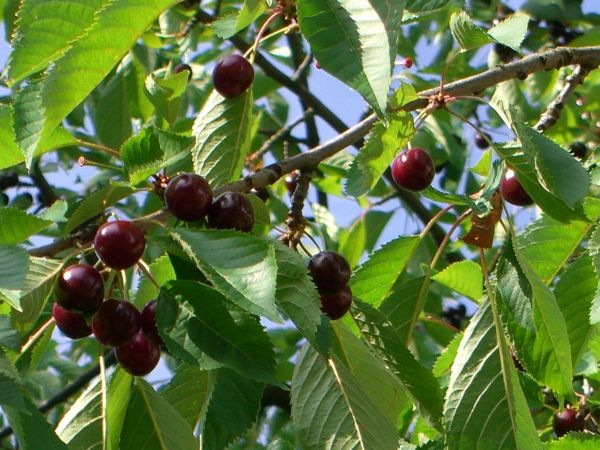
And of course, whatever we do, she wants to join or copy. Mummy takes a handbag when she goes out? Ingrid takes her bag, too. (The bag is one of her few important possessions right now.) Daddy climbs a ladder to pick cherries? Ingrid wants to stand on a ladder and pick cherries, too. I generally try to accommodate her as much as possible in these situations. When Eric is on a ladder picking cherries, the option of doing nothing does not exist: she would climb up after him. I could take her away so she cannot see that he’s climbing. But if I’m going to be busy keeping her out of his way, I might as well do it so that she is a part of the action: bring out the small stepladder and find a low-hanging branch that she can eat from.

In fact the surest way to make her angry is for one of us to do something that she can see, and finds interesting, but isn’t allowed to copy. And of course it must seem terribly unfair. The other sure way to anger her is to ignore her: to sit in the sofa and try to read, and tell her to play on her own. For everyone’s peace of mind we try to avoid both, if possible.

Of course it isn’t always possible. When I’m eating dinner, I’m not going to stop just because she wants to play with me. And then she gets angry. Being upset and crying is nothing new of course, but now she displays proper anger and sometimes starts hitting and throwing things. She has no other way to diffuse her anger, I guess. Sometimes she sits down on the ground and picks up whatever is closest and throws it, and then goes after it and throws it again, and again. It’s kind of funny when that thing is a small piece of crumpled-up paper… Less funny when she’s sitting at the kitchen table and we see she’s about to get angry, and the closest thing is a glass of water. (The glass gets quickly moved out of range.) But the violent anger dissipates quickly, and she calms down enough to come to us for a cuddle of consolation.

When she isn’t joining in our activities, we’re often out doing something active. We go to playgrounds (climbing, swinging, splashing in a pool), or kick a big beach ball around the garden, or simply run up and down the lawn. All of these are quite social activities: she quickly loses interest in the ball if I’m not there to kick it with her (and when my attention wanders she reminds me that it’s my turn now), and running is a lot more fun when she can hold my hand.

A relatively new favourite is spinning around in circles. Ideally she’d hold my hand and then we’d both spin until she is so dizzy she falls over. Unfortunately I feel nauseous well before we get to that point. I generally try to convince her to run around me while I sit on the ground and hold her hand.

Books are still popular. She’s now getting interested in actual stories, not just pointing out things that she sees. Some of the baby books are going out of favour, while others that she had ignored are now suddenly interesting, because they have a story. And she listens attentively to the bedtime stories I tell her. I’m planning to do some major book shopping when I go to Estonia later this summer.

Drawing is another nice indoor activity. She used to enjoy scribbling with crayons, but now she prefers to watch me draw, and then either guess what I’m drawing, or suggest things for me to draw. Her own scribbling used to be forceful but artless, focusing mostly on making as big a mark on the paper as possible. Now I think she has once or twice tried to actually draw something. At least she once drew a brown line and then a green one, and said “puu” (= tree), moments after I had drawn a tree for her with the same crayons.

Here’s what they look like:

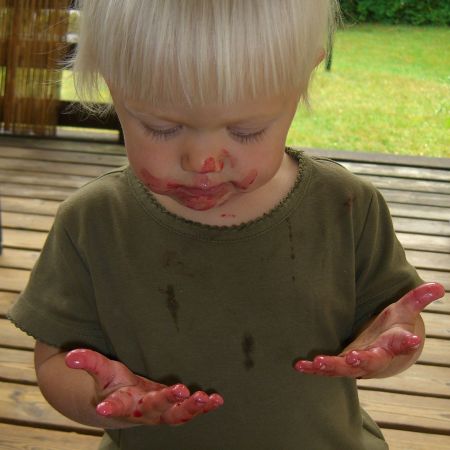
And here’s what Ingrid looks like after eating them:

More pictures

Ingrid is on the verge of giving up her daytime naps. It’s harder and harder to get her to sleep (most days the bicycle trailer is the only thing that works) and the naps happen later and later. And if she naps, she is alert and awake until late evening, some days well past 9 o’clock. On balance, the struggle of getting her to nap is now barely worth it. But if she doesn’t nap, she often gets overtired in the evening, and both our dinner and preparations for getting her to bed are interrupted by frequent temper explosions, with crying and flying cutlery.

We had looked forward to a few more years of naps at least (she’s not even two yet)… they give us a chance to catch our breath and to maybe get something done during the day. Now it’s non-stop activity from morning to evening. But on the other hand, if she doesn’t nap, she goes to bed around 7 in the evening, which leaves me 4 hours of free time, instead of 1 or 2.

Ingrid’s having a real language boom. It feels like she “gets” a new important concept every other day or so. These are not just words for things or actions, but for more complex ideas, and I get the impression that she grasps the concept together with the word.

Each time the pattern is the same. First she learns to understand the word and the concept and when to use them. Then she learns to say them, and does it intensively for a few days. Then the word becomes part of her vocabulary and loses its novelty.

First came the concept of waiting. (That was about a month ago I think.) I would tell her to wait (“wait, let me put away my bag and then I’ll pick you up”) and she would wait rather than continuing to ask to be picked up. Then she started saying the word herself, telling me, in effect, “I’m waiting”. Or rather, “I’m waiting, I’m waiting, I’m waiting, I’m waiting” – because she was always repeating it lots of times very fast, “oota-oota-oota-oota”. Not an ounce of patience!

Then she learned ise (“myself”, meaning “I can / want to do this myself”). That appeared to arrive together with a new desire for independence. Can walk, don’t want to sit in the pushchair! Can brush my teeth myself! Can put on my trousers myself! Can wash the dishes! (No, actually you can’t.)

Recently she also learned veel / mer (“more”). I understand that that’s a word that many babies learn early on, but until recently Ingrid’s been happy with just pointing or saying the name of the thing she wants more of.

The latest thing is the numbers one and two, and palju (“much”, “many”). Now every time she picks up, holds or sees two of something she says “two!”, and sometimes even picks up two things just so she can then say “two!”. I don’t think she has understood “three” yet – things are one, two, or many.

Ingrid used to be very fond of bathing – bathtime was the best part of the day. It should be obvious from all the bath photos I’ve posted, too!

Note the words “used to”. All of a sudden, she has lost her taste for baths. Every evening I ask if she wants a bath, and she shakes her head. Some days I convince her to give it a try, and three minutes later she’s telling me “done!” and trying to climb out. In the last few weeks she’s had a few quick showers, one or two baths that I more or less forced her to take, and that’s it. Of course I wash her hands and face and feet, but most of her body doesn’t come into contact with water very often now (apart from when we go to a pool).

What happened? And what do we do now? I’m not going to force her into the bath, especially since she is now tall enough to be almost-able to climb out (and then slip halfway and fall). I take my shower in the morning, and generally I’m in a hurry to get to work after that, so I don’t dawdle much. But perhaps I should still try to get her to shower with me… or maybe we’ll just go swimming once a week and share a shower after that. Or maybe she will just rediscover the joy of baths.

Ingrid is definitely “almost two” now: a “big girl”.

More and more, she wants to be like us and to join us in whatever we’re doing. When I am cooking dinner, she wants to stand on her step stool and watch me chop the veggies. (And have a little taster of everything. It turns out that she really likes raw mini sweetcorn, will eat raw aubergine and potatoes, as well as uncooked beans.) When I’m doing the laundry, she wants to be there to help me pull the clothes out of the washer and hang them up to dry. When the table in front of her mysteriously acquires splashes of food, she wants to wipe it with a paper towel, just like we do. When I go grocery shopping she gets a little trolley to push, and loves to put our shopping in it.

Watering flowers Watering the cat

Shopping actually goes faster this way, because she is in constant movement. The moment we’ve picked up the milk, she’s rolling onwards, and I have to either keep up or stop her trolley (in which case she’s likely to toddle off without it). I try to have a detailed list with me so I don’t need to stop and think while we’re in the shop, and it means that we walk through the shop in one long smooth movement.

Speaking of walking, she’s got much better stamina now than just a month ago. She often prefers walking to sitting in the pushchair. The shop we normally go to is, I’d guess, about 15 minutes’ walk away, and it isn’t uncommon for Ingrid to walk half the way there before climbing up into the pushchair, then come down again to walk through the shop and halfway home, too.

Meanwhile Ingrid has also discovered / understood pretend play. I’m not sure if this is related to participating in our activities, or just happened at roughly the same time. Her stuffed penguins walk, and her cow sits and sleeps. (Any animal or toy that lies down is always “sleeping”.) She also has her doll, and quite often doll wants to sit next to us on the sofa, or reads a book, or sleeps. Doll sometimes also wants to drink water from a cup, or to breastfeed. This morning doll was apparently hungry and was carefully fed with yoghurt. Occasionally Ingrid also enjoys feeding me (although my patience lasts through about two or three bites).

Speaking of eating… she’s now quite competent at feeding herself with spoon and fork, and reliably manages a glass or a cup. When she wants to, she can get stuff in her mouth without spilling much at all. The bib is there just in case, and remains clean after many meals. Messes arise when she gets bored with eating and starts to play with her food instead. She dips her pasta in her milk, or eats orange juice with a spoon, or tries to eat yoghurt with her fingers, or stuffs her mouth full of grapes and then spits them out half-chewed. At least she’s now learned that hand-washing after a meal is an unavoidable step.

It’s hard to say anything meaningful about her language development. I know her vocabularly keeps growing, and that it now includes a good amount of verbs, as well as simpler adjectives (big, small, hot, cold, wet, etc, plus a few colours I think). But I really only know about the ones she uses actively. I know that she understands an awful lot more than she says. I can give her instructions using words she’s never said – “put that nappy in the bin in the kitchen, please” or “climb up on the bench and I’ll help you open that box”, and she’ll follow them without hesitation.

Books remain as popular as ever. She still likes to point out things in books, but now I think she’s beginning to be interested in actual stories, in things happening after each other, in the same order. She likes to predict what will be on the next page: turns a corner and peeks enough to be able to guess, then turns the whole page and is happy when it turns out that, yes indeed, there is a cow on that page.

I’ve recently started telling her bedtime stories, too. It’s hard to know how much she understands of the actual story, but hearing my voice drone on keeps her relatively calm and makes bedtime a bit shorter. Before I started telling stories, she’d spend upwards of half an hour kicking and climbing around in the bed. Now it can sometimes take as little as 15 minutes, although half an hour isn’t at all rare. But at least she doesn’t kick me in the ribs, or climb over me while supporting herself with a knee in my groin, or accidentally headbutt me while trying to walk on the bed.

In fact I hope she doesn’t understand too much of the stories, because otherwise she’d probably be too scared to sleep: the only stories I know well enough to tell without much thought are the classics, Little Red Riding Hood, The Wolf and the Seven Little Kids, Hansel and Gretel, and other scary stories where someone generally gets eaten alive.

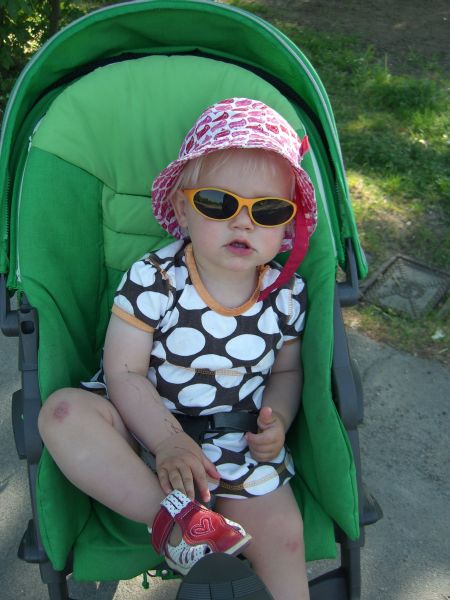
Life right now:

  • Scraped knees, because she has more speed than control
  • Sunglasses, because she wouldn’t leave mine alone
  • Scribbles on arm, because she has been learning how to pull the cap off a pen

The only untypical thing in this picture is her shoe: she usually pulls them off within minutes and runs barefoot instead.