Ingrid’s pretty much grown up without TV. Until now.

One evening last week, when she had skipped her nap and was cranky and tired (tired enough to say no to all kinds of activities but not tired enough to sleep), I sat down in front of a computer with her and turned on Teletubbies. She sat there as if she had been hypnotised, staring at the screen, totally happy.

Now she is addicted. Almost every afternoon when we get home from nursery, she asks for Teletubbies. Sometimes she asks for Teletubbies as soon as we get up in the morning. When the one-hour episode ends, she asks for more. (We’ve limited it to one round, i.e. she can watch all of one DVD but only once, and only in the evening.)

And by the way, that’s when she’s only seen one disc of a three-disc set. She’s perfectly happy watching the same one hour over and over again, day after day. I haven’t even mentioned the other two to her.

Today something went wrong with the computer and there was no sound. No matter! Ingrid accepted silent Teletubbies, too.

This is how TV addiction starts, I guess…

I’ve put up several new photo albums, with Ingrid
playing in the garden,
learning her letters,
splashing in puddles and
drawing.

We celebrated Ingrid’s birthday this Sunday. Unfortunately she was slightly off-colour and the large crowd (9 guests) was a bit too much for her. But she really enjoyed opening her presents, and playing with her two cousins, whom she doesn’t meet very often. She liked her cards, too, especially since several of them had photos of herself on them.

(Ingrid’s quite fascinated with photos: every time I try to take a photo of her she runs to me and wants to look at it on the camera screen. Often she does this before I’ve even had time to take the picture, which makes it quite hard to get any photos at all…) I didn’t have the time to take any photos of the birthday party myself, so I’m hoping the guests will send me theirs. Hint, hint…

We had two yellow candles for her, and spoke about how she’s now two years old. I don’t think she understands what a year is, but she understood that the number two has something to do with her now. Whenever we run across a “two” somewhere in a story or a book, she pauses, and very proudly tells me “kaks aastat!”

This is part two of a two-part post. You can read the first part here.

Yesterday’s post was all about Ingrid’s emotional rollercoaster life. Today’s is about more practical things.

Last month’s big news was the nursery start. This month it’s become routine, and Ingrid now really enjoys going to nursery. Most days I leave for work first, and later Eric drops her off at nursery. On the few mornings that I’ve done it, she’s gone straight to one of the nursery teachers, smiling all the way, and then carelessly waved good-bye to me. In the afternoon she’s always happy to see me and ready to go home, but already she’s sometimes telling me that she’d like to play some more, and that she wants to go to nursery the next day again.

While I don’t know exactly how she behaves there during the day, I get the impression that she’s as social there as she is at home. When I get there she’s almost always engaged in some activity together with a teacher. She knows the names of her own three teachers, and a few others that she sees when all the different groups are playing outside in the yard. She knows the other kids’ parents and tells me who’s whose mum.

Playing on her own is not her thing. In fact playing is not really her thing. At home her toys mostly languish in the box. If I join her, she doesn’t mind building with her Duplo blocks for a while, but not for long. She’d rather we read books together. I remember when she was smaller, she used to sit with her books all on her own. But that was before she learned that there are stories in the books, and I can get the stories out of the books, while she cannot. I’m very glad we got all those books when we went to Estonia in the summer: they’re very popular, and it’s great to be able to read in Estonian rather than translate Swedish books on the fly.

She’s also very fond of singing. They must do a lot of singing at nursery, because I often catch her singing snatches of songs that I don’t recognise. (Those songs are often followed by a “bravo!” which must also be something she’s picked up at nursery.) In Estonian we sing Põdra maja with all the movements, and Süda tuksub (which I remember my grandmother singing to me) and the one that goes mis need käivad kiiga-kääga. All sorts of “hopping” songs are great fun, too – Sõit, sõit, linna etc. I thought at first that I’d somehow only stick to Estonian songs, but I’ve realised that that plan was unworkable and abandoned it. Imse vimse spindel is too important, as are Bockarna Bruse and others.

I was a bit concerned that speaking Swedish all day at nursery would make her prefer Swedish, or that she’d be slower learning Estonian. No problems yet: most of the time she’s quite comfortable switching between languages. It gets a bit confusing for her when I’m also speaking Swedish (to the nursery staff, for example). But generally, when she says something that she only knows in Swedish, I reply in Estonian. She usually picks that up after a few repetitions and uses the Estonian word from then on. But there are some phrases that she has heard a lot in Swedish, and hardly ever in Estonian. She tends to stick to Swedish with these. (“Mummy will come in the afternoon” is one example that she probably heard many times during her early weeks at nursery.)

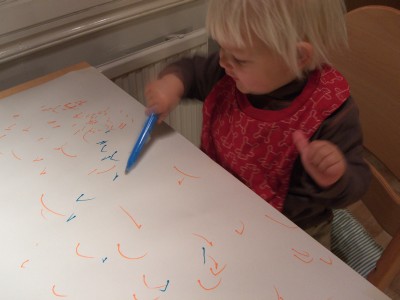
As a preventative measure we’re going to an Estonian playgroup every other Sunday. There’s a lot of singing there, which she likes, followed by some sort of creative activity. She’s tried painting with a brush there, and liked it a lot better than the crayons we’ve at home for a while. I think she was getting bored with them because there were too few colours, and she had to press quite hard to make a mark with them. The brushes made big marks quickly. Now I’ve bought a set of colourful felt-tip pens, and those are a lot more popular. She can draw things with these that she couldn’t make with crayons: small dots and big sweeping curves.

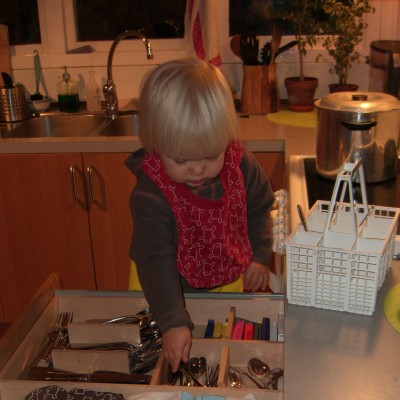
But I can’t spend all my evening drawing or reading, and it’s only fun for a short while if she’s on her own. She’d rather “help” me wash the dishes or load the washing machine. And in fact sometimes she does help rather than “help”. She can take the cutlery basket from the dishwasher and put away all the cutlery in the right compartments in the drawer (as long as I take care of all the irregular items there). She can put on her shoes and sometimes manages trousers or socks, too. Jackets and tops are harder: she can get them off but not on.

She wants to do like I do, and be like I am. When we eat dinner, and I lay out a fork and knife for myself, but only a fork for her, she wants a knife, too. When I hurt my finger, she wants a plaster, too. She points out all the things we have in common: that I put on a shirt, and that she is also putting on a shirt; that I go to work, and she goes to nursery.

Ingrid also points out all sorts of other things. We talk a lot when we’re out and about: both of us, not just me. She’s become quite verbal quite fast. We speak about how leaves fall off the trees, and how some trees are all bare now, and the leaves are on the ground. How the ground is wet after rain, and how it gets dark in the evening. We speak about things we pass: trees and cats and lawnmowers and garbage trucks. Quite often, she also mentions things that have happened before. This is where we saw the cat go into the bushes. This is where the garbage truck was standing yesterday. Here is where Ingrid fell from the swing and hit her head. And that was back in August I think: she’s got a long memory.

This post grew far longer than planned, so rather than subject you to a whole novella here, I’m publishing this in installments. Part 2 coming up tomorrow.

Twenty-four months. Two years. It feels like some sort of longer-term retrospective is in order but I can’t think of any good angle for it so it’s not happening today at least. Just the ordinary monthly thing.

In one sense, this has been a month of consolidation. She hasn’t mastered any major new skills, and there haven’t been any big changes in her life. But at the same time I feel that she’s changed a lot emotionally.

Ingrid’s become a lot more independent-minded. She has opinions on just about everything, and it’s become more and more important for her to have a choice, to make up her own mind, to feel in control, and to do things herself. She wants to choose what clothes she wears (which leads to some rather garish choices, such as an pink top paired with red and orange striped trousers). She wants to decide which towel I dry her with, and which route we take when we go home from nursery. She wants to turn on the bathroom light herself, and to take off the cap on the toothpaste herself, and to pour her own breakfast cereal. There’s a constant stream of “ise!” (“myself!”) all the time.

And these things are IMPORTANT to her. Her reaction to when things go “wrong” (meaning, not the way she would have done them) is instant and very emotional. There are floods of tears, and “Ingrid sad!”. (She generally reacts with sadness rather than anger.) She’s never been quite this emotionally fragile before. This independence and emotional fragility remind me of my own teenage years, as far as I can recall them. I’m guessing that this is as tough for her as teenage is for teenagers.

Quite often I forget these small things – I haven’t quite internalised the importance of who gets to turn on the bathroom light – so we end up redoing things. I turn off the light again and then she gets to turn it on. Since it’s obviously much more important to her than me, I don’t mind.

Of course, there are times when we will do things my way. We will take off a soaking wet nappy, no matter what she thinks about it. (For some reason she’s become really averse to nappy changes recently.) And we will go grocery shopping in the afternoon, even though she’d rather sit at home and read a book, because otherwise we won’t have anything to cook for dinner.

Those occasions are quite enlightening, actually, because I can see that her crying is not due to any sort of defiance or hoping to get her way, or a performance somehow aimed at me. She is truly upset. This afternoon, on our way out to go grocery shopping, she bawled all the way as she walked (on her own, ahead of me) out of the house and down the steps in the garden. She’d understood that I wasn’t going to change my mind, and that she had to do this, but she was still oh so unhappy about it. When both of us had reached the bottom of the stairs and I’d strapped her into her stroller, and we’d started walking, she wanted to point out a tree to me (because it had no leaves) and she could barely get the words out through her sobs.

Running with a handbag in one hand and a dry leaf in the other

Luckily the emotional storms pass quickly. We hug each other, or something distracts her, or we get the unpleasant task done and move on. Distractions help: a nappy change is more OK if I sing to her while we do it (despite my total lack of musical talent) or if she gets some puzzle blocks to play with. Early warnings also make things smoother (“we will read one more story, and then we’ll go brush your teeth”) and so do promises of better things to come (“we will go grocery shopping now, and when we’re home again we will draw pictures”).

I’ve also noticed that she feels more comfortable when things follow a routine, and are done the same way every day. People always say routine is good for babies, but I notice it a lot more now that she’s a bit older. We have our going-home-from-nursery routine, and our morning bathroom routine, and our bedtime routine. She also likes small things to be done “the right way”: she quickly reminds me when I forget to light the candle on our dinner table, or when I give her a piece of bread but no plate.

Sort of in the same vein, fixed rules often work better than one-off decisions, assuming the rule can be explained in terms that she understands. “You cannot splash in puddles without rubber boots. No nursing during the night. You cannot sit in my lap while I’m eating. No drawing on hands, clothes, or table: only on the paper. We can eat when the timer rings.” She understands these kinds of rules very well and can repeat them to me herself. It’s harder to get her to accept decisions like “we must change your nappy now” or “we cannot go for a bus ride now because we need to go home and cook dinner instead”.

Our weekends are routineless almost by definition, firstly because she’s not at nursery, and secondly because that’s when we do all the odd tasks we don’t have time for during the week. But I believe I will try to find a fixed routine our weekday afternoons, going grocery shopping every day even though every other day is really enough, just to make life run more smoothly.

Last weekend’s Berlin trip was my first night away from Ingrid. It quite naturally became the end of night-time breastfeeding for us, without too much complaining.

Things would have been different even just a few months ago. Breastfeeding has been an important source of comfort and security for her. Whenever I have tried to cut out night feeds (and I’ve tried this every few months or so) she has been very upset. Sometimes she understood what I wanted and tried her best, really tried, but she couldn’t go back to sleep – she just lay there, tossing and turning and whimpering, for close to an hour. (After which I gave up, fed her, and we were both asleep within minutes.) As a result, both of us got even less sleep than usual during those nights, which is why I didn’t repeat the experiment too often.

This time she was upset the first night I wasn’t there, and then she accepted the new deal. For several nights she still woke once or twice, but didn’t even ask to breastfeed: just rolled closer to me, confirmed that I’m still there, and went back to sleep. The last 2 nights she’s had a cold, slept worse, and missed breastfeeding again, but now that I know she can do it, it’s a lot easier to refuse.

I was slightly concerned that this might be the end of breastfeeding for us. I feared that a 2-day separation plus no more night feeds would cause supply problems, and then she’d be less interested, leading to even lower supply, and thus even less interest. But that hasn’t happened – she’s still breastfeeding at least once a day, and generally both morning and evening.

You might think that 2 years of breastfeeding is enough, even more than enough. Somehow it’s become the cultural norm to wean as soon as you can, and definitely before the child’s a year old! (I have my theories about why this may be so, but that’s a separate topic.) Had you asked me two years ago how long I’d breastfeed, I would never have guessed that I’d go on for this long. But that was then. That was before I knew how enjoyable these moments would be for both of us – and before I had seen how natural and right this feels.

Experiments that Ingrid has recently performed at the kitchen table:

  • Dip a biscuit in water
  • Dip a piece of potato in water
  • Eat water with a spoon
  • Eat water with a fork
  • Eat water with a knife
  • Stab the table with a fork
  • Eat carrots by spearing them on a (not particularly pointy) table knife
  • Slap her palm with a fork
  • Poke her thigh with a fork
  • Scratch herself behind the ear with a fork
  • Squeeze her eyes shut while chewing
  • Balance her glass on her face after drinking from it

I have to say I am amazed by her imagination.

(The only activities that got a negative reaction were stabbing the table, and balancing the glass, because – not surprisingly – the glass fell off her face and onto the floor. I’m all for experimentation but not if it is more likely than not to permanently damage things.)

The main news of this month was Ingrid’s nursery start. After a settling-in period of two weeks, she’s now there full time, 8 hours a day, 5 days a week. During most of the settling-in period the children all had a parent there as well; the last few days were parentless. Ingrid had no objections at all to being there with Eric: a new place with interesting toys, and with other children to play with!

It was a lot less fun without Eric. For about a week everything was in upheaval: she was sleeping badly, really clingy while at home, and generally in a bad mood. Before this upsetting period she had almost stopped nursing at night, without much pushing from me. Now she went back to waking three, sometimes even four times a night. She’d wake up inconsonable and cry “not work, not work!” (meaning that she didn’t want me to go to work).

As she has gotten used to the new situation, she’s come to accept it. She’s gotten to know the teachers and the other children, and learned that she will not be left there, we will pick her up every afternoon. She grumbles a bit in the morning, but now when Eric drops her off she walks straight to the teacher she feels closest to, sits in her lap, and watches Eric leave. During the day she sleeps well, eats well, and plays happily. Only late in the afternoon, when she knows it’s almost time for me to come, and when the other children start leaving, does she get a bit sad.

By now our evenings are mostly back to normal. She is somewhat clingier than she used to, but that’s understandable: she’s squeezing a day’s worth of closeness into just a few hours. Nights have improved markedly, too.

With this major change, routine and familiarity seems to have become more important to her. Or perhaps it’s because she is older and has clearer expectations? In any case, she likes us to do things the same way and in the same order every afternoon. I meet her at the nursery. We go and pick up her nappies and then her clothes bag. We take all the bags outside and we put them on the bench. She puts her little red bag on the bench. We get the buggy out of the buggy storage shed. She climbs up. I pack in the bags. We take the same route home every day. We open the mailbox and she gets out the mail. And so on.

The same preference for familiarity recurs in many settings, and she is starting to have favourite things. Previously she’s never cared much about what she wears or what glass she drinks from. But now she wants the blue glasses, and she likes to take her little red bag to nursery every day, and she prefers her yellow leggings to all others. She wants the same jacket every day, and the same shoes. (The jacket is too small for her, about two sizes smaller than what I’d buy today, and yesterday I finally confiscated and hid it. I’m accepting her choice of footwear, even though it’s sandals, as long as the temperature is above freezing and she is wearing socks with them.)

Sometimes she seems to like things in theory but not in practice. Or perhaps she just doesn’t know what she wants. For several days she’s been telling me how she wants to go to the swimming pool – and yet when we get there she’s not particularly interested and wants to get out after barely 20 minutes. She begs for an apple, and then takes two bites and changes her mind.

As always, books are important to her, far more so than any toys or dolls. The first thing she wants to do in the morning is “läsa bok!” and it’s also the first thing we do when we get home in the afternoon. She remembers random phrases from her books and quotes them to me half a day later. Late in the evening as we’re preparing for her bedtime she can suddenly say “pappa kiigub” (daddy is swinging) and expect me to remember that in one of her books, the piglet had to wait in line while his daddy and the other piglets were swinging. Good memory training for both of us.

She has favourite books, and favourite pages in those books, and favourite phrases in those pages, which she starts repeating to me as soon as we get to that page.

H: Then the chicken went to the cat and asked, “I’m all alone and looking for a friend. Do you want to play with me?”
I: Rats of course!
H: “No, I’m busy,” says the cat. “What are you doing?” asks the chicken.
I: Rats of course!
H: “I’m hunting,” says the cat. “What are you hunting?” asks the chicken.
I: Rats of course!
H: “Rats, of course,” answers the cat. “Why don’t you talk to the goat instead?”

The alphabet book we bought in Estonia remains one of the favourites. Eric also bought a set of large colourful letter magnets, and she enjoys picking out the letters she knows (A, I, O, Ö, Ä, K, T, S, M, N, R and possibly some that I’ve forgotten). To reduce confusion, he removed all the lowercase letters, but of course an s looks the same as an S, and P and p and d are all the same too, so we have lots of these.

Sometimes we pick out all the Ss and put them on the fridge door. Sometimes we puzzle over Å and its similarity to both A and Ä. Sometimes we put Os on our fingers like rings, and look at the Os with little tails (Q) and the Os with the little openings (G). But the letters are amazingly versatile: there’s also the game of putting them all in a box and then pouring them out on the kitchen floor again, as well as the game of trying to sweep them up on a dustpan, and the game of poking them in under the fridge and then asking me to fish them out with a broom handle.

Some toys are for mess-making (the letters, for example, and a bunch of old phone cards, and marbles). All great for pouring on the floor and then picking up and putting somewhere else. Other toys seem to bring out her sense of order. Wooden blocks or toy cars, for example, are now lined up very carefully. And when she plays with her Duplo blocks (which she does almost every day now), she carefully builds straight lines (straight up, or end-to-end, or side-by-side). I don’t know if that’s a natural development or something she’s picked up from myself and Eric – we are rather orderly types, both of us.

I have seen inklings of pretend play – very occasionally she will pick up a piece of cheese from her plate and say that it’s a boat (and it does in fact look like a boat), or a horse, or a train. But mostly it’s just “doing stuff with things”.

Now that she’s spending much of her day at nursery, we don’t spend much time playing together, and especially not on workdays. Instead I try to get stuff done (dinner, laundry, shopping, cleaning) and that generally means I have to try to involve her, too. She’s a social creature and would much rather join me than play on her own.

With most activities her contribution to the practical aspect of things is about zero, which is not so bad, because it is not a negative contribution. And sometimes she likes the activity so much (in a very serious, concentrated way) that it becomes enjoyable for me, too. She really likes sweeping the steps from the gate to the door, for example.

Shopping with her is a fast-paced activity but calmer than it used to be, and I’m not so anxious about her eating all the fruit she can get her hands on. (Except if we happen to get close to the candy section: somehow she’s learned about candy and wants to have it right then and there.) She knows that we go to the shop to buy food, and she knows where some of the stuff is, and she understands that when we’re done we go to the till and give money to the man or woman sitting there.

On the other hand, food preparation with Ingrid is messy and hectic. She wants to do all the things that I do: chop veggies, and to whisk sauces, and to open jars, and to pour water in the saucepans, and so on. Most of the time I can keep her on a parallel track – she gets her own chopping board and her own little knife, and a measuring cup with which she can fill a saucepan, and her own dish brush. But even then it all ends up very messy and wet. Other things remain off limits, especially anything to do with the hot stove.

And of course she wants a taster of everything that goes in the food. I’m OK with her tasting tomato purée and sour cream, but I’ve thus far refused her pleas for black pepper and raw garlic. Not because I think it’s a bad idea but because I don’t have the time to deal with the aftereffects at the same time as I’m preparing a meal.

Her language development has gotten to a point where I can have actual conversations with her, and see that she understands what I’m talking about. It’s mostly simple, everyday stuff. We’ve spoken a lot about autumn recently (leaves turning yellow or red and falling down). We talk about puddles, and how there are big puddles that you need rubber boots for, and small puddles that you can sometimes walk in with your sandals, and the very small puddles that collect on our crumbling stairs. We talk quite a lot about other people, and about “ours” and “someone else’s” and “her own” etc – how we have our home, and the other children from the nursery go to their own homes, and the houses we pass are someone else’s homes. We talk about other children also having mummies, and other adults also going to work. We talk about our train station being the right station for us, and other stations being wrong for us, but right for the people who get off the train there. We talk about how to make sense of the world.

In English there is the concept of “the terrible twos”, lasting from before the 2nd birthday until after the 3rd birthday. The Swedish term is more evocative – “trotsåldern” or the “age of defiance”.

While there is nothing terrible about Ingrid’s behaviour, she has definitely become more oppositional and negative recently. Quite often her first reaction to whatever I offer is no!, only to make an about-turn seconds later.

H: Kas sa tahad piima?
I (angrily): Inte piima!
…10 seconds pass…
I (giggling): Ikka piima!

H: Do you want some milk?
I: Not milk!

I: Yes milk!

Or how about this, more enlightening example:

H: I’m going to take a shower. Do you want to shower with me?
I: Not shower!
H gets into shower.
I (crying): Shower!
H: Do you want to shower?
I (running away angrily): Not shower!
H turns on the water
I (crying): Shower!
H: Shall I take off your pajama top?
I (angrily): Not shower!
H (finally understanding): Can you take off your pajama top yourself?
I takes off pajama top with just a bit of help and holds up her arms to be lifted into the bath, and continues to shower happily.

It’s all about independence. Apparently, sometimes even offers of milk insult her sense of independence.

Toddlers love attention. We all do, generally, except that most adults only want the right kind of attention, while children

…will usually aim for the best level of attention they can get, and if the best is not on offer they will descend through the grades until they find one that gives them what they want

as Dr. Christopher Green puts it in his “Toddler Taming”.

Recently I’ve had that demonstrated very clearly for me. The other day I was talking to someone and trying to keep Ingrid quiet for those few minutes that I needed for that conversation. That was not appreciated. She tried talking to me for a while, I wouldn’t respond with more than a “hmmm”. Finally she took my sunglasses, said “emme kuri” (“mummy angry”) and then threw the sunglasses on the floor, peering at me all the time. She knows very well that throwing things is a sure way to make me angry!

Mummy gets angry, Ingrid gets sad. When she’s upset, it’s just that and nothing more… but sometimes she is really sad and unhappy and tells me “Ingrid ledsen”, looking at me with big sad eyes and a quivering mouth. I’m not glad that she is unhappy but I am very glad that she understands this herself and can tell me!

Sadness and anger are the two emotions she has words for. Positive emotions have generally been expressed through smiles, laughter and “thank you”. But I guess we should give her some more positive words, too!