Småbarnsförälder is a very useful Swedish word meaning a parent of young children. It is useful because it allows one to concisely express wry observations about parenthood, such as “only parents of young children would have their Sunday dinner at IKEA’s customer restaurant”.

(Ingrid has not discovered McDonald’s yet, so the IKEA restaurant is her idea of fine dining. Meatballs! With jam! And you can watch TV afterwards!)

The twenty-ninth month has generally been a positive, contented, stable, routine one. There were a couple of days when everything seemed to upset Ingrid, and every little setback would be met with hysterics. But otherwise Ingrid has been happy and in a good mood most of the time.

She seems to have such a positive view of the world, such confidence that things will go her way. There’s no asking, “Can I take this?” – no, she confidently proclaims “You will have this!” or “You will eat this!” or “We can do it like this!” or whatever it is she intends to do.

She’s also becoming more aware of fun. She jokes and makes fun of things, and tells me “du narras”. She says things she knows are wrong, does things she knows are wrong, makes funny noises or funny faces. She thinks it’s hilarious to offer me her socks to eat, or to blow bubbles while drinking orange juice.

When things don’t go her way, on the other hand, she is heart-broken. I read somewhere at some point that children consistently react to adversity with either anger or sadness. Ingrid goes for sadness: tears, sobs, and then cuddles. She never hits or bites or stomps her feet or yells.

The best fix for sadness is sitting in my lap. The second best is a long hug. Sometimes it takes a while for the sadness to dissipate. She tells me “now you are happy again” and climbs down. Sometimes she then discovers that it was too early, and runs back to me and tells me “you are still sad!”. When she is pulled between wanting a hug, and wanting something else (such as going back to her movie) which is at some distance from me, she can oscillate three or four times before she is ready to let go for real.

We seem to have entered another one of those periods where toys are of no interest. When we’re at home we read books, or watch a movie, or cook dinner together, or jump and run around. Occasionally she might play a little bit with her stove and pots and pans, but not much. The only things that toys are good for is throwing: it turns out that lying on the floor and throwing soft animals at each other, as a mini pillow fight, is very funny.

Toys are important as possessions, though. There are things she almost never plays with, but when it’s time to go to bed (or time to run to the potty) she suddenly decides that she MUST have one with her. Or two, or four. She doesn’t have them for cuddling or holding (and sometimes she picks very un-cuddly things, such as a book). She just wants them to be in the bed next to her. At night it’s not too bad, but it can get irritating when she suddenly realises she needs to pee, and then decides that she cannot do it without some totally random object that she decides on because it’s closest. If that object happens to be something unwieldy, like her Wheely Bug, the trip to the bathroom can take so much time and attention that sometimes we get there too late.

Instead of playing with toys, she engages in various sorts of physical play. Jumping up and down is also a lot of fun, since we saw Jänku-Juta jump a rope. This is often accompanied by shouts of “keks! keks! keks!”. Climbing snowdrifts is fun, as well as running up and down ramps and stairs.

I get the impression that she’s become slightly more cautious in her physical activities. Sometimes she tells me “otherwise you can fall down” about something that to me seems totally safe, and wants to hold my hand. I wonder if it’s something she’s learned at nursery. Disappointing, if that’s the case.

We’ve started going swimming again, after a few months’ break. We did it a couple of times during autumn, but then Ingrid seemed to lose interest, and would ask to go home after just 20 minutes. And since the trip to the swimming pool is at least 40 minutes (and even longer if the weather is bad and we have to take the bus instead of cycling) I gave up. But a couple of weeks ago we had another go, and she enjoyed it a lot. We bought a pair of little red floaters to have around her upper arms (just like in one of the books we read), and while she didn’t use them for any floating, she was so enamoured with them that she took them to bed that night. She’s even OK with water splashing on her face again: we tried the big slides, with her sitting on my lap, and she was shouting more, more! all the time. It was even fun to watch Eric came down after us, drenching her in spray.

As usual, she is very interested in doing anything that we adults do. We go grocery shopping every afternoon after nursery, and she takes it very seriously: pushes her trolley, picks up the milk, helps me put things on the converyor belt and pack the bag. She loves pressing the buttons to call the lift or to cross the street, not so much because it’s a button to press (although that’s a part of it) but because helps us get somewhere. She almost always helps me cook dinner, and loves to help set the table. This month she’s started learning to pour her own drink (with me holding the glass, so the bottle doesn’t upset it), and to serve food. I get the impression that she’s particularly proud of setting the table and serving food, because that way she’s not just taking care of herself (which is very satisfying in itself) but also taking care of us.

The flip side is that she’s very aware of her inabilities, and very sensitive to being reminded of them. (These quotes from John Holt’s How Children Learn really resonated with me.) For example, she generally enjoys painting (well, not so much this month) but not drawing – because she knows that I can draw things that look like things, but she can’t. I haven’t shown her that I can do the same with a paintbrush. When we get out pens and paper, I draw and she watches, and guesses what I’m drawing. When I ask her to try, she says “but you cannot!” and refuses.

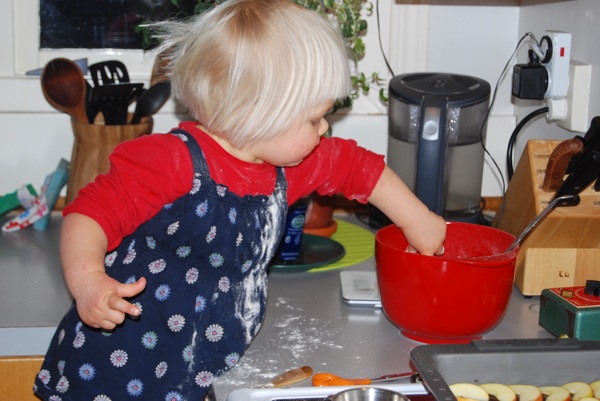
Earlier this evening, Eric was baking a cake, and Ingrid was overseeing the process: watching everything, trying a bit of apple, tasting a pinch of flour, poking at the whisks and bowls.

It was late for her (past 7 o’clock) and she was getting a bit tired and hyper. Which probably explains why she suddenly grabbed our largest and sharpest kitchen knife (which Eric had put down a few minutes earlier) and started swinging it around, as carelessly as if it was a wooden spoon.

Eric had been standing right next to her. He jumped back with a big yell and shouted at her. “Ingrid, put the knife down!!!”

Which she did, quite calmly. Then over the next 5 seconds reality sank in. She had been yelled at! Ingrid realized that things were serious, and that Eric had been really frightened and angry. She became very very frightened herself. Her mouth trembled, her face went red, and tears welled in her eyes. Then she broke down sobbing and crying. Eric picked her up to soothe her, but the more she had time to think, the more upset she became. After a while she just sat in my lap and (barely able to get the words out through her sobs) asked me to sing to her. “Lau… Lau… Laulame! T… Trollmor!”

We sang a lullaby, and then we sang some more. And by the time Ingrid had started to calm down, she was so exhausted that I took her straight to bed, and she didn’t object at all, even though it was an hour before her normal bedtime.

Hopefully, a lesson learned: People get angry when you wave a foot-long piece of sharp steel in their face.

We invited our next-next-door neighbours for coffee and cake this afternoon. Their younger daughter is in Ingrid’s group at nursery, and we’re hoping that they will become friends, once they are old enough to actually make friends, and spend lots of time playing together.

Since Ingrid was familiar with both the girl and her parents (and probably the older sister as well), she was not at all shy with them, as she normally is with guests. Instead she started showing off: someone mentioned singing, and she burst into song (“Nyss så träffade jag en krokodil”) followed by another song and then another, and she very much enjoyed the attention.

There wasn’t much playing together this time. In fact there wasn’t much playing at all: instead they spent a lot of time listening to the mother reading, and some time eating (and aping each others’ monkeying around at the table) and drawing. Ingrid was a bit possessive about her stuff, reminding us that the pens were hers, and the jigsaw puzzle that the other girl looked at, but she didn’t object to others using her stuff.

The guests left at 5, after about 2 hours. Ingrid fell asleep a quarter past 6, which is, I think, the earliest she’s ever gone to sleep without being ill. All this socializing must have really exhausted her. Now I hope she won’t wake at 6 tomorrow morning.

Speaking of sleep, I’ve had to reintroduce a kind-of-fixed bedtime for Ingrid. For quite a long while we had nothing of the sort. When she got tired in the evening, she said so, and went to bed. Now she doesn’t. There are so many things she’d rather do (especially read books) that she can easily stay awake until 9.30, and then be really tired and grumpy when she’s woken around 7 the next morning. Sometimes she didn’t even wake when our alarm went off, and slept until 7.30, and was still tired. So now I start steering her towards the bed sometime around 8.30, to have her in bed by 8.50, and asleep by 9.15–9.30 or so. I don’t like this in principle (I would rather she learned to manage her own sleep) but I like it in practice. The mornings are far more pleasant this way.

I think it may be because she’s again hovering between needing and not needing her daytime nap. If she doesn’t nap, she has no trouble recognizing her sleepiness in the evening. If she does, I need to tell her to go to bed. But at the same time she can’t really manage a whole day at nursery without a nap. Some weekends, yes, but she’s often more active at nursery than at home.

Language remains in focus here. Ingrid’s definitely picking up a lot of grammar now. She’s got the hang of both tense and person for verbs: mina söön, sina sööd, meie sõime, tahan süüa. She can do singular and plural forms of nouns in both Swedish and Estonian (as long as they’re not irregular) and knows that adjectives should change in accordance with the noun. In Estonian she’s learning noun cases: siin on emme, otsid emmet, annad emmele, emmega koos.

One thing she has not figured out yet is pronouns. Or rather, she can say “you” and “I” in both Swedish and Estonian – but she doesn’t understand how they work. She always says “you” about herself, and “I” about whoever she’s talking to. She seems to treat pronouns as names: “mina” is another word for “emme” and “jag” is another word for “pappa”, and “sina” and “du” is her name in Estonian and Swedish. I found it quite confusing initially, until I got used to switching viewpoints all the time.

H: Do you want to put on your boots yourself, or shall I help you?
I: You will do it.

Meaning: I can do it myself.

She comments a lot on what she’s doing, what she’s about to do, what she sees us do, how things ought to be done (“nii tehakse”, “så gör man” – “this is how it’s done”), and what she wants to do. She even comments on things she’s saying: “Du sa ’emme’” – “You said ’Mummy’”.

She expresses her wishes quite articulately now, if not particularly politely: instead of “nej inte” (“no will not”) she now says “ei taha” (“don’t want to”), and instead of “mera läsa!” (“read more”) she now tells me “üks lugu veel, ja siis aitab” (“one more story, and then it’s enough”). It’s like hearing an echo, because that’s what I tell her every evening when bedtime is approaching. Some other expressions definitely don’t come from us: “Nej, sa jag!” (“I said, no!”) must be something she’s picked up from nursery.

When there’s something she doesn’t want to do, or doesn’t want us to do, she tells us it can’t be done. I ask her to put her boots on, and she says “Du kan inte!” (“You can’t do it!”). Or, when she wants me to help her put on her leggings in the morning, and I suggest that she ask Eric instead, she tells me “Men pappa kan inte!” (“But daddy cannot do it!”). I guess she’s echoing what she’s being told all the time. When there’s something we adults don’t want her to do, we tell her she can’t do it. I try (when I remember) to say it as it is – “I don’t want you to play with this” – but I guess we still say “you cannot play with this” often enough for her to mimic it.

We count quite a lot, which is both fun and practical. I can now tell her that she gets three pieces of candy, and then we count them out together, and there’s no argument about getting more. I find that predictable, easy-to-explain rules like that work quite well with her. “I cannot carry you home because you’re too heavy. You can sit on my lap when we get home.” or “You cannot put that juice bottle in your bag. We need to go to the till first and pay for it, then you can put it in the bag.” She accepts rules.

As planned, I’ve started demanding more Estonian from her. When she talks to me in Swedish, I either say nothing, or just “hmm”, or ask her “what’s that in Estonian?”, or repeat whatever she said but in Estonian. (The choice depends on the situation, her mood, my mood, etc.) It’s worked quite well: she understands what I’m after and doesn’t mind repeating herself in Estonian. I have the impression that she is speaking more Estonian to me now spontaneously, and today at playgroup one of the mums commented on how much Estonian Ingrid is speaking.

Speaking of language, Teletubbies and Miffy have now been joined by Naksitrallid. She liked the look of the DVD box, and the sound of the word “naksitrallid”, I believe. In any case one day she wanted to see the movie. I didn’t expect her to like it at all. It’s kind of avantgarde for a children’s movie, and there’s almost no music, and some scenes should be kind of scary. But she really liked it. There’s no accounting for taste!

More physical activities include painting and play-do, and messing around with glue. I bought a pair of kids’ scissors and she’s learned to use those, better than I had expected. (And now she shouts out “You will fetch your own scissors!” whenever she sees I’m about to cut open some packaging.) She’s started practising using a butter knife and a table knife, too, but those are hard, because the butter is hard, and the food is often slippery. The dishbrush and the toilet brush are also very popular tools.

As for eating, her appetite still comes and goes in huge waves. Last week she was hardly eating anything (her breakfast might consist of three grapes and a square inch of bread). Then last Saturday she wolfed down two large pancakes for lunch and asked for more, and her appetite hasn’t waned since then.

Potty accidents keep happening at an average rate of one per day, especially in the evening. Often she can manage an entire day in nursery (or even at playgroup, including a train trip there and back) but then create a puddle or two in the evening. Frustrating, but I’m getting resigned to it and it bothers me less than it used to, even though it’s now been going on for months.

The end of breastfeeding led to an increased need for cuddling and touching. She became very fond of putting a hand on my chest, as close to my boobs as possible (meaning, as close as I would let her). Mostly it doesn’t bother me (I just remove her hand when it starts to wander too far). There was a period when she wanted to keep her hand on my chest all the time while falling asleep (and occasionally at night too), which got to be too much for me, so now my neckline is off the limits at night.

The one thing I miss from my pre-child days are the lazy Sundays. The days when I felt like doing nothing much at all – perhaps because the weather was gray and wet, or because I was tired, or just because. Days I spent in the sofa, reading, only occasionally getting up for a quick meal.

Now with Ingrid there’s no chance of more than 10 minutes of peace and quiet, unless she’s asleep, or Eric and Ingrid both leave the house. Otherwise she’s always wanting me to read a book, play with her, watch Miffy with her, endlessly. If I insist that I want to rest, she tells me she wants to rest too, and lies next to me on the sofa – for all of a minute, after which she gets restless. She’s not fond of lazy do-nothing Sundays. I guess it’s something one learns to appreciate after a certain age.

This month’s big news is that we’ve finished breastfeeding. We took it slow and easy (almost 6 weeks from decision to completion) so it wasn’t much of a struggle but Ingrid still misses it occasionally. Early December I cut out breastfeeding from the afternoon we’re-home-from-nursery cuddle session. Then a week later I told her that she would not get to nurse in the evening when she goes to bed. Then in mid-December she was sick with a high fever, and so miserable that I relented and let her nurse in the evenings again. Around Christmas I took that away again. Once that happened, she also became less interested in nursing in the morning. Partly because nursing once a day was not enough to keep the supply up – and partly because she was happy and rested each morning because she wasn’t woken by an alarm.

Food goes in the mouth!

One day I told her that there was no more milk, and she accepted it pretty well. “Ingrid eaten it! In the mouth! And then the tummy!” she told me. She still talks about milk and boobs almost every day, though. Some days she asks to nurse and I remind her that there’s no more milk. She confirms: “Piim sai otsa. I Ingrids magen!” (“Milk all gone. In Ingrid’s tummy!”) Other days she just tells us, randomly in the middle of some totally unrelated conversation: “Pappa ingen tiss. Ingrid ingen tiss. Bara emme tiss, bara emmel on piim!” (“Daddy no boobs. Ingrid no boobs. Only mummy boobs, only mummy has milk!”)

That last quote is pretty representative of her liberal mixing of Swedish and Estonian. When talking to me, she almost always uses both languages in one sentence, even when she knows all the necessary words in one of the languages. Some words have always tended to always come out in Swedish, even when she’s generally speaking Estonian, and vice versa. But in general Swedish now dominates. She always speaks Swedish to herself, and often to me, too. I prompt her – “What’s that in Estonian?” – and generally she’s able to find the words, but in the next sentence she’s back to Swedish.

Now that she’s generally speaking well and confidently, I’m starting to sometimes ignore her when she speaks Swedish to me, waiting for her to repeat in Estonian. When she was younger I was happy when she spoke any language, but now I think she’s got a solid enough foundation, and I can be a bit more demanding.

It doesn’t help that she’s still very fond of TV (Teletubbies has now been complemented by Miffy) and spends about an hour in front of the screen every evening. That’s all in Swedish, which means we spend much less time reading Estonian books or singing Estonian songs. We’ve also lost our bedtime stories: she now prefers to lie quietly in her bed, next to me. Every evening I ask if she wants a story, but no, she wants me to lie down. Which means even less Estonian exposure.

And the books affect her language a lot. She’s often quoting Miffy or Alfons or something. Miffy is actually quite good for this, because unlike Teletubbies this movie uses proper grownup language. I think that (plus the novelty value) is why she now prefers it to Teletubbies.

When she isn’t quoting movies or books, a lot of her conversation has been small stories about sequences: of things that have happened, or things that tend to happen, or things that she intends to do.

Du ramla i sängen. Och så gjorde ont och du var ledsen. Och så hüüad Emme! ja emme tuleb. Siis emme sülle ja on parem.
You fell down in the bed. And it hurt and you were sad. And then you shout Mummy! and mummy comes. Then sit in mummy’s lap and it’s better.

or

Emme gå till jobbet. Pappa och Ingrid gå till dagis, och sen pappa gå till jobbet. Emme [???] eftermiddag [???] dagis och sen emme och Ingrid hem.
Mummy go to work. Daddy and Ingrid go to nursery, and then daddy go to work. Mummy [???] afternoon [???] nursery and then mummy and Ingrid home.

Ingrid’s current favourite activities apart from TV are jigsaws (still going strong), hide-and-seek, and cooking. She got a toy stove for Christmas, together with an assortment of pots, pans, spoons, and toy food. Apart from jigsaws, that’s the toy she uses most, by far. The toy food is a set of sandwich parts – bread, slices of egg, cheese, ham, tomatoes etc – all with small pieces of velcro so she can assemble a sandwich and play with it without it falling apart. And the sandwiches are just large enough to fit nicely in the pots and pans.

Food not done yet

She potters around with her stove, making hot sandwiches: assembles several sandwiches, puts them in pots, then into the oven. Closes the oven, tells us that the food is not ready yet, and then reports that it’s time to check if the food is hot, and finally serves it to us or to her doll.

There seems to be no end to Ingrid’s interest in jigsaw puzzles, so we keep adding to her collection. Occasionally she still plays with her cube puzzles, too, but one’s almost too easy and the other one’s a bit too hard. She’s more interested in the jigsaws, anyway – and becoming really proficient, because she gets lots of practice.

She likes re-doing the same puzzles, unlike adults who generally do a puzzle once and then put it away and go on to the next one. With Ingrid it’s the opposite: the first time is less fun, and she needs a lot of support. Then she learns what the picture looks like, and how to look at each piece, and plays with it much more independently. After a while she knows the puzzle by heart, but that doesn’t diminish her enjoyment. She still likes assembling the farmyard picture, which was her first larger jigsaw (20 pieces), and she’s had it for almost two months. Some evenings she can assemble it four or five times, turning it over to begin again as soon as she’s finished. I think it takes her no more than a few minutes now.

Surrounded by puzzles

But she does more than just memorise the puzzles. She has now learned the difference between edge pieces, corner pieces and middle pieces. She’s learned how to try different orientations when a piece should fit but doesn’t. And she’s learned to actually think about what she’s doing. It used to be that she grabbed a rather random piece and tried to put it somewhere random. If it didn’t fit, she tried something else. Now she looks at the puzzle, sees that she needs a piece of a flag, and looks for it – or takes a piece, checks if it’s something she recognises, and then tries to find a place for it. Great cognitive training! Plus it’s patience training, too: “Det är svårt! Den passar inte! Prova en annan bit.” she says to herself. (“It’s hard! It won’t fit! Try another piece.”) Her newest, largest puzzle has 48 pieces and last time it took her three or four evenings to finish it.

When she’s in the mood for something slightly more actively social, we play hide-and-seek (and it’s real hide-and-seek now, not like last month). It seems to be a favourite game at nursery, too: several days now when I’ve asked her what they’ve done, she tells me they’ve played hide-and-seek. At home at least, it’s almost always her counting and me hiding. She very much likes counting to ten, and she likes finding me, but she hasn’t quite understood how to hide, and mostly looks a bit confused when we try and switch roles.

Hide-and-seek actually has three roles, not two: in addition to the hider and the seeker, there’s the hinter. Ingrid’s patience and especially her imagination are still quite limited, so if she doesn’t find me within a minute or two, she gets confused and gives up. She hasn’t figured out the concept of looking again, more carefully: if she doesn’t see me at first glance, she concludes I can’t be there. That’s where the hinter comes in. “Could emme be in the bathroom? Go look in the bathroom again. Not there? Go look in the bedroom,” Eric says. That way I can find a slightly more interesting hiding place than just round the corner, and the game lasts a bit longer. When it’s just the two of us playing, it’s almost enough for me to go to another room, and some part of me needs to be immediately visible (like a foot sticking out from behind the sofa). When we have Eric as a hinter (or vice versa) I can hide under a sheet in the laundry room, etc.

Speaking of counting, she’s now also understood for real how to use numbers to count things. For quite a number of months she’s been able to tell me when there are two of something, but not beyond that, even though she could name the numbers beyond two. I think it’s because she could see “two” at a glance, without needing to count. Now she actually counts things, pointing at them with a finger. Occasionally the finger goes too fast and she touches two items for one count, and sometimes she loses track and skips an item, so quite often she reports having four fingers on a hand, but she’s definitely grasped the general principle. (For a short while the fingers were often six: she’d count them – one, two, three, four, five – and then loudly announce, SIX!)

It may sound like we spend all our time with pedagogical exercises and educational activities. We don’t. It’s just that Ingrid enjoys learning. One of us thinks “wouldn’t it be interesting to see what she thinks of X”, and we discover that she really enjoys X, and in the process of playing with X she learns stuff. One day Eric thought, wouldn’t it be interesting to see if she can understand the difference between left and right. It turns out that she could, so now she knows that as well. Other times we discover that she doesn’t enjoy X at all, so we forget about it and do something else.

When we need something more energetic, we wrestle and tumble and twirl. She’s too heavy for me to swing her by holding onto her hands, but I can still twirl her around that way. Or she runs in circles around me while holding my hands. Her goal seems to be to make herself as dizzy as possible, without falling down, which is why she wants to hold on to me: otherwise she reaches the falling-down stage much faster. My tolerance for twirling has improved massively over the last half-year. Still, she could keep going far longer than me, and then collapse in a heap of giggles.

She’s developing a giggly sort of sense of humour. I’m sure she’s had a sense of humour for a while, but it has been quiet and understated. Now there’s a lot of bubbly laughter, cheeky faces, and general monkeying around. She enjoys tickling, and making funny noises and faces, and silly games like me pretending to eat her toes and fingers.

To a man with a hammer, everything looks like a nail.

To a girl with a fascination for jigsaw puzzles, every toy looks like a jigsaw puzzle.
A plastic Rush Hour game? – Try to fit all the cars on the board, in neat rows.
Blister pack with toy food made of rubber? – Take the pieces out and then try to fit them back into their little shaped slots.
Set of six soft furry animal-shaped bowling pins? – Take them out of their bag and then try to fit them back in again.

… I went through the last two bank statements (6 months’ worth of transactions), the pile of DVDs on my desk, about 50 blog posts from the “to process” list, and a few loose papers.

In other news, Ingrid’s finally well again but had her crankiest, whingiest day in recent memory. Nothing was good, everything was no no no. Probably because she hasn’t had a proper meal since Monday… When she gets too hungry, she gets stuck in a vicious circle: her mood becomes so unstable and contrarian that she will even say no to food, just because she’s in a bad mood. This time a handful of grapes broke the circle and after that she was as happy as ever.