The weather is chilly now, but the first half of this past month was still summery, and we spent a fair amount of time outside. Picking damsons was a favourite: Ingrid especially liked shaking the bush to make the damsons fall. It was particularly great if they fell on me or her. But picking the fallen fruit was also good fun.

We’ve also played in the play house that Eric built. Ingrid’s favourite use for it is a throwing platform. She climbs up, I stay outside, and then we throw a big inflatable ball between us. The play house makes it very easy: since she’s standing above me, she is throwing slightly downwards and has a good view of me, the target. And when I throw the ball back at her, the walls make sure the ball doesn’t roll past her.

She also likes riding her tricycle (to and from the playground, or Julia’s house). Practice makes perfect: she’s gotten quite good at controlling her speed. She used to need help braking when going downhill, but now she can ride it down good-sized hills at considerable speed, and push back against the pedals to brake when it goes too fast.

In general she’s gained physical control and confidence recently. She used to always want to hold my hands when jumping down (from a ledge, or a stone, etc) but the other day she jumped down from a knee-high step (my knee, not hers) without any help at all. The same goes for stepping across wide gaps: between the balance beams at the playground, or the big flat stones in the pond in our park. I think she’s running better, too: it looks slightly more balanced and less toddlerish.

Running, of course, means chasing. Our latest chasing game is the troll game. Usually she’s a troll and I am to run away from her. Sometimes she wants to be an angry troll, which means that I should run fast enough so she cannot catch me. Other times she says she’s a friendly troll, meaning I should let myself be caught. But in either case, and regardless of which of us is the troll, the most important part of of the game is that the chasee should frequently look over her shoulder to see how close the troll is. This leads to a fair few falls: I think Ingrid has entered the age of ever-present scabs on knees and elbows.

Ingrid remains intensely social. Yesterday she told me, “I don’t want to go home. I don’t want to be alone. I want my friends, too!” So I try to find her a playmate for at least a few afternoons each week. Julia is her best friend (and lives closest to us) but Ingrid’s found another favourite at nursery whom we’ve also visited a few times. I’ve asked if there are others she’d like to play with, but she says no, she only likes Julia and Elin.

They are definitely playing together, but it’s mostly limited to simple, physical activities. They might run to the trampoline and jump together, and then run to the see-saw together, and from there on to somewhere else. I haven’t seen any playing with toys together. I think it might be because both Julia and Elin are younger than her, and less used to playing together with others.

Sometimes “let’s go play with Julia” just means “let’s go to Julia’s house” and ends with us reading Julia’s books. I think we might start going to the library with her. Her Estonian feels solid enough that I’m happy reading to her in Swedish now.

At home, the doctor’s equipment set remains Ingrid’s favourite toy, by far. Other toys get occasional brief use, but not very much. She wants to play doctor every single evening. It’s become a set piece, almost. First I’m ill and she’s doctor, then we switch, and she’s always got a stomach ache. And when we take her temperature, it’s always fifty-one.

She’s quite interested in how numbers are used: temperatures, measuring, telling the time. She often asks me what time it is, and most mornings she asks me what day it is. Then she wants to know what that means: what do we do when it’s Tuesday, what do we do when it’s seven o’clock? Is it a weekday (“nursery day”) or weekend (“home day”)? Do we have anything special planned for today – is this the day when we go play with Elin, or the day when I need to work late? Sometimes we go on to hypothetical cases: she tells me “no, it’s half past eight! What’s it time for now?”

Turns out she’s learned to recognize numbers, too, even though we haven’t spent much time looking at them. This Sunday at the Estonian nursery she found a wooden number puzzle, with one piece for each number from zero to nine, and each number’s place was indicated by that number of things: there was one snake in the slot for number 1, two rabbits in the slot for 2, and so on. She got almost all of them right at first try (but 6, 8 and 9 were a bit tricky).

Another subject of fascination is buttons – the kind you press, not the ones on clothes. She likes pressing the buttons to make the traffic light go green, and doorbell buttons, too. But she also finds pretend buttons in all sorts of places: on lamp posts (to make the light go on), on her bike (to make it go), on playground equipment (to make the light go green, so she can go on and play).

And phones: she makes many phone calls on the toy phone they have at nursery, and on mine. She can repeat my side of the most important conversations (the ones where I call Julia’s mum to ask if Ingrid can come play with Julia) almost verbatim.

When she’s done that, she seems to believe that she really has called Julia’s mum, and insists that I don’t need to call, she’s done it already, and Julia’s mum has said yes. The border between truth and fantasy is fluid. When we play doctor, she is well aware that it’s make-believe sickness and make-believe medicine. But when she talks about things that aren’t physically present, she makes no difference between things that really happened, and things she has made up because she wishes they were true.

Somewhat related, I think, is her interest in what other people are thinking. When we pass someone in the street, who’s doing something noteworthy, she will ask me: where is he hurrying? why is she running? what are they talking about? I tell her I don’t know, but he might be hurrying to the train station, or to the market; and she adds her own guesses.

In general she’s asking more complex questions now. It’s not just “what is this”, “where is the spoon” and “can I play with this” but also “which station do we get off at”, “what did you just ask daddy”, “what is a folding rule” etc.

Speaking of questions, she’s already learned that when a stranger talks to her, they will inevitably ask for her name and age. So when someone asks a question that she doesn’t quite hear or understand, she will attempt to answer one of those known questions, and tell them her age or her full name. (And she knows her full name, with all four parts in the right order, too!)

There’s a fair amount of focus on her being a big girl and helping me. And the reverse, too: sometimes she tells me she is a small baby and needs help. Sometimes when we’re eating fruit (such as raspberries) she wants to feed me, or vice versa ask me to feed her. Sometimes she tells me that when she was a baby she drank milk from my breasts – and other times she tells me that she’s my mum and I used to be small and drink milk from her breasts.

She understands that children grow bigger, and then they go to school, and then they grow into adults. When asked, she can tell me that girls grow into mummies and boys grow into daddies. But I don’t think she’s quite understood it yet:

Kui mina suureks saan, siis saab minust emme. Ja kui ma veel suuremaks saan, siis saab minust pappa.

When I grow up, I will be a mummy. And when I grow even bigger, I will be a daddy.

Favourite books: Alfons, and Kringel (one of Eric’s old books), and Palle üksi maailmas. Favourite movie: Leiutajateküla Lotte.
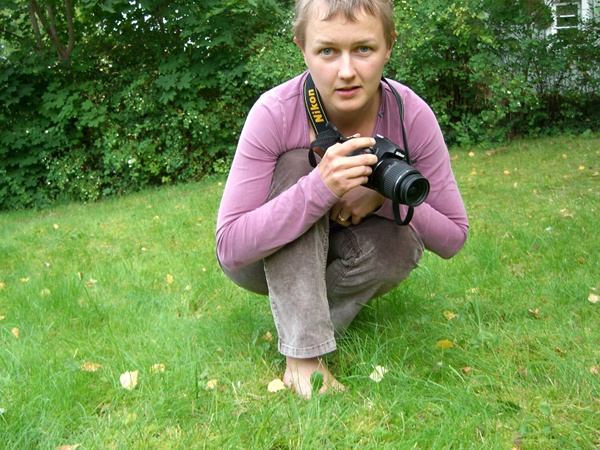
I don’t seem to be doing anything interesting recently, and can’t seem to find time to write reviews for all the books piled up on my desk. So instead of text, here’s a photo that Ingrid managed to take of me. We were out in the garden, with me photographing some of the mushrooms that have popped up here and there. Ingrid wanted to take photos, too, so she borrowed my pocket camera.

I cannot have been particularly diligent when taking notes for this month’s Ingrid update, for as soon as I had posted it, new things came to mind that I wished I had written about.

Such as the fact that Ingrid now likes ice cream. She used to find it too cold – happy to lick a spoon dipped in mostly-melted ice cream, but not actually eat it. Now she’s not exactly wolfing it down, still mostly licking the soft edges, but definitely appreciates it. Ice cream has displaced candy; she hardly ever remembers to ask for sweets now.

Or our continued enjoyment of drawing and writing together. As before, we begin by me writing a short word for some common object. She then spells it out and asks me “Mis see kokku tuleb?” (“What does that make?”). I draw the object, slowly, and as soon as she sees what it is, she shouts out: “Auto!”.

This month she’s actually learned to recognize two of the simplest words, puu (tree) and kuu (moon) – she shouts out the word before I’ve begun to draw it. So I make sure to draw at least one of those every time. I’ve tried suu (mouth) as well but it’s hard to draw a recognizable mouth without a face around it. And I’ve tried uss (snake) but she doesn’t recognize that one yet, and definitely none of the four-letter ones. I’ll have to find more three-letter words somehow.

Oh, and today I saw tooth #18 appear as well. Number 17 was a molar on the lower right, and this one is its left-hand companion.

Current favourite movies: Wallace and Gromit, and Kalles klätterträd. There’s no clear favourite among books, but we read a lot of Villi, Kuula! Kuula!, and Rongisõit, and in Swedish Stora vinterboken and Visst kan Lotta cykla.

I think I am detecting faint stirrings of independence in Ingrid. She has been very attached to me for a long time, almost always choosing me ahead of any alternative. When the choice is between doing something boring with me, and doing something fun with Eric, she chooses me. When the choice is between playing on her own, and waiting for me to finish something I’m doing, she’ll hang by my side and wait. Whether at home or out on a playground, all activities start with “emme tule!” (“mummy come!”).

When I’m not available (when she’s with Eric, or at nursery) she’s perfectly capable of amusing herself. But when I’m there, all independence disappears.

She’s usually more independent just after eating (something to do with blood sugar levels?), and late in the evening. When the choice is between brushing teeth and going to bed with me, or playing on her own, she actually prefers playing!

But in the past few weeks, I’ve seen her play on her own for short stretches of time. Nothing long, maybe 5 minutes at a time, but more frequently than she used to. And out at the playground she’s gone off on her own without dragging me with her. I’m really curious to see whether this is just something I’ve imagined, or if it’s the beginnings of real change.

Ingrid’s also more aware of age and growing up. We’ve been talking a lot about babies and big girls this summer. We talk about how babies come from their mummies’ bellies, how they cannot chew or walk or talk, only sleep and drink milk from their mum’s breasts. We talk about how she used to be a baby, but isn’t any longer.

Sometimes she wants to be carried like a baby (which is hard with a 15 kg kid!). Other times Ingrid says she’s a big girl. She doesn’t know much about what big girls do – I’ve never used “big girls [don’t] do X” to encourage or discourage any behaviour. The only thing she knows about big girls is that they go to school. So she regularly tells me that she’s a big girl and will soon go to school. I try to explain that she’s got several years of nursery ahead of her still, but it’s not registering.

The “I don’t want anything!” episodes from last month are far fewer now. I think it’s Ingrid’s new, more verbal way of expressing general dissatisfaction with life, instead of just crying. By far the strongest trigger for these is hunger / low blood sugar. First thing in the morning before breakfast, her mood is very labile. She desperately needs to eat, but since she’s so anti-everything, it’s hard to get her to eat – she loudly claims she does not want to eat. The same happens if we have too long a gap between meals for some reason, or when she’s overtired.

A stranger would see her act out and think that she’s just trying to get our attention, and then perhaps just ignore her, wait for the mood to pass. But those moods can easily spiral, and if we ignore them, they can go on for a long time. When the cause is hunger, the resolution is usually to soothe her with whatever form of closeness she will accept (cuddle, or let her crowd onto my side of the table, etc) and then coax her to take a bite. Then I can detach myself from the cuddle, and the rest of the meal passes smoothly. When she’s overtired, it’s harder, but we’re quite good at spotting her tired signals so we usually nip it in the bud. There was one evening when she was too tired to want anything, not even sit or lie down, which culminated with her spending a good 15 minutes standing in the bedroom, unable to stop screaming. For all our sakes, we make an effort to avoid a repeat performance.

Speaking of eating, she seems to have learned the concept of portions. It used to be that we’d serve her some amount of food, and she’d eat some of it and leave some. Or she’d eat all and want more, and then leave some of the 2nd serving. Now she’s more likely to stop exactly when her plate is empty, even when she hasn’t decided how much was on the plate to begin with (although she often does). When I offer her more food, she declines. Interesting.

Favourite toys this month: her doctor’s bag, and her play food. We play doctor almost every day. “Emme sina oled haige!” she tells me (mummy you’re ill) and proceeds to listen to my foot with her stethoscope, poke at it, shine her tiny torch on it, take my temperature and give me injections and medicine.

With the toy food we have picnics where she serves me cake and fruit and juice, or cooks soup for me. It’s amazing how many variations on this theme she can perform before she gets bored.

We play word games. We rhyme: Ingrid pingrid! Maja paja! Auto pauto!. And we make up words: Jag tar mina höstskor. Höstskor… grässkor! molnskor! bajsskor! (“I’ll take my autumn shoes. Autumn shoes… grass shoes! cloud shoes! poop shoes!”)

She’s also started making things up.

I: Look mum, I have no hands.
H: Oh, no hands! Where did the hands go?
I: They’re in the cloud.
H: What will the cloud do with your hands?
[etc]
I: I got my hands back now.

While it was still summer, we spent many afternoons at the beach. Ingrid got to splash and jump and carry buckets of water around, and swim with her arm floats. After a few times our beach outings settled into a fixed pattern, and the process itself was as important to Ingrid as the actual swimming. The picnic food, and the stuff we’d pass when cycling to and from the beach, and of course the ice cream.

The ice cream kiosk at the beach sells nice scoop ice cream, not just the cheap-tasting pre-wrapped kind. We ate some every time we were there. Outside of the beach season we’ve had a rule that we only eat ice cream on weekends. This Saturday Ingrid selected an ice cream for herself at the supermarket, but left most of it – I don’t think she liked the taste much, after having tried the good stuff.

PS: This evening while brushing her teeth I spotted tooth #17 making its way out.

Most of this month was happy and contented. But suddenly something changed, and the last few days have been less than fun. For a few hours everything is OK, and then suddenly Ingrid is unhappy about just about everything. I say it’s time to eat. She cries “I don’t want to eat!” I say “OK, you don’t have to eat.” She cries “But I want to eat!” I say, “You can eat or not eat, whichever you want.” She cries “I don’t want anything!” (“Ma ei taha mitte midagi!”) Even things I know she wants and likes get the same response. I’m sure it’s a phase, but I sure do hope it’s a brief one. Or perhaps it’s the heat.

Half of the month was spent in Estonia. And the experience did wonders to Ingrid’s language skills. At first she would mostly speak Swedish, and then be reminded by people around her that they didn’t understand her, after which she would try to repeat herself in Estonian, and I would help her out. After a week she was speaking Estonian almost all the time (only forgetting where she was first thing in the morning) and fluently. She now speaks Estonian more freely, has a bigger vocabulary and better grammar, and overall a more Estonian pattern (word order, sentence structure etc) when she speaks Estonian.

Our vacation in Estonia was also fun because she had playmates almost every day. Two of my childhood friends both have kids who are just a few months older than Ingrid. One of them lives in the building across the street from my father’s place, so we spent a lot of time together. Katariina may be only a few months older, but she’s more than a few months ahead of Ingrid, so it was an inspiring experience for Ingrid. She learned to play doctor, and shopping. She now has a doctor’s bag of her own, and has used it every day I think.

Both children had birthday parties while we were in Estonia, so we’ve also had a lot of pretend birthday parties, with a wooden chocolate cake and lots of fruit. Mostly it’s Ingrid’s birthday but sometimes I get to have one, too. The cake is one of those where the pieces attach to each other with velcro, and you can cut them apart with a little wooden knife. Ingrid’s long been fascinated with cutting (probably because she sees me do it so often) so she’s really enjoyed that. And today we discovered that a ripe watermelon is perfect for cutting practice, with a table knife.

Another favourite game is what I think of as the contrarian game, or the lying game. We might be looking at a page in a children’s book with all the different colours. She then points at each one and says “Black. Black. Black.” about all of them. Or points at red and says “green”, and so on (and if she accidentally says the right colour, such as “red” for a red thing, she stops, thinks, and “corrects” herself). Or perhaps we’re looking at pictures of animals, and all of them are cats. Or we’re eating dinner and she starts asking us: “Is that milk? Is that milk? Is that milk?” about everything but the milk.

Tartu had a lot of good playgrounds, with far more interesting stuff than we find at playgrounds around here, especially many more kinds of structures for climbing and balancing. Ingrid did some climbing but was more interested in balancing and swinging. She found a few swings that were just the right height for her to hang on, so she did that a lot. Plus she stomped a lot of sand cakes.

Ingrid’s interest in story books has declined somewhat. Instead she’s been much more interested in counting, and in learning to read. There was a lovely animal book at my father’s place, which became a counting toy for Ingrid. “Let’s count the antelopes. Now the zebras. Now the gnus. Now the elephants.” And so on. She’s good at counting now, rarely skips objects, even when they’re in an irregular bunch. Only sometimes does her finger move faster than her mouth, so while she touches, say, seven animals she only counts six.

The same book had headings with big bold capital letters, which we would read over and over again. Ingrid knows all the common letters but cannot make a word out of them, so she spells the word and I tell her what word the letters make. It’s good practice; as with counting, she very rarely loses her place and can spell very long words (such as Emajõe ärikeskus) without a single mistake. Sometimes she thinks she knows the word and pretends to read it, slowly dragging her finger along the word and slowly saying the word. Occasionally it’s right and other times it’s something completely wrong.

On the housekeeping side, we have had very few potty accidents (to the tune of one per week, and then mostly due to some special circumstance). The nighttime nappy is still almost always wet (and I think that’s why she gets restless and half-wakes around 6.30 to 7 in the morning, but I’m usually too sleepy myself to remember to ask her whether she wants to go potty). But after daytime naps, it’s almost always dry, so I’ve stopped insisting on it, and just sneak a folded towel underneath her when she’s fallen asleep.

We spent Sunday afternoon at Oliver’s three-year birthday party, out in the countryside. Ingrid met mosquitoes for the first time in memory, as well as stinging nettles, and was not happy about either experience. She also fell face first onto the arm of a wooden chair while climbing on it, hard enough for a big bruise. I think the other guests will remember her as “that kid who was screaming all the time”. Ingrid, on the other hand, will probably have more positive memories. She might remember the singing potty, or the digging in the dirt, or the book about Little Red Riding Hood with all the movable parts, or all the incessant snacking.

(By the way, she’s gotten used to mosquitoes by now and swats them away with barely a comment.)

Monday we were my father’s country house and it did not go too well, so we’ve been in Tartu since then. Unfortunately this has coincided with a heat wave, and Tartu lacks Stockholm’s wading pools, so I’ve really struggled to come up with things to do. We’ve ended up spending a lot of time with Rahel and Katariina, mostly on various playgrounds and at their place. Katariina is just that little bit ahead of Ingrid (in age and in development) that Ingrid is really interested in anything Katariina does, and likes to follow her around and copy her actions.

Something I forgot to mention in my monthly post: my losing battle to keep Ingrid’s Estonian skills alive. The better she becomes at Swedish (and she is speaking very well now), the bigger the gap between the two languages, and the more likely she is to choose Swedish.

As the dialogue example shows, even when I speak Estonian to her, she often responds in Swedish. I used to prompt her for the Estonian equivalent, but I keep forgetting – after all I understand Swedish so well that it’s hard for me to ignore and pretend to not understand it. The best I manage is to respond with the Estonian version of what she just said.

She rarely uses an Estonian pattern in Swedish, but when she does speak Estonian she often slips into a Swedish pattern. “Emme mul on vaja üks lusikas” (Mummy I need a spoon) instead of “Emme mul on lusikat vaja”. And I think I can detect a hint of Swedish sound and melody when she speaks Estonian – she is developing a foreign accent.

I hope our upcoming 15-day visit to Estonia is enough to stem the tide for a short while.

After last month’s lack of attention, I’ve been taking notes. Not only does that help me remember the things I want to write about, it also brings out the recurring, dominant themes: language and social interactions.

Language, then. On the grammar front, she’s got a grip on first- and second-person pronouns now. She figured out du and jag in Swedish first (last month already, but I forgot to mention it then) but kept saying them the other way round in Estonian. Then a month later she got the Estonian pronouns, too. Third person pronouns are tricky – it and they are not a problem, but she mixes up she and he (in Swedish only, because Estonian doesn’t differentiate by gender). Part of the cause is, we think, that she isn’t really able to tell the difference between boys and girls, women and men, which means that our labelling people as he and she must seem pretty random to her. The other day we asked her “is X a boy or a girl” about other children in her nursery group, and the answers were near random. Same with the staff – she deemed Sandra and Malin to be mummies, Åsa to be a daddy but Niclas a mummy.

She manages to correctly use a suprising variety of verb forms in Estonian. In Swedish there are more irregular verbs to be grappled with, and it’s clear that she’s aware of the complexities. Sometimes she starts to use a regular pattern on an irregular verb (“jag sågde”) and then gets stuck because she hears or feels that it’s not quite right. Plural forms of nouns have similar traps: bokar instead of böcker, stenor vs. stenar.

Ingrid still likes word/sound games. The neighbour girls have the whole series of Mitt ABC and Ingrid always wants me to read those when we visit them. (There’s one book for each letter of the alphabet, and each book has stuff with that letter.) The books focus on first letters, but when Ingrid herself gets to decide, the important letter of each word is the strong, stressed sound. It’s not R as in raamat but A as in raamat, and O as in kook, Y as in cykel, and M as in emme.

Sometimes she also plays with songs – takes something like Idas visa (Lille katt, lille katt…) and makes it into Lille mus, or Nyss så träffa’ jag en krokodil might become Nyss så träffa’ jag en elefant. The changes are small, often just switching one animal for another.

The social aspects of language are becoming important to her. She’s picking up polite phrases and formulaic expressions, and using them a lot. “Jag tar gärna lite bröd”, “nej tack”, “jag tänkte titta på film”, “jag tycker att det är varmt idag”, “jag ska visa dig en sak”, “hej då vi ses imorgon”. (“I would like some bread”, “no thanks”, “I thought I’d watch a movie”, “I think it’s warm today”, “let me show you something”, “bye-bye see you tomorrow”.) It’s nice (and novel) to hear her ask politely, but at the same time slightly scary to think about how much our everyday behaviour affects her manners, already at this early age.

A few of these things she says without fully understanding them, but in general she’s good at using social language, asking or telling people things – language as a social tool, rather than just a way to express wants (“more milk!”) or comment on her environment (“there’s a big puddle”). There’s a fair amount of talk about yours, mine, and borrowing: “can I borrow your bucket”, “this is mine, you can’t take it, but you can borrow it”.

Unlike both Eric and myself, Ingrid is an extrovert, a very social creature. (It’s hard to remember but I think I was the same at her age. The introversion came later.) She’s never happier than when there are people around her, and she is bored when there aren’t any. Every day when I go to pick her up from nursery, one of the first things she says is “today we will go play with Julia” (the younger neighbour girl).

I: Jag vill leka med Julia.
H: Peab Julialt küsima, kas ta tahab meiega mängida.
I till J: Julia, vill du leka med mig idag?
J: ja
I till H: Julia vill leka med mig idag!
H: Julia on selle üle rõõmus.
I: Jag är också glad! Jag är jätteglad!

I: I want to play with Julia.
H: We have to ask Julia if she wants to play with us.
I to J: Julia, do you want to play with me today?
J: Yes
H: Julia is happy about this.
I: I am also happy! I am very happy!

A lot of the time she still imitates or plays side by side rather than together with others. Whenever there are other kids at the playground, she trails them, and wants to do whatever they do. If they climb the jungle gym, she wants to do the same. If their mom catches them when they come down the slide, she wants to be caught, too. If they swing on a big kid swing, she will, too. If the other kid is a year and a half older than her and stands up on the bird’s nest swing, she will try that, too, even though she’s kind of scared.

Other popular activities: making sand cakes together with me and then happily stomping on them, one by one. “Now they are ready, now I can stomp?” Balancing on kerbstones, ledges, planks etc. Cycling on her tricycle. (The balance bike was quickly discarded – “It’s difficult! I cannot do it.” Perhaps next summer.)

Drawing, too: now it’s not just me drawing for her all the time. She’s more willing to draw herself, and she now draws actual things, not just scribbles and swirls. Sometimes she tries to copy something that an adult has drawn for her, but other times she comes up with her own ideas. Mostly they are relatively shapeless things, but she says they are balls, clouds, snakes, or hot dogs or cupboards. She’s also bolder in her drawings, more likely to draw huge balls that cover the entire piece of A2-size paper. (We bought a roll of cheap paper from IKEA for the easel, and often cut pieces from it for drawing, too.) When I draw for her, she likes to choose the colour for me. I get to draw a lot of purple and pink stuff. When I’ve finished, she likes to colour in my drawing.

Loose facts:

  • Does not like jokes about eating her up. Sometimes she just looks scared/worried, and sometimes she says “No, you cannot eat me!”
  • Likes Bendicks Bittermints, dark chocolate, and liquorice.
  • Does not like having her hair brushed, but no longer objects to brushing teeth, at all.

This month seems to have passed without me noticing. I’m sure Ingrid has changed and grown, but somehow I haven’t had time to pay much attention to it. (Exactly the sort of thing that these blog posts were supposed to help avoid…)

There were a few hard weeks when Ingrid seemed moody and unhappy. Nothing was fun, for anyone. But that now seems to have passed and we’re back to the normal flow of things.

We also had a few weeks when all her potty skills had disappeared, and she went through three changes of clothing every day. Puddles after puddles after puddles. Some days she didn’t even notice what was going on. Other days I could see her getting restless, ask her if she needed to pee. She’d reply NO, very emphatically, and then 10 seconds later pee all over the floor. After a while we started insisting that she go to the potty when we saw that she needed it, and that worked marginally better. And just as we were giving up hope of improvement, and almost starting to think of nappies again, the tide seems to have turned. Today she managed to get through all day in one pair of trousers (until the very last moment, when we were preparing for the night).

Toys are of less interest than ever. The only thing that she has actually played with is the toy stove, with its pots and pans and plates and plastic food. Some other toys get the occasional 5-10 minutes, but that’s it. I am no longer buying her any new toys; it’s a waste of money and effort. We read books instead, cook food together, or go to playgrounds.

Books and movies. Those are the two things she loves. Weekday evenings she gets about an hour’s worth of movie-watching, sometimes one and a half. I generally don’t limit it much because I can see that she’s tired and wouldn’t do anything more active even if I turned the movie off. Weekends we work harder at finding alternative activities: we try to leave the house so the temptation is completely removed. And when we go to Estonia this summer, I’ll be buying lots and lots of new books for her.

Balancing

She used to be so active as a baby. I wonder where that energy went? In part I think the change appears bigger than it is, because I see a more limited part of her life: tired evenings, and weekends. Still, she has definitely changed. Looking back to last summer, I remember us running in the garden, kicking the big beach ball up and down the slopes. Now when I invite her to kick the ball around together, she is usually not interested. I would like her to be more active, but there’s not much I can do. I can’t exactly force her to enjoy running around.

I do try to find physical activities for weekends – playgrounds, swimming pools, etc. Those still work: last time we went swimming, we spent two hours in the pool and only left because they were about to close. And she was working hard and actually swimming much of the time, with her little red armbands. We’ve spent two Sunday afternoons at the Mulle Meck playground in Järvastaden. (Speaking of playgrounds, Ingrid seems to have mastered the art of swinging when standing up, without me pushing her.) We’ve also bought a little Puky balance bike for her. It remains to be seen whether she enjoys that.

Letters and numbers are fun. She can count to 20 in both Estonian and Swedish (although she tends to lose track somewhere around 16, so we often get fourteen, fifteen, eighteen, nineteen, twenty, done! I think she knows some of the number symbols, too: the other day she pointed at a number two and said “two!” without any hints. She knows all the common letters, and likes to point them out. Recently she’s started to pretend that she reads: drags her finger across a chapter heading in a book and slowly says what it says. Or rather, she says the title she remembers, which is sometimes not the same thing. She goes by memory only, and doesn’t seem to look at any of the letters, even the capital letters at the beginning of names. But she is clearly intrigued by the concept of reading.

Play-do

Favourite books: Sipsik, Mattias ja mamma, Sina ja mina, mu väike karuke, and Kuula, kuula!. With both Sipsik and Mattias ja mamma she can sit through entire chapters that are several pages long, with hardly any pictures. When the pictures are too few and far between, I hold the pages so that she can see one side, where the picture is, and I can read the other side, where the story is.

Favourite movies: Kung Fu Panda, various old Mickey Mouse episodes from the 1930s and 1940s, and A Bug’s Life. All in English, so she cannot understand much, except Mickey, where the story is often very visual and quite straightforward. Karu aabits used to be interesting but gets less love now. Teletubbies are pretty much out.

Teeth: 16; no new teeth for almost a year now, I think.
Clothes size: 98, except for tight-fitting stuff where I buy 104 instead.
Shoe size: 23.

Thirty months, two and a half years. I know I keep saying that Ingrid is growing up, and of course it’s hardly news because that’s what all children do, but really I keep noticing how quickly she matures. The patterns of her movement, her facial expressions, all look more like those of an adult than those of a baby.

Life continues on a generally contented, positive path. No major upsets or mood swings. The only thing causing friction is boredom. It is becoming clearer all the time that Ingrid is a social creature, extroverted unlike both me and Eric, and loves to have people around her. She is happy at nursery, happy when we have guests or are visiting other people or at playgroup – and bored and clingy when it’s just the two of us at home.

When we spent the afternoon with Julia (her friend from nursery who lives across the street) and her sister, they played together with her toy kitchen and her balloons and the doll stroller, ran around, chased each other to the bedroom where they jumped up and down on the bed… full of energy.

On a normal weekday evening, on the other hand, Ingrid spends some time watching a movie, ideally with me keeping her company, then some time in the kitchen watching me prepare dinner or do the dishes, and then we read some. Perhaps we play a bit, together. She is totally not interested in playing with her toys on her own. For a while she enjoyed a computer game for small children, where she could make things happen by moving the mouse, but after a few weeks she lost interest, and the only thing she kept coming back to was a letter-matching game. She’s barely even interested in painting: several times now she’s told me she wants to paint, only to give up after a short while, and then spent more time washing up afterwards than she spent painting.

For doing “real” stuff is fun. Ingrid enjoyed planting bulbs and spreading fresh soil together with me. Now that it is warm outside, we go out to water the flowers, too. She’s getting good at pouring things: not just from the watering can (which doesn’t require much control, after all) but also pouring juice into her glass or cream into the saucepan. If the food is relatively solid, she’s sometimes served her own food, climbed down from the stepstool and carried her plate to the table, all on her own. With some guidance she can pour “one, two, three” measures of water into a pot, or a pinch of salt that I’ve poured onto her hand. And of course she can cut all sorts of bags and packaging, as well as herbs. Too bad all the veggies we eat tend to be crisp and crunchy and hard to cut, otherwise she could start practicing with a knife, too.

When we do play, our games tend to be small, random ones, things that we do on a whim, enjoy, and then occasionally come back to. Me pushing her over while she’s standing on the bed, which then evolves to her falling over when I barely poke her with a finger, and finally when I just point at her. Or word games: I say “ni ni ni… nina!” and she says “to to to… tool!” or “em em em… emme!”. Games with rules, where we are both supposed to do things a certain way, over and over again. But I’ve also noticed pretend play, when she picks up some invisible thing and tells me it’s peas or milk or some other thing I need to eat.

Rules are important. Rules are good, because it is easier for her to understand and accept a rule, than to accept daily negotiation. No shoes outside the hall. Teeth must be brushed every evening. Three small pieces or one large piece of candy in the afternoon when we get home, and then no more.

Speaking of candy, Ingrid has now learned to like ice cream, too. Until recently she’s enjoyed the taste but not the coldness. While we had to have rules about candy, we’ve never had to think about ice cream, because she just wasn’t interested. But now she takes tiny spoonfuls and actually eats them, and wants more. Other foods she likes just now: bell peppers, Kalles Kaviar (both long-time favourites), prunes, dates, peas, boiled eggs, bread dipped in soup.

She has learned about milk moustaches and found the concept so funny that she insists on drinking her yoghurt instead of eating it with a spoon, just so she can then show off her yoghurt moustache. Milk, by the way, becomes “coffee” when there is a spoon in the glass while she’s drinking from it.

Some practical stuff to finish this post off – less interesting to read now, but I think I will find this useful later on. Ingrid can now put on most clothes on her own, although trousers often end up backwards and shoes sometimes go on the wrong foot, and the sleeves on tight tops are difficult. On the other hand, she can manage gloves without any help at all.

Potty accidents still happen, but nowadays we almost always make it to the potty in time to catch the pee. With poo, unfortunately, making it to the potty is still the exception rather than the norm. But on the whole I have enough confidence in her potty skills to leave nappies off even when we’re going out on a longer trip, and just take the potty with us. (She doesn’t like big toilets.)

No change in sleeping habits since I reintroduced a fixed-ish bedtime. We start our evening routine around 8: brush the teeth, get a nappy on, choose a book, go to bed, maybe put the pyjamas on or maybe keep the t-shirt, read the book, fall asleep while I sit by the side of the bed. Asleep by 9, most days. Never wakes at night, now, but starts to get restless around 6 in the morning. At that point she sleepily rolls closer to me and puts a hand or a foot somewhere on my body, and goes back to sleep.