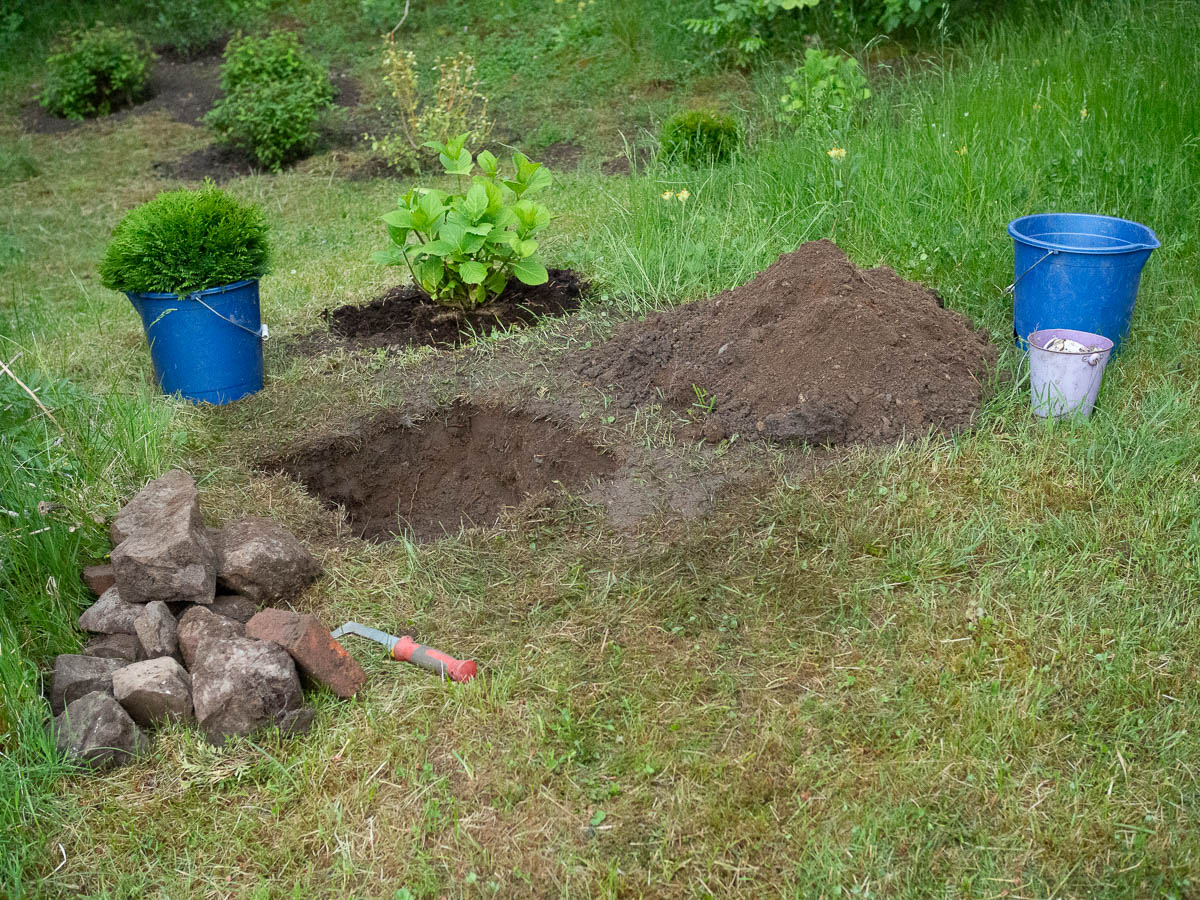
Another day, another hole. What would a Sunday evening be without some digging?

Though I am getting a bit fed up with this endless digging. I am looking forward to getting this done so that I can do other things in the garden. Mow the lawn, prune the raspberries, plant something other than bushes. Well, after this thuja there are only three more bushes to go, so I’ll be done soon.

Speaking of planting, Ingrid and I have been watching Garden Rescue together. The main focus of the programme is on design, not so much the implementation, but they do show bits and pieces of the actual work as well, including planting.

Their way of planting bushes is surprisingly different from mine. I follow the standard Swedish recommendations: dig a big hole, mix up the soil with some cow manure, plant, water thoroughly. If there’s one thing all the books and articles and blog posts agree on, it’s the importance of a good-sized hole. Some say 60 cm wide and 40 cm deep; some say two or three times the diameter of the root clump. But the folks in Garden Rescue dig really, really small holes, often barely larger than the pot that the plant came in! And they do nothing to improve the soil, even when it is more gravel than soil.

I wonder how well their bushes and trees develop and grow. I wish I could see those gardens three to five years later. I haven’t done any real experiments with smaller holes, but I have two unplanned data points – the elderberry and the staghorn sumac that were among the first things I planted. I just plopped them in the ground, in holes just large enough to fit the clump of roots and soil because I hadn’t read any gardening books yet.

In the first two or three years they barely grew at all. A few years later, when I saw how much better all my more recent bushes were doing in their big holes, I dug them up, made proper holes, added fertilizer to the soil, and put them back. The difference was immediate – both bushes really shot up. The sumac was later killed by deer, but the elder is growing very nicely to this day. So I’m going to keep following the Swedish recommendations, even though it is more work. I’d rather do more work up front than be forced to replant later.
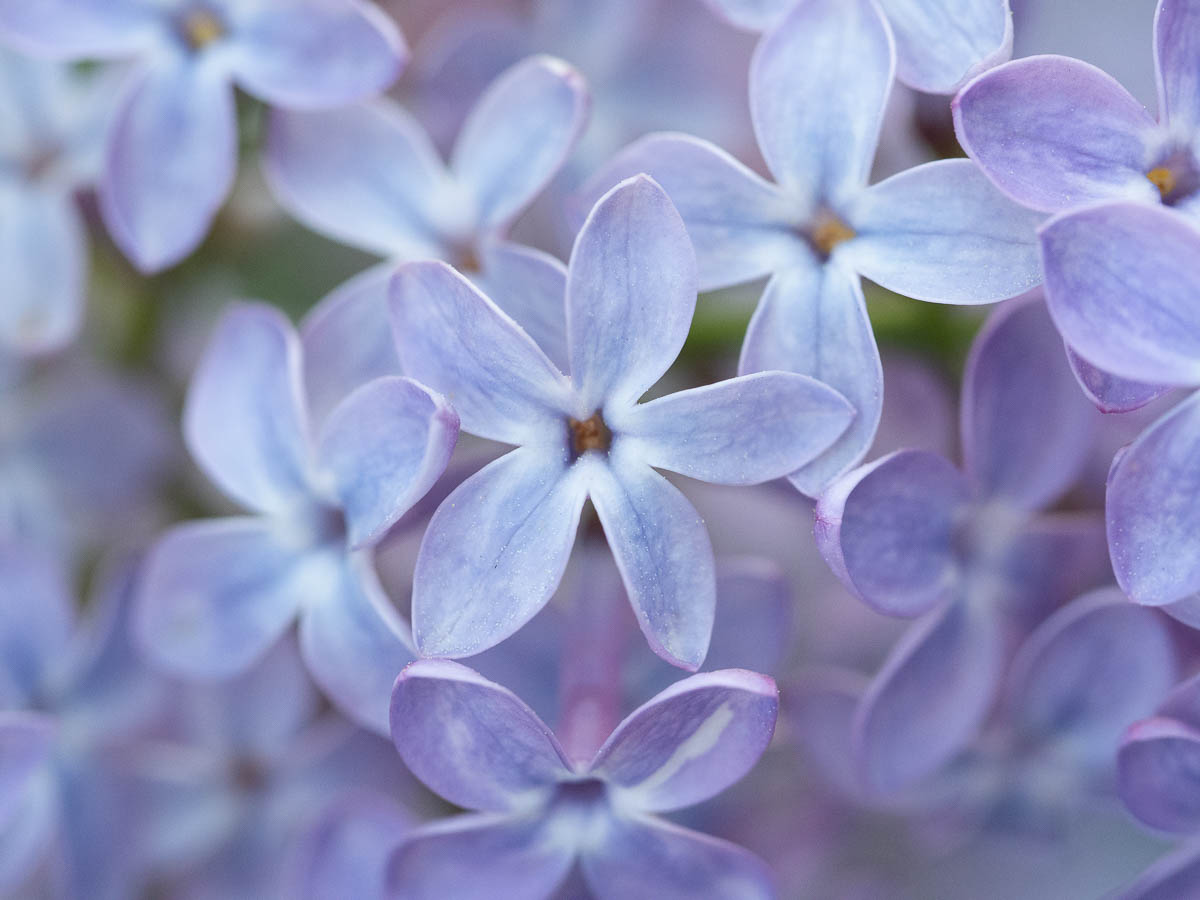
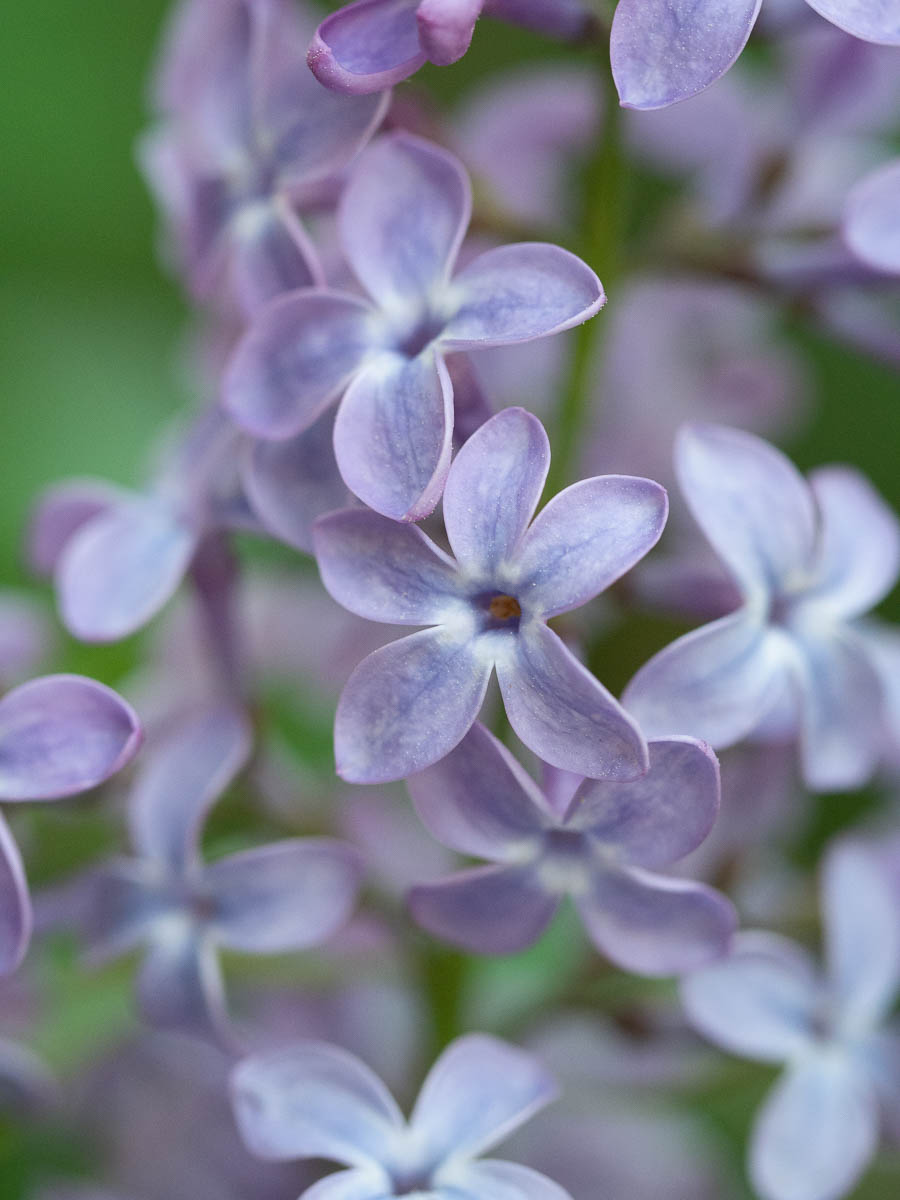
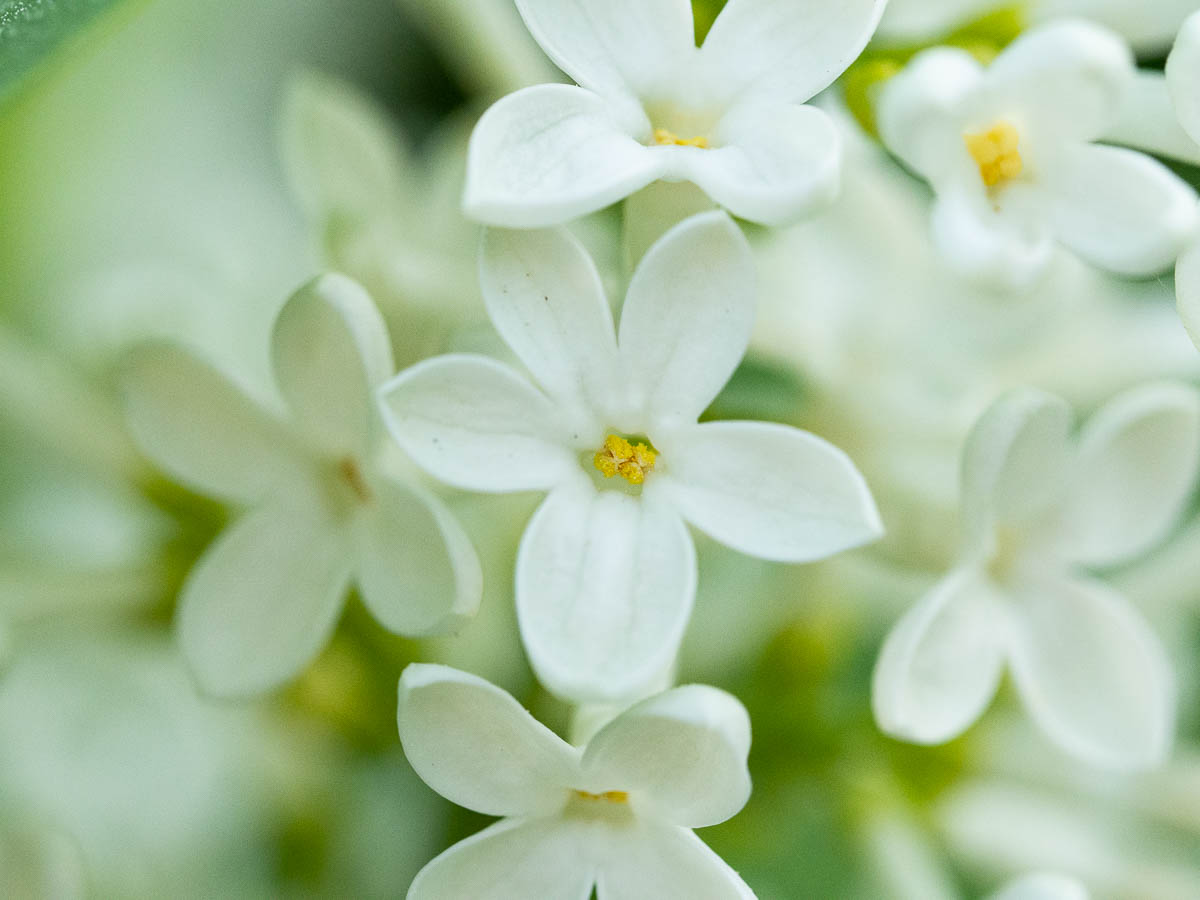
I went out to take smell the lilacs and take photos of them. Without even trying, I found three lucky five-petal blossoms.


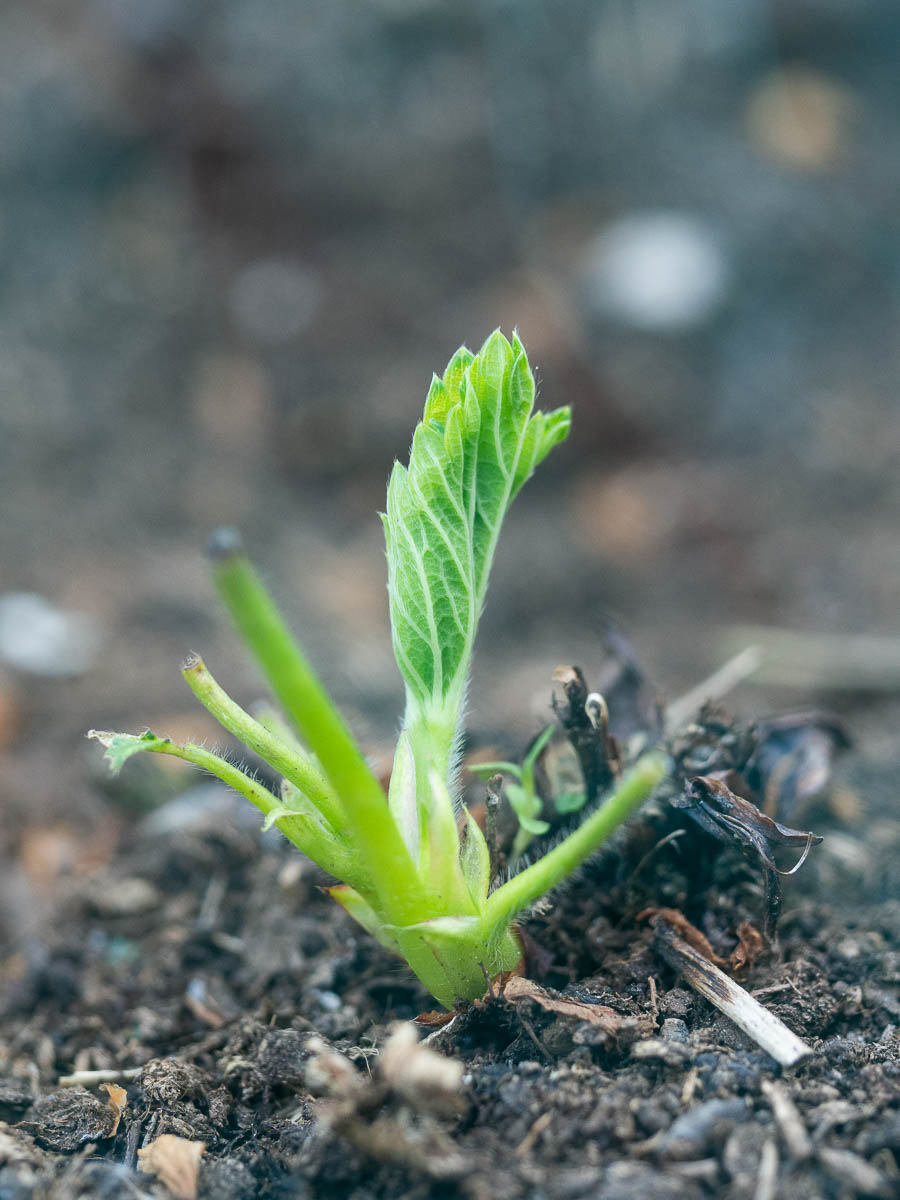
Every spring there is some plant or other that is so late coming up that I am convinced that I have managed to kill it. I should have watered it more, or maybe it needs a more sheltered spot, less sun, more sun, less competition from other plants, or something. When it does come up after all, I’m extra glad to see it still alive.


There are so. Many. Rocks.

I’m still working on getting those bushes planted. It’s taking time. I’ve replaced several of my lunchtime workouts with lunchtime digging sessions. But there are just so many rocks and roots that digging those holes really takes time. Each hole takes around an hour and a half to finish.

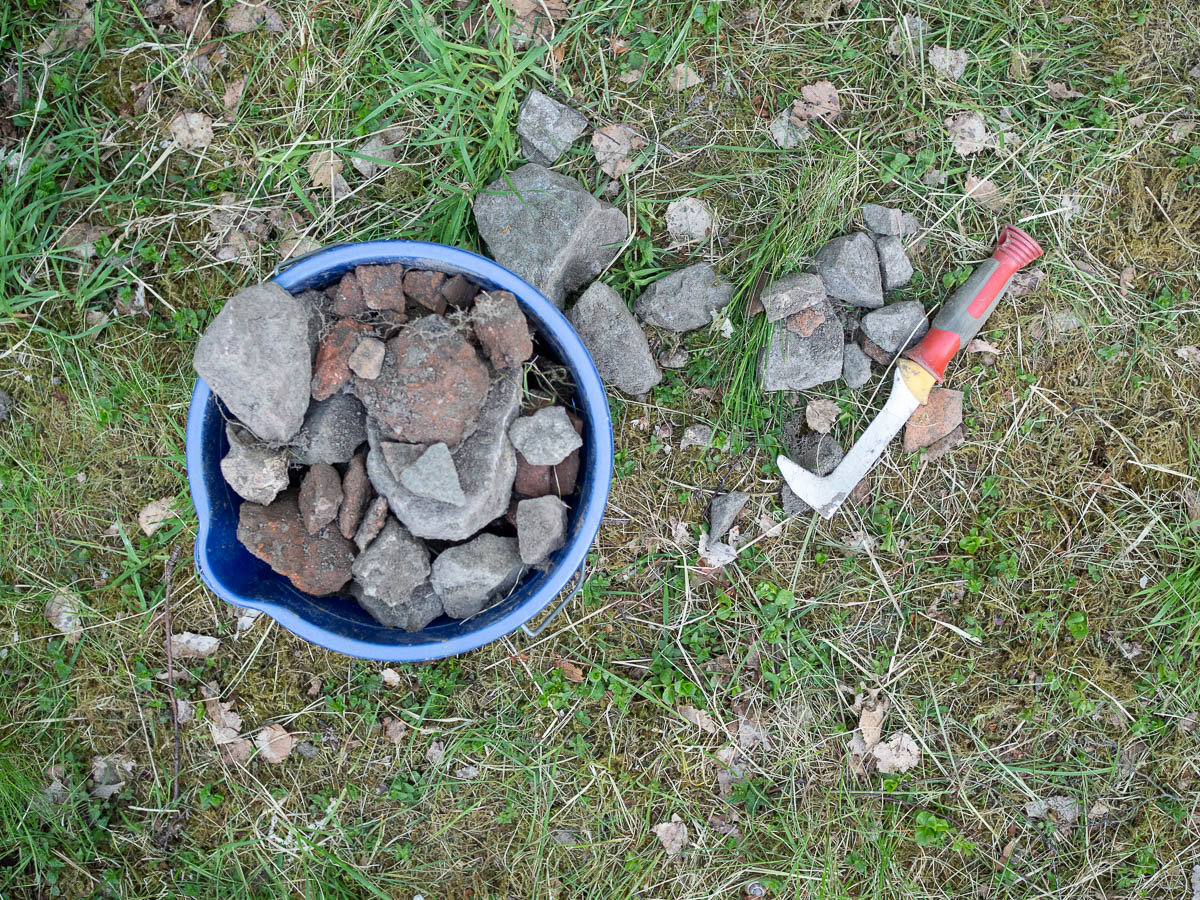
Each hole tends to yield around a bucketful of small rocks, plus a number of larger ones.

Having nothing better to think about as I dig, I think of rocks, and their sizes.

I realize now that I think of them in no particular language. Now that I am writing it down, I don’t know what to call them. Both Swedish and Estonian have a single word for “rock” and “stone”, but English has two. When does a stone become a rock?

The very smallest ones I don’t notice because they don’t matter. They get shoveled around together with the soil. These I think of as “small stones”, when I think of them at all.

Rocks start mattering when they are large enough to turn or stop the spade. That’s also roughly when they become individually noticeable – when my hand can fit “three rocks” rather than a handful. And it’s also the point when they start standing out visually in a pile of earth. They no longer blend in, and they may even roll off the pile completely. These I think of of as “rocks” and I pick them out when I notice them.

The next size up is when the rock doesn’t fit in the palm of my hand any more. Those go in a pile, not the bucket. If I threw them in the bucket, it would fill up very fast. And probably break, too, because I have a flimsy bucket. These are “one-hand rocks”.

The size after that is “two-hand rocks” because I need two hands to hold one of them. These generally need to be carried instead of thrown, and dropping them might damage things.

After those come “lift” rocks. These are rocks that I lift with care, because careless handling might damage not just my toes but also my back. I haven’t found any in this part of the garden, but there were enough of them when I was digging the trenches for the hedges.

Even larger than those are “roll” rocks, so large that lifting them is impractical or impossible, but I can still lever them out of the ground and roll them from one place to another. Those have been rare, luckily.

Anything larger than that stays in the ground. (Although there was a rock once that we got out of the ground with the help of the car.)


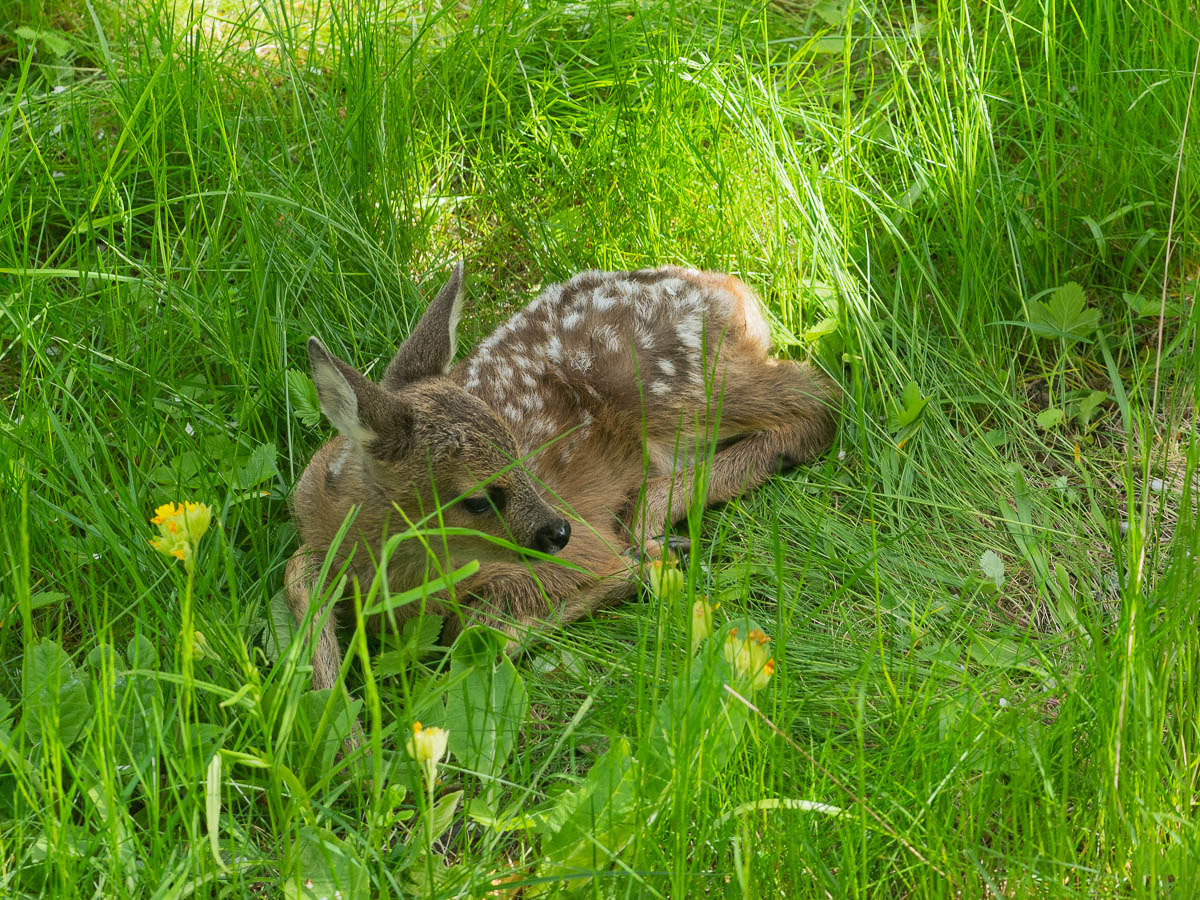
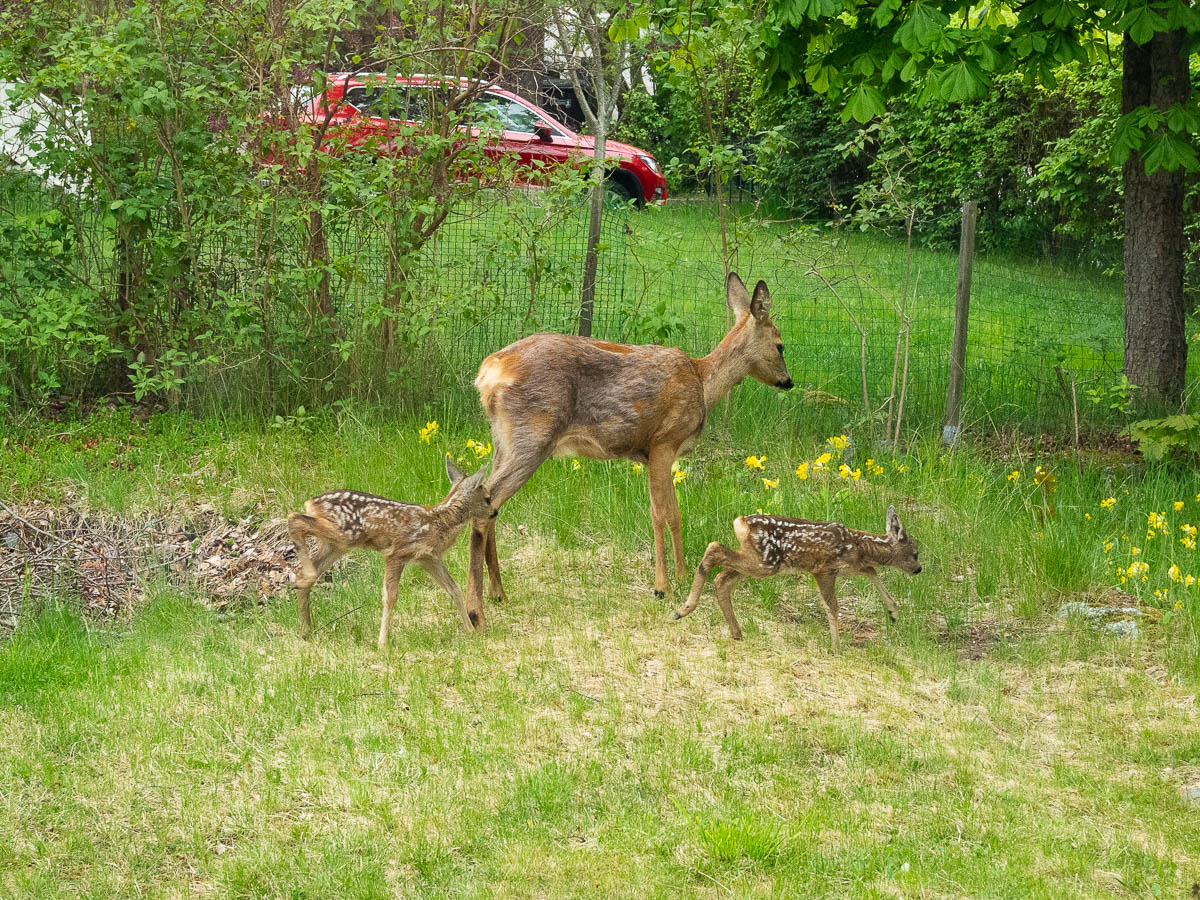
The day before yesterday, a roe deer walked through our garden with its fawn. Deer walking in the garden is no news, it happens often enough. But this was the first time I saw one with a newborn fawn this close.

After the two crossed most of the garden, I saw another fawn come out of the lilac hedge! Very cute.

Then they went off across the road and that was that, I thought.

Today, as I was finishing my lunch out on the deck, I suddenly noticed that one of the fawns had been lying in the tall grass under our cherry tree during my entire lunch, only 5 metres away from me. It was so quiet and immobile that I hadn’t noticed it at all until I happened to look at that exact spot.

Mama deer came by a few times in the afternoon, and I saw them in a few different places in the evening.

I mostly tried to stay out of the garden today. If I was too visible, I was afraid mama deer might not dare come back to feed the baby. And I wouldn’t want to have a fawn starve because of me.

They left in the evening, probably to move to some other garden in the neighbourhood.

Deer look cute but they are marauders when it comes to plants. No tulips would survive in this garden, and deer have repeatedly eaten my pansies in the past.

This time mama deer took big bites from my strawberry plants, right under my eyes. I normally cover the strawberries with netting but hadn’t had time to put up nets for this summer yet. I’d forgotten that the nets protect against deer as well, I was mostly thinking of them as protecting the berries from birds.

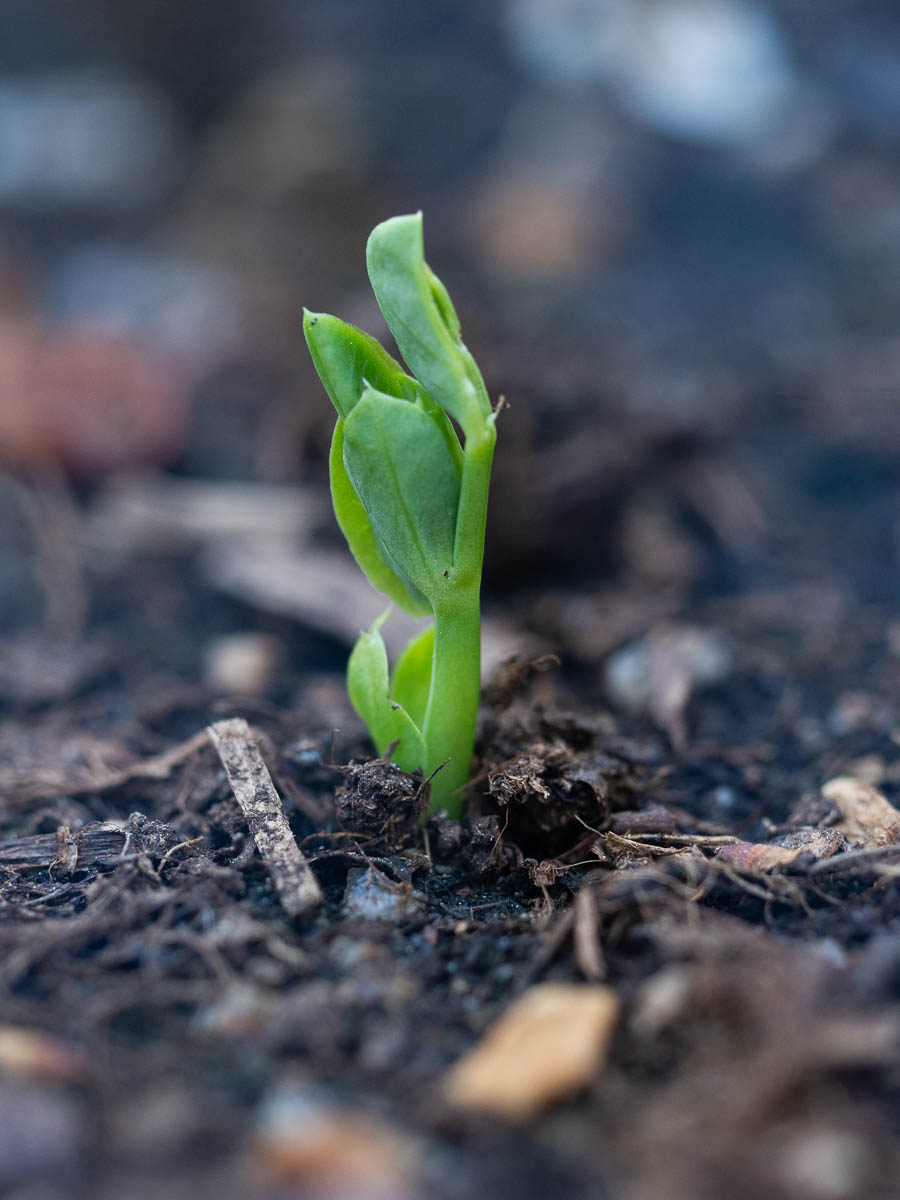
I quickly threw on the nets today, on the strawberry boxes as well as the one where we planted peas. And just in time – the pea sprouts are just becoming visible. If pea shoots are a delicacy for us humans, how much more delicious might deer find them? They would probably leave nothing behind.

I have mixed feelings about deer. I like wildlife of all kinds, and I like seeing animals in the garden. Squirrels and hares and deer, and birds of course. I wish there were hedgehogs around here.

I don’t like them eating the things I care about.

On balance, though, I’d rather have a garden without tulips than a garden without deer.

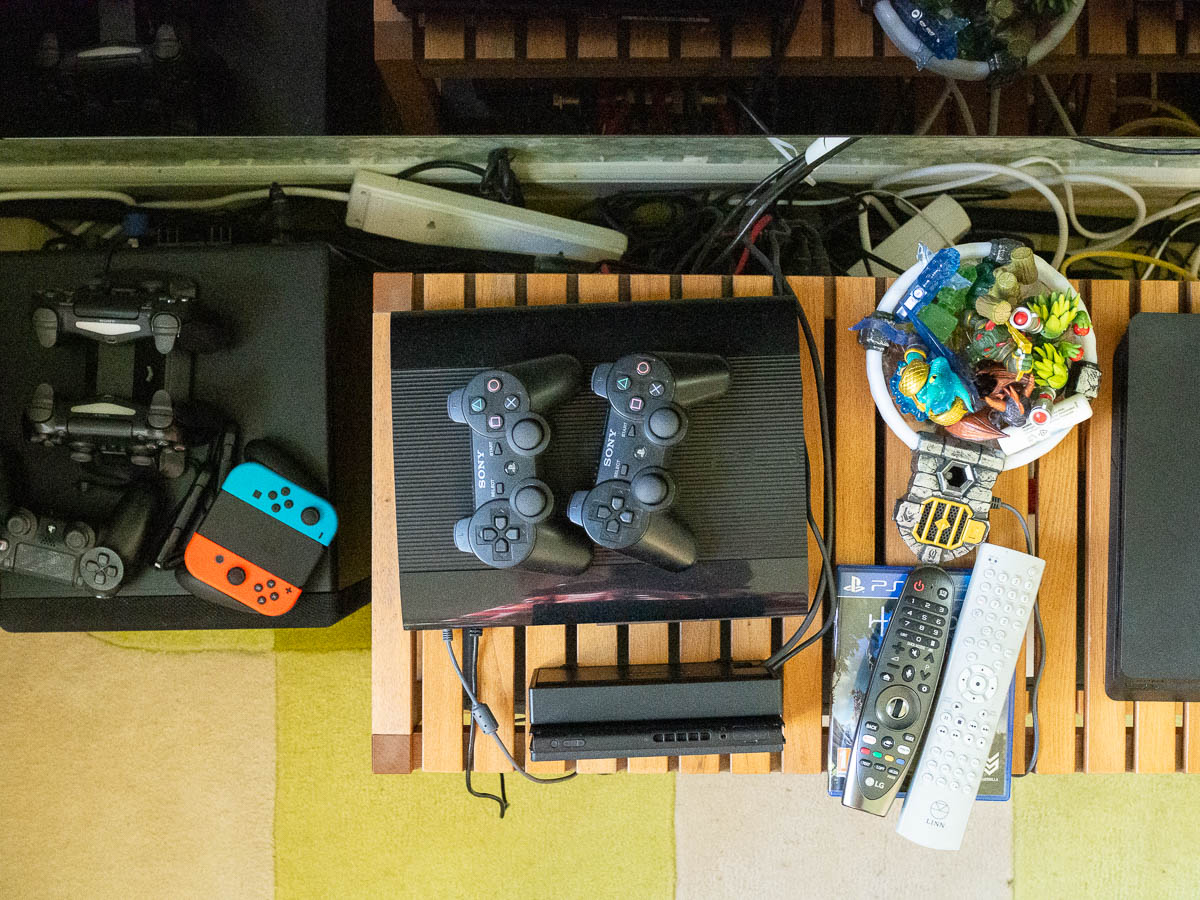
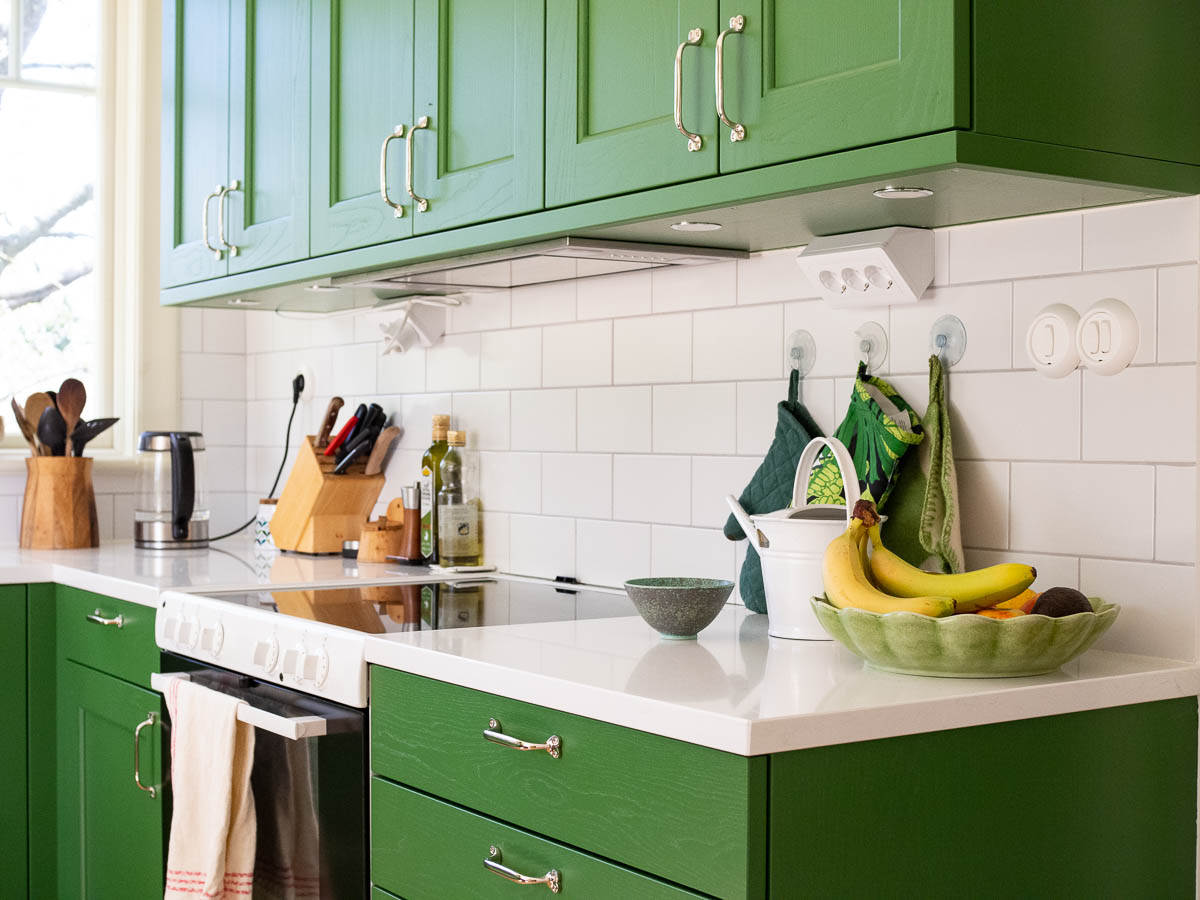
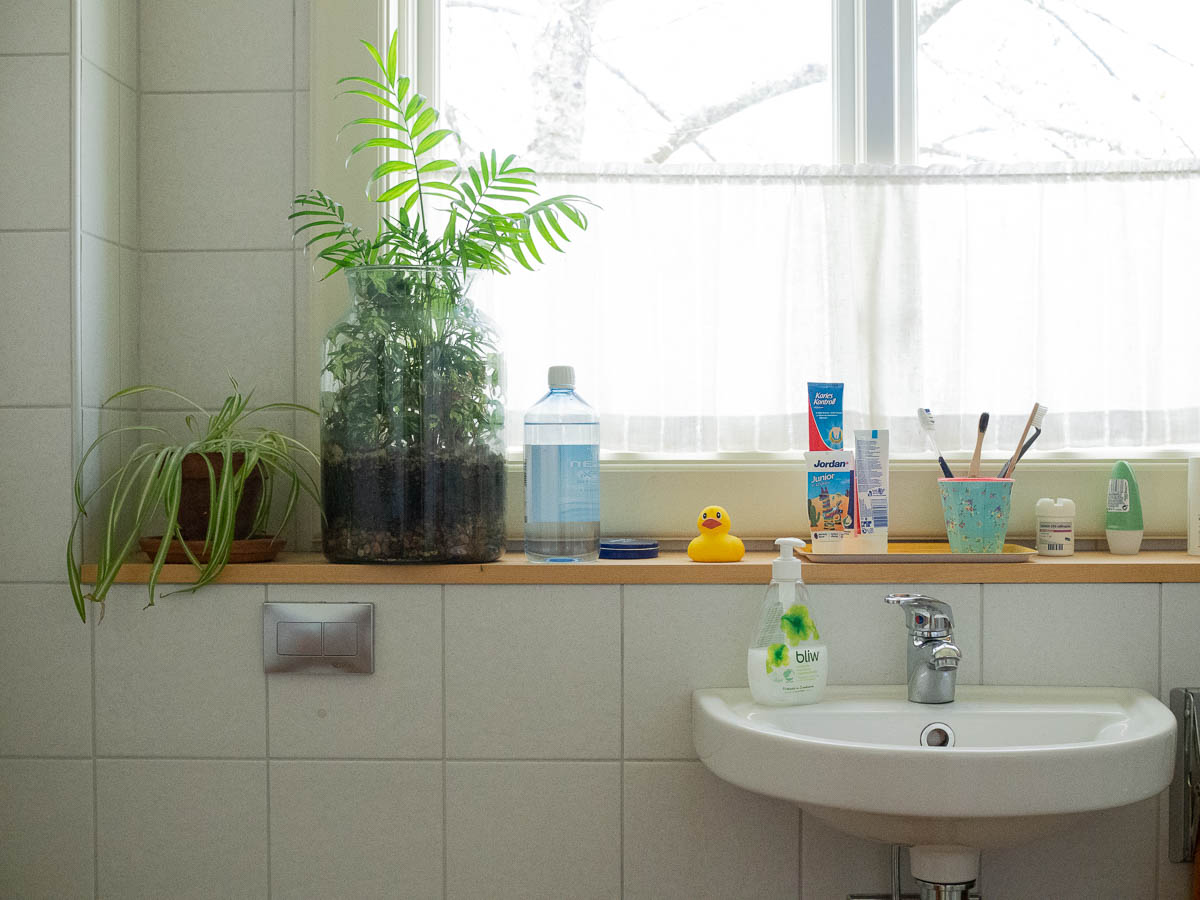
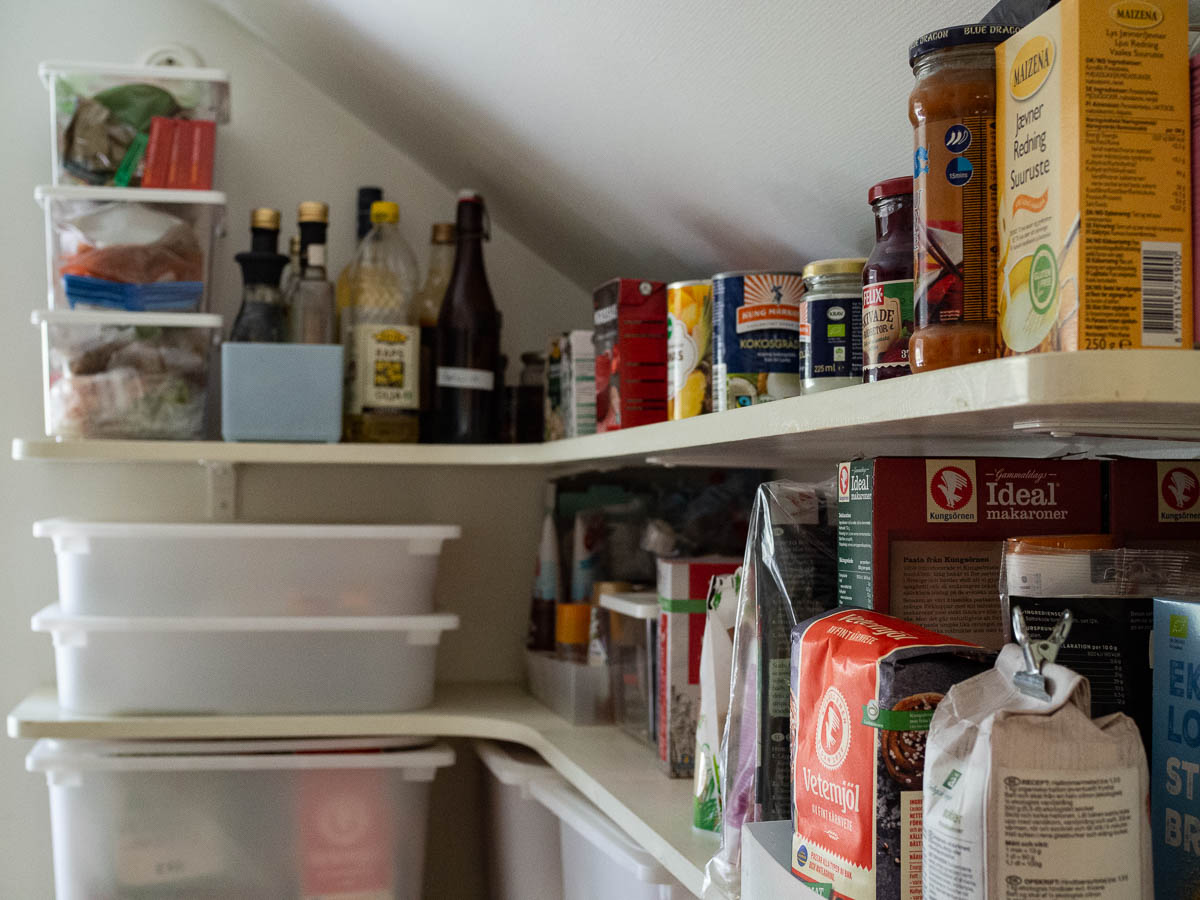
We’re doing a social thing at work – sharing photos/videos/whatevers of our homes, and others will guess to whom each home belongs. I’m definitely doing photos; there’s no question about that!

I’m quite sure that nobody at work reads my blog. Otherwise, whoever does will get major spoilers here. Well, if they read my blog then they will have seen plenty of photos of the house already so this won’t make any difference…

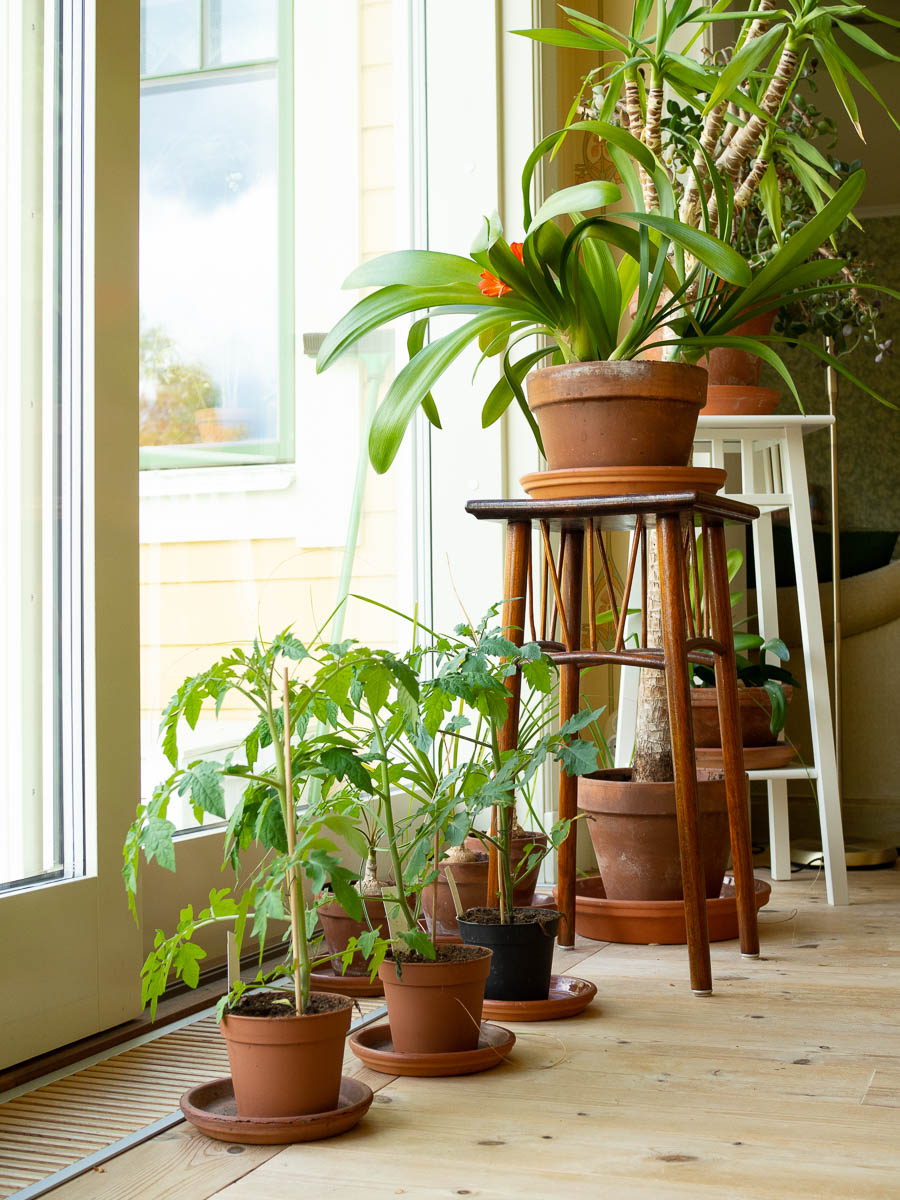
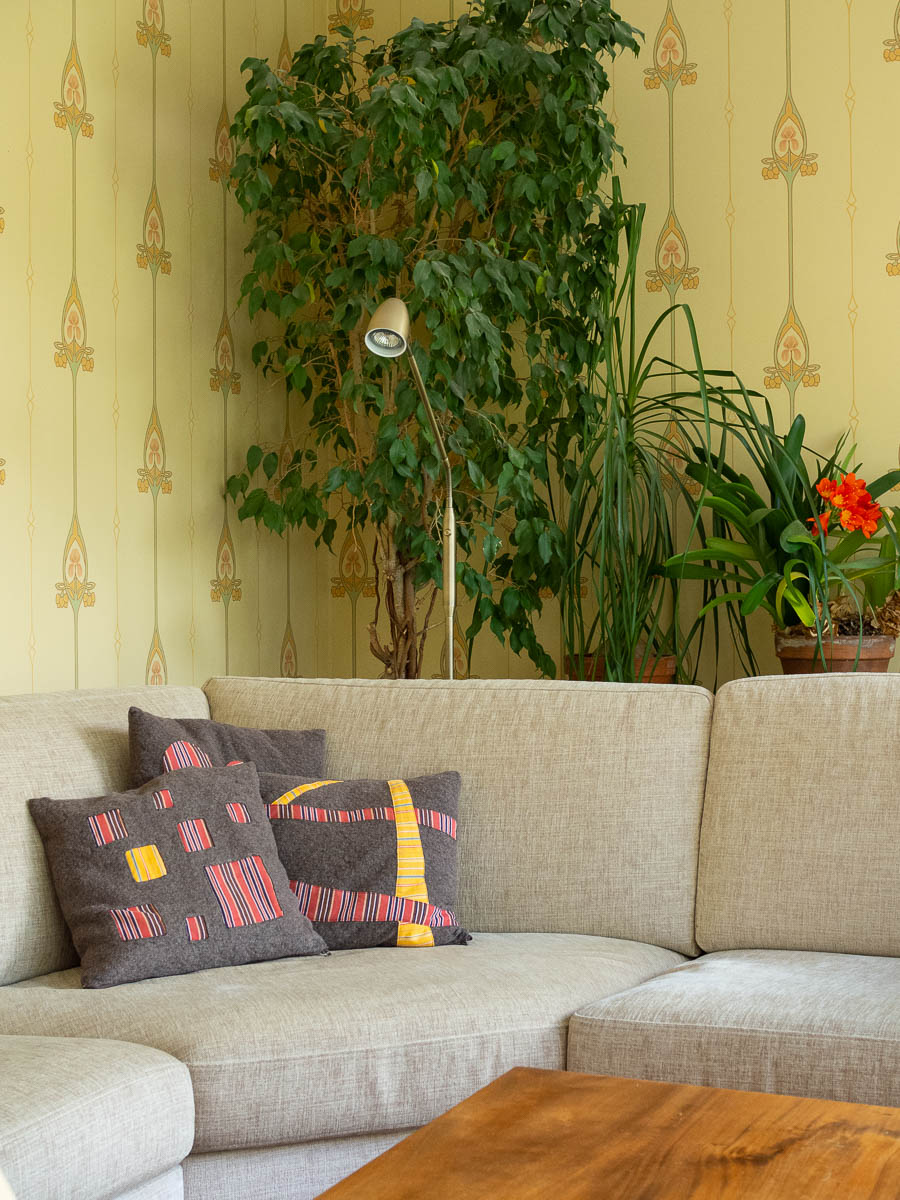
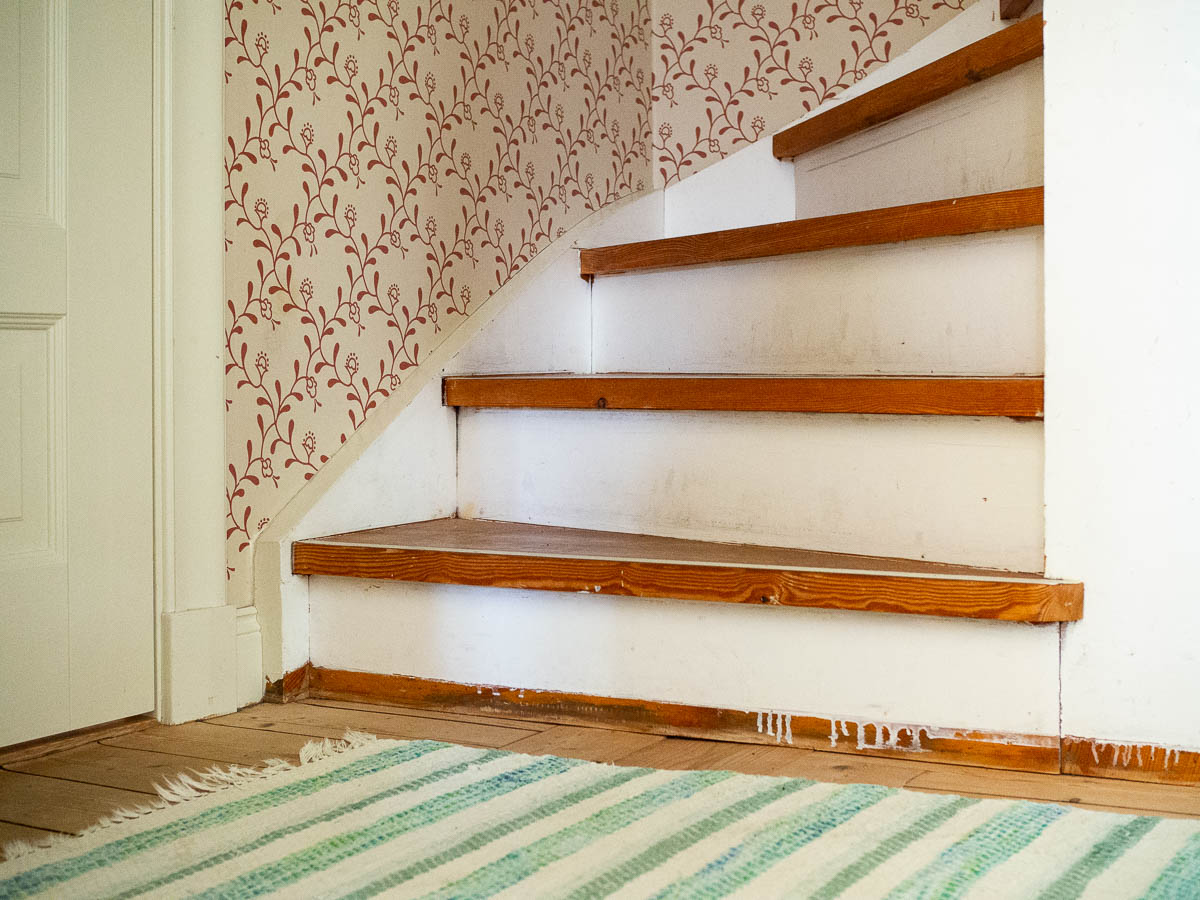
Anyway, here are some photos I took of various parts of the house. All rooms are represented except the bedroom and the children’s rooms. I also skipped my home office because my colleagues see it every day in our online meetings, so a photo of that would make the challenge way too easy.

I am willing to bet money that all the other homes will have predominantly white walls.


Yesterday was a day of gardening – of soil chemistry and strawberry plants. We also made a trip to a nearby garden centre to make a start on planting that curve between sections 4 and 4b.

I had a list of ideas, but when I got there, I still felt lost and aimless. They didn’t have some of the bushes I wanted, even though they are quite common ones. Of other species they had the “wrong” varieties. Or their estimates of final size didn’t match up with what I’d read online. And with all those changes, I just couldn’t picture the whole thing in my head.

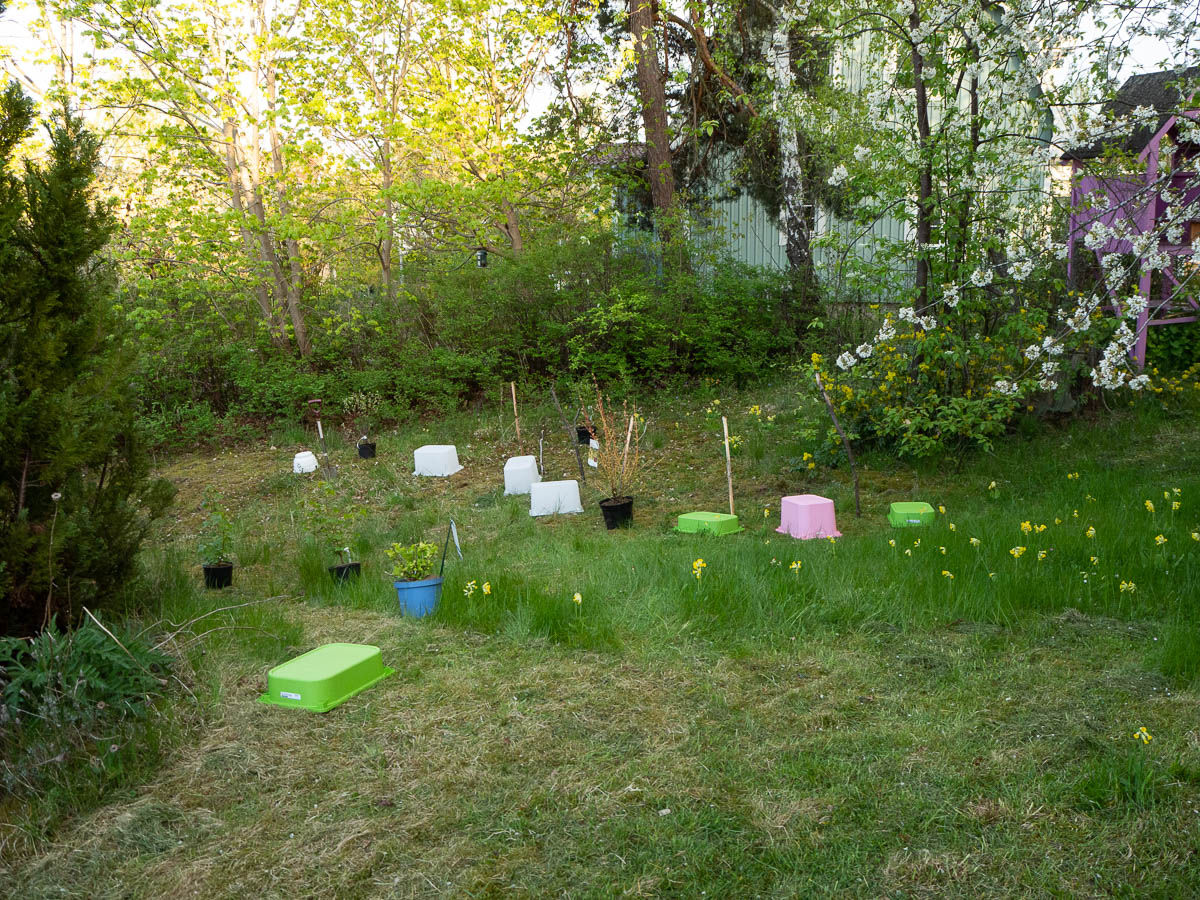
Still, I bought a few bushes to at least make a start. Later in the evening Ingrid and I went out and made a more serious attempt at a design. IKEA’s Trofast boxes made great stand-ins for plants: durable, stable, visible, and mud-proof.

Ingrid was great help in this! “What if we swap these two, so we get a more interesting height variation here? Should we have something dense and ball-shaped here next to the flowering one?”

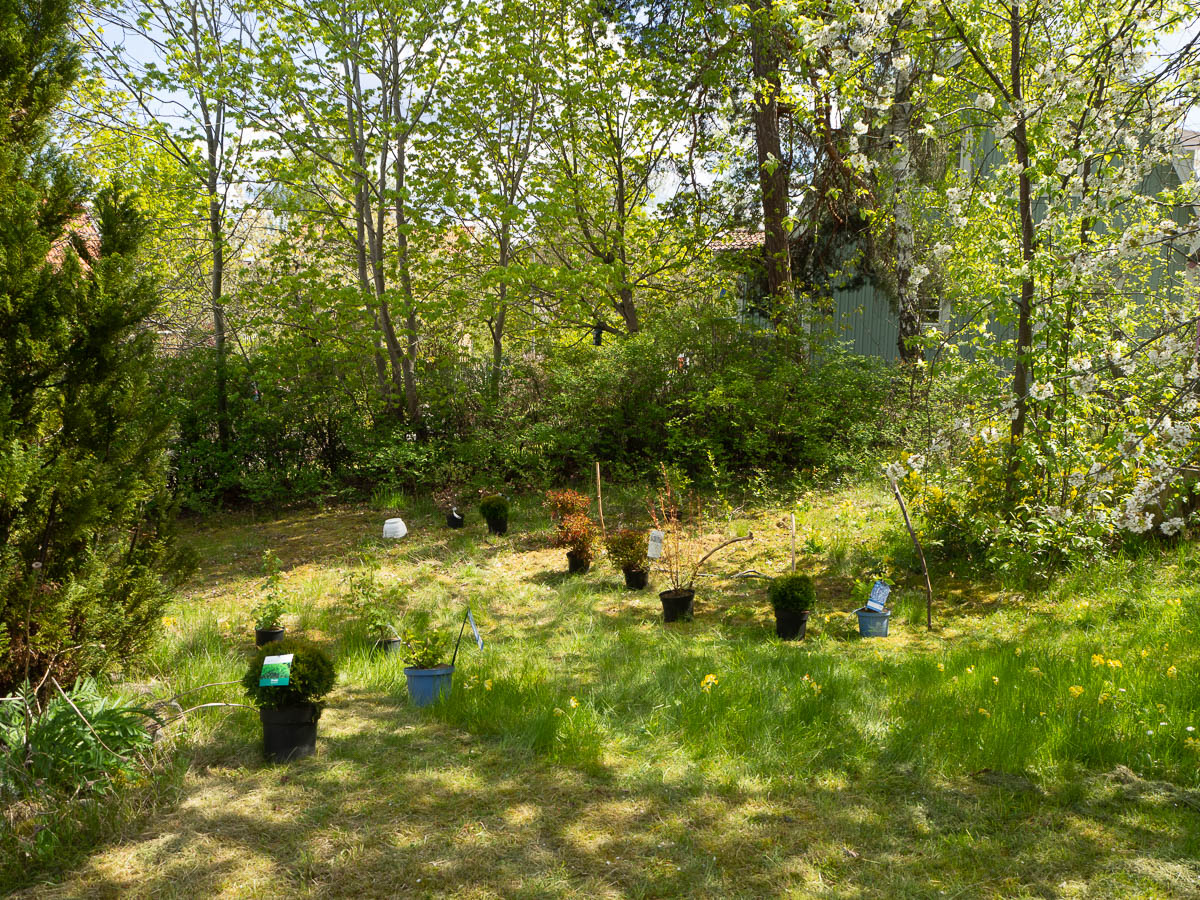
Armed with this new, much clearer design idea, we made a new, more confident shopping trip today and came home with plenty more bushes. Our shrubbery curve is starting to become reality!

From yesterday: one Cornus mas, one Amelanchier alnifolia, one Cornus sanguinea ‘Midwinter Fire’, and two blackcurrants ‘Delikatesnaja’.

Today the pink Trofast box turned into a Hydrangea or two, the three white ones into Spiraea japonica and the three green ones into Thuja occidentals ‘Danica’.

I’m not convinced of our ability to keep Hydrangea bushes alive. The internet says they die if you’re not really diligent about watering them. But Ingrid has been fascinated by them for years, and it is the one and only bush she really wants to have in the garden, so we’ll give it a try.


I’m still thinking about the large mossy patches in the back garden. Could it be because the soil is more acidic there? The soil there is definitely different than in front of the house, much sandier and less full of heavy clay.

We should have some pH indicator strips somewhere, and even an electronic gadget to measure acidity, for the pool. But we seem to have put those away in such a good place that we can’t find them any more, even after searching through the kitchen, the laundry room/pantry/mud room, and the basement shelves.

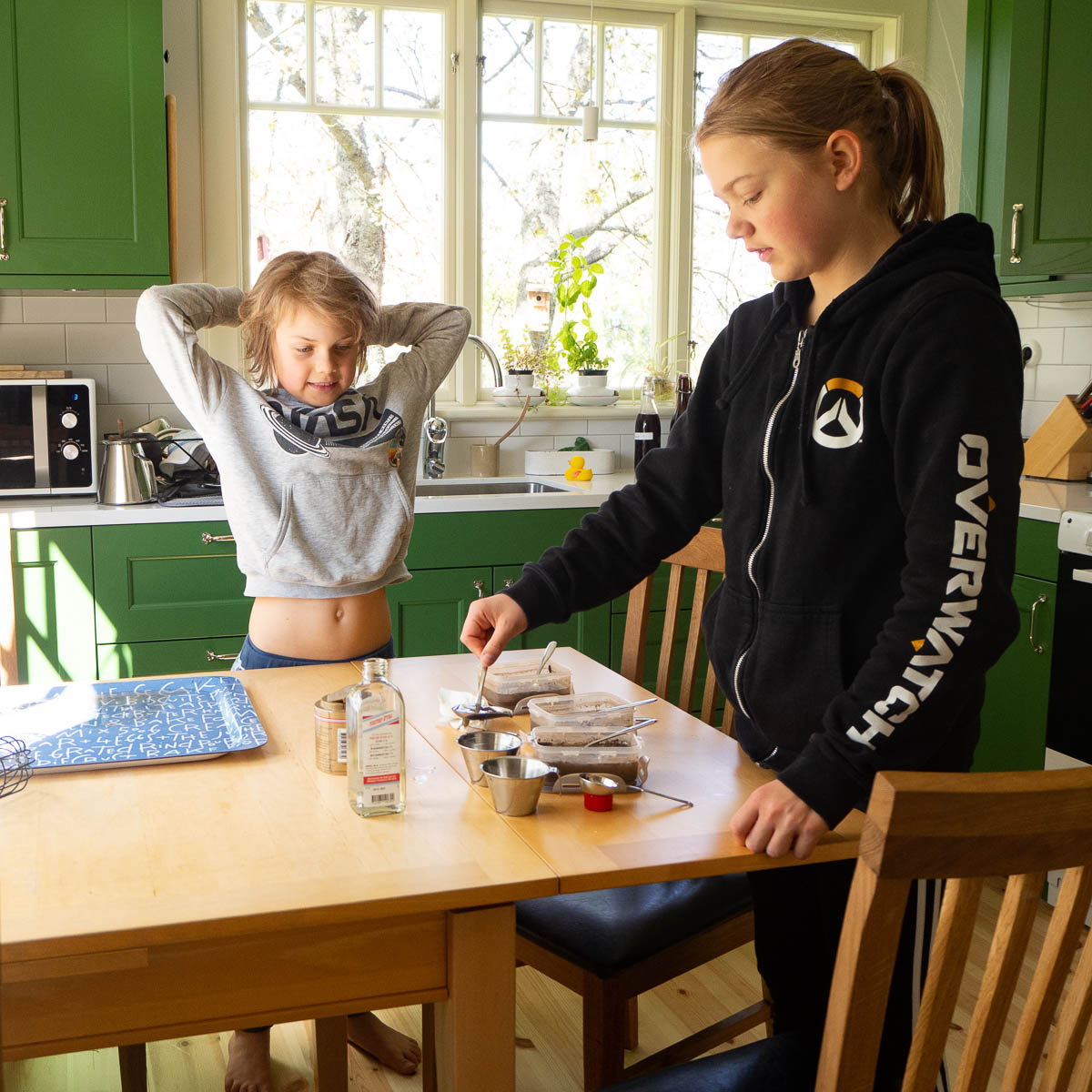
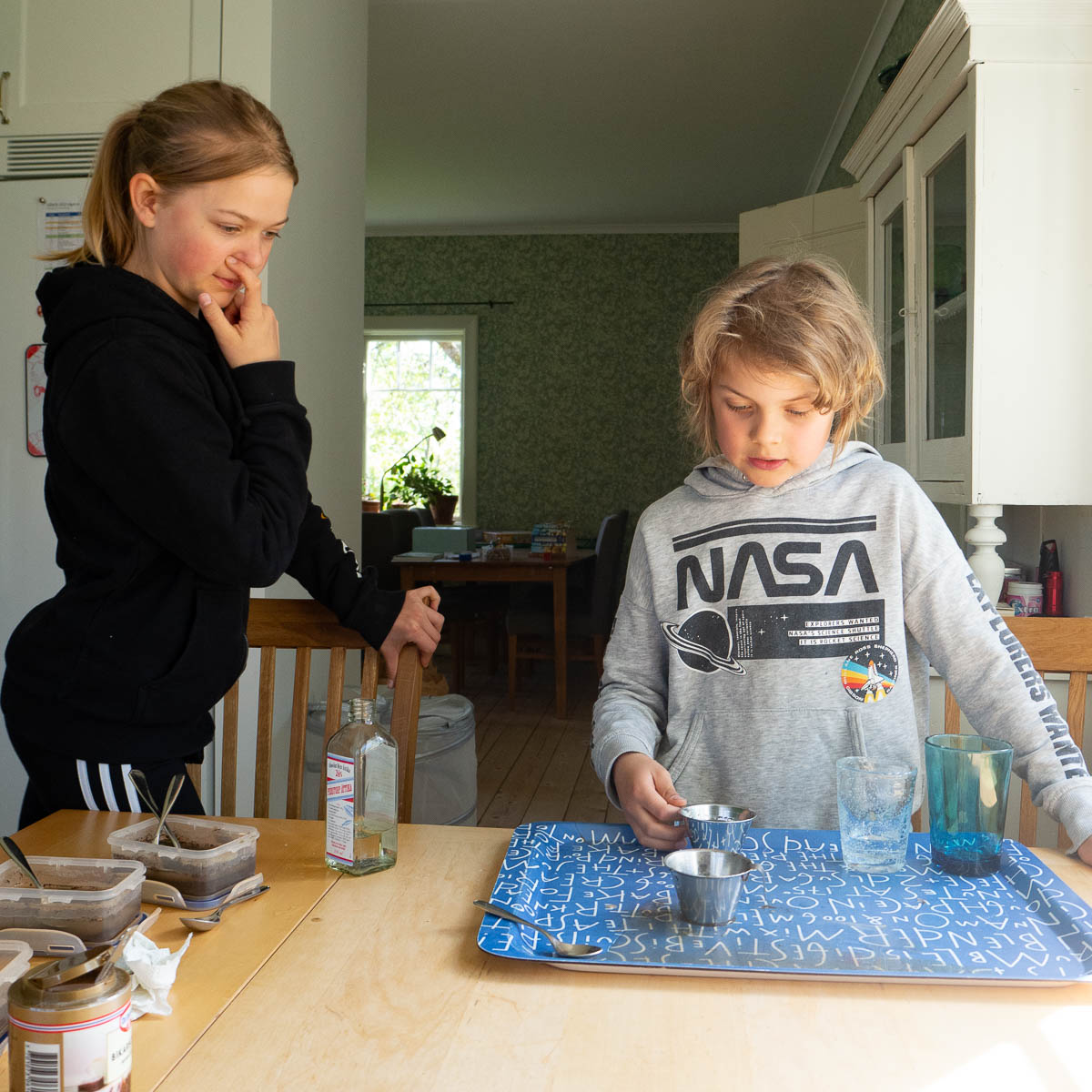
We could buy new ones (and will have to, anyway, for the pool) but I wanted some answers today, now! Instead of shopping, we did home chemistry. Dug up soil samples, mixed them with water, and then tested half of each sample with white vinegar and the other half with baking soda.

The results were very boring. No fizzing anywhere. So I guess the soil is neutral. It is of course also possible that our chemistry experiment was too crude – perhaps we should have taken more of something, or mixed it better… but whatever, it’s not really that important.

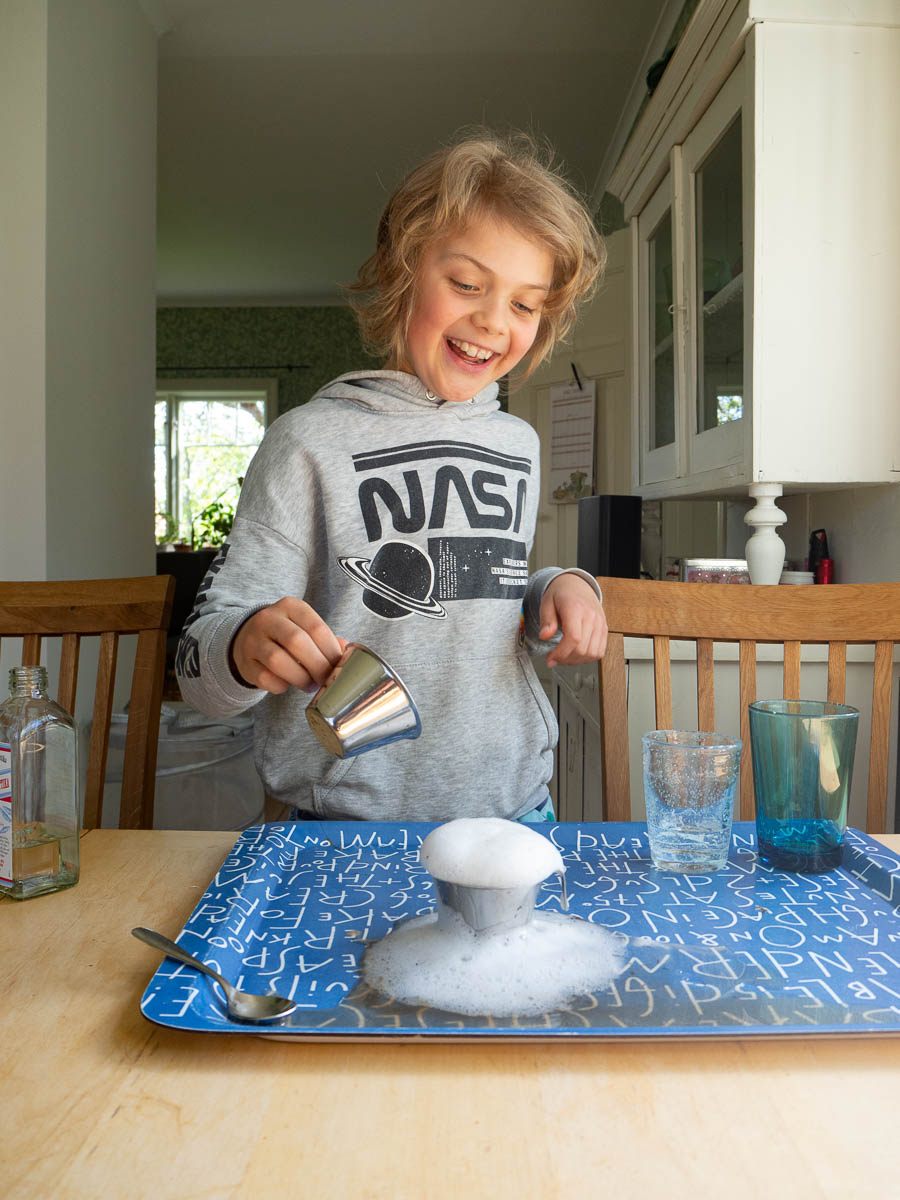
But chemistry that doesn’t go fizz and bang and change colours is very dissatisfying. When we were done with the testing, Adrian got to pour the vinegar-mixed sample onto the bicarbonate sample to at least get some proper fizzing out of it. Much better!

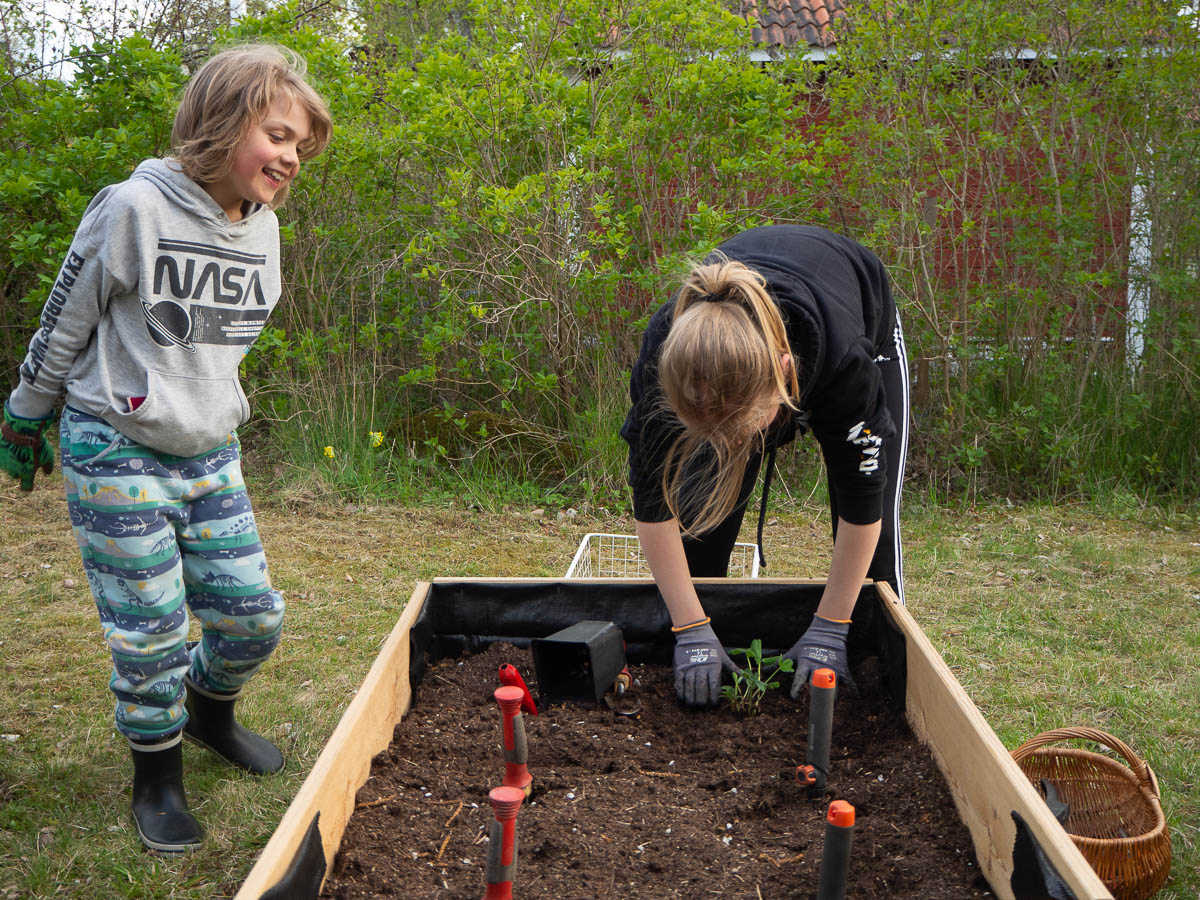
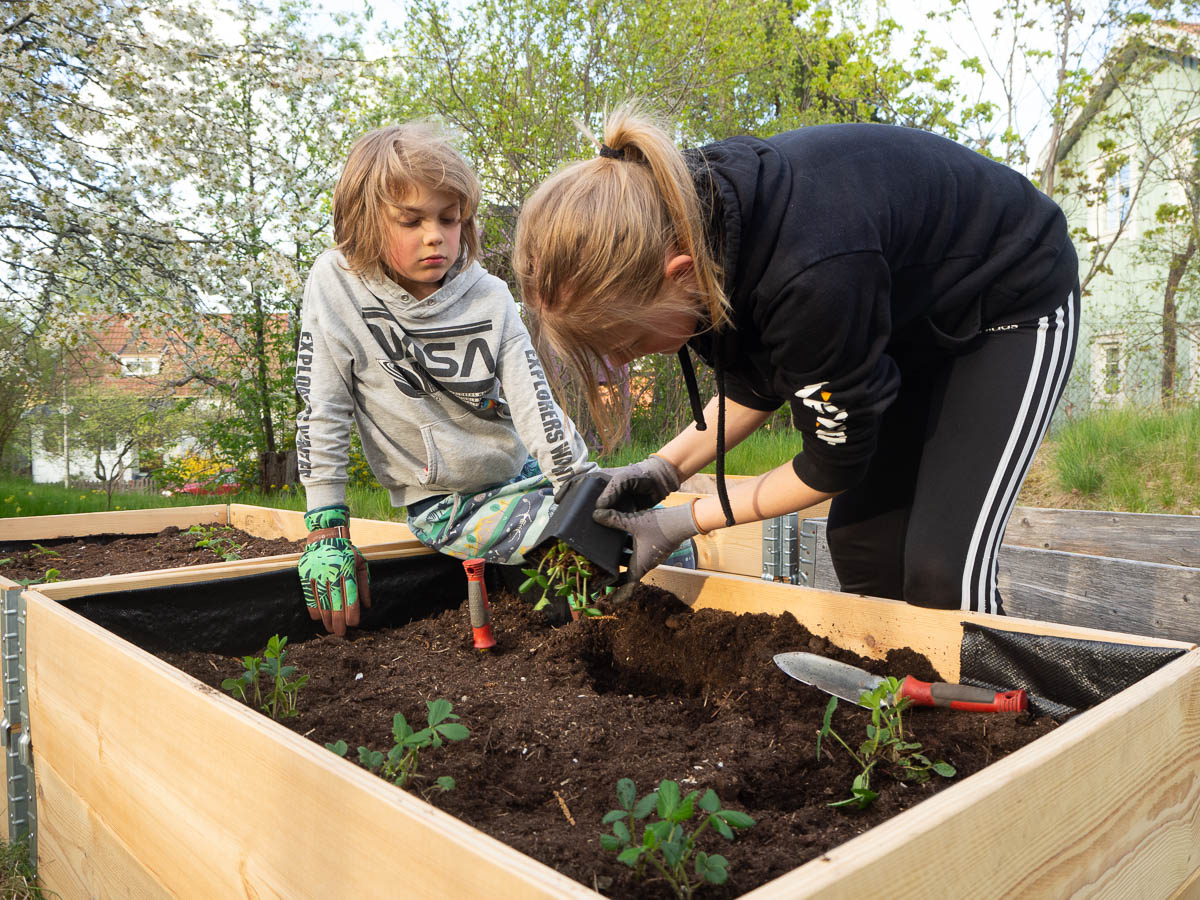
In the afternoon we planted more strawberry seedlings. That is, Ingrid planted strawberry seedlings, while Adrian planted my hand tools (in neat, straight rows and at equal distances and at the same depth!) and I took photos.

We now have one box with older plants of either Honeoye or Zephyr (the sign says Zephyr but I thought we had Honeoye there) and three plants with this year’s seedlings: Polka, Florence and Senga Sengana.


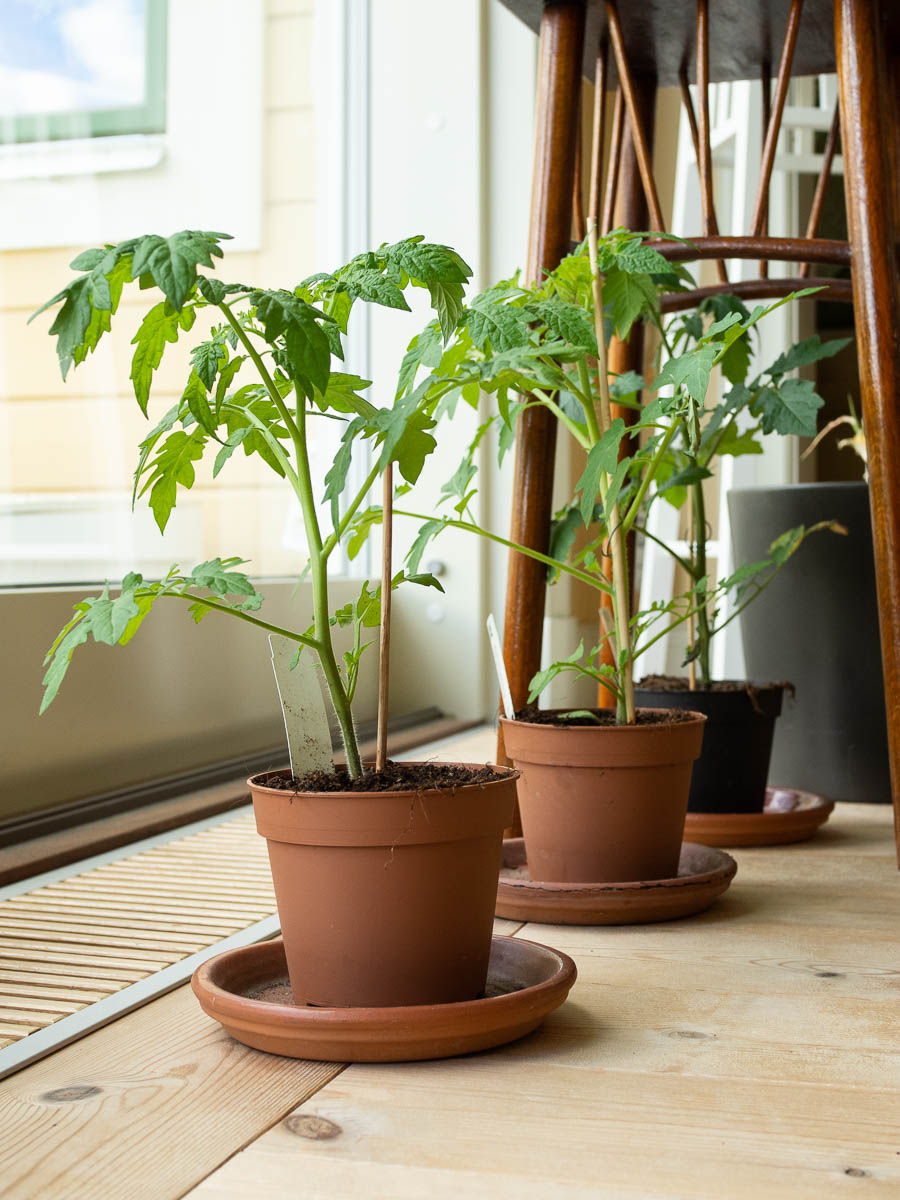
We will hopefully be getting tomatoes this summer.