As I said, Darren, our local Upland Escapes manager, was out of action when it came to walking. But he did provide us with excellent food. The Upland Escapes package included breakfasts and packed lunches. The breakfasts were self-catering, and our kitchen was stocked with all we could possibly want: fresh bread and cheese and fruit, fresh eggs and juices, and excellent jams, including a lovely quince marmalade. The fruit bowl was based on local fruit, including things whose identity we could only guess at (which later turned out to be guavas, and a very large papaya).

The lunches were even better. I was most impressed that UE had managed to find staff who were both good guides and such good cooks! The words “packed lunch” had led me to expect sandwiches, or maybe an occasional quiche slice. Admittedly we have been conditioned by past holidays to have quite low expectations when it comes to food. (The low point was reached in Pyrenean mountain refuges, where breakfast consisted of dry biscuits.) And Spain isn’t exactly known for its vegetarian cooking.

Instead we got wonderfully varied meals: there was a quiche slice, yes, but also a pizza sandwich, roasted vegetable kebabs, potato salads, cous cous, and so on. Each lunch was juicy and flavourful, and always topped off by a scrumptious cake. And all of this was made from great quality ingredients and beautifully presented – which must have been extra challenging given that it all arrived in plastic containers and was made to last at least half a day before it was eaten.

In fact Darren’s lunches were so much better than anything we could find in the local restaurants that we kept them for dinner, and took bread and fruit for lunch, or made do with what the restaurants had to offer. The restaurant fare may have been OK for meat-eaters but wasn’t particularly exciting for vegetarians, whereas Darren’s was created with vegetarians in mind. We did our best to praise his cooking each time we saw him but I’m still not sure whether we managed to properly convey just how pleased we were with the food. This was the first holiday ever where the food will be one of our most positive memories. (You can probably tell that from how much I’ve talked about it here.)

(In fact we had one good restaurant meal on our last day, in Las Palmas, at La Chascona. It was the first and only restaurant we saw that offered something other than the standard menu full of grilled meat, and had good food, so I feel it deserves a mention here.)


(To be continued.)
One of my pet peeves is food crumbs. I cannot stand them. I can deal with dust bunnies on the floor, dirty windows, cat hair, food stains on baby clothes, or a mess of toys all across the floor. But there is something that just makes food crumbs inherently disgusting to me. Food remains on the table, food crumbs on the floor or in the kitchen sink, and badly washed dishes – they just make me cringe and want to clean up, no matter whether it’s in my own home or someone else’s. I’ve visited one household where the kitchen table was so dirty that I had to make an effort to sit and eat there. (Luckily that happened a few years ago and I have no reason to believe I will ever be invited there again.)

(There’s no real point to this post. Just wanted to tell you.)

When I am too busy, I easily forget meals. I don’t even notice that I’m hungry, or sometimes I do notice but just tell myself that I’ll eat “soon”. Then I suddenly realise that it’s two o’clock and I haven’t had lunch, and my stomach is growling and my blood sugar is far too low. As a result I’ve had trouble keeping my weight – if I don’t take care, I lose weight. (While that may sound like a good thing if you have the opposite problem, trust me, it’s not.) I’m taking special care now that I’m breastfeeding, because I need to eat enough not only for myself but also for Ingrid.

Two things help me make sure I get enough food. One is to ALWAYS have food at hand. If getting food means interrupting whatever interesting and important thing that I’m doing to take the lift down to the cafeteria and queue to get a muffin and then get back up, well, that’s just too much work and won’t happen. But if all I need to do is to open a drawer, the equation changes. Of course this only works if I actually want to eat whatever I have at hand, so there must be choice, which is why I have a well-stocked snacks drawer at work. There’s always at least two kinds of cereal bars, and one or two kinds of dried fruit, and I usually bring fresh fruit or yoghurt with me every morning.

The other is to remind myself to eat. I actually have reminders in Outlook at work that simply say “Eat”. One at 11, one at 13 for lunch, and one at 16. My colleagues have been laughing at me for years about these (different colleagues over different years) but it really works. I call this my food and sleep clock, or in Swedish mat- och sovklocka. (The food and sleep clock was invented by Skalman, a green turtle in a Swedish children’s comic. He listens to his a bit more slavishly than I do, though. I don’t fall asleep in the middle of the day.)

This weekend we offered Ingrid some baby food with chicken. She accepted it with great pleasure, and ate with more enthusiasm than she has shown towards my lovely vegetable purées recently. I have given birth to a meat eater!

(I have been a vegetarian for almost 15 years now, and Eric well over 10 years. I may eat a piece of fish occasionally, especially when we’re abroad and vegetarian food is hard to find, but that happens maybe once a month on average.)

The chicken smelled kind of gross, actually… I don’t think we’ll be buying that again any time soon. She can eat all the meat she wants at the nursery, but I’m not going to let any of that stinky stuff into my house if I can help it. This first time was only because the nursery staff will not experiment with food: they won’t feed her any kind of food that she hasn’t tried before. Now that she has tried chicken, she can eat some of their standard lunches. Once we’ve tried fish and pasta at home, she’ll be able to eat most (if not all) of their baby menu.

I wonder why she liked it so much, though. Possible explanations:

  • They put some mysterious addictive substance in the baby food, that isn’t on the label. Like sugar.
  • She just likes meat.
  • She liked the more complex flavour. That jar contained more ingredients than three of her home-made meals do together.
  • She liked the spices.

I think it may be time to get a bit more adventurous with her food. Mix it up, add some spices.

Ingrid’s taken to eating (as opposed to drinking milk) like a duck to water. It’s as if this is what she had been looking forward to all her life. We started last weekend with one meal a day (the afternoon meal), but this Friday she was visibly disappointed when she wasn’t offered “real food” for the late-morning meal so we switched that one to solids as well.

She likes cauliflower and parsnip well enough, accepts small amounts of potato and broccoli but isn’t particularly fond of them, and adores carrots, apples and banana. Her mouth opens wide like the beak of a hungry little bird and if I’m too slow for her taste she starts chasing the spoon with her head. Definitely not a food refuser.

An important part of any trip “back home” (wherever that is) is the food. I’ve got my must-eat-when-in-Estonia foods, and my must-eat-when-in-Sweden foods. I imagine that every expat will have similar longings – foods that you wouldn’t love so much if you could eat them at any time, but when they’re miles away and you only get them a few times a year (at best) they become very important.

Estonia has kohupiim and various things made of kohupiim (such as kohupiimakorbid and kohupiimavorm) and Estonian bread.

Sweden has filmjölk (to be eaten with cereal) and Kalle’s kaviar.

Plus of course both of them have a whole lot of good but less important things, such as desserts, and candies I remember from my childhood, and special brands of bread, and potatoes and apples that taste just so…

Today is Shrove Tuesday / Pancake day / fettisdagen / vastlad. In both Sweden and Estonia there is a tradition of eating semlor / vastlakukleid on this day. (If you have never heard of these, The Local helpfully provides The lowdown on Sweden’s best buns.)

While I have long been doing most of the cooking in our house, Eric is the master baker. My theory is that cooking is too nitty-gritty and pedestrian for him. But give him a proper big project – gingerbread cookies, semlor, even pancakes or lasagne – and he’s hooked.

So this year, and indeed almost all of our years here in London, Eric baked semlor. I don’t think he ever did it in Sweden where quality semlor can be bought in every bakery for months, but here it brings back a bit of home.

There are some differences between the Estonian and the Swedish traditions. Swedish semlor are filled with almond paste and whipped cream. As far as I can remember, an Estonian vastlakukkel only had whipped cream as filling – possibly because it was almost impossible to get one’s hands on almonds or almond paste back when I was a child. Or maybe it has always been that way.

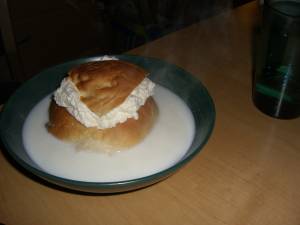
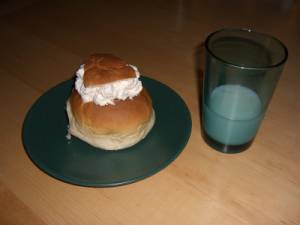
Also, some Swedes drown their semlor in hot milk. I’ve always found this habit most bizarre – I prefer my milk on the side, in a glass – but to each his own.

Semla, my way Semla, Eric’s way

For some reason, I’ve become a slow eater. I’ve never been a particularly fast one, but recently I’ve noticed that I’m really slow. When Eric and I eat identically sized servings, for example, I often have a third or even half of my portion still on my plate, when he has finished. And it’s not because Eric’s a fast eater – I’ve noticed the same thing in company with other people as well.

At home it doesn’t really matter that much. But it’s almost becoming a problem when I eat in company. When I’ve had lunch with people at work, for example, I’ve started buying myself a smallish lunch and added a dessert that I’ve eaten afterwards at my desk. Even so, everyone has usually finished their huge plates of meat and veg, and I’m still sipping on my soup. I have also started to pay more attention to when I talk – I try to keep my contributions to the conversation between courses and let others talk when there is food on the table, in order to have a chance to keep up. Not that it really works, though.

I don’t really know why this has happened… I don’t like my food very hot, so I’m slightly slower to start. I like to drink quite a lot with my meals. But this doesn’t seem sufficient to explain such a huge difference. Do I chew longer? Have a smaller mouth? Don’t know.

On the positive side, slow eating is supposed to be good for you – “the secret of longevity” and all that. And it gives me more time to enjoy my food, because I do enjoy eating.

Things they don’t tell you before you start breastfeeding: how absurdly, mind-bogglingly hungry it makes you. Whenever I’m not feeding Ingrid, I’m feeding myself. I could eat constantly, if I didn’t need my hands for other things occasionally. Now I limit myself to four solid meals a day (porridge for breakfast, two lunches, one dinner), frequently followed by a dessert, plus an unknown number of snacks between meals. Before I learned to breastfeed while lying down, I even ate after each nightly feeding session.

There are no cravings and no preferences. Anything goes, as long as it’s vegetarian and sufficiently calorie-dense. (Soup is bad. Cheesecake is good.) Eric still occasionally asks me whether I would like to eat, or what I would prefer for dinner. The answers are always the same: “Yes!”, and “Anything!”. The bare question is enough to make me hungry enough to really not care about what I’m eating!

Food goes in, milk comes out. I transform adult food into baby food.

I just noticed that it’s suddenly October. And it’s like autumn came overnight. All of September was sunny and warm, around 20°C. Today has been filled with thunderstorms and heavy showers – the kind that make you really happy to be inside. Indoors it got cold enough for me to put on socks (I’ve been barefoot at home since spring) and wear something with sleeves. And sunlight was sufficiently weak that I turned on the lights when having breakfast.

September is a great time of the year, especially when it turns out this nice. Not too hot, not too cold. And it’s a great time to be vegetarian: fruit & veg departments are full of fresh English stuff. Fresh local vegetables (well, not quite local but from within a hundred miles at least) do taste different.

The berry season has not yet ended, so you get strawberries (not as good as Estonian or Swedish ones, but far superior to Belgian or Spanish ones), raspberries, blackberries, redcurrants etc. This is the brief period when strawberries are not sold as just “strawberries” but actually have names – most of which start with E, for some reason: Evie, Elsanta, Everest. And Jubilee.

Same with apples: there are juicy flavourful English apples with interesting names like Early Windsor and Worcester Pearmain, instead of just the standard 4 (Royal Gala, Golden Delicious, Red Delicious, Granny Smith), all of which are rather boring, and have generally been shipped halfway around the world so even the flavour they might have had is mostly gone.

September is also mushroom season, so it’s occasionally even possible to find chantarelle mushrooms and other such delicacies (even if those do come from Romania and not Sussex).