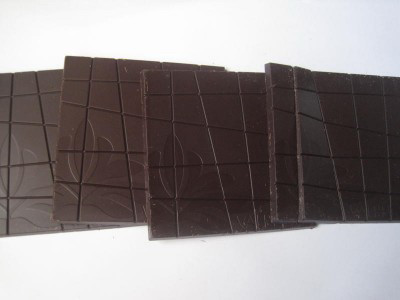
For my birthday this year I got a tasting set of Valrhona Grands Crus chocolates. Today I had a private little chocolate tasting session.

I found Alpaco (which my brain keeps wanting to turn into Alpaca) the most interesting one, with a spicy, rich flavour. It is both “floral and oaky” according to the wrapper, and while I couldn’t have picked out those overtones on my own, they were definitely there when I went looking for them, and especially the oaky hints were very nice.

Guanaja had a higher cocoa content and a more bitter taste, which I really liked; Caraïbe had hints of coffee. Manjari stood out because I experienced it as the sweetest of the four, with fruity, lemony tones.

It was interesting to experience just how different four bitter chocolates can taste, even when all have roughly the same cocoa content (64–66%, except for Guanaja’s 70%).

Valrhona makes great chocolate but has a pretty but almost-unusable Flash-based web site that I won’t even bother to link to. Instead, go read this review at Chocablog.

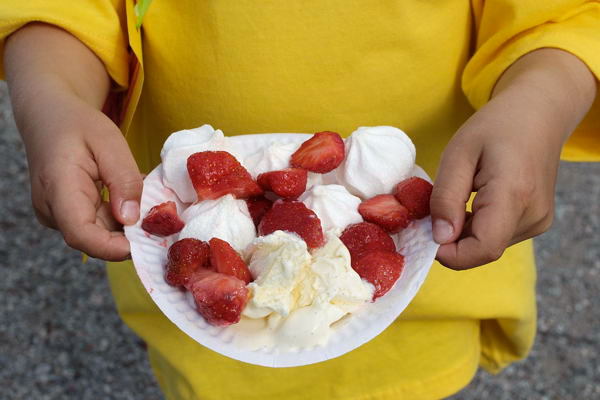
Summer party at preschool: a song-and-dance-and-magic show by the kids, and then an orgy of strawberries, ice cream and merengue.

Spring was cold this year. Six weeks ago we had snow (really we did, and I have pictures to prove it!) But now it is suddenly summer. I still haven’t quite caught up with this shift: Ingrid’s winter boots are still in the hall and I haven’t had time to pack away our winter coats.

One of the nice things that comes with summer is the outdoor vegetable market here in Spånga. Well, it’s really more of an outdoor produce shop rather than a real market, because it’s all a single firm. But it’s outdoors (which is nice) and their range is very wide (which is even better). They opened for this season about a week ago. They have so much nice stuff that I can’t get in the supermarkets in Spånga, that I have a hard time making up my mind about what to buy. Broad beans and green beans, scallions, apricots, three kinds of melon, mangoes…

You’re “supposed” to do your shopping weekly and not buy a little every day. I’ve never managed to make it work for me, just like I find the idea of weekly meal plans very unappealing. How can I decide today what I will want to eat 5 days from now, and what I will want to cook 5 days from now? Maybe Ingrid will be away at a friend’s and Eric will be working late. Maybe we’ll be busy in the garden and I’ll want to spend a minimum of time on dinner. Maybe I’ll suddenly feel like having soup.

So I stop by the supermarket almost every day on my way home, to buy dinner materials. But I normally have enough vegetables in the fridge to put together some sort of dinner even if I have to skip the shopping for some reason, and also to adjust my dinner plan if circumstances change.

In addition to dinner, I top up the must-have stuff. Here’s my shortlist that I always go through mentally in the supermarket:

  • Bread.
  • (Soft) flatbread. This is both kids’ go-to food for afternoon snacks, and my standard breakfast.
  • Liver pâté. Ingrid’s favourite sandwich material, and the packages are small so I’m often buying more.
  • Milk. Now that I don’t drink milk with my meals, Ingrid doesn’t, either. But Eric takes milk in his coffee, and both sometimes need it with their cereal for breakfast.
  • Apple juice. Diluted apple juice is now our everyday meal-time drink.
  • Eggs. For baking and for breakfast.
  • Bananas. Adrian’s favourite breakfast and snack food.
  • Fruit.

For some while now, since the remodelling, we’ve been talking about replacing our fridge with a larger one so we can at least stock up for an entire week on such basics as milk and eggs and apple juice. (Right now there isn’t space for more than 2 litres of milk, and about 15 eggs, if everything else is to fit in there as well.) But somehow other important purchases keep coming up, and the fridge never gets to the head of the queue.

We only decorated a handful of eggs this year. Some we dyed with onion skins, others we painted with watercolours.

The black-and-white one at the front Ingrid made especially for her judo teacher Erik: it is, of course, Erik in his white judo suit and black belt. The idea was his and not ours but it is a fun egg nevertheless.

You can give type O blood to blood groups A and AB. You can give type A blood to type AB. You cannot give type AB to anybody except AB.

Butter knives in our kitchen work the same way. You can use a knife that has previously been used for Adrian’s dairy-free margarine on both butter and Ingrid’s liver pâté. A knife that has been in contact with butter can be used for liver pâté but not for margarine. A knife with liver pâté on it can not be used for anything else.

The complication is that remains of butter and margarine are almost impossible to tell apart. So whenever Adrian wants a sandwich, we have to get a new knife for him. This is why there is an almost-constant shortage of butter knives in our kitchen even though we have half a dozen.

(On weekend mornings there is also orange marmalade to be taken into account but that luckily does not look like anything else and can be eaten by everybody.)

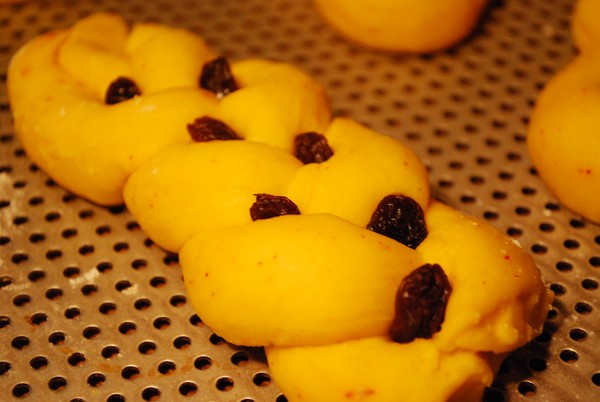
Having just gone through the receipts in my wallet for December, I note that I have bought 23 lussekatter at Pressbyrån during this Christmas season, for a total of 338 kronor.

(The one in the photo below was made by Ingrid and not bought at Pressbyrån.)

Adrian is well over a year old, and it’s been a long time since I last tested dairy products other than butter (since spring, actually). I thought I’d try and see how his milk protein allergy is doing. Perhaps I can go back to a more varied diet?

By now I don’t miss milk products much, but it does complicate cooking, and eating out is a serious challenge. I’m glad if I find one milk-free meat-free option on the menu, and often have to ask the kitchen to skip the sauce, give me boiled potatoes instead of mashed potatoes etc. I’ve been eating a lot of sushi and pizza without cheese. (Which is a pretty poor alternative to real pizza.)

What I know and don’t know

I know that there are two types of milk protein allergy. One is a true allergy, “IgE-mediated”, with a fast reaction and more classical allergy symtoms – hives, itching, vomiting. The other is an intolerance, still an immunological reaction but “non-IgE-mediated”, with a delayed reaction and more gastrointestinal symtoms – reflux, abdominal pain, abnormal stools. All signs point towards Adrian having the latter. (Which is great, because this non-IgE-mediated version is much more likely to disappear, and much less likely to widen to cross-reactions to other allergens.)

I also know that non-IgE-mediated CMPI often disappears on its own in kids and around 90% are allergy-free by age three. But I realized I have no idea how it actually disappears. Does it happen fast or gradually over many months? Do the kids tolerate larger and larger amounts, or do their symptoms just become weaker? Do the symptoms change? – because obviously Adrian’s gastrointestinal system is much more mature now than a year ago.

I now also know that there are four main types of protein in milk that kids can be allergic to. I’ve learned from the internet that they may react to one or several of those, and there’s no real correlation between the different types. But I have no idea which one(s) Adrian might react to.

How to test?

When we first tested for CMPI we did an eliminiation/challenge test. I ate no dairy products for three weeks, and then ate normal amounts of milk again for one day. The result was unequivocal.

But I’m not so sure that this would be the right thing to test now. I could do a challenge, but if Adrian reacts, all it would tell me is that he reacts if I consume a lot of milk. But I don’t necessarily need or want to consume a lot of milk. If I can put parmesan on my pasta and cheese on my pizza every now and again, I’d be pretty happy.

So the alternative is to try with just a little bit. But that might also not be the right thing to test. Adrian might react, but not so much that it would be a clear signal. He might not scream with pain like he used to, just feel slightly sick and fuss a bit more than usual. We may just interpret that as ordinary fussing and I’d continue with milk, making him live with constant low-level stomach pain (for example) which I obviously don’t want.

Can I? Can’t I? Confusion.

A couple of weeks ago I had pizza for lunch. That seemed to go well. Then a cheese sandwich. That seemed to go less well – he slept like crap. Another week or so later I tried grilled cheese sandwiches, and he didn’t seem to react.

Around the same time we had him tested for milk protein allergy (skin prick test) and the test was a clear negative. Great, we thought, finally a clear answer! Let’s go!

So I ate home-made pizza on Saturday and pasta with feta cheese on Sunday. Adrian slept like crap again last night, and was crazy all day today. Hyperactive, racing around, unable to concentrate on anything, throwing things; grabs for food and then refuses to eat it; grabs for breast and then pushes it away… “crazy” is the best way I can describe it. What’s up?

Facts: a skin test is useless for this

What’s up is that the doctor needs to go back to school, it seems. I went back to the internet to learn more and immediately found out that skin prick tests are worthless in the case of non-IgE-mediated CMPI. They do not detect that type of reaction, they only work for IgE-mediated cow’s milk allergy.

The internet was less helpful in coming up with a plan for testing to see whether Adrian’s outgrown his CMPI. So it’s back to our own homebrew method, slow and steady. I will try a bit, wait a few days, try the same again and wait again. If everything is OK, I try with the next type of dairy product.

Right now it looks like I can consume small amounts of cheese that has been strongly heated. Cheese straight from the fridge is not OK. Next I should probably test whey products that contain no casein (the protein in cheese) to see if Adrian also reacts to the other milk proteins.

Useful resources:
Food Allergy and Food Intolerance on Patient.co.uk
The diagnosis and management of cow milk protein intolerance in the primary care setting on PubMed – only an abstract is provided but a search for the exact title will likely turn up some unofficial copies of the article.
Today I ate my first cheese sandwich since I went milk-free last November. It was good.

Now Adrian is sleeping like crap, waking all the time. Either it’s because of the cheese, or it’s because of all the commotion here today because of Ingrid’s birthday party.

To be continued.

Smarties: the prettiest kind of candy

I see other kids eat cinnamon swirls for their mid-afternoon snack and eat candy off and on throughout the day. And they still don’t gain weight or have trouble with their teeth.

With Ingrid we need to worry about both weight and teeth. Eric keeps an eye on his weight, and I have weak teeth, so I guess Ingrid inherited the worst from each of us. Se’s definitely got the Bergheden body type, broad and strong and tending towards overweight if you don’t pay attention. Adrian looks like he’ll be following in Ingrid’s footsteps.

The standard Swedish solution for keeping kids’ teeth healthy is lördagsgodis, “Saturday’s candy”, i.e. sweets on Saturdays only. And then they get lots, lots and lots and lots. Many of them really get to gorge themselves on sweets. The argument is that if you eat your sweets all in one go then your teeth get to rest from sugar in between Saturdays. (The whole idea was introduced by the worried public health authorities in 1957, according to an unverified source.)

It’s also supposed to instil in kids an understanding and a habit that sweets are a treat, to be limited, not everyday fare. If a Swede sees kids eat sweets on another day then s/he will probably comment on it, whether in his head or out loud.

But while mid-week candy turns heads, many Swedish parents exclude cakes, fika, ice cream and other such stuff from their definition of sweets, so those are OK on other days, too. And pancakes for dinner are not “sweets” either. Judging from the kids’ menus at restaurants, for many Swedish families pancakes is not a treat but a normal meal. And then there are all the other lingonberry-jam-accompanied kid-friendly everyday meals such as potato griddle cakes and black pudding and meatballs and so on. So the whole Saturday candy thing suffers from serious cognitive dissonance issues.

I also think it leads to an unhealthy attitude towards sweets, and eating in general. Many adult Swedes I know tell me that when they are offered sweets, they are unable to eat just a little, they feel compelled to eat lots. This is not an issue I’ve noticed among my Estonian friends. So instead of teaching kids to limit their intake of sweets, the Saturday candy thing teaches them to obsess about sweets all week long and then gorge themselves. (Pretty much the same problem that adults in many countries have with alcohol – but not in countries where there is a tradition of having wine with your dinner.)

So we don’t “do” Saturday candy in our home. We do “everything in moderation” instead. As a result Ingrid is limited to one small-sized treat per day on weekdays, and two on weekends, when she can have a sweeter breakfast (toast with marmalade, or a sweeter kind of cereal) as well as ice cream after dinner. And pancakes with jam most certainly count as a treat in our home. It seems to work; the long-term results remain to be seen.

Milk protein allergy experience of the day: apparently IKEA’s chips (French fries) contain milk. Or perhaps their bread does. I knew McDonald’s has gotten into trouble for having both milk and wheat in their chips but didn’t think that IKEA would do stuff like that. In any case Adrian threw up his entire lunch an hour after eating there. The only things he ate from their menu were bread, carrots, and a few chips.