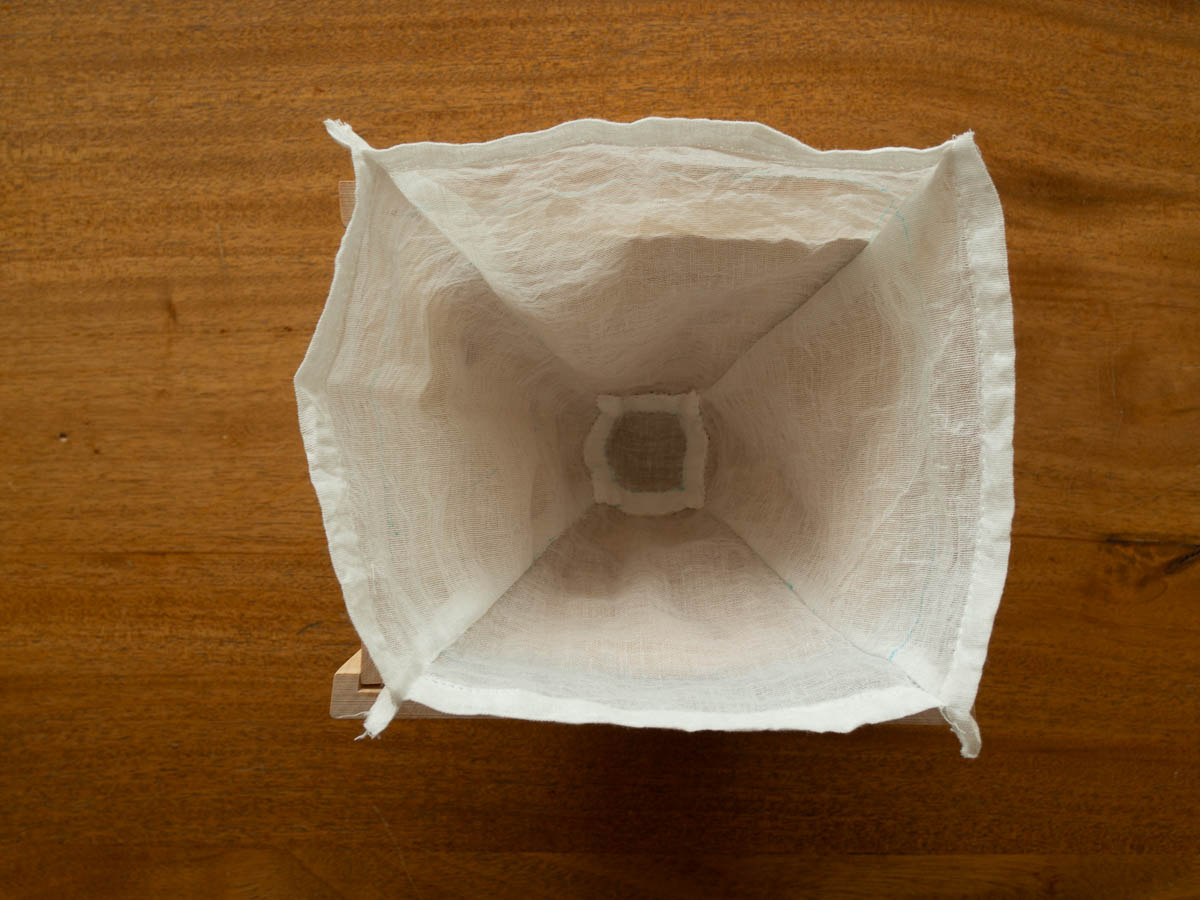
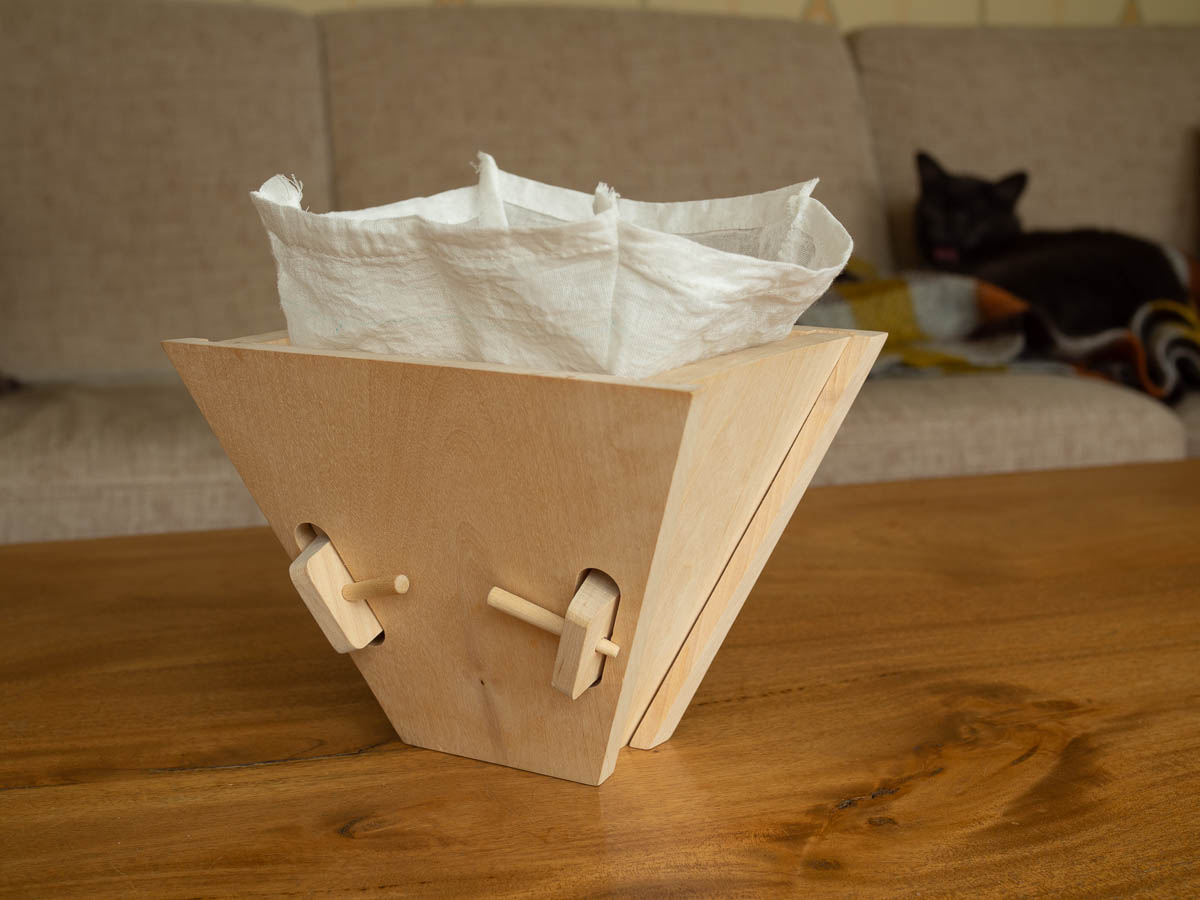
It’s pasha season, but the cloth I used to line the pasha mould with went with Eric. (It was part of a juice strainer.) We can’t have Easter without pasha, so it is time to make a replacement.

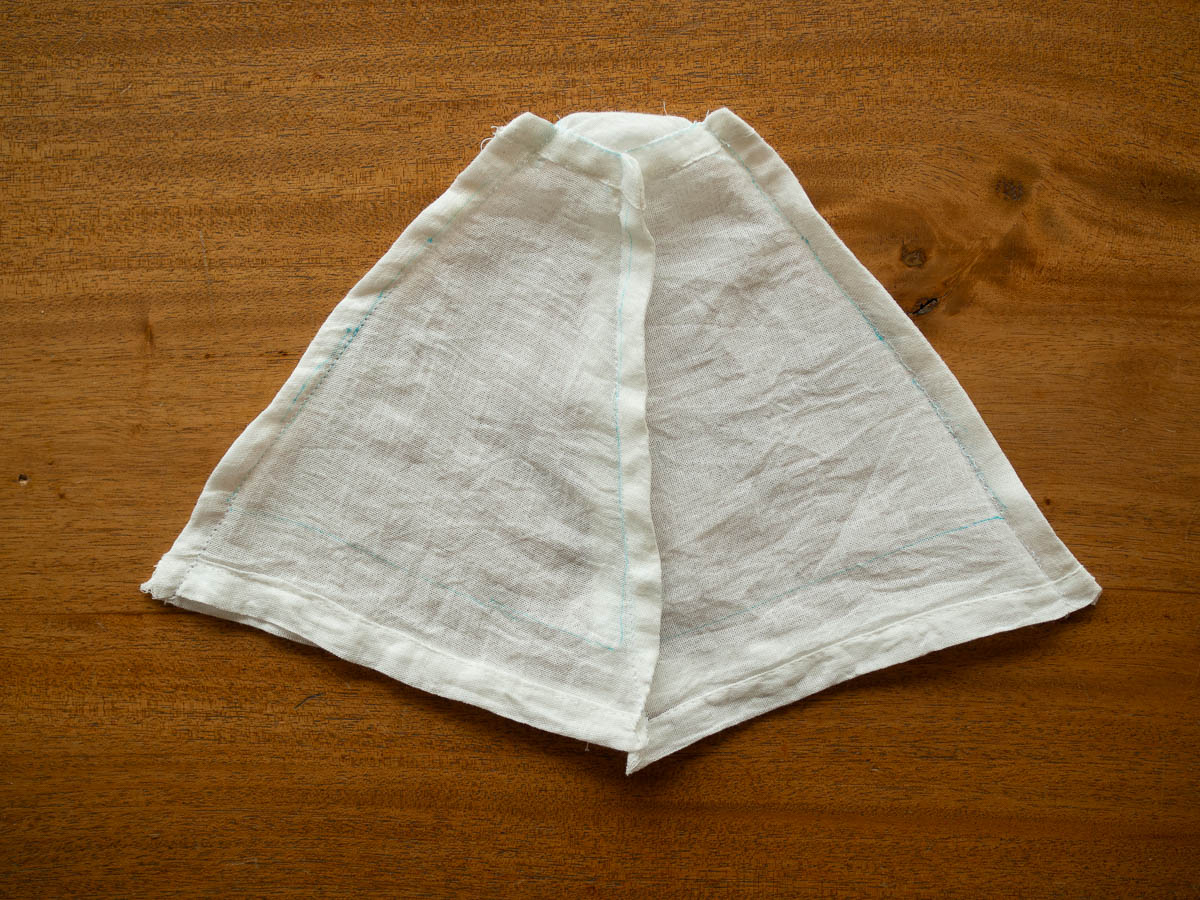
Cordon Bleu, the kitchen goods store on Vasagatan, had not one but two kinds of muslin/cheesecloth. There is more of a market for this than I thought. I bought the smaller variety, 100% cotton, and my project for today was to sew a liner for the pasha mould.

It took forever. Literally hours and hours. It’s such a small thing – but that just means it has many small fiddly seams, and an awkward 3D shape. And all the seams needed to be enclosed, because we do not want bits of cotton thread in our food or between our teeth. And I must still be doing something wrong with my sewing machine because several times I did something that mucked up the tension on the bottom thread, and had to untangle it and re-do the seam.

But! Now I have a liner. I will be using it until the day that I die, to make it worth the effort. And then my children and my children’s children will be obliged use it until the end of their lives as well, until the cloth falls apart.

The pasha itself went much faster and easier.

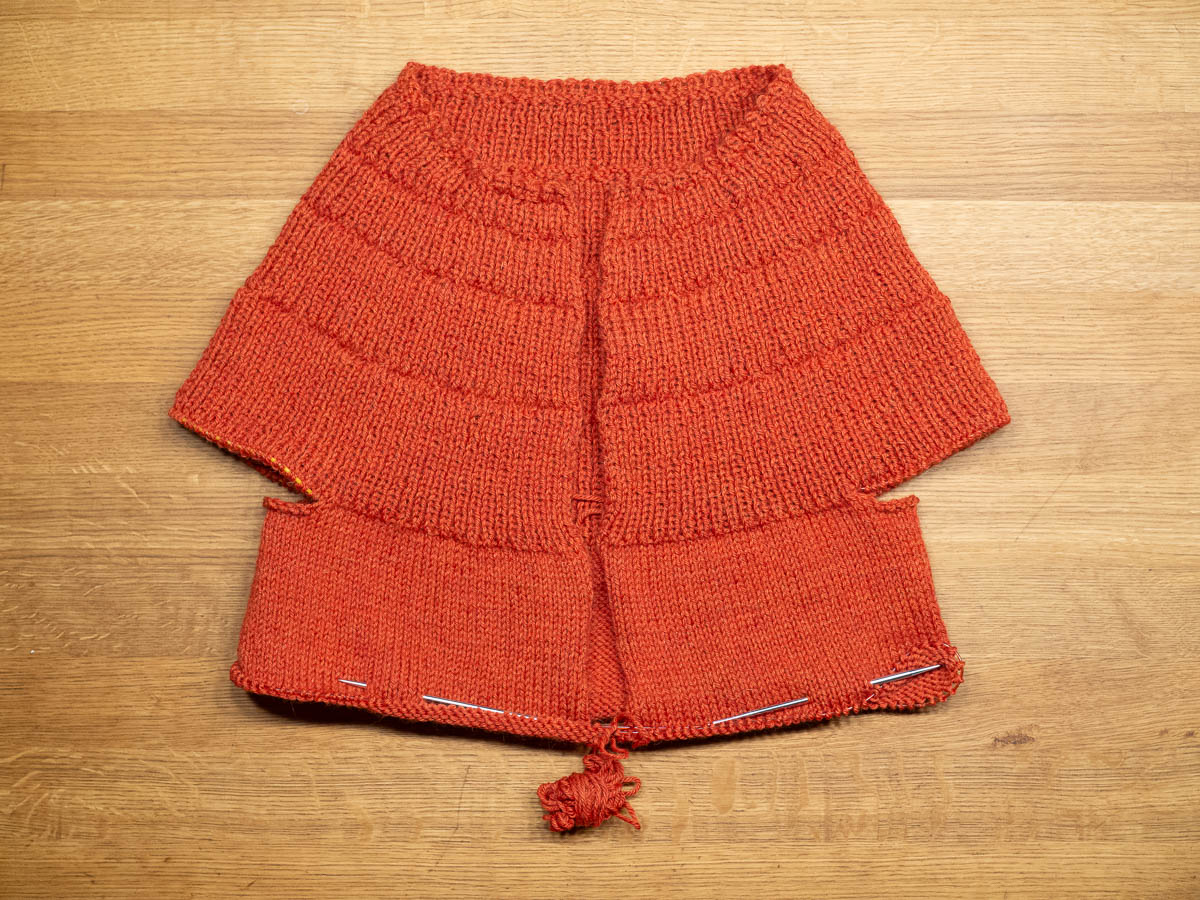
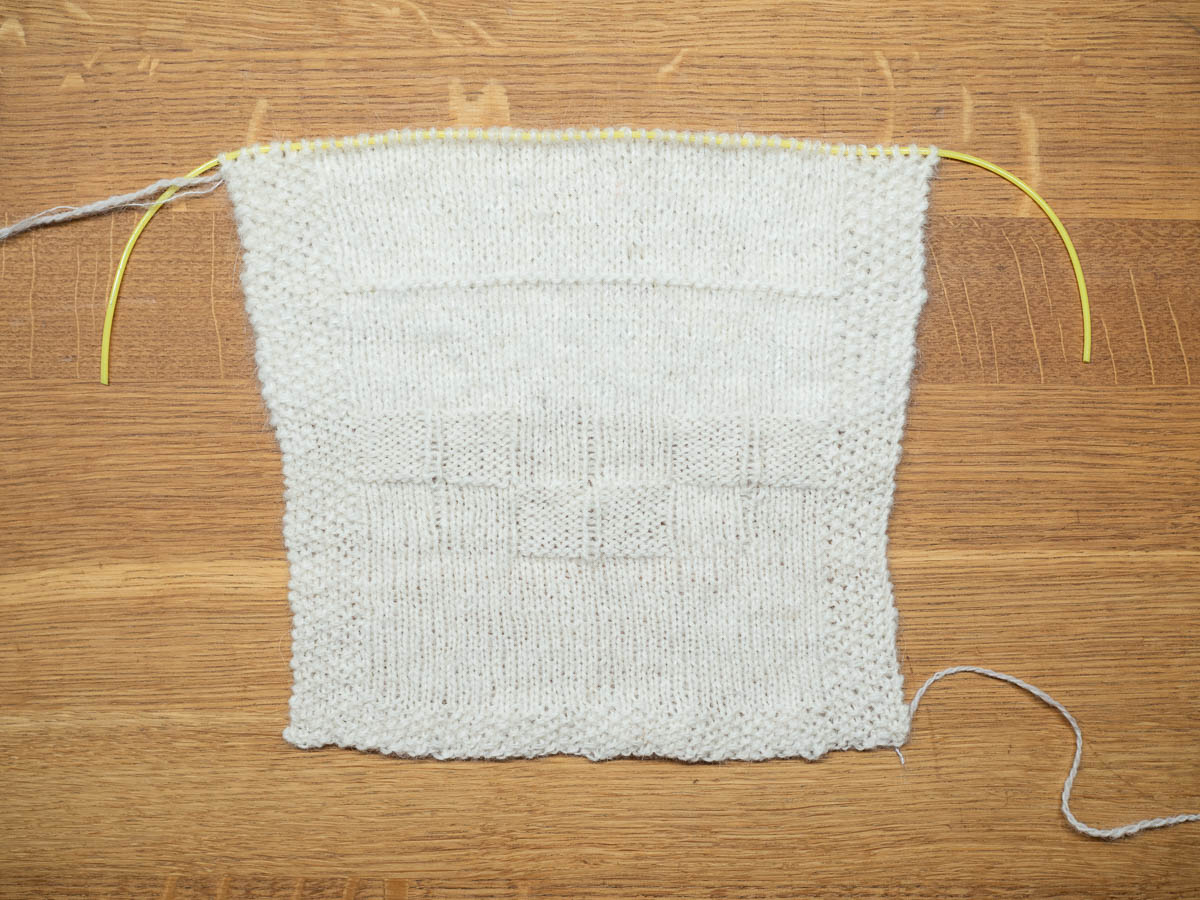
I started knitting on the next cardigan during the conference trip to Italy. With a thicker yarn than I tend to choose, and a slightly looser knit, it knits up fast.

The yarn is Drops Lima, a lovely wool and alpaca blend. I love the way alpaca yarn feels.

The design is a very simple one and mostly my own. I’ve been eyeing the Ankers cardigan, but I didn’t like the high neck with no neckline shaping. (Any cardigan design that does not show a single photo of it worn fully buttoned, is probably not going to look good fully buttoned. Knitwear designers ignore neckline shaping and waist shaping way too often, in my opinion.)

Overall a round yoke seems simple enough, and the yoke on the Ankers is just bands of ribbing interspersed with increase rows, and I figured I could do that myself. I’ve knitted enough sweaters now to feel like I mostly know what I’m doing, and the Internet is full of helpful tutorials and guides.

It took a full evening of arithmetic (there are a lot of details that need to line up!) and one aborted attempt that I ripped up, and now I have something that looks like it will work out and fit me decently well. It looks better on me than on the table. Even then it takes a bit of imagination to add the missing details, such as button bands, neckline edging. I hope it all comes together the way I have it planned.

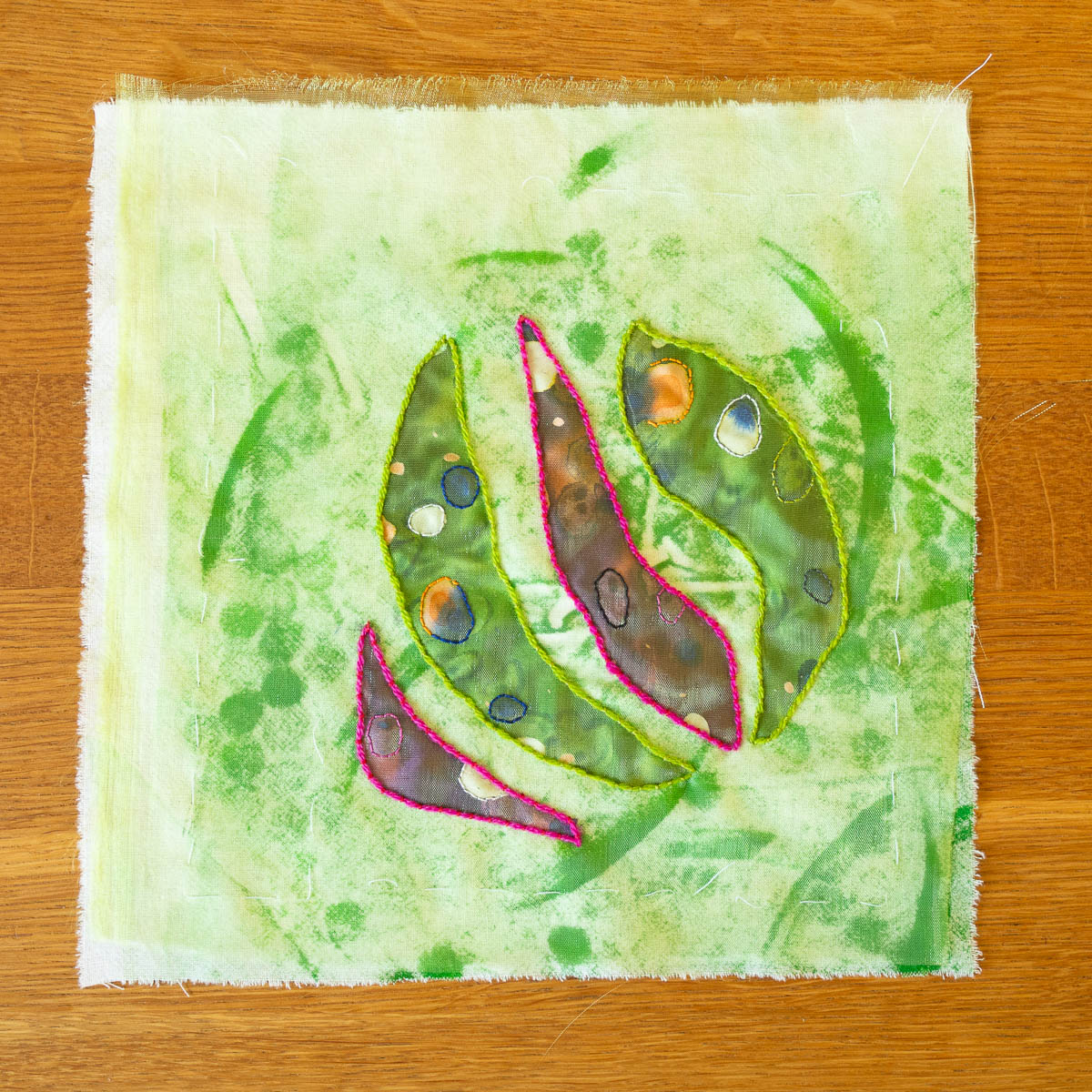
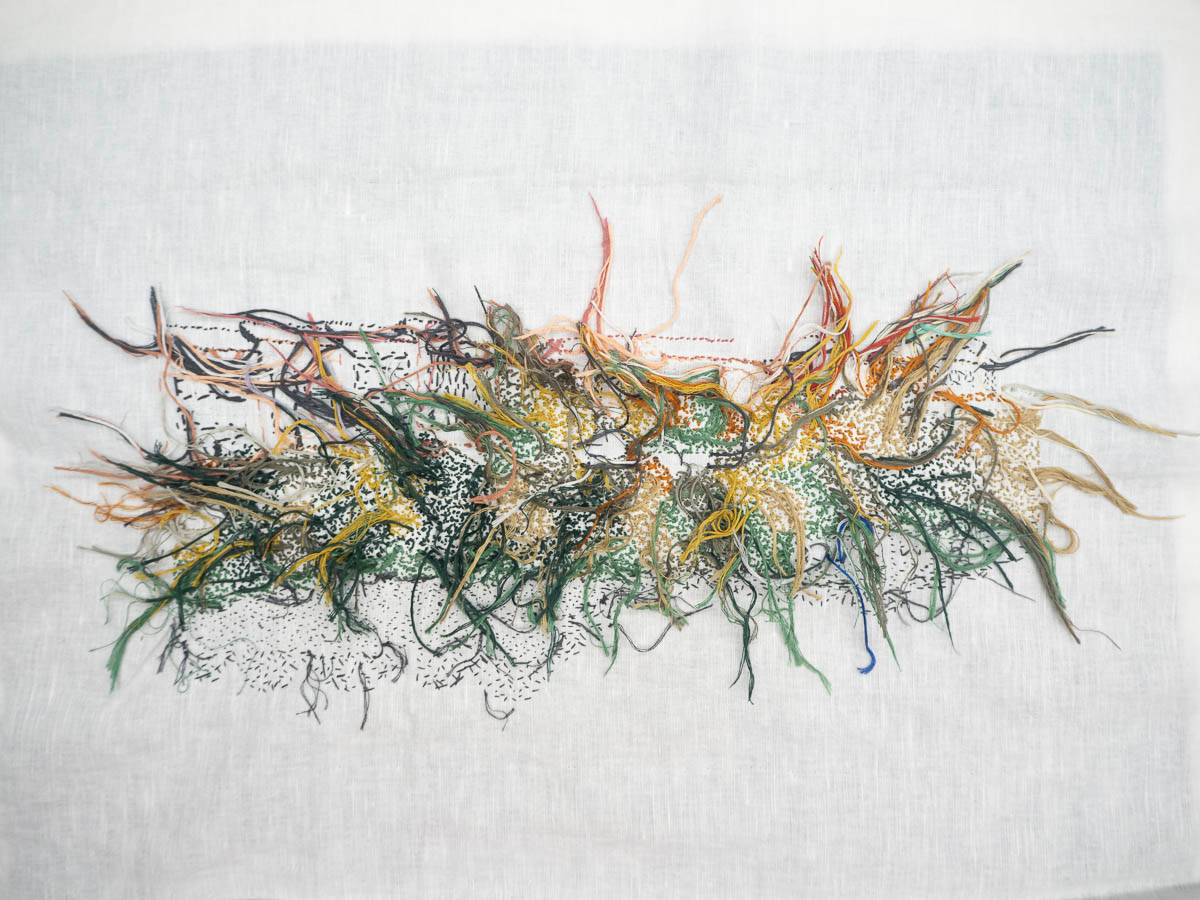
Finished the organza-over-silk-over-print embroidery. Still not in love with it, but it’s better.

I think the original idea has promise, though, so there will be more attempts. This was one quarter of a larger square of printed fabric. I think I’ll make variations on the theme of the other three quarters, and then perhaps frame them all together.

Today I learned that tetraptych is a word.

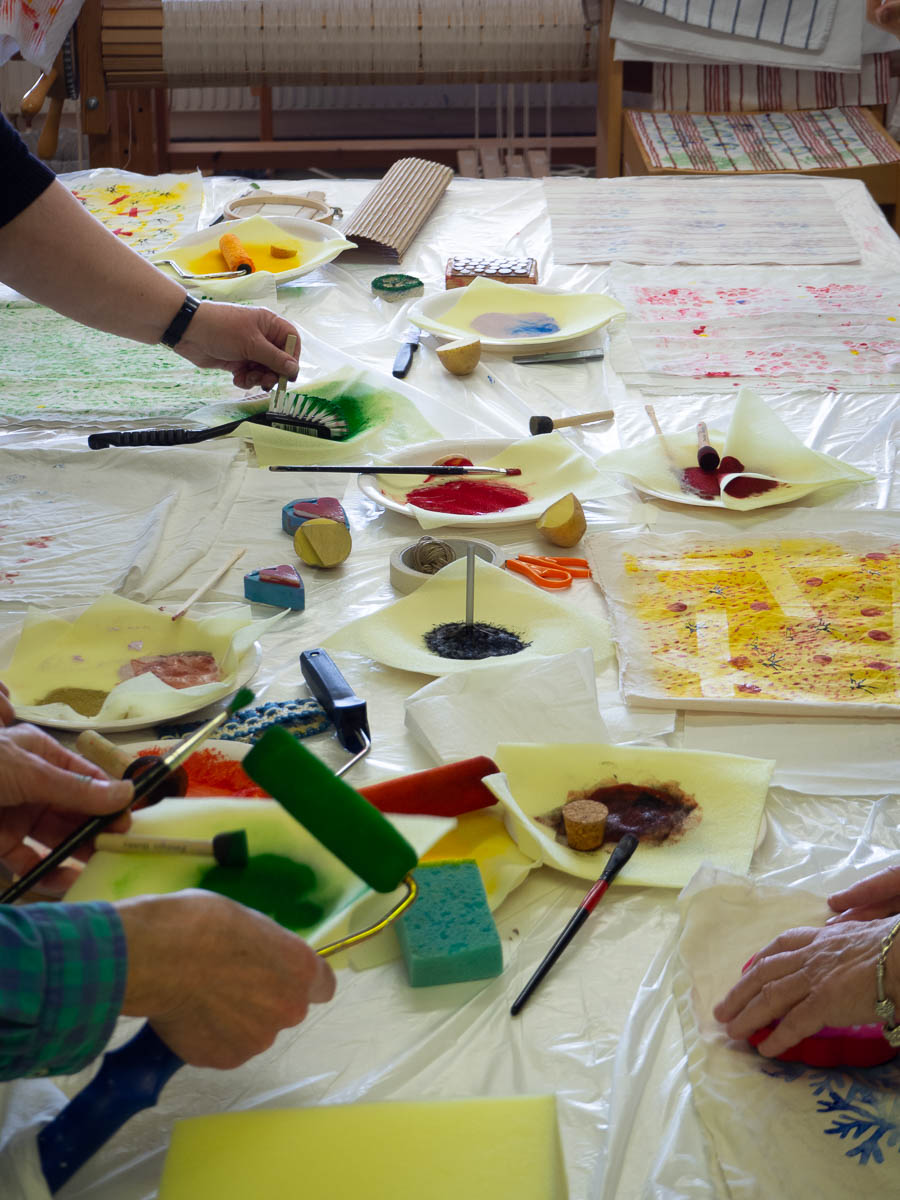
More photos of the results of this weekend’s textile printing workshop. I want to remember what we did and note down some of the key things I learned, so I can do more of this in the future.

The traditional way of making patterns on fabric, in my head at least, is that you first put paint on an object of some sort, such as a stamp, or a leaf, or whatever, and then press that object to the fabric. We did a little bit of that, but I didn’t find the results too exciting. It’s very intentional, and you tend to end up with very regular patterns. You don’t have to, of course, but these designs tend in that direction. The regularity and repetition of it makes my brain itch and I just want to mess it all up and make it more random and unpredictable.

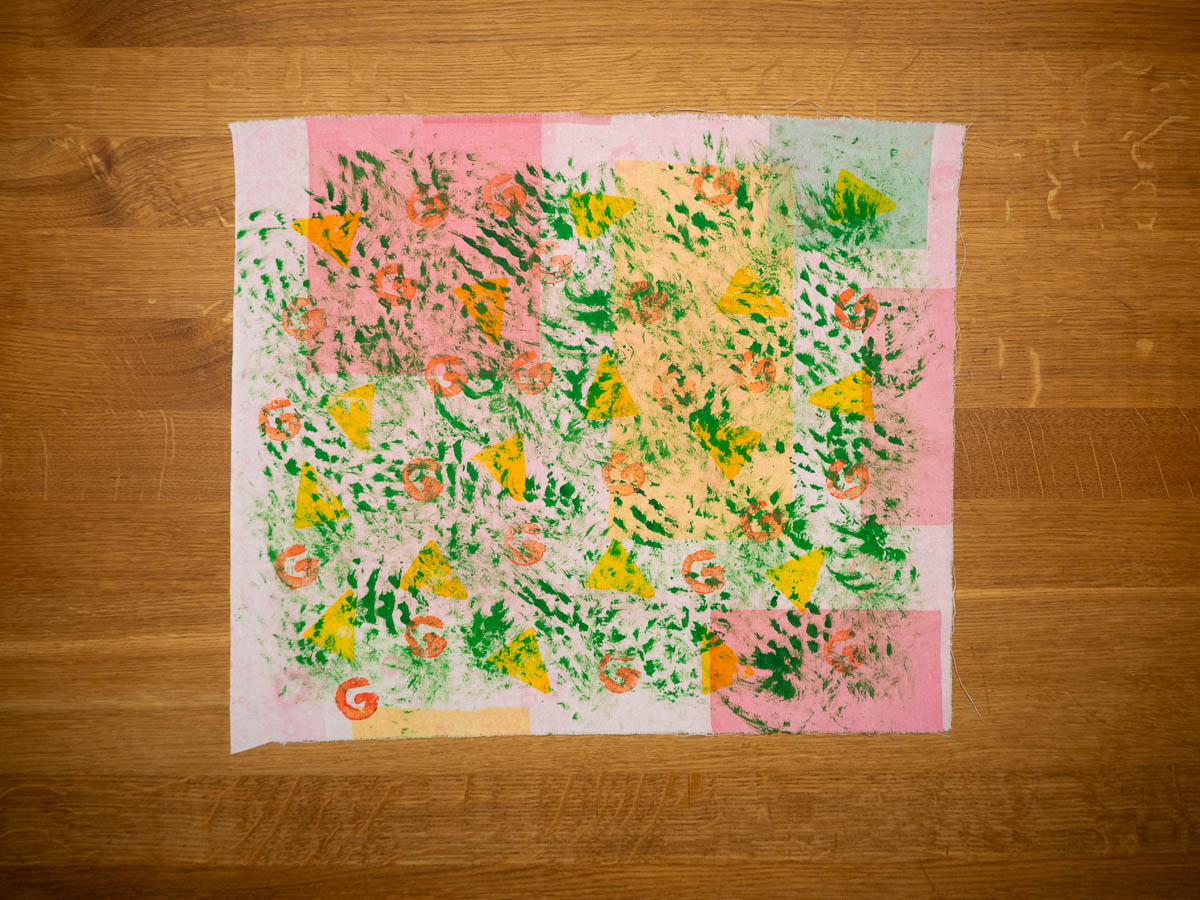
Here’s my one and only stamp print from the workshop. It was the day’s warm-up exercise, on scrap fabric from the workshop leader, and I knew right then and there that I wouldn’t be doing any more of that.
Learning #1: instead of putting objects ON the fabric, put them UNDER the fabric, and then run a roller over the fabric. The stuff under the fabric presses it up against the roller, so the fabric gets paint where there was stuff, and little to no paint where there wasn’t. And you can do this with just about anything.

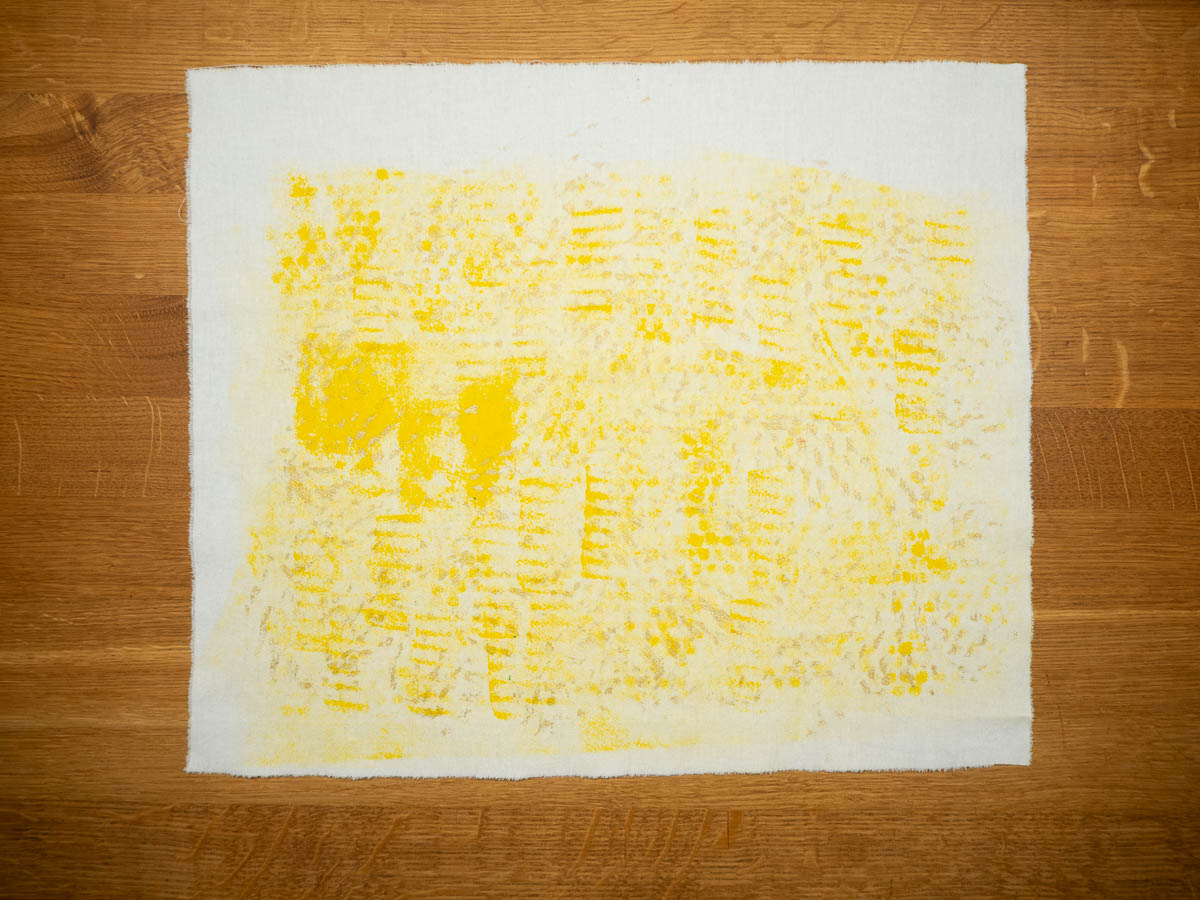
Corrugated cardboard:
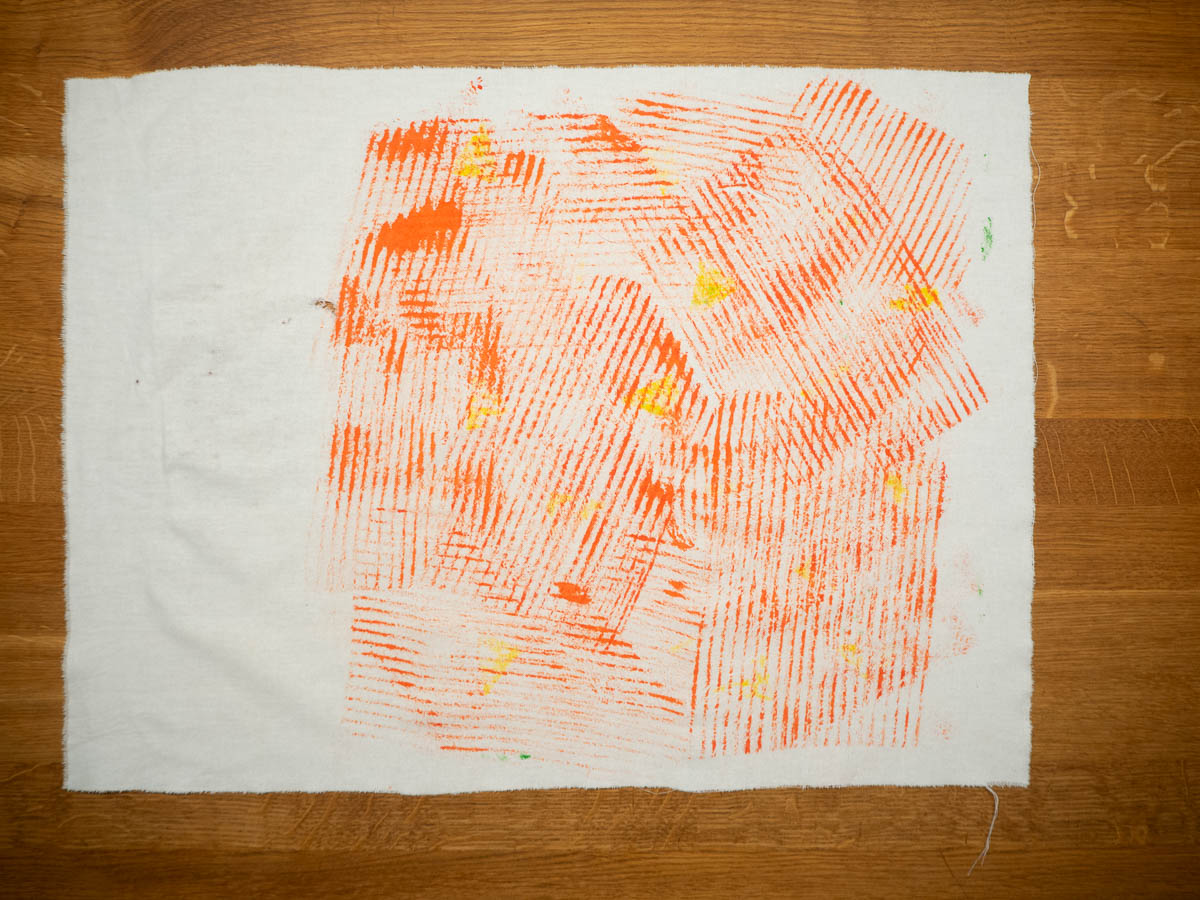
Old crochet doilies:
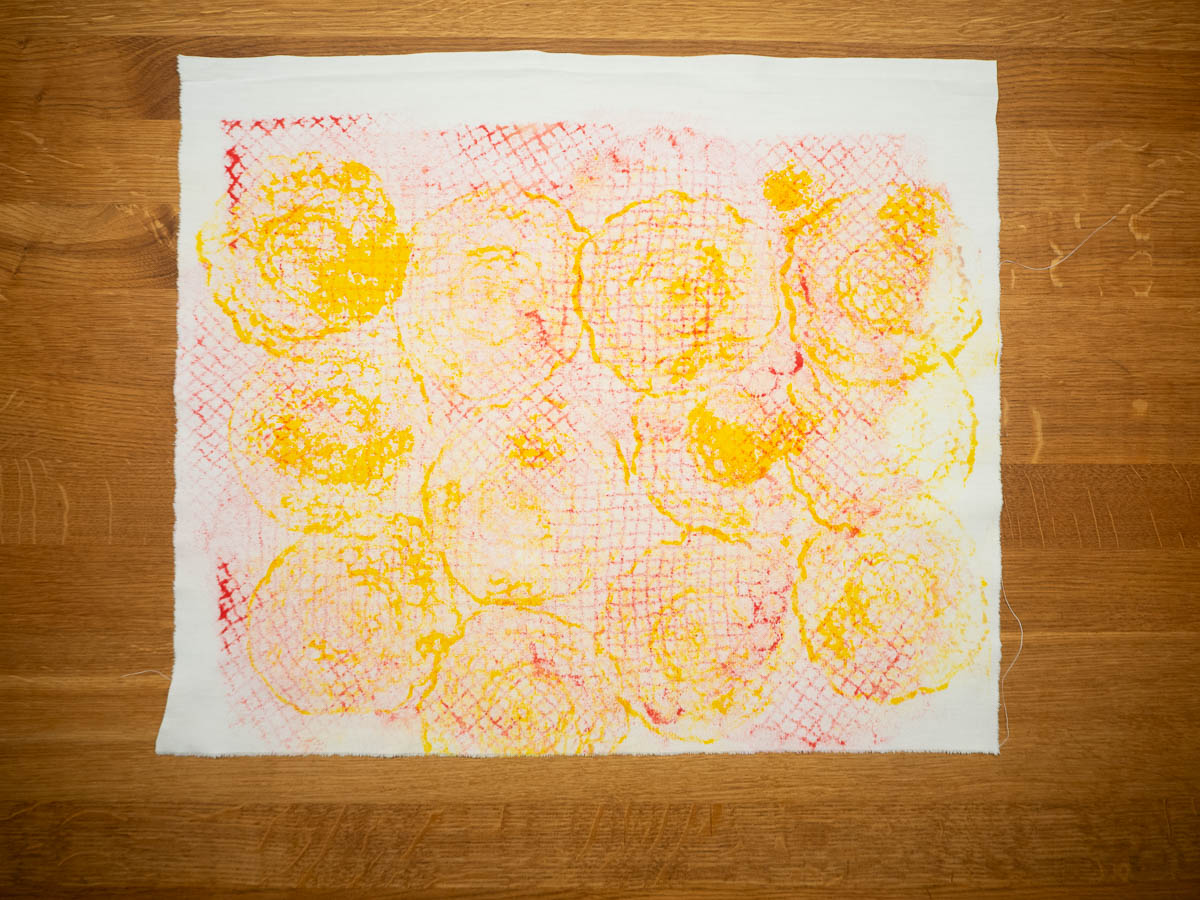
You can combine them, with different colours for different objects. You can move the objects around, so a tiny piece can make prints on the whole fabric. You can roll over just a part of the stuff, or roll at an angle.

Bubble wrap and a roll of masking tape:
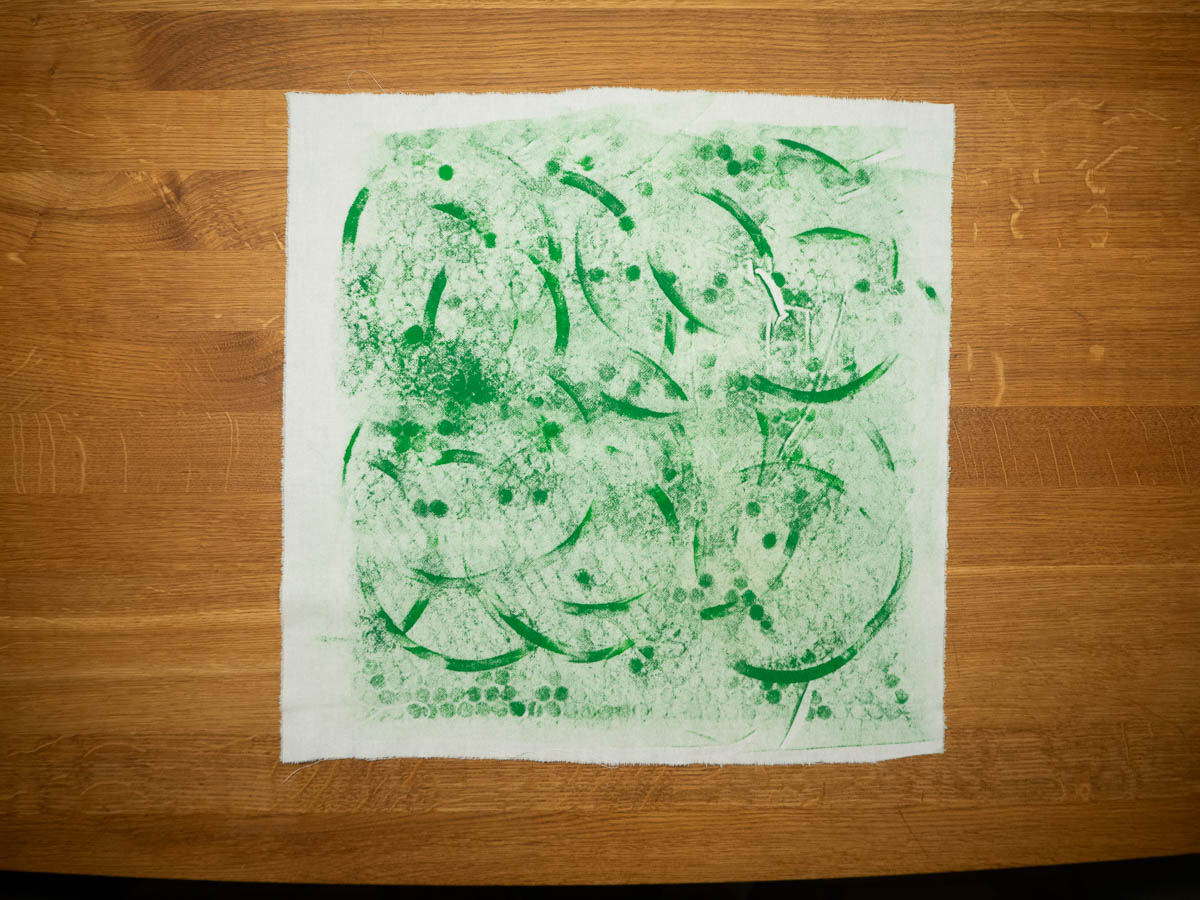
Jumbled-up strips of bedsheet hems:
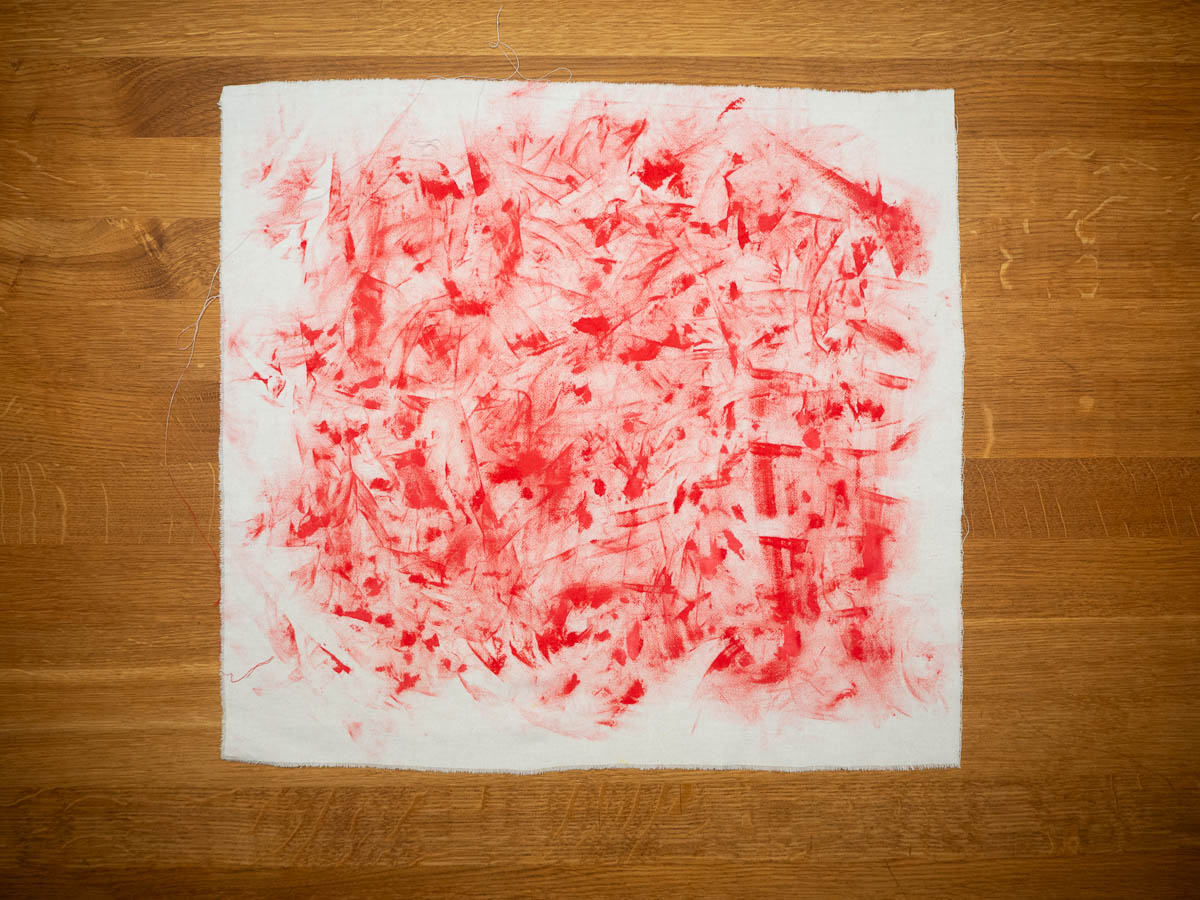
Roll of masking tape and jumbled-up strips of bedsheet hems combined:
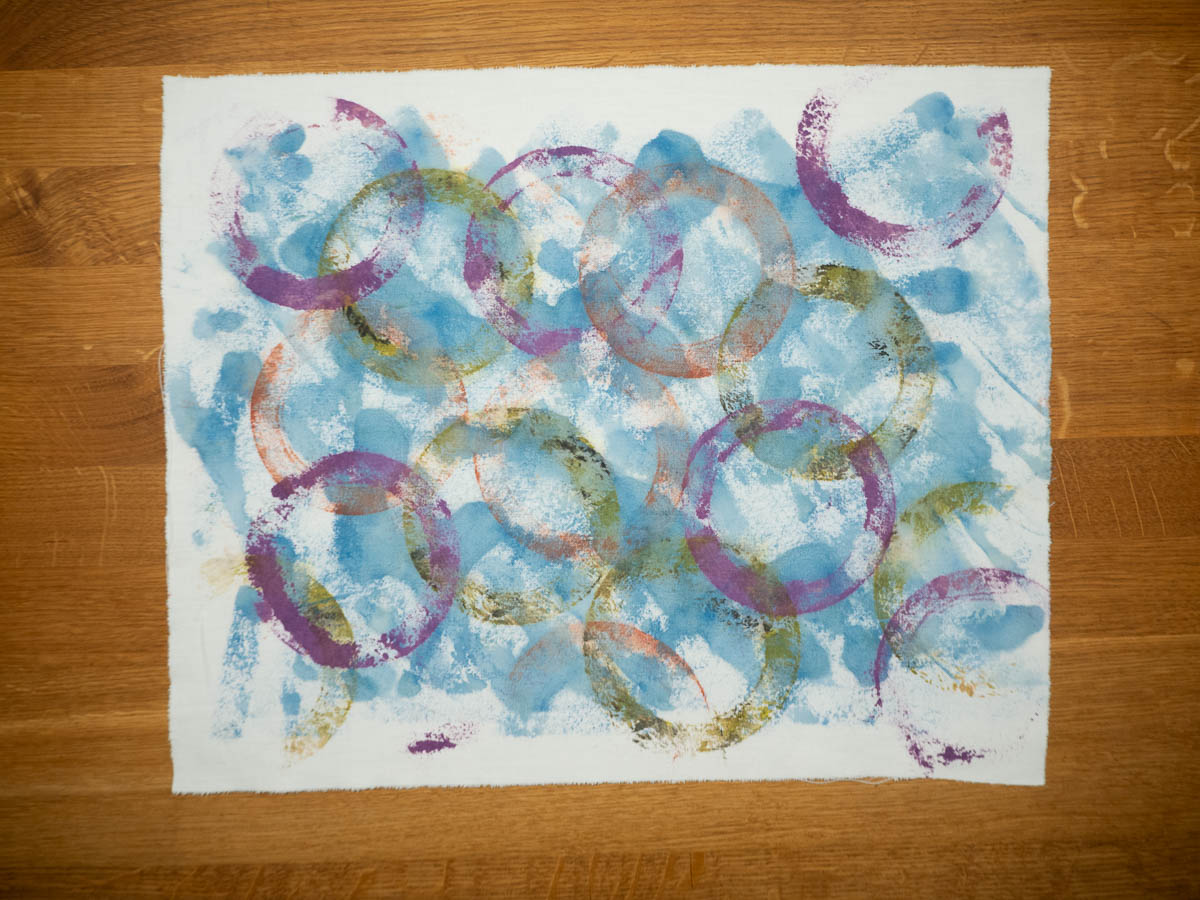
You can mask off parts of the fabric so those don’t get paint (corrugated cardboard and a bundle of string):
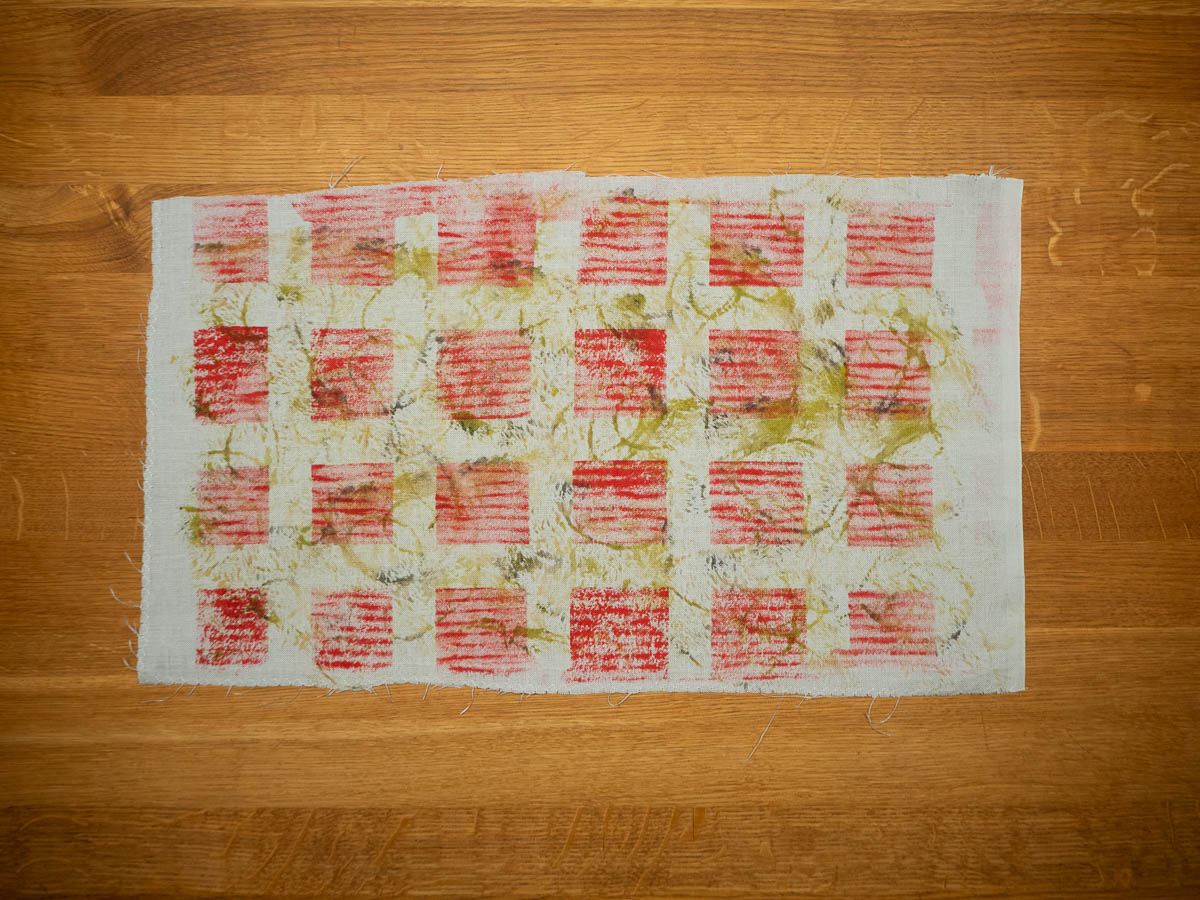
You can dilute the paint to make it wet and runny (roll of masking tape again):
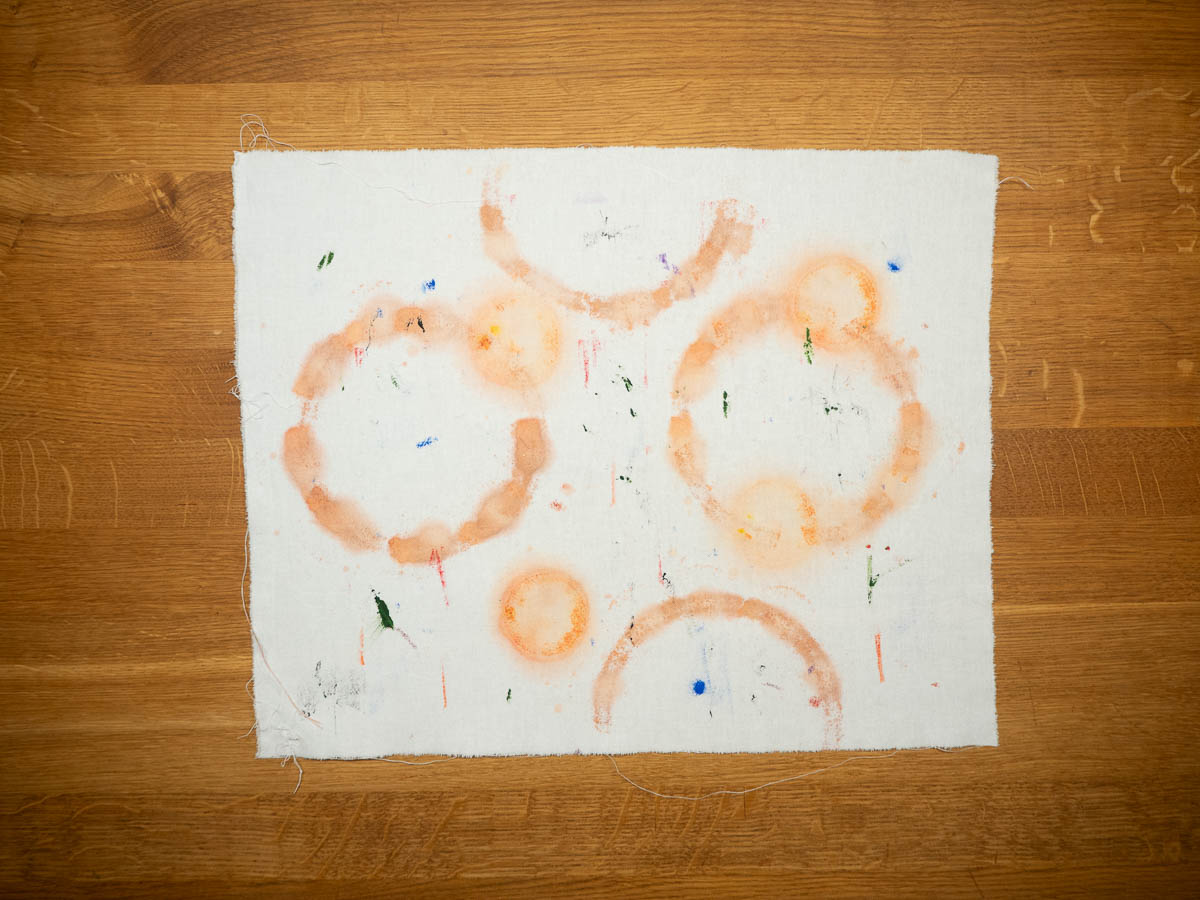
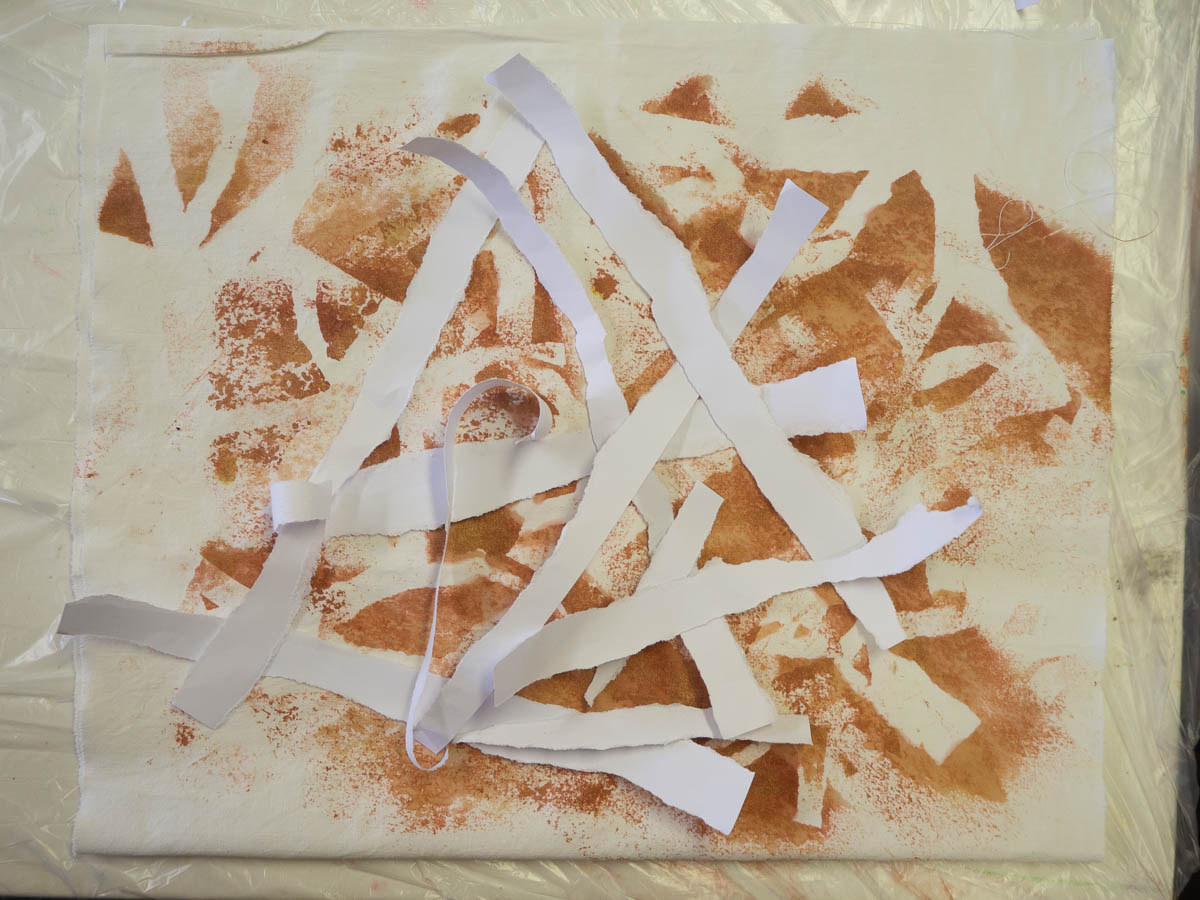
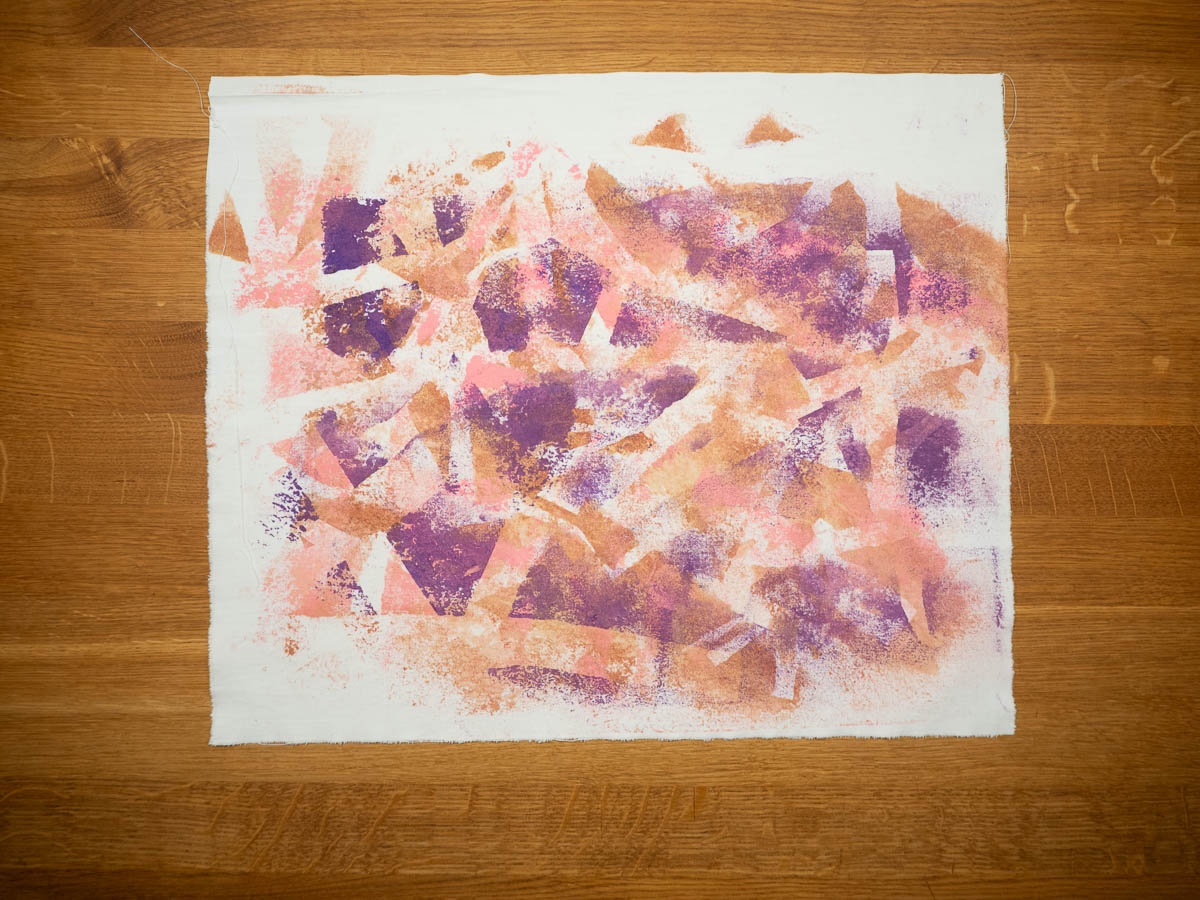
Learning #2: you can mask off parts of the fabric with all kinds of things, not just masking tape and tidy stencils.

For example, a random jumble of paper strips:
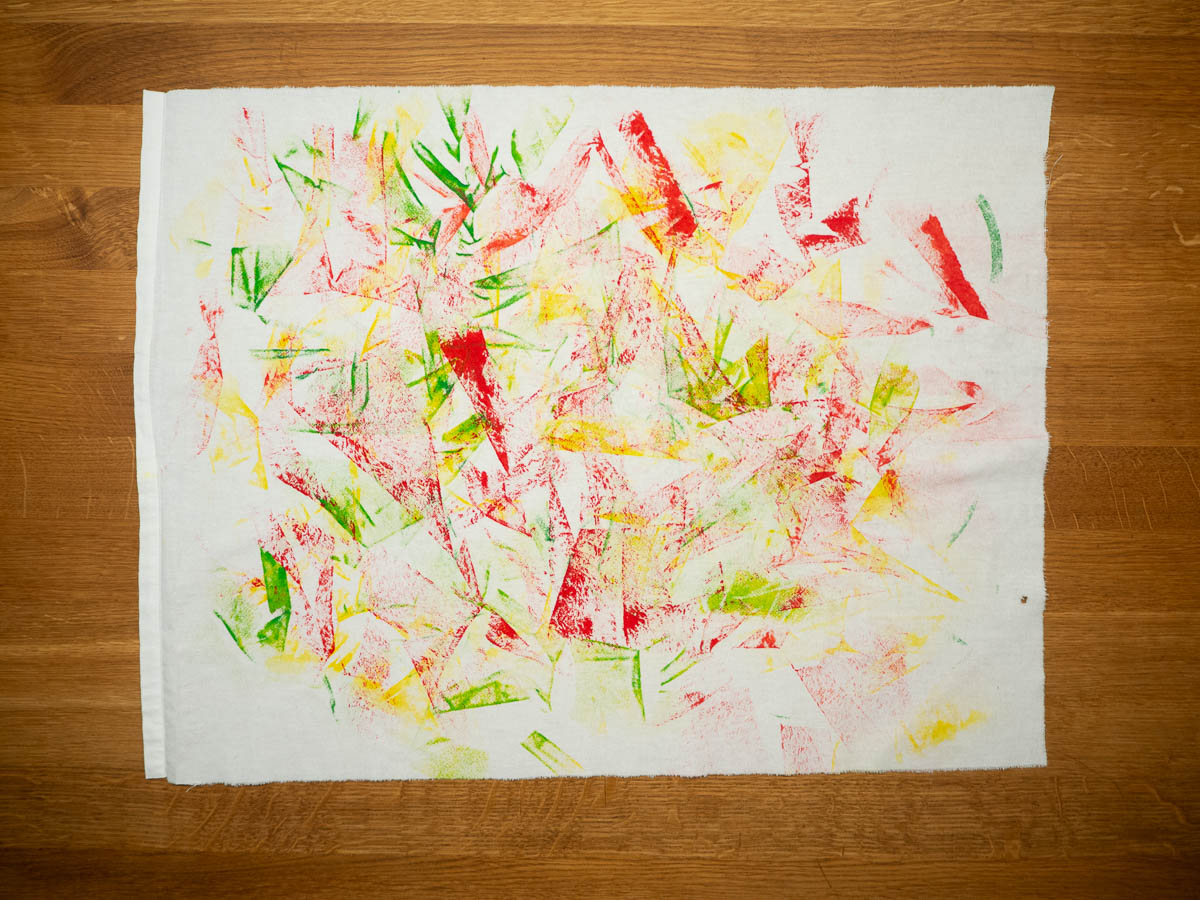
Or just wrinkles and folds in the fabric itself – bunch it up and run a roller over it:
Learning #3: use non-traditional things to apply paint.

A dish brush:
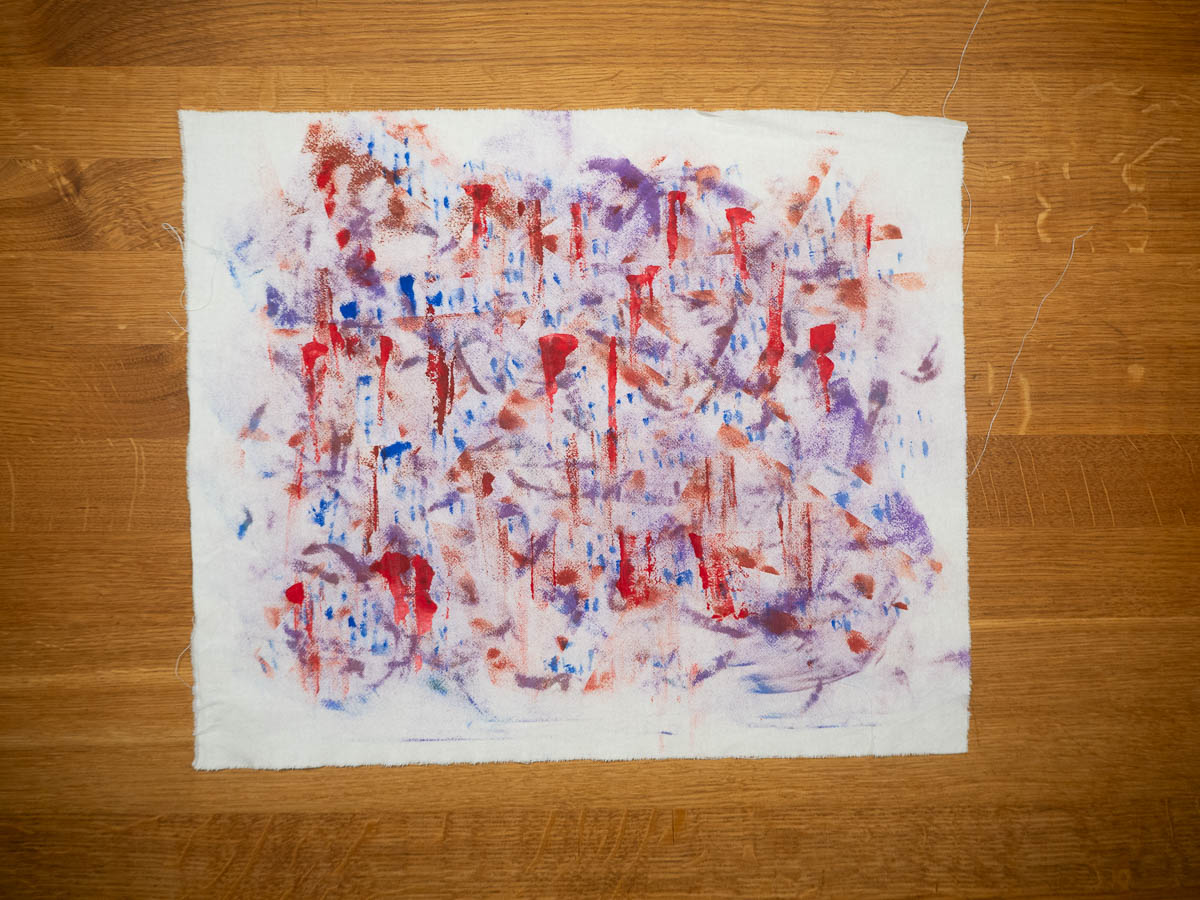
A paint mixing chopstick (for the red – and I can’t even remember what I used for everything else, although it looks like corrugated cardboard was involved for the green):
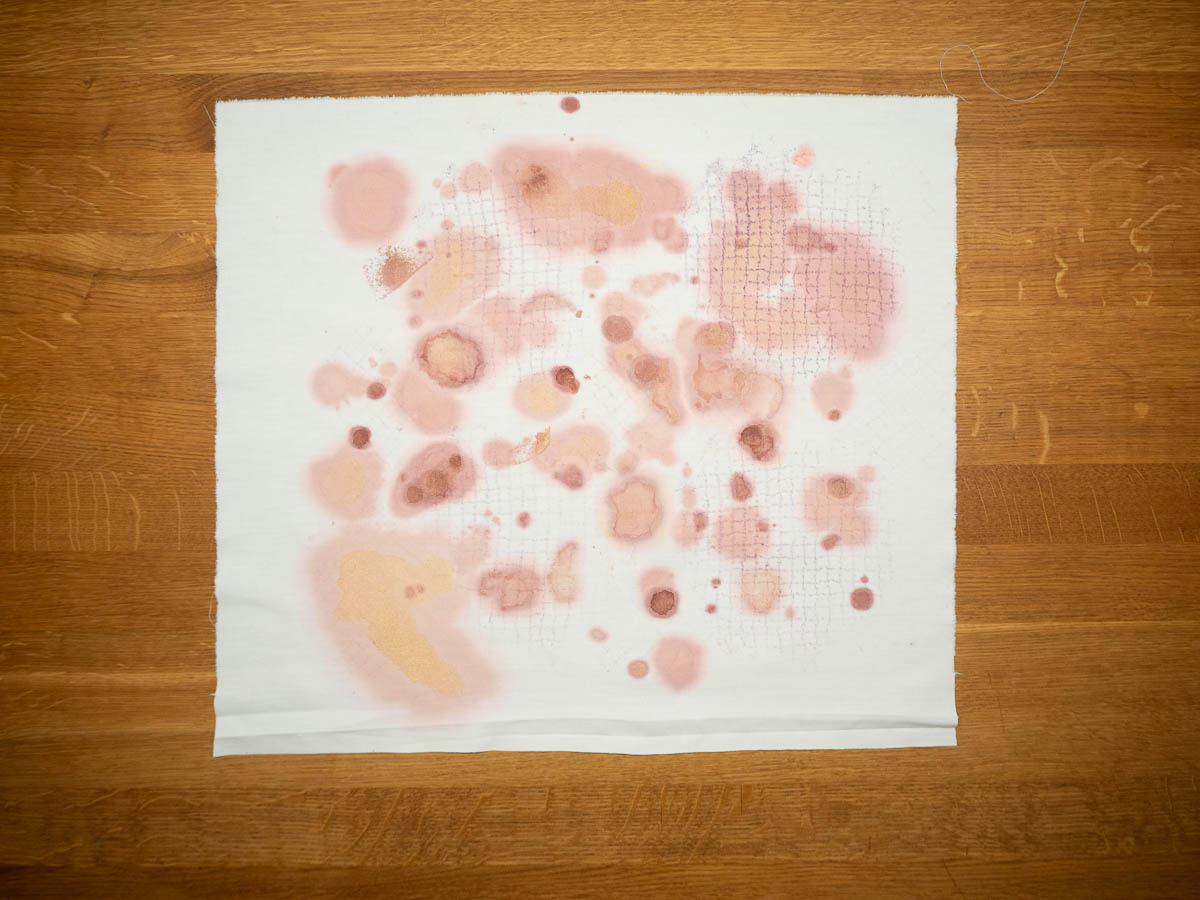
Learning #4: put another layer of fabric underneath the one you’re actively working on, for subtle patterns and serendipitous leakage.
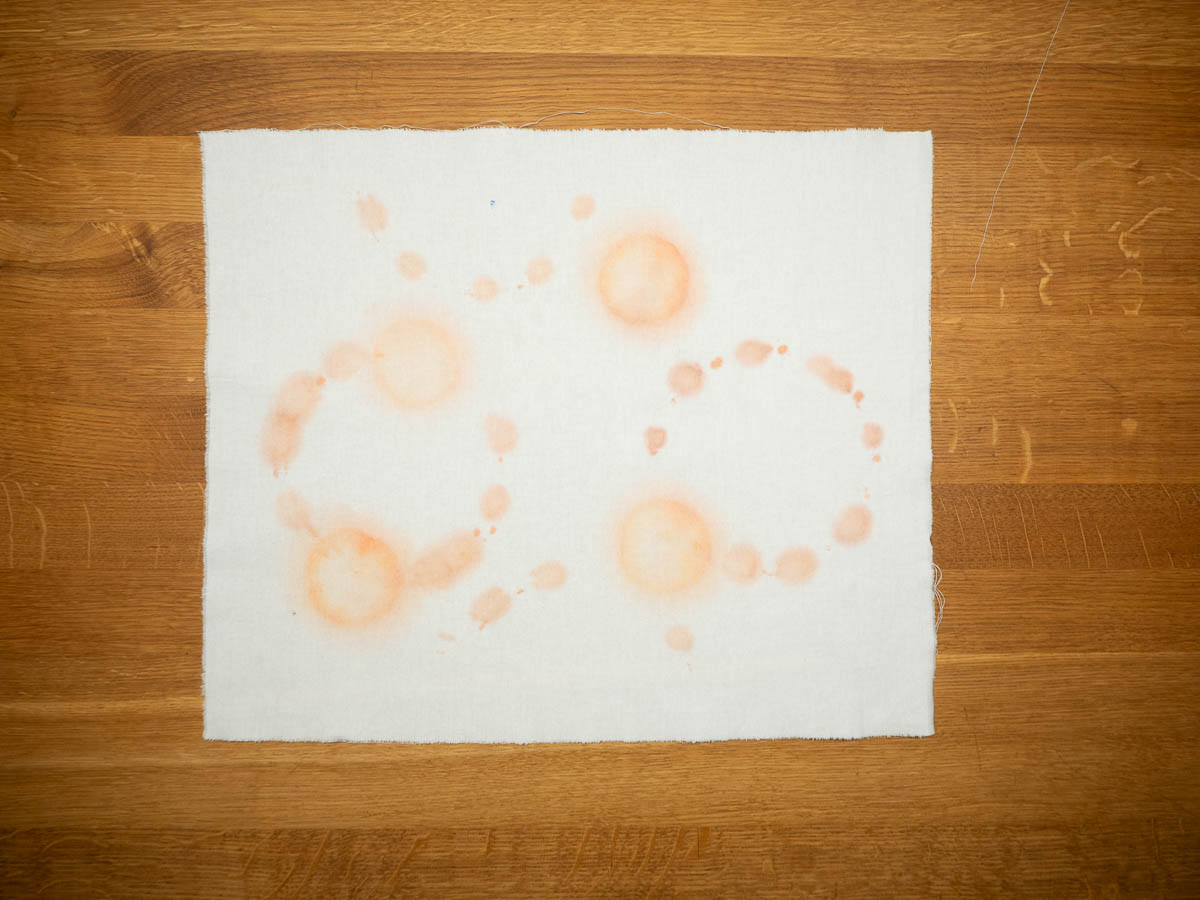
Learning #5: any time you’re reaching for paper towels to wipe something off, use a fabric scrap instead. Have paint left over on the roller? Sloppily roll it onto a piece of fabric. Have a wet roller? Dry it with yet more fabric.

A paint-covered doily left accidental prints on an underlayer of fabric. I then used it to dry a wet, mostly rinsed-off roller, and got lovely watercolour effects.
Learning #6: go with the flow. There are no free rollers for the green you had in mind, but someone has made a purple and blue mixture? Sure, why not. Someone spilled water in the paint so it’s too wet for rolling? Use a sponge to drip it on the fabric instead. The red roller got used for black by accident? Interesting colour combinations will arise.
Day two of our weekend textile workshop with Lena Larsson. Yesterday we printed on fabric; today we’re embroidering on our printed fabrics.

Lena uses a lot of applique in her embroidery, and she has a particular technique for this that I haven’t run across in anyone else’s work. During the first half of the day I experimented with her technique. She puts a layer of thin, translucent fabric such as organza or tulle on top of her printed fabric, and then sets applique pieces between these two layers. Then she stitches along the contours of the applique pieces. So the applique pieces are not actually sewn to the fabric – they’re only held in place by the contouring stitches. They almost hover in place.

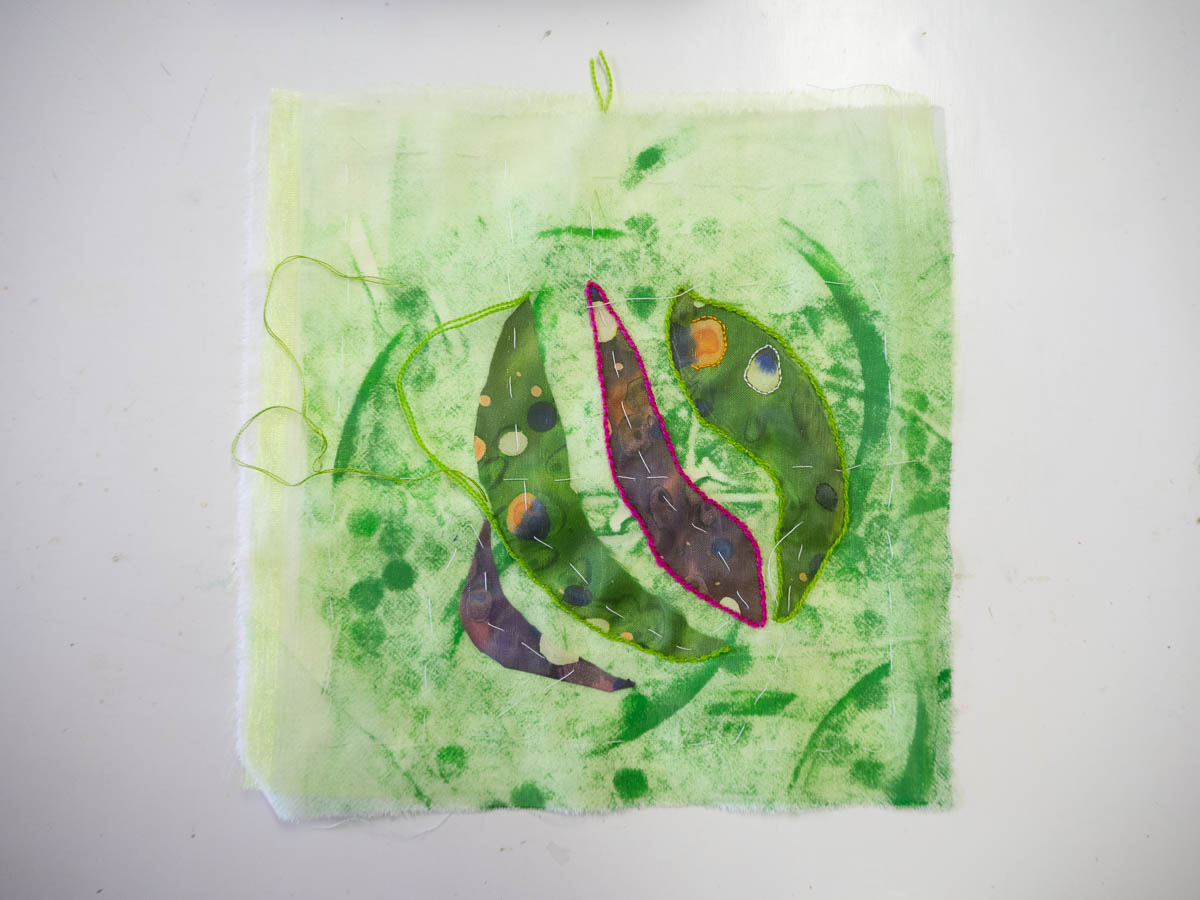
I tried light green organza over a fabric with plenty of green, strips of patterned silk in between, and couched contours. I liked the technique, but I think my fabric choice wasn’t the best. I thought green and purple would give me vibrant contrast, and they would have, if they had been side by side – but the green organza on top of the purple silk strips just made them look washed out and muddy. I tried bringing back some of their colour with embroidery, but I still don’t like the look.

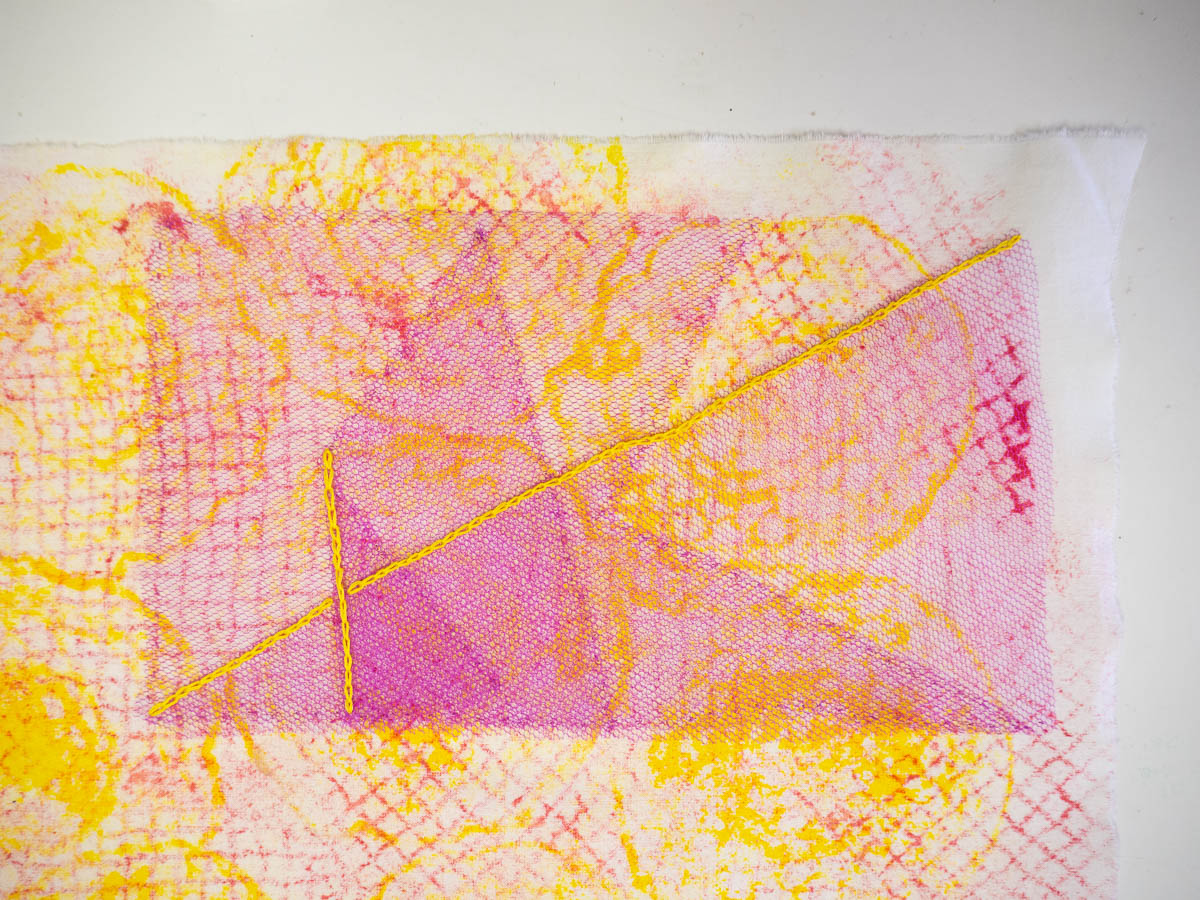
After lunch I switched techniques and experimented with stacking layers of tulle on top of each other, and embroidering on that.

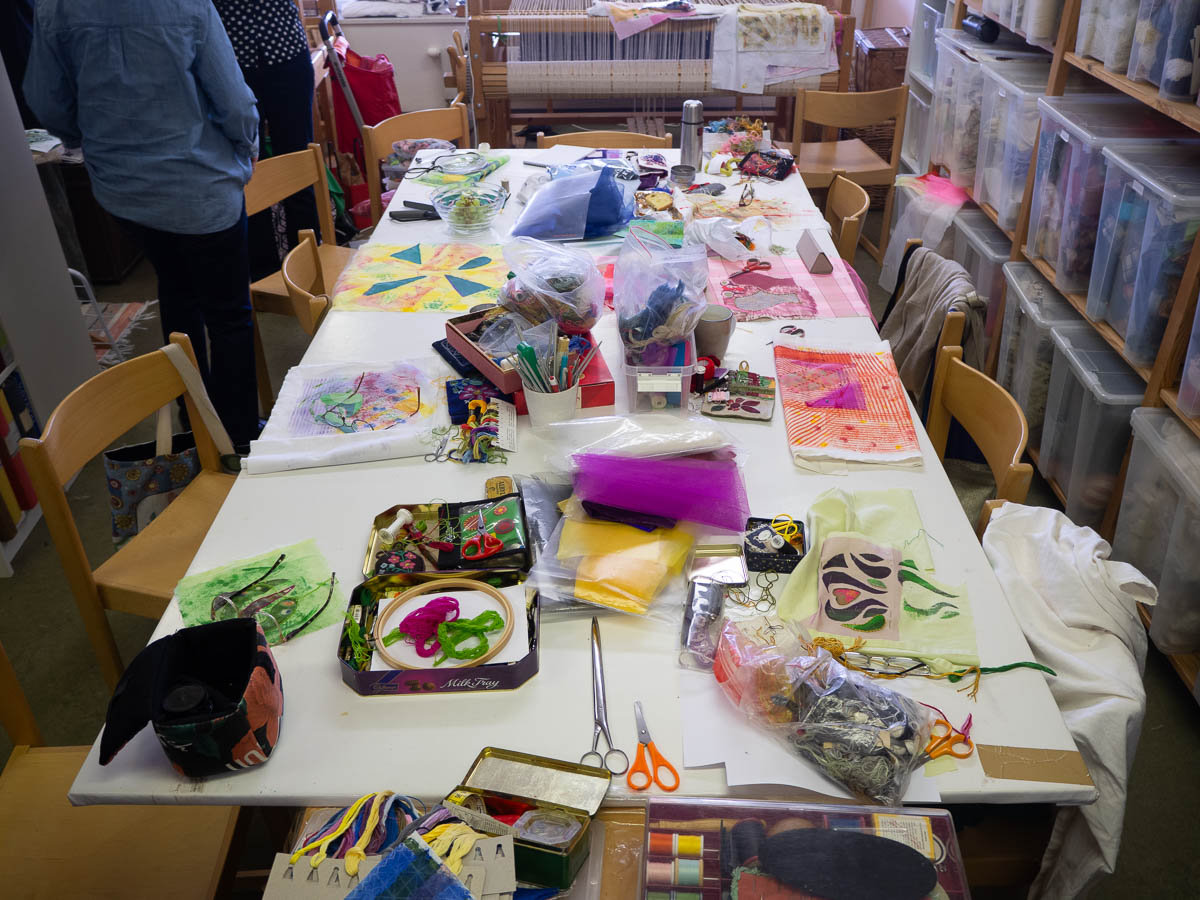
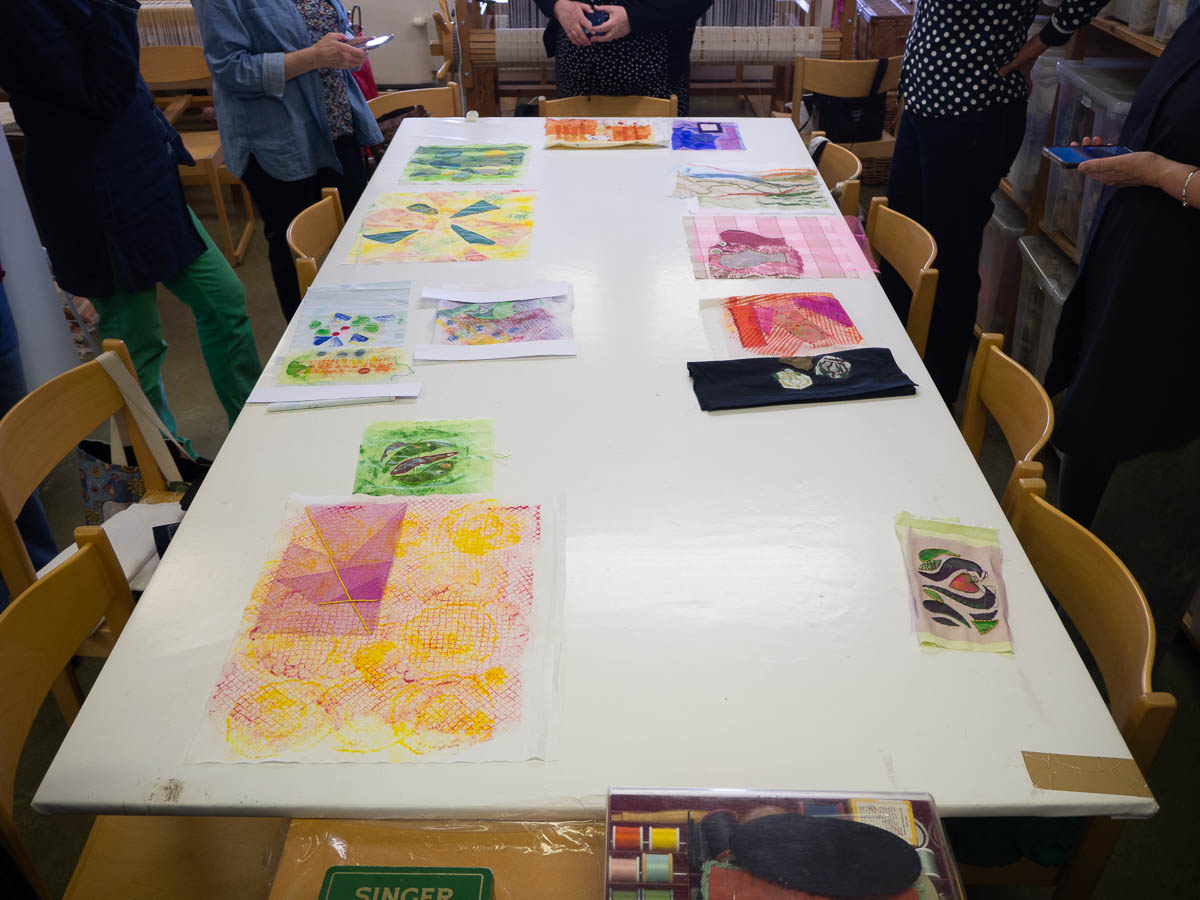
Ten people, all given the same materials and instructions, ended up with ten very different results.

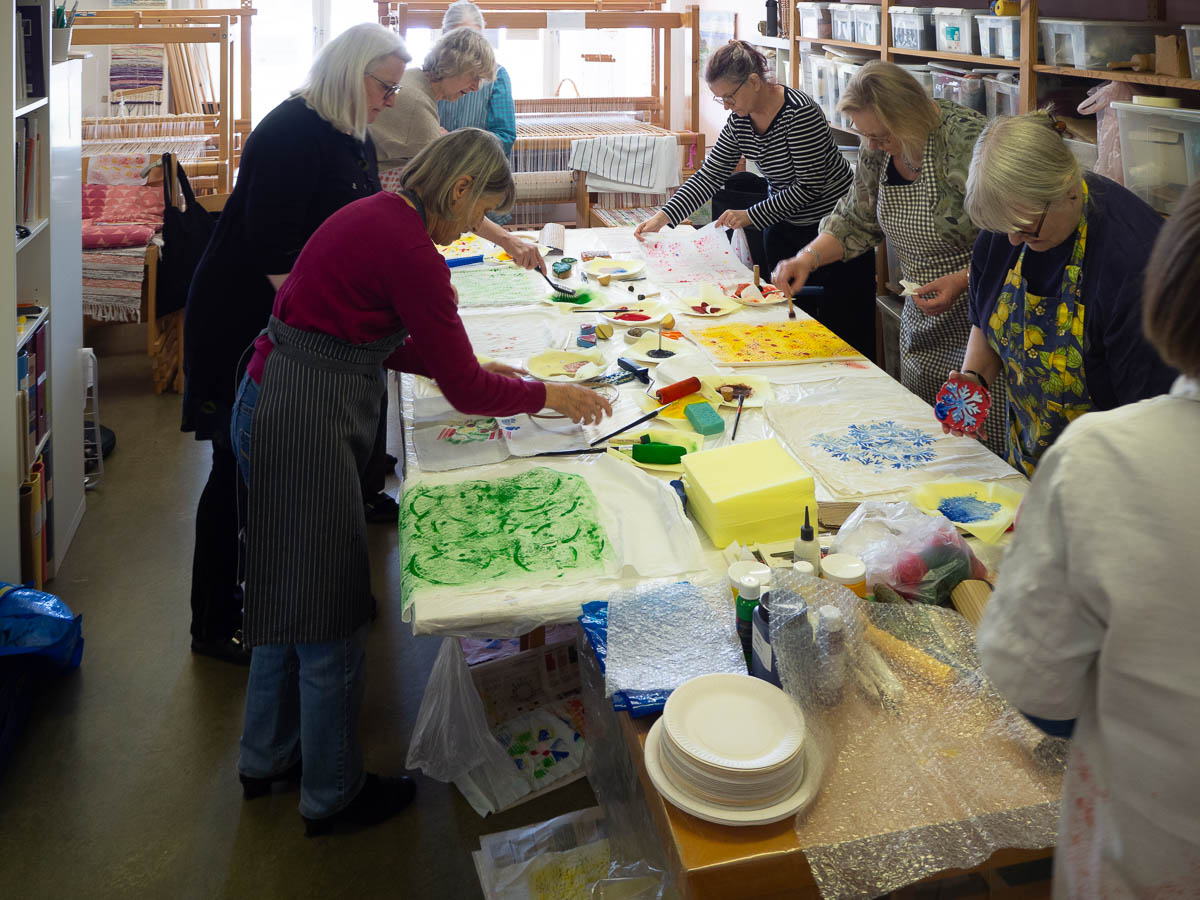
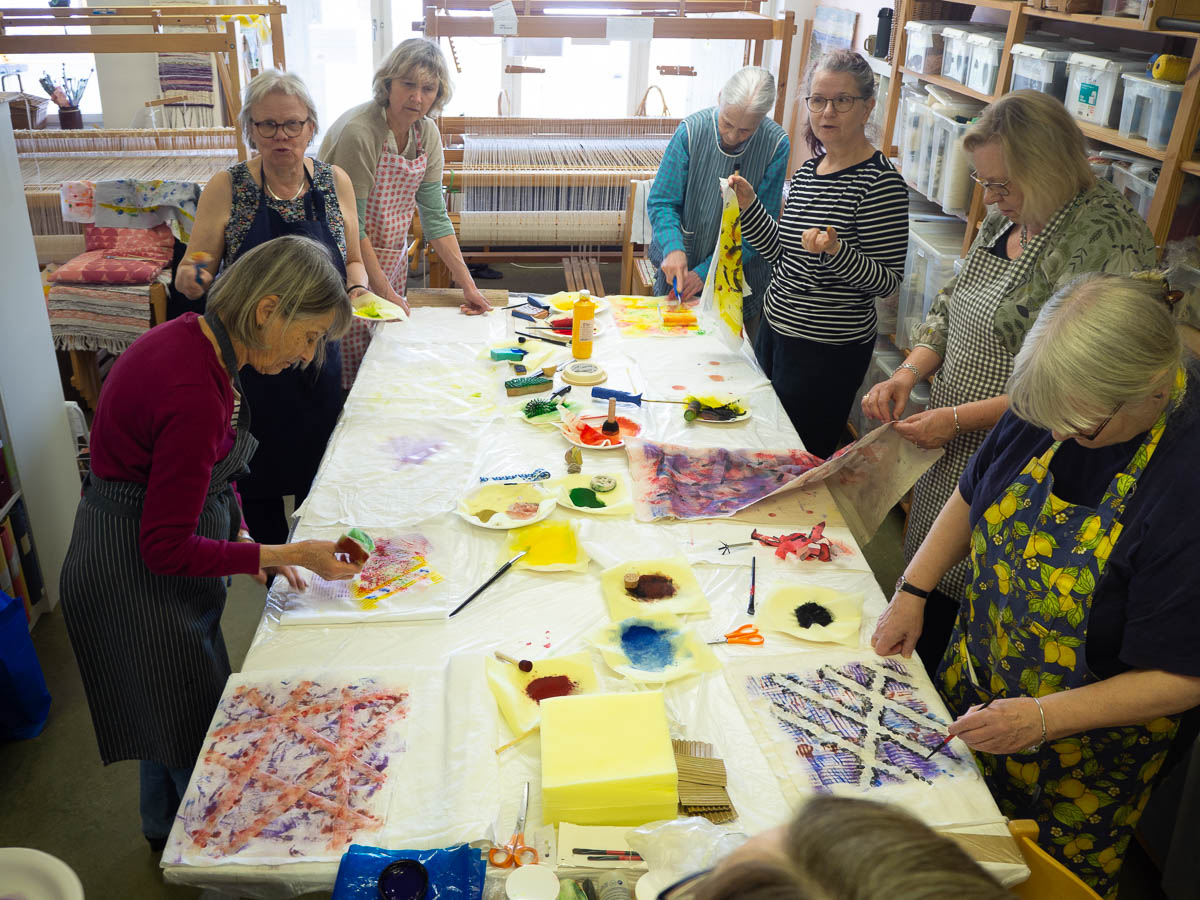
A full-day textile printing workshop with the ladies from my Thursday embroidery club, led by Lena Larsson, whom we discovered through her exhibition at Husby GÄrd back in October. Several of us visited the exhibition, enjoyed it, ended up talking to the artist herself, and at some point someone proposed that she could show us how she does stuff. Half a year later, here we are!

This was an incredibly fun way to spend a day. Just playing around with paint on fabric, in all kinds ways. I haven’t been so immediately, playfully creative since I mucked around with children’s crafts back when Ingrid and Adrian were in their first years of school.

Doing this together made it so much better than it would have been on my own. Lena showed us examples of her work and gave us some ideas to get started with. Then someone came up with a variation, and someone else thought of a different one, and a third person combined the two into something entirely new. The ideas just kept flowing.

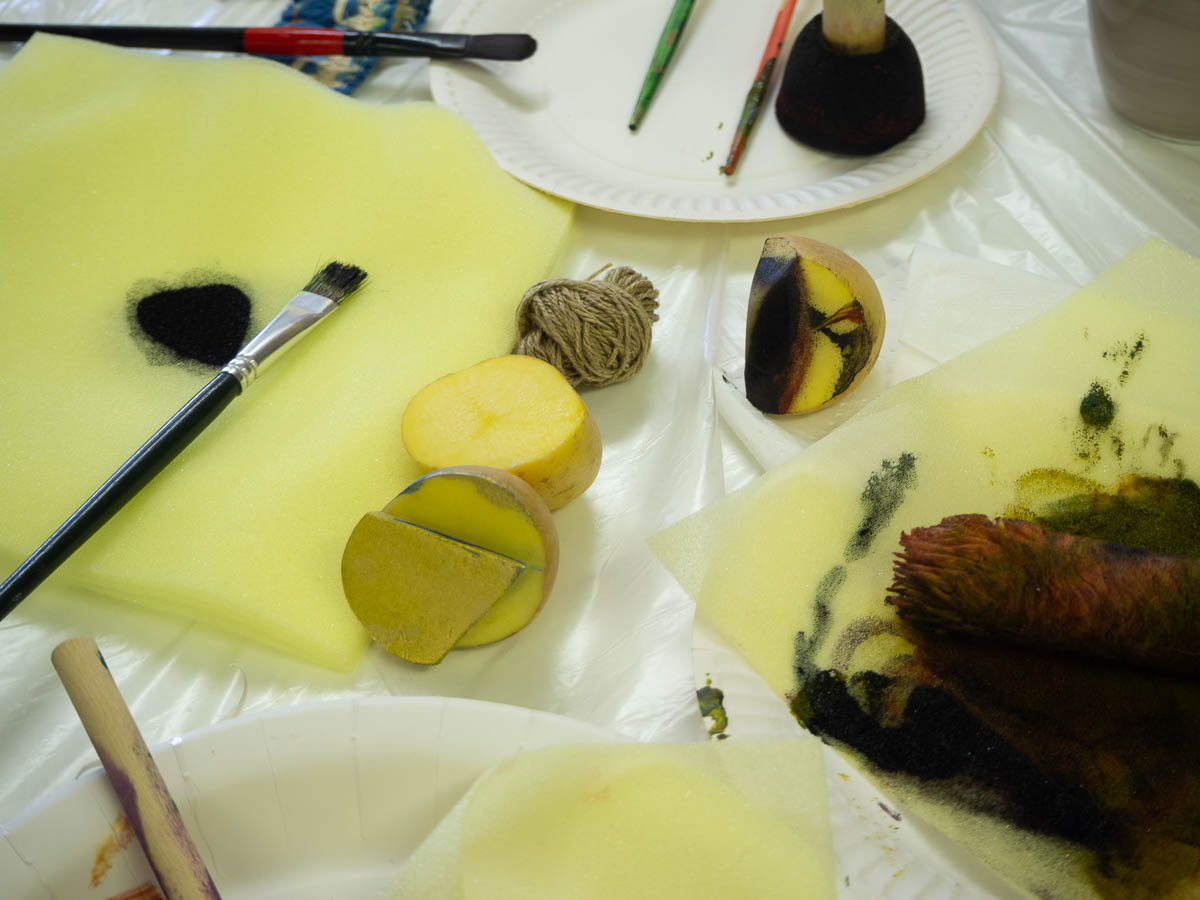
Textile printing sounds like it might require all sorts of equipment, but it really didn’t. Textile paint, paper plates to put it on, some cheap paint rollers – that’s all you need. And then random stuff we found lying around: pieces of string, rolls of masking tape, scraps of old lace, strips of paper. Potatoes, for cheap stamp-making, if you want.

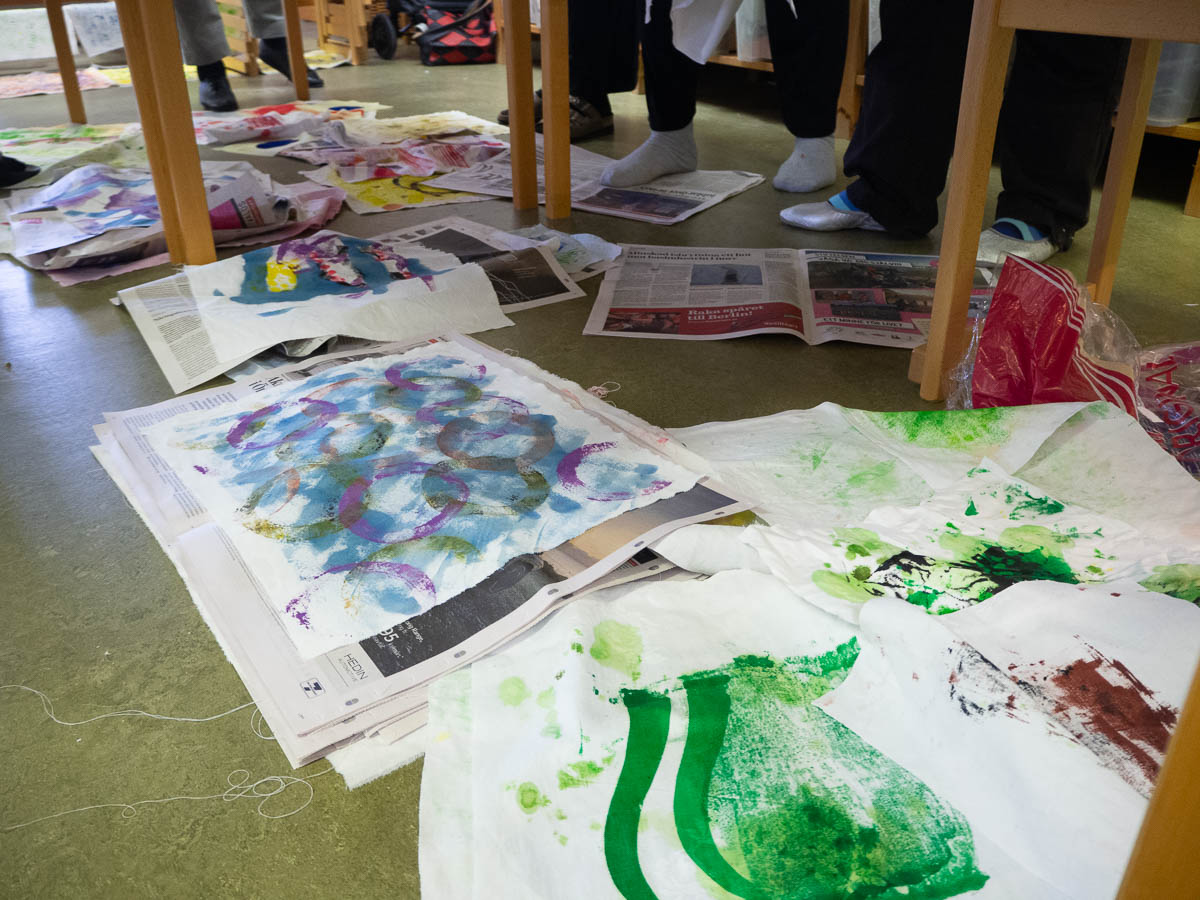
For fabric, we used old bedsheets that we ripped into smaller pieces, and thrifted towels. With cheap and plentiful fabric, we could play freely, without any concern for the cost of the materials, or any worry about running out. We all ended up with piles of experiments stacked on the floor under our work stations, with layers of newspapers in between to keep the paint from spreading.

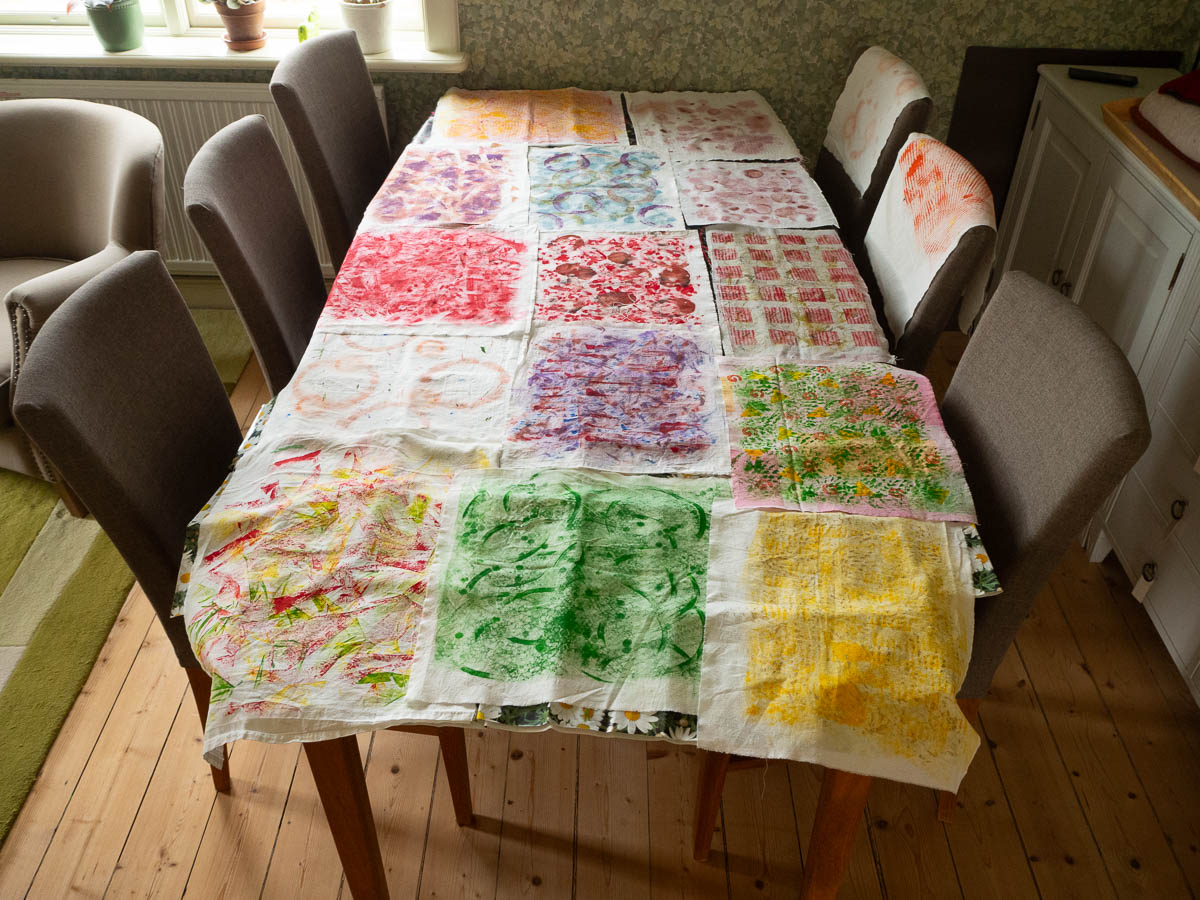
I came home with tons of pieces of printed fabric, each one based on a different technique or idea. They just barely fit on my dining table to dry, and it took an hour to iron them all to set the paint.

Tomorrow we will have the second half of the workshop, where we’ll be embroidering on our newly printed fabrics.

It’s embroidery club Thursday.

I think I am actually done with the Stockholm embroidery. I’ve been hesitating about adding a little bit more, but I suspect I’d end up overworking it, so I’m stopping now. I did take a photo but the lighting in our meeting room is not very good and I only had the phone camera, and the picture did not do it justice. A proper photo will be coming up when I have it mounted and ready for hanging.

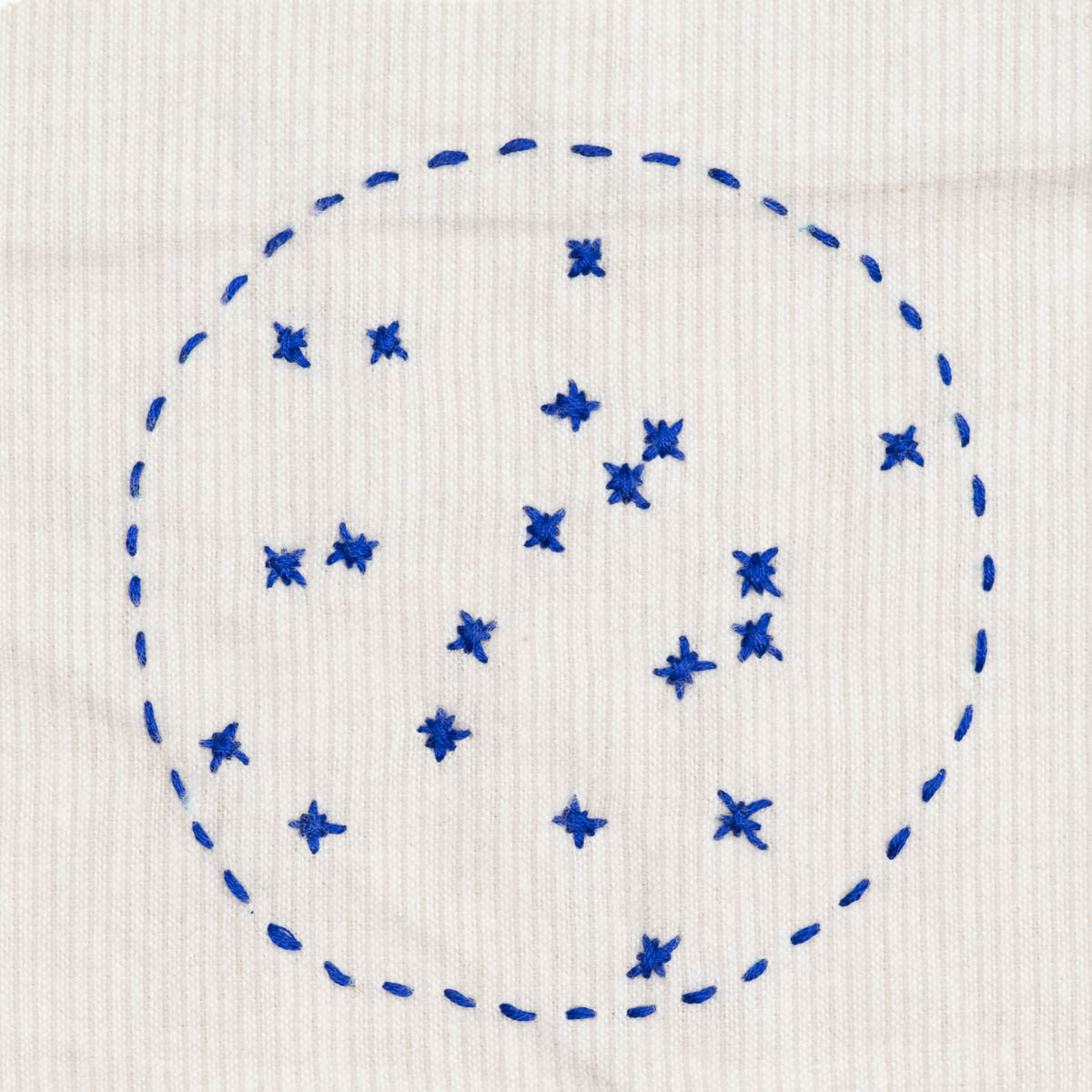
This week’s dogma embroidery: use fabric in the colour of your hair. Randomly sprinkle hole punch confetti on your circle of fabric and embroider them with star stitches. I had no hole punch so I made do with other pieces of paper. Afterwards I saw that others had fastened their confetti with their stitches; I had misunderstood and just used it to mark the spots where to put the stitches.

Remember the stiff white yarn I was struggling with? The internet reminded me to wash and block my swatches before drawing any conclusions. I did that, and the fabric was a lot softer afterwards. Actually floppy; much more wearable.

I also tried combining it with some white mohair (in the top half of this swatch) and the result was very nice. Fluffier and with more body than the wool on its own. It even looks a bit whiter – I’m not sure if the wool yarn is a teeny bit grey, or if it’s just the background shining through.

I had pretty much given up on the idea using the yarn for a dress, due to its lack of drape, and started picturing it as a sweater, holding the yarn double and adding mohair. I had even decided on a rough design. (A white sweater with a green design, something that could be a Christmas tree but could also just be a fir tree.) Now this swatch is making the dress idea seem not absurd, so it’s back in the game again.

I’ve been picturing a dress with the skirt knit sideways, with short rows in a contrast colour for shaping, something vaguely like this. An all-white dress seems impractical for everyday use, and the contrasting stripes would make it more versatile. However I have no idea how much fabric the yarn will knit into, and even if I did try to estimate, chances are I’d be wrong. I obviously have no way of getting more, so a skirt knit sideways seems risky. Make the skirt too long, run out of yarn too early, and I will have half an unwearable skirt. Make the skirt too short, and end up with unused yarn.

Today I was idly looking at my one and only (store-bought) merino wool dress, which is knit top-down, and realized that I could knit the white one top-down as well and just add embroidered vertical stripes afterwards. That would be a much more low-risk approach. I can knit a sideways skirt some other time, with store-bought yarn that I can top up when needed.

I girded my loins and felted the slippers! Blogging about a problem(ish) got me unstuck, not for the first time.

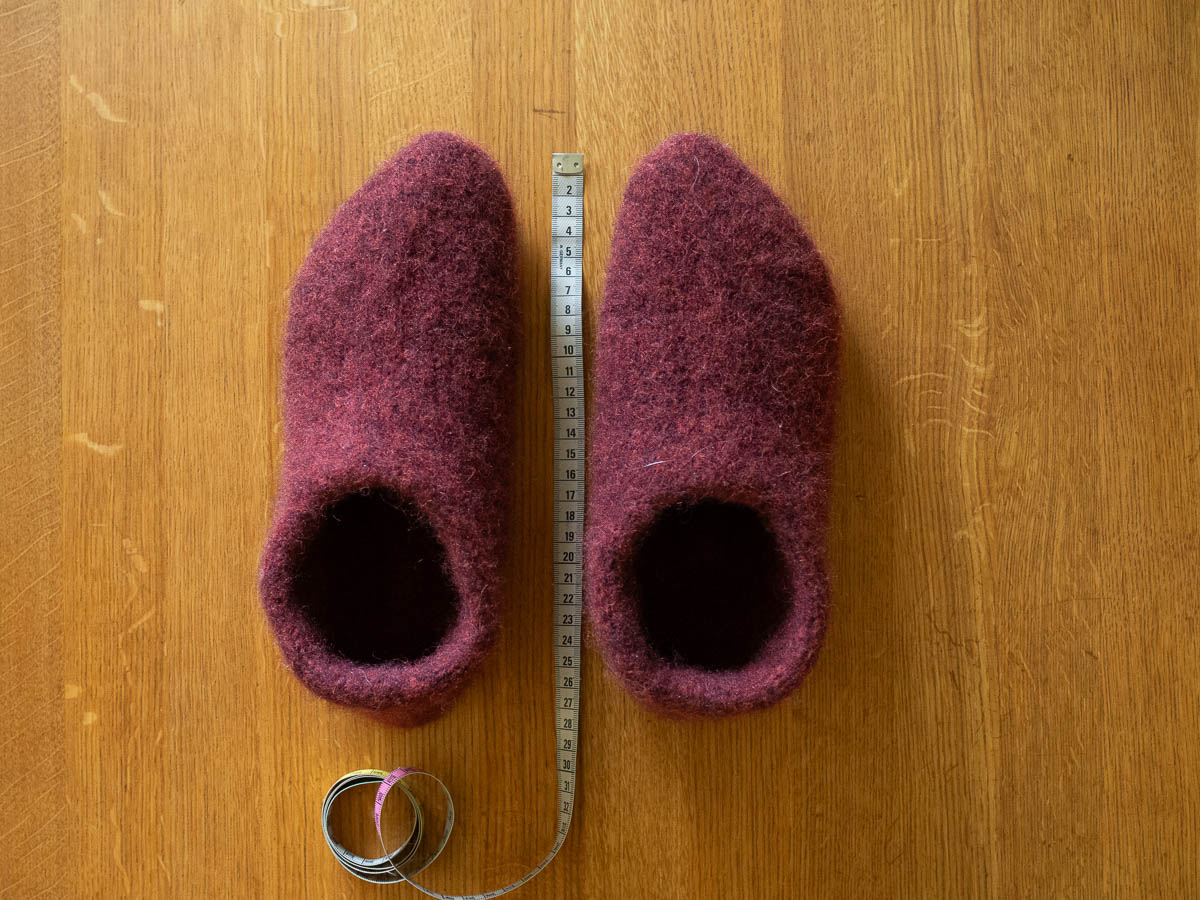
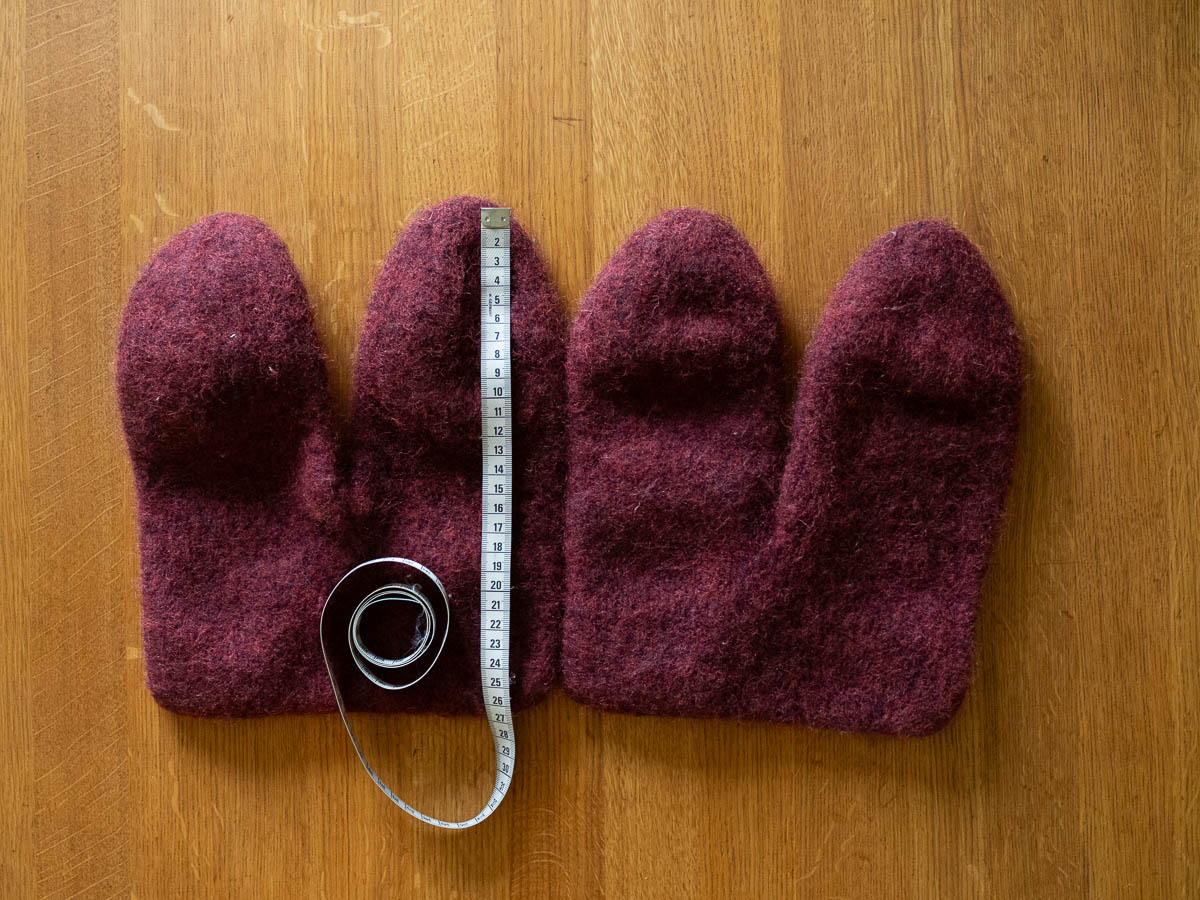
In their original, unfelted state, the slippers measured 37 cm from heel to toe. A standard wash and centrifuge cycle in the washing machine took them to 28 cm. That was still a bit too large, so I put them back in for a brief 30-minute cycle, which shrunk them by another centimetre or so. Shaping them and putting one half inside the other stretched them out a little bit again, so the end result was back to 28-ish. Maybe a teeny bit too large? Maybe not. It’s too warm to wear them now so I’ll have to see next season.

I was concerned that the inner layer would get bunched up, since it’s the same size as the outer one, but slightly wet felt turned out to be very squishable, and it formed itself very nicely. Or perhaps it was the outer one that stretched to fit the inner one. Either way, no bunching, no wrinkles, very slipper-like shape. Overall, a success.


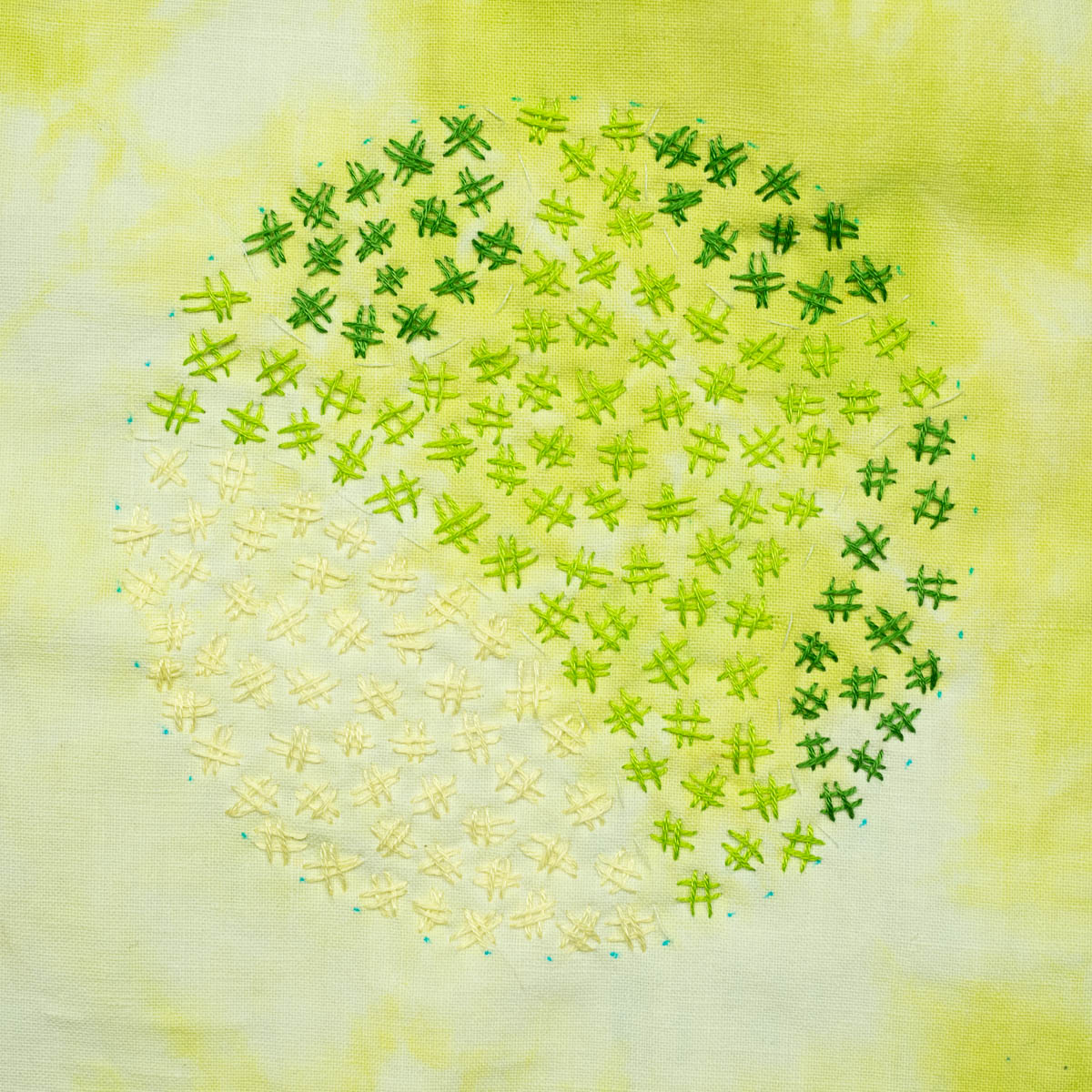
The rules for this dogma embroidery: A light-coloured fabric. A circle, divided into five parts. Threads in the same general colour as the fabric but in different values, one for each part of the circle. Use only the hash stitch.

I used a piece of a very old fabric dying experiment by Eric, from well before we met. He was about to throw them out at some point and I said no, I’ll take them. They’re smallish pieces of fabric and mostly not in my favourite colours, so they’ve stayed in the fabric stash. A greenish-yellow piece, with a bit of a spring vibe to it, was perfect for this.

As usual, I badly underestimate how long this kind of work takes. A 12-centimetre circle, that’s nothing! But it took me two evenings.