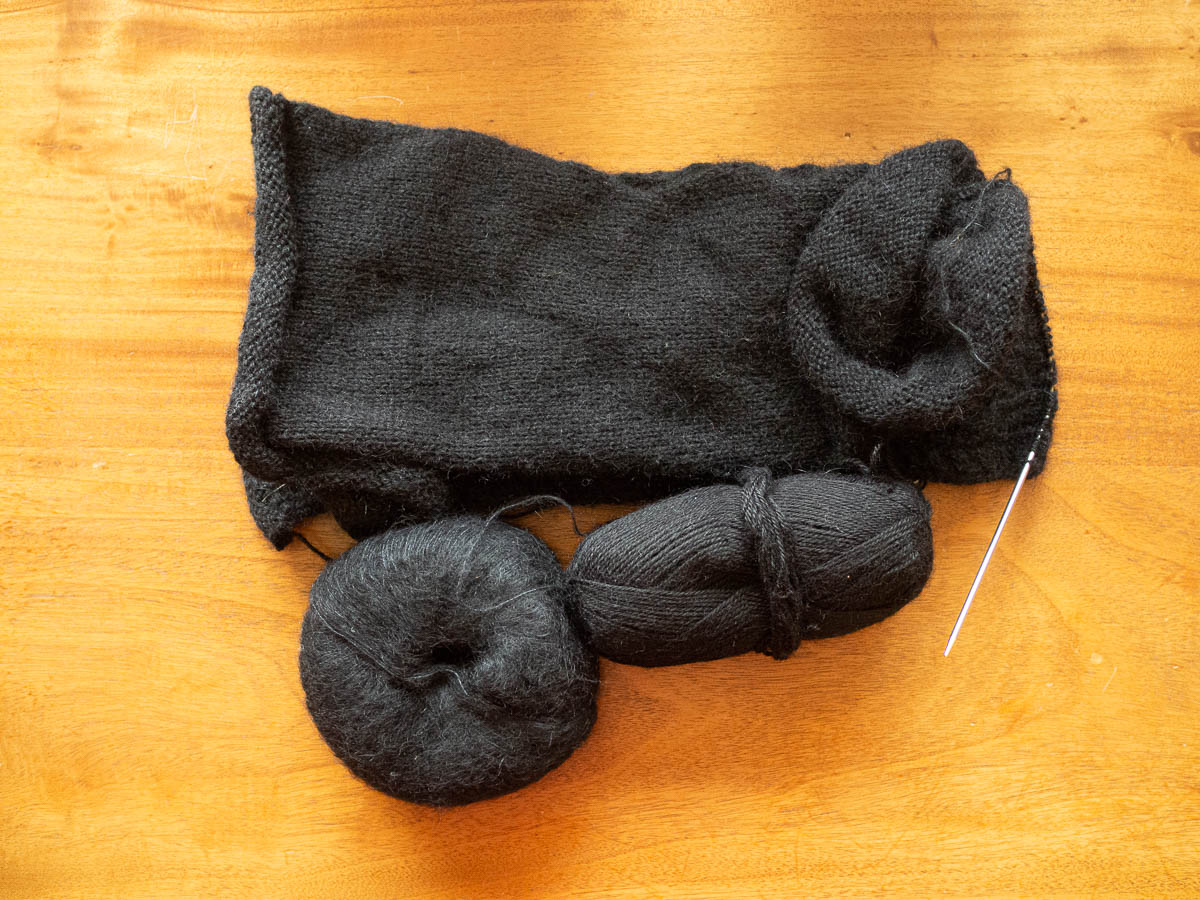
The cardigan is now at roughly the same point where I ripped it up last time. Time to try it on again soon.

I’m making good progress on it, and on the socks I’m also working on, with all the online meetings we have. Knitting is the perfect filler activity for meetings where I am mostly a passive participant.

But meetings are only good for a certain kind of knitting: the kind that I can do with half my attention. No measuring or fitting, no casting on new things, no tricky counting. I try to make sure to have at least one of my projects in a meeting-ready state by each morning. I wouldn’t want to end up in an hour-long meeting with no knitting just because I’m stuck behind the start of a heel or something like that.

This work-from-home thing is really spoiling me.


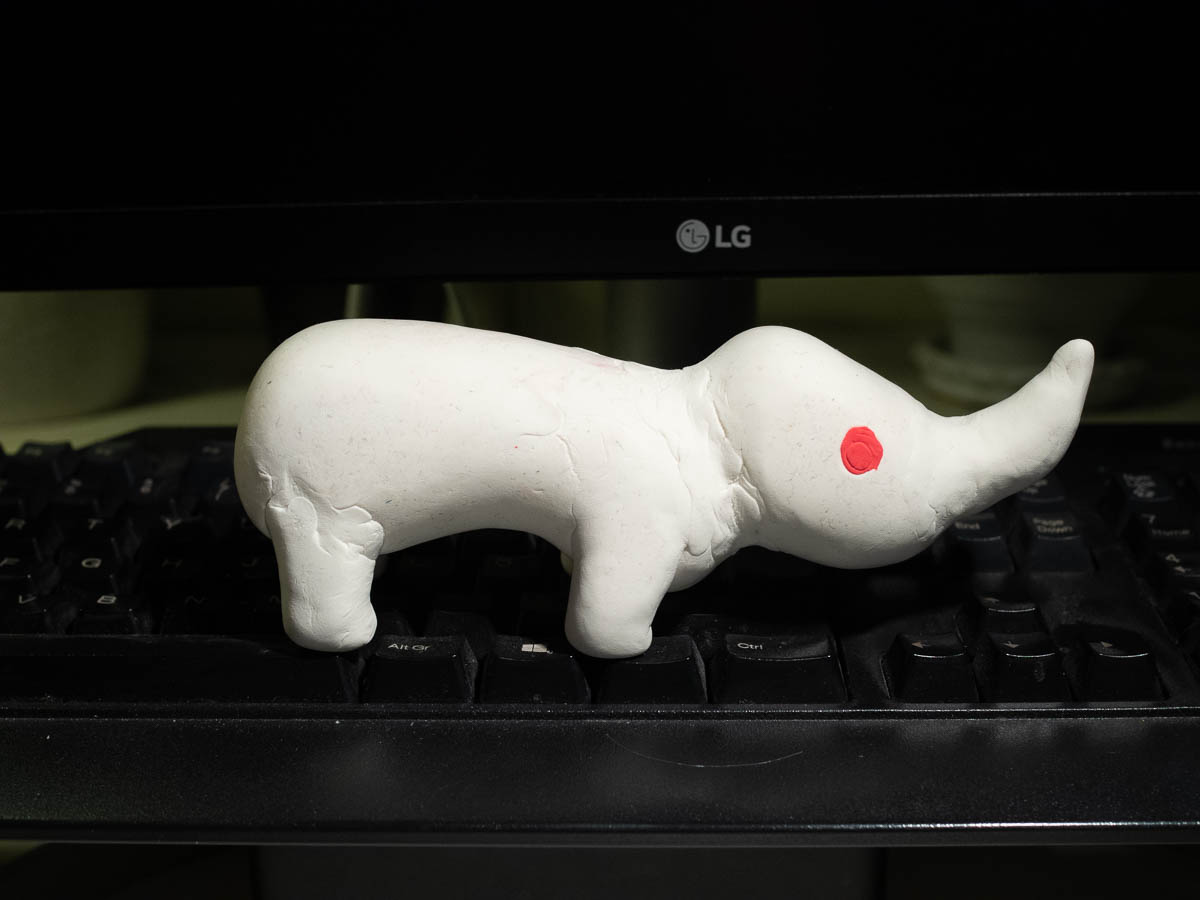
Adrian made this rhino sculpture, liked it but had no use for it, so he gave it to me. Now it sits on my desk because I also like it but have no real use for it.

Part of the role of a parent is to accept gift of random crafts, apparently. Drawings and paintings, embroidered pieces of cloth, pin cushions, decorated candle holders, miscellaneous objects made of paracord or steel wire or wood…

I guess the rhino can stay here until it gets replaced by the next thing.


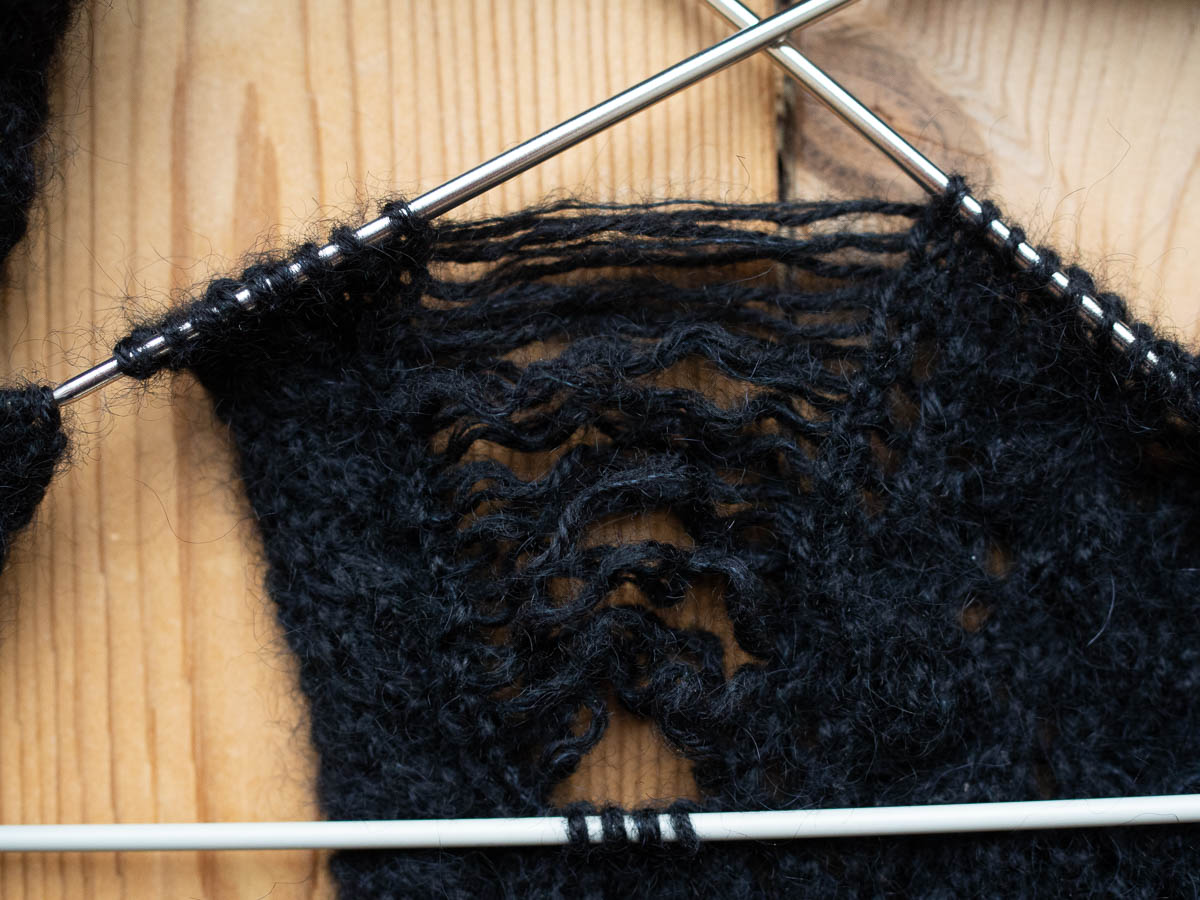
I made no forward progress on the cardigan today because all the time I spent on knitting today went towards fixing an earlier mistake. The lacy pattern has cables, and three pattern repeats ago I twisted half the cables the wrong way. Not a big deal, and it probably wouldn’t even be visible – but if I don’t fix this, I’ll be confused each time I come to the cables, because I won’t be sure which ones are the correct ones.

Fortunately the pattern is made up of rectangular blocks that don’t interfere with each other. I could unravel a vertical column, four stitches wide, fix it, and repeat the process for the other wrongly-twisted cables.

Eric already jokes that half the work of knitting cardigans is about ripping up and starting over. Indeed. Perhaps I should try to do with cardigans as I do with socks: decide on a base pattern and only make minor modifications in it. I would certainly be more productive that way.


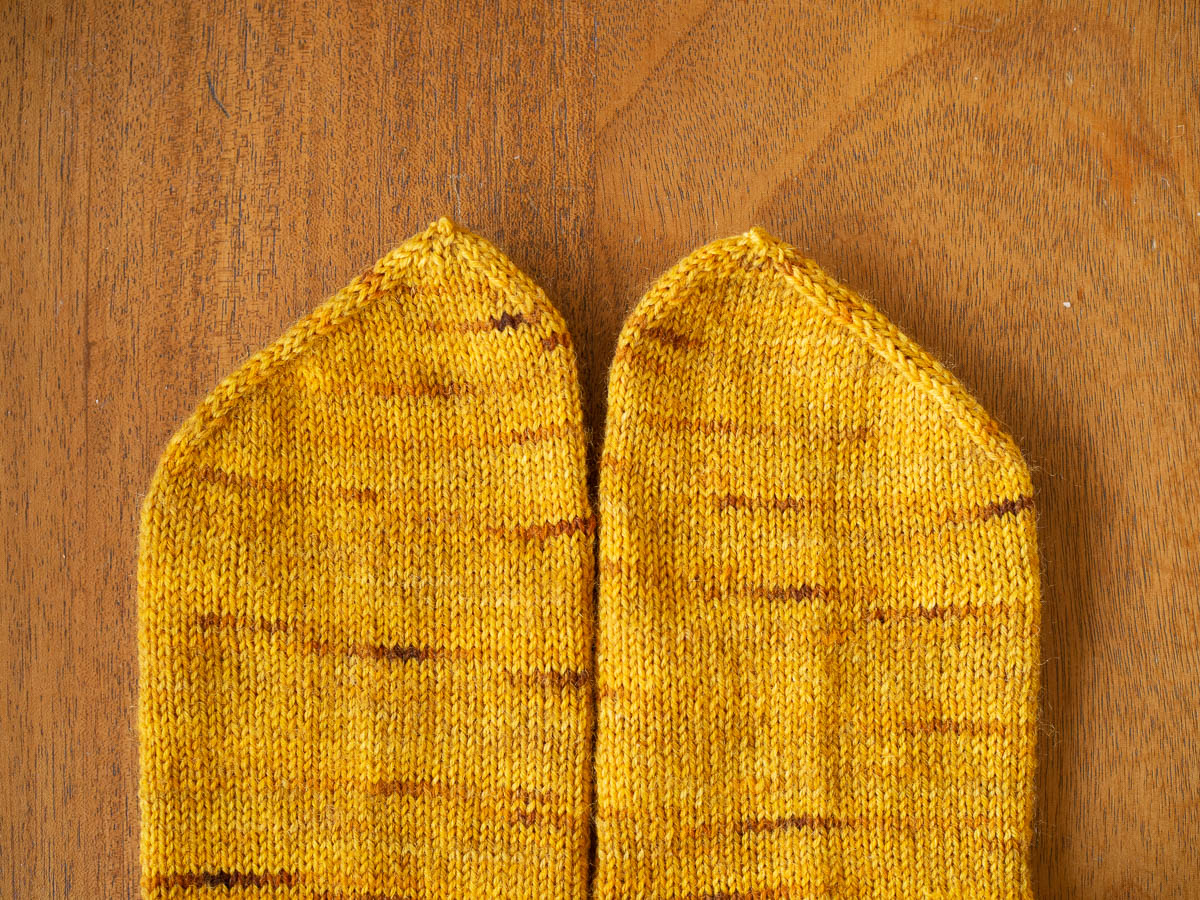
Continuing my experiments with knitting socks, I’m trying out socks with anatomically correct toes.

Store-bought socks are symmetrical. The toe area has a relatively straight shape, like a very flat isosceles trapezoid. Industrially made socks always so stretchy that they fit my toes well.

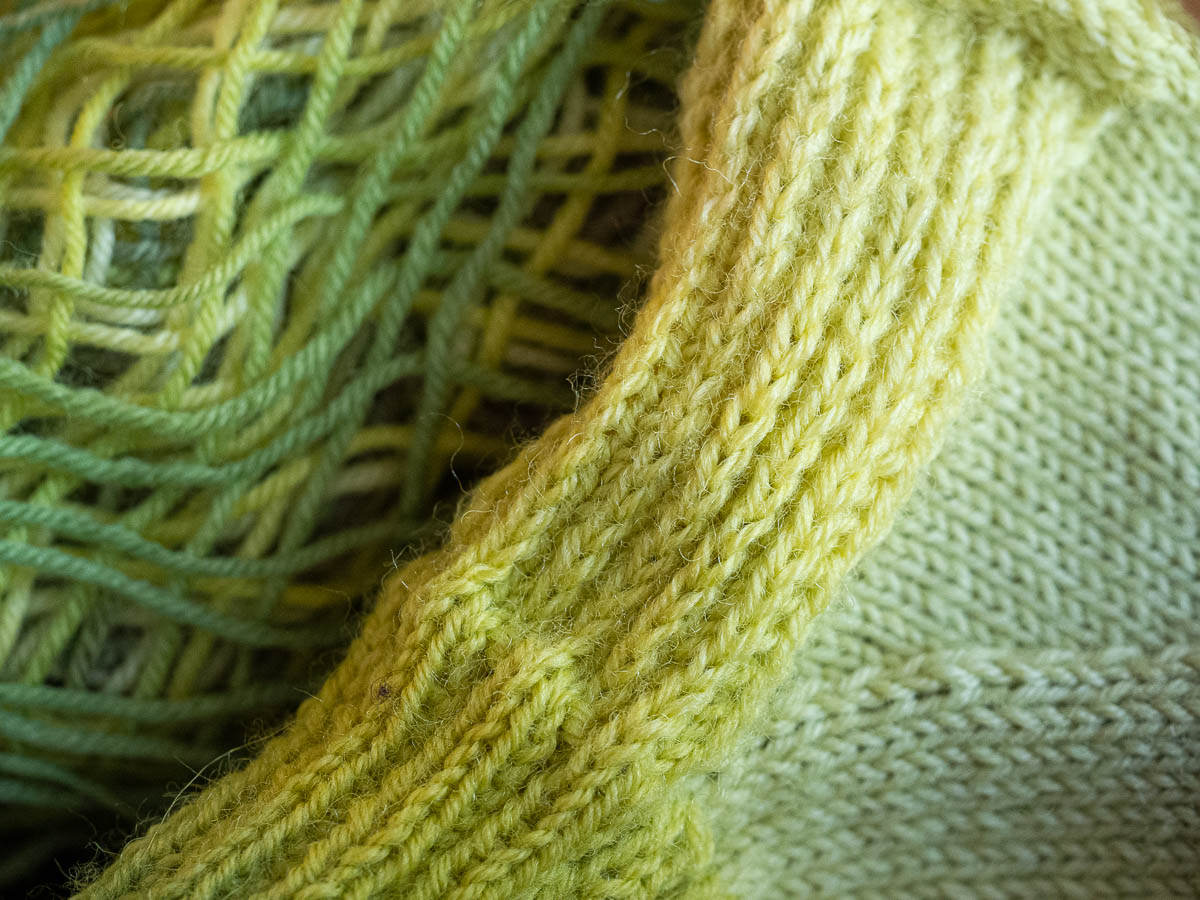
The standard hand-knit sock pattern also has a symmetrical toe in the shape of a slightly curved isosceles triangle. You can see the shape on the leet feet I made to give away, and on these green socks I made for myself. The knitting does stretch to more or less fit, but not as much as store-bought socks. With a thin yarn I find that this puts unnecessary stress around the big toes.

For this pair I tried to match the actual shape of my feet. My big toes are noticeably longer than the second toe, and the front of the foot very definitely follows a diagonal line. I just started to decrease earlier on the outside, and decreased faster on the outside than the inside, and they came out really nice on the first try.

The next step might be to do something about the final rows. The standard sock toe pattern (which this asymmetrical one is based on) ends with a distinct little tip, where the yarn is pulled through the final four remaining stitches. I might look for a different way to finish off that leaves the end a bit flatter.


By the way, did you see the lovely yarn I found for these socks? Hand-dyed sock yarn from Limmo Design in a wonderfully rich, dark yellow colour. The specks of brown are not too loud, but liven up the surface. The shop labels this colour “curry” but it makes me think of honey. Now that I’ve started looking, I find yarns in so many beautiful colours that I’m going to have to make a lot more socks.

Socks are such a great knitting project. Small and fast, uncomplicated once you get the basic pattern down. Knitting a cardigan is a major investment in time. Socks on the other hand almost finish themselves. And there is always a need for more, because they wear out.
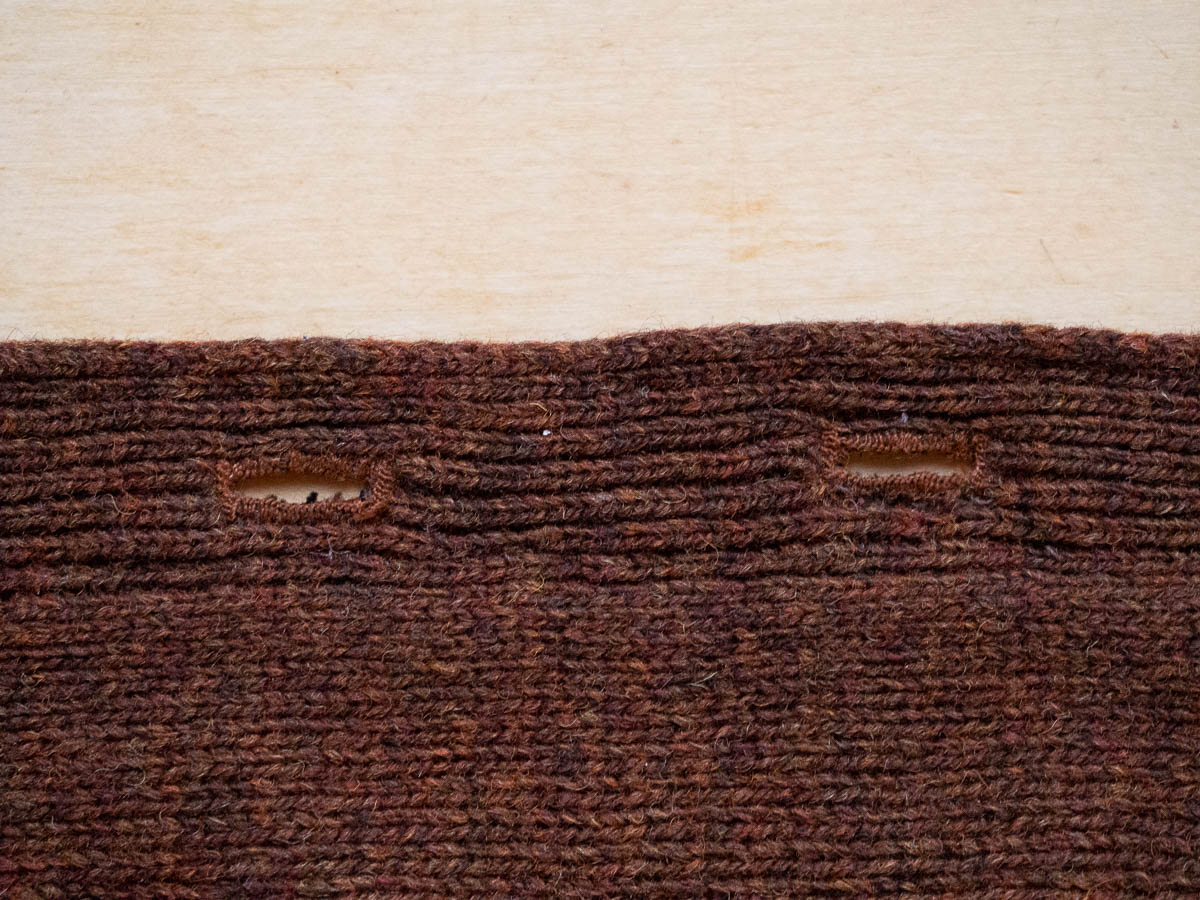
I have a favourite cardigan with very worn buttonholes. The yarn around the buttonholes was worn all the way through and the knitted fabric was starting to unravel completely.

I don’t enjoy sewing buttonholes. It’s fiddly and tedious.

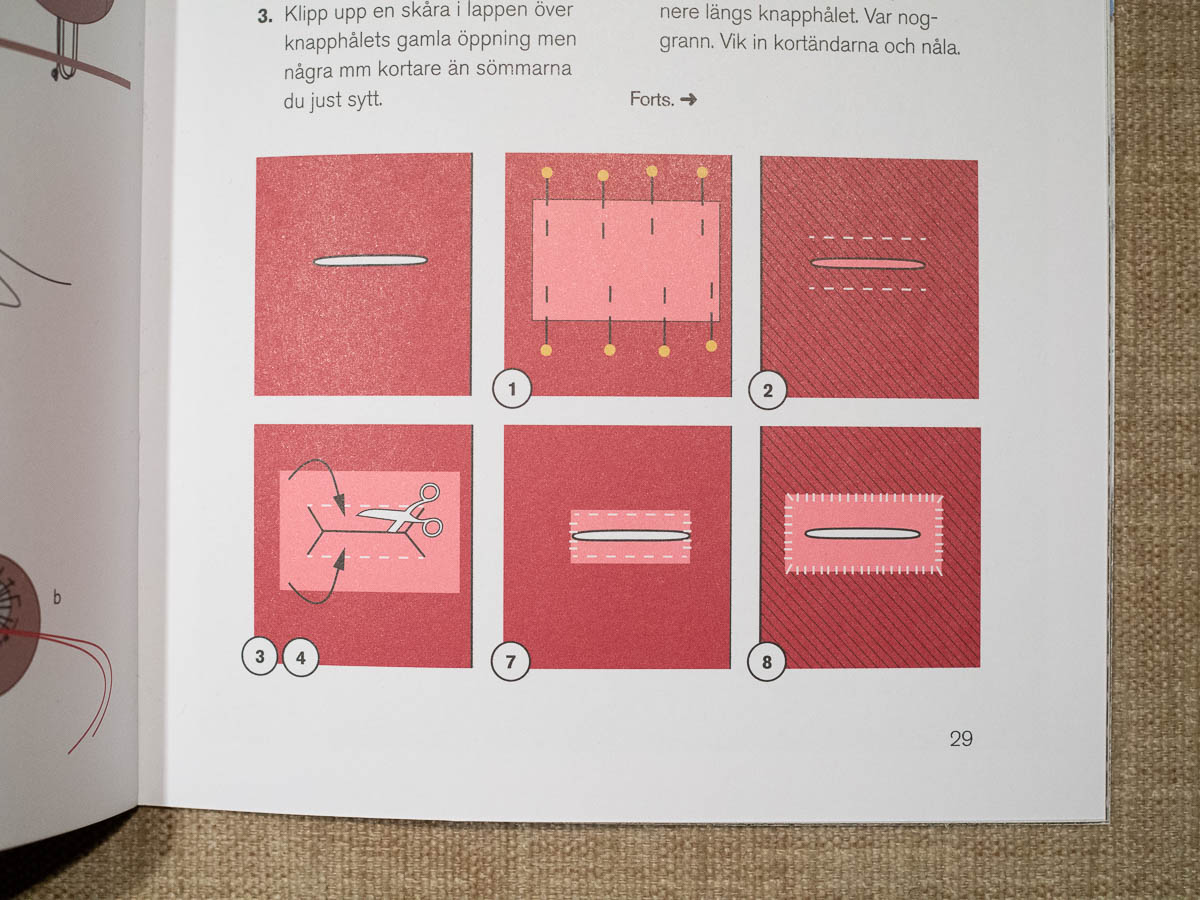
One of my mending books spends several pages on a technique for mending buttonholes with a small patch of fabric. It looks clever and tidy and sturdy:

Despite the illustrations, I couldn’t quite wrap my head around how it actually works. Topologically it just does not make sense. You cannot take a rectangular, flat piece of fabric and fold it inside out through a slit, and have all of it still lay flat.

I tried it out anyway, assuming it would make sense when I held it all in my hands. Maybe the fabric would somehow settle into tidy folds. Nope. Not even near. No matter how much I tried to smooth it and flatten it and gather it into pleats, it just bunched up and pulled on itself. I couldn’t even get it flat enough to sew the edges down. Completely hopeless.

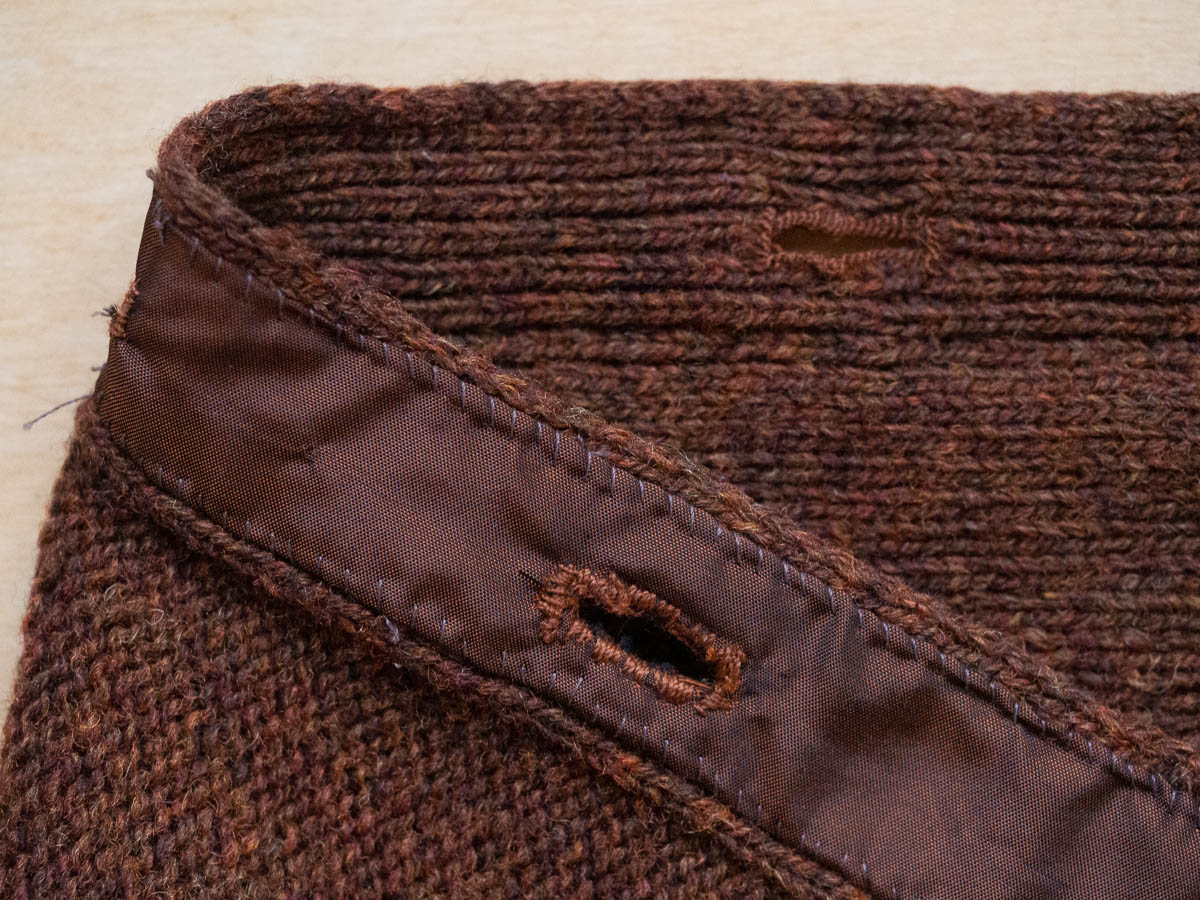
So it’ll have to be the old school way after all. I reinforced the button band with a strip of fabric that I sewed onto the rear of it, and now I’m sewing the buttonhole edges one at a time. The front looks pretty good but the reverse, not so much. Luckily nobody will be looking at that side. Also luckily I don’t have to finish all the buttonholes before I can wear the cardigan again. They’re boring, so I’m doing them one at a time. Four done, which is enough to make it usable.


I started work on the cardigan again, and then I tried it on, and now I’m ripping it all up again.

I don’t get it. I made a gauge swatch, and measured and counted it carefully. And when I had knitted about 10–15 cm of the cardigan itself, the measurements still matched up nicely. But after 20cm the cardigan felt a bit tighter when I held it around me. And at 30 cm it was clearly way too tight. I’m going to be making the next attempt with almost 20% more stitches.

I am beginning to suspect that knitted fabric behaves differently when there is more of it in all directions. More stitches are pulling at each other, so it doesn’t relax as much. If that is true, then a smallish swatch – even though I follow the advice I’ve found and make mine at least 15 cm across – is never going to give a true view of gauge for the final thing.

I had the same problem with the previous cardigan. The difference was not quite as drastic, but overall the cardigan still came out smaller than it should have done based on the swatch.

The trouble is, it takes so much time to figure this out! If I get the sizing wrong for a pair of socks, I can remake them in less than a week. With a cardigan, it takes months. And for socks I can reuse my numbers for the next pair. But I don’t plan to knit a pile of identical cardigans, so I will need to redo the work every time I want to make another one. I wonder how many cardigans I have to knit before I finally master this and can produce them with predictable sizing on the first attempt.

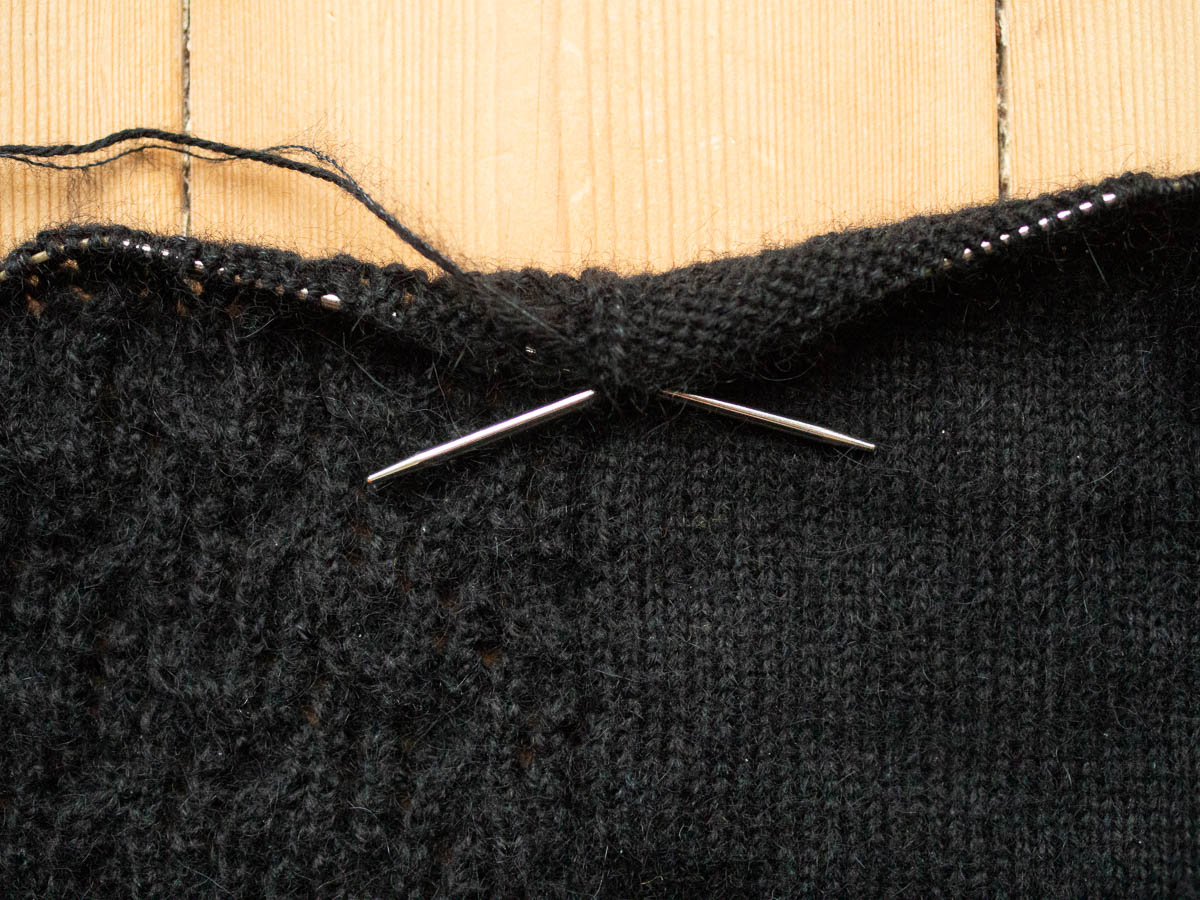
The mohair yarn is starting to look the worse for wear. It’s getting uneven. If I have to rip this up one more time, I may have to throw out the used mohair yarn and buy more to replace it. The alpaca yarn (in the photo) is smoother and bears the repeated knitting and unravelling better.


I’m picking up the cardigan again, after a break to knit two pairs of socks. I want more socks but I also want a cardigan. The socks are small, easy wins and I’d been putting off this larger project.

Working on it again is a pleasure. I’d forgotten just how soft the yarn was. If I could choose, I might never wear a cardigan in anything other than alpaca or mohair again.

I notice the same with other activities I enjoy. If enough time passes, I forget just how much I normally enjoy them. I wonder if there is a term for this. Sort of the inverse of the Pollyanna principle.


I knit a scarf out of sock yarn because the yarn felt so soft and I was afraid it would wear out in no time if I actually used it according to the label.

But I kept wondering. Maybe I could use it for a pair of really, really soft and cosy socks as well?

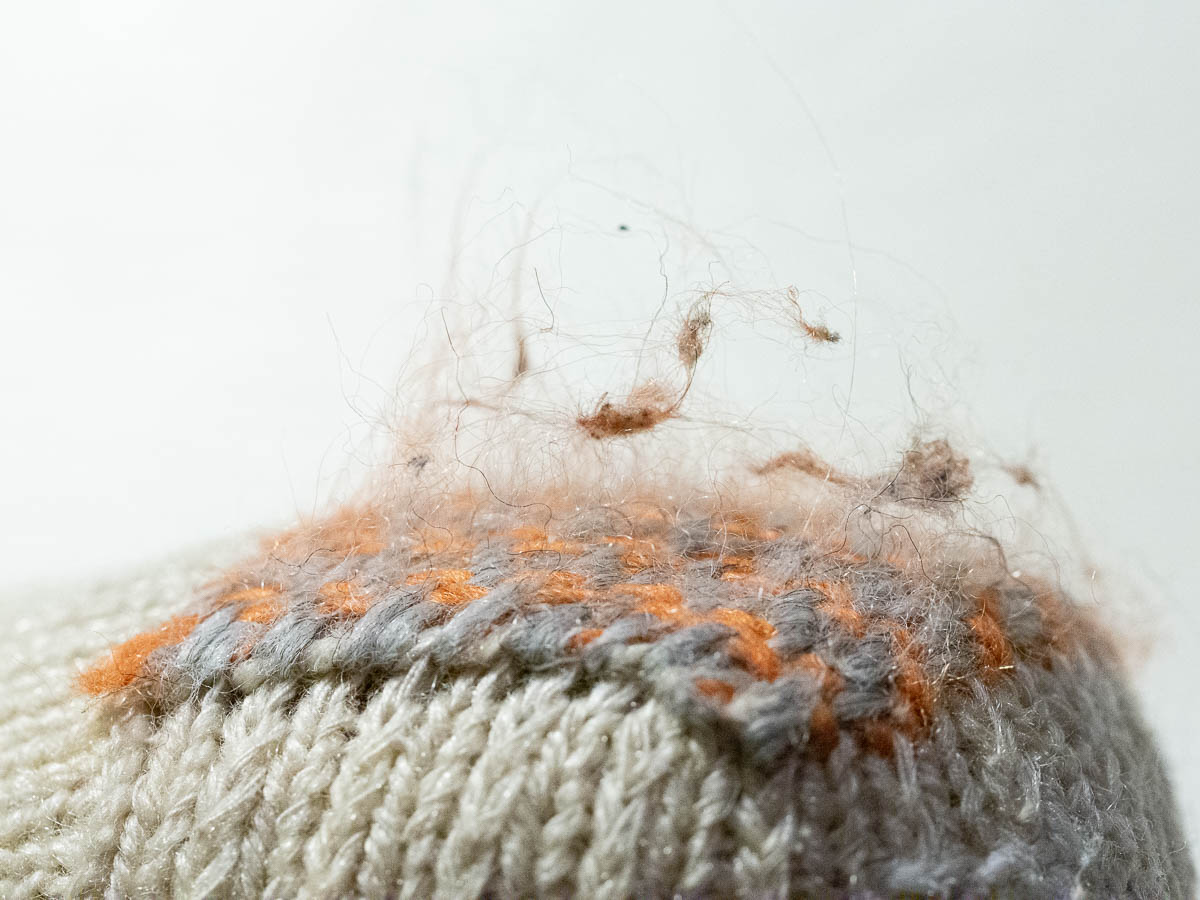
I used some of the leftovers to darn the heels of another pair of socks. Those patches are all fuzz and lint now. The yarn is too loosely spun so it doesn’t even wear through. Rather it slowly unravels and falls apart.

I no longer wonder. This would be a terrible yarn for socks.


My knitting basket is near-permanently stationed at my desk during working days. Long remote meetings become so much more bearable when I can keep my hands busy.

I wonder what my colleagues think of it. It hasn’t come up in our discussions yet. The knitting is mostly out of view for the camera, but not always. And I’m sure they notice that I’m not looking towards my screen and camera. Then again, it’s not rare for people to have their camera somewhere off to one side, so those folks are never facing the camera, so perhaps my doings don’t look as odd as I imagine.


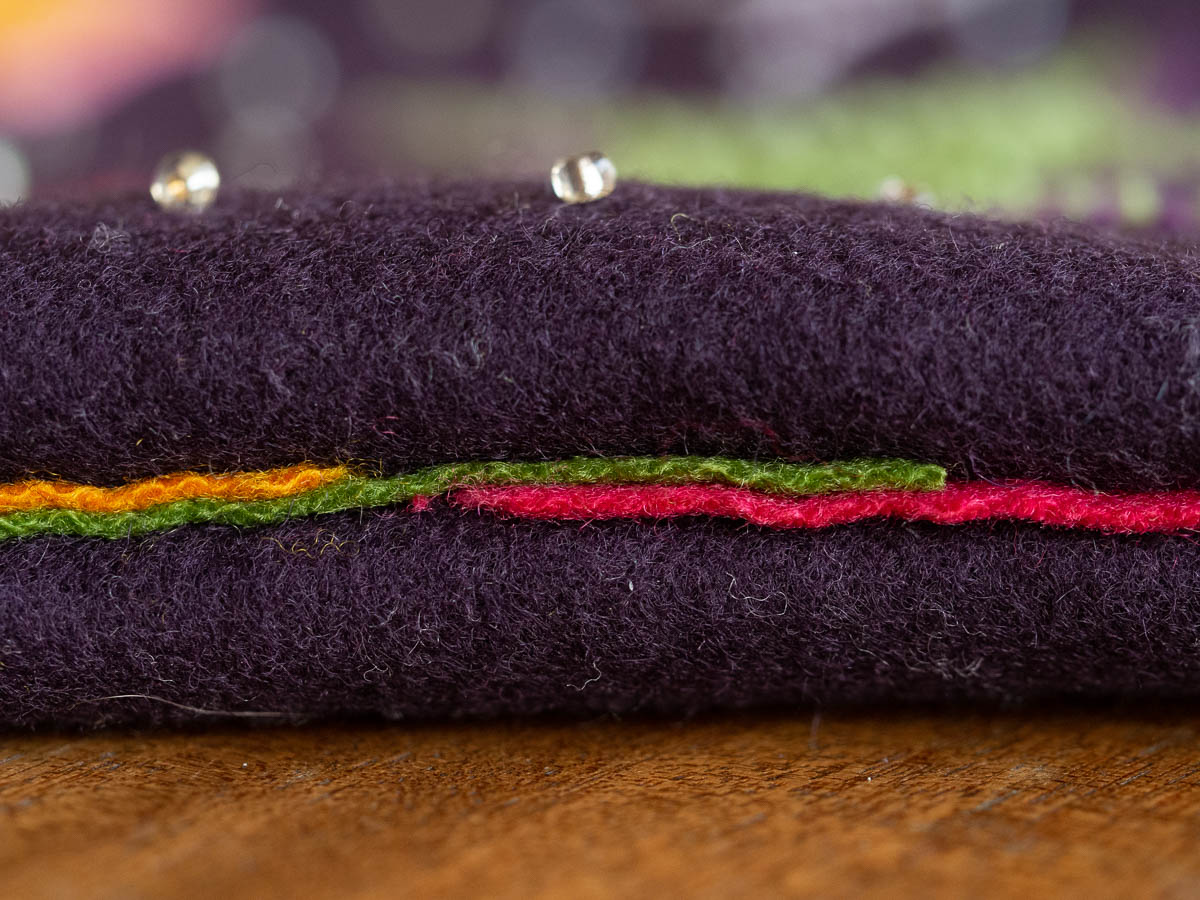
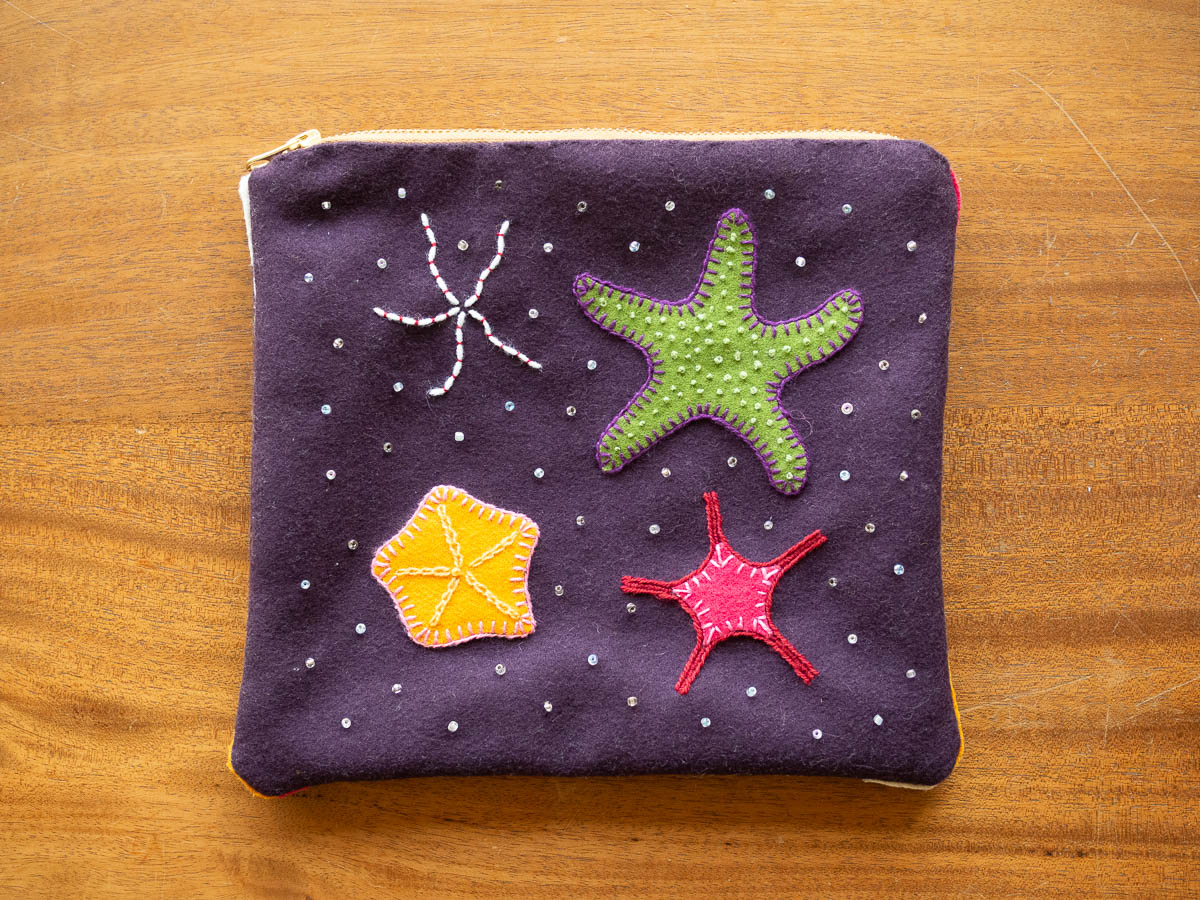
This weekend I finished assembling the little bag that I decided to use my embroidery sample for. Instead of a pretty but useless piece of embroidered wool, I have a usable bag.

Each individual part came out well, and the bag feels pleasingly solid. But the overall result is not what I had hoped for. The embroidery looked better when it lay sleek and flat. Forcing it into a three-dimensional object inevitably made it bunch and bend. If I decide do more of this, then I need to find a design that keeps the embroidered parts more separate from the fussier parts of the product, all the zippers and corners and such. Maybe by framing the embroidery with plain fabric?