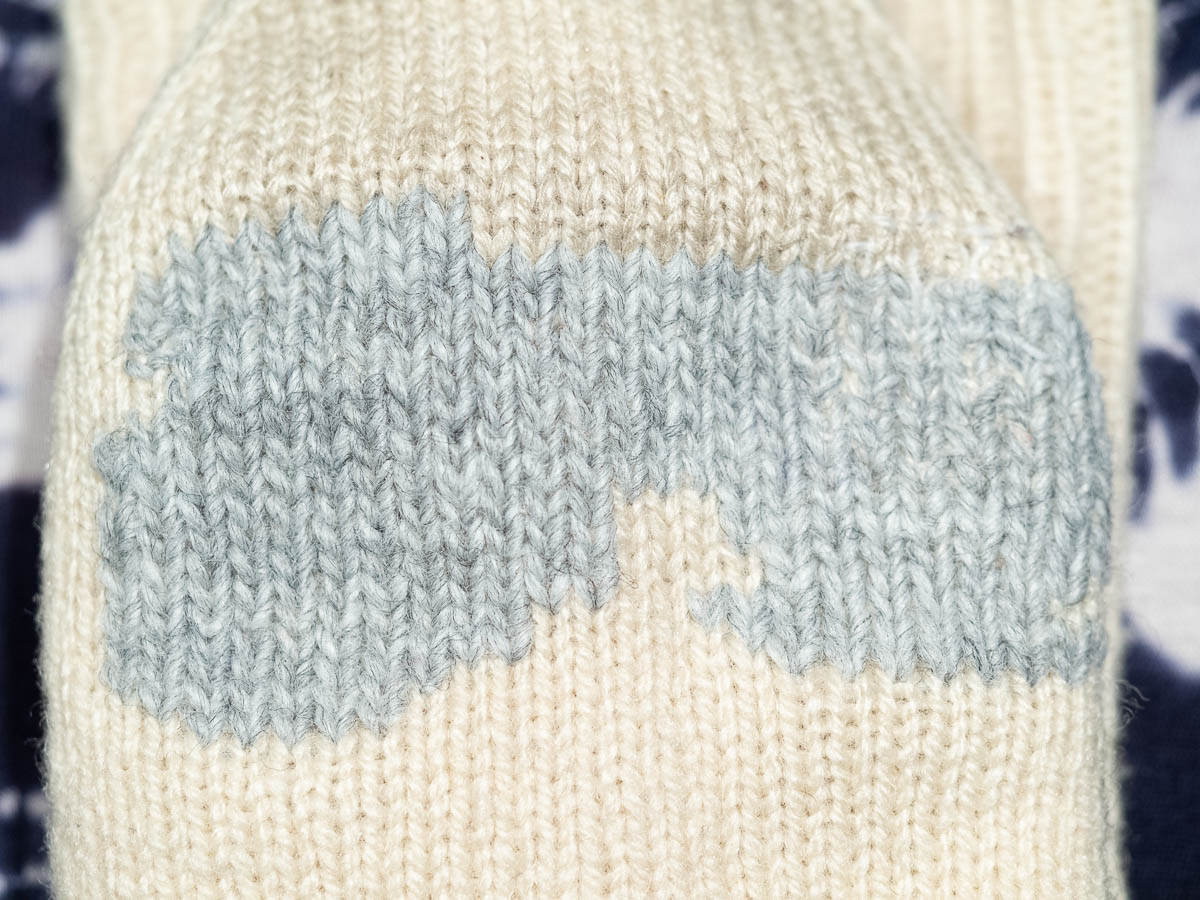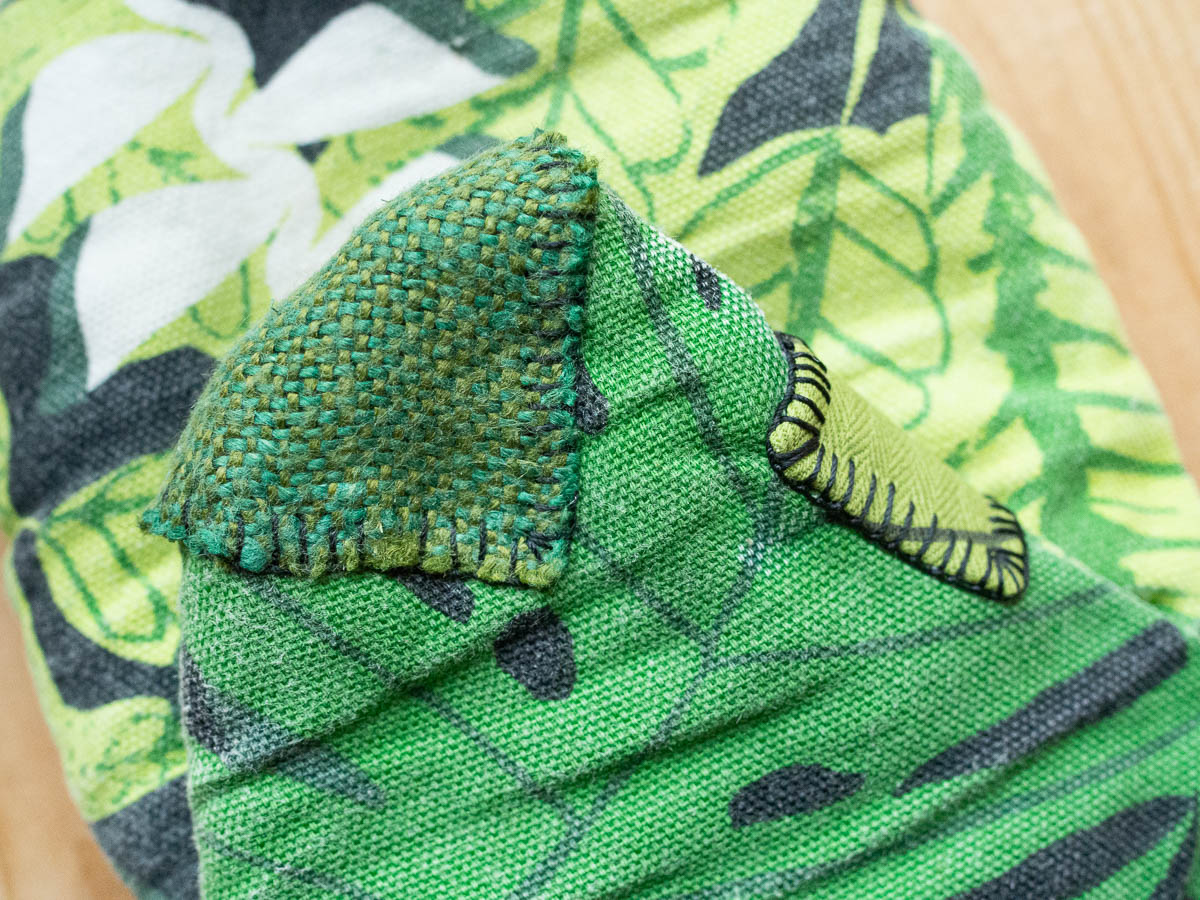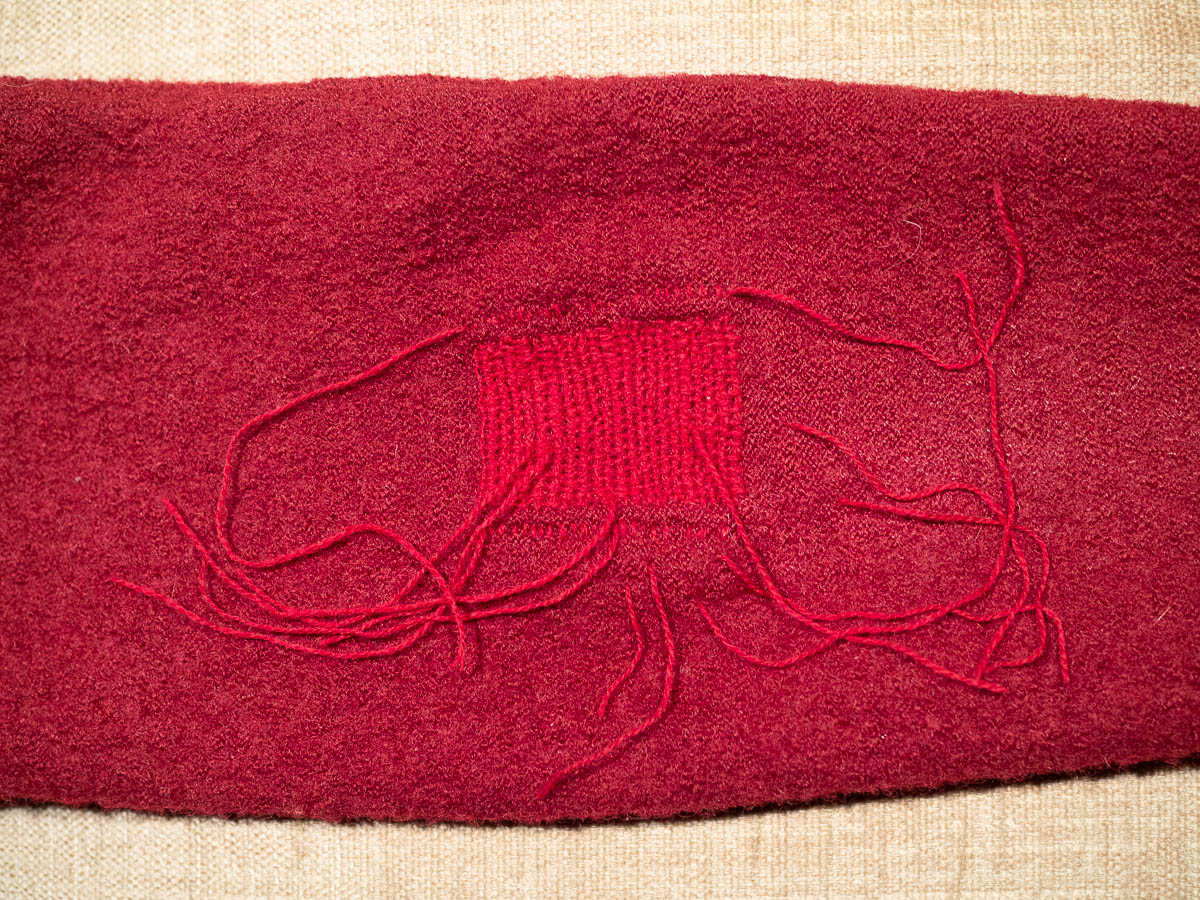
I always wear out the elbows on my cardigans. I am very aware of it when I’m wearing any of my hand-knitted cardigans, and try to keep my elbows off my desk, but I’m sure I’ll still end up wearing through them.

I’ve sewn on leather patches on two of my cardigans. For this one I didn’t think the leather look would be a good match, and I find it difficult to get ordinary darning to look even in larger sizes, so I looked for an alternative. (Good thing I have books about mending.)

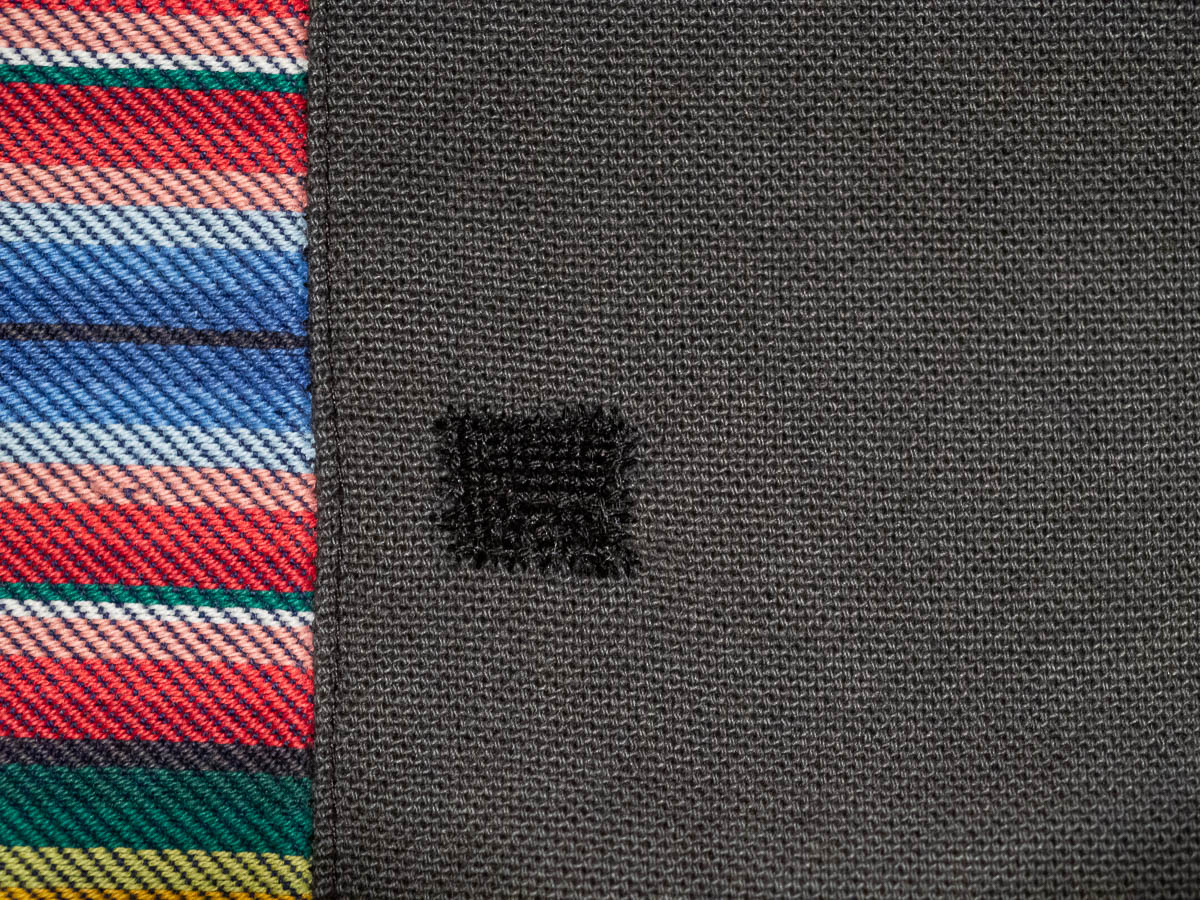
One of the books described Scotch darning as a good fit for elbows – sturdy and hard-wearing. It’s effectively blanket stitch over weft yarn. I tried it out and it came out really well, if I say so myself. Sturdy and even.

What I discovered, and wish the book had told me, was that the weft threads should have more distance between them than for normal darning. Because effectively you’ll be fitting another thread in every gap between the weft threads. Mine ended up too densely packed and I sometimes had to stitch around two of them at the same time, to fit my stitches in. I ended up with some thicker wales here and there, but you can’t see it from a distance.

And it took so much yarn! That’s why there are so many ends to weave in. I had small hanks of embroidery wool specifically for mending, one of which was a lucky colour match for the cardigan, and it ran out just as I finished. I used up the whole hank for this one patch. I could have done another row if I’d had more yarn, where the fabric is thin but not quite worn through yet.
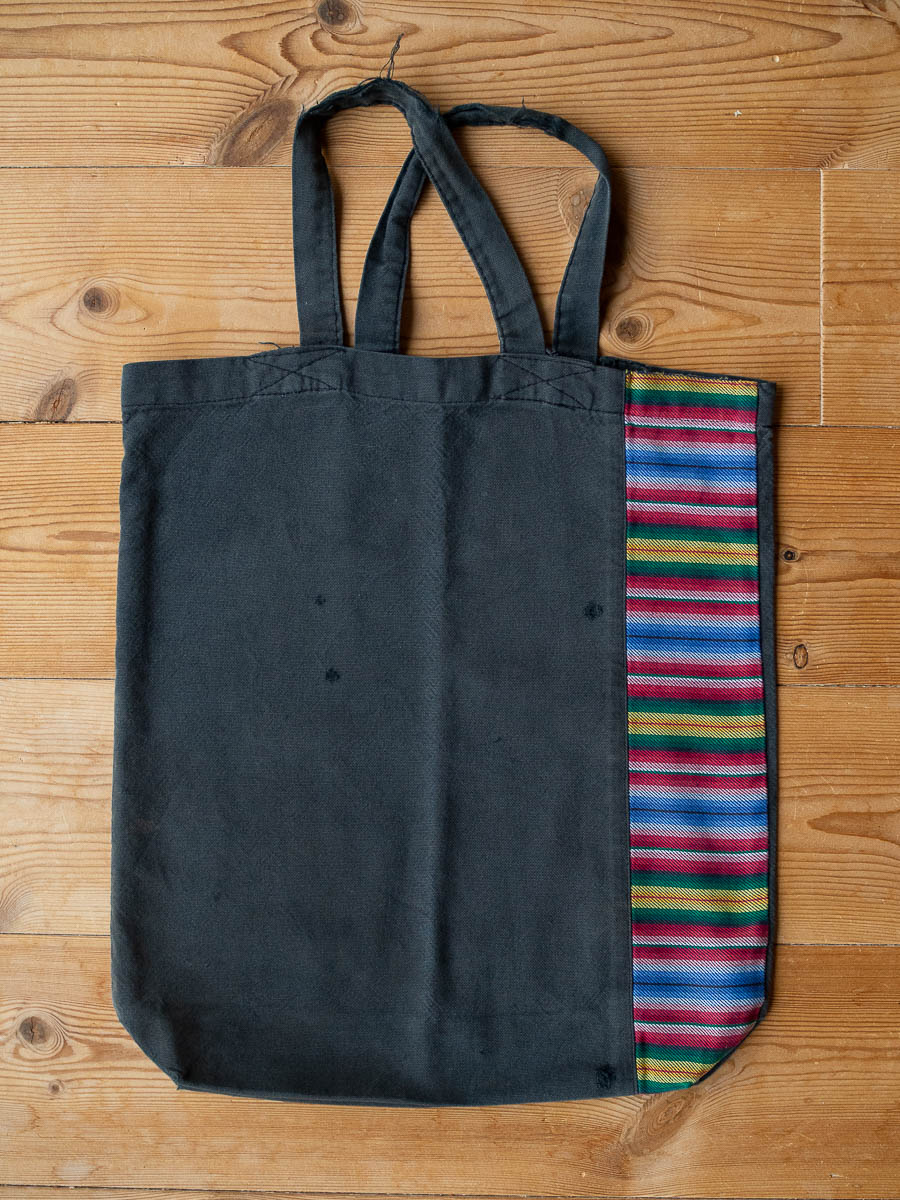
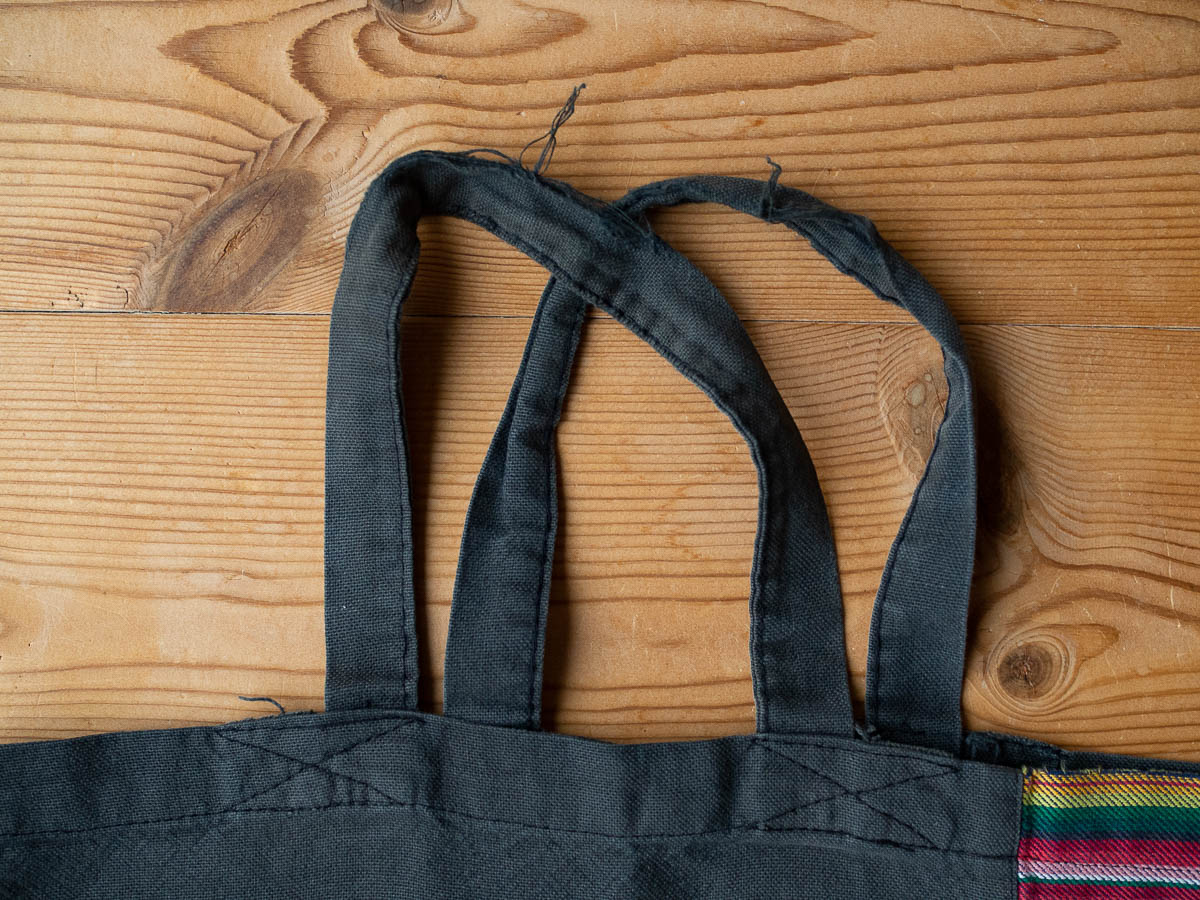
This is my second favourite shopping bag. I am a big fan of cotton shopping bags. More comfortable than nylon bags, much, much more comfortable than plastic, more durable and weatherproof than paper.

My most favourite shopping bag is one that Ingrid sewed for me at school a couple of years ago. It’s orange, with patterned handles, and lives permanently in my handbag whenever it is not in use, so I always have it at hand.

This one and its identical twin I remember buying at a book store in Estonia when Ingrid was three years old. I use them for all my grocery shopping.

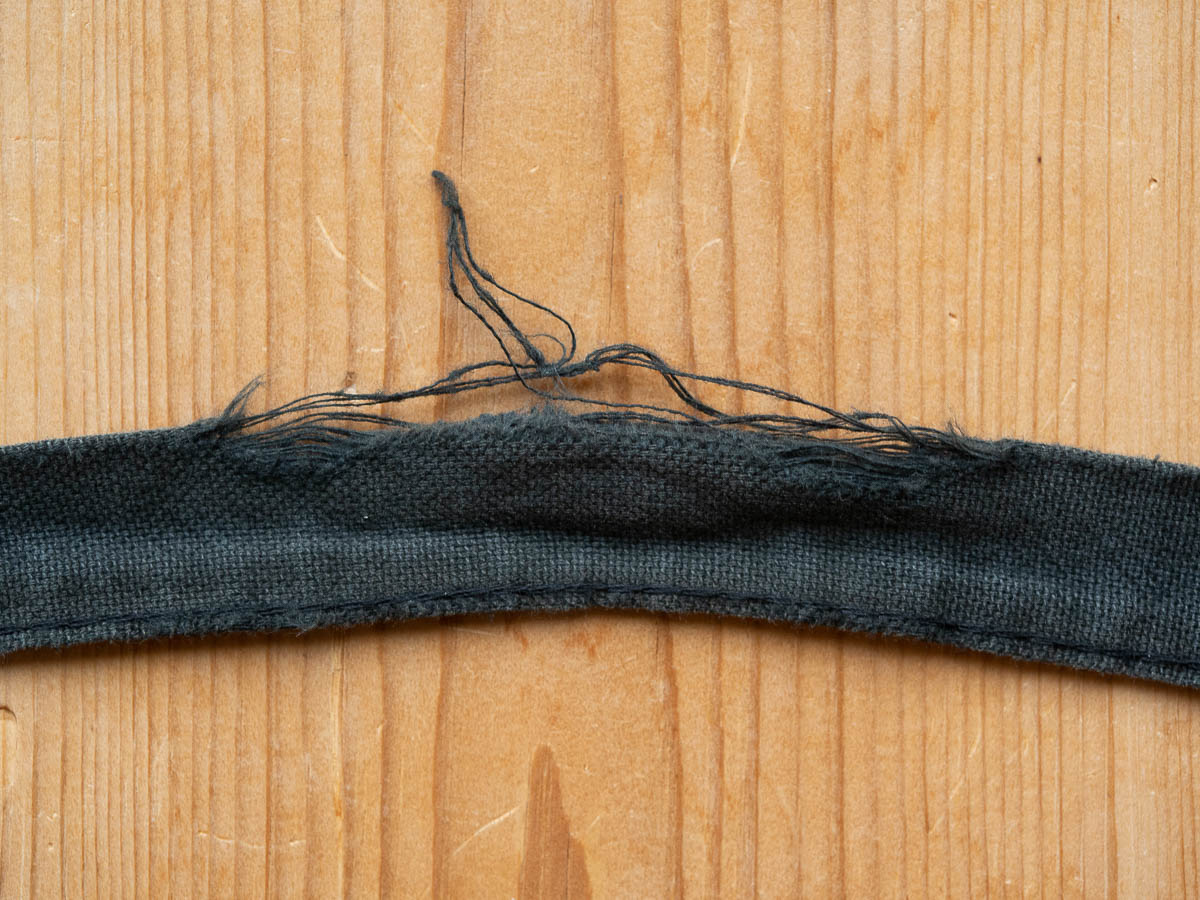
The two bags have held up for over thirteen years and are only now starting to show significant wear. The handles are fraying, and there are tiny holes here and there.

Just replace them with new ones, I thought. Reusable bags are so trendy now – there’s so much choice and they’re everywhere. But after thirteen years of very frequent use, I’m picky. I know exactly what I want from my bags, and it’s not easy to find a replacement that delivers.

Many bags have stupidly long handles. I guess you’re supposed to carry them on your shoulder, because if I hold them in my hand, the bottom drags on the ground.

Many are too large for use as grocery bags. Load them full, and they’re too heavy and bulky to carry comfortably. For people who drive to the supermarket, perhaps, or for carrying or storing lighter items.

Many are in unbleached, undyed cotton. Stylish but completely impractical. Others are all black, and I realize this one isn’t technically that far from all black, but the stripes make all the difference, in my opinion.

I can either sew a new bag (and I know from experience that that takes me two hours), or spend fifteen minutes and 200 kr to buy a new one and then maybe still not be satisfied – or I can spend those same fifteen minutes replacing the handles on this one. Not a difficult choice.

As a bonus I even darned one of the holes, just because I felt like it.

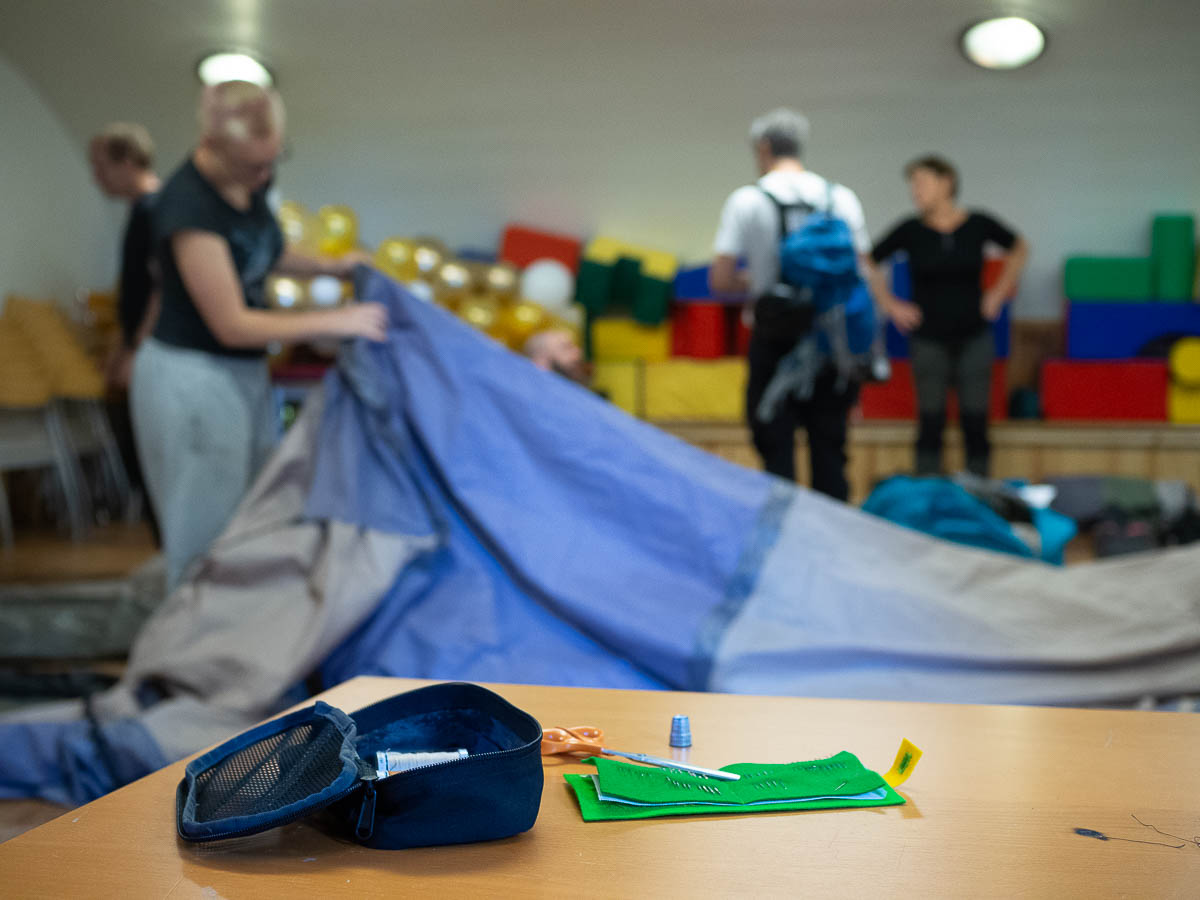
I volunteered to help at the SpĂ„nga scout group’s annual “autumn fixer day” where parents and other engaged folks help out with various maintenance tasks. This time around the task list included everything from deep cleaning the freezer and disassembling old desks so that they can be transported to the recycling centre, to removing thistles from the yard and mending tents.

It won’t surprise any of you to hear that I signed up for mending tents. However the notes about tents needing attention were hard to interpret, and much time and attention went to figuring out what the problem even was. That task required a fair amount of expertise and experience with the tents themselves, so the mending crew spent a lot of time just sitting and waiting. Whenever an actual rip was found, there was almost a queue of us waiting.

Looking back at my blog post about the scouts’ mending day two years ago, the situation was the same. Maybe someone could learn something from this experience. Who knows.

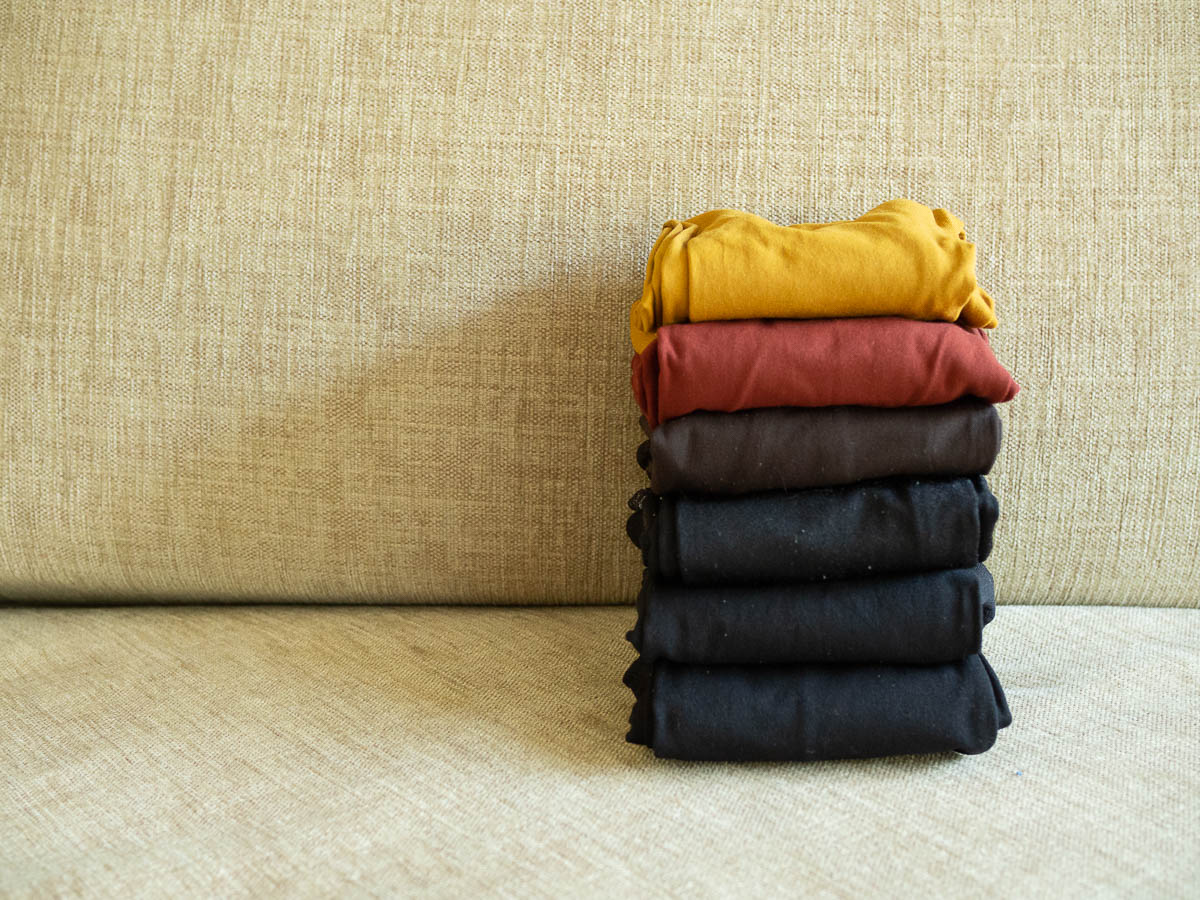
All in all I felt that I contributed much less than I had hoped. When I came home, dissatisfied with my morning, I picked up my own pile of mending and fixed up six pairs of tights. And felt much better about the day afterwards.

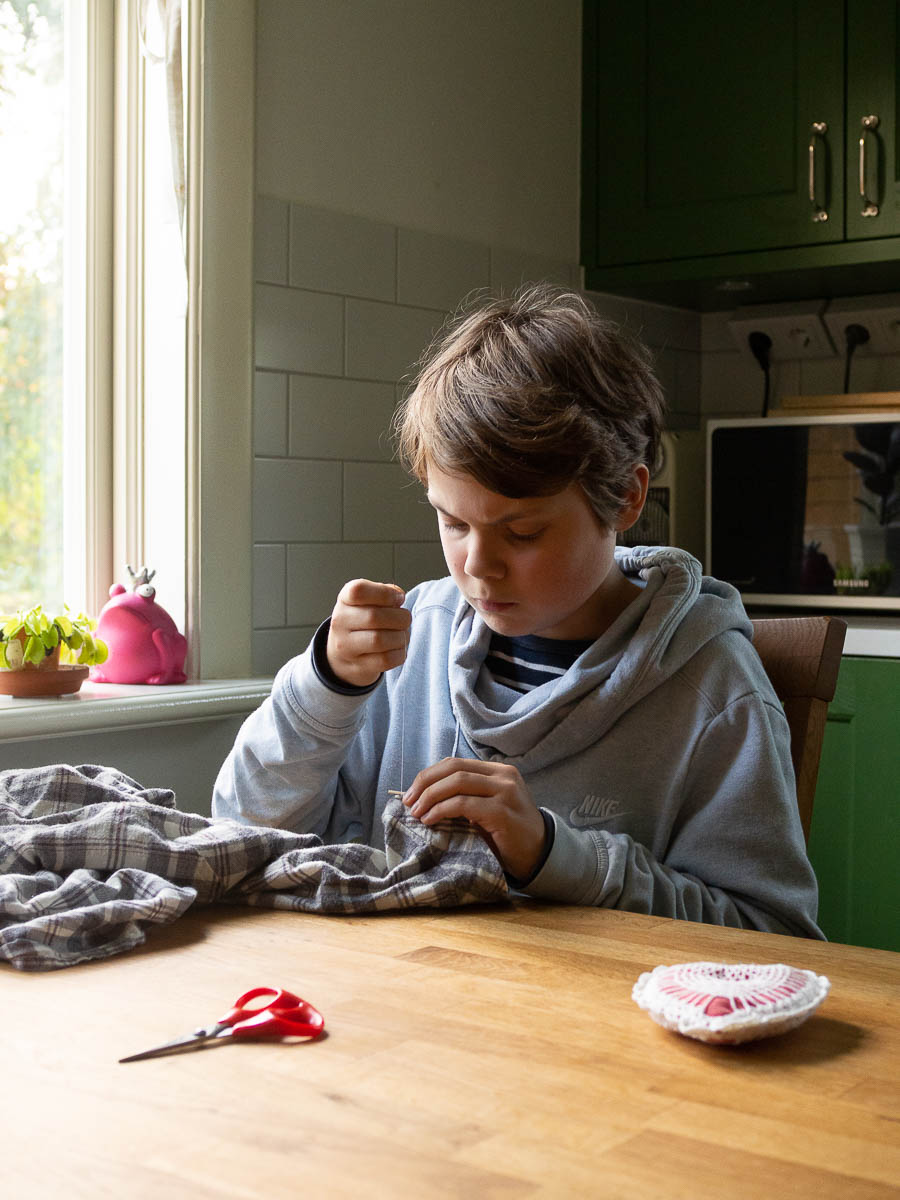
All this mending reminded Adrian that he had a list of homework tasks from his home economics class, one of which was to mend a small hole or sew on a button. My backlog of mending was now empty – except for a shirt waiting for a sleeve button to be re-sewn! He came just in time; had he mentioned the homework an hour later, I wouldn’t have had anything for him. I guess we could always cut off a button and reattach it, but it would have felt like a waste.


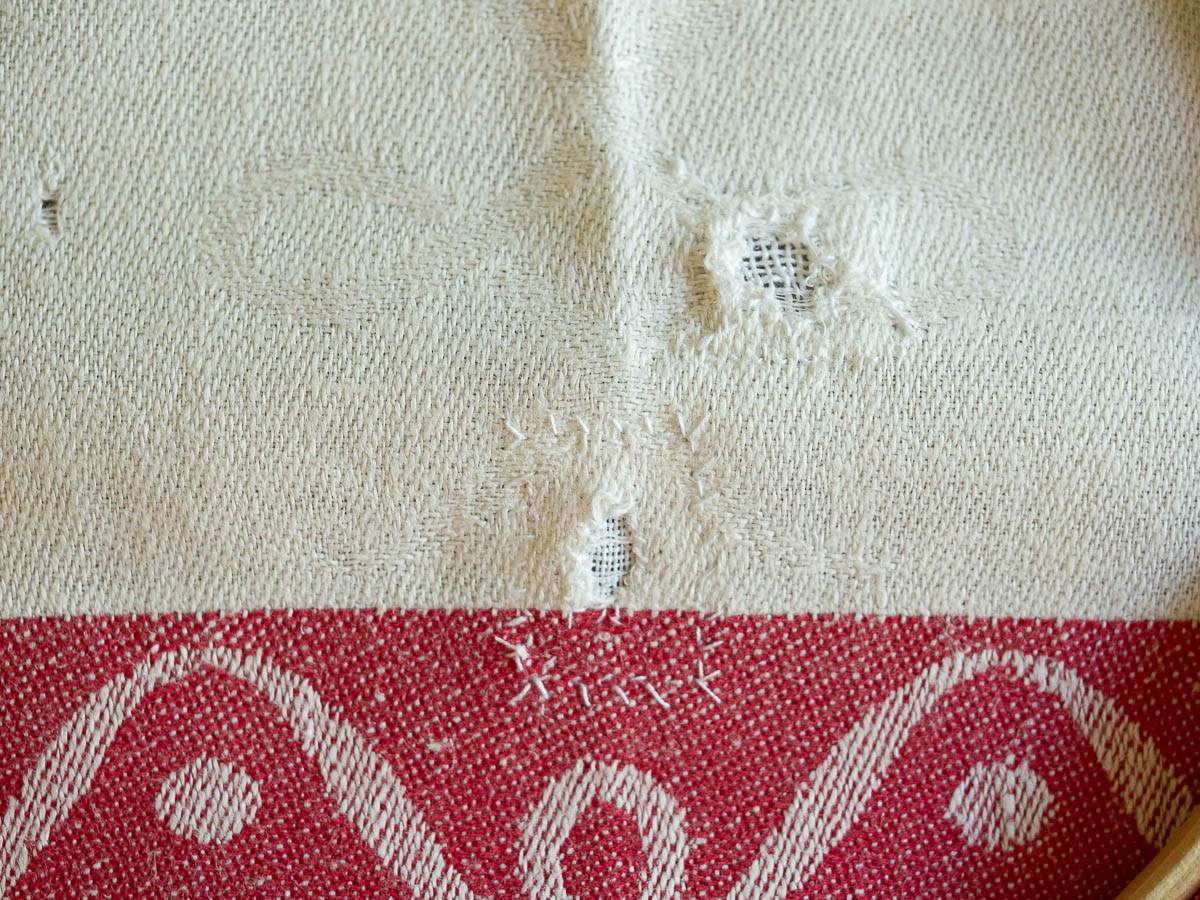
We have a lot of antique/vintage linen kitchen towels, many of which Eric inherited. We use them daily – they’re no decorative mementos – and they are starting to wear out here and there. I really don’t want to throw them out. Nothing wrong with modern towels (as long as they are 100% linen because cotton towels suck) but these have a history.

I’ve mended plenty of socks, and children’s clothing, and bags, but not towels. Towels seem tricky. They’re thin, to begin with, so I can’t just put a big thick patch on them. I’ve never tried darning anything this fine. And the mend needs to be flat and smooth and not scratchy, or it will make the towels unusable. And ideally it needs to look good from both sides of the fabric, which has never been a consideration for any of my other mends.

I did a trial run on two holes – darning one and patching the other. The darning was super challenging, even though I did it in the middle of the day in the best light. It’s not that I couldn’t see what I was doing, but it was exhausting for the eyes. I think I’d need to work with a magnifying glass if I ever wanted to try this again. But it does look pretty good – from the side of the fabric that was facing me when I worked, at least. From the reverse it’s a bit less impressive.

The patch was so much easier, but also stands out more, and I’m not sure how well it will hold up in use and in laundry. I guess I’ll leave the towel be for a while and see what it looks and feels like after a wash.

(Ten years ago, by the way, I couldn’t imagine spending time on mending a towel. You own and use and care for something long enough and closely enough, and you become attached to it.)


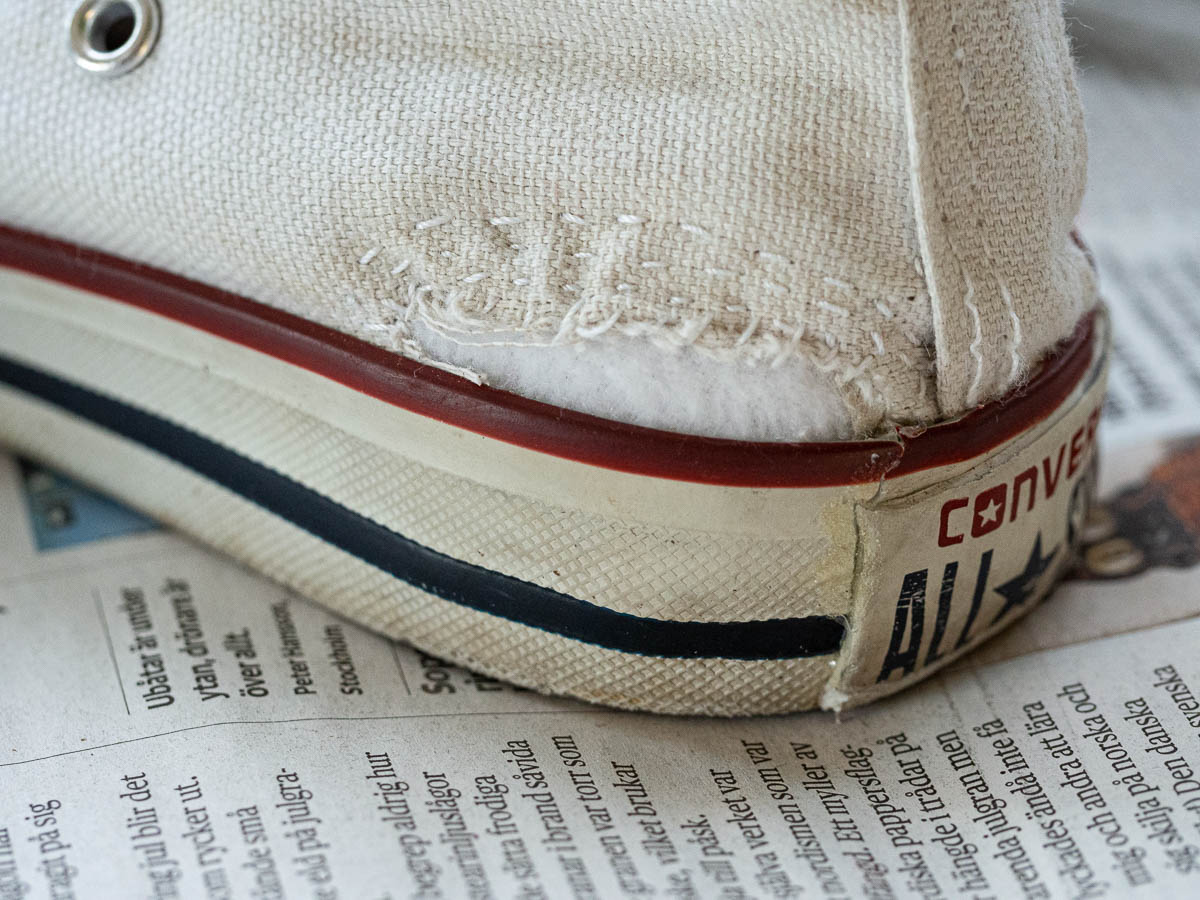
Ingrid’s favourite pair of shoes needed mending. A fleece patch and some superglue, and they’re wearable again.

I’ve come to realize that polyester fleece is the ultimate mending material for any kind of textiles – clothes, shoes, bags and so on. I’ve even used it to mend laundry baskets. It is durable, comes in many colours, doesn’t fray, has a little bit of stretch to it but is still stable, and is easy to sew. I know polyester has its shortcomings (like spreading microplastics) but nothing else compares. Which is the case for many plastics, isn’t it.


Layers and layers of duplicate stitch keep this pair of socks going.


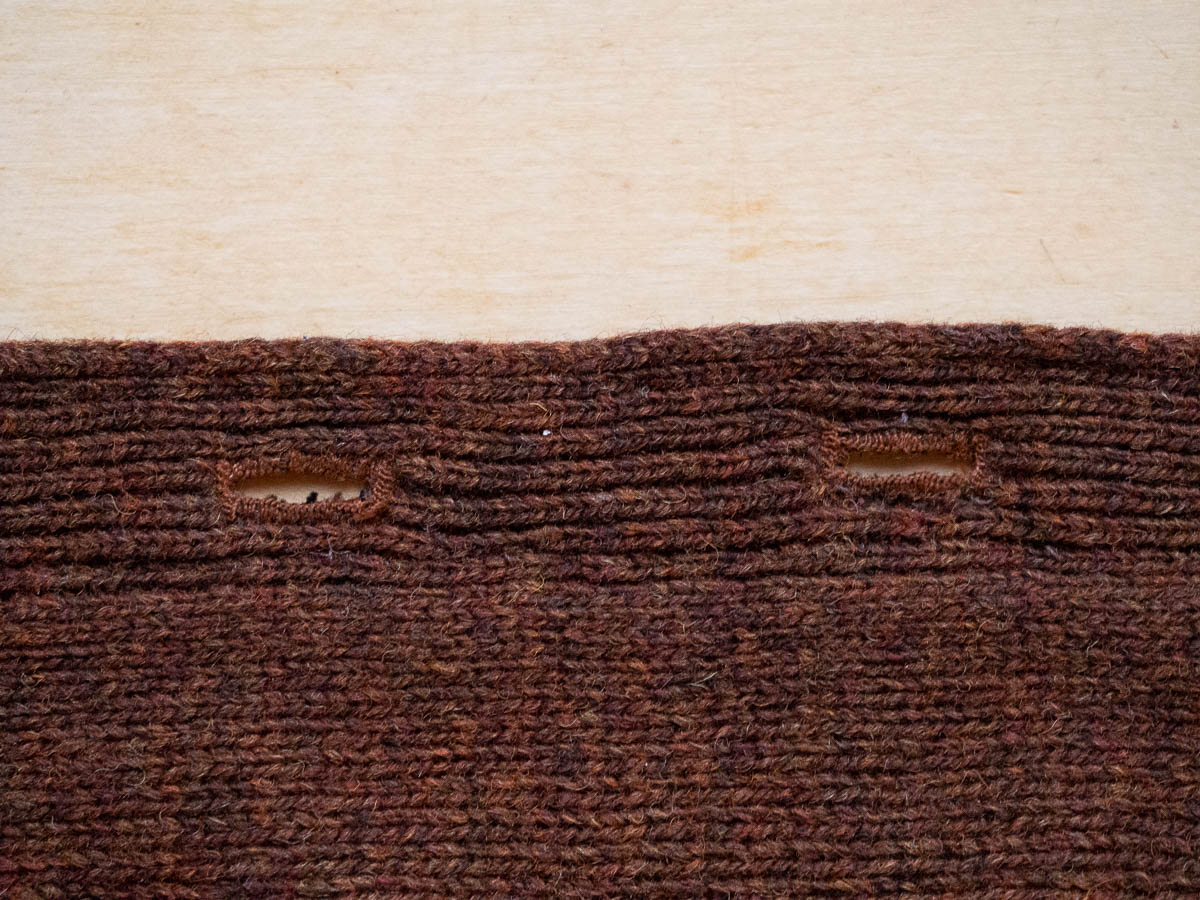
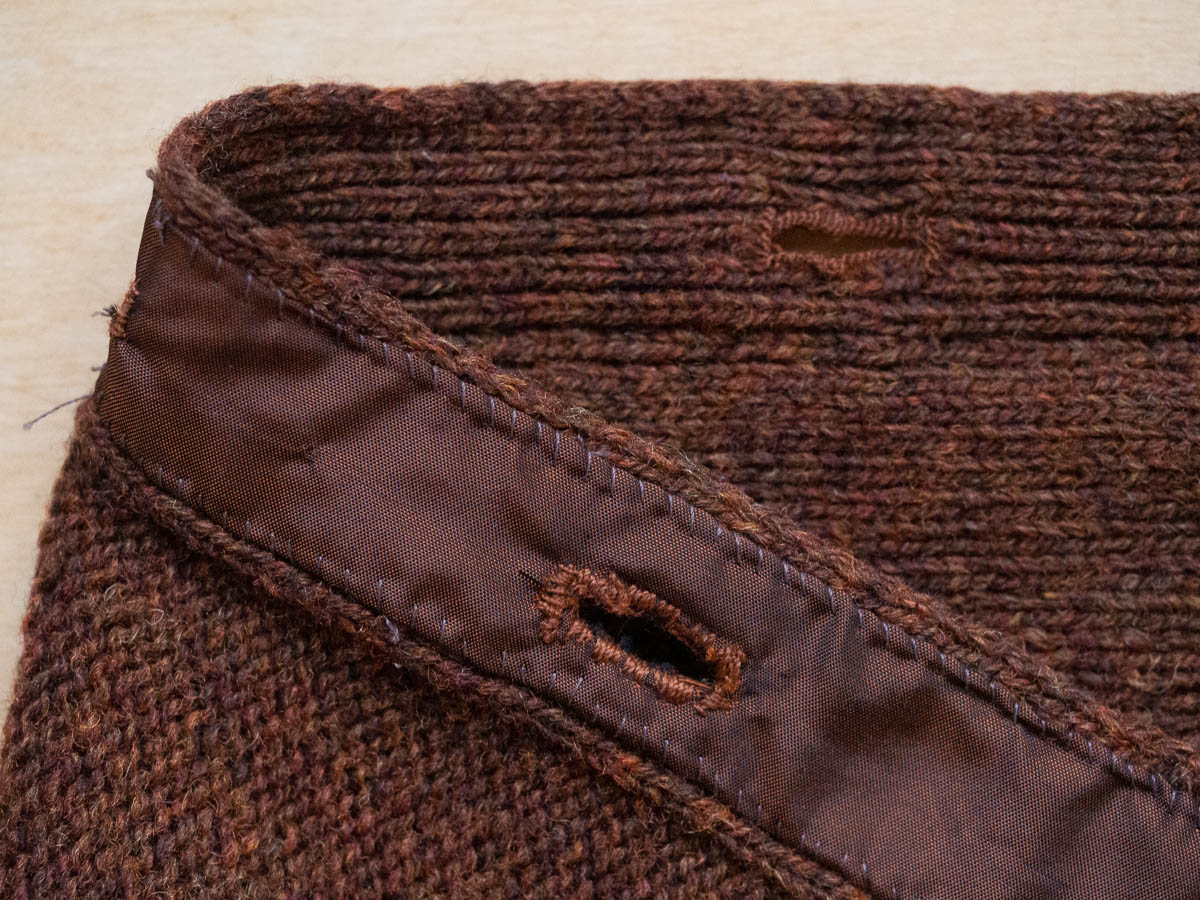
I have a favourite cardigan with very worn buttonholes. The yarn around the buttonholes was worn all the way through and the knitted fabric was starting to unravel completely.

I don’t enjoy sewing buttonholes. It’s fiddly and tedious.

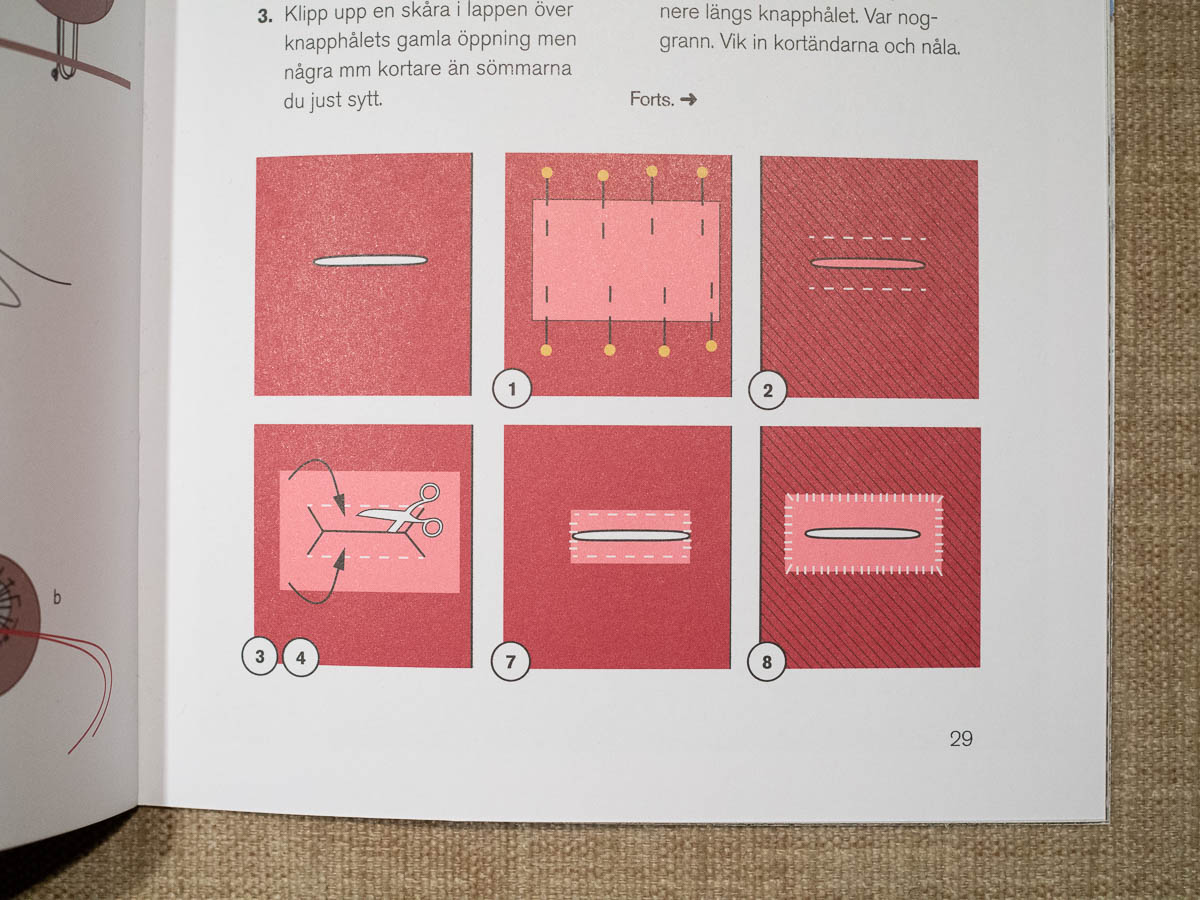
One of my mending books spends several pages on a technique for mending buttonholes with a small patch of fabric. It looks clever and tidy and sturdy:

Despite the illustrations, I couldn’t quite wrap my head around how it actually works. Topologically it just does not make sense. You cannot take a rectangular, flat piece of fabric and fold it inside out through a slit, and have all of it still lay flat.

I tried it out anyway, assuming it would make sense when I held it all in my hands. Maybe the fabric would somehow settle into tidy folds. Nope. Not even near. No matter how much I tried to smooth it and flatten it and gather it into pleats, it just bunched up and pulled on itself. I couldn’t even get it flat enough to sew the edges down. Completely hopeless.

So it’ll have to be the old school way after all. I reinforced the button band with a strip of fabric that I sewed onto the rear of it, and now I’m sewing the buttonhole edges one at a time. The front looks pretty good but the reverse, not so much. Luckily nobody will be looking at that side. Also luckily I don’t have to finish all the buttonholes before I can wear the cardigan again. They’re boring, so I’m doing them one at a time. Four done, which is enough to make it usable.


I knit a scarf out of sock yarn because the yarn felt so soft and I was afraid it would wear out in no time if I actually used it according to the label.

But I kept wondering. Maybe I could use it for a pair of really, really soft and cosy socks as well?

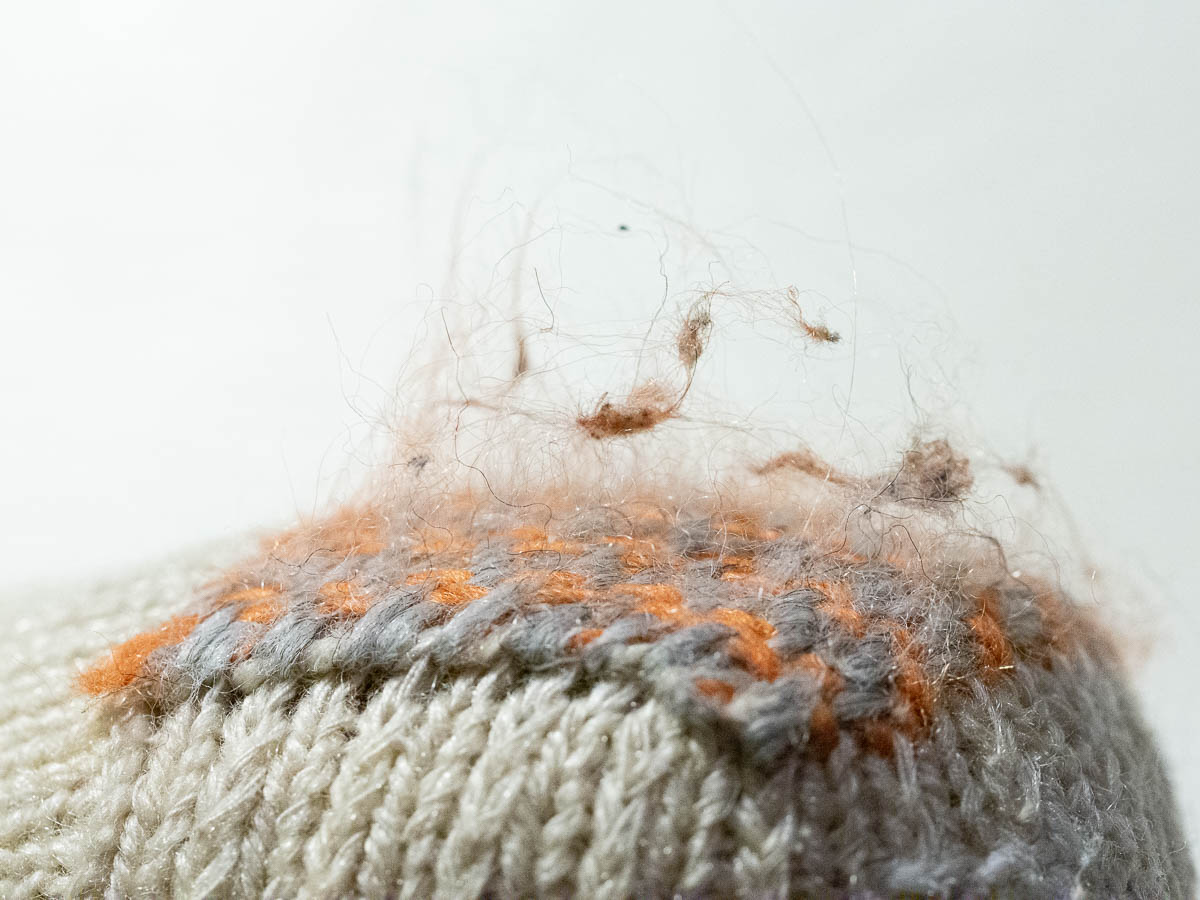
I used some of the leftovers to darn the heels of another pair of socks. Those patches are all fuzz and lint now. The yarn is too loosely spun so it doesn’t even wear through. Rather it slowly unravels and falls apart.

I no longer wonder. This would be a terrible yarn for socks.


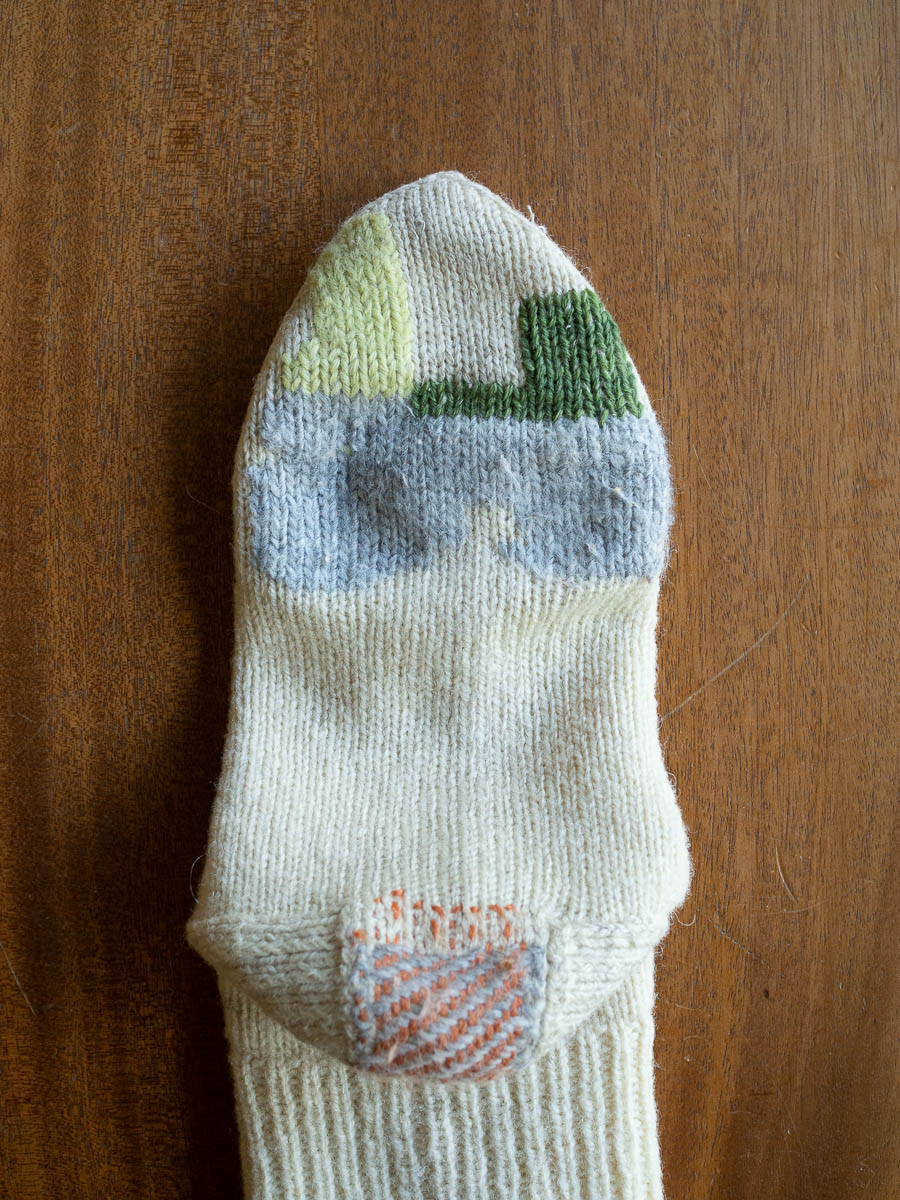
Working from home, I wear woollen socks a lot more. Working in the office I’d wear indoor shoes instead but socks are so much comfier. Which leads to a lot more darning.

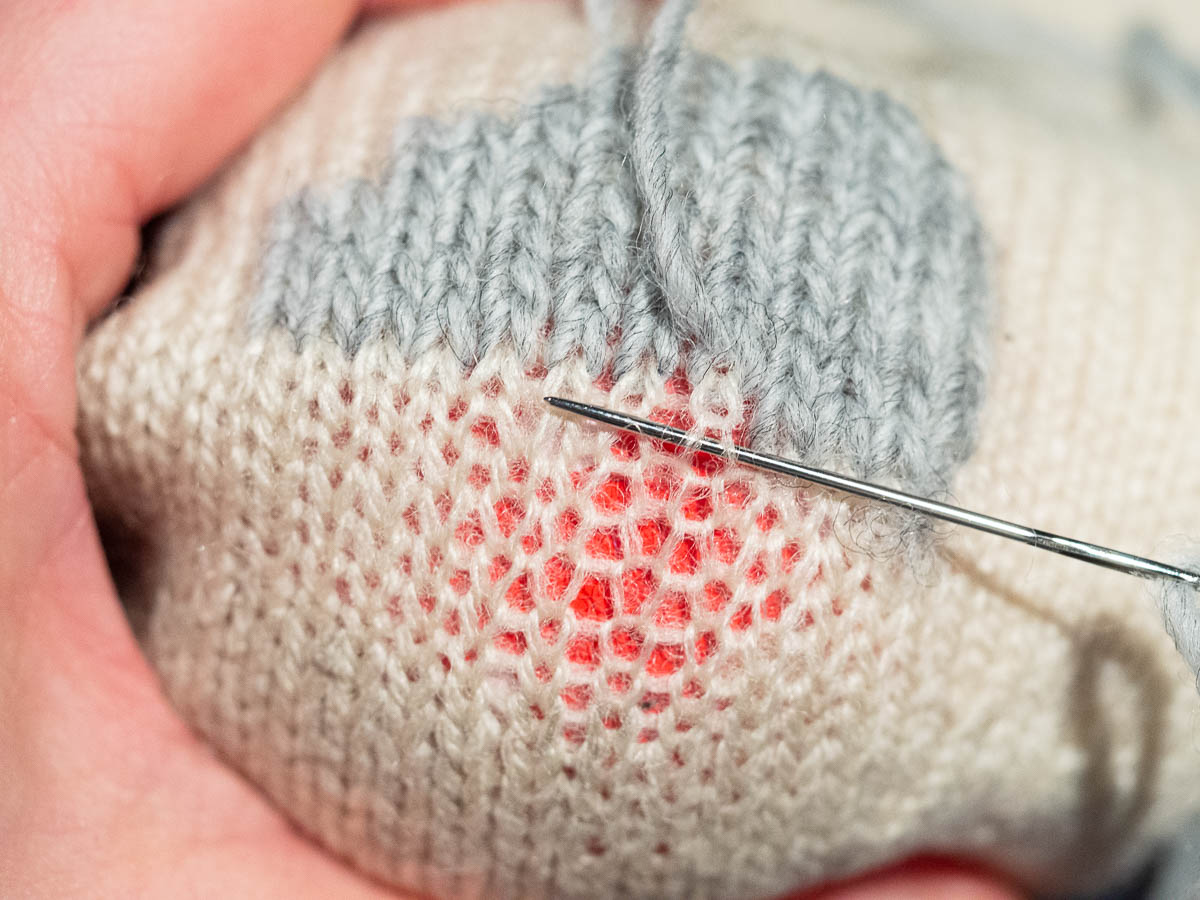
A nice thing about hand-knitted socks is that I can fix a hole before it actually becomes a hole. The yarn wears thin but still retains the knitted structure, and I can use duplicate stitch to reinforce it. On this sock my reinforcement even covers up an earlier, less-than-expert darning.

Store-bought socks have their benefits but they are usually made of such thin yarn that duplicate stitching them would take a magnifying glass and one of those surgery robots that repeat your hand movements in miniature.

This, of course, assumes that I notice the soon-to-be hole in time, and don’t procrastinate about fixing it until it does actually become a hole.


There was a full-on crisis at work today, which I spent all day resolving. Once the crisis was over my brain was mush and I felt too dull to do anything. I’m borrowing this photo from an earlier day, and posting this two days later.

This is the second oven mitt I’ve patched in exactly the same spot: the tip of the thumb. I’m pretty sure that the wear here is due to the thumb getting into food. Maybe someone lifts a heavy, full baking pan with lasagna out of the oven and the thumb of the mitt gets a bit of sauce on it. That spot of food goes unnoticed and unwashed, and somehow it weakens the fabric. As we keep using the mitt the fabric in that spot gets exposed to heat and a hole is burned in the dirty spot. But only there, and not in the parts that are most exposed to heat. There’s some chemistry behind this, I’m sure.