Last week we visited the Royal Academy to see Chola, an exhibition of Indian sacred bronze statues from the time of the Chola dynasty (9th–13th century). I had previously seen a similar exhibition in Antwerp at the Etnographic Museum and enjoyed it a lot, so I was really looking forward to this. But the exhibition was disappointingly small – only three rooms, around 40 pieces in total, about half an hour’s viewing – and quite expensive for its size (£8 per person).

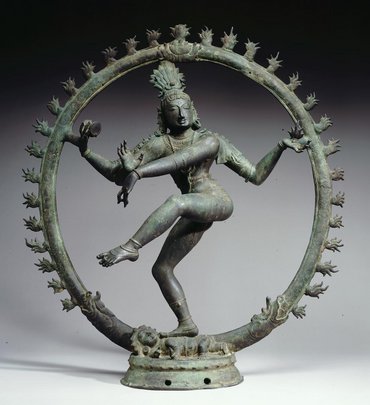
The statues were impressive, especially the signature pieces of Shiva as the Lord of Dance, and Krishna dancing. These were also the most dynamic ones – many of the others were simply straight, upright figures, all quite similar to each other. Which was interesting in itself, in a way, because it demonstrated how the statues were not primarily works of art but expressions of a concept, and thus bound by strong conventions. The same is true of much western religious art, in particular Russian Orthodox icons, where all the saints look the same except for their characteristic accessories and poses that symbolise some part of their role. The same was true here: god X always holds A in his left hand and B in his right hand, etc.

Unlike western religious imagery, though, many of these gods were elegant and physically beautiful, with a strong focus on the naked body, and lively rather than serene or serious. These gods appear far more physical than most Christian saints.

While the individual statues were beautiful, I missed a larger framework or story around them. I would have liked to see photos of them in their ordinary settings in a temple or in use in a processions; some understanding of how this art form changed over time; more about the meanings of the symbols, etc. Perhaps the audio guides gave some of that, I don’t know, but it wasn’t present in the exhibition.

The advance booking brochure for bite07 (Barbican International Theatre Events) arrived today. Interestingly, 6 out of the 19 shows are marked as “contains nudity”, and one of them has age guidance 16+. Even Peer Gynt and Chekhov have nudity in them. What’s the world coming to?

Eric’s latest project finally finished, after several weeks of absurdly long hours (on the worst days he left before I got up, and came home when I was already asleep) so he took today off and we went to see the Rodin exhibition at the Royal Academy.

I’m not an art critic and not even particularly knowledgeable about art, so I don’t have much intelligent commentary to offer (and Rodin has probably been commented-on more than enough, anyway) – only a handful of disjointed personal observations. If you want a proper review, try The Guardian’s.


Bronze suited Rodin a lot better than marble. His marble sculptures tended towards a tame smoothness, whereas the bronzes had vigour and character – there was a lot more strength in their movement, and more life in their surfaces.

All of his portrait busts of men were in bronze. Almost all of his portrait busts of women were in marble. His choice, or the subjects’? Quite possibly the latter: one of the women apparently complained about the first proposed version of her portrait that it made her look fat, so the final version was a dreamy soft portrait, with only her face emerging from a large block of marble. Pretty pathetic in a way (easy for me to say!) although I’m sure it was popular. His portraits of men on the other hand sit straight up, so to say, facing forward, eyes open.

Composition is not his strong side. Each figure on its own made a stronger impression on me than the larger groups. Take the Burghers of Calais for example: they don’t really look like a coherent group to me. One seems to be talking to someone outside the group; one seems to be arguing with the others; one has a headache. What’s going on? I’m sure it’s possible to come up with explanations, but a well-composed sculpture shouldn’t need that. I found the composition of The Gates of Hell equally awkward and confusing.

He spent decades on The Gates of Hell even though the commission was cancelled after a while, and still he never finished them. One has to be really obsessed with something to keep going for that long.

Even though the Gates were never finished, a lot of his other sculptures started out as elements in the Gates but evolved into full-scale standalone pieces. So it wasn’t wasted work. More interestingly, he reused several of those elements in a cut-and-paste manner: take the body of this figure, replace its head with that one, oh, and let’s add one of these women as well. “Object-oriented sculpture”, Eric named it; The Guardian draws parallels to Frankenstein.

He often changed the orientation of the figures when reusing them, so a pose that appeared to have been modelled on a more-or-less upright woman might end up being used lying down, or even upside down. Not really noticeable except on a large scale, but then it had a curiously distorting / twisted effect.


PS: I really like the little folding stools that you can borrow at museums.

This summer has been relatively culture-poor for us. No particularly interesting theatre or musical events in London have caught our attention, and we’ve both been working too much to see any spontaneous, unplanned culture.

Looking forward, now that summer is over, all sorts of interesting events are cropping up. But now we’re not really sure whether it will be possible for us to get out at all, so we’re not booking anything.

Between these two lulls, we managed to get in one excellent evening of dance to music by Steve Reich.

Part 1

The first of the three parts was set to Piano Phase and Violin Phase. In both of these a short phrase of music is played over and over again by two musicians (pianists or violinists). They start out in phase. Then one of them speeds up marginally so they get out of phase, and slows down again when he is exactly one beat ahead of the other. They repeat that until they’ve gone full circle and are in phase again. Wikipedia’s article on Piano Phase explains it in more detail.

The full description actually sounds boring and technical to me – an experiment, a gimmick, “see how clever I can be” – but the music was anything but. It was absolutely mesmerising. The melody itself was beautiful in its utter simplicity, and even though this was taped music, it sounded very good through the Barbican’s sound system. I imagine it must be rather challenging to play, so live performances of this are probably rare. The phasing in/out kept a constant subtle tension, so despite the simplicity the music never got boring. (While listening I didn’t actually realise fully what they were doing – I just heard the repeating music and shifting in/out of phase.)

Violin Phase was similar in setup, but because the rhythm wasn’t as distinct, I felt it lost some of that magic.

The dance element matched the music. Two dancers performed a simple, short sequence of movements over and over again, shifting in and out of phase with each other. The two dancers look almost identical, and are far back on the stage so details aren’t visible. Instead the focus is on the shape of the movements – pendulum-like with long arm swings and rhythmical 180-degree turns – and the phase, the similarity. Two strong lights cast two shadows of each of them, and the ones in the middle overlap, so the dancers melt into one. Like the music, this was almost hypnotic.

Part 2

Part 2 also consisted of two pieces of music – Perotin’s Viderunt Omnes, a medieval polyphonic piece for four singers, followed by Reich’s Proverb for five singers plus vibraphones and electric organs. Both are, again, very minimalistic, and beautiful in their simplicity. They are far less technical than the Phases, and really got their strength from bringing out the best from human voices: clear, graceful, melodious. (Performed live by Theatre of Voices.) Reminded me of Tehillim, which I saw/heard a year ago or so, and which I also loved a lot.

The dance part by Richard Alston Dance Company, on the other hand, was completely uninteresting to me. It didn’t suit the music in style or temperament, and wasn’t particularly interesting on its own, either. I found it a distraction, and simply closed my eyes to shut them out. Therefore I don’t really have much more to say about that.

Part 3

The last part was Variations for Vibes, Pianos & Strings. Nice enough, but not as interesting or engrossing as the previous two parts – relatively tame and neutral compared to his best pieces.

Yet this part was most popular with the rest of the audience. I guess that was mostly due to the dance, performed by three very vigourous male dancers (Akram Khan Dance Company). It had some interesting aspects. For example, even when the three were doing the same thing, they retained quite individual styles, reflecting their different backgrounds (one African, one Middle Eastern, one Asian). But I found the choreography itself a bit simplistic. Much of it was very close to the music, almost acting it out: long sweeps of violins were accompanied by long arm sweeps, etc. At times the dancers were mock-conducting the orchestra in the way a child would: not providing direction but following the music exactly. It was the kind of choreography that might emerge if a very talented someone, with no education or experience in choreography, tried to just dance to the music. I guess this immediacy and closeness to the music may have been what the audience liked about it.


The more I hear of Steve Reich’s music, the more I like it. And every time I run into Theatre of Voices, I like what they do. Both deserve more of my attention, I think.
Kabuki is a strange phenomenon. In Western terms it could perhaps be described as a combination of silent movies, opera and abstract dance. It is a very Eastern form of art, in its strong adherence to tradition. I can’t think of any Western art where performers are born into their job, and most plays in the repertoire are handed down through centuries with little change.

This evening’s performance consisted of two parts. The first was a lyrical / abstract piece, where a young girl (well, a male actor playing the role of a young girl) danced of love, then heartbreak, quarrel, and making up. The second was a dramatic story blending love and horror.

Kabuki’s popular roots were quite apparent in the story, which was a melodrama worthy of any soap opera: lovers fleeing in the night through pouring rain to commit suicide together, possessions by ghosts, bloody fights, and so on. A lot of traditional Japanese stories seem very dramatic, in fact, and involve lots of ghosts and violent deaths – I’ve noticed the same in Japanese manga and fairy tales as well.

The acting, meanwhile, was at once stylised and extravagant. A lot was communicated through small and subtle gestures that may well be obvious to a more experienced audience, but would have remained completely incomprehensible to us, if it hadn’t been for the audio guides that were available. “Note how she crosses her arms to indicate intimacy” or “the deep drum signifies a heavy downpour of rain”… umm, OK. Other feelings and facts were acted out most expressively – the fights in particular were almost overly obvious, as the fighters froze repeatedly in pre-defined tableaus.

The acting was supported by excellent music – quite discrete and low-key, but expertly performed – as well as beautiful costumes and impressive scene designs. Even the programme was good, and the audio guide added the final touch. A great introduction to kabuki, and a nice break from ordinary theatre fare.

(Yesterday)
Where some choreographers start from music, Deborah Colker’s shows appear to be constructed around a very physical scene design. There was Casa (House), where the scene was built around a deconstructed house. There was 4×4, which actually had 5 parts, where the decor ranged from corners to porcelain vases.

Knot, which according to the programme is supposed to be about the philosophy of desire, had two parts. The first had a tree of ropes that later broke into four parts and then dissolved into a forest of ropes. The dancers were also connected and occasionally tied together by ropes. Desire in the sense of that which connects and binds, I guess. The second act was centred around a transparent box that the dancers climbed on, around and into – desire as yearning and frustration and voyeurism?

On the whole the performance fell short of my expectations, which were admittedly rather high after the previous two shows. Colker’s choreography is usually acrobatical, innovative and interesting, and the dancers move with energy and passion. This one seemed to have less movement and more posing. Instead of fluidity we got passages from one pose to another. Some of the pas de deux in act one were visually interesting and elegant, but even then ideas were explored for a moment and then abandoned as the dancers took a different pose. Somehow it lacked passion and felt more like physical exercise than art.

I was literally nodding off towards the end of each act, and can definitely think of better ways to spend an evening.

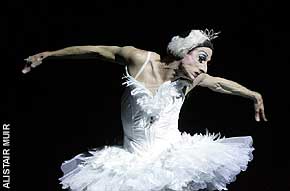
The Trocks, or Les Ballets Trockadero de Monte Carlo, is an all-male classical ballet troupe. What makes them different is that they dance women’s roles, in women’s clothing and style, en pointe: men in tutus and white tights, but with broad hairy chests and muscular arms.

Their show is part serious ballet, part physical comedy, part parody – and it works surprisingly well, and is both funny and interesting. At one end of the scale are the simple jokes about ballet divas: rival ballerinas “accidentally” kicking each other on stage, and dancers devoting more effort to flirting with the audience than to dancing. At the other end, exaggerated interpretations of traditional gestures from the female ballet repertoire, and those pasted-on artificial smiles that ballerinas always seem to wear. And under / over all this, there is obviously a constant play with gender roles: male control and leadership vs. female hand-fluttering. Not surprisingly, when a piece calls for a male role, they picked the smallest guys with the least masculine bodies for those roles.

The Trocks are really good dancers – when they want to be. Occasionally their focus leaned too far towards burlesque parody, for my taste, and technique suffered. But when they focused on dancing, their technique was excellent, with crisp movements, accurate poses, well-controlled pirouettes and sharp timing. And since they are men, their dancing is a good bit more forceful and energetic than women’s. At their best, they work a strong illusion: occasionally I forgot that the piece is performed by men in drag, and only to suddenly be reminded of it by a hairy chest.

One of the best pieces was the Dying Swan solo. Again a combination of physical comedy (where the swan literally collapses on stage) and excellent dancing. To top it off, the solo is performed by a man who looks to be well over 50, and his body shows it: skinny legs, knobbly knees and elbows, plus a nose like a hawk.

The audience appreciated the burlesque parody pieces most, which was to be expected, given the venue. The Peacock Theatre generally runs shows that appeal to inexperienced audiences, and prefer the flamboyant and comical to the refined. One has to admire the Trocks for their skill in combining gags on different levels and satisfying all tastes.

Played by Jeremy Irons and Patrick Malahide; directed by Michael Blakemore; based on a novel by Sándor Márai.

It is 1940. Henrik (Irons) has waited for 40 years for his friend Konrad (Malahide) to return, after he left in mysterious circumstances. This is the evening when Konrad returns, and Henrik is determined to find out the truth about what happened.

In the first few minutes we learn that this is somehow about Henrik’s wife, now long dead. (Not surprising, really, that a drama between two men would revolve around a woman.) The rest of the evening slowly uncovers more of the past, revealing why 40 years have passed since they last met, and also explaining why, after 40 years, the meeting is happening at all.

Márai’s storytelling skill is a large part of what makes this play interesting. The story itself is simple. But the way it unfolds is compelling: step by inevitable step, revealing small things that – when you reflect on them for a moment – tell of larger things in the background. It hints at the hours that Henrik has spent obsessing over all of this and rehearsing for this single evening, which he has been waiting for for years. It was also interesting to wonder how much Henrik already knew or guessed, and how much he only consciously realised when talking to his friend.

(As usual, reviewers and even the programme reveal far too much of the story. I’m glad I hadn’t read any of them in advance. The drama would have lost a lot of its power for me if I had known more about the story.)

The stage version is really a monologue by Henrik – Konrad is only there to act as the reason for the story. Unfortunately the only seats we could get, for any weekend, was the last row in stalls, so we didn’t have a very good view and missed quite a lot of Konrad’s performance. Facial expressions don’t carry as well as sound.

I have not read the book, but I understand that it’s not presented as a monologue. I think this approach works well on the stage, but I am interested in reading the original version. Several reviewers have said they preferred the book, and found the stage version inert, bloodless and lacking in life. A matter of taste, I guess – I would describe it as refined, subtle, and simply told. And a play about two old, bitter, world-weary men shouldn’t be lively.

As with many recent shows we’ve seen, the performance would have been even more enjoyable if it the rest of the audience hadn’t been there. Adults should be able to sit still without constant fidgeting through two short acts. And I cannot help but be annoyed by people who expect every play to be funny, and laugh out loud as soon as the story takes an unexpected turn, or an actor uses an unexpected phrase.

Photos.

This was a concert that Eric bought tickets to, and I would join him mostly because… well, why not?… just because he was going. In the end, Eric got sent off to Manchester for the week, and I went on my own.

They turned out to be talented musicians, but the music (much of it from their latest CD “Day is Done”) was not really to my taste. It was the sort of refined and elegant jazz that makes experts nod knowingly at each other and comment on how skilled the bassist is. And that may be entirely true, but isn’t enough to carry a whole concert, unless you’re one of those experts, which I am not. The kind of jazz where every song sounds much like every other song, at least to an untrained ear. They could have played any one of them again, and I wouldn’t have been able to say whether I had already heard it or not. (Even reviewers at The Guardian who gave it 4 stars described it as “absentmindedly drifting”.) I like music to have some sense direction, not just aimlessly wandering improvisation.

A few of the songs had more character, more groove and melody. Their rendition of “The very thought of you” was quite nice. But most of it was pleasant but rather boring, in my opinion.

Japanese drums. A very special art form, and very intensive experience.

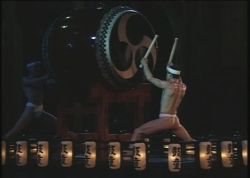
O-daiko

Kodo seems to be the Japanese Taiko group that most often visits Europe. We’ve seen/heard them once before, but that was several years ago. This time their programme was more modern: the leaflet named individual composers for all songs of the first half. The last of them (“Monochrome”, on 7 small drums) had a particularly modern feel, with enormous variation in volume. It gave the impression of a large swarm of potentially aggressive insects – a storm of locusts, or a nest of hornets. First quiet humming, then sharp and furious.

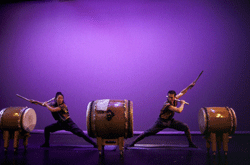
The second half shifted towards a more traditional style, with more primal rhythms – purer and more focused in my opinion. And it’s got more of the really large drums – the ones that make the entire hall vibrate, the ones you can feel not just in your belly but in your bones. Miyake style taiko (with two drummers playing on one large drum, placed horizontally between them) in particular is very vital and intensive. Then of course there’s o-daiko which is the largest one. It’s odd that something so large and loud can at the same time be so tranquil and meditative. To listen to, that is – playing it appears very physical.

Miyake

Taiko is also a very visual show. (I found reasonably good pictures of a Kodo show here.) Taiko concerts are not ones to listen to with closed eyes – possibly with the exception of o-daiko. It’s fascinating to see the drummers move: focused and purposeful, economic, full of power but also very graceful. It looks like as much thought lies behind the shape of each movement as the sound it is to produce. (More likely, they’ve realised that cleaner, stronger movements lead to cleaner, stronger sound.) This is another reason I like more traditional taiko music better – the larger kinds of drums make the physical aspect more visible. I also get the impression that movement patterns are more important in traditional pieces.

The experience was somewhat marred by the audience. I think I must be growing old – I’m starting to think that people have no manners nowadays. Arriving half an hour late and then standing up to take off their coats, and walking out partway through the concert when their wine glass runs dry… And far too many enjoy their own applause more than the music itself, and applaud as soon as there’s a quieter moment. If they just glanded at the players they would see that it’s nowhere near done! I guess concerts have become a social event rather than a cultural one – the music is just entertainment, and not the main event.

I learned today that the drum sticks, Bachi, are not only of different sizes for different drums, but also of different materials. Softer woods give a clearer sound on small drums, where harder woods would sound “dead”, while hard woods bring out the sound better in larger drums.