Exhibition poster. Foto: © Yves Bresson

Yesterday we went to the Nationalmuseum to catch their exhibition about trompe l’oeil art, “Lura ögat”, during its last weekend. The objects on display were many and varied, ranging from 17th-century paintings to video installations.

Based on the exhibition poster I was expecting most of the works to be modern, but the bulk of the exhibition consisted of works from the heyday of trompe l’oeil painting: pictures pretending to be plaster reliefs, or deceiving the eye about the dimensions of the room, or simply attempting such verisimilitude to make the viewer believe that what we see is not a painting but the real thing.

The video installation I mentioned showed a woman balancing on a tightrope that’s runs just along the horizon, where the sky meets the sea. Other modern works included what seemed to be a photo of Queen Elizabeth II but turned out to be a photo of a wax statue at Madame Tussaud’s.

The exhibition topic was interesting and so were the contents, but the presentation was suboptimal. There were too many objects in too few rooms: many of them would have made more of an impression if they had had more space around them. Especially the small rooms were way too small (or way too crowded) – I skipped several rooms because I could not see past all the other people in there. It’s partly my own fault for waiting until the last weekend, of course. The poster image was particularly badly placed, in a corner, opposite a three-dimensional installation which left a relatively narrow passage in front of the image, so everyone was queueing to go past there.

Many of the older hyperrealistic paintings lost much of their effect because of the frames around them – they became nothing more than impressive still lifes. That’s the traditional way to display oil paintings, I know, but it was not very appropriate for this exhibition. On the other hand, Escape from the Critique looked great.

I also thought there were disproportionately many paintings of quod libets (paintings of small objects on a wall, like this one), which became much of a muchness after a while.

My favourite was Yrjö Edelmann’s Packed Picasso (Blue period). What you see here is a photo of a painting of a parcel containing a painting.

You can see many more pictures on the exhibition’s press relations page.
On Sunday we had our first evening out since April. We went to see Cirque du Soleil’s Varekai. We’ve seen, I believe, all their shows that have come to London, and generally buy tickets for each one as soon as as they become available (about a year in advance).

The show wasn’t bad, but I felt it was not up to their usual standard. It was not as innovative as I had expected. Are they running out of ideas, getting stale? Or is it just me, getting used to their thing? In any case it wasn’t quite worth the money I thought (given how horrendously expensive the tickets are, plus the expense of 5 hours of babysitting).

Nevertheless a good show. As usual, a Cirque du Soleil show has to be seen as a whole rather than separate parts. The costumes, music, the acts themselves, etc all have an overarching theme and a coherent feeling. The costumes in particular were fabulous, impressive enough on their own and then even more impressive when you stop to think that the artists can move freely in them without destroying the costumes.

You can’t go wrong with skilled acrobats and tumblers, and two of the strongest acts of this show were acrobatic. One was a tumbling act: two men reclining on their back, spinning their partners with their feet. (Youtube video – you can skip the first 2:30 of the clip which is just general prancing around.) The other one was a Russian swings act – acrobats launched from swings high into the air where they turn and tumble, and then impossibly land on each others’ shoulders, or gracefully “land” high up on a large canvas nets stretched out behind them. (Youtube video.) In both acts the feats that the acrobats perform become gradually more and more impressive until I sat there with my mouth open and could hardly believe the things I was seeing.

At the other extreme of the scale were some totally boring swirlers (marketed as a Georgian dance) and an almost-as-boring hand-balancing contortionist doing nothing new. The swirling dancers were so boring I don’t understand why they were even included in the show. If someone turns up at a circus with swirling as their only skill, you wouldn’t generally expect them to be hired!

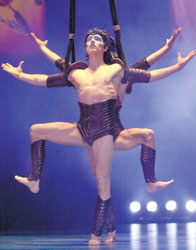
My favourite act was an aerial one – two men hanging from wrist straps, swinging high and wide across the scene, sometimes together, sometimes apart. When they first appeared, in tight low-cut black leather, my first thought was, “how much did they pay them to wear those costumes?”. But the act itself was beautiful, well-coreographed and very expressive. Refreshingly, they were not aiming for a pretty result (which is where most aerial acrobatics end up sooner or later) – it was angular and sharp, full of heels and elbows. Very fittingly the performers are two brothers (Andrew and Kevin Atherton). (Youtube video.)

This Saturday we went to see the First Emperor exhibition at the British Museum. Advance tickets are all sold out but they release 500 same-day tickets every morning. I was there when the ticket desk opened and had no trouble getting tickets – if you haven’t seen it yet you still have a chance. (By the way they now keep the exhibition open until midnight Thursday to Saturday – the demand for tickets must be enormous.)

The exhibition space was rather crowded. One has the choice of queueing and moving at a snail’s pace, or standing outside the queues and therefore viewing some of the exhibits over other people’s shoulders. We chose the latter.

This First Emperor of China is the man who united various warring states into a Chinese empire, and who built a 7000-man terracotta army to stand guard over his tomb. I’m not going to write even a short overview of all the other things he did and achieved; you can find all of that elsewhere on the Internet (starting with Wikipedia for example). Instead I’ll just focus on what I saw and what I thought about it.

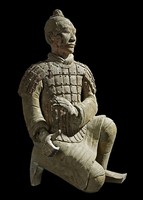
The focus and main draw of the exhibition was a small fraction of the terracotta army. There were archers, warriors, horses and chariots and charioteers, and more unexpectedly, acrobats, musicians and civil officials. Before seeing the exhibition I thought the army existed to guard the tomb, but I understand that it was really to provide the emperor with all he might need in his afterlife. And of course, for a good life one needs much more than just warriors.

The statues were surprisingly realistic and also surprisingly individual. I imagined that they would be stylized and mass produced – because there were so many of them! The main body parts were indeed mass produced but from multiple moulds, and faces, hair, mustaches etc were added by hand, making each one different. The emperor must have been something of a perfectionist given how detailed the statues were, all the way down to individual rivets on plates of armour, and hobnails on the soles of their shoes.

As with antique statues from other cultures (ancient Greece for example) the statues were originally coloured but have now lost all colour. So photos of 7000 clay-coloured statues give a somewhat misleading impression of what the ranks of the army would have looked like originally. Based on traces of paint found on the statues, one was reproduced in an approximation of its original state – and just as with ancient Greek statues, the result looked garish and loud compared to the stylish dignity of terracotta (or white marble).

While the statues were fine and interesting, I was a bit disappointed to see so few of them. They were far too few to really convey the sensation of grandeur and immensity that 7000 of them would do. So in a way, the Terracotta Army can be more impressive on picture. But on the other hand, seeing the statues up close, you can see and appreciate the details. The statues were very nicely exhibited in such a way that we could see them from all angles, and reasonably close up as well. It made a big difference to have no glass between us and the statues.

The rest of the exhibition was really there to provide a background to the army. There was a brief intro to the emperor’s life and works, explanations of how the army and the emperor’s tomb were built (by conscripted workers and convicts), and how they fit into the general fabric of his society. For example, the legs and bodies of the terracotta warriors were built much like the water pipes in the emperor’s new palaces. And the manufacturing process was highly standardised, just as the emperor standardised many other things (including coinage, weights, writing and the manufacture of weapons). One of the more interesting exhibits was a miniature panorama sculpture showing a team of workers making one statue of a warrior and one of a horse.

Emperor Qin must have been an extraordinary man. It is one thing to conquer your neighbours (other warrior kings have done that, too). But this emperor obviously had a grander plan. He was not just a great general but must also have been a great administrator, in order to successfully rule an empire. And he certainly achieved immortality, just as he wanted.

The BBC has some photos (not good but the best I could find).

Here’s an interesting review.

Today we made it to the Shell Wildlife Photographer of the Year exhibition that we missed last time.

This year’s exhibition was set up just like last year’s, and the one before that, and was as pleasant an experience as the previous ones were. The organisers have obviously worked out a great concept and continue to run it successfully year after year.

The exhibition is relatively small – 45 minutes’ worth of photos, an hour tops – but well worth seeing. The photos, of course, are generally interesting and all of high quality (although Eric said this year’s best photos were not as striking as last year’s, and I had to agree).

The photos are also well presented, so the atmosphere of the exhibition is quite pleasant. The number tickets sold is limited (which is why we didn’t get to see it last time) so it never gets too crowded. The room has good but soft light, and the photos all back-lit and displayed with no glare (which can otherwise kill any exhibition of photos or paintings). Each photo is accompanied by a brief one-paragraph comment by the author, and another paragraph about the subject of the photo.

Like last year we noted without much surprise that almost all the photos had been taken with a digital camera. Interestingly the two exceptions I noticed were both photos of plants.

Another trend was towards more and more technology (remote cameras, infrared triggers etc) which felt, well, sort of like cheating. If you just point your camera at animals and let it automatically take thousands of photos, then the result may be original, educational, beautiful etc, but to what extent can you really say that you took that photo?

There were also several photos which had been produced in highly contrived settings that in my mind are not really suitable for such an exhibition. Putting out food to attract animals is one thing, but putting out an aquarium to catch a view of a heron or a window frame to frame a swallow definitely feels like cheating.

But despite these minor quibbles I found the majority of the exhibition well worth seeing. If you are in London and have a spare few hours, this would be a great way to spend them.

If you’re not, try the online gallery which has all the photos. It’s not a very satisfying way of viewing them (too small) but will give you a taste at least.

There is a Swedish children’s song about a spider. It goes like this:

Imse vimse spindel klättrar upp för trå’n.
Ned faller regnet, spolar spindeln bort.
Upp stiger solen, torkar bort allt regn,
Imse vimse spindel klättrar upp igen.

It never made sense to me as a song. It doesn’t rhyme, for starters. It seems to describe a rather random sequence of events. Why would the rain wash the spider away from its thread? And what the heck is “imse vimse”, anyway? I wondered for years why anyone who sets out to write a children’s song would come up with such a weak effort.

Then one day I heard it in English. Suddenly it all said click.

The eensy weensy spider crawled up the water spout.
Down came the rain and washed the spider out.
Out came the sun and dried up all the rain,
And the eensy weensy spider climbed up the spout again.

The lyrics rhyme! And they make sense! Instead of climbing up a thread, the spider really crawls up a water spout – and of course when it rains there’s lots of water in a water spout, which would flush the spider out. Instead of the meaningless “imse vimse” the spider is a perfectly sensible “eensy weensy” spider (or “itsy bitsy” if it’s an American spider). And the “Swedish” song is really a bad translation of an English one.

Interestingly, though, even the English version seems to be degrading and slowly slipping towards meaninglessness. I’ve heard the first words being pronounced more like “incy wincy”, and indeed Google finds 49,800 hits for “incy wincy spider” but only 47,600 hits for “eensy weensy spider”. (The American version “itsy bitsy spider” gets 465,000 hits.)

Yesterday we went to see the Lee Miller exhibition at the V&A. We were really aiming for the Wildlife Photographer of the Year exhibition at the neighbouring Museum of Natural History, but that was sold out, so it was Lee Miller instead.

She was both a model and a photographer, doing a bit of everything: fashion photography, portraits, photojournalism etc.

The exhibition notes described her as an extraordinary photographer, an icon of photography, or something in that vein. There were some nice photos but on the whole I found her work rather unremarkable. I got the impression that she was famous by association (she was the lover of Man Ray, and friends with Salvador Dali and Jean Cocteau), rather than because of any remarkable talent. Yes, she had guts – photographing the Blitz as well as Nazi concentration camps – but the importance of those photos seemed more documentary than artistic to me.

It didn’t help that all introductory and explanatory texts seemed written by a gushing friend rather than anyone with any real knowledge. This, for example, is all they had to say about why she is important or interesting:

Lee Miller (1907 – 1977) is one of the most remarkable female icons of the 20th century – an individual admired as much for her free-spirit, creativity and intelligence as for her classical beauty. Charting her transformation from muse to ground-breaking artist, this centenary exhibition provides a unique exploration of her life and unprecedented career as a photographer.

Lots of superlatives and big words, little information, and very little to put any of it in any context.

I have a lullaby. Exactly one. It helps her calm down when she is sleepy and tired, and knows that she is tired (so that she is no longer trying to crawl all over the bed) but still isn’t quite comfortable just going quietly to sleep. I don’t know whether it’s just the fact that I sing, or because it is a tune she is used to, or perhaps because it is a good lullaby – simple and repetitive melody, lots of humming mmm sounds etc.

The song is a very well-known one that every Estonian will recognise: Karumõmmi unelaul. It is about a little bear (karumõmm) who cannot sleep, because there is no one to sing for him. A honeybee (mesimumm) flies by and tells the bear to sing to himself. Bears say mõmm-mõmm in Estonian, and bees go summ-summ.

I have been singing it to Ingrid for many months. By now I know it so well that I can sing it almost unconsciously, even while I am half asleep. Sometimes I come to the end of one of the phrases (“mõmm-mõmm, mõmm-mõmm, something karujõmm”) and then I realise I don’t know which one it is, because I have sung the lyrics without any thought. I suspect that sometimes, in the middle of the night, I’ve looped the first verse several times before going on to the next one. (Nowadays I rarely need it in the middle of the night, but I used to use it more often some months ago.)

Unlike the bear, Ingrid is not yet listening to suggestions that she might sing to herself. However I am quite impressed that she is now willing to lie quietly while I sing to her, given how distant this possibility seemed 9–10 months ago.

We went to Tate Modern to see the famous crack and an exhibition of Louise Bourgeois.

I found the crack a baffling waste of money – digging up the floor along the entire length of the turbine hall just to put in place a new concrete floor with a crack in it is not art.

The exhibition was not too interesting either. I like her giant spiders. There was one outside on the river bank, and I also saw it when it was first set up in the Tate turbine hall, and happened to see them in New York in the summer of 2001 as well.

But much of her work was just weird. Too modern for my taste, the kind of thing that is art only because an artist says it is. Too modern, even though the majority of the works were done before I was even born.

I liked her marbles and bronzes, like the one in the photo here – a nice contrast between soft forms and hard materials, and shapes that seemed both organic and mineral at the same time.

Eric and Ingrid went to the baby swimming class this morning, which totally knocked her out so she slept for 1½ hours when they got back, so I got lots of work done.

In the afternoon we went out for Open House weekend. We saw St George’s German church (mostly because it was so close to home), and walked from there to the old Turkish baths that now houses a restaurant. We finished our tour with Guildhall and Guildhall Art Gallery. This was actually the first time I visited Guildhall, despite having lived in London for over 6 years. The art gallery was also a pleasant surprise, with some fine Victorian and Pre-Raphaelite paintings.

Yesterday we went to a concert for the first time in at least 7 months – to hear Murray Perahia at the Barbican. This was a birthday gift to Eric’s father who is very fond of classical music, so Eric bought tickets well over a year in advance. Hearing a great pianist live would be a wonderful experience in any case, but our excellent seats made it even better.

The programme consisted of Bach (a partita), Beethoven (a sonata), Schumann (Fantasiestücke) and Chopin (a ballade). The Bach piece was my favourite – no surprise there. Bach is the one classical composer whose music I could put on a continuous loop for days without tiring of it. Beethoven has “too many notes” – I find his music a bit difficult to follow. Schumann’s Fantasiestücke were, as the title implies, a mixed bag: very varied. Chopin’s was technically impressive but again not as gripping as Bach.

Despite this I thought that Perahia’s style was better suited for the lighter, more romantic composers. He played very emotionally, gently, almost tenderly. I like my Bach performed firmly, with gusto and confidence – Glenn Gould’s version of the Goldberg Variations is more to my taste than Perahia’s. Not that I didn’t enjoy this, though!

I was also intrigued to simply see Murray Perahia as a person. He appeared very quiet and introverted, almost bothered by the huge crowd. His bows were polite but small, his introductions of the encores quick and clipped – I got the impression that he would have preferred to walk out as soon as he finished playing.