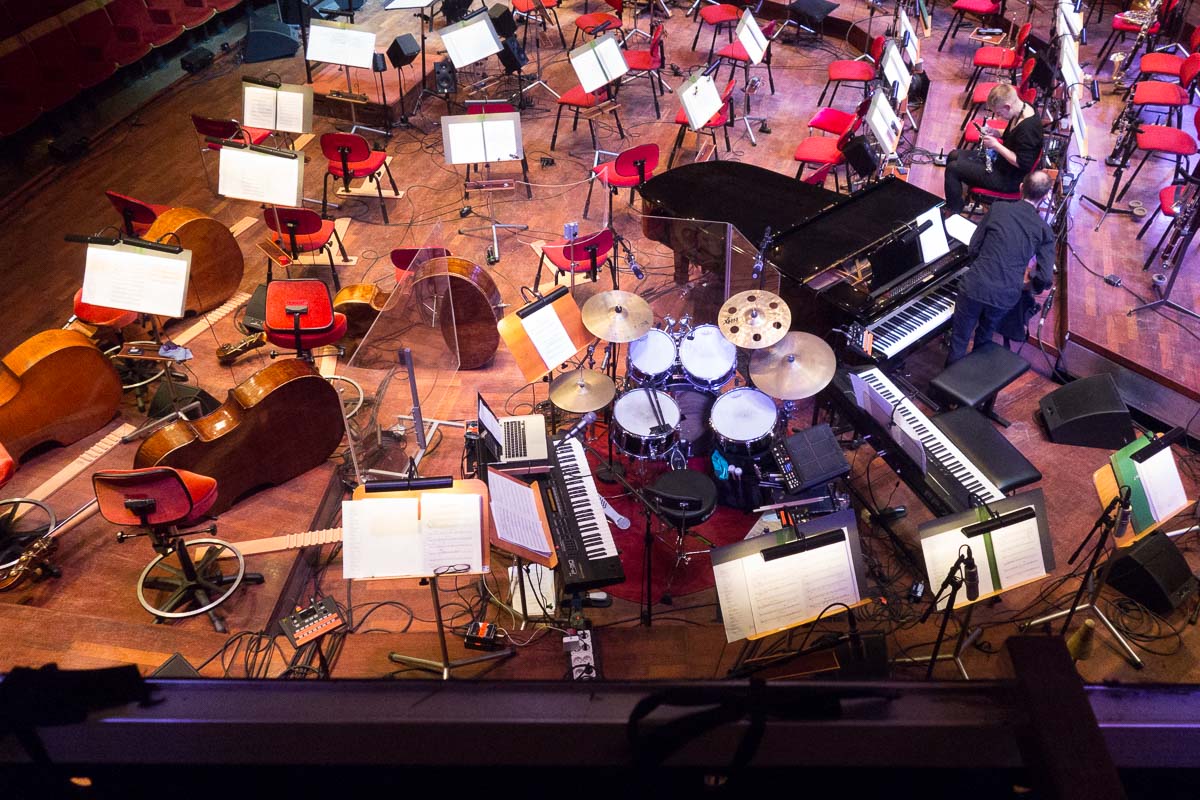
Simon Bolivar Orchestra with Gustavo Dudamel, at Berwaldhallen. Desenne, Villa-Lobos and Ravel. Desenne was a modern composer unknown to me; not particularly interesting. Villa-Lobos I had heard of but didn’t know much about. I mostly went there to hear the Ravel pieces.


Listening to great music with my eyes closed leads to a qualitatively different experience.

It’s not always possible. I can only get immersed in great music – not any particular favourite piece of mine, but music with emotional and acoustic depth. It has to be performed well. And finally, the acoustics are important – this just does not work with over-amplified concerts.

But when it works, it’s like magic.

When I see the orchestra, the music comes from the orchestra in front of me, at some distance. It has a location in space. It is outside of me.

When I close my eyes, the music comes closer, expands and fills everything. I am immersed in it. There is no more light or colour or movement, nothing to compete with the music. The music is no longer produced by people moving their arms and touching instruments. It simply exists all of its own. It is like a substance around me that swells and flows and shifts and pulsates, akin to an endlessly moving ocean wave in a world where gravity cannot decide which way is down.


This is my first week back at work and I was really in no mood to start working again, so I’m only doing half days this week. This afternoon after work we all went to Moderna Museet to see an exhibition of Yayoi Kusama.

There was less of it than I had hoped, and frankly I found her early paintings rather boring. Perhaps they would have been of interest if I’d gone there as an art student or journalist, trying to understand how she ended up creating what she has been creating recently.

The later, more abstract paintings were more interesting. I especially liked the “infinity net” paintings (go google them). Seen up close, the picture disappeared and instead the act of painting became visible. At medium distance it was just randomness, and stepping back further suddenly there was an overall structure to it.

Her large-scale dotted installations were most fun, especially the infinity themed ones. “Infinity Mirrored Room: Hymn of Life” was my favourite. A dark room with mirrors in all directions, filled with large paper lamps with black dots. The lamps changed colour, which made this installation feel more alive than the others. Somehow the sizes and colours and placement of the balls were such that the whole room felt welcoming and comfortable, whereas some of the other dotted infinity installations were more weird and alien.

Yayoi Kusama, Infinity Mirrored Room – Hymn of Life.
Photo: Vegard Kleven/HOK. Licensed under CC BY 3.0


This Monday Eric, Ingrid and I saw Alice in Wonderland, a ballet at Kungliga Operan.

This ballet was originally created for and by the Royal Opera House in London and has now been exported wholesale to Stockholm, with the original choreography by Christopher Wheeldon, scenography, and everything else.

The performance was spectacular and wonderfully crazy, quite befitting Alice’s crazy adventures.

The costumes and scenography were fanciful and colourful, yet also stylish. I loved the ingeniously designed Cheshire cat – a giant cat of disconnected parts moved around by invisible dancers in black costumes. The fabulously choleric and bloodthirsty, blood-red queen was also memorable.

Alice herself was almost pale in comparison to the rest of the characters. But so she is in the book: she is an observer, pulled in to the craziness against her own will, rather than participating whole-heartedly.

I was a bit sceptical initially to the idea of making a ballet of Alice in Wonderland. So much of the book is about word-play and nonsensical use of language – how can you possibly translate that into dance? Surprisingly well, for the most part. A tap-dancing Mad Hatter in the middle of a ballet was nonsensical enough; a whirling and almost overwhelming dance of flowers was another.

The decorations of course played a major role in making the book’s crazy dream world real. The Cheshire cat was one clever solution; using projected video sequences for Alice’s falling through the tunnel and for her growing and shrinking was another.

I am no connaisseur of classical music so I cannot say much about the score, other than that I liked it, and that it fit the ballet perfectly.

It was a long time since I read the actual book and my recall of the plot is mostly based on the Disney version, of which I feel rather ashamed. I had no recollection of the scenes from the book that didn’t make it into the movie – the one with the Duchess and the Cook and the Pig Baby for example, which was wonderfully over-the-top and grotesque on scene.

I had also forgotten that the trial in the end of the story is about a case of stolen jam tarts. In this ballet version the plot line of a Knave of Hearts stealing jam tarts is extended into the real world at the very beginning of the story, before Alice goes down the rabbit hole. A gardener’s boy is accused of stealing a jam tart (while in fact it was given to him by Alice). And to complicate things further, Alice is in love with that boy, so we get a whole extra plot thread of young love. Rather unnecessary in my opinion, because it really doesn’t contribute to the larger picture, other than giving the two a chance to perform some quite romantic but boring but love duets.

But that’s a minor quibble; overall it was a wonderful performance that I really enjoyed.


The end-of-term show for Ingrid’s dance school.

We went there to see Ingrid’s group perform, but the rest of the show was unexpectedly interesting to watch. Not artistically interesting, perhaps, but intellectually.

A few points I observed:

Expression and emotion matter at least as much as technical and physical skills. Dancers who looked like they were really enjoying themselves were more fun to look at than others who perhaps performed the movements with more skill and precision.

After an hour, it started feeling repetitive. The choreographies mostly consisted of the same basic moves, and the similarities outweighed the differences after a while. I guess there is a limited number of moves you can use for kids who have danced maybe a year or two, once a week.

The more advanced groups had more interesting choreographies, but the competition groups almost went in the other direction: their acts were technically more complicated, and a lot faster, but not so much more interesting from an artistic point of view – choreographed with judges in mind, not general audiences.

It turned out that one of the teachers at the school (Kindahls dansskola) is the choreographer behind several of the performances at Melodifestivalen. Those also consisted of the same “vocabulary” of moves.


We went to Fotografiska to see Erik Johansson’s exhibition Created Reality – hyperrealistic composite images of impossible scenes. Impressive and interesting, well done and well presented. Even Ingrid said it was more fun than she had expected.

Afterwards we climbed the stairs to Fjällgatan (raced them, actually, and I won but Ingrid said it was cheating to take them two at a time) for lunch at Hermans, one of Stockholm’s best know vegetarian restaurants. It’s on all “top ten vegetarian places” lists in media, but I had never been there.

Well, now I have, and I won’t go there again. The staff was unpleasant, the restaurant cramped and overcrowded, and the food no more than so-so. A lot of flavour, yes, but crude and unbalanced – sort of tone-deaf, with pepper, mustard and vinegar mostly overpowering the flavour of the vegetables themselves.

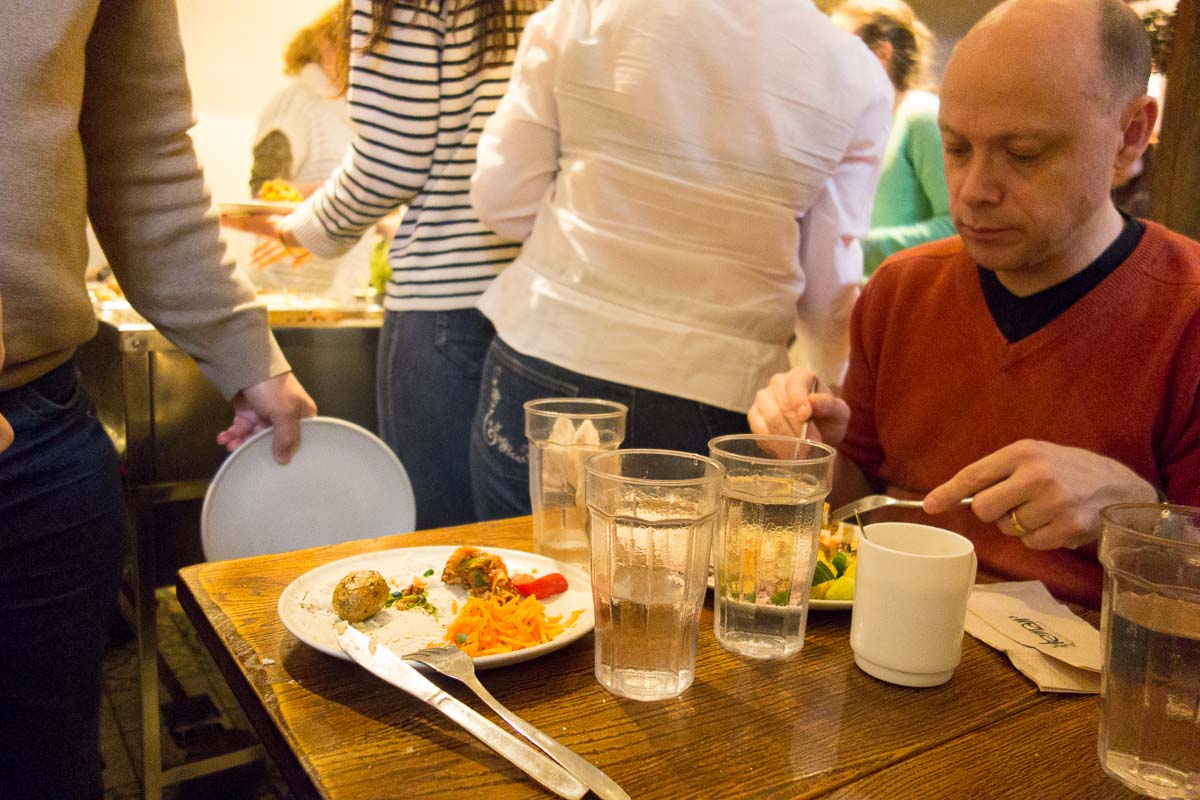
What I mostly remember from Hermans is the queueing, trying to get at the food, and the endless stream of other guests’ bottoms and crotches squeezing past our table to also get at the food.


I joined a colleague for a Friday night out at a club – Soul Train. More of an evening club than a nightclub, really, since they opened at 19:00 and closed at 22:00. An after work disco, I guess.

The photo shows the official photographer at the club. We took photos of each other.

The whole thing was kind of fun but oh my god the sound level. If this is what other people regularly subject their ears to, it’s a wonder that they are not all deaf. I put in earplugs (which I always have in my handbag) the moment I got there – had it not been for those, I would have lasted a few minutes, tops.

I do not understand the point of turning up the volume to 11. Yes, loud music sounds better and is more danceable than quiet music, but only up to a point. At this volume and probably with cheapish speakers to boot, the music just sounds atrocious, with distortion and crackling bass. You cannot speak to your friends; you cannot even order a drink without yelling. Where is the fun in that?

Today we went to a concert with Helen Sjöholm and Magnus Carlson, and Sveriges Radios Symfoniorkester. They sang pop songs, mostly older ones, mostly moody and melancholy – Nick Cave, Depeche Mode, David Bowie etc.

Helen Sjöholm is one of my favourite Swedish artists – I love her voice and the way she sings. I had no idea who Magnus Carlson was (turns out he is quite well known) but Helen Sjöholm on her own would be enough for me.

The concert was nice, but no more than that. I had hoped for something better. I didn’t think the songs they performed really let her shine – the programme seemed to consist of songs that they liked, and that the audience would like, rather than songs that suited her voice and style best. I came there to listen to Helen Sjöholm, but got more enjoyment out of listening to Magnus Carlson.

And, like almost all concerts, the sound was too loud and unbalanced in my opinion.

I understand that most singers need amplification. But a symphonic orchestra should be able to fill a concert hall with sound without any amplification. Now Adrian was holding his hands over his ears and complaining the music was too loud, and I had to agree. It was not quite loud enough to hurt my ears, but definitely louder than I had expected. It had truly never crossed my mind that we would need to bring hearing protectors to a concert with a symphonic orchestra.

Adrian likes music and I had hoped he might actually enjoy this concert. Perhaps not as much as Eric and I, but some. He didn’t get a chance because he was too busy covering his ears.

I also wish the sound technicians prioritized the singers more. The song and the singer’s voice is what it is all about, to me. I want the song to soar, and the orchestra to back and accompany it. Most concerts amplify them to about equal “weight”.

If I was filthy rich and had nothing better to do with my money, I would pay for private concerts with my favourite singers – sound engineered to fit my taste and not to the needs of people with dull or damaged hearing!

I saw Star Wars yesterday. Summary verdict: solid but unexciting. Oh, there’s loads of superficial excitement, sword fights and crazy flying, but it is all rather traditional and predictable.

The entire movie is a kid’s dream of adventure. Leave your dull planet, meet awesome people, fly to strange places, be a hero, fight the bad guys, save the galaxy!

Dreams are by their nature unrealistic, and so is the movie. It’s kind of interesting to pick out the particular kinds of unrealism in that movie, because they all serve to reinforce that dream.

Unrealism #1: Skill is already in you. You don’t need to practise, train, or learn anything. All you need is will. You may be a great pilot – you just don’t know it yet because you’ve never gotten a chance to try. And if the Force is strong in you, you also don’t need to practise sword fighting, or anything else.

Unrealism #2: It’s a small universe. The relevant parts of the galaxy are few and small, and all the right people hang out at the same few places. Fly to one small bar in one small corner of one small planet of one small star system – out of the billions of star systems in the entire galaxy, and you’re bound to run into a bunch of friends and acquaintances. What are the odds of that happening in even one normal-sized city, let alone an entire galaxy?

Or possibly the entire galaxy is really, really sparsely populated. The entire rebellion fighting force is a few hundred men, after all, and the First Order’s forces on Starkiller are no more than a few thousand.

Unrealism #3: Systems are fragile. There are no fail-safes, no safety valves, no redundancy. Yank out a single piece and the entire system will collapse. Threaten the right person and you can shut down the entire planet’s defences. Shoot the right chunk of unprotected machinery and everything will explode.

All of these unrealisms help support the idea that a brave youngster who is fighting for the right cause can find a few friends and, together with them, bring down the forces of evil and change the world.


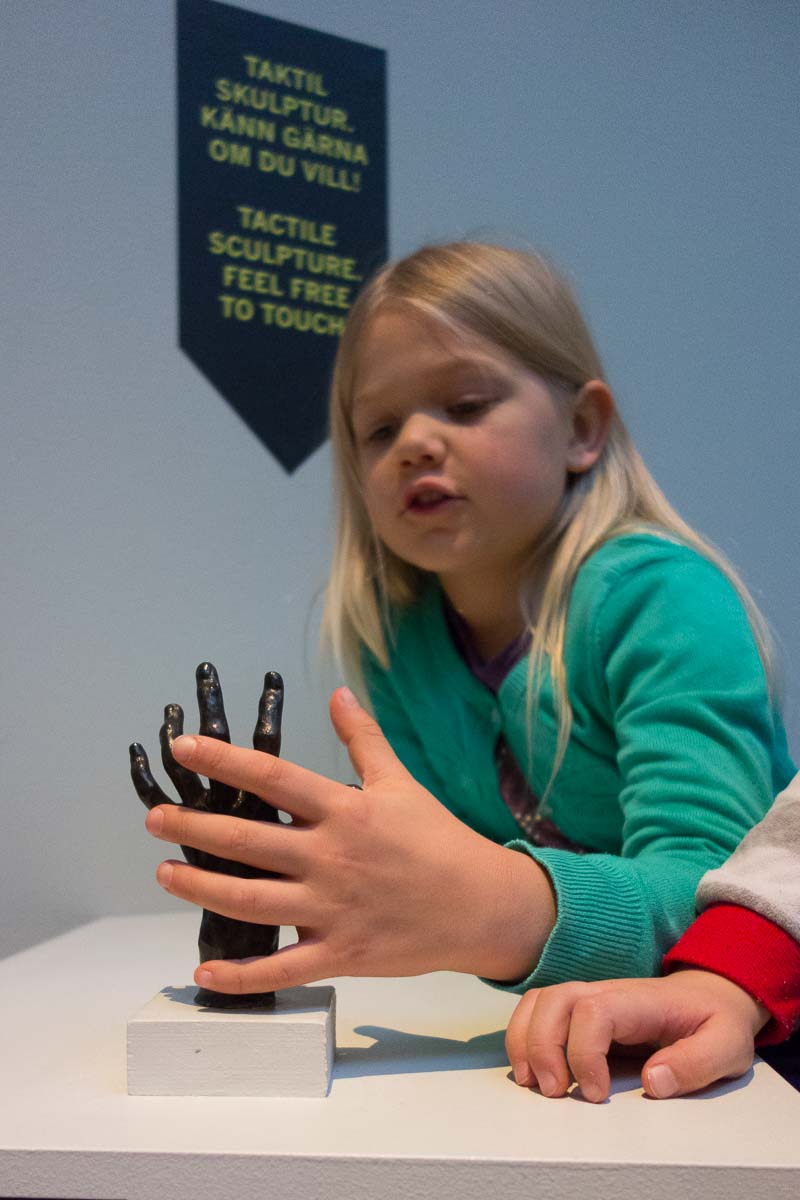
We went to see a Rodin exhibition at Konstakademien. The kids were reluctant, “do we really have to”, but as Ingrid said, “it was more fun than it sounded”. The exhibition was small enough so they didn’t run out of energy, and well presented. The info text for each item had interesting facts that even a kid could relate to. And since Rodin’s oeuvre contains many variations on the same themes, where he reworked an idea again and again and reused the same sculptures in different works, in different sizes and materials, even the kids could make sense of the bigger picture as well.