For my non-Swedish readers, here’s a representative sample of bugg.
Plain old link, in case the embedded object above decays and stops working (which it has done once): a video of bugg on Youtube
For my non-Swedish readers, here’s a representative sample of bugg.
Plain old link, in case the embedded object above decays and stops working (which it has done once): a video of bugg on Youtube
The bugg course ended in June, and then we were away in Estonia, but now that I’m back, I’m determined to go out dancing regularly.
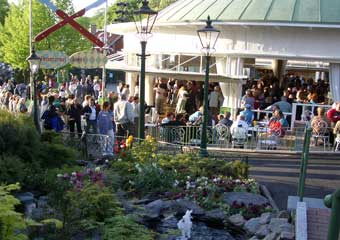
During summertime there are several outdoor dancing venues in Stockholm. Skansen and Gröna Lund are two popular ones in central Stockholm. I’ve been to Gröna Lund these past two Thursdays, and it’s been great.
The standard setup for social dancing in Sweden is that you pay some sort of entrance charge, and then you get to dance for a couple of hours while a band plays live music. At Gröna Lund the band plays from 19:00 to 22:45. There’s a break (or several) in the middle to let everyone rest. And there’s free drinking water available somewhere near the dance floor, because bugg is sweaty business.
The band always plays two slower tunes (for quickstep/foxtrot) followed by two faster ones (for bugg), and this pattern repeats throughout the evening. In order to dance, one person (usually, but not always, a guy) approaches another person (usually, but not always, of the opposite sex) and asks if they want to dance. An affirmative answer is a commitment for one “dance” consisting of two tunes, but if both are happy, a couple can go on dancing for as long as they want.
The crowd can be very varied, ranging from 20-ish girls dancing with each other to 70-ish couples, and everything in between. Some are there for serious dancing, showing off competition-level moves. Some are more casual. Some only come for a few dances after their dinner. Some are there with the very explicit goal of meeting women. (I’ve gotten polite but very thinly-veiled invitations both times.)
There was a slight excess of women both evenings. Turning up without a partner, and not knowing many people there (although I did recognize a couple of people from the dance school where I took my bugg course), I spent some time partnerless both times. It’s much easier to dance with someone you know – the first dance with a new partner can be a bit awkward when both try to figure out the other’s style – so most people are hesitant to invite a stranger to the dance floor. But I spent much less time standing on the side yesterday, so the trend is looking good.
Most guys on a dance floor are reasonably good at bugg. You either know how to dance it, or not – and if you really suck, you won’t go out dancing. There’s also some scope for the girl to dance “better” than the guy – if he’s hesitant or unclear in his signals, the girl can compensate for it. But quickstep/foxtrot is trickier. It seems so simple on the surface, so guys think they can do it. But it’s not at all easy to really do it well. Yet when both partners know it well, and their styles “match” or mesh well, it is fabulous. Out of all the dances yesterday I had a single fabulous foxtrot, and it eclipses the entire rest of the evening.
Bugg is fast, sporty, somewhat technical, with lots of twirling. It takes focus and energy. Foxtrot done well, on the other hand, is smooth and sensuous, especially the so-called “dirty fox” style with lots of body contact. It’s a bit like meditation: a combination of relaxation and concentration. I can close my eyes to shut out the world (just like when listening to music), even forget about the music and just follow the guidance of the guy, and I’m floating around like on a cloud. When the music ends, it feels like waking from a dream.
About six weeks ago I attended a cocktail party. The first for a long time, actually: I haven’t been moving in circles where people organize cocktail parties.
Adult conversation, dressing up, live music, dancing, and all that… very nice. And the best part was the dancing. I have really missed dancing. I used to dance quite a lot during my university years, performance dance as well as social dancing – Swedish jitterbug (bugg), quickstep (which is generally called foxtrot in Sweden), tango, lindyhop. But I never got around to finding a dance club after moving to London so I lost my dancing habit. Now this cocktail party gave me the push I needed, and I decided to finally take up dancing again.
Most social dancing in Sweden is quickstep and bugg – if you know those two, you’ll get by in almost all situations, unless you specifically go to a tango or gammeldans event or a salsa venue, which I don’t plan to do. In quickstep most guys, even the really good dancers, stick to the basic moves, and I can follow those without much work. But I haven’t danced bugg for almost 10 years now, before I can go out and dance, I felt I needed to refresh my memory. So yesterday I started on a seven-week bugg course. Once that’s done, I’m going out dancing!
This summer has been relatively culture-poor for us. No particularly interesting theatre or musical events in London have caught our attention, and we’ve both been working too much to see any spontaneous, unplanned culture.
Looking forward, now that summer is over, all sorts of interesting events are cropping up. But now we’re not really sure whether it will be possible for us to get out at all, so we’re not booking anything.
Between these two lulls, we managed to get in one excellent evening of dance to music by Steve Reich.
Part 1
The first of the three parts was set to Piano Phase and Violin Phase. In both of these a short phrase of music is played over and over again by two musicians (pianists or violinists). They start out in phase. Then one of them speeds up marginally so they get out of phase, and slows down again when he is exactly one beat ahead of the other. They repeat that until they’ve gone full circle and are in phase again. Wikipedia’s article on Piano Phase explains it in more detail.
The full description actually sounds boring and technical to me – an experiment, a gimmick, “see how clever I can be” – but the music was anything but. It was absolutely mesmerising. The melody itself was beautiful in its utter simplicity, and even though this was taped music, it sounded very good through the Barbican’s sound system. I imagine it must be rather challenging to play, so live performances of this are probably rare. The phasing in/out kept a constant subtle tension, so despite the simplicity the music never got boring. (While listening I didn’t actually realise fully what they were doing – I just heard the repeating music and shifting in/out of phase.)
Violin Phase was similar in setup, but because the rhythm wasn’t as distinct, I felt it lost some of that magic.
The dance element matched the music. Two dancers performed a simple, short sequence of movements over and over again, shifting in and out of phase with each other. The two dancers look almost identical, and are far back on the stage so details aren’t visible. Instead the focus is on the shape of the movements – pendulum-like with long arm swings and rhythmical 180-degree turns – and the phase, the similarity. Two strong lights cast two shadows of each of them, and the ones in the middle overlap, so the dancers melt into one. Like the music, this was almost hypnotic.
Part 2
Part 2 also consisted of two pieces of music – Perotin’s Viderunt Omnes, a medieval polyphonic piece for four singers, followed by Reich’s Proverb for five singers plus vibraphones and electric organs. Both are, again, very minimalistic, and beautiful in their simplicity. They are far less technical than the Phases, and really got their strength from bringing out the best from human voices: clear, graceful, melodious. (Performed live by Theatre of Voices.) Reminded me of Tehillim, which I saw/heard a year ago or so, and which I also loved a lot.
The dance part by Richard Alston Dance Company, on the other hand, was completely uninteresting to me. It didn’t suit the music in style or temperament, and wasn’t particularly interesting on its own, either. I found it a distraction, and simply closed my eyes to shut them out. Therefore I don’t really have much more to say about that.
Part 3
The last part was Variations for Vibes, Pianos & Strings. Nice enough, but not as interesting or engrossing as the previous two parts – relatively tame and neutral compared to his best pieces.
Yet this part was most popular with the rest of the audience. I guess that was mostly due to the dance, performed by three very vigourous male dancers (Akram Khan Dance Company). It had some interesting aspects. For example, even when the three were doing the same thing, they retained quite individual styles, reflecting their different backgrounds (one African, one Middle Eastern, one Asian). But I found the choreography itself a bit simplistic. Much of it was very close to the music, almost acting it out: long sweeps of violins were accompanied by long arm sweeps, etc. At times the dancers were mock-conducting the orchestra in the way a child would: not providing direction but following the music exactly. It was the kind of choreography that might emerge if a very talented someone, with no education or experience in choreography, tried to just dance to the music. I guess this immediacy and closeness to the music may have been what the audience liked about it.
The more I hear of Steve Reich’s music, the more I like it. And every time I run into Theatre of Voices, I like what they do. Both deserve more of my attention, I think.
(Yesterday)
Where some choreographers start from music, Deborah Colker’s shows appear to be constructed around a very physical scene design. There was Casa (House), where the scene was built around a deconstructed house. There was 4×4, which actually had 5 parts, where the decor ranged from corners to porcelain vases.
Knot, which according to the programme is supposed to be about the philosophy of desire, had two parts. The first had a tree of ropes that later broke into four parts and then dissolved into a forest of ropes. The dancers were also connected and occasionally tied together by ropes. Desire in the sense of that which connects and binds, I guess. The second act was centred around a transparent box that the dancers climbed on, around and into – desire as yearning and frustration and voyeurism?
On the whole the performance fell short of my expectations, which were admittedly rather high after the previous two shows. Colker’s choreography is usually acrobatical, innovative and interesting, and the dancers move with energy and passion. This one seemed to have less movement and more posing. Instead of fluidity we got passages from one pose to another. Some of the pas de deux in act one were visually interesting and elegant, but even then ideas were explored for a moment and then abandoned as the dancers took a different pose. Somehow it lacked passion and felt more like physical exercise than art.
I was literally nodding off towards the end of each act, and can definitely think of better ways to spend an evening.
In the past few weeks, I’ve seen three performances of contemporary dance. In a way they were all similar, and all could be described by the same headline: “a humorous mixture of dance and circus”. Today’s performance was James Thierrée’s “La Veillée des Abysses”. I’ll try to write about the other two later, perhaps – “Opus Cactus” by Momix, and “Tricodex” by Lyon Opera Ballet.
The show had a decidedly French feel, the way Jeunet’s “Cité des enfants perdus” (“City of Lost Children”) could only be French. Somewhere between mime and dance, fanciful and intense, yet managing – like French circus/dance often does – to strike a balance between a wild imagination and a slight feeling of poetic sadness.
Five performers were all on stage all the time and made this a very coherent piece. While it wasn’t really a narrative, there was definitely an underlying story, with one scene fading smoothly into the next.
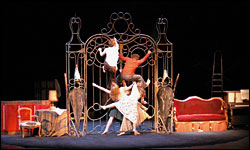
The first half circled in and around what seemed to be a dusty and ageing castle – a place of decaying opulence, with fading red velvet, cracked wood and ornate iron gates. The dancers themselves are dressed in half-tattered evening gowns and worn uniforms. The scenes can best be described as conversations that go on so long that they get out of hand. One of the reviews I read describes this part as being marooned in an old house – imagine this, and add gentle humour as the dancers start playing games to fill their long evenings. Trying to fit four people in a sofa for three, that then starts swallowing people. Or locking the gates, and making up elaborate passwords (passmoves?) consisting of such complicated gestures that the guardian himself forgets the correct order.
The story then shifts from evening to night, and stranger things start happening. A sleek green cat/dragon creature crawls and climbs on the gates, pulling the gate guardian into a lovely pas de deux on the gates. Decorative suits of armour transform into bats, and a princess with her maid turn into a menacing horse. All done very sparingly with simple materials and few moves, so that the wild and imaginative props stay secondary to the dancers themselves.
The tone then changes for a while, and the feeling of magic is replaced with a starker setting and less interesting sketches, where both the dancers’ actions and the audience’s laughs are predictable. But towards the end, the magic returns, now with a half-wrecked ship instead of a castle – with billowing white sails, a man swinging in a high lookout point, and high waves and wind.
The sounds are as well designed as the sets and costumes, and vary from live piano, to Nina Simone’s Lilac Wine and Tom Waits. (I know that Tom Waits song so well, but can’t remember which one it is… now I have to listen through all our Tom Waits CDs to find it!)
Dreamlike and fantastic, beautiful, combining playful humour with melancholy and decay. Wonderful piece.
| Newer posts » |
