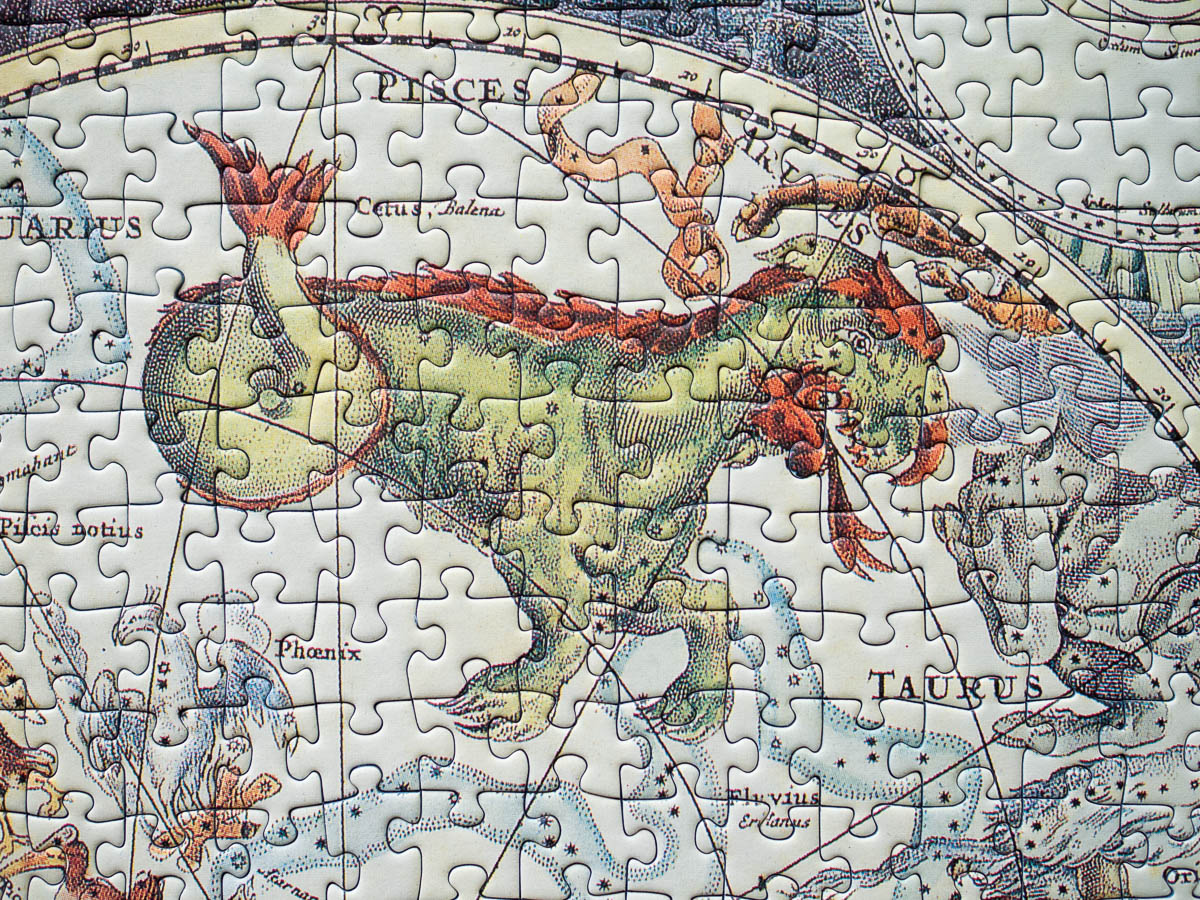
I finished a jigsaw puzzle. Most puzzles are just pretty pictures, but this one was interesting.
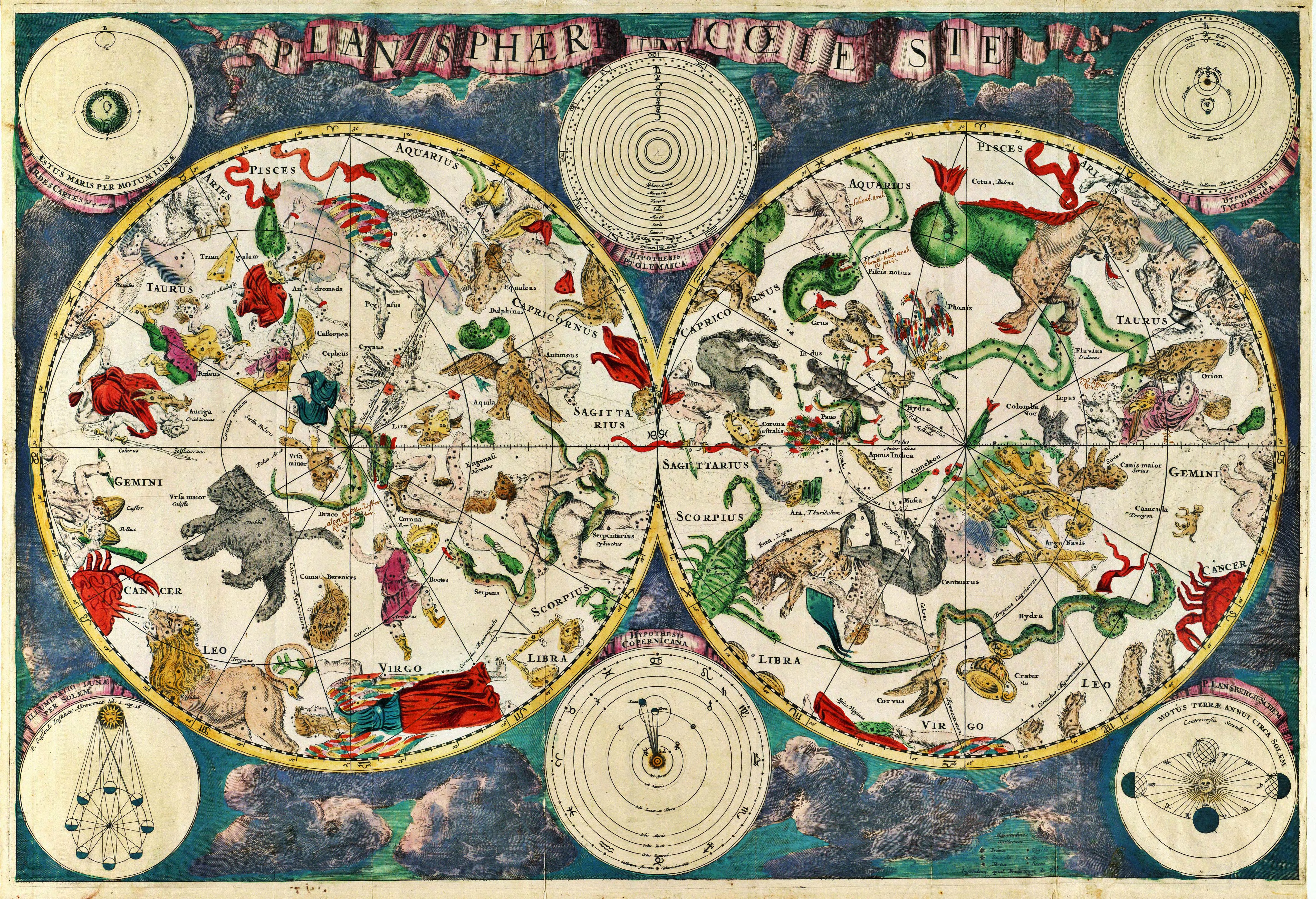
The puzzle is based on a celestial map by Frederik de Wit from 1640. My photo is just a detail and full of noise from the puzzle piece contours, but you can find a high-resolution, zoomable version of the map at the page I’ve linked to, or a version with brighter colours here.
At first glance it looks just like a pretty map of the sky and all the constellations. But as I was doing the puzzle, I inevitably became familiar with all its details and realized it’s more like a science poster, illustrating the latest knowledge about astronomy at that time. Around the main map there are smaller insets explaining astronomical concepts and phenomenons such as the tides, the phases of the moon, and how the Earth’s rotation causes the cycle of day and night. Other insets illustrate the Ptolemaic, Tychonian and Copernican astronomical systems.
The artist had obviously seen horses and women and peacocks and lions, or perhaps reasonably realistic pictures of them. His bears are reasonably bear-like, although with rather long tails. His dolphin on the other hand looks to be based on hearsay and imagination. I wonder how far removed the artist would have been from a first-hand sighting of a dolphin.
The constellation Cetus/Balena (“The Whale”) in my photo looks even more monstrous. At first I assumed this might be due to lack of knowledge, but I have now learned that the Ancient Greek name kētŏs for this constellation originally meant “sea monster”. Now that our understanding of the world does not contain mysterious sea monsters any more, cetus has come to mean “whale” instead.
I noted with some curiosity that all fishes, dolphins, sea monsters, snakes, hydras and dragons are depicted in green.
I also realized that the Estonian word for “peacock” (paabulind), which sounds so Estonian, clearly has its roots in the Latin name Pavo.

Leave a comment