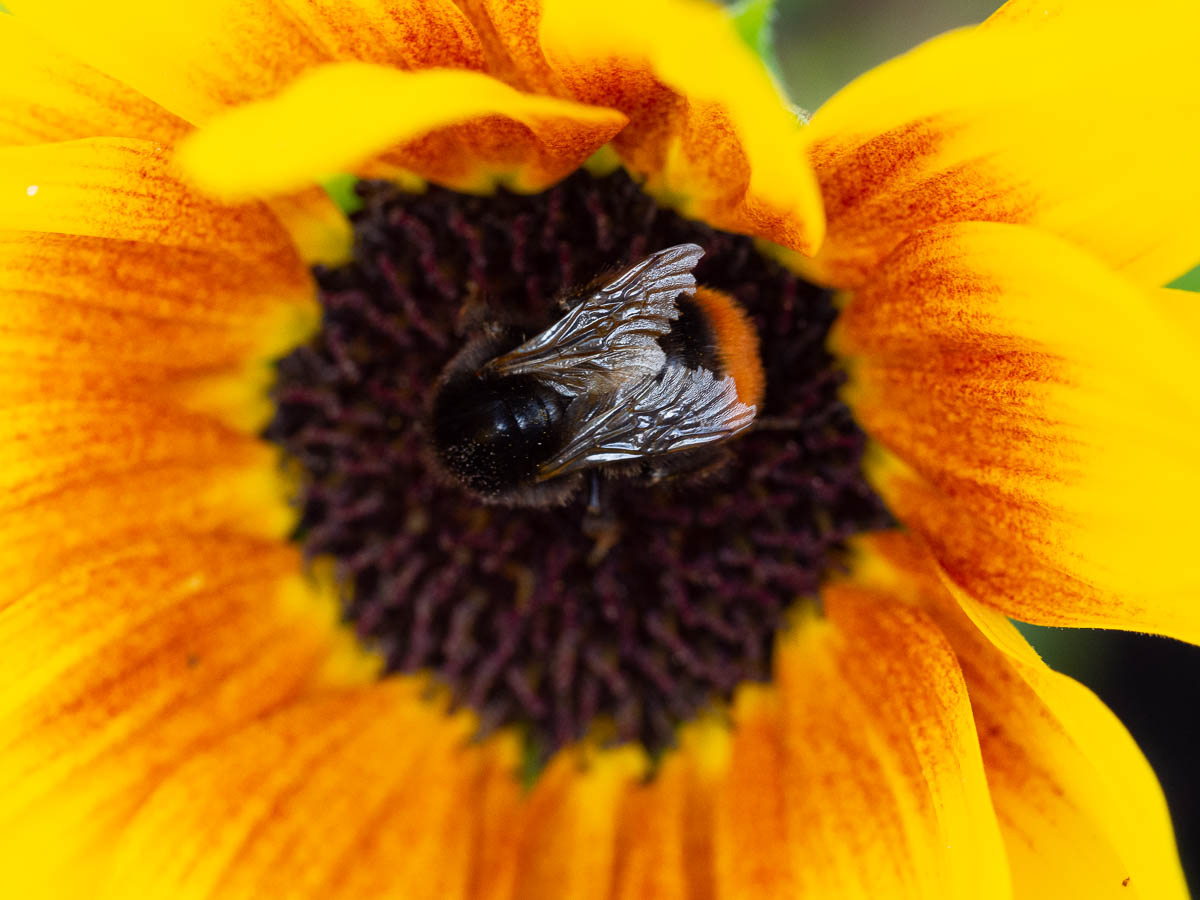
I tried to photograph the bees and bumblebees in my summer flowers but they were uncooperative and wouldn’t stay still.
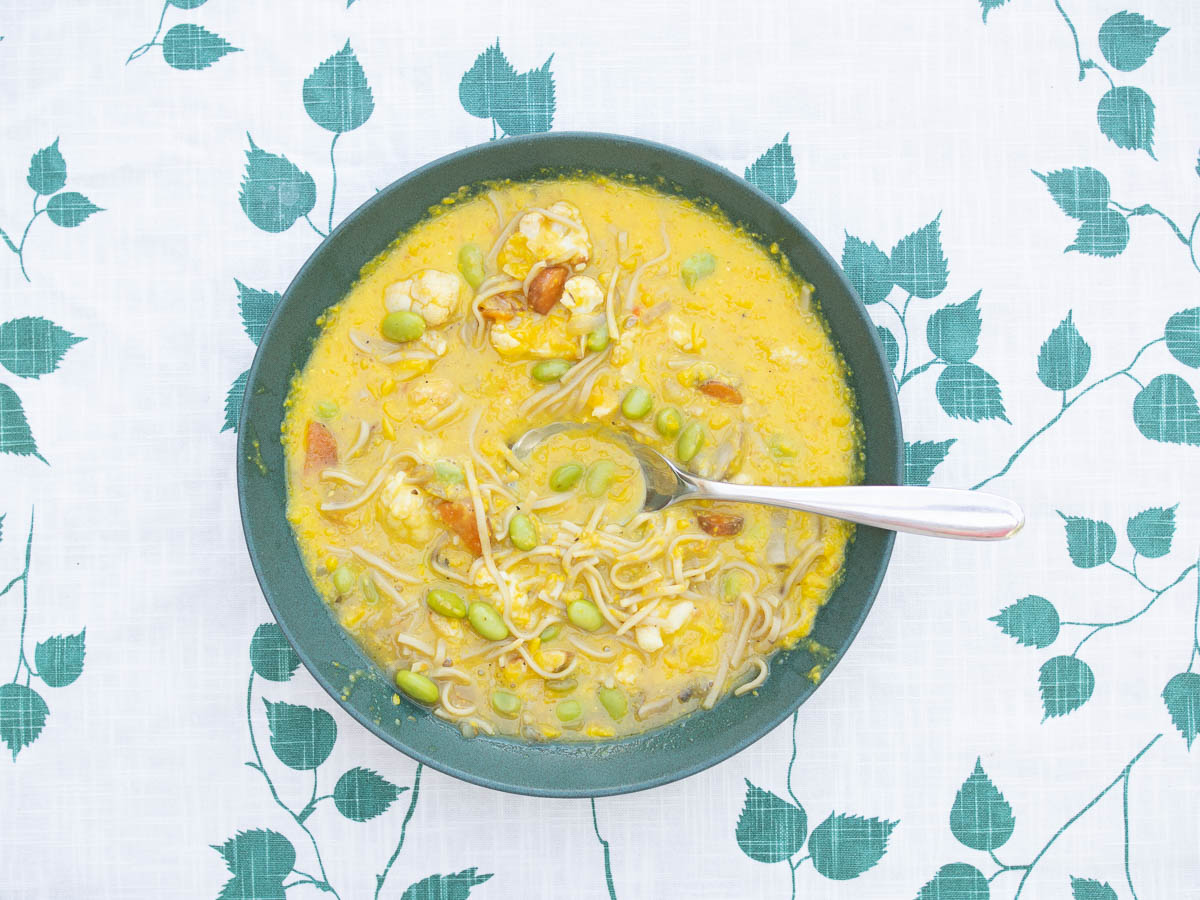
My second day back at work.
I realize now that I need to start thinking about lunches in advance again. During the summer someone has usually just ambled off to the supermarket when lunchtime approaches, and cooked something. But if I want to get a reasonable amount of work done during the day, I can’t take time for that every single day.
Today I fortunately found some odds and ends in the fridge. One half Mexican-inspired sweetcorn soup and one half Asian-inspired noodle soup plus a handful of roast cauliflower actually made a surprisingly good combination.
The workday was dull, both yesterday and today. The people on the business side of the team are still on vacation and one of the developers has been off sick so it felt rather lonely. And there is nothing interesting ahead of me in the backlog, only boring tasks. I had real trouble focusing and finding the energy to get anything done.
Vacation is over and I am back at work in my home office. And working on re-establishing a healthy, sustainable everyday routine.
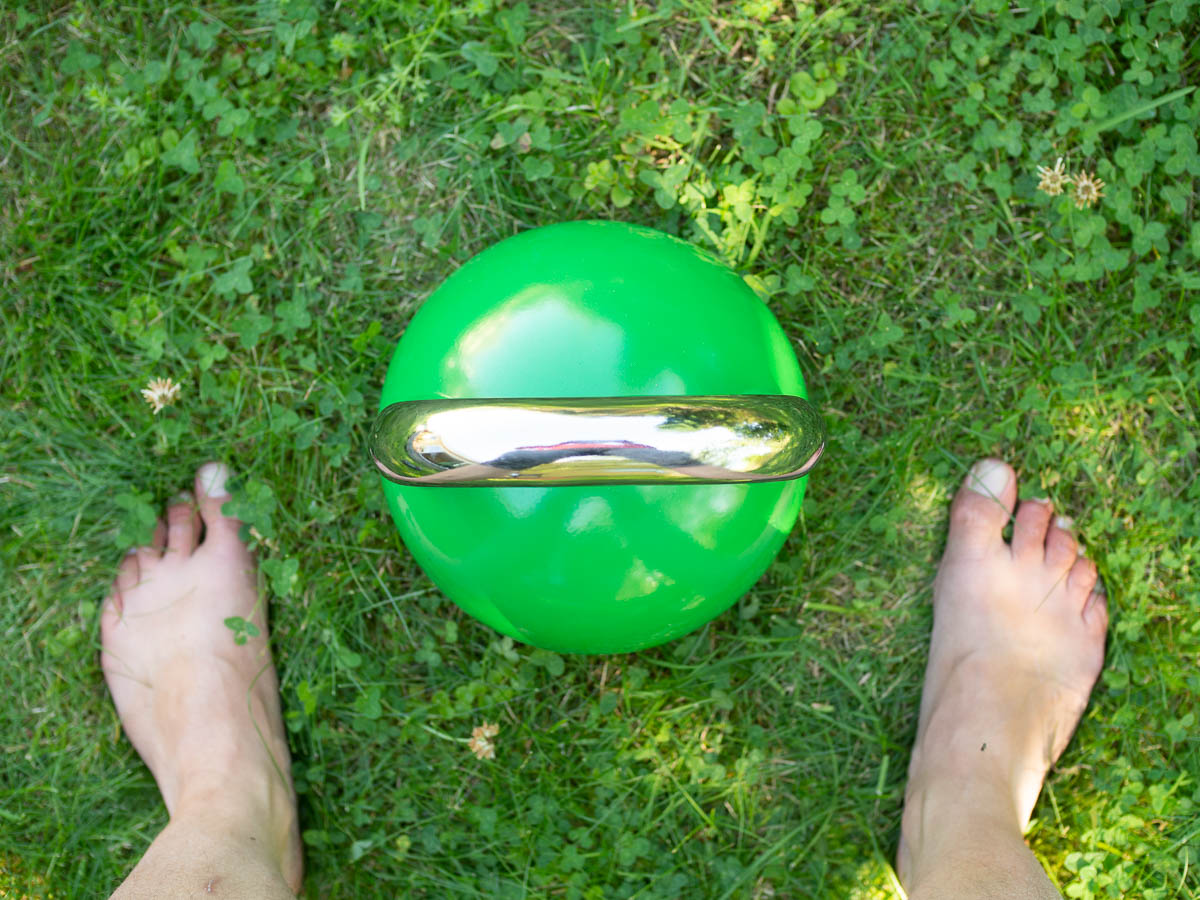
Eric recently saw a kettlebell at a sports store! We seem to be past the worst of the quarantine shortage of weights. There was exactly one kettlebell in the whole store, and at 24 kg, it just happened to be the perfect weight for me. I’m not going to build up a whole home gym (no room for it) and I intend to make do with just the one weight for the foreseeable future. 24 kg is usable for squats and lifts as well as swings. I’m glad this one and only kettlebell was green and not pink, for example.
In this fine weather, I do my workout out on the grass. The grass feels nice, warm, firm without being hard like a floor, and wonderfully grippy for bare feet. I’ve always done my workouts barefoot and while bare feet are nicer than shoes in almost all ways, it can be harder to get a good grip on smooth gym floors for things like side plank variations. The slightly bumpy ground here in the garden is perfect.
On the flip side, grass is itchy to lie on with a bare neck and shoulders, or when I get my face too close to it. But this view during my hip lifts is pretty darn nice.

In parts of our garden, digging around in the soil is guaranteed lead to bits of old bricks, roofing tiles, crockery and glass. In fact in some parts that kind of junk wasn’t even hidden in the soil but lying right on the surface, but I cleared those areas as soon as possible to make the garden safe for bare feet. For years we made sure to always wear shoes on the slope of weeds. But there’s a lot of ground I haven’t touched, so there’s plenty more junk still buried here.
Out of curiosity, I saved some of the more interesting-looking pieces of junk I unearthed while I was planting bushes behind the house this summer. They’ve been lying in a bucket, waiting for my attention, which they got today.
I’m surprised at the sheer number of different designs I find. It’s not like someone has thrown out a single plate or a cup in their compost heap – there are pieces of dozens of different items.
Most are hard to date. I wish I knew an expert in vintage and antique ceramics!
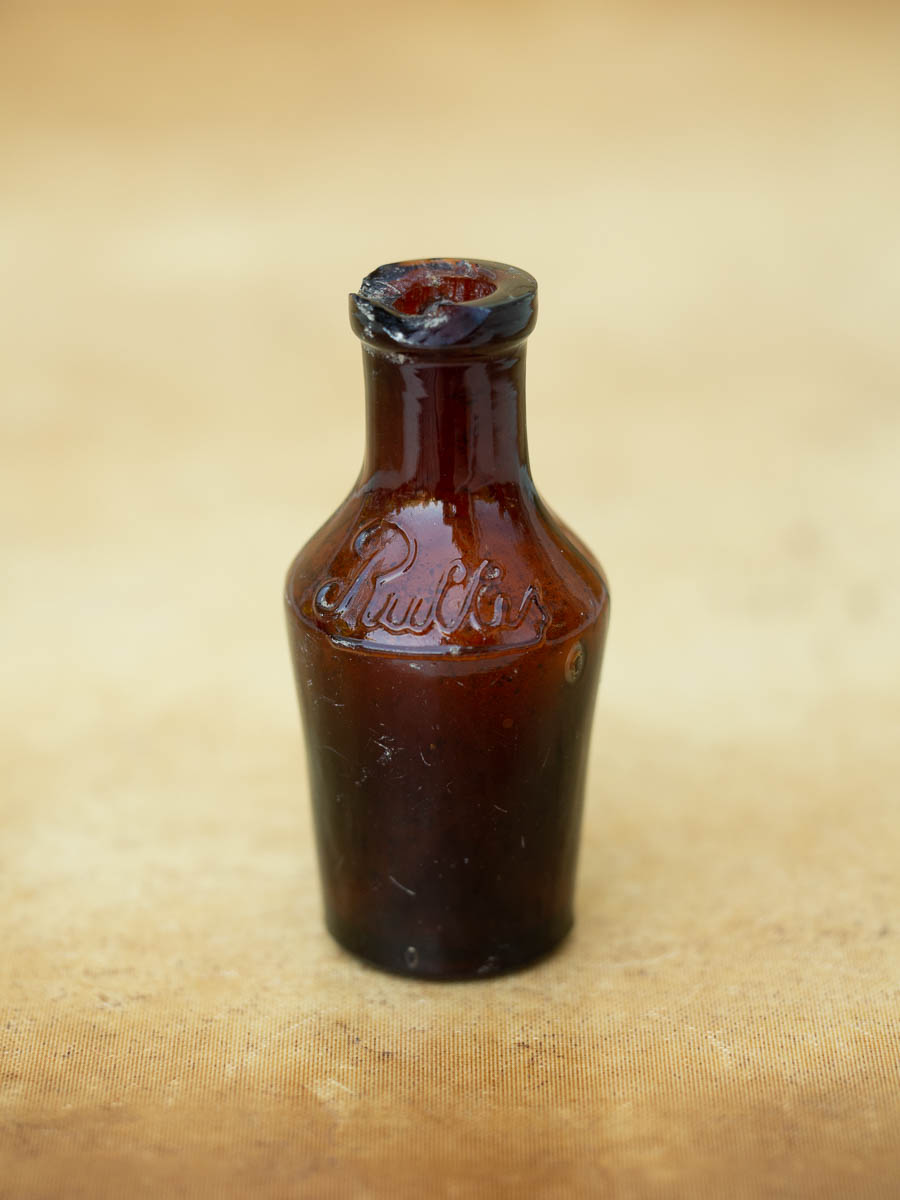
The brown little bottle was easy to identify because it has a logo. Rulles is a maker of liquer essences, still exists, and their website has a small photo archive.
I found pieces of one or more plates with blue and white decorations in a Chinese style…
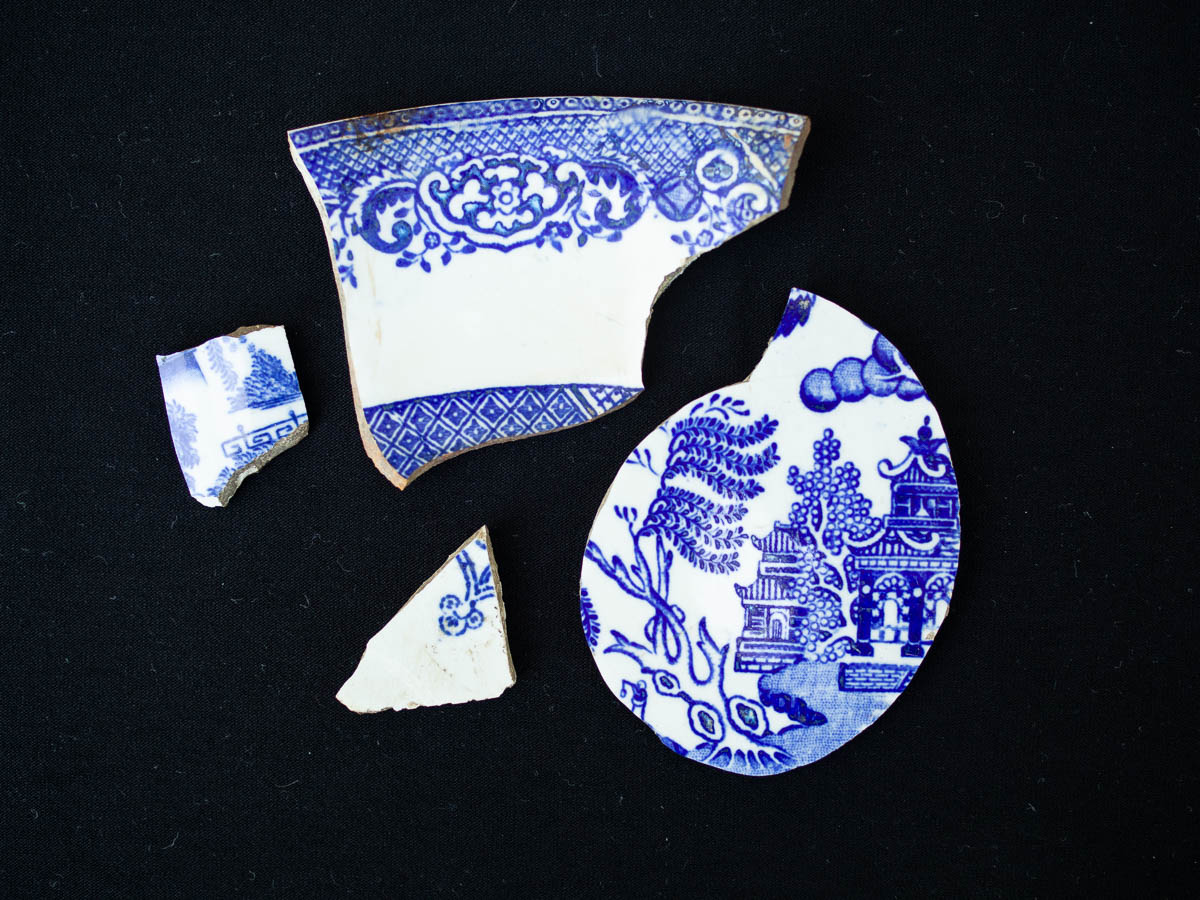
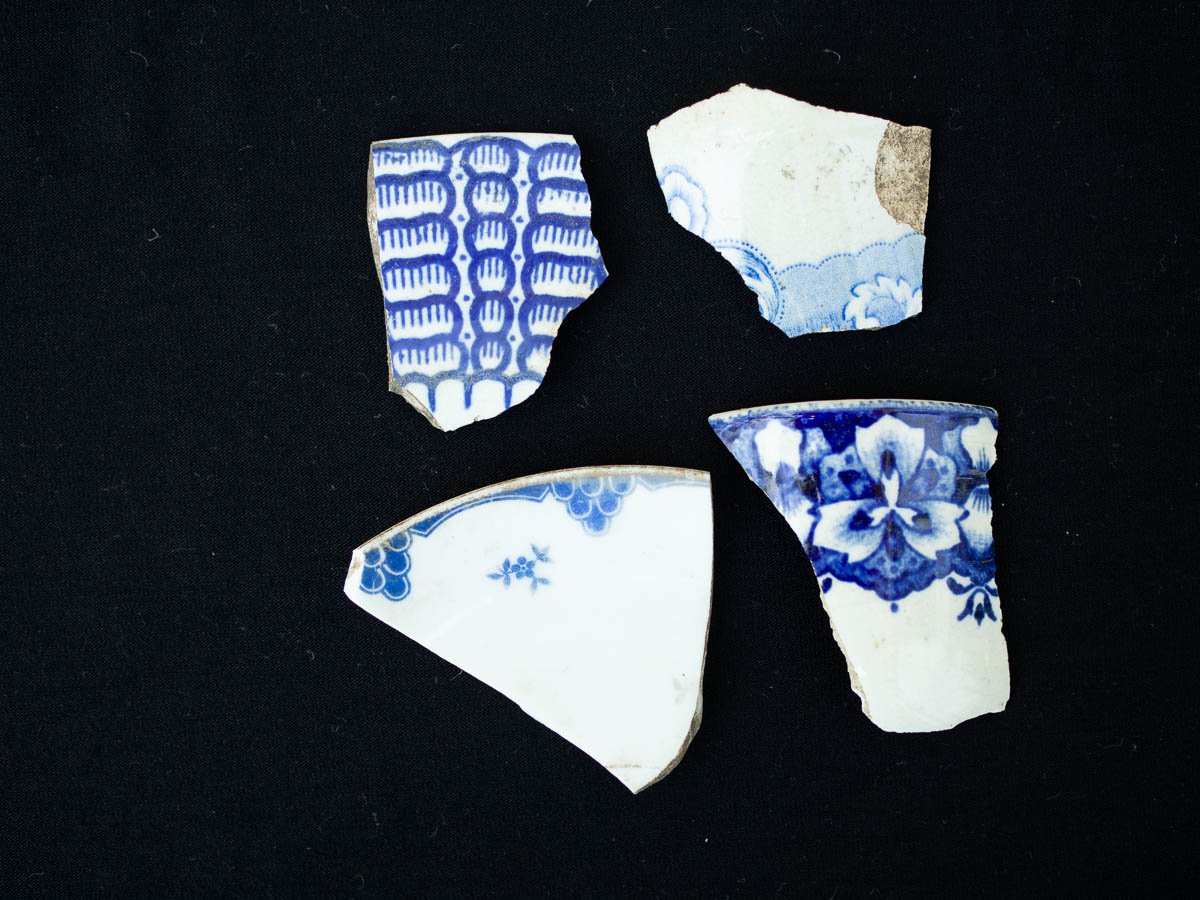
… as well as pieces of other blue and white crockery.
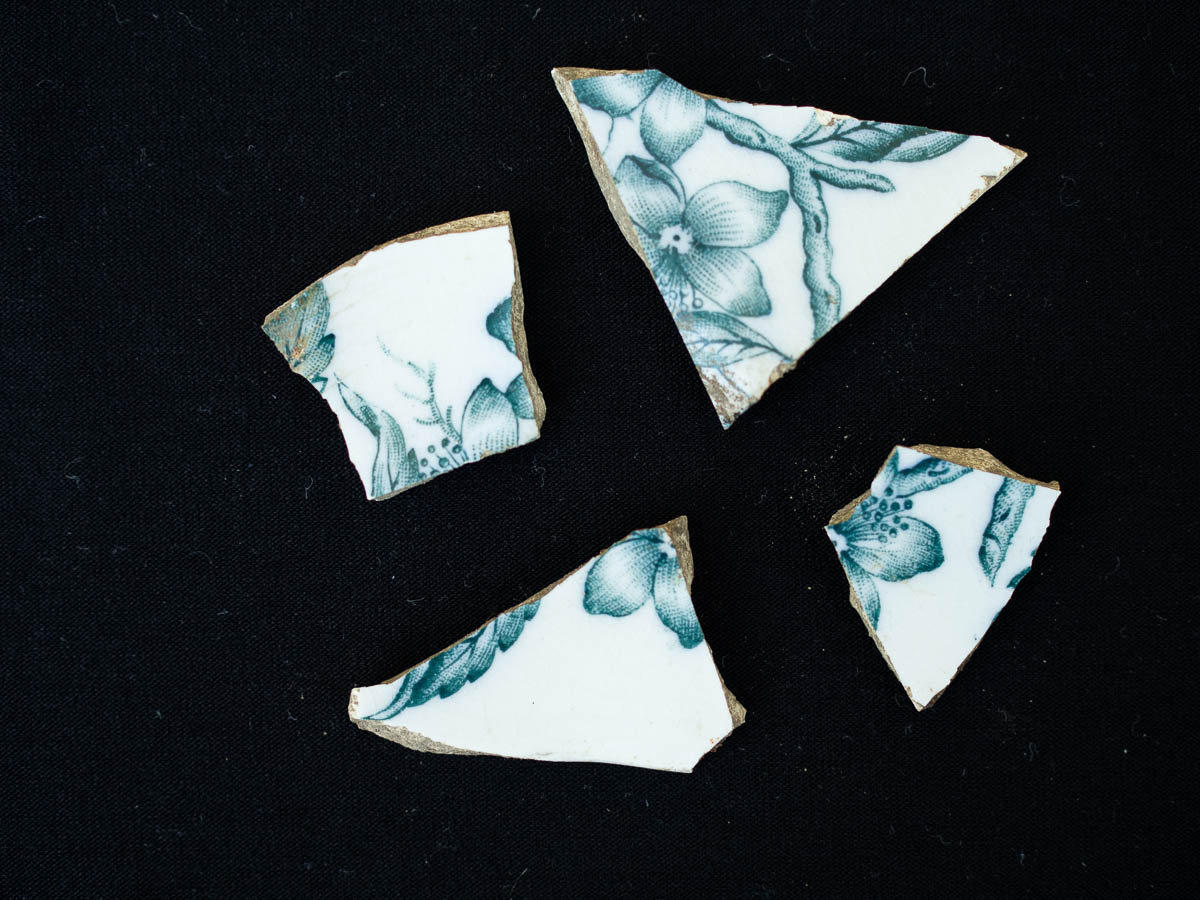
A lovely plate with a green design of flowering branches…
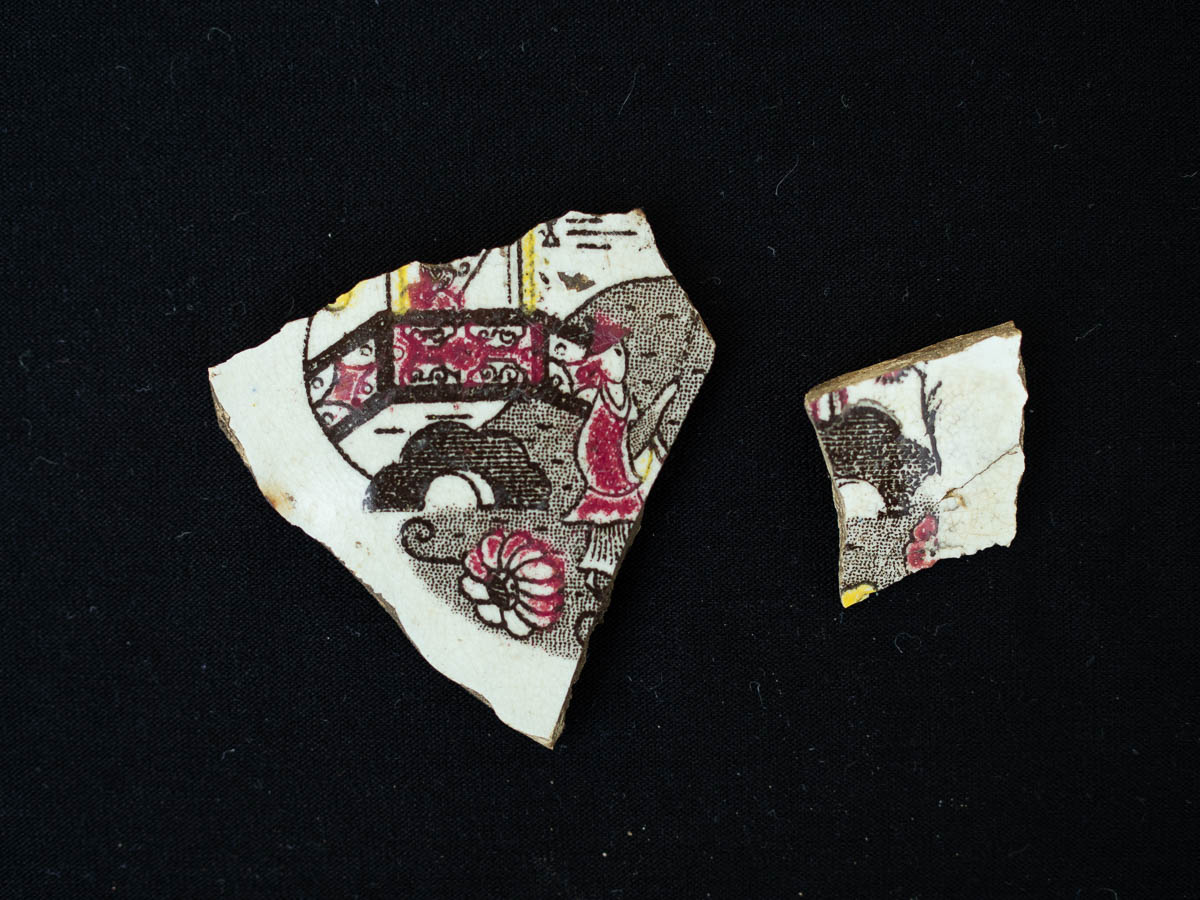
… and a strikingly ugly design that is apparently suppose to invoke an impression of China again.
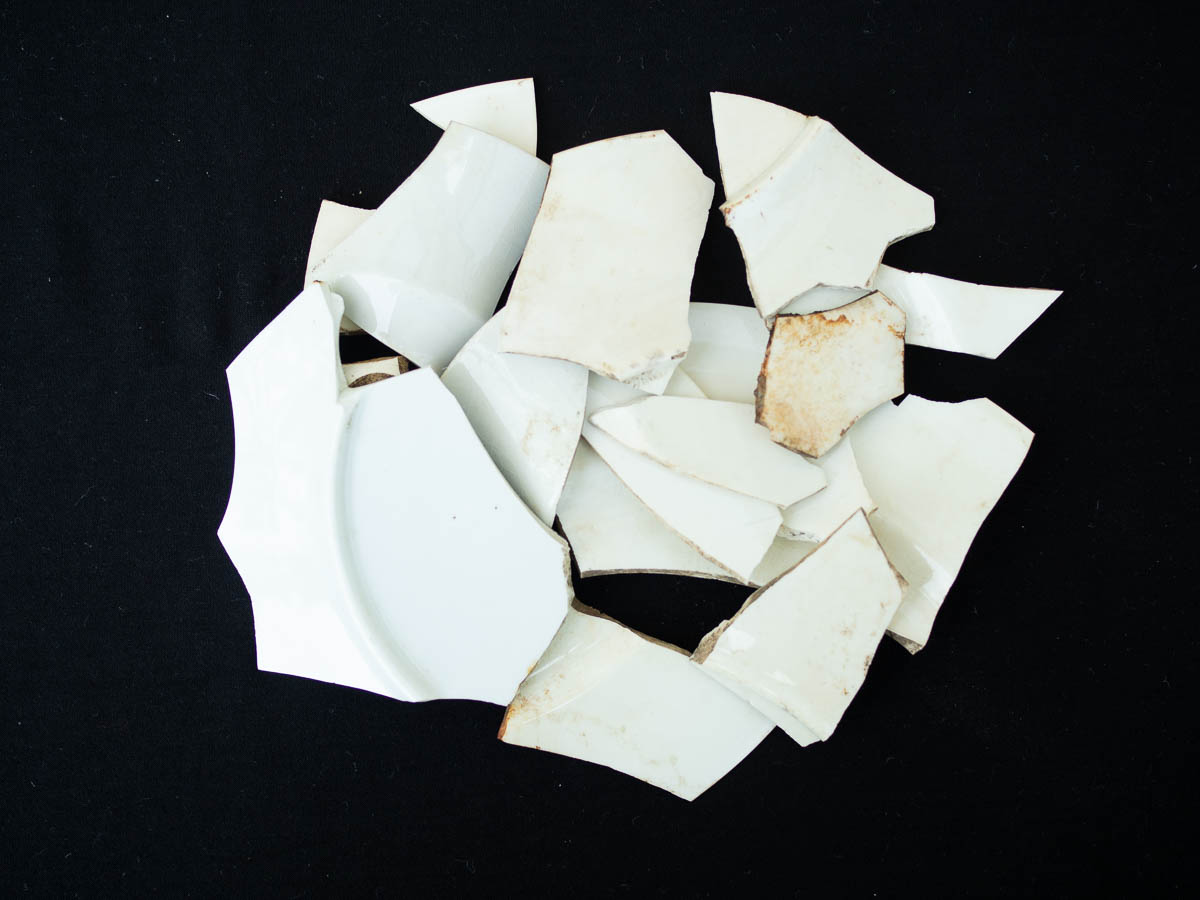
Plenty of chunks of plain white plates – more than one because of differences in thickness and curvature.
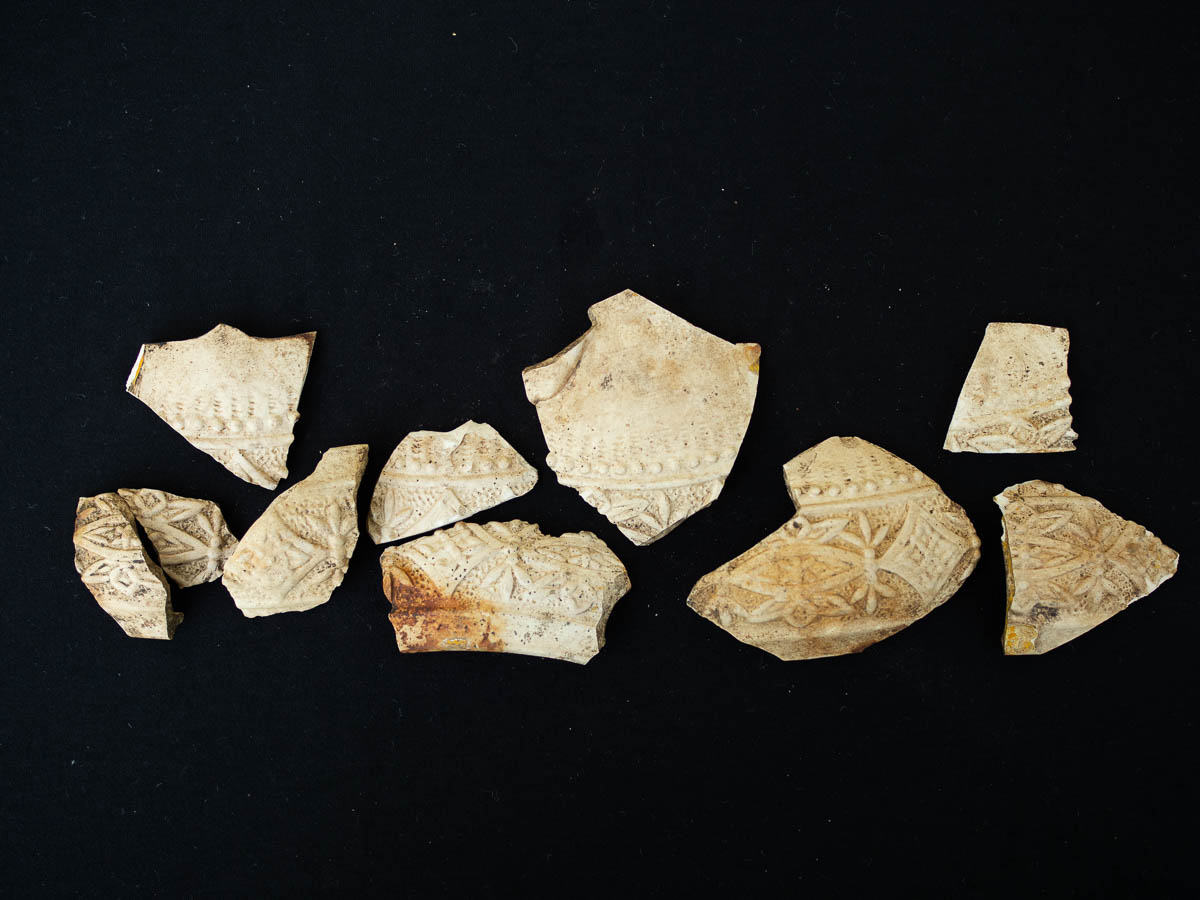
An item in unglazed earthenware, perhaps a flowerpot.
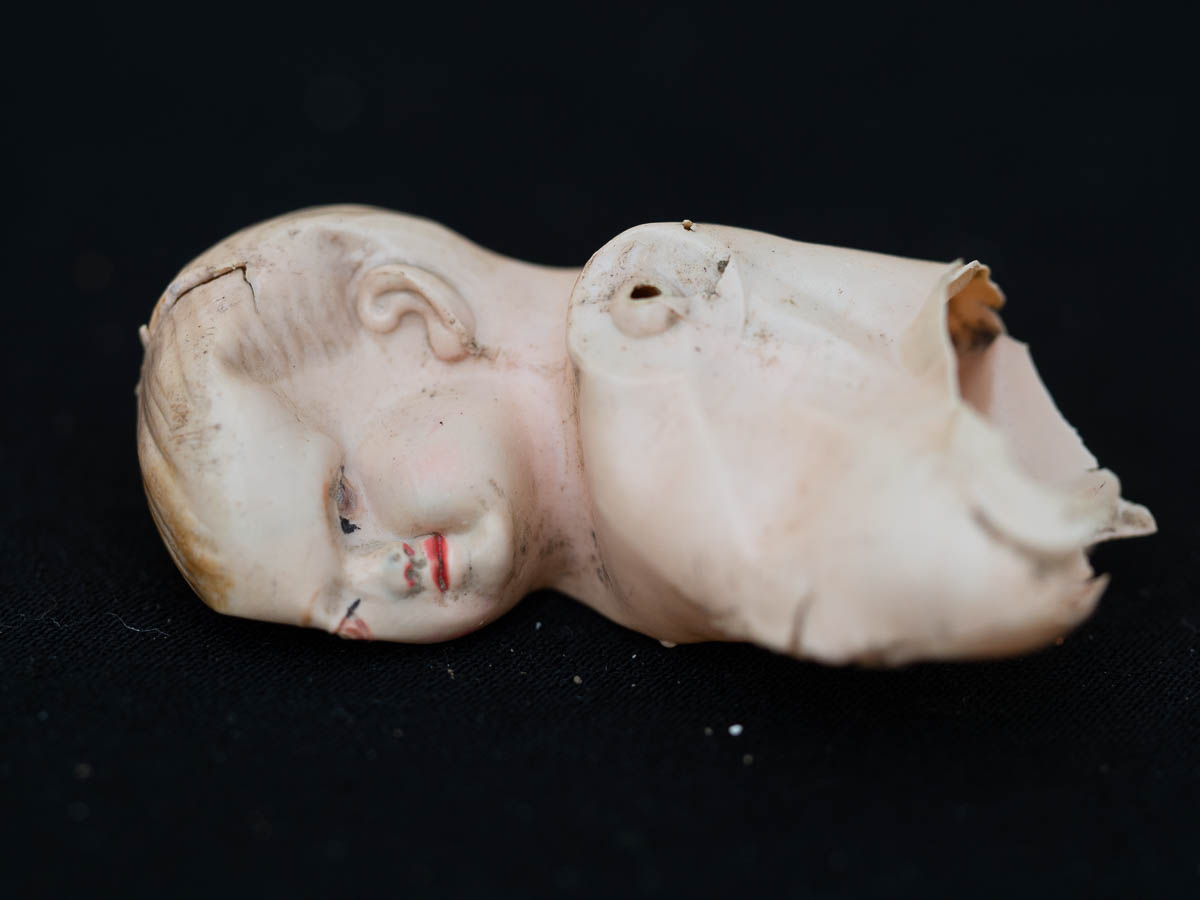
Also the head and torso of a small plastic doll, a little bit larger than a matchbox, slightly creepy.
I’ve been a voracious reader for as long as I can remember. We had a great variety of books at home. I read children’s books at first of course, but moved on to adult literature around my tweens. Classics, detective stories, travel stories, adventure stories, and so on. (Everything except contemporary English-language literature, which was hard to get hold of until the early nineties.)
At my grandmother’s cottage where we spent our summers, there wasn’t much to read. Partly due to a lack of space, I imagine. The cottage consisted of a single large room, with the kitchen open into that same room. 35 m2 maybe? – and that housed as many as five of us at times. Or maybe the expectation was that we’d all be outdoors most of the time.
We took the train to town, to Tallinn, at regular intervals for laundry, baths, groceries and whatever else the adults did. My grandma’s apartment there was not much larger, but it did have a bookcase… which, however, contained almost no books that I recognized or that looked interesting. There was really a surprisingly small overlap between her library and my parents!
There were two or three (quite literally) children’s books from my father’s childhood in the 1950s. One was a picture book about how trucks were produced in the 1950s. One was about how spacecraft worked. I read both.
I read and browsed books about cooking and gardening, including giant gardening encyclopedias in German, which had gratifying amounts of illustrations. I’ve always liked well-written, illustrated “how-to” books.
I opened dull-looking books at random and stumbled upon a collection Tolstoy’s stories for children (in that same 14-volume series from the 1950s) and read most of those.
There was one small oasis in that reading desert – two books that I truly enjoyed and kept returning to. I think we may even have taken them with us to that tiny cottage. Both were memoirs. One was Kirurgi süda by Fyodor Uglov, a pioneering Russian doctor and surgeon. (“Heart of a surgeon”, full of fascinating medical case histories, not available in English as far as I can see.) The other was Eesriie avaneb (“The curtain opens”) by Mari Möldre, an Estonian actress.
My grandma passed away in 2003. Now I have her copies of these books in my bookshelf, and they always remind me of her.
Olen lapsest saati ablas lugeja olnud. Meie kodus oli lai valik raamatuid. Alustasin loomulikult lasteraamatutega, aga varases teismeeas läksin täiskasvanute kirjandusele üle. Klassika, krimkad, reisikirjeldused, seikluslood, jne. (Kõike pealse kaasaegse inglisekeelse kirjanduse, mida polnud saada enne 1990-ndaid aastaid.)
Minu vanaema suvilas, kus me oma suved veetsime, polnud eriti midagi lugeda. Osaliselt vist ruumipuuduse tõttu, oletan ma. Suvilas oli üksainuke suur tuba, ja köök avanes samasse tuppa. 35 m2 võib-olla? – ja seal elasime kuni viiekesi. Või oli arvestatud sellega, et kõik veedavad suurema osa ajast õues.
Sõitsime aeg-ajalt rongiga Tallinna pesu pesema, vannis käima, sisseoste tegema ja mida muud täiskasvanud veel tegid. Mu vanaema linnakorter polnud suvilast palju suurem, aga seal oli raamatukapp… mis küll ei sisaldanud peaaegu ühtegi raamatut mida ma oleks ära tundnud, või mis huvitav näiks. Tema raamaturiiuli sisu ja meie pere oma vahel oli üllatavalt vähe ühist!
Seal oli kaks või kolm lasteraamatut minu isa lapsepõlvest 1950-ndatel aastatel. Üks oli pildiraamat sellest, kuidas 1950-ndatel veoautosid toodeti. Üks oli sellest, kuidas kosmoseraketid töötavad. Lugesin mõlemat.
Lugesin ja lappasin raamatuid kokandusest ja aiandusest, muuhulgas hiiglasuuri saksakeelseid aianduse entsüklopeediad, milles palju illustratsioone oli. Hästi kirjutatud, paljude piltidega käsiraamatud on mulle alati meeldinud.
Avasin suvalisi igava välimusega raamatuid ja leidsin sedaviisi Tolstoi lood lastele (osa tollest samast 14-köitelises sarjast) ja lugesin suurema osa läbi.
Selles raamatukõrbes oli üks väike oaas – kaks raamatut, mida ma ikka ja jälle tõelise rõõmuga lugesin. Vist võtsime nad isegi kaasa sinna pisikesse suvilasse. Mõlemad olid mälestused. Üks oli kuulsa vene arsti ja kirurgi Fjodor Uglovi „Kirurgi süda“, täis põnevaid haigusjuhtumite kirjeldusi. Teine oli näitlejanna Mari Möldre „Eesriie avaneb“.
Mu vanaema suri 2003. aastal. Nüüd on need tema raamatud minu riiulis, ja nad meenutavad mulle alati teda.
Hot day today, 28°C in the shade. It’s not hot enough to make me feel like I’m being baked; I just feel sluggish and dull.
With careful timing I got the plants into the ground in the new flowerbed. There is a short while in the late morning when nearly all of that area is covered by the shadow of the house.
After that I mostly stayed indoors. Trying to find something useful and productive to do, I went through some of the boxes of books from the basement. Bookshelf space is limited, so some books by necessity stay in the basement. But I realized that if I don’t pack up at least some of the Estonian books, I will never read them again. Accessibility matters.
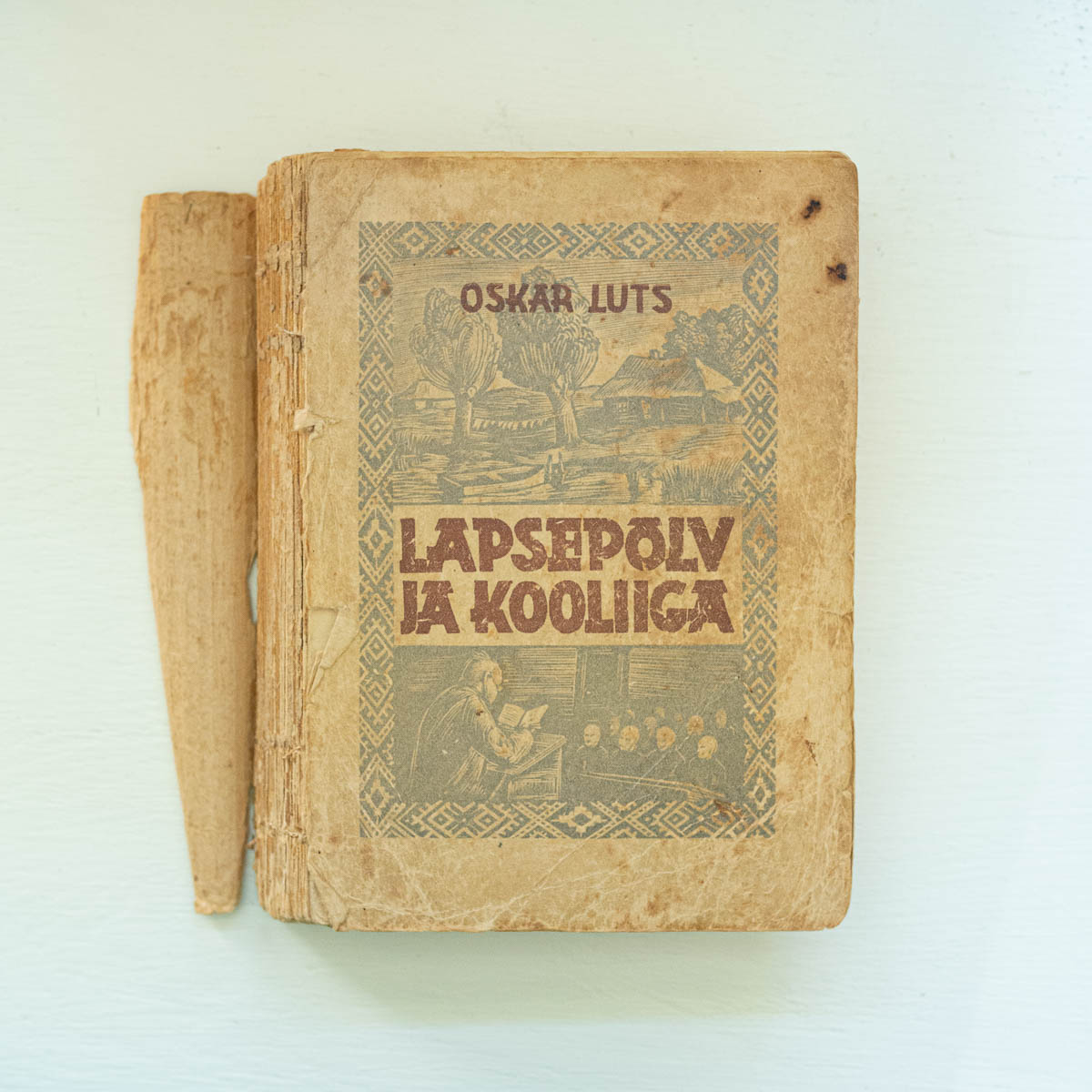
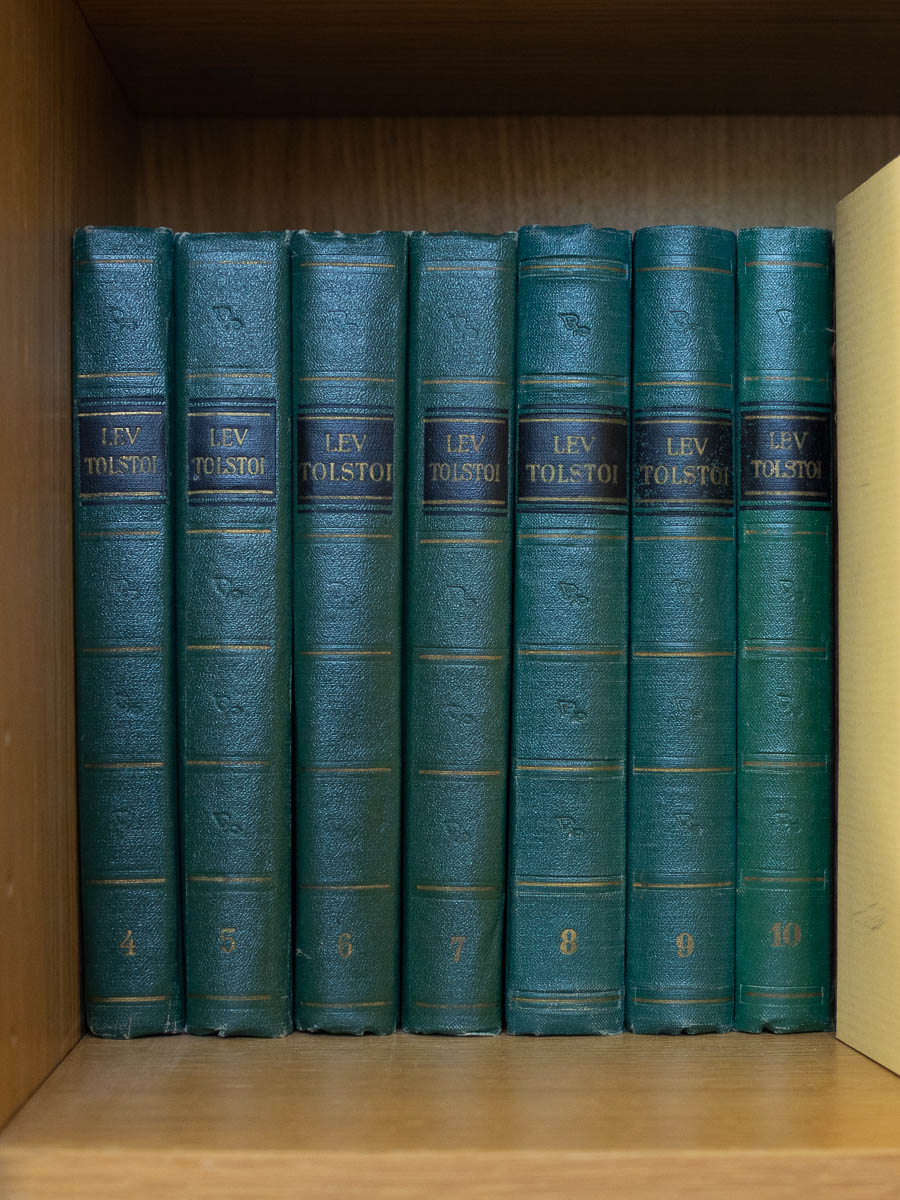
I culled the contents of these boxes ruthlessly. That fourteen-volume set with the collected works of Tolstoy? Some of it I am very sure I’m never going to read (there are too many other books in the world) so I’m keeping volumes 4 to 10 and throwing out the rest without pity. Tammsaare, “Tõde ja õigus” – a great and famous work but not my cup of tea and I cannot imagine any scenario where this would be my first choice of reading material. The memoirs of Oskar Luts – I read the first volume with memories from his childhood several times when I was a child, but didn’t find the rest interesting. Keeping that first volume, mostly out of nostalgia, and not wasting shelf space on the rest.
It does feel wrong to be throwing books away. Anything that has a chance of being useful to someone else, I make sure to donate. The boxes of culled Estonian children’s books I’ll try to give away to the Estonian school in Stockholm. The adult books… it’s possible though unlikely that some used book store in Estonia might want them. (I am pretty sure that newer editions exist and anyone who wants to read them will have no problem of getting hold of them.) The effort of packing, storing, and transporting these books for that slim chance is not worth it.
And it definitely feels odd to save half of a fourteen-volume set only. But my library is not a museum or an archive. It exists for my reading pleasure, and to some small extent for triggering fond memories, not for storing books out of a sense of duty only.
The first programming language that I learned was GW-BASIC, some time in the late 1980s. We had a laptop-ish Tandy computer at some point, but I’m not sure if it was the first one or if there was another one before it.
Computers used 5 1/4 inch floppy disks.
GW-BASIC had line numbers and GOTO statements, and came with a thick reference book that contained everything there was to know about the language. Line numbers were normally used in increments of 10, so that you could easily insert a missed line between existing lines of code – say, insert line 25 between lines 20 and 30 – without retyping everything that follows. The RENUM command renumbered all the lines back to tidy increments of 10.
I remember making the computer draw circles and lines on the screen.
Esimene programmeerimiskeel, mida ma õppisin, oli GW-BASIC, kunagi 1980-ndate lõpus. Meil oli sülearvuti-laadne Tandy, aga ma ei mäleta, kas see oli esimene või oli enne seda ka mõni muu arvuti.
Arvutid kasutasid 5 1/4 tolliseid flopisid ehk diskette.
GW-BASICus olid reanumbrid ja GOTO kommando. Sellega tuli kaasa paks manuaal, kus oli kogu keel ära kirjeldatud. Reanumbrid suurenesid tavaliselt kümnekaupa. Nii sai kergesti kahe olemasoleva rea vahele uue lisada – näiteks lisada ridade 20 ja 30 vahele uus rida 25 – ilma et peaks kõiki järgnevaid ridu uuesti sisse toksima. RENUM kommando nummerdas kõik read jälle 10-stele sammudele.
Mäletan, kuidas panin arvuti ekraanile ringe ja jooni joonistama.
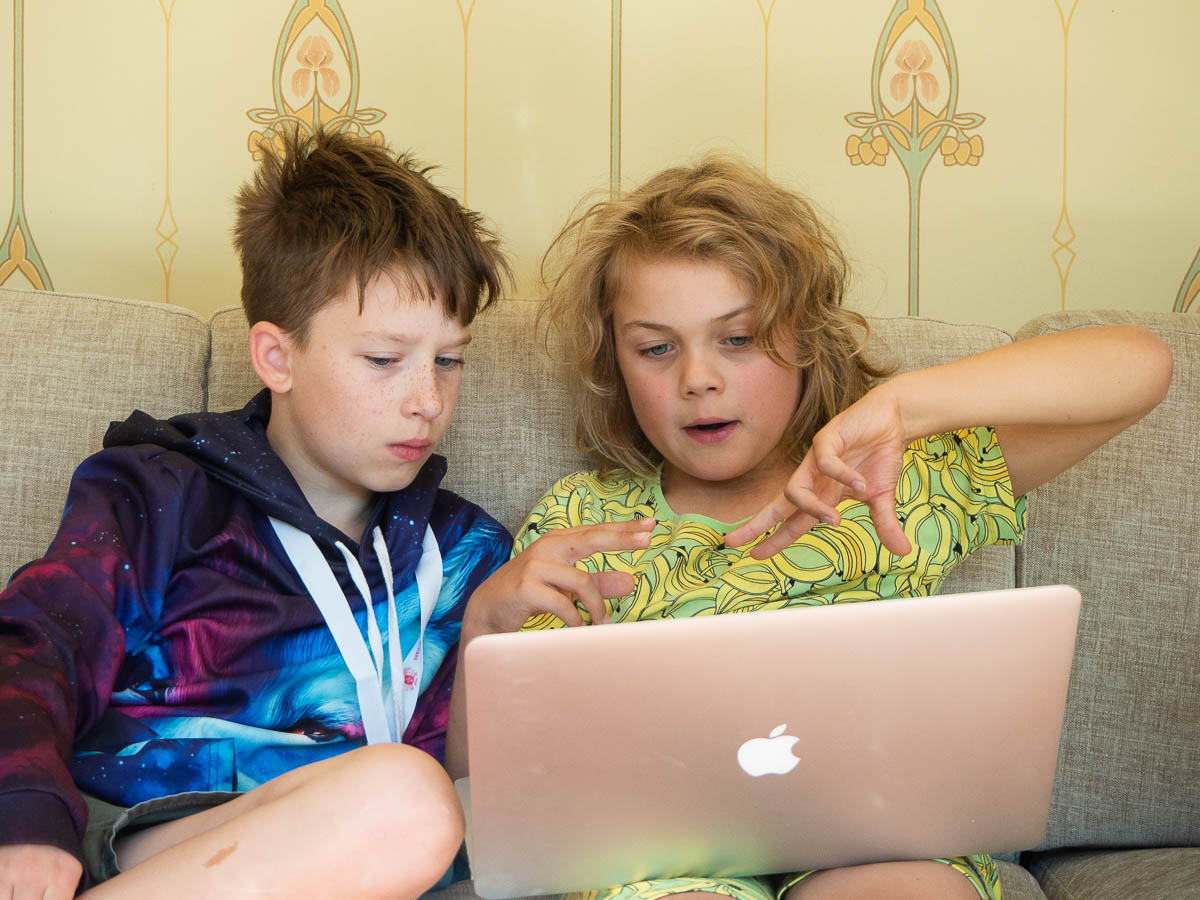
Ingrid is at a “Hack camp” all this week, learning game programming with Unity. She started out with Scratch, then moved on to experimenting with Python (which I think they started with at school) and now to learning Unity. (The camp is organized by Nox Academy and Ingrid has been really satisfied with her week. She’s had fun, learned a lot, and made several new friends.)
This has inspired Adrian to pick up Scratch as well. He’s dabbled before but not with any kind of persistence. It’s more fun with a friend to keep him company and help him come up with ideas. Levels! And bosses! And different backgrounds!
Any kind of overt encouragement from me has shown itself to be pointless, even counter-productive. All I can do is set an example and show that programming is enjoyable – and be there to answer questions and help them get unstuck when needed.
One thing that both Ingrid and Adrian are learning is that much of programming is about really understanding what you want to do, and breaking a project down into smaller tasks.
Adrian wanted “levels” in his game, and asked me how he can do that. It seemed hard, and he didn’t even know how to get started. But then we started untangling that concept. What does it mean for your game to have “levels”? When does the player advance to the next level? What happens then? And suddenly it wasn’t so impossibly hard any more.
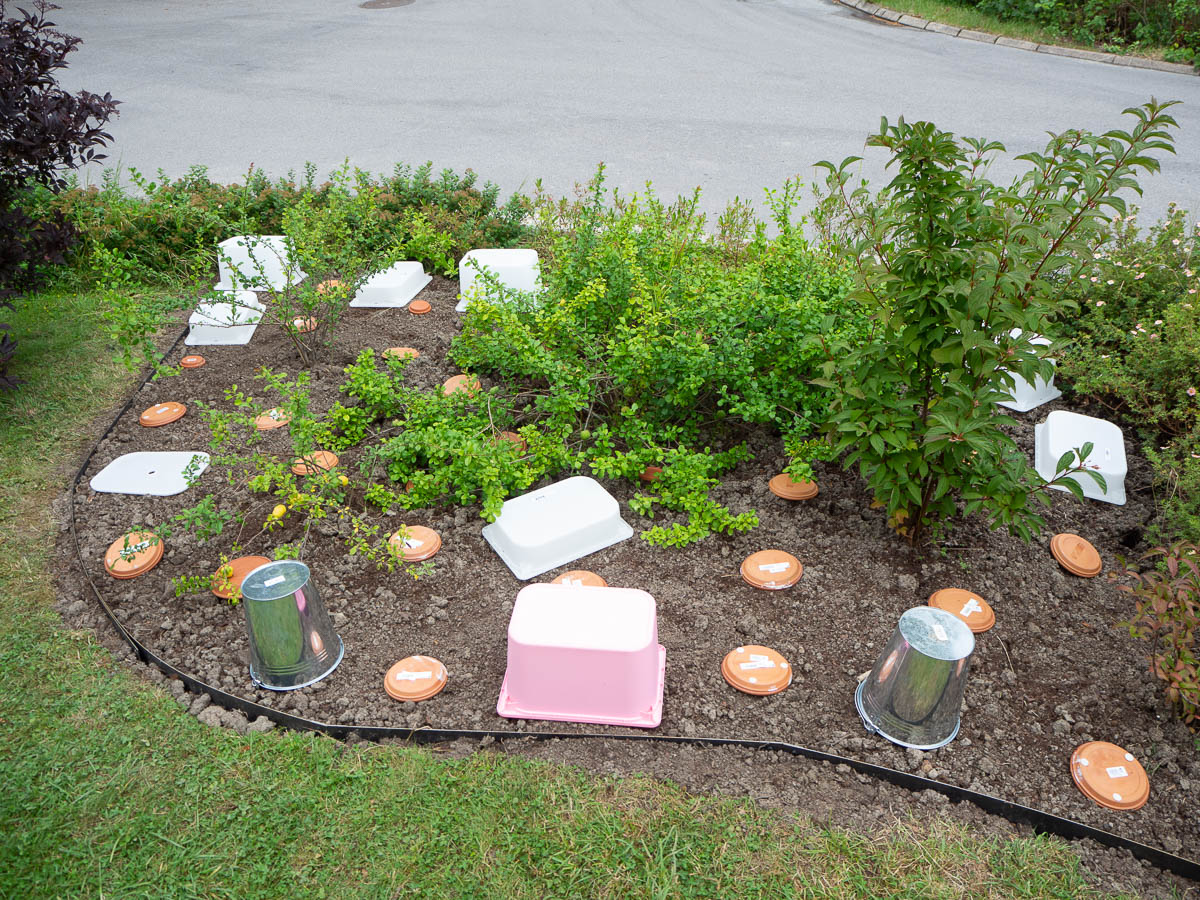
I’m playing with buckets and IKEA boxes again, to plan and design the new flowerbed. I first did this for the bushes and shrubs behind the house and this approach worked better than anything I’ve tried before. It gives a much better idea of the size of things.
I only have a limited number and variety of such design aids, though, so one bucket will have to stand in for a whole group of plants in some places, and the same kind of flower pot saucers means different things in different places.
That’s why phase two of the process is to take a photo of the design and annotate it with specific plant names. That made the groupings more obvious and I went back several times to move some boxes around and take a new photo.
Phase three was shopping, but buying fewer plants than I thought I needed based on the design, and then placing the flowerpots in their intended spots. And indeed as usual I had overestimated the number of plants that I had room for. A bucket looks large but three day lilies still take up more space.
Book publishing in Soviet Estonia, like most other industries, was based on planning. When a book was scheduled or planned for publishing, people pre-ordered it. Years later, the book actually came out, and your pre-order form was mailed back to you as a notification that it was time to go and actually buy the book.
With popular books, if you didn’t pre-order, there was no book for you. Unless of course you worked in a book store or had connections who did. Book shops did have books on their shelves, so some must have been generally available as well.
The process in the book store involved several steps. First you went to one desk and asked for the book or books you wanted. The grumpy lady there added up their prices, quite probably on a wooden abacus, and handed you a small piece of paper with the sum. You then walked to the cash desk where another lady punched in that sum into a cash register, took your money and handed you a receipt. With the receipt in hand you walked back to the first desk, where you exchanged the receipt for the actual book. Oh, and there was most likely a queue at each step.
This is what a book store looked like:
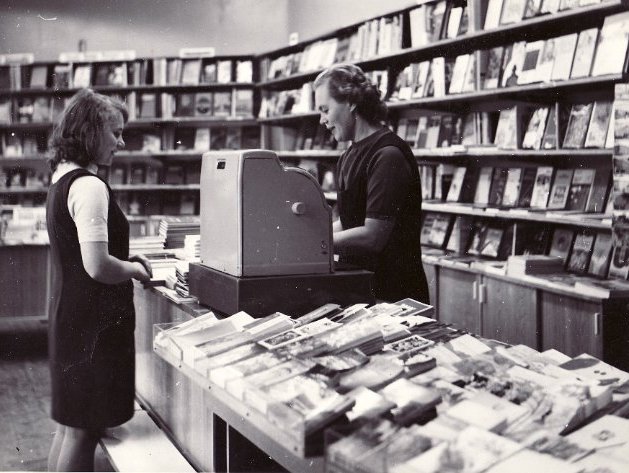
Source: Tapa muuseum, where you can also find more.
Here is an example of an advertising poster for pre-ordering the collected works of Lev Tolstoy:
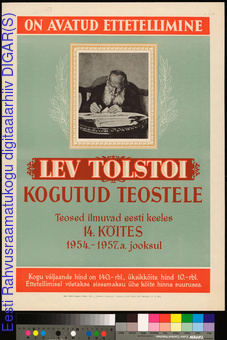
Source: Estonian National Library Digital Archive, where you can also read the official state instructions for the pre-ordering process.
Nõukogude Eesti raamatukirjastus põhines plaanimajandusel, nagu ka enamus muid tööstusalasid. Kui mingi teose väljaandmine oli planeeritud, siis said inimesed seda tellida. Aastad hiljem tuli raamat lõpuks välja, su tellimisblankett saadeti sind teavitamaks sulle koju, ja siis läksid ostsid selle ära.
Populaarsemate teostega oligi nii, et kui ei tellinud, siis ei saanud. Kindlasti oli võimalusi, kui sa ise raamatupoes töötasid, või kui sul seal tutvusi oli. Raamatukauplustes oli mingeid raamatuid riiulites, nii et midagi pidi ka üldiselt saada olema.
Protsess raamatukaupluses koosnes mitmest sammust. Kõigepealt tuli minna ühe leti juurde ja seal paluda soovitud raamatut või raamatuid. Leti taga seisev morn naisterahvas liitis nende hinnad kokku, tõenäoliselt puidust arvelaual, ja andis sulle pisikese lipiku kogusummaga. Selle lipikuga kõnniti kassa juurde, kus järgmine daam summa kassaaparaati toksis, sinu raha võttis ja sulle kassatšeki andis. Tšekiga mindi tagasi esimese leti juurde, kus see raamatu vastu välja vahetati. Ja loomulikult eelnes igale sammule tavaliselt järjekord.
| « Older posts | Newer posts » |
