Ingrid’s favourite spot in the house is her changing mat. The mat is next to the wall, near the end of a bookshelf. For some reason, she really likes that corner, preferring it to other parts of the room that I would think should be more interesting. Sometimes when she is grumpy, she cheers up when I put her on the mat. She can lie there and coo and even smile happily at the bookshelf. Sometimes she smiles at the bookshelf but not at me!
Names I have frequently called my baby:
- Kullake (“darling”)
- Konnake (“froglet”)
- Vorstike (“little sausage”)
- Tibuke (“little chicken”)
- Musirullike (hmm… “little” + “kiss” + “roll”… sort of something like “sweetie pie”)
- Pudisuu (“messy-mouth”)
- Pudrunägu (“porridge-face”, though she does not eat porridge)
- Unekott (“sleepy-bag”)
- Õnnetusehunnik (“heap of misery”)
- Hädapundar (“bundle of distress”)
Notably, “Ingrid” is not in the list. I suspect she will grow up believing her name is Konnake Bergheden.

Before Ingrid arrived, I used to wonder why all mothers suddenly become so fond of long walks.
After Ingrid arrived, I realised that they don’t. They just do it anyway – because it puts the baby to sleep, and because it allows the mom to leave the house, and to get some exercise. I am not particularly fond of walking around in the city myself (hills and woods are a different matter!) but nevertheless I take substantial walks several times a week.
Most of the time Ingrid goes out in her pretty Stokke pram / pushchair. I love the pram. I feel a bit guilty about how much I paid for it (I’ve seen used cars advertised for less money!) but I figured, if I’m going to be using this thing every other day for several years, it better be good. I’m hoping it will be the only pram/pushchair that Ingrid needs.
And it truly is a joy to use. I really like going out with it. The big wheels go easily over bumps, and it handles so well that it can almost turn around in place. I can control it with one hand – I’ve even managed to push the pram and a shopping trolley at the same time. All parts are adjustable. The seat can face either forwards or backwards, and its position can range from almost-flat to sitting up. The rear wheels fold in so I can pull it up stairs and don’t have to carry it. There’s space for “stuff” so I don’t have to carry the groceries. And it looks cool – it often gets comments from passers-by.
The Stokke is easy to take on a bus, but Tube stations are a pain, with all those stairs. It wouldn’t be so bad if it was just one long staircase – I’d fold in the wheels and drag it up (or down), and be done with it. But instead it’s five steps here, then a straight walk, then another 10 steps, then another walk, then another few steps… Every time I need to fold in the wheels, and then fold them out again. I tried it on the tube a few times, and the stairs were driving me crazy. So when we go to town, I either take the bus, or leave the pram at home and take Ingrid in the sling. The sling is also good when I am in a hurry: I don’t have to worry about the abominable pavements with all their holes and edges.
So the sling is more convenient in a way, but on the other hand I then have to carry her weight all the time, plus a backpack with baby stuff (changing mat, nappies, baby wipes, spare clothes, blanket). That plus a baby a good 10 kg altogether. And since she spends so much time in the sling anyway, my back is starting to feel the strain. With the pram on the other hand I can wheel her until she’s asleep, and then just park her in a corner while I’m doing other things, such as having lunch, or browsing books. (That’s assuming she doesn’t wake up as soon as I stop – she’s started doing that recently.)
PS: Did you know that the word “pram” is short for “perambulator”?
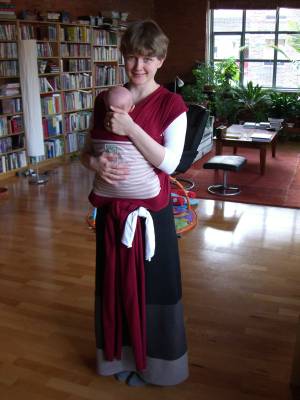
During her first weeks, Ingrid easily fell asleep anywhere and any time. When she gradually became more alert, getting her to sleep became more of a struggle. I didn’t want her to get used to falling asleep on the breast – I think it would become inconvenient in the long run, and even in the short run it would mean that I am the only person who can get her to sleep. What if I fall ill? So we tried to find some other way to help her fall asleep. Initially the main solution was a dummy. We’d spend ages by the side of her Moses basket, popping the dummy back in her mouth when it fell out too early, and then trying to take it from her before she was completely asleep (because otherwise she’d wake again when she lost it later).
One night she just wouldn’t go to sleep that way, no matter how much I tried. I was too tired to carry her around in my arms all evening, so I thought I’d try my new Tinokis sling. And as if by magic, she was asleep within 10 or 15 minutes! Since then, the sling has become my #1 sleep tool.
Ingrid really doesn’t know how to fall asleep on her own. In fact she seems to actively fight sleep. When she is tired, she doesn’t start yawning or looking sleepy – she just gets whiny and fussy. And as she gets more and more tired, she gets more and more upset, until she can be crying and screaming constantly. This often happens within minutes of the first sound of tiredness.
When she’s crying with tiredness, motion – in the sling or the pushchair, or simply in my arms – is the only thing that keeps her relatively calm. All the lower-touch sleep tricks that I’ve heard about – singing, shushing, patting, holding a hand on her chest – are pointless; she ignores them completely and doesn’t get the least bit sleepy. The crying and the rocking goes on, she sounds more and more desperate, until suddenly, really suddenly, she gives up, her eyelids drop, and she is asleep.
I am constantly surprised by how forceful the rocking needs to be! This is no gentle swaying or swinging. When she’s in the sling, I need to really bounce her up and down. And when she is in the pushchair, I actively seek out bumps in the pavement to make sure that she gets enough “bounce”. Too big a bump will shock her awake again; too smooth a pavement just has no effect.
We sometimes still try to get her to go to sleep in the Moses basket, just so she doesn’t forget how that works, but now that she’s a lighter sleeper, it is getting harder and harder. We generally give up and I put her in the sling anyway. By that time she is sometimes so tired that it only takes two minutes of rocking before she is asleep.
For her night sleep and the long mid-day nap, I try to move her from the sling to her Moses basket when she is fast asleep. I don’t want to carry her around all the time! Sometimes it works, sometimes not… and sometimes it seems to work but then she wakes up 10 minutes later and misses me, and goes back in the sling anyway.
I don’t know what I’d do without the sling. Develop enormously strong upper-body muscles, perhaps. Just today I ordered a second one, because this one needs washing, but I don’t want to spend even half a day without it.
And I really hope that this is only temporary. Well, I’m sure it is temporary – I’ve never heard of a teenager who needs to be rocked to sleep – what I mean is, I hope this phase doesn’t last too long. She will have to be able to fall asleep without this much work by the time she starts in the day nursery, when I go back to work. I doubt if anyone there will want to bounce her up and down for every nap!
While Ingrid is a lovely baby, and getting lovelier by the day, I really cannot say that I enjoy staying at home and taking care of her all day, every day. It’s challenging and boring at the same time.
First of all, it can be immensely frustrating because there is very little feedback, and the little that there is, is very unclear. She is a black box: I am taking care of a system whose workings are hidden from me, and whose feedback is generally limited to two states: “I’m OK”, “I’m not at all OK, fix me!”. When she seems hungry, there is no gauge to say whether she is very hungry, a little bit hungry, or just feels like snacking on the breast. When she seems tired, there is no way to know whether she really is tired or simply bored. And no way of knowing whether what I am doing to calm her is (1) just right but needs some time to work; (2) almost right, just needs some tweaking; or (3) totally wrong and making her more upset. All guesswork. And to make it worse, even when I think I’ve figured out some part of it, that part is sure to change so my solution stops working again.
At the same time, I find it quite tedious to take care of a baby. My days are very repetitive. Change, feed, burp, keep her awake, try to get her to sleep. Wait an hour or two while she sleeps, and start over. And repeat all over again. And each step is the same every time. Getting her to sleep is especially boring: it generally involves patting her while rocking / swaying her in a sling, for 10–15 minutes, and again if she wakes up halfway through her nap. So every day I spend about an hour rocking and bouncing from one foot to the other.
The part that rankles me the most, I think, is the utter lack of flexibility. I cannot ask her to wait just a few minutes – when she wants food, she better get it immediately, and when she is crying out of tiredness, she cannot wait until I’ve finished my meal, for example.
I really am looking forward to a more communicative Ingrid. Much of this does come down to communication, doesn’t it? When her feedback becomes more nuanced than just “this is good” and “this is awful”, when it becomes possible to play with her while she’s awake, when she starts understanding what I say… this should all become much more enjoyable. I hope so!
I couldn’t agree more with these thoughts from Jeff Atwood:
90% of Windows software is absolute unfettered crap which should never be installed on any computer running any operating system. Ever. But I’d also say Sturgeon’s Revelation applies to all media, not just Windows software. But our 90% is larger than your 90%. Despite what all the Elise-drivin’, iPod wearin’, Mac-lovin’ pundits would have you believe, it’s not all craplets and malware in the Windows world.
As Windows users, we should do our part to fix this. Let’s band together and support those small software vendors writing Windows apps that not only don’t suck, they ROCK. Let’s support the little guy who still gives a damn about creating small, beautiful, useful apps on an operating system that gets no respect.
That is why I declare today, Friday, December 1st, 2006, Support Your Favorite Small Software Vendor Day.
Check your hard drive, and I’m sure you, too, will find some bit of software written by a small software development shop, maybe even a single developer. Something you find incredibly useful. Something you rely on every day. Something you recommend without reservation to friends and peers. Something that makes using the computer that much more enjoyable. Or at least less painful.
The two most useful applications on my computer – both of which I use daily, and really enjoy using – are EditPad, an excellent text editor and Opera, an excellent web browser. I write all my blog posts in EditPad, and most other things as well. I feel handicapped without these two applications, and missed both on my work computer (even though UltraEdit and Textpad are both good text editors, too). I am upgrading to EditPad Pro right now!
I used to resist paying for software. If I could get it for free, or borrow someone else’s license, I did. Getting into software development has really changed my viewpoint on this. Even when I was only doing it for myself, for fun, it gave me a whole new perspective: an appreciation of the effort involved, an understanding of what it feels like to have someone steal your code, and conversely, what it feels like to know that you have written something that others use, enjoy and find useful. I am a lot more inclined to pay for software now.
Of course, the fact that it is now a lot easier to find and buy good-quality software, also helps. Everything is reviewed and recommended (or not) somewhere on the web, and there are trial versions of everything.
Both myself and Eric have received several request for more photos. So here they are! There is now a whole photo gallery with pictures of Ingrid in all sorts of settings and poses. We will be adding new pictures as and when we feel like it, and removing old ones if / when I run out of server space (unlike the photos I’ve posted here, the ones in the gallery are all full-size). I will not be posting about all such changes here, but the gallery appears to have an RSS feed, which should provide notifications when new items are added (although I must admit I haven’t tested it myself).

New things Ingrid has learned:
- Smiling!
- Faces. In the last week or so, she has become really interested in looking at faces. When she is near people, she prefers looking at their faces to staring out through the window.
- Imitating. Just this morning she learned to copy facial expressions – Eric and Ingrid were making faces at each other. It seemed to be hard work for her – she tired after a few minutes.
- Head. Her neck is a lot stronger, and she can now hold her head upright and turn it in different directions, without constant support. She’s still far better at starting a movement than controlling or stopping it: the movements often end up being way too forceful and going too far, so she throws her head around quite wildly, and ends up hitting me with her head a few times every day…
- Hands. Ingrid now knows that her hands are hers, and that she can do things with them. “Do things” in this case really means “put them in the mouth and suck on them”.
Confessions of an Ugly Stepsister is labelled as a retelling of Cinderella, set in 17th century Holland. And at a very superficial level, it is. There is a girl whose mother dies, whereupon her father remarries a woman with two daughters. The girl is unbelievably beautiful while her new stepsisters are ugly. She stays in the kitchen and does all the work around the house. And in the end they all go to a ball in a castle.
But reading it, it turns out that Cinderella is, at most, a vague inspiration. Despite describing various bizarre and curious events, the story really feels nothing like a fairy tale – it is more of a tragedy. It is raw and frank rather than beautiful, and at times quite cruel. There is no real happy ending. Beautiful people are not kinder than others; ugly stepsisters are not evil. Beauty does not lead to happiness. And there is no magic to solve all problems.
And unlike fairy tales, the focus of the book is not on events but the people. It is populated with a number of interesting characters, all of whom are far more complex than the fairy tale characters. Cinderella is not a poor victim but manipulative and whiny. The scheming stepmother is not villain but human, trying to provide for her children. Iris, the stepsister who is in the centre of the story, is no happier about getting Cinderella as a stepsister than Cinderella is about Iris.
All of the characters are very human, generally unsympathetic, and often surprisingly mean to each other. They are all blind (sometimes deliberately) to some aspects of their own lives and what is going on around them. Relationships between them are complex mixtures of love and hate, jealousy and joy. Though the book is less than 400 pages, all the main characters change and evolve: the girls grow up; adults around them mostly degrade.
Despite the mean characters and the unfortunate events that happen to them, the book itself is not unpleasant or depressing. It isn’t exactly fun, either, but it is definitely engrossing.
The one noticeable weakness of the book is its ending. The main story is wrapped in a meta-story, as if one of the sisters was remembering their childhood. This totally unnecessary technique leads to a very weak ending, where the sister simply summarizes what happened afterwards (instead of a “happily ever after”): “This is what happened to X. This is what happened to Y. This is what happened to Z.” It all feels very separate from the main story, as if it was glued on.
An unusual strength of the book is its cover. Well, “strength” is perhaps too strong a word… but it is a feature that I enjoyed. The cover depicts a complex scene with several things going on. Initially, it looks like this scene has nothing to do with anything that goes on in the book. Then something relatively unexpected happens in the book, which explains part of the cover. Having read this far in the book, I looked again at the cover, and more parts of it started to make some kind of sense. And then I couldn’t wait to find out if these things would actually happen, and when and how.
Altogether quite a readable and interesting book, quite different from most of what’s out there.
| Newer posts » |
