Today we flew to Maspalomas in Gran Canaria for a week-long vacation. Not the destination we’d choose if it was just Eric and me, but right now a week’s rest some place warm will be just fine. In order to make this a vacation rather than an exercise in patience and child management, we brought my mum with us. She gets a free trip, we get company and another pair of hands. The adults outnumber the kids, which makes life significantly nicer for all those involved.

Now we’re all tired after a long day of travelling. The flight left at 7.30 and since we didn’t want to have to hurry at the airport, we aimed to be there two hours before, which meant getting up at 3.45. Everything went smoothly, although Adrian was pretty bored during the flight, and it was hard to get him to go to sleep. Though it could have been much worse, I suspect our fellow travellers were not too happy about having us on board.

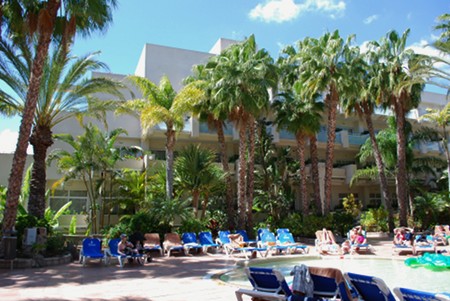
Tabaiba Princess, the hotel we’re staying at, is large and really nice, inside and outside. It’s almost a resort rather than just a hotel, with lots of palm trees and several large pools and even an artificial beach. The only thing it lacks is wifi in the rooms. There is a wifi hotspot in the lobby but even that costs money.

We haven’t really had time to explore it all yet; that’s one thing we plan to do tomorrow.

After an afternoon snack at a bar by the “beach”, we went for a walk to the real beach. It’s about one and a half kilometers from the hotel, a pleasant walk along a palm-lined road next to a canal (dry at this time of the year). Where the canal meets the beach there’s a small freshwater lake or lagoon, with coots and moorhens and a lot of fish. Turning west/right at that point, we walked on towards the lighthouse and then back to the hotel. To the east/right, we could see the Maspalomas sand dunes, which we will definitely visit another day.

On Monday and Tuesday we went on a bicycle ride.

I’d been making vague plans for a longer bike outing since the beginning of summer – Ingrid not being much of a walker, and somewhat too young for climbing mountains, biking seemed like a good way to get us all outdoors. Initially I had thought of maybe being away three or four days, but since the weather forecasts have been promising rain and yet changing all the time, and Ingrid hasn’t been in the best of moods lately, we cut it to just two days, with one night of camping. (We wanted to be as sure as possible that rain wouldn’t ruin Ingrid’s first camping experience, so that we can convince her to do it again next year.)

To keep it simple, we went for a local ride: a combination of Sverigeleden and Mälardalsleden, two marked and mapped bicycle routes. From our home in Spånga we headed east, via Kista towards Edsviken, where we hit the Sverigeleden. Then we followed that route north, past Sollentuna and Upplands Väsby, up to Märsta. After dining in Märsta we made camp at the beach at Steningebadet (with a view of Steninge castle across the water). On day two we cycled to Sigtuna, had a bit of a walk around the town centre, and continued to Bålsta. From there we took the train back home in the afternoon. In total I think we covered about 45 km on day one and perhaps 35 on day two. Ingrid sat on a child seat behind me, and Eric got the trailer with all the food, clothes and camping gear.

The weather was just about perfect for cycling. On Monday it was about 20°C and overcast but dry all day. On Tuesday there was a bit of sun, which made for a sweatier ride, but still not too hot. There was some wind to cool us off but not so much that it would be a hindrance.

I think Ingrid found the camping experience exciting: outdoor meals, sleeping in a tent, cooking porridge on the portable stove, washing up in the lake…

Well, the actual sleeping in a tent part was better in theory than in practice. At about 11 o’clock, prime sleeping time, we were interrupted by some yobs joyriding and skidding a van back and forth across the beach. It made an awful lot of noise and the headlights came close enough to make me worry they’d hit the tent. Fortunately they stopped when Eric went out and gave them the evil eye. Then a few hours later the early morning light started bothering Ingrid, and all her tossing and turning kept waking me. (And, predictably, sleeping on the ground is not at all comfortable when you’re 7 months pregnant.) We were all pretty tired in the morning.

The bike ride itself was, I think, rather boring for Ingrid. Sitting still, doing nothing… There was a fair amount of complaining about “I wish it was evening already” and “Are we almost there yet”. On Monday, in the more inhabited areas, we could at least stop at a few playgrounds on the way. On Tuesday it was mostly countryside.

Of course, the countryside had wild raspberries, and fields of wheat and oats (“flour for bread and cakes, and oats for your morning cereal”), and grazing horses, sheep and cows. Horses aren’t uncommon around the outskirts of Stockholm but there aren’t many who keep cows and sheep here. “Normally it is horses who are in pasture” Ingrid told me, somewhat surprised.

Next year I think we will try something a bit more ambitious – Åland perhaps, or Gotland. Baby 2 should be the perfect age: young enough to not be bored by the bike ride, old enough to not be too fragile.

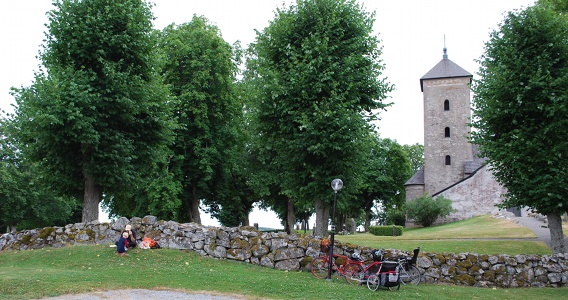
Snacking outside Skånela church

Today we visited Tartu Hansapäevad (Tartu Hanseatic Days), a summer festival in central Tartu. Lovely. I associate festivals with loud music, crowds, crappy expensive food, and sellers of cheap tat. We didn’t sample any of the food, other than ice cream, but on all other fronts, this was the opposite in all ways.

The city centre was way more crowded than usual, of course, but not so bad that it would get annoying (and my threshold for crowd tolerance is low, believe me). The stalls were all spacious and spread out, which made the festival area easy to get around. It wasn’t even hard to get around with a buggy.

The music (where present) was provided mostly by wind orchestras and brass bands, since this year’s Hansapäevad coincided with a wind music festival.

Instead of cheap tat, there was a huge market for traditional Estonian handicrafts: wood working and wood carving, pottery, knitted wool, felted wool, embroidery and sewing, smithery, traditional food and so on. A lot of lovely stuff to look at! In some senses I may not be strongly Estonian any more, but I do feel a strong affinity to Estonian crafts. The feel of the Estonian woollen yarns (hand spun, slightly rough, unbleached), the smell of juniper wood, the look of the traditional striped fabrics – it all says “home” to me. I love Estonian traditional textiles in particular, and wish I could fit them into my wardrobe without clashing with everything else I wear.

They had even thought of families with children. Not just the usual bouncy castles (although there was an area with such junk as well) but also meet-a-policeman, pony rides, and a lot of craftsy activities for kids of all ages: stamp your own shopping bag, draw and paint, make a paper doll with real fabric clothes. Even better, the activities were not all in one corner of the festival area. We could alternate between window shopping (stall shopping?) for me and activities for Ingrid, so no one got bored.

Add ice cream, and a fountain to splash in, and great weather (below 30°C!) and it was a roaring success for us.

Ingrid and I are on vacation in Estonia (leaving Eric at home to work, mow the lawn, water the kitchen garden and eat all the nice strawberries that were just ripening when we left).

We flew to Tallinn yesterday and spent the first day and night with an old friend of mine in Tallinn. This afternoon we took the bus onwards to Tartu, where we’ll be staying the majority of our time here, almost two weeks. We were met by proper high summer weather: 30°C heat alternating with thunderstorms. (It’s pouring down outside now, and finally cooling a bit, after several very unpleasant hours of sticky, sweaty heat.)

In Tartu we’re renting a guest apartment. Somewhat to my surprise, there were a number of such apartments on offer in Tartu. I picked the cheapest one, not so much because it was cheap (although that also mattered) but mostly for its convenient location.

Given the price and the apartment’s non-commercial landlord (the Estonian Society of Naturalists) I wasn’t expecting a high standard. And that’s fine – I don’t need fashionable furnishings or cable TV. I wanted a kitchen, a bathroom, and an internet connection. This apartment promised all three, and technically delivers all three. I have no complaints about the internet connection, and the bathroom looks reasonable. (Although I’ve yet to investigate the quality of the hot water supply). But the kitchen really surprised me on the downside. I mean, if someone rents an apartment rather than staying at a hotel, it’s probably because they want a kitchen, right?

I can understand that someone of the older generation might consider a microwave oven to be a non-essential item. I can live with that. But this kitchen has a stove from the 1970s, with those black iron hotplates, dreadfully slow – and no kettle to compensate. Dinner tonight took forever; I’d lost the habit of turning on the stove as soon as I’ve decided that dinner will be needed.

Tomorrow we will go shopping for essential kitchen equipment:

  • A kettle, so that we can cook pasta in under half an hour
  • A pair of scissors
  • A potholder or two
  • Salt (of which there was some, but there was so much rice in the salt shaker that I barely managed to get any of it out)

Still, I’m not unhappy, given the price of this place. The next cheapest place cost double, and several other guest apartments cost triple the price of this one. Even the kitchen investments will cost me no more than two nights’ price difference to the next apartment on my list.

I’ve posted a selection of photos from our Beijing trip in the photo gallery.

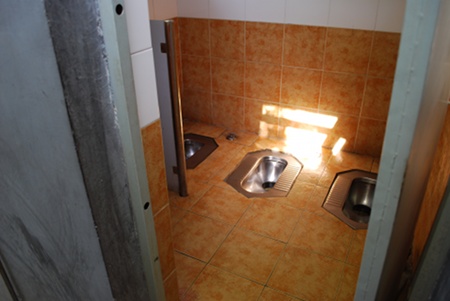
The people in our group had apparently not done much travelling before, and did not know much about the world outside their home. Some had no idea what kind of writing they used in Japan, others were shocked by the squeaky clean hole-in-the-ground toilets in Beijing; several were cautious about the foreign food.

At first I thought this might not be the right group for us. I’d have preferred to stay longer at every temple, have more time to take pictures, see and hear things in more depth. But then again Ingrid wouldn’t like such delays anyway, so actually the pace was quite right for us after all.

Beijing toilet, extreme version

A bit more about the toilets. Beijing is abundantly supplied with public toilets – a boon for tourists, especially when travelling with a three-year-old. Many but not all were squat toilets, and some places even gave you a choice, with a pictogram on the door of each stall telling you what’s inside – seat or squat. The toilets would not have surprised anyone who’d grown up in a Soviet country – except that the Chinese ones were always spotlessly clean. You could argue (and perhaps they do) that the seated version is less hygienic – you’re sitting where other people have put their bottoms. When you squat, on the other hand, you’re at a safe distance from any germs, as long as you can aim. Western tourists, lacking the required technique, sometimes miss, which makes for wet floors, but all the toilets we saw were very frequently cleaned. (Like every 10 minutes, literally.) The cleanest ones I saw were in the hutongs, where there were no tourists.

Travelling with a three-year-old turned out to be quite doable. It took some extra planning, effort and attention (I think I missed half of what our guide told us because was busy with Ingrid) but nothing hard. The following worked for us:

  • Choose the right trip. No long bus rides (no two-week tour of Morocco). Lots of variety. Best to have a trip where we’re based in one place rather than moving every day, so we have the option to take a day off if needed.
  • Make sure there is entertainment at hand for the slow moments – story books, drawing materials, etc. For Ingrid, Ingrid also borrowed our cameras quite a lot.
  • Carry snacks (fresh and dried fruit) and tasty drinks at all times. Ingrid hardly ate any “real food” and hardly drank any water, but consumed a lot of sandwiches and fruit.
  • Not all normal rules need to apply. We allowed a lot more snacking between meals than we normally do, and were more willing to carry her on our shoulders than we ever do at home.

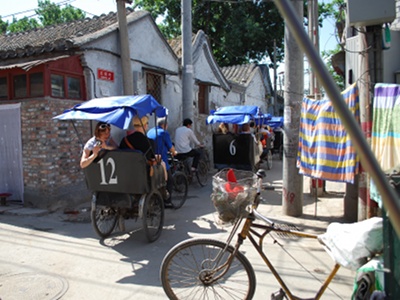
Day 6: fever, cycle rikshas, hutong visit, market, home lunch, Beihai Park again, boat on lake, visit dagoba.

Very very hot, over 30 degrees, maybe 35. I was walking from shade to shade and felt quite knocked out by the heat.

Ingrid woke early with a strong fever. I thought: that’s that, we will have to stay at the hotel and be bored all day. Nevertheless we got some paracetamol into her and dragged her down to breakfast. She’s been eating hardly anything, and especially tiny breakfasts. Today she had a whole fried egg and two croissants. After that, she was all perky and ready to go. So we decided to give it a chance after all. The rest of the day was roller coaster ride. At times she was jumping and running, other times obviously really sick and miserable, telling us she wanted to go home. Nevertheless the day went well.

The morning’s activity was a cycle riksha tour through a hutong. I found it hard to see much at this pace, especially since everyone not sitting in the first riksha will mostly see the other rikshas. It’s a good thing we saw them properly yesterday.

Then the group visited a local lady who lived in the hutongs, and got to ask her questions about her life. At this point Ingrid was feeling unwell and impatient, so I didn’t hear much of the Q&A. Instead we walked around in the street, where we happened to find a local primary school, so we watched what seemed to be an outdoors gym class, with the children all taking turns to show their rope skipping skills in the schoolyard.

It was interesting to see the hutong residence from the inside: it was more spacious than I expected, with all sorts of nooks and crannies. Almost all rooms seemed to be in separate buildings in and around the courtyard, with the courtyard serving as a sort of a hall. You had to actually go outside to get from the living room to the kitchen. Nice in the summer, probably less convenient in winter – and a nightmare to keep warm.

After this home visit we briefly visited a local vegetable market. It was crowded, noisy, and abundant. I am no fan of noise or crowds, and yet I wish I had something like this at home. Five kinds of tomatoes, three kinds of garlic, many varieties of eggs, also cereals and nuts – and fresh fish still splashing in their buckets.

Lunch was served in another hutong home. It wasn’t a real home lunch (they were obviously used to serving groups of 10 people) – perhaps it could be compared to an English bed & breakfast place – but nevertheless different from the restaurants we’ve been visiting thus far, with far more interesting flavours. (Tomato slices with sugar, anyone?)

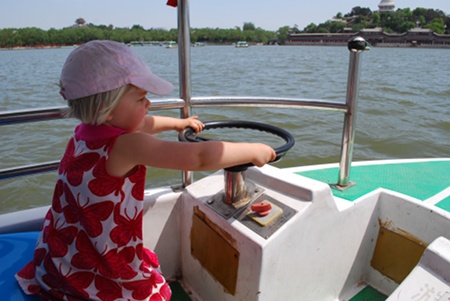
The afternoon was free time again. Since it was so terribly hot, and since we hadn’t gotten our boat ride the day before, we went back to Beihai Park. We rented a little electric boat and cruised around on the lake for a while. It was a great relief to be in boat on lake: there was a nice breeze and the air above the water was noticeably cooler. Ingrid had a go at steering the boat (it had one speed only, and that was most sedate). It went zigging and zagging but definitely in the right general direction.

As soon as we got off the boat the heat hit me again. I had a cold drink and a cold yoghurt to fortify me, and then we went up the hill on Jade Island in the middle of the lake, to have a look at the White Dagoba. The dagoba is striking but weird from a distance, but it turned out not to be very interesting up close. It is a very large, relatively featureless white lump, and definitely looks more like it was designed in the 1970s than in the 1670s.

Then it was back to the hotel for a last dinner with our group.

Day 5: Lama temple, Confucian temple, veggie lunch, Drum tower & Bell tower, hutongs, Beihai park, Coal Hill.

The day was really hot and sunny, around 30 degrees, which was a bit too much for me.

This was also our guide’s day off and our chance to spend time on whatever we wanted.

In the morning we visited the Lama temple. This building complex started out as the residence of an imperial prince, but was turned into a Tibetan Buddhist temple when he became emperor. The architecture was the same as we’d seen before: north-south orientation, courtyards, red pillars, yellow tiled roofs, elaborate eaves.

Inside, though, things looked different: in each hall there were statues of Buddhas, saints, devils, and other creatures. (It is interesting, really, that a religion that started out as abstract as Buddhism has now acquired so many mythical objects of worship.) Many statues were golden, and they were often clothed. Unlike the Temple of Heaven, this was an active place of worship, which gave it more life and made it more interesting, but unfortunately meant that photography was not allowed inside the halls. On the other hand, there were people burning incense in front of each hall, and we could even see a few monks walking around.

Next, we went to a Confucian temple nearby. We were met by the same architecture again, but a completely different atmosphere. It was a quiet, contemplative place, with large scrolls instead of golden statues, and educational texts about Confucianism.

Outside in the courtyards there were pavilions housing stone tablets memorializing important events: the suppression of a rebellion, the renovation of the temple, or just the emperor’s writing a poem about Confucius. When the emperor writes a poem, it isn’t enough to just frame it and put it on a wall. No, first you carve it in stone, then you make a huge statue of a tortoise to carry the carved stone, and finally you erect a massive pavilion around it.

By now it was time for lunch, and very luckily for us there was a vegetarian restaurant opposite the temple, called Xu Xiang Zhai. (No web site that I can see.) It turned out to be an excellent place, with fabulous food (esp. compared to the uniformly boring fare we’ve been served otherwise). As a nice touch, their menu had photos of all options – very practical, since the staff’s English was very limited. And besides, the photos were beautiful, really whetting the appetite. We ate copious amounts.

After lunch we walked through the nearby hutongs to have a look at Beijing’s Drum tower and Bell tower. We didn’t feel like climbing in the heat, and viewed the towers from the outside only. The hutongs themselves were interesting to see – this was the first time we did any significant walking in Beijing, until now it’s mostly been bus rides.

On our way to Beihai park, which we wanted to see next, we passed through the area by Houhai lake. This was a very very touristy spot, with trendy shops and cafes everywhere. It must be where all the westerners go – we had not seen another place like it in Beijing. Hutongs killed by marketing.

Beihai park was a very nice park. (They’re good at parks and gardens). The park is dominated by a large lake, and there are gardens, pavilions, ornamental bridges etc around it. We had been hoping to take a boat ride on the lake but the boat rental had closed already. Instead we had a pleasant walk around the lake, and tried out the contents of the mysterious clay pots that were sold everywhere – and turned out to contain chilled sweetened yoghurt.

By now Ingrid was finding her energy. She’s been much more energetic in the evenings – I guess she must still be severely jetlagged. In the mornings she’s hard to wake, grumpy, and doesn’t want to do anything. Now she is jumping and running around, racing up and down ornamental bridges, climbing on stones, running up stairs, jumping down stairs, with endless energy.

Just at dusk we walked across to Coal Hill, climbed the hill and got a panoramic view of the city. To the south, the yellow roofs of the Forbidden City; elsewhere a very green and relatively flat city centre (although hills were visible further off). And a very large city, of course.
Day 4: cloisonné showroom; Great Wall; Sacred Way; market; duck.

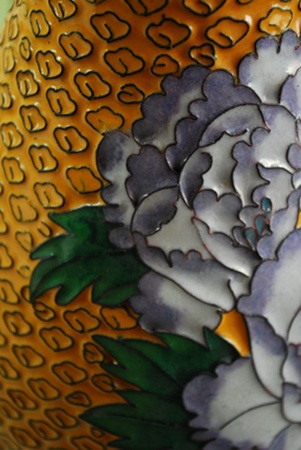
The main activity for day 4 was seeing and climbing the Great Wall. It takes about an hour and a half to drive to the section we were going to visit, so we stopped on the way to visit a cloisonné showroom. We first saw the (very fiddly) process of producing a cloisonné object. A lot of work goes into them! Draw the pattern, glue the copper strips, paint all the little spaces between them (using an eyedropper), fire the object, repeat 4 more times, and polish.

The showroom had everything from huge cloisonné urns for 490,000 yuan to cheap knick-knacks for 50. (They had lots of cheap Christmas tree ornaments for some reason, and I mean LOTS, probably as many as the more traditional, and more Chinese, vases.) The larger items were also of higher quality, so price generally went up faster than size. Everything above ca 500 yuan was really pretty: I found the whole cloisonné concept (and realization) very appealing. They are durable and solid, and yet elegant, lustrous and colourful.

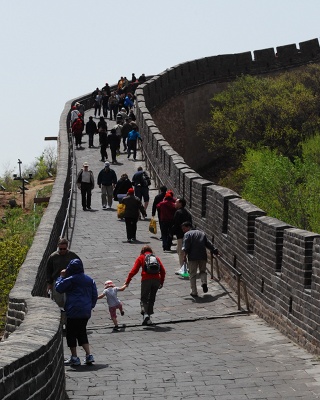
Then, the Great Wall of China, which we visited at Badaling, the first section of the Wall to be opened for visitors, and a very popular spot. A bit crowded, as all sites, but really not too bad. (Enough people so you can’t take a photo without getting a number of strangers in your picture, but not so you that it would be difficult to walk or that can’t get a view at all.)

The Badaling section of the Wall is in a very nice setting, with steep, rocky, verdant hills all around. Even if the Wall itself had been dull, a walk in that beautiful landscape would have been a treat. The Wall snakes goes up and down along the hills, with towers on top of some of them.

Upon arriving, we were offered a choice by our guide: turn right for an easy walk, or turn left for a steep and dangerous section of the wall. We assumed that the “danger” was relative to the average tourist (which in China often means retired people) and chose to turn left. Our choice was quickly proven right: the going was somewhat steep in places, with slopes and stairs, but really nothing very taxing or perilous. The surface of the Wall was in good repair, and there were walls (at least waist-high) and handrails on both sides. So we had a very pleasant walk, uneven and varied enough to make it easy for the legs even when steep. I would happily have walked there far longer than the hour and a half we got.

I had expected Ingrid to complain about all the walking but she marched like a champion. Litle miss “my legs are tired” took the stairs two at a time. We walked mostly uphill to a suitable tower, where we had a snack (Ingrid devoured all our dried apricots, and all of Grandma’s raisins and nuts). It seems that many visitors had found that tower a suitable turning point: beyond it, the Wall was much emptier. On our way back the downhill slopes and stairs seemed to scare her a bit so I carried her on my shoulders for a while, but then she hopped and skipped onwards with great vigour.

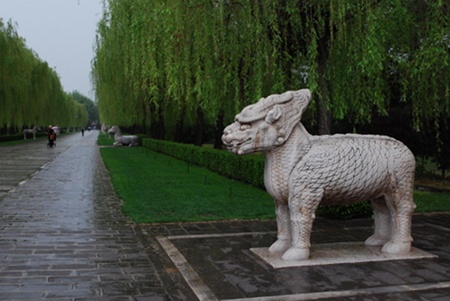
On our way back to Beijing, we stopped to walk a part of the Sacred Way leading to the Ming tombs, Ming dynasty emperors’ graves. This was basically a long straight road with an occasional ceremonial gate, and then a section flanked by statues of animals and people to guard the graves: lions, horses, elephants, unicorns generals and officials, etc. (Interestingly, most of the animal statues were in a realistic style, while others were more symbolic. The elephant looked like a real elephant, and so did the camel; the unicorn was a symbolic mythical creature – and so was the lion. This must have been a conscious choice; I’m sure they had seen actual lions but chose to depict a heraldic/imperial/mythical lion instead.) Halfway along the road we were caught in a thunderstorm, which we waited out under the eaves of a souvenir shop. It passed quickly, after scaring away most of the people, and leaving us with clean, fresh, but wet views.

Back in Beijing we were taken to yet another market, with more cheap clothes, electronics, jewellery, shoes, bags etc. I’m sure you can get a bargain at these places if you’re determined, but my philosophy of shopping is to go for quality rather than quantity, so this was not of much interest.

In the evening, the meat-eaters had Beijing duck for dinner. Their unanimous verdict was that the duck was a disappointment: it didn’t taste much at all. And apparently it’s supposed to be that way. All this roasting, carving and rolling is much ado about nothing. But the restaurant itself was nice: although we didn’t eat the duck we got better food than usual.

Day 3. Beijing Zoo, a pearl market, Summer palace, Olympic venue, tea, acrobatics.

Again a cool day, no more than 20°C. Ingrid slightly unwell but nevertheless coped relatively well.

At the zoo the main attraction was the giant pandas (who turned out to be pretty dull creatures, mostly lying still or perhaps eating at best). Then we took a walk in the park while Ingrid had ice cream. I was a bit surprised to see them charge extra for various parts of the zoo – at first it felt sneaky, but on the other hand I guess it allowed them to keep the gate fee affordable for more visitors.

Next we went to a pearl market, about which I don’t have much to say, other than that it had lots of pretty, shiny, expensive things.

The Summer Palace was a large park, of which we only saw a tiny bit. The buildings looked quite familiar by now, similar to the Forbidden City and the Temple of Heaven. And there were the familiar crowds as well. But unlike the Forbidden City which mostly consisted of large paved courtyards, this was a very pleasant place with a large lake and beautiful gardens. I would have loved to spend more time here. (Now much of my attention was taken up by Ingrid, who was rather whiny and impatient.) The two most eye-catching sights were the Long corridor (which really was very long, and beautifully painted) and the marble boat.

On our way back into town we took the road past the area where the Olympic games took place. The main Olympic stadion looks, in real life, pretty much like what I’d seen in photos.

Then we went to a tea tasting and demonstration. Tea is not really my thing, but they did have a nice Oolong with ginseng.

Finally, in the evening, we went to an acrobatics show by China National Acrobatic Troupe at the Tiandi Theatre. This was a grand experience. There were the usual numbers (contortionists, juggling, vertical poles, jumping through hoops) but also a slack wire act (which I’d heard of but never seen). This was amazing: the guy managed to do a headstand on the wire, as well as unicycle on it, etc. No photos allowed, unfortunately.

Ingrid adored the show. We’d expected her to fall asleep (she was really tired this late in the evening, plus slightly feverish) but she was on the edge of her seat, totally absorbed. Then she showed us all sorts balance tricks in the minibus all the way back to the hotel, and asked if we would go back to the circus the next day.

By the way, I am getting very tired of rice + pak choi, which is pretty much all we (the vegetarians) were served yesterday and today. And I used to love pak choi. It seems to be their equivalent of a vegetarian lasagna (which is the vegetarian staple at many lunch restaurants in Sweden). And they all serve sliced watermelon as dessert – even Ingrid (who usually loves watermelon) is getting tired of it.