Leirvassbu to Spiterstulen, 15 km.

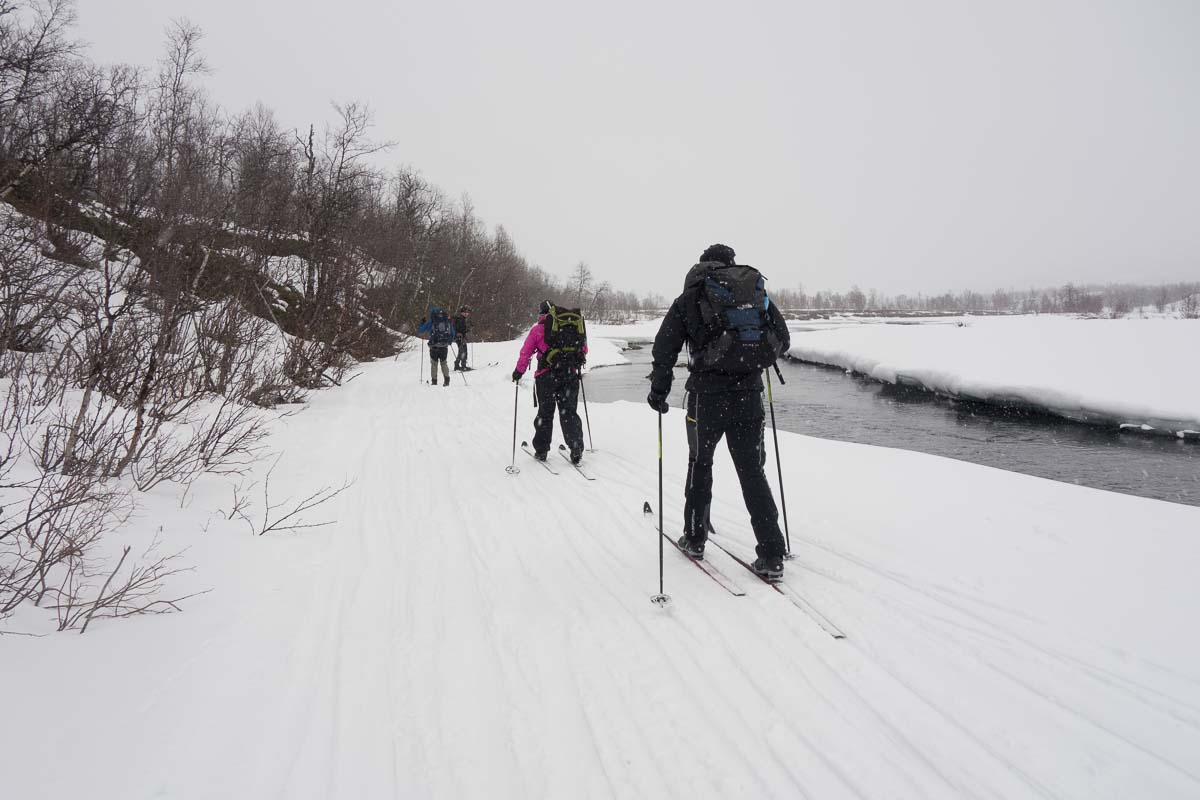
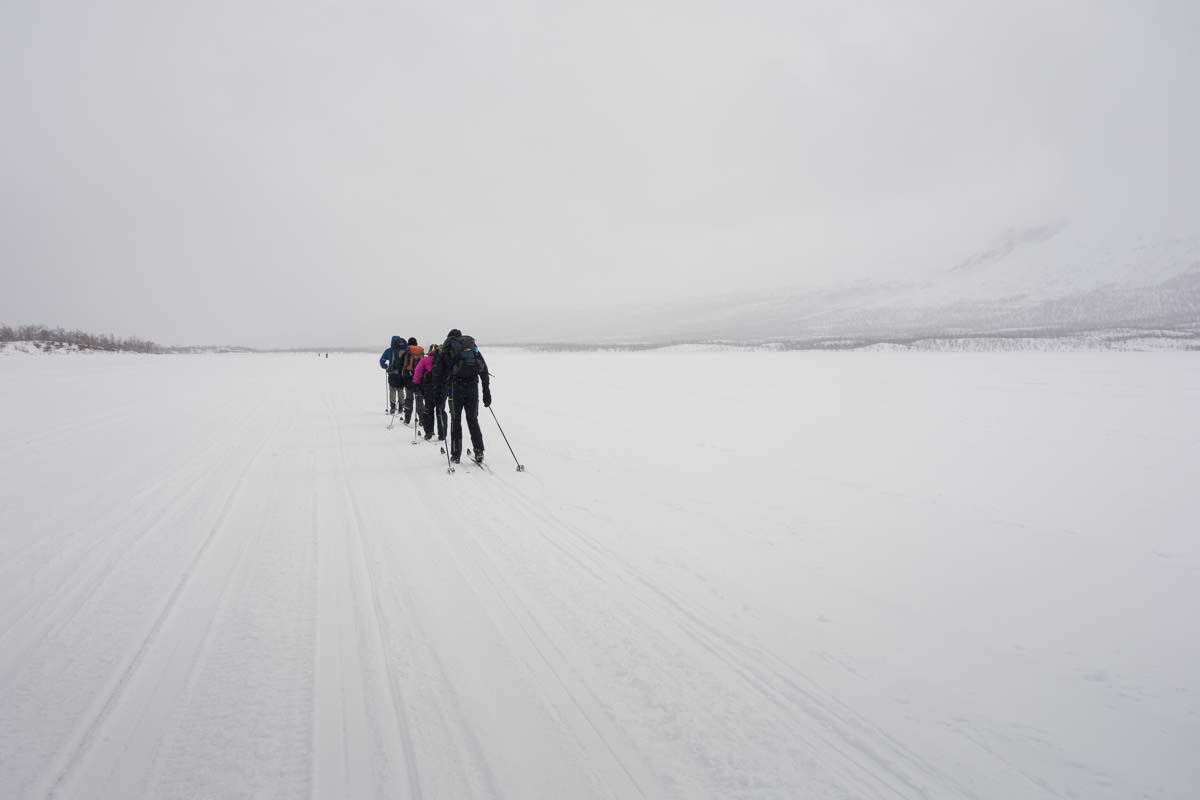
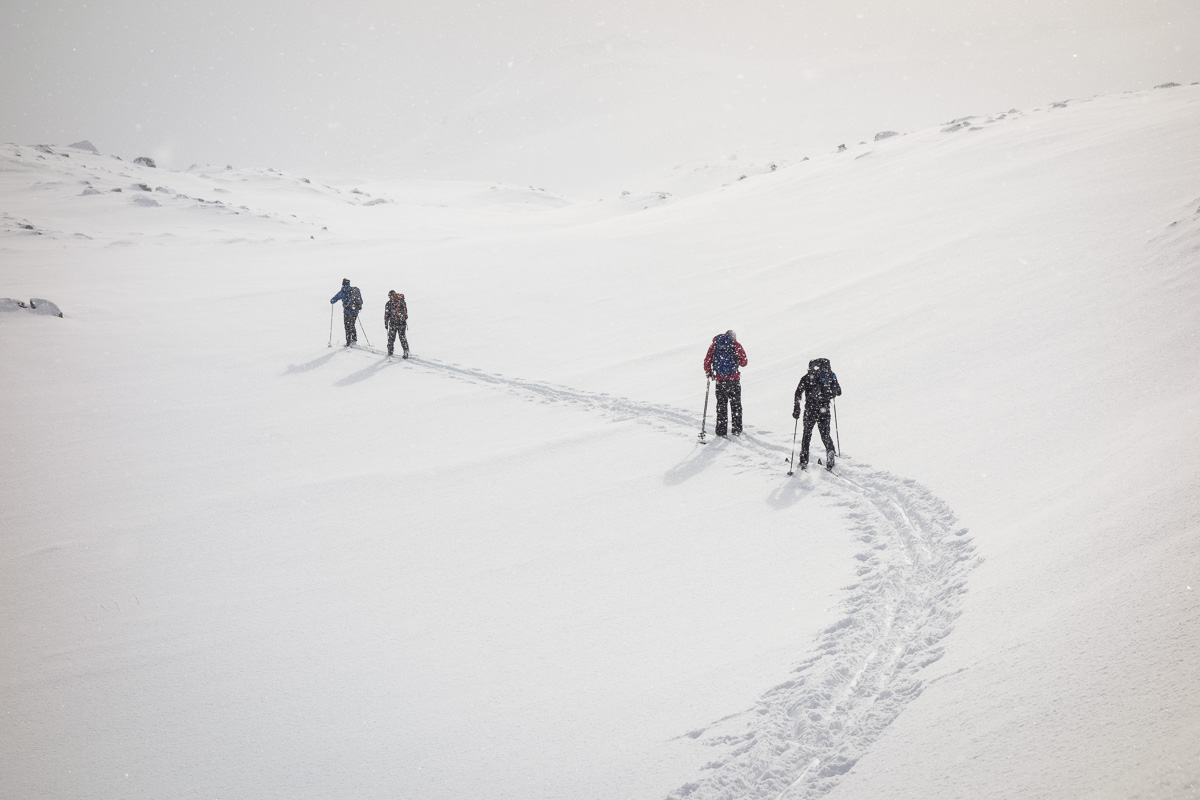
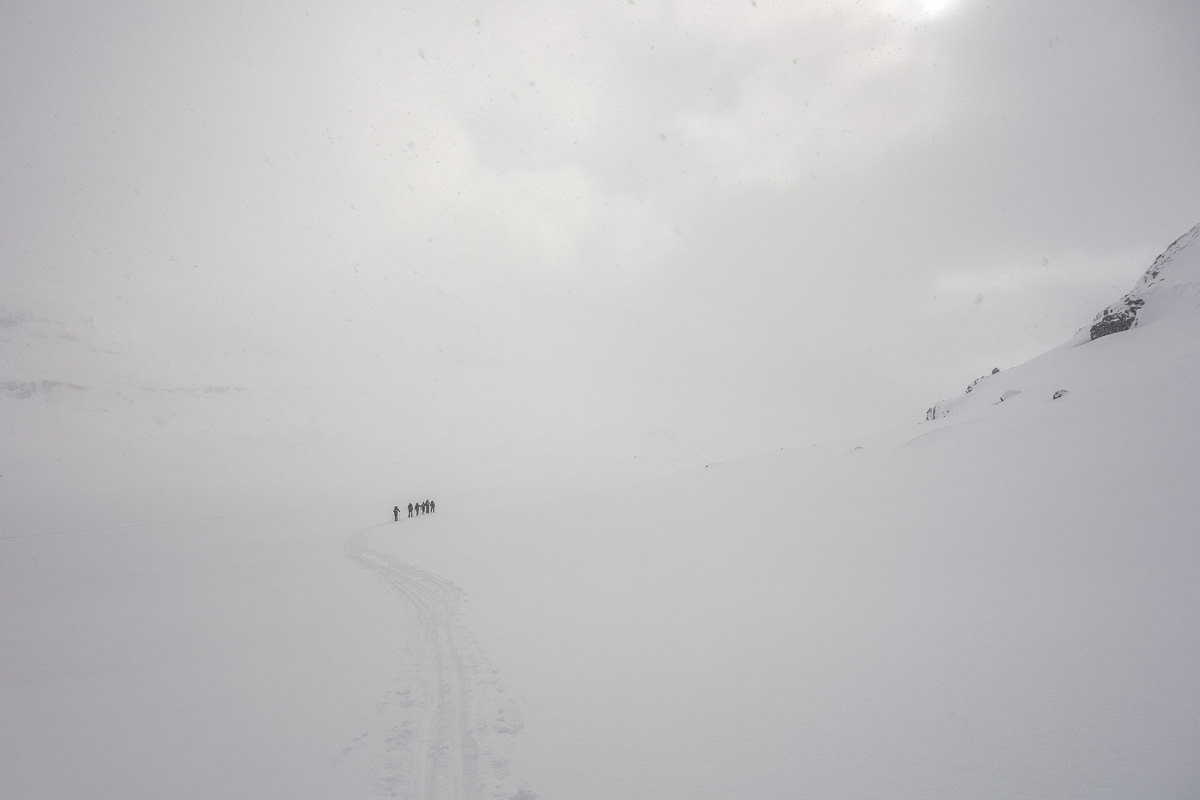
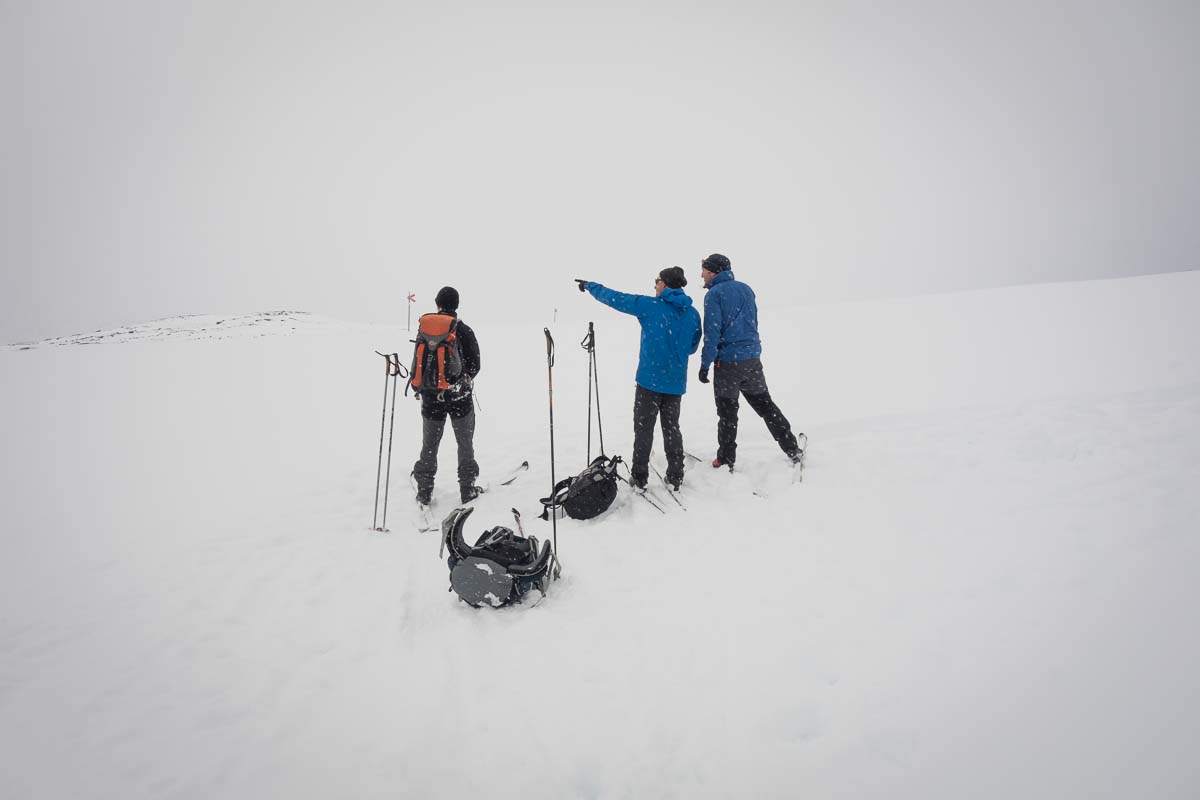
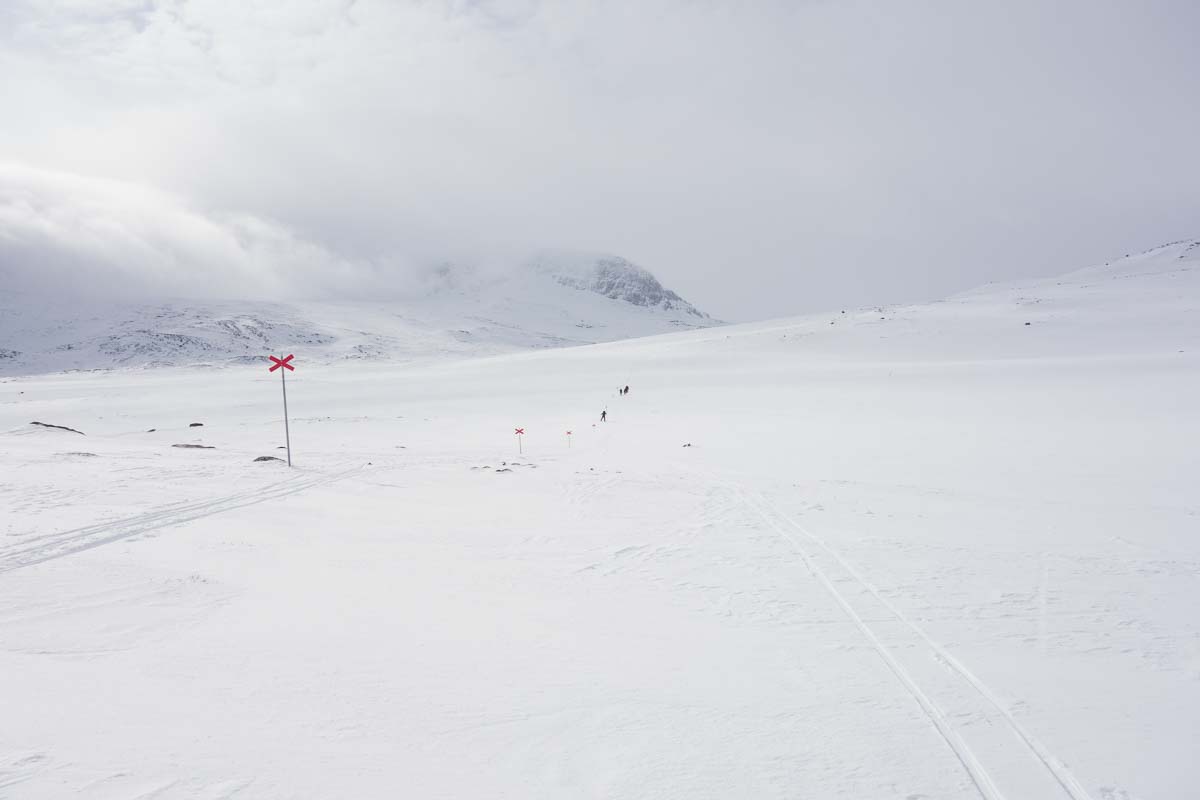
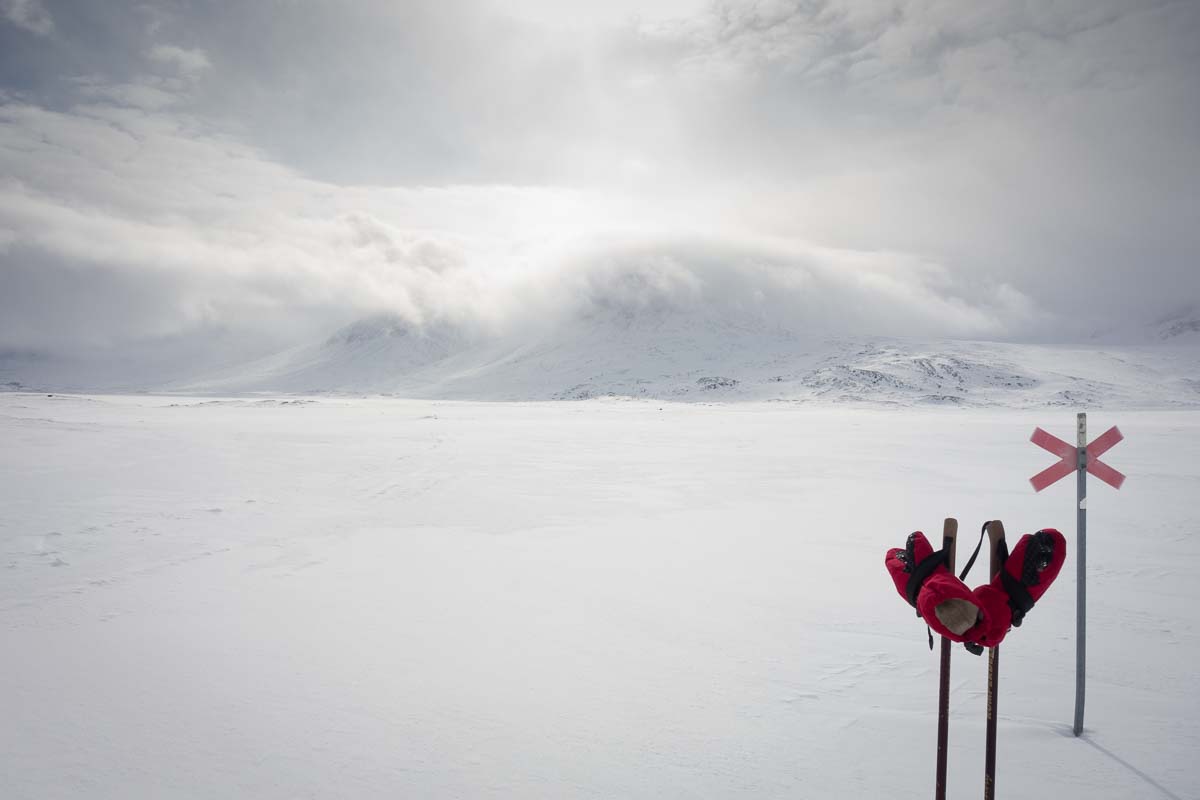
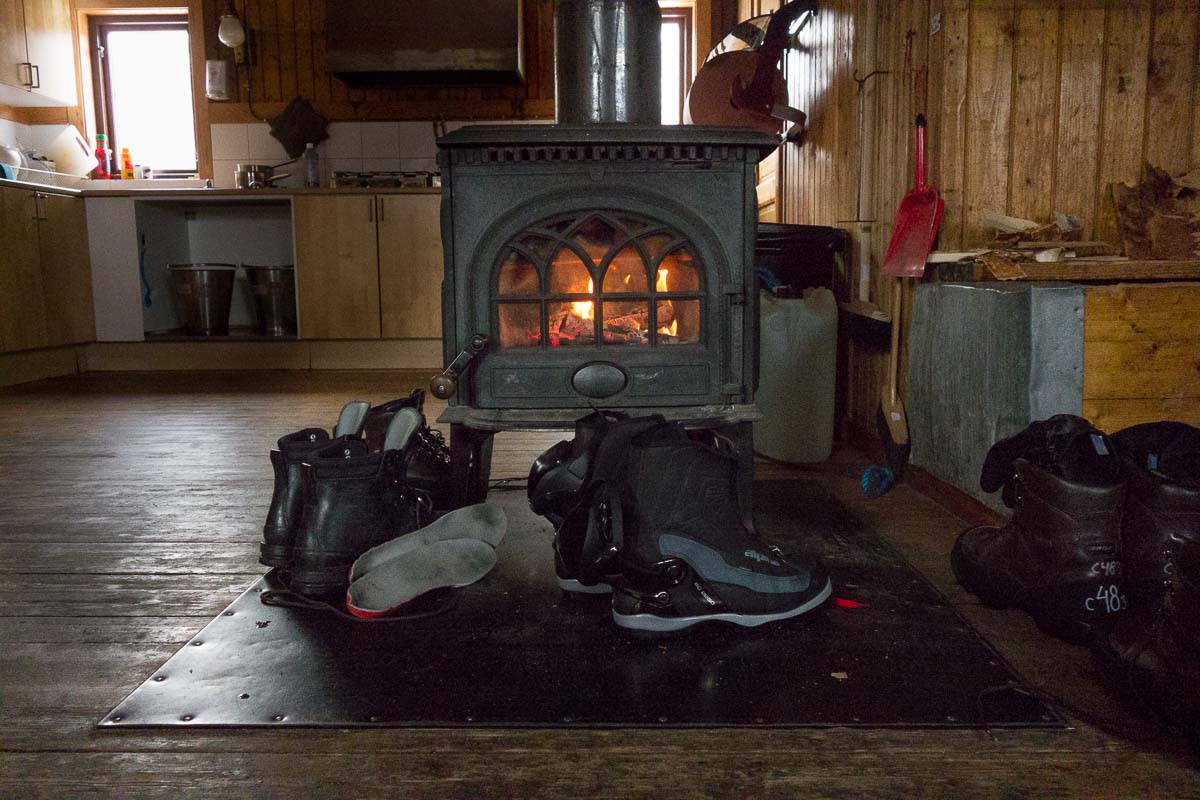
An easy day: short, and gently downhill pretty much all the way. But the blizzard stayed with us for another day and for the first half of the day, visibility was crap again. We skipped lunch break entirely and ate our sandwiches when we got to our destination for the day. Our only snack break was spent crouched up between a large rock and the drifts of snow that had accumulated around it.

Speaking of snacks, I’ve come one step closer to finding the ultimate winter trail snacks: Skotte bars. (Viennese) nougat with raisins and chopped nuts, covered in dark chocolate. They are less chewy and faster to eat than Raw Bite, which is otherwise my preferred trail snack, and unlike many other, more popular chocolate bars they contain no toffee that becomes inconveniently hard in cold weather.

Hot drinks are almost more important than snacks. Last year on the Kungsleden we stayed in self-service huts where we made our own drinks, just like we made our everything else. Here in the fancy schmancy Norwegian DNT huts, the staff make hot drinks for you. At exorbitant Norwegian prices (40 kr per thermos flask!) but on the other hand there’s a whole menu to choose from. Coffee? Tea? With milk or sugar? Or even hot blackcurrant cordial for those who, like me, prefer non-caffeinated drinks.

Lunch is packed sandwiches that you make yourself, from the materials in the breakfast buffet. Also at exorbitant Norwegian prices: 17 kr per slice of bread, which means 70 to 100 kr for a sandwich lunch where I’ve done almost all the work myself.

By now I’ve settled into this whole skiing thing. I have re-found my ski technique. I’ve figured out how to best organize my pack so that I can easily access everything I may want during the day’s skiing.

The muscles that were sore yesterday are getting used to being used hard. (I’d expected some soreness in my hamstrings and hips and glutes, but I was surprised to notice how tired my forearms were yesterday evening. I guess I’ve been gripping the poles too hard.) The small blister on one toe, due to tensing my foot when pushing off, is in retreat now that I’m taking care not to tense that foot any more.

It seems I am quite a bit stronger than last year. Thanks to my twice-weekly circuit training and regular day hikes, I guess. Most of the time I do not feel my pack at all – if it weren’t for all the straps, I’d forget it was there. When I checked it in for the flight, it weighed in at about 9 kg. Minus the clothes that I’m now wearing rather than carrying, plus a litre of drink, it should be just under 10 kg.

We arrived in early afternoon, which left us with hours of time to kill. The weather had improved, and one of the guys went out for some more skiing. I thought of joining him but hesitated and missed my moment. So instead I went for a brief photo walk with another guy. It was a pleasant mini-hike, but afterwards in the evening I had trouble falling asleep, because I hadn’t tired myself out enough during the day.


Day 2: Gjendebu to Leirvassbu, 21 km.

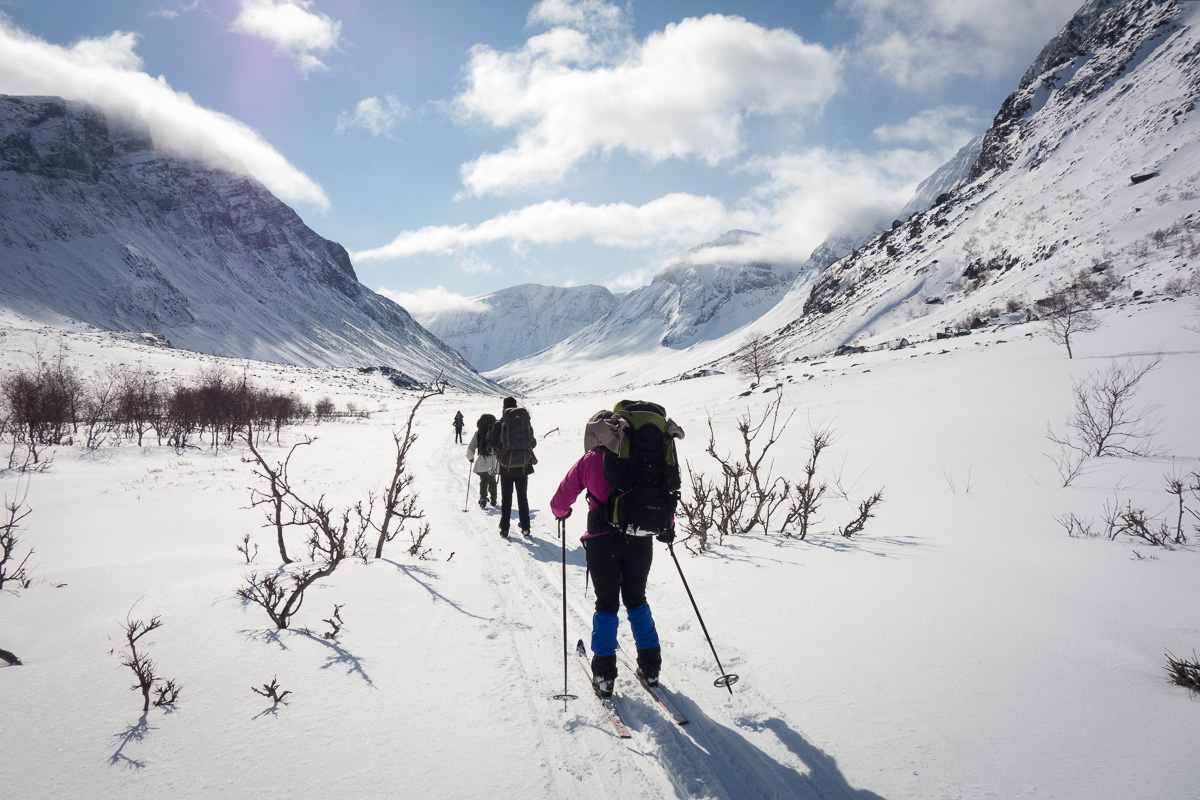
From Gjendebu hut right on the shore of Lake Gjende we headed upwards, first through scrubby, sparse birch and juniper forest and then onwards above the tree line into fells/fjäll: snow, mountains, a line of sticks to mark the trail, and not much else. Gradual ascent most of the time, except for one long lake (Langvatnet) and a few small ones – covered with snow, unlike yesterday’s lake – and one steeper uphill section next to a waterfall.

The morning started out cloudy, but the weather gradually got worse as the day went on. High winds and fine, stinging, icy snow made the going rough and meant that most of the time we couldn’t see anything of the presumably beautiful landscape around us. Just snow. Occasionally the clouds broke and we got beautiful views for a few brief minutes, and then it was back to blizzard again. Our lunch break was a hurried, huddled affair in the lee of a tantalizing locked hut.

I found the adverse weather perversely enjoyable. There was something oddly exhilarating about being opposed by something as implacable and impersonal as a blizzard, and still going on. The blizzard was infinitely stronger than I am, but at the same time I was stronger than the blizzard.

I could of course only stand up to the blizzard because I protected by a combination of ancient and modern technology. Wrapped in a layer of windproof Goretex all over, with a wool top, mittens, buff and hat to keep me warm, and goggles to protect my face. I’m not too fond of wearing goggles, but I’ll take them over eyecicles in my eyelashes and tears streaming down my face, any day.


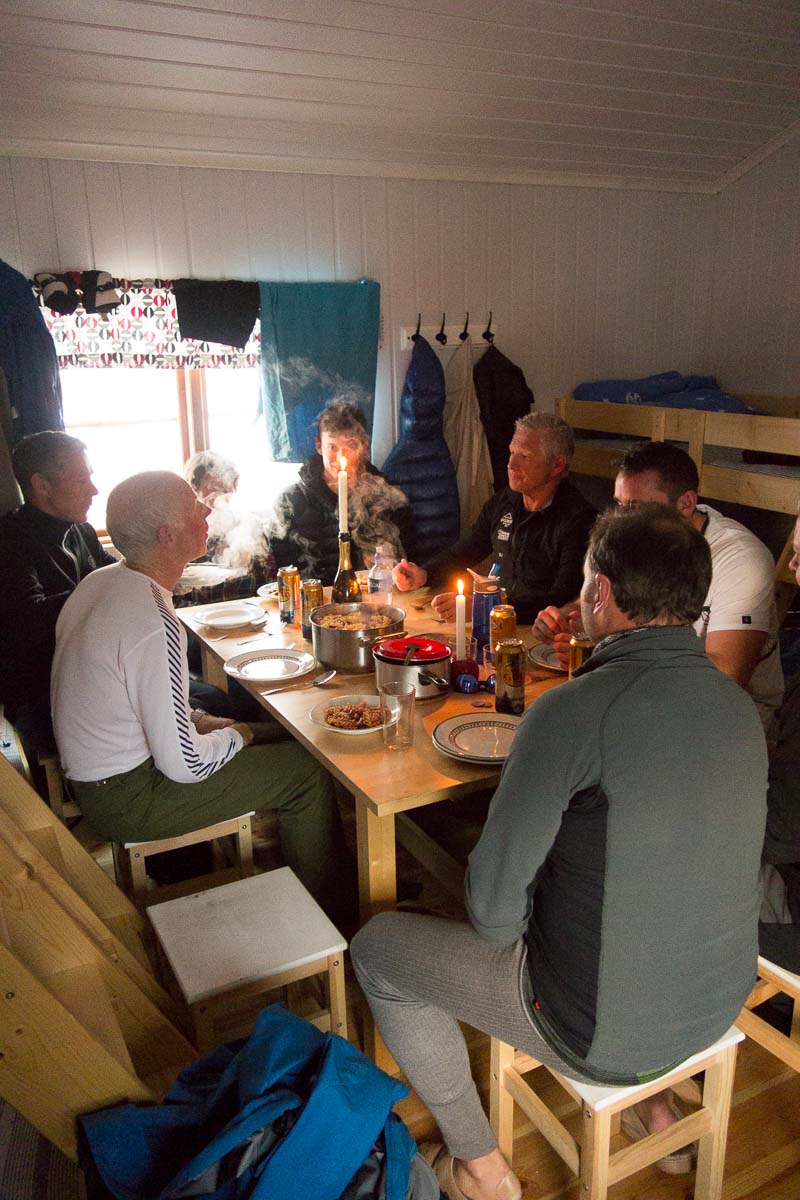
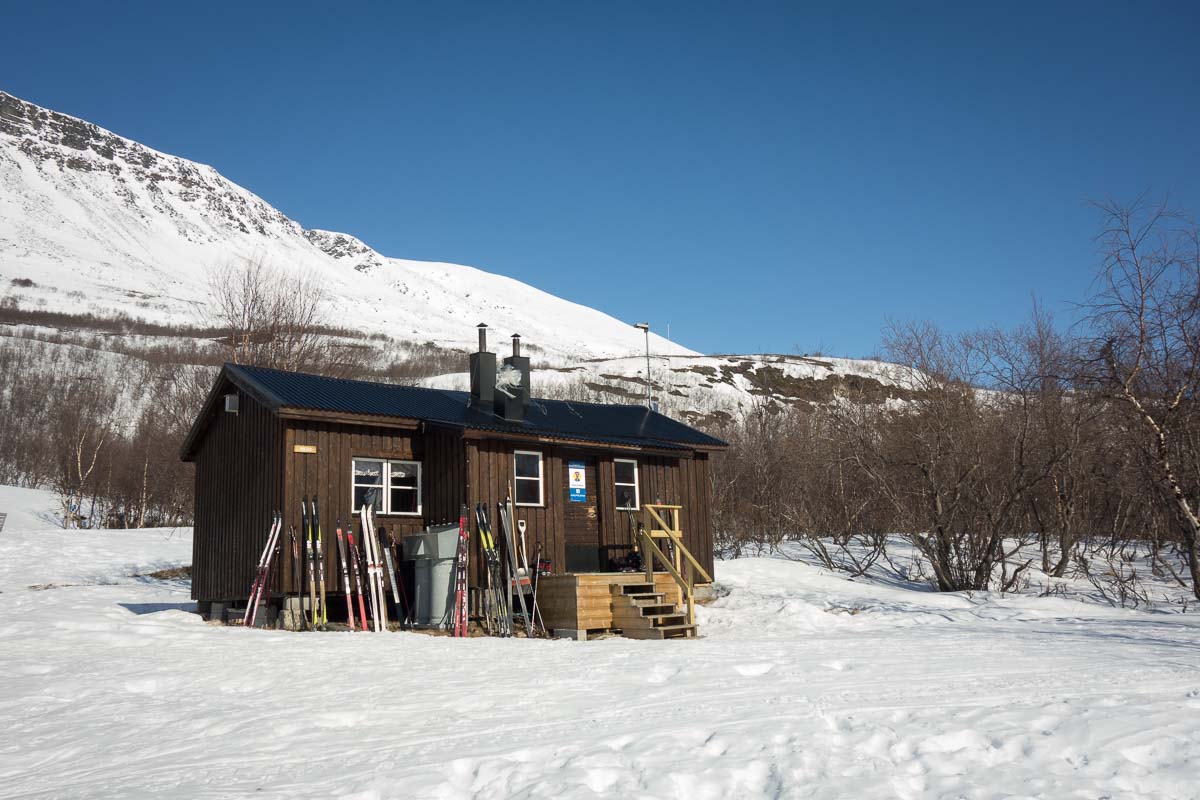
The day ended at Leirvassbu hut. “Hut” is almost an insult to what was basically a hotel in the middle of wilderness. All of the huts on this year’s route are full-service huts with all kinds of comforts, including electricity, hot showers, restaurant dinners etc. But this place is one step above the rest, especially its restaurant. (Waffles! Espresso!) The decorations in traditional style stood out as well – the other huts have been much more utilitarian in style. It even had phone network coverage, so once we’d gotten out of our gear and had our showers (which are always the first priority when we reach a hut) the gang headed straight for their phones and beers.


Day 1: Gjendesheim to Gjendebu along the frozen Lake Gjende. 21 km.

Today’s skiing was icy, flat, and monotonous. Ice is not the most comfortable ground to ski on. Most of the group described this as their least favourite kind of skiing; I actually quite liked it. You say monotonous – I say meditative.

For this year’s trip I bought my own equipment. I would have enjoyed last year’s trip a lot more if I hadn’t been struggling with the rented skis. Even though it took me a while to find my “skiing legs” and technique again, I could feel from the very start that these skis will work for me. This year I was not at the tail end of the pack, struggling to keep up. Not the fastest either, but that’s as expected, given the composition of the group. (8 strong men with (ex-)Army physique, 1 lady who goes skiing every weekend near her home in Geneva, and then myself and another “ordinary” lady.) I don’t mind being among the slower ones, I just want the skiing to be enjoyable rather than frustrating.

The clear air and wide vistas made it quite hard to judge distances. Sometime in the afternoon I spotted a thing that looked man-made. A shed belonging to tonight’s hut, I thought – the hut itself is probably behind a spur of the hill, like the place where we stopped for lunch. A few kilometers away perhaps. But after the next hour or so of skiing, the hut looked barely closer – it turned out that the “shed” I saw was in fact the whole hut complex, and quite a bit more than 2 km away.


I’m off for a week-long ski tour today. Last year I toured a part of the Kungsleden; this year I’ll be skiing in the Jotunheimen natural park.

Otherwise it’ll be pretty much the same. I’ll be travelling with the same company, and half the group are the same folks as last year.

Yesterday was packing and charging day. I pack light and leave most optional extras behind. Somewhat selfishly I assume that other people will be bringing stuff such as duct tape that could be good to have in an emergency, but is heavy and unlikely to see any use. The two heaviest parts of my pack will be (1) electronics (phone, camera, Kindle, charger, extra batteries) and (2) food and drink (thermos, water bottle, snacks). Learning from last year, I’m bringing an extra camera battery and compensating by packing fewer extra clothes.

Today is transportation day: commuter train, Arlanda Express, Norwegian flight to Oslo, and then a 4-5 hour car ride to Gjendesheim hut.

Kebnekajse mountain station to Nikkaluokta (19 km).

Scrubby birch forest, initially slightly downhill and then flat across lake Laddjujavri and the marshes around it.

This was an optional day of skiing; we had the option to be transported to Nikkaluokta by snowmobile. About half the group chose the option to ski, while the other half lounged around the mountain station for half the day and the motored down to Nikkaluokta in (probably) about half an hour.

The extra skiing must have seemed like an unnecessary hardship for the stayers (primarily the two beginners among us, and the guy with the worst blisters). But to me it was the easiest, most effortless skiing I had done all week. For two reasons.

One: minimal pack. Since the others were going by snowmobile, we could empty out almost everything from our packs except what we would or might need during the day (water, snacks, down jackets, extra mittens). I had already gotten a taste of what it feels like to ski with a light pack yesterday: the “blister guy” skipped skiing and paid for a snowmobile trip, and I gave him some of my heaviest stuff. It definitely made a difference – I found it easier to keep up with the group. An extra incentive to keep my pack light next time!

Two: better skis. At Kebnekajse in the morning some stranger had mistakenly grabbed my skis and left another pair behind. I could guess which ones, but I didn’t want to just take them because I could well be wrong. Instead I borrowed a pair of skis from another member of our group, who in turn borrowed from one of the snowmobilers, so both of us got skis of almost-correct length, just slightly too long. But the skis I got were of a different brand and felt very different.

The rental skis were a pair of Åsnes Amundsen. Not a bad model, according to a review I read afterwards, but totally unsuited to me. They have a stiffer span than most skis, and that just did not work for me at all. I don’t know if it was because of my technique or my weight or a combination of the two. In any case, I really, really struggled with getting a grip on them: I just glided back with each step, especially when when going gently uphill, and especially when the snow was cold and hard. Thursday’s trek from Vistas to Nallo and the rise just after Nallo was no fun at all: part of the way I was literally swearing at my skis with every single step, because it was either that, or give up and cry.

The skis I borrowed today were a pair of Fischer 78. And what a difference! Better grip, better glide, better stability – a pure joy. I felt like I was flying along on them. No longer at the back of the group, struggling to catch up – now I was easily keeping pace with the others and even getting ahead at times. If I ever do this again, I will absolutely buy my own skis, fit for my weight and skill level, rather than make do with a standard “fits everybody and hence nobody” model.


And all of a sudden we were at Nikkaluokta. Pack up the skis to post them back to Abisko; have lunch; wait for bus back to Kiruna. It was a shock to take in noise and diesel fumes from the bus. And then back to everyday life.

Sälka hut to Kebnekajse mountain station, almost but not quite via Singi hut (26 km).

We are now back on the main Kungsleden trail, with red crosses to mark the trail, occasional snowmobile traffic etc. Just before Singi we left the main trail for a short while to cut off a corner, skipping the descent to the huts, and then rejoined the Kungsleden again slightly further to the east.

From Sälka to Singi things were still relatively quiet, but after Singi we were clearly approaching civilization again. The trail was wide and numerous skiers and snowmobiles had left their tracks. It was slightly downhill, and many sections looked like scaled-up corrugated cardboard: down and then slightly up again, repeated over and over. We pitied the few groups who were skiing the same section in the opposite direction, going up all those downhill sections.

My camera ran out of juice in the morning so the only photos I have are from the afternoon when we had reached Kebnekajse mountain station and its electrical outlets.

A mountain station is a hybrid between a hut and a hotel, which meant all kinds of luxuries: electricity, running water (showers!), a restaurant, fresh food, rooms with real beds and so on.

But getting back to this spot of civilization also meant that our trip was almost over. We were about to leave the peace and quiet behind and go back to crowds, noise, smells, stress, and all that. I felt sorry that it was coming to an end.

People go on hikes for different kinds of reasons. I tried to untangle my reasons and figure out what I actually get out of this kind of trip.

There are of course the general benefits of a well-planned and well-organized all-inclusive group vacation. I am not responsible for anything or anybody other than myself. I do not need to plan, prepare, manage, schedule or prioritize anything at all. This is a welcome change from my everyday life where I manage something almost all day long: a team at work and a household at home.

When it comes to hiking in particular, I like the physical challenge: exerting myself just enough, feeling my body do what it is supposed to do, and do it well.

I like the beauty of nature. I particularly like mountainous landscapes, and especially if there is also water of some kind. There is something special about mountains, about being above the world.

But above all I like the serenity, the peaceful silence, the lack of people and noise. I need this kind retreat into nature at regular intervals. Even just a few hours in a forest near home works, but this was of course many miles better. The snowy emptiness here was a bit extreme when it comes to serenity, but at times I wished that it could have been even more so: I wished I could have done this alone, to truly be away from people and not see a soul around me.

With these points in mind, this was a good hike but not the best one ever. An ideal hike would have had:

  • More beautiful weather, with some blue skies.
  • Slightly slower pace. Both in general, so I could relax more and not have to think about keeping up with the group, but also because it would give me more opportunities to take photos, perhaps even leave the path for better angles and views.
    This is of course a very personal preference and difficult to achieve when hiking with a group – if the whole group had to wait each time someone wants to take a photo, it would get annoying fast for the others. The group cannot spread out too far either, especially in winter when getting lost can be life-threatening.

Vistas hut to Sälka hut via Nallo (19 km).

From Vistas to Nallo we followed a broad valley. According to the map there was a river or stream at the bottom of it, as I think is the case for all valleys here. I saw no signs of it, but we stayed on slightly higher ground nevertheless. After Nallo hut there was a steep rise into Stuor Reaiddavaggi. Then we passed through the valley and crossed another invisible frozen lake.

There was something in this valley that encouraged us to spread out a bit, rather than skiing in each others’ tracks. Perhaps it was the broad even lower slopes, or maybe the snow conditions made it easier to ski on fresh snow. (We had a cold night and this morning started out colder than the previous days, so the snow was icier.) In any case, I found myself skiing in fresh snow with nobody else immediately near me.

It was so quiet. All I heard was the swish of the skis against the snow, and the creak of the poles as their angle against the snow changed with my forward movement.

Swish/creak. Swish/creak. Swish/creak.

Up in the pass, the world was even more empty and monochrome. I fell behind the others, and at times neither saw nor heard anybody or anything else. This high up there were no signs of life, no trees or ptarmigan tracks. The mountains on both sides of the valley rose gently so they were blanketed by snow, with rocks only peeking through here and there. The sky was equally white, and clouds hid the rest of the world from view.

At times the whole thing seemed unreal. There was nothing for the eye to hold on to. Everything around me was so white, so empty and quiet that it was hard to believe it existed. I felt like I was outside the world, in a dream.

At the other end of the pass we descended into a broad valley with Sälka hut in the middle of it, like tiny specks of coal in an endless expanse of snow. The light was very flat so it was hard to see where we were going. Everything looked the same, but wasn’t: several of us fell when we were taken by surprise by a shallow snowdrift or depression that just could not be distinguished from the rest of the whiteness.

Approaching Sälka hut

Alesjaure hut to Vistas hut (18 km). We left the main Kungsleden trail for a detour to Vistas, along Visttasvaggi valley and Visttasjohka river.


I wouldn’t exactly describe the Kungsleden as crowded, not while we were there. The opportunities for meeting people on the trail are relatively limited – this route is usually done north-to-south so you don’t normally meet people going in the other direction. You’d have to leave the hut at the same time, or take a lunch break at the same time (because most sections of the trail have exactly one obviously suitable resting place) – or be overtaken if they are going significantly faster than yourself (or vice versa).

Nevertheless we saw a few people yesterday: two skiers who were just leaving the shelter as we stopped there for our snack break, and a group of three whom we passed on the way up to the pass.

Today it was just us and the snow and the mountains. No people. No snowmobile tracks. No trail to follow. No trail markers, even.

We had no shelter for our lunch break either, so it was lucky for us that we had better weather today: sunshine and not much wind.

Skiing is sweaty work, so you don’t wear much: even though temperatures were below zero all week, I just wore a thin wicking top and a Goretex jacket, with no middle layer. But as soon as you stop, you start to cool down. When its windy, nobody wants to stand still for any more than a moment, just enough to do whatever made you stop (most likely: drinking, or taking a photo, or adjusting/putting on/taking off your goggles/sunglasses/mittens/hat/scarf). If you stop for more than a few minutes, you need to put on an extra layer, or more conveniently a down jacket.


The slope down into Visttasvaggi was the steepest downhill section of the path, not only today but of the whole week. It was nowhere near as steep as even a blue piste for alpine skiing, but much more challenging. It was uneven and unpredictable, with powdery snow and icy snow, bumps and hollows, all mixed up, and you couldn’t really see any of these in advance before hitting them with your skis. It took our group a fair amount of time to get down, and a fair few falls.

This was the most fun I had skiing all week. I am bragging only slightly when I say that I got down with no falls and even some style.

The valley after the pass was a bit stony and with a sparse birch forest. We crossed and re-crossed the icy river in places that seemed solid and luckily were solid. We saw lots of tracks of some animal that we at first couldn’t identify, but later realized must have been not an animal but a bird (ptarmigans).

Today’s hut, like today’s skiing, was beautiful and simple and clearly off the beaten path. No solar panels and antennas here! Just Bosse, our friendly host. The huts and the rooms were much smaller than the previous ones, with one small room for everything – bunk beds, table, stove, and barely any room between them.

Since the Vistas hut had no electricity, Bosse also had no contact with the outside world. Nevertheless he had heard (from some unknown source at some unknown time) that there might be another large group coming for the night, and for a while it looked like we might need to double up in some of the wider bunk beds. The huts never turn anyone away – they make sure everybody gets a roof over their heads for the night, sleeping on the floors or wherever. In the end the other group never materialized and each of us got a separate bed after all.

Unlike the huts on the main Kungsleden trail, which were supplied by snowmobile throughout the season, the Vistas hut was stocked once at the beginning of the season (late February) and those supplies had to last until the end of April. We bought the last tins of mackerel in tomato sauce that Bosse had and counted ourselves lucky.

The Vistas hut also had the smallest and most low-tech sauna yet: no separate washing room and no drains. The sauna simply had an uninsulated floor with slight gaps between the floor boards, and any water you poured over yourself just drained out through the floor. Despite its simplicity, the sauna was very pleasant, but it was also blazing hot and I didn’t stay for long.

Abiskojaure hut to Alesjaure hut (20 km).

Up from Abiskojaure lake into Garddenvaggi valley, then on alongside lake Alesjaure. At the time I didn’t even realize there was a lake there; I only discovered it on a map afterwards. Sparse birch forest to begin with, endless expanses of softly undulating snowy hills later in the day.

The winter route of Kungsleden is marked by red crosses on posts. (The summer route is not the same because of rivers and lakes.)

After a full day out in the snow, tired and hungry, the hut is a welcome sight. The STF (Swedish Tourist Association) huts are comfortable in a homey, rustic way. Most huts are actually a multiple huts: one for the host and a few for the guests. Plus a few other important buildings: a shop/reception, a sauna, a woodshed, and loos.

The guest huts have dorms of various sizes. Our group of 9 fit nicely into the 10-bed rooms which seemed to be standard. Each hut also had a kitchen, and often a drying room for clothes and boots.

Much of hut life is rustic and low-tech. There is no electricity. Huts have wood-burning stoves for heating and gas stoves for cooking. Water is fetched in large plastic jerry cans from an ice hole in the river or lake.

But there are small islands of surprising modernity. The shop/reception hut has a solar panel. This, together with a parabolic antenna, is used for two important purposes: (a) the host can communicate with the outside world, and (b) the host can accept credit card payments in the shop. No kidding.

There is a strong environmental awareness. Garbage is recycled even more religiously than I do at home. Whatever garbage has to be taken back to civilization goes down on snowmobiles only, and only on the return leg of restocking journeys, so there are no wasted trips.

The loos always seemed to be at the top or bottom of an icy hill, which made night-time loo trips extra exciting. An unexpected luxury in the loos was styrofoam loo seats. What an improvement over sitting on an ice cold wooden seat!

Train from Kiruna to Abisko tourist station. Rent skis. Ski from Abisko to Abiskojaure hut (15 km).

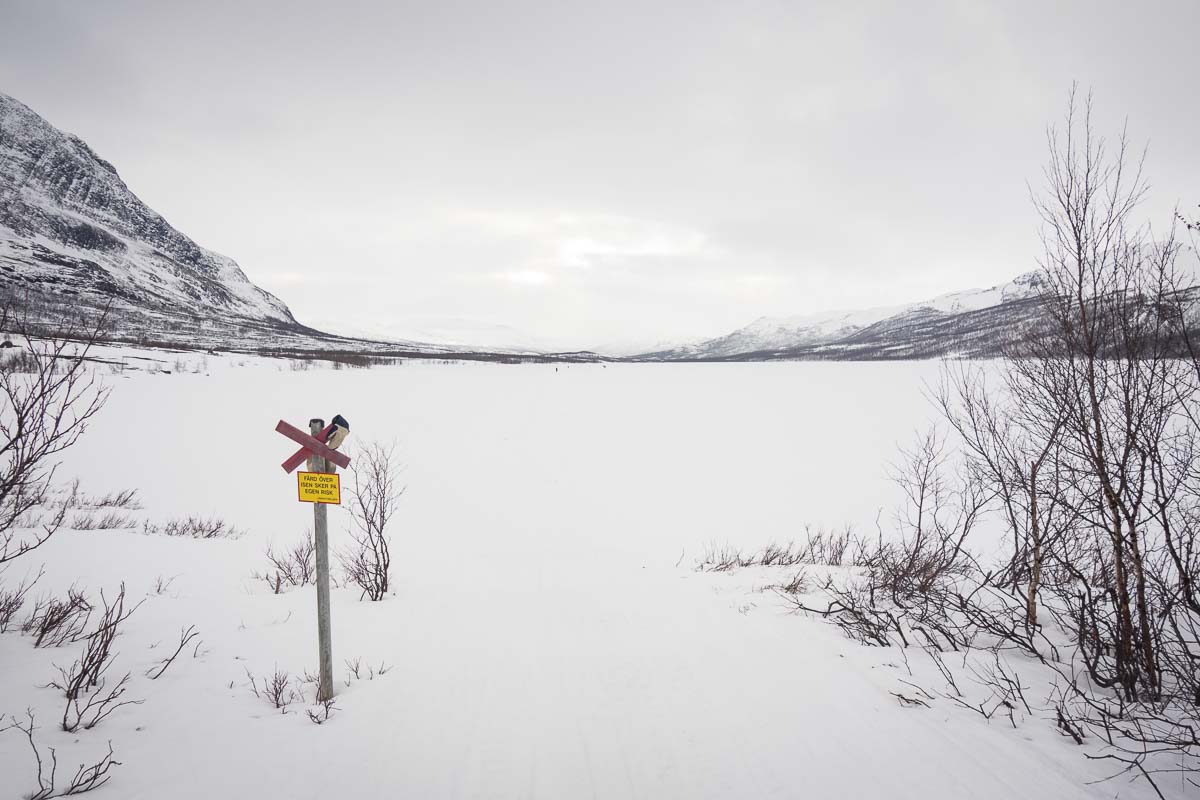
“Färd över isen sker på egen risk” / “Crossing the ice is at your own risk”

Leaving behind yesterday’s red planks, today we equipped ourselves with proper skis from the ski rental at Abisko tourist station (except those of us who brought their own). By the time we were done, it was already time for lunch. (Abisko tourist station serves great lunch, even for vegetarians, especially considering the remote location.) After lunch we packed away the last loose things, tightened the last straps, crossed the road and then we were off.

The skiing was initially as wobbly as I had expected, especially going downhill. I was quite focused on the skiing, busy trying to remember how it was supposed to feel and how my body was supposed to move, and didn’t pay much attention to my surroundings.

Snowmobiles are allowed on this part of Kungsleden, and they had been using it a lot. Especially the first half of the track was mushy and slushy and churned up – not the best to ski on. The best I could achieve was a kind of a plodding shuffle, or perhaps a shuffling plod, rather than any kind of gliding motion.

At first the trail passed through a sparse birch forest, with small hills and a frozen river. There were mountains in the distance, but nothing spectacular to look at, especially since the weather was dull and cloudy.

The last part of the trail went across the frozen lake of Abiskojaure: flat, featureless, somewhat icy – and windy. Not exciting, but (unlike most of our group) I actually liked the lake better than the preceding part of the track because I could finally put on some speed. At the far end of the lake was the Abiskojaure hut where we would stay the night.

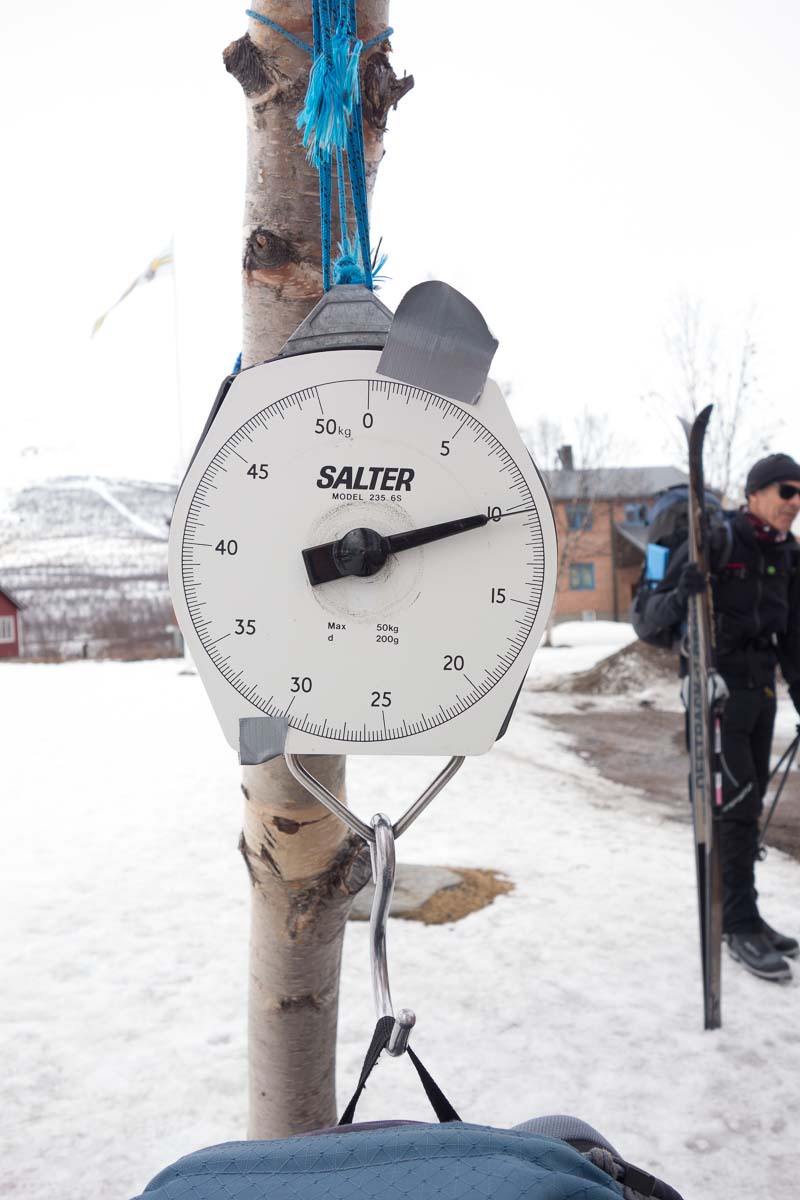
Outside the tourist station where we started, there’s a large wooden tripod with a scale for weighing your packs. We all weighed ours. Mine came in at just a smidgen over 10 kg. It was the second lightest pack in our group, which was a very good thing since I was the weakest skier. And it was the smallest one too: I got it all into my 35+8 litre rucksack.

I could have lightened the pack some more, but not by much, if I had been a more experienced hiker/packer. The heaviest two things in my bag were my thermos flask and my shoes, and there was no leaving those behind. But I could have left behind some other things:

  • Soap. Outside I was wearing gloves or mittens all the time and had no opportunity to get my hands dirty. Indoors in the kitchen there was water and kitchen paper rolls. There was even hand sanitizer in the loos.
  • Extra meals. I brought two freeze-dried meals in case any of the huts didn’t have vegetarian food. That was not a problem, but I ate the meals anyway because some days I was just too hungry to wait for dinner. But I need not have brought my own; I could have managed with something tinned or a packet of noodles from the hut shops instead.
  • Extra tops. The wicking tops didn’t get too smelly even after several days of use; I could have managed with just two (one for skiing, and a clean dry one for evenings).
  • The thick fleece top. A thinner, lighter one would have been enough.

Beyond that, I’d be cutting into things like shampoo and toothpaste, clean underwear and fresh socks, which I could have survived without but would really have missed. I want my hiking vacations to feel like vacations, not a week of deprivation. For this reason, there was some heavyish stuff in my pack that I will not leave behind next time either.

  • Raw Bite or other trail snacks. They are rather heavy, but I see no good alternative. All the manned huts did have shops with tinned food and pasta and such. They also stocked potato chips and peanuts, chocolate, sweets, soda and beer – but nothing that I would describe as a healthy snack. A Snickers bar is not a snack.
  • A Kindle. There is nothing to do in the huts in the afternoons. Most huts had some books, but it was all boring Swedish detective stories. Some people played solitaire for hours each afternoon. I got through two whole books on the Kindle I borrowed from Eric, plus one paper book in one of the huts. I would have been bored out of my mind without it.

There was only a single thing that I didn’t bring but wish I had.

  • Extra camera battery. Normally the battery lasts a long time, but in the cold up there it ran out unexpectedly fast. It didn’t even last me half the usual time.