Eric and I have turned into quite keen walkers over the last couple of years. We haven’t been doing much of it since Ingrid’s birth, but when we started feeling that a holiday would sit well before Christmas, we thought we’d try again. (Our other favourite holiday activity, diving, seemed much less suited to a toddler.) I rather fancied some sun so we aimed for some place warm rather than a wintery location. We ended up going to Gran Canaria because it’s really the closest place to Europe where you can get good walking and reliable good weather this time of the year. (Madeira, our #2 option, failed the second condition.)

Indeed we got a week of consistent sunshine (except for a few slightly cloudy afternoons, and a slight misting of rain one morning before we set out). The temperature was a pleasant 20+ degrees in the sun, dropping, I think, to around 15 in the shade higher up in the mountains. Warm enough to walk in t-shirt, but not so warm that the heat becomes a burden. (The evenings and mornings felt distinctly chillier and we were happy to have our fleeces and warm socks then.)
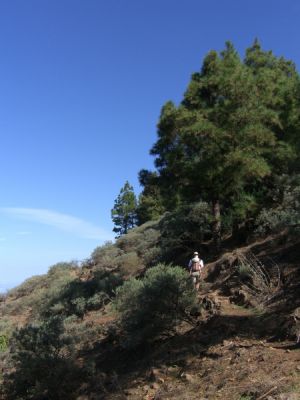
Pine forest and shrubs

I had previously pictured the Canary Islands as quite a beachy place, not really as a destination for a walking holiday, but it turned out that the interior of Gran Canaria is full of eminently walkable mountains, ridges and valleys. The landscape is very volcanic, with much exposed rock and steep slopes, and quite arid. The general feel is sort of a mixture of African desert and Mediterranean hills: cactuses, various shrubs and large aloe plants on the lower slopes, and pine forests higher up. The pine forests seemed familiar at first, but a closer look showed them to be quite different from Northern European ones. Not only were the pines strange, with very long needles and very large cones – the forest was very uniform, and almost a complete monoculture. The pines were all the same shape and size and bright green in colour and the undergrowth was limited to just a few shrubs. It almost looked artificial.

While the landscape in Gran Canaria isn’t as breathtaking as, say, the Dolomites, there was still enough variety and striking landscapes to make every day’s walking interesting. Eric and I concluded that the missing ingredient that would have taken the whole thing closer to breathtaking was colour. This was the end of the dry season, so the colour scheme was brown / beige / green across the board. A bit of snow would have helped – or some flowering plants. I imagine that the islands would look better in February–March when things are in bloom.

The other missing part was animal life. There were butterflies and a few birds, but most of the time everything was very quiet around us.

It was also quiet because there were not many people around. Since the Canary Islands are mostly known for their sun and beaches, the interior gets very few tourists, most of them day trippers from one of the coastal towns. Because tourism is so important for the islands’ economy, and the mountains really aren’t good for many other productive uses, the government is focusing on getting more people to spend more time in the mountains. (The only other possible activity in the mountains is small-scale agriculture. But the slopes are so steep that they have to be terraced for farming, which excludes most farm machinery, so the plots are all tended by hand.) So there were well-maintained paths in many places, and the information centres were up-to-date and in good shape. Nevertheless even the most popular spots (like Roque Nublo) were far from crowded, and on some walks we didn’t see a single other walker. We liked that.


(To be continued.)

Here are some pictures from our Lake District trip. Nothing spectacular; visually this wasn’t a very memorable holiday. Scotland was more impressive (4 years ago). And despite the name, there were far more hills than lakes!

I was surprised by how barren the hills were – they’re not particularly tall, but for some reason there were hardly any trees or bushes – due to the soil, maybe, or the wind? And because we went in early spring, the views were mostly of brown hills covered with dry grass and dead bracken. It probably looks greener in the summer, but it must still be pretty empty.

Down in the valleys, the walled-in meadows were green and dotted with sheep. It was lambing season, so the meadows were full of lambs, ranging from newborns who could barely stand, to restlessly prancing and skipping ones, and finally those that had already started to settle down, grow up and eat grass. I don’t know what they do with the lambs to make them so cute!


Sunday was our last full day, so we wanted a full-size walk again. On the other hand we were a little bit tired after the previous day’s walking – both of us somewhat out of shape, not having had much exercise in the past couple of weeks – so we didn’t feel up to anything too ambitious. Eric didn’t want any too steep descents as his knees were bothering him a bit. The walk up to Dale Head and Robinson (Duerden #19) seemed like a good compromise: two little peaks and lots of easy ridge walking, totalling 12 km and 860m ascent. Most of the walk can be seen on the map here.

The first quarter or so of the walk, starting in Little Town, was a nice and easy flat bit in a valley between two ridges. Then came the ascent, all concentrated into one long and steady, but not too strenuous uphill march. During the ascent the wind grew in strength, as we came out of the protected valley. When we reached Dale Head the wind was absolutely ferocious – we covered every bit of exposed skin except our faces to try and protect ourselves, and had to lean hard into the wind to stay upright. Our hoped-for lunch break near the top with beatiful views was cut very short because the wind was just too cold. There were even a few patches of snow up there, even though it wasn’t a particularly tall hill. In fact the top of Dale Head, the highest point during the walk, was by far the least enjoyable moment. But the views were impressive. The ridge walk from Dale Head to Robinson was a lot less windy, more sunny and more comfortable. The ground went from rocky to grassy, and was very pleasantly bouncy-soft to walk on. This continued all the way along the rest of the ridges, even though the wind picked up again occasionally.

Monday morning was rainy. This probably wouldn’t have stopped us if it had been our first day, but after two full days we were not as eager to walk any more, so we abandoned our initial plans for a shorter walk and just went for a drive: first up to Keswick, and then the loop along B5289 past Derwent Water, Buttermere and Crummock water. This passed just south of where we had walked on Sunday, giving us a different perspective of the hills we’d walked on, as well as of the views we’d had from up there. We stopped at the highest point of Honister Pass, just below the hills, to take a few pictures, and were again almost blown off our feet by the freezing wind, and hurried back into the car as soon as we’d snapped our photos.


Photos will have to wait a week or so, as I’m about to leave for New York to spend the week in our NY office.

Easter is a 4-day holiday in the UK – both Friday and Monday are free. Eric and I have a bit of a tradition (all of five years now!) of using the Easter weekend for exploring beautiful parts of Britain. We’ve been to Scotland, Cornwall, Wales, Isle of Wight, and now this year the Lakes.

As usual, we took the train to roughly the right part of the country, and then rented a car. If we owned a car, we’d probably feel obliged to drive all the way from London, and back again, which would be exhausting and take forever, since half of London probably heads out of the city for the long weekend. But since we don’t have one, we can relax in a comfortable train seat for a few hours instead, and leave the traffic jams to others.

We stay in B&Bs most of the time. In the past we’ve just printed out a list of potential B&B places and had no firm plans at all. Every day around midday we’d decide roughly which direction we would go in the afternoon, and where we might end up for the night, and called around until we found something in the area. It’s always worked well. This time we planned to do less driving and more walking, and were happy to stay in one place all nights, so we actually booked in advance – and besides, the Lake District is a bit more popular for holidays than Scotland for example. In fact, if we hadn’t, we might well have had trouble finding some place to stay. Almost all places we passed had their “No Vacancies” signs out. We stayed at the Elder Grove in Ambleside. Nice place, and quite professional – I’m not even sure why they call themselves a B&B and not a hotel. Very decent breakfast (home made jams!) and very helpful hosts – they even helped us find a veggie restaurant nearby.

In addition to a car and a roof over the head, a walking holiday requires maps and/or books. We had two books this time – one Pathfinder Guide to More Lake District Walks with what looked like relatively leisurely strolls, and Frank Duerden’s Best Walks in the Lake District, which seemed to have slightly more demanding walks. Duerden did have more interesting walks, in general, but its maps were horrible. All in black and white, they use his own symbols instead of conventional ones, and they only show features that lie directly along the path, i.e. walls, streams, hedges etc. There is no context, apart from crude contour lines – for a circular walk the middle of the circle is left blank on the map! This makes navigation far harder than necessary, because it ignores most of the surroundings, including such obvious navigation aids as peaks and ridges. Luckily I had also bought OS Explorer maps for most of the Lake District region, so we didn’t have to rely much on the book’s maps. Apart from our first walk, we only used them to figure out the general plan, and then used the OS maps and the book’s description to find our way.

The Pathfinder book on the other hand had detailed Ordnance Survey maps in full colour, and could be used without any additional maps at all.

We had a soft start on Friday, with a long drive and two short walks. In the morning we drove from Ambleside towards Wast Water, over Wrynose Pass and Hard Knott Pass. Interesting roads, to say the least! Very twisty and with 30% slopes. We then walked around the south end of Wast Water (Duerden, walk 4) and in the afternoon around Dunnerdale Fells (Pathfinder, #17). Both pleasant enough but not very memorable.

Feeling all warmed up, we undertook a slightly longer walk on Saturday: Place Fell and Ullswater (Duerden #17). 13 km and 700m of ascent, rough map here. From Patterdale (which is just outside the map, in the south) across the small river to the farm, then up to Boredale Hause, then up up up to Round How and on to the top of Place Fell. Then slowly descending towards the northeast while passing some smaller peaks, dropping down to Sandwick, and ambling back along the coast of Ullswater. The paths marked on the map are pretty close to where we actually walked. Good paths and good views, and the lakeside path back was very pretty – but the landscape up on the fells was pretty desolate.

Almost nicer than the walk itself was, again, the road there and back through Kirkstone pass.


It’s well past bedtime here so this will have to do for today. More to come soon, including photos of course.

  • Get an underwater camera. I want my own pictures!
  • Get a dive computer. On our previous trips, the pressure gauge has had an integrated depth gauge, but this wasn’t the case this time. I like to know where I am and what I’m doing, so I didn’t find that acceptable and rented one. Based on the price they charged, I think buying one would pay for itself after just a few trips.
  • Get a good torch. Night dives are fun, and even more so with a comfortable and strong torch. The dive centre actually ran out of torches this time, and the ones they had were not that good. (Four torches for a resort that can house a hundred – I wonder how they thought that would work?) We tried a torch by Underwater Kinetics from their Sunlight range, and it was far better than the no-name option.
  • 12 kg of weight assuming a two-part wetsuit.

Diving is like visiting another world. You’re floating around almost weightlessly, drifting slowly, hovering. You can hold yourself in place with a single finger (if there’s no current) and move up and down just by breathing in and out.

The best part, and the main joy of diving, is the fish. On dry ground you can’t get very close to anything more exciting than a beetle – as soon as you approach, all wildlife flees. Fish don’t. Perhaps they’ve learned that divers are harmless, or maybe they just don’t care. You can float through a school of goatfish, and they just let you pass. Or you can be nose to nose with a damselfish and they take no more notice of you than of a lump of stone. (Unless you get too close to their anemone, at which point they turn towards you and try to scare you away by determined posturing – which is quite funny when the fish is smaller than your hand.)

This part of the Red Sea, around Marsa Alam, had somewhat less fish than the reefs we saw near Hurghada and Sharm-el-Sheikh. Less in terms of density, that is, not in terms of variety. We bought a thorough guide to Red Sea fish last time and this time I tried to write down all the different species we spotted and were able to identify. All in all my list for this trip had over 80 species.

Clownfish

The range of species was slightly different, and different species dominated. Lionfish were more common than in Northern Red Sea: seeing a lionfish was a big thing on previous trips, whereas here we might see half a dozen on a single dive. The same with masked puffers and picassofish. Butterflyfish, bannerfish, groupers and damselfish were everywhere, as usual, and various surgeonfish and wrasse were common.

One difference compared to previous trips was that we saw more juvenile fish, probably due to the season. Adult clownfish / anemonefish (like Nemo) are the size of my palm, roughly, so baby anemonefish are really tiny! The smallest ones were barely larger than the tip of my thumb. They were also pale and semitransparent.

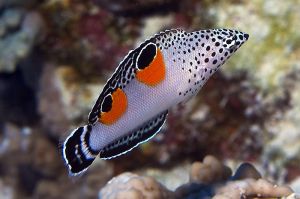
Some fish (especially some wrasses) change their markings completely when they grow up, so a juvenile doesn’t look anything like an adult version. The most extreme example I saw was the clown sand wrasse. Adults are large, greenish/black with a lighter vertical band, with a slightly ragged tail and a humped head. Juveniles on the other hand are white with black spots on the front half, and two large orange/black eyelike spots on the back. I wouldn’t even have recognised them as the same fish, if it hadn’t been for our book, and the help of one of the experienced divers in our group.

Clown sand wrasse – adult Clown sand wrasse – juvenile

Among the more interesting creatures we met were turtles. On one of the early dives on our first trip three years ago we saw one turtle pass in the distance. This time I saw two of them, up close. They turned out to be mostly like cows – placid and mostly interested in eating. One of them was, in fact, feeding on seagrass on a flat bit of sea bottom. Impressively large creatures, though, and it would be interesting to follow them for a longer while.

Stingrays were a dime a dozen in Marsa Alam – we saw them almost every day, mostly lying in the sand, not doing much. They are beautiful creatures, though. The manta ray we saw was a more impressive sight as it slowly “flew” past us: huge (at least 2 metres across), a very distinctive shape, and very majestic movements.

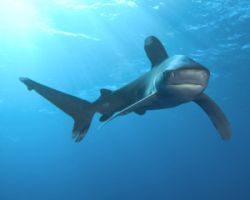
Oceanic white tip shark

Yet the absolute highlight, for me, was swimming with sharks. We went out to Elphinstone reef, which is further from the shore and in deeper waters. After 30-40 minutes diving along the reef we swum out “into the blue”, away from the reef, to see some larger fish. We didn’t have to wait long at all until the sharks turned up. To me they just looked like ordinary shark-shaped sharks, so to say, but I was later told that they were oceanic white-tip sharks. They looked every inch like predators and behaved accordingly, moving much faster and more alertly than the large fish we’d seen nearer the reefs. At first I found their closeness a bit unnerving, but as they just continued to circle around us, most of the time keeping a few metres’ distance between us and them, I got used to them and even felt a temptation to get closer (which I resisted). We had been told that the sharks don’t like to come too close to large groups, so we kept the group fairly tight. We also went up one by one, because a whole bunch of fluttering fins might otherwise attract the sharks’ curiosity and get us some bite marks on our fins.


The pictures in this post are not mine.

Divers have log books to log their dives. One of the points of this is that you can then prove how many dives you’ve done. It’s not a very secure system – your log book is supposed to be stamped by the dive operator, but all the ones I’ve met just hand you the rubber stamp and you do the stamping yourself. But I guess very few people would want to fake their dive log.

Standard log information usually includes dive location, length (in minutes), maximum depth, start/end time and conditions (current, visibility, sea/wind etc). I usually include a brief note about any other salient points (boat dive vs shore dive) but spend most of the space on what I saw during the dive. Even so, going back two years later I notice that I cannot really recall the dive. But this close after the trip, each dive is still fresh in my memory so the log notes are enough to bring back most of it.

We made 14 dives in total – mostly around 50-60 minutes long, with a max depth of ca 17–20m. The first two were at the house reef, and the very first one was mostly spent getting everybody’s buoyancy right. Buoyancy depends on all sorts of things – water temperature, how salty the water is, the size and material of the air tank you’re using, the type of wetsuit etc. Buoyancy is adjusted so that you can float if you inflate the BCD (= the vest) but sink slowly when the BCD is deflated. You do this by wearing lead weights – either threaded onto a belt, or in the pockets of the BCD. I vaguely recalled having about 6 to 8 kg on our last trip, and started out with 6 this time, but that turned out to be far too little – I just couldn’t get down under the surface. I ended up with 12 kg!

The dives were of all sorts: one day we went out for the whole day in a “big” boat, and did two dives from the boad. Another day we did the same in a speedboat. That was a very windy day so the small boat bounced around a lot – this was the first time I’ve really felt seasick, and I was very happy to get out of the boat and into the water. Even just a metre below surface everything was calm.
Some days we just walked in from the beach, and other times a small Zodiac dropped us a few hundred metres from the shore and we then slowly made our way back. Distances that seemed very small on the surface took surprisingly long time to cover underwater.

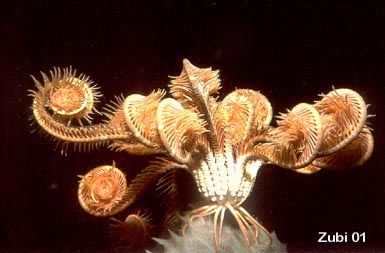
Feather star
A feather star (image borrowed via Google Images)

This trip had several “firsts” for us. We did our first night dives, at the house reef (or dusk/night, to be more precise). Just before 5 when the light started to dim, we had a Zodiac drop us a short way off the beach, and then swum back as it got darker and darker. And it got very dark indeed. When I was the last person in the group, I turned around and looked back, and despite a strong torch, all I could see was blackness. And the lights of the others’ torches became faint very soon – perhaps 10 metres or so would have been sufficient to barely see them. That was quite spooky, actually, so I made sure to keep close to the group. Wouldn’t want to get lost!

Otherwise, night diving was interesting but not spectacular. The colours looked different because the light source was close and didn’t have to filter through 15 metres of water. Many red corals and fishes looked a lot more interesting in torchlight. We did see a feather star. It was fully open when we noticed it, and curled up when we shone our torches on it. Other than that we didn’t really see much that we hadn’t already seen in the daytime. Maybe because it had only just gotten dark; perhaps the real night life comes out later.

We also did our first unguided dives. Previously all our dives had been planned and led by a guide, but this time some of the shore dives were so simple (follow the reef for half an hour, then turn back) that we ventured out on our own. It added some complexity: we now had to take care to keep an eye on the details (the time, how much air we had left, how deep we were) as there was nobody there to remind us. But at the same time it was actually easier in a way, because we only needed to keep track of each other and not worry about keeping up with the group or keeping an eye on the guide. Good practice in any case.

Around the beginning of December I started to get the feeling that some sunshine would be nice – it had been several months since last time. Since half the team at work were going to be gone anyway, nothing much was going to get done, so Christmastime seemed like a good time to go away. We’d been talking about going diving again, so I looked up a few UK dive tour operators with the help of Google, and searched for last minute trips. Half a day later I’d booked a week-long diving trip via Oonas Divers. We’ve never travelled with them before, but all reviews I could find were positive, so I thought we’d give it a go.

They did quite a good job. The place we stayed in was pleasant, the boats and diving equipment in good condition, the dive sites varied and interesting. My only complaint would be that the dive guide was not very good at organising the group or communicating – he had a habit of “mumbling” when signalling to the group, which led to some rather confused dives.


Diving trips come in two varieties: liveaboards, where you stay on a boat for the whole duration of the trip, and shore-based, where you stay in a hotel or resort, and make day trips. We wanted to try a liveaboard – in part just to try it, and in part because those usually go to more distant and interesting reefs. Liveaboards tend to require a minimum number of dives: some require 30, others even 40. That’s more than we’ve got. We took our PADI certificates three years ago on our honeymoon trip, and we’d only been on one trip since then, so we had logged about 20 dives. So we had to make this a shore-based one. Now, however, we’re up to 30 dives each, so next time we’ll take a closer look at liveaboards again.

We stayed in Marsa Nakari (which is near Marsa Alam in southern Egypt) in something called “Eco village” or “Ecolodge”. This turned out to mean a very small low-key resort on a beach in the middle of the desert. The next nearest sign of civilisation was a hotel about 2 km to the south, and beyond that, nothing much at all. Looking inlands, all we could see was desert and sky.

The resort was minimal, having only that which was necessary for diving or for keeping us comfortably housed and fed. This meant about 20–30 small one-room chalets, a dining hall, and a small cafeteria/office/equipment store. There were also communal toilet/shower blocks near the beach, and some small utility buildings. Further off there was a generator (the site was far from the power grid) that we could hear in the evenings. The picture here shows pretty much the whole resort.

During the end of the week, a dozen tents were added, as they were expecting more guests. (We were really supposed to be in a tent as well, but were upgraded upon arrival – I guess they couldn’t be bothered to put them up just for us. Which was nice, as the tents were a bit more basic than I had expected, while the chalets were very cosy.)

It seemed to be a relatively new place, with plans for expansion. The area had an unfinished look, and most of it was just unmodified desert ground, with only small lamps to mark the main paths between buildings. The terraces in front of the chalets seemed to have space for plants, and some greenery would indeed have cheered the place up. But the pared-down style was more to my taste than most beach resorts – I often find them overly opulent and overdone.

A winter with no snow is not a proper winter.

Snow is the definitive separator that cuts the long cold season (“not summer”) into distinct parts. Without snow, autumn just gets colder and and darker until it starts getting noticeably warmer again, and then it is called spring. All rather unsatisfyingly vague. But add some snow, and winter emerges as a proper season, worthy of having a name of its own.

Snow makes the world lighter and cleaner. It brings sharp contrasts, covering up autumn’s indistinct dust and mud, and the black skies of winter evenings are set off against a sharp white ground.

There’s rarely any snow in London… we had one snowy day last year. This year I hear rumours that some snow was sighted between Christmas and New Year, while we were away in a warmer place.

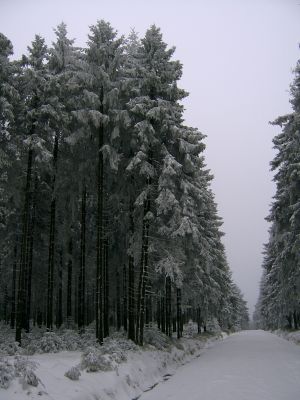
But I got at least one weekend’s worth of snow in the Ardennes (with Kid 2 weeks ago). We wandered around in a beautiful coniferous forest for hours. The snow was wet but fresh, and many paths were untouched by human feet (though there were tracks of hare and squirrel and deer) to the point where it was sometimes difficult to see where the paths were. The thick mists were very pretty but didn’t make pathfinding any easier!